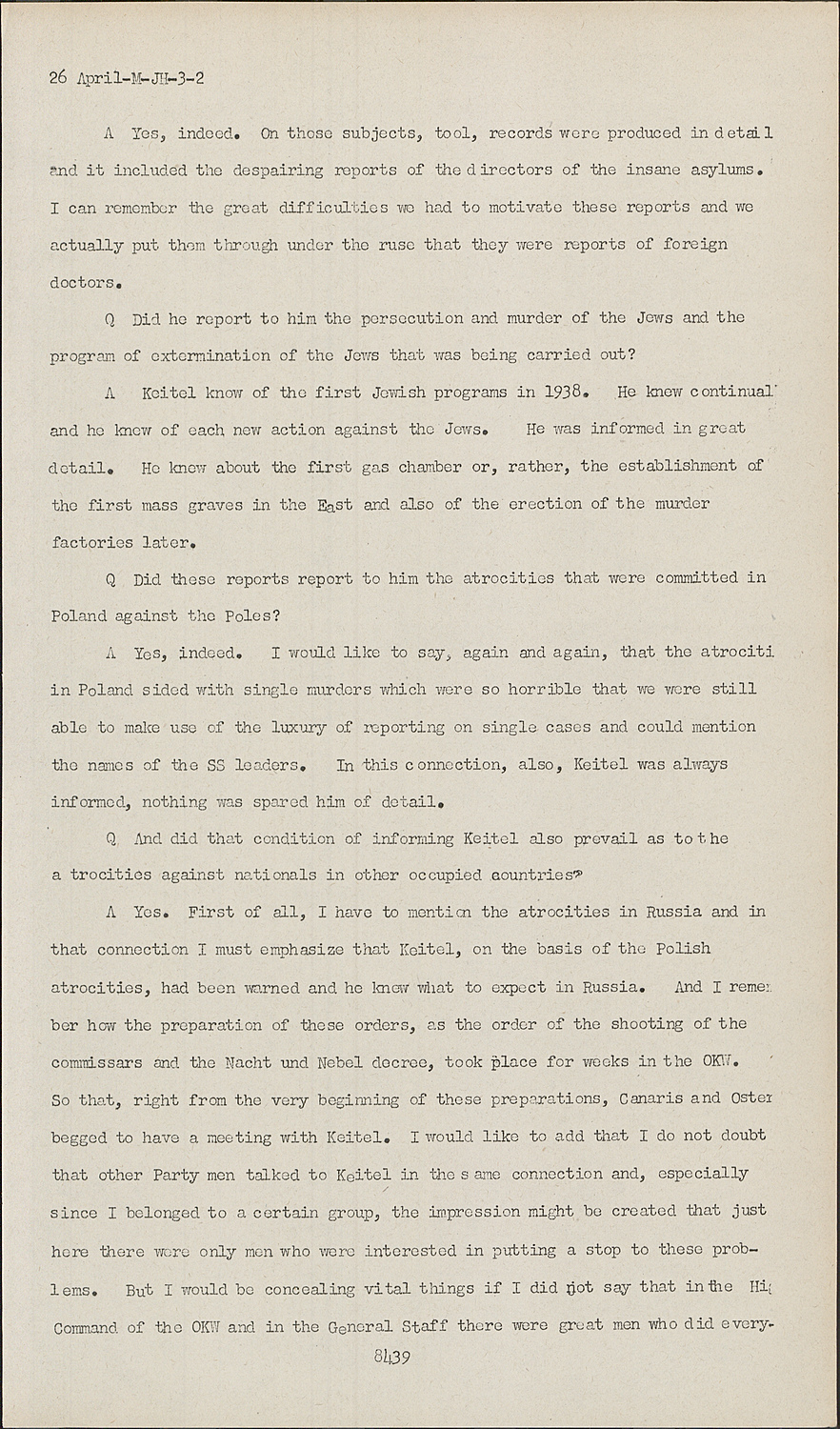
A Yes, indeed. On those subjects, tool, records were produced in detail and it included the despairing reports of the directors of the insane asylums.
I can remember the great difficulties we had to motivate these reports and we actually put them through under the ruse that they were reports of foreign doctors.
QDid he report to him the persecution and murder of the Jews and the program of extermination of the Jews that was being carried out?
AKeitel know of the first Jewish programs in 1938. He knew continual and he knew of each new action against the Jews. He was informed in great detail. He knew about the first gas chamber or, rather, the establishment of the first mass graves in the East and also of the erection of the murder factories later.
QDid these reports report to him the atrocities that were committed in Poland against the Poles?
AYes, indeed. I would like to say, again and again, that the atrocities in Poland sided with single murders which were so horrible that we were still able to make use of the luxury of reporting on single cases and could mention the names of the SS leaders. In this connection, also, Keitel was always informed, nothing was spared him of detail.
QAnd did that condition of informing Keitel also prevail as to the a trocities against nationals in other occupied countries?
AYes. First of all, I have to mention the atrocities in Russia and in that connection I must emphasize that Keitel, on the basis of the Polish atrocities, had been warned and he knew what to expect in Russia. And I remenber how the preparation of these orders, as the order of the shooting of the commissars and the Nacht und Nebel decree, took place for weeks in the OKW. So that, right from the very beginning of these preparations, Canaris and Oster begged to have a meeting with Keitel. I would like to add that I do not doubt that other Party men talked to Keitel in the same connection and, especially since I belonged to a certain group, the impression might be created that just here there were only men who were interested in putting a stop to these problems. But I would be concealing vital things if I did not say that in the His Command of the OKW and in the General Staff there were great men who did every thing to reach Keitel through their own channels and in their own ways, and that there were brave men in "the ministeriums who tried to reach every officer whom they saw in order to help them stop these disasters.

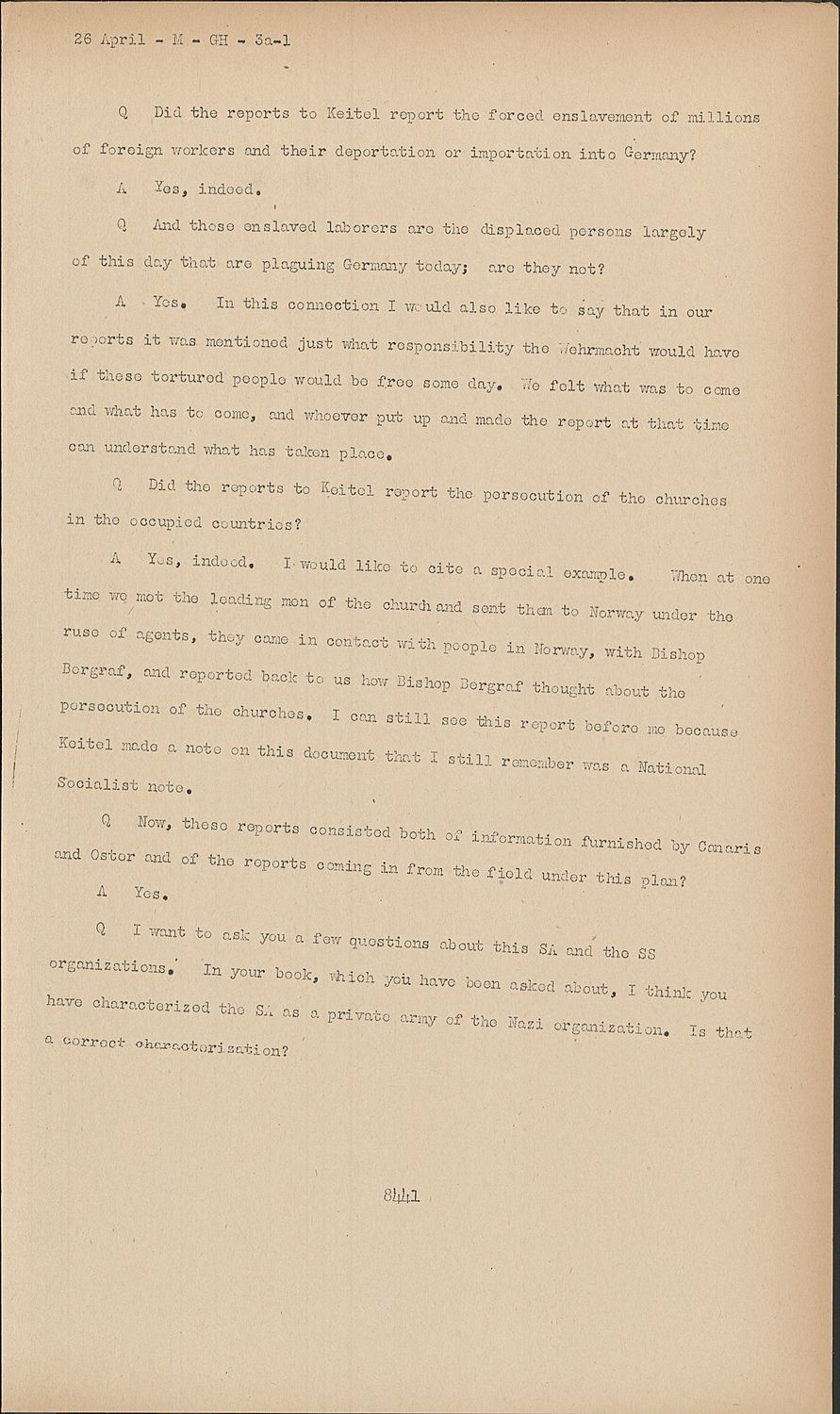
Q Did the reports to Keitel report the forced enslavement of millions of foreign workers and their deportation or importation into Germany?
AYes, indeed.
QAnd these enslaved laborers are the displaced persons largely of this day that are plaguing Germany today; are they not?
AYes. In this connection I would also like to say that in our reports it was mentioned just what responsibility the Wehrmacht would have if these tortured people would be free some day. We felt what was to come end what has to come, and whoever put up and made the report at that time can understand what has taken place.
QDid the reports to Keitel report the persecution of the churches in the occupied countries?
AYes, indeed. I would like to cite a special example. When at one time we met the leading men of the church and sent than to Norway under the ruse of agents, they came in contact with people in Norway, with Bishop Bergraf, and reported back to us how Bishop Bergraf thought about the persecution of the churches. I can still see this report before me because Keitel made a note on this document that I still remember was a National Socialist note.
QNow, these reports consisted both of information furnished by Canaris and Oster and of the reports coming in from the field under this plan?
AYes.
QI want to ask you a few questions about this SA and the SS organizations. In your book, which you have been asked about, I think you have characterized the SA as a private army of the Nazi Organization. Is that a correct characterization?
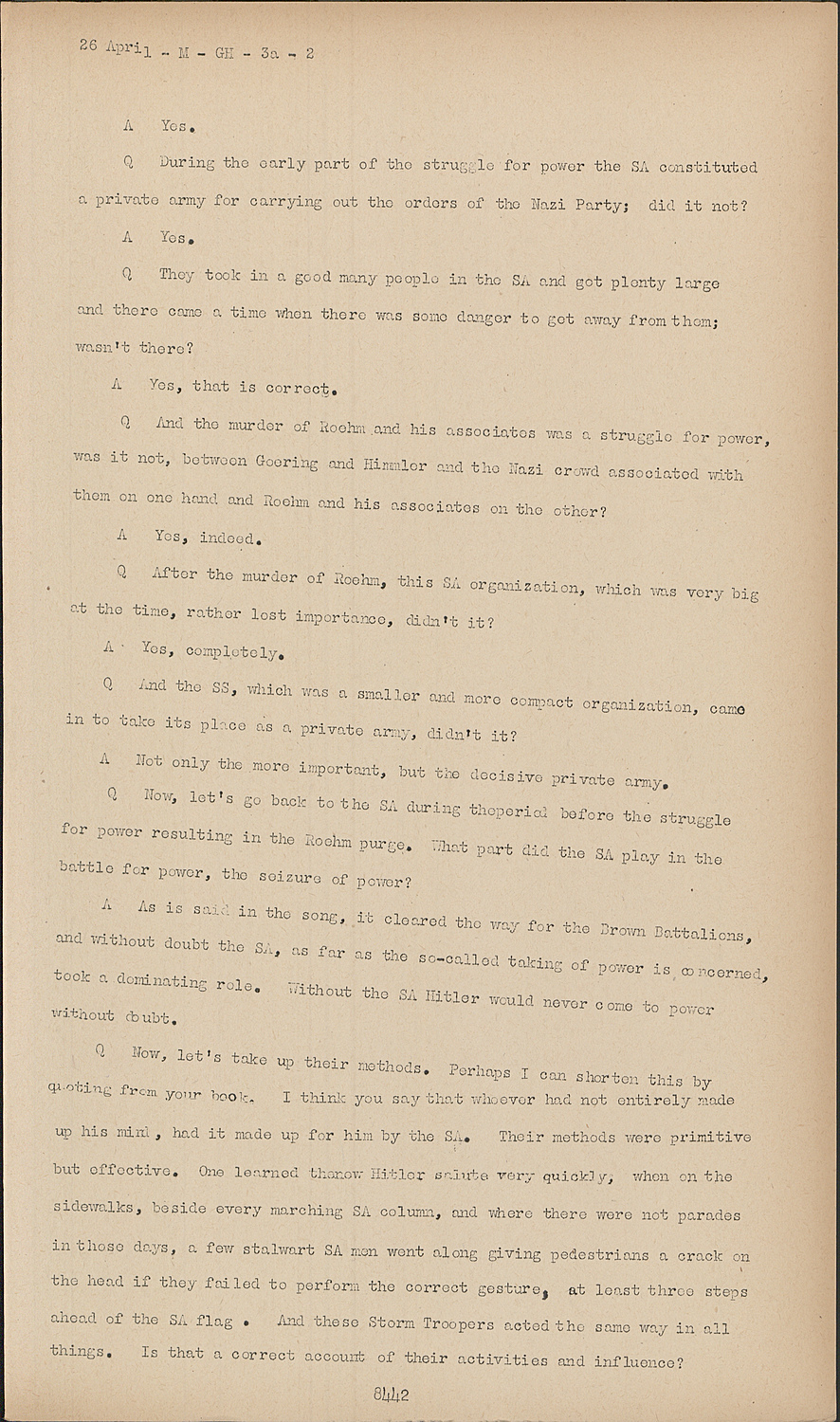
A Yes.
QDuring the early part of the struggle for power the SA constituted a private army for carrying out the orders of the Nazi Party; did it not?
AYes.
QThey took in a good many people in the SA and got plenty large and there came a time when there was some danger to get away from them; wasn't there?
AYes, that is correct.
QAnd the murder of Roehm and his associates was a struggle for power, was it not, between Goering and Himmler and the Nazi crowd associated with them on one hand and Roehm and his associates on the other?
AYes, indeed.
QAfter the murder of Roehm, this SA organization, which was very big at the time, rather lost importance, didn't it?
AYes, completely.
QAnd the SS, which was a smaller and more compact organization, came in to take its place as a private army, didn't it?
ANot only the more important, but the decisive private army.
QNow, let's go back to the SA during theperiod before the struggle for power resulting in the Roehm purge. What part did the SA play in the battle for power, the seizure of power?
AAs is said in the song, it cleared the way for the Brown Battalions, and without doubt the SA, as far as the so-called taking of power is concerned, took a dominating role. Without the SA Hitler would never come to power without doubt.
QNow, let's take up their methods. Perhaps I can shorten this by quoting from your book. I think you say that whoever had not entirely made up his mind, had it made up for him by the SA. Their methods were primitive but effective. One learned thenew Hitler salute very quickly, when on the sidewalks, beside every marching SA column, and where there were not parades in those days, a few stalwart SA men went along giving pedestrians a crack on the head if they failed to perform the correct gesture, at least three steps ahead of the SA flag. And these Storm Troopers acted the same way in all things. Is that a correct account of their activities and influence?
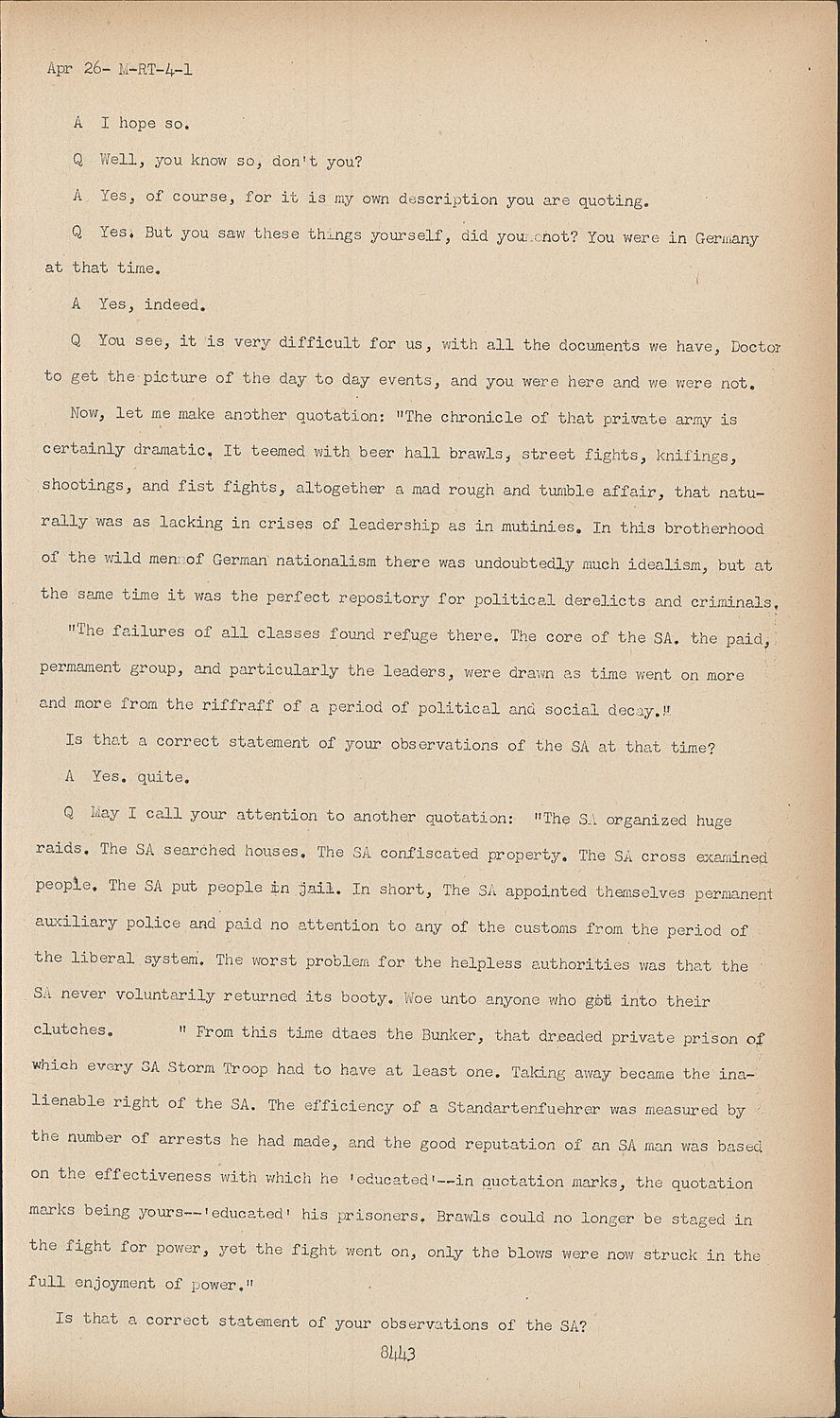
A I hope so.
QWell, you know so, don't you?
AYes, of course, for it is my own description you are quoting.
QYes. But you saw these things yourself, did you not? You were in Germany at that time.
AYes, indeed.
QYou see, it is very difficult for us, with all the documents we have, Doctor to get the picture of the day to day events, and you were here and we were not.
Now, let me make another quotation: "The chronicle of that private army is certainly dramatic. It teemed with beer hall brawls, street fights, knifings, shootings, and fist fights, altogether a mad rough and tumble affair, that naturally was as lacking in crises of leadership as in mutinies. In this brotherhood of the wild men of German nationalism there was undoubtedly much idealism, but at the same time it was the perfect repository for political derelicts and criminals.
"The failures of all classes found refuge there. The core of the SA. the paid, permanent group, and particularly the leaders, were drawn as time went on more and more from the riffraff of a period of political and social decay."
Is that a correct statement of your observations of the SA at that time?
AYes. quite.
QMay I call your attention to another quotation: "The SA organized huge raids. The SA searched houses. The SA confiscated property. The SA cross examined people. The SA put people in jail. In short, The SA appointed themselves permanent auxiliary police and paid no attention to any of the customs from the period of the liberal system. The worst problem for the helpless authorities was that the SA never voluntarily returned its booty. Woe unto anyone who got into their clutches. "From this time dtaes the Bunker, that dreaded private prison of which every SA Storm Troop had to have at least one. Taking away became the inalienable right of the SA. The efficiency of a Standartenfuehrer was measured by the number of arrests he had made, and the good reputation of an SA man was based on the effectiveness with which he 'educated'--in quotation marks, the quotation marks being yours--'educated' his prisoners. Brawls could no longer be staged in the fight for power, yet the fight went on, only the blows were now struck in the full enjoyment of power."
Is that a correct statement of your observations of the SA?
A Yes.
QI think you also used the term "Bunker", and it is a slightly technical term with which some of us are not familiar. Will you tell the Tribunal what this Bunker system of the SA was?
ABunkers were those cellars or other jails with thick walls in which the poor prisoners were locked up, where they were beaten and in a large measure beaten to death. They were those private jails in which in the first months the leaders of the Leftist Parties and of the unions were placed. The leftist group did not arise again, for there, very thoroughly the entire leadership had been done away with.
QYou also use the term "Taking away became the inalienable right of the SA, and "taking away" is in quotation marks. Will you tell us about this "taking away" word of art, what it means?
AThat was the arresting whereby the relatives for periods of weeks or month, did not know where the poor victim had disappeared to, and had to be glad if the poor victim ever returned home.
QI think you also make this observation in your book:
"Every excess was pardoned as over-zealousness in the cause of the National Socialist revolution, was a demonstration of official sanction, and necessarily drew in its wake a fresh crime. It was the bestiality tolerated during the first months that later encouraged the sadistic murders in the concentration camps.
"The growth in brutality and insensibility of the general public, which toward the end of the revolution extended far beyond the territory of the Gestapo was the unavoidable consequence of at first giving free rein to the Brown Shirts in their acts of violence."
Does that, too, represent your observation of the SA?
AYes--not of the SA, of conditions in general in Germany, also.
QNow, will you tell us about--as I understand you, after the Roehm Purge the SA was rather abandoned, as the private army, and a more reliable and smaller and more compact private army was created under Himmler.
AI believe I should express myself to this effect. A guard established by Hitler which had been established long prior to this time now actually came into action. I do not doubt that Himmler and his close circle for years had worked toward this objective so that one day, with their protective guard, they could realize the terror system in Germany. Only up until the 30th of June the SS had been a part of the SA. Roehm was the chief leader of the SS. The road for Himmler as police chief in Germany for the police chief of evil was here only after Roehm had been put aside with his much larger SA. But the will toward power with the SS, with lack of scruples and the ideas therewith, had been planned by the leadership of the SS for many years and had to be assumed so.
QNow, this SS organization selected its numbers with great care, did it not?
AYes.
QWill you tell us something about the qualifications for membership in actual practice? What was necessary?
AThese men had to be so-called Nordic types. As far as this question was concerned. I always considered it as a rather humorous paper, and for that reason I am not in a position today to give you particulars. It is almost embarrassing for me.
If I am not wrong, I recallthat Heydrich and Himmler, especially, as far as the selection of those SS men are concerned who were to do police duty, they decided only after a picture of their future victim before the misuse of commands had been submitted to them. I know that, for example, Nebe repeatedly, as far asofficials who wanted him to protect them from the criminal police of the Gestapo and save them in such a way, that he produced bad photographs of these people so that they did not look Nordic.
In that case, of course, they were turned down immediately.
Of course it would lead us too far afield if I were to tell you more about these strange things in this Tribunal.
QWell, was the membership of the SS recruited only from what we may call fanatical Nazis, reliable Nazis?
AI believe we have to make a limitation in time. In the first years of the SS, many decent German people, especially farmers and people in the country, felt drawn to the SS, for they believed Himmler's assurance that the SS was to bring order in Germany and to be a counter-balance to the SA terror. In that way, in my opinion and to my knowledge, some people in the years before 1933, and even in 1933 and 1934, entered the SS, because they hoped that here would be a nucleus for right and for decency.
I believe it is my duty, as far as the tragedy of these people is concerned, to point to their tragic fate. Each and every case should be examined as to whether, later on, they were guilty or whether they remained decent.
But from a certain period of time forward--I believe I mentioned it yesterday as 1935--no one could have any doubts as to the real SS objectives. From that period of time on, I would like to say that only fanatical National Socialists, that is super National Socialists, entered the SS.
Q And from 1935 on, was it in your judgment as one who was one the ground, necessarily so, that the persons who entered it knew what its actual activities were?
AYes: just what orders he had to expect, yes.
QThe Tribunal asked me to enquire in reference to the incident, if there was anything further, and I have nothing further on that incident, in reference to the threat made. Is there anything that you wish to add about that incident in order to make it clear to the Tribunal, anything that hasn't been told about it?
AI would like to say clearly that Dr. Dix not only was responsible in arranging a discussion with Dr. Stahmer for me that morning I arrived in the group of the attorneys and I do not wish to quote particulars but the atmosphere with which I was greeted was not entirely pleasant. Then I was with Dr. Dix to report something else--Dr. Stahmer approached and ostensibly seemed quite excited. He asked Dr. Dix for a discussion. Dr. Dix refused and said that he was just talking with me. Dr. Stahmer demanded in a loud voice that he would have to speak to Dr. Dix immediately and on an urgent business. Dr. Dix stepped aside, took about two steps, and the discussion that followed, the discussion and conversation was carried on by Dr. Stahmer in such a loud voice, that of necessity I had to hear it in its most vital parts. I did hear it and said verbatim to the attorney Dr. Kraus " Just listen here how Dr. Stahmer is carrying on." Dr. Dix then stepped over to me and he also seemed excited and after these preliminaries on my questions just what the message of Goering was--and gave me information about that which I had heard anyway. I would like to emphasize that if I had had the opportunity of my own accord to tell the story, I would have emphasized the point, that I was under the impression that Dr. Stahmer had a message, or rather I would say a threat of the defendant Goering and transmitted this threat to me.
QNow, in this Nazi regime, after Hitler came to power, will you state whether there was, to your observation, a systematic practice of the Nazi ministers and Nazi officials enriching themselves by reason of their confiscation of property of Jews and others?
A Yes. This increased from year to year and we kept lists as to which of the ministers and staff office generals and field marshals participated in this system.
We had to inquire with the generals whether these items had been put on a bank account or whether this money had been used for their own personal purposes.
QAnd will you state to the Tribunal which of the defendants were engaged in the self-enrichment in the manner that you have indicated?
AI regret to be able to give the high Tribunal just a negative reply.
THE PRESIDENT:It is not coming through to me.
THE WITNESS:I am sorry I am only able to give a negative reply to the Tribunal. I regret to say that I can only give a negative statement.
THE PRESIDENT:It is not coming through to me now.
THE WITNESS:We repeatedly inquired from the defendant Schacht --
THE PRESIDENT:Perhaps this will be a good time to adjourn for ten minutes.
(A recess was taken)
BY MR. JUSTICE JACKSON:
QDr. Gisevius, I have just a few more questions which I would like to put to you in reference to the war and the resistance movement of which you were a part.
THE PRESIDENT:Mr. Justice Jackson, there is just one question I should like to ask the witness. You said that you kept lists of the ministers and generals who participated in this system of spoils. What was your source of information?
THE WITNESS:We had information from the various ministries, from antechambers of ministries, and from the Finance Minister. But I did not finish the answer before. I said that I could only answer the question, as to which of the defendants had enriched himself, in the negative.
Concerning the defendant Schacht, I wanted to continue that I personally did not look into these lists, and that I only took part in the questioning of the defendant Schacht and could say that he himself had not enriched himself. I did not intend to say, therefore, that all the defendants, especially defendants von Papen or von Neurath, to name only these two, had enrichwd themselves. I do not know that. I only wanted to say that about Schacht we know, or rather I know, that he did not take part in that system of spoils. BY MR. JUSTICE JACKSON:
QWell, in addition to a system of spoils from confiscated property, there were also open gifts from Hitler to the generals and ministers, were there not, of large sums of property and money?
AYes. Those were the famous donations which, at least in the years after the outbreak of the war, the top generals systematically received.
QAnd did that hold true with reference to many of the ministers?
AI do not doubt it.
QNow, as I understood your testimony, whatever doubts you may have had before 1938 when the affair Fritszch occurred, that event or series of events convinced even Schacht that Hitler was bent on aggressive warfare.
AAfter the Fritszch crisis, Schacht was convinced that now radicalism and the course of war could not be held back any more.
Q There was never any doubt in the minds of all of you men who were in the resistance movement, was there, that the attack on Poland of September 1939 was aggression on Hitler's part?
ANo, no there could be no doubt about that.
QAnd that diplomatic means of righting whatever wrongs Germany felt she suffered in reference to the Corridor and Danzig had not been exhausted?
AI can only point to the existing material. There was no will for peace.
QNow, in the German resistance movement, as I understand you, there was agreement that you wanted to obtain various modifications of the Treaty of Versailles and you also wanted various economic betterments for Germany, just as other people wanted them. That was always agreed upon, was it not?
AWe were all agreed that in Europe the center of balance could be achieved if certain modifications of the Versailles Treaty would be carried through in a diplomatic way.
QYour difference from the Nazi group was chiefly, in reference to that matter, one of method.
AYes.
QFrom the very beginning, as I understand you, it was the position of your group that a war would result disastrously for Germany as well as the rest of the world.
AYes.
QAnd that the necessary modifications, given a little patience, could be brought about by peaceful means.
AAbsolutely.
QNow, it was in the light of that difference of opinion, I suppose, that your resistance movement against the regime in power in Germany carried out these proposals for putsches and assassinations which you have described.
AYes, but I would like to supplement that by saying that we were not only thinking of the great danger to the outside, but we also realized what internal dangers would be brought about by such a system of terror.
From the very beginning, there was a group of people in Germany who were not even thinking of the possibility of war, and still they protested against the deprivation of liberty and the fight against religion.
In the beginning, therefore, it was not a fight against war, but if I may say so it was a fight for the rights of man. From the very first moment on, in all classes of the nation, in all professional circles and in all other groups, there were people who were ready to fight for that idea, to suffer, and to die.
QNow, the question was arise here as to what your motives and what your purposes in this resistance movement were wise reference to the German people, and I shall ask you to state to the Tribunal your over all purposes in resisting the government in power in your country.
AI should like to say that there was such a rich harvest of deaths among the members of the resistance movement than it is only for that reason I sit here, and that otherwise men who were more able could give this answer.
Within that limitation, I feel that I can answer that from right to left, whether Jew or Christian in Germany, there were people who believed in the freedom of religion, in human rights and human dignity, not only for Germany, but also, in their responsibility as Germans, for Europe and the world.
QThere was a group which composed this resistance, as I understand it.
AIt was not only a group, but many individuals carried the secret of their resistance silently to their in death.
QMost of the men who were associated with you in this movement are dead?
AAlmost all of them.
QIs there anything you would like to add to clarify your position to the Tribunal, Dr. Gisevius?
AExcuse me.
QIs there anything you would like to add in order that the Tribunal may understand your position in this, your feeling, your very strong feeling in this matter, to understand and appraise your own relation to this situation?
A I do not like to talk of myself, but I want to thank you, Mr. Prosecutor, for giving me an opportunity to speak for those who are dead and those who are alive, and to certify for their actions.
MR. JUSTICE JACKSON:I have concluded the examination.
GENERAL ALEXANDROV:Mr. President.
THE PRESIDENT:Wasn't the understanding arrived at with counsel for the Prosecution that the witnesses for the Defendant Frick should only be cross examined by one prosecutor?
GENERAL ALEXANDROV:Mr. President, the understanding among the prosecutors was that the questioning of Schacht's witness should be done by one prosecutor, but that the French and Soviet Prosecution would also question this witness, and as the Soviet Prosecution has a number of questions to put to this witness Gisevius which have great importance to this case, I beg your permission to put these questions to this witness.
THE PRESIDENT: What are the questions which you say are of particular importance to the Soviet Union?
I do not mean the individual questions but the general nature of them.
GENERAL ALEXANDROV:Questions connected with the part played by defendant Frick in the preparation for war and also in connection with the relationship between the defendant Schacht and the Hitler regime and a number of further important questions.
THE PRESIDENT:The Tribunal will adjourn in order to consider whether the Prosecution ought to be allowed to cross-examine the witness in addition to the cross-examination which has alread taken place.
(A recess was taken)
THE PRESIDENT: The Tribunal has before it two documents which were pre-
sented to it by the chief prosecutors upon the subject of cross-examination. In the first of these documents it was provided that the following procedure for the cross-examination of the Defendants Keitel, Kaltenbrunner, Frank, Frick Streicher, and Funk was agreed, and that with reference to Frick the American Prosecution was to conduct the cross-examination of the Defendant and his witness. This document was presented because of the Tribunal's express desire than too much time should not be taken up by the cross examination by more than one prosecutor.
In addition to that document there was another document, which was only a tentative agreement, and with reference to the Defendant Schacht it provided that the American delegation should conduct the principal cross-examination and the Soviet and the French delegations should consider whether either would wish to follow.
In view of those two documents, the first of which suggests that the prosecution have agreed to only one cross-examination of the witnesses of the Defendant Frick, and the second of which tentatively suggests that in addition to the American Prosecution the Soviet and the French might wish to cross examine, the Tribunal propose to allow the additional cross-examination in the pre sent instance, and they are loath to lay down any hard-and-fast rule concerning cross-examination. They hope, however, that in the present instance, after the formal cross-examination by the Prosecutor of the United States, the Soviet Pro secutor will make his cross-examination as short as possible, For the future, the Tribunal hopes that the prosecutors may be able to agree among themselves that in the case of witnesses one cross-examination only will be sufficient and that, in any event, the additional cross-examination will be made as brief as possible. BY MAJOR GENERAL ALEXANDROV:
QMr. Witness, in order to save time, I beg you to answer my questions as briefly as possible.
Tell me, what part did the German ministry of the interior and the Defenda Frick play personally in the preparation of the second World War?
AThis question is very difficult to be answered by me. I left the mini try of the interion already in the month of May, 1935, and about conditions after that time I could not say any more than any ether German, that is to say that the ministry of the interior was part of the German government machine and doubtlessly there, as well as in all other ministries, all those preparations for war were made which administrations would make in preparing the war.
DR. PANNENBECKER:May I say something? Attorney Pannenbecker for Defendant Frick. The witness has just stated that he could not say any more in answering that question than any other German could. I believe that, considering the facts the witness is not the right person to make any definite statements.
THE PRESIDENT:He has just said so himself. That is exactly what he said. I don't see any reason for any intervention. The witness said so.
DR. PANNENBECKER:I only meant that he could not even function as a witness concerning these facts. BY MAJOR GENERAL ALEXANDROV:
QI consider it possible to put to you this question, and I am satisfied with your answer.
Do you know anything about the so-called "college of three", which consisted of the plenipotentiary for economics, and a representative of the OKW, and was entrusted with the preparation of all organizational questions connected with the war?
AI personally cannot give any information on that.
QDo you know anything about the activity of the ministry of the interior on territories occupied by the Germans?
AAs much as I know, the ministry of the interior sent important officials to the military administration, but it is not quite clear to me whether those officials from that moment on were still subordinate to the ministry of the interior or the OKW.
Q Do you know whether the organism of the Reich commissariat in territories occupied by the Germans was subordinated to the Ministry of the Interior or at least was considerably helped by this ministry?
AI should like to assume so, yes. I could say yes to the questions as far as the assistance is concerned because the ministry for the territories occupied in Russia could only take their officials from the personnel department of the Ministry of the Interior.
QWhat do you know as to the visits made by defendant Frick to the concentration camps?
AAt the time when I was in the Ministry of the Interior I did not hear anything about that.
QAnd after that?
AI didn't hear anything about that either.
QCould such a situation arise where the defendant Frick, being Minister of the Interior, was not informed as to the system of concentration camps established in Germany and the arbitrary treatment handled there?
AI believe that I haveyesterday already given exhaustive information to the fact that we were informed about everything.
QI'm not interested in defendant Frick in this particular case. What do you know about him?
AI have said yesterday that the Reich Ministry of the Interior received numerous cries for help from all over the country, and yesterday we have even seen a letter from the Ministry of Justice; also I have referred -
THE PRESIDENT:This subject was fully covered yesterday.
MAJOR GENERAL ALEXANDROV:Well, then, I will pass on to the next question, Mr. President. BY MAJOR GENERAL ALEXANDROV:
QAre you acquainted with the secret law concerning the killing of sick persons and aged people?
AYes.
QWhat had the defendant Frick to do with issuing of this law and its putting into effect?
AI assumed that he signed it.
THE PRESIDENT: The law, if there was a law, was after 1935, was it not?
What is the law that you are putting? If it was in 1935, then this witness was not in the Ministry of the Interior.
MAJOR GENERAL ALEXANDROV:I am speaking of the law which was issued in 1940.
THE PRESIDENT:He would not know anything about it any more than anybody else.
MAJOR GENERAL ALEXANDROV:Yes, I am satisfied with his answer. Will you allow me to pass on to questions concerning the defendant Schacht. BY MAJOR GENERAL ALEXANDROV:
QTell me, witness, you were in close relationship to defendant Schacht for a considerable period of time; is that right?
AYes.
QThus you were sufficiently acquainted with the political and state activities of the defendant Schacht?
AI believe so, yes.
QTell us what you know about the part of defendant Schacht in the seizure of power by Hitler?
AThat was just the time when I didn't know Schacht yet, and about which I cannot give any information.
QBut what do you know about it?
AI know only that he entered the cabinet and that without doubt he assisted Hitler in the preliminary political negotiations.
QDid you know anything about the meeting organized by Schacht between Hitler and the leaders of the industry in 1933; in the course of this meeting or as a result of this meeting a fund was created in view of the successful carrying out of the elections? What do you know about this meeting?
AI know nothing about this meeting. In my book I wrote that to my knowledge the decisive funds in the election campaign in 1932 were raised by Thyssen and the member of the Rumanian industry Grauer.
QBut what was the part played by the defendant Schacht on this particular occasion?
AAt that time I did not see Schacht in the Ruhr district, and I do not know whether he was there.
I emphasize again that I did not know him at that time.
QYes, I know that. But in your book entitled "Until the Bitter End", and published in 1926, and in your answer to preliminary interrogations, you characterized the defendant Schacht under favorable light; is that right?
AThe last words I did not understand.
QI repeat that you characterized the defendant Schacht from a positive point of view; is that right?
AYes.
QYou state that beginning with 1936 the defendant Schacht was in opposition to the Hitlerite regime and that he expressed these opinions in a sufficiently apparent way; is that true?
ANo, I emphasize that beginning with '36, he was starting to see things in a different light, but that the transitions to an opposition against Hitler came during the Frick crisis.
QWhich year was this crisis?
AEnd of 1937 ---beginning of '38, that is more like it.
QTell us, under the regime which existed then in Germany, could a situation arise where Hitler was not informed as to the oppositional views of Schacht which appeared to exist at the end of 1937?
AYou mean that Hitler, after 1938, was not informed?
QNo. I asked you, could it be possible under conditions existing in that regime that Hitler was not informed as to this attitude on the part of Schacht?
AHitler knew that Schacht was very critical towards the system and he frequently received letters from Schacht and heard a lot about it. But how far that opposition went, he did not find out.
QI understand. In the same way as in January. Well, then how could he remain in the cabinet as minister without portfolio if Hitler was informed as to this critical attitude of Schacht towards Hitler's policy?
AHitler always saw to it to let prominent individuals disappear quietly or put them in the shadow so that the foreign propaganda could not take advantage of these facts. The case Schacht is not the only one where Hitler tried to avoid or camouflage an open crisis.