QDid Sauckel have an organization of his own?
AWell, of course he had a staff, but I can't make a statement on the size of it. He took care that the civil administration had labor offices attached to them, and his demands as far as civil administration in the east was concerned were handed over to the administrative departments for their carrying out. In my opinion and as far as I know he had no very large organization.
QBefore Sauckel came into office, wasn't there a department in your ministry called labor, which had its corresponding departments which were labor offices?
AI can't give you a precise answer to that. I think a main department labor and social police did exist at the very beginning of the ministry, but I can't toll you the exact date at the moment. Perhaps Dr. Beil's statement will contain some details.
QSo you are not in the picture regarding the organization of these worker departments?
AI am informed as far as I have told you, only I can't give you the date for the foundation of that main department in the ministry for eastern affairs.
QDid labor offices exist which had their head in your ministry for occupied eastern territories?
AYes, in as far as the social policy did of course cooperate with the civil administration. That is,the Reich Commissioners had continuous contact and correspondence with the labor offices attached to the Reich Commissioners would of course have been going on. A correspondence on a lower level was, of course not going on, but the departments attached to the Reich Commissioners were obviously corresponded with.
Q In your letters, you are talking about service departments of Sauckel's. That are the departments you mean?
AWell, I mean, first of all, the immediate representative Peukert. Later on, he was to achieve collaboration with that section and he was the formal head of that department working on social policy. He was very rarely at the Ministry for Eastern Affairs since he was being used by Sauckel most of the time and apart from that, he had another few gentlemen who, with my department, were negotiating regarding the reduction of the --
THE PRESIDENT:Witness Sauckel will give all this information. What is the good of wasting our time putting it to Rosenberg.
DR. SERVATIUS:It is important so as to ascertain responsibility. I wouldn't be able to call on Rosenberg as a witness later. A great number of questions will arise.
THE PRESIDENT:I understand that, of course, but these are all details of Sauckel's administration which Sauckel must know himself.
DR. SERVATIUS:Yes, but I would have no opportunity later on to ask the witness Rosenberg regarding the consequences and the result of the organizations, whois responsible, who has the right to supervise, who had the duty to intervene? Whey are these measures addressed to us, why does he react to them? One can't understand all that, if one can't ask the witness about it first of all. I would suggest that, if possible, Rosenberg should be called later on in connection with Sauckel's case and after Sauckel has spoken to abbreviate the matter.
THE PRESIDENT:There is no issue with the prosecution about it; If there is no issue with the prosecution, then Sauckel's evidence about it will be quite sufficient.
DR. SERVATIUS:Mr. President, the witness Rosenberg, in a letter addressed to Sauckel, mentioned the fact that his departments were using these letters which had been objected to. Since, in my opinion, such department didn't exist, but since Rosenberg was addressing the wrong person, it must be possible for me to ascertain which service department did in fact exist. It is a complaint raised by Rosenberg regarding the conditions and instead of addressing himself to Koch(?) he is addressing himself to Sauckel.
THE PRESIDENT:Ask him some direct question, will you? BY DR. SERVATIUS:
QWhat did Sauckel do upon receiving the letter you addressed to him?
AI didn't receive a fetter in reply to it -- nor had he replied, to it, but I heard that Sauckel on the occasion of a meeting of labor offices at Weimar, referred to these complaints in detail and that he was making efforts to do his best so as to remove the grounds for the complaints.
QDidn't that meeting take place a fortnight later; namely, on the 6th of January 1943, and weren't you present, too?
ANo, I spoke in one meeting at Weimar; it may be I spoke at one meeting; whether or not at this one, I can't tell you.
QDid you hear Sauckel's speech on the occasion of that meeting?
ANo, I have no recollection of it.
QDid you get the speech in writing later?
AI can't remember it either.
DR. SERVATIUS:Later on, when Sauckel's case comes up, I shall submit the speech, in document form. I have a number of more questions. BY DR. SERVATIUS:
QDid other departments, too, in the occupied territories, concern themselves with recruiting laborers?
AYes. I have received several reports that the so-called "Todt" organization, for the carrying out of their technical tasks, were recruiting workers and using them and I think the railway administration and several other authorities in the East were making efforts to create for themselves replacements of workers.
QIsn't it right that the armed forces were demanding workers, that workers were demanded for road construction by industry, home industry, and that there was a general effort to keep the laborers, the workers in the country, too, and not let them go to Germany?
A That is correct and that is understandable. It is understandable that the armed forces and the organization Todt and various other departments were asking for asmany laborers as possible for the work they were doing and they probably didn't want to give any of their workers up either.
That is understandable.
QSauckel has repeatedly pointed out that workers must be brought under all circumstances and that all obstacles must be removed. Did that refer to the resistance of the local department which didn't want to give up these workers?
AIt certainly referred to these local forces and in a conference which I had with Sauckel in 1943, and which is in evidence as a document which has been mentioned today; reference was made to these documents. Sauckel stated that by order of the Fuehrer he would have to raise a large number of new workers in the East and in this connection, I am thinking of the armed forces most of all, who had been hoarding workers and been active in Germany.
QDid Sauckel have anything to do with the rounding up of workers in connection with the Germanizing of the East?
AI don't understand that question.
QWhat do you understand in connection with Germanizing? In carrying out the resettlements in the East, forces were transferred; they were allotted to Sauckel upon his request.
AFirst of all I don't know for certain what resettlement you are talking about.
Q A report has been presented here which was stating that it was con-
cerned with just who were sent into Polish territory; presumable they reached your territory, too. Don't you know about that?
AI can only tell you based on my own knowledge, that this concentration of the Jewish population from Germany, in certain towns and camps in the East, was the responsibility of the Chief of the German Police, who had the same tasks for the occupied Eastern Territories; that in connection with the transfer to camps and concentrations in certain towns, there my have been a possible shortage of labor but I don't know what that can have to do with Germanization.
DR. SERVATIUS:I have no further questions.
THE PRESIDENT:Before we adjourn, I should like to know v/hat the position is about the defendant Frank's documents. Does anybody know anything about that,
MR. DODD:Mr. President, I am able to say that in so far as we are concerned, we have been in consultation with Dr. Seidl for the defendant rank as well as the representatives of the Soviet prosecuting staff. We are prepared to be hoard at any time that the Tribunal would care to hear us on the documents.
THE PRESIDENT:Y es. Then, Dr. Thoma, how many witness have you got and how how long do you think you will be in the defendant Rosenberg's case?
DR. THOMA:I have only one witness, my Lord, the witness Riecke. I believe that as far as I am concerned, I shall deal with him in no more than one hour; probably it won't take as long as that. It will depend on cross examination.
THE PRESIDENT:Very well, Yes; then you may finish the defendant Rosenberg's case tomorrow.
DR. THOMA:It depends upon the cross examination, my Lord.
THE PRESIDENT:Yes, of course. We may. Then, Dr. Seidl, will you be able to go on at once in Frank's case? Supposing we finish Rosenberg tomorrow -- tomorrow being Wednesday, is it not? Will you be able to go on Thursday morning in Frank' s case?
MR. SEIDL:Mr. President, I can start with Frank's case as soon as Rosenber berg's case is finished. As far as documents are concerned, I only had difficulties regarding one document and I have foregone the presentation of it but apart from that, these are documents which already mostly have been presented by the prosecution.
THE PRESIDENT: If there is any one document in question, we can hear you upon it now.
As I understand you, you only have one document about which there is any difference of opinion.
DR. SEIDL:That has been settled. I no longer want to present it.
THE PRESIDENT:Very well.
DR. SEIDL:There are no differences of opinion.
THE PRESIDENT:Well, then, you are perfectly ready to go on?
DR. SEIDL:Yes.
THE PRESIDENT:Have they been translated yet?
DR. SEIDL:As far as I know, they have all been translated.
THE PRESIDENT:Very well, thank you.
(The Tribunal adjourned until 17 April 1946 at 1000 hours).
Official transcript of the International Military Tribunal, in the matter of:
The United States of America, the French Re public, the United Kingdom of Great Britain and Northern Ireland, and the Union of Soviet Socialist Republics, against Hermann Wilhelm Goering, et al, Defendants, sitting at Nurnberg, Germany, on 17 April, 1946, 1000-1700, Lord Justice Lawrence, presiding.
MR. DODD:Just before recess yesterday afternoon the Tribunal inquired as to the status of the Frank document book and when I informed the Tribunal that we were prepared to be heard Dr. Seidl advised that we had a pact to which we had agreed. I was not aware of that at the time. I think we were both a little bit in error. The situation is that last night about 6:00 o'clock we did reach an agreement so that there is no difficulty at all about the Frank books.
DR. THOMA:I would like to make a brief correction. Yesterday we discussed a document as to the reasons for the Special Staff Rosenberg. My client repeatedly asked me to bring in this document. There is a possibility that I confused thus document with other documents which I recovered but which were not grated me and I just wanted to make that correction as this time.
THE PRESIDENT:Yes. You do not want to do anything more than just make that verbal correction?
DR. THOMA:Yes.
THE PRESIDENT:Is there any other defendant's counsel who wishes to ask any questions? BY DR. HAENSEL (Counsel for SS).
Q.Witness, are you of the opinion that you, as Plenipotentiary of the Fuehrer, were carrying out the spiritual objectives of the N.S.D.A.P. and its subsidiary organizations? Are you of the opinion that that which you did in carrying out these objectives for the planned combating of Jewry and that every thing you said and wrote was as an official statement of the Party and may be considered as an official statement?
A.If I may answer this long series of questions one by one I would like to say my office as far as spiritual education was concerned worked with the Hauptschulungsamt, with the main school system of the SS.
We were in constant contact with them.
My office distributed the "Leitheft" of the SS, which was a journal which was published. I myself read this journal, had it in my hands, and through the years found that in this journal at least very valuable thoughts were published and, of course, I had through all these years reason to work with the SS and not to enter into any conflict with them.
As far as the Jewish question is concerned, the objective as to this problem was contained and expressed in the program of the N.S.D.A.P. and that is the only official statement to which I tried to keep the Party members. Anything which I said about that point and what others wrote about it were just reasons that were set forth. Much of what was said was accepted but as far as the Fuehrer and the state was concerned, any thoughts that were advanced were not binding to the Fuehrer and to the state.
Q.Was your objective as to combatting Jewry limited in any way? Did you picture that the Jews were to be eliminated from economic and state administration or did you view stronger measures such as extermination as necessary? What was your final objective?
A.According to the Party program and in line with the objective I had, the leadership and the directions in the German state were to be changed as it existed from 1918 to 1933 and that was the vital point. As far as elimination from economic life was concerned we did not talk about it at that time.
Yesterday I referred to two speeches and I said that after the end of this harsh political battle an investigation and examination of the question Would have to take place and emigration from Germany was talked about as far as Jews were concerned. Later when matters became more critical I uttered the same thoughts and very prominent Jewish leaders made proposals that German unemployed be sent to Africa, Asia and China.
Q Then, following your train of thought of yesterday and today, one could differentiate three kinds of measures against the Jews.
First, up until '33, that is the taking over of power; that would have been propaganda measures. Point 2: After '33, these measures which were shown in the laws against the Jews which were issued; and then, finally, after the war, certain measures which without doubt can be considered crimes against humanity. Do you agree to this tripartite arrangement?
AYes, it may be approximately right.
QThen, I would like to call your attention to group 2; that is, to these measures which were instituted after the taking over of power and which were laid down in laws against the Jews. Did you participate in the formulating of the laws?
THE PRESIDENT:You are counsel, are you not, for the SS?
DR. HAENSEL:Yes.
THE PRESIDENT:What have these questions got to do with the SS?
DR. HAENSEL:The questions concern the SS in the following way: If the Party in itself had the total objective of laws against the Jews, the SS was bound to these objectives and could not go beyond these objectives and had none beyond that point. I wanted to establish when the making of laws and measures against Jews turned into criminal acts, and that up until that time the SS in no manner took criminal measures against the Jews.
THE PRESIDENT:Well, he said already that the Jewish problem was contained in the Party program, and that is all that you want, is it not?
DR. HAENSEL:I wanted to show that the fact that this question was contained in the Party program did not mean that it was a crime against humanity. In the Party program there was just a general sentence which I do not believe that, as such, it was a crime against humanity and--
THE PRESIDENT:That is a matter of construction of the Party program. It is not a matter for him to give evidence about. It is in a written document. The Party program is contained in the written documents.
DR. HAENSEL:But, Mr. President, up and above the Party program, a series of decrees and laws were issued which expanded the Party program and the question;;
THE PRESIDENT:They are also documents which this Tribunal has to construe; not for this witness to construe.
DR. HAENSEL:The question is, in so far as the defendant can tell us, how far the SS might have gone in the carrying out of these measures.
THE PRESIDENT:He can tell us the facts; he cannot tell us the laws or the interpretation of documents. If you are asking him about facts, well and good, but if you are asking him to interpret the Party program or to interpret the decrees, that is a matter for the Tribunal.
DR. HAENSEL:Very well. BY DR. HAENSEL:
QIn your book you mentioned and represented the objective that all Germans should be unified in a greater Germany and that p;int is set down in the Party program.
AYes.
QDid you believe that this could happen only through the preparation of a war or did you believe, also, that it could be arranged through peaceful means?
AIn the beginning of my testimony I referred to a speech of 1932 before an International Congress, at which I made a (speech and gave a proposal which was approved by the Fuehrer, that the four great powers should investigate and examine the general European problems. In these proposals they said that we would dispense with German colonies; that we would not insist on Alsace-Lorraine; and that we would not insist on the Southern Tyrol.
THE PRESIDENT:We have heard all this before from the defendant Goering and the defendant Ribbentrop, and we said that we did not want to go into it again. In any event, it has nothing to do with the SS, nothing directly to do with the SS. BY DR. HAENSEL:
QJust one more Question. Do you know that the SS, as far as the Jews were concerned, followed secret aims and objectives, others than those that were declared officially?
AThat I learned here.
QYou do not know that from your own knowledge?
ANo.
BY DR. STEINBAUER (Counsel for defendant Dr. Seyss-Inquart):
Q.Witness, I have one single question to put to you. The prosecution under PS-91 submitted and read a letter which you, as the chief of the Rosenberg All Purpose Staff, sent to Dr. Seyss-Inquart in his capacity as Reichskommissar for the Netherlands, and in which letter you mentioned the library at Amsterdam and demanded that library. I do not know whether you recall this library. It is rather voluminous of Socialist, Marxist contents. The Prosecution did not submit the answer given by my client. Therefore, I have to ask you: Do you remember this matter and what answer did Seyss-Inquart give you?
A.I remember this library very well for I have been told about it. To my knowledge, we were concerned with the establishment of a spiritual central point, and Amsterdam, in which the history of all social movements in various countries was to be summarized and centralized in a library, so that on the basis of this historical and scientific material -
Q.Please try to be more brief. You know what I am talking about?
A.Yes.
Q.And what answer did you receive? Did Seyss-Inquart agree that this library would go to Germany or that it would remain in Germany?
A.It was agreed that this library would remain in Holland and that the cataloguing of these treasures, which were not in an orderly manner, was to take place in Amsterdam. In the course of years this took place at Amsterdam, In the year 1944, when the invasion had already begun or when it was imminent, when bombing attacks increased in this area, part of this library was taken to Silesia and another part, to my knowledge, remained in Emden; and the third part, I believe, was not transported.
Q.Is it correct that Seyss-Inquart prevented the taking away of this library?
A.Yes, that is correct.
CROSS-EXAMINATION BY MR. DODD:
Q.Before we begin our discussion of some matters that we would like to go over, I wonder if you would be good enough to write your name a few times on these pieces of paper, both in pen and in pencil.
(Witness was handed paper, pen, and pencil.)
Q. (Continuing.) Would you write "A. Rosenberg", please, with the pen, and "Alfred Rosenberg" with the pen; and would you handwrite the first initial of your last name with a capital?
Now, would you do the same thing with pencil on another piece of paper, "A. Rosenberg" in pencil, "Alfred Rosenberg", and the first initial of your last name?
And then would you do one thing more, please, Would you print the first initial of your last name?
Now, yesterday afternoon, while you were on direct-examination through your own counsel, you stated before the Tribunal that you did have a discussion with Heinrich Himmler, the Reichsfuehrer SS, about concentration camps and, if I remember correctly, you said that that was some time in 1939; is that so?
A.Yes. I testified that I had this discussion with him; I discussed th concentration camps, but I cannot fix the exact date. It was in '38.
Q.Very good. He offered to have you go through one or the other of these camps, Dachau or some other camp; is that so?
A.Yes, he suggested that I look over the camps.
Q.And you refused or declined the invitation?
A.Yes.
Q.And I understood you, if I recollect correctly, you said, because you were quite sure that he would not show you the unfavorable things that wer in that camp?
A.I assumed more or less that if there were unfavorable things, I perha would not seen them anyway.
Q.You mean that you simply assumed that there were unfavorable things; that you didn't know there were unfavorable things?
A.I heard this through the foreign press.
Q.When did you first hear that through the foreign press?
A.That was in the first months of 1933.
Q.And did you continuously read the foreign press about the concentrate camps in Germany from 1933 to 1938?
A.I did not follow the foreign press at all for I do not speak English. On occasion I received some excerpts from time to time, and even in the foreign press there were certain references with the strict explanation that these allegations were not true. I remember a statement by Goering in which he said that it was beyond his comprehension.
Q But you thought they were true to the extent that there were unfavorable things in that place that Himmler might not show you.
AYes, I assumed that in such a revolutionary process a number of excesses were taking place, that in some Gaus or districts on occasion there might be conflicts, and that the fact of murders of National Socialists in the months subsequent to the taking over of the power most probably would call forth sharp counter measures.
QDid you think that was still going on in 1938, these measures against the National Socialists in the concentration camps?
ANo. The chief reports upon the continuance of murders of members of the Hitler Youth, of the police, and members of the Party, took place especially in 1943 and 1944, but I do not remember that many -
THE PRESIDENT:Did you say 1943 and 1944 or 1933 and 1934? Which is it?
THEWITNESS: 1933 and 1934.
BY MR. DODD:
QBut, in any event, in 1938 you had some knowledge in your own mind which made you think that it would not be profitable for you to inspect these camps because some things were going on there that would not be shown to you. Now, that is so, isn't it?
ANo. I said very frankly that under some circumstances excesses might be taking place. I talked to Hitler about this matter, and I told him so that he knew that we knew about such things through the foreign press and that he should take care.
QNow, turning to another matter, we also understood you to say yesterday that when you wrote your book, "The Myth of the Twentieth Century," you expressed your personal opinion and you did not intend it to have any great effect upon state affairs. Is that a fair statement of your testimony of yesterday with respect to your book?
AI did not quite follow the conclusion, but I must say yes. I wrote "The Myth of the Twentieth Century" in those years according to certain historical investigations, 1927 and 1928. It was published in 1938, and there was an introduction that this was a purely personal opinion, and that the political organization of which I was a member was not responsible for it.
QVery good. I will ask that you be shown document 3553-PS. That is also, if Your Honor please, USA Exhibit 352.
It is already in evidence.
Now, you wrote a preface or a little introduction for that edition of that book. It is right there before you. You said in it "To the 150th Thousand Copy: The Myth has today drawn deep, ineffaceable furrows into the emotional life of the German nation. Ever new editions are a clear indication that a decisive turning over of the spritual soil is growing into a historical event. Many things which in my book seemed to be a peculiar idea have already become a reality of state policy. Many other things will yet, I hope materialize as a further result of this new vigor."
You wrote that?
AThat is entirely correct. This book of 700 pages does not apply to every point of which I am accused here. This book dealt with a large number of problems the problem of the peasants, of the world states, of the cocept of socialism, of the relation between leadership of industry and of labor, a present -
Q (Interposing) Now, just a minute. I don't think it is necessary for you to give us a list of the table of contents of the book. I simply asked you if you wrote that introduction.
AYes. of course.
QNow, with respect to the well-known forced labor program. I think it is perfectly clear to everyone who has been in attendance at these sessions before this Tribuanl, and of course to yourself, that there was a forced labor program in effect, or a so-called slave labor program, both in the East and in the Western occupied countries. Isn't that a fact?
AThe law of the 21st of March is concerned herewith, that workers from the occupied countries were to be taken to Germany. In Germany there was a compulsory labor law.
QNow, there are only two possible offices under the then German State which can by any stretch of the imagination be held responsible either in part or altogether for that forced or slave labor program. Isn't that so? Two pricipal offices, at least.
AYes.
QAnd they were your ministry and the office of the defendant Sauckel. That is pretty simple. Is that true or not?
AIt is correct that under the directive Gauleiter Sauckel and I were to have the same right, and all other high Reich authorities.
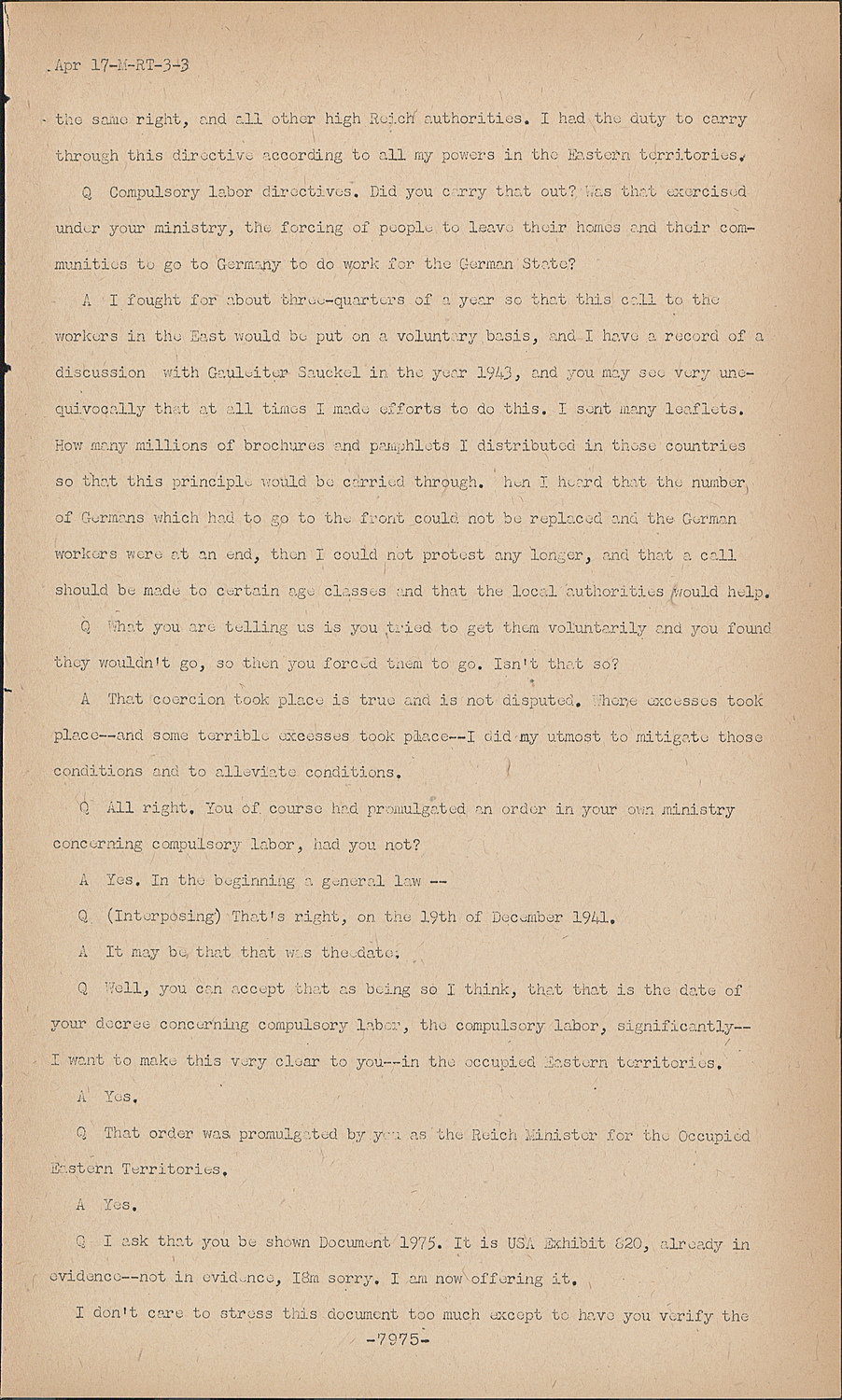
I had the duty to carry through this directive according to all my powers in the Eastern territories.
QCompulsory labor directives. Did you carry that out? Was that exercised under your ministry, the forcing of people to leave their homes and their communities to go to Germany to do work for the German State?
AI fought for about three-quarters of a year so that this call to the workers in the East would be put on a voluntary basis, and I have a record of a discussion with Gauleiter Sauckel in the year 1943, and you may see very unequivocally that at all times I made efforts to do this. I sent many leaflets. How many millions of brochures and pamphlets I distributed in these countries so that this principle would be carried through. When I heard that the number of Germans which had to go to the front could not be replaced and the German workers were at an end, then I could not protest any longer, and that a call should be made to certain age classes and that the local authorities would help.
QWhat you are telling us is you tried to get them voluntarily and you found they wouldn't go, so then you forced them to go. Isn't that so?
AThat coercion took place is true and is not disputed. Where excesses took place--and some terrible excesses took place--I did my utmost to mitigate those conditions and to alleviate conditions.
QAll right. You of course had promulgated an order in your own ministry concerning compulsory labor, had you not?
AYes. In the beginning a general law -
Q (Interposing) That's right, on the 19th of December 1941.
AIt may be that that was the date.
QWell, you can accept that as being so I think, that that is the date of your decree concerning compulsory labor, the compulsory labor, significantly-I want to make this very clear to you--in the occupied Eastern territories.
AYes.
QThat order was promulgated by you as the Reich Minister for the Occupied Eastern Territories.
AYes.
QI ask that you be shown Document 1975. It is USA Exhibit 820, already in evidence--not in evidence, I8m sorry. I am now offering it.
I don't care to stress this document too much except to have you verify the fact that this is the order which you promulagated, and in the first paragraph with the small figure 1, you stated:
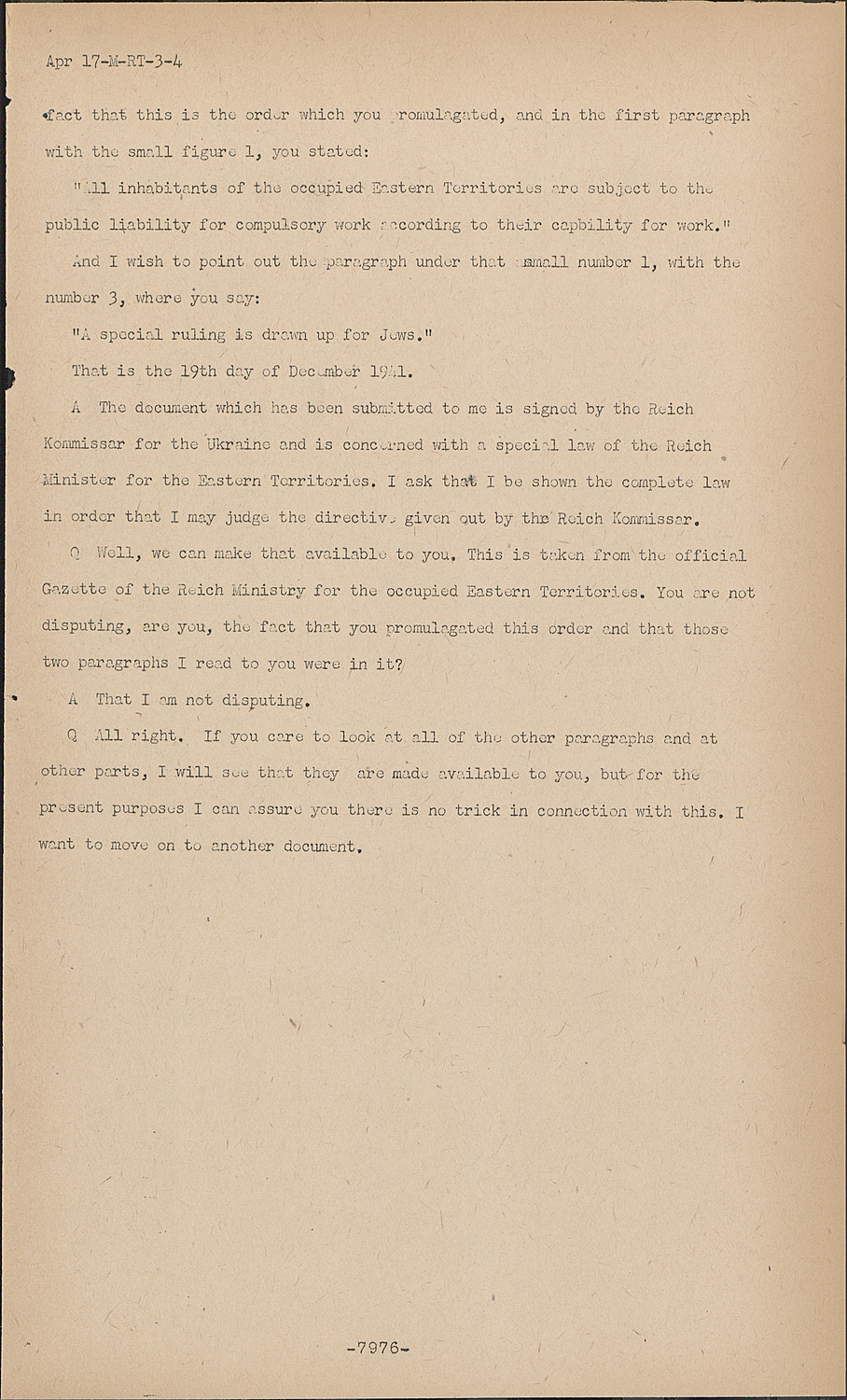
"All inhabitants of the occupied Eastern Territories are subject to the public liability for compulsory work according to their capbility for work."
And I wish to point out the paragraph under that small number 1, with the number 3, where you say:
"A special ruling is drawn up for Jews."
That is the 19th day of December 1941.
AThe document which has been submitted to me is signed by the Reich Kommissar for the Ukraine and is concerned with a special law of the Reich Minister for the Eastern Territories. I ask that I be shown the complete law in order that I may judge the directive given out by the Reich Kommissar.
QWell, we can make that available to you. This is taken from the official Gazette of the Reich Ministry for the occupied Eastern Territories. You are not disputing, are you, the fact that you promulagated this order and that those two paragraphs I read to you were in it?
AThat I am not disputing.
QAll right. If you care to look at all of the other paragraphs and at other parts, I will see that they are made available to you, but for the present purposes I can assure you there is no trick in connection with this. I want to move on to another document.
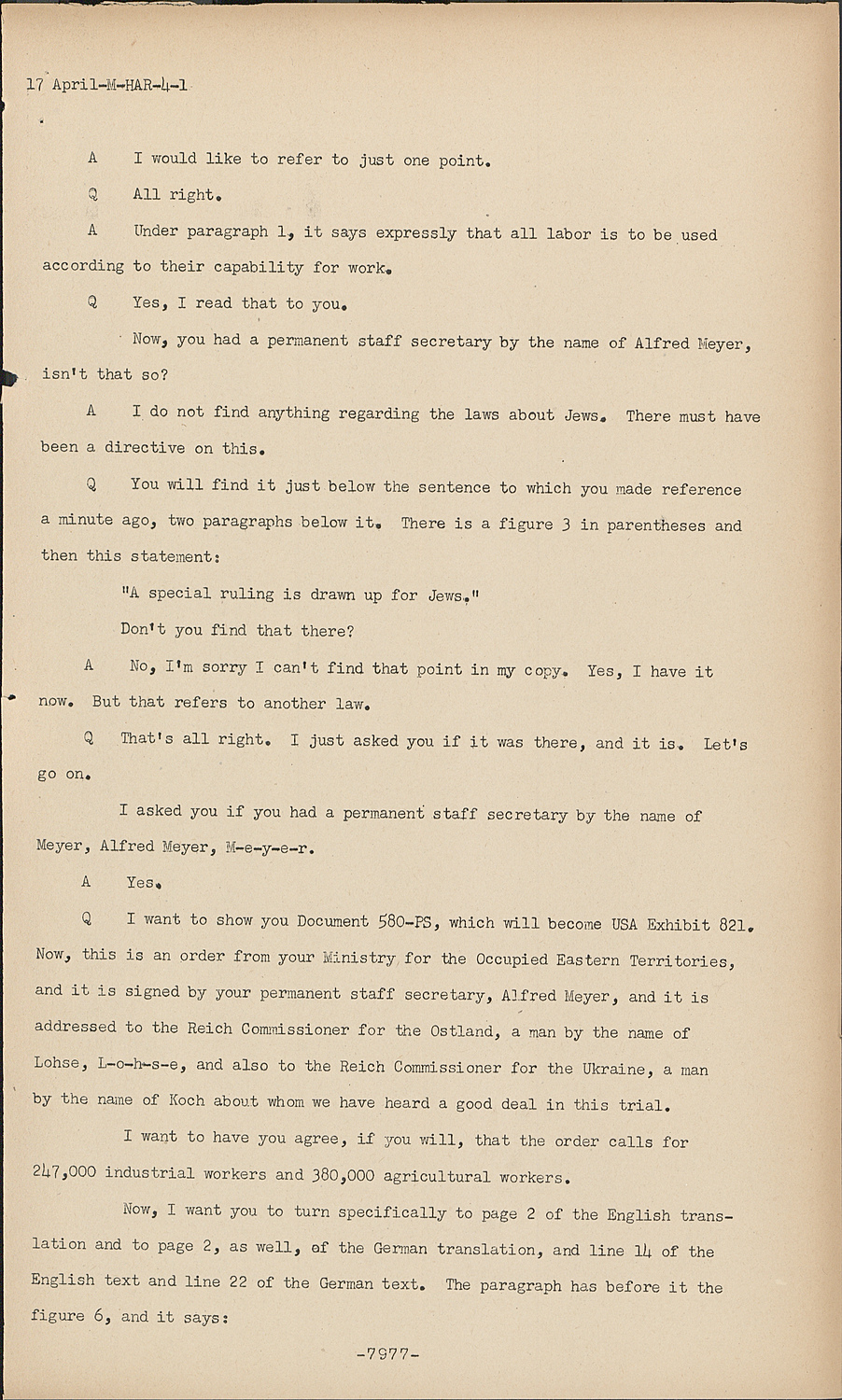
A I would like to refer to just one point.
QAll right.
AUnder paragraph 1, it says expressly that all labor is to be used according to their capability for work.
QYes, I read that to you.
Now, you had a permanent staff secretary by the name of Alfred Meyer, isn't that so?
AI do not find anything regarding the laws about Jews. There must have been a directive on this.
QYou will find it just below the sentence to which you made reference a minute ago, two paragraphs below it. There is a figure 3 in parentheses and then this statement:
"A special ruling is drawn up for Jews."
Don't you find that there?
ANo, I'm sorry I can't find that point in my copy. Yes, I have it now. But that refers to another law.
QThat's all right. I just asked you if it was there, and it is. Let's go on.
I asked you if you had a permanent staff secretary by the name of Meyer, Alfred Meyer, M-e-y-e-r.
AYes.
QI want to show you Document 380-PS, which will become USA Exhibit 821. Now, this is an order from your Ministry for the Occupied Eastern Territories, and it is signed by your permanent staff secretary, Alfred Meyer, and it is addressed to the Reich Commissioner for the Ostland, a man by the name of Lohse, L-o-h-s-e, and also to the Reich Commissioner for the Ukraine, a man by the name of Koch about whom we have heard a good deal in this trial.
I want to have you agree, if you will, that the order calls for 247,000 industrial workers and 380,000 agricultural workers.
Now, I want you to turn specifically to page 2 of the English translation and to page 2, as well, of the German translation, and line 14 of the English text and line 22 of the German text. The paragraph has before it the figure 6, and it says:
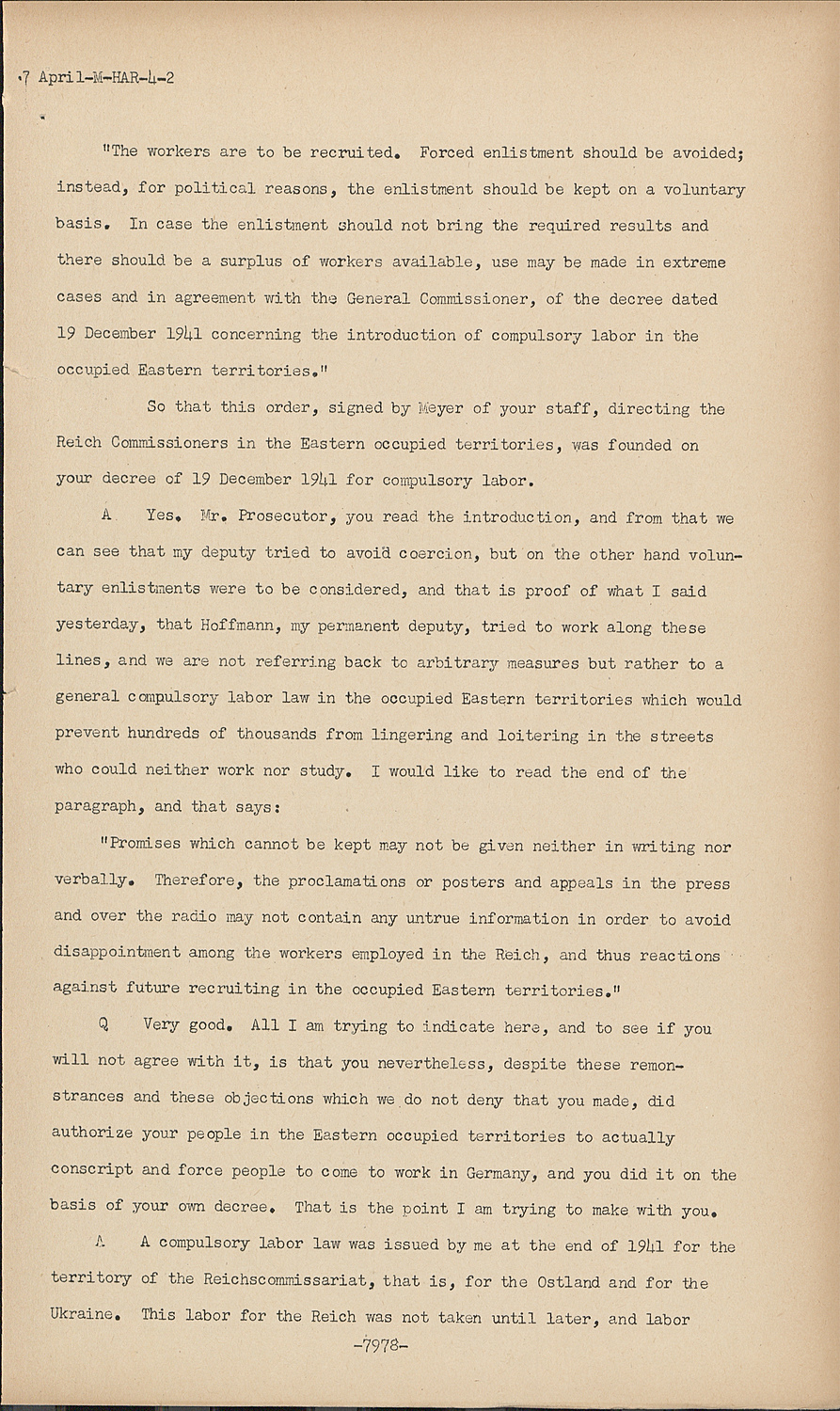
"The workers are to be recruited. Forced enlistment should be avoided;
instead, for political reasons, the enlistment should be kept on a voluntary basis.
In case the enlistment should not bring the required results and there should be a surplus of workers available, use may be made in extreme cases and in agreement with the General Commissioner, of the decree dated 19 December 1941 concerning the introduction of compulsory labor in the occupied Eastern territories."
So that this order, signed by Meyer of your staff, directing the Reich Commissioners in the Eastern occupied territories, was founded on your decree of 19 December 1941 for compulsory labor.
AYes. Mr. Prosecutor, you read the introduction, and from that we can see that my deputy tried to avoid coercion, but on the other hand volun tary enlistments were to be considered, and that is proof of what I said yesterday, that Hoffmann, my permanent deputy, tried to work along these lines, and we are not referring back to arbitrary measures but rather to a general compulsory labor law in the occupied Eastern territories which would prevent hundreds of thousands from lingering and loitering in the streets who could neither work nor study.
I would like to read the end of the paragraph, and that says:
"Promises which cannot be kept may not be given neither in writing nor verbally.
Therefore, the proclamations or posters and appeals in the press and over the radio may not contain any untrue information in order to avoid disappointment among the workers employed in the Reich, and thus reactions against future recruiting in the occupied Eastern territories."
QVery good. All I am trying to indicate here, and to see if you will not agree with it, is that you nevertheless, despite these remon strances and these objections which we do not deny that you made, did authorize your people in the Eastern occupied territories to actually conscript and force people to come to work in Germany, and you did it on the basis of your own decree.
That is the point I am trying to make with you.
AA compulsory labor law was issued by me at the end of 1941 for the territory of the Reichscommissariat, that is, for the Ostland and for the Ukraine.
This labor for the Reich was not taken until later, and labor service in the occupied countries was, in my opinion, legally necessary so that no wildcat recruitments would take place, and also to prevent the loitering of hundreds of thousands in the streets.