German author, Dr. Stadl, who was especially interested in religious reform. In this document the Reich Church Minister presents the view as to having a community of religion which would affirm the National Socialist state and at the same time have the direct support of the Reich Church Minister.
In the preliminary interrogations a document of mine was submitted to me in this matter, a letter which I had written to the Party Chancellory and in which I expressed an opinion about the sessions of the Church Congress, I said that a National Socialist Minister of Churches did not have the task of calling for a community of religion and he would appear to be in the same position as that which holds true for me. If I had the intention of establishing a community of religion then I would have had to give up all my functions and activities in the Party. That can be traced back to a point of view which I represented. The Minister of Churches as a National Socialist member was obligated to help religion but to be independent of all religions and denominations.
Document 101-PS, which I am passing to now, is a letter from the leader of the Party Chancellory, at that time the Staatsleiter and Deputy of the Fuehrer, wherein it is complained that denominational writing could be used to paralyze resistance of troops and he asked my office or department to do something to this effect.
My answer was not ready. I never did give any opinion but my opinion has always been that it was not my task to publish religious articles in my official capacity but that, of course, it was up to each individual who had something vital to say to put in writing.
Now, Document 100-PS is an accusation of the then state leader and deputy of the Fuehrer Bormann to me that I had expressed an opinion to the Fuehrer that the Protestant Bishop Mueller had written a very fine book for German soldiers.
Reichsleiter Bormann said that this book by Mueller was not appropriate because it could be considered as denominational propaganda. I do not believe that the accusation against me that I was agreeing with Mueller without reservation; that he was adding his voice in a reasonable manner, may be interpreted as persecuting.
The next document is a letter by Bormann, which he gave to mo to take notice of. He to ld me that he talked to the then Reichsleiter Amann, and said that, because of the paper scarcity, religious writings, tan per cent of which had been decrees, should be further decreed and curtailed. I didn't know in what way the curtailment of all journals and magazines was done at that time, but I did find out that in the course of a war the publications about art, music, and al lied fields was curtailed along with the rest of the magazines and journals in the German Reich.
Document 064-PS is a letter of the loader of the Party Chancellory, in which he reports to me about the letter of a Gauleiter about a writing of General von Rebenau about the spirit and soul of the soldier. This Gauleiter criticized the very traditionally bound opinion of General von Rabenau and he protested against the fact that this letter was published by the Party. In that connection I would like to say that this memorandum by General von Rabenau did appear in a weries of articles which were published by my official department; and this letter was published without having been read. He had the occasion to deal with general subjects. I gave him the opportunity to voice his opinion, but I did not withdraw this letter from publication.
Document 098-PS contains a new accusation of the leader of the Party Chancellory to me. In this accusation he says that the Reichsbishop Mueller Was telling the story that he had had instructions from me to set down basic principles for religious instruction in the schools.
Mr. Bormann at great length says that it was not the task of the Party to act in a reformatory manner as for as religious instruction in the school is concerned. To this I would like to say the following. I gave no instruction to Reichsbishop Mueller and could not give him any instructions on this topic. But the Bishop visited no on two occasions, and on one occasion with tears in his eyes he told me that in his sphere of influence he had no special backing. I told him, "Your Excellency, you are a military pastor, and perhaps not generally known; It would be quite correct and apropos if you would write a literary work setting forth your views so that the various parts of the Evangelical Church might know your views; and in that way you can make your influence felt." Then Mueller probably made a few additions on this topic, as I had suggested to him. But I believe that the accusation made by Bormann is not true and cannot be construed as persecution of the churches on my part.
Document 075 is an extraordinarily severe circular letter by the party Chancellory, setting forth the position of National Socialism and Christendom, as seen from his point of view. As I remember, any of the following can be concerned in this. At one time I heard that Bormann had written to a Gauleiter and then sent copies to all Gauleiters. I asked him to give me official knowledge of this fact. After much hesitancy I received this letter. I received it in form. I did not consider it possible. I held Bormann--and I believe the letter that to him should be found in my records --that I did not consider it possible for a circular letter of that sort to be circulating. So that nothing could be overlooked, in my own handwriting I added that in my opinion the Fuehrer would not approve a circular letter of this sort. Then I spoke with Bormann about this personal matter and told him that each one of us had the right to define his position towards this problem, but official circulars, and especially in this form, were absolutely impossible in my opinion.
A tern this conversation Bormann became greatly embrassed and, as I just accidently heard from Schirach, he also know of this circular letter, and he further said that this was rescinded and declared null and void.
Mr. President, I would like to call the attention of the High Tribunal that I gave the number 075 to this document, but I wish to make a correction; it should be "D", as in "Denver", 75.
THE PRESIDENT:Wait a minute. What should it be?
THE WITNESS:D-75, rather than 075.
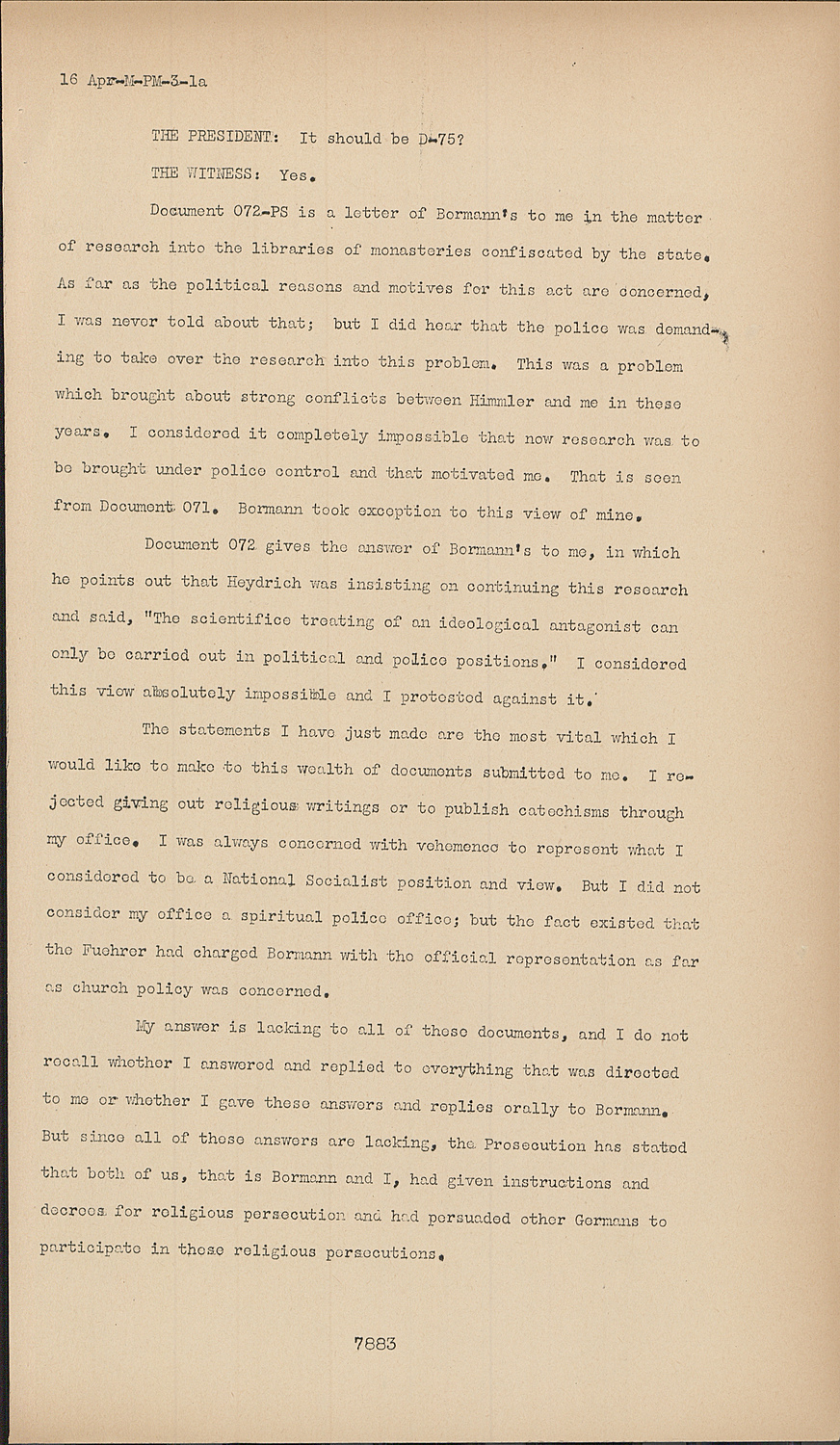
THE PRESIDENT: It should be D-75?
THE WITNESS:Yes.
Document 072-PS is a letter of Bormann's to me in the matter of research into the libraries of monasteries confiscated by the state. As far as the political reasons and motives for this act are concerned, I was never told about that; but I did hear that the police was demanding to take over the research into this problem. This was a problem which brought about strong conflicts between Himmler and me in these years. I considered it completely impossible that now research was to be brought under police control and that motivated me. That is seen from Document 071. Bormann took exception to this view of mine.
Document 072 gives the answer of Bormann's to me, in which he points out that Heydrich was insisting on continuing this research and said, "The scientifice treating of an ideological antagonist can only be carried out in political and police positions." I considered this view absolutely impossible and I protested against it.
The statements I have just made are the most vital which I would like to make to this wealth of documents submitted to mo. I rejected giving out religious writings or to publish catechisms through my office. I was always concerned with vehemence to represent what I considered to be a National Socialist position and view. But I did not consider my office a spiritual police office; but the fact existed that the Fuehrer had charged Bormann with the official representation as far as church policy was concerned.
My answer is lacking to all of these documents, and I do not recall whether I answered and replied to everything that was directed to me or whether I gave these answers and replies orally to Bormann. But since all of these answers are lacking, the Prosecution has stated that both of us, that is Bormann and I, had given instructions and decrees for religious persecution and had persuaded other Germans to participate in these religious persecutions.
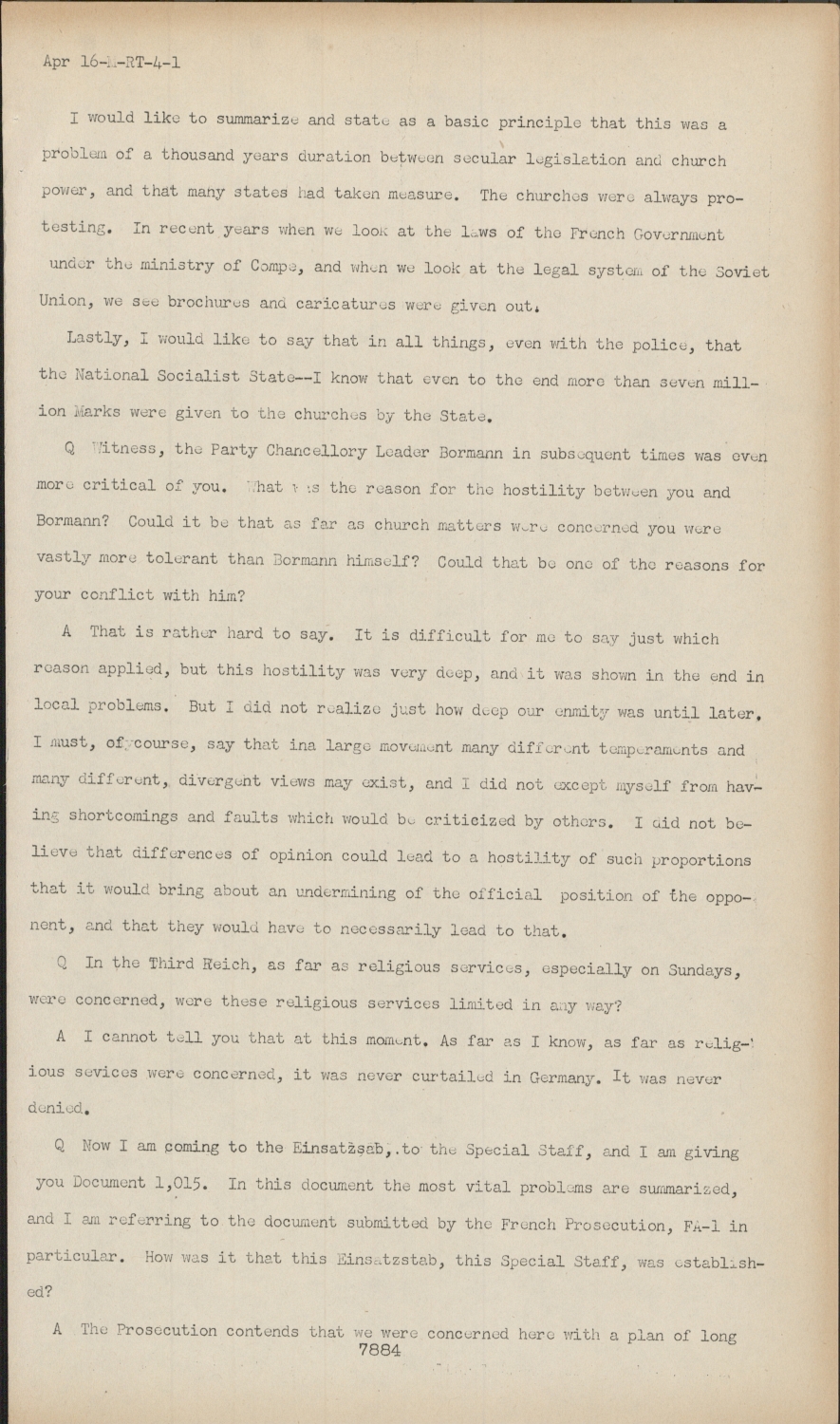
I would like to summarize and state as a basic principle that this was a problem of a thousand years duration between secular legislation and church power, and that many states had taken measure.
The churches were always protesting. In recent years when we look at the laws of the French Government under the ministry of Compe, and when we look at the legal system of the Soviet Union, we see brochures and caricatures were given out.
Lastly, I would like to say that in all things, even with the police, that the National Socialist State--I know that even to the end more than seven million Marks were given to the churches by the State.
QWitness, the Party Chancellory Leader Bormann in subsequent times was even more critical of you. What was the reason for the hostility between you and Bormann? Could it be that as far as church matters were concerned you were vastly more tolerant than Bormann himself? Could that be one of the reasons for your conflict with him?
AThat is rather hard to say. It is difficult for me to say just which reason applied, but this hostility was very deep, and it was shown in the end in local problems. But I did not realize just how deep our enmity was until later. I must, of course, say that ina large movement many different temperaments and many different, divergent views may exist, and I did not except myself from having shortcomings and faults which would be criticized by others. I did not believe that differences of opinion could lead to a hostility of such proportions that it would bring about an undermining of the official position of the opponent, and that they would have to necessarily lead to that.
QIn the Third Reich, as far as religious services, especially on Sundays, were concerned, were these religious services limited in any way?
AI cannot tell you that at this moment. As far as I know, as far as religious sevices were concerned, it was never curtailed in Germany, it was never denied.
QNow I am coming to the Einsatzsab, to the Special Staff, and I am giving you Document 1,015. In this document the most vital problems are summarized, and I am referring to the document submitted by the French Prosecution, FA-1 in particular. How was it that this Einsatzstab, this Special Staff, was established?
AThe Prosecution contends that we were concerned here with a plan of long range duration as far as the plundering of cultural treasures of other states was concerned, In reality the following was true:
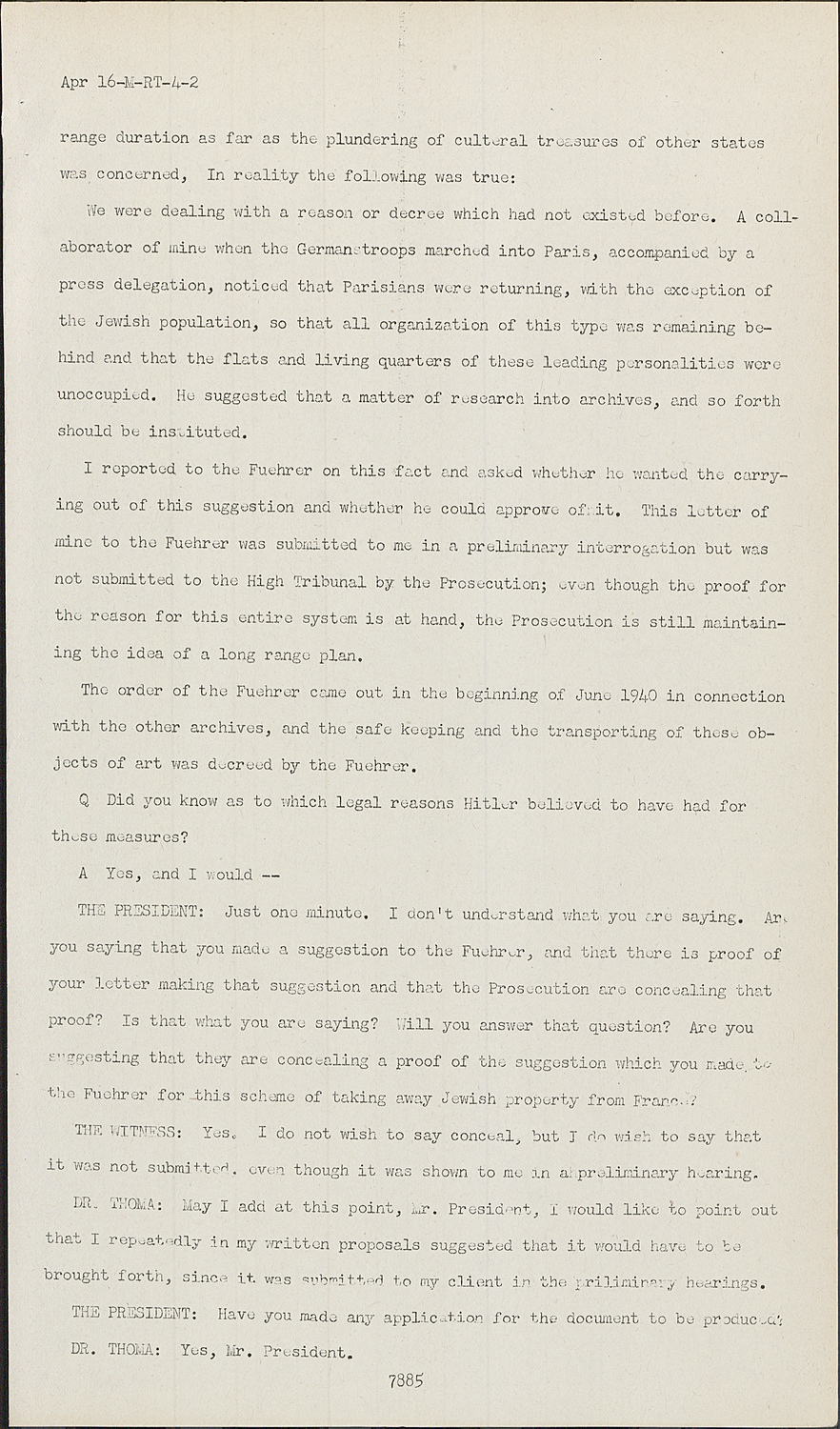
We were dealing with a reason or decree which had not existed before. A collaborator of mine when the German troops marched into Paris, accompanied by a press delegation, noticed that Parisians were returning, with the exception of the Jewish population, so that all organization of this type was remaining behind and that the flats and living quarters of these leading personalities were unoccupied. He suggested that a matter of research into archives, and so forth should be instituted.
I reported to the Fuehrer on this fact and asked whether he wanted the carrying out of this suggestion and whether he could approve of it. This letter of mine to the Fuehrer was submitted to me in a preliminary interrogation but was not submitted to the High Tribunal by the Prosecution; even though the proof for the reason for this entire system is at hand, the Prosecution is still maintaining the idea of a long range plan.
The order of the Fuehrer came out in the beginning of June 1940 in connection with the other archives, and the safe keeping and the transporting of those objects of art was decreed by the Fuehrer.
QDid you know as to which legal reasons Hitler believed to have had for these measures?
AYes, and I would -
THE PRESIDENT:Just one minute. I don't understand what you are saying. Are you saying that you made a suggestion to the Fuehrer, and that there is proof of your letter making that suggestion and that the Prosecution are concealing that proof? Is that what you are saying? Mill you answer that question? Are you suggesting that they are concealing a proof of the suggestion which you made to the Fuehrer for this scheme of taking away Jewish property from France.
THE WITNESS:Yes. I do not wish to say conceal, but I do wish to say that it was not submitted even though it was shown to me in a preliminary hearing.
DR. THOMA:May I add at this point, Mr. President, I would like to point out that I repeatedly in my written proposals suggested that it would have to be brought forth, since it was submitted to my client in the preliminary hearings.
THE PRESIDENT:Have you made any application for the document to be produced
DR. THOMA:Yes, Mr. President.
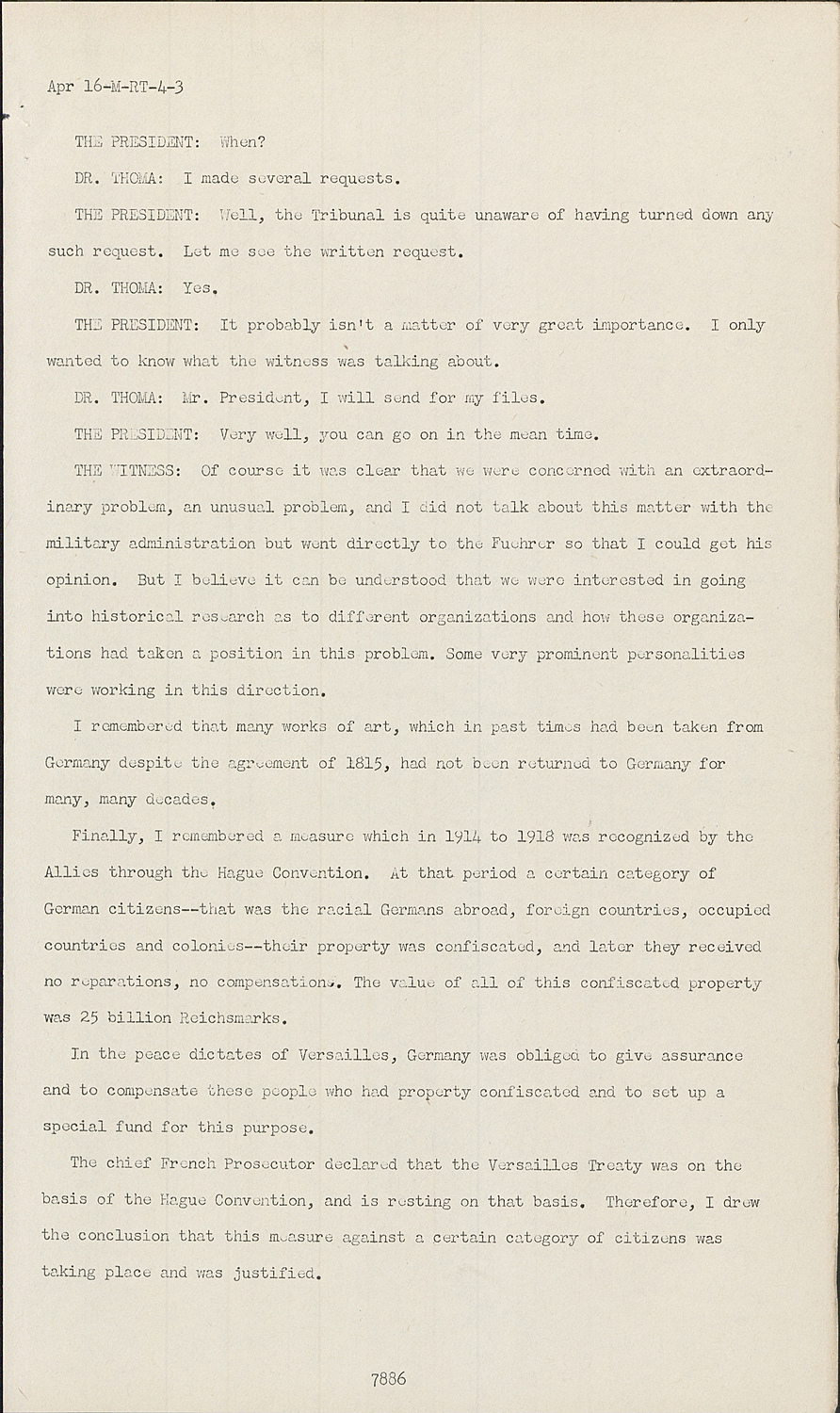
THE PRESIDENT: When?
DR. THOMA:I made several requests.
THE PRESIDENT:Well, the Tribunal is quite unaware of having turned down any such request. Let me see the written request.
DR. THOMA:Yes.
THE PRESIDENT:It probably isn't a matter of very great importance. I only wanted to know what the witness was talking about.
DR. THOMA:Mr. President, I will send for my files.
THE PRESIDENT:Very well, you can go on in the mean time.
THE WITNESS:Of course it was clear that we were concerned with an extraordinary problem, an unusual problem, and I did not talk about this matter with the military administration but went directly to the Fuehrer so that I could got his opinion. But I believe it can be understood that we were interested in going into historical research as to different organizations and how these organizations had taken a position in this problem. Some very prominent personalities were working in this direction.
I remembered that many works of art, which in past times had been taken from Germany despite the agreement of 1815, had not been returned to Germany for many, many decades.
Finally, I remembered a measure which in 1914 to 1918 was recognized by the Allies through the Hague Convention. At that period a certain category of German citizens--that was the racial Germans abroad, foreign countries, occupied countries and colonies--their property was confiscated, and later they received no reparations, no compensations. The value of all of this confiscated property was 25 billion Reichsmarks.
In the peace dictates of Versailles, Germany was obliged to give assurance and to compensate these people who had property confiscated and to set up a special fund for this purpose.
The chief French Prosecutor declared that the Versailles Treaty was on the basis of the Hague Convention, and is resting on that basis. Therefore, I drew the conclusion that this measure against a certain category of citizens was taking place and was justified.
During the preliminary hearing, I was asked about the legal hypotheses and started to point out the legal bases, but I was interrupted with the remark that we were not concerned with that problem at the time.
In the record of this interrogation which the French prosecution presented here, it may be seen that I said yes -
THE PRESIDENT:We are not concerned with the interrogations until the interrogations are put in evidence.
These interrogations haven't been put in evidence yet.
You can give your explanations of them if they are put to you in cross examination.
THE WITNESS:Mr. President, this document, was referred to here and the German translation may be found, although not exactly verbatim, as a part of the French files.
DR. THOMA:Mr. President, the defendant wishes to say that from the beginning he pointed out that the Treaty of Versailles, Article 279, may be a legal parallel.
He wanted to say that he did not invent that later on, but that he held that view right from the beginning.
THE PRESIDENT:Dr. Thoma, all I was pointing out to him was that the various interrogations which have taken place very likely are not in evidence.
Of course, If he is referring to interrogations which have been put in evidence -- but is he?
DR. THOMA:Yes. This is FA-16. That was submitted, Mr. President.
THE WITNESS:The record of the other interrogations was not submitted, but this special -
THEPRESIDENT (Interposing): Just a moment. If he is referring to an interrogation which has been put in evidence, it must have an exhibit number.
DR. THOMA:I have the record in the document book, and it is known as FA-16.
THE PRESIDENT:If he is referring to an exhibit, no doubt he can do it.
THE WITNESS:I would like to rectify an error in translation. I did not say, "Yes, it is true I remember that this measure was taken," but I did say I thought of it, I contemplated it.
That is to say, I had thought of it prior to that time, not at the moment.
When I received the translation which I had not seen prior to that time, I saw that.
As far as Document 1058-PS is concerned, in order not to take up valuable time I would like to point to just a few vital spots in the report of 40-44. On page 2 it is referred to that the origin was determined, and on page 3 we see that the inventory taking was to be done in a scientific and conscientious manner, that a restoration shop was to be put up so that any damage was to be prevented.
At the end I would like to add this, because these words seen important to no since the Soviet prosecution has mentioned the treating of cultural objects by the Einsatzstab in the occupied countries of the East. The report stated, and I quote, under the title "Work in the Occupied Eastern Regions":
"The activity of the special staff was limited to a scientific and photographic reproduction of public collections, their safeguarding in collaboration with military and Soviet officers. Then, several hundred of the most valuable Russian icons, several hundred paintings of the 19th and 18th centuries, pieces of furniture, from castles, were put in safekeeping with the help of some troops, and they were brought to the Reich for safekeeping."
I wanted to point out by this that the Einsatzstab in the East did not transport any objects of art to the Reich, but when the areas were evacuated, as may be seen from the documents, these objects were transported, during battle, into the rear regions farther and farther back, and some of them were taken into the Reich for safekeeping.
From the same document I would like to point to a letter of the 5th of July 1942, a letter from the leader of the Reichschancellory. This document deals with the accusation by the Polish Government that the transporting of Polish works of art was concentrated in my special staff in Berlin. I will return to this special Polish accusation. I am just pointing to the paragraph in the letter which says that the Fuehrer had decreed that some libraries of the Eastern region were to be confiscated, but that the Government General was not included in that decree.
Furthermore, I would like to point to the decree of the Reichsminister for the occupied Eastern countries on the 20th of August 1941 to the Reichsk ommissar.
DR. THOMA: What page?
THE WITNESS:Page 2 of this document. Toward the end it says -
THE PRESIDENT:What document are you talking about now? What document number?
THE WITNESS:I'm sorry, but the copy I have is not marked in red and I am referring to the document which I had at hand. I believe it is at the end of page 1 of Document 1015-PS. There is no special letter given. It is Just a circular letter dated the 7th of April 1942.
THE PRESIDENT:I only want to get this clear. What I took down was that he was referring to a decree of the 20th of August 1941.
THE WITNESS:I beg your pardon. It is the 20th of August.
DR. THOMA:The 20th of August, that is correct, and the year is 1941. It is page 78 of Document Book 2, at the end of the page.
THEWITNESS: "I request that you specifically prohibit the removal of cultural goods of any kind from your Reich Comissariat by any agencies whatsoever without your approval. Everything of the seized cultural goods which remains in the Reich Comissariat Ostland and which may be eventually utilized for research work in the Higher School must come under a later regulation. I request that you inform your subordinated General and District Commissioners of this directive. The national administration of museums, libraries, etc., regardless of the right of inspection and inventory by the Special Purpose Staff, remains unaffected by this directive."
Later, I would like to refer back to this quotation, regarding an accusation by the Soviet Prosecution as far as Esthonia and Lithuania are concerned.
BY DR. THOMA:
QLet us pass to the next point.
AI have not finished, for I am accused most unfairly in this direction, and I would like to refer to a second directive for the Minister of the Occupied Eastern Territories, dated the 7th of April 1942, where, at the end, under I, the some principle I have just read is reiterated. It is in Document Book 2, page 94. Everyone is told not to take independent action.
Under II, it says verbatim -- and I quote:
"In special exceptional cases, immediate measures of securing or removal of items to a safe place can be carried out in order to evade danger threatening (e.g. danger of collapse of buildings, enemy action, climatic influences, etc,). In all cases, immediate written notification of my Special Purpose Staff must take place."
I should like to return to the accusation of the Soviet Government. When Document 076-PS was road, it said that there was never any directive for the securing of cultural good, but proofs do exist as I have just quoted two times.
Further, I would like to refer to a directive by the Reichminster for the Occupied Eastern Countries to the staff leader of the Einsatzstab. This is a document of the 3rd of October 1941. I again call his attention to the documents which I have just read.
Furthermore, I would like to call your attention to a decree of the Supreme Command of the Army in September of 1942, which was in agreement with the Reichminster for Eastern Occupied Countries. Here also it says at the end, under I,-
QThat is page 89 of the document book?
THE PRESIDENT: Which is that? September '42?
THE WITNESS: The 30th of September.
THE PRESIDENT: Yes, I have get that. What about the one of October '41? Where is that?
THE WITNESS: October '41?
THE PRESIDENT:October '41.
THE WITNESS:That was the 3rd of October 1941.
THE PRESIDENT:Do you know where it is, Dr.Thoma?
DR. THOMA:It is contained in Document 1015-PS, which is U SA-85, but it may be that this document is not listed. In my document I cannot locate it at present, but it belongs to 1015-PS which was submitted in its entirety.
THE WITNESS:And the order of the 30th of September 1942 says, under I:
"Disregarding exceptional cases, in which the safeguarding of endangered works of culture is urgent, its place of temporary location is to be sought on the spot. For this purpose, according to the mutual agreement between the Supreme Command of the Army General Staff of the II/G on. Qu. and the Speci al Purpose Staff of Reichsleiter Rosenberg, the following authorities have been granted to the latter:
"c. To conceal or to safeguard in the operational area of the East for the protection against damage or destruction, also such works of culture which do not fall under paragraph b, especially art treasures of museums."
At the end of this directive, it says, under IV:
"Independent from the missions of the Special Purpose Staff of Reichsleiter Rosenberg according to Section I, a, b, c, the troops and all military units located in the operational area are immediately to be notified to preserve if possible valuable art monuments and to save them from destruction or damage."
I believe I am obligated and duty-bound to prove, but very briefly, that as far as my Special Purpose Staff and the military office were concerned, unequivocal directives and orders were issued for the protection of valuable art objects, even in these bitter battles, the objects of art of the Polish, Ukrainian, and White Ruthenian people. BY DR. THOMA:
QMr. Rosenberg, do you know that Hitler and Goering received some of the objects of art which were concentrated in France? What was your part?
A In general, the Fuehrer had decreed, and this order was transmitted by Keitel; and it was pointed out that the Fuehrer would decide alone, himself, that he would make the decision.
I do not wish to dispute in any way that I had the hope that a large part of these objects of art would remain in Germany, since, in the course of time, many German cultural works of art had been destroyed by bombing attacks, especially in the West. These works of art were to be a basis for later negotiations.
Reichsmarshal Goering supported the work of the Special Purpose Staff, on the special directive of the Fuehrer, and when a number of these works of art were earmarked by Goering for his collection, I was, I must say frankly--as it says in the record--a little uneasy, because, with this directive, I had a certain responsibility. I had signed my name, and I had taken over responsibility for the confiscated objects. I was, therefore, obligated to catalog them in their entirety, to save them, and to have them ready for a final disposition. Therefore, I directed my deputy to make a complete list of those things which the Reichsmarshal, at the approval of the Fuehrer, was taking for his collection.
I knew that Reichsmarshal Goering intended to give this collection to the German Reich and not to keep it as part of his private inheritance.
In the record which was produced and read by the French prosecution, I must say that there is a regrettable error to be found. It says that I had been uneasy because Reichsmarshal Goering had taken these works of art. In German, the term "entwendent" used means "unjustly" or "illegally" or "embezzled". However, what I said was "verwendent", which means "utilized", and there is a difference.
DR. THOM:Mr. President, I would like to call to your attention the fact that the French used the work "detourne", which means "embezzled".
THE PRESIDENT:The Tribunal will adjourn now.
(A recess was taken)
------------
BY DR. THOMA:
QI now turn to the Action Moebel, in France, and for that purpose I am showing the defendant document 001, in volume 2 of the French document book, and I am asking the defendant to state his views.
(The document was submitted to the witness.)
AThe document 001-PS contains, at the beginning, information to the effect that in the East the accommodation problem and conditions had been so dreadful that I was asking for consideration as to whether unoccupied Jewish flats in France, and parts of their equipment, should be used for that purpose. This suggestion was taken up by the Chief of the Reich Chancellery on the 31st of September, 1941, and conceded in a decree issued by order of the Fuehrer.
In the course of the increasing bombardment in Germany I considered that I no longer could take responsibility for this, and thus I made a suggestion that this furniture should be placed at the disposal of bombing victims in Germany--which amounted to more than 100,000 people in certain towns--so that first help would be given to them.
In the report of Action M in the French document book, it states, in the 7th paragraph, how the confiscation was carried out: that these deserted apartments were sealed; that they remained sealed for a lengthy period, so that any possible claims were waited for, and that only then was the transport of the articles to Germany carried out.
I am aware here that this, no doubt, must have been serious interference with private property, but here again, in connection with previous thoughts, I had thought of the homeless millions of Germans.
I want to emphasize in this connection that I was well informed regarding the fact that, in a book of considerable size, flats, their owners, and the main contents in the way of furniture, had been laid down in detail, so that, at a later date, there would be a basis for any possible negotiations.
In Germany the matter was handled in such a way that those people who suffered damage through bombing, with regard to these furnishings which were placed at their disposal, and household goods as well, had to pay for them, and these supplies made to them were deducted from the claims which they had against the state.
That money was paid into a special fund administered by the minister of finance.
The document here--001-PS--contains under No. 2 a suggestion which I myself consider a serious implication against me. This is a suggestion that on the strength of four murders committed against Germans in France not only Frenchmen should be shot as hostages, but that Jewish citizens also were to be held responsible. I should like to say that these shootings of hostages, since they were to be announced locally, were considered by me as being justified in a war under certain special circumstances, since the fact that the armed forces were carrying out such things appeared to me to be the result of a natural legal investigation, particularly since these things were taking place in the territory and with reference to a state with which the German Reich had signed an armistice.
Secondly, this happened during a period of excitement, due to the war which had just broken out with the United States of America, and there were thoughts of the report from the Polish Ambassador, Court Potowski, dated the 30th of January, 1939, which the Tribunal has forbidden to be read.
In spite of that, I must say that this suggestion is considered by me to be a personal injustice and recognized as every but that looking at it from the legal point of view I would like to point out in the document 1015-PS, under letter Y there is a letter from the chief of the Reichschancellery, which is dated December 31, 1941, and in which it says in a note for the files, dated 18 December 1941.
"This has been reported to the Fuehrer. The Fuehrer has concerned himself with the suggestion under 1 and has stated his principal agreement. A copy of that part of the file note will deal with the use of Jewish furniture, and it has been submitted to the chief of the supreme command of the armed forces and the Reich Commissioner for the occupied Netherlands together with a letter attached hereto in copy."
In this manner, as far as point 1 is concerned, this has been accepted, and it has been silently though emphatically stated that point 2, with reference to the suggestion, is turned down, which means that the whole suggestion had no legal consequences. Later on I referred again to this suggestion, and I must say that I had forgotten all about it until it was put before me once again.
QI now turn to the subject "Minister for the Occupied Eastern Territories". The Defendant is anxious that he may define his attitude to Molotov's note that he, the Defendant, was a Czarist spy, since this affects his personal character. I therefore ask the Defendant whether he has at any time had connection to the Czarist police.
ANo.
GENERAL RUDENKO:Mr. President, in the Indictment which has been presented to the Defendant Rosenberg no point incriminates him of having been a Czarist spy. Therefore, we consider that this question is irrelevant
DR. THOMA:The Molotov reports have been submitted to the Tribunal, and in that way they have been introduced in evidence. Consequently, I think that I may be permitted to put that question.
THE PRESIDENT:He has answered in the negative already, so you can pass from it, can't you? It has formed no part of the indictment.
DR. THOMA:Yes. BY DR. THOMA:
QWhen did you learn that you had been appointed minister for the occupied eastern territories or that you were proposed for this position, and what reasons were given you for having the task given to you?
AMay I state in connection with this that at the very beginning of April, as far as I can remember it was the 2nd of April, 1941, the Fuehrer called me in the morning and explained to me that he regarded a military clash with the Soviet Union as unavoidable. The reasons he quoted were two: firstly, the military occupation of Rumanian territory-that is to say, Bessarabia and North Bucovina; and, secondly, the long existing considerable increase in the strength of the Red Army along the line of demarcation and in Soviet Russian territory altogether.
These matters, he said, were co clear that he had given the corresponding military orders and that in every shape and form did he want to include me as a military advisor.
Thus I was facing an accomplished fact, and any attempt even to discuss the matter was countered by the Fuehrer with the remark that the orders had been given and that nothing could be altered in the matter, so that I consequently told the Fuehrer in that case I wish the best of luck to the German armed forces and I am at your disposal for this political advice which you desire.
Immediately afterwards I called a meeting of my nearest officials, since I didn't know whether the military events would be taking place very soon or later on. We discussed the possible treatment of the political problems and possible measures which may have to be taken in connection with the territories to be occupied in the east. We made a number of drafts, which have been submitted in this courtroom, and on the 20th of April I received a temporary task, which was the forming of a central department for the treatment of the eastern questions and the order to get into touch with the corresponding leading departments in the Reich in the matter.
QThe instructions which were given to the defendant Rosenberg after he was nominated--which he drafted, rather--I should like to submit them to the Defendant. And I have yet another request to the Tribunal These instructions appear in their photostatic copy as being crossed out and bearing a number of remarks, and I have the request therefore that the Tribunal would take personal cognizance of the photostatic copies so that it can be seen how these instructions have been crossed out. I think the actual documents have been submitted to the Tribunal.
AMay I refer to these documents--1017, 1029 -
THE PRESIDENT:They have already been put in evidence?
DR. THOMA:Yes, they have been put in.
QMay I ask you, Defendant, to state the exhibit numbers.
AI had just mentioned the PS number.
Q What is the USA number?
AThere is 1028, which has the USA number 273; whereas document 1030 has the USA number 144. The other documents do not seem to have a USA number.
Q 1017 is USA 142; 1028 is USA 213; 1029 is USA 105; and 1030 is USA 144.
AIn addition I should like to state -
QThey are contained in the special document book for the Defendant Rosenberg.
AI state in this connection that these are provisional drafts, and according to a statement which is contained in the upper left-hand corner they originate from the end of April to the beginning of May. These provisional drafts did not go out at all, but as they are now crossed out and bear certainwritten remarks in the margin they contain statements regarding those points which were later on not passed by the Fuehrer. So that for that reason alone, particularly referring to the Ukraine, they couldn't have been sent out.
The actual first instructions which went out to the Reich Commissars in the Eastern Countries and the Ukraine, after the Ministry for the Occupied Eastern Territories had been formed, are unfortunately not available.
They haven't been found so that unfortunately I cannot refer to them.
QOn the 20th of July 1941, that is to say, one day before the out break of the war against Russia, you have made a speech regarding all these, concerning the Eastern problems.
I am sure you have extracts from that speech.
It is 1058-PS, USA 147.
THEPRESIDENT: 1058, was it?
DR. THOMA:Yes.
THE WITNESS:This is a document from which the prosecution has quoted one single paragraph repeatedly and this is a lengthy impromptu speech made before those who were interested in Eastern problems and who had been given corresponding parts and I would like to state in that connection, that it was my obvious duty to reflect on which political measures would have to be suggested so as to avoid that the German Reich would every twenty-five years have to fight for its existence in the East and I should like to say, and emphasize before I go any further, that the matters which have been stated by me in a confidential speech do not correspond in any way with the statements made by the Soviet Prosecution; namely, that I was in favor of a systematic liquidation of the Slavic peoples.
I do not wish to occupy the Tribunal's time by reading too much but perhaps I may read some paragraphs to justify myself.
It says in paragraph 2:
"Originally, Russian history was an entirely continental affair. 200 years they lived under the yoke and they were predominantly turning to the East.
The Russian traders and hunters have gone to the East as far as the Urals; some have gone to Siberia and the colonization of Siberia is no doubt one of the greatest deeds of the history of the world."
I think that this might underline my attitude of respect towards that historic achievement in the East.
The next paragraph states: "This means the aim of Germany is the freedom of the Ukrainian people.
This must be made a political point of our program.
In what form and to what extent a Ukrainian State can be formed later, that is something which one cannot discuss now.
In that connection, great care must be employed; the literature regarding Ukrainian struggles must be cultivated so that the consciousness of the Ukrainian people regarding the history can be revived.