
Q Now, my next question. Is it correct that Himmler was frightened of Heydrich and this because Heydrich had been given too much authority and that for that reason he thought that by calling on you he had found the very man who to him, Himmler, would be no longer in danger at all?
In this connection the Prosecution have drawn a parallel between you and Heydrich, and, as I just said, have described you as the second Heydrich.
A The relationship between Himmler and Heydrich can be characterized as follows:
Heydrich was by far the more intelligent of the two. He was-
THE PRESIDENT:Dr. Kauffmann, we do not want to know anything about Heydrich's intelligence. The witness has said over and over again that he was not his successor. BY DR. KAUFFMANN:
QIn that case I will repeat the question which I put earlier, and which is the following:
Did Himmler by calling on you find a man whom he considered to be of no danger to him, Himmler?
AHe never wanted to give executive powers as Heydrich had in his hands; he never wanted to lose such powers ever again. The moment Heydrich was dead, Himmler took over the entire department and never gave the executive powers away after that. On one occasion he had the experience as to how dangerous the Chief of the Security Police can become in the person of Heydrich. He wasn't going to run that risk a second time.
QIn other words, what you want to say is that after Heydrich died, Himmler retained the executive powers in his hands?
AYes.
QNow, another question. You had stated yesterday that the conception of the so-called "final solution" didn't reach you until afterwards. In effect, instructions from Himmler to Heydrich and to Eichmann are available as early as 1941 or 42. Is it true that you frequently met Himmler and you were a friend of Himmler's?
AIt is utterly wrong to construct a relationship between Himmler and myself and call it friendship. Just like every other official, I found that his attitude and treatment toward me was cool. He wasn't a man who had any personal contact or relationship to anyone.
QIt appears that, if I place myself in the position of the Prosecution, you might possibly have had knowledge of that "final solution" if you met Himmler frequently and had direct contact with him.
I, therefore, ask you again, didn't Himmler at some time or other put to you clearly what this "final solution" was?
ANo, he didn't. I said yesterday that, on the basis of all documents which accumulated during the autumn of 43 and the summer of '44, including reports from any enemy broadcast, I came to the conviction that the statement regarding the destruction of Jews was true, and that, with this conviction which had ripened within me, I immediately went to see Hitler, and forty-two hours later I went to see Himmler, and I reproached them both and said that I would not for one single minute lend my hand to any such action.
Beginning with that moment-
QYes, well, you said so yesterday. You needn't repeat it.
THE PRESIDENT: Dr. Kauffmann, you told us yesterday that you would finish in an hour; you have now been nearly an hour and a half.
DR. KAUFFMANN: I have only two or three questions.
BY DR. KAUFFMANN:
QThe trial brief of the Prosecution contains a statement of Schellenberg, and it runs as follows:
"What am I going to do with Kaltenbrunner? He would have had me under his thumb in that case."
This is stated by Schellenberg in an affidavit, and it is supposed to have been said by Himmler.
Please, will you give a very brief statement regarding the fact whether you would consider such a statement possible or probable?
AI don't consider it probable. If he did say this, then it can only have been in connection with-THE PRESIDENT:
The Tribunal does not think that is a possible question to put to the witness.
DR. KAUFFMANN: In the trial brief a document of this kind has been presented by the Prosecution but, if the President does not wish that question, I shall withdraw it.
THE PRESIDENT:It seems to be merely a matter of argument, and you cannot criticize this affidavit, if the affidavit is in evidence.
BY DR. KAUFFMANN:
QSo, I now come to the last question. I ask you whether the possibility existed that you, after you gradually became aware of conditions within the Gestapo and concentration camps, could have brought about a change?
If that possibility did exist, can you say that by staying on in your position you achieved an alleviation and an improvement of conditions?
AI have repeatedly tried to be posted to the front, but the most burning question which I personally had to decide was:
"Will the state of affairs be improved or altered or is it your duty to do everything that can possibly be done to change all these conditions?"
Upon repeated refusals on my request to be posted to the front, I had no alternative, therefore, but to make every attempt personally to alter a system, the ideological and legal basis of which had been proved by all the orders which had been quoted here, could not be altered by me, and every thing that I could do was to alter these methods and assist in having them finally removed.
QDid you consider it possible in your conscience still to remain?
AIn my opinion, the possibility to influence Hitler and Himmler repeatedly, again and again, was the reason why I couldn't in my conscience leave my position.
I considered that it was my duty that I should fight against the wrong personally.
DR. KAUFFMANN:Mr. President, I have no further question.
THE PRESIDENT:The Tribunal will adjourn.
(a recess was taken.)
THE PRESIDENT: Do any of the Defendant's Counsel wish to ask any questions of the Defendant?
BY DR. DIX (Counsel for Defendant Schacht):
QCan you tell me Witness, that Schacht before he was taken into custody by the Allied Powers, had been in a concentration camp?
AYes.
QHow long have you known that?
ASince his wife told me in a letter, and I believe that she requested me to call--so that she might call and visit her husband.
QAnd about when was that?
AI assume around Christmas, 1944.
QCan you tell me something about or can you picture at whose suggestion Schacht was interned in a concentration camp?
AAs far as, that question is concerned, I believe I received a letter from Schacht's wife and sent it the same day to the office of the Adjutant to Hitler, or to Fegelein. I received word that Himmler was to be consulted in this matter. Some time later I learned that Schacht on Hitler's decree or order had been interned and for the reason that he was suspected of working together with G oerdeler or perhaps another collaborator, involved in high treason and assassination in July, 1944.
QI have a letter I received a short time ago. It is written by a former concentration camp inmate, written by Obersturmbannfuehrer Stawitzky. Do you know him?
ANo.
QHe was the last commandant of the concentration camp at Flossburg. In this letter I am told that this Stawitzky told him he had been ordered to murder Schacht with the rest of the special internees. Do you know anything about such an order for murder, as far as Schacht is concerned?
ANo.
QDo you consider it possible that Stawitzky might have decided on such a step through his own authority?
ANo.
Q Then may I interpret your answer to be such a decree or instruction could come only from Hitler or Himmler, and if such an order went out-
AYes, you may assume that. As far as Schacht together with the other special internees, like Canaris, etc., is concerned, Hitler himself would have been the only person who could have ordered anything like that.
DR. DIX:That is all. BY DR. MERKEL (Counsel for the Gestapo):
QWitness, the Prosecution contends that the Secret State Police in the years 1942 to 1945 had forty to fifty thousand members. What can you tell me about those figures?
AI believe that this figure is slightly too high.
QWhat is your statement?
AI would assume thiry-five to forty thousand.
QHow many Stapo officials were in the occupied countries, the approximate number, that is?
AThat I can't tell you even approximately, but I believe I have heard a figure for the occupied region in France of perhaps 800 people
QCan you tell me to whom those officials in the occupied countries were subordinate?
AIn the occupied countries, to the Supreme Commanders of the Security Police.
QCan you tell me anything about the offices of the commandants of the Sipo and SD in the occupied countries? Kripo officials, that is, officials of the Criminal Police, had tasks of a State Police nature?
AThat is possible.
QCan you tell me about whether those officials, who were organized into the special action groups were excluded from the sphere of the State Police and were acting in a special sector or had a special task aside from the State Police functions?
AI believe that is so, but they received their pay nevertheless in that department, even though they were personally not responsible to it, but as far as orders were concerned, their orders came from a different source.

QHow were the members of the State Police organized, that is, officials who had purely administrative functions?
A At least twenty percent had purely security police functions; the same number for the largest volume were the technical personel and other subordinate personel.
QThe technicians, teletypists, others officer personnel, including clerks and so forth, about how many?
AIf the first group is twenty percent, that is administrative, and then twenty percent for executive personnel; then the rest, 60 per cent, that remained, fall into two large groups of 30 per cent each. Technical, auxiliary forces and the other group, office forces -
QTell me in one brief sentence the aims and tasks of the State Police.
AI believe they have been explained and mentioned repeatedly. The State Police had for its main function as in every other country, the protection of the State from any attack coming from within.
QThe Prosecution contends that the membership, as they called it of the State Police, was voluntarily recruited. What can you say to that?
AI believe that contention cannot be maintained and cannot be proved. I would like to say that those officials were in existence in 1943, and consisted of, officials who had been police officials at that already, in 1943.
QAnd how, in what way, did they come to the State Police?
AYes, they were transferred. Of course, there was a State police in existence prior to that time; it was not called the State Police -- I believe it was called the political police at that time.
QThen the personnel was expanded along with the personnel of every other State office ?
AYes.
QAs far as the actual orders of the Reichs Sicherheits Haupt Amt were (concerned, the Fuehrer decreed that No. 1 -- as far as keeping secrecy was concerned -- no one was to know more about a thing or matter than he had to know. Did that apply in the office of the RSHA?
AYes, this decree applied not only to the Wehrmacht but to the entire internal executive power for all administrative offices and I believe this was announced and publicized in every office of the Reich. Of coursem we were especially keen on observing this order in the police sector.
Q Do you know anything about the 1 - 10 - 1944 decree? The entire border custom protection which had been under the Reich Finance Office up until that time was transferred to the Ant IV of the RSHA.
Did that transfer take place?
AYes, that took place on the order of Hitler in the fall of 1944, I believe September 1944. It was transferred to Himmler and it was taken out of the sphere of the Reich Finance Ministry.
QDo you know how many members were concerned in that, how many people?
AIn the beginning there were approximately 50,000 people involved but at this time I think there were about 10,000 people less, because recruiting had taken place and these 10,000 had been lost to the Wehrmacht; some of the younger men were in the fighting forces.
QCan you tell me in one sentence the function of the Zollgrenzschutz the Customs and Border protection?
AAs the name implies, the financial sovereignty of the Reich had to be protected through the border police.
QCan you tell us perhaps that at last approximately 40,000 men went to the Gestapo voluntarily?
ANo, that was an order.
QSomething different from the Zollgrenzschuts is the actual border police. Do you know that it was in 1945 -
AYes, It was; Mueller was General Border Inspector of the Reich.
QTell me in one sentence the tasks of his Grenzpolizei -- border police.
A The Border Police at the border, the airports, roads, highways, checked passports and was active in those spheres.
QWas this task different than before 1943?
ANo.
QDid it vary from the customs police in other countries?
ANo, it was the same.
QWhat was the relationship of the State Police to the SS? Did they enter the SS voluntarily, or was it on the basis of an order?
AVoluntary enlistments were relatively few. I know that later Himmler, as far as promotions were concerned, was a little more restrictive and reserved if the official did not belong to the SS, so that in that way enlistments occurred, perhaps not from inner convictions but from a desire to be promoted.
QThe larger part then came in?
AYes, it was all managed through the promotional system through Himmler.
QDid the members of the State Police and the officials have the opportunity to leave their offices?
ANo.
QA large part of the State Police, because of an emergency, were required to serve on the "Notdienst." Can you explain that?
AThat is not true of that part who had. As far as the other personnel were concerned, there were more who were liable for this service, especially after the war had taken place. The personnel toward the end was recruited from the members of the "Notdienst", and the personnel could be kept up. That is especially true of the technical and office personnel.
QDid these members enter voluntarily?
AThey had no choice. In connection with the labor offices, they were put into the "Notdienst" as the place where the Reich needed them.
QWhat happened to the members of the State Police who committed infringements or committed excesses or other misdemeanors?
AThe same applied to them as to everyone else. All organizations who were subordinate to Himmler.
There was a special police court for them.
In one sentence I can characterize this system by saying that on the whole the sentences were more severe and passed more often than in a regular civil court.
QIt has been asserted that for an offense, because he had taken some matters from sone one, that he had to serve in the penitentiary. Was that true?
AYes, he did receive that sentence.
QDo you know was came to the concentration camp Danzig-Matzgau?
AIn that concentration camp, which was an SS punishment camp rather than a concentration camp, every one who was taken there was sentenced by SS or police courts.
QCould Gestapo members, especially of a higher rank, visit a concentration camp?
AOnly with the express approval of Pohl or Gluecks.
QIs that also true of the higher SS and police leaders for the camps which were under your jurisdiction?
AI could not say that with assurance or certainty, but I think they could apply to make these visits.
QDo you know the so-called "severe measures of interrogation", and can you find those in other states?
AI was present at the International Criminal police Commission, and I had the opportunity in the fall of 1943 at a session to speak about this topic, and from my reading in the foreign press. I gathered that each police system of each state has such measures.
QCould a state -
THE PRESIDENT:What happened at some international police commission does not seem to be relevant to anything in this case.
DR. MERKEL:I only wanted to question the defendant on whether these severe measures of interrogation were in existence not only in Germany but also in other states.
THE PRESIDENT:We are not concerned with that.
DR. MERKEL:The more severe measures of interrogation are used as an incriminating statement for this witness.

Q Could a state police officer who had given a protective custody order which was limited in time think of corporal punishment or death at the commitment of the internee?
ANo, not with an order of that kind.
QWas there a so-called Haftpruefungsverfahrung, an investigation? Did that apply to the inmates of the concentration camps?
A Yes, in peace and in war. Three times in peace and twice in time of war, and that was applied to every protective custody internee.
This investigation was not just a matter of the State Police. This result had to be received from the camp commandant, and these reports had to be given to the Inspector of the Concentration Camps. He, in turn, had to deal with the State Police about this matter and about this internee.
QThe Prosecution talked about mistreatment in the occupied western countries, France, Holland, Belgium, Norway, and has brought evidence to that effect. Were there any instructions from the RSHA as far as torturing was concerned?
ANo, certainly not.
QHow do you explain the fact of this mistreatment?
AThe mistreatment with which the State Police is charged--I have never heard of that. In my opinion, the excesses of individuals might be involved, but a decree to that order certainly was never issued.
QDo you know that in the occupied countries, members of the resistance party and criminal elements masqueraded as members of the German State Police in order to facilitate their tasks?
AThat has been repeatedly stated, but I do not remember any such thing or having seen anything like that.
DR. MERKEL:I have no further questions. BY DR. HAENSEL (Counsel for the SS):
QWitness, in the year 1932 you entered the Austrian SS, according to the testimony.
AYes.
QWas there a difference between the Austrian SS and the German SS, or was it a unified group?
AThere was a certain organizational similarity, but that took place after the Anschluss. Up until the time of the Anschluss, the SS in Austria can not be differentiated from the SA or from the Party.
QTell me, as far as members are concerned, the numbers of the Austrian SS, to which you belonged; first of all, before the Anschluss in 1938 and at the time at which you entered.
What was the difference in numbers, and how did the development take place?
THE PRESIDENT:Too fast.
QHow, as far as figures were concerned, did the development of the SS, to which you belonged, take place?
AI believe that at the time of the Austrian Anschluss, the maximum membership was perhaps 7,500.
QDid that group in Austria play the role of a fifth column? Is "fifth column" a concept as far as you are concerned?
AYes, "Fifth column" became a concept to me through the statements of the enemy, but to term the Austrian SS a fifth column is entirely wrong. The Austrian SS never had the task of being an intelligence unit or a sabotage unit. It never had any task like that.
QIn the Austrian SS, to which you belonged, was the intention through force to bring about the annexation of Austria to Germany to be seen, or should this be brought about through plebiscites, through legal measures?
AThere was not a plan of annexation by force. There was never any necessity for any such step, for the Anschluss movement was very strong in itself.
QIt has been asserted that the SS Standarte 86-
AThat might have been the one at Vienna.
Q Do you mean the standarte which appeared at the Dolfuss Putsch? Can you tell me something about that?
Did the work of this standarte have any connection with the assassination of the Austrian Chancellor?
AI consider that incorrect. I must say that this standarte did not have the number 86, but 89.
Point 2, the group which had entered the Chancellory on the 21st of June of 1935 was not a group of the SS, but a group of former members of the Austrian Army who, because of National Socialist activity, had been discharged from the Army.
In that connection I do not know of anything further, but that at that time highest Austrian Police Leader, Dr. Skubl, should be able to give you information about that. I believe he has been asked for as a witness in another case, and I ask that you question him about this matter.
QSo far as the entry of the troops on the night of the 11th of March, 1938can you remember that date? Which troops, according to your recollection, did march in? Here they SS units, or were they other units? Were they regular Army units, or were any SS units at all connected with that? What is your recollection?
AMy recollection is such that, first of all, they were Wehrmacht units, and there was one regiment of the Waffen SS, I can't recall which one, perhaps the Standarte Deutschland.
QWhich of these units took part, and what is the proportional figure between the Wehrmacht and the Standarte Deutschland? That is, approximately.
AThe Standarte Deutschland at that time, perhaps, had 2800 men. So far as the Wehrmacht is concerned, I don't know how many units there were.
QIn order to establish the relationship, according to your idea, what is the entire figure of SS men? I would like to make it a little easier for you..I have seen a letter in which it is stated that in all a membership of three quarters of a million to one million men existed. Is such a figure correct?
AOne million is much too high. With all parts of the SS together, including the Allgemeine SS, the General SS and the Waffen SS, including the SSmembers in police activity, I believe the figure is 720,000 to 750,000 men. Out of that number, at least 320,000 to 350,000 men died in action.
These losses might even be a little higher then what I have just stated, but I believe the exact figure might be found, out from one of the defendants of the Wehrmacht.
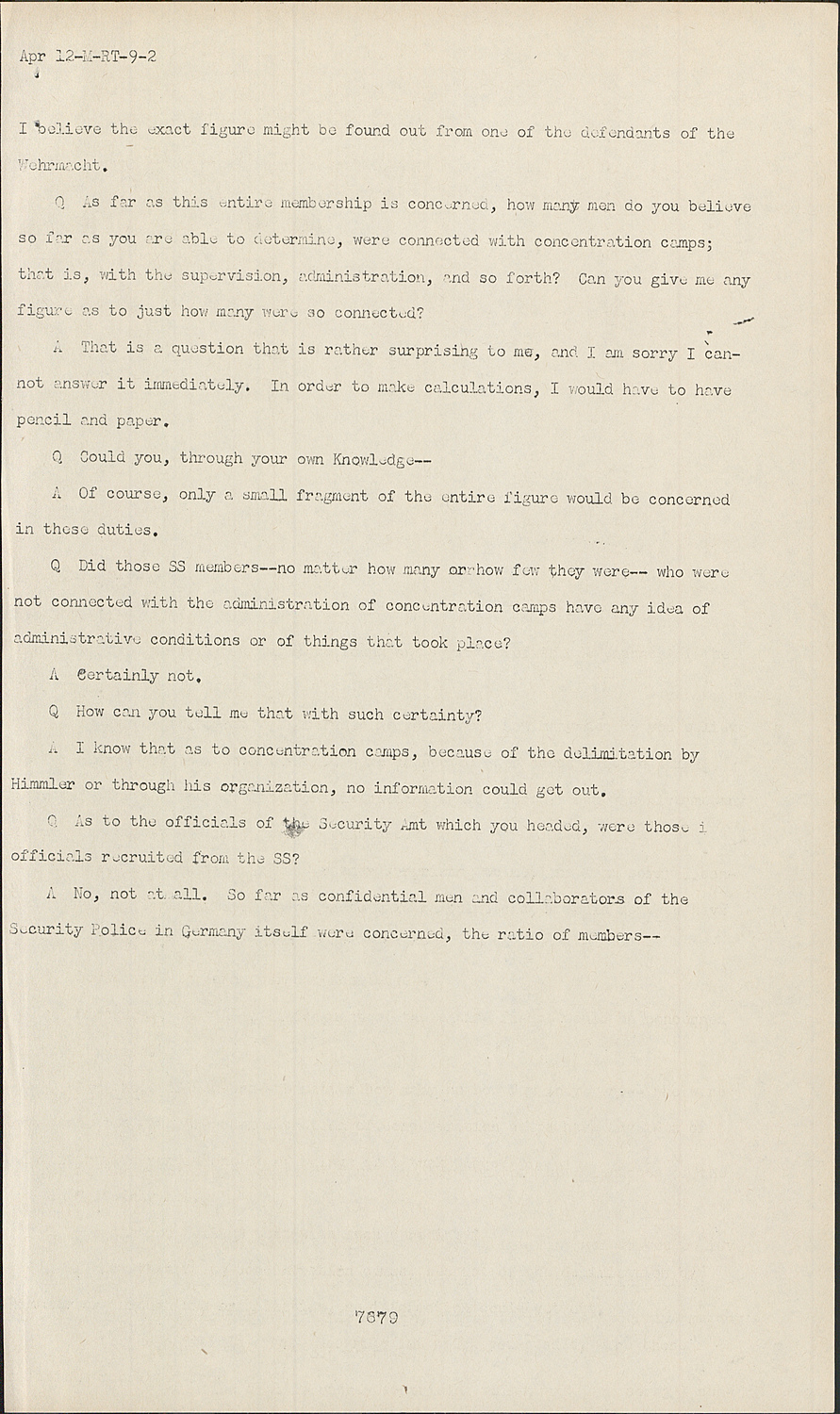
QAs far as this entire membership is concerned, how many men do you believe so far as you are able to determine, were connected with concentration camps; that is, with the supervision, administration, and so forth? Can you give me any figure as to just how many were so connected?
AThat is a question that is rather surprising to me, and I am sorry I cannot answer it immediately. In order to make calculations, I would have to have pencil and paper.
QCould you, through your own Knowledge-
AOf course, only a small fragment of the entire figure would be concerned in these duties.
QDid those SS members--no matter how many or how few they were-- who were not connected with the administration of concentration camps have any idea of administrative conditions or of things that took place?
ACertainly not.
QHow can you tell me that with such certainty?
AI know that as to concentration camps, because of the delimitation by Himmler or through his organization, no information could got out.
QAs to the officials of Security Amt which you headed, were those officials recruited from the SS?
ANo, not at all. So far as confidential men and collaborators of the Security Police in Germany itself were concerned, the ratio of members-
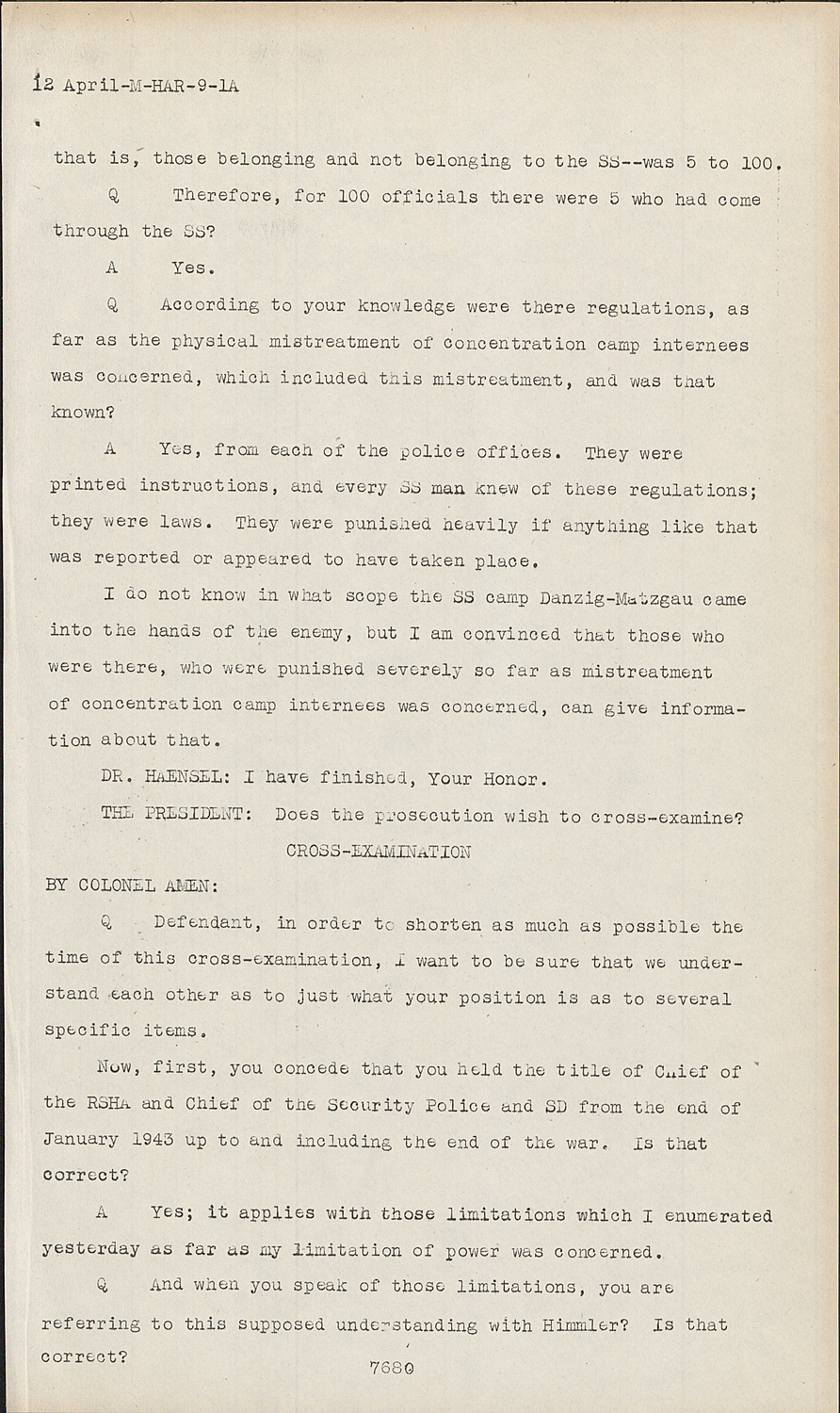
that is, those belonging and not belonging to the SS--was 5 to 100.
QTherefore, for 100 officials there were 5 who had come through the SS?
AYes.
QAccording to your knowledge were there regulations, as far as the physical mistreatment of concentration camp internees was concerned, which included this mistreatment, and was that known?
AYes, from each of the police offices. They were printed instructions, and every SS man knew of these regulations;they were laws.
They were punished heavily if anything like that was reported or appeared to have taken place.
I do not know in what scope the SS camp Danzig-Matzgau came into the hands of the enemy, but I am convinced that those who were there, who were punished severely so far as mistreatment of concentration camp internees was concerned, can give informa tion about that.
DR. HAENSEL:I have finished, Your Honor.
THE. PRESIDENT:Does the prosecution wish to cross-examine?
CROSS-EXAMINATION
BY COLONEL AMEN:
QDefendant, in order to shorten as much as possible the time of this cross-examination, I want to be sure that we under stand each other as to just what your position is as to several specific items.
Now, first, you concede that you held the title of Chief of the RSHA and Chief of the Security Police and SD from the end of January 1943 up to and including the end of the war.
Is that correct?
AYes; it applies with those limitations which I enumerated yesterday as far as my limitation of power was concerned.
QAnd when you speak of those limitations, you are referring to this supposed understanding with Himmler?
Is that correct?
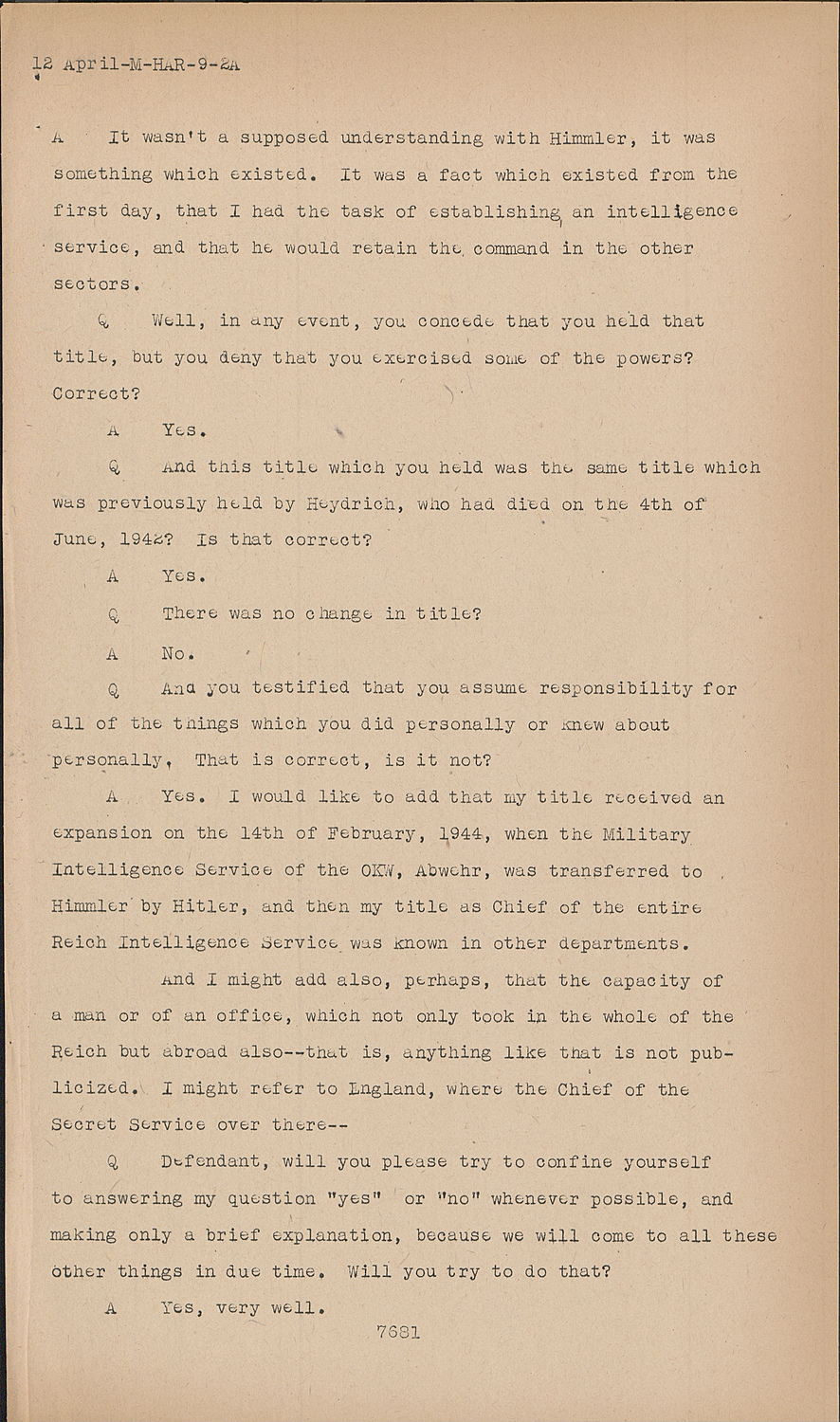
A It wasn't a supposed understanding with Himmler, it was something which existed.
It was a fact which existed from the first day, that I had the task of establishing an intelligence service, and that he would retain the, command in the other sectors.
QWell, in any event, you concede that you held that title, but you deny that you exercised some of the powers?
Correct?
AYes.
QAnd this title which you held was the same title which was previously held by Heydrich, who had died on the 4th of June, 1942?
Is that correct?
AYes.
QThere was no change in title?
ANo.
QAnd you testified that you assume responsibility for all of the things which you did personally or knew about personally.
That is correct, is it not?
AYes. I would like to add that my title received an expansion on the 14th of February, 1944, when the Military Intelligence Service of the OKW, Abwehr, was transferred to Himmler by Hitler, and then my title as Chief of the entire Reich Intelligence Service was known in other departments.
And I might add also, perhaps, that the capacity of a man or of an office, which not only took in the whole of the Reich but abroad also--that is, anything like that is not pub licized.
I might refer to England, where the Chief of the Secret Service over there-
QDefendant, will you please try to confine yourself to answering my question "yes" or "no" whenever possible, and making only a brief explanation, because we will come to all these other things in due time.
Will you try to do that?
AYes, very well.
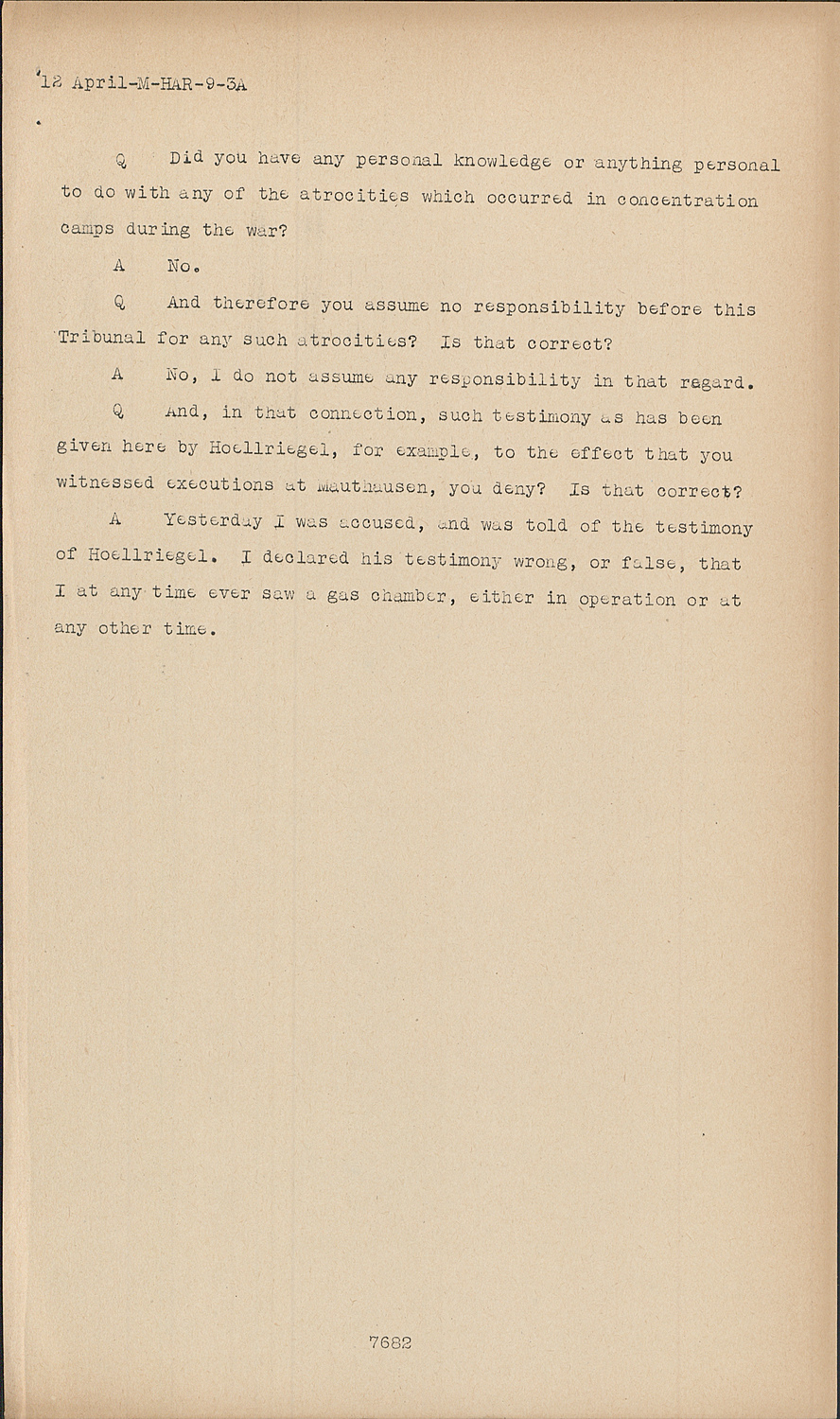
Q Did you have any personal knowledge or anything personal to do with any of the atrocities which occurred in concentration camps during the war?
ANo.
QAnd therefore you assume no responsibility before this Tribunal for any such atrocities?
Is that correct?
ANo, I do not assume any responsibility in that regard.
QAnd, in that connection, such testimony as has been given here by Hoellriegel, for example, to the effect that you witnessed executions at Mauthausen, you deny?
Is that correct?
AYesterday I was accused, and was told of the testimony of Hoellriegel.
I declared his testimony wrong, or false, that I at any time ever saw a gas chamber, either in operation or at any other time.
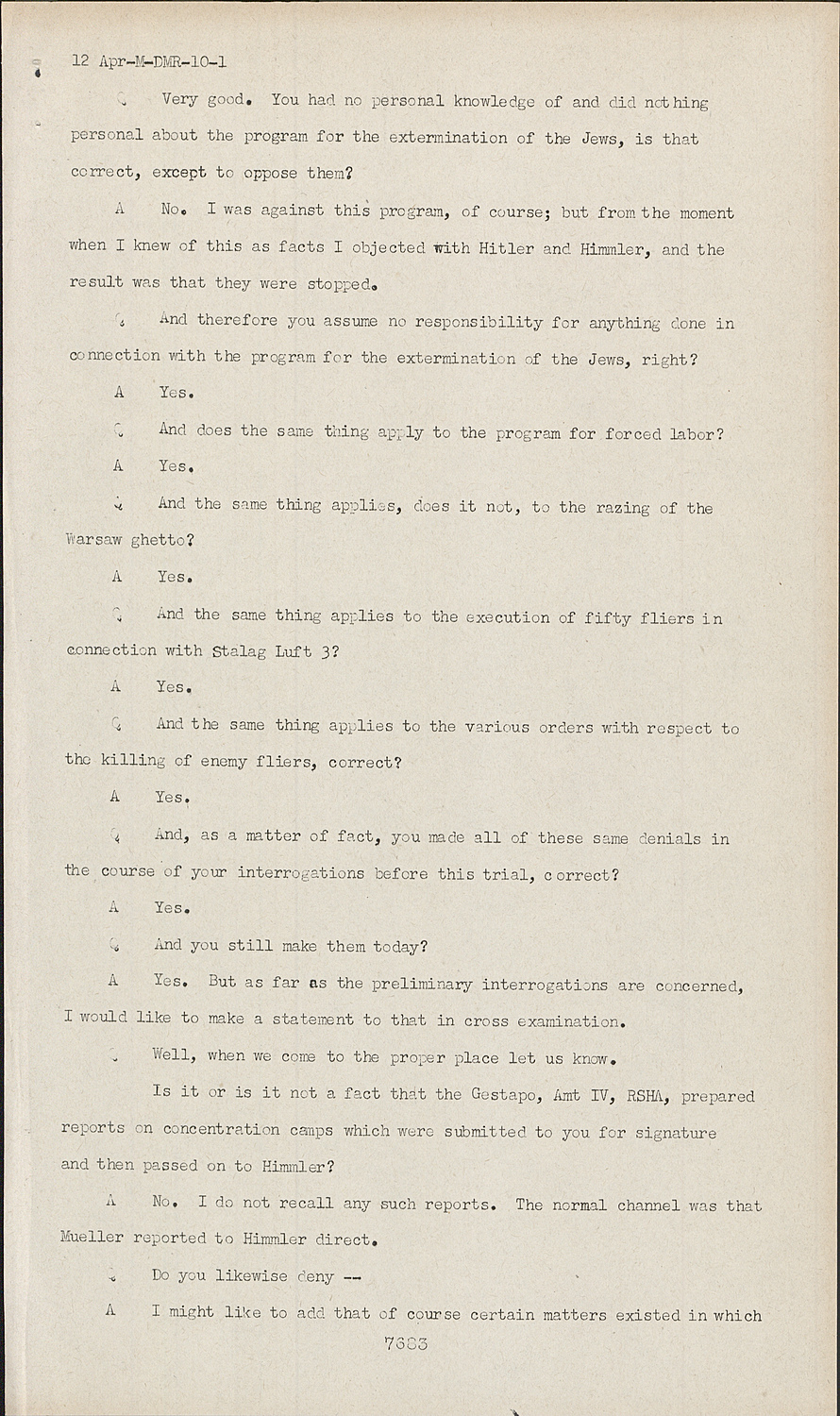
Q Very good. You had no personal knowledge of and did nothing personal about the program for the extermination of the Jews, is that correct, except to oppose them?
ANo. I was against this program, of course; but from the moment when I knew of this as facts I objected with Hitler and Himmler, and the result was that they were stopped.
QAnd therefore you assume no responsibility for anything done in connection with the program for the extermination of the Jews, right?
AYes.
QAnd does the same thing apply to the program for forced labor?
AYes.
QAnd the same thing applies, does it not, to the razing of the Warsaw ghetto?
AYes.
QAnd the same thing applies to the execution of fifty fliers in connection with Stalag Luft 3?
AYes.
QAnd the same thing applies to the various orders with respect to the killing of enemy fliers, correct?
AYes.
QAnd, as a matter of fact, you made all of these same denials in the course of your interrogations before this trial, correct?
AYes.
QAnd you still make them today?
AYes. But as far as the preliminary interrogations are concerned, I would like to make a statement to that in cross examination.
QWell, when we come to the proper place let us know.
Is it or is it not a fact that the Gestapo, Amt IV, RSHA, prepared reports on concentration camps which were submitted to you for signature and then passed on to Himmler?
ANo. I do not recall any such reports. The normal channel was that Mueller reported to Himmler direct.
QDo you likewise deny -
AI might like to add that of course certain matters existed in which I had to be informed for several reasons.