The first time I heard of the affair was when the Foreign Office made representations, or rather, demanded from Nebe and Mueller that the case should be clarified so that they could prepare a note, and I have already said that in this connection, the Foreign Office was informed by the Protecting Power.
General Westhoff's description, in my opinion, is misleading. I think he said that approximately four weeks after the shooting, during a conversation with me he mentioned Sagan. I think that it was at least six weeks afterwards. It should be possible to ascertain when the Foreign Office made that inquiry. Then it would be possible to ascertain the date.
QLater on, when you talked to Mueller and Nebe, what was decided upon as a camouflage for this matter and what was thought of?
ANo camouflage was decided on nor discussed, but when Mueller and Nebe said that they would have to reply to the Foreign Office's inquiry and in that connection informed me of that dreadful order for the first time, I asked them who had given that order, and they replied Himmler. I told than that we ought to get in touch with that man immediately and ask him how the case should be dealt with further. I myself refused to have any connection with what matter. It had been unknown to me up until that time, and I did not want anything to do with in.
QBut was it not mentioned in that connection that it would be said that the fliers had lost their lives through bombs or that they had been shot whilst trying to escape? What do you know in that respect? The witness Schellenberg has stated that there were such conversations.
ASuch words may have been said, yes. It has been described here how the large scale searches were handled, and in connection with these manhunts, there were shootings. Even Germans were shot in that connection. An SS Oberfuehrer in the Alsatian territory was shot on the occasion when he passed a road block which had been erected and refused to stop and there were other such cases, and in fact I was told that two or three of the fliers were actually killed by bombs. I think that was in the town of Kiel or Stettin, and I understand that two Criminal Police officials also lost their lives. That is something that ought to be ascertainable, and in this connection losses through bombing were mentioned, but a camouflage of the whole affair was not discussed in our office.

What we did discuss, what was done, was that on answer was prepared in Himmler's headquarters. The two of them received this inquiry from the Foreign Office and left for Himmler's headquarters.
Q Are you trying to say that the statement according to which these fliers had lost their lives by bombs, or been shot whilst escaping, that that did not originate from you?
ANo, certainly not; it did not originate from me.
QWith reference to the church policy of Department IV, the prosecution is accusing you of the following:
So-called bible scientists, or Jehovah's Witnesses, had often been sentenced to death only because they, on the strength of their inner convic tions, refused to serve in the war.
My question to you is this:
Do you know of this state of affairs, and in what manner did you participate in that question?
AUnder German law there was a basis for proceedings against these Jehovah's Witnesses.
That is, under the law any one could be penalized with detention or death who was interfer ing with German armed strength by refusing to serve in the forces.
According to this law, military, as well as civilian courts, did pronounce the death sentence as to these Jehovah's witnesses.
However, the death sentences did not appear through the channels of the Secret State Police.
In this connection undue harshness against people with a strong belief, such as members of Jehovah's Witnesses, was often mentioned.
I approached the party Chancellery and the Ministry of Justice, and Himmler and Hitler, and pointed the facts out to them, and during several conferences with Thierack I have demanded that this type of handling under the law should cease.
As a result, two things were done immediately. On the occasion of the first conference, after Thierack had made an inquiry at Bormann's office, and Hitler, whom he evidently did not see, a directive was issued to the public prosecutor's office stating that sentences which had already been pronounced were to be can celed.
During a further conference another step could have taken place, which was that the public prosecutors were given instruc-tions to no longer pronounce the death sentence.
The third step was that Jehovah's Witnesses were no longer brought before the court.
I consider it a definite success of my personally mentioning this to Thierack--which later had been discussed with Hitler--that this type of handling of the law was completely done away with.
QI am now submitting document -
AMay I supplement my statement by saying this? This event, or this alteration of German law, became known abroad at that time. I remember quite well, for instance, that a very well known Swedish medical officer thanked me personally and stated that this deed had been well received in Sweden.
THE PRESIDENT:This really is an unnecessary detail about what happened with some Swedish person outside of Germany, as to what they thought of his actions.
DR. KAUFFMANN:Yes. BY DR. KAUFFMANN:
QI am now coming to document 1063-D, USA Exhibit 219. This is a directive from the Chief of the Security Police, dated 17 December, 1942. It is a secret letter, and it is addressed to all commanders of the Security Police and SD; and it goes, for information, to the Higher SS and Police Leaders and the Inspectors of Concentration Camps. It refers to a directive according to which at least 35,000 persons capable of work, by January of 1943, would have to be transferred to concentration camps. The letter is signed by Mueller.
I am asking you, do you know of this letter, or do you know of any such affair at all?
A I neither know the letter, nor do I know the story.
THE PRESIDENT:Will you g ive us the number again?
DR. KAUFMANN:It is 1063-D, USA Exhibit 219. BY DR. KAUFMANN:
QYes?
AFrom the date of the letter, it becomes apparent that this was written before I came into office, and it was net made known to me afterwards either. The signature is Mueller's, and he signed "by order of Himmler", as is shown from line 2. It is a typical case, which proves how unlimited Mueller's authority was, if he could issue such a decree as this.
I gather from the whole content of this lette r--it refers, to a date at the end of January 1943--that this affair had not been reported to me or brought to my notice.
QThe prosecution have held you responsible in the following matter: There was an agreement between the former Minister of Justice Thierack, and Himmler, dated September 13, 1942, according to which Jews Poles, and so forth, were to be subjected to penal police proceedings instead of being dealt with by ordinary law courts.
Now I ask you, did you know of this agreement, and if so, what attempt did you make so as to reinstate ordinary law proceedings so far as that was possible?
ASuch an agreement between Thierack and Himmler is not known to me. As you said it was made in the autumn of 1942. But repeatedly again and again. I worked and submitted proposals that all police courts should be dropped and proper law proceedings should be instituted. For that reason I was mere respected by the courts themselves than Himmler. This was one of the main reasons why we never understood each other, and it was one of the main reasons for differences which cropped up even during our first discussions in 1942.
I can't understand Thierack's actions either, that he did make such an agreement with Himmler, because later on, as I know myself, he repeatedly spoke against the police courts, or the police court system.
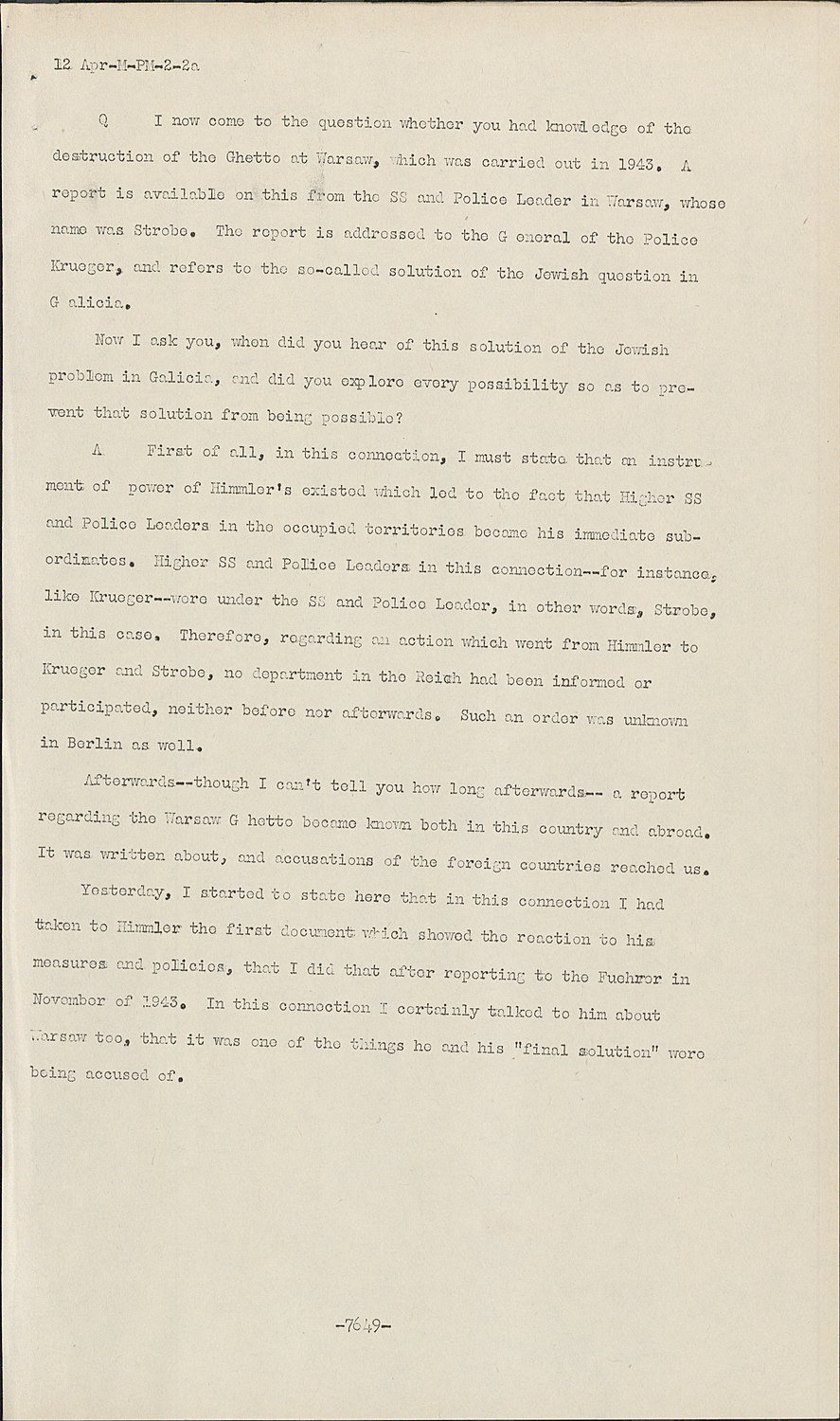
Q I now come to the question whether you had knowledge of the destruction of the Ghetto at Warsaw, which was carried out in 1943.
A report is available on this from the SS and Police Leader in Warsaw, whose name was Strobe. The report is addressed to the G eneral of the Police Krueger, and refers to the so-called solution of the Jewish question in G alicia.
Now I ask you, when did you hear of this solution of the Jewish problem in Galicia, and did you explore every possibility so as to prevent that solution from being possible?
AFirst of all, in this connection, I must state that an instrument of power of Himmler's existed which led to the fact that Higher SS and Police Leaders in the occupied territories became his immediate subordinates, Higher SS and Police Leaders in this connection--for instance, like Krueger--were under the SS and Police Leader, in other words, Strobe, in this case. Therefore, regarding an action which went from Himmler to Krueger and Strobe, no department in the Reich had been informed or participated, neither before nor afterwards. Such an order was unknown in Berlin as well.
Afterwards--though I can't tell you how long afterwards-- a report regarding the Warsaw G hetto become known both in this country and abroad. It was written about, and accusations of the foreign countries reached us.
Yesterday, I started to state here that in this connection I had taken to Himmler the first document which showed the reaction to his measures and policies, that I did that after reporting to the Fuehrer in November of 1943. In this connection I certainly talked to him about Warsaw too, that it was one of the things he and his "final solution" were being accused of.
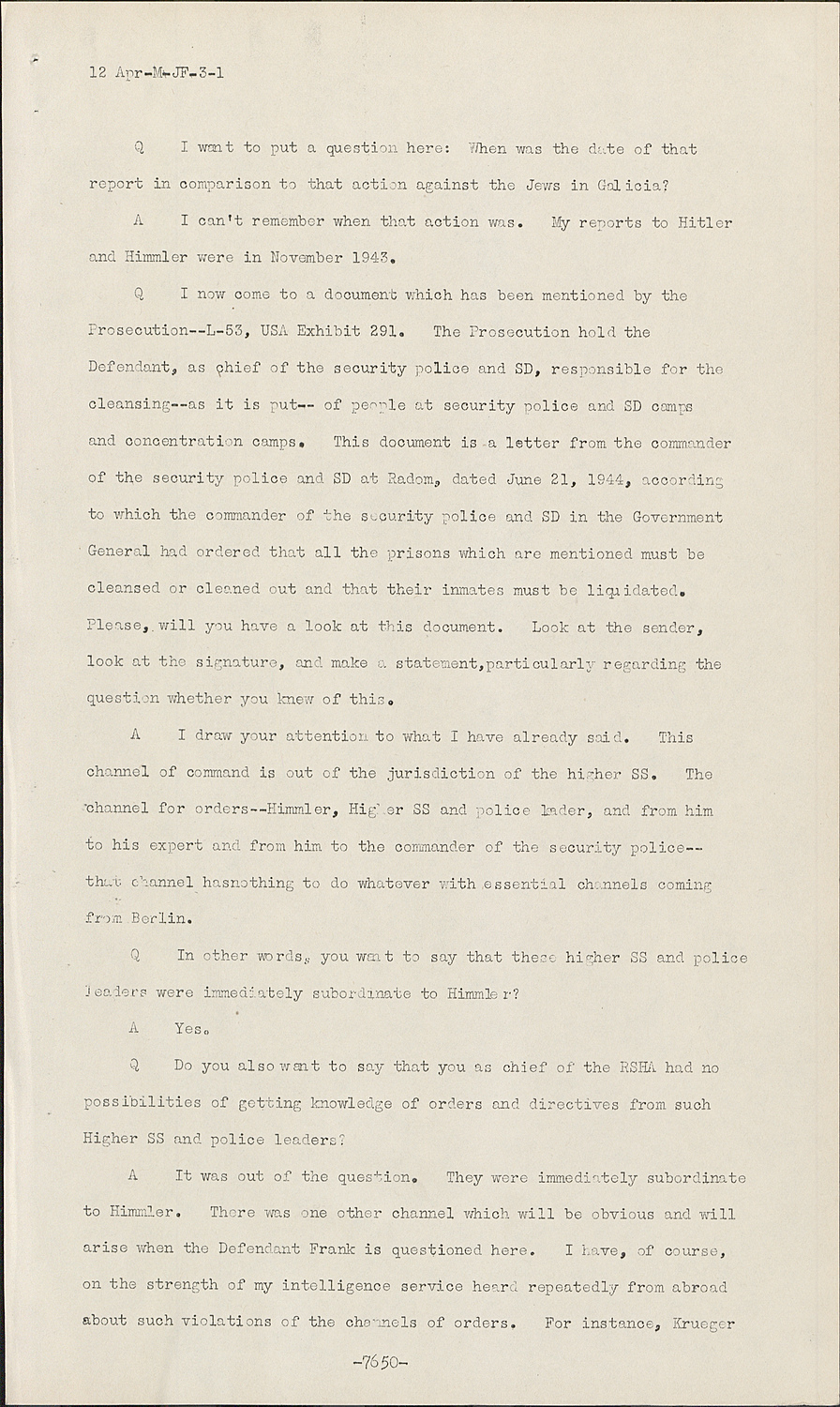
Q I want to put a question here: When was the date of that report in comparison to that action against the Jews in Galicia?
AI can't remember when that action was. My reports to Hitler and Himmler were in November 1943.
QI now come to a document which has been mentioned by the Prosecution--L-53, USA Exhibit 291. The Prosecution hold the Defendant, as chief of the security police and SD, responsible for the cleansing--as it is put-- of people at security police and SD camps and concentration camps. This document is a letter from the commander of the security police and SD at Radom, dated June 21, 1944, according to which the commander of the security police and SD in the Government General had ordered that all the prisons which are mentioned must be cleansed or cleaned out and that their inmates must be liquidated. Please, will you have a look at this document. Look at the sender, look at the signature, and make a statement, particularly regarding the question whether you knew of this.
AI draw your attention to what I have already said. This channel of command is out of the jurisdiction of the higher SS. The channel for orders--Himmler, Higher SS and police leader, and from him to his expert and from him to the commander of the security police-that channel hasnothing to do whatever with essential channels coming from Berlin.
QIn other words, you want to say that these higher SS and police leaders were immediately subordinate to Himmler?
AYes.
QDo you also want to say that you as chief of the RSHA had no possibilities of getting knowledge of orders and directives from such Higher SS and police leaders?
AIt was out of the question. They were immediately subordinate to Himmler. There was one other channel which will be obvious and will arise when the Defendant Frank is questioned here. I have, of course, on the strength of my intelligence service heard repeatedly from abroad about such violations of the channels of orders. For instance, Krueger in the Government General was most violently attacked by me.
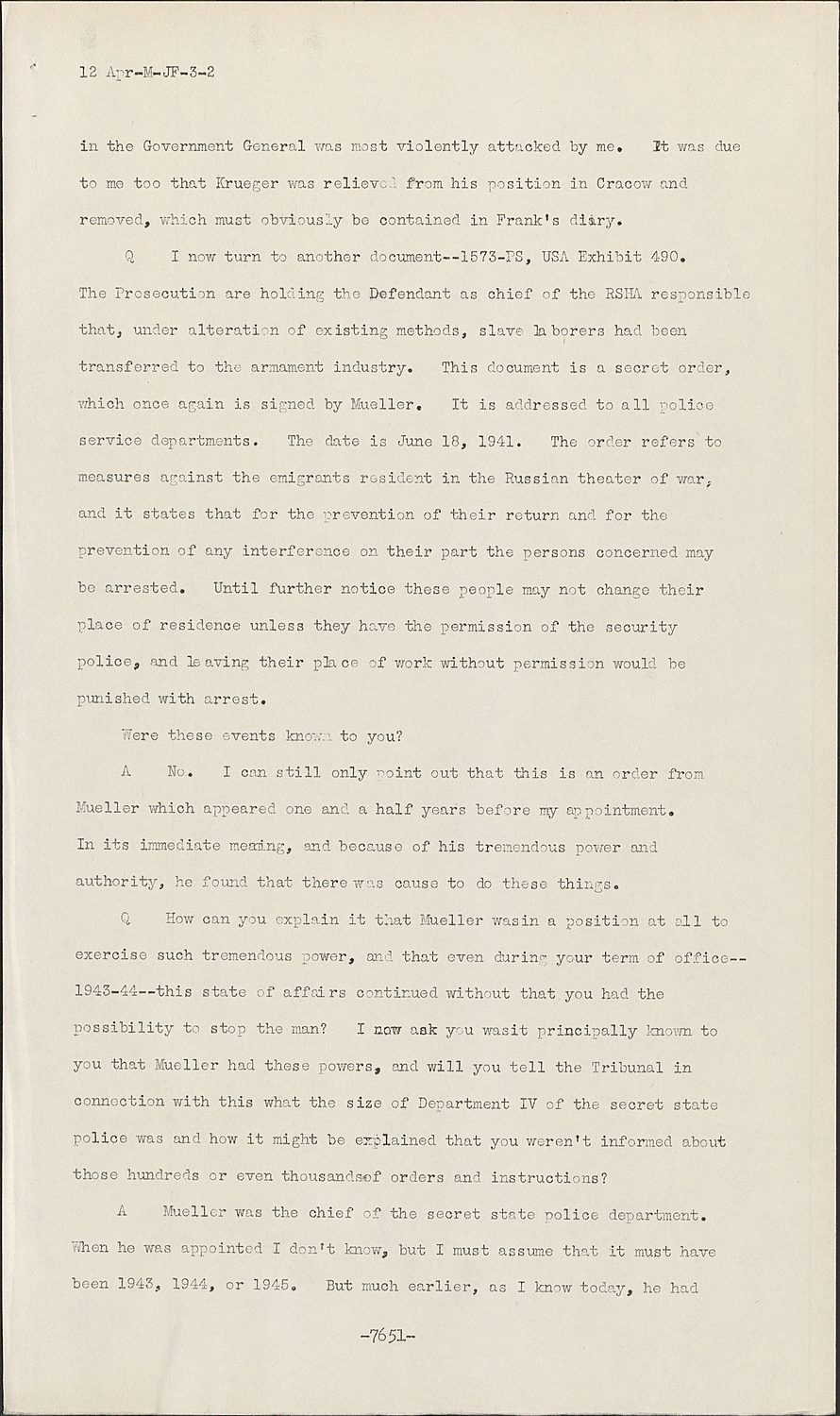
It was due to me too that Krueger was relieved from his position in Cracow and removed, which must obviously be contained in Frank's diary.
QI now turn to another document--1573-PS, USA Exhibit 490. The Prosecution are holding the Defendant as chief of the RSHA responsible that, under alteration of existing methods, slave laborers had been transferred to the armament industry. This document is a secret order, which once again is signed by Mueller. It is addressed to all police service departments. The date is June 18, 1941. The order refers to measures against the emigrants resident in the Russian theater of war, and it states that for the prevention of their return and for the prevention of any interference on their part the persons concerned may be arrested. Until further notice these people may not change their place of residence unless they have the permission of the security police, and leaving their place of work without permission would be punished with arrest.
Were these events known, to you?
ANo. I can still only point out that this is an order from Mueller which appeared one and a half years before my appointment. In its immediate meaning, and because of his tremendous power and authority, he found that there was cause to do these things.
QHow can you explain it that Mueller was in a position at all to exercise such tremendous power, and that even during your term of office-1943-44--this state of affairs continued without that you had the possibility to stop the man? I now ask you wasit principally known to you that Mueller had these powers, and will you tell the Tribunal in connection with this what the size of Department IV of the secret state police was and how it might be explained that you weren't informed about those hundreds or even thousandsof orders and instructions?
AMueller was the chief of the secret state police department. When he was appointed I don't know, but I must assume that it must have been 1943, 1944, or 1945. But much earlier, as I know today, he had the closest contact with Himmler and later with Heydrich.
He originated from the Bavarian County Police, where he met Himmler.
He had his personal confidence for at least twelve or fifteen years. He joined him in every action which Himmler carried out in pursuance of his aims as chief of the German police and helped him to carry them out. This confidence was continually increased for twelve or fifteen years and remained unshaken to the very last days of the war.
Mueller for instance had the order to remain with Himmler, and in fact he did.
Himmler relied on him as his blind instrument and relied solely on him. These things by-passed me absolutely.
THE PRESIDENT:Dr. Kauffmann, the question that you have put to him, or the questions which you put--you put several--he doesn't seem to be answering. The main question was whether he knew of these actions of Mueller. He is giving us a long speech now abort how much confidence Himmler had in Mueller. He hasn't said anything else yet.
DR. KAUFFMANN:Mr. President, I think that this question particularly ought to be dealt with at some length, because what the Gestapo and Mueller are being accused of is what Kaltenbrunner is accused of as chief of the organization,
THE PRESIDENT:What I was pointing out to you was that you had asked him several questions in one, and the main part of the question was whether he knew that Mueller had these powers and was exercising them. BY DR. KAUFFMANN:
QAnswer that question briefly and clearly.
AThe relationship between Himmler and Mueller was so immediate and confidential that there was no cause for him to give me any reports. I had no knowledge, and Himmler expressedly, as early as September 1942, stated that the chiefs of departments four one five were his immediate subordinates, as had been the case since Heydrich's death.
QNow, you are going to be accused, or it is going to be put to you, that based on such written statements and official proof it must be assumed that conferences of departments chiefs must have taken place between you and Mueller, and that it appears improbable that you weren't aware somewhat about the things which Mueller ordered. Isn't that accusation, at least to start with, based on fact?
AIt appears to be, but isn't. What is called a conference of department chiefs here wan something which didn't happen every day but three or four times a week. It was a joint lunch of adjutants, department chiefs, or any guests who might have been in Berlin at the time, and as such that atmosphere made it impossible that internal or secret events could have been discussed in front of all these people.
QIn 1943 and the following years were you always in Berlin, or I think I had better say were you mostly resident in Berlin, or did your work as chief of the intelligence service make it necessary for you to leave Berlin often?
AI was absent from Berlin a great deal. I think I can say that half of the working time was spent away from Berlin. I was only in Berlin from the moment that the headquarters were transferred there. That was the months of February and March, 1945. I was away from the 28th of March until April 15, then from the 19th of April until the last day I was not in Berlin. During the years 1943 and 1944 I didn't reach Berlin until Lay 1943, because up to that time I had my own organization in Vienna which I reorganized so that it could be taken over by my Berlin department. I think only once during the first week in February 1943 did I stay in Berlin so as to pay visits, and from the middle of Feb1943 to February 1945 I was away for at least half the time. I have covered more than 400,000 kilometers by plane and car in my duties.
Q What were your activities when you were absent from Berlin?
Did you not have immediate and Direct contact with Mueller During that time?
ACertainly not with Mueller. During all those journeys of nine in the entire Reich, I never entered one single service Department of the State Police on any occasion. The exceptions are my visits to Linz where my family was living for a while and from which I used to send teleprints to my Department in Berlin but only for technical reasons. I have no other ways of using a teleprinter.
QI am now going to Discuss an affair of which you are accused by the prosecution. To say in a few words, these are the facts. During the suppression of the revolt in Warsaw in 1944, inhabitants of the town of Warsaw were taken to concentration camps. The prosecution put the figure at 50,000 or 60,000. Further deportations are supposed to have ceased due to an intervention of the defendant Frank with Himmler and he, that person, had interfered since defendant Frank and the Secretary of State Buckler had asked you -this should read that your person was included -- had asked you to get these people out of the concentration camps and return them to their homos. To begin with, I ask you, did such a conference on that subject take place in your office?
AA conference between Buckler and myself had taken place. The subject was quite different and I am asking you to let me stateit. The so-called uprising of Warsaw was defeated in a purely military action. I think that the battle took place under the command of the Chief of the Anti-bandit units, under von don Bach-Zelewski. That the units were that he was commanding, I do not know but I must assume that there were mixed troop units of the armed forces and the police. Any participation of my office in this purely military action is out of the question from the start. What Himmler and the troop units may have done with the prisoners, that was naturally not reported to me. The reason why Buckler came to see me was quite a different one. Frank, I think, for one or one and a half years had been trying to get Hitler to employ a different policy in the Government General.
Frank was in favor of increased autonomy for the Polish people.
In October 1944, I think, on the occasion of the National Polish Holiday, Frank had been planning to announce the extension of their autonomy. Hitler's refusal, in which he was encouraged by Himmler and various other factors, was in the way so he sent Buehler to me with the aim that I should make suggestions through the intelligence service, with the same aim, which is to say, participation of the poles in the administration and at the head of the government and I agreed to both and told Buehler so, and then he went on to say on this occasion that "Frank wants a generous amnesty to be pronounced in Poland and that includes the release of the prisinors from the Warsaw uprising, Can't you help us with that?" So I asked him, "Where are those prisoners; probably Himmler sent them to prisoner of war and concentration camps?" And the answer was, and could have been in that case, that "he must have used them in the armament industry and it would be hard for you to get then out;" and at any rate, I couldn't work in that connection for the amnesty.
QWould it have been possible for you, using your entire influence to bring out a release?
ADuring the time I was in office, as I have repeatedly stated during interrogations before the trial, I have received at least 1,000 individual applications for release and every single case was put before Himmler or sent to him -- put before him, into my report file, and mentioning them for verbal discussion when I reported to Himmler verbally. In two-thirds of all the cases I had same success in so far as he ordered their release but to such an extent as Frank was trying to get it through via Buehler, I neither had been able to get a decision or make a decision on my own; that was entire in Himmler's hands and it certainly meant diversion from the policy which he and Hitler agreed on regarding Poland.
QI now put before you a statement from the witness Schellenberg. On January 3rd, this witness stated before this Tribunal, that the evacuation of the concentration camp at Buchenwald had been ordered by Kaltenbrunner.
"Kaltenbrunner," he said "had said 'yes, this is correct; this evacuation is duo to a Fuehrer order which had been confirmed to him, Kaltenbrunner, by the Fuehrer'." Please give your explanation?
AThe statement is quite definitely incorrect. It is incorrect because Hitler quite definitely never ordered an evacuation or even a non-evacuation of concentration camps. Such an order could only originate from Himmler.
THE PRESIDENT:Was there an affidavit or did he give the evidence, Schellenberg?
DR. KAUFFMAN:It was evidence given.
THE PRESIDENT:It was given in evidence, was it?
DR. KAUFFMANN:Yes, a statement here of the witness on January 3rd.
THE PRESIDENT:Yes.
DR. KAUFFMAN:But, then, who did actually give such an order?
AIt could only have been an order from Himmler. The channel of command is quite clear, Himmler-Pohl-Gluecks, and the Camp Commandant. It isn't impossible that Himmler may have given the order direct to the commandant of the camps. That I don't know.
QI want to interpose a question. Did you gain knowledge of the orders?
ANo, I didn't hear of them nor would these orders in any way have had to be taken to no, since I had ordered exactly the contrary regarding Mauthausen, and this is why in the case of M authausen I gave an order for the first and only time and that was something which I propose to state later, in connection with the powers given to me in April 1945, Until then, I never had any possibility to give any such order on behalf of Himmler.
QIn the sane connection, I am mentioning the statement made by the witness Berger, given here on January 3rd. I am reading one or two sentences. The commandant of Dachau says that Berger became his deputy, or his deputy telephoned about twelve o'clock and stated to me that he had received this order, the order for the evacuation from Kaltenbrunner after the Gauleiter of Munich had been asked by the Reich Commissioner.
My question now. Do you know anything about the evacuation of Dachau?
ANo. This statement of Berger must be doubted quite definitely because he was the man who had been given authority by Himmler, concerning Bavaria and all the military territory near the front, which was given to him the same day I had my authority or my powers regarding Austria given to me.
QCan you tell me, did the concentration camp at Dachau come under Berger in accordance with these new powers or did it possibly come into yours?
ASince Dachau is near Munich in Bavaria, it must have come under Berger.
QWas Dachau evacuated at all?
AI don't know; I have never been to Bavaria after, I think, the 19th of April.
QThe witness refers to the date, 23rd of April 1945, or he says a little later. Where abouts were you at the time?
AOn the 19th of April, three o'clock in the morning, I left Berlin and went via Prague, to Linz and then to Innsbruck; wanted to go to Innsbruck where I wanted to meet Burckhardt's representatives. From that moment onwards, I lost touch with Berlin and I did not set foot on Bavarian soil or give orders there. My territory was defined by the Austrian Border.
QHow can you explain this statement.
AThe only way I can explain it is, that this must be a mistake and if Berger were confronted with me here, I am convinced the whole thing can be cleared up.
Q Could there have been an evacuation order signed by Himmler?
ACertainly, perfectly possible.
QAmong other things you have been accused of having committed a crime against peace. Will you tell the Tribunal whether and if so what you have done during your time of office with regard to trying to end the war?
AI commenced my position on February 1, 1943. The situation which I found in the Reich was such that with the effects of the fall of Stalingrad -to be more exact February 2, 1943 -- and in accordance with my convictions the war must have been regarded as lost for Germany. The conditions which I viewed from a completely different viewpoint coming from Austria just confirmed that opinion of mine completely.
I think it was on the 2nd or 3rd of February that I talked to Secretary of State Luther in the Foreign Office and I was talking to him at half past eleven in the morning. We were talking about foreign political intelligence tasks which we would have to carry out together and it went on until two in the afternoon and at four o'clock in the afternoon the same Secretary of State Luther was arrested by the Gestapo.
I do not think I could find any more practical example regarding the atmosphere in which I found myself transferred and how such events as this -
THE PRESIDENT:What is this in answer to? What is the question it is in answer to? BY DR.KAUFFMANN:
QYou ought to come to the point a little more quickly, namely, what you did to bring the war to the quickest possible end?
AI could quote a lot of arguments in this connection but my first efforts were in the spring of 1943. But I think it was even in February 1943 when I favored a completealteration of the church politics and when I considered the Vatican as a preferred medium of achieving peace. That was my first effort in that direction.
QI now wish to mention the name Dalles, a Mr. Dalles. Did you have direct contact or indirect contact with him and what was the purpose of your taking up those connections?
AYes, I was in contact with him through Hoettl. Since May 1943 I, together with Hoettl and others, was leading the political opposition in Auztria over to our side step by step and I met there contacts from foreign countries in favor of peace.
Through these channels Roosevelt's representative was reported as being present in Switzerland.
QI want to ask you a question in that connection. What would have happened if Hitler or Himmler had heard of that attitude of yours?
AMy order to Hoettl and my knowledge of his activity was, if you interpret it strictly, high treason since the Fuehrer's views were known to me at the time and they were that there should be no contact regarding peace or any discussions about peace. That opinion was stated to me by Hitler in the presence of a certain Wolf and as late as the 15 of April 1944.
QIn the course of this so-called peace policy which you have described, did anyone make journeys to Switzerland so as to make contact with that man Dalles?
AYes, there we re a number of journeys and that was not only by Hoettl. There were several other persons. For instance, I can draw your attention to a discussion which I had with Count Pototsky, whom I also asked to get in touch with the same circles and impart the same information an to Anglo-American circles also in Switzerland.
QIn that case I think we can leave this subject. In my opinion you have related the essential parts.
ABut, of course, there was not only that attempt, there were numerous others.
QI now come to your contact with the President of the Red Cross Professor Burckhardt and I ask you, is it true that in 1943 you had a conference with Professor Burckhardt with the aim that camps, prisoner of war camps and concentration camps should be opened to the Red Cross so that medical supplies could be taken into these camps?
AI tried to get into contact with Burckhardt for a long time and I was helped by the fact that he himself wan trying to meet Himmler but Himmler did not get Hitler's permission for sum a meeting because he at that time was the commander on the northern front of the River Weitzel and a meeting with Burckhardt could only have taken place there at the front. I tried, therefore, to arrange a meeting between Burckhardt and a responsible personality in the Reich or to take it upon myself and after a lot of ado and in spite of all the difficulties I succeeded and a personal meeting with Burckhardt was held on March 12.
QDid you come to an agreement and in any such agreement was any help given and in what manner?
AYes, considerable help came. An agreement was reached, according to which all foreign civilian detainees, with the help of the Red Cross, were to be taken from all camps in the Reich and released to their home countries. But in the first place by granting Burckhardt's request during these discussions I achieved the aim that the leading departments of the Reich would be prejudiced by me to such an extent that they could no longer detach themselves from this agreement and that I think was my greatest success with Burckhardt.
QIs it true that to get two or three thousand French and Belgian detainees through the front line you got in touch with Kesselring at his headquarters?
AI sent a wireless message to that headquarters just as the Americans and British had to get prepared so the Germans too would permit this number of people to go through the lines.
QThat is enough.
THE PRESIDENT:Dr. Kauffmann, he said March 12 but he did not give the year.
DR. KAUFFMANN:I do not understand -- yes, March 12.
THE PRESIDENT:What year?
DR. KAUFFMANN: 1945. BY DR. KAUFFMANN:
QWhat is the total number of people who, due to your intervention, reached their homeland?
A You have got to refer to two different periods. The first period which is period before the personal meeting on the 12th of March and the period after that.
QBut in my opinion you can give me a brief answer to that question. We are not really concerned with the period.
AAt least six thousand civilian detainees coming from France and Belgium and all the eastern European states including the Balkan states were included in these talks. At least fourteen thousand Jewish detainees were handed over to the Red Cross for their immediate care at Theresienstadt. This applies to the whole camp at Theresienstadt.
QAnd is it correct and please either answer it in the affirmative or if not very briefly, whether it is due to your intervention at Lake Constance, there was a special liaison department with the Red Cross which was serving the purpose of helping the carrying out of this program.
AA liaison department was established at Constance.
QThat is enough.
The Prosecution holds you responsible for a wireless message you are supposed to have sent to Fegelein in which it says: "Please report to the Reichsfuehrer that all measures regarding Jews, political and concentration internees in the protectorate, have been carried out by me personally today."
Did you send, such a wireless?
AIt was not sent because it -
THE PRESIDENT:What is the number?
DR. KAUFFMANN:Mr. President, I did not mention a number. It was not presented in Court but it is contained in the trial brief on page 14.
THE PRESIDENT:I think it is 2519-PS. It was presented to the Court.
A (continued) The wireless message was planned -- the text probably was written by the adjutant who was accompanying me. I did not write it personally and as I say it was not sent.
On April 19, 1943 I had been given authority in accordance with the discusions with Burckhardt I would act independently (1) with reference to foreign civilian detainees and regarding the entering of all camps by the Red Cross. On that occasion I stated in Hitler's and Himmler's presence that my route would go through Prague to Linz and Innsbruck and that I would pass by Theresienstadt and I said that there were not only Jewish detainees there who were to be looked after by the Red Cross but also Czechs, political detainees.
I suggested that their release should also be carried out and that is the explanation for that wirelessmessage. But not until the 19th of April at six o'clock in the evening was I given these powers.
QBut the Prosecution might assume from that statement, and rightly so, that you night have had jurisdiction over concentration camp questions. Please answer that question with yes or no, the one I am going to put to you.
Is it true that the powers you have mentioned given to you on April 19, 1945 were the first powers in that sphere altogether..
AYes, otherwise a renewed authority or renewed power would not have been necessary.
QIn a speech Himmler made on the 3rd of October 1942 at Posen which he delivered to the higher SS Police Leaders you are called Heydrich's successor. The Prosecution consider that this is a confirmation of the entire executive power and the extra-ordinary powers and authority you had.
Does this formal expression which was certainly used in this connection do justice to the situation or not?
ANo, I definitely refuse to admit that and I have done so during interrogations. I deny that I was Heydrich's successor or that I had been called that. If in my absence Himmler referred to me as such or if earlier on such a notice was published in the press coming from him, then this was done without my knowledge, and without my wish and the first time in connection with that press notice there was a violent reaction on my part. The day which you mentioned here I was sick in Berlin with an inflamed artery and therefore did not join that discussion.
Neither did any powers nor any authority permit any comparison with Heydrich and I want to say quite briefly now that to the very last day of my activity I was paid 1,820 marks, which is the salary of a general of the police and that Heydrich's income from him office was more than thirty thousand marks, not because he was paid for a higher rank but in recognition of the fact that he had a completely different position than I did and a comparison is completely out of the question.