QI will give you something which you have read.
AAs to the facts about which you ask me, to that I have to answer "yes". I don't know the figures, but the facts.
QAnd you can't answer my question? You can't give us any reason as to why the Wehrmacht and those other offices were sending these 24,000 people, who had been sentenced by ordinary courts, over to the SD? You can't give us any reason for that?
ANo, except that I could say that up to a point I can. I think "SD" is a mistake; it is an error. I think police custody is what we are concerned with.
QCertainly not.
AWhether it might have been the same thing I don't know.
QSurely you have been at this trial too long to think that handling people over to the SD means police custody. I t means a concentration camp and a gas chamber usually, does it not? That is what it meant in fact, whether you know it or not.
AI didn't know it, but it is obviously the result. Very probably, the and was a concentration camp. I consider it possible, and, at any rate, I cannot say that it was not.
THE PRESIDENT:Sir David, the last paragraph but one refers to the OKW.
SIR DAVIDMAXWELL-FYFE: Yes, My Lord, I am just coming to that. BY SIR DAVID MAXWELL-FYFE:
QIf you will notice that, defendant, two paragraphs below the one I put to you it states:
"As OKW does not set any great store by passing sentence on the trifles still remaining for the military courts, it has been left for local agreement to deal with them by decree."
It is quite clear that your office was deeply concerned in this business, was it not, defendant?
AJust what that means I don't know, but it obviously had been mentioned during that, conference.
Q Now, before I put the next document, I want you to realize how we have been going.
We started with the Nacht and Nebel decree, which disappeared, and we went on to the terror and sabotage decree. We then proceeded to acts which were less than terror and sabotage, but were criminal acts under the rules of the occupying powers.
I now want you to consider what was done to people who simply refused to work. Would you look at 769? That is GB-304. That is a telegram from Luftwaffe General Christiansen, who was in the Netherlands, Commander of the Armed Forces in the Netherlands, through his Chief of Staff.
Now listen to this:
"Owing to strike of railway men, all communications in Holland at a standstill. Railway personnel does not obey the appeal to resume work. The call for providing motor vehicles and other means of transport to make the troops mobile and to maintain supplies is no longer answered by the civil population. According to the Fuehrer's decree of the 18th of August, 1944"-- that is the terror and sabotage decree, which you have already had-- "and the executive instructions of the Chief of the OKW", which we have already seen, "the troops may use armed force only against persons who commit acts of violence as terrorists or saboteurs, whereas persons who endanger the security or war preparedness of the occupying power in any way, by terrorism or acts of sabotage, are to be handed ever to the SD."
Then General Christiansen comes in with this:
"This regulation has proved too round-about, and therefore ineffective. In the first place, the necessary police forces are lacking. The troops must again receive authority to shoot, with or even without summary trial, such persons also as are not terrorists or saboteurs in the sense of the Fuehrer's decree, but who endanger the fighting forces by their passive attitude. It is requested that the Fuehrer's decree be altered accordingly, as the troops cannot otherwise assert themselves effectively against the population, which, in its turn, appears to endanger the conduct of the operations."
Now, defendant, will you agree that shooting, with or even without trial, railway men who won't work, is about as brutal and cruel a measure as could well be imagined by the mind of man? Do you agree?
AThat is a cruel measure, yes.
Q What was your answer to that cruel measure?
AI can't tell you now, I don't recollect the incident at all, but perhaps an answer is available.
QWell, look at the document D-770, which is, I think, your answer; it is GB-305. You will notice on the distribution list that that goes to the Commander of the Armed Forces in the Netherlands, and further to the signal which we have just been looking at. Now, you say:
"According to the Fuehrer's order of 30 July, 1944, non-German civilians of the occupied territories who attack us in the rear in the decisive stage of our battle for existence, deserve no consideration. This must be the guiding line for the interpretation and application of the Fuehrer's decree itself and of the Chief of the OKW's executive decree of 18 August 1944. If handing over to the SD is impossible, wing to the military situation and the state of communication, other effective measures are to be taken ruthlessly and independently.
"There are, naturally"--and I ask you to note the word "naturally"-"no objections to passing and executing death sentences by summary court procedure under such circumstances."
I can't remember, defendant, whether you have ever had an independent command youself or not. Have you? Have you had an independent command, apart from your division? I think that was the last independent command you had. You haven't had an independent command yourself, have you?
Don't I make myself clear?
AI didn't understand. What do you mean by "independent"?
QI mean that you haven't been a commander or chief of an army or army group yourself, if I remember rightly, or of an area, have you?
ANo, I was not.
QI ask you to put yourself in General Christiansen's position. That answer of yours was a direct encouragement, practically amounting to an order, to shoot these railway men out of hand, was it not? "To take other effective measures ruthlessly and independently."
AThat is explained by using summary court procedure. It isn't left to the initiative of the individual; there was to be summary court procedure.
QJust look at the way it is put, defendant. I suggest to you that it is quite clear.
One sentence states: "If handing over to the SD is impossible, owing to the military situation and the state of communication, other effective measures are to be taken ruthlessly and independently."
Then, the next sentence: "There are, naturally"-- look at the word "naturally". I suppose that it was "natuerlich" in German. Is that correct?
AI haven't got the word "natuerlich" here. Two wards, so far as I can make out, have been inserted.
QBut it says: "There are, naturally, no objections to passing and executing death sentences by summary courts." What you are saying is that, of course, there is no objection to a summary court, but you are telling him addition to that, that he is to take effective measures ruthlessly and independently. If General Christiansen had shot these railway men jut of hand, after getting that letter from you, neither you nor any other superior could have blamed him for it, could you?
AAccording to the last sentence, it was his duty to carry out summary court procedure. It says that there are no objections to the executing of this sentence by summary court procedure under such circumstances.
QBut what did you mean by "effective measures to be taken ruthlessly and independently"? What did you mean by that, if it was only an ordinary summary court procedure?
ABy that I don't mean apart from summary court procedure, but by means of same. That is what the last sentence means.
QWell, I put my point to you.
AIt is unusual if a summary court is used in such connection.
QYes, even on your basis, to use a military summary court to short railway men who won't work is going rather far even for you, is it not? It is going rather far, isn't it?
AThat was certainly a very severe measure.
QDo you tell the Tribunal that when you make all those additions-taking you through the chain of additions that you made to the order replacing the Nacht and Nobel order, of which you disapproved, do you say that you went to Hitler for every one of these executive orders and answers that you made?
AYes. I didn't issue any of these orders without having submitted then to the Fuehrer first.
I must definitely emphasize that that was so.
DR. NELTE:Mr. President, I think a misunderstanding has crept into the translation.
It says in the translation "Standgericht", "Summary Court". I don't believe that the words "Summary Court" reflect accurately what we understand in the German language under "Standgericht.
I don't know just what you understand in the English or American language under "Summary Court", but I can imagine that this is some summary procedure.
SIR DAVIDMAXWELL-FYFE: I was taking it in favor of the defendant that it meant the court he referred to yesterday, one officer and two soldiers.
I was taking that. If I am wrong, the defendant will correct me.
Is that right, defendant?
THE WITNESS:I briefly talked about this "Standgericht" court martial procedure yesterday, and it was a fact that it wasn't always necessary that a fully trained person needed to be present.
THE PRESIDENT:While you are on the subject of translation, the defendant seemed to suggest that there was he word in the German which is translated by the English word "naturally". Is that true?
SIR DAVIDMAXWELL-FYFE: I had it checked, and I am told that the translation is right.
THE PRESIDENT:There is a German word which is translated by "naturally"? I should like to knew that from Dr. Nelte.
DR. NELTE:I am told that possibly an error of judgment could he caused in this connection by assuming that in American rood British law a summary court is not at all entitled to pass death sentences.
I am told that a summary court-
THE PRESIDENT:Excuse me, Dr. Nelte; I didn't ask that question.
The question I asked you was whether there was any German word which is translated into English by the word "naturally". Is that not a clear question?
Perhaps you haven't got the German text.
DR. NELTE: In the German text it says "under such circumstances, of cours It is, in my opinion, not correct that the translation into English uses the word "Naturally". That is put at the beginning so that you could come to the conclusion that there are naturally no objections, whereas in the German it says "against passingof and executing death sentences by summary court procedure there are, under such circumstances, of course no objections."
THE PRESIDENT:Then the answer to my question is "yes" There is a word in the German which is translated "naturally"
DR. NELTE:Yes, but the words "naturally" and "under such circumstances" are separated in the English version, whereas in the German version they belong together. "Naturally" refers to "under such circumstances".
QNow I want to come to another point. You told us yesterday that with regard to forced labor you were concerned in it because there was a shortage of manpower and you had to take men out of industry for the Wehrmacht. Your office was concerned with using military forces in order to try to round up people for forced labor, was it not?
AI don't think that is quite the correct conception.
QIf you are going to deny it, I put the document to you. I put General Warlimont's views to you and see if you agree. I think it saves time in the end. If you look at document 3819-PS, which will be GB 306 -- page 9 of the English version -- it is the report of a meeting at Berlin on the 12th of July, 1944. You have to look on through the document after the letters from the Defendant Sauckel and the Defendant Speer -- the account of a meeting in Berlin. I think it is page 10 of the German version. It starts with a speech by Dr. Lammers and goes on with a speech by the Defendant Sauckel, then a speech from the witness Von Steengracht, then a speech from General Warlimont:
"The Deputy of the head of the OKW, General Warlimont, referred to a recent ly issued Fuehrer order." Have you found the portion? I will read it if you have
AYes, I have found the paragraph "The Deputy of the Chief of the OKW" Q "The Deputy of the Head of the OKW, General Warlimont, referred to a recently issued Fuehrer order, according to which all German forces had to place themselves in the service of the work of acquiring manpower.
Wherever the Wehrmacht was and was not employed exclusively in pressing military duties, as for example, in the construction of the coastal defenses, it would be available, but it could not actually be assigned for the purposes of the G A. General Warlimont made the following practical suggestions:
"a) The troops employed an fighting partisans are to take over in addition the task of acquiring manpower in the partisan areas. Every me who cannot fully prove the purpose of his stay in these areas is to be seized forcibly.
"b). When large cities, due to the difficulty of providing food, are wholly or partly evacuated, the population suitable for labor commitment is to be put to work with the assistance of the Wehrmacht.
"c) The seizing of labor recruits among the refugees from the areas near the front should be handled especially intensively with the assistance of the Wehrmacht."
After reading this report of General Warlimont's words, do you still say that the Wehrmacht -
AI am not aware that the armed forces have over received an order referring to the rounding up of workers. I haven't found any indication of such a case. The conference as such is unknown to me and so are the proposals you mentioned. It is new as far as I am concerned.
QIt is quite clear that General Warlimont is suggesting that the Wehrmacht should help in the rounding up of forced labor, isn't it?
ABut as far as I know it has never happened. I don't know that any such order was given. According to the record, this is a proposal made by General Warlimont, yes.
THE PRESIDENT:Sir David, perhaps in these circumstances you should read the three lines after the passage you have read.
My Lord, I should. The next line: "Gauleiter Sauckel accepted these suggestions with thanks and expressed the expectation that certain successes could therewith already be achieved."
AMay I say something about that? May I ask that when the time comes Gauleiter Sauckel should be asked whether and to what extent troops of the armed forces did actually participate in such matters. It is not known to me, anyway.
QNo doubt the Defendant Sauckel will be asked a number of questions in due time.
At the moment I am asking you. You say that you don't know anything about it?
ANo, I don't recollect that an order has been given in this connection. That measures have been taken I can gather from the statement from Warlimont.
ANow I want to ask you a few questions about the murder of various prisoners of war. I want to get it quite clear. Did you mean yesterday to justify the order for the shooting of commandos, dated the 18th of October, 1942? Did you wish to say that it was right and justified, or not?
AI stated yesterday that neither General Jodl nor I thought that we were in a position or considered it suitable that a written order should be drafted or submitted. We didn't do it because we couldn't explain offhand reasons for it.
QThe next question that I put to you is this: Did you approve and think right the order that was made that commandos should be shot?
AI no longer resisted, firstly because of the fear of punishment, and secondly because I could no longer alter that order without personal orders from Hitler.
QDid you think that that order was right?
AAccording to my inner convictions I did not consider it right, but after it had been given I did not contradict or resist or work against it in any way.
QYou know that your own orders had contained provisions for the use of parachutists being dropped for sabotage purposes, don't you? Your own orders have contained that prevision of parachutists being dropped for sabotage purposes. Don't you remember in the Fall Gruen against Czechoslovakia I would put it to you if you like, but I would so much prefer that you try to remember it yourself. Don't you remember that your own orders contained a provision for parachutists being dropped for sabotage purposes in Czechoslovakia?
ANo.
QYou don't?
ANo, I do not remember that.

SIR DAVID MAXWELL FYFE: My Lord, it is page 21 and 22 of the document book.
THE FITNESS:May I ask which document book?
SIR DAVID MAXWELL FYFE:Yes. It ought to be your first document book, and quite early on. It is part of the Fall Gruen, which is document 388-PS, and it isitem 11. I think it is somewhere about page 15 or 16. You remember the Schmundt minutes are divided into items.
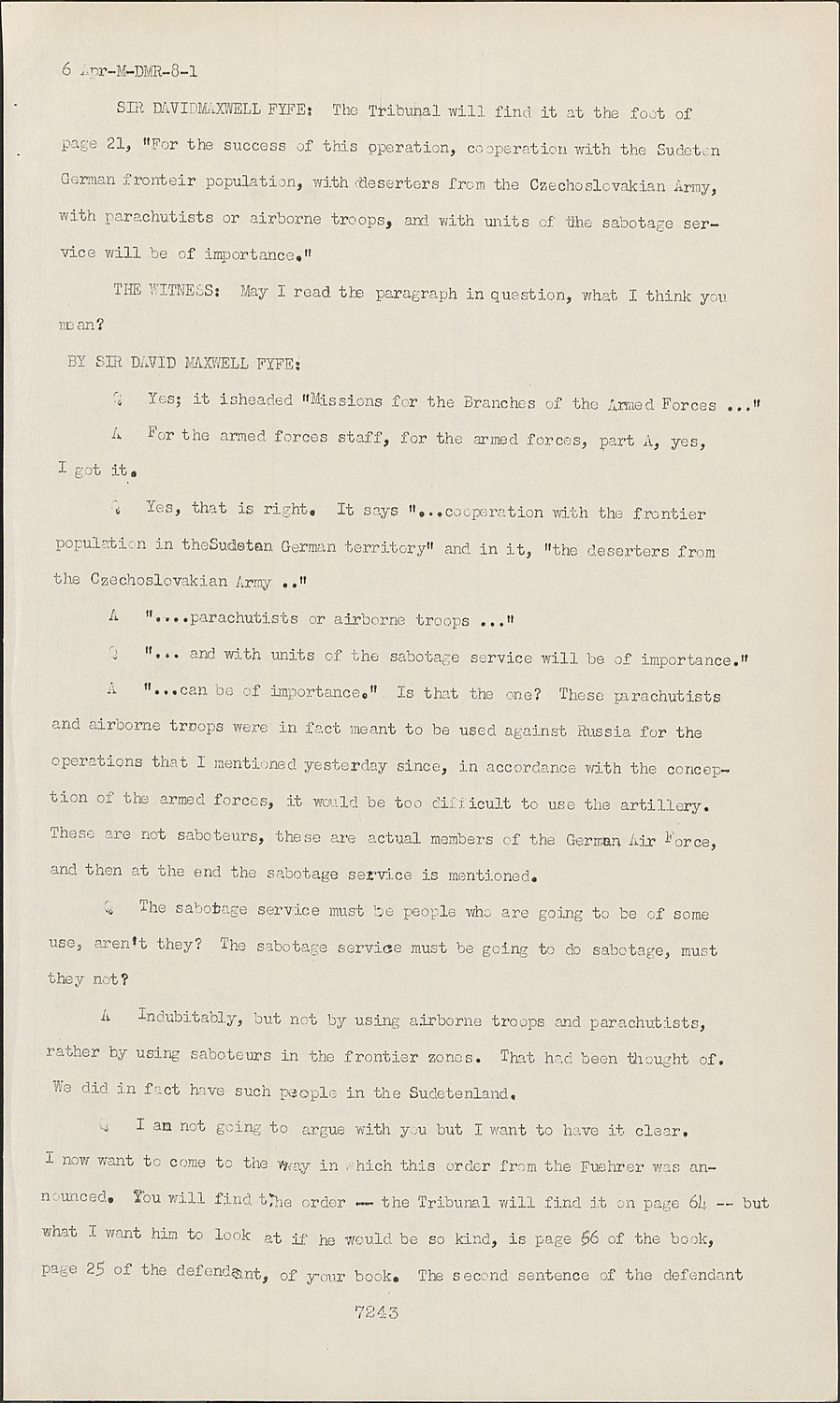
SIR DAVIDMAXWELL FYFE: The Tribunal will find it at the foot of page 21, "For the success of this operation, cooperation with the Sudeten German fronteir population, with deserters from the Czechoslovakian Army, with parachutists or airborne troops, and with units of the sabotage service will be of importance."
THE WITNESS:May I read the paragraph in question, what I think you mean?
BY SIR DAVID MAXWELL FYFE:
QYes; it isheaded "Missions for the Branches of the Armed Forces ..."
AFor the armed forces staff, for the armed forces, part A, yes, I got it.
QYes, that is right. It says "...cooperation with the frontier population in theSudetan German territory" and in it, "the deserters from the Czechoslovakian Army .."
A "....parachutists or airborne troops ..."
Q "... and with units of the sabotage service will be of importance."
A "...can be of importance." Is that the one? These parachutists and airborne troops were in fact meant to be used against Russia for the operations that I mentioned yesterday since, in accordance with the conception of the armed forces, it would be too difficult to use the artillery. These are not saboteurs, these are actual members of the German Air Force, and then at the end the sabotage service is mentioned.
AThe sabotage service must be people who are going to be of some use, aren't they? The sabotage service must be going to do sabotage, must they not?
AIndubitably, but not by using airborne troops and parachutists, rather by using saboteurs in the frontier zones. That had been thought of. We did in fact have such people in the Sudetenland.
QI am not going to argue with you but I want to have it clear. I now want to come to the way in which this order from the Fuehrer was announced. You will find the order -- the Tribunal will find it on page 64 -- but what I want him to look at if he would be so kind, is page 56 of the book, page 25 of the defendant, of your book. The second sentence of the defendant Jodl "Top Secret copy to Commandos" about this order.
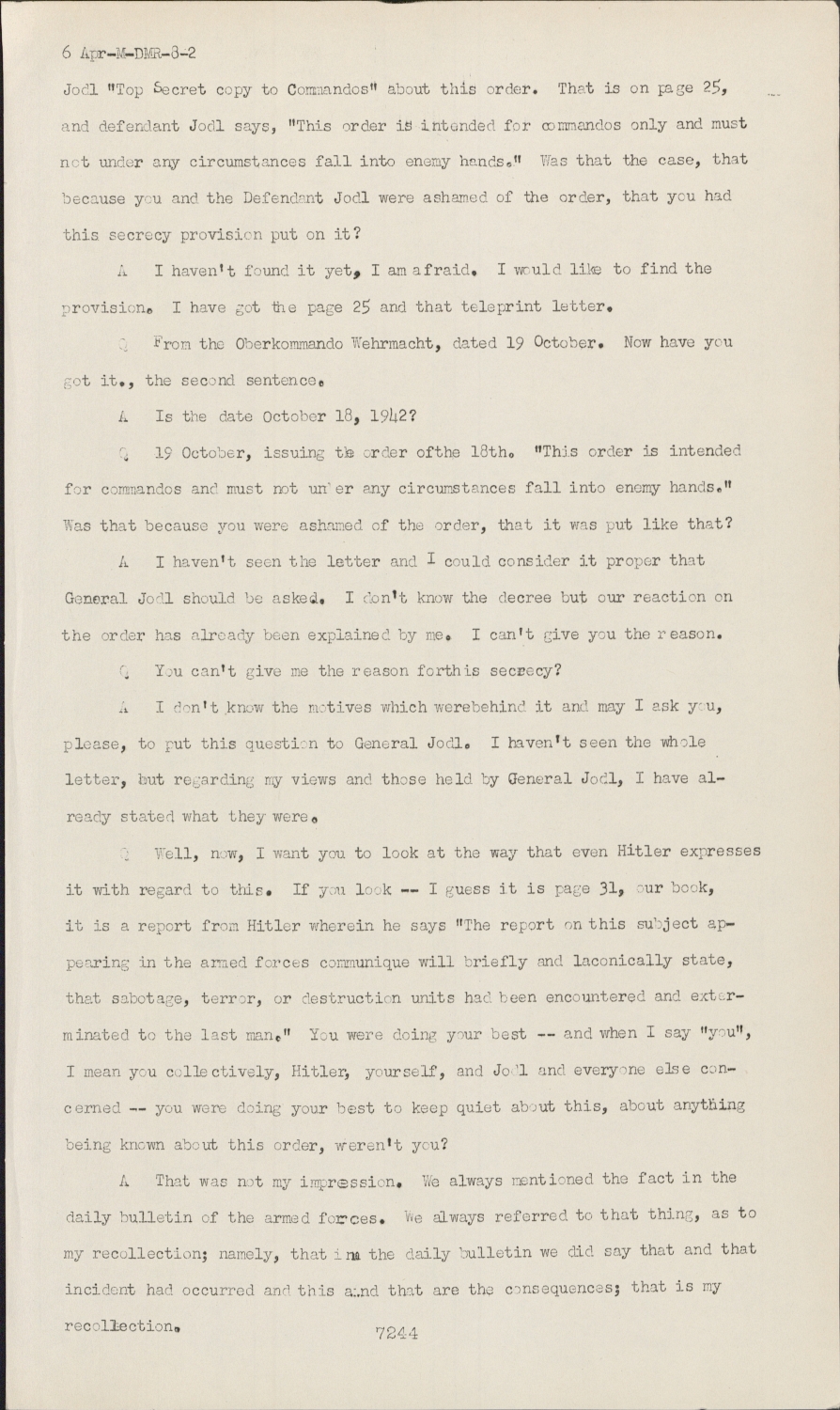
That is on page 25, and defendant Jodl says, "This order is intended for commandos only and must not under any circumstances fall into enemy hands."
Was that the case, that because you and the Defendant Jodl were ashamed of the order, that you had this secrecy provision put on it?
AI haven't found it yet, I am afraid. I would life to find the provision. I have got the page 25 and that teleprint letter.
QFrom the Oberkommando Wehrmacht, dated 19 October. Now have you got it., the second sentence.
AIs the date October 18, 1942?
Q 19 October, issuing the order ofthe 18th. "This order is intended for commandos and must not under any circumstances fall into enemy hands." Was that because you were ashamed of the order, that it was put like that?
AI haven't seen the letter and I could consider it proper that General Jodl should be asked. I don't know the decree but our reaction on the order has already been explained by me. I can't give you the reason.
QYou can't give me the reason forth is secrecy?
AI don't know the motives which werebehind it and may I ask you, please, to put this question to General Jodl. I haven't seen the whole letter, but regarding my views and those held by General Jodl, I have already stated what they were.
QWell, now, I want you to look at the way that even Hitler expresses it with regard to this. If you look -- I guess it is page 31, our book, it is a report from Hitler wherein he says "The report on this subject appearing in the armed forces communique will briefly and laconically state, that sabotage, terror, or destruction units had been encountered and exterminated to the last man." You were doing your best -- and when I say "you", I mean you collectively, Hitler, yourself, and Jodl and everyone else concerned -- you were doing your best to keep quiet about this, about anything being known about this order, weren't you?
AThat was not my impression. We always mentioned the fact in the daily bulletin of the armed forces. We always referred to that thing, as to my recollection; namely, that in the daily bulletin we did say that and that incident had occurred and this and that are the consequences; that is my recollection.
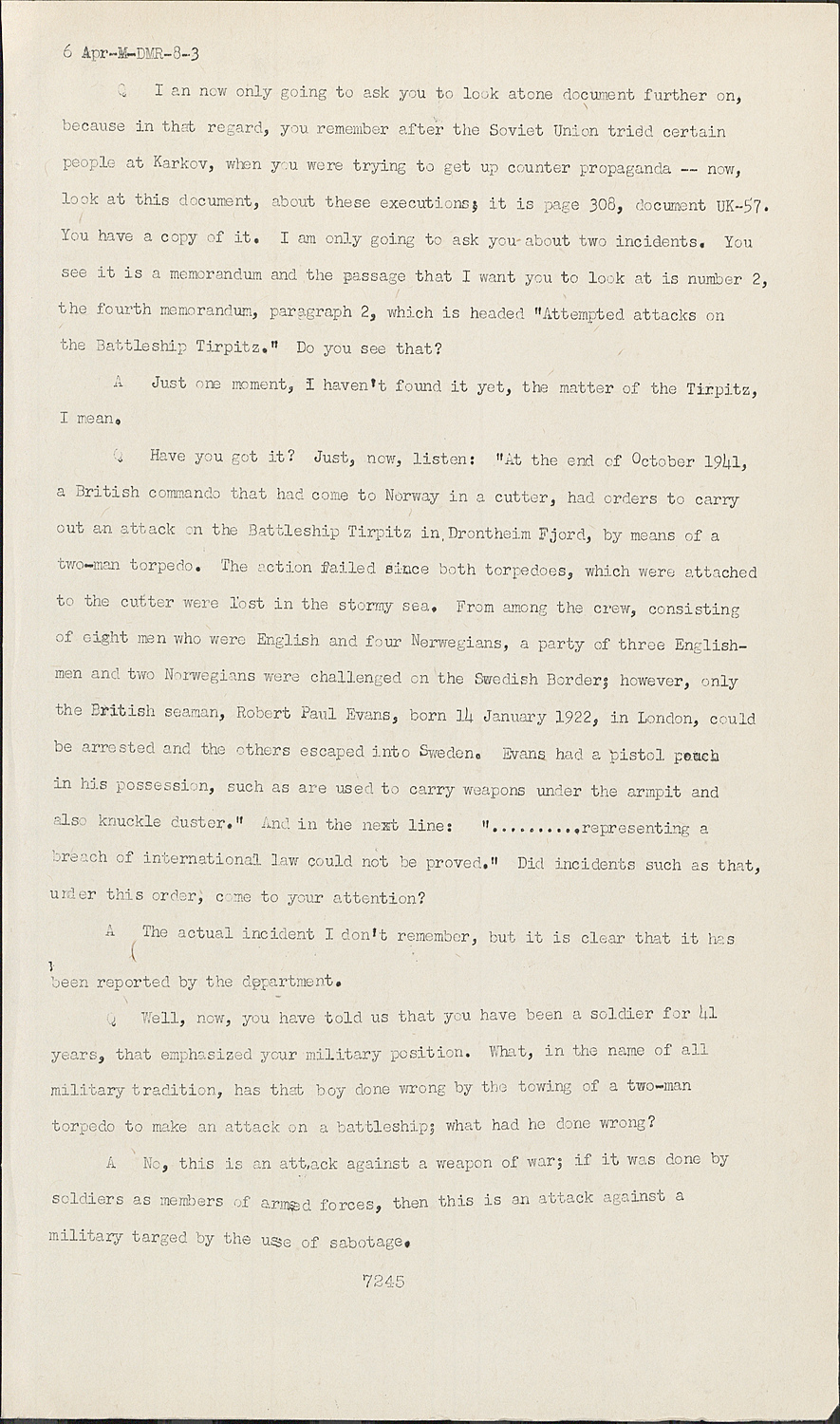
Q I am now only going to ask you to look atone document further on, because in that regard, you remember after the Soviet Union tried certain people at Karkov, when you were trying to get up counter propaganda -- now, look at this document, about these executions, it is page 308, document UK-57.
You have a copy of it. I am only going to ask you about two incidents. You see it is a memorandum and the passage that I want you to look at is number 2, the fourth memorandum, paragraph 2, which is headed "Attempted attacks on the Battleship Tirpitz." Do you see that?
AJust one moment, I haven't found it yet, the matter of the Tirpitz, I mean.
QHave you got it? Just, now, listen: "At the end of October 1941, a British commando that had come to Norway in a cutter, had orders to carry out an attack on the Battleship Tirpitz in Drontheim Fjord, by means of a two-man torpedo. The action failed since both torpedoes, which were attached to the cutter were lost in the stormy sea. From among the crew, consisting of eight men who were English and four Norwegians, a party of three Englishmen and two Norwegians were challenged on the Swedish Border; however, only the British seaman, Robert Paul Evans, born 14 January 1922, in London, could be arrested and the others escaped into Sweden. Evans had a pistol peach in his possession, such as are used to carry weapons under the armpit and also knuckle duster." And in the next line: "..........representing a breach of international law could not be proved." Did incidents such as that, under this order, come to your attention?
AThe actual incident I don't remember, but it is clear that it has been reported by the department.
QWell, now, you have told us that you have been a soldier for 41 years, that emphasized your military position. What, in the name of all military tradition, has that boy done wrong by the towing of a two-man torpedo to make an attack on a battleship; what had he done wrong?
ANo, this is an attack against a weapon of war; if it was done by soldiers as members of armed forces, then this is an attack against a military targed by the use of sabotage.

Q If you were prepared to tow a two-man torpedo for an attack against a battleship, what is wrong with a sailor doing that?
I want to understand what is in your mind. What do you as a man who has been a soldier for forty years, what do you see wrong for a man doing that, towing out a torpedo against a battleship? Tell us. I can't understand what is wrong.
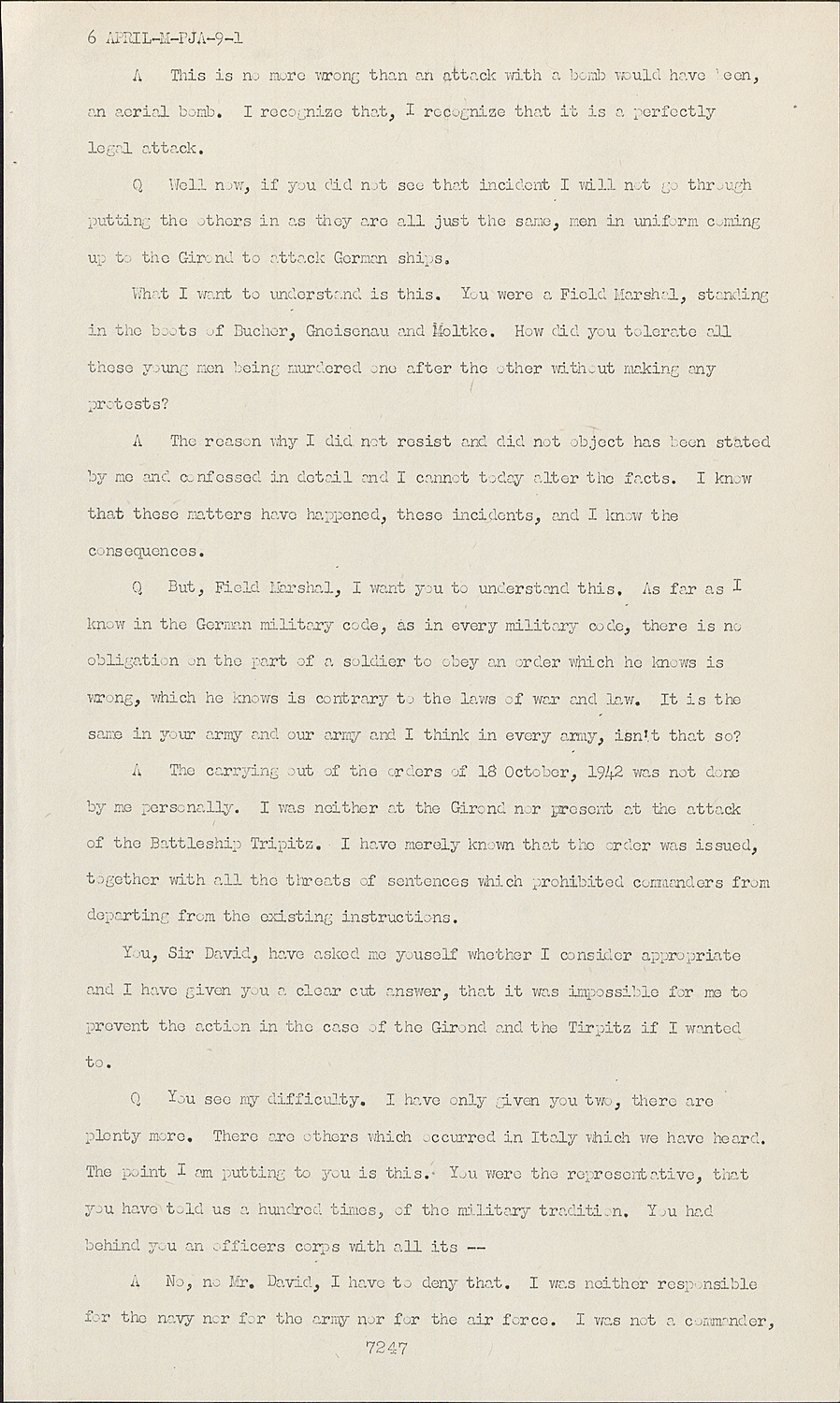
A This is no more wrong than an attack with a bomb would have been, an aerial bomb.
I recognize that, I recognize that it is a perfectly legal attack.
QWell now, if you did not see that incident I will not go through putting the others in as they are all just the same, men in uniform coming up to the Girand to attack German ships.
What I want to understand is this. You were a Field Marshal, standing in the boots of Bucher, Gneisenau and Moltke. How did you tolerate all these young non being murdered one after the other without making any pretests?
AThe reason why I did not resist and did not object has been stated by me and confessed in detail and I cannot today alter the facts. I know that these matters have happened, these incidents, and I know the consequences.
QBut, Field Marshal, I want you to understand this. As far as I know in the German military code, as in every military code, there is no obligation on the part of a soldier to obey an order which he knows is wrong, which he knows is contrary to the laws of war and law. It is the same in your army and our army and I think in every army, isn't that so?
AThe carrying out of the orders of 18 October, 1942 was not done by me personally. I was neither at the Girand nor present at the attack of the Battleship Tripitz. I have merely known that the order was issued, together with all the throats of sentences which prohibited commanders from departing from the existing instructions.
You, Sir David, have asked me youself whether I consider appropriate and I have given you a clear cub answer, that it was impossible for me to prevent the action in the case of the Girand and the Tirpitz if I wanted to.
QYou see my difficulty. I have only given you two, there are plenty more. There are others which occurred in Italy which we have heard. The point I am putting to you is this. You were the representative, that you have told us a hundred times, of the military tradition. You had behind you an officers corps with all its -
ANo, no Mr. David, I have to deny that. I was neither responsible for the navy nor for the army nor for the air force. I was not a commander, I was a Chief of Staff and I had no influence upon the carrying out of orders in the various sub-sections of the armed forces.
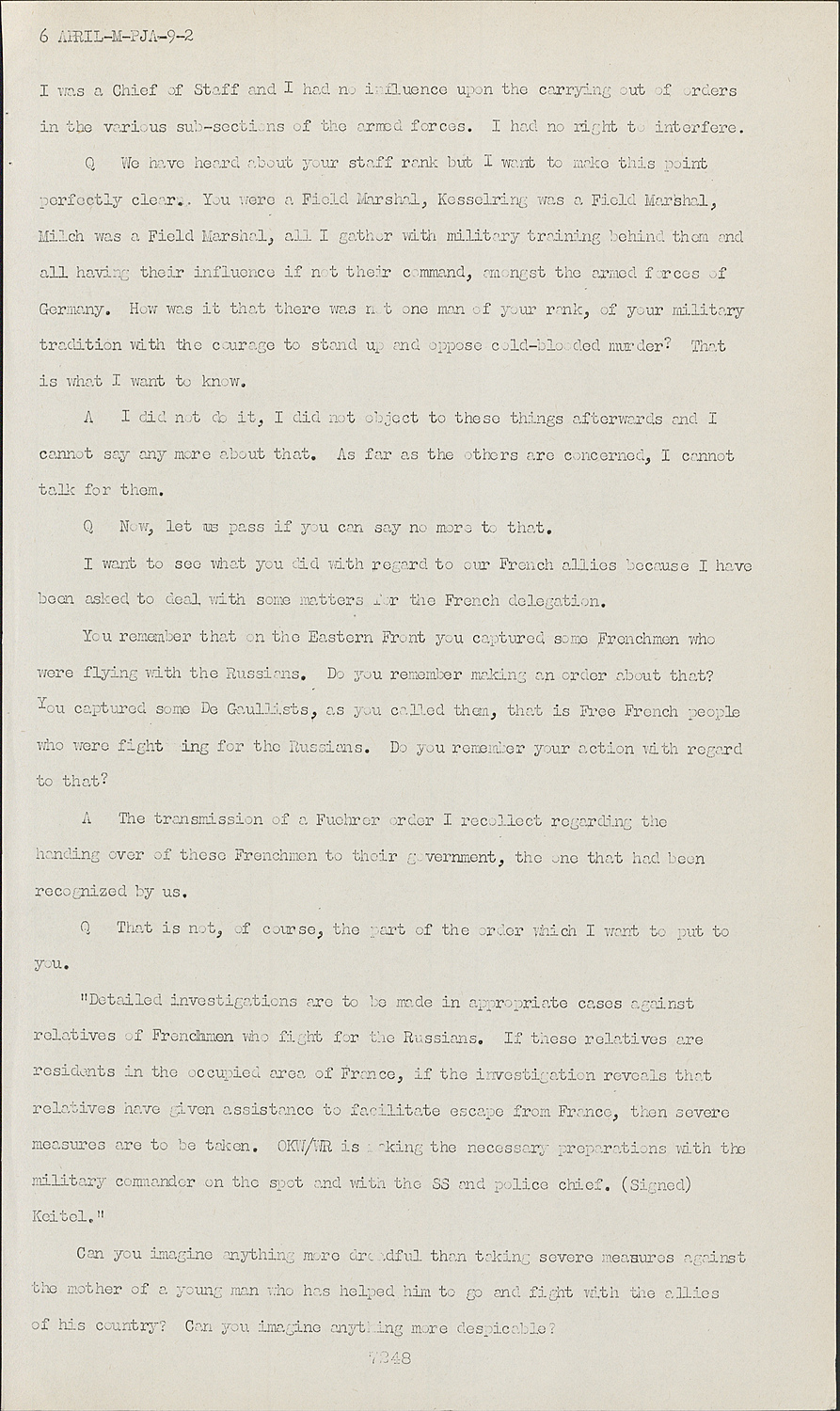
I had no right to interfere.
QWe have heard about your staff rank but I want to make this point perfectly clear. You were a Field Marshal, Kesselring was a Field Marshal, Milch was a Field Marshal, all I gather with military training behind them and all having their influence if not their command, amongst the armed forces of Germany. How was it that there was not one man of your rank, of your military tradition with the courage to stand up and oppose cold-blooded murder? That is what I want to know.
AI did not do it, I did not object to these things afterwards and I cannot say any more about that. As far as the others are concerned, I cannot talk for them.
QNow, let us pass if you can say no more to that.
I want to see what you did with regard to our French allies because I have been asked to deal with some matters for the French delegation.
You remember that on the Eastern Front you captured some Frenchmen who were flying with the Russians. Do you remember making an order about that? You captured some De Gaullists, as you called them, that is Free French people who were fight ing for the Russians. Do you remember your action with regard to that?
AThe transmission of a Fuehrer order I recollect regarding the handing ever of these Frenchmen to their government, the one that had been recognized by us.
QThat is not, of course, the part of the order which I want to put to you.
"Detailed investigations are to be made in appropriate cases against relatives of Frenchmen who fight for the Russians. If these relatives are residents in the occupied area of France, if the investigation reveals that relatives have given assistance to facilitate escape from France, then severe measures are to be taken. OKW/WR is asking the necessary preparations with the military commander on the spot and with the SS and police chief. (Signed) Keitel."
Can you imagine anything more dreadful than taking severe measures against the mother of a young man who has helped him to go and fight with the allies of his country? Can you imagine anything more despicable?
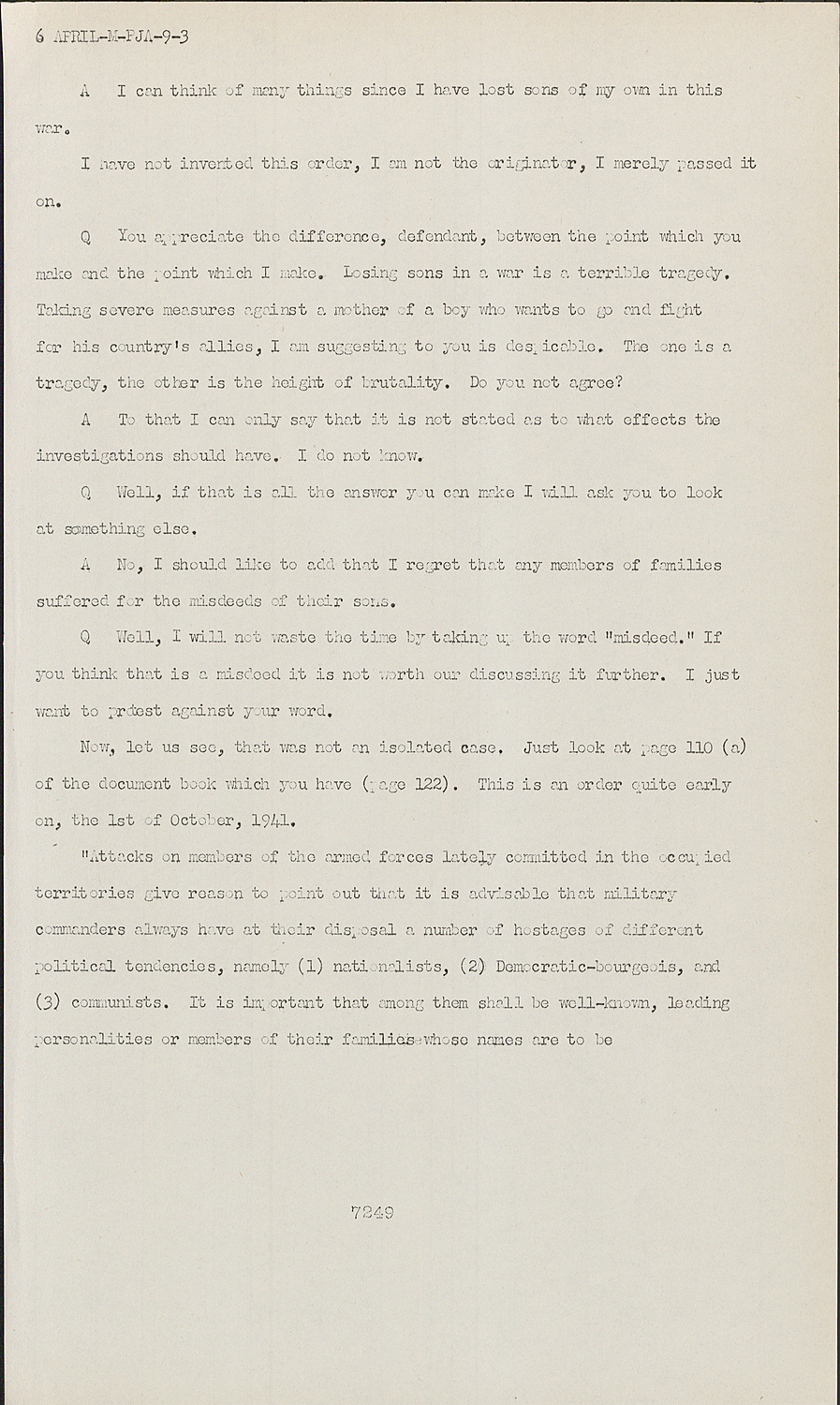
A I can think of many things since I have lost sons of my own in this war.
I have not inverted this order, I am not the originator, I merely passed it on.
QYou appreciate the difference, defendant, between the point which you make and the point which I make. Losing sons in a war is a terrible tragedy. Taking severe measures against a mother of a boy who wants to go and fight for his country's allies, I am suggesting to you is despicable. The one is a tragedy, the otter is the height of brutality. Do you not agree?
ATo that I can only say that it is not stated as to what effects the investigations should have. I do not know.
QWell, if that is all the answer you can make I will ask you to look at something else.
ANo, I should like to add that I regret that any members of families suffered for the misdeeds of their sons.
QWell, I will not waste the time by taking up the word "misdeed." If you think that is a misdeed it is not worth our discussing it further. I just went to protest against your word.
Now, let us see, that was not an isolated case. Just look at page 110 (a) of the document book which you have ( age 122). This is an order quite early on, the 1st of October, 1941.
"Attacks on members of the armed forces Lately committed in the occupied territories give reason to point out that it is advisable that military commanders always have at their disposal a number of hostages of different political tendencies, namely (l) nationalists, (2) Democratic-bourgeois, and (3) communists. It is important that among thorn shall be well-known, leading personalities or members of their families whose names are to be made public.
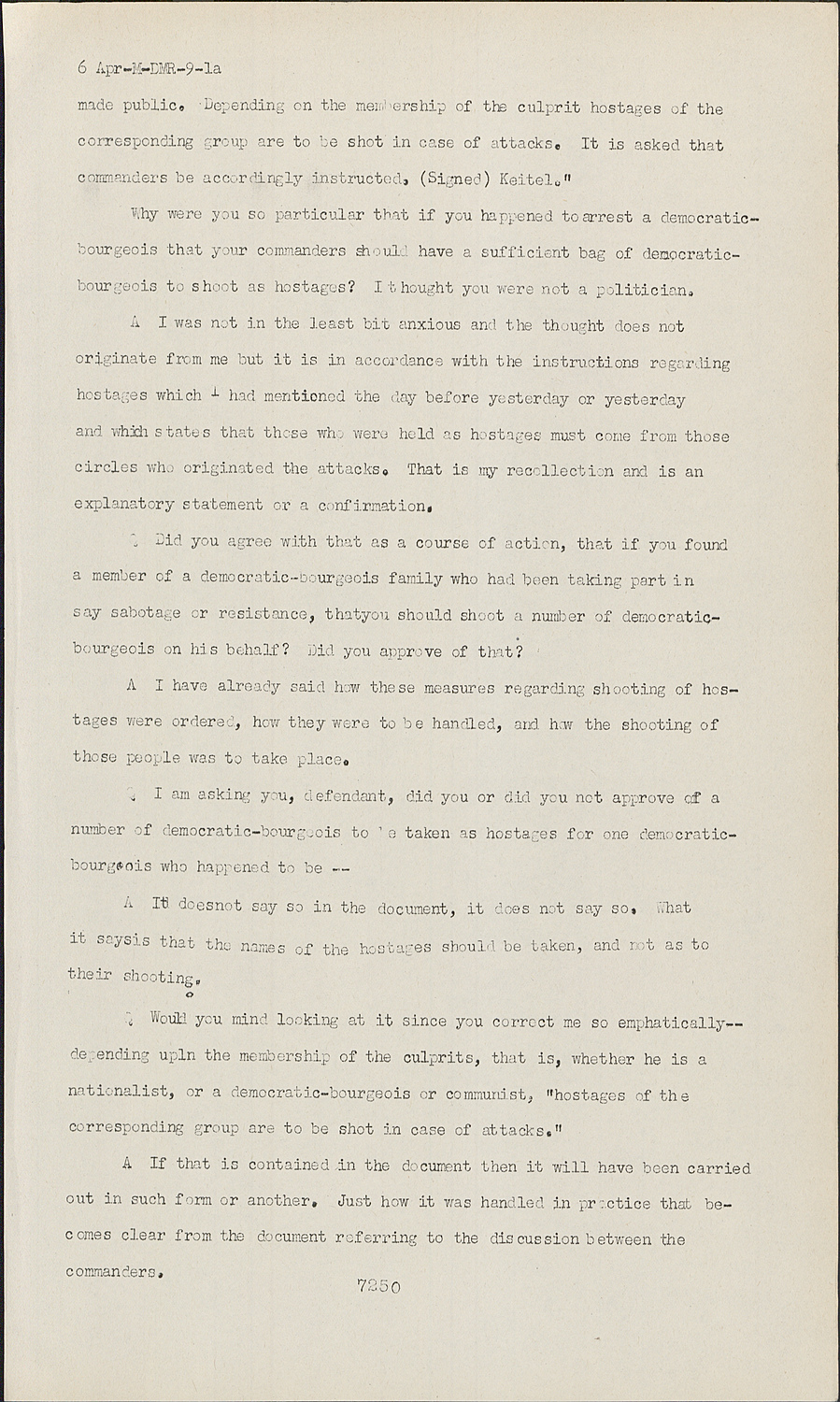
Depending on the membership of the culprit hostages of the corresponding group are to be shot in case of attacks.
It is asked that commanders be accordingly instructed, (Signed) Keitel."
Why were you so particular that if you happened toarrest a democraticbourgeois that your commanders should have a sufficient bag of democraticbourgeois to shoot as hostages? I thought you were not a politician.
AI was not in the least bit anxious and the thought does not originate from me but it is in accordance with the instructions regarding hostages which I had mentioned the day before yesterday or yesterday and which states that these who were held as hostages must come from those circles who originated the attacks. That is my recollection and is an explanatory statement or a confirmation.
QDid you agree with that as a course of action, that if you found a member of a democratic-bourgeois family who had been taking part in say sabotage or resistance, thatyou should shoot a number of democraticbourgeois on his behalf? Did you approve of that?
AI have already said how these measures regarding shooting of hostages were ordered, how they were to be handled, and how the shooting of these people was to take place.
QI am asking you, defendant, did you or did you not approve of a number of democratic-bourgeois to we taken as hostages for one democraticbourgeois who happened to be -
AIt doesnot say so in the document, it does not say so. What it saysis that the names of the hostages should be taken, and not as to their shooting.
QWould you mind looking at it since you correct me so emphatically-depending upon the membership of the culprits, that is, whether he is a nationalist, or a democratic-bourgeois or communist, "hostages of the corresponding group are to be shot in case of attacks."
AIf that is contained in the document then it will have been carried out in such form or another. Just how it was handled in practice that becomes clear from the document referring to the discussion between the commanders.

Q I now ask you, did you approve of that?
AI personally had a different view regarding the shooting of hostages, but I signed it, because I had been told and ordered to do so.
QYou said you had a differ at view. Will you just look at a letter from Herr Terboven, who was in charge in Norway, Document PS-870, and it is page 85, 71 (a), GB 307. This is a report from Terboven for the information of the Fuehrer and I what you to look at paragraph 2 "Counter Measures", sub-paragraph 4. Do you see it? Have you got it, defendant? I am sorry, I did give you the number, probably you did not hear it, 71 (a), page 71 (a) of the document book. So sorry I did not make it clear.
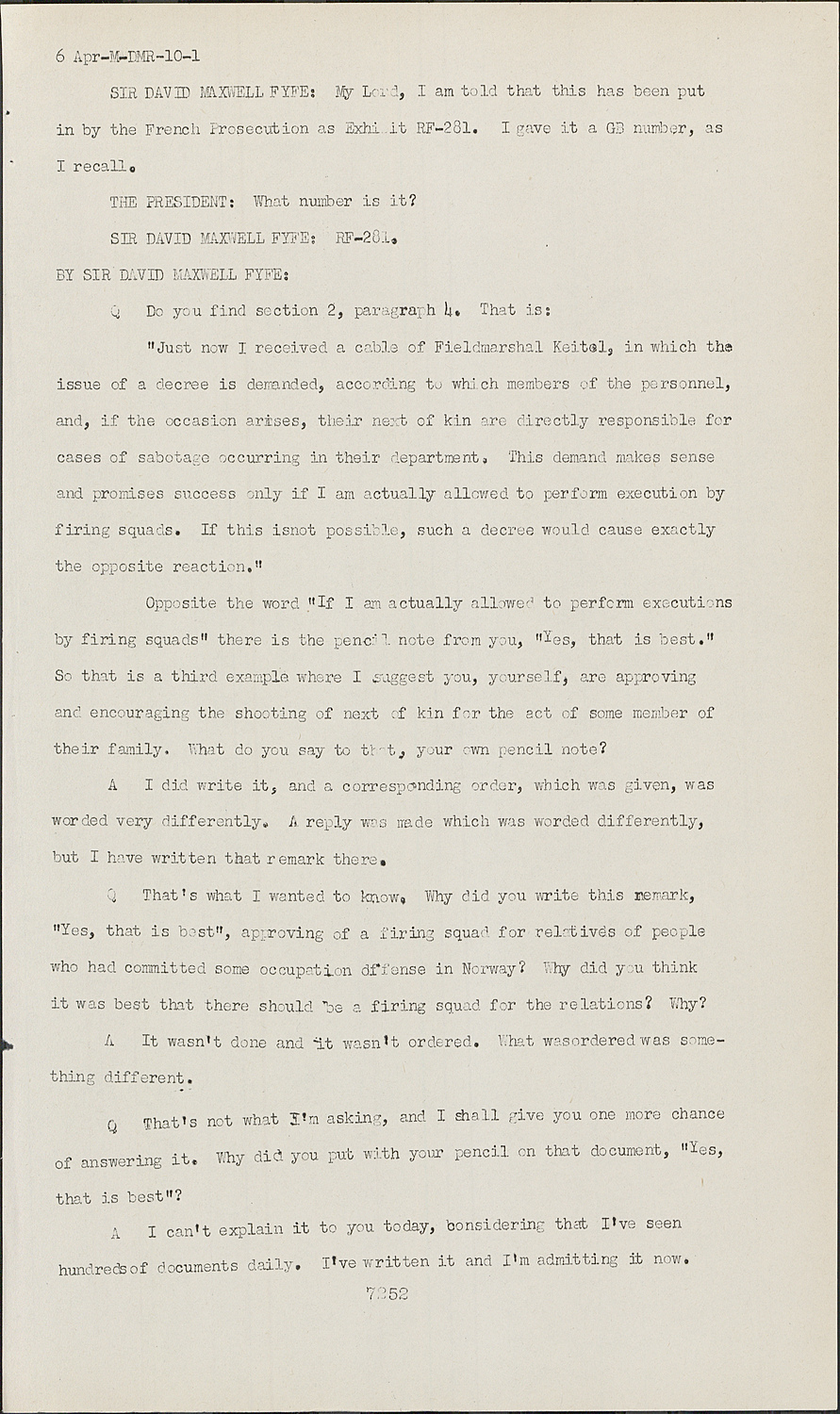
SIR DAVID MAXWELL FYFE: My Lord, I am told that this has been put in by the French Prosecution as Exhibit RF-281.
I gave it a GB number, as I recall.
THE PRESIDENT:What number is it?
SIR DAVID MAXWELL FYFE: RF-281. BY SIR DAVID MAXWELL FYFE:
QDo you find section 2, paragraph 4. That is:
"Just now I received a cable of Fieldmarshal Keitel, in which the issue of a decree is demanded, according to which members of the personnel, and, if the occasion arises, their next of kin are directly responsible for cases of sabotage occurring in their department. This demand makes sense and promises success only if I am actually allowed to perform execution by firing squads. If this isnot possible, such a decree would cause exactly the opposite reaction."
Opposite the word "If I am actually allowed to perform executions by firing squads" there is the pencil note from you, "Yes, that is best." So that is a third example where I suggest you, yourself, are approving and encouraging the shooting of next of kin for the act of some member of their family. What do you say to that, your own pencil note?
AI did write it, and a corresponding order, which was given, was worded very differently. A reply was made which was worded differently, but I have written that remark there.
QThat's what I wanted to know. Why did you write this remark, "Yes, that is best", approving of a firing squad for relatives of people who had committed some occupation offense in Norway? Why did you think it was best that there should be a firing squad for the relations? Why?
AIt wasn't done and It wasn't ordered. What wasordered was something different.
QThat's not what I'm asking, and I shall give you one more chance of answering it. Why did you put with your pencil on that document, "Yes, that is best"?
AI can't explain it to you today, considering that I've seen hundredsof documents daily. I've written it and I'm admitting it now.
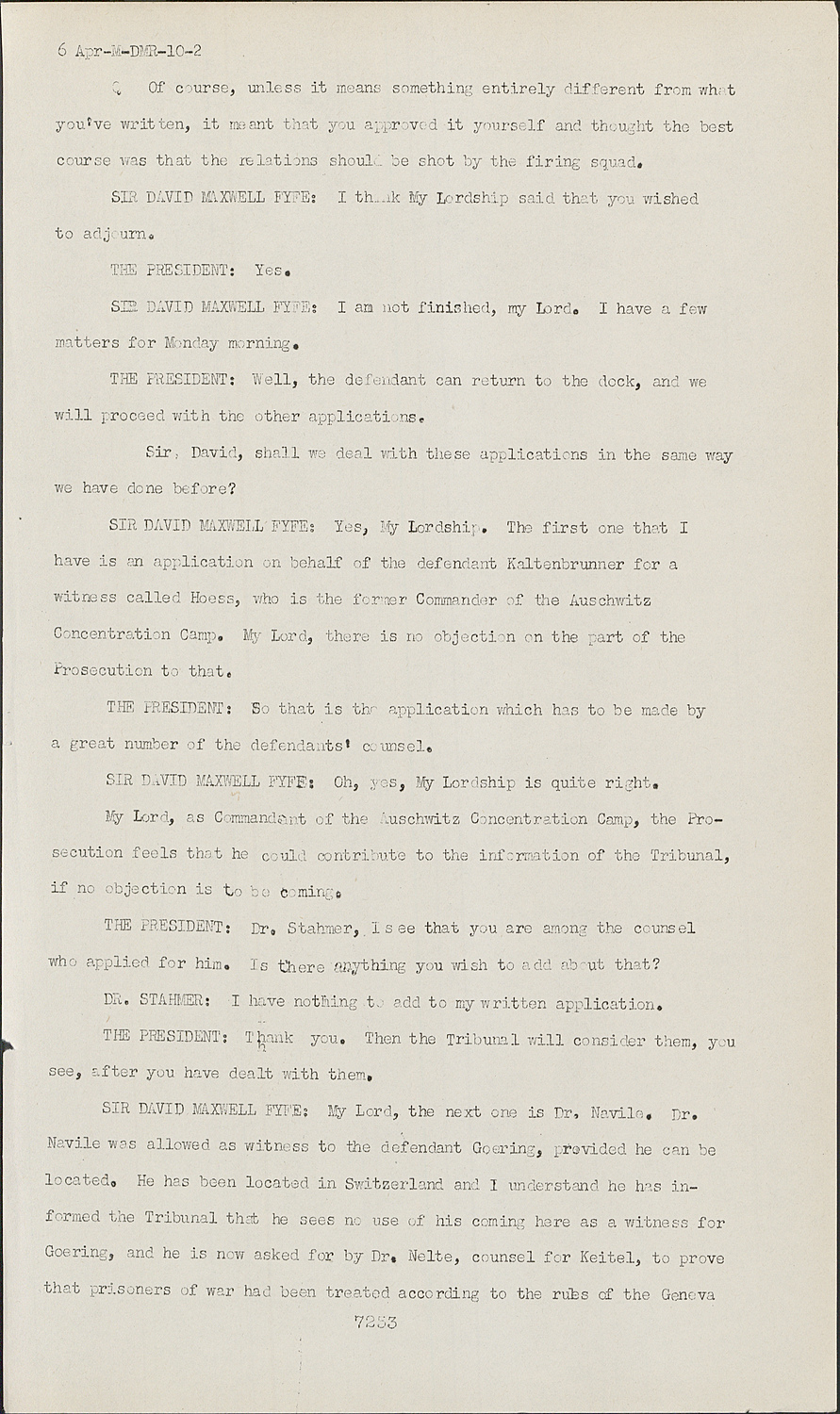
Q Of course, unless it means something entirely different from what you've written, it meant that you approved it yourself and thought the best course was that the relations should be shot by the firing squad.
SIR DAVID MAXWELL FYFE:I think My Lordship said that you wished to adjourn.
THE PRESIDENT:Yes.
SIR DAVID MAXWELL FYFE:I am not finished, my Lord. I have a few matters for Monday morning.
THE PRESIDENT:Well, the defendant can return to the deck, and we will proceed with the other applications.
Sir. David, shall we deal with these applications in the same way we have done before?
SIR DAVID MAXWELL FYFE:Yes, My Lordship. The first one that I have is an application on behalf of the defendant Kaltenbrunner for a witness called Hoess, who is the former Commander of the Auschwitz Concentration Camp. My Lord, there is no objection on the part of the Prosecution to that.
THE PRESIDENT:So that is the application v/hich has to be made by a great number of the defendants' counsel.
SIR DAVID MAXWELL FYFE:Oh, yes, My Lordship is quite right.
My Lord, as Commandant of the Auschwitz Concentration Camp, the Prosecution feels that he could contribute to the information of the Tribunal, if no objection is to be coming.
THE PRESIDENT:Dr. Stahmer, I see that you are among the counsel who applied for him. Is there anything you wish to add about that?
DR. STAHMER:I have nothing to add to my written application.
THE PRESIDENT:Thank you. Then the Tribunal will consider them, you see, after you have dealt with them.
SIR DAVID MAXWELL FYFE:My Lord, the next one is Dr. Navile. Dr. Navile was allowed as witness to the defendant Goering, provided he can be located. He has been located in Switzerland and I understand he has informed the Tribunal that he sees no use of his coming here as a witness for Goering, and he is now asked for by Dr. Nelte, counsel for Keitel, to prove that prisoners of war had been treated according to the rules of the Geneva Convention, Mr. Navile having been a representative of the Red Cress.