Q You said that these words are not in the order.
AAs far as I know it does not say absolutely. It merely says that human lives were not worth very much in those territories. That is the way I can recollect it.
Now you remember you were interrogated by General Alexandrev on the 9th of November, 1945, and to a question in regard to the essence of this sentence you made this reply;
"This sentence I must admit is a true sentence but the Fuehrer personally himself included this sentence."
Do you remember this explanation you made?
AThat is correct, that does apply, that is perfectly correct.
QI can submit this order to you. I did not present it to you because yesterday you locked at it.
AI did not read it all yesterday. I merely recognized the fact that it existed.
THE PRESIDENT:It would help the Tribunal if you got a translation of the document. When you are cross-examining upon a document and as to the actual words of it, it is very inconvenient for us not to have the document before us.
GENERAL RUDENKO:Now, Mr. President, I shall submit this order to the defendant.
(witness handed document)
THE PRESIDENT:Is it 389-PS?
GENERAL RUDENKO:Yes, this is document 389-PS.
THE PRESIDENT:When you are citing a document it would be a good thing if you would cite the number rather slowly because very often the translation does not come through accurately to us.
GENERAL RUDENKO:I understand, all right, Mr. President. I named it R-98 but it really has a double number, R-93 and 389-PS. I cited paragraph (b) of this order. BY GENERAL RUDENKO:
QDefendant Keitel, you have familiarized yourself with this?
AThe wording in the German language says that in the countries affected by this human life quite often had no value.
Q And further?
AAnd further it says that there should be the effect of frightening off which can be achieved by being extremely hard as the price for the life of a German soldier.
QYes, it is clear now. And in the same order in paragraph (b) there is also stated that as redemption for the life of a German soldier there should be the execution of fifty to one hundred Communists. The method of execution should increase the effect of intimidation. Is that correct?
AThe German text is slightly different from that. It says:
"In such cases, generally speaking, the death sentence must be passed for fifty to one hundred people."
That is the German wording.
QFor one German soldier?
AYes. I know that and I have seen this.
QThat is what I am asking you about. Once again I ask you-
ADo you want me to make a statement on that or should I not say any more?
QI shall ask you in regard to this matter.
I ask you whether when signing this order you expressed in this manner your own opinion as to these cruel measures, that is you had agreed with Hitler?
AI did sign the order, yes, but the figures which are contained therein represent alterations which had been made in that order, personal alterations by Hitler.
QAnd what figures did you present to Hitler?
AFive to ten. That was the figure which was contained in the original.
QAnd so in other words, the divergence between you and Hitler was only as to figures but not as to the fact or the essence thereof?
AThe only way a stimulating effect could be imparted to the order would be if the death of several victims was demanded.
THE PRESIDENT:That was not an answer to the question. The question was whether the only difference between you and Hitler on this docu ment was a question of figures.
That admits of the answer yes or no.
Was the only difference between you and Hitler a question of figures?
THE WITNESS:In that case I must say that with reference to the basic thoughts there was a difference of opinion which, however, in its final effect does not have to be justified by me since I merely signed the document on behalf of my department.
There was a basic difference regarding that entire question.
BY GENERAL RUDENKO:
Q.All right, we shall go on further.
I would also like to remind you about one more order, that is the order dated the 16th of December, 1942, referring to the so-called struggle against partisan bands. This document was submitted to the Tribunal as Exhibit USSR-16 I shall not examine you in detail in regard to this order. This order was presented to you yesterday by your defense counsel.
A.I have no recollection of that, general, I am afraid. I do not remember that it was shown to me yesterday, I mean.
Q.All right, if you do not remember I can present it to you in order to refresh your memory.
GENERAL RUDENKO:This document was submitted by the Soviet Prosecution as USSR 16.
THE PRESIDENT:I just took down that it was USA 516 but I suppose I was wrong in hearing. It is USSR 16, is it?
GENERAL RUDENKO:Yes, USSR 16.
THE PRESIDENT:Very well.
(Witness handed Document) BY GENERAL RUDENKO:
Q.I shell ask you, defendant Keitel, only one question in regard to this order. In paragraph one of this order it is stated -- pleas pay attention to the following sentence:
one troops therefore have a right and they are obligated, to take any measures in this struggle without any restriction and also against women and children if it is condusive to success."
Do you find that place?
A.Yes.
Q.No you find that the order calls for using any kind of measures without any restriction against women and children?
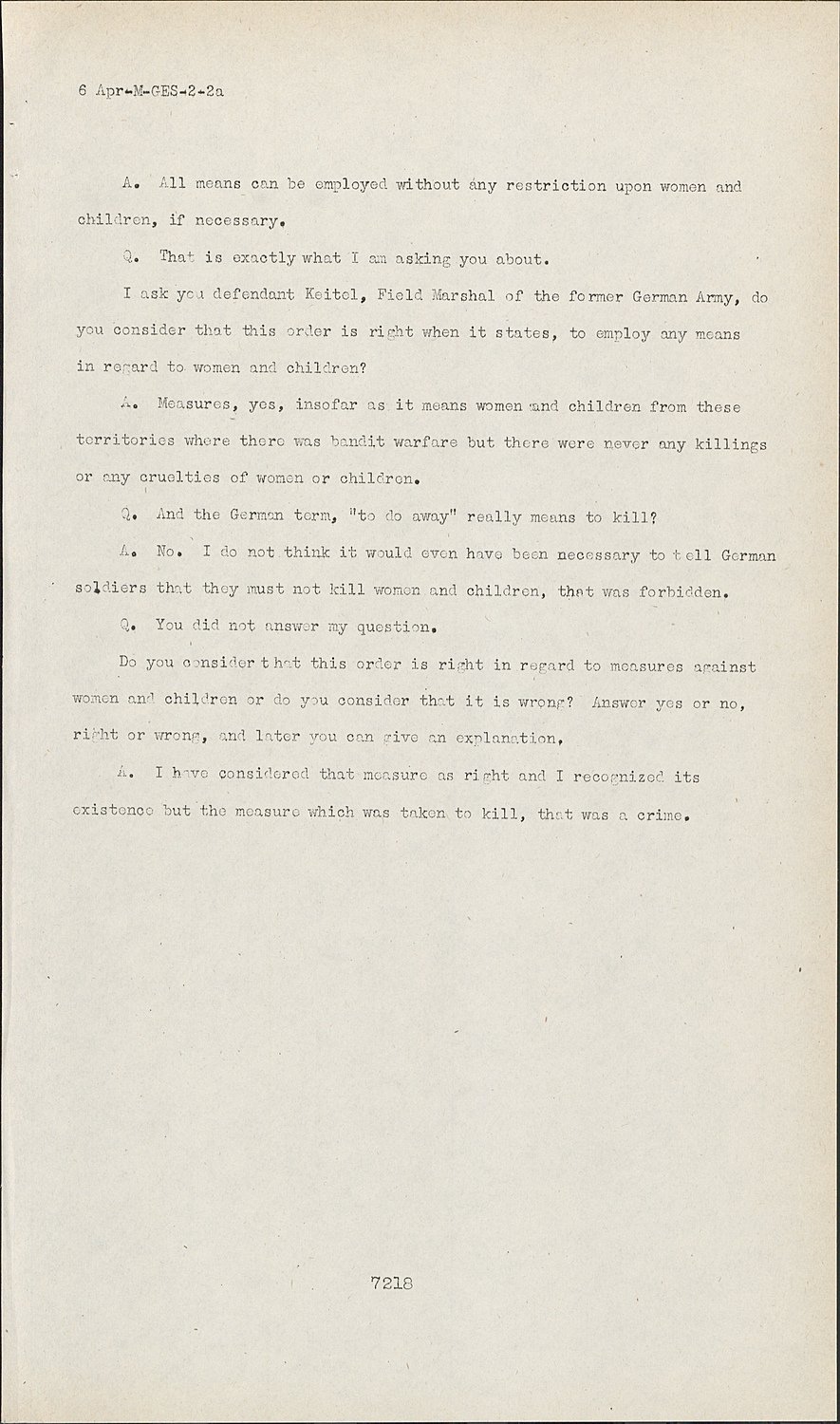
A. All means can be employed without any restriction upon women and children, if necessary.
Q.That is exactly what I am asking you about.
I ask you defendant Keitel, Field Marshal of the former German Army, do you consider that this order is right when it states, to employ any means in regard to women and children?
A.Measures, yes, insofar as it means women and children from these territories where there was bandit warfare but there were never any killings or any cruelties of women or children.
Q.And the German term, "to do away" really means to kill?
A.No. I do not think it would even have been necessary to tell German soldiers that they must not kill women and children, that was forbidden.
Q.You did not answer my question.
Do you consider that this order is right in regard to measures against women and children or do you consider that it is wrong? Answer yes or no, right or wrong, and later you can give an explanation.
A.I have considered that measure as right and I recognized its existence but the measure which was taken to kill, that was a crime.
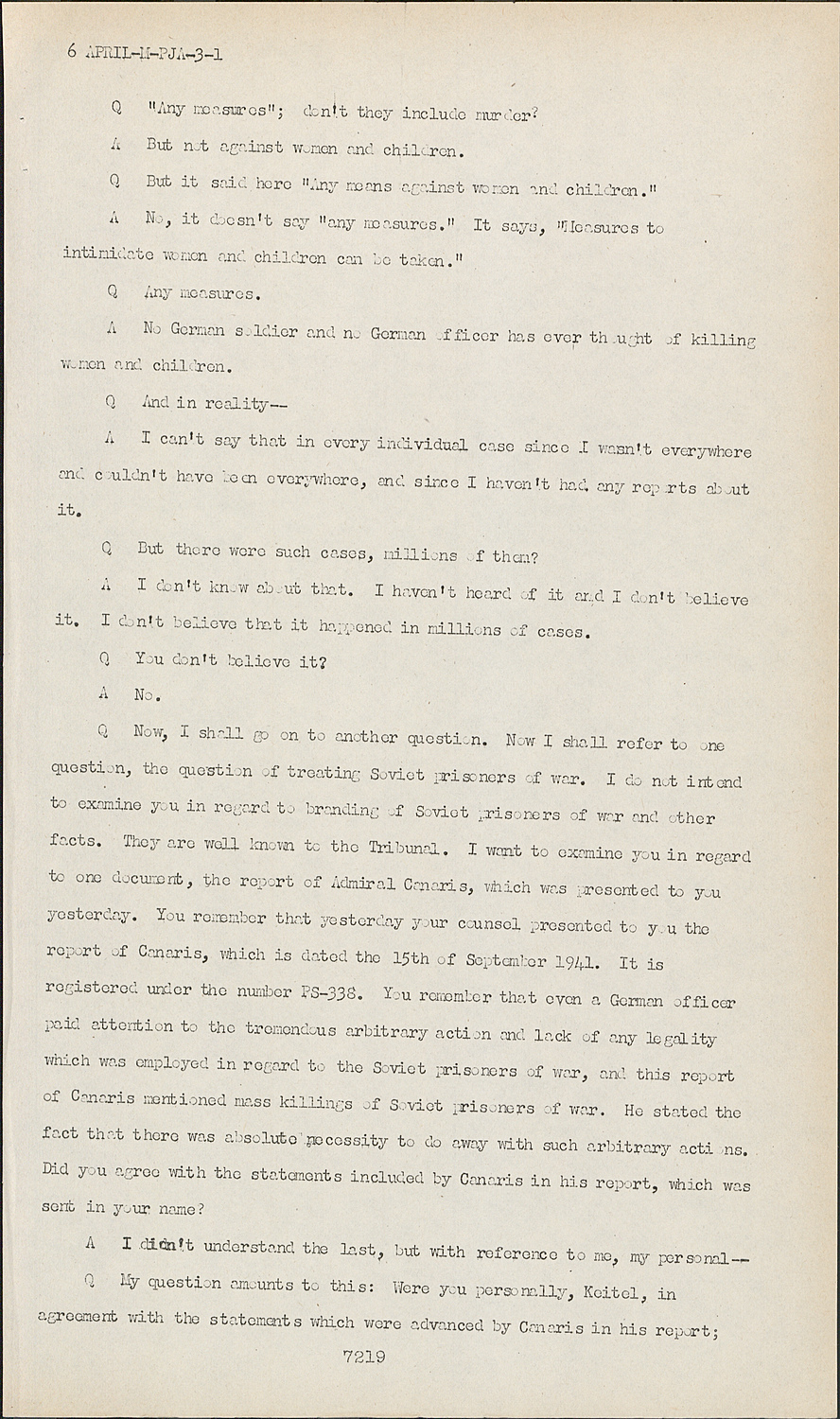
Q "Any measures"; don't they include murder?
ABut not against women and children.
QBut it said here "Any means against women and children."
ANo, it doesn't say "any measures." It says, "Measures to intimidate women and children can he taken."
QAny measures.
ANo German soldier and no German officer has ever thought of killing women and children.
QAnd in reality-
AI can't say that in every individual case since I wasn't everywhere and couldn't have been everywhere, and since I haven't had, any reports about it.
QBut there were such cases, millions of them?
AI don't know about that. I haven't heard of it and I don't believe it. I don't believe that it happened in millions of cases.
QYou don't believe it?
ANo.
QNow, I shall go on to another question. Now I shall refer to one question, the question of treating Soviet prisoners of war. I do not intend to examine you in regard to branding of Soviet prisoners of war and other facts. They are well known to the Tribunal. I went to examine you in regard to one document, the report of Admiral Canaris, which was presented to you yesterday. You remember that yesterday your counsel presented to you the report of Canaris, which is dated the 15th of September 1941. It is registered under the number PS-336. You remember that even a German officer paid attention to the tremendous arbitrary action and lack of any legality which was employed in regard to the Soviet prisoners of war, and this report of Canaris mentioned mass killings of Soviet prisoners of war. He stated the fact that there was absolute necessity to do away with such arbitrary actions. Did you agree with the statements included by Canaris in his report, which was sent in your name?
AI didn't understand the last, but with reference to me, my personal -
QMy question amounts to this: Were you personally, Keitel, in agreement with the statements which were advanced by Canaris in his report;
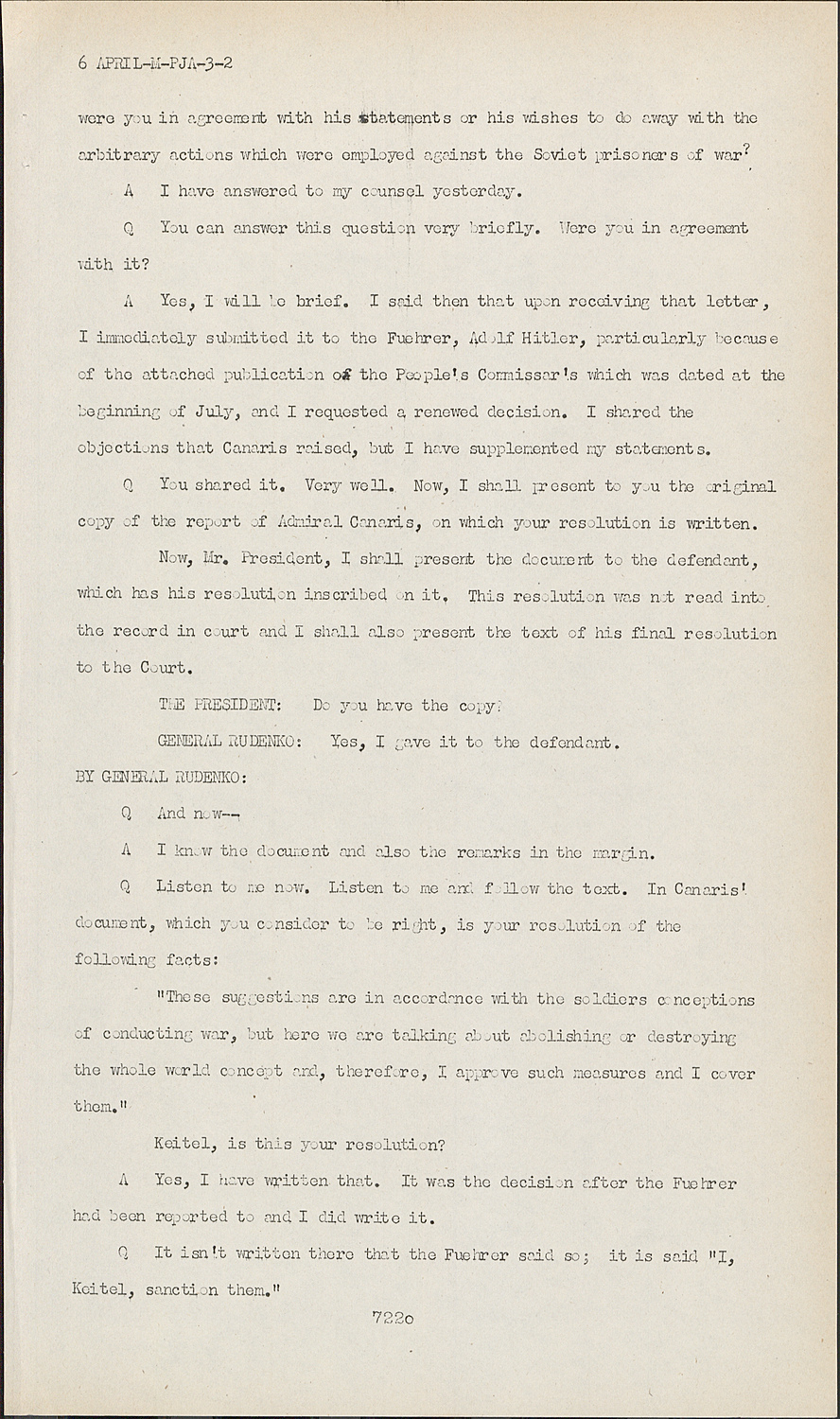
were you in agreement with his Statements or his wishes to do away with the arbitrary actions which were employed against the Soviet prisoners of war?
AI have answered to my counsel yesterday.
QYou can answer this question very briefly. Were you in agreement with it?
AYes, I will do brief. I said then that upon receiving that letter, I immediately submitted it to the Fuehrer, Adolf Hitler, particularly because of the attached publication of the People's Commissar's which was dated at the beginning of July, and I requested a renewed decision. I shared the objections that Canaris raised, but I have supplemented my statements.
QYou shared it. Very well. Now, I shall present to you the original copy of the report of Admiral Canaris, on which your resolution is written.
Now, Mr. President, I shall present the document to the defendant, which has his resolution inscribed on it. This resolution was not read into the record in court and I shall also present the text of his final resolution to the Court.
THE PRESIDENT:Do you have the copy;
GENERAL RUDENKO:Yes, I gave it to the defendant. BY GENERAL RUDENKO:
QAnd now-
AI know the document and also the remarks in the margin.
QListen to me now. Listen to me and fallow the text. In Canaris' document, which you consider to be right, is your resolution of the following facts:
"These suggestions are in accordance with the soldiers conceptions of conducting wan, but here we are talking about abolishing or destroying the whole world concept and, therefore, 1 approve such measures and I cover them."
QKeitel, is this your resolution?
AYes, I have written that. It was the decision after the Fuehrer had been reported to and I did write it.
QIt isn't written there that the Fuehrer said so; it is said "I, Keitel, sanction them."
A And I am stating that here under oath and I said that before I read it.
QIn other words, you admit this resolution. Now, I will give you another document. I shall draw your attention to another part in this document. I wish to call your attention to the second page of this document. Please pay attention to the part right opposite the text of Canaris' report, where it is stated:
"Getting held of civilian personnel and also politically undesirable military personnel and the decision in regard to their fate is to be done by operating troops of the Security police and SD in accordance with the instructions which are not known to the army agencies in carrying out the wish that they are not capable of."
This is written by Canaris, and your resolution is written in the margin, defendant Keitel. It say, "It is quite reasonable." Is that not so?
AYes.
QAnd I repeat that in the margin is written -
AAll I heard was "Canaris writes".
AAnd now I am mentioned that right opposite that paragraph there is your resolution in the margin, written by you personally, "I am quite in accordance with that." Isn't it? Did you find this resolution?
AYes. The word "suitable" refers to the fact that the army had nothing to do with these Einsatzkommandos (Action Groups) and that they were strange to them.
QAnd, furthermore, that the Security Police and the SD are making their vengeance on the civilian personall and military personnel. Do you consider that it is quite proper?
ANo, I considered it right that the activities of these commandos were unknown to the armed forces. I underlined "unknown."
QI presentthe original to the Tribunal. I am asking you, defendant Keitel, who have been called Fieldmarshal here several times before the Tribunal, you, who called yourself a soldier, whether you, by your own bloody resolution, on September 1941, approved and sanctioned the murder of defenseless unarmed soldiers who were taken by you as prisoners? Is this correct?
AI have found these two decrees and, therefore, I assume the responsibility for the action of my office; I assume it.
QThat's clear. In connection with this I ask you another question. Since you mentioned several times before the Tribunal about the soldiers' duty, I want to ask you:
Is it in accordance with the concept of a soldiers' duty and the honor of an officer to publish or promulgate such orders in regard to prisoners of war and the civilian population?
AThe answer is "yes", in so far as reprisals are concerned, which occurred during August and September. They were justified when we heard what happened to German prisoners of war in the field of battle. when we heard abou them and found them lying murdered by hundreds.
QEnough of this, Defendant Keitel. Defendant Keitel, I want you once again to take the same road as you already used here and that is your imagination about so-called reprisal actions as to German war prisoners, but you and I confirmed yesterday that even in May, 1941, before the war, you signed the directives about the shooting of the political and military workers of the Red Army.
AI signed those orders before the war, too, but they don't contain the word "murder."
Q I am not going to argue with you, One cannot argue against documents;
they speak for themselves.
I have a few questions more: You testified before the Tribunal that the Generals of the German Army were blindly carrying out Hitler's orders.
AI have stated that I do no, know which Generals did object, and I said that it did not happen in my present when the question of the words that are subjects of war was raised by Hitler, and of course running orders. More I cannot tell you.
QDo you happen to know that the Generals on their own initiative would promulgate an order about atrocities, about violations of law and customs of war and that such orders would be approved by Hitler? Do you know such facts?
AThe fact is that departments of the Army on a high level with reference to legal procedure, for instance, did alter measures and made then nilder or even withdrew them. That fact is known to me, because they all talked to me about it.
QYou did not understand me. I didn't ask about lessening or slackening the policy, but whether the Generals on their own initiative ever promulgated orders about violating laws and customs of war -- on their own initiative. Did you ever promulgate such orders?
AI don't know of that. I don't know.
QYou don't know it? I shall refer only -
AI don't know what order you are referring to. I don't know; but it is possible.
QI shall refer only to one order. What I have in mind is General Field Marshal von Reichenau's order as to the conduct of troops in the East. This is a document, Mr. President, which was presented by the Soviet prosecution as USSR-13 in connection with giving this order about the conduct of troops in the East. I shall use only one quotation, "Furnishing foodstuffs to the local population andprisoners of war is an unnecessary humanitarian action."
AI know the order. It has been shown to me during interrogations, before the trial,
QThis order was issued on Reichenau's initiative and it was approved by Hitler as a moder order, was distributed among all the Army commanders.
A I didn't know about that until I heard about it here and I don't think I read that order before either.
QOf course, such orders evidently were considered by you to have much significance, because after all, the fate of Soviet prisoners of war and of the civilian population couldn't be f any interest to the head of the OKW; their life didn't mean anything.
AYou mean me? I had no contact with the commanders at the front and I had no further contact with then either; only the Supreme Commander of the Army had that.
QAnd now I am finishing my cross-examination: Here you were testifying before the Tribunal quite often and your accomplices were doing the same thing -- the Defendants Goering and Ribbentrop -- you mentioned several times about the Treaty of Versailles, and I am asking you, were Vienna, Prague, Belgrade, the Crimea before the Versailles Treaty the property of Germany?
ANo.
QYou testifies here that in the year, 1947, after an amendment of laws you received an offer to join the Nazi Party. Did you accept the suggestion or offer . You accepted and you gave your personal data to the leadership of the Party and you paid your entrance free, membership free. Tell us, accepting this offer to join the Nazi Party, should'n it be considered as your agreement with the program of the Party, its objectives and its methodes?
AThe request that I should submit my personal details after I had had the golden Party medal for three and a half or four years was considered by me merely a question of administration and there was the request to pay my membership free and I admit both happened.
QIn other words, before this formal offer you already considered yourself a Nazi member, even before the offer was made to you ?
AI have always considered that I was a soldier, not a political soldier and not a politician.
QShouldn't one admit, after all that was heard here, that you were a Hitler General, not because of your call of duty but on account of your own convictions?
A. I have stated here that I was a loyal, faithful and obedient soldier under my Fuehrer.
And I don't think that there is any General in Soviet Russia who would not obey Marshal Stalin.
GENERAL RUDENKO:I have finished all my questions. BY SIR DAVID MAXWELL-FYFE:
Q.Defendant, do you remember on the 2nd of October, 1945, writing a letter to Colonel Amen, explaining you position? It was after your interrogations, and in your own time you wrote a letter explaining your point of view. Do you remember that?
A.Yes, yes, I think I have written such a letter. I can't recollect the contents at the moment, but it referred to interrogations, I think.
Q.Yes -
A.And I think it was a question that I should be given additional opportunity to think about matters, since owing to the surprising character of the questions qut to me I often didn't know how I should reply.
Q.I want to remind you of one passage and ask you whether it correctly expresses your view:
"In carrying out the acknowledged thankless and most difficult tasks of those functions, I had to fulfil my duty under the hardest exigencies of war, often acting against the inner voice of my conscience and not infrequently against my own opinion, with a complete self-denial and the most imperious obligation to obey, so that I had to take upon myself to carry out what Hitler my most immediate chief urged or charged me to do."
Remember that passage? Do you remember that passage?
A.Yes.
Q.Well, now, I just want you to tell the Tribunal, what were the worst matters in your view in which you often acted against the inner voice of your conscience? Just tell us some of the worst matters in which you acted against the inner voice of your conscience.
A.I found myself in such a situation quite frequently, but the decisive questions when my inner voice, inner conviction, came into it, and when they were burdened, were those questions which were against my education as a German officer which I had received over 37 years.
That was my basic attitude; that was affected.
Q.I wanted it to come from you, Defendant. Can you tell the Tribunal the three worst things you had to do which were against the inner voice of your conscience? What do you pick out as the three worst things you had to do?
A.Perhaps to start with the last, the orders which were given regarding the warfare in the East, as far as they were contrary to the usages of war, and furthermore, those matters which have been mentioned by the British Delegation particularly, the question of the fifty R.A.F. officers. The question, lastly, which implicates me most, that of the terrorist fliers. But foremost of all is the decree of "Nacht und Nebel" -- Night and Fog -and the effects it had, unknown as they were.
Q Well, now, I think --
AThose are among the worst fights through which I had to go.
QWell, we will take the Nacht und Nebel.
SIR DAVIDMAXWELL-FYFE: My Lord, this document and a good many to which I shell refer are in the British Document Book Number 7, Wilhelm Keitel and Alfred Jodl, and it occurs on Page 279.
It is L-90, US Exhibit
QDefendant, I will give you the German document book. It is 279 of the British document book, and 289 -
AIs it Number 7, Part 1?
QIt is page 289. I do not know which volume it is. Part 2. I think it is.
AAre the pages numbered?
QYes, 289.
AAre these figures at the bottom the page numbers? I think these figures at the bottom at the ones.
QYou see, the purpose of the decree is set out a few lines from the start where they say that in all cases where the death penalty is not pronounced and carried out within eight days, "in all other cases, the prisoners are in the future to be transported to Germany secretly, and further dealing with the offenses will take place here. Those measures will have a deterrent effect because (a), the prisoners will vanish without leaving a trace; (b) no information may be given as to their whereabouts or their fate."
Both these purposes, you will agree, were extremely cruel and brutal, were they not?
AI said at that time and yesterday that it was my personal view that the secret transports were more cruel than anything else.
QWould you turn to page 281--291 of yours, 281 of the English book?
AYes, I have it.
QYou say that this is your covering letter:
"The Fuehrer is of the following opinion:" Line Four.
"If these offenses are punished with imprisonment, even with hard labor for life, this will be looked upon as a sign of weakness. Efficient and energetic intimidation can only be achieved either by capital punishment or by measures by which the relatives of the criminal and the population do not know the fate of the criminal."
You will agree that there again these sentences of the Fuehrer which you are here transmitting were cruel and brutal, were they not?
AYes.
QNow, what I -
AMay I add something, please?
QCertainly, as shortly as you can.
AI made a statement yesterday a this subject. I drew your attention particularly to the words that this is a wish of the Fuehrer, which is what I was going to tell the generals who were receiving these orders, namely, what was written between the lines.
QBut, you know, defendant, the that was by no means the end of this series of orders, was it? This order was unsuccessful despite its cruelty and brutality in achieving its purpose, was it not? This order, the Nacht and Nebel order, in that form was unsuccessful is achieving its purpose; it did notstop what it was designed to step? Is that right?
AYes, that is right. These matters did not cease.
QSo that in 1944 you had to make a still more severe order. Would you look at document D/762.
SIR DAVIDMAXWELL-FYFE: My Lord, that will become GB 298.
QIt says, "The continuously increasing acts of terror and sabotage in the occupied territories which are being committed increasingly by uniformly led gangs compel us to take the most severe counter measures, corresponding to the rigor of the war. These who attack us from the rear at the decisive stage of our fight for existence deserve no consideration. I therefore order that all acts of violence by non-German civilians on the occupied territories against the German armed forces, the SS and the Police, and against installations which serve their purposes, are to be combatted as follows as acts of terrorism and sabotage:"
Then, (1), the troops, the SS and so on "are to overcome on the spot all terrorists and saboteurs.
"(2) Those who are apprehended are to be handed over to the Security Police and the SD. Accomplices, especially women who do not participate directly in the fighting, are to be put to work, and children are to be spared."
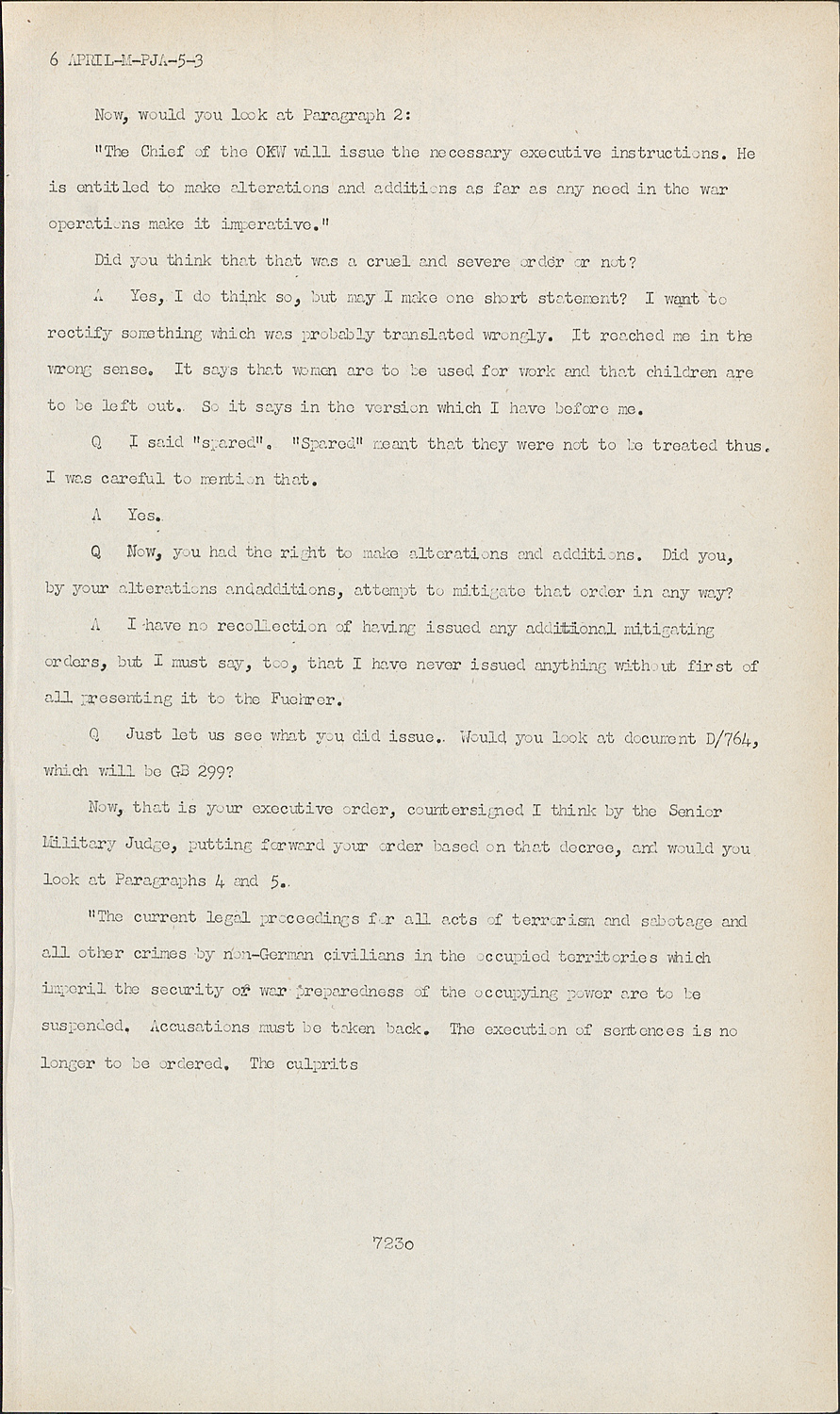
Now, would you lock at Paragraph 2:
"The Chief of the OKW will issue the necessary executive instructions. He is entitled to make alterations and additions as far as any need in the war operations make it imperative."
Did you think that that was a cruel and severe order or not?
AYes, I do think so, but may I make one short statement? I want to rectify something which was probably translated wrongly. It reached me in the wrong sense. It says that women are to be used for work and that children are to be left out. So it says in the version which I have before me.
QI said "spared". "Spared" meant that they were not to be treated thus. I was careful to mention that.
AYes.
QNow, you had the right to make alterations and additions. Did you, by your alterations andadditions, attempt to mitigate that order in any way?
AI have no recollection of having issued any additional mitigating orders, but I must say, too, that I have never issued anything with at first of all presenting it to the Fuehrer.
QJust let us see what you did issue. Would you look at document D/764, which will be GB 299?
Now, that is your executive order, countersigned I think by the Senior Military Judge, putting forward your order based on that decree, and would you look at Paragraphs 4 and 5.
"The current legal proceedings for all acts of terrorism and sabotage and all otter crimes by non-German civilians in the occupied territories which imperil the security or war preparedness of the occupying power are to be suspended. Accusations must be taken back. The execution of sentences is no longer to be ordered. The culprits are to be handed over with a report on the proceedings to the nearest local - -
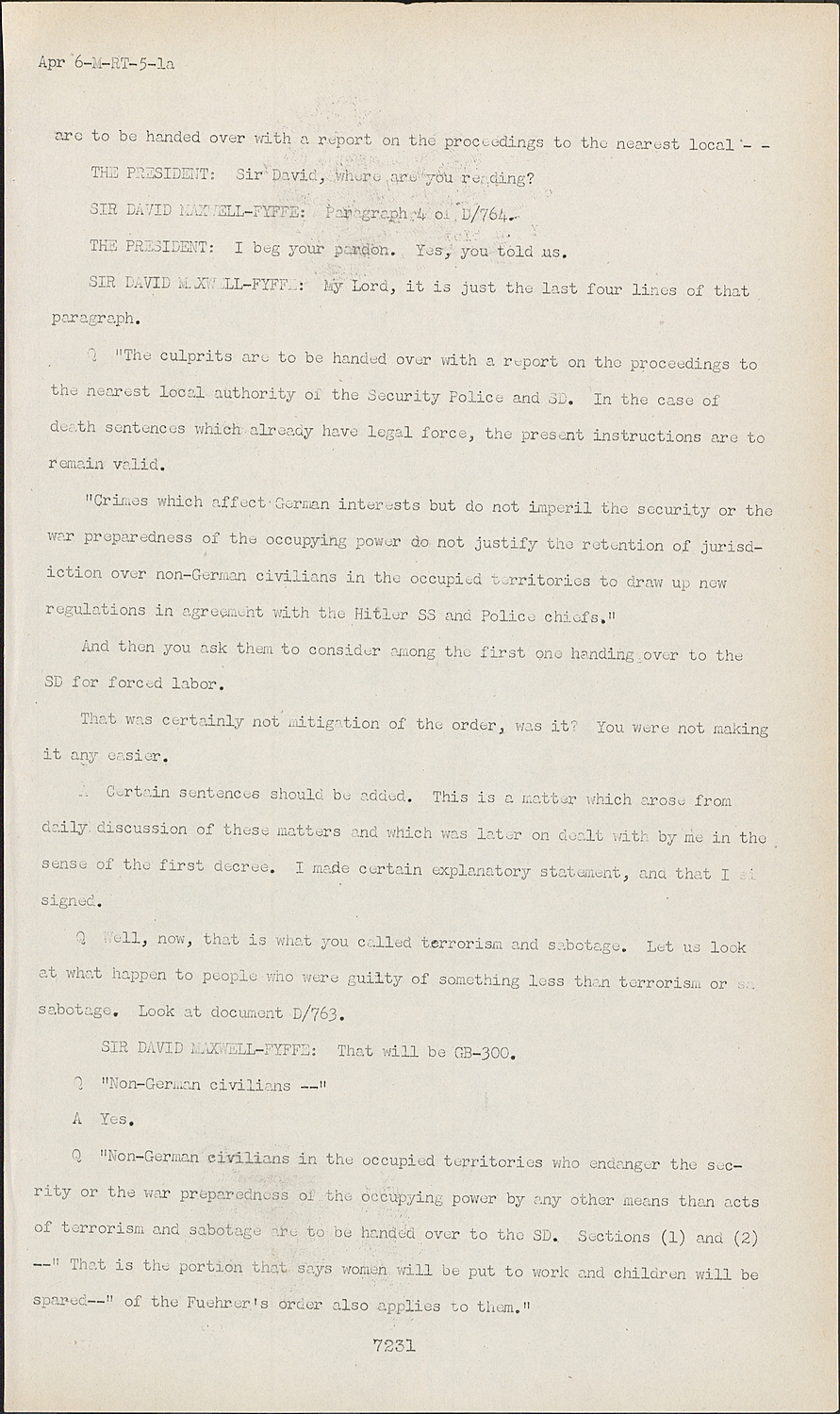
THE PRESIDENT:Sir David, where are you reading?
SIR DAVIDMAXWELL-FYFFE: Paragraph 4 of D/764.
THE PRESIDENT:I beg your pardon. Yes, you told us.
SIR DAVIDMAXWELL-FYFFE: My Lord, it is just the last four lines of that paragraph.
Q "The culprits are to be handed over with a report on the proceedings to the nearest local authority of the Security Police and SD. In the case of death sentences which already have legal force, the present instructions are to remain valid.
"Crimes which affect German interests but do not imperil the security or the war preparedness of the occupying power do not justify the retention of jurisdiction over non-German civilians in the occupied territories to draw up new regulations in agreement with the Hitler SS and Police chiefs."
And then you ask them to consider among the first one handing over to the SD for forced labor.
That was certainly not mitigation of the order, was it? You were not making it any easier.
ACertain sentences should be added. This is a matter which arose from daily discussion of these matters and which was later on dealt with by me in the sense of the first decree. I made certain explanatory statement, and that I signed.
QWell, now, that is what you called terrorism and sabotage. Let us look at what happen to people who were guilty of something less than terrorism or sabotage. Look at document D/763.
SIR DAVIDMAXWELL-FYFFE: That will be GB-300.
Q "Non-German civilians --"
AYes.
Q "Non-German civilians in the occupied territories who endanger the Secrity or the war preparedness of the occupying power by any other means then acts of terrorism and sabotage are to be handed over to the SD. Sections (1) and (2) --" That is the portion that says women will be put to work and children will be spared--" of the Fuehrer's order also applies to them."
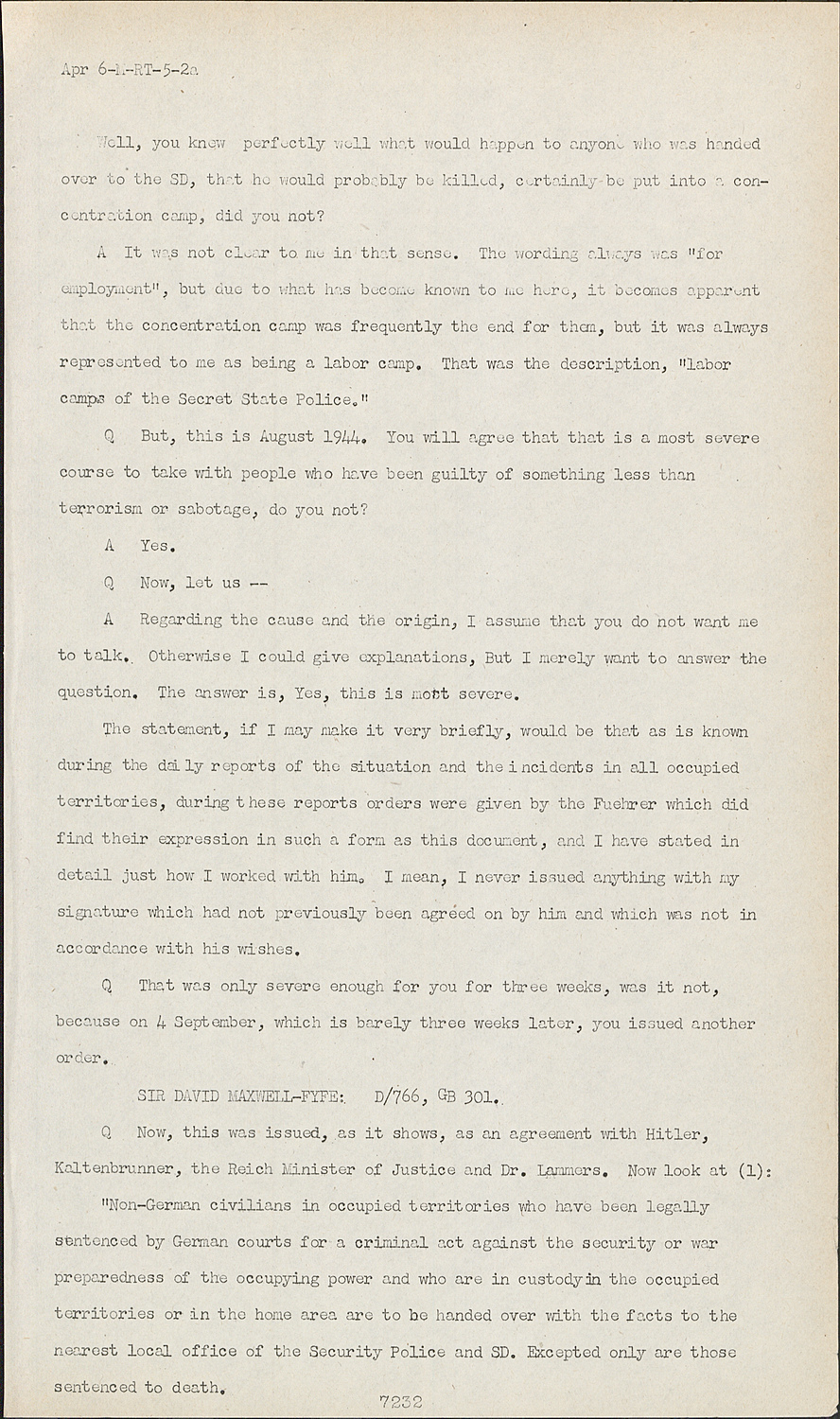
Well, you knew perfectly well what would happen to anyone who was handed over to the SD, that he would probably be killed, certainly be put into a concentration camp, did you not?
AIt was not clear to me in that sense. The wording always was "for employment", but due to what has become known to me here, it becomes apparent that the concentration camp was frequently the end for them, but it was always represented to me as being a labor camp. That was the description, "labor camps of the Secret State Police."
QBut, this is August 1944. You will agree that that is a most severe course to take with people who have been guilty of something less than terrorism or sabotage, do you not?
AYes.
QNow, let us -
ARegarding the cause and the origin, I assume that you do not want me to talk. Otherwise I could give explanations, But I merely want to answer the question. The answer is, Yes, this is most severe.
The statement, if I may make it very briefly, would be that as is known during the daily reports of the situation and the incidents in all occupied territories, during these reports orders were given by the Fuehrer which did find their expression in such a form as this document, and I have stated in detail just how I worked with him. I mean, I never issued anything with my signature which had not previously been agreed on by him and which was not in accordance with his wishes.
QThat was only severe enough for you for three weeks, was it not, because on 4 September, which is barely three weeks later, you issued another order.
SIR DAVID MAXWELL-FYFE: D/766, GB 301.
QNow, this was issued, as it shows, as an agreement with Hitler, Kaltenbrunner, the Reich Minister of Justice and Dr. Lammers. Now look at (1):
"Non-German civilians in occupied territories who have been legally sentenced by German courts for a criminal act against the security or war preparedness of the occupying power and who are in custodyin the occupied territories or in the home area are to be handed over with the facts to the nearest local office of the Security Police and SD. Excepted only are those sentenced to death.
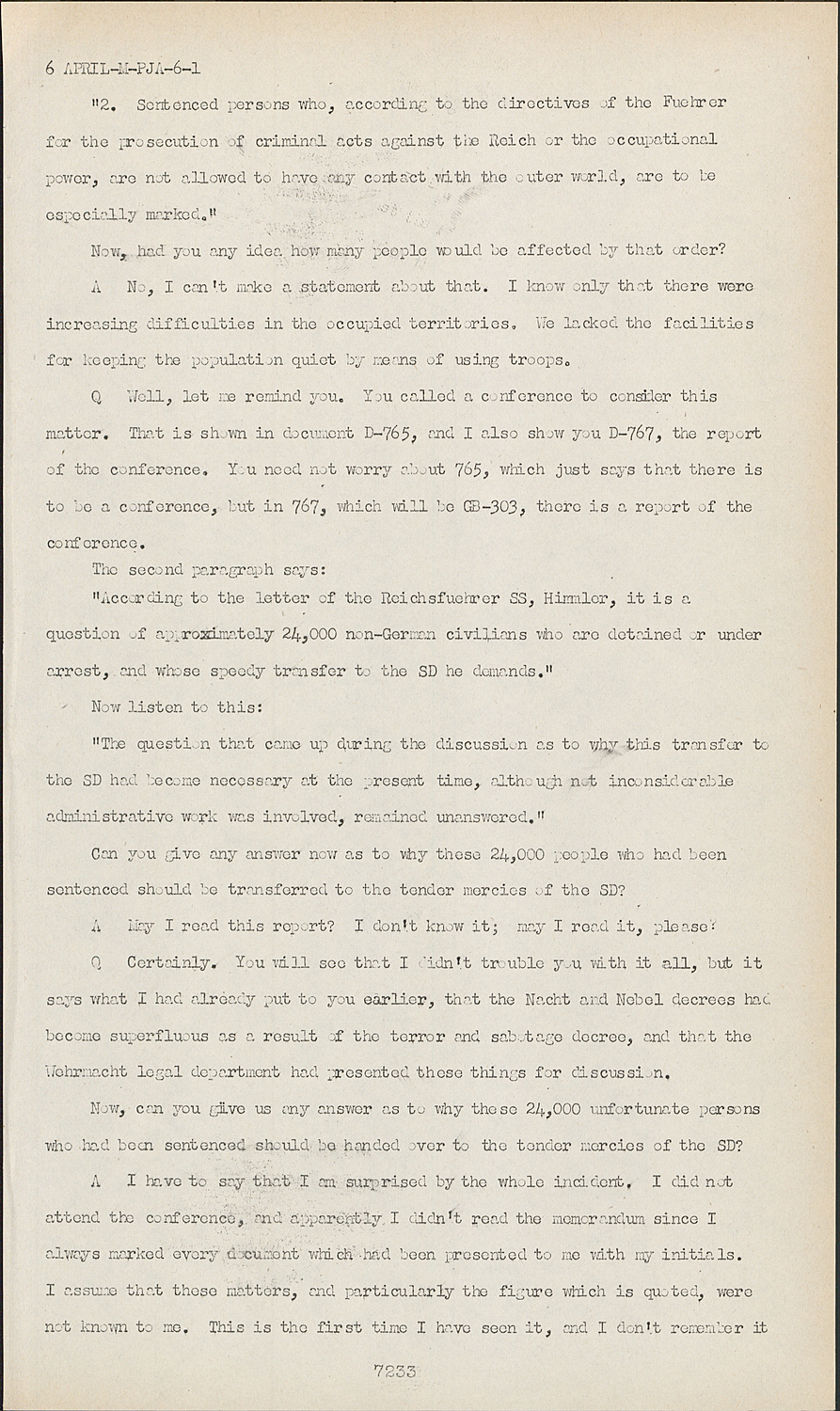
"2. Sentenced persons who, according to the directives of the Fuehrer for the prosecution of criminal acts against the Reich or the occupational power, are not allowed to have any contact with the cuter world, are to be especially marked."
Now, had you any idea how many people would be affected by that order?
ANo, I can't make a statement about that. I know only that there were increasing difficulties in the occupied territories. We lacked the facilities for keeping the population quiet by means of using troops.
QWell, let me remind you. You called a conference to consider this matter. That is shown in document D-765, and I also show you D-767, the report of the conference. You need not worry about 765, which just says that there is to be a conference, but in 767, which will be GB-303, there is a report of the conference.
The second paragraph says:
"According to the letter of the Reichsfuehrer SS, Himmler, it is a question of approximately 24,000 non-German civilians who are detained or under arrest, and whose speedy transfer to the SD he demands."
Now listen to this:
"The question that came up during the discussion as to why this transfer to the SD had become necessary at the present time, although not inconsiderable administrative work was involved, remained unanswered."
Can you give any answer new as to why these 24,000 people who had been sentenced should be transferred to the tender mercies of the SD?
AMay I read this report? I don't know it; may I read it, please?
QCertainly. You will see that I didn't trouble you with it all, but it says what I had already put to you earlier, that the Nacht and Nebel decrees had become superfluous as a result of the terror and sabotage decree, and that the Wehrmacht legal department had presented these things for discussion.
Now, can you give us any answer as to why these 24,000 unfortunate persons who had been sentenced should be handed over to the tender mercies of the SD?
AI have to say that I am surprised by the whole incident. I did not attend the conference, and apparently I didn't read the memorandum since I always marked every document which had been presented to me with my initials. I assume that these matters, and particularly the figure which is quoted, were not known to me. This is the first time I have seen it, and I don't remember it It could be that I issued an order in that connection.