I do not know and I cannot tell you just how the giving of the oath before the taking over of power was carried through. The only thing I can tell you about is what I did. After a certain period of time, after I got to know the Fuehrer and his personality, I gave him my hand and told him "I wish to lock my fate with yours, come what may, for better or for worse; if it means my head, my head is included, "and that is included today, here.
QIf you would answer three or four questions for me yes or no, than I will be quite willing to lot you give your version of this thing. In the first place, you wanted a stronger German State to overcome the conditions of Versailles.
AYes, we wanted a strong government disregarding Versailles, but to set aside Versailles, the State had to be strong, for a weak State was never listened to; that, we knew from experience.
QAnd the Fuehrer's principle you adopted because you thought it would serve the ends of a strong State?
ACorrect.
QAnd on this aim, which was one of the aims of the Nazi Party, to modify the conditions of Versailles was a public and notorious aim in which the people generally joined -- it was one of your best means of getting people to join with you, was it not?
AThe Dictate of Versailles was of such a nature that every German, in my opinion, was for its modification and there was no doubt that this was a strong inducement for joining the party.
QNow, a number of the men who took part in this movement are not here and -- for the record -- there is no doubt in your mind, is there, that Adolf Hitler is dead?
AI believe there is no doubt in that connection.
QAnd the same is true of Goebbels?
AGoebbels, I have no doubt about that for I know from someone, whom I trust completely, who told me that he witnessed Goebbel's death.
QAnd you have no doubt of the death of Himmler, have you?
AI am not exactly certain but I believe that you should be all the more certain, for he died in your internment. I was not there,
QYou have no doubt of the death of Heydrich, have you?
AI am definitely certain about that.
QAnd probably of Bormann?
AI am not absolutely certain in this connection. I have no proof. I do not know but I assume so.
QAnd those are the chief persons in your testimony, who have been mentioned as being responsible -- Hitler for everything; Goebbels for inciting riot against the Jews; and Himmler, who deceived Hitler (this morning); and Bormann who misled him about his will?
AHis influence on the Fuehrer varied with time. The chief influence on the Fuehrer was, if I may mention influence on the Fuehrer at all, was up until the end of 1941 or the beginning of 1942, and that chief influence was I. Then my influence gradually decreased up until 1943, and from 1943 on it decreased speedily. All in all, I do not believe anyone had anywhere near the influence on the Fuehrer that I had, beyond or outside of myself.
If there was influence from the beginning, in certain directions Goebbels, with whom the Fuehrer was together quite a good deal --this influence varied temporarily and would be light at certain points and was increasingly large in the last four years.
A certain influence before the taking over of power -- Hess had influence before the taking over of power and after the taking over of power, and that is in his special field only. In the course of years Himmler's influence grew; after the end of 1944, this influence decreased rapidly and the decisive influence during the war on the person of Hitler and especially from the year 1942 on, after Hess had been eliminated in 1941, and after a year had elapsed, that was influence by Bormann, but this was a disastrously strong influence. It was possible only since after the 20th of July, the Fuehrer had a very strong mustrust and Bormann was with him constantly and told him everything, pictured everything to him. That, in a rather sketchy way, I described the personalities who had influence on Hitler at one time or another temporarily.
Q You took over a special intelligence work in 1933 which was devoted to monitoring the telephone conversations of public offices and others inside and outside of Germany, did you not?
AI have said that I had a detective system which "monitored", as you said, the telephone conversations of important foreigners to and from abroad, telegrams, wireless communications, which not only came from Germany and went into foreign countries, but those that went through Germany. Monitory of all phone conversations was; first, of all important foreigners; second, important firms; and third, personalities who for any reason were being supervised for political or police reasons.
In order that no abuse on the part of the police went unpunishable, this office, which was to monitor the telephone conversations, had to have my personal permission, and uncontrollable monitoring was possible and is possible. We are aware that is being done today.
QYou kept the results of those reports to yourself, did you not?
ANo, it was as follows. These reports which the Fuehrer's office was interested in were released to the Fuehrer's office. Those reports which were important to the Fuehrer went to the Fuehrer, and those reports which were important to the military went to the Ministry of War, or to the air ministry, or whichever ministry might be involved.
By deputies and I decided which report was to be sent to each office. There was a man who was responsible that these secret reports went to the chief office. I could decree that these reports would be for my own knowledge and no one else would come into possession of them.
QYou had a good deal of difficulty with other police authorities who wanted to get possession of this instrument, did you not?
AThat is correct. It is correct that the police were interested in getting this instrument into their hands, but they did not receive it, and perhaps now and then they did some similar monitoring, but the decisive monitoring which was done through my authority, that I could only decree.
QYou have listened to the evidence of the prosecution against all of the defendants in this case, have you not?
AYes.
Q Is there any act of any of your co-defendants which you claim was not responsible, necessarily, to carry out the plans of the Nazi Party?
AThose are just assertions of the prosecution and they are not facts which have been proven, and if these assertions are mentioned, I must say that quite a few acts were not necessary.
QWill you specify which acts, of which defendants, you claim, were beyond the scope of the principle of the Nazi Party?
AIt is a very difficult question which is almost impossible to answer without proof or reference to my records.
DR.STAHMER (Counsel for the Defendant Goering): Mr. President, I object to that question. I do not believe that judgment in such a general scope can be answered.
THE PRESIDENT:Mr. Justice Jackson, the Tribunal thinks that the question is somewhat too wide. BY MR. JUSTICE JACKSON:
QYou have said that the program of the Nazi Party was to rectify certain injustices which you considered in the Treaty of Versailles, and I ask you whether it is not the fact that your program went considerably beyond any matter dealt with in that Treaty?
AThe program contained a number of other points which were not concerned with the Treaty of Versailles.
QI call your attention to a statement in Mein Kampf, which reads as follows:
"The boundaries of 1914 do not mean anything for the future of the German nation. They did not represent either a defense of the past nor did they represent a power in the future. The German people were not supported .. nor do these battles appear, from a militarystandpoint, appropriate or militarily fair."
That is all true,is it not?
AI would have to re-read the original passages to determine if it is exactly as you have read it. I assume what you have read is correct, but we are concerned here with a notation in a public work and not with a party program
QThe first country to be absorbed by Germany was in Austria and not a part of Germany before the first WorldWar and had not been taken from Germany in the first war, is that correct?
AThe program said clearly and definitely -- it is concerned with Versailles only since, in this case, such determination which had been proclaimed had been influenced upon after it was denied.
QThe second territory taken was Bohemia, then Moravia, and then Slovakia. These were not taken by Germany by the Treaty of Versailles, nor were they part of Germany before the first World War?
AConcerning these territories, the same applies to them as applied to Austria. As far as we are concerned with Bohemia and Moravia before the Versailles Treat , they were not considered part of the German land, but before that time they were connected with the German Reich.
QYou still have not answered my question although you have answered everything else. Were those territories not taken?
A of course Austria, through the Versailles Treaty, was taken away. Those territories, with the Treaty of Versailles and the Treaty of St. Germain could have become German property through the determination right of the people.
QYou have testified, have you not, on interrogation, that it was Hitler's conviction that the United States would never go to war even if they were attacked, and he thought the isolationists of that country would keep it out of any war?
AThis interrogation must be entirely incorrect and that is the reason why I refused, from the beginning, to give my oath before the German interrogatories without having seen the German notes so that I could determine whether these translations were correct. Only once, during these interrogations, did I receive a copy, a correct transcript of what I said, and I signed it page by page. This was a Russian transcript. And I know those pages.
I would like to clarify this statement. I said that the Fuehrer said that he did not believe in the beginning that America would intervene in the war, but I, on the other hand, from the beginning, was of the opinion that America, under any circumstance, would intervene in the war.
If you will permit my saying so, I never made any such statement.
QDo you know Wannegrinn?
AHe is a Swede whom I have seen two or three times.
QYou talked with him about this ubject, have you not?
AAbout the subject of America entering the war, no. I talked about other matters.
QYou told him that a democracy could not mobilize and would not fight, didn't you?
A I didn't tell him any such nonsense. For we had one democracy as our chief enemy, and that was England, which we were fighting at that time, and I spoke to him when the war with England was in full swing.
Q You have testified on interrogation, if I understand you correctly that there were at all times two basic ideas in Hitler's mind, either to ally himself with Russia and seek increase in living space through the acquisition of colonies, or to ally himself with Britain and seek acquisition of territories in the east.
But in view of his orientation, he would very much preferred to ally himself with Great Britain, is that true?
AThat is correct. I would like to refer to the book "Mein Kempf," where these things were established by Hitler.
QNow, as early as 1933 you began a real program to rearm Germany regardless of any treaty limitations, did you not?
AThat is not correct.
QAll right; tell us when you started.
AAfter our suggestions of disarmanent were refused - the suggestions made by Hitler; that is, after our departure from the disarmament conference. He made several suggestions to limit, but these suggestions were not taken seriously, and at that point he undertook to rearm. At the end of 1933 some slight preparations were started by me as far as air was concerned, and perhaps in the direction of a uniformed police I took over the auxiliary police, but I had the responsibility for that personally.
QWell, then, the militarization of the police auxiliary was not a state affair. It was your personal affair. What do you mean by that?
AI beg your pardon. Not the auxiliary police: of the Schutzpolizei. By that we meant we had a police which wore uniforms, which was concerned with police matters, of punishing; and, second, which were grouped in formations whicn were at disposal but which were not created by us which were assisting when we took over power. But these were in units, and the armed Schutzpolizei had barracks. I made and strengthened a military instrument out of that branch, in that I took them, removed them from police duties, trained them militarily, and gave them heavier munitions. I meant that that was my responsibility. These formations were taken into the Wehrmacht as regular parts of the Wehrmacht.
QI want to ask you some questions from your interrogation of the 17th day of October, 1945. I will first read you the questions and answers as they appear in the interrogation, and I shall then ask you whether you gave those answers, and then you can make the explanations if you desire, I assume.
The interrogations reads:
I wanted to ask you today about some of the economic history of the period. When was the armament program first discussed, that is, the rearmament program? What year?
Answer: Immediately; in 1933.
Question: In other words, Schacht had assumed the obligation at that time already to raise funds for the rearmament program?
Answer: Yes. But, of course, in cooperation with the Minister of Finance.
Question: During the years 1933 to 1935, before general conscription came in, naturally, the rearmament was a secret rearmament, was it not?
Answer: Yes Question:
So that monies that were used outside of the budget would have to be raised by some secret means not to be known to foreign nations?
Answer: Yes, unless they could be raised from normal army funds.
Question: That is to say, you had a small budget for the standing 100,000-man army which was pen, and the rest of the rearmament had to be from secret sources?
Answer: Yes.
Were you asked those questions and did you give those answers, in substance?
AJust about; generally correct. I have to say, though, first, I was asked as to when rearmament had been discussed, not when it had been started. It had, of course, been discussed already in the year 1933, because we were sure at once that something had to be carried out different by our government than others. That is to say, demands that the others disarm, and, if they do not disarm, that we should rearm. These things required discussion. The conclusion of the discussion and reorganization into a clear order was carried out after all attempts to disarm the others had failed. As soon as the Fuehrer had recognized that his proposals were not being accepted under any circumstances, of course a gradual rearmament got underway. He had no reason about whatever we did in the way of armament to inform the world about it.
We had no obligation to do that, nor was it opportune, Mr. Schacht, in the year 1933, in the beginning, could not raise funds, because in the beginning he had no function.
That also referred to a later date. And here it was a matter of course that the funds be raised through the Minister of Finance and the President of the Reichsbank, according to the orders of the Fuehrer.
We left no doubt that if the other side would not disarm we had to rearm. That was clearly expressed in our articles since 1921, and, therefore, for all the world.
QIsn't it a fact that on the 21st of May, 1935, by a secret decree, Schacht was named Plenipotentiary for the War Economy?
AThe date, if you will kindly read the decree to me, I could tell you exactly. I do not have the dates in my head, especially if they do not have anything to do with me personally, but that can be seen from the decree.
QAt any event, shortly after he was named he suggested you as commissioner for war materials and foreign currency, didn't he?
AIf Mr. Schacht, shortly after his appointment, suggested that, then that appointment could have taken place only in 1936, because only in December of 1936, Mr. Schacht, together with the war minister von Blomberg, made the proposals or suggestions that I should become commissar for raw materials and foreign currency.
QWell, I ask you if you didn't give this answer to the American interrogator on the 10th day of October, 1945, referring to Schacht:
He made the suggestion that I was to become the commissioner for war materials and foreign currency. He had the idea that in that position I could give the minister for economics and the president of the Reichsbank valuable support.
Now, did you give that answer, and is that information correct?
AOnce more, please.
QReferring to Schacht, the record shows that you said:
He made the suggestion that I was to become the commissioner for war materials and foreign currency. He had the idea that in that position I could give the minister for economics and the president of the Reichsbank valuable support.
A That is absolutely correct, with the exception of the word "Reichstag". That ought to be president of the Reichsbank.
QYes. That is the way I have it.
AIt sounded like Reichstag president over the earphones.
Q (Reading) Moreover, he was very outspoken in the suggestion that he and Blomberg made that I was to be put in charge of the Four Year Plan. However, the idea that Schacht had there is that I myself did not know very much about economy and that he could very well hide in the protection of my broad back.
AThat I said the other day quite clearly,
QNow, from that time on you and Schacht collaborated for some time in preparing a rearmament program, did you not?
AI worked from that time on together with Schacht in economic matters as far as the entire German economy was concerned, and also the armament economy, and, of course, as a prerequisite for the establishing of the German Army.
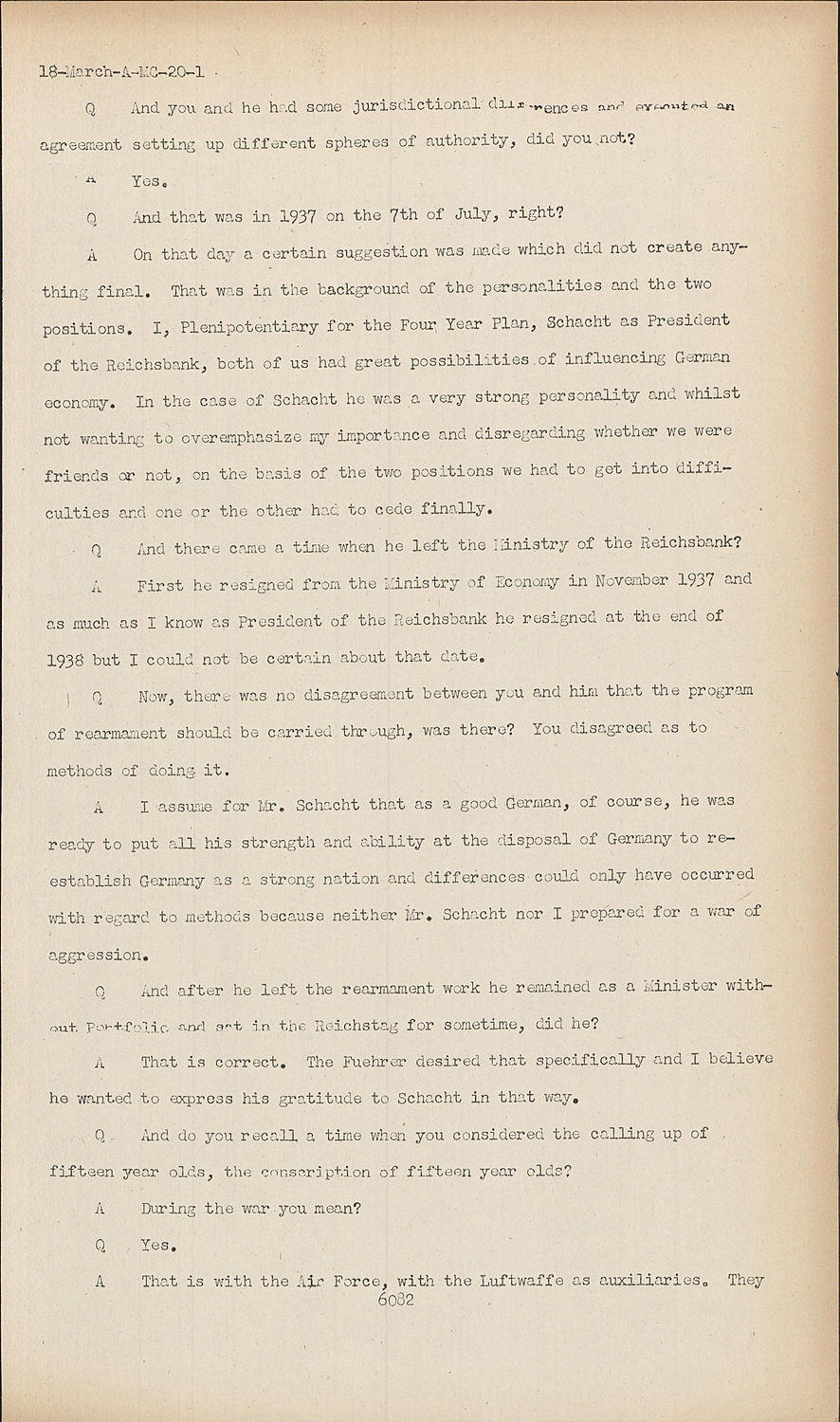
Q And you and he had some jurisdictional differences and executed on agreement setting up different spheres of authority, did you not?
AYes.
QAnd that was in 1937 on the 7th of July, right?
AOn that day a certain suggestion was made which did not create anything final. That was in the background of the personalities and the two positions. I, Plenipotentiary for the Four Year Plan, Schacht as President of the Reichsbank, both of us had great possibilities of influencing German economy. In the case of Schacht he was a very strong personality and whilst not wanting to overemphasize my importance and disregarding whether we were friends or not, on the basis of the two positions we had to got into difficulties and one or the other had to cede finally.
QAnd there came a time when he left the Ministry of the Reichsbank?
AFirst he resigned from the Ministry of Economy in November 1937 and as much as I know as president of the Reichsbank he resigned at the end of 1938 but I could not be certain about that date.
QNow, there was no disagreement between you and him that the program of rearmament should be carried through, was there? You disagreed as to methods of doing it.
AI assume for Mr. Schacht that as a good German, of course, he was ready to put all his strength and ability at the disposal of Germany to reestablish Germany as a strong nation and differences could only have occurred with regard to methods because neither Mr. Schacht nor I prepared for a war of aggression.
QAnd after he left the rearmament work he remained as a Minister without portfolio and act in the Reichstag for sometime, did he?
AThat is correct. The Fuehrer desired that specifically and I believe he wanted to express his gratitude to Schacht in that way.
QAnd do you recall a time when you considered the calling up of fifteen year olds, the conscription of fifteen year olds?
ADuring the war you mean?
QYes.
AThat is with the Air Force, with the Luftwaffe as auxiliaries. They were fifteen or sixteen years, I don't remember that exactly, which were called as auxiliaries for the Air Force.
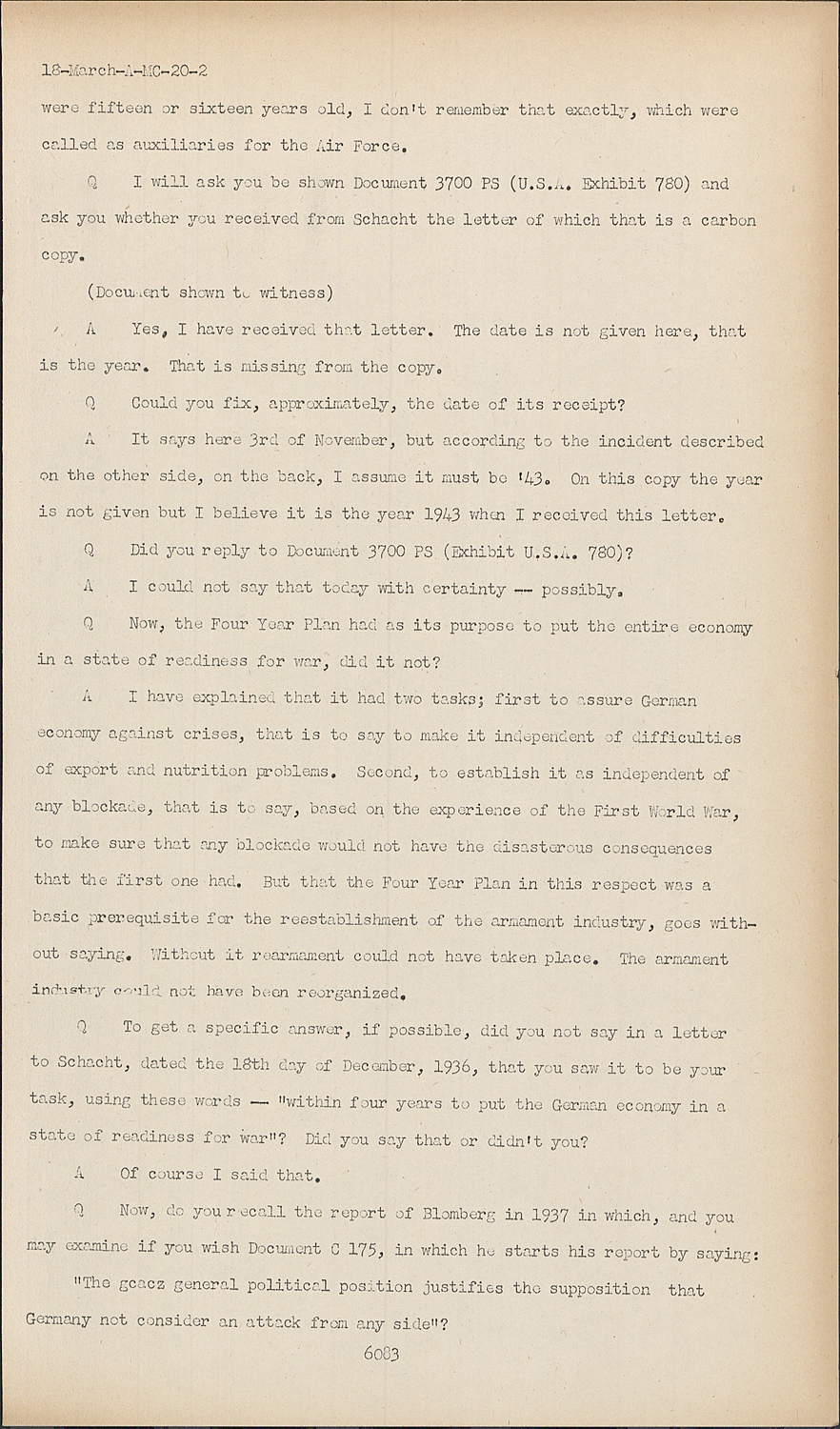
QI will ask you be shown Document 3700 PS (U.S.A. Exhibit 780) and ask you whether you received from Schacht the letter of which that is a carbon copy.
(Document shown to witness)
AYes, I have received that letter. The date is not given here, that is the year. That is missing from the copy.
QCould you fix, approximately, the date of its receipt?
AIt says here 3rd of November, but according to the incident described on the other side, on the back, I assume it must be '43. On this copy the year is not given but I believe it is the year 1943 when I received this letter.
QDid you reply to Document 3700 PS (Exhibit U.S.A. 780)?
AI could not say that today with certainty -- possibly.
QNow, the Four Year Plan had as its purpose to put the entire economy in a state of readiness for war, did it not?
AI have explained that it had two tasks; first to assure German economy against crises, that is to say to make it independent of difficulties of export and nutrition problems. Second, to establish it as independent of any blockade, that is to say, based on the experience of the First World War, to make sure that any blockade would not have the disasterous consequences that the first one had. But that the Four Year Plan in this respect was a basic prerequisite for the reestablishment of the armament industry, goes without saying. Without it rearmament could not have taken place. The armament industry could not have been reorganized.
QTo get a specific answer, if possible, did you not say in a letter to Schacht, dated the 18th day of December, 1936, that you saw it to be your task, using these words -- "within four years to put the German economy in a state of readiness for war"? Did you say that or didn't you?
AOf course I said that.
QNow, do you recall the report of Blomberg in 1937 in which, and you may examine if you wish Document C 175, in which he starts his report by saying:
"The gcacz general political position justifies the supposition that Germany not consider an attack from any side"?
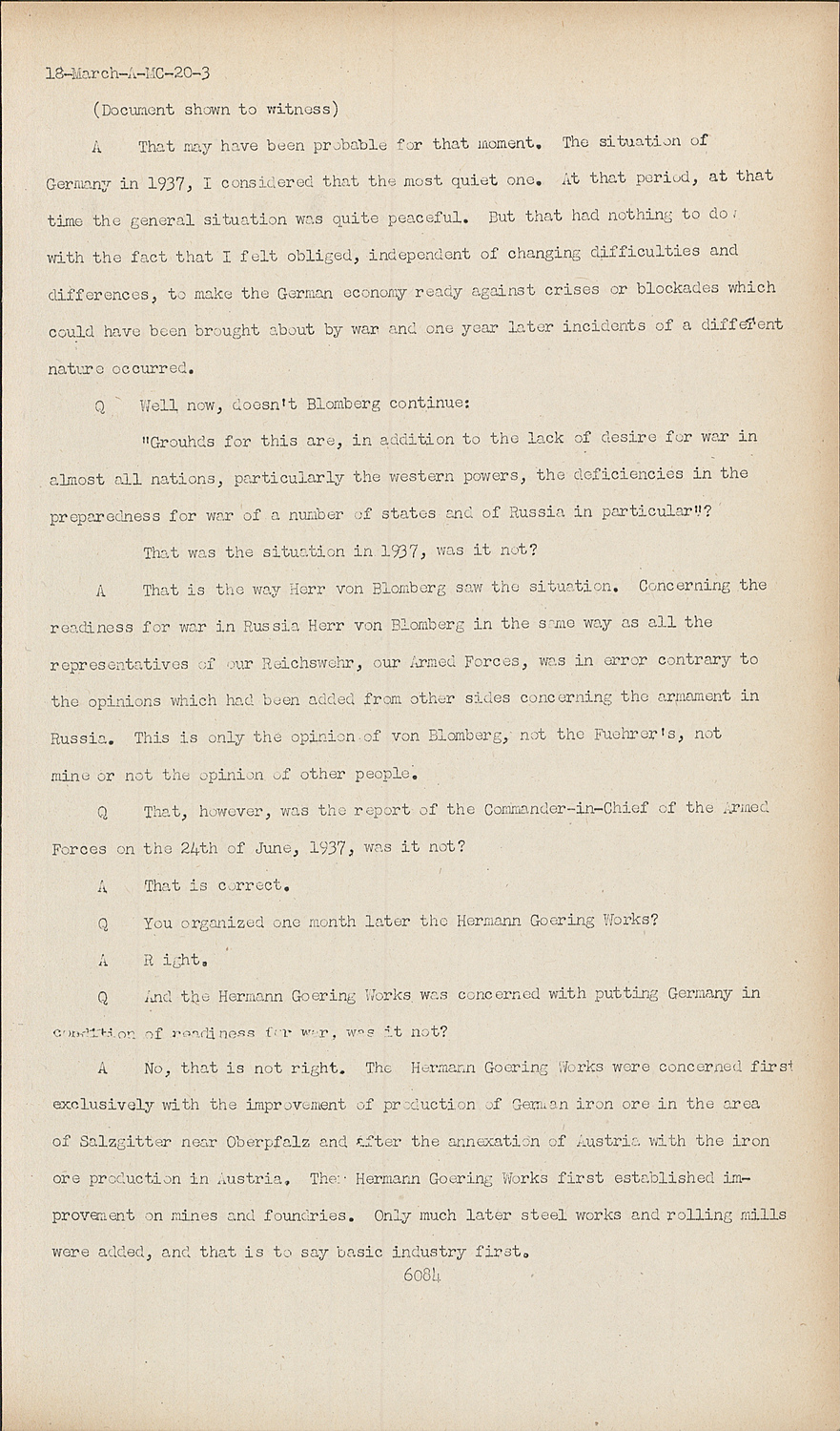
(Document shown to witness)
AThat may have been probable for that moment. The situation of Germany in 1937, I considered that the most quiet one. At that period, at that time the general situation was quite peaceful. But that had nothing to do with the fact that I felt obliged, independent of changing difficulties and differences, to make the German economy ready against crises or blockades which could have been brought about by war and one year later incidents of a different nature occurred.
QWell now, doesn't Blomberg continue:
"Grouhds for this are, in addition to the lack of desire for war in almost all nations, particularly the western powers, the deficiencies in the preparedness for war of a number of states and of Russia in particular"?
That was the situation in 1937, was it not?
AThat is the way Herr von Blomberg saw the situation. Concerning the readiness for war in Russia Herr von Blomberg in the same way as all the representatives of our Reichswehr, our Armed Forces, was in error contrary to the opinions which had been added from other sides concerning the armament in Russia. This is only the opinion of von Blomberg, not the Fuehrer's, not mine or not the opinion of other people.
QThat, however, was the report of the Commander-in-Chief of the Armed Forces on the 24th of June, 1937, was it not?
AThat is correct.
QYou organized one month later the Hermann Goering Works?
ARight.
QAnd the Hermann Goering Works was concerned with putting Germany in Condition of readiness for war, was it not?
ANo, that is not right. The Hermann Goering Works were concerned first exclusively with the improvement of production of German iron ore in the area of Salzgitter near Oberpfalz and after the annexation of Austria with the iron ore production in Austria. The Hermann Goering Works first established improvement on mines and foundries. Only much later steel works and rolling mills were added, and that is to say basic industry first.
Q The Hermann Goering Works was a part of the Four Year Plan, was it not?
AThat is right.
QAnd you have already said that the Four Year Plan and as its purpose to put the economy in a state of readiness for war; that the Hermann Goering Works was organized to exploit are mining and iron smelting resources and to carry the process through to completed guns and tanks, was it not?
A No. The Hermann Goering Works had at first no armament works of their own, only, as I have to say again, the basic product, raw steel.
QWell, at all events, you continued your efforts and on the 8th of November 1943, you made a speech describing those efforts to the Gauleiters in the Fuehrer Building at Munich, is that right?
AI don't know the date, but around that time I made a short speech in connection with other speeches made to the Gauleiters.
As far as I remember it was about the situation in the air and also maybe the armament situation.
I do not remember the words of that speech because I have not been asked about it since, but the fact is so.
QWell, let me remind you if you used these terms, refresh your recollection.
"Germany, at the beginning of the war, was the only country in the world possessing an operative fighting air force.
The other countries had split their air arms up into army and navy air forces and had considered the air arm primarily as a necessary and important auxiliary of the other branches of the forces.
In consequence, they relaxed the instrument which is alone capable of dealing concentrated and effective blows, namely, the operative air force.
In Germany we had gone ahead on those lines from the very outset, and the main body of the air force was disposed so that it could thrust deep into the hostile areas with strategic effect, while a lesser portion of the air force, consisting of Stukas and, of course, fighter planes, went into action on the front line in the battlefields.
You all know what great results were achieved by these tactics and what superiority we attained at the very beginning of the war through this modern kind of air force."
AThat is definitely true. I said that under all circumstances, and what is still more decisive, I acted like that, too.
But in order to be sure that this is understood correctly, I would like to explain it briefly.
In this statement I dealt with two separate opinions of air strategy which are still debated today and not quite clear, that is to say:
shall the air force be an auxiliary of army and navy and part of either the army or navy, or should it be a separate part of the armed forces?
I have explained that nations with a very large navy find it to be understood if such a distribution takes place between army and navy, but we, consequently and quite correctly, had chosen the path that besides army and navy we had built a strong air force, and I underlined the word "strong," and I explained what part we had taken, how we came to an operative air force.
As an expert I still am of the opinion that only operative air forces can bring about decisions.
I have also explained as to the proportion between two and four motored planes, that at first I was satisfied with the two-motored planes because, first, I did not have four-motored, and then because the operating radius of the four-motored bombers was not large enough.
I further pointed out that the quick termination of the campaign in Poland and in the West proved in an extraordinary way the effectiveness of the air force.
That is quite correct.
QI remind you of the testimony of the witness Milch sworn in your behalf, as to a subject on which I have not heard you express yourself.
He said.
"I nave been under the impression that already at the time of the occupation of the Rhineland, he, Goering, was worried that Hitler's policies would lead to war."
Do you remember that?
AYes.
QAnd was it true or false? True or mistaken, perhaps I should say.
ANo, I did not want any war, and I saw the best possibility to avoid war in a strong armament, according to the well known principle, "He who has a strong sword has peace."
Q You are still of that opinion?
AI am of that opinion today because I see the complications in existence more than ever.
QAnd it is true, as Milch said, that you were worried that Hitler's policies would lead to war at the time of the occupation of the Rhineland?
AExcuse me. I just understood that you asked whether it is also my opinion today that only a nation that is armed can have peace.
That is what I meant to answer with my last statement.
You referred to the statement by Milch, that I was worried that the policy of the Fuehrer could lead to war.
I would like to say that I was worried that war as such would come, and if possible I wanted to avoid it, not in the sense that the policy of the Fuehrer would lead to it, because the Fuehrer also desired to carry out his program by agreements and diplomatic action.
On the question of the Rhineland occupation, I was worried temporarily about the reactions, repercussions.
Just the same, it was necessary.
QAnd when nothing happened, the next step was Austria?
AThat has nothing to dowith it, that one can be brought in relation to the other.
Austria would never have caused me worries about war, as did the Rhineland occupation, because the occupation of the Rhineland--well, I could believe that a repercussion would occur there, but how any repercussions could occur from abroad after the reunion of two brother nations was not clear to me.
I did not expect that, especially since Italy, who always made believe that she had a vital interest, was eliminated.
England and France had no business to be concerned about the union, so there I did not see the danger of a war.
QI ask you just a few questions about Austria. You said that you and Hitler had deep regret about the death of Dollfuss, and I ask you if it isn't a fact that Hitler put up a plaque in Vienna in honor of the men who murdered Dollfuss, and went and put a wreath on their graves when he was there.
Is that a fact? Can't you answer that yes or no?
ANo, I can neither answer it with yes nor no, if I have to say the truth, because I cannot say, "Yes, he did it," because I don't know; I cannot say, "No, he didn't do it," because I don't know that either.
I wanted to say that I heard about that here and never before.
QNow, in June of 1937, Seyss-Inquart came to you and to the Secretary of State Keppler, and you had some negotiations.
AYes.
QAnd it was Seyss-Inquart's desire to have an independent Austria, was it not?
AAs far as I remember, yes.
QAnd Keppler was the man who was sent by Hitler to Vienna at the time of the Anschluss, and who telegraphed to Hitler not to march in, do you recall?
AYes.
QThat is the telegram that you characterized as impudent and senseless from the man who was on the ground and who had negotiated earlier with Seyss-Inquart, do you recall that?
AI did not designate the telegram by those words which have just been translated to me, "impudent."
I said that this telegram had no influence any more and was superfluous because the troops were on the move already, or at least they had the orders; the thing was roiling already.
QYou had demanded that Seyss-Inquart be made Chancellor?
Is that right?
ANot I personally wanted it, but that developed out of circumstances.
He was at that time the only one who could assume the Chancellorship because he was in the Government already.
QNow, did Seyss-Inquart become Chancellor of Austria with the understanding that he was to surrender his country to Germany, or did you lead him to believe that he would be independent, have an independent country?