AYes, I was present at that time.
QAnd the SS seized you and the Reichsmarshal and several others and searched your houses, seized all your papers, and took you prisoner, did it not?
AIt is correct that on the 23rd of April at 19 hours we were surrounded. The Reichsmarshal was led to his room and from that moment on never remained without personal guard; that we were put in single custody and separated from him and that we executed by the troops of the SS, who were stationed at the Berghof.
QAnd this occurred at Berchtesgaden?
AThat happened at Berchtesgaden.
QI think you have told us that you were all supposed to be shot by the SS at the time of the surrender and were supposed to approve it by your own signature. Is that correct?
ANo, that is not quite correct.
I know that an order existed indicating that the Reichsmarshal with his family and those surrounding, at the time of the capitulation in Berlin, should be shot.
The second thing you mentioned is different. We should have been -we were about to be forced to volunteer for the SS. One has to say that the SS leaders did not want us there at that time and we were not forced to execute that order. At that time, however, we were already separated from the Commander-in-Chief.
QWhat was the state of your knowledge about the activities of the SS? What was the SS and what was its relation to the Wehrmacht at this time? What was its relation to the Air Force? Tell us about the SS.
AI can only say that as such, from the word SS, a lot could be understood. Speaking of the SS, SD, Gestapo, Waffen SS, they were entirely different units. The Gestapo, as such, was a means of pressure which prevented a great deal of free development.
Q And the SS likewise, as a matter of fact?
AThe Waffen SS was the military organization, the troops. I, personally, did not have any bad experiences with them, no difficulties, no friction with them.
QBut what about the SS proper? Brauchitsch, you know this situation about the SS, I am sure, and you impress me as wanting to tell us candidly whet you know about this situation, and I wish you would tell us a little, what the influence of the SS was on these situations.
AI pointed out once before that as a purely military adjutant I am only able to give you information about the Air Force, but I am not in a position to say anything about general things about which I have no technical knowledge, just a subjective opinion.
QWell, wasn't the SS the subject of a good deal of discussion among you officers, and wasn't everybody aware that the SS was an organization like the Gestapo that was repressive and cruel?
AIn the Air Force we had so many worries ourselves about the increase of the air power of the enemy that these worries kept us busy, more than sufficiently.
QBut you knew, did you not, about the campaign against the Jews of Germany and the Jews of occupied countries?
AI was not informed about the campaign against the Jews as it was pointed out here and as it went through the press.
QWell, I don't want to interrogate you from what is in the press, but do you want the Tribunal to understand that you had no knowledge of a campaign against the Jews in Germany?
AI only know about the cruelties and the extermination about which I have now read in the press. I did not know at the time.
QYour father was Field Marshal, was he not?
AYes.
QAt what period was he Field Marshal?
AField Marshal is a military ran which he had from 1940 until now.
QHe has never been deprived of his rank, is that a fact?
AHe was never deprived of his rank.
QThere came a time when your father, as you knew, disagreed with Hitler as to military programs?
AI know that my father at one time had great difficulties with Hitler concerning political and military questions.
QDid you not say to the interrogator who examined you for the United States that he retired from active command in 1941?
AYes.
QAnd what did you understand to be the reason for his retirement?
You gave the reasons as follows, that neither in the military nor in the political considerations did he see eye to eye with Hitler, and could not come to any accord, and since he could not make his own opinions prevail, he desired to manifest his dissent by resigning, and that specifically also referred to religious questions.
AYes.
QThat is true, is it not?
AThat is correct, and I will stand for it.
QI hope you are proud of it, sir.
You were also asked this:
"And from 1941 to the end of the war, do you know what he was doing?"
And you answered:
"Well, he had, through his second wife, a little house in a small town in Silesia, Bockenheim, and he occupied himself with studies of family history and also with forestry, economics, and hunting work, but did not take any share" -
A (Interposing) That was military history only, with economic question
QBeg pardon. I didn't get that.
AHe was only interested in economic questions and hunting, but not in military questions.
QNot in military, yes.
" -- but did not take share in any sort of bloody political endeavors."
You said that, did you not?
AMay I ask to hear the question once more.
QThis is your answer in full. You interrupted me. This is your answer to the interrogator:
"Well, he had, through his second wife, a little house in a small town in Silesia, Bockenheim, and he occupied himself with studies of family history and also with forestry" -- and, they have down -- "economics, and hunting works, but did not take any share in any sort of bloody political endeavors."
And, with the exception of economies, you still stand by that answer, don't you?
AI have never said that he ever took part in bloody things. It must be an error. I have never seen that protocol any more. I have not signed it
QI have not made myself clear. You said he did not take part in any bloody political endeavors. That is what this says you said.
AHe did not take part, but I have not said anything about bloody or any political endeavors.
QYou didn't use those terms in the examination?
ANo, I cannot remember that I said that. I have not signed that protocol and I didn't see it any more after the interrogation.
QAnd you say that you did not use those words on the 26th of February 1946 to Captain Horace Hahn, Interrogator?
AI say I have net used any expression about bloody endeavors or such, because that expression is foreign to me. I do not know in what connection I would have mentioned it.
QWell, you don't know of any that he did partake in, do you?
ANo. My father retired, yes.
QAbsolutely from this whole Nazi outfit. He cut his strings with them and retired to a little village rather than go on with the program he didn't agree with, didn't he? Isn't that a fact?
AYes.
DR.PECKMANN (Counsel for the SS): I believe that I do not have any more formal right to question this witness after Justice Jackson has interrogated him, but I would be grateful if I would be permitted to since Justice Jackson questioned the witness also about the SS.
THE PRESIDENT:The witness statement about the SS was that he knew nothing about it. I don't know what ground that gives for your cross examination.
DR. PECKMANN:He was asked whether, on Obersalzburg, he was guarded by the SS who also had orders to shoot him and to shoot Goering.
I would like to clarify whether that was SS or SD.
THE PRESIDENT:Very well.
RE-DIRECT EXAMINATION BY DR. PECKMANN:
QI ask the witness, therefore: Do you knew whether these people whom you have just mentioned were members of the SS or SD. Do you know the difference, Witness?
AI knew the difference generally. I believe that the troops which had the mission of guarding us were SS, but that the Sicherheitsdienst had the special order.
DR. PECKMANN:Thank you.
THE PRESIDENT:Do any of the other counsel for the Prosecution wish to cross-examine?
Dr. Stahmer, do you wish to re-examine?
DR. STAHMER:I have only two short questions. BY DR. STAHMER:
QWitness, can you tell us something as to how the relations between the Reichsmarshal and Himmler were?
AAs much as I am informed about that and therefore could give information, there existed between Himmler and Goering a relation which on the outside looked very careful, but one could not talk of the real relation between the two.
QCan you tell us something about whether the German people, until the last moment, still trusted the Reichsmarshal, and there was special confidence in the Reichsmarshal? Can you tell us about any particular incident
AI can mention two cases.
The first one was at the end of 44 or the beginning of 45 -- I cannot say the exact date -- in a public air raid shelter. The Reichsmarshal was without any guards, and he spoke to the people and they greeted him with the old slogan "Hermann, halt die Ohren steif", Hermann, keep your chin up.
Another example was on the trip from Berlin to Berchtesgaden, the night of the 20-21 April. On the morning of the 21st, towards noon, the Reichsmarshal arrived at a town in Sudetengau, Bohemia, where a short stop-over was made, and where, after a short time, the market place was filled by people.
He was asked for his autograph, and we could not get him out of the crowd with his own car.
Here also, he was greeted by the old shout, "Hermann."
DR. STAHMER:I have no more questions.
THE PRESIDENT:The witness may retire.
DR. STAHMER:As next witness, I name State Secretary Paul Koerner.
PAULKOERNER, a witness, took the stand and testified as follows: BY THE PRESIDENT:
QIs your name Paul Koerner?
AYes.
QWill you repeat this oath after me:
I Swear by God, the Almighty and Omnniscient, that I will speak pure truth, and will withhold and add nothing.
(The witness repeated the oath).
THE PRESIDENT:You may sit down if you wish.
DIRECT EXAMINATION BY DR. STAHMER:
QWitness, which official position did you have before the capitulation?
AI was the State Secretary of the Prussian State Ministry.
QIn this office were you one of the collaborators of the Reichsmarshal?
AYes.
QWhen did you first meet the Reichsmarshal?
AIn the year 1926
QWhen were you picked as collaborator?
AAt the end of 1939.
QIn what function?
AI was his secretary.
Q when were you taken into the Civil Service?
AApril 1933. Pardon; the previous date was '31.
THE PRESIDENT:The translator said the previous date was 1931; which date was 1931?
DR. STAHMER:In 1931 he first became Goering's private secretary. In 1933 he entered the Civil Service.
BY DR. STAHMER:
QWhich office did you hold?
AI became State Secretary of the Prussian Ministry.
QWhat do you knew about theinstitution of the Secret State Police, the Gestapo?
AThe Secret State Police was established in the first months after the seizure of power, was developed from the Political Police Department 1-A. Basically, the Political Police Department remained in existence, only it was newly formed, and got the name of the State Police.
QWhat was their mission?
AThey had to watch enemies of the State.
QAre you informed about the establishment of concentration camps?
AI know that at that time concentration camps were established.
QWhat purposes did they serve?
AThey were supposed to house enemies of the State.
QWhat do you mean by "house"?
AHostile enemies, elements hostile to the State, should be put into these camps.
QAnd what should be done with them there?
AThey should be taken into custody, and, as far as I know, a reeducation should take place in order to be able to return them to the mission.
QDo you know anything about the treatment which took place there?
AAs far as I know, the treatment was always good.
QDid you ever hear anything about so-called wild concentration camps?
AYes, in 1933, in various places, wild concentration camps were established.
QBy whom?
AI remember that one was established in Breslau by SA Obergruppenfuehrer Heines; one in Stettin. Whether there were any others, I do not know.
QIn Stettin? Who was it in Stettin?
AI think it was Karpfenstein, but I cannot be sure about it.
QAnd what became of these camps?
A When the Reichsmarshal heard about it, he had them dissolved because they were established without his approval.
QWhat was the Reichsmarshal's attitude to complaints?
AOh, he always went after the complaints; he went to the sources of the complaints.
QDo you knew of any case where he took special measures?
AYes.
QHow was it?
AThey had heard that the treatment had not been such as the Reichsmarshal wanted. He tried to get information about it and then had the man brought before him.
QWho was Thaelmann?
AThaelmann was one of the leaders of the Communists and he was a Communist member of the Reichstag.
QAnd how did the Reichsmarshal speak to Thaelmann?
AHe asked him to come into his office and requested that he tell him anything, why a complaint had been sent.
Q And then?
AThaelmann was very reticent at first, because he feared an offense, but it became clearer to him, after the Reichsmarshal spoke very plainly to him, that he could speak freely. Then he told the Reichsmarshal that he had not been treated correctly. The Reichsmarshal promised to do something about it immediately, and gave the respective directives; and he also suggested to Thaelmann that whenever such things occurred again he should report about them immediately. He also gave orders that whenever any complaints should come from Thaelmann, they should be sent directly to him.
QDo you know how long the Gestapo and the concentration camps were under the competence of the Reichsmarshal?
AUntil the spring of 1934; I believe it was March or April.
QUnder whose competence did they come then?
AUpon orders of the Fuehrer, they came under the competence of Reichsfuehrer Himmler.
QWhat do you know about the events regarding the Roehm revolt on the 30th of July, 1934?
AThat a Roehm revolt was planned I found out about when I was in Essen, where we were present at the wedding of Gauleiter Roehm. During the wedding ceremony Himmler reported to the Fuehrer. Later the Fuehrer confided in the Reichsmarshal and told him about the plans of Roehm.
QDo you also know what he told him?
AI can only say that what Himmler told the Fuehrer was also brought to the knowledge of Goering.
QDo you know any details?
ANo, I do not know any more details, but that is sufficient.
QWhat directives did Goering receive?
AThe Fuehrer directed Goering, after the wedding, to return to Berlin at once, and the Fuehrer went to Southern Germany to investigate these reports personally.
QWhen was that wedding?
ASo far as I remember, that was two days before the Roehm putsch.
QDo you know whether on the day after the Roehm putsch, the Reichsmarshal was to see Hitler?
A No. The Reichsmarshal was in Berlin. We returned, the same evening to Berlin.
QYes, and on the day after the Roehm putsch, after the 30th?
AThe Reichsmarshal was in Berlin.
QDo you know anything about whether there was a conversation between him and Hitler?
AYes. I remember that the Reichsmarshal drove to the Reich Chancellery to report several things to the Fuehrer, especially that the Reichsmarshal had been informed that on that occasion innocent people also could have been, or were the victims. Therefore, he wanted to ask the Fuehrer to stop the whole action immediately.
QWas that done?
AYes, that was done.
QIn what form, or in what manner?
AAfter the report of the Reichsmarshal to the Fuehrer, the Fuehrer personally issued directives that no wild actions should take place any more, that the actions were finished, and if any guilty people were found they would be sent to courts, which had to decide whether any action should be taken against the men or not.
QDo you know anything, or can you tell us something about whether the Reichsmarshal had anything to do with the action of the 8th and 9th of November, 1938, against the Jews?
ANo, the Reichsmarshal had nothing to do with it and had no idea of it.
QHow do you know?
ABecause I was with the Reichsmarshal on the 9th of November in Munich, and on the same evening we went to Berlin. If the Reichsmarshal had known anything, undoubtedly be would have told me, or these who were around him. He had no idea.
QWhen did he find out about it?
AHe found out shortly before he arrived at Berlin, at the Anhalte Station at Berlin.
QThrough whom?
AThrough his adjutant.
Q And what was his attitude when he got this information?
AHe was furious when he received that report, because he rejected the entire action as such.
QAnd what did he do about it?
AHe got in touch with the Fuehrer immediately, in order to demand that this action be stopped immediately.
QWhich task did you have within the framework of the Four-Year Plan?
AI was Chief of the Office of the Four-Year Plan.
QWhich jobs did you have?
ATo head the office, supervise the work.
QHow did the Four-Year Plan come about? When was that, and how did it start?
AThe Four-Year Plan was proclaimed in October of 1936, but the history goes back to the nutritional crisis of 1935. In the fall of 1935 the Reichsmarshal received the order -
THE PRESIDENT:Witness, try not to go quite so fast. It is very difficult to get the translation.
THE WITNESS:Yes, sir.
A (Continuing) In the fall of 1935, the Reichsmarshal received the order from the Fuehrer to assure nutrition for the German people since, because of the bad harvest of 1934 and 1935, that was in danger. We were short about two million tons of bread grain and several hundred thousand tons of fat, which had to be procured some way or another.
The Reichsmarshal solved this problem satisfactorily, and that caused the Fuehrer to ask him for suggestions as to how the entire German economy could be reorganized. These proposals were worked out at the first of the year 1936, and during the summer were presented to the Fuehrer.
On the basis of these proposals, the Fuehrer had the idea of the Four-Year Plan, which he proclaimed on the occasion of Party Day in 1936. On the 18th of October, 1936, the Fuehrer issued a decree which appointed the Reichsmarshal Plenipotentiary for the Four-Year Plan.
QWhat were the purposes connected with the Four-Year Plan?
AAs I said before, to reform and reorganize the German economy. The main task was to increase German export as much as possible, and to supplement exports so as to increase the production of agriculture.
QWas the Four-Year Plan a means of rearmament?
AOf course, it also served for the reestablishment or the rebuilding of the German Wehrmacht, the Army.
QDid the Four-Year Plan have anything to do with manpower?
AYes. Within the Four-Year Plan a Plenipotentiary for Manpower was appointed. He was the former President of the Reichsamt, President Syrup.
QWhen was he appointed?
AThat was at the beginning of the Four-Year Plan, in the fall of 1936.
QWhat were his tasks in particular?
AHe had to regulate the Arbeitseinsatz, so that the confusion which existed in the labor market could be ended.
QHow long did Syrup remain in office?
ASyrup left in the spring of 1942, for reasons of illness.
QWho was his successor?
AHis successor was Gauleiter Sauckel.
Q who appointed Sauckel?
ASauckel was appointed by the Fuehrer.
QAnd what was his job?
AHis main job as Plenipotentiary for the Arbeitseinsatz, manpower, was that he had the job to regulate manpower problems. He was formally under the Plenipotentiary for the Four-Year Plan, but he received his directives immediately from the Fuehrer.
QIn what manner did you work for that?
AFrom the beginning, 1942, I had no more influence so far as manpower was concerned, since Sauckel received his directives from the Fuehrer and executed them independently.
QDidn't you have any more negotiations with Sauckel?
ANo, There had been no negotiations, so far as I remember, since he received his directives immediately from the Fuehrer.
QWho disposed of the manpower? Who distributed it?
AThe labor offices, and they were under Sauckel.
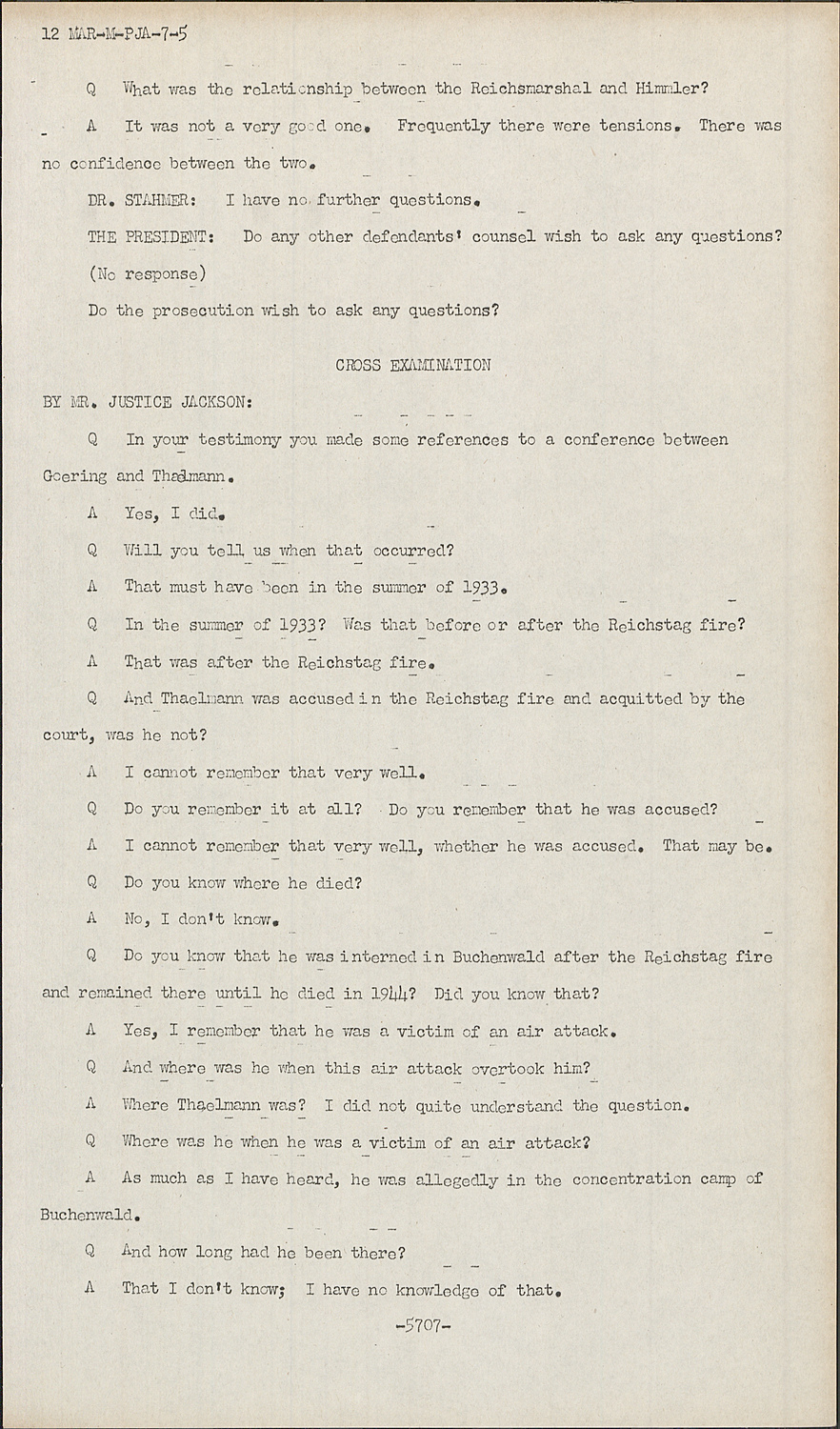
Q What was the relationship between the Reichsmarshal and Himmler?
AIt was not a very good one. Frequently there were tensions. There was no confidence between the two.
DR. STAHMER:I have no further questions.
THE PRESIDENT:Do any other defendants counsel wish to ask any questions?
(No response)
Do the prosecution wish to ask any questions?
CROSS EXAMINATION BY MR. JUSTICE JACKSON:
QIn your testimony you made some references to a conference between Goering and Thaelmann.
AYes, I did.
QWill you tell us when that occurred?
AThat must have been in the summer of 1933.
QIn the summer of 1933? Was that before or after the Reichstag fire?
AThat was after the Reichstag fire.
QAnd Thaelmann was accused in the Reichstag fire and acquitted by the court, was he not?
AI cannot remember that very well.
QDo you remember it at all? Do you remember that he was accused?
AI cannot remember that very well, whether he was accused. That may be.
QDo you know where he died?
ANo, I don't know.
QDo you know that he was interned in Buchenwald after the Reichstag fire and remained there until he died in 1944? Did you know that?
AYes, I remember that he was a victim of an air attack.
QAnd where was he when this air attack overtook him?
AWhere Thaelmann was? I did not quite understand the question.
QWhere was he when he was a victim of an air attack?
AAs much as I have heard, he was allegedly in the concentration camp of Buchenwald.
QAnd how long had he been there?
AThat I don't known I have no knowledge of that.
Q Were you present at the conversation between Thaelmann and Goering?
AYes.
QWhat did he complain about then in the concentration camp?
AAbout treatment during interrogations.
QThat was the only complaint he made?
AYes, so far as I can remember. The Reichsmarshal asked him whether he had good food, and they were discussing everything, treatment and food.
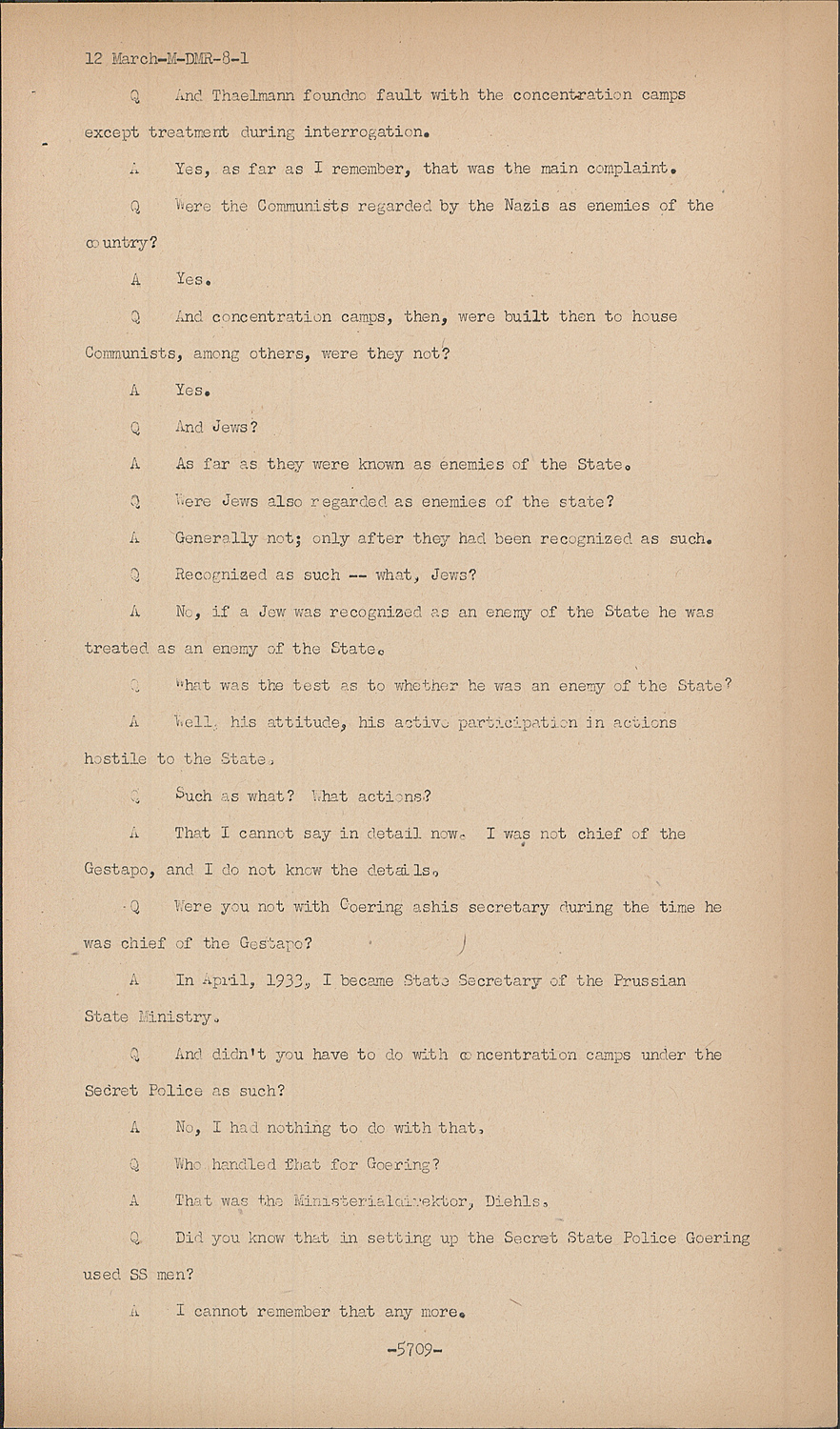
Q And Thaelmann foundno fault with the concentration camps except treatment during interrogation.
AYes, as far as I remember, that was the main complaint.
QWere the Communists regarded by the Nazis as enemies of the country?
AYes.
QAnd concentration camps, then, were built then to house Communists, among others, were they not?
AYes.
QAnd Jews?
AAs far as they were known as enemies of the State.
QWere Jews also regarded as enemies of the state?
AGenerally not; only after they had been recognized as such.
QRecognized as such -- what, Jews?
ANo, if a Jew was recognized as an enemy of the State he was treated as an enemy of the State.
AWell, his attitude, his active participation in actions
QWhat was the test as to whether he was an enemy of the State? hostile to the State.
QSuch as what? What actions?
AThat I cannot say in detail now. I was not chief of the Gestapo, and I do not knew the details.
QWere you not with Goering ashis secretary during the time he was chief of the Gestapo?
AIn April, 1933, I became State Secretary of the Prussian State Ministry.
QAnd didn't you have to do with concentration camps under the Secret Police as such?
ANo, I had nothing to do with that.
QWho handled that for Goering?
AThat was the Ministerialdirektor, Diehls.
QDid you know that in setting up the Secret State Police Goering used SS men?
AI cannot remember that any more.
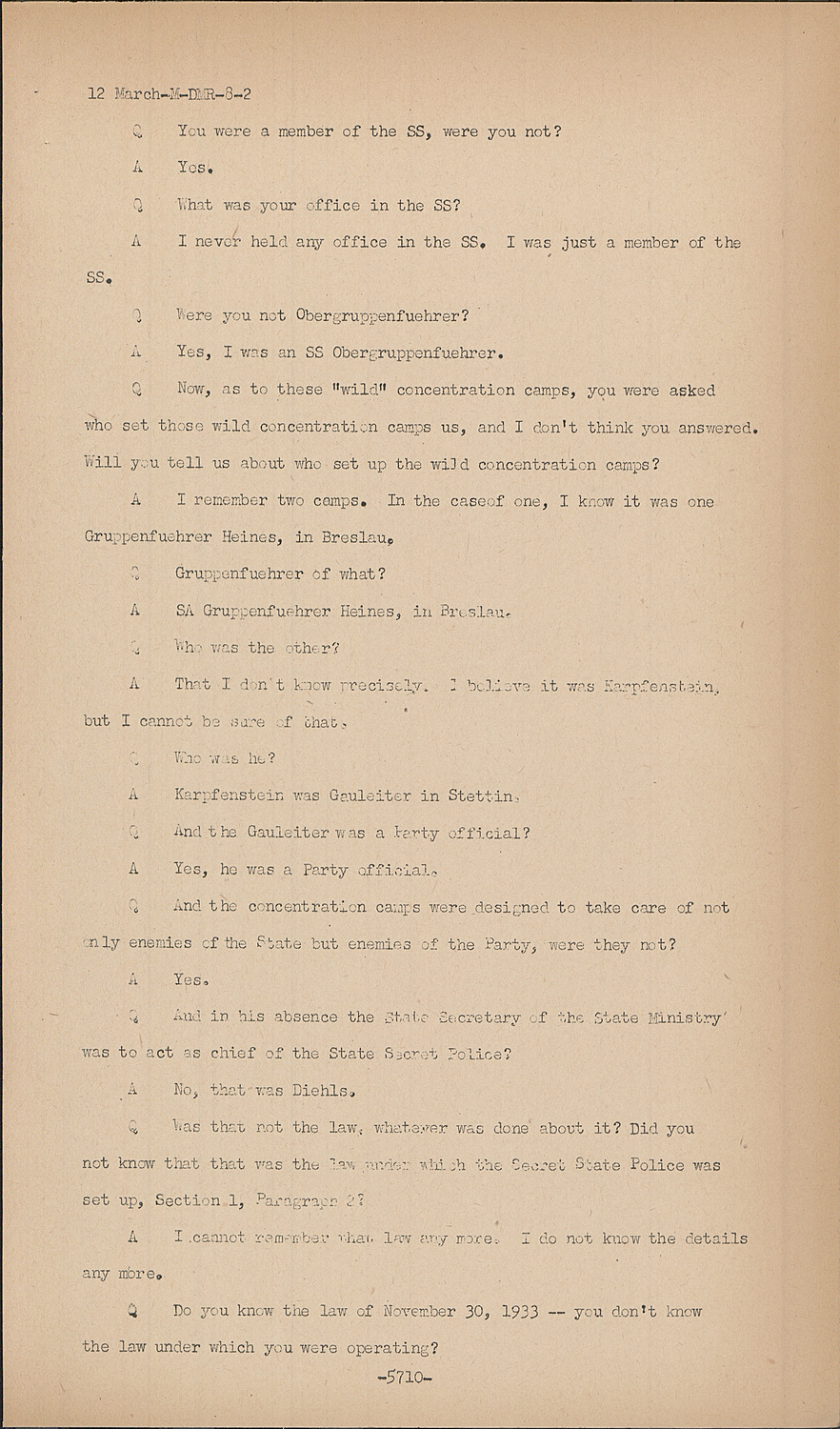
Q You were a member of the SS, were you not?
AYes.
QWhat was your office in the SS?
AI never held any office in the SS. I was just a member of the SS.
QWere you not Obergruppenfuehrer?
AYes, I was an SS Obergruppenfuehrer.
QNow, as to these "wild" concentration camps, you were asked who set those wild concentration camps us, and I don't think you answered. Will you tell us about who set up the wild concentration camps?
AI remember two comps. In the case of one, I know it was one Gruppenfuehrer Heines, in Breslau.
QGruppenfuehrer of what?
A SAGruppenfuehrer Heines, in Breslau.
QWho was the other?
AThat I don't know precisely. I believe it was Karpfenstein, but I cannot be sure of that
QWho was he?
AKarpfenstein was Gauleiter in Stettin.
QAnd the Gauleiter was a Party official?
AYes, he was a Party official.
QAnd the concentration camps were designed to take care of not only enemies of the State but enemies of the Party, were they not?
AYes.
QAnd in his absence the State Secretary of the State Ministry was to act as chief of the State Secret Police?
ANo, that was Diehls.
QWas that not the law, whatever was done about it? Did you not knew that that was the law under which the Secret State Police was set up, Section 1, Paragraph 2?
AI cannot remember what law any more. I do not know the details any more.
QDo you know the law of November 30, 1933 -- you don't know the law under which you were operating?
A I do not remember that law now. I would have to see it again.
QNow, what was wrong with these concentration camps that they had to be closed out?
AThese wild concentration camps had been established without the approval of the Prussian Prime Minister and therefore he prohibited them immediately.
QThat is the only reason, that they were set up without his authority?
AI believe, yes.
QAnd he had them stopped immediately?
AImmediately stopped, yes.
QGoering did not tolerate concentration camps that were not under his control and the Fuehrer backed him up in it, is that right?
AYes.
QNow, from time to time complaints came to you about the treatment of people in concentration camps, all during the time you were with Goering, did there not?
AThose -- yes, there were frequent complaints; that is true.
QWhat did they complain of?
AThere was naturally -
QTell the Tribunal what the complaints were that you had to deal with.
AWell, mostly they were relatives of the people who had been brought to concentration camps and they asked for their release; or made complaints because they thought they had reasons that these people had been brought to the concentration camp unjustifiably.
QThat is, that they were innocent people, innocent of any offense?
AThe relatives asserted that.
QDid you do anything to get them released from concentration camps?
A The Reichsmarshal had ordered that all complaints had to be con-
sidered and investigated, and it was immediately done.
QAnd did you find that many of these people were innocent, or did you find that they were guilty?
AIf there was a case among them were somebody had been brought into a concentration camp and he was innocent, he was released immediately.
QAnd to whom was the communication given, that he had been found innocent and was to be released from the concentration camp?
AThat was sent to the Secret State Police, Cestapo.
QWhat at the Secret State Police? Who was the man you communicated with?
AWhoever was competent in these matters. In detail, I do not know. The chief, as far as I remember, was first Heydrich and then Kaltenbrunner and then Mueller.
QGoering was on good terms with all of those, was he not?
AYes.
QWell-acquainted with all of those men?
AWell-acquainted, of course.
QNow, when you say that Goering obtained the release of people from concentration camps, are you talking about just one or two cases or did he obtain the release of a good many people?
AThroughout the years, of course; there were several cases -- a number of cases.
QWhat do you mean by "several"?
AWell, I cannot tell the number now. At any rate, there was quite a number of cases where people had been released.
QDid you find any where the people were guilty when you investigated?
AIf they could not be released, then they were guilty.
QWho decided that?
AThat, as far as I know, was decided by the chief of the Secret State Police.
QWell, then, what did you do in requesting their release? Did you advise the Secret Police that you disagreed with their conclusion that the man was guilty, or did Goering simply order the man released or request his release?
A No, they were told what reason there was that the man should be re-
leased.
QDo you know of any instance in which Goering requested the release of a person from a concentration camp whore it was not granted?
AI cannot say that now. I have to think it over -- think about it.
QYou can't recall any today, can you, in which Goering's word requesting a release was not honored?
AAt this moment I cannot remember any particular case.
QHow many people were put in concentration camps as a result of the Roehm revolt?
AThat I cannot say either.
QHow many people were killed as a result of it?
AI cannot say that from memory any more. As far as I know, these figures were published at the time.
QWell, would it be a couple of hundred people that were killed for it?
AI would not like to state a figure, because I may be wrong.
QWell, it was a very large number of people, wasn't it?
ANo, I am sure it was not a very large number. The number was published at that time. One could investigate that and find out.
QWell, why did the Reichsmarshal want Hitler to stop punishing the people who had been a party to the Roehm revolt?
AI did not quite understand the question.
QI understood your testimony to be that the Reichsmarshal went to Hitler at some time and wanted this campaign against people who were in the Roehm revolt stopped. And I want to know why he wanted it stopped?
ASo as to prevent the suffering of innocent people, so that only the absolutely guilty should be caught and punished It was clear that during that action one or the other would like to take personal revenge and do away with his personal enemy, and in order to stop that, this action should be stopped immediately and only regular courts pass upon the matter.
Q Who was in charge of the selection of the people who were shot or otherwise killed as a result of the Roehm revolt?
AThe Fuehrer personally ordered it.
QAnd the Reichsmarshal had sufficient influence to stop that immediately when he complained?
AAt that time, yes, the Reichsmarshal had absolutely that influence.
QIn connection with this Four Year Plan, you say that it was its function to regulate the confusion in the labor market?
AYes.
QNow, you represented the Reichsmarshal in many meetings, did you not?
AYes.
QAnd was not one of your functions to get prisoners of war to work in the armament industry and other industries that needed labor?
ANo.
QYou never had anything to do with that?
AThe job potential for the Four Year Plan demanded, of course, prisoners of war for Arbeitseinsatz.
QYou attended many meetings when that was discussed, did you not?
AI could not recall that from memory.
QDid you report to the Reichsmarshal what happened at those meetings?
AIf questions of a general nature were discussed, always a report was made and presented to the Reichsmarshal.
QYou were a member of the Central Planning Board, were you not?
AYes.
QAnd you were representing on that Board the Reichsmarshal?
ANo. I did not represent the Reichsmarshal. It was a group of three men -- Speer, the Field Marshal, and myself. Central Planning was created in the spring of 1942.
QWho appointed you?
AThe three of us were appointed to the Central Planning Board.
QWho appointed you?
AAs much as I remember, it was Goering.
QAnd you reported to hi, did you not, what occurred from time to time?