We were afraid that murder had been committed.
QYou were afraid that murder had been committed. It does appear likely, doesn't it?
AWe gained this impression after we heard all the details.
QIt is quite clear that if that was murder the order for that murder would have to come from a high level, isn't it?
ASurely, certainly. Further, more details I have heard from General Westhoff about these cases, while I was in captivity together with him in England.
QNow, I want to ask you, first of all, about the prisoner of war organization.
Was the prisoner of war organization a department of the OKW?
AIn my opinion, yes.
QWhich was called KGW, Kriegsgefangenen Wesen?
AI cannot say any more about it, because I don't know how it was.
I only knew that there was a chief of the Kriegsgefangenen Wesen with the OKW.
QWas the chief of the Kriegsgefangenen Wesenat that time General Major von Graevenitz?
AVon Graevenitz, yes.
QThis was an air force camp? Stalag Luft 3 was an air force camp?
AYes. It had such a name that I was convinced that all prisoners were under the OKW.
That was my attitude, my opinion. I cannot say more about it because I did not know much about that organization.
QWas the directorate for supervising the air force camps, or the inspectorate, rather, called Inspectorate No. 17?
AThere was an inspectorate, an inspection, which for this question was installed according to the name.
What they had to do and what tasks they had, I cannot say.
Whether it was just for examination or anything else, I would not know.
QWas the head of that General Major Grosch?
A Grosch?
QGrosch.
AI cannot say. It is possible. I know the name, but I do not know whether he held that position.
QAnd the second in command, Oberst Waelde?
AIt is not known to me.
QYou were No. 2 in the air force at the Air Ministry in March 1944, were you not?
AThere were more number 2's at that time. I was in the same rank as the chief of staff, the chief of the personnel office, and the chief of technical armament, which were independent of ours and were working beside me, but according to the rank I was the second highest officer in the air force.
QWas there a conference in Berlin on the morning of Saturday, the 25th of March, about this escape?
AI cannot remember.
QDid not Goering speak to you about that conference?
AI have no recollection; I cannot remember that.
QDid Goering never tell you that there was a conference between Hitler, Himmler, himself and Keitel on that Saturday morning?
ANo. I do not know anything about that. I could not remember anything.
QAt which the order for the murder of these recaptured prisoners of war was given?
ANo, I know absolutely nothing about that. According to the descriptions which I have received later, it was entirely different.
About this I received information from General Westhoff and also from General Bodenschatz.
QGeneral Westhoff we are going to see here as a witness. He has made a statement about the matter saying
AI beg you to excuse me. I could not hear just now.
QGeneral Westhoff-
A Yes.
Q --has made a statement-
AYes.
Q --and we are going to see him as a witness.
AYes.
QSo perhaps I had better not put his statement to you, because he is going to give evidence.
Perhaps that would be fairer from the point of view of the Defense.
But are you suggesting that these officers, if they were murdered, to use yourwords, having escaped from an air force camp, that action could have been taken without the knowledge of Goering?
AI consider it absolutely possible in the great confusion which existed in highest places at that time.
QHigh confusion in March 1944?
ADuring the entire time already there was terrible confusion.
QBut it is quite clear-
AHitler mixed into all questions, and gave his orders over the heads of the Wehrmacht or by himself.
QBut did you never discuss this matter with Goering at all?
ANo. I cannot remember that I ever spoke to Goering about these questions.
QDon't you think this is a matter which reflects shame on the armed forces of Germany?
AYes, that is a great shame.
QYet Goering never spoke to you about it at all? Did you ever speak to Keitel?
AMay I say that during that time I have met Goering practically at no time.
QDid you over speak to Keitel about it?
ANo, never. I saw Keitel even more seldom than Goering.
QWasn't there a General Foster or Foerster at the Air Ministry?
AYes, there was such a gentleman.
Q General Foerster?
AYes.
QWas he Director of Operations?
ANo. He was, according to the German name, chief of the Luftwehr, and as such he had to deal with personnel replacements in connection with the General Staff and the Reichsmarshal, but during wartime he was in charge of the civil aviation, and regarding civil aviation he worked together with me, but during the war-
QI was going to ask you, did he ever mention this shooting to you?
AI have been asked about that once before, but much as I may try I cannot remember. It is not impossible that in the course of a conversation he may have told me that officers had been killed. If, and in what sense, he may have told me, I do not remember. I have not received an official report through him. It would not have been correct.
QIf Foerster told you, did you ever report it to Goering?
AI cannot remember the conversation with Foerster. Therefore, I do not believe that I have talked to him about it. He did not give me a report which I could have given to Goering--passed or to Goering--but this report would have gone directly from him or through other channels much quicker to Goering.
QDid you take any steps to prevent this shooting being carried out?
AWhen I heard about it for the first time, I could not get clear picture, but even if I had had a clear picture of it then from the words of Westhoff it is clear to me that it would have been much too late.
QWhy too late?
ABecause, first, Westhoff knew about it first of all when he found out, and he was told already that the order had been execution But I may point out that General Westhoff testified to that and will testify to that.
QVery well, you never went to Goering at all on the matter as you say?
AI don't know anything about that.
QNow I am going to deal with three short points further. With regard to the use of labor for the armament industry, Mr. Justice Jackson has asked you questions on that. Was labor from concentration camps used?
AYes.
QWould you just look at 1584-PS: that is shorthand note 1357, 12th of December, in the afternoon.
(A document is handed to the witness).
Is that a teletype from Goering to Himmler, dated the 14th of Februar 1944?
There are various code numbers; then, to Reichsfuehrer SS; that was Himmler, Reichsminister Himmler.
Who actually sent that teletype? It is signed by Goering, but he wouldn't be dealing with questions of labor, would he; or would he?
AI could not say, I could not say who actually sent it.
QThat was a subject with which you dealt, was it not, the position of labor for air armament?
AOnly as long as I had to do with air armament I have sent the demands for labor to the respective officers, but this telegram did not come from my office.
QIf it didn't come from your office, whose office did it come from?
AThere are a few things here. First -
QFrom whose office did it come?
AI cannot say that offhand.
QVery well.
AI don't know.
QSecond sentence: At the same time I ask you to put at my disposal as great a number of concentration camp convicts as possible for air armament, as this kind of manpower proved to be very useful according to previous experiments. You had frequently used concentration camp labor, had you?
A During the last time, yes. This is of the 15th. May I ask about the month of the telegram?
QYes, I told you witness, 14 of February, 1944. It is on the top.
AYes, I couldn't read it.
QNo, I quite understand. And did Himmler respond by providing you with ninety thousand further concentration camp prisoners? I refer to 1584 PS Number 3, dated 9 March, 1944. It is to the "Most honored Reichsmarshal" from Himmler. It says:
"At the present time 36,000 prisoners are employed for the purpose of the Air Force. Increase to a total number of ninety thousand prisoners is contemplated."
Then he refers in the last paragraph:-- "The movement of manufacturing plants of the aviation industry to subterranean locations requires a further employment of about one hundred thousand prisoners."
Now, those were concentration camp internees, witness.
(The witness was handed a document)
AYes, I see that from that letter.
QYou said you were almost innocent of the conditions reigning in concentration camps.
ANo, I don't know about that.
QYou have not seen the films when the camps were captured?
ANo.
QThe grim contrast -- just wait a moment -- the grim contrast between the plump and well-fed guards and civilians and the skeletons of the internees?
AI have not seen the film but I have seen photographs in England.
QDid you close your eyes deliberately to what was going on in Germany?
ANo, there was no possibility for us to see that.
QYou, in your position, could not know what was going on?
AIt was absolutely impossible.
QNow then, I just want to deal very shortly with a matter upon which Mr. Justice Jackson touched but he did not read the letter. That is the question of the experiments for the purpose of Air Force research. I am anxious to refer to as few documents as possible but I can give the reference.
Do you know that on the 15 of May, 1941, and the reference is shorthand note 1848, 1602-PS, that Dr. Rascher wrote to Himmler?
AI did not knew about that. I think I have told that recently during the interrogations.
QHe had very dangerous experiments for which no human would volunteer; monkeys were not suitable and so he asked for human subjects and Himmler at once provided, said he would be glad to provide human subjects for the experiment. Now that was in 1941. Did you know that was taking place?
ANo. I did not know anything about that.
QNow, Rascher was -
AI did not knew Rascher personally.
QHe was a doctor on the staff of the Air Force.
THE PRESIDENT:But, Mr. Roberts, this is not a letter to this witness, is it?
MR. ROBERTS:My Lord, I am leading up. The next letter is a letter signed by this witness. That was preliminary. Perhaps I had better come to the letter which he signed now. I am much obliged. BY MR. ROBERTS:
QI want to put to you now 343 PS and I also want to put to you, if the officer in charge of the documents would be so good, I want to put to you 687 PS (the witness was handed a document)
THE PRESIDENT:He has already been cross examined upon this letter, has he not?
MR. ROBERTS:I didn't Hunk the letter was read or was dealt with sufficiently. I believe you Lordship thinks it was.
THE PRESIDENT:The letter was put to him. I do not know whether it was actually read.
MR. ROBERTS:I shall be guided by the Court entirely. I know the matter was touched upon. I felt perhaps the letter should be read but I may be quite wrong.
THE PRESIDENT:I am told it was not read but the two letters were put to him.
MR. ROBERTS:I agree.
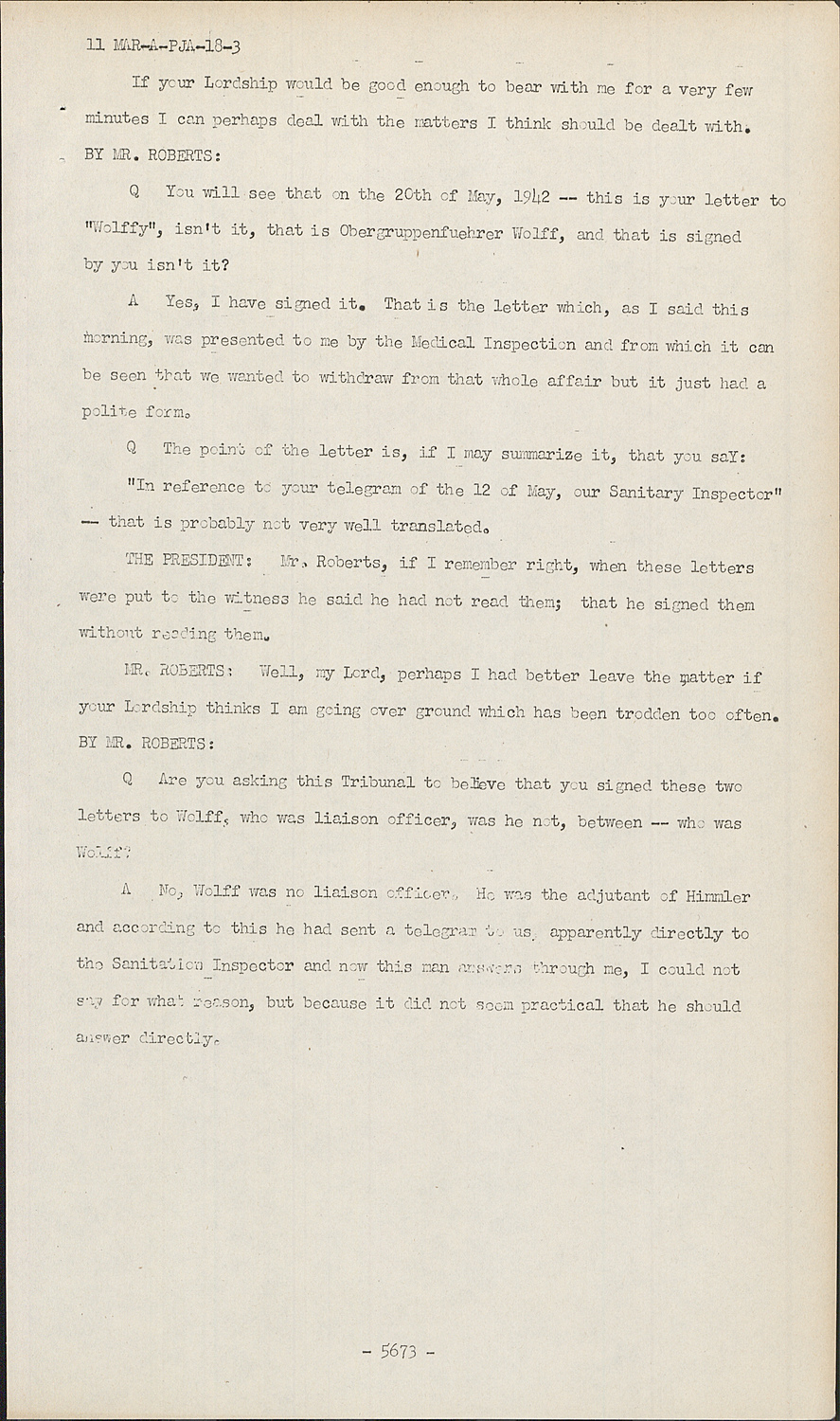
If your Lordship would be good enough to bear with me for a very few minutes I can perhaps deal with the matters I think should be dealt with.
BY MR. ROBERTS:
QYou will see that on the 20th of may, 1942 -- this is your letter to "Wolffy", isn't it, that is Obergruppenfuehrer Wolff, and that is signed by you isn't it?
AYes, I have signed it. That is the letter which, as I said this morning, was presented to me by the Medical Inspection and form which it can be seen that we wanted to withdraw form that whole affair but it just had a polite form.
QThe point of the letter is, if I may summarize it, that you saY:
"In reference to your telegram of the 12 of May, our Sanitary Inspector" -- that is probably not very well translated.
THE PRESIDENT:Mr. Roberts, if I remember right, when these letters were put to the witness he said he had not read them; that he signed then without reading them.
MR. ROBERTS:Well, my Lord, perhaps I had better leave the matter if your Lordship thinks I am going over ground which has been trodden too often. BY MR. ROBERTS:
QAre you asking this Tribunal to believe that you signed these two letters to Wolff, who was liaison officer, was he not, between -- who was Wolff?
ANo, Wolff was no liaison officer. He was the adjutant of Himmler and according to this he had sent a telegram to us, apparently directly to the Sanitation Inspector and now this man answers through me, I could not say for what reason, but because it did not seem practical that he should answer directly.
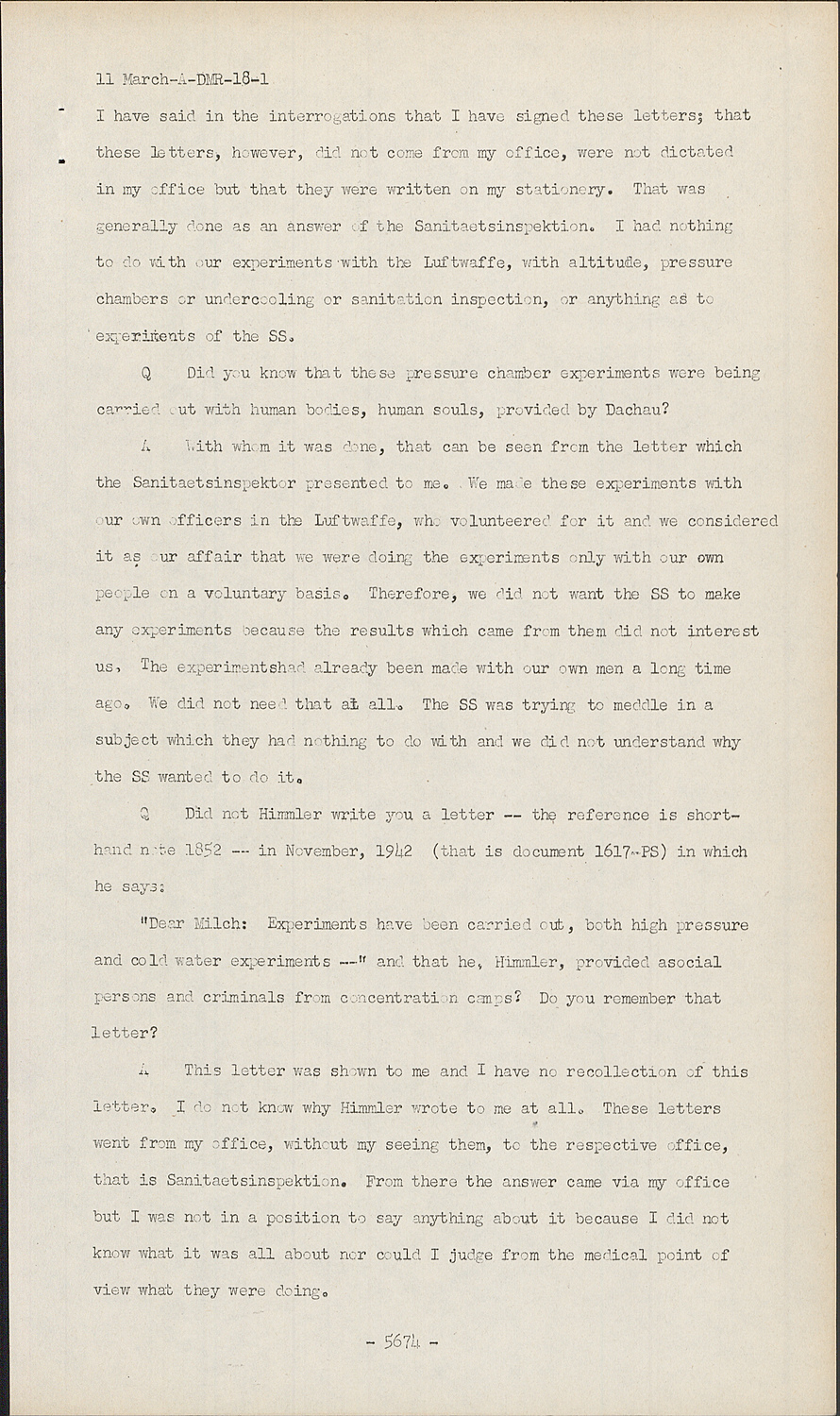
I have said in the interrogations that I have signed these letters; that these letters, however, did not come from my office, were not dictated in my office but that they were written on my stationery.
That was generally done as an answer of the Sanitaetsinspektion. I had nothing to do with our experiments with the Luftwaffe, with altitude, pressure chambers or undercooling or sanitation inspection, or anything as to experiments of the SS.
QDid you know that these pressure chamber experiments were being carried out with human bodies, human souls, provided by Dachau?
AWith whom it was done, that can be seen from the letter which the Sanitaetsinspektor presented to me. We made these experiments with our own officers in the Luftwaffe, who volunteered for it and we considered it as our affair that we were doing the experiments only with our own people on a voluntary basis. Therefore, we did not want the SS to make any experiments because the results which came from them did not interest us. The experimentshad already been made with our own men a long time ago. We did not need that at all. The SS was trying to meddle in a subject which they had nothing to do with and we did not understand why the SS wanted to do it.
QDid not Himmler write you a letter -- the reference is shorthand note 1852 -- in November, 1942 (that is document 1617-PS) in which he says:
"Dear Milch: Experiments have been carried out, both high pressure and cold water experiments --" and that he, Himmler, provided asocial persons and criminals from concentration camps? Do you remember that letter?
AThis letter was shown to me and I have no recollection of this letter. I do not know why Himmler wrote to me at all. These letters went from my office, without my seeing them, to the respective office, that is Sanitaetsinspektion. From there the answer came via my office but I was not in a position to say anything about it because I did not know what it was all about nor could I judge from the medical point of view what they were doing.
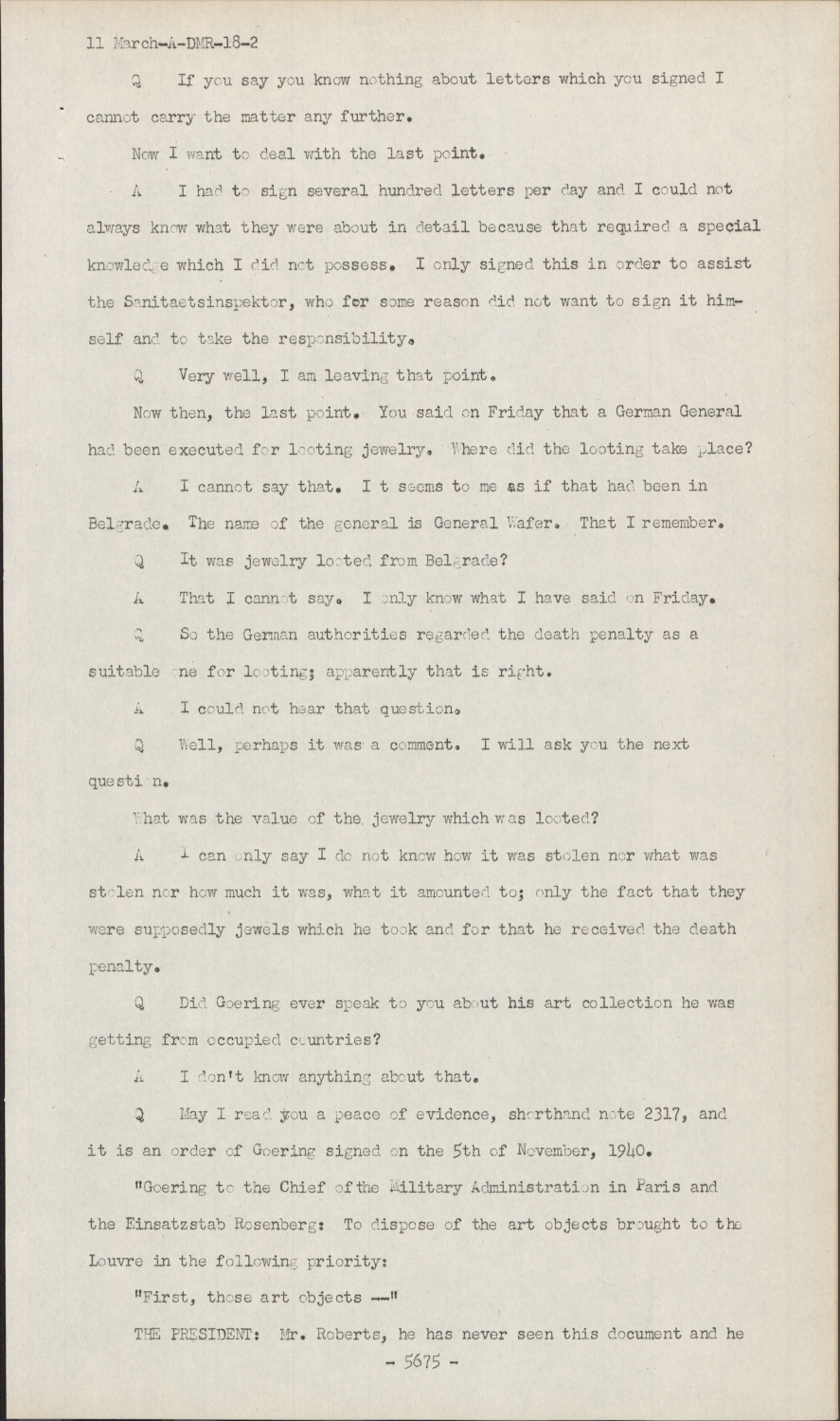
Q If you say you know nothing about letters which you signed I cannot carry the matter any further.
Now I want to deal with the last point.
AI had to sign several hundred letters per day and I could not always know what they were about in detail because that required a special knowledge which I did not possess. I only signed this in order to assist the Sanitaetsinspektor, who for some reason did not want to sign it himself and to take the responsibility.
QVery well, I am leaving that point.
Now then, the last point. You said on Friday that a German General had been executed for looting jewelry. Where did the looting take place?
AI cannot say that. I t seems to me as if that had been in Belgrade. The name of the general is General Wafer. That I remember.
QIt was jewelry looted from Belgrade?
AThat I cannot say. I only know what I have said on Friday.
QSo the German authorities regarded the death penalty as a suitable one for looting; apparently that is right.
AI could not hear that questions
QWell, perhaps it was a comment. I will ask you the next question.
What was the value of the jewelry which was looted?
AI can only say I do not know how it was stolen nor what was stolen nor how much it was, what it amounted to; only the fact that they were supposedly jewels which he took and for that he received the death penalty.
QDid Goering ever speak to you about his art collection he was getting from occupied countries?
AI don't know anything about that.
QMay I read you a peace of evidence, shorthand note 2317, and it is an order of Goering signed on the 5th of November, 1940.
"Goering to the Chief ofthe Military Administration in Paris and the Einsatzstab Rosenberg: To dispose of the art objects brought to the Louvre in the following priority:
"First, those art objects --"
THE PRESIDENT:Mr. Roberts, he has never seen this document and he says he knows nothing about it.
MR. ROBERTS:If your Lordship please, if you do not think I should put it to him-
QYou say Goering never dismissed with you his art collection?
A No.
QDid you not know that valuable art objects, inventoried to the amount of over 21,000 objects, were taken from the western occupied countries?
ANo, that is not know to me.
QWhat ought the General who looted the jewellery, perhaps from Belgrade, have done with it, given it to the Fuehrer, or given it to Goering?
AI ask to be relieved form answering this question.
BY GENERAL RUDENKO:
QWill you please tell me when you heard of the planning of war by Hitler against the Soviet Union?
In January 1941?
AIn January I heard, as I said Friday, form Reichsmarshal Goering, that Hitler had told him he expected an attack from Russia.
Then for several months I did not hear anything about the whole thing until by coincidence I found out from a subordinate that a war with Russia was imminent and preparations concerning the clothing of the troops had been started.
QDid you know about or were you acquainted with the Barbarossa Plan?
AI heard the name, the word, and I saw the plan as such demonstrated in a conversation with the Fuehrer one or two days before the attack, with the Army groups and Army commanders.
QAnd when did this take place, one day or two days before the invasion?
AI can tell you the date exactly in one second.
QPlease do.
AOn the 14th of June. That is about eight days before the attack which took place on the 22nd.
QAnd before that, you did not hear of this plan and you did not see it.
AI say that I probably heard the name Barbarossa, the word, before, but only shortly before.
QAnd how long before?
AI cannot say that because during the entire Months of January, February, March and also in April, most of the time I was outside of Germany and I only returned in May.
I was in Africa, in Greece, Yugoslavia, and the West, also.
QI am interested in the period when you were in the High Command of the German Air Force.
ADecember 1940.
QSo?
AOnly partly. Part of the time I was in France and in Italy.
QAnd where were you in January 1941?
AAt that time I was in the West, and as far as I know, not in Germany.
QBut you just told us that in January 1941 you had a talk with Goering regarding the plan of war against the Soviet Union.
AYes, I-
QIn January 1941?
AYes, on the 13th of January, but I cannot say any more whether I spoke to Goering in France or whether it was via cable, via telephone, or whether I was in Germany for a day or two.
That I cannot say.
I didn't mark it down.
QPlease forgive me. What has a telephone conversation to do with an attack on the Soviet Union?
AThere was only mentioned an attack by Russia against Germany.
QYou mean this question of an attack of the Soviet Union against Germany was also discussed by telephone?
ANo, I have said nothing like that. I just say that I do not know whether I received the information by special cable which could not be tapped, or whether the Reichsmarshal told me that in France, or whether I was in Germany for one day.
Q Yes. And when did you discuss this question with Goering, and when did Goering express his apprehensions as to this war against the Soviet Union?
AThat was on the 22nd of May.
QThe 22nd of may, 1941?
A '41, yes.
QAnd where was this question discussed?
AClose to Nurnberg, in Feldenstein.
QDid you discuss this question with Goering alone, or was anybody else present at this conversation?
AAt that time only with Goering. We were alone.
QAnd you assert that Goering did not wish to go to war with Russia?
AThat was my impression.
QSo. And why did Goering not want this war against the Soviet Union?
This was a defensive war?
AGoering was opposed to such a war because he knew -
QHe was also opposed to a defensive war?
AHe was against any war, a war of any kind, personally.
QThat is strange. Maybe you will be able to give me precise reasons why Goering did not wish war against the Soviet Union.
ABecause a war on two fronts, especially war against Russia, as I saw it, meant the loss of the war, and I believe that just as I did, many other soldiers and men saw it that way.
QYou were also personally an opponent of this war against the Soviet Union?
AA very outspoken opponent, a definite opponent.
QStrange Your explanations are not very conclusive . On the one hand, you assert it was a question of aggressive war of the Soviet Union against Germany, and on the other hand you say that the German officers did not wish war with the Soviet Union.
AMay I explain again: on the 13th of January Goering told me that Hitler had the impression Russia wanted to go against Germany. That was not the opinion of Goering, I assume and not mine, but it was the opinion which Hitler had mentioned as his own.
QForgive me. Do I understand that neither you nor Goering believed this opinion of Hitler's?
AI can only speak of myself. Also, in my close circle, I paid openly that I didn't beleive that Russia would go against us.
What Goering thought about it I could not say, because he did not talk to me about it. You Would have to ask him personally.
QYes, and I will ask you now. You mean that personally you did not believe in Hitler's opinion? You mean that Goering's opposition to war was to war against the Soviet Union?
AOn the 22nd of May, when I talked to Goering about this question and asked him with great urgency to avoid a war against Russia, to speak to Hitler about it, Goering told me that he had expressed the same arguments to Hitler, but it was not possible to change Hitler's mind; Hitler's decision was firm and there was no power in the world which could change it.
Q I understand. You mean that Goering, speaking against war with the Soviet Union, meant that it was incompatible with war against England, that he wished to prevent a two-front war?
AFrom the military point of view, certainly, but I believe that if it wouldn't have come to war at that time, it would not have come to it later.
QAnd you admit seriously that it is possible to speak of a preventive war for such a long time, and on the other hand to elaborate the Barbarossa Plan and all the instructions which followed? Do you seriously believe in the preventive character of such a war?
AI do not understand the sense of the question.
QDo you think that one can explain on one hand that Russia wanted to commit an aggressive war against Germany, and on the other hand, if one takes into consideration the official date of this document, in the earlier part of December 1940 they began to prepare plans of war against the Soviet Union?
AWell, I can only volunteer the opinion that Hitler really believed that, that he said, "By preventive war I have to stave off the attack by Russia," but that has nothing to do with my opinion. I did not definitely believe that Russia would attack us. I could not see the whole picture, but I did not believe definitely that Russia would do it, from their own Russian interests, which I tried to understand.
QI understand.
I would like to put a few questions with regard to the prisoners of war. There has already been mentioned here the calling up of Soviet prisoners of war for work in the aircraft industry.
AYes.
Q How do you consider it when prisoners of war are compelled to work against their own country?
What do you think of that?
AIt is, of course, a very bad thing, an ugly thing. However, so far as I know, that has been done by all other nations against our prisoners of war.
QI am talking of Germany now. You say that is an ugly thing. Isn't that a rather weak answer?
AIt depends uponwhat all the others do. All laws concerning warfare-
Q (Interposing): I would like you to answer my question. I am speaking of the action of the German Supreme Command. Do you consider that these actions were in violation of the rules of international law?
AThis question, so far as the legality is concerned, was never clear to me and it isn't clear to me today. I only knew that orders were given to use them, and in the fight for our very existence, to lead this fight also with the help of these men and women.
QDo you consider that this order was a just order?
AI cannot judge that; that depends upon conditions.
DR.LATERNSER (Counsel for the General Staff and the OKW): Mr. President I ask to have the question and answer deleted from the record. The witness was asked to give a legal opinion, which is not his job. Since the question is not admissable, the answer should not be admissible either.
THE PRESIDENT:General Rudenko?
GENERAL RUDENKO:I would like to say that I did not know that the witness did not know whether this was a violation of international law or not. I had every reason to believe that the witness was competent to answer this question because, at the beginning of his statement today, this witness had enumerated ten rules of international law which were given to the German soldiers. I thought that, therefore, the witness could really answer the questions concerning the rules of international law.
In this case, as to the problem of the utilization of prisoners of war-if the Tribunal considers that this question is unnecessary, I will certainly retract it.
THE PRESIDENT:The question might have been framed differently, as to whether it wasn't a breach of the rules which he had gotten in his pay book.
However, as to international law, that is one of the matters which the Tribunal has got to decide, and upon that, of course, we don't wish the evidence of witnesses.
GENERAL RUDENKO :Yes.
I still have two questions to put to this witness.
THE PRESIDENT:We wanted to rise at half-past four. If it is your intention to ask some more questions, perhaps we had better rise now, or, have you finished?
GENERAL RUDENKO:We had better call a recess now, because I still may have a few questions to put to this witness.
(The Tribunal adjourned until 12 March 1946 at 1000 hours.)
Official Transcript of the International Military Tribunal in the matter of The United States of America, the French Republic, the United Kingdom of Great Britain and Northern Ireland, and the Union of Soviet Socialist Republics, against Hermann Wilhelm Goering et al, Defendants, sitting at Nurnberg, Germany, on 12 March 1946, 1000 to 1700, Lord Justice Lawrence presiding.
THE PRESIDENT:General Rudenko, have you concluded your interrogation?
GENERAL RUDENKO:Yes.
THE PRESIDENT:Does the French Prosecution wish to ask any questions?
Dr. Stahmer, do you wish to examine further?
DR. STAHMER:No, sir.
THE PRESIDENT:Then the witness can retire.
(Whereupon the witness left the witness box.)
DR. STAHMER:I call as the next witness, Colonel of the Air Force, Bern von Brauchitsch.
COLONEL BERN VON BRAUCHITSCH, a witness, took the stand and testified as follows.
THE PRESIDENT:Will you repeat the oath after me. I swear by God, the Almighty and Omniscient, that I will speak the pure truth and will withhold and add nothing.
(The witness repeated the oath.)
You may sit down if you wish.
BY DR. STAHMER:
QWhat is your name?
ABern von Brauchitsch.
QMr. Witness, which position did you have on the staff of the Commander in Chief of the Air Force?
A (No answer.)
QWhich position did you hold on the staff of the Commander in Chief of the Air Force?