I am quoting only the underlined passages, in order to save time.
I quote:
"General Wert, Chief of the General Staff, briefed us on the military and political situation. It appears that in the forthcoming attack of Germany against the Soviet Union, Roumania and Hungary will take active part on the side of Germany."
Ruskiscai Ruediger further points out that:
"The decision to declare war was taken by the Council of Ministers, after Premier Bardoshy and Minister Barta made their reports, and it was ratified by the Crown Council. The question was not submitted to Parliament. This decision did not produce any surprise, as it was the result of the voluntary military, factual collaboration with Germany which had existed for many years.
"The Hungarian General Staff and the political leadership of Hungary, beginning with the aggression against Czechoslovakia, considered Germany as the mainstay in their plans of revision. Afterwards followed the occupation on Trans-Carpathian Ukraine, and the strategic organization of this region as a military base for an attack on Soviet Russia."
Ujzaszi, in his report, mentioned the German military attache in Budapest, Krappe. The former Lieutenant-General of the German Army, Gunther Krappe, was really the German military attache, in Budapest from November 1939 until 30 April 1941. After that, Krappe was in command of the Tenth Corps of SS troops of the Army Group "Visla,", and was taken prisoner by the Red Army units.
I beg the Tribunal to accept as evidence, as an exhibit, USSR-150, a statement made by Krappe in January of this year. It should be noted that the main circumstances mentioned in Krappe's statement coincide with those in Ujzaszi's report.
I shall read only a few excerpts from Krappe's document, at page 4 of the document, and page 165 in the Document Book.
"In October 1940, I was ordered by the OKH to report on the conditions of fortifications in the region bordering Russia, that is, Carpathian Ukraine. The Chief of the Operations Section, Colonel Laszlo, reported to me that so far there were only simple anti-tank obstacles placed from one to two kilometres in depth, and that the construction of the barracks for quartering troops had just begun.
The necessary surveys for the con-
struction of reinforced concrete pillboxes along the border and the highways would be made during the winter, and in the spring of 1941 it would be possible to start the actual construction. It appeared to be a matter of some 6,000,000 pengo.
"General Wert gave me permission for an automobile trip through Mukachevo to Ujoksky Pass. The results of the inspection trip and the information obtained from Colonel Laszlo were communicated by me to Berlin, Sometime later Colonel Laszlo informed me that the necessary sums for the building of these fortifications had been appropriated.
In order to save time, I shall briefly express the further testimony of Colonel Laszlo. An agreement was reached with War Minister von Barta to organize military units of the German army. In connection with this a nevi mission arrived which was charged with the project of communications. At the same time there was received the permission to establish communications system for military needs, and, furthermore, a whole series of German officers were attached to the Hungarian Army in order to exchange their experiences and act as instructors.
"Beginning with December 1940, the industry of Hungary fully turned over to increase German military potential. General Leeb, the Chief of Armament Department, was in charge.
In concluding the presentation of evidence concerning the building up by the fascist war criminals of an aggressive bloc against the Union Of Soviet Socialist Republics, I consider it necessary to make a few comments of a general order, deriving from these documents.
The actual measures on the part of the fascist conspirators for the inclusion of Rumania, Finland, and Hungary in the preparations for the predatory attack on the Soviet Union began at least in September 1940, when a military mission was sent to Rumania.
The negotiations accompanying military preparations for aggression against the Soviet Union in each of these countries proceeded without difficulties, and in the main they were concluded during the period September - December 1940. The negotiations were conducted by the general staffs of the German and the satellite armies. The subjects of the negotiations in each case were matter. Of a purely military character, such as the reconditioning of the troops, the transportation of military units, the coordination of strategic plans, deciding on the number of divisions needed to attack the Soviet Union, etc.
The character of such negotiations testifies to the fact that there ecisted between the Fascist Government of Germany and the governments of Rumania, Finland, and Hungary, a mutual consent with regard to aggression against the Soviet Union long before the negotiations began.
And finally, the documents submitted establish that each of these countries in one way or another was promised by the Fascist conspirators some territory belonging to the Soviet Union.
I would, now like to point out one more fact.
In order to grasp fully the consequences of the predatory Fascist attack on the Union of the Soviet Socialist Republics, it is not enough to stop at the plan "Barbarossa", or that is a strategic plan; plan for a military attack; plan for commencing aggression. And following it was the so-called "assimilation and "organisation" of the occupied territories. The plans for the "assimilation" and "organisation", which were plans for the destruction of the civilian population and the plundering of the occupied districts of the Soviet Union, were also made in advance in the same way as the plan "Barbarossa", was made in advance.
The Soviet Prosecution declares that the documents in the possession of the Tribunal, and specifcally such documents as the "Directives for Special Areas" dated March 13, 1941, U.S. Exhibit No. 447-PS, signed by the Defendant Keitel; "Order for the Application of Military jurisdiction and procedure in Area Barbarossa," dated May 15, 1941, U.S. Exhibit C-50, also signed by Keitel; "Propaganda Directive for Plan "Barbarossa," U.S. Exhibit C-26, and others, represent destruction of not only legal but also moral standards of conduct of the Fascist usurper hordes on temporarily-occupied Soviet territories; this destruction having been premeditated and planned long prior to the attack on the Soviet Union.
Even before the attack on the Soviet Union, the Hitlerites decided and outlined in the appropiate paragraph of these instructions, directions, and orders the methods of dealing with the civilian population, and the orders and means for plundering the Soviet land and reducing it to a colonial region of the Third Reich.
And when the war broke out and the secret became obvious, the Fascists felt no embarrassment in transferring all these problems to the pages of their press.
I submit to the Tribunal as USSR. Exhibit 59 an article published on the 20th of August, 1942, in "Das Schwarze Korp," an SS paper and organ of the Reichsfuehrer of the SS. It was openly written in this article entitled, "Should They Be Germanised?" - - Page 150 of the document book -
"The Reichsfuehrer of the SS chose the following slogan for one of the editions of the newspaper "Deutsche Arbeit" devoted to the problems of resettlement in the East.
"Our objective is not Germanization in the East in the old sense of the term, that is, imposing upon the population the German language and the German laws, but to ensure that only people of really German blood inhabit the East."
This negation of Germanization is not new. However, expressed by the Reichsfuehrer of the SS, acting as State Minister for the strengthening of the German nation, it becomes and order. Such is the exact meaning of this order.
The refusal to Germanize the populations of occupied territories, and the assertion that "The East should only be inhabited by people of really German blood," signified in practice the mass extermination of Soviet citizens, their deportation to slave labor, the destruction of centuries' of Russian culture, and of our cites and villages.
I shall confine myself to that which has already been stated, as this theme, or rather these several themes, have been elaborated and will be presented to the Tribunal by my colleagues.
On June 22, 1941, after lengthy preparations, the German-Fascist hordes crashed on the Soviet Union.
170 divisions, concentrated on the borders of the Soviet Union from the Arctic Ocean to the Black Sea, started the invasion. The military problems of the attack were formulated in the plan "Barbarossa."
"The German armed forces should be ready for a defeat of Russia by means of a fast-flowing operation even prior to the end of the war with England.
"To this end the army will have to utilize all units at its disposal, except those which will have to guard the occupied territories against unexpected developments." Another version of "Barbarossa" foresaw the necessity of annihilating the Red Army simply to forestall the possibility of the speedy retreat inland of its combat units, and to provide the German-Fascist invaders with the possibility to reach speedily a line of combat which would put the German regions out of the range of the Soviet Air Force.
As in ultimate aim, the plan "Barbarossa" provided for the strengthening of the Astrakhan-Archangel line, the destruction from the air of the Ural industry, the seizure of Leningrad and Kronstadt, and as a decisive finale, the capture of Moscow.
THE PRESIDENT:Would that be a good time to break off?
(The Tribunal adjourned until 13 February 1946 at 1000 hours).
Official transcript of the International Military Tribunal in the matter of The United States of America, the French Republic, the United Kingdom of Great Britain and Northern Ireland, and the Union of Soviet Socialist Republics against Hermann Wilhelm Goering et al, Defendants, sitting at Nurnberg, Germany on 13 February 1946, 1000-1300, Lord Justice Lawrence presiding.
GENERAL ZORYA:Your Honors, yesterday afternoon I dealt with the question of Plan Barbarosa, which provided for the attack on the Red Army and its combat fighting units, and speedy achievement of the means by which Soviet aviation could not bomb German regions.
The final aim, according to Plan Barbarosa, was fortification of the Astrakhan-Archangel Line, the destruction of the Ural industry, the seizure of Leningrad and Kronstadt, and, as a decisive finale, the capture of Moscow.
The political aims which determined the military plans have been formulated by the Hitlerites in the many documents which were read into the record in this courtroom. But these aims were stated particularly clearly and cynically at the meeting in Hitler's headquarters on July 16, 1941. This document was presented by the American prosecution as Exhibit No. L-221, and it is at page 141 in the Document Book.
At this meeting Hitler, Goering, Rosenberg, Keitel, and other fascist conspirators, were deciding, as they thought, the subsequent fortunes of the Soviet Union.
The Crimea, together with the adjoining regions of the Ukraine, the Baltic regions, the Bielostok Forests, and the Kola Peninsula, were to "join" Germany. The Volga colonies were also to become a part of the Reich. The Baku area was envisaged as a German military colony. Bessarabia and Odessa were to be handed over to Roumania, while Finland acquired Eastern Karelia, Leningrad, and the Leningrad District.
As is well known, the Hitlerites alwaysstrove to prevent their real piratical aims from receiving publicity. At the same meeting at General Headquarters, on July 16, 1941, Hitler, for instance, said that it was important not to reveal their aims to the whole world, not to complicate their path by unnecessary declarations, and, in giving reasons for their actions, to start from tactical intentions.
The defendant Rosenberg stated, on the 20th of June, 1941, at a conference regarding the Eastern question -- the record of which was presented by the American Prosecution as Exhibit 1058-PS--that tactics were very important and that political aims would be determined as the occasion arose, when one slogan or another could be given publicity.
That particular paragraph you will find on page 15 of the Russian text of the document, which corresponds to page 201 in the Document Book.
Taking this circumstance into consideration, Your Honors, it appears of value for our investigation to turn to some statements by the fascist war criminals which refer to the period when they considered it possible to make public some of their political aims.
In 1941-42 the fascist hordes broke through territories of the Soviet Union and approached Moscow. Battles were waged on the banks of the Volga.
The specter of a "Great Germany" ruling the world appeared as a beacon before the eyes of the Hitlerite conspirators. The opportunity arrived about which defendant Rosenberg had spoken when, from the standpoint of the fascist criminals, it was possible that certain political slogans could be made public.
I present to the Tribunal, under number USSR-58, a document from the archives of the defendant Rosenberg's office relating to questions of German policy in the occupied regions of the Caucasus. Once again I ask to refer to this document. I refer to page 203 in the Document Book, and page 9 of the Russian text, the translation of this document.
Rosenberg, on the 27th of July, 1942, solved this Eastern problem in this way, and I quote:
"The Eastern problem consists in bringing the Baltic peoples under the influence of German culture and in preparing widely conceived military frontiers for Germany. The Ukraine problem consists in securing Germany's and Europe's food supply and the Continent's supply of raw materials.
"The problem of the Caucasus is primarily a political problem, and its solution means the expansion of Continental Europe, under German leadership, from the Caucasin Isthmus to the Near East."
On November 27, 1941, the defendant Ribbentrop made a report on the international situation. The text of this report was published in Volume 329-A of the Hamburger Freudenblatt. I present this report as Exhibit No. USSR-347.
Ribbentrop, in this report, said:
"I should like to summarize the consequences of this defeat of Soviet Russia, and of the occupation of the greater part of European Russia in 1941, as follows:
"1. With regard to the war, England's last ally on the continent has thereby ceased to be a significant factor, Germany and Italy, with their allies, thus become unassailable in Europe.
Besides this, colossal forces have become free for other purposes.
"2. In the economic field, the Axis powers, together with their friends, which means the whole of Europe, have achieved independence from countries overseas. Europe has once for all been freed from the threat of blockade. The grain and raw materials of Russia in Europe can fully cover the needs of Europe. Its war production will serve Germany's war economy and that of her allies, as a result of which Europe's war potential will increase still more. The organization of this vast area is already in full swing. Thus, two decisive prerequisites for the victory of the Axis and its allies over England have been created."
I shall take the liberty of presenting another document on this same subject. It is Gobbels' speech in Munich, published on 19 October 1942, in the main organ of the Nazi party, the "Voelkischer Beobachter" South German edition.
The text of this speech is presented to the Military Tribunal as Exhibit USSR 250. That is on page 205 in the Document Book.
In his address Goebbels said:
"We have captured the most important grain-producing, coal-mining, and metallurgical regions of the Soviet Union. We today possess what the enemy has lost. And since what the enemy is short of has come to us, it is of double value. In the past we were a people without space, but today this is no longer the case. Today we have only to shape this space which our soldiers have conquered to make it useful to us, and this requires a definite period of time. But if the British contend that we have lost the war because we have lost time, this contention only shows how completely they fail to understand the situation. Time works only against those who have no space and raw materials. If we make use of time to organize the space conquered by us, the time will work not against us, but for us."
Your Honors, that which Ribbentrop, Goebbels and Rosenberg said about exploiting the space captured by the soldiers, took on, at the OKW, the shape of plans for further aggression.
In this respect the following document -- which I now submit to the Tribunal under No. 57 USSR 336 -- appears interesting. I ask you to accept this as evidence. This document is a letter from the German Naval War Staff to the commanding Generals of Groups West, North and South. This document was discovered in German archives by the allied troops.
The letter, which you will find on page 210 in the Document Book, is entitled "Objectives for the further conduct of war upon termination of the campaign in the East."
It is numbered 01345-41, and it is dated August 8.
In those days the fascist conspirators considered that victory over the Soviet Union was really only a question of time, and therefore they planned for further aggression.
This letter which I am about to quote begins with the following words:
"The Naval War Staff has just received the draft of the Fuehrer's directives concerning further intentions on termination of the campaign in the East.
"The following propositions give a general outline of these intentions and are intended for the personal information of the Commanding Generals and their Chiefs of Staff."
There follows part 2, Paragraph P, the 8 sub-paragraphs of which detail the plans to be carried out on the termination of the campaign in the East.
I omit the first two-sub-paragraphs which deal with the tasks of the so-called "pacification" of the occupied Eastern territories and with the assignment to other fronts of troops which had become available.
Sub-paragraph 3 details the intentions of the fascist conspirators in North Africa. I quote:
"Sufficient strengthening of armed forces in North Africa to make the capture of Tobruk possible. In order to permit the passage ofnecessary transports, attacks by the German air force on Malta must be resumed.
"Provided the weather conditions do not cause delay and the shuttle service of transports is assured, it can be counted on that the campaign against Tobruk will begin as soon as the middle of September."
In August 1941 the Hitlerites intended, with the aid of Spain, to seize Gibraltar during the same year.
Sub-paragraph 4 of Part 2 of the same letter envisaged that:
"Plan 'Felix', i.e., the seizure of Gibraltar with the active participation of Spain, must executed still in 1941."
The Hitlerites planned the execution of an attack against Syria and Palestine in the direction of Egypt. Sub-paragraph 5 of the above mentioned letter states as follows:
"If, after the obvious termination of the campaign in the East, we succeed in bringing Turkey to our side, an attack on Syria and Palestine in the direction of Egypt is foreseen after a minimum preparation of the necessary forces lasting 85 days, and the preliminary securing of the Caucasian passes and the improvement of transportation conditions in Anatolia, Turkey, with German help."
Two sub-paragraphs later we find, in the same letter, in sub-paragraph 8, the following version of this plan:
"If, even after the defeat of Soviet Russia, Turkey should not side with us, an attack through Anatolia in a southerly direction will be carried out against her will."
In the plans of fascist aggression Egypt played a large part. It is mentioned in sub-paragraphs 6 and 7 of Part 2 of the quoted letter.
Subparagraph 6 mentions:
"An attack on Egypt from Cyrenaica, after the fall of Tobruk. Presumably this attack cannot be carried out before the end of 1941 or the beginning of 1942."
Sub-paragraph 7 stated that:
"If the collapse of Soviet Russia creates the necessary conditions, an advance by a motorized expeditionary force through Trans-Caucasia in the direction of the Persian Gulf, Iran, Syria, Egypt, is envisaged.
"Because of weather conditions, this attack Will become possible only at the beginning of 1942."
This document, which I have just presented to the Tribunal, shows the turn of events intended by the fascist conspirators, should the Red Army not have stopped their aggression.
The fascist aggressors hoped to destroy the Soviet Union in a blitzkrieg, to seize her wealth, to subjugate the Soviet people, and by these means to open for themselves the road to world domination.
Now, your Honors, I have come to the end of presentation. In concluding the presentation of documentary evidence regarding the aggression of the fascist conspirators against the Soviet Union, may I ask the Tribunal's permission to sum up briefly as follows:
1. The criminal intent of attacking the USSR for the purpose of plundering the Soviet Union and exploiting its riches for purposes of further German aggression was conceived by the fascist conspirators long before the actual launching of the attack.
2. The military preparations for the attack on the Soviet Union were conducted by the fascist criminals for at least a year and embraced not only Germany but also the satellite countries, particularly Roumania, Finland, and Hungary.
3. The execution of the criminal designs of the fascist aggression consisting of the extermination of the peaceful population, plunder of the Soviet Union, and the wresting of its territories, was planned long before the attack on the Soviet Union.
Fortunately for all freedom-loving nations in the world, the Union of the Soviet Socialist Republics, the Soviet people, and its Red Army, completely overthrew all the fiendish plans of the fascist aggressors. The Red Army not only withstood and stopped the fascist aggression, but, together with thearmies of its allies, brought Hitler Germany to complete catastrophe and the fascist war criminals to the dock.
I thus end my presentation.
COLONEL POKROVSKY:May it please the Tribunal, my task today is to present before you materials on the count of Criminal Violation of the Laws and Customs of War in the Treatment of Prisoners of War.
Before commencing the presentation of evidence relative to the overwhelmning guilt of the defendants in regard to the persons who became prisoners of war of the Germany army, I consider it essential to make a few brief remarks.
As early as the end of the last century, the Hague Convention of 1899 established certain rules regulating the rights and responsibilities of the belligerents in regard to prisoners of war. In pursuance of the provisions of the Convention of 1899, a number of states drew up the necessary instructions concerning the treatment of prisoners of war. I would like to cite three or four sentences taken from such instructions:
"The exclusive aim of the military plan is to prevent the further participation of prisoners in the war.
"A state may do everything necessary for the holding of prisoners, but nothing more.
"Prisoners of war may be employed to perform moderate work in conformity with their social position.
"In any case, such work must not be detrimental to health and must not be of a humiliating nature. It must not contribute directly to military operations against the native country of the prisoners.
"Prisoners of war lose their freedom but retain their rights. In other words, military confinement is not on act of mercy on the part of the captor, but the right of a disarmed person."
It may surprise you to learn that the cited instructions are those issued by the German General Staff, which were published in 1902, three years after the Hague Convention.
The principle of humane treatment of prisoners and wounded servicemen was further developed in the Hague Convention of 1907, and the Geneva Convention of 1929.
Germany's adherence to these conventions found some reflection in the German Law regarding war-time court-martials in military courts. I have in mind, particularly, the German Law of 17 August 1938, and, in particular, section "e", paragraphs 73 and 75, which contain direct reference to the Convention of 1929. That was at a time when Hitlerite Germany had already begun the execution of her aggressive plans.
As the Tribunal will remember, the 23rd Article of the Hague Convention of 1907 states....
"It is forbidden to kill or wound an enemy why, having laid down his arms and possessing no means of defense, has unconditionally surrendered.'
It cannot be said that the brief code of the laws of war, which was, in fact, drawn up at the Hague and Geneva, encompassed the whole range of questions relating to the laws of war. The authors of these documents had, therefore, inserted the following proviso; and I will cite this excerpt:
"Until the opportunity presents itself of issuing a more complete code of the laws of war, the High Contracting Parties -- and I would remind the Tribunal that Germany was one of those contracting parties -consider it appropriate to affirm that in cases not provided for in the rules established by them, the population and the belligerents remain safeguarded by the principles of international law insofar as these principles ensue from the customs, laws of humanity, and dictates of public conscience in force between civilized nations."
I would like to emphasize that in the Appendix to the Convention on the Laws and Customs of Land War -- Second Peace Conference, 1907, -Article 4 of Chapter 2 concerning prisoners of warstates as follows, and you will find the quotation on page 4 of the Document Book, where it is underlined with red pencil:
"Prisoners of war remain in the custody of the enemy state and not of the individuals or troops which had captured them.
"They must be treated humanely.
"All their personal belongings, except arms, horses and military papers, will remain in their possession."
It may, therefore, be considered definitely established that the Governments of a number of states, including Germany, had unconditionally recognized their obligations to insure conditions under which prisoners of war should not suffer from arbitrary actions on the part of members of the armed forces of any state.
The natural conclusion presents itself that in cases of violations of this obligation, the responsibility for any crime against a prisoner of war, and especially for a definite system of crimes against the dignity, person, health and life of prisoners of war, must fall on the Government of the country which had signed the Convention.
In the light of the facts which I shall respectfully submit to you, on the basis of irrefutable documents, Germany's solemn undertakings in regard to prisoners of war will appear to be nothing but cynical mockery of the very conception of treaties, laws, culture and humanity.
I present to the Court as our Exhibit No. USSR-51, a Note submitted by V.M. Molotov, People's Commissar of Foreign Affairs of the USSR, dated 25 November 1941, concerning the outrageous atrocities committed by the German authorities against Soviet prisoners of war; and I quote several extracts from this note, which you will find on page 5 of the documentpresented to you:
"The Soviet Government is in possession of numerous facts testifying to the systematic outrages and atrocities committed by the German authorities against prisoners of war, privates and commanders of the Red Army.
Lately these facts have become particularly numerous and have assumed a particularly glaring character, thereby once again revealing the German war machine and the German Government as a gang of bandits who utterly ignore all codes of international law and all laws of human ethics.
"The Soviet Military Command is aware of numerous cases of the subjection of captured Red Army men, the majority of them wounded, to savage torture, ill usage and death at the hands of the German Military Command and German Military Units. Captured Red Army men are tortured with bars of red-hot iron, their eyes are gouged out, their feet, hands, fingers, ears and noses are hacked off, their stomachs ripped open, and they are tied to tanks and torn asunder. Enormities and shameful crimes of this sort are committed by Germanfascist officers and men along the whole front, wherever they may be, and wherever men and commanders of the Red Army fall into their hands.
"For example, in the Ukrainian SSR, on the island of Khortitsa, on the Dnieper, after the German troops were forced to retreat by the Red Army, the bodies of captured Red Army men who had been tortured by the Germans were found. The prisoners' hands had been cut off, their eyes gouged out, their stomachs ripped open. In the southwestern direction, in the village of Repki in the Ukraine, after the Germans had retreated from the positions they had occupied, the bodies of Battalion Commander Bobrov, Political Officer Pyatigorski, and two privates were found. Their arms and logs had been nailed to stakes, and on their bodies five-pointed stars had been cut with red-hot knives. The faces of the dead men were cut and burnt. Near these bodies was found the body of a Red Army man whom the Germans had captured the day before. His feet were burnt and his ears were cut off. When our units captured the village of Kholmy, Northwestern Front, the mutilated bodies of Red Army men were found. One of these had been thrown into a bonfire. This was Private Andrei Ossipov of the Razakh SSR.
"At Greigovo Station, Ukrainian S.S.R., German units captured a small group of Red Army men and kept them without food or drink for several days.
A number of the prisoners had their cars slashed off, eyes gouged out and hands cut off, after which they had been run through with bayonets.
In July of this year, at Schumilino Station, German units captured a group of severely wounded Red Army men and put them to death on the spot. In the some month, in the vicinity of the town of Borisov, Byelorussion S.S.R., the Hitlerites captured 70 severely wounded Red Army men and poisoned them all with arsenic. In August, near the township of Zabolotye, the Germans captured 17 severely wounded Red Army men on the battlefield. For three days they gave them no food. The 17 men, their wounds still bleeding, were then tied to telegraph posts, as a result of which three of them died. The remaining 14 were saved from certain death by the timely arrival of a Soviet tank unit commanded by Senior Lieutenant Ribin. In the village of Lagutino, in the vicinity of Bryansk, the Germans tied a Red Army man to two tanks and tore him to pieces. At a point west of Bryansk, not far from the Krasni Oktyabr Collective Farm, 11 charred bodies of men and officers of the Red Army captured by the Fascists were found. The arms and back of one of these Red Army men bore traces of torture with a red-hot rod.
"There are a number of cases on record where the German Command has driven captured Red Army men in front of their advancing columns during an attack on pain of shooting. Such cases in particular have been registered in the vicinity of the Vybori State Farm, in the Leningrad Region; in the vicinity of Yelna, in the smolensk Region; in the Gomel Region of the Byelorussian S.S.R.; in the Poltava Region of the Ukrainian S.S.R., and in a number of other places.
"Wounded and sick Red Army men in hospitals which fall into the hands of the German invaders are also systematically subjected to outrageous indignities, torture, and savage ill usage. On innumerable occasions defenseless sick and wounded Red Army men in hospitals have been bayonetted or shot by the fascist fiends on the spot. Thus, at Malaya Rudnya, in the Smolensk Region, fascistGerman units captured a Soviet field hospital and shot the wounded Red Army men, and the male and female hospital attendants. Among the victims were privates Shalamov and Azimov and Lieutenant Dileyev, who were wounded and Varya Boiko, a seventeen-year old nurse, and others.
"There have been numerous cases of the abuse and violation of woman's honour when female hospital nurses and ambulance workers fell into the hands of the Hitlerite invaders."
There are many similar facts in the some Note. Then it continues:
"Marauding is rife among the men and officers of the Hitler army. When the cold winter weather set in, marauding assumed a mass character, the Hitlerite robbers stopping at nothing in their quest of war clothing. They not only strip warm clothes and boots from the dead bodies of Soviet soldiers, but divest wounded men of literally all their warm clothing--felt boots, boots, socks, jerseys, quilted jackets and warm caps--leaving than stark naked. They put on themselves everything even women's warm clothing taken from killed or wounded hospital nurses.
"Red Army men prisoners are starved to death; they are left without food for weeks or issued infinitesimal rations of mouldy bread or rotten potatoes. Depriving the Soviet war prisoners of food, the Hitlerites compel them to rake the garbage cans for remnants of food which the German soldiers have thrown out or, as happened in a number of camps, including the one at Malaya Korma, Byelorussian SSR, they fling the carcasses of horses over the barbed wire fence to the Soviet prisoners of war. In the Vitebsk camp, in Byelorussia, the Red Army prisoners received almost no food for four months. When a group of Red Army prisoners sent to the German Command a written request for food to keep them alive, a German officer inquired as to who wrote the statement. Five Red Army men who affirmed that they had written it, were shot on the spot.
"Similar cases of unbridled tyranny and brutality are to be observed in other camps, Shitkov, Demyan and others.
"The German authorities and the German Government have established a savage regime in the camps for Soviet prisoners of war with the object of exterminating the Soviet prisoners of war on masse. The German High Command and the Ministry of Food and Agriculture have issued a regulation establishing a food ration for Soviet prisoners of war far inferior in quantity and quality to that for prisoners of war of other countries. This ration consists of 6,000 grams of bread, and 400 grams of meat per month, which dooms the Soviet prisoners of war to a painful death from starvation.
"While enforcing this disgraceful and obviously unlawful regime for Soviet prisoners of war with inhuman cruelty, the German Government is doing its utmost to conceal from the public the regulation it issued on this question. Thus in reply to an inquiry made by the Soviet Government, the Swedish Government stated that the information concerning the aforesaid regulation of the German Government published in the European and American press was correct, but that the text of this regulation had not been published and was therefore not available."
The regulation which had not been available for the Swedish Government in autumn of 1941 has now become available for the International Military Tribunal.
I assume a very important circumstance is that these regulations were distributed in two channels: the High Command and the channel of the Fascist Party. In such a way, the extermination by starvation of the Soviet prisoners of war captured by the Germans had been planned and carried out both by the German High Command and by the Fascist Party.
I present to the Court these documents which were not available some time ago as a heavy load on the scale of the Prosecution. On page 17, your Honors, you will find the document which has been cited by me. It boars the number 225-D:
"High Command of Berlin, the land forces 6 August 1941 Chief of the armament and commander of the reserve forces.
"Subject: Food ration of the Soviet prisoners of war.
"The Soviet Union did not join the regulation regarding the regime for prisoners of war. According to that we are not obliged to supply Soviet prisoners of war with food either equal in quantity or in quality to the requirement of the regulation. Taking into consideration the general situation, the following rations for the Soviet prisoners of war were established.
"The ration in the camps for the prisoners of war (for those people fulfiling not a very important work) dated 6 July 1941:
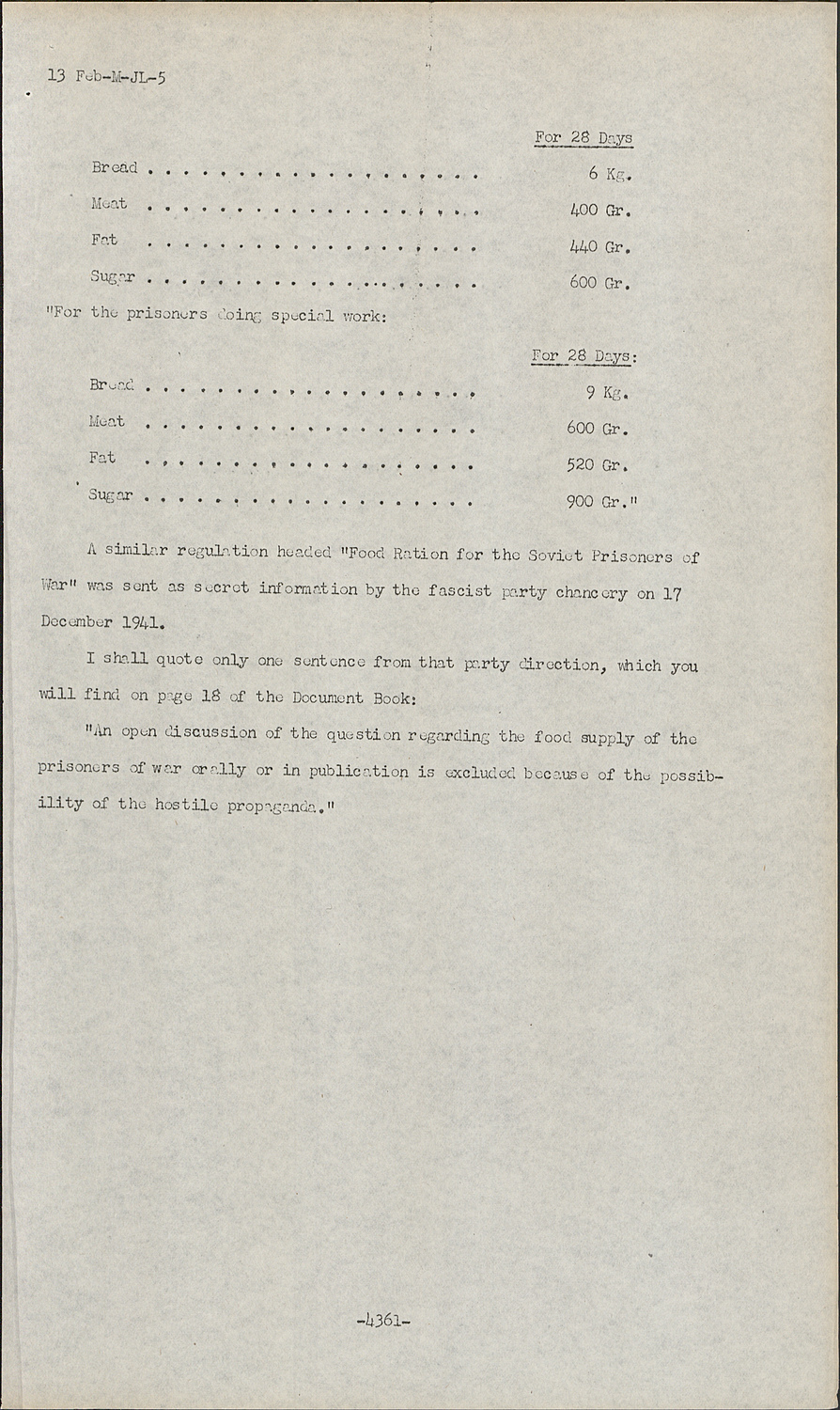
For 28 Days Bread . . . . . . . . . . . . . . . . . . . 6 kg.
Meat . . . . . . . . . . . . . . . . . . . 400 Gr.
Fat . . . . . . . . . . . . . . . . . . . 440 Gr.
Sugar . . . . . . . . . . . . . . . . . . . 600 Gr. "For the prisoners doing special work:
For 28 Days:
Bread . . . . . . . . . . . . . . . . . . . 9 Kg.
Meat . . . . . . . . . . . . . . . . . . . 600 Gr.
Fat . . . . . . . . . . . . . . . . . . . 520 Gr.
Sugar . . . . . . . . . . . . . . . . . . . 900 Gr."
A similar regulation headed "Food Ration for the Soviet Prisoners of war" was sent as Secret information by the fascist party chancery on 17 December 1941.
I shall quote only one sentence from that party direction, which you will find on page 18 of the Document Book:
"An open discussion of the question regarding the food supply of the prisoners of war orally or in publication is excluded because of the possibility of the hostile propaganda."