THE PRESIDENT:What page?
M. DUBOST:Six of your document book.
THE PRESIDENT:Of the same document book?
M. DUBOST:This is the only book of documents that we are referring to now. Terrorist action against patriots, F-673, on page six of the book, which is now before your eyes. The whole of that document has already been deposited under No. 323. F-673 is a considerable bundle of papers which comes from the archives of the German Commission at Wiesbaden, and we are placing it in in its entirety under No. 392 after placing it under our own number 673. It will be one of the documents quoted in reference to this German question.
Letter of the Fuehrer's headquarters, 18 August 1944, thirty copies, number twenty-six. It deals with secret matters of command. First of all, struggle against the terrorists and the saboteurs in occupied territories. Second, jurisdiction against non-German civilians in occupied territories.
THE PRESIDENT:Is this page twenty-six?
M. DUBOST:No, sir; page six of the document book. First of all, as added documents, says the writer of this letter, we are transmitting a copy of the order of the Fuehrer of 30-7-1944, and the first supplementary ordinance of 18-8-44. This order of the Fuehrer of 30-7-44 will be found on page nine of your document book. Here is the order, page nine, paragraph three.
"I order the troops and every individual member of the Wehrmacht, the SS, and the police immediately to shoot down on the spot terrorists and saboteurs who are caught in flagrante delicto. Whosoever shall be captured later is to be transferred to the nearest local service of the Security Police and of the SD. The sympathizers, specifically women, who are not taking a direct part in the struggle, are to be placed at work."
We know what that means. We know the regime of labor in concentration camps. But I shall proceed with reading the document of the letter of trans mittal of this order, paragraph four.
This paragraph is a commentary on the order itself.
THE PRESIDENTSHasn't this been read before?
M. DUBOST:It has never been read, Mr. President.
This is F-673 of the Wiesbaden Armistice Commission. "The present judicial procedure against any act of terror or sabotage or any other crime committed by civilian individual non-Germans in occupied territories, and which places in danger the security and the rapidity of the execution of the occupying power, is to be suspended. This compliance has to be withdrawn. The execution need no longer be ordered. The order as well as the files are to be turned over to the Security Police and the SD."
This order, which is to be transmitted to all commanding generals, as indicated on page seven, is accompanied by one last comment on page eight. The penultimate paragraph.
"The non-German civilian individuals in the non-occupied territories who should endanger the security or the rapidity of the application of the occupying power in a manner other than through terror and through sabotage action are to be turned ever to the SD." This order is signed "Keitel."
This comment which we have just read to you - Keitel has associated himself with the order of his Fuehrer. It has led to the execution of numerous innocent individuals, because anyone who is suspected to be a terrorist - this will be striking innocent onces even more than it will terrorists. Moreover, the comment from Keitel exceeds even Hitler's own order. Keitel applied the stipulation emanating from Hitler, on page nine of your document book, to a hypothetical case which has not been anticipated there, to wit:
"Attempts committed by non-German civilians in occupied territories which endanger the security or the rapidity of application of the occupying power." This is from the General himself. It is a political act which has nothing to do with the conduct of operations. It is a political act which compromises and binds him and brings him to participate in the development, the extension of the Hitlerian policy; inasmuch as the interpretation of an order from Hitler is within the spirit of the order perhaps, but beyond the scope of the order.
Instructions were given to the SIPO and the SA to carry out this order. These instructions were applied. Document F-574 on page ten of your document book, which is placed before you under No. 393, is a testimony from someone by the name of Goldberg, who was staff sergeant in Chalon before the liberation of that city. He was captured by the patriots and interrogated by them by the divisional commissar, who was in charge of the judiciary police of the region. The defendant will certainly not reproach us for having had him examined by a subaltern police officer. He comes from the region of Dijon, and he interrogated this witness. The witness declared, page twelve, at the bottom of the page:
End of May 1944. Without having seen any written order on this subject, the Sicherheitspolizei of Chalon had the right to pronounce capital punishment and to have the sentence executed without these concerned having appeared before a tribunal and without the case having been submitted for the approval of the commander in Dijon. This is the chief of the SD in Chalon, that is to say, by the name of Kruger, who had every necessary authority to make such decision. There was no opposition so far as I know on the part of the SD of Dijon, which allows me to conclude that this procedure was according to the regulations and was the consequence of instructions which were not officially communicated to me but which emanated from higher authorities."
The execution was inspired by members of the SD. The names are given by the witness, but they are not of particular interest to this Tribunal, which is only concerned with the punishment of principle culprits, those who gave orders and from whom orders emanated.
Now, where these orders applied in the various countries of the West:
In Holland, according to the testimony found in the report given by the Dutch Government -- page 15 -- three days after the attempt against Rauter, we may read:
"Dutch patriots were assassinated by the German political police."
This Dutch document is classified under the French file as F-224, and it has been submitted to you, but the specific passage to which I refer has not been read.
The witness continues, at page 16 of your Document Book: "A member of the police, whose name is unknown to me, and who told me that this execution was vengeance as a result of the attempt against Rauter, told me also that hundreds of terrorists" -- and this is at the top of page 16 -- "hundreds of terrorists had been executed."
In the penultimate paragraph of page 17, another witness stated: "About 6 o'clock in the evening it was a German who gave the orders to execute the Dutch patriots." This is the next to the last paragraph: "About 6 o'clock in the evening I went to my office and there I received the order to have 40 prisoners shot."
At page 19, at the very bottom of the page, those who carried out the inquiries, who were Canadian officers, state the conditions under which the corpses were discovered. I don't believe that the Tribunal will want me to read this passage.
On page 21 the Tribunal will find a supplement to the report of Munt on the shooting of these Dutch patriots, which completes the report of 4 June, 194 The execution was carried out upon order from Kolitz; 198 prisoners were transported.
Munt defends himself for having favored the execution of the Dutch patriots, but he says that it was impossible for him to prevent it, in view of the order from higher sources which he had received.
On page 22, next to the last paragraph, Munt states: "After an attack against two members of the Wehrmacht on two consecutive days -- on this occasion they were both wounded while their rifles were taken away from them-my chief insisted upon having 15 Dutch citizens shot; 12 were shot.
A basic, important document is to be found on page 30 in your Document Book. It is still included in F-224, which comprises the documents resulting from the inquiries made by the Dutch Government. This is a decree concerning the proclamation of summary justice for the Netherlands Occupied territories. It is signed by the Defendant Seyss-Inquart, and therefore we must go up to his echelon when we seek the principal responsibility for these summary executions of patriots in Holland.
From this decree we emphasize paragraph 1:
"I proclaim, for the Netherlands Occupied Territories, in its entirety, summary police justice, which shall enter into force immediately. Simultaneously, I order that each one abstain from any kind of agitation which might disturb public order and the security of public life."
I skip a paragraph.
"The top leader of the SS and of the police will take every step deemed necessary by him for the maintenance or the restoration of public order, or for the security of public life."
The following paragraph:
"In the execution of his task he can deviate from the law in force."
The words "summary police justice" do not deceive us. This is purely and simply a matter of murder, inasmuch as the police is authorized, in executing its functions, to deviate from the law in force.
This sentence which Seyss-Inquart signed, and which protected his subordinates who assassinated Dutch patriots with regard to German law, is the very condemnation of Seyss-Inquart.
To carry out this decree, on the following page the Tribunal will see that on the 2nd of May -- and this is page 32 of your Document Book -- a summary police tribunal pronounced the death sentence against ten Dutch patriots.
At page 34 of your Book, another summary police tribunal pronounced the death sentence on ten other Dutch patriots.
All of them were executed.
At the next page, still to apply this said decree, summary police tribunal pronounced the condemnation to death of a patriot, and he was executed This Document F-224 comprises a very long list of similar acts, which it appears superfluous to cite before you now.
The Tribunal may refer to the last only, which is especially interesting. We nay consider it for a moment; it is at page 46 of your Document Book. That is the report of the Identification Service of the Netherlands, according to which, while it was not possible to make known at that time the number of Dutch victims, or the number of burghers who were shot by the military units of the occupying power, we can state now that a total of more than 4,000 of them were executed.
You have, then, the declared list of the executions, together with the places where the corpses were discovered.
This constitutes only a very fragmentary aspect of the sufferings endured by Holland and the sacrifices in human life which were made by Holland in our common cause, which needs to be stated because that is the consequence of the criminal orders of the Defendant Seyss-Inquart.
In the case of Belgium, the basic document is the French Document F-685, submitted under 394, and you will find it on page 48 of your Book. It is a report drawn up by the Belgian Commission on War Crimes, which deals only with the crimes committed by the German troops at the time of the liberation of Belgian territory, September 1944. These crimes were all committed against Belgian patriots who were fighting against the German Army. It is not merely a question of executions, but ill-treatment and tortures as well are involved.
Page 50: "At Graide a camp of the secret army was attacked. Five corpses were frightfully mutilated when they were discovered." That is the first paragraph at the top of page 50. "The Germans utilized bullets, the tips of which had been sawed off. Some of the bodies had been pierced with bayonets. Two of the prisoners were beaten with sticks before being finished with a pistol shot."
The prisoners were soldiers who were taken with weapons in their hands, and in battle, and belonging to those units which unofficially, according to the testimony of documents formerly cited to you, were considered in the German General Staff as from that time on being combatants.
The sixth paragraph: "At Foret, on 6 September, several hundred men of the Resistance were billeted in the Chateau de Foret.
The Germans, having been warned of their entering into operation, decided to carry out a repressive operation.
A certain number of members of the Resistance, who were not armed, sought to flee.
Some were brought down; others succeeded in reaching the castle, not having been able to go through the cordon of German troops; others were finally made prisoners.
The Germans came behind the Resistance whom they had taken as prisoners.
After two hours the fighting stopped for lack of ammunition.
The Germans promised safety to those who surrendered.
Some of the prisoners were loaded on the lorry; the others, in spite of the word given, were massacred after having been tortured.
The castle was set on fire, and the corpses, sprinkled with gasoline, were also set on fire.
Twenty men perished in this massacre; fifteen others had been killed in the course of combat."
The examples are numerous. This testimony to heroic Belgium was necessary.
It was necessary that there should be recalled here what we owe to these combatants of the secret army and the price paid by those armies.
With regard to Luxembourg, we have a document given to us by the Ministry of Justice of the Grand Duchy of Luxembourg, which is UK-77, already submitted under number 327, which the Tribunal will find on page 52 of the book of documents.
At page 53, paragraph 4, the Tribunal will note that a special summary tribunal, similar to those which functioned in Holland, was constituted in Luxembourg, that it did function in that country and pronounced a certain number of sentences--21 death sentences--all of them equally arbitrary in view of the arbitrary character of the tribunal which pronounced such sentences.
On page 54 is contained the official accusation made by the Grand Duchy of Luexembourg against all members of the Cabinet of the Reich, specifically against the Ministers of Interior, of Justice, and the Chancellery of the Party, against the loaders of the SS and of the Police, and specifically against those of the Reich Commissar fuer die Festigung des Deutschen Volkstums.
In the case of Norway, document UK-77, already submitted under number 326, shows, in the third paragraph, at the middle of the page-
THE PRESIDENT:What page?
M. DUBOST:Page 55 of the document book--that a similar tribunal, similar to that special tribunal established in Holland by the police, was in operation in Norway.
It was an SS Tribunal.
More than 150 Norwegians were condemned to death. That is the next to the last paragraph on that page.
Moreover, the Tribunal will remember the testimony of Mr. Cappelen, who came before you to say what his country and his compatriots had endured.
As to the case of Denmark, at page 57 of your document book, F-666, already before you, our F-278, page 59, the Tribunal will note that, according to this official report submitted by the Danish Government, there operated in Denmark police court-martials similar to those which functioned in Luxembourg, in Norway and in Holland.
These summary tribunals for the police, made up of SS or policemen, in fact disguised the arbitrariness of the police and of the SS, which arbitrariness was not only a matter of intolerance on the part of the Government, but was wielded by the Government, as can be shown by documents which we have placed before you at the beginning of this presentation.
We therefore can assert that the victims of those tribunals were assassinated without having been able to justify or defend themselves.
In France the question should be carefully examined. The Tribunal does know that from the very moment of landing, answering the call of the General of the Headquarters, the French secret army started the battle.
Undoubtedly, in spite of the warning given by the Allied staff, these combatants--to which, unofficially, a few weeks later, there was to be granted the quality of combatants on the part of the Germans--at the beginning, found themselves in a rather irregular situation.
In many instances the thought was that they were Franc Tireurs, and it is admitted that they could be condemned to death;but we do protest, because they were not condemned to death, but they were assassinated after having been shamefully tortured, and we are going to give you proof thereof.
Document F-577, which has been placed before you under number 395, is to be found on page 62 of your document book.
It states that on 17 August, on the eve of the liberation of Rodez, the Germans shot 30 patriots with a submachine gun.
Then, to finish them, they detached large stones from the wall of the trench in which they were and hurled them on the bodies, with a little dirt.
The chests and the skulls were crushed.
Document F-580, page 79 of your document book, which was placed before you under number 396, shows that five Maquis--these religious who were certainly net communists--were assassinated, after having been tortured, because they belonged to a group of the secret army.
Thirty corpses in all were discovered after this execution, after this punitive operation carried out the by German Army.
At page 95 the Tribunal will read the result of the inquiry and will see under what conditions, after having been tortured, these five religious were brought down and under what circumstances were arrested and deported with a few members of the same religious order, a staff of the Resistance group, who had been betrayed.
In the fourth paragraph before the end of the page, starting from the bottom, the testimony, or the proof thereof, is before you, that people belonging to the Maquis in the Fortress of Acheres were arrested and tortured after having been incarcerated in the prison of Fontainebleau.
We even know the name of the German of the Gestapo who tortured these patriots.
His name is of no consequence, however, Korff carried out the orders that were given by Keitel and by others, whose names were enumerated a while ago.
Document F-584, page 87, at Pau -- this document will be 397, and the Tribunal will find it at page 87.
At page 88 the Tribunal will note that when the bodies were found, it was discovered that ten of them had been blindfolded before being shot. Eight had had their arms broken, either by wounds or by torture, and many had wounds in the lower parts of their legs due to very tight bindings.
This is the report of the Commissar of Police, drawn up on 28 August 1944, on the day following the liberation of Pau.
We now place F-585, under number 398, before you, and the Tribunal will find it at page 96 of the Document Book. I summarize:
The day following the liberation, 38 corpses were found in two graves in the mountain of Var. They were able to identify one of the leaders of the resistance of the area of Nice, and with him two parachutists, Pageaut and Manuel. From this massacre a witness was found; his name is Quirot, whose statements are transcribed on pages 11 and 12 of this document, pages 105, 106 and 107 of your own Book of Documents.
Quirot was tortured, along with his comrades, without having had the chance of having counsel or a chaplain. The thirty eight men were taken to the woods. They appeared before what was after all a parody of a Tribunal made up of SS. They were condemned to death and the sentence was carried out, We place now before the Tribunal Document F-586 under Number 399.
The Tribunal will find it on page 110 of the book of documents. It deals wit the execution at Saint Nazaire en Royans of thirty-seven patriots, members of the French Secret Army, Who were tortured before being executed. The Tribunal will read on page 110, at the beginning of Paragraph 2, the statement of facts by one of the eye-witnesses.
"I came through the ruins and I arrived at the Chateau of Mrs. Laurent, the widow. There a frightful spectacle awaited me. The castle, which had been used by the men of the Gestapo for the torturing of the young men of the Maquis, had been set on fire. In a cellar there was the calcinated corpse which prior to that had had its forearms and foot pulled away and was perhaps burned to death."
But I proceed. Everywhere where the Gestapo acted one encountered the same spectacles.
Now we place before the Tribunal Document F-699, which relates to the assassination at Grenoble of forty-eight members of the Secret Army; all of them were tortured. It is placed before you under Number 400. It begins on page 112 of your document book.
I now come to F-587, which we place before you under Number 401. The Tribunal will find this document on page 115 of the document book. It concerns the execution by hanging of twelve patriots at Nimes, two of whom were seized in the hospital where they were under care for wounds received in battle. These young men, all of them, had been captured in combat at St, Hippolyte-du-Fort (paragraph 4 of page 115) and the bodies of these wretched men were profaned. They, on their chests, had a sign thus written: "Thus are French terrorists punished."
When the French sought to render the last honors to these unfortunate men the bodies had disappeared. The German Army had them taken away and the have never been able to find them again and it is a fact that two of these people were seized from the hospital.
Document F-587 contains also the report of a witness who came to fetch the men from the hospital, where they were being cared for.
I place before you now Document F-561 under Number 402. It is found on page 118 of your book. It deals with the execution in Lyon of one hundred and nine patriots, who were shot under inhuman conditions.
They were brought down at the end of a day's labor on the 14 of August. The Allied aviators had bombed the Bron Airfield (second paragraph of page 118). The German authorities employed from the 16th to the 22nd of August civilians and internees at the Fort of Montluc at Lyon.
These men filled the craters made by the bombs. Finally, at the end of the day, when the work was finished, (this is at the end of paragraph 2) the civilian requisitioned laborers were going away while the internees were shot on the spot with gun shots, after having been more or less ill-treated and their bodies were stacked in craters, not yet filled.
Document F-591, which we place under Number 403 and which appears on page 119 of the document book before the Tribunal, is a report of atrocities committed by the German Army on 30 August, 1944 at Tavaux in Aisne. That day, during the afternoon, German soldiers of the Adolf Hitler Division arrived at Tavaux. They appeared at the home of M. Maujean, who was the leader of the Resistance. His wife opened the door. This is paragraph 2. Without any explanation they shot her, wounding her in the thigh and also in the lower jaw. They dragged her to the kitchen; they broke one arm and one leg. In the presence of her children, aged nine, eight, seven, six years and eight months, they sprinkled her with an inflammable liquid and they burned her in front of them. The older child held his little sister, eight months old, in his arms.
They then stated to the children that they were going to shoot them if they did not say where their father was. But the children said nothing, though they knew where the father was. Before leaving, they took the children down to the cellar. They locked them in and they spread gasoline in the house and set it on fire. The fire was put out and the children were saved. These facts were stated to M. Maujean by the oldest child. No other person was a witness to these facts because the inhabitants, frightened by the first houses set on fire, had sought refuge either in the trenches or in the fields and woods in the vicinity.
During the same evening twenty-one persons were killed at Tavaux and eighty-three houses were set on fire.
On the following page there is a report transmitted by the Gendarme Carlier on the day following the events.
On page 121 the Tribunal will find French Document F-589, which we place under Number 404.
This document shows the provisional total of murders of patriots committed in the region of Lyon, under date of 29 September, 1944; 713 victims have been uncovered in eight departments, 217 only have been identified. This figure is approximate; it is definitely less than the number of people who have been missing in the same eight departments, Ain, Adeche, Drome, Isere, Loire, Rhone, Savoie, Haute Savoie.
A German general, General Brodowski confessed in his journal, which fell into our hands, that he had caused the assassination of numerous patriots and that Wehrmacht Police and SS, operating simultaneously, were equally responsible for these murders. Those troops murdered wounded men in hospital camps of the French Forces of the Interior. This document, which is under Number F-257, is placed before you under Number 405 and is to be found on page 123 of your document book.
On page 125 -- "the police and the Army are but one."
The last full paragraph:
"I have been charged with the restoration and have the authority of the Army of Occupation in the Department of Cantal." This is under date of 6 June, 1944.
Paragraph 5: -- "General Jesser has been charged with the tactical direction of the undertaking. All troops available for the separation will be subordinate to him as well as all other forces."
Paragraph 6 -- "The Major of the SIPO and of the SD, Captain Geissler, remains at my immediate disposal. He will submit proposals for the possible intervention --" and so forth.
The last paragraph: -- "The staff and the two battalions of the SS Panzer Division Das Reich are, in addition, to remain available for the operation of Cantal."
Then on page 127 -- this general turned over to theSD, which is equivalent to execution, some prisoners. These prisoners were wounded on the 15 of June, 1944. The Prefect of du Puy asked for the release of the men wounded in the battle of Montmouchet but they requested that they be turned back to them as prisoners of war. The German general, executing the orders of Keitel and of the German Headquarters said that these men are to be treated as "francs tireurs" and are to be taken to the SD or to the SD or to the Abwehr.
"They will be turned over to the German Police and tortured without judgment." statement of Geissler -- "Any man turned over to the SD is executed without judgment."
On 21 June, 1944, the facts took place as indicated by Geissler. Paragraph 4 at the end -- "All suspects who will be arrested will be then turned over to the SD."
On the date of 16 August, 1944, page 133, this general of the German Army calls for the assassination of forty-four men after combat at Cosnat. This is in the second paragraph of page 11 of the document.
"In the course of the operation Jesser on the 15 of August, twenty-three persons were executed. (martial law) Attack of Cosnat, three kilometers east of St. Hilaire, during the night of the 17 of August, forty terrorists were shot down."
On page 136 -- this German general recognizes in his own journal that our comrades were fighting as soldiers and not as terrorists (paragraph 5). This general of the German Army acknowledges that the French Forces of the Interior took prisoners and southeast of d'Argenton, thirty kilometers east of Chateauroux, they discovered a group of terrorists. Sixteen German soldiers were liberated, arms and amunition were captured, seven terrorists were killed; two of them were captains. One German soldier was seriously wounded.
Another similar incident is related on page 137, at the very top of the page.
"Discovery of two camps of terrorists in the region of d'Argenton. Nine enemies were killed, two of whom were officers. Sixteen German soldiers were liberated." At the bottom of the page it states:
"We liberated two SS men."
The soldiers were entitled to the respect of their adversaries. They conducted themselves as soldiers and they were assassinated.
I am through, Mr. President, if the Tribunal will give me five minutes. I will only need one hour to present the remainder of my case this afternoon.
THEPRESIDENT; We will adjourn now until two o'clock.
(Whereupon, at 1250 hours the Tribunal adjourned until 1400 hours of the same day) Official transcript of the International Military Tribunal, in the matter of:
The United States of America, the French Re public, the United Kingdom of Great Bri tain and Northern Ireland, and the Union of Soviet Socialist Republics, against Hermann Wilhelm Goering, et al, Defend ants, sitting at Nurnberg, Germany, on 31 January 1946, 1400-1700 hours, Lord Justice Lawrence presiding.
MARSHAL OF THE COURT:May it please the Court, I desire to announce that the defendants Kaltenbrunner and Seyss-Inquart will be absent from this afternoon's session on account of illness.
M. DUBOST:We had arrived, gentlemen, at the presentation of the terrorist policy applied by the German Army and the German police, the SS. All of them united together in their evil task against the French patriots.
The militant patriots were not the only ones to be the victims of this terrorist policy. There were threats of reprisals against their relatives, and these threats were carried out with deeds.
We place before you Document 719 PS, under Number 406, which your Tribunal will find on Page 147 of the document book. It is a pencilled note of the German Embassy in Paris, addressed to the Ministry of Foreign Affairs in Berlin. The German Ambassador reports a conversation which the Vichy Echelon had with Laval. In the fourth paragraph, the last three lines, the author of this note, who is probably Abetz, explains that Bousquet, with whom Laval was at the time of this conversation, stated that he was strictly ignorant of the recent flight of Giraud's brother.
Madame Giraud--this is seven lines before the end of the next to the last paragraph--three of her daughters, her mother and another brother of the General and his daughter-in-law are reported to be at the camp of Vals les Bains. I replied that such measures were insufficient and that one should not be surprised if the German police should some day take these matters in its own hands in view of the obvious incompetence of the French police in numerous cases.
The throat was put to execution. We have already stated before you that the family of General Giraud had been deported.
We place before you Document 717, under No. 407, page 149 of your document book.
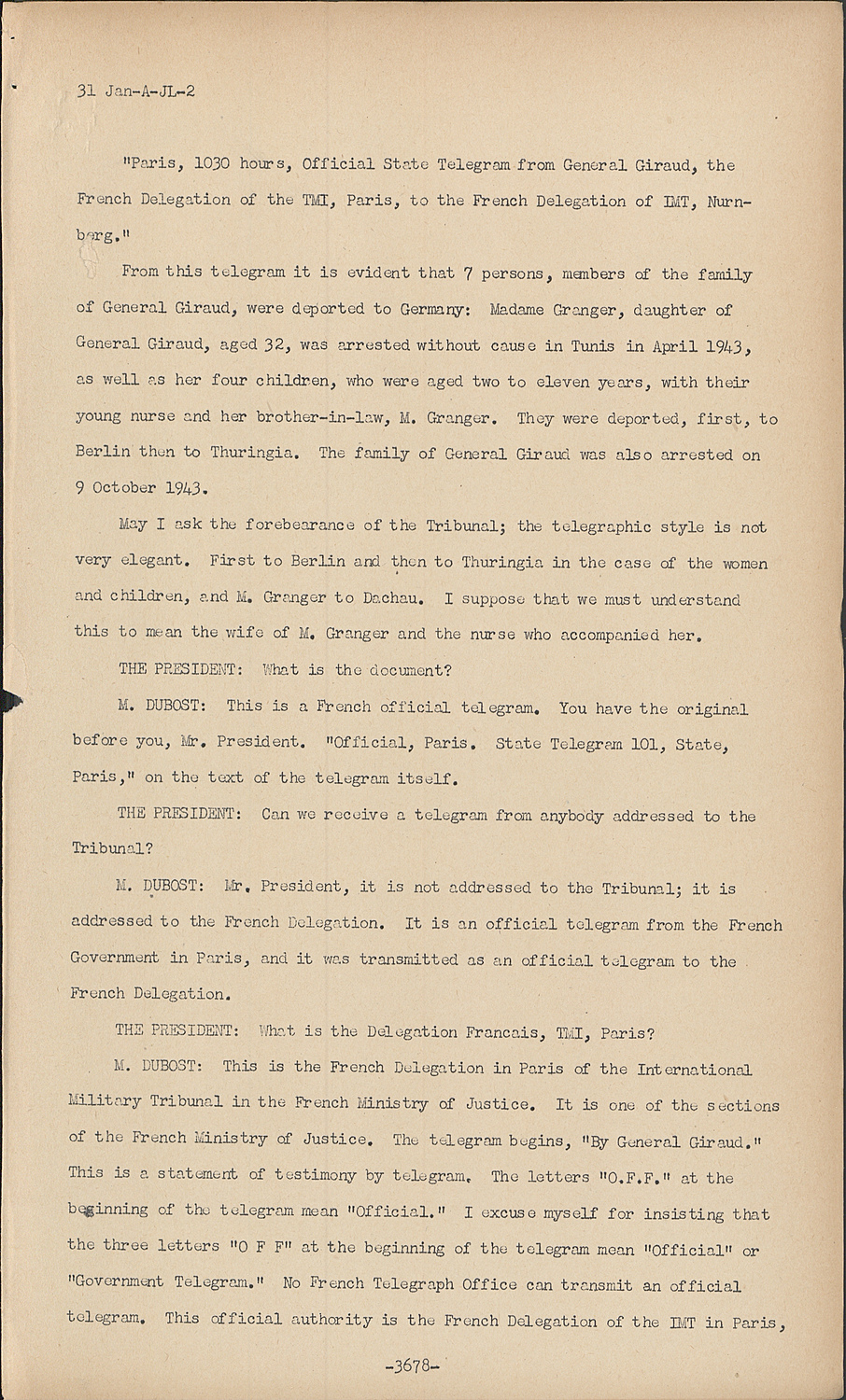
Paris, 1030 hours, Official State Telegram from General Giraud, the French Delegation of the TMI, Paris, to the French Delegation of IMT, Nurnberg."
From this telegram it is evident that 7 persons, members of the family of General Giraud, were deported to Germany: Madame Granger, daughter of General Giraud, aged 32, was arrested without cause in Tunis in April 1943, as well as her four children, who were aged two to eleven years, with their young nurse and her brother-in-law, M. Granger. They were deported, first, to Berlin then to Thuringia. The family of General Giraud was also arrested on 9 October 1943.
May I ask the forebearance of the Tribunal; the telegraphic style is not very elegant. First to Berlin and then to Thuringia in the case of the women and children, and M. Granger to Dachau. I suppose that we must understand this to mean the wife of M. Granger and the nurse who accompanied her.
THE PRESIDENT:What is the document?
M. DUBOST:This is a French official telegram. You have the original before you, Mr. President. "Official, Paris. State Telegram 101, State, Paris," on the text of the telegram itself.
THE PRESIDENT:Can we receive a telegram from anybody addressed to the Tribunal?
M. DUBOST:Mr. President, it is not addressed to the Tribunal; it is addressed to the French Delegation. It is an official telegram from the French Government in Paris, and it was transmitted as an official telegram to the French Delegation.
THE PRESIDENT:What is the Delegation Francais, TMI, Paris?
M. DUBOST:This is the French Delegation in Paris of the International Military Tribunal in the French Ministry of Justice. It is one of the sections of the French Ministry of Justice. The telegram begins, "By General Giraud." This is a statement of testimony by telegram. The letters "O.F.F." at the beginning of the telegram mean "Official." I excuse myself for insisting that the three letters "O F F" at the beginning of the telegram mean "Official" or "Government Telegram." No French Telegraph Office can transmit an official telegram. This official authority is the French Delegation of the IMT in Paris, which received the statement made by General Giraud and transmitted it to us.
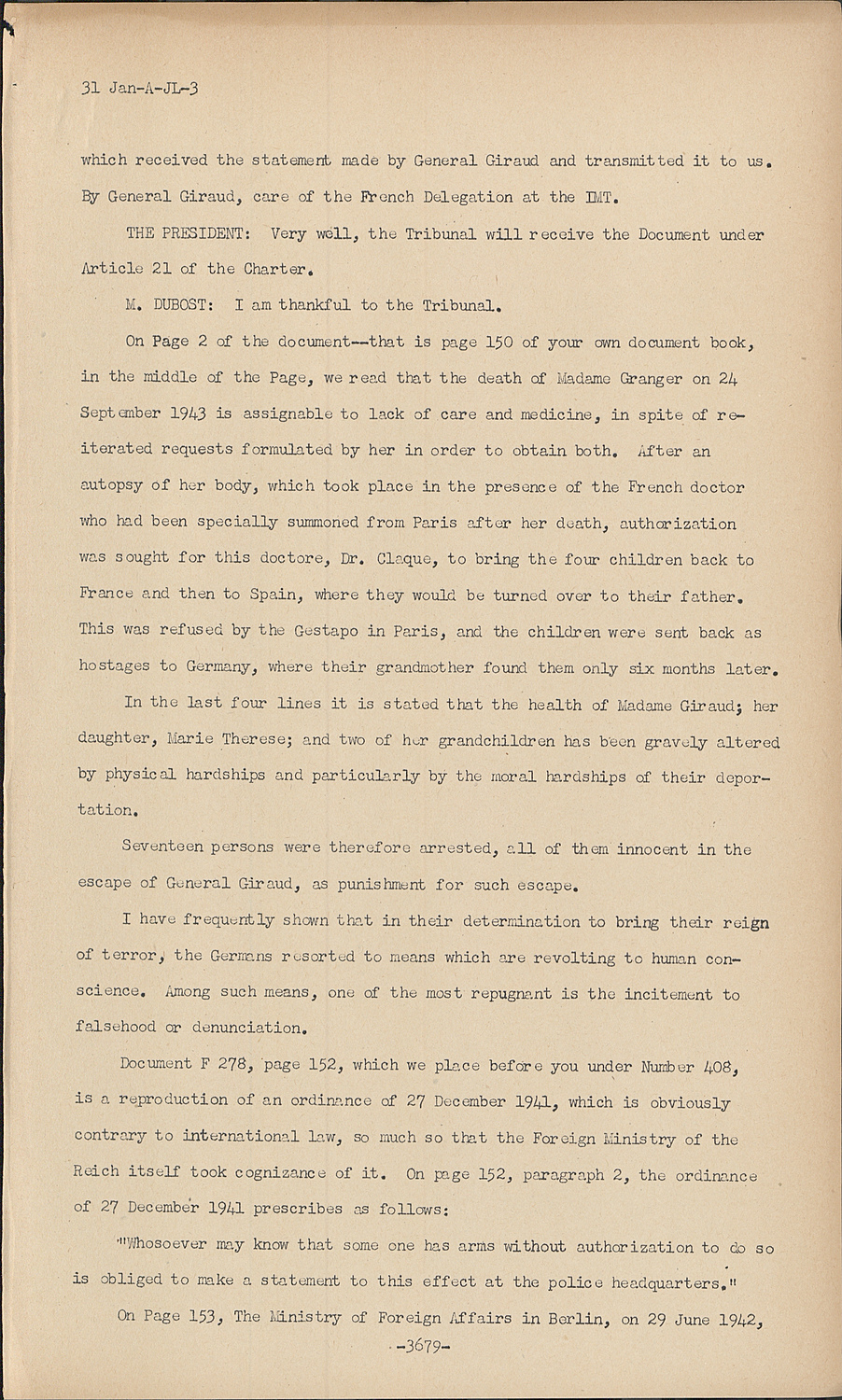
By General Giraud, care of the French Delegation at the IMT.
THE PRESIDENT:Very well, the Tribunal will receive the Document under Article 21 of the Charter.
M. DUBOST:I am thankful to the Tribunal.
On Page 2 of the document--that is page 150 of your own document book, in the middle of the Page, we read that the death of Madame Granger on 24 September 1943 is assignable to lack of care and medicine, in spite of reiterated requests formulated by her in order to obtain both. After an autopsy of her body, which took place in the presence of the French doctor who had been specially summoned from Paris after her death, authorization was sought for this doctore, Dr. Claque, to bring the four children back to France and then to Spain, where they would be turned over to their father. This was refused by the Gestapo in Paris, and the children were sent back as hostages to Germany, where their grandmother found them only six months later.
In the last four lines it is stated that the health of Madame Giraud: her daughter, Marie Therese; and two of her grandchildren has been gravely altered by physical hardships and particularly by the moral hardships of their deportation.
Seventeen persons were therefore arrested, all of them innocent in the escape of General Giraud, as punishment for such escape.
I have frequently shown that in their determination to bring their reign of terror, the Germans resorted to means which are revolting to human conscience. Among such means, one of the most repugnant is the incitement to falsehood or denunciation.
Document F 278, page 152, which we place before you under Number 408, is a reproduction of an ordinance of 27 December 1941, which is obviously contrary to international law, so much so that the Foreign Ministry of the Reich itself took cognizance of it. On page 152, paragraph 2, the ordinance of 27 December 1941 prescribes as follows:
"Whosoever may know that some one has arms without authorization to do so is obliged to make a statement to this effect at the police headquarters."
On Page 153, The Ministry of Foreign Affairs in Berlin, on 29 June 1942, objected to the draft of the reply to the French note, which we do not have here but which must have been a protest against this ordinance of December 1941.
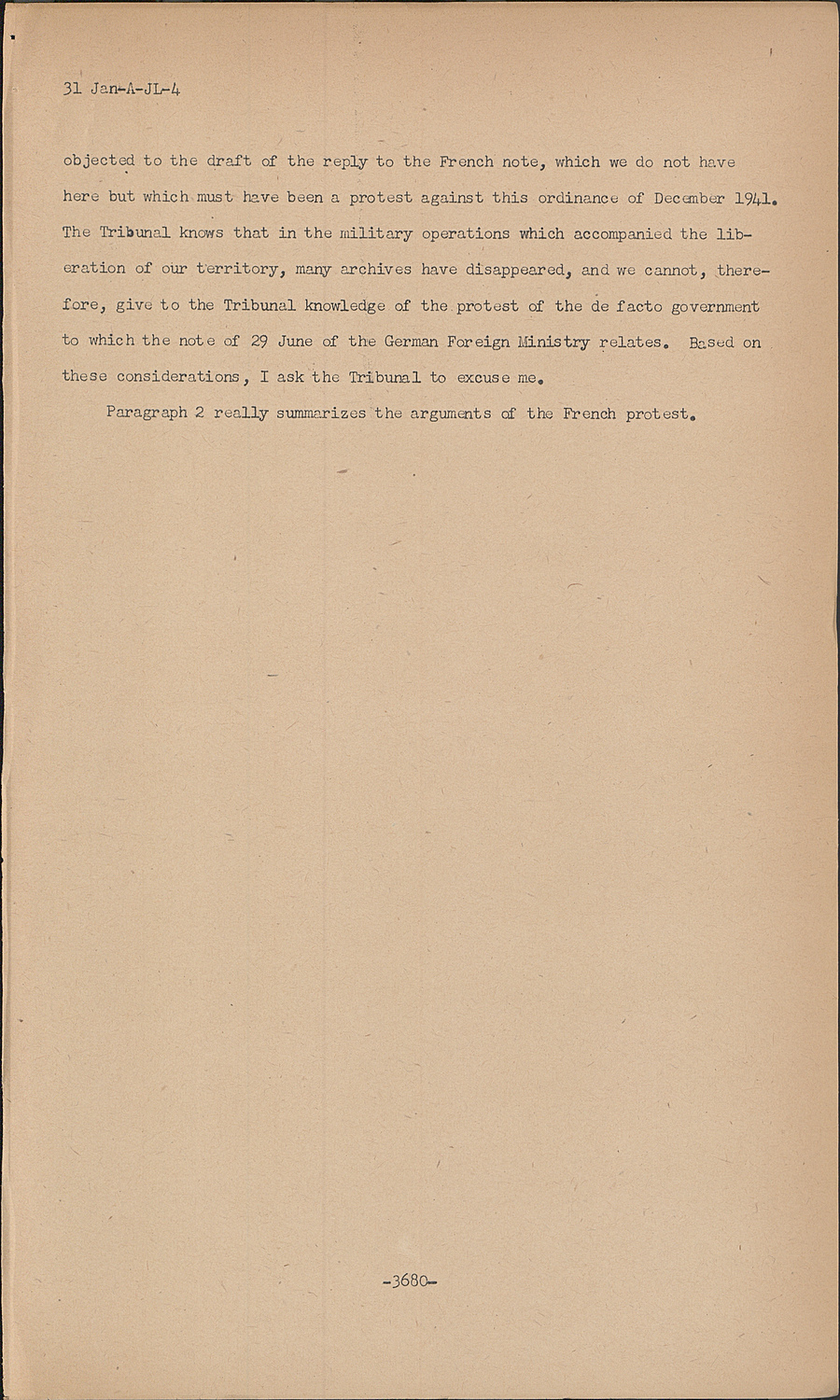
The Tribunal knows that in the military operations which accompanied the liberation of our territory, many archives have disappeared, and we cannot, therefore, give to the Tribunal knowledge of the protest of the de facto government to which the note of 29 June of the German Foreign Ministry relates. Based on these considerations, I ask the Tribunal to excuse me.
Paragraph 2 really summarizes the arguments of the French protest.
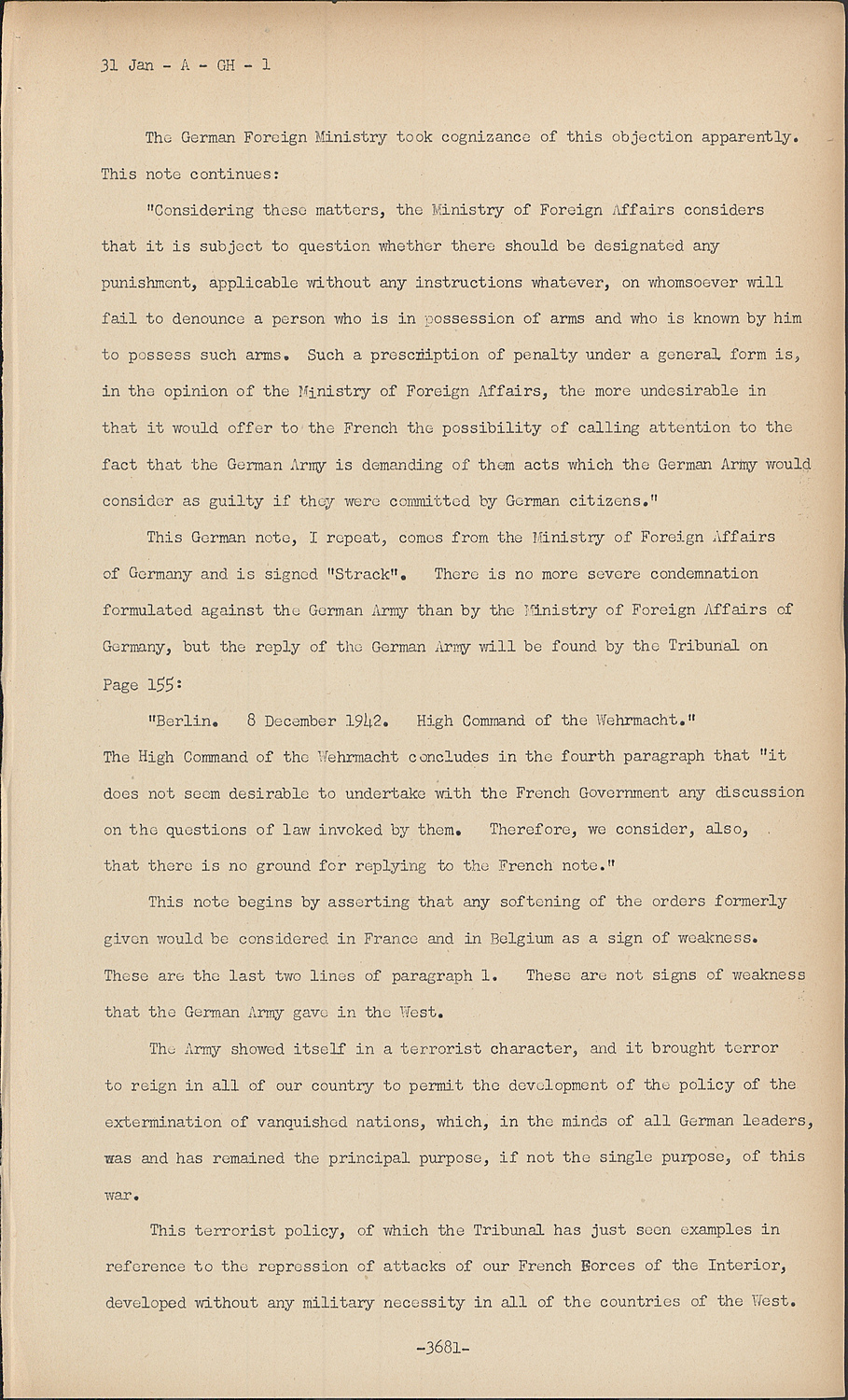
The German Foreign Ministry took cognizance of this objection apparently.
This note continues:
"Considering these matters, the Ministry of Foreign Affairs considers that it is subject to question whether there should be designated any punishment, applicable without any instructions whatever, on whomsoever will fail to denounce a person who is in possession of arms and who is known by him to possess such arms. Such a prescription of penalty under a general form is, in the opinion of the Ministry of Foreign Affairs, the more undesirable in that it would offer to the French the possibility of calling attention to the fact that the German Army is demanding of them acts which the German Army would consider as guilty if they were committed by German citizens."
This German note, I repeat, comes from the Ministry of Foreign Affairs of Germany and is signed "Strack". There is no more severe condemnation formulated against the German Army than by the Ministry of Foreign Affairs of Germany, but the reply of the German Army will be found by the Tribunal on Page 155:
"Berlin. 8 December 1942. High Command of the Wehrmacht." The High Command of the Wehrmacht concludes in the fourth paragraph that "it does not seem desirable to undertake with the French Government any discussion on the questions of law invoked by them. Therefore, we consider, also, that there is no ground for replying to the French note."
This note begins by asserting that any softening of the orders formerly given would be considered in France and in Belgium as a sign of weakness. These are the last two lines of paragraph 1. These are not signs of weakness that the German Army gave in the West.
The Army showed itself in a terrorist character, and it brought terror to reign in all of our country to permit the development of the policy of the extermination of vanquished nations, which, in the minds of all German leaders, was and has remained the principal purpose, if not the single purpose, of this war.
This terrorist policy, of which the Tribunal has just seen examples in reference to the repression of attacks of our French Forces of the Interior, developed without any military necessity in all of the countries of the West, The devastations committed by the enemy are extremely numerous.