And under date 2 January 1941, the date of this document, the German Administration divided the camps into three categories, indicating the division of the camps throughout Germany into three categories, which seems to make it unnecessary to come back to the geographical distribution of these camps in Germany, since my American colleague has already given a complete presentation of this question with geographical maps.
The organization and the functioning of those camps were regulated in this way.
THE PRESIDENT:Will your address take much longer, because we are going to adjourn unless you are going to close in a few moments?
M. DUBOST:It will be five minutes and I can finish the account and it will be unnecessary to come back tomorrow morning.
The organization and functioning of those camps have been so arranged for a double end.
First, according to document No. 285, which is on page 14 of the second document book, which you have before you, it was the aim to supplement labor by giving the guards protection at the least cost.
We shall not read this. On page 14 in your second document book you wall read the first paragraph, for reasons of military importance.
This is under date 17 December 1942 and coincides with difficulties met in the course of the Russian campaign, and for impossible reasons which cannot be discussed here.
The Reichsfuehrer SS and Chief of German Police had ordered that from 14 December 1942 until end of January 1943, 35,000 prisoners at least who are incapable of working must be sent to concentration camps.
Paragraph 2, the following measures, which read thus.
"The number from then on until 11 May 1943--all the workers from the countries of the East, and all the workers of foreign race who have fled or broken their contracts, not belonging to Allied, friendly or mutual States, shall be interned, as rapidly as possible; arbitrary internment with a view to getting at the least cost the maximum of labor, which is already spent in Germany, and which must be paid for, since it is under the regime of labor contract.
which must be paid for, since it is under the regime of labor contract.
The organization of these camps tend even further to exterminate all forces which cannot be any longer expedited by German industry, and which in general could limit or hinder the Nazi expansion.
The proof of this is furnished by document R-91, second document book, submitted under No. RS-347, which is a telegram from the Chief of Staff of the Reichsfuehrer SS and received at 2.10, 16 December 1942 from Berlin.
The paragraph from the last is given. "In regard to organization of the number of workers for the concentration camps, which was found completed for 30 January 1943, you might proceed in the way as concerns the deportees.
First, total number 45, second, 11 January, 1943, beginning of the transport and ending of the transport, 31 January 1943, composition third.
The most important part of the document shows 45,000 Jews are composed, and the 30,000 Jews coming from the district of Byalystock, 10,000 Jews from Byalystock Depot, but that 5,000 are Jews capable of working until now which were for minor work in the Ghetto, and 5,000 Jews in general incapable of working, which can include the Jews above sixty years of age.
In order to take advantage of, or reduce the number of internees, which have reached the.
number of 48,000, which is excessive for the Ghetto, I ask for special power to attend to this."
The number at the end of this paragraph was 45,000, including the invalid old Jews and children included by reason of rational system of selection of new selectees in Auschwitz, where were apprehended 10,000 to 15,000 prisoners capable of work.
(This is underlined in the text.)
Here is the official document which corroborates the testimony of Mme.
Vaillant Coutourier, and the various other testimony on the same question, and in terms of which the systematic selections were made in each convoy when each convoy arrived at Auschwitz, not merely by mere will of the chief of the camp of Auschwitz, but from results of the highest order emanating from the very Government of the Reich.
If the Tribunal please, my presentation will cease here this evening, and will be continued tomorrow, on the problem of the utilization of labor, which I shall treat as quickly as possible, taking into account the testimony we already had.
(Whereupon at 17.20 hours the hearing of the Tribunal adjourned, to reconvene at 10.
00 hours, 30 January 1946.)
Military Tribunal, in the matter of: The Official transcript of the International United States of America, the French Republic, The United Kingdom of Great Britain and Northern Ireland, and the Union of Soviet Socialist Republics, against Hermann Wilhelm Goering, et al, Defendants, sitting at Nurnberg, Germany, on 30 January 1946, 1000-1245, Lord Justice Lawrence, presiding.
MARSHAL OF THE COURT:May it please the Court, I desire to announce that defendants Kaltenbrunner and Seyss-Inquart will be absent from this morning's session on account of illness.
THE PRESIDENT:Dr. Babel, I understand that you do not wish to cross examine that French witness.
DR. BABEL:That is correct.
THE PRESIDENT:Then the French witness can go home.
M. DUBOST:Thank you, Mr. President.
THE PRESIDENT:M. Dubost, there is one reason that possibly that French witness ought not to go. I think I saw she was moving out of Court. Could you stop her, please? I am afraid she must stay for today.
M.Dubost, are you going to deal with documents this morning?
M. DUBOST:Yes, Mr. President; there will be no witnesses this morning.
THE PRESIDENT:Would you be so good as to give us carefully and slowly the number of the document first, because we have a good deal of difficulty in finding them.
M. DUBOST:Yes, quite, Mr. President.
THE PRESIDENT:And specify, also, so far as you can the book in which they are to be found.
M. DUBOST:With the permission of the Tribunal, we shall continue the exposition of the organization and the way in which the camp functioned.
Document R-80, which I submitted yesterday, showed a double purpose, to make up for lack of labor and to exterminate. R-91, which I submitted yesterday, page 14, of the second document book. Pardon me, 20 and 21 of the second document book. Document RF-285, pages 14, 17, 18 and 19 of the second document book. This document is submitted under number RF-348.
THE PRESIDENT:I am afraid you are going too fast. I had just got as far as R-91 in Document Book 2, pages 20 and 21.
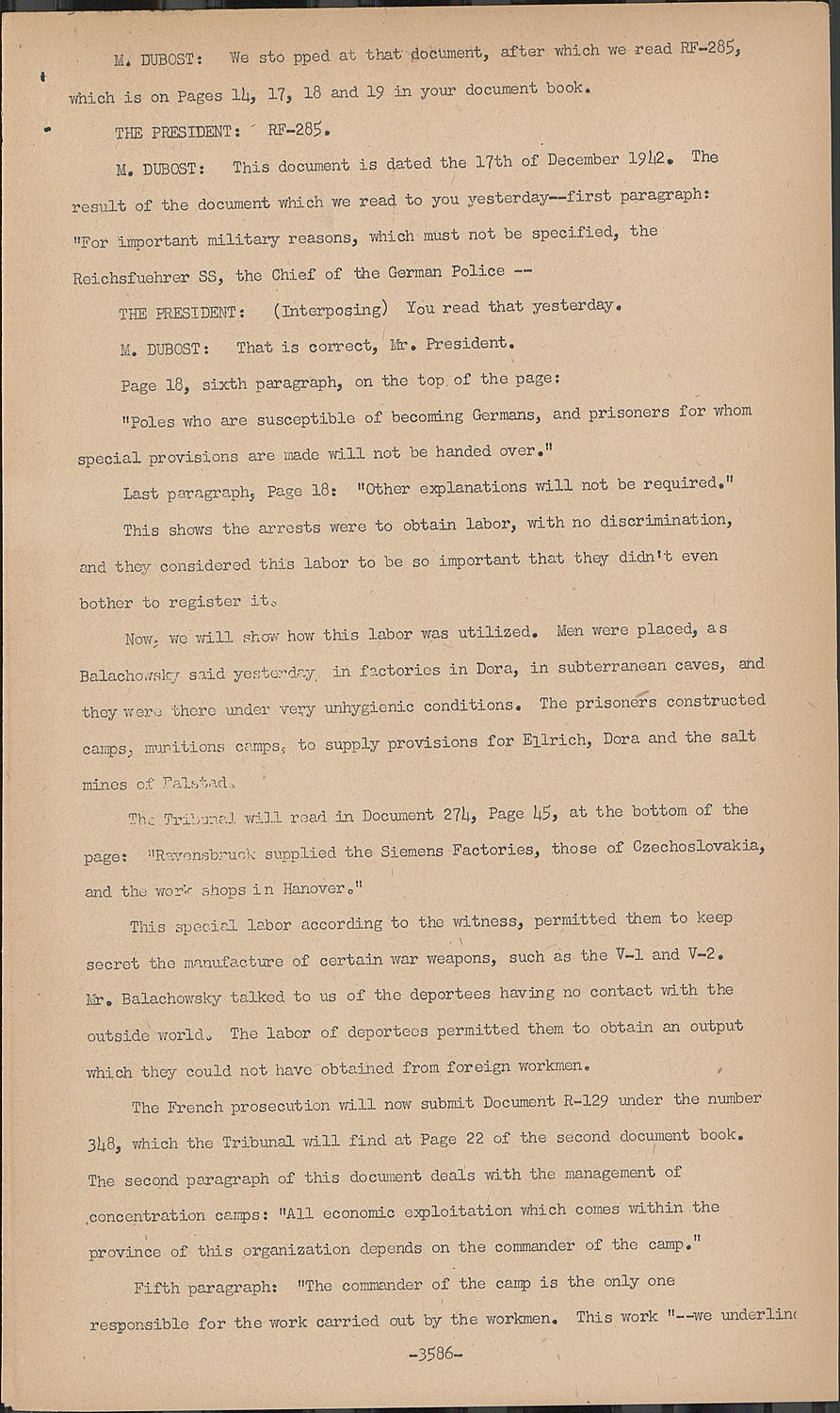
which is on Pages 14, 17, 18 and 19 in your document book.
M. DUBOST:We sto pped at that document, after which we read RF-285,
THE PRESIDENT: RF-285.
M. DUBOST:This document is dated the 17th of December 1942. The result of the document which we read to you yesterday--first paragraph: "For important military reasons, which must not be specified, the Reichsfuehrer SS, the Chief of the German Police -
THEPRESIDENT: (Interposing) You read that yesterday.
M. DUBOST:That is correct, Mr. President.
Page 18, sixth paragraph, on the top of the page:
"Poles who are susceptible of becoming Germans, and prisoners for whom special provisions are made will not be handed over."
Last paragraph, Page 18: "Other explanations will not be required."
This shows the arrests were to obtain labor, with no discrimination, and they considered this labor to be so important that they didn't even bother to register it.
Now, we will show how this labor was utilized. Men were placed, as Balachowsky said yesterday in factories in Dora, in subterranean caves, and they were there under very unhygienic conditions. The prisoners constructed camps, munitions camps, to supply provisions for Ellrich, Dora and the salt mines of Falstad.
The Tribunal will read in Document 274, Page 45, at the bottom of the page: "Ravensbruck supplied the Siemens Factories, those of Czechoslovakia, and the work shops in Hanover."
This special labor according to the witness, permitted them to keep secret the manufacture of certain war weapons, such as the V-1 and V-2. Mr. Balachowsky talked to us of the deportees having no contact with the outside world. The labor of deportees permitted them to obtain an output which they could not have obtained from foreign workmen.
The French prosecution will now submit Document R-129 under the number 348, which the Tribunal will find at Page 22 of the second document book. The second paragraph of this document deals with the management of concentration camps: "All economic exploitation which comes within the province of this organization depends on the commander of the camp."
Fifth paragraph: "The commander of the camp is the only one responsible for the work carried out by the workmen. This work "--We underline these words--"this work must, in the true sense of the word, be exhausting so that we can attain the maximum of labor output."
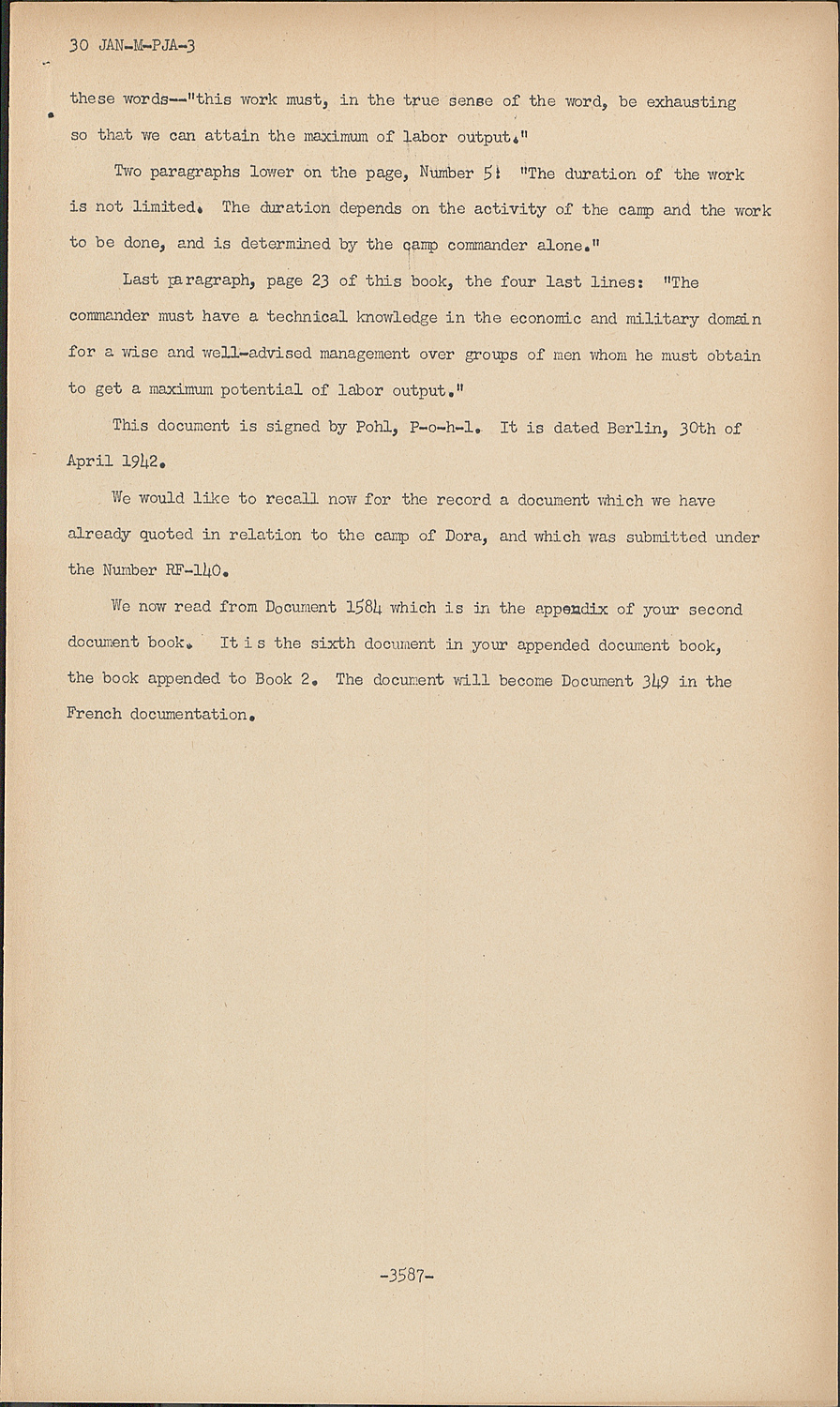
Two paragraphs lower on the page, Number 51 "The duration of the work is not limited. The duration depends on the activity of the camp and the work to be done, and is determined by the camp commander alone."
Last paragraph, page 23 of this book, the four last lines: "The commander must have a technical knowledge in the economic and military domain for a wise and well-advised management over groups of men whom he must obtain to get a maximum potential of labor output."
This document is signed by Pohl, P-o-h-l. It is dated Berlin, 30th of April 1942.
We would like to recall now for the record a document which we have already quoted in relation to the camp of Dora, and which was submitted under the Number RF-140.
We now read from Document 1584 which is in the appendix of your second document book. It is the sixth document in your appended document book, the book appended to Book 2. The document will become Document 349 in the French documentation.
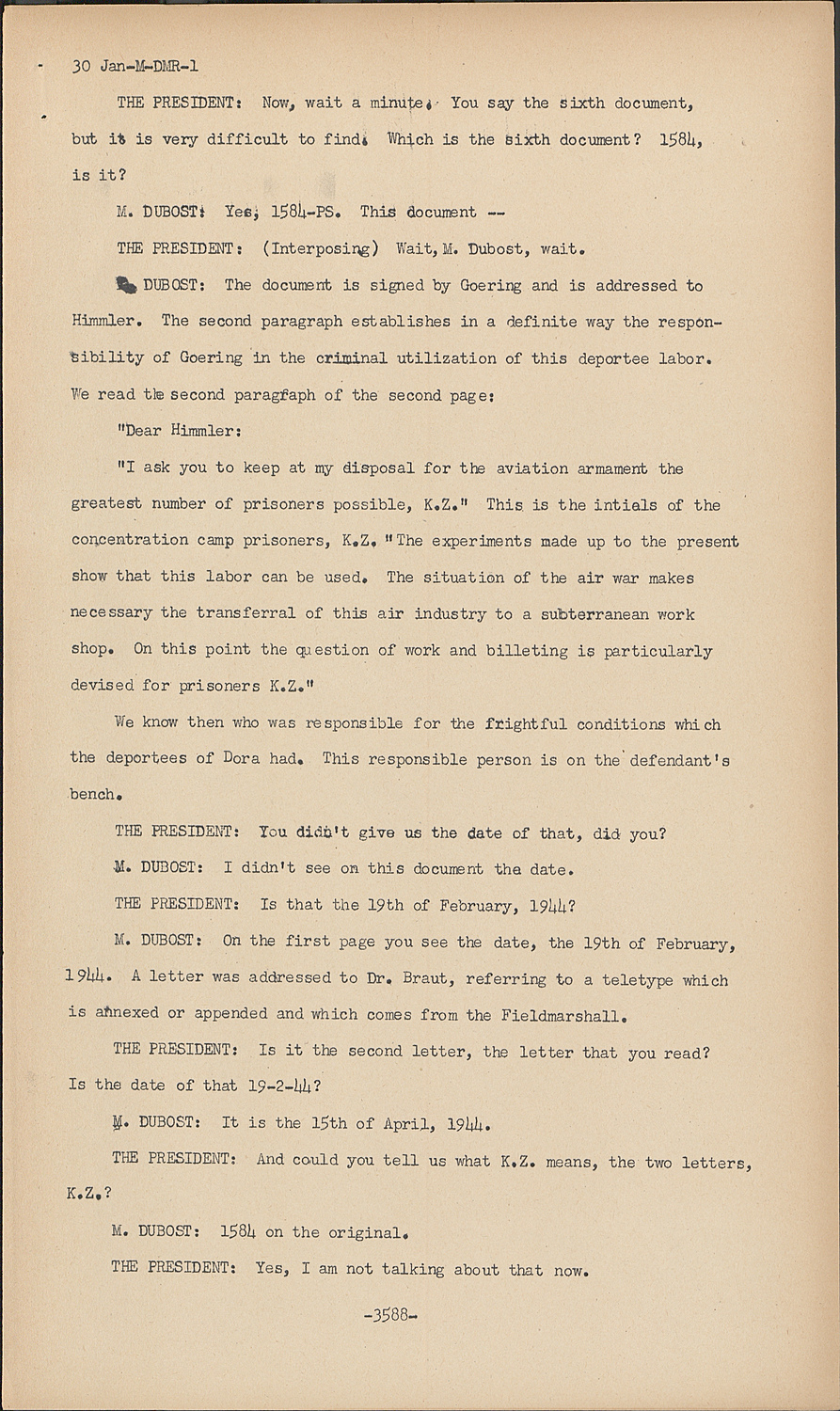
THE PRESIDENT: Now, wait a minute. You say the sixth document, but it is very difficult to find.
Which is the sixth document? 1584, is it?
M. DUBOST:Yes, 1584-PS. This document -
THEPRESIDENT: (Interposing) Wait, M. Dubost, wait.
M. DUBOST:The document is signed by Goering and is addressed to Himmler. The second paragraph establishes in a definite way the responsibility of Goering in the criminal utilization of this deportee labor. We read the second paragraph of the second page:
"Dear Himmler:
"I ask you to keep at my disposal for the aviation armament the greatest number of prisoners possible, K.Z." This is the intials of the concentration camp prisoners, K.Z. "The experiments made up to the present show that this labor can be used. The situation of the air war makes necessary the transferral of this air industry to a subterranean work shop. On this point the question of work and billeting is particularly devised for prisoners K.Z."
We know then who was responsible for the frightful conditions which the deportees of Dora had. This responsible person is on the defendant's bench.
THE PRESIDENT:You didn't give us the date of that, did you?
M. DUBOST:I didn't see on this document the date.
THE PRESIDENT:Is that the 19th of February, 1944?
M. DUBOST:On the first page you see the date, the 19th of February, 1944. A letter was addressed to Dr. Braut, referring to a teletype which is annexed or appended and which comes from the Fieldmarshall.
THE PRESIDENT:Is it the second letter, the letter that you read? Is the date of that 19-2-44?
M. DUBOST:It is the 15th of April, 1944.
THE PRESIDENT:And could you tell us what K.Z. means, the two letters, K.Z.?
M.DUBOST: 1584 on the original.
THE PRESIDENT:Yes, I am not talking about that now.
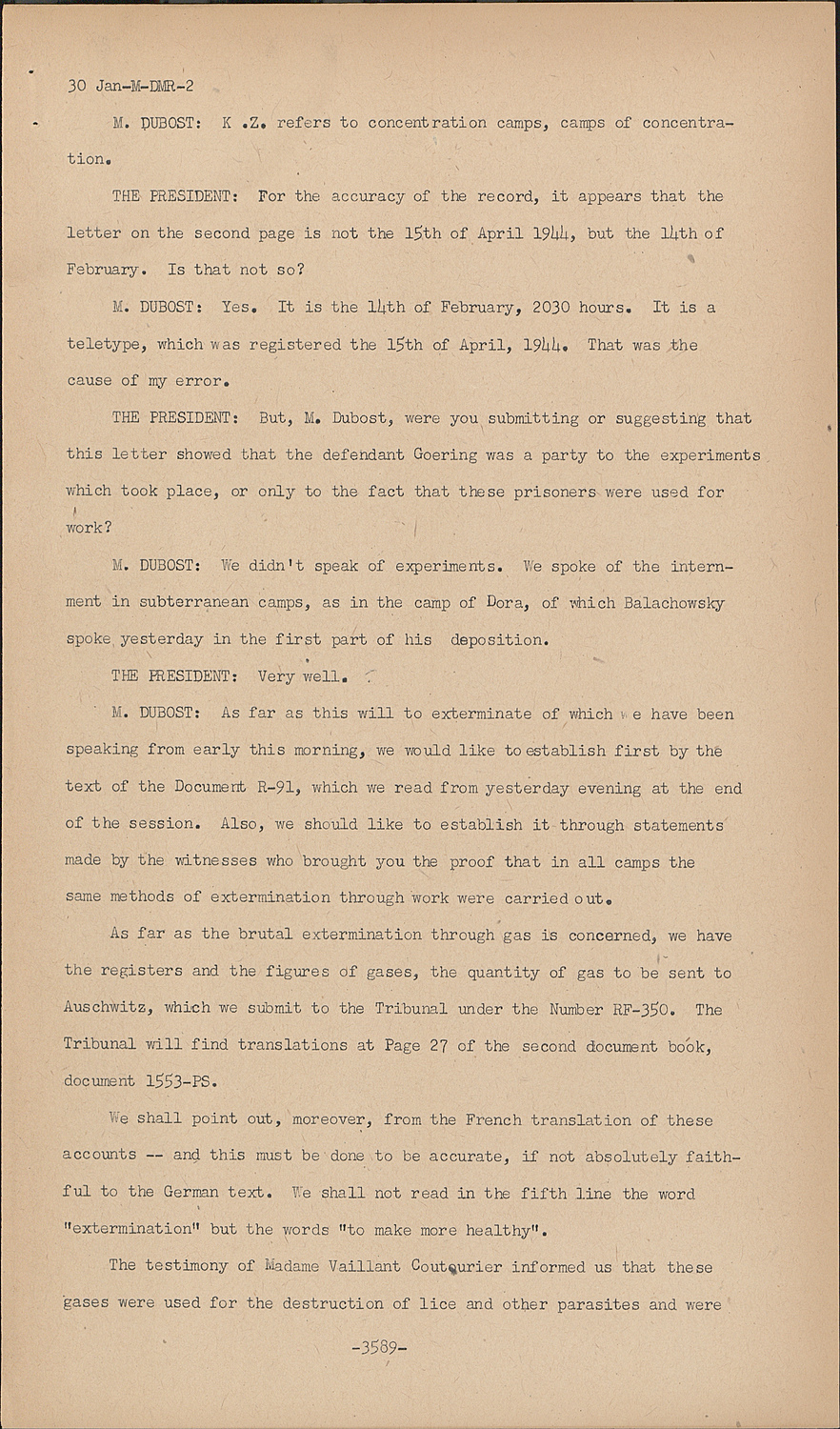
M. DUBOST: K. Z. refers to concentration camps, camps of concentra-
tion.
THE PRESIDENT:For the accuracy of the record, it appears that the letter on the second page is not the 15th of April 1944, but the 14th of February. Is that not so?
M. DUBOST:Yes. It is the 14th of February, 2030 hours. It is a teletype, which was registered the 15th of April, 1944. That was the cause of my error.
THE PRESIDENT:But, M. Dubost, were you submitting or suggesting that this letter showed that the defendant Goering was a party to the experiments which took place, or only to the fact that these prisoners were used for work?
M. DUBOST:We didn't speak of experiments. We spoke of the internment in subterranean camps, as in the camp of Dora, of which Balachowsky spoke yesterday in the first part of his deposition.
THE PRESIDENT:Very well.
M. DUBOST:As far as this will to exterminate of which we have been speaking from early this morning, we would like to establish first by the text of the Document R-91, which we read from yesterday evening at the end of the session. Also, we should like to establish it through statements made by the witnesses who brought you the proof that in all camps the same methods of extermination through work were carried out.
As far as the brutal extermination through gas is concerned, we have the registers and the figures of gases, the quantity of gas to be sent to Auschwitz, which we submit to the Tribunal under the Number RF-350. The Tribunal will find translations at Page 27 of the second document book, document 1553-PS.
We shall point out, moreover, from the French translation of these accounts -- and this must be done to be accurate, if not absolutely faithful to the German text. We shall not read in the fifth line the word "extermination" but the words "to make more healthy".
The testimony of Madame Vaillant Couturier informed us that these gases were used for the destruction of lice and other parasites and were also used to annihilate human beings.
And the quantity of gas which was sent and the frequency with which it was sent, as you can see from the great number of bills of lading, proved that the gas was used for a double purpose.
We have the bill of the 14th of February, of the 16th of February, of the 8th of March, of the 13th of March, the 20th of March, the 11th of April, the 27th of April, the 12th of May, the 26th of May, and the 31st of May, which are all submitted as Document Number 350.
THE PRESIDENT:Are you putting in evidence the originals of these other bills to which you refer on this document?
M. DUBOST:I request the court clerk to hand them over to your Honor, and I take advantage of the circumstance to request the Tribunal to examine tentatively this bill. They will observe the quantities of toxic crystals which were sent to Oranienburg and Auschwitz. The quantities of these crystals were considerable.
The bill of 1844, 832 kilograms; also 276, 25 kilos. These toxic crystals were sent, giving a net weight of 555 Kilos or kilograms.
THE PRESIDENT:What is this document that you have just put in?
M. DUBOST:The 30th of April, 1944.
THE PRESIDENT:I am not asking the date. What I want to know is what is the authority for this document. It comes, does it not, from one of the committees set up by the French Republic?
M. DUBOST:No, Mr. President. The document is the American document which wasin the American Archives, under the number 1564-PS.
THE PRESIDENT: M. Dubost, this note at the bottom of Document 1553-PS was not on the original put-in by the United States, was it?
M. DUBOST:No, Mr. President, but you have under your eyes all the originals which the clerk of the court has just handed you.
THE PRESIDENT:Unless you have an affidavit identifying these originals the originals don't prove themselves. You have got to prove these documents which you have just handed up to us either by a witness or by an affidavit. The documents are documents, but they don't prove themselves.
M. DUBOST:These documents were gathered by the American Army and filed in the Archives for the Nurnberg trial. I got them in the archives or records of the American delegation, and I consider them to be as authentic as all the other documents which were filed by my American colleagues in their records and archives. It was captured unquestionably by the American Army.
THE PRESIDENT:There are two points, M. Dubost. The first is that in the case of the original exhibit, 1553-PS, it was certified, we imagine, by an officer of the United States. These documents which you have now drawn our attention to are not so certified by anyone as far as we have been able to see. Certainly we can't take judicial notice of these documents, which are private documents, and therefore, unless they are read in court they cannot be put in evidence. That can all be rectified very simply by such a certificate or by an affidavit annexing these documents and showing that they are analogous to the document which is the United States exhibit.
M. DUBOST:They are all documents of the United States, and they are all filed in the Archives of the United States in the American delegation under the number 1553.
THE PRESIDENT:The American exhibit 1553-PS has not yet been submitted to the Tribunal and the Tribunal is of the opinion that they cannot take judicial notice of this exhibit without any further certification, and they think that some short affidavit identifying the document must be made.
M. DUBOST:We will request our American colleagues, the American prosecution, to furnish this affidavit. We believed, of course, that this document, which was classified in the archives, would naturally be established.
This will for extermination, moreover, does not need to be proved by this document.
It is established amply by the witnesses and testimony which we have submitted. The witness Boix said that no one could come out of this camp alive. There was only one possible exit and that was by the chimney of the smokestack of the crematorium.
Document F-321, page 49, at the top of the page, page 36 of the German text, relates that the only explanation which the SS made was that no captive should ever come out of this camp alive.
On page 179, the next to the last paragraph of the French text, page 152 of the German text, the SS said that there was only one way of coming out of the camp, and that was through the chimney of the smokestack.
On page 174, page 148 of the German text, the last paragraph, before the title "Gassing and Cremation":
"This camp had for its essential purpose the extermination of the greatest possible number of men. It had the name of a destruction camp. This destruction, this extermination of the internees, assumed two different forms. One was progressive; the other was brutal."
In the second document book which the Tribunal has under its eyes, pages 28, 29, and 30, we find the account of a parliamentary delegation from the British Parliament in the month of April 1945, from which we read the third paragraph on page 29:
"Although the work of clearing out the camp was continued for more than a week before our visit, we immediately felt, and we continued to feel, an impression of horrible uncleanliness within the camp."
Page 30, below the dashes, next to the last paragraph, third line of this paragraph:
"However, we would like to conclude stating that according to our opinion which has been well weighed and is unanimous, founded on valid proofs, a policy of continuous starvation and inhuman brutality was carried out at Buchenwald for a long time, and that such camps caused humanity to reach the lowest degree of degredation that it ever was able to attain."
Likewise, there is the report of a committee including General Eisenhower on pages 31, 32, and 33 of the same document book. We read the second paragraph of the French extract, page 32 in your document book:
"The purpose of this camp was extermination."
In the first paragraph on the top of the page:
"The means of extermination were blows, torture, over-population of the dormitories, illness."
Page 32, at the top, in the second document book -
THE PRESIDENT:Will you go a little bit slower over these numbers.
You said, first of all, 31, and then 32. It came to us as 32.
It is quite impossible to follow you unless we know the right page.
You have read 31 now, haven't you? Have you read 31?
M. DUBOST:I said to the Tribunal that the document which we now submit and read is Document L-159 which is the second document book, including pages 31, 32 and 33, and I read from page 31, "Atrocities and other conditions in the concentration camps in Germany. Report of a committee made up of General Eisenhower under the Chief of Staff, General George Marshall, to the Congress of the United States, treating atrocities and other conditions in concentration camps in Germany."
THE PRESIDENT:I asked you whether you had read the part you wished to read on page 31.
M. DUBOST:Yes, Mr. President, I read the title, and then, from page 32.
THE PRESIDENT:Where are you going to read on page 32?
M. DUBOST:Second paragraph.
THE PRESIDENT:On page 32?
M. DUBOST:Page 32, second paragraph.
"The purpose of this camp was extermination, and the means of extermination"
THEPRESIDENT: (Interposing): M. Dubost, that is page 31.
M. DUBOST:I beg your pardon. I have a sheet which is not numbered in that way. I request the Tribunal to excuse me. I had a text in front of me which was paginated in another fashion, another way.
We finish then, page 31, the first paragraph:
"The purpose of this camp was extermination, and the means of extermination were blows, torture, overcrowding in the dormitories, and illness. The result of these measures was heightened by the fact that prisoners were obliged to work in an armament factory adjoining, which manufactured guns, small firearms, and so on."
The means which were used to carry out this progressive extermination are numerous and multiple. We are going to submit documents which have just been handed to us, which we have not communicated to the defense, and which constitute printed extracts from Auschwitz concerning the number of blows which could be administered to the internees or prisoners.
These documents will be handed over to the defense for their criticism. They have just been given to us. I am not able to authenticate their origin. They were presented to us under the character of having certain authenticity. We think they are authentic. Photostats of the documents were given to the defense attorneys.
THE PRESIDENT:The Tribunal thinks that they can't admit these documents at present. It may be that after you have more time to examine the matter you may be able to offer some evidence which authenticates the documents, but we can't admit the documents simply upon your statement that you believe them to be genuine.
M. DUBOST:Moreover, everything they found in the camps prepared progressive extermination of the people who were interned there. All were under a hard regime. It was a very cold climate. Some were in subterranean caves. Their living conditions have been brought out by the witnesses which we have brought before the Tribunal.
As to the conditions under which the internees lived, they had to live hours bare while they were being registered and waiting to be tattooed. Everything tended to cause the rapid death of those who were to be interned in these camps. A good number of those internees were subject to a regime which was even more serious. The description was given to the Tribunal by the American prosecution when they submitted Document US R-243 dealing with the regime of the Nacht und Nebel, the NN. We don't think it is necessary to go back over the description of this regime. We shall submit only a new document which shows with what rigor the regime of the NN was applied to our compatriots. This document is the second of the first document book. It is included under the number 278-B. It comes from the Armistice Commission, the German Armistice Commission of Wiesbaden and shows that upon repeated protests of the French population and even of the government of Vichy against the conditions which surrounded the internees of the NN camps, no measure was ever undertaken against these camps.
We shall now read from paragraph 2 which explains why the reply was not made:
"This fact was provided for and anticipated by the Fuehrer. The opinion was that intimidation of the population would not be obtained by the sentence of death, but only by measures which would leave the population uncertain as to their fate."
This document becomes MF-353.
We will not dwell further on the description of the blocks and the hygienic conditions of the internees in the block. Four witnesses who all came from different camps have pointed out to us that the hygienic conditions were similiar. The blocks were as overcrowded in all these camps. We know that everywhere the water was provided in insufficient quantities. Everywhere, deportees slept two or three in beds of 60 to 70 motors wide. We know that everywhere the linen was never renewed or was in very bad condition. We know likewise the conditions in which were carried out the services of the camp. Several witnesses; physicians, have testified to this fact before your Tribunal, The Tribunal will find confirmation of the testimony in Document F-121, page 119, page 98 of the second document book.
We read the last line of page 100 of your document books:
"Because of lack of water the prisoners were obliged to satisfy their thirst by seeking water which was found in the water closets."
Page 119 of Document F-321, page 103 in the German text, third paragraph "The surigical service was insured by a German who was a surgeon from Berlin.
This was a prisoner, a common criminal, who killed his patient on each operation."
Two paragraphs lower:
"The management of the block was carried out by two Germans, a man without scruples who carried out the surgical operations on the spot, with a certain Asch who was a mason by trade."
According to the statements by our witnesses, who in their capacity as doctors and physicians, eared for patients in these infirmaries in the camps, it seems superfluous to multiply the evidence in our documents.
When the labor was exhausted from work, when it seemed impossible that they could ever recover, selections were made which separated or screened out those who could not be utilized, with the purpose of exterminating them through gassing, as related by our first witness, Madame Vaillant Coutourier, or by intra-cardiac injections, as related by two other French witnesses, Dr. Dupontand Balachowsky.
This system of screening was carried out in all the camps, and it carried out general orders, proof of which we find in document R-91, in the first document book. The Tribunal will find the testimony written by Blaha, testimony received here the 9th of January, and which recalls the 15th document of the first document book, the testimony of Blaha, that 3000-
THEPRESIDENT (interposing): Is it 3249-PS?
M. DUBOST:That is the document, Mr. President; yes, the document which you have under your eyes, the 6th page.
THE PRESIDENT:You have already given this as evidence, haven't you?
M. DUBOST:I am not going to read it. I merely wish to recall this for the record because it enters into the body of proofs which I wish to submit.
THE PRESIDENT:We don't want affidavits by witnesses who have already given evidence. This affidavit, PS-3249, has not been put in, has it?
M. DUBOST:No, I am merely recalling the testimony which was given at the session, at the public hearing. We shall not submit this document, Mr. President. We are just utilizing this document to remind the Tribunal that Blaha pointed out the wretched conditions existing in the infirmaries, the miserable hygienic conditions in the infirmaries.
To all these miserable, wretched conditions, you must add this exhausting labor, for all the deportees were forced to carry out the hardest labor. We know that they worked in these work commandos and in the workshops.
We know, according to the witnesses, that the duration of this work was a minimum of 12 hours, and it was often prolonged according to the whim of the camp commander.
The document R-129, from which we have already read, is the document of Pohl, addressed to Himmler, pages 22, 23 and 24 of the second document book, on the subject that the working hours must be utilized.
This work was carried out, according to testimony, in water, in mud, in subterranean caves in Dora, for instance, in quarries in Mauthausen.
In addition to this exhausting work, which was exhausting in itself, the deportees underwent the ill-treatment of the SS and the Kapo or trustees, such as blows, being bitten by dogs.
Our document RS-274, pages 74 and 75, brings out the official testimony.
Is it necessary to read to the Tribunal from this document, which is an official document to which we constantly refer, which has been translated into German and into English?
THE PRESIDENT:I don't think you need read it. Give us the pages.
M. DUBOST:I thank you, Mr. President.
This same document, page 77 and page 78, informs us that all the prisoners were subjected, even under the most difficult conditions from the point of view of hygiene and health, to the work which they were forced to do.
There was no quarantine for them even in periods of great epidemics.
The French document 392 which we have submitted and which is in the first document book, confirms the testimony of Madame Vaillant Coutourier.
It is the twelfth document of your first document book, third paragraph, page 4."Received about half a litre of herb tea; this when we were awakened.
The supervisor, who was at the door where we were to wash, gave us blows with a cudgel.
Shortly afterwards there was an epidemic of typhus."
At the end of the third paragraph and the beginning of the next paragraph are the conditions in which the prisoners were taken to factories.
In the fifth paragraph:
"We were provided with wooden shoes which in a few days caused us wounds.
These wounds brought about infections which brought death to many."
We now pass to the reading of document R-129, pages 22, 23 and 24 in the second document book, and which we submit under the number-
THEPRESIDENT (interposing): One moment: the Tribunal will adjourn now for fifteen minutes.
(Whereupon a recess was taken from 11.25 hours to 12.
15 hours.)
THE PRESIDENT:Mr. Dubost, the Tribunal has been considering the question of the evidence which you have presented on the concentration camps, and they are of opinion that you have proved the case for the present, subject, of course, to any evidence which may be produced on behalf of the Defendants, and of course subject also to your right under Article 24-E of the Charter to bring in rebutting evidence, should the Tribunal think it right to admit such evidence.
They think, thereofore, that it is not in the interests of the trial, which the Charter directs should be an expeditious one, that further evidence should be presented at this stage on the question of concentration camps, unless there are any particular new points about the concentration camps to which you have not yet drawn our attention; and, if there are such points, we should like you to particularize them before you present any further evidence upon them.
M. DUBOST:I thank the Tribunal for this statement. I do not conceal from the Tribunal the fact that before I can make a choice of the points on which it seems necessary to insist, I shall need a few moments.
With the authorization of the Tribunal, we shall pass to the examination of the situation of war prisoners.
THE PRESIDENT:Mr. Dubost, possibly you could, during the adjournment, consider whether there are any particular points, new points, upon concentration camps which you wish to draw our attention to, and present them after the adjournment, in the meantime proceeding with some other matter.
M. DUBOST:The 1 o'clock recess?
THE PRESIDENT: Yes, that is what I meant.
M. DUBOST:We shall, therefore, provisionally consider as establish, the proof that Germany in its internment camps, in its concentrations can pursued a policy tending to annihilate its enemies -- to exterminate them -at the same time as it created asystem of terror that it exploited to facilitate the realization of its political aims.
Another aspect of this terroristic policy, this policy of extermination, appears when one studies the war crimes committed by Germany on the persons of war prisoners. These crimes we shall present to you answer two motives: To debase as much as possible the captives; to relax their energy; to demoralize them; and to bring them to doubt the merit of the cause for which they had fought; and to despair of the future of their country. The second motive was to bring about the disappearance of those among them who, by their antecedents or by the signs which they had given since their capture, showed themselves as inadaptable to the new order the Nazis intended to set up.
With this aim, Germany multiplied inhuman treatments with the aim of debasing the men who were soldiers and who had surrendered, trusting the military honor of the army to which they surrendered.
The transfers of prisoners were carried out under the most inhuman conditions. The men, badly fed, were obliged to make long trips on foot, exposed to all kinds of punishments, and struck down when they were tired and ceased to follow the column. No shelter was provided for the halting places, and no feeding. The evidence for this is given in the report on the evacuation of the column that left Seygand on the 8th of February, 1945, at 12:30 p.m., a document which the Tribunal will find in the annex to the document book on the prisoners. This document has already been submitted by my colleague. Mr. Herzog, under No. 46.
THE PRESIDENT:Where shall we find it?
M. DUBOST:I shall read the second annex, last line.
THE PRESIDENT:I haven't got the document, I am afraid, Mr. Dubost, if you could tell us which book it is in.
M. DUBOST:It is in the document book submitted by Mr. Herzog. The order was given to the French Secretariat to hand these documents to you.