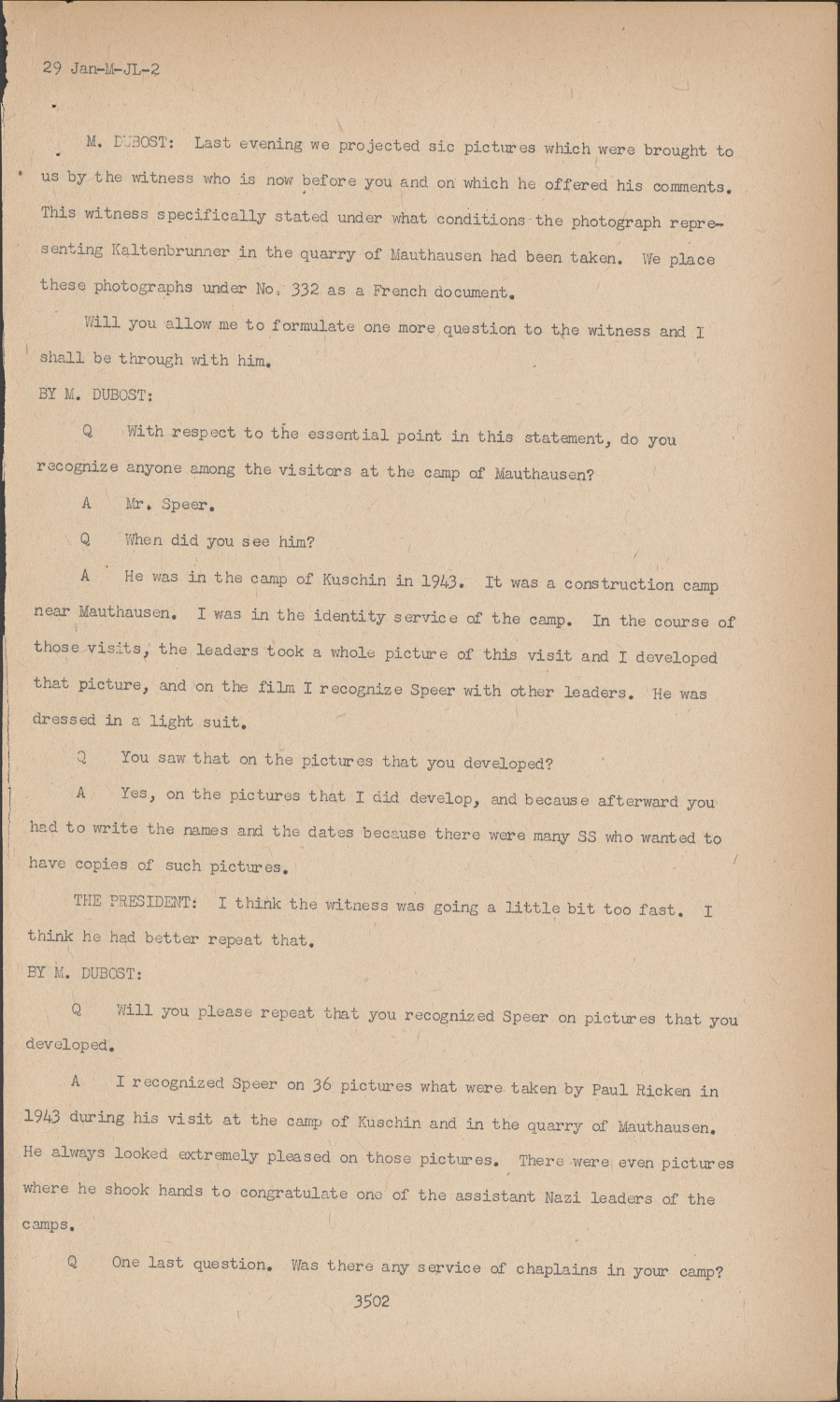
M. DUBOST: Last evening we projected sic pictures which were brought to us by the witness who is now before you and on which he offered his comments.
This witness specifically stated under what conditions the photograph representing Kaltenbrunner in the quarry of Mauthausen had been taken. We place these photographs under No. 332 as a French document.
Will you allow me to formulate one more question to the witness and I shall be through with him. BY M. DUBOST:
QWith respect to the essential point in this statement, do you recognize anyone among the visitors at the camp of Mauthausen?
AMr. Speer.
QWhen did you see him?
AHe was in the camp of Kuschin in 1943. It was a construction camp near Mauthausen. I was in the identity service of the camp. In the course of those visits, the leaders took a whole picture of this visit and I developed that picture, and on the film I recognize Speer with other leaders. He was dressed in a light suit.
QYou saw that on the pictures that you developed?
AYes, on the pictures that I did develop, and because afterward you had to write the names and the dates because there were many SS who wanted to have copies of such pictures.
THE PRESIDENT:I think the witness was going a little bit too fast. I think he had better repeat that. BY M. DUBOST:
QWill you please repeat that you recognized Speer on pictures that you developed.
AI recognized Speer on 36 pictures what were taken by Paul Ricken in 1943 during his visit at the camp of Kuschin and in the quarry of Mauthausen. He always looked extremely pleased on those pictures. There were even pictures where he shook hands to congratulate one of the assistant Nazi leaders of the camps.
QOne last question. Was there any service of chaplains in your camp?
How did the interned die who wanted the assistance of religion as they passed away?
Were there any chaplains in your camp?
AYes, there were several. Of those that I can speak of, there were some German Catholics.
QDid the administration of the camp officially grant to the internees the right to practice their religion?
ANo, it was absolutely forbidden, even to live.
QWere there any Catholic chaplains or were there any Protestant pastors?
AMost of them were Protestants. I don't know much about this.
QHow were priests and pastors treated?
AThere was no difference between them and ourselves. They were fed as we were. They were, at times, sent to the gas chamber, at times sent to work, sometimes plunged in freezing water. The Germans knew that they were not people who could perform the labor that could be exacted from other camp inmates, and that is the way they treated the intellectuals of all countries.
QThey were not allowed to exercise their ministry?
ANo, not at all.
QDid the men who died have the assistance of a chaplain before they died, on being executed?
ANo, they did not. At times, rather than being assisted by anyone in respect to religious matters, they would rather be beaten with bludgeons by the SS. I can mention the case of a few officers and political kommissars and prisoners of war.
M. DUBOST:I have no further questions to ask of the witness. BY GENERAL RUDENKO:
QWitness, will you be so kind as to tell us what you know about the extermination of Soviet prisoners,
AI am glad to be interrogated on this subject in detail. I know so many things that I could scarcely speak of them.
QI would like to have you tell us specifically and briefly what you know about it.
THE PRESIDENT: The witness' evidence isn't coming through to some of the defense counsel.
Is it coming through to any of the defense counsel? I understand it is coming just to some and not to others. BY GENER AL RUDENKO:
QThen I would like to ask you, Witness, to tell us briefly in principal what you know about the extermination of Soviet war prisoners in the camp where you were.
AThe arrival of the first prisoners of war took place in 1941, in November. They had announced the arrival of 2,000 Russian prisoners of war. They took the same precautions as in the case of the Republican Spanish prisoners of war. They put machine guns everywhere.
As soon as the Russian prisoners of war entered the camp, they said that they were in frightful condition. They were human rags. They were placed in the barracks, 1,600 in each barracks. They were 7 meters wide by 104 meters long. They had no clothing. They could only keep one pair of drawers and two shirts. It should be emphasized that this was in November and it was 10 degrees below zero in Mauthausen.
Upon their arrival, there were a hundred or more who died in walking from the station to the camp of Mauthausen.
The same system was applied to them as was applied to the Spanish prisoners of war. They applied the same methods to them. They left them somewhat lone, but without anything to eat. At the end of four weeks they were already exhausted, and then the elimination procedure was applied to them. They were sent to labor under the worst conditions. They were struck and beaten and humiliated. At the end of three months, out of 2,000 Russian PW's, there were only 30 survivors. Of these 30 pictures were taken for a photographic document. I am prepared to show those pictures if they are accepted.
QYou do have this picture?
A M.Dubost knows about that, yes. M. Dubost has it.
QThank you.
What do you know about executions of Jugoslavs and Poles?
AThe Poles came to the camp in 1939, from the moment of the defeat of Poland. They received the same treatment as we did. At that time there were only German common criminals in there.

Then the work of the extermination was begun.
There were tens of thousands of Poles who died under frightful conditions.
It should be emphasized that the Jugoslavs started coming in convoys. They were dressed in civilian clothes. They wore steel helmets and 165 came in the first lot. After that they came in small groups of 20 to 30, and 60, and even women came then. Among the four women that were once shot, it was the first time that any internees had spat upon the face of the camp fuehrer before dying. They suffered more than any nationality. Their position was comparable to that of the Russians, Until the very end they were massacred by every imaginable means. They did as many things to them as they did to the Russians.
QDo I understand correctly that the concentration camp was really an extermination camp?
AIt was Mauthausen Concentration Camp, Third Echelon, that is to say, the last echelon. That is, it was a camp from which no one was to come out.
GENERAL RUDENKO:I have no further questions.
THE PRESIDENT: Does Counsel for Great Britain desire to cross examine?
COLONEL PHILLIMORE:No questions.
THE PRESIDENT:Counsel for the United States?
MR. DODD:No questions.
THE PRESIDENT:Do any counsel for the Defendants wish to cross examine: BY DR. BABEL (Counsel for SS, SD):
QWitness, how were you identified in the camp?
AThe number? What, if you please? What kind of a brand?
QThe prisoners had insignia of various colors, of red, green, yellow, and so forth. What did you wear?
AEverybody wore insignia. Some wore stars; some wore triangles. There was also a letter which indicated the nationality. The Jews -
QWhat color were you characterized by?
AI had a blue one with an R, blue with an R in it.
QWere you a Kapo?
AI was an interpreter at first. Then I was in the identity service.
QWhat were your tasks and duties there?
AAt first, as interpreter, there were practically no Spaniards who could speak German and my work was to translate the barbarities which the SS caused me to say all the time. Then my work was that of a photographer, charged with developing the pictures which maintained the full story of what happened in the camp.
QWhat was the policy with regard to visitors? Did visitors go only to the inner camp or did they also go to the places of work?
AThe visitors went everywhere in the camp. Therefore, it was impossible for them not to know what was going on there. Only when there were magistrates or other such visitors from Poland, Austria, Slovakia, and all of that, then they allowed them to visit only the better parts of the camp. They would look for the cooks and they would look for the criminal inmates who were fat and healthy locking and they would show them to the visitors, saying that all inmates were the same.
QWere the prisoners forbidden to communicate to the outer world anything regarding the conditions in the camp?
AIt was so completely forbidden that if anyone was caught at it, it was not merely a question of being put to death, but of being tortured and reprisal being exercised on members of his nationality.
QWhat did you observe about the behaviour of the Kapos? How did they behave toward their fellow prisoners?
AAt times they were really worthy of being SS themselves. To be a Kapo, you had to be a pure Aryan. That means that they had a martial bearing. Therefore, they considered that they had the right to treat us like animals. The SS gave them carte blanche to do what they willed with us. Thus it was that at liberation the prisoners and deportees executed all the Kapos on whom they could lay their hands. Before that, the majority of the Kapos and the common criminals asked to enlist voluntarily in the SS and they left with the SS because they knew what was awaiting them. In spite of that we looked for them everywhere and executed them on the spot.
QYou said they had to behave like animals. I deduce from that that you knew of that.
AYou could see that by the way they behaved. It was preferable to die like a man rather than to live like a beast, and they preferred to live like beasts and they behaved as such.
QI didn't receive the translation of that reply. Would you please repeat your answer. I didn't understand.
AYou would be blind in order not to see what went on. I know what they were doing. There were many among us who had the possibility of becoming Kapos because we were specialists in some of the trades in the camp. They would prefer to be beaten, if necessary, and executed, rather than to become a Kapo.
DR. BABEL:Thank you.
THE PRESIDENT:Does any other member of the defendants' counsel wish to ask questions of the witness?
M.Dubost, do you wish to ask any questions?
M. DUBOST:I have no further questions, Mr. President.
GENERAL RUDENKO: The witness informed us that he has a photographic document at his disposal showing 30 Russian war prisoners who were the only survivors from several thousand Russian war prisoners who were interned in this camp; I would like to ask you, Mr. President, to present this photographic document to the witness to that he can confirm before the Tribunal that this is really a document about this group of Soviet war prisoners.
THE PRESIDENT:Certainly you may show the photograph to the witness if you have it. You may put the photograph to the witness if it is available.
GENERAL RUDENKO:Yes. BY GENERAL RUDENKO:
QWitness, can you show this picture?
AWhat was it please? To whom? BY THE PRESIDENT:
QIs this the photograph? (Indicating)
AYes, that is these 30. I can assure you that these 30 survivors were still living in 1941. Since then, in view of the conditions of the camp, it is very difficult to state whether any of them are still alive.
QWould you please state the date when this photograph was taken?
AIt was at the end of winter, 1941-42. In those days, it was still 8 degrees below zero. You can see on the picture the countenance of the prisoners because of the cold.
THE PRESIDENT:Has this book been put in evidence yet?
M. DUBOST:This book has been submitted as evidence. It is RF-321.
THEPRESIDENT: 321. Have the defendants got copies of it?
M. DUBOST:They have received a copy of that text in German, your Honor. I am not certain whether the German text has the pictures as well. No, the pictures are not in the German version.
THE PRESIDENT:Well then, let this photograph be marked. It had better be marked with a French exhibit number, I think. What will it be?
M. DUBOST:We shall give it number 333, RF-333.
THE PRESIDENT:Let it be marked in that way, and then hand it to Dr. Babel.
GENERAL RUDENKO: Thank you, sir.
(The document above referred to was handed to Dr. Babel).
THE PRESIDENT:I think it should be handed about to the other defendants' counsel in case they wish to ask any question about it.
Mr. Dubost, I suppose that an approved copy of this book, including the photographs, has been deposited in the defendants' information center.
M. DUBOST:The whole book, except for the pictures.
THE PRESIDENT:Why not the pictures?
M. DUBOST:We didn't feel that we were to place them. In our expose we did not discuss the photographs.
THE RESIDENT:The German counsel ought to have the same documents as are submitted to the Tribunal in evidence. The photographs have been submitted to the Tribunal; therefore, they should have been submitted in the information center.
M. DUBOST:It was deposited, the French text including the pictures, and in addition a certain number of texts in German which did not include the pictures because that translation was prepared for the use of the defense. But there are French copies of the book that have been placed in the document center with the pictures.
THE PRESIDENT:Very well.
M. DUBOST:We have here four copies, which We shall place before you, of the picture which was shown yesterday, which shows Kaltenbrunner and Himmler in the quarry of Mauthausen, on the basis of the testimony given by M. Boix. One of thesepictures will also be delivered to the defense, that is, to the lawyer of the defendant Kaltenbrunner.
THE PRESIDENT:Now, the photograph has been handed around to the defendants' counsel. Do any members of the defendants' counsel wish to ask any questions of the witness upon this photograph?
The witness can then retire.
THE WITNESS:I would like to say something more. I would like to note that there are a few cases where Soviet officers were massacred because they were prisoners of war. The Russian gentleman ought to listen to me on that.
BY THE PRESIDENT:
QWhat is it you wish to say about the massacre of the Soviet prisoners of war?
AThere was a transport in 1943. They were Russian officers or political kommissars. On the day of their arrival in the camp they were massacred by every imaginable means. But it seems that from the higher spheres an order had come saying that something special had to be done, so they put them in the best block that there was in the camp.
They gave them new clothing, Russian prisoners' clothing; they gave them cigarettes; they were put in beds with sheets; they were given everything they wanted to eat.
Dr. Krissbach listened to them.
Then they were taken down to the quarry, They carried heavy stones and at that time Paul Sicken was there and was taking pictures of this incident. He undoubtedly took about 48 pictures. These pictures were developed by me and they were sent, with the negatives. It is too bad I couldn't keep the negatives of that as I did of the others. They were sent to Berlin for these questions.
When it was all over, the Russians were then asked to give up their clothing and they were sent to the gas chamber. The comedy was ended. Everybody could see on the pictures that the Russian prisoners of war and political kommissars were well treated, that they were in good condition. That is one thing that should be noted because I think it is necessary.
And another thing. There was a barrack called number twenty. In that barrack inside of the camp, and in spite of the electrified barbed wire around the camp, there was an additional wall with new electrified barbed wire around it, and in that barrack prisoners of war -- Russian, a few Frenchmen, some Jugoslavs, perhaps a few Englishmen - no one could enter that barrack except the two fuehrers who were of the SD, that is, the commandant of the inner camp and of the outer camp. They were dressed like we were; like common-law prisoners. You could not tell their nationality from their dress. We had to run as we took the pictures, and they put a number on them. The number started with three thousand and some. Number eleven in blue. That started in about three thousand. Then it went up to four thousand. In the pictures at that time Herman Schimann, who was taking those pictures in Dasaltz --it was somewhere north of Berlin, I don't remember where he came from -- he had the order to develop them himself. But since all the SS in the inner service in the camp only had orders to kill prisoners -- there were always two prisoners to do that. They needed me to develop their films, so that they would not be disturbed, so I did the enlargements. I always made two copies.
I always gave them to SS Obersturmfuehrer Schulz. He was in Cologne.
He was the political leader of the political division. He recommended to me to say nothing to anyone, otherwise we would be immediately liquidated. That is why I immediately told my comrades -- we had never been afraid of death -so we thought that if anyone could get out of the camp they would be able -
THE PRESIDENT:I think we have heard enough of this detail that you are giving us. But come back for a moment to the place you were speaking of where the Russian prisoners of war in 1943 -- just a moment; I want to put a question about.
You said that the officers were taken to the quarry to carry the heaviest stones.
THE WITNESS:No, just small stones or less, about twenty kilos, to show in the pictures that the work that Russian officers were doing was not heavy work. It was very heavy work that they were required to do -- not really forced labor -- that was for the pictures. But in reality it was entirely different. BY THE PRESIDENT:
QI thought you said they carried big heavy stones. Were the photographs taken while they were in their uniforms carrying these light stones?
AYes, sir; they had to put on clean uniforms, and neatly arranged in order to show that Russian prisoners were as they should be.
THE PRESIDENT:Very well. Is there any other particular incident you want to refer to?
THE WITNESS:Yes. I come back to block twenty. This little detail of which I want to speak -- in that block I succeeded in taking advantage of my knowledge of photography. I was able to keep the light in there in order to take my pictures, so I was able to get all sorts of details as to what was taking place in these barracks. In these barracks seventy metres wide by fifty metres long the prisoners there did not receive even one-fourth of what we received by way of food. They didn't have any spoons; they didn't have any plates. The bad food was thrown away under the snow, then the Russians had to eat what was thrown away. The Russians were so hungry that they would fight in order to eat that.
Then when such fights broke out the SS --
BY THE PRESIDENT:
QDo you mean that Russians were put into block twenty?
ANo, the Russians came specially. They did not enter directly into the camp. Those who were not immediately gassed went to number twenty. Even the inner leader of the camp could not enter there. Small groups of fifty or sixty several times each week. And then one could always hear the shouts and the blows of the fights that went on inside. From new arrivals the Russians knew that the Russian Army was approaching Jugoslavia, so they took one last chance. They took one last chance and they beat the soldier, they took the machine gun, then they tore down the barbed wire with their own wooden shoes, with anything they could find, in order to be able to find weapons. Many died on the spot. There were seven hundred of them. Only sixty-two of the seven hundred succeeded in passing to Jugoslavia with the Partisans. On that day the leader of the camp gave the order by radio that all civilian prisoners were to cooperate in liquidating the Russian criminals. And if anyone brought proof that they had assassinated any one they would receive special rations. That is why those who belonged to the Nazi Party in Mauthausen and in the vicinity went to work. They brought more than six hundred down. There were many who could not drag themselves as far as ten metres.
After the liberation a Russian major came to Mauthausen, He was a survivor of the group. And it was he who told me the details of the fateful -
THE PRESIDENT:I don't think the Tribunal wants to hear more details which you didn't see yourself. Does any member of the defense counsel wish to ask any question of the witness upon the points which he has dealt with himself? BY DOCTOR BABEL (Counsel for SS and SD):
QIn the course of your testimony you named a certain number of figures. How were you in a position, yourself, to count them?
ANearly always there were complete convoys who were brought in the camp of columns of five. It was easy to count them. There were always transports who were sent from the Wehrmacht prisons somewhere in Germany.
They were always sent from all prisons in Germany -- from the Wehrmacht, the Luftwaffe, the SS and SA.
THE PRESIDENT:Just answer the question and don't make a speech. You have said they were brought in in columns of five, and it was easy to count them.
THE WITNESS:Very easy to count them, particularly for those who wanted to be able to tell the story some day. BY DOCTOR BABEL:
QDid you have so much time that you were able to observe all these things?
AThe transports came always in the evening after the deportees had returned to the camp. At that time we always had two or three hours where we could wonder about in the camp waiting for the bell that would tell us to go to bed.
THE PRESIDENT:The witness may now retire.
--------------
M. DUBOST:If the Tribunal permits, we shall now hear Mr. Cappelen, who is a Norwegian witness. The testimony of Mr. Cappelen will be limited to the conditions that were imposed on Norwegian internees in Norwegian camps and prisons.
THE PRESIDENT:Very well.
-----------
HANSCAPPELEN, a witness on behalf of the French prosecution, takes the stand.
THE PRESIDENT:I understand that you speak English.
THE WITNESS:Yes, I speak English.
THE PRESIDENT:Will you take the English form of oath?
THE WITNESS:Yes, I prefer to speak out in English.
THE PRESIDENT:What is your name?
THE WITNESS:My name is Hans Cappelen.
THE PRESIDENT:Will you repeat this oath after me.
I swear that the evidence I shall give shall be the truth, the whole truth, and nothing but the truth, so help me God.
(Witness repeats oath in English)
THE PRESIDENT:M. Dubost, can you spell the name?
M. DUBOST:C-a-p-p-e-l-e-n.
THE PRESIDENT:It would help the Tribunal if the names of these witnesses could be handed up. It is extremely difficult to get these names.
M. DUBOST:They were given, Mr. President, last evening, I had taken to the Tribunal a letter addressed to you, Sir.
THE PRESIDENT:I haven't seen it. BY M. DUBOST:
Q. M.Cappelen, you were born 18 December 1903?
A.Yes.
Q.In what town?
A.I am born in Kvietseid, Telemark, Norway.
Q.What is your profession?
A.I was a lawyer; but now I am a business man.
Q.Will you tell what you know of the brutalities of the Gestapo in Norway?
A.My Lord, I was arrested the 29th of November 1941 and brought to the Gestapo prison in Oslo, Moellergata 19. After ten days I was interrogated by two Norwegian N.S. or Nazi police agents. They started in at once to beat me with bludgeons. How long this interrogation lasted I can't exactly remember, but it did lead to nothing. So after some days I was brought to 32 Victoria Terrace. That was the headquarters of the Gestapo in Norway. It was about eight o'clock in the night. I was brought into a seemingly big room and they asked me to undress. I had to undress until I was absolutely naked. I was a little bit swollen after first treatment I had by the Norwegian police agents, but it wasn't so bad.
There was present six or eight Gestapo agents, and there was -kriminalrat was his title -- Femer. He was very angry, and they started to bombard me with questions which I couldn't answer. So Mr. Femer run upon me and tore all the hair off my head, so hair and blood was laying on the floor around me.
And so all of a sudden they all started to run upon me and beat me with rubber bludgeons and iron wires. It hurt me very bad, and I fainted. But I was brought back to life again in the way that they poured ice-cold water over me.
I vomitted, naturally, because I was feeling very sick. But that only made them angry, and they said, "Clean up, you dirty dog," and I had to make an attempt to clean up with my bare hands.
In this way they carried on for a long, long time, but the interrogation led to nothing because they bombarded me and asked me of persons whom I did'nt know or scarecely knew.
I suppose it must have been in the morning I was brought back again to the prison, I was placed in my cell and felt very sick and ill, I was. All during the day I asked the guard if I couldn't have a doctor; that was the 19th. After some days -- I suppose it must have been the day before Christmas Eve, 1941 -- I was again in the night brough to the Victoria Terrace. The same happened as last time, only that this time it was very easy for me to undress because I had only a coat on me; I was torn up from the beating last time. As last time, six, seven, or eight Gestapo agents were present. BY THE PRESIDENT:
Q.German Gestapo, do you mean?
A.Yes, German Gestapo, all of them. And then there were present at that time too Kriminalrat Gemer, and he had a rank in SS and was criminal commissar. Then they started to beat me again, but it was useless to beat a man like me who was so swollen up and so bad looking. Then they started in another way: they started to screw and break my arms and legs. And my right arm dislocated. I felt that awful pain, and fainted again. Then the same happened as last time: They poured water over me and I came back again to life.
Now all the Germans there were absolutely mad. They roared like animals and bombarded me with questions again, but I was so tired I couldn't answer.
Then they placed a sort of home-made -- it looked to me as a sort of home-made wooden thing with a screw arrangement on my left leg, and they started to screw so that all the meat loosened from the bones.
I felt an awful pain and fainted away again.
But I came back again, and I have still big marks here on my leg from the screw arrangement now four years afterwards.
So that led to nothing, and then they placed something on my neck -- I still have marks here (indicating) -- and loosened the meat here. But then I had a collapse, and all of a sudden I felt that I was sort of paralyzed in the right side. It has otherwise been proved that I had a cerebral hemorrhage. And I got that double vision; I saw two of each Gestapo agents; and all was going round and round for me. That double vision I have had four years, and when I am tired it is coming back again. But I am better now so I can move again in the right side, but I am -- the right side is a little bit effected from that.
Well, I can't remember much more from that night, but the other prisoners who had to clean up the corridors in the prison had seen them bring me back again in the morning. That must have been about six o'clock in the morning. They thought I was dead, because I have no iron on my hands. If it had been for one day or two days, I can't tell, but one day I moved again and was a little bit clear, and then the guard at once was in my cell where I was laying on a cot among my own vomitting and blood, and afterwards there came a doctor.
He had, I suppose, quite a high rank; which rank I can't exactly say. He told me that I most probably would die, especially if I wasn't -- I asked him, "Couldn't you bring me to a hospital, because He said, "No. Fools are not to be brought to any hospital, before you do just as we say you shall do. As all Norwegians, you are a fool."
Well, they put my arm into joint again. That was very bad, but two soldiers hold me and they draw it in, and I fainted away again. So the time passed and I rested a bit. I couldn't walk, because it all seems to be going around for me. So I was laying on the cot. And so one day, it must have been in the end of February or in the middle of February 1942, when one night they came again. It must have been about ten o'clock in the night, because the light in my cell had been out for quite a long time. They asked me to stand up, and I made an attempt and fell down again because of the paralysis.
Then they kicked me, but I said, "Isn't it better to put me to death, because I can't move?"
Well, they dragged me out of the cell, and I was again brought up to Victoria Terrace; that is the headquarters where they made their interrogations. This time the interrogation was led by one SS man called Stehr. I couldn't stand. So naked as I was I was laying on the floor. This Stehr had some assistants, four or five Gestapo agents, and they started to tramp on me, kick me. So all of a sudden they brought me to my feet again and brought me to a table where Stehr was sitting. He took my left hand like this (indicating) and put some pins under my nails and started to bring them up. Well, it hurted me badly, and all things going around and around for me, the double vision, but the pain was so intense that I draw my hand back.
I shouldn't have done that, because that made them absolutely furious.
I fainted away, collapsed, and I don't know for how long a time, but I came back to life again by the smelling of burned flesh or burned meat. And then one of the Gestapo agents was standing with a little sort of a lamp burning me under my feet. It didn't hurt me too much, because I was so feeble that I didn't care, and I was so paralyzed my tongue couldn't work, so I couldn't speak, only groaned a bit, crying naturally, always.
Well, I don't remember so much more of that time, but this was to me one of the worst things I was through with respect to interrogations. I was brought back again to prison and time passed and I attempted to eat a little bit. I spewed most of it up again, I thre it up again, most of it. But little by little I recovered. I was still paralyzed in the side, so I couldn't stand up.
But I was also taken into interrogations again, and then I was confronted with other Norwegians; people I know and people I didn't know. And the most of them were badly treated; they were swollen up, and I remember especially two of my friends; two very good persons. I had been confronted with then, and they were very bad looking for torture. And when I came back again after my prison trip I learned that they both were dead; they died from the treatment.
Another incident which I aim to tell - I hope My Lord will permit me to do it - was a person called Emil Halwuschen. He was one day - that must have been the autumn or in August or October 1943. He was a little bit swollen up and very unhappy, and he said they had treated him so bad. But he and some of his friends had been in some sort of a court where they had been told that they were to be shot the next day. They placed a sort of sentence upon them, just to set you an example.
Well, Halwuschen had naturally a headache and felt very ill, and I asked the guard to bring - the head guard, that was one person, Mr. Goetz. He came and asked what the devil I wanted. I said, "My comrade is very ill, couldn't he have some aspirins". "Oh, no," he said, "it is wasted to give him aspirin, because he is to be shot in the morning."
Next morning he was brought out of the cell, and after the war they found him up at Trondheim together with other Norwegians in a grave there with a bullet through his neck.
Well, the Moellergata 19, in Oslo, in prison where I was for about twenty-five months, was a house of horror. I heard every night, nearly every night, people screaming and groaning, One day, it must have been in December 1942, about the 8th of December, they came into my cell and told me to dress. It was in the night. I put on my ragged clothes what I had. Now I had recovered practically. I was naturally lame in the one side, couldn't walk so well, but I could walk, and I went down in the corridor and there they placed me as usual against the wall, and I waited that they would bring me away and shoot me. But they didn't shoot me, they brought me to Germany together with heaps of other Norwegians. I learned afterwards that some few of my friends - and through friends I mean Norwegians - not exactly - we were so-called "Nacht and Nebel" prisoners, "Night and Mist" prisoners. We were brought to a camp called Natzweile, in Elsace. It was a very bad camp, I dare say.
I shall only - we had to work in a stone - yes - to take out stone out mountains. But I shall not tell you about - bore you about my tales from Natzweile, My Lord; I will only say that all other nations: French, Russians, Dutch and Belgians were there, and we are about five hundred Norwegians between sixty and seventy percent died, there or in other camps of concentration. Also two Danes were there.
Well, we saw many cruel things there, so cruel that they need - they are well-known. The camp had to be evacuated in September 1943. They were then brought to Dachau by Munich, but we didn't stay long there; at least, I didn't stay long there, I was sent to a command called Aurich in East Friesland, whore we were about - that was an under-command of Nevengamme, by Hamburg. We were there about fifteen hundred prisoners. We had to dig panzer graves where we worked. The work was so, so, so strong and so hard, and the way they treated us so bad, the most of them died there, I suppose about half of the prisoners died by dysentery or by ill-treatment in the five, six weeks we were there.
It was too much even for the SS, who had to take care of the camp, so they gave it up, I suppose, and I was sent from Nevengamme, in Hamburg, to a camp called Grossrosen, in Silesia; it is near Breslow.
That was a very bad camp too. We were about forty Norwegians there, and of those forty Norwegians we were about ten left after four or five months.
THE PRESIDENT:You will be some little time longer, so I think we better adjourn now for ten minutes.
(A recess was taken from 1130 to 1840 hours).
THE PRESIDENT:Continue.
QUESTIONS BY M. DUBOST:
QWill you please continue to speak to us of your passage in those camps, and speak to us specifically of what you know of the camp of Natzweiler and the role at Natzweiler of Dr. Hirtz of the medical German faculty of Strassbourg?
AWell, in Natzweiler, yes, there were also carried on experiements. Just beside camp there was a farm they called Struthof. That was pratically a part of the camp, and some of the prisoners had to work there to clean up the rooms and, well, not so often, but sometimes, on the call they were taken out. For instance, one day I remember all the gypsies were taken out, and then they were brought down to Struthof. They were very afraid of being brought down there.
Well, one friend, of mine, a Norwegian called Widing, he had a job in the hospital - so-called hospital in the camp, and he told me afterwards, the day after the gypsies were brought away down to Struthof, he said, "I tell you something", he said. They have so far as I understand, attempted some sort of gas upon them," "HOW do you know that?"
I asked.
"Well, come along with me."
And then, through the window of the hospital, I could see four of the gypsies lying in beds. They didn't look well, and it was so easy to look through the glass, but they had some mucus, I suppose, around their mouths. And he told me that they had - Widing told me that the gypsies couldn't tell much because they were so ill, but so far as he understood this was gas which they had used upon them.