M. DUBOST:Is the Tribunal willing to hear this witness? BY THE PRESIDENT:
QWhat is your name?
AJean Frederic Veith.
QWill you repeat this oath?
Do you swear to speak without hate or fear?
AI swear to speak without hate or fear.
QTo say the truth, all the truth, and only the truth?
AAll the truth, and nothing but the truth.
THE PRESIDENT:Raise your right hand.
THE WITNESS:I swear it.
THE PRESIDENT:Would you like to sit down?
THE WITNESS:Thank you. BY M. DUBOST:
QWill you give your name, please? Give your first name.
AJean Veith.
I was born on the 28th of April, 1903, in Moscow.
QAre you of French nationality?
AYes.
QOf birth?
AOf French parents.
QYou were a prisoner in what camp?
AI was a prisoner in Mauthausen, from the 22nd of April, 1943, until the 22nd of April, 1945.
QDo you know about the work that was done in factories supplying the Luftwaffe with material? Who controlled these factories?
AI was in the Arbeitseinsatz Kommando, Mauthausen, from June 1943, and consequently I have seen all the matters which relate to the work.
QWho controlled the factories working for the Luftwaffe?
AThe work in Mauthausen had external camps where workers worked at Heinkel, at Messerschmitts, at Fabian, at Sauer Werke, Wien, and the working of the tunnel of the Abel Pass, which was by the Alpine-Montana.
QWho controlled this work? Was it your surveyors or engineers?
AThere was only as SS surveyance. The work was controlled by the engineers of the factories.
Q Did these engineers belong to the Luftwaffe?
AI saw, on certain days, Luftwaffe officers who came to visit the Messerschmitt factories that were in the vicinity.
QWere they able to inform themselves of the condition in which the prisoners were living and working?
AYes, certainly.
QDid you see any Nazi officials visiting the camp?
AI saw numerous officials; among others, Himmler, Kaltenbrunner, Pohl, Maurer, the chief of the Labor Bureau, and numerous other visitors, whose names I do not know.
Q who told you that Kaltenbrunner came there?
AThe office was opposite the open square, which overlooked the Kommandatur, so we could see the persons arriving; and the SS themselves would tell us "There is so and so; there is so and so."
QCould the civillian population be informed of what was going on?
AYes, it was able to be informed because at Mauthausen there was a road which was close to the quarry, one could see everything in passing on this road. Besides the workers, the prisoners worked in the factories. They were separated from the workers, but just the same they had certain contacts with them, and it was quite possible to know what their conditions were.
QCan you tell us what you know about the trip to an unknown castle of a car containing prisoners which were never seen again?
AAt a certain moment, at Mauthausen, they proceeded, by injections to eliminate the ill. It was particularly Dr. Spritzbach, who, at a given moment-- he was called Dr. Spritzbach by the prisoners because he had inaugurated the system of injections. At a given time injections ceased to be made, and at this time the people that were too ill were sent to a castle, which we later learned was called Altheim, which was officially designated as Genesungslager; that is to say, a convalescant camp. None of the people that went there ever returned. We received the lists of deaths directly from the political section of the camp. These lists were secret. All those who went to Altheim died. The figure is about five thousand.
Q Did you see war prisoners arrive at the Mauthausen Camp?
AI saw war prisoners, certainly. Their arrival at the Mauthausen Camp, first of all, happened before the political section. As I was working at the oelerei, my office overlooked the open space, which was before the political section, where the convoys arrived. These convoys were immediately selected.
Some were sent to the camp to be regi-
stered, and so on. Very often prisoners in uniform were put aside. These underwent special punishment and were directly handed over to the prison guards, passed through their hands, and nothing was further said of them.
They were not registered in the camp. It was through the political section that this happened, which was in charge of these prisoners.
QThey were war prisoners?
AThey were war prisoners. They were in uniform.
THE PRESIDENT:Don't go so fast, please.
A (continuing) They were generally men in uniform.
BY M. DUBOST:
QOf what nationality?
AEspecially Russians and Poles.
QThey were taken to your camp to be killed?
AThey were taken into our camp under action.
QCan you tell me how you found out about this action?
AWhat I know about Action K comes from the fact that I was directing the dolorite service in Mauthausen, and consequently I received all the transfer sheets of the various camps. And when there were K prisoners, who by mistake were transferred to us as ordinary prisoners, we would put on the transfer sheet, which we had to send through the Central Office of Berlin no, we did not put any numbers on these sheets. The Politische Leiter gave us no indication and even tore up the list of the names if, by chance, it reached us.
Through conversations with my companions, I found out that these K actions concerned war prisoners who were taken while attempting to escape. Later this action was extended still, to soldiers, but extended to certain individuals, particularly officers caught in the countries taken by the Germans, who had escaped but who had been captured again.
Besides, all persons who were active in any way that could be interpreted as not in conformity with the desires of the Nazi Chiefs could also be subject to Action K. These prisoners arrived at Mauthausen and would disappear; that is to say, they were brought into the prison and were immediately executed.
They would pass to the annex of the prison, which was the famous Block 20 of Mauthausen.
QYou are talking about war prisoners, are you not?
AYes. This applies in major part to war prisoners.
QCan you tell us about any particular execution of war prisoners taken to the Mauthausen camps?
AI cannot give you any names, but there are names.
QHave you seen allied officers executed who were killed within 48 hours of their arrival?
AI saw the arrival of the convoy of the 6th of September; I think that is the one you are referring to. I saw the arrival of this convoy, and in the afternoon these 47 went into the quarry clothed merely in shirts and underdrawers. Shortly after, the sound of machine guns was heard, and as I came out of the office I passed behind, pretending to bring documents into another office, and with my own eyes I saw that these poor unfortunates had been shot down. Eighteen of them were executed that very afternoon, and the others were executed the following morning. All the death certificates carried the notation afterwards, "Shot while, attempting to escape".
QDo you have the list of names?
AYes, I have the list of these prisoners.
THE PRESIDENT:Perhaps this would be the best time to break off.
(Whereupon at 1250 hours the hearing of the Tribunal adjourned, to reconvene at 1400 hours).
Official transcript of the International Military Tribunal, in the matter of:
The United States of America, the French Republic, the United Kingdom of Great Britain and Northern Ireland, and the Union of Soviet Socialist Republics, against Hermann Wilhelm Goering et al, defendants, sitting at Nurnberg, Germany, on 28 January 1946, 140-1700, Lord Justice Lawrence presiding.
MARSHALL OF THE COURT:If the Court please, it is desired to announce that the defendant Kaltenbrunner will be absent from this afternoon's session on account of illness.
THE PRESIDENT:You may go on, M. Dubost.
M. DUBOST:With the permission of the Tribunal, we are going to complete the questioning of the witness.
THE PRESIDENT:Have him brought in.
(whereupon the witness again took the stand and was questioned further by M. Dubost as follows):
QWill you continue to testify under the oath that you already made this morning; will you furnish some additional information concerning the execution of 47 Allied officers whom you saw shot in 48 hours in the camp at Mauthausen where they were brought?
AThese parachutists were shot not according to the ordinary system, which was used when the prisoners were to disappear or to be done away with. That is to say, they made them work in an exaggerated fashion. They beat them and made them carry heavier and heavier stones, and so on until either they were forced to the end of their strength and they tried to reach the barbed wire. They either went voluntarily, or they were pushed toward it, and at that time when they approached the barbed wire, and they were about one yard away, they were shot with a machine gun by the SS troops. This was the customary system used, which was called "caught while trying to escape". It was alleged that they were trying to escape.
These 47 men were shot during the afternoon on the 6 and 7 of September.
QDo you know their names?
AThe name was known to the official list because they were registered on the official registers of the camp, and since I was concerned to transmit or to make known all changes of names in the forces, making it known to Berlin, I saw all the lists of those who came and went.
QDid you communicate this list to official officers?
AThis list was taken by the American officers when I was at Mauthausen, after my freedom. I immediately went back to Mauthausen after my liberation, because I knew where the documents were, and at that time the American authorities had all the lists which we were able to find.
M. DUBOST:Mr. President, I have no further questions to ask the witness.
THE PRESIDENT:Does the British Prosecutor want to ask any questions?
BRITISH PROSECUTOR:No.
THE PRESIDENT:Does the United States Prosecutor?
UNITED STATES PROSECUTOR:No.
THE PRESIDENT:Do any members of the Defense Counsel wish to ask any questions?
DR.BABEL (Counsel for SS and SD): Mr. President, I was in the camp at Dachau on Saturday, and yesterday at the camp at Augsburg, Wuerthingen. I made a few discoveries there which put me now in the position to ask questions of individual witnesses which I previously was not in.
First of all, one question. I was not present
THE PRESIDENT:Will you try to go a little more slowly?
DR. BABEL:Yes. I was not present at this morning's session because of a conference I had to hold with General. Mitchell. Consequently, I could not be present during the testimony of this witness. I should like to ask one question of the witness and should like to know whether I can then later take the witness under cross-examination, or whether I should ask those questions now?
THE PRESIDENT:You can cross-examine this witness now, but the Tribunal is informed that you left General Mitchell at 15 minutes past ten.
DR.BABEL; Yes.
THE PRESIDENT:There was no reason
DR. BABEL:Because of the conference with General Mitchell, I had to despatch a telegram and do other various pressing duties which kept me away from the Court.
THE PRESIDENT: You can cross examine this witness, certainly.
DR. BABEL:I have, first of all, simply one question.
(Cross examination by Dr. Babel).
QThe witness has stated that the officers in question were driven toward the barbed wire. By whom were they so driven?
AThey were driven towards the barbed wire by the guards, the SS guards that accompanied them, and all of the staff of Mauthausen were present. They were beaten by the SS and by one or two of the green prisoners, who were in the camp and who were the KAPO. Those KAPO were very often worse than the SS.
QWithin the camp of Dachau, within the camp itself, within the barbed wire enclosure, there were almost no SS guards, and that was probably the case also in Mauthausen. Is that so?
AWithin the camp there were only a certain number of SS guards, but they changed, and no one of the troops who were on guard could be unaware of what was going on since, if they weren't within the camp, they went out and then they saw from outside the camp exactly what was happening even if they weren't within.
QWere the guards who shot at the prisoners within or without the barbed wire enclosure?
AThey were placed under the guardhouses, which were in the same line as the barbed wire.
QCould you observe from there that the officers were driven to the barbed wire by anyone?
AThese guards could observe this very easily. There were several occasions that there were sentinels who refused to shoot for what they didn't consider an attempt to escape. These guards were immediately relieved from their posts, and they disappeared.
QDid you observe that yourself?
AI didn't see them myself, but it was related to me, among others, by the Kommandofuehrer who told me that a sentinel had refused to shoot.
QWho was the commander?
AThis work commander chief was Viermann. I am not sure exactly of his rank.
He was not Unterscharfuehrer; he was one grade below Unterschar-
fuehrer. His name was Viermann. He had the section in which I was at Mauthausen.
MR. BABEL:Thank you. One more question. Then I shall make an application to be able to cross examine the witness later on, and to ask the questions further, I should like that the witness be kept in Nurnberg for the purpose that I shall cross examine him later. I am not in a position now since I was not at the morning session to ask those questions because I am not familiar with his testimony of the morning.
THE PRESIDENT:You ought to have been here. If you were released from an interview with General Mitchell at 10;15, there seems to the Tribunal to me at any rate - to be no reason why you shouldn't have been here whilst this witness was being examined.
DR. BABEL:Mr. President, this morning I had a conference with General Mitchell regarding certain questions that had concerned me for quite a while.
General Mitchell also saw, during our talk together, that my activities are so large that it is necessary to bring in a second Defense Counsel for the SS.
I have had to so extend my work here that occasionally I have had to miss a session of the Court, and circumstances made it impossible for me to be here this morning.
May I add something? So far, more than 40,000 members of the SS have made application to the Tribunal, and you can judge from that how extensive my work has been.
THE PRESIDENT:Yes, no doubt your work has been extensive, but this morning, as I have already told you, General Mitchell has informed the Tribunal that his interview with you finished at 10.
15, and it appears to the Tribunal that you must have known that the witnesses who were giving evidence this morning were giving evidence about concentration camps.
In addition to that, you had obtained the assistance of another Counsel, I think, Dr. Marx, to appear on your behalf, and he did appear on your behalf, and he will have an opportunity of cross-examining this witness if he wishes to do so now.
The Tribunal considers that you must conclude your cross-examination of this witness now.
I mean to say, you may ask any further questions of the witness that you wish.
DR. BABEL:The question is only, whether, since I am not in a position to ask the questions I should like to, I shall consequently renounce my opportunity of cross-examining the witness now.
THE PRESIDENT:M. Dubost, there may be some other German Counsel who wish to cross-examine this witness.
M. Dubost, do you wish to address the Tribunal?
M. DUBOST:May it please the Tribunal, we have no reason to fear a cross-examination of our witness of this morning, or any witness we will produce this afternoon, at any time the Defense wishes to cross-examine him, and we are ready to request our witnesses to remain in Nurnberg as long as necessary to be prepared for any questions on the part of the Defense Attorneys.
THE PRESIDENT:Very well then. Dr. Babel, in view of the offer of the French Prosecutor to keep the witness in Nurnberg, the Tribunal will allow you to put any questions you wish to put to him in the course of the next two days.
Do you understand?
DR. BABEL:Yes.
DR.KAUFFMANN (Counsel for Kaltenbrunner): Before I ask the witness the questions I have in mind, I should like to make an application.
I believe that the trial will progress more expeditiously.
My application is the following, and I speak also in the name of my colleagues.
Were it not well if it could be agreed that both the Prosecution and the Defense should, on the day before the hearing of the witnesses, should be informed what witnesses are to be heard?
The material in the meantime has become so extensive that circum stances make it impossible to ask pertinent questions or questions that are to the interest of everyone.
As far as the Defense is concerned, we are ready to inform the Prosecution at least one day before a witness is to be heard exactly who this witness is to be.
THE PRESIDENT:The Tribunal has already expressed its wish that they should be informed beforehand of the witnesses who are to be called and upon what subject.
They hope that Counsel for the Prosecution will take note of that wish.
DR. KAUFFMANN:Yes. I thank you.
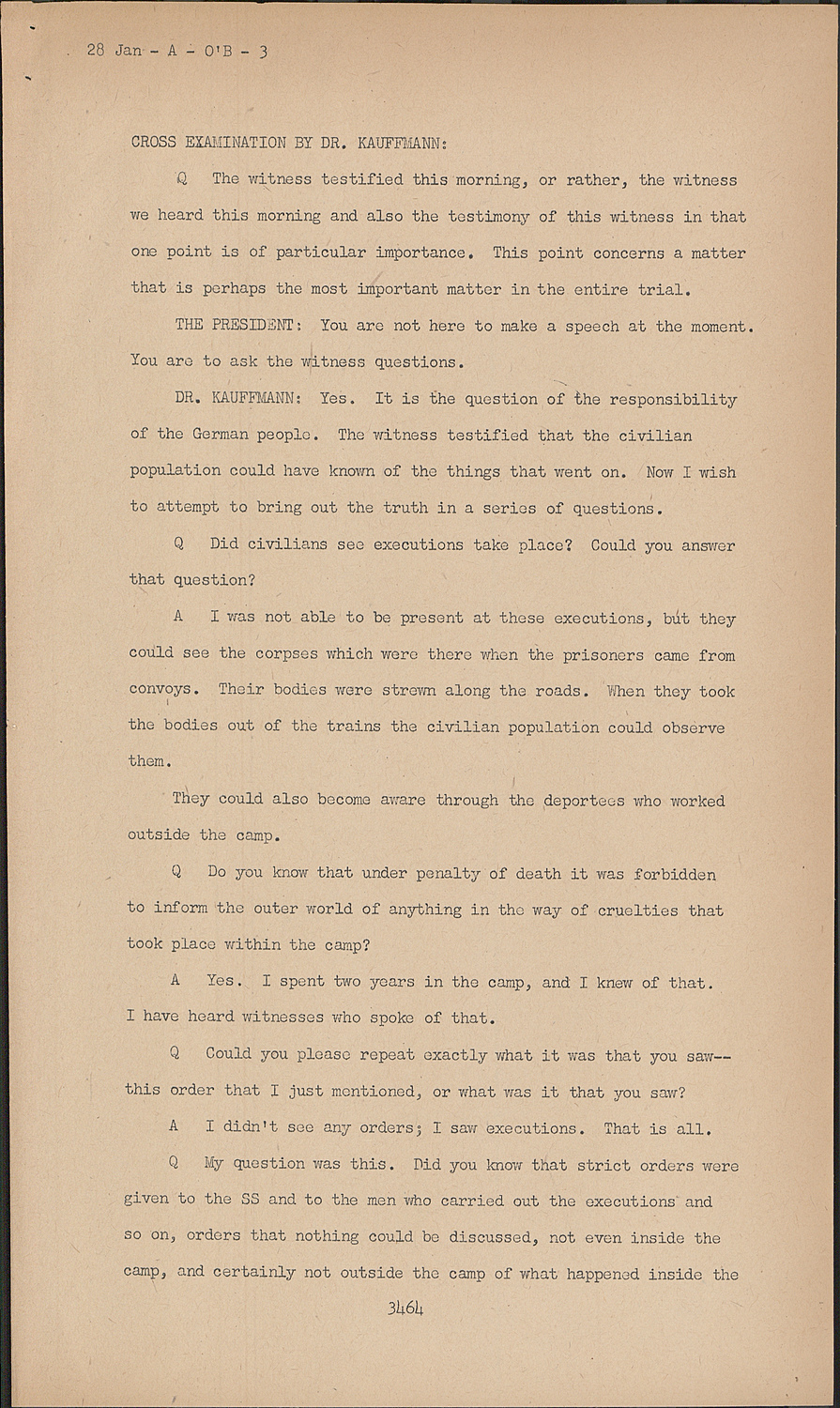
CROSS EXAMINATION BY DR. KAUFFMANN:
QThe witness testified this morning, or rather, the witness we heard this morning and also the testimony of this witness in that one point is of particular importance.
This point concerns a matter that is perhaps the most important matter in the entire trial.
THE PRESIDENT:You are not here to make a speech at the moment.
You are to ask the witness questions.
DR. KAUFFMANN:Yes. It is the question of the responsibility of the German people.
The witness testified that the civilian population could have known of the things that went on.
Now I wish to attempt to bring out the truth in a series of questions.
QDid civilians see executions take place? Could you answer that question?
AI was not able to be present at these executions, but they could see the corpses which were there when the prisoners came from convoys.
Their bodies were strewn along the roads. When they took the bodies out of the trains the civilian population could observe them.
They could also become aware through the deportees who worked outside the camp.
QDo you know that under penalty of death it was forbidden to inform the outer world of anything in the way of cruelties that took place within the camp?
AYes. I spent two years in the camp, and I knew of that.
I have heard witnesses who spoke of that.
QCould you please repeat exactly what it was that you saw-
this order that I just mentioned, or what was it that you saw?
AI didn't see any orders; I saw executions. That is all.
QMy question was this. Did you know that strict orders were given to the SS and to the men who carried out the executions and so on, orders that nothing could be discussed, not even inside the camp, and certainly not outside the camp of what happened inside the camp in the way of cruelties and so on, and that penalties of the strictest sort, even to the death penalty, were to be imposed if the people discussed such things as they saw in the camp?
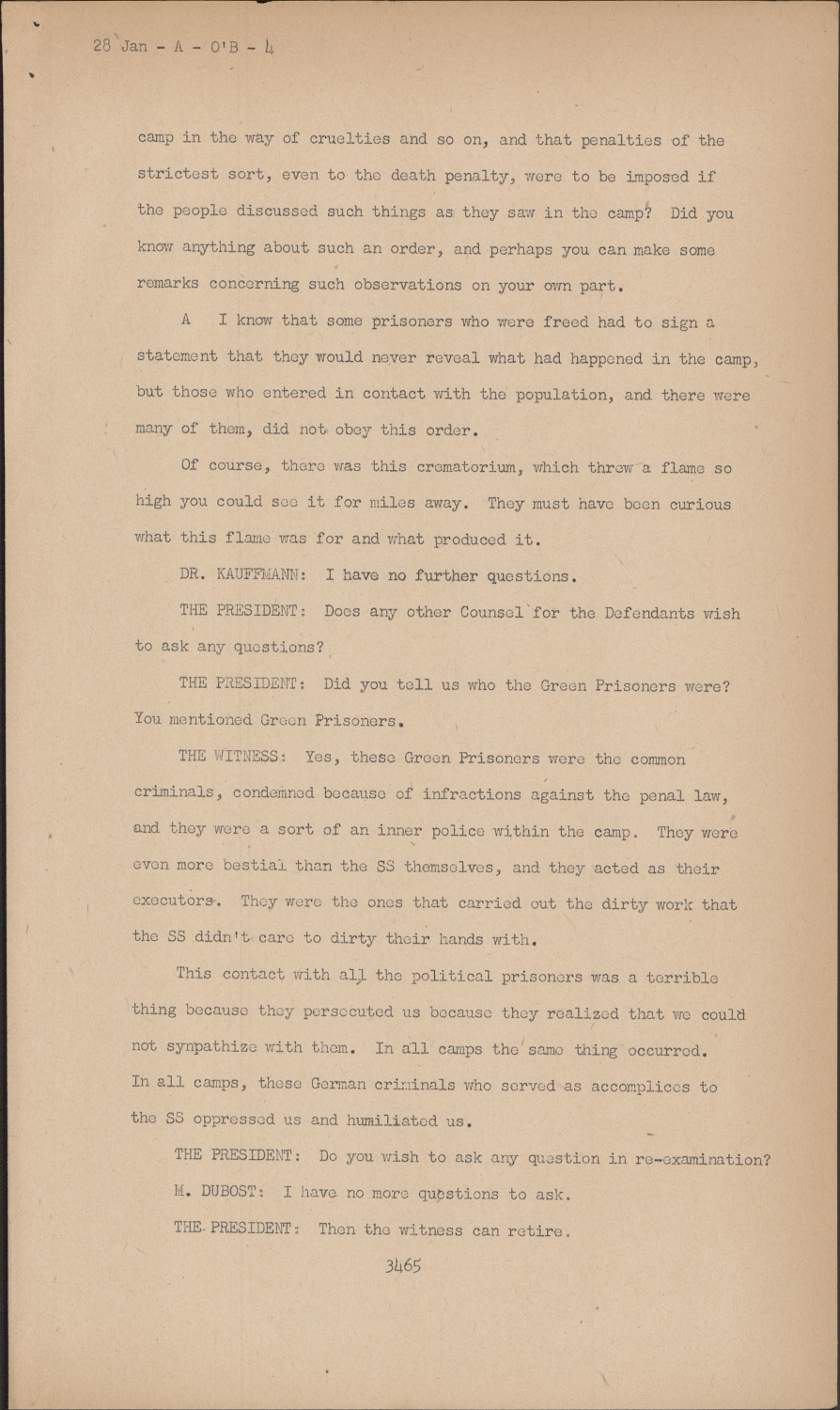
Did you know anything about such an order, and perhaps you can make some remarks concerning such observations on your own part.
AI know that some prisoners who were freed had to sign a statement that they would never reveal what had happened in the camp, but those who entered in contact with the population, and there were many of them, did not obey this order.
Of course, there was this crematorium, which threw a flame so high you could see it for miles away.
They must have been curious what this flame was for and what produced it.
DR. KAUFFMANN:I have no further questions.
THE PRESIDENT:Does any other Counsel for the Defendants wish to ask any questions?
THE PRESIDENT:Did you tell us who the Green Prisoners were?
You mentioned Green Prisoners.
THE WITNESS:Yes, these Green Prisoners were the common criminals, condemned because of infractions against the penal law, and they were a sort of an inner police within the camp.
They were even more bestial than the SS themselves, and they acted as their executors.
They were the ones that carried out the dirty work that the SS didn't care to dirty their hands with.
This contact with all the political prisoners was a terrible thing because they persecuted us because they realized that we could not synpathize with them.
In all camps the same thing occurred.
In all camps, these German criminals who served as accomplices to the SS oppressed us and humiliated us.
THE PRESIDENT:Do you wish to ask any question in re-examination?
M. DUBOST:I have, no more questions to ask.
THE- PRESIDENT: Then the witness can retire.
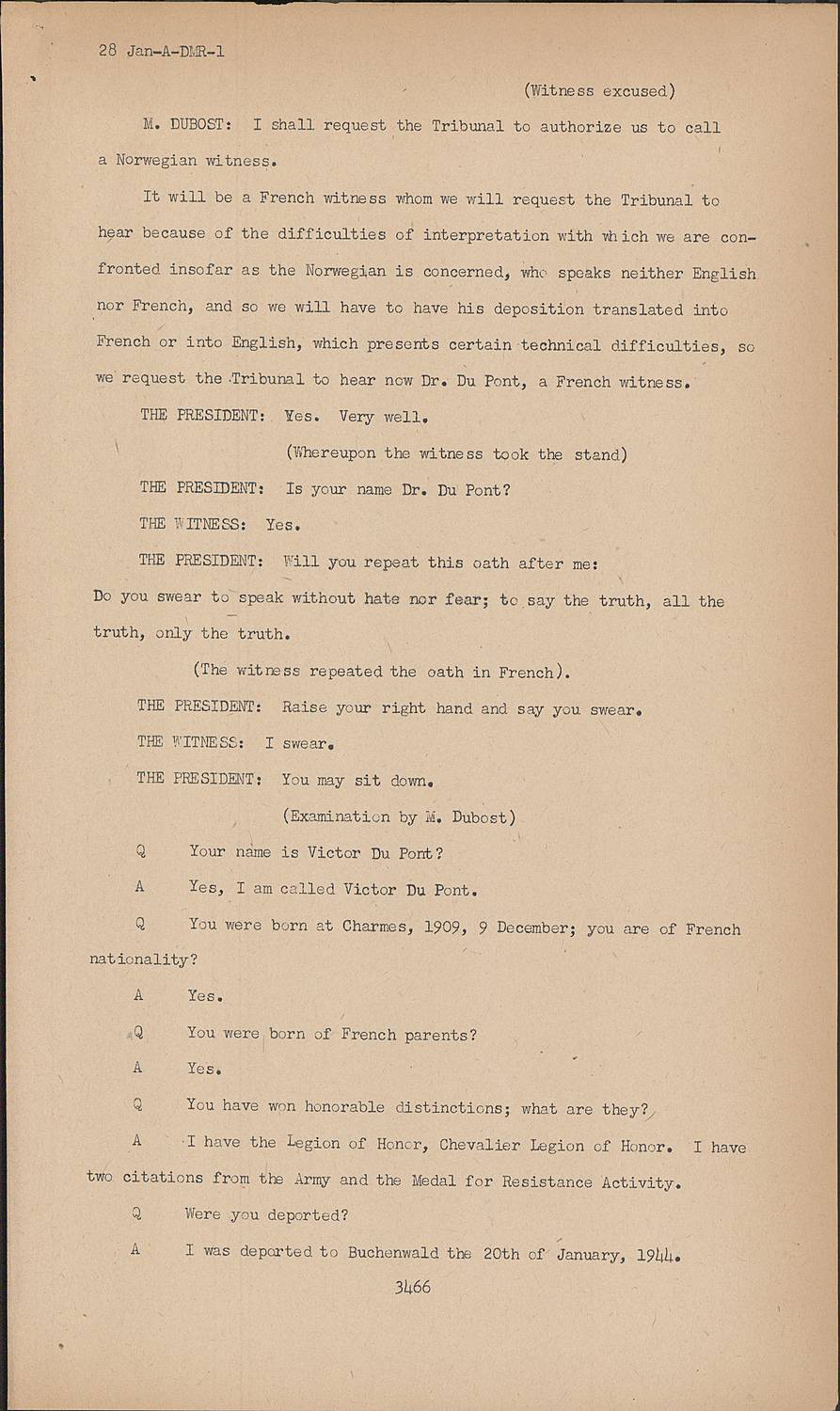
(Witness excused)
M. DUBOST:I shall request the Tribunal to authorize us to call a Norwegian witness.
It will be a French witness whom we will request the Tribunal to hear because of the difficulties of interpretation with which we are confronted insofar as the Norwegian is concerned, who speaks neither English nor French, and so we will have to have his deposition translated into French or into English, which presents certain technical difficulties, so we request the Tribunal to hear now Dr. Du Pont, a French witness.
THE PRESIDENT:Yes. Very well.
(Whereupon the witness took the stand)
THE PRESIDENT:Is your name Dr. Du Pont?
THE WITNESS:Yes.
THE PRESIDENT:Will you repeat this oath after me: Do you swear to speak without hate nor fear; to say the truth, all the truth, only the truth.
(The witness repeated the oath in French).
THE PRESIDENT:Raise your right hand and say you swear.
THE WITNESS:I swear.
THE PRESIDENT:You may sit down.
(Examination by M. Dubost)
QYour name is Victor Du Pont?
AYes, I am called Victor Du Pont.
QYou were born at Charmes, 1909, 9 December; you are of French nationality?
AYes.
QYou were born of French parents?
AYes.
QYou have won honorable distinctions; what are they?
AI have the Legion of Honor, Chevalier Legion of Honor. I have two citations from the Army and the Medal for Resistance Activity.
QWere you deported?
AI was deported to Buchenwald the 20th of January, 1944.
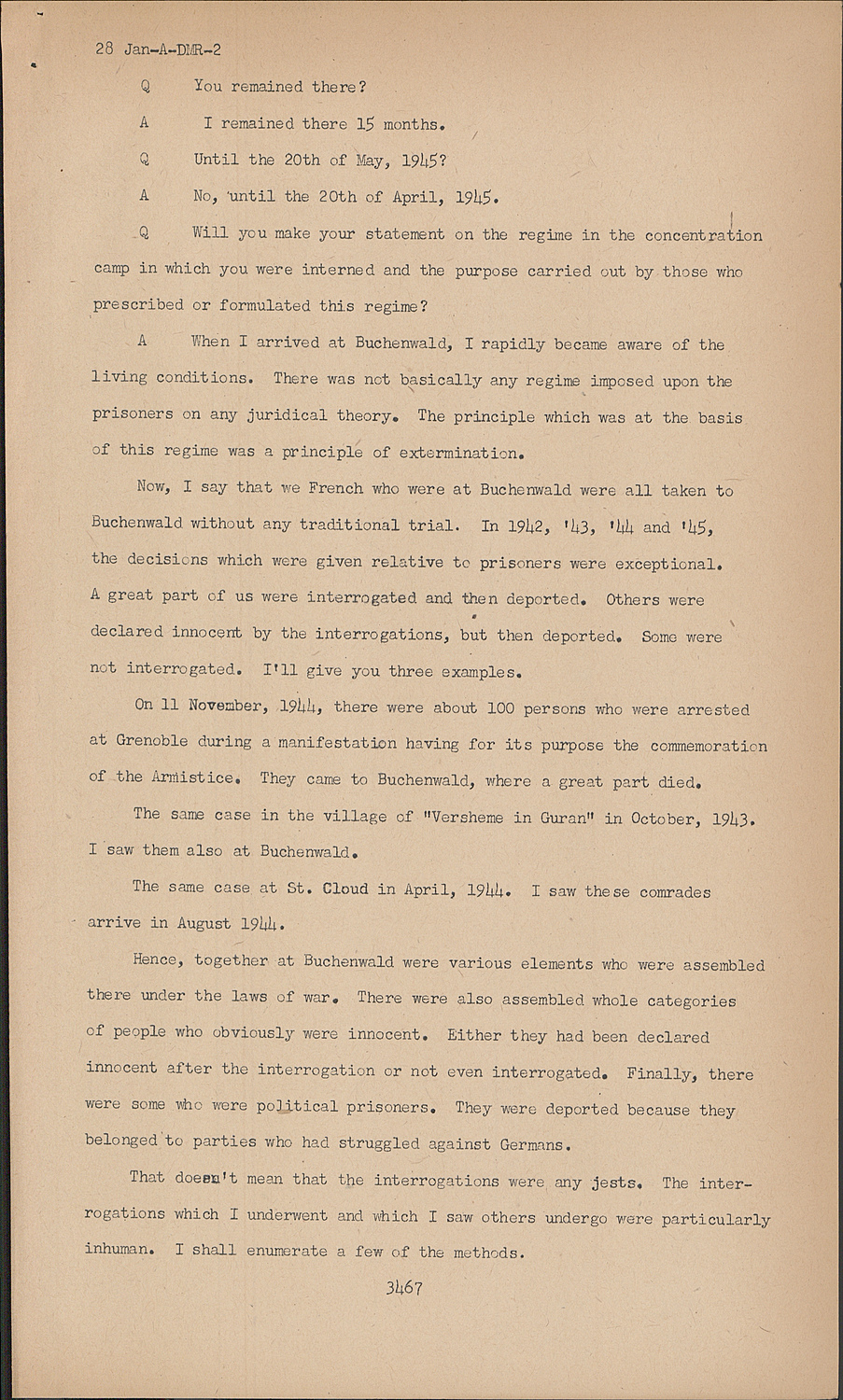
Q You remained there?
AI remained there 15 months.
QUntil the 20th of May, 1945?
ANo, until the 20th of April, 1945.
QWill you make your statement on the regime in the concentration camp in which you were interned and the purpose carried out by those who prescribed or formulated this regime?
AWhen I arrived at Buchenwald, I rapidly became aware of the living conditions. There was not basically any regime imposed upon the prisoners on any juridical theory. The principle which was at the basis of this regime was a principle of extermination.
Now, I say that we French who were at Buchenwald were all taken to Buchenwald without any traditional trial. In 1942, '43, '44 and '45, the decisions which were given relative to prisoners were exceptional. A great part of us were interrogated and then deported. Others were declared innocent by the interrogations, but then deported. Some were not interrogated. I'll give you three examples.
On 11 November, 1944, there were about 100 persons who were arrested at Grenoble during a manifestation having for its purpose the commemoration of the Armistice. They came to Buchenwald, where a great part died.
The same case in the village of "Versheme in Guran" in October, 1943. I saw them also at Buchenwald.
The same case at St. Cloud in April, 1944. I saw these comrades arrive in August 1944.
Hence, together at Buchenwald were various elements who were assembled there under the laws of war. There were also assembled whole categories of people who obviously were innocent. Either they had been declared innocent after the interrogation or not even interrogated. Finally, there were some who were political prisoners. They were deported because they belonged to parties who had struggled against Germans.
That doesn't mean that the interrogations were any jests. The interrogations which I underwent and which I saw others undergo were particularly inhuman. I shall enumerate a few of the methods.
Every imaginable type of blow. People were drowned in bathing tubs;
squeezing of testicles; hangings; finally, family tortures. I have particularly seen a wife tortured before her husband. On the other hand, children were tortured before their mothers. I'll cite a name: Francis Bouraille from Paris was tortured before his mother. Once in camp, for all these men, the conditions were the same.
QYou spoke of extermination, or purging - of racial purging for political reasons, for official reasons. By what criterion was this carried out?
AAt Buchenwald it was where you found under the same regime the same political prisoners, the same racial, and same gypsy and Jew prisoners, and, also, for social reasons criminally they were there, criminals of all nations, Germans, Czechs, French, Russians, and so on, who lived together with the others, and were subject to the same regime. The purge does not imply necessarily the idea of extermination, but this purge was brought about through the extermination of which I just spoke. It began for us in certain phases, and there was quite an advancement in each phase about which I shall try to cite an example.
In 1944 a few Gypsy children arrived at Buchenwald, several hundred, I would say. By some administrative mystery - by what administrative mystery we never knew, but during the winter of 1944 the first children were all brought together to be sent to be gassed. It is one of the most tragic memories of my deportation, with these children knowing perfectly well what they were waiting for, and who had to be driven towards the gas cars; and screaming and crying as they were driven towards the gas cars.
In other cases the extermination was very progressive. For example, when one convoy arrived, the advance convoy which came up from Compiegne, 24 January 1944 and arrived 26 January, in that transport car which I saw were twelve dead and eight mad out of one hundred persons who were in the car. I saw numerous transports which arrived in this way. Every car in transportation was different but of the same phenomenon; as soon as the convoy arrived enumeration was made of the number of Jews who arrived. Then they were placed in quarantine, after which they were exposed to cold, or, from weakness died. Then there was the extermination through work.
Some were chosen to send to work commanders, such as Dorrar, a.s.o. After their departure had taken place every day, and the quarters were filled, they returned to Buchenwald to bring back to the place the corpses.
I even saw and I was present at autopsies, and I shall tell you the result of those. These people were at extreme stages, those who had even had one month, two months and three months exposure, and frequently you would notice particular lesions, very acute tubercular lesions. At Buchenwald there were ones who had to work, and there was every possible means of only ones conscience surviving these exterminations at Buchenwald. The exterminations at Buchenwald was assured by a screening which was carried out by a chief who did the screening, a doctor.
QExcuse me for interrupting. This chief doctor was what nationality?
AThis chief doctor was a SS German.
QAre you sure ?
AYes, I am sure.
QDoes that mean that you know personally about the testimony you are bringing out?
AThe testimony I am bringing out was from my own personal observation. This selection was assured by Schilowski who had selected those informed and ill persons. They were sent before January 1945 to Auschwitz, then more recently to Bergen-Belsen. None ever returned. I saw another case which concerned Jewish working commandos, who was sent to Zeiss, where they remained several months upon assurance when they were incapable of functioning, with the loss of slave work, they received the same visit when they were selected and were sent to Auschwitz. This was on personal observation, and I was present at the selection, and I was witness of their departure.
At a later date at Buchenwald they gathered the casuals in to carry out executions in the camp themselves. They began in September. To my own personal knowledge September 1944 in room seven, a little room in the Revier. The men were treated by an intra-cardian injection, and their labor output was very slight.
At a late date convoys came, and the group of people who had occupied them by that time under general policy were to be executed.
For these executions they were first taken to the bath, and then at the time one of the transports, or convoys arrived; but, then in January 1945, they were placed in special block sixty-one. At that time in this block we would find all the men were near the exhausted stage, and we never found them without blankets over their shoulders. They were incapable of the slightest work. They had all to go into block sixty-one and we figured the dead in block sixty-one was daily about ten to two hundred at a minimum. The executions was assured by intra-cardiac injections of phenol. Many were carried out under the most brutal conditions. The bodies were then carried into the crematorium in a cot during the hour of rollcall, and during that night.
Finally, also, the extermination was assured at a later time by convoys which left for Buchenwald as the Allies advanced, and these convoys were to insure the extermination of these prisoners. The last day of March 1945 arrived at the Buchenwald camp, and the SS three commandos had withdrawn to Buchenwald, where they arrived completely exhausted and incapable of carrying out the slightest work. They first were to be re-expedited elsewhere two days after their arrival, and between the place they left, which was at the lower part of the camp of Buchenwald, and the place where they were to assemble for rollcall, there were only five hundred meters, and to give you an idea of the weakness of these people -- I only say, that is between where they left and where they were to have the rollcall, not over a distance of five hundred meters, we had sixty bodies which were of prisoners who fell, and could not go any farther, and most of them died very quickly, those of that day, or at a subsequent day. These were methods of extermination which I have know of personally at Buchenwald, and also at Dachau.
QAnd for those who remained?
AFor those who remained, one of the convoys -- it is a complicated story. We were full of anguish for them. After the first of April -- no, I cannot guarantee the date exactly, the Commander of the Camp, Viermann, assembled a great number of prisoners, and he spoke at last about the Allies are coming close to Buchenwald, and "my drsire and my will are that the keys of the camp should be in the hands of the leader of the Allies, and I don't want any atrocities.
I say that all the camp should be under the command of the Allies, and anything after." Three days later the Allied advance having been delayed, at least we thought so far as we were concerned, evacuation began to take place.
There was a delegation of prisoners who went to see the Commander, reminding him of his words, after he had given his word of honor as a soldier, and he seemed to be impressed, and he gave an explanation of the gravity of the communication Schilowski had given. Schilowski had given an order that no prisoner should remain in Buchenwald, after that representation for the prisoners, representing that there was some danger for the prisoners.
Another point, we knew that all those who had been witnesses at Buchenwald of the secrets and of the methods in the camp would be done away with. A few days before the Allies came, forty-three of our comrades of the different nationalities were called to be done away with, but what happened then in the camp, all the people in the camp revolted, and they hid the forty-three men, who were never found. That is what I know of those who were employed there in the exterminatory block, or in the infirmary, they were never to leave the camp. That is what I have to say about these events.
QThis officer who commanded the camp, whom you just said gave his word of honor as a soldier, you say he was a soldier?
AHis conduct towards the prisoners was implacable. He received his orders more than he was a soldier, or a special agent, but he was not very close personally with the methods used in the prisoners camp.
QHe belonged to what branch?
AHe belonged to a certain SS Division.
QWas he an SS?
AYes, he was an SS.
QHe carried out orders, you say?
AHe certainly carried out orders, yes.
QFor what purposes were the prisoners used?
AThe prisoners were used for such that I now can say, if taking of the human conditions are concerned, they were used for experimental purposes at Buchenwald, that is, the experiments took place in Block 46.