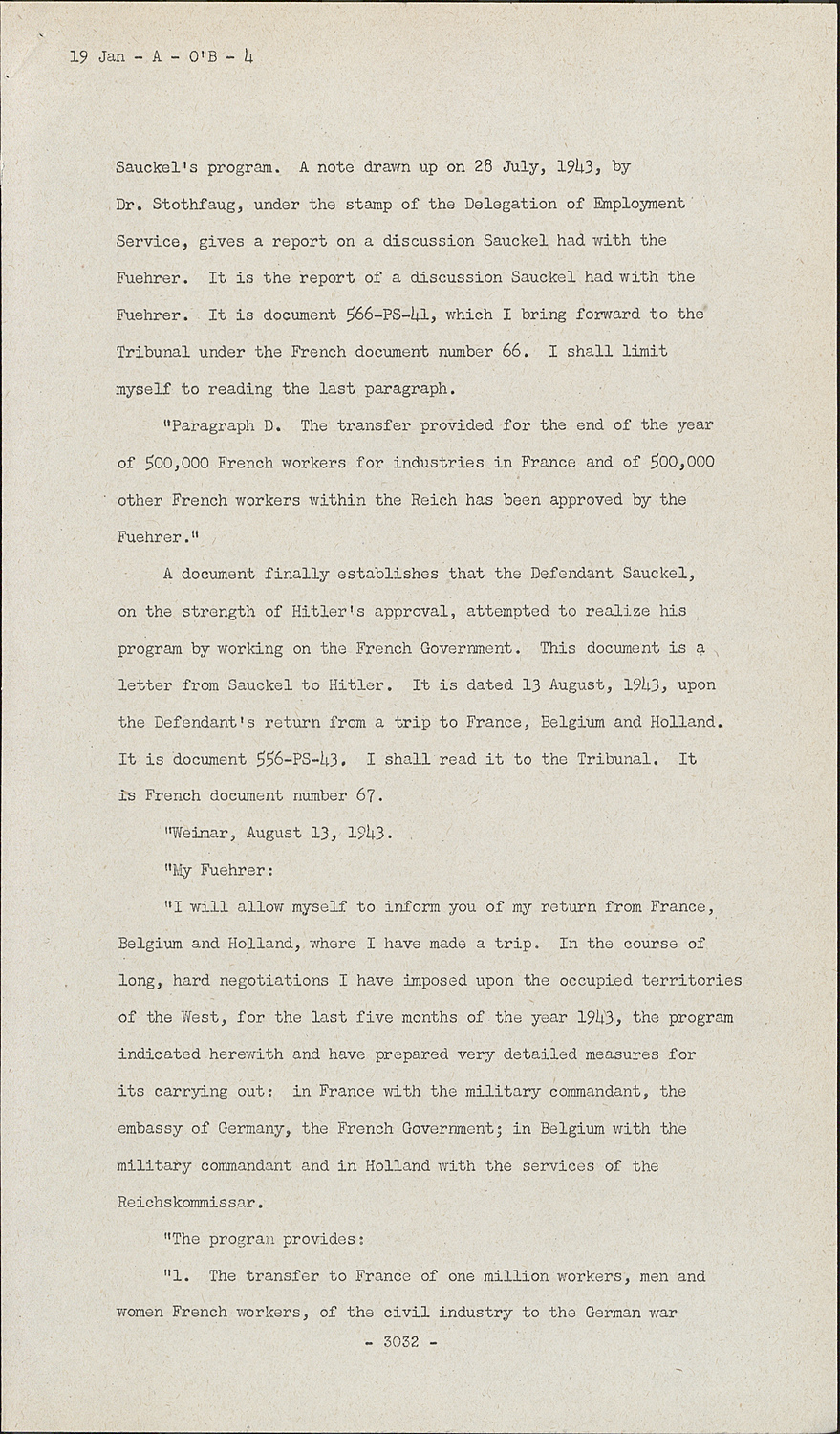
A note drawn up on 28 July, 1943, by Dr. Stothfaug, under the stamp of the Delegation of Employment Service, gives a report on a discussion Sauckel had with the Fuehrer.
It is the report of a discussion Sauckel had with the Fuehrer.
It is document 566-PS-41, which I bring forward to the Tribunal under the French document number 66.
I shall limit myself to reading the last paragraph.
"Paragraph D. The transfer provided for the end of the year of 500,000 French workers for industries in France and of 500,000 other French workers within the Reich has been approved by the Fuehrer."
A document finally establishes that the Defendant Sauckel, on the strength of Hitler's approval, attempted to realize his program by working on the French Government.
This document is a letter from Sauckel to Hitler.
It is dated 13 August, 1943, upon the Defendant's return from a trip to France, Belgium and Holland.
It is document 556-PS-43. I shall read it to the Tribunal. It is French document number 67.
"Weimar, August 13, 1943.
"My Fuehrer:
"I will allow myself to inform you of my return from France, Belgium and Holland, where I have made a trip.
In the course of long, hard negotiations I have imposed upon the occupied territories of the West, for the last five months of the year 1943, the program indicated herewith and have prepared very detailed measures for its carrying out:
in France with the military commandant, the embassy of Germany, the French Government; in Belgium with the military commandant and in Holland with the services of the Reichskommissar.
"The progran provides:
"1. The transfer to France of one million workers, men and women French workers, of the civil industry to the German war industry in France.
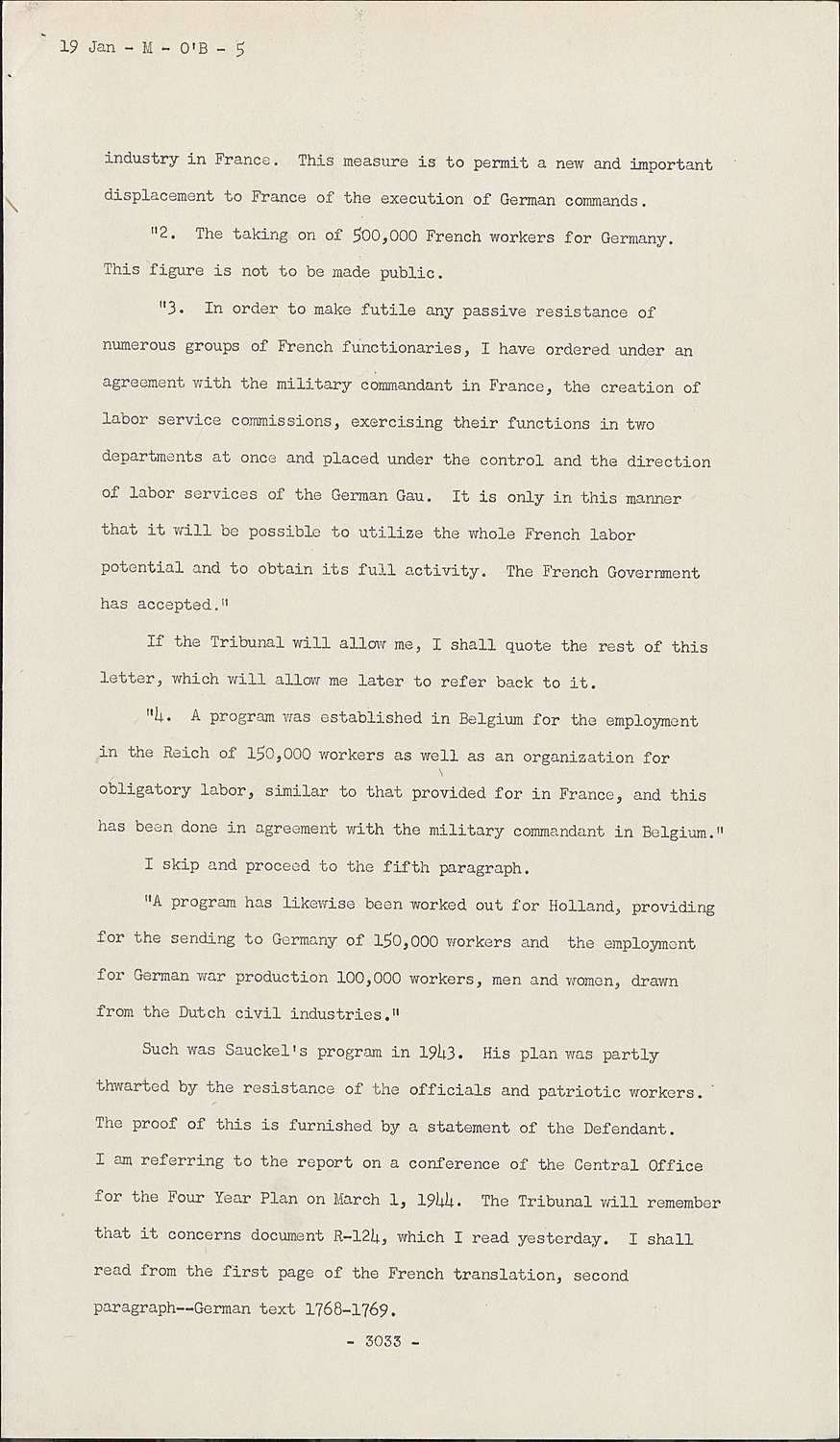
This measure is to permit a new and important displacement to France of the execution of German commands.
"2. The taking on of 500,000 French workers for Germany.
This figure is not to be made public.
"3. In order to make futile any passive resistance of numerous groups of French functionaries, I have ordered under an agreement with the military commandant in France, the creation of labor service commissions, exercising their functions in two departments at once and placed under the control and the direction of labor services of the German Gau.
It is only in this manner that it will be possible to utilize the whole French labor potential and to obtain its full activity.
The French Government has accepted."
If the Tribunal will allow me, I shall quote the rest of this letter, which will allow me later to refer back to it.
"4. A program was established in Belgium for the employment in the Reich of 150,000 workers as well as an organization for obligatory labor, similar to that provided for in France, and this has been done in agreement with the military commandant in Belgium."
I skip and proceed to the fifth paragraph.
"A program has likewise been worked out for Holland, providing for the sending to Germany of 150,000 workers and the employment for German war production 100,000 workers, men and women, drawn from the Dutch civil industries."
Such was Sauckel's program in 1943. His plan was partly thwarted by the resistance of the officials and patriotic workers.
The proof of this is furnished by a statement of the Defendant.
I am referring to the report on a conference of the Central Office for the Four Year Plan on March 1, 1944.
The Tribunal will remember that it concerns document R-124., which I read yesterday.
I shall read from the first page of the French translation, second paragraph--German text 1768-1769.
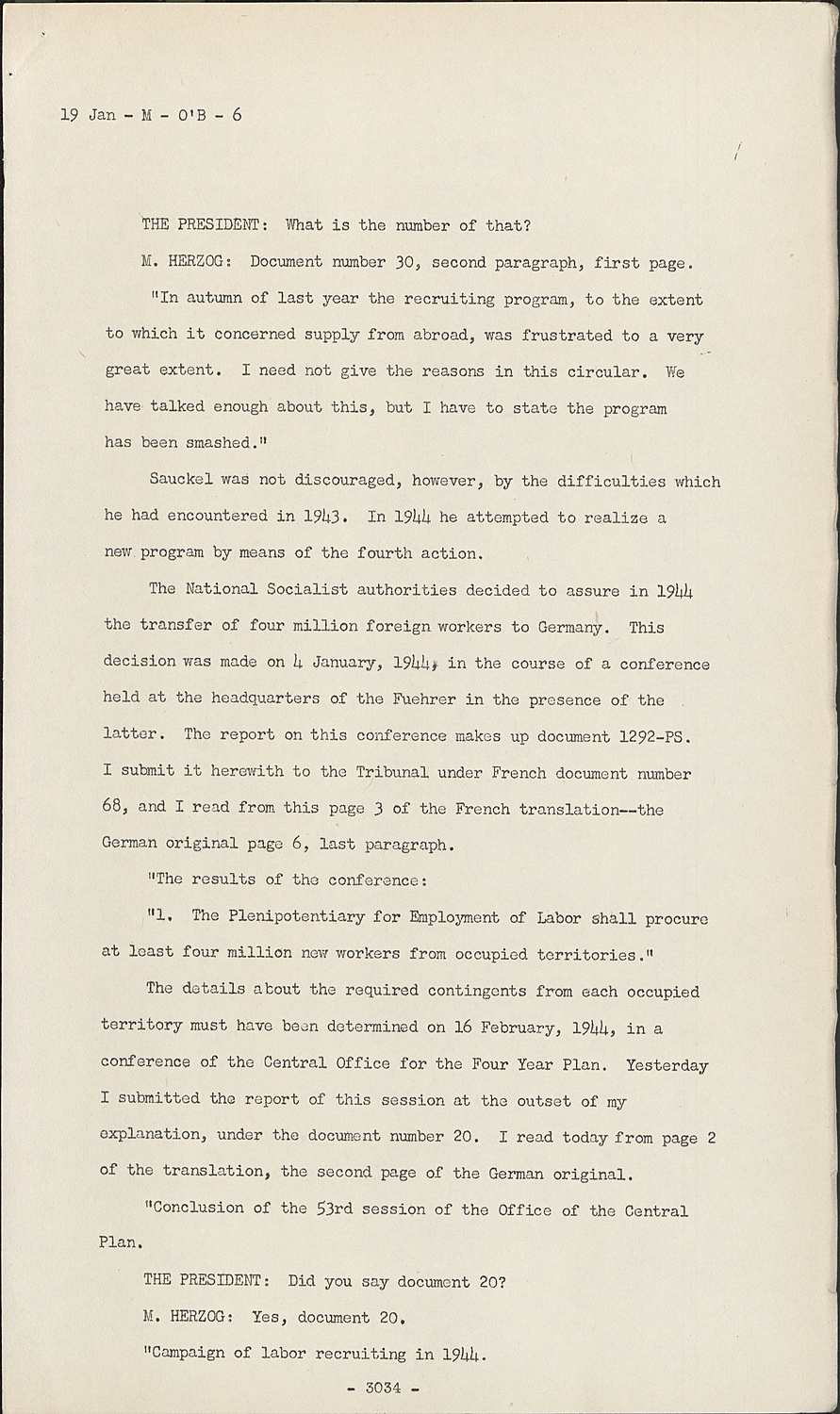
THE PRESIDENT: What is the number of that?
M. HERZOG:Document number 30, second paragraph, first page.
"In autumn of last year the recruiting program, to the extent to which it concerned supply from abroad, was frustrated to a very great extent.
I need not give the reasons in this circular. We have talked enough about this, but I have to state the program has been smashed."
Sauckel was not discouraged, however, by the difficulties which he had encountered in 1943.
In 1944 he attempted to realize a new program by means of the fourth action.
The National Socialist authorities decided to assure in 1944 the transfer of four million foreign workers to Germany.
This decision was made on 4 January, 1944, in the course of a conference held at the headquarters of the Fuehrer in the presence of the latter.
The report on this conference makes up document 1292-PS.
I submit it herewith to the Tribunal under French document number 68, and I read from this page 3 of the French translation--the German original page 6, last paragraph.
"The results of the conference:
"1. The Plenipotentiary for Employment of Labor shall procure at least four million new workers from occupied territories."
The details about the required contingents from each occupied territory must have been determined on 16 February, 1944, in a conference of the Central Office for the Four Year Plan.
Yesterday I submitted the report of this session at the outset of my explanation, under the document number 20.
I read today from page 2 of the translation, the second page of the German original.
"Conclusion of the 53rd session of the Office of the Central Plan.
THE PRESIDENT:Did you say document 20?
M. HERZOG:Yes, document 20.
"Campaign of labor recruiting in 1944.
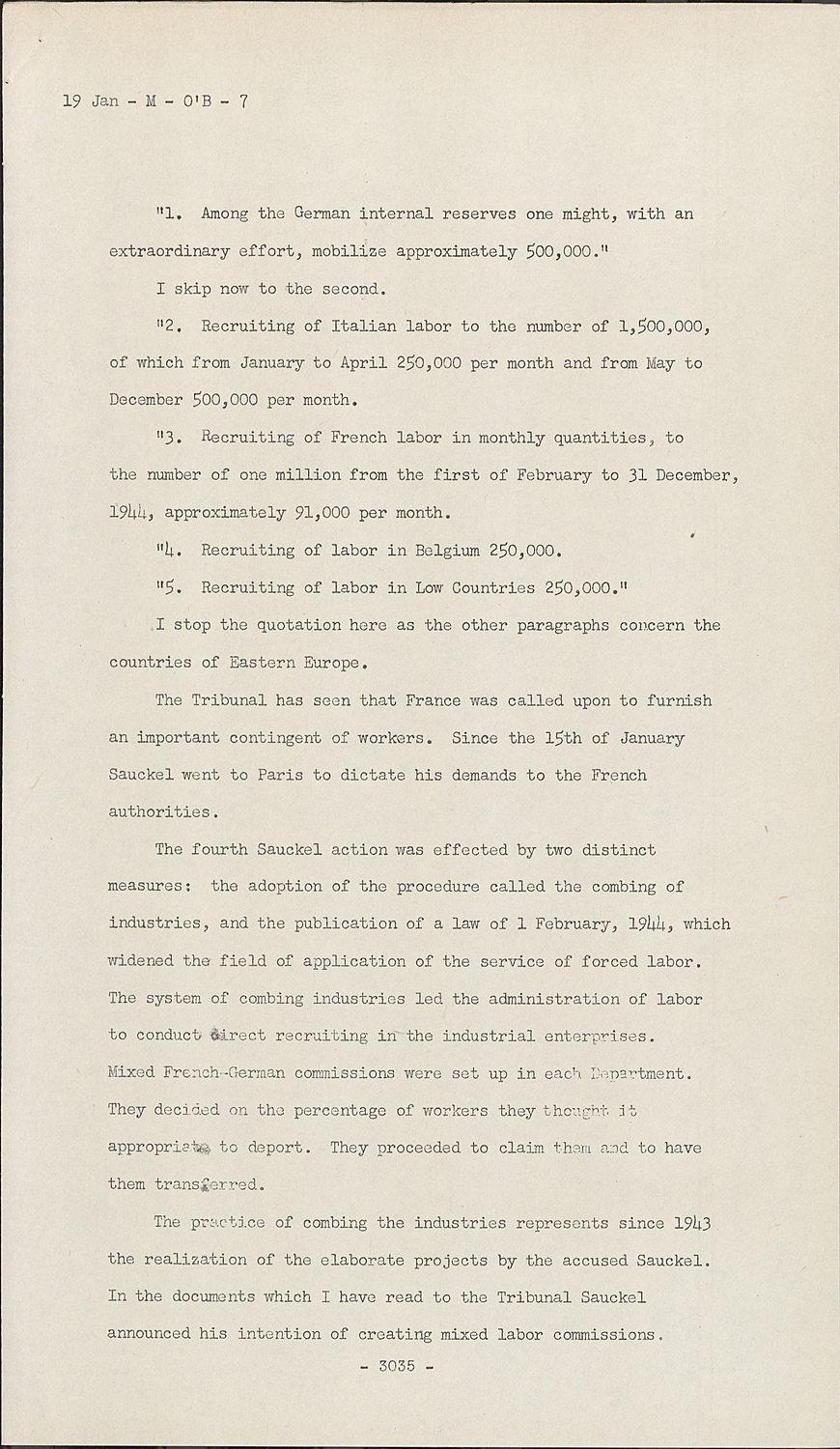
"1. Among the German internal reserves one might, with an extraordinary" effort, mobilize approximately 500,000."
I skip now to the second.
"2. Recruiting of Italian labor to the number of 1,500,000, of which from January to April 250,000 per month and from May to December 500,000 per month.
"3. Recruiting of French labor in monthly quantities., to the number of one million from the first of February to 31 December, 1944, approximately 91,000 per month.
"4. Recruiting of labor in Belgium 250,000.
"5. Recruiting of labor in Low Countries 250,000."
I stop the quotation here as the other paragraphs concern the countries of Eastern Europe.
The Tribunal has seen that France was called upon to furnish an important contingent of workers.
Since the 15th of January Sauckel went to Paris to dictate his demands to the French authorities.
The fourth Sauckel action was effected by two distinct measures:
the adoption of the procedure called the combing of industries, and the publication of a law of 1 February, 1944, which widened the field of application of the service of forced labor.
The system of combing industries led the administration of labor to conduct direct recruiting in the industrial enterprises.
Mixed French-German commissions were set up in each Department.
They decided on the percentage of workers they thought it appropriate to deport.
They proceeded to claim them and to have them transferred.
The practice of combing the industries represents since 1943 the realization of the elaborate projects by the accused Sauckel.
In the documents which I have read to the Tribunal Sauckel announced his intention of creating mixed labor commissions.

The law of 1 February, 1944, marked the culminating point on the legislative plan of the actions led by Sauckel.
It extends the scope of application of the law of 4 September, 1942.
Beginning with February 1944 all men between the ages of 16 to 60, and all women between the ages of 18 and 45 were subject to compulsory work.
I present before the Tribunal the law of 1 February, 1944, No. 69, and I request that it take judicial note of it.
The proof of the pressure that Sauckel exerted on the French authorities to impose on them the publication of this law is furnished by a report of the Defendant to Hitler.
This report bears the date of 25 January, 1944.
It was, therefore, prepared during the course of the negotiations which characterized the fourth Sauckel action.
It constitutes document 556-PS-55. I present it before the Tribunal No. 70.
I shall read this document.
"25 January, 1944.
"My Fuehrer:
"The French Government, as well as Marshal Petain, have on the 22nd of January, 1944, to a great extent accepted my demands in regard to the increase in hours of labor--to extend it from 40 to 48 hours a week--as well as the law providing for an extension of the labor service in France and the sending of French workers to Germany.
"The Marshal did not express himself in agreement on the subject of the use of the work of women in the Reich, but solely within France itself, and this to be limited to women aged 26 to 45 years.
Women aged from 15 to 25 are to be employed only at the place of their residence "Inasmuch as this constitutes nevertheless a great progress, if one considers, the extremely difficult negotiations which I have been obliged to conduct in Paris, I accepted the law in order to avoid any loss of time and on condition that the German demands are applied and carried out with energy.
"The French Government likewise accepted my demand that French officials sabotaging the application of the law of obligatory labor service should be condemned to very severe penalties that might even include the death sentence.
I have not allowed a doubt to exist as to the rigor of the measures that would be taken in case the requirements concerning the transfer of workers were not carried out.
"Your ever devoted and faithful, Fritz Sauckel."
I call the attention of the Tribunal to the problem of compulsory labor of women to which the two preceding documents have reference.
For a long time the French authorities expressed categorical opposition to the introduction of feminine labor.
The Defendant Sauckel did not cease to exercise violent action.
On the 27th of June, 1943, in a letter to Hitler, he suggested that a strong representation of German interests be made before the French Government.
I have already read this letter to the Tribunal, No. 65.
I shall not revert to it, but I do wish to emphasize that the law of February I did not satisfy Sauckel and did not appease his demands.
His miscontent and his will to pursue his policy of constraint are translated and expressed in a report of 26 April, 1944, which has his signature and presentation of which is assured by Berk, one of his assistants.
There are four reports involved in this same batch, and they constitute 1289-PS.
I present them under French document number 71, and I read from the second page of the French translation.
"(1) The problem of women. At the time of the promulgation of the French law instituting obligatory labor service, the French authorities, Marshal Petain in particular, have urgently insisted on the exemption of women from obligatory service in Germany.
After long hesitation the G.B.A. responsible for the work gave its agreement to this exemption.

"This agreement was granted under the reservation, however, that the provisions of contingents demanded were met.
In the contrary case the G.B.A. would reserve to itself the right of taking new measures.
Inasmuch as the contingents were far from being met, a demand must be addressed to the French Government in order that it extend the service of obligatory labor to women."
The fourth Sauckel action, therefore, was led in such a manner as to utilize all of France's manpower.
The French resistance and the development of the military operations hindered the execution of the Sauckel plan.
The Defendant, however, had planned extraordinary measures which he contemplated applying on the day of the landing of the allied armies.
I quote again document 1289-PS, French document 71, and I read on page 3."Measures for the utilization of labor in the case of invasion.
In the occupied territories there have already been partly established dispositions to evacuate the population of regions menaced by invasion and to save in this manner a precious labor reserve.
In view of the actual situation of labor in Germany, it is necessary to bring labor to the greatest possible potential of production in the Reich.
"Orders for the Wehrmacht to assure the security in the carrying out of these measures are indispensable.
For an ordinance of the Fuehrer the following text is proposed."
I shall not read the text of the ordinance proposed by the Defendant Sauckel.
The rapidity of the Allied victory was of such a nature that Sauckel did not have the possibility to carry out his plan of mass deportation.
However, he undertook its execution. The deportations of workers were prolonged up to the day of liberation of the territory.
Several hundred thousand French workers were at that time stationed in Germany as a result of the various actions of Sauckel, and I demand of the Tribunal that it retain him as a Defendant.
The compulsory labor service was introduced in Norway in the same manner as in France.
The Defendants imposed upon the Norwegian authorities the publication of a law instituting the compulsory registration of Norwegian citizens, and ordering their enrolment by force.
I cite in this respect the preliminary report on the crimes of Germany against Norway, a report prepared by the Government of Norway.
I submit it to the Tribunal, and I quote an excerpt from it that bears the number UK-19.
It is French document number 72, and I read from the first page, the third paragraph.
"The result of Sauckel's order in Norway has been the promulgation of the Quisling law of 3 February, 1943, concerning the obligatory enrolment of Norwegian men and women for the so-called effort of national labor.
"Terboven and Quisling have openly admitted that the law had been promulgated to enable the Norwegian people to utilize its labor for the benefit of the German war effort.
"In a speech of 2 February Terboven declared among other things that he himself and the German Reich supported this law with their authority, and he threatened the use of force against one who would attempt to oppose its execution."
In Belgium and in the Netherlands the German authorities made use of a direct procedure.
The compulsory labor service was organized by decrees of the occupying power.
In Belgium these are decrees of the military commander and in the Netherlands decrees of the Reich Commissar.
I remind the Tribunal of the fact that the authority of the military commander in Belgium extended to the north of France.
This is a decree of March 6, 1942, which established the principle of compulsory labor in Belgium.
It appeared in the Belgium Verordnungsblatt of 1942, page 845.
I submit it to the Tribunal under number 73, and I ask the Tribunal to take judicial notice of it.
The decree of March 6 excluded the possibility of forced deportation of workers to Germany.
This deportation was ordered by a decree of October 6, 1942, which appeared in the Belgium Verordnungsblatt of 1942, page 1060.
I submitted it to the Tribunal under number 67 in the course of my explanations.
The German activities in Belgium gave rise to protests of the leading Belgian personalities, among others the King of Belgium.
The decrees instituting compulsory labor in Belgium and the North of France bear the signature of General von Falkenhausen, but the latter proclaimed his decree of October 6 on the order of Sauckel.
I relate again to the testimony of General von Falkenhausen, which I submitted to the Tribunal yesterday under the French document 15.
I beg the Tribunal permission to read from the following passages, first page, fifth paragraph.
"Q On 6 October, 1942, there appeared an ordinance which instituted forced labor in Belgium and in the Departments of the North of France for men of 18 to 50 years old and for single women from 21 to 25 years old.
"A I was commander-in-chief for Northern France and Belgium.
"Q Does the witness recall having promulgated this ordinance?
"A I do not remember exactly the text of this ordinance because it was made following a long dispute with the labor deputy Sauckel.
"Q Did you have any trouble with Sauckel?
"A I was fundamentally opposed to the establishment of compulsory labor, and consented promulgating the ordinance only after receiving orders.
"Q Then this ordinance was not brought up on the initiative of von Falkenhausen himself?
"A On the contrary.
"Q Who gave instructions in such matters?
"A I suppose that at that time Sauckel was already in possession of the responsibility for manpower and that at that time he gave me all instructions on Hitler's orders."
I skip and take up the quotation again on Page 3 of the French translation, the fourth paragraph:
"Q Since you were opposed to this idea of compulsory labor, didn't you react when you received these instructions?
"A There were unending battles between Sauckel and myself. In the end this contributed to a large extent to my resignation."
End of the quotation.
The violence of the pressure exerted against the German administrators in Belgium by the defendant Sauckel in order to impose on them his plan of recruitment by force is equally demonstrated by two documents which I have produced to the Tribunal. Under Number 67 the Tribunal will remember that it is the report addressed on the 13th of August 1943 by Sauckel to Hitler on his return from France, from Belgium and from Holland.
Finally, I have to report on the introduction of forced labor in the Netherlands. I request the Tribunal to retain the institution of forced enrollment in the occupied Netherland territories for the accusation of the defendant Seyss-Inquart just as well as for the accusation of Sauckel.
Decrees of the Reich Kommissar have really organized the deportation of the Netherland workers. Whether they bear his signature of were issued at his order they established all the more the responsibility of the def-endant who in his quality as Reich Kommissar derived his powers directly from the Fuehrer.
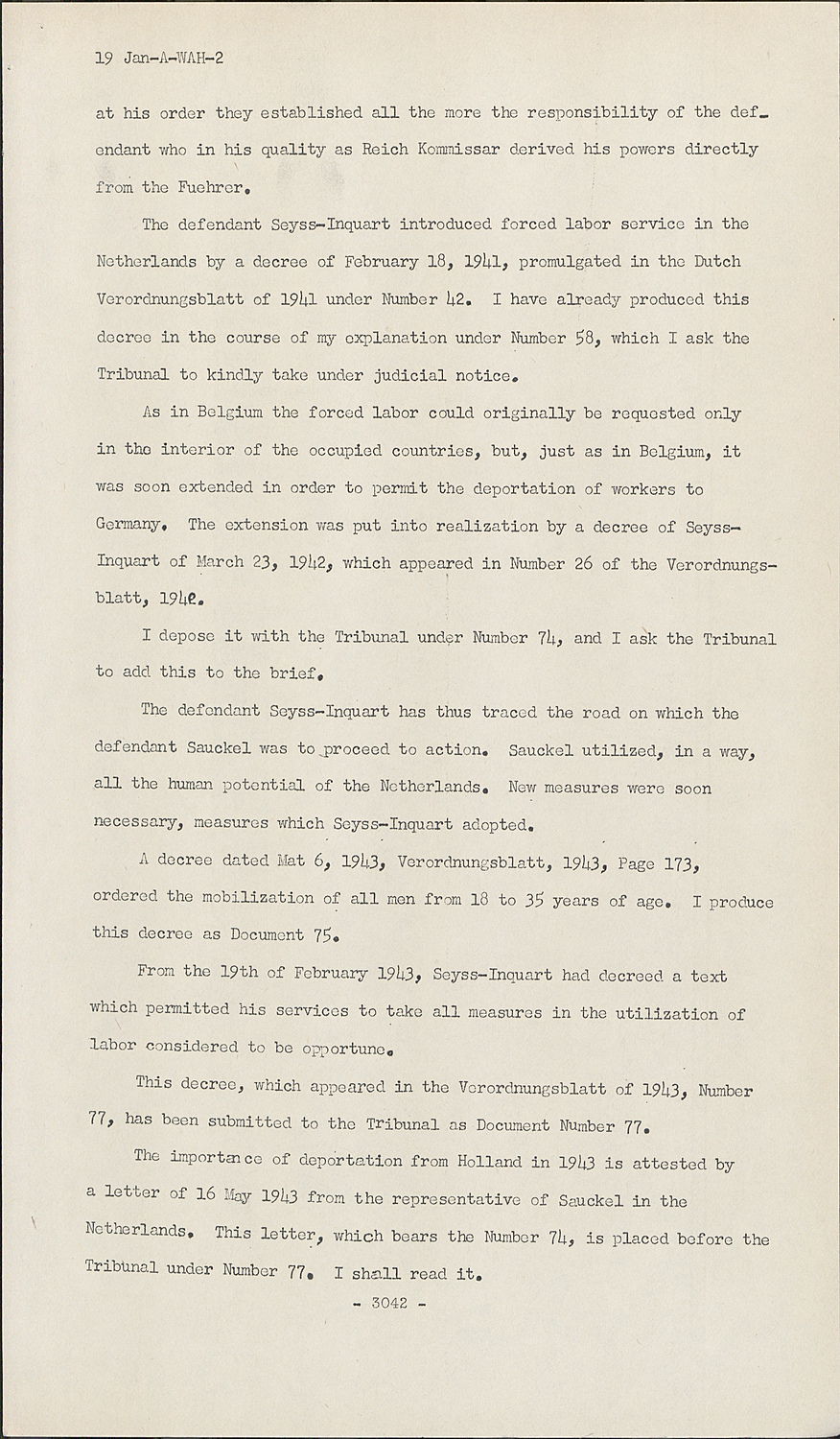
The defendant Seyss-Inquart introduced forced labor service in the Netherlands by a decree of February 18, 1941, promulgated in the Dutch Verordnungsblatt of 1941 under Number 42. I have already produced this decree in the course of my explanation under Number 58, which I ask the Tribunal to kindly take under judicial notice.
As in Belgium the forced labor could originally be requested only in the interior of the occupied countries, but, just as in Belgium, it was soon extended in order to permit the deportation of workers to Germany. The extension was put into realization by a decree of SeyssInquart of March 23, 1942, which appeared in Number 26 of the Verordnungsblatt, 1942.
I depose it with the Tribunal under Number 74, and I ask the Tribunal to add this to the brief.
The defendant Seyss-Inquart has thus traced the road on which the defendant Sauckel was to proceed to action. Sauckel utilized, in a way, all the human potential of the Netherlands. New measures were soon necessary, measures which Seyss-Inquart adopted.
A decree dated Mat 6, 1943, Verordnungsblatt, 1943, Page 173, ordered the mobilization of all men from 18 to 35 years of age. I produce this decree as Document 75.
From the 19th of February 1943, Seyss-Inquart had decreed a text which permitted his services to take all measures in the utilization of labor considered to be opportune.
This decree, which appeared in the Verordnungsblatt of 1943, Number 77, has been submitted to the Tribunal as Document Number 77.
The importance of deportation from Holland in 1943 is attested by a letter of 16 May 1943 from the representative of Sauckel in the Netherlands. This letter, which bears the Number 74, is placed before the Tribunal under Number 77. I shall read it.
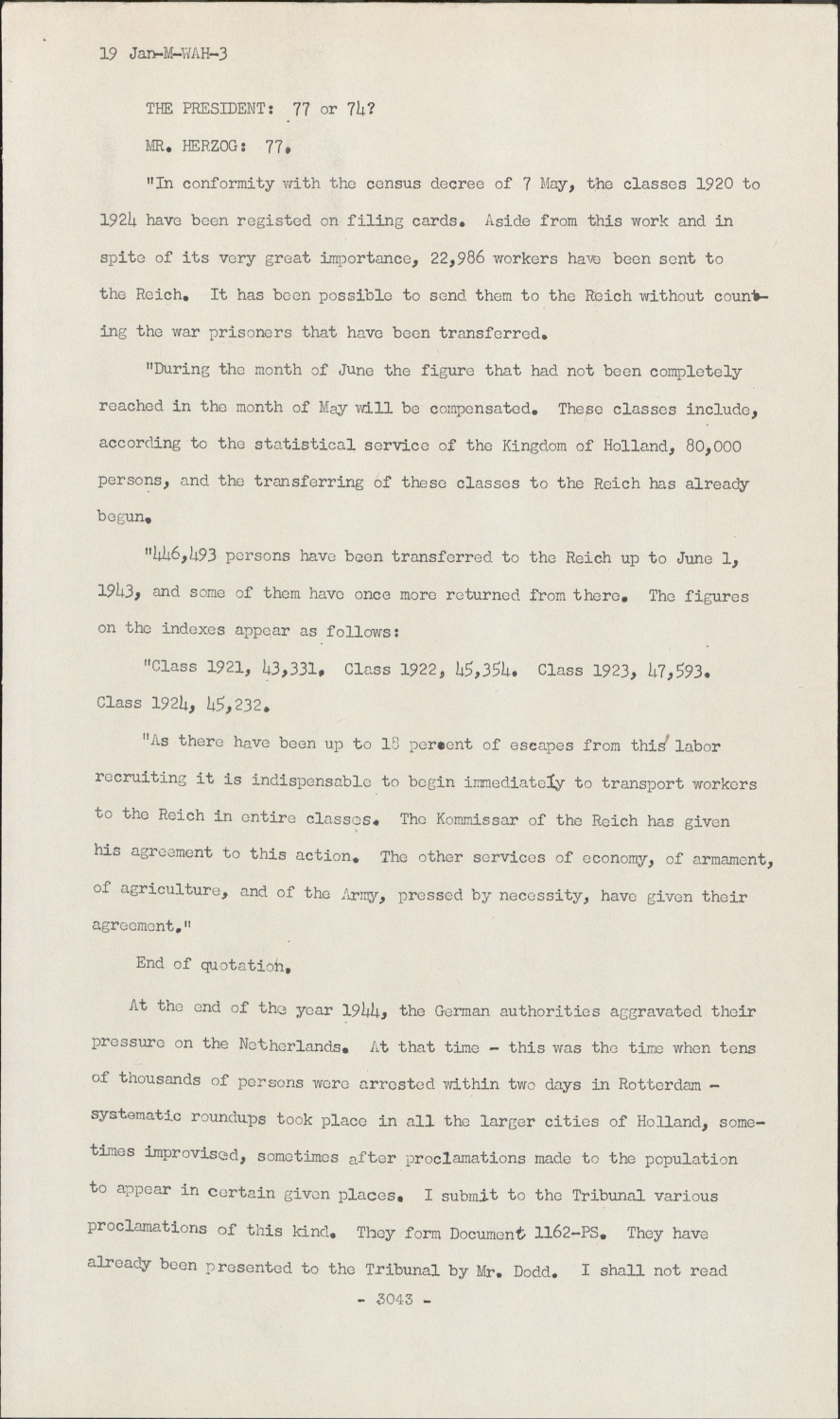
THE PRESIDENT: 77 or 74?
MR. HERZOG: 77.
"In conformity with the census decree of 7 May, the classes 1920 to 1924 have been registed on filing cards. Aside from this work and in spite of its very great importance, 22,986 workers have been sent to the Reich. It has been possible to send them to the Reich without counting the war prisoners that have been transferred.
"During the month of June the figure that had not been completely reached in the month of May will be compensated. These classes include, according to the statistical service of the Kingdom of Holland, 80,000 persons, and the transferring of these classes to the Reich has already begun.
"446,493 persons have been transferred to the Reich up to June 1, 1943, and some of them have once more returned from there. The figures on the indexes appear as follows:
"Class 1921, 43,331. Class 1922, 45,354. Class 1923, 47,593. Class 1924, 45,232.
"As there have been up to 18 percent of escapes from this labor recruiting it is indispensable to begin immediately to transport workers to the Reich in entire classes. The Kommissar of the Reich has given his agreement to this action. The other services of economy, of armament, of agriculture, and of the Army, pressed by necessity, have given their agreement."
End of quotation.
At the end of the year 1944 the German authorities aggravated their pressure on the Netherlands. At that time - this was the time when tens of thousands of persons were arrested within two days in Rotterdam systematic roundups took place in all the larger cities of Holland, sometimes improvised, sometimes after proclamations made to the population to appear in certain given places. I submit to the Tribunal various proclamations of this kind. They form Document 1162-PS. They have already been presented to the Tribunal by Mr. Dodd. I shall not read them again.
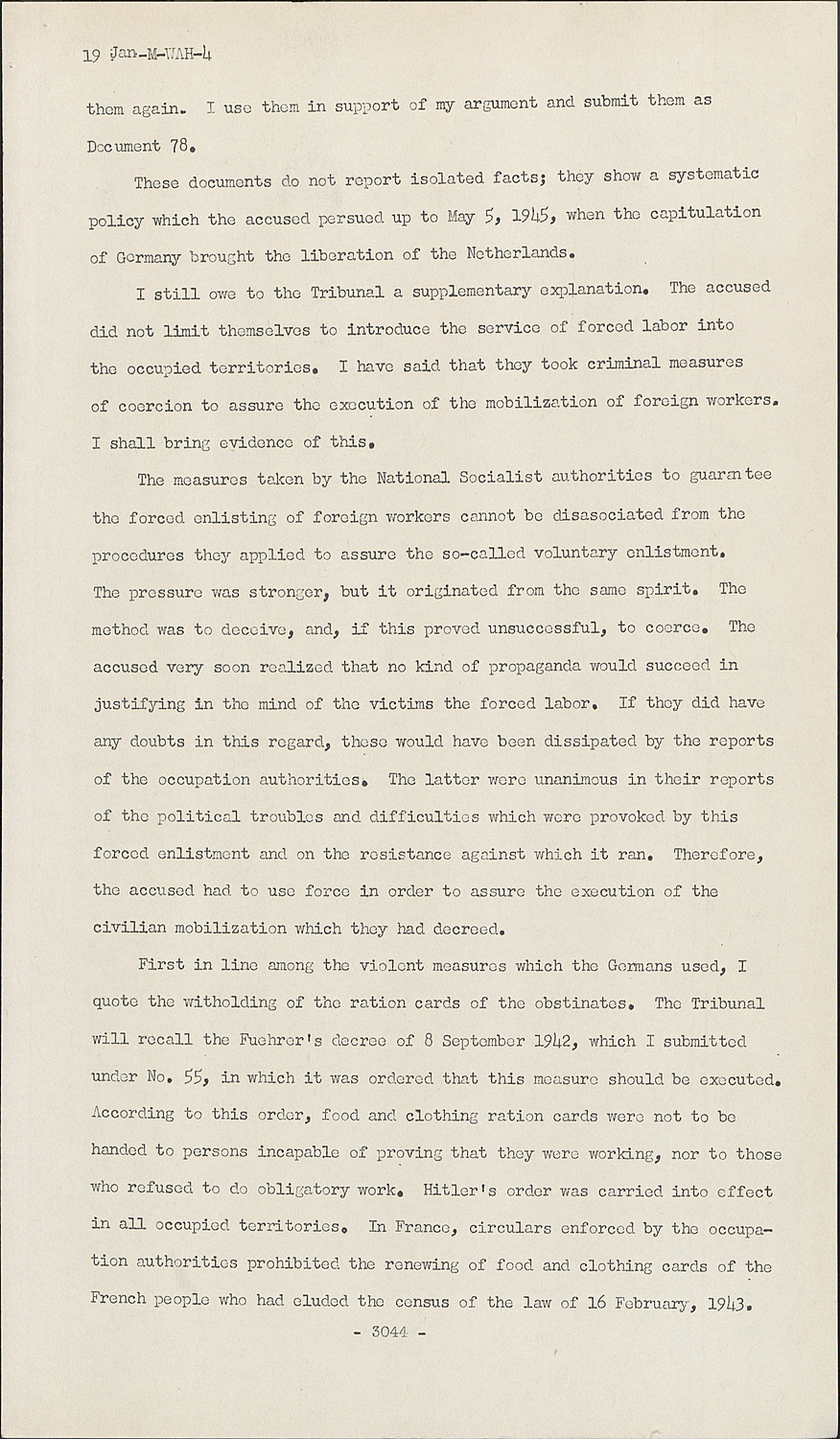
I use them in support of my argument and submit thorn as Document 78.
These documents do not report isolated facts; they show a systematic policy which the accused persued up to May 5, 1945, when the capitulation of Germany brought the liberation of the Netherlands.
I still owe to the Tribunal a supplementary explanation. The accused did not limit themselves to introduce the service of forced labor into the occupied territories. I have said that they took criminal measures of coercion to assure the execution of the mobilization of foreign workers. I shall bring evidence of this.
The measures taken by the National Socialist authorities to guarantee the forced enlisting of foreign workers cannot be disasociated from the procedures they applied to assure the so-called voluntary enlistment. The pressure was stronger, but it originated from the same spirit. The method was to deceive, and, if this proved unsuccessful, to coerce. The accused very soon realized that no kind of propaganda would succeed in justifying in the mind of the victims the forced labor. If they did have any doubts in this regard, those would have been dissipated by the reports of the occupation authorities. The latter were unanimous in their reports of the political troubles and difficulties which were provoked by this forced enlistment and on the resistance against which it ran. Therefore, the accused had to use force in order to assure the execution of the civilian mobilization which they had decreed.
First in line among the violent measures which the Germans used, I quote the witholding of the ration cards of the obstinates. The Tribunal will recall the Fuehrer's decree of 8 September 1942, which I submitted under No. 55, in which it was ordered that this measure should be executed. According to this order, food and clothing ration cards were not to be handed to persons incapable of proving that they were working, nor to those who refused to do obligatory work. Hitler's order was carried into effect in all occupied territories. In France, circulars enforced by the occupation authorities prohibited the renewing of food and clothing cards of the French people who had eluded the census of the law of 16 February, 1943.
In Belgium, the cancelling of ration certificates was regulated by an order of the Military Commander.
It is the order of 5 March 1943 which was published in the Verordnungsblatt for Belgium and Northern France in 1943, and which I present under No. 79. General von Falkenhausen, the signatory of this order, admitted the seriousness of it in an interrogation, which I have submitted to the Tribunal under No. 15, and to which I return.
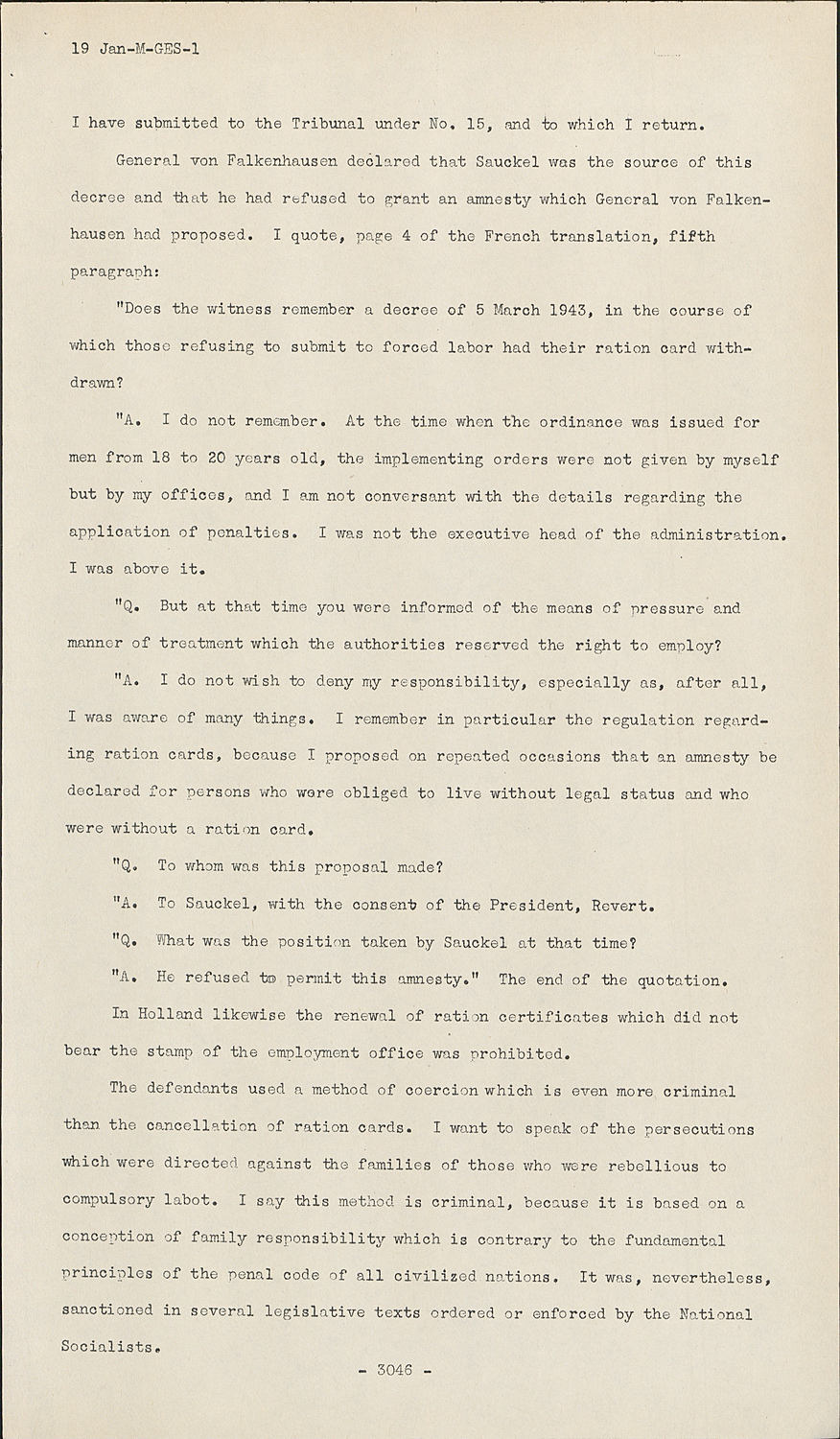
General von Falkenhausen declared that Sauckel was the source of this decree and that he had refused to grant an amnesty which General von Falkenhausen had proposed. I quote, page 4 of the French translation, fifth paragraph:
"Does the witness remember a decree of 5 March 1943, in the course of which those refusing to submit to forced labor had their ration card withdrawn?
"A. I do not remember. At the time when the ordinance was issued for men from 18 to 20 years old, the implementing orders were not given by myself but by my offices, and I am not conversant with the details regarding the application of penalties. I was not the executive head of the administration. I was above it.
"Q. But at that time you were informed of the means of pressure and manner of treatment which the authorities reserved the right to employ?
"A. I do not wish to deny my responsibility, especially as, after all, I was aware of many things. I remember in particular the regulation regarding ration cards, because I proposed on repeated occasions that an amnesty be declared for persons who were obliged to live without legal status and who were without a ration card.
"Q. To whom was this proposal made?
"A. To Sauckel, with the consent of the President, Revert.
"Q. What was the position taken by Sauckel at that time?
"A. He refused to permit this amnesty." The end of the quotation.
In Holland likewise the renewal of ration certificates which did not bear the stamp of the employment office was prohibited.
The defendants used a method of coercion which is even more criminal than the cancellation of ration cards. I want to speak of the persecutions which were directed against the families of those who were rebellious to compulsory labot. I say this method is criminal, because it is based on a conception of family responsibility which is contrary to the fundamental principles of the penal code of all civilized nations. It was, nevertheless, sanctioned in several legislative texts ordered or enforced by the National Socialists.
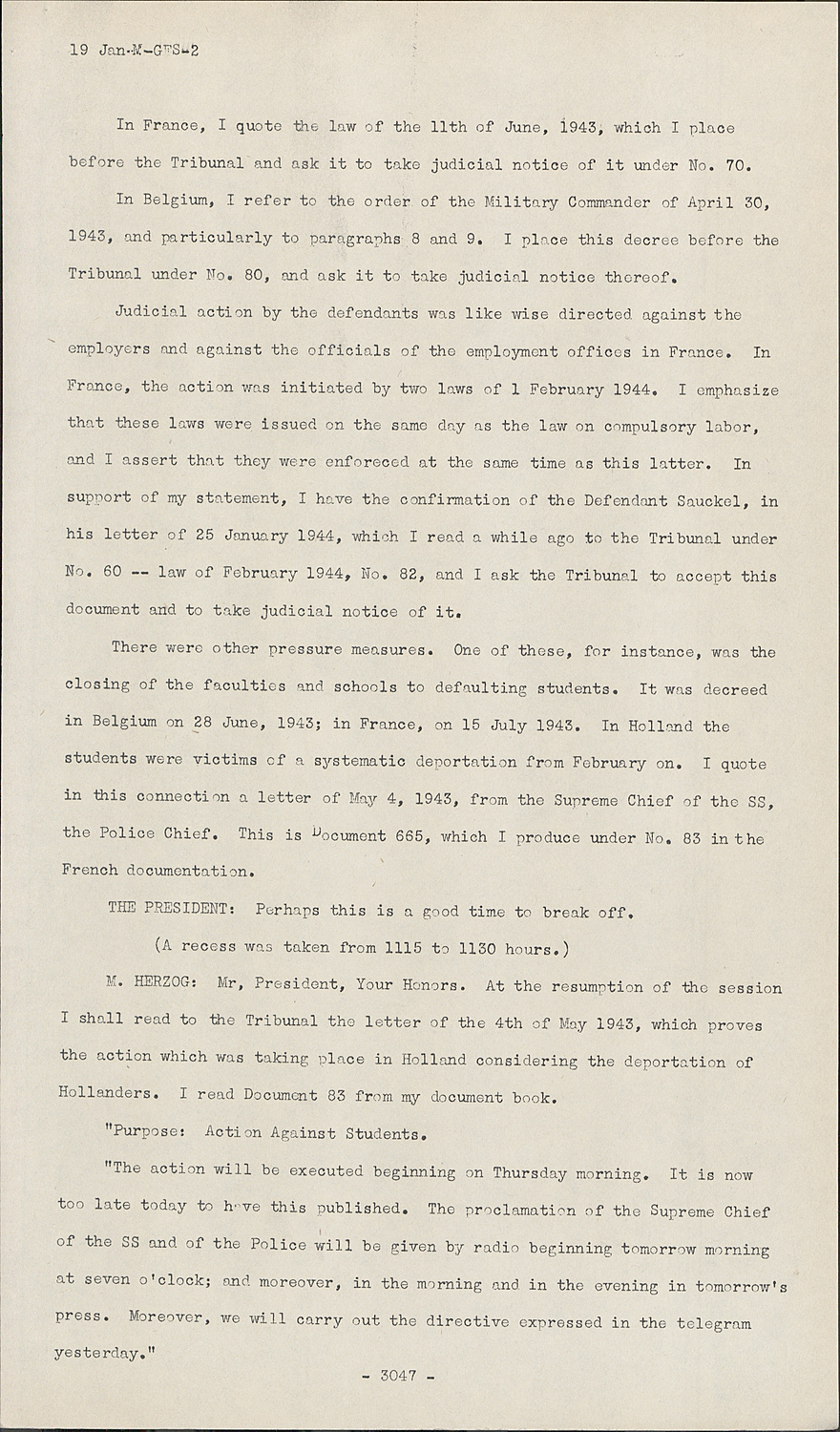
In France, I quote the law of the 11th of June, 1943, which I place before the Tribunal and ask it to take judicial notice of it under No. 70.
In Belgium, I refer to the order of the Military Commander of April 30, 1943, and particularly to paragraphs 8 and 9. I place this decree before the Tribunal under No. 80, and ask it to take judicial notice thereof.
Judicial action by the defendants was like wise directed against the employers and against the officials of the employment offices in France. In France, the action was initiated by two laws of 1 February 1944. I emphasize that these laws were issued on the same day as the law on compulsory labor, and I assert that they were enforced at the same time as this latter. In support of my statement, I have the confirmation of the Defendant Sauckel, in his letter of 25 January 1944, which I read a while ago to the Tribunal under No. 60 -- law of February 1944, No. 82, and I ask the Tribunal to accept this document and to take judicial notice of it.
There were other pressure measures. One of these, for instance, was the closing of the faculties and schools to defaulting students. It was decreed in Belgium on 28 June, 1943; in France, on 15 July 1943. In Holland the students were victims of a systematic deportation from February on. I quote in this connection a letter of May 4, 1943, from the Supreme Chief of the SS, the Police Chief. This is Document 665, which I produce under No. 83 in the French documentation.
THE PRESIDENT:Perhaps this is a good time to break off.
(A recess was taken from 1115 to 1130 hours.)
M. HERZOG:Mr. President, Your Honors. At the resumption of the session I shall read to the Tribunal the letter of the 4th of May 1943, which proves the action which was taking place in Holland considering the deportation of Hollanders. I read Document 83 from my document book.
"Purpose: Action Against Students.
"The action will be executed beginning on Thursday morning. It is now too late today to have this published. The proclamation of the Supreme Chief of the SS and of the Police will be given by radio beginning tomorrow morning at seven o'clock; and moreover, in the morning and in the evening in tomorrow's press. Moreover, we will carry out the directive expressed in the telegram yesterday."
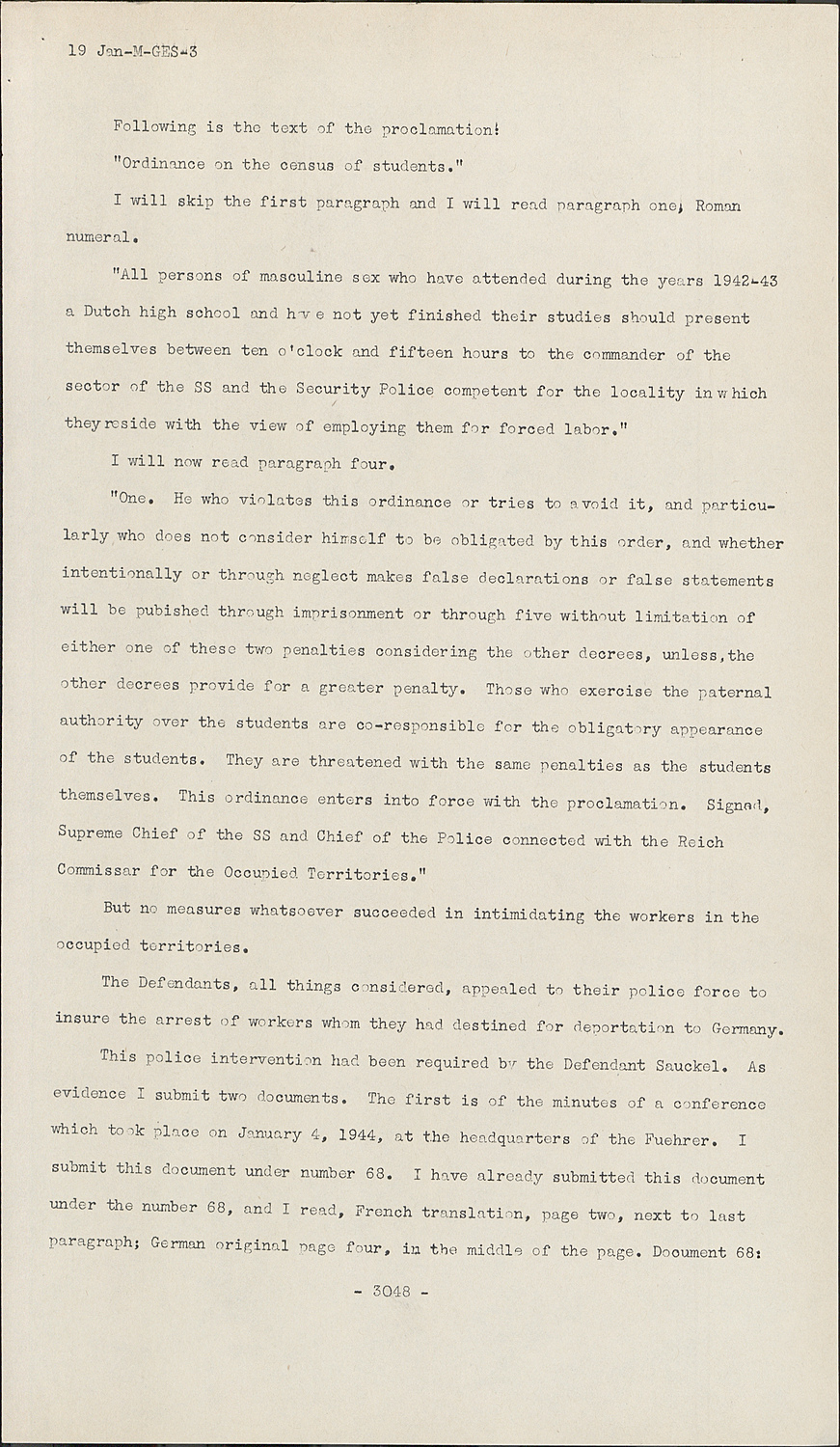
Following is the text of the proclamation:
"Ordinance on the census of students."
I will skip the first paragraph and I will read paragraph one, Roman numeral.
"All persons of masculine sex who have attended during the years 1942-43 a Dutch high school and have not yet finished their studies should present themselves between ten o'clock and fifteen hours to the commander of the sector of the SS and the Security Police competent for the locality in which they reside with the view of employing them for forced labor."
I will now read paragraph four.
"One. He who violates this ordinance or tries to avoid it, and particularly who does not consider himself to be obligated by this order, and whether intentionally or through neglect makes false declarations or false statements will be pubished through imprisonment or through five without limitation of either one of these two penalties considering the other decrees, unless, the other decrees provide for a greater penalty. Those who exercise the paternal authority over the students are co-responsible for the obligatory appearance of the students. They are threatened with the same penalties as the students themselves. This ordinance enters into force with the proclamation. Signed, Supreme Chief of the SS and Chief of the Police connected with the Reich Commissar for the Occupied. Territories."
But no measures whatsoever succeeded in intimidating the workers in the occupied territories.
The Defendants, all things considered, appealed to their police force to insure the arrest of workers whom they had destined for deportation to Germany.
This police intervention had been required by the Defendant Sauckel. As evidence I submit two documents. The first is of the minutes of a conference which took place on January 4, 1944, at the headquarters of the Fuehrer. I submit this document under number 68. I have already submitted this document under the number 68, and I read, French translation, page two, next to last paragraph; German original page four, in the middle of the page. Document 68:
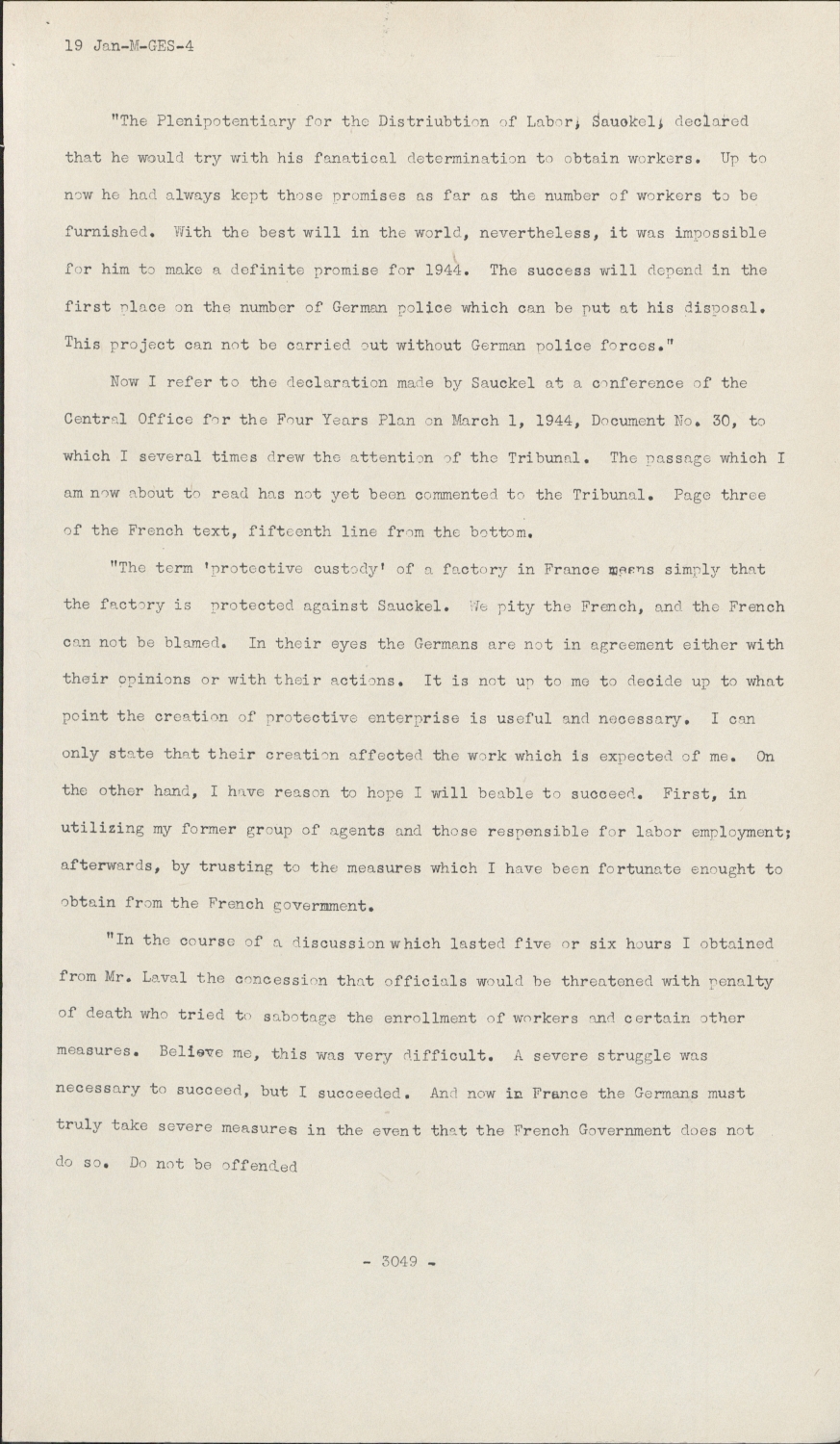
"The Plenipotentiary for the Distriubtion of Labor, Sauckel, declared that he would try with his fanatical determination to obtain workers.
Up to now he had always kept those promises as far as the number of workers to be furnished. With the best will in the world, nevertheless, it was impossible for him to make a definite promise for 1944. The success will depend in the first place on the number of German police which can be put at his disposal. This project can not be carried out without German police forces."
Now I refer to the declaration made by Sauckel at a conference of the Central Office for the Four Years Plan on March 1, 1944, Document No. 30, to which I several times drew the attention of the Tribunal. The passage which I am now about to read has not yet been commented to the Tribunal. Page three of the French text, fifteenth line from the bottom.
"The term 'protective custody' of a factory in France means simply that the factory is protected against Sauckel. We pity the French, and the French can not be blamed. In their eyes the Germans are not in agreement either with their opinions or with their actions. It is not up to me to decide up to what point the creation of protective enterprise is useful and necessary. I can only state that their creation affected the work which is expected of me. On the other hand, I have reason to hope I will beable to succeed. First, in utilizing my former group of agents and those responsible for labor employment; afterwards, by trusting to the measures which I have been fortunate enought to obtain from the French government.
"In the course of a discussion which lasted five or six hours I obtained from Mr. Laval the concession that officials would be threatened with penalty of death who tried to sabotage the enrollment of workers and certain other measures. Believe me, this was very difficult. A severe struggle was necessary to succeed, but I succeeded. And now in France the Germans must truly take severe measures in the event that the French Government does not do so. Do not be offended if I and my assistants in fact have sometimes seemed to do things in France that I am forced to ask, is there no longer any respect in France for the German Lieutenant and his ten men?
For months everything that I said finds this reply, what do you mean, Your Honor, the Gauleiter? Do you know that we have no means of execution at our disposal? We cannot act in France. They gave me this reply I do not know how many times. How then can I regulate the enrollment of labor so far as France is concerned? There is only one solution. The German Authorities must cooperate with each other if the French despite all their promises, do not act. We then, we Germans, we must make an example of one case, and after that law hang, if that is necessary, the prefect or the mayor if he does'nt submit to the rules. Otherwise there will not be one Frenchman sent to Germany."
It was thus finally that the deportation of workers to Germany was assured by their systematic arrest. It was in accordance with the logic of the National Socialist system that the recruiting policy of foreign workers be carried out through terroristic police methods.
I have told the Tribunal that the resistance by the prisoners of war and by the workers of the occupied territories against the activities, both insidous and violent, of the Defendant caused the failure of the plan for the recruitment of foreign workers. The Defendant Sauckel had the greatest difficulty in carrying out the program which he had accepted by Hitler and the Defendant's Goering, Speer, and Funk.
It does not follow that Nazi Germany did not suceed in carrying out huge deportations of foreign workers. The number of workers coming from the occupied territories and from the Western Europe who had been deported into Germany is very high. More numerous still were the workers compelled to work on the spot in factories and workyards under the control of the occupational authorities.
I shall give the Tribunal statistics which will permit my statement to be checked. These statistics are fragmentary. They are extracts from reports which the governments of the occupied countries drew up after their liberation and from reports sent during the war by the Arbeitseinsatz office to the authorities to which it was subordinate.
These statistics of Allied origin are incomplete. The records from which they are drawn up have been partly destroyed.
On the other hand, the governments of the occupied territories are only in possesion of second hand information whenever the requistion of workers was made directly by the occupation authorities.
As for the German statistics, they are also incomplete since the Allied authorities have not yet discovered all the enemy records.
It is however possible to give to the Tribunal an exact evaluation of the extent of the deportations effected by Germany.
This evaluation furnishes proof that the violations of international law commited by the Defendant's did not remain in the state of tentative endeavours characterised by the first stages of execution and reprehensible in themselves. They brought about the social disorder which, from the standpoint of penal legislation, determines the seriousness of the offense.
I shall first submit to the Tribunal the statistics furnished by the official reports of the French Government. The French government's record comes from the Institute of Economic Market Analysis.