Q How do you explain that particularly among the Russians, the French and the Italians was the biggest number of people who died of starvation?
Was there any difference in feeding of prisoners of different nationalities, or were there any other different reasons?
AThe case was this, that the others, the Germans, the Poles, Czechs, who had already been in the camp for some time had had time to adjust themselves to it, if one can so express oneself. I mean adjust themselves physically. The Russian population of the camp changed rapidly. The same was true of the French and the Italians. Further, these three nations had already suffered from malnutrition in other camps so that they then fell easy prey to the epidemics and sicknesses in the camp. Also, the Germans, Poles, an several others from the year 1943 on, who had worked in the armaments industry, had had opportunity to get nourishment from their homes. That was of course not the case with citizens of Soviet Russia or France.
Q Can you answer this question as to what Rosenberg, Kaltenbrunner or Funk -- what did they see in the Dachau concentration; do you know what was shown them?
AI had he opportunity to follow the course of these visits. That occasions was afforded only very seldom. One could occasionally see these visitors from the window and could observe where they went. I had occasional opportunity to see Himmler, Obergruppenfuehrer Pohl, and Gauleiter Geissler. In the case of these men I was present when they visited the experiments or the patients in the hospital. Of the others, I do not know what they visited in those individual cases.
QPerhaps you had an opportunity to observe the length of the visit of those people in the camp, whether the visit was short, brief, just for a few moments, or were to stay there for a long period. I have in mind Rosenberg, Kaltenbrunner and Sauckel.
AThat depended. Many visitors were there only for half an hour. Many spent as many as three hours there. We were always able to observe that very well because at those times no work could be done. We did not carry on our work in the hospitals during those times and had to wait until the signal was given to us that the visitors had already left the camp. Otherwise, I'm not able to judge the individual cases or how long they spent in the camp.
QCan you recall Kaltenbrunner's visit, Rosenberg's function, and Sauckel's? If we wait to classify them the same way as you mention now, whether they were brief visits or whether those people stayed there for several hours? Did you understand my question? A Unfortunately, I cannot make a statement on that because, as I said, the visits were such a matter of course; it happened so often that I have difficulty even remembering the year and cannot recall whether they stayed for a shorter or longer time. There were visits, for instance, from schools, from the military and police schools, and sometimes it lasted a whole day.
COL. POKROWSKI:Thank you. I have no further questions of this witness at this stage of the sitting.
BY MONSIEUR DUBOST:
QYou have alluded to a convoy of French deportees who came from Compiegne, of whom only 1,200 survivors survied. Were there any other convoys?
AYes. There were transports, particularly from Bordeaux, Lyons, and Compiegne, all in the first half of the year 1944.
QWere all the transports carried out under the same condition?
AAll the circumstances surrounding these transports, if they were not identical, at any rate very similar.
QEach time upon the arrival you were able to see that there were numerous victims?
AYes.
QWhat were the causes of decease?
AThe causes of death were those resulting from the fact that the people were packed too closely into the cars, which were then closed and then for several days kept there without any food or water. Usually they were simply starved or suffocated. Of those who survived we took many to the camp hospital, and again a large number of these people died of various complications and sicknesses.
QDid you make autopsies of the people who died during the transportation?
AYes, particularly in the transport from Compiegne my services were demanded because the rumor was spread that the French had attacked the Fascists in the cars and had died of the riots that followed. I had to autopsy these people, but in no case did I find any signs of violence. Moreover, I took ten corpses for an examination, dissected them, and sent a special report on them to Berlin. These people had died of suffocation. I could also determine during my autopsy that these were prominent people of France. I could tell this from their uniforms and insignias. I could determine that they were high French officers, priests, representatives, and well-fed people who had been taken from civilian life directly into the cars and sent to Dachau.
QAfter the reports which you sent to Berlin - the conditions under which the transports were made, were they the same after these reports that you sent?
ANothing happened, as usual, or it happened always that long reports were written out but nothing was ever improved.
QYou indicated that some French generals had been put to death shortly before the liberation of the camp. Do you know the names of these generals?
AUnfortunately, I have forgotten these names. I can simply remember that the prisoners who were kept in the same barracks with them, namely, the prominent personalities from Germany and other countries. Pastor Niemueller was among them - a Prussian prince, Schuschnigg, members of the French Government, and several others. These people told me that one of the generals who had been shot was a close relative of General De Gaulle. I have unfortunately, forgotten his name.
QIf I have properly understood, these generals were prisoners of war who had been transported into this concentration camp?
AThese two generals never got to the concentration camp along with the other prominent personalities. They were kept in so-called "Kommandatur Arrest" in separate barracks, not in the camp. On the various occasions on which they needed medical attention I had a chance to get in touch with them, but that was infrequently. Otherwise, with the other prisoners they did not come into any touch at all.
QDid they belong to the category of the deportees whose return was not desired or were they of the category of the "Nacht and Nebel" deportees?
AI do not know. Two days previously all the others who were kept in that barracks were transported in special trains to the Tyrol. That was, I believe, a week or eight days before the liberation.
QYou indicated that numerous visitors, military visitors, students, political men, and German military men had visited the camp on numerous occasions. Can you say if any common people, workers, also passed through this camp?
AIn my opinion, the people who lived in the neighborhood of Munich must have known of these things because they had daily opportunity in the various factories in Munich and the surrounding neighborhood to come into contact with the civilian workers in these factories, moreover, on the plantations, in the factories of the munitions industry have entered these places and must have seen what was done to the prisoners and how they appeared.
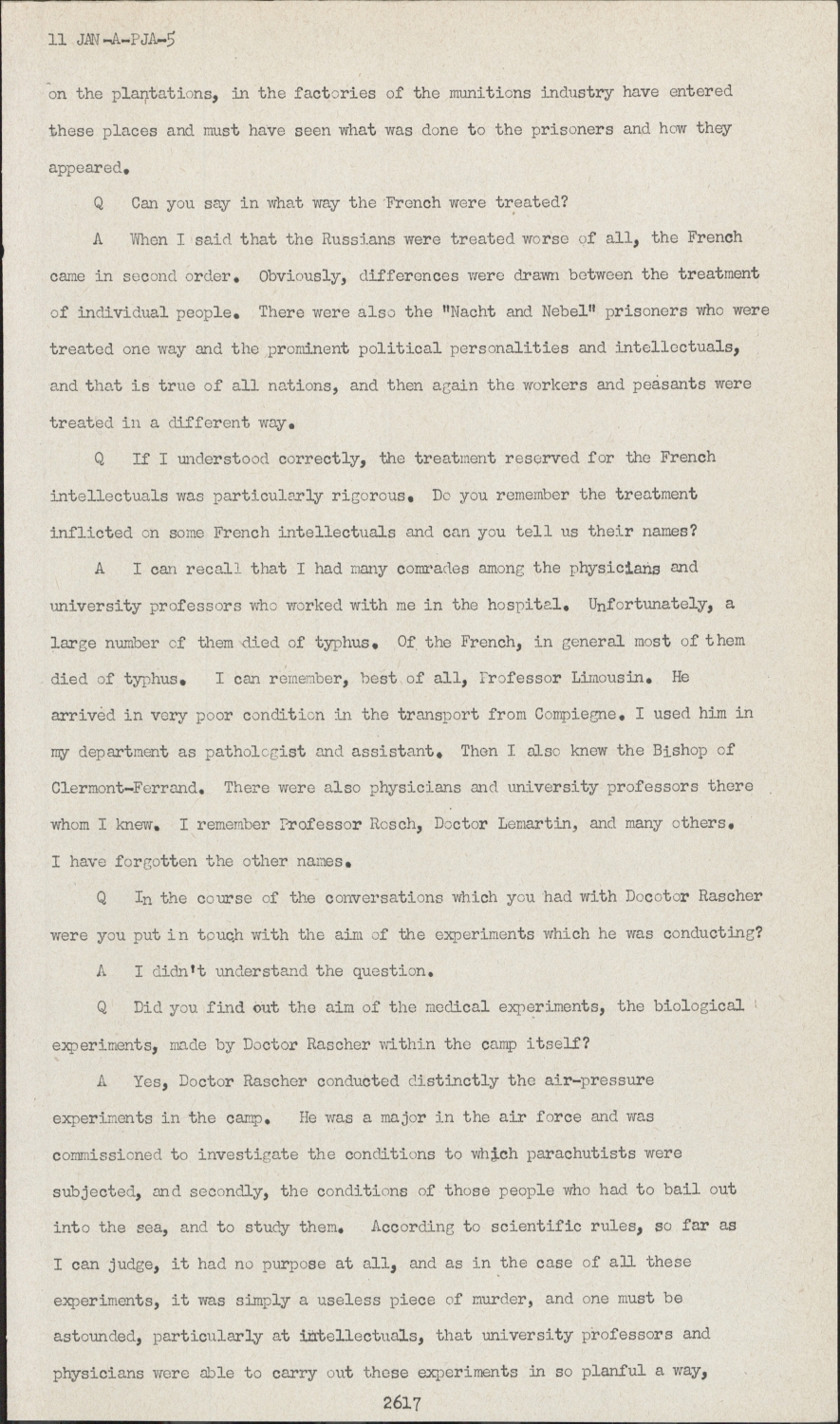
QCan you say in what way the French were treated?
AWhen I said that the Russians were treated worse of all, the French came in second order. Obviously, differences were drawn between the treatment of individual people. There were also the "Nacht and Nebel" prisoners who were treated one way and the prominent political personalities and intellectuals, and that is true of all nations, and then again the workers and peasants were treated in a different way.
QIf I understood correctly, the treatment reserved for the French intellectuals was particularly rigorous. Do you remember the treatment inflicted on some French intellectuals and can you tell us their names?
AI can recall that I had many comrades among the physicians and university professors who worked with me in the hospital. Unfortunately, a large number of them died of typhus. Of the French, in general most of them died of typhus. I can remember, best of all, Professor Limousin. He arrived in very poor condition in the transport from Compiegne. I used him in my department as pathologist and assistant. Then I also knew the Bishop of Clermont-Ferrand. There were also physicians and university professors there whom I knew. I remember Professor Rosch, Doctor Lemartin, and many others, I have forgotten the other names.
QIn the course of the conversations which you had with Docotor Rascher were you put in touch with the aim of the experiments which he was conducting?
AI didn't understand the question.
QDid you find out the aim of the medical experiments, the biological experiments, made by Doctor Rascher within the camp itself?
AYes, Doctor Rascher conducted distinctly the air-pressure experiments in the camp. He was a major in the air force and was commissioned to investigate the conditions to which parachutists were subjected, and secondly, the conditions of those people who had to bail out into the sea, and to study them. According to scientific rules, so far as I can judge, it had no purpose at all, and as in the case of all these experiments, it was simply a useless piece of murder, and one must be astounded, particularly at intellectuals, that university professors and physicians were able to carry out these experiments in so planful a way, which were much worse than all the liquidations and executions, because all the victims of these experiments simply had their misery prolonged with various medical means, such as hormones, vitamine injections, and so on, which were then not available to the usual patients, and were provided to these experimental patients simply so that the experiments might last longer and give the experimenters more time to observe their victims.
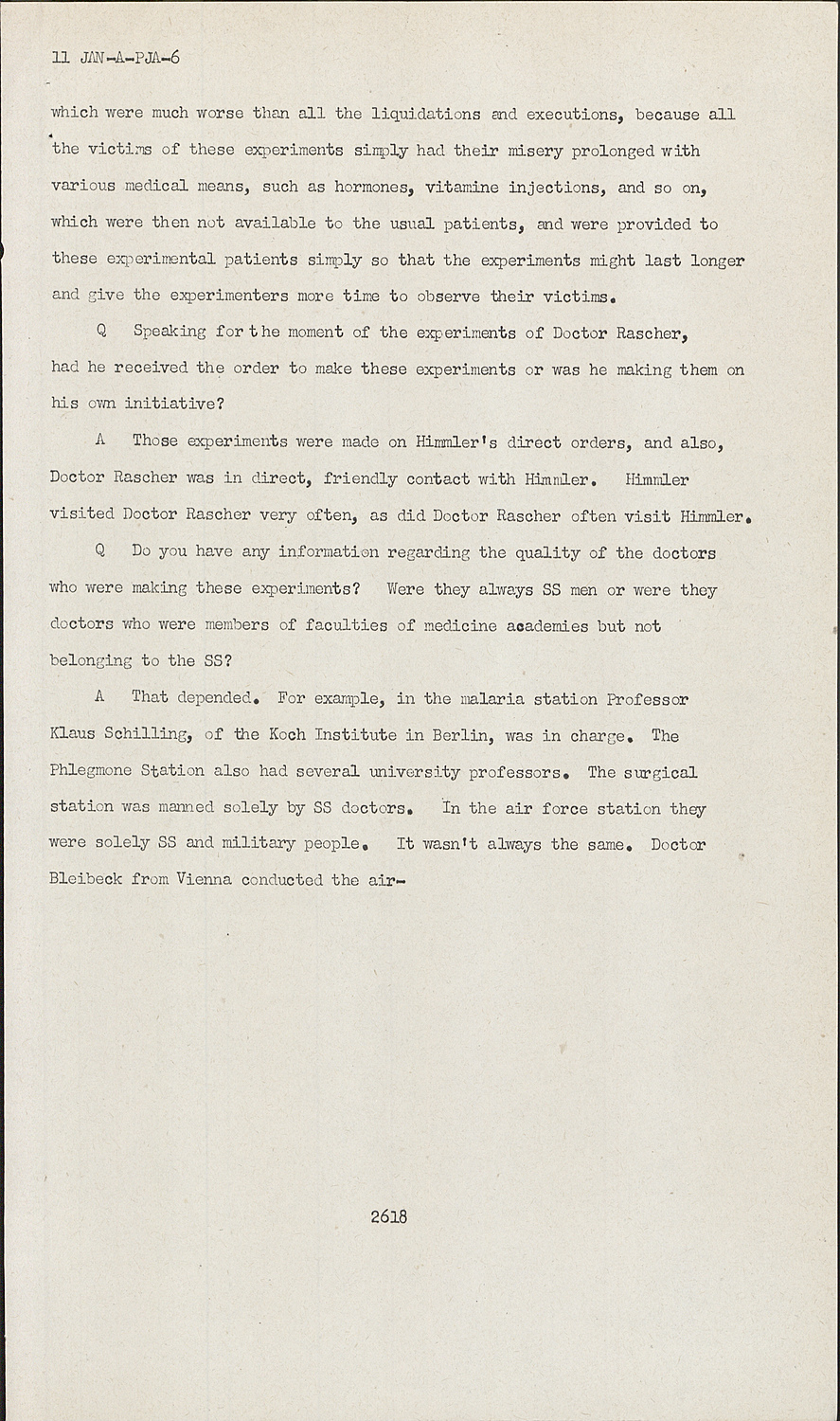
QSpeaking for the moment of the experiments of Doctor Rascher, had he received the order to make these experiments or was he making them on his own initiative?
AThose experiments were made on Himmler's direct orders, and also, Doctor Rascher was in direct, friendly contact with Himmler. Himmler visited Doctor Rascher very often, as did Doctor Rascher often visit Himmler.
QDo you have any information regarding the quality of the doctors who were making these experiments? Were they always SS men or were they doctors who were members of faculties of medicine academies but not belonging to the SS?
AThat depended. For example, in the malaria station Professor Klaus Schilling, of the Koch Institute in Berlin, was in charge. The Phlegmone Station also had several university professors. The surgical station was manned solely by SS doctors. In the air force station they were solely SS and military people. It wasn't always the same. Doctor Bleibeck from Vienna conducted the air pressure experiments.
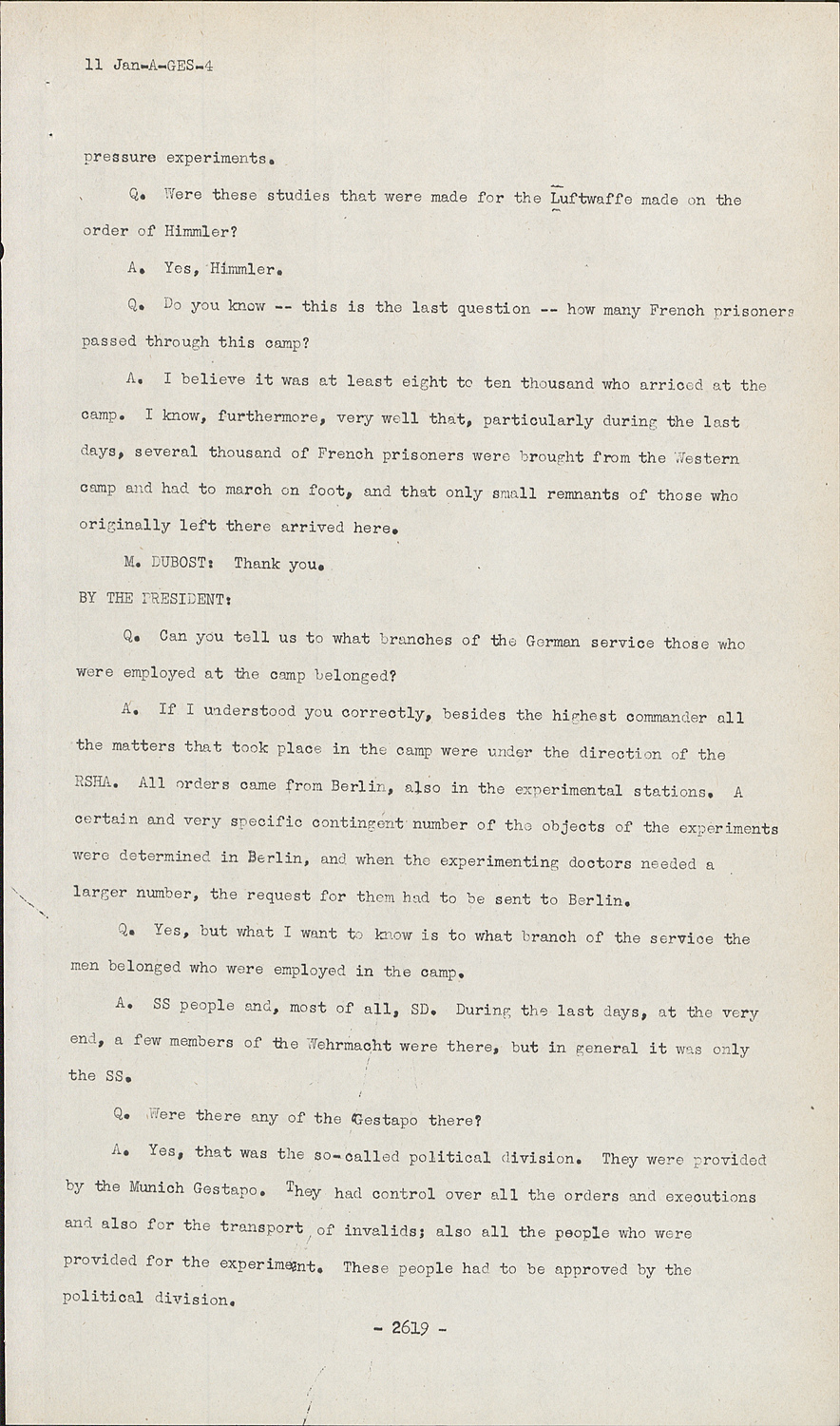
Q.Were these studies that were made for the Luftwaffe made on the order of Himmler?
A.Yes, Himmler.
Q.Do you know -- this is the last question -- how many French prisoners passed through this camp?
A.I believe it was at least eight to ten thousand who arriced at the camp. I know, furthermore, very well that, particularly during the last days, several thousand of French prisoners were brought from the Western camp and had to march on foot, and that only small remnants of those who originally left there arrived here.
M. DUBOST:Thank you. BY THE PRESIDENT:
Q.Can you tell us to what branches of the German service those who were employed at the camp belonged?
A.If I understood you correctly, besides the highest commander all the matters that took place in the camp were under the direction of the RSHA. All orders came from Berlin, also in the experimental stations. A certain and very specific contingent number of the objects of the experiments were determined in Berlin, and when the experimenting doctors needed a larger number, the request for them had to be sent to Berlin.
Q.Yes, but what I want to know is to what branch of the service the men belonged who were employed in the camp.
A.SS people and, most of all, SD. During the last days, at the very end, a few members of the Wehrmacht were there, but in general it was only the SS.
Q.Were there any of the Gestapo there?
A.Yes, that was the so-called political division. They were provided by the Munich Gestapo. They had control over all the orders and executions and also for the transport of invalids; also all the people who were provided for the experiment. These people had to be approved by the political division.
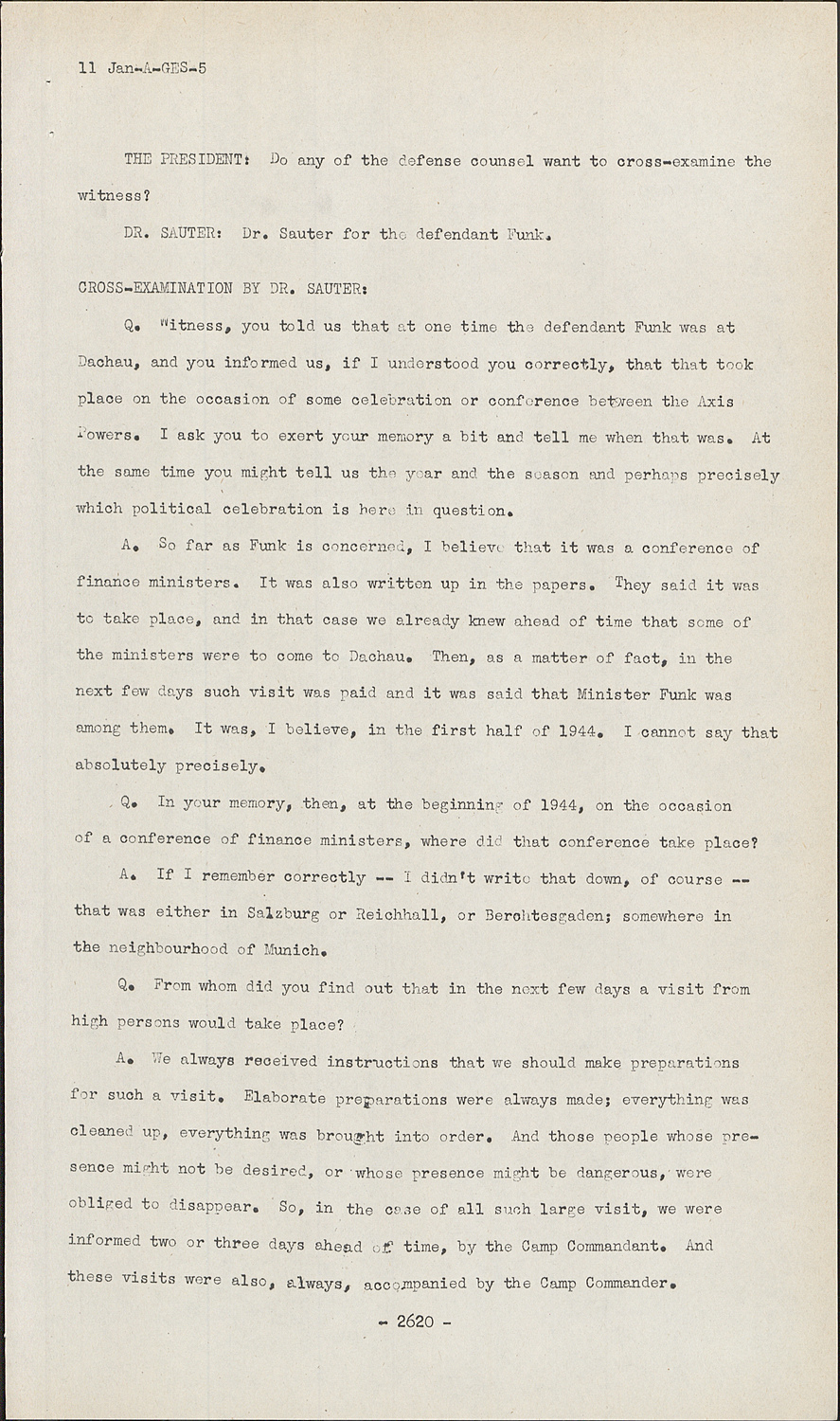
THE PRESIDENT: Do any of the defense counsel want to cross-examine the witness?
DR. SAUTER:Dr. Sauter for the defendant Funk. CROSS-EXAMINATION BY DR. SAUTER:
Q.Witness, you told us that at one time the defendant Funk was at Dachau, and you informed us, if I understood you correctly, that that took place on the occasion of some celebration or conference between the Axis Powers. I ask you to exert your memory a bit and tell me when that was. At the same time you might tell us the year and the season and perhaps precisely which political celebration is here in question.
A.So far as Funk is concerns I, I believe that it was a conference of finance ministers. It was also written up in the papers. They said it was to take place, and in that case we already knew ahead of time that some of the ministers were to come to Dachau. Then, as a matter of fact, in the next few days such visit was paid and it was said that Minister Funk was among them. It was, I believe, in the first half of 1944. I cannot say that absolutely precisely.
Q.In your memory, then, at the beginning of 1944, on the occasion of a conference of finance ministers, where did that conference take place?
A.If I remember correctly -- I didn't write that down, of course -that was either in Salzburg or Reichhall, or Berchtesgaden; somewhere in the neighbourhood of Munich.
Q.From whom did you find out that in the next few days a visit from high persons would take place?
A.We always received instructions that we should make preparations for such a visit. Elaborate preparations were always made; everything was cleaned up, everything was brought into order. And those people whose presence might not be desired, or whose presence might be dangerous, were obliged to disappear. So, in the case of all such large visit, we were informed two or three days ahead of time, by the Camp Commandant. And these visits were also, always, accompanied by the Camp Commander.
Q. Now, if you know that the Defendant Funk was there and mention was made of it at that time, then discussions must have taken place in the camp.
What other people were in the same group?
A.I cannot remember. There were always many and different personalities.
Q.That does not interest me. I am interested only in whether or not at that particular visit, in which Funk was present, word was not passed around the camp that such and such another person was there.
A.No, I cannot remember that now.
Q.Can you remember whether afterwards, perhaps on the next day or the day after, something was said about that, perhaps by people who had seen the visit?
A.Yes, we always discussed such visits; but now I can no linger remember precisely who were named at that time.
Q.Witness, I am not interested in any other visit, but in this specific visit. In this case I should like to know whether you can say anything at all about who else besides Funk was part of that visit.
A.That I cannot say: there were so many visits. For instance, after one visit, the very next day there would be another visit announced.
Q.Now, you remember the visit that Funk made also? For instance, other finance ministers were there. Could you, perhaps, recall these other people?
A.No, I cannot remember. Many of the people with whom I spoke did not know these other people.
Q.Do you know which parts of the camp were visited by the visit of which Funk was a part?
A No; at least, the visitors did not come to the Surgical Department.
QBut you were informed and prepared?
AYes. All departments had to be prepared, even if the visit did not come to their department. That is, several times it happened to me that a visit was announced, and then, for one reason or another, nothing came of it.
QWitness, as regards these observations of yours that you have related to us today, have you been interrogated on them several times?
AI was interrogated on these matters for the first time before the Military Court at Dachau.
QDid you at that time say something to indicate-
A (Interposing): I repeat, at the Military Court at Dachau.
QDid you say something to the effect that Funk had been present at Dachau?
AYes, I said the same thing to the Military Court at Dachau, also as regards Funk.
QBut is it true, witness--I ask again whether it is really true, because you are here as a witness under oath. I ask again if that is true.
AYes.
QYou were interrogated the day before yesterday?
AYes.
QDid you, at that time, also make these statements about Funk?
AI said the same thing while I was being examined by the Prosecution.
QIs that also in the document that you signed?
AI signed no protocol.
QYou signed no protocol?
ANo; I simply signed what was just read by the Prosecution.
QWell, that is a protocol.
AYes, but in that protocol there is no mention of these visits.
QThat was asked me orally, and the prosecuting attorney had informed me that these matters would be taken up in cross-examination during the Court's session.
Q Were you also told where the defendants sit in the Tribunal?
ANo. Before the Court session I was shown pictures of the defendants and I was asked to identify the various people before the Court. The three whom I mentioned today I was able to identify and to state that I had seen them personally. Funk and the ethers I did not name as ones whom I had seen. I did not say that I had personally seen, nor did I say that could identify them.
QBut when the pictures were shown to you you saw these defendants in the pictures?
AYes.
QNow, if I understand you correctly, you knew today precisely where Funk or Frick or anyone else was actually sitting?
AFunk I do not know personally, because I did not see him at that time.
QDid the pictures that were shown to you at Dachau, did not those pictures say--were you not told, "This is Funk; look at him and tell me if you recognize him"?
ANo; that was done entirely differently.
QHow?
AThe individual pictures were shown to me and I was to say which of those individuals I had seen at the camp at Dachau. Of those people I named the aforementioned three. Of the others--as to the other pictures there was no discussion whatsoever.
QDr. Blaha, during your previous interrogation you were asked by the President, or one of the prosecuting attorneys--you made a statement, I believe, in the Czech language.
A No.
QWhat then?
AIn German.
QNow, everyone heard that that was not German; it was apparently Czech.
AYes, the original sentences.
QI ask you to state and to repeat the sense pretty literally of what you actually said at that time, because that interests us from the point of view of the Defense.
AI believe that an English translation of this Czech statement was included in the protocol.
QPlease repeat what you said then.
AI said that I am ready, because it is technically impossible to use my native tongue, that I was ready to speak in German, because all these matters that occurred during the last seven years and that are now the object of the trial took place in German surroundings, and also the special and technical expressions that were used in the camp can only be said in German and cannot be translated into any other language.
Such expressive terns cannot be turned into other languages.
DR. SAUTER:I have no further questions, Mr. President.
BY DR.THOMA (Counsel for Defendant Rosenberg):
QWitness, was there a demand of silence for the inhabitants of the concentration camp at Dachau?
ANo. Of course, if someone was let out of the camp by the Gestapo--and those were very few cases particularly in the case of the Germans--then it was necessary.
.
THE PRESIDENT (interposing): More slowly, please.
A (continuing) .. then the person who was let out had to sign a statement with the so-called duty to silence.
BY DR. THOMA:
Could the people who inhabited the camp and who worked outside the camp, could they talk about conditions in the camp?
AYes, there were opportunities, because the people worked in the same rooms and factories as civilians.
That was so in the German munitions industry, on the plantations, and in all factories in Munich and surroundings.
QIf I understood you correctly, you said previously that the people who delivered things to the camp also had an opportunity to observe the conditions in this camp.
AYes. Many of these people saw the whole plantation, as well as the various manufactories and factories.
They went through these institutions and saw the life there in all its details.
QAnd what did they see there in the way of torture and mistreatment?
ANo, they saw how they worked; they saw what their appearance was and what was done there.
For instance, I can remember one example very specifically.
At that time I was working on the herb plantation.
We were pulling a heavy steam roller;
16 men and an excursion of girls passed. When they passed the leader said very loudly, so that we might all hear it, "Look, those people are so lazy that they would rather pull that roller alone than take the trouble to hook a horse to it."
QWitness, when did you have occasion to tell other people about those terrible cruelties that you saw in the camp?
The first occasion after you left the camp?
APlease repeat.
QWhen did you first have an opportunity after your liberation from the concentration camp to tell an outside person something about the terrible cruelties?
AImmediately after my liberation. I was at that time, as chief physician of the concentration camp, interrogated by the American investigating court, and it was to this court that I told for the first time these things, and I also offered then various proofs, the case histories and the story of these experimental stations.
All these things I turned over to the Americans before they were destroyed by fire.
QSo that the Prosecuting Attorneys believed the statements you made without any further question?
AYes.
QWitness, you said that the Defendant Rosenberg was showed to you in the concentration camp when he was there.
AYes.
QWhen was that?
AIn the year 1941; first half of 1941.
QFirst half?
AI believe so, yes.
QCan you remember?
AI arrived at Dachau in April, so it was perhaps from April to July.
I believe that it was so.
Q Was Rosenberg at that time in uniform?
AYes.
QIn what uniform?
AI believe it was an SS uniform.
QSo, an SS uniform.
ABut I cannot say that very precisely, but he was in uniform.
QAll right, you remember that it was an SS uniform, a black uniform?
ANo, at that time the SS did not any longer wear the black uniform because before the beginning of the war they wore field uniforms and others and it was a gray uniform.
QA gray uniform?
A ell, whether it was gray or yellow or brown I don't remember any more.
QThat is rather important, just whether it was brown, yellor, or gray. Was it a field uniform?
AI do not any longer remember because from 1939 on I wasin the concentration camp and was not familiar with the various German uniforms and categories of the Army and so forth.
QBut you just said that during the war they changed the uniform.
AYes, the people in the Gestapo also changed their uniforms. When I was taken prisoner in 1939, all Gestapo personnel wore this black uniform. After the beginning of the war, most of them wore either green or gray uniforms.
QMay I ask you again: Did Rosenberg have a civilian or war uniform on?
AI believe it was a war uniform.
QThe Defendant Rosenberg was pointed out to you by another comrade?
AYes.
QAt what distance?
AWell, he was going down the camp street. That was perhaps 30 or 40 meters; 30 steps, 30 paces, 30 meters.
QAnd had you previously seen pictures of Rosenberg? Was the name Rosenberg already familiar to you?
A Yes.
QAnd when this comrade showed you Rosenberg, did it happen this way, that he said, "This is Rosenberg"? Did you recognize him already from having seen him in the cinema?
AI can't remember that now. When he showed him to me I did remember that I had already seen pictures of him in newspapers and recognized him in that way.
QCould I ask you to describe to me the precise event, where you were standing, who was there, what road Rosenberg took, and exactly what happened?
AI recognized in his company the Camp Commander Pierkowski, then the Lagerfuehrer Ziel, and Hoffmann. I recognized all of them.
QYou were in your room and were locking out the window?
ANo, we were on the so-called Block Street, on which the visit passed.
QWhat was said to you?
A "Look, there goes Rosenberg."
QWas Rosenberg alone?
ANo, he was with the others whom I mentioned.
QThat is to say, only with the camp commander?
ANo, with many other people.
QThat is to say, he had a staff with him?
AI don't know whether that was Rosenberg's staff, but there were many people with him.
QWitness, the defendant Rosenberg assures me most definitely that he has never been to the concentration camp at Dachau. Is any error possible here?
AI do not believe that I have made a mistake. The German who told me that that was Rosenberg knew him very well.
QHow do you know that?
ABecause he told me that so definitely. Otherwise, I have no other way of determining that.
THE PRESIDENT:Dr. Thoma.
DR. THOMA:Yes.
THE PRESIDENT: You will forgive me if I point out to you that this is intended to be an expeditious trial and that it is not right to take up too much time upon small points like this.
DR. THOMA:My Lord, I ask the permission to remark that the decision whether or not Rosenberg was at the concentration camp is a very important question of decisive significance. BY DR. PANNENBECKER (Counsel for the Defendant Frick):
QThe Defendant Frick states that he was never in Dachau Concentration Camp. I should like, therefore, in order to clarify the question, to ask the following question:
How far away were you when you saw Frick from the window?
AI saw him from the window as he passed with several people in his company.
QDid you know Frick before?
AYes, from pictures.
QSo, from pictures. Did you recognize him yourself or did some friend tell you that that was he?
ASeveral of us saw him and I looked at him particularly because at that time he was already Protector of Bohemia and Moravia. For that reason I had a personal interest in recognizing him.
QDid Frick wear a uniform?
AI do not believe so.
QDid you recognize anybody who was with him, anyone from his staff or from the leadership of the camp? a I didn't recognize any staff members of his, but the camp commander was there, Commander Weiter and his adjutant Otto.
QCould you name anyone of your comrades who also recognized him?
AThere were many friends of mine who at that time were standing at the window. Unfortunately, I cannot say now, because as you should understand, so many events took place in the concentration camp that one cannot keep these things separate in one's memory. One remembered only the larger events.
QDid you recognize him immediately as he passed by, or had they already told you that he would be there?
ANo, he was not discussed beforehand. It was simply told us that a visit of important people would take place, and we were waiting for this visit. We were not told who would be part of this visit.
QDid you recognize Frick immediately in the court here, or did you know beforehand that he was sitting in the fourth place in the dock?
ANo, I recognized him very well on my own, because I had seen several pictures of him, because he was a very popular person in Bohemia and Moravia.
QYou believe that no error could have taken place here?
AI believe so.
DR. PANNENBECKER:May I then ask the Court whether Frick might not himself take the stand to testify that he never visited Dachau, and that he might be confronted with the witness?
THE PRESIDENT:Counsel for the Defendants will understand that they will have the opportunity when it comes to their time to present their cases to call all the Defendants, but they will not have an opportunity of calling them now. They will have to wait until the case for the prosecution is over and they will then have an opportunity of each of them calling the Defendant for -whom they appear if they wish to.
DR. PANNENBECKER:I simply thought that since the witness was now here we might now have that confrontation.
THE PRESIDENT:It is now 5:00 o'clock and unless you are going to be very short -- are you going to be very short?
DR. KUBUSCHOK:Short, yes. BY DR. KUBUSCHOK (Counsel for the Political Leadership Corps):
QYou said that when prominent visitors came to the camp, previously extensive preparations were made. You said in your statement that unwelcome individuals were removed. Could you supplement that statement? I am interested to know the purpose of these preparations.
AThat is to say, everything had to be in order. In our case, all the patients had to be lying quietly in bed; everything was washed up, repaired; the instruments were polished, and this was usual in the case of visits from high places. No operation, no bandages nor food were given out before the visit was terminated.
QCould you tell me what unwelcome persons were to be removed, as you said before?
AWell, people -- the Russians were hidden away. It was said that they were afraid of possible demonstrations or assassinations.
QWere prisoners kept at a distance because their persons showed signs of ill-treatment?