That is 1730-PS again - the entry for 10 August 1938. It appears on page 4 of the translation of 1780-PS.
10 August 1933: "The Army Chiefs and the Chiefs of the Air Force Groups, Lt. Col.
Jeschonnek and myself are ordered to the Berghof.
After dinner the Fuehrer makes a speech lasting for almost three hours, in which he develops his political thoughts.
The subseq uent attempts to draw the Fuehrer's attention to the defects of our preparations, which are undertaken by a few generals of the Army, are rather unfortunate.
This applies especially to the remark of General Wietersheim, in which to top it off he claims to quote from General Adams that the western fortifications can only be held for three weeks.
The Fuehrer becomes very indignant and flames up, bursting into the remark that in such a case the whole Army would not be good for anything.
"I assure you, General, the position will not only be held for three weeks, but for three years". The cause of this despondent opinion, which unfortunately enough is held Very widely within the Army General Staff, is based on various reasons.
First of all, it (the general staff) is restrained by old memories; political considerations play a part as well, in stead of obeying and executing its military mission.
That is certainly done with traditional devotion, but the vigour of the soul is lacking because in the end they do not believe in the genius of the Fuehrer.
One dees perhaps compare him with Charles XII.
And since water flows downhill, this de featism may not only possibly cause immense political damage, for the opposition between the Generals' opinion and that of the Fuehrer is common talk, but may also constitute a danger for the morale of the troops.
But I have no doubt that the Fuehrer will be able to boost the morale of the people in an unexpected way when the right moment comes."
THE PRESIDENT:Shall we break off now for ten minutes:
(A recess was taken from 1514 hours to 1529 hours.)
COLONEL TAILOR:The extract from the Jodl diary from which I have just read may indeed show that some of the German generals at that time were cautious with respect to Germany's ability to take on Poland and the Western Powers simultaneously; but none theless, the entry shows no lack of sympathy with the Nazi aims for conquest.
And there is no evidence in Jodl's diary or else where that any substantial number of German generals lacked sympathy with Hitler's objectives.
Furthermore, the top military leaders always joined with and supported his decisions, with for midable success in those years from 1938 to 1942.
So, if we are told that German military leaders did not know that German policy toward Czechoslovakia was aggressive, or based on force or threat of force, let us remember that on 30 May 1938, Hitler signed a most secret directive to Keitel-already in the transcripts, 388-PS, US 26--in which he stated clearly his un-alterable decision to smash Czechoslovakia by military action in the near future.
The Defendant Jodl was in no doubt what that directive meant. He noted in his diary, the same day, that the Fuehrer had stated his final decision to destroy Czechoslovakia soon and had initiated military preparation all along the line.
And the succeeding evidence, both in the Schmundt file and in the Jodl diary, shows how these military preparations went forward. Numerous examples of discussions, plans, and preparations during the last few weeks before the Munich pact, including discussions with Hungary and the Hungarian General Staff, in which General Halder participated, are contained in the Jodl diary and the later items in the Schmundt file. The day the Munich Pact was signed, the 29th of September, Jodl noted in his diary--1780-PS, the entry for 29 September:
"The Munich Fact is signed. Czechoslovakia as a power is cut. Four zones as set forth will be occupied between the 2nd and 7th of October . The remaining part of mainly German character will be occupied by the 10th of October. The genius of the Fuehrer and his determination not to shun even a World War have again won the victory without the use of force. The hope remains that the incredulous, the weak and the doubtful people have been converted and will remain that way."
Plans for the liquidation of the remainder of Czechoslovakia, were made seen after Munich. Ultimately, the absorption of the remainder, was accomplished by diplomatic bullying, in which the Defendant Keitel participated, for the usual purpose of demonstrating that German armed might was ready to enforce the threats--as shown by two documents already in, and which I need not read: 2802-PS, US 107; and 2798-PS, US 118.
And, once again, the Defendant Jodl, in his 1943 lecture--L172, US 34-tells us clearly and in one sentence why the objective of eliminating Czechoslovakia lay as close to the hearts of the German military loaders as to the hearts of the Nazis:
"The bloodless solution of the Czech conflict in the autumn of 1938 and the spring of 1939, and the annexation of Slovakia, rounded off the territory of Greater Germany in such a way that it then became possible to consider the Polish problem on the basis of more or less favorable strategic premises."
And this serves to recall the affidavits by Blomberg and Blaskowitz, which I have already read from. "The whole group of German staff and front officers believed that the question of the Polish Corridor would have to be settled some day, if necessary by force of arms," they told us. "Hitler produced the results which all of us warmly desired," they have told us.
I turn not to Poland. The German attack on Poland is a particularly interesting one from the standpoint of the General Staff and High Command. The documents which show the aggressive nature of the attack have already been introduced by Mr. Griffith Jones of the British Delegation.
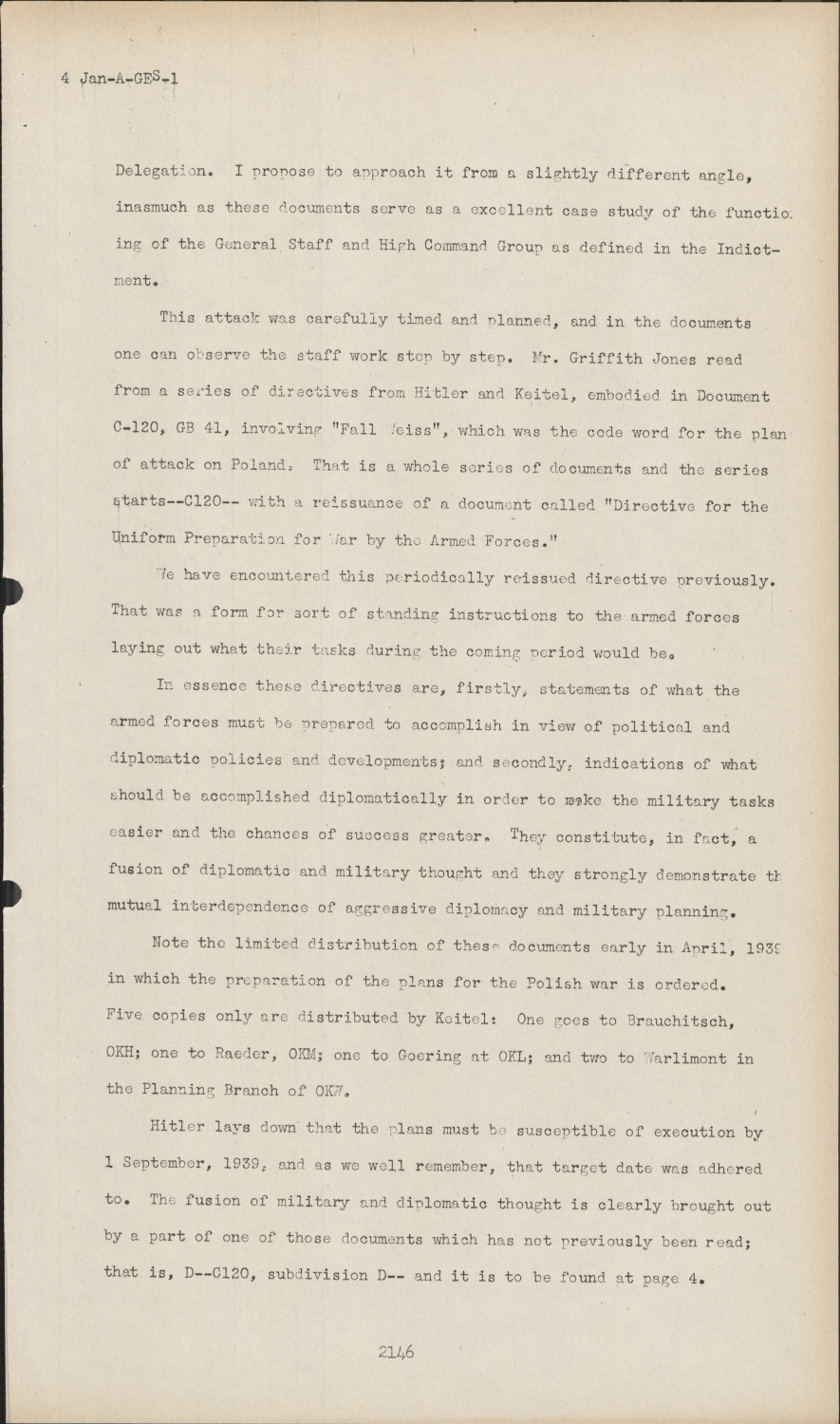
I propose to approach it from a slightly different angle, inasmuch as these documents serve as a excellent case study of the function ing of the General Staff and High Command Group as defined in the Indict ment.
This attack was carefully timed and planned, and in the documents one can observe the staff work stop by step.
Mr. Griffith Jones read from a series of directives from Hitler and Keitel, embodied in Document C-120, GB 41, involving "Fall Weiss", which was the code word for the plan of attack on Poland.
That is a whole series of documents and the series starts--C120-- with a reissuance of a document called "Directive for the Uniform Preparation for War by the Armed Forces."
We have encountered this periodically reissued directive previously.
That was a form for sort of standing instructions to the armed forces laying out what their tasks during the coming period would be.
In essence these directives are, firstly, statements of what the armed forces must be prepared to accomplish in view of political and diplomatic policies and developments; and secondly, indications of what should be accomplished diplomatically in order to make the military tasks easier and the chances of success greater.
They constitute, in fact, a fusion of diplomatic and military thought and they strongly demonstrate the mutual interdependence of aggressive diplomacy and military planning.
Note the limited distribution of these documents early in April, 1939 in which the preparation of the plans for the Polish war is ordered.
Five copies only are distributed by Keitel: One goes to Brauchitsch, OKH; one to Raeder, OKM; one to Goering at OKL; and two to Warlimont in the Planning Branch of OKW.
Hitler lays down that the plans must be susceptible of execution by 1 September, 1939, and as we well remember, that target date was adhered to.
The fusion of military and diplomatic thought is clearly brought out by a part of one of those documents which has not previously been read;that is, D--C120, subdivision D-- and it is to be found at page 4. The subheading is:
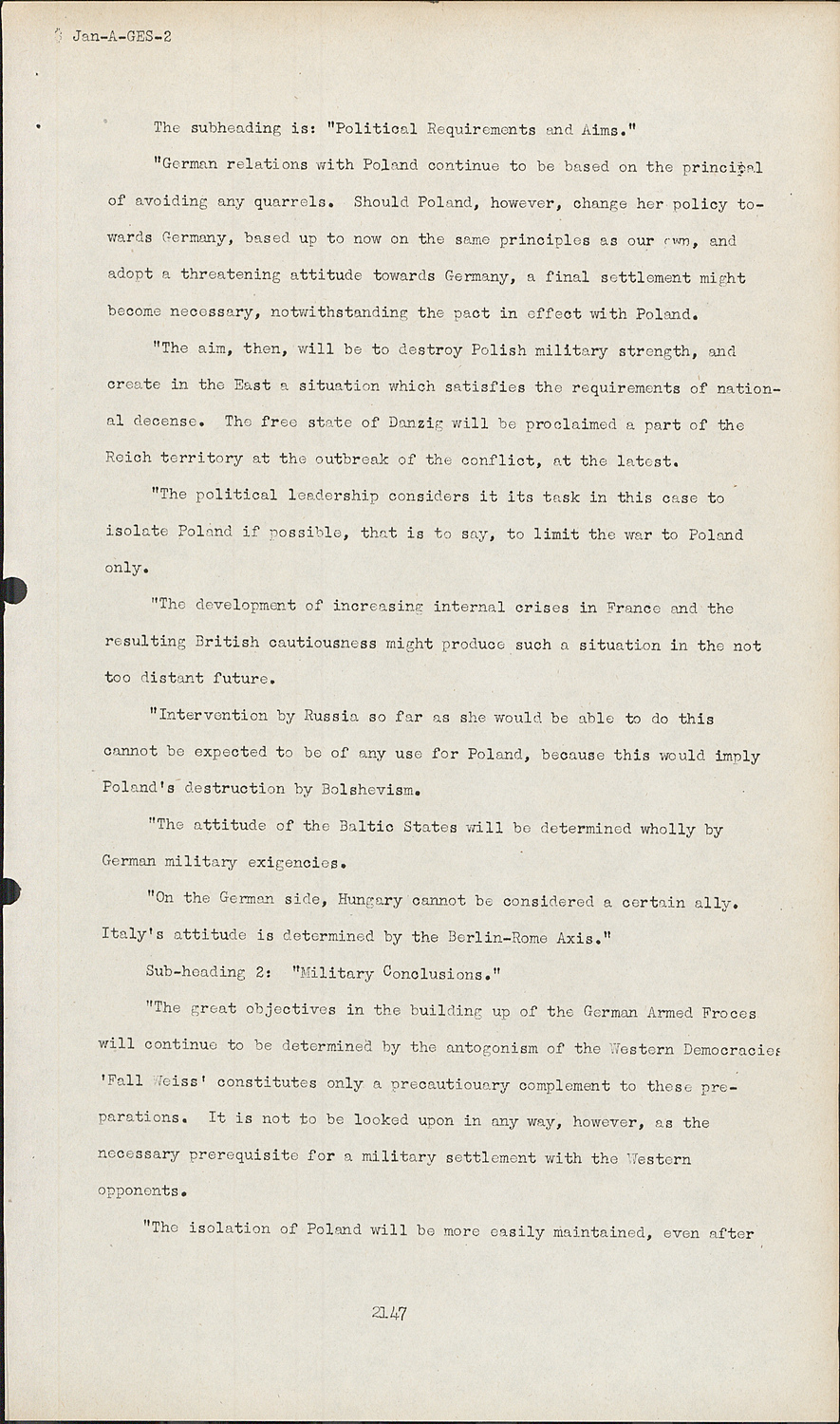
"Political Requirements and Aims."
* Jan-A-GES-2 "German relations with Poland continue to be based on the principal of avoiding any quarrels.
Should Poland, however, change her policy to wards Germany, based up to now on the same principles as our own, and adopt a threatening attitude towards Germany, a final settlement might become necessary, notwithstanding the pact in effect with Poland.
"The aim, then, will be to destroy Polish military strength, and create in the East a situation which satisfies the requirements of nation al decense.
The free state of Danzig will be proclaimed a part of the Reich territory at the outbreak of the conflict, at the latest.
"The political leadership considers it its task in this case to isolate Poland if possible, that is to say, to limit the war to Poland only.
"The development of increasing internal crises in France and the resulting British cautiousness might produce such a situation in the not too distant future.
"Intervention by Russia so far as she would be able to do this cannot be expected to be of any use for Poland, because this would imply Poland's destruction by Bolshevism.
"The attitude of the Baltic States will be determined wholly by German military exigencies.
"On the German side, Hungary cannot be considered a certain ally.
Italy's attitude is determined by the Berlin-Rome Axis."
Sub-heading 2: "Military Conclusions."
"The great objectives in the building up of the German Armed Froces will continue to be determined by the antogonism of the Western Democracies 'Fall Weiss' constitutes only a precautiouary complement to these pre parations.
It is not to be looked upon in any way, however, as the necessary prerequisite for a military settlement with the Western opponents.
"The isolation of Poland will be more easily maintained, even after the beginning of operations, if we succeed in starting the war with heavy, sudden blows and in gaining rapid successes.
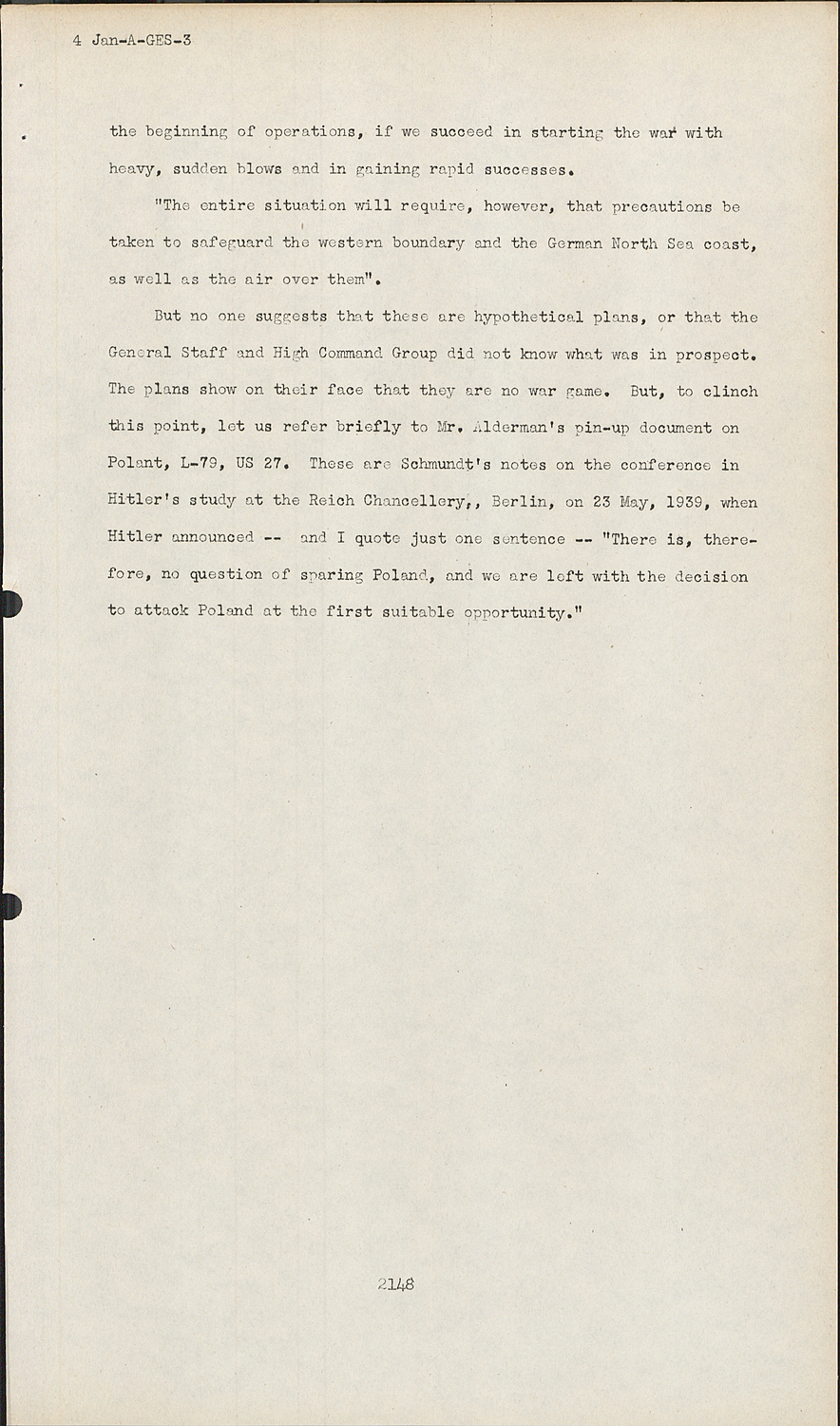
"The entire situation will require, however, that precautions be taken to safeguard the western boundary and the German North Sea coast, as well as the air over them".
But no one suggests that these are hypothetical plans, or that the General Staff and High Command Group did not know what was in prospect. The plans show on their face that they are no war game. But, to clinch this point, let us refer briefly to Mr. Alderman's pin-up document on Polant, L-79, US 27. These are Schmundt's notes on the conference in Hitler's study at the Reich Chancellery, Berlin, on 23 May, 1939, when Hitler announced -- and I quote just one sentence -- "There is, therefore, no question of sparing Poland, and we are left with the decision to attack Poland at the first suitable opportunity."
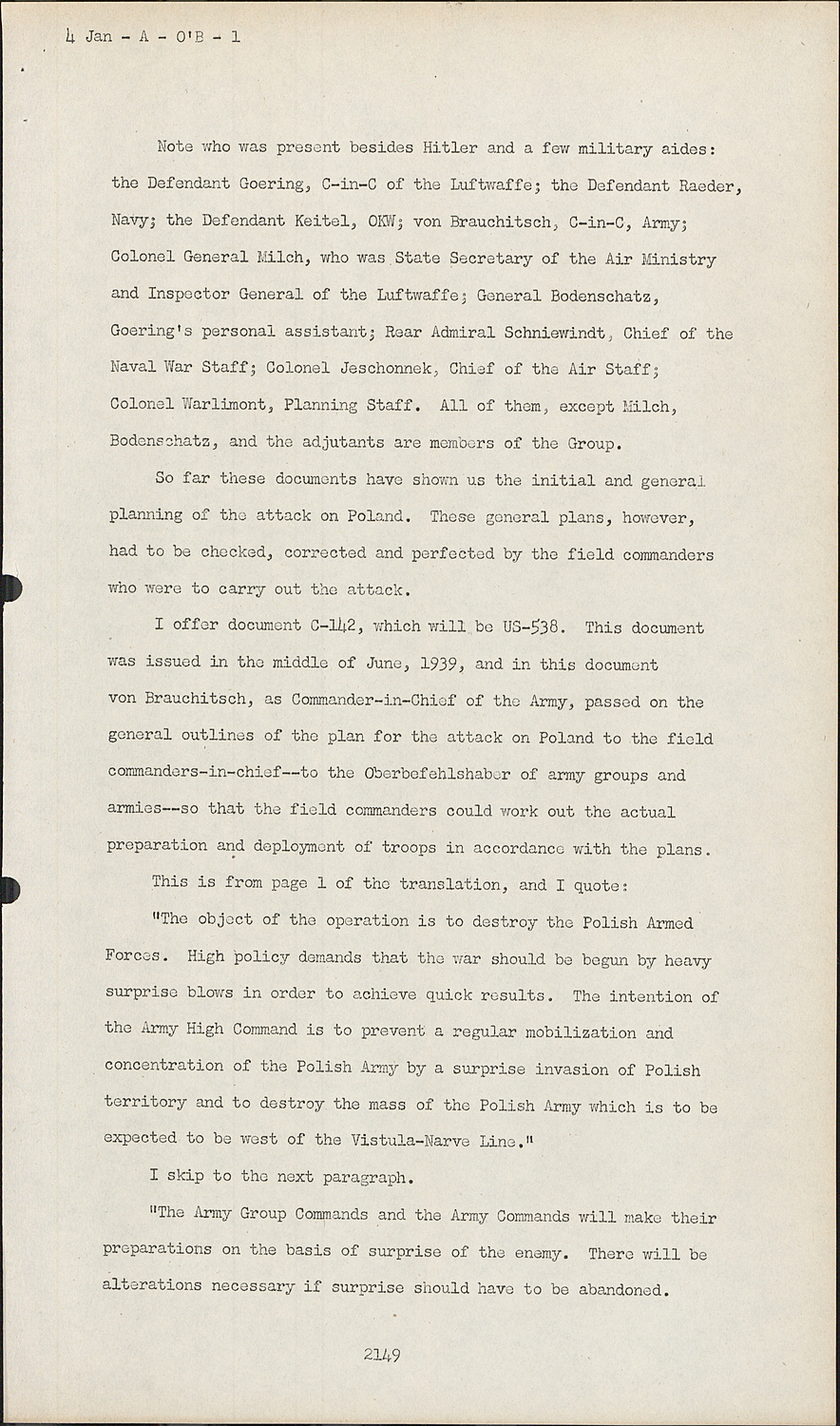
Note who was present besides Hitler and a few military aides:
the Defendant Goering, C-in-C of the Luftwaffe; the Defendant Raeder, Navy; the Defendant Keitel, OKW; von Brauchitsch, C-in-C, Army;Colonel General Milch, who was State Secretary of the Air Ministry and Inspector General of the Luftwaffe; General Bodenschatz, Goering's personal assistant; Rear Admiral Schniewindt, Chief of the Naval War Staff; Colonel Jeschonnek, Chief of the Air Staff;Colonel Warlimont, Planning Staff.
All of them, except Milch, Bodenschatz, and the adjutants are members of the Group.
So far these documents have shown us the initial and general planning of the attack on Poland.
These general plans, however, had to be checked, corrected and perfected by the field commanders who were to carry out the attack.
I offer document C-142, which will be US-538. This document was issued in the middle of June, 1939, and in this document von Brauchitsch, as Commander-in-Chief of the Army, passed on the general outlines of the plan for the attack on Poland to the field commanders-in-chief-to the Oberbefehlshaber of army groups and armies--so that the field commanders could work out the actual preparation and deployment of troops in accordance with the plans.
This is from page 1 of the translation, and I quote:
"The object of the operation is to destroy the Polish Armed Forces.
High policy demands that the war should be begun by heavy surprise blows in order to achieve quick results.
The intention of the Army High Command is to prevent a regular mobilization and concentration of the Polish Army by a surprise invasion of Polish territory and to destroy the mass of the Polish Army which is to be expected to be west of the Vistula-Narve Line."
I skip to the next paragraph.
"The Army Group Commands and the Army Commands will make their preparations on the basis of surprise of the enemy.
There will be alterations necessary if surprise should have to be abandoned.
These will have to be developed simply and quickly on the same basis;
they are to be prepared mentally to such an extent that in case of an order from the Army High Command they can be carried out quickly."
THE PRESIDENT:What is the date of that document?
COLONEL TAYLOR:The date of that document is the middle of June, 1939; I believe it is the 15th or 14th of 1939.
THE PRESIDENT:Did you say June?
COLONEL TAYLOR:Yes, your Honor. The date is on the original.
The next document is 2327-PS, which will be US-539, signed by Blaskowitz.
It is dated 14 June, 1939, and it shows us an Oberbefehlshaber at work in the field planning an attack.
Blaskowitz, at that time, was Commander of the Third Army Area Command, and he became Commander-in-Chief of the German Eighth Army during the Polish campaign.
I read some extracts from this document--found on page 1 of the translation.
"The Commander-in-Chief of the Army has ordered the working out of a plan of deployment against Poland which takes into account the demands of the political leadership for the opening of war by surprise and for quick success.
"The order of deployment by the High Command, known as 'Fall Weiss,' authorizes the Third Army Group--in Fall Weiss Eighth Army Headquarters--to give necessary directions and orders to all commands subordinated to it for 'Fall Weiss.
'" I skip to paragraph 7 on page 1."The whole correspondence on 'Fall Weiss' has to be conducted under the classification 'Top Secret.
' This is to be disregarded only if the content of a document, in the judgment of the chief of the responsible command, is harmless in every way--even in connection with other documents.
"For the middle of July a conference is planned where details on the execution will be discussed.
Time and place will be ordered later on. Special requests are to be communicated to Third Army Group before 10 July."
That is signed: "The Commander in Chief of Army Area Command 3, F. Blaskowitz."
I skip to page 2 to read one further extract under the title - at the top of page 2 of the translation - "Aims of Operation 'Fall Weiss'":
"The operation, in order to forestall an orderly Polish mobilization and concentration, is to be opened by surprise with forces which are, for the most part, armored and motorized, placed on alert in the neighborhood of the border. The initial superiority over the Polish frontier-guards and surprise that can be expected with certainty are to be maintained by quickly bringing up other parts of the Army as well as to counteract the marching up of the Polish Army.
"Accordingly, all units have to keep the initiative against the foe by quick acting and ruthless attacks."
Finally, a week before the actual attack on Poland, and when all the military plans are laid, we find the Group as definited in the Indictment all in one place, in fact, all in one room. On August 23 the Oberfehlshaber assembled at Obersalzberg to hear Hitler's explanation of the timing of the attack and for political and diplomatic orientation from the head of the State. This speech has already been read from at length. It is found in 798-PS, US 29, and I pass over it except to note and emphasize that it is addressed to the very group defined in the Indictment as the General Staff and High Command Group. It is, incidentally, the second of the two examples referred to in the affidavits by Halder and Brauchitsch, numbers 1 and 2 which I read previously.
We have now come to the point where Germany actually launched the war. Within a few weeks, and before any important action on the Western Front, Poland was over-run and conquered; German losses were insignificant.
The three principal territorial questions mentioned in the Blomberg and Blaskowitz affidavits were all solved.
The Rhineland had been reoccupied and fortified; Memel was annexed; the Polish Corridor had been annexed. And a good deal more, too: Austria a part of the Reich; Czechoslovakia occupied; all of Western Poland in German hands. Germany was superior in arms and in experience ever her Western enemies, France and England.
Then came the three black years of the war - 1939, 1940, and 1941, when German armed might swung like a great scythe from North, South, and East: Norway and Denmark; the Low Countries; France: Italy became an ally of Germany; Tripoli and Egypt; Yugolsavlia and Greece; Roumania, Hungary and Bulgaria became allies; the Western part of the Soviet Union overrun.
I would like to deal as a whole with the period from the fall of Poland in October 1939 to the attack against the Soviet Union in June of 1941. In this period occurred the aggressive wars in violation of treaties, as charged in the Indictment, against Norway, Denmark, Holland, Belgium, Luxembourg, Yugoslavia, and Greece.
I cannot improve on nor add much to the presentation of these matters by the British Delegation. From the standpoint of proving crimes against peace, our case is complete. But I would like to review this period briefly from the military standpoint and view it as the German military leaders viewed it. And of one thing we may be sure: None of the Nazis nor the Generals thought daring this period in terms of a series of violations of neutrality and treaties. They thought in terms of a war, a war of conquest, a war for the conquest of Europe. Neutrality, treaties, non-aggression pacts -- these were not the major considerations. They were annoying obstacles, and devices had to be formed and excuses manufactured to fit the circumstances.
Von Blomberg has told us in his affidavit, which I have read, that after 1939 some generals began to condemn Hitler's methods and lost confidence in his judgment. Which particular Hitler methods some of the generals condemned is not stated, but I think the Tribunal will not hear any substantial evidence that many of the generals condemned the march of conquest during the years 1939 to 1941.
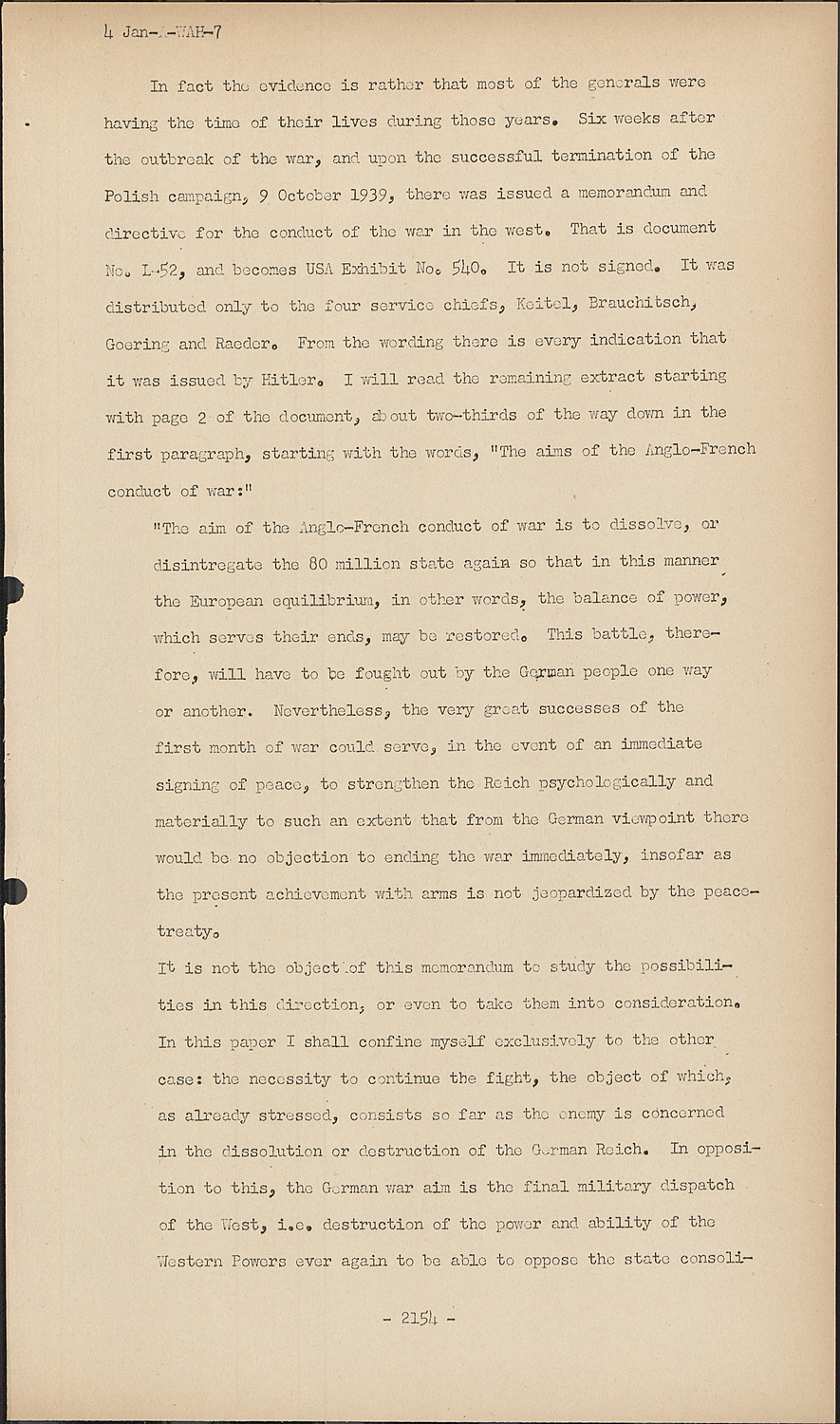
In fact the evidence is rather that most of the generals were having the time of their lives during those years.
Six weeks after the outbreak of the war, and upon the successful termination of the Polish campaign, 9 October 1939, there was issued a memorandum and directive for the conduct of the war in the west. That is document No. L-52, and becomes USA Exhibit No. 540. It is not signed. It was distributed only to the four service chiefs, Keitel, Brauchitsch, Goering and Raeder. From the wording there is every indication that it was issued by Hitler. I will read the remaining extract starting with page 2 of the document, about two-thirds of the way down in the first paragraph, starting with the words, "The aims of the Anglo-French conduct of war:"
"The aim of the Anglo-French conduct of war is to dissolve, or disintregate the 80 million state again so that in this manner the European equilibrium, in other words, the balance of power, which serves their ends, may be restored.
This battle, there fore, will have to be fought out by the German people one way or another.
Nevertheless, the very great successes of the first month of war could serve, in the event of an immediate signing of peace, to strengthen the Reich psychologically and materially to such an extent that from the German viewpoint there would be no objection to ending the war immediately, insofar as the present achievement with arms is not jeopardized by the peace treaty.
It is not the object of this memorandum to study the possibili ties in this direction, or even to take them into consideration.
In this paper I shall confine myself exclusively to the other case:
the necessity to continue the fight, the object of which, as already stressed, consists so far as the enemy is concerned in the dissolution or destruction of the German Reich.
In opposi tion to this, the German war aim is the final military dispatch of the West, i.e. destruction of the power and ability of the Western Powers ever again to be able to oppose the state consoli dation, and further development of the German people in Europe.
As far as the outside world is concerned, however, this internal aim will have to undergo various propaganda adjustments, necessary from a psychological point of view.
This does not alter the war aim.
It is and remains the destruction of our Western enemies.
I now pass to page 3 of the translation, paragraph 2, and the subheading, "Reasons":
"Reasons The successes of the Polish campaign have made possible first of all a war on a single front, awaited for past decades without any hope of realization:"
THE PRESIDENT:Where are you reading now?
COLONEL TAYLOR:Page three of document L-52, paragraph 2 on that page, Your Honor.
THE PRESIDENT:Yes.
COLONEL TAYLOR:Subheading "Reasons".
THE PRESIDENT:Yes.
COLONELTAYLOR: "That is, to say, Germany is able to enter the fight in the West with all her might, leaving only a few covering troops. The remaining European states are neutral either because they fear for their own fates, or lack interest in the conflict as such, or are interested in a certain outcome of the war, which prevents them from taking part at all, or at any rate too soon.
"The following is to be firmly borne in mind."
In line with, and at this point I interpolate here a succession of references to countries when I pass to Belgium and Holland at the foot of page 3: "Belgium and Holland."
THE PRESIDENT:My document has no heading on it.
COLONEL TAYLOR:There is the heading "Russia", and the heading "Italy".
THE PRESIDENT:I have the "The Nordic States", and the "The Southeastern States." That is on page 3.
COLONEL TAYLOR:That is page 4, Your Honor. It is the previous page.
THE PRESIDENT:You are talking about Belgium and Holland?
COLONEL TAYLOR: Belgium and Holland, Yes, sir.
THE PRESIDENT:Go ahead. Page 2, yes.
COLONELTAYLOR: "Both countries are interested in preserving their neutrality but incapable of withstanding prolonged pressure from England and France. The preservation of their colonies, the maintenance of their trade, and thus the securing of their interior economy even of their very life, depend wholly upon the will of England and France. Therefore, in their decisions, in their attitude, and in their actions, both countries are dependent upon the West, in the highest decree. If England and France promise themselves a successful result at the price of Belgian neutrality, they are at any time in a position to apply the necessary pressure. That is to say, without covering themselves with the odium of a breach of neutrality, they can compel Belgium and Holland to give up their neutrality. Therefore, in the matter of the preservation of Belgo-Dutch neutrality, time is not a factor which might promise a favorable development for Germany."
The final paragraph to be read is of the "The Nordic States:
- Provided no completely unforeseen factors appear, their neutrality in the future is also to be assumed. The continuation of German trade with these countries appear possible even in a war of long duration." End of quotation.
Six weeks later, on 23 November 1939, our group, as you will find in the indictment, the Oberbefehlshaber again assembled, as found in document No. 789-PS, already in the record as USA Exhibit No. 23 - our group of Oberbefehlshaber again assembled and heard from Hitler much of what he had said previously to the four service chiefs. This speech, part of which is already in the record, contains other portions not previously read from and now of interest, and the first extract which I would like to read on page 2 of the translation, about half way down in paragraph one, starting with the words: "For the first time in history we have to fight on only one front." I quote:
"For the first time in history we have to fight on only one front, the other front is at present free.
But no one can know how long that will remain so.
I have doubted for a long time whether I should strike in the east, and then in the west.
Basically I did not organize the armed forces in order not to strike. The decision to strike was always in me. Earlier or later, I wanted to solve the problem. Under pressure, it was decided that the east was to be attacked first. If the Polish war was won so quickly it was due to the superiority of our armed forces. The most glorious appearance in history. Unexpectedly small expenditures of men and material. Now the eastern front is held by only a few divi "sions.
It is a situation which we viewed previously as unachievable Now the situation is as follows:
The opponent in the west lies behind his fortifications.
There is no possibility of coming to grips with him.
The decisive question is: how long can we endure this situation."
Passing to page 3 of that document, line 3:
"Everything is determined by the fact that the moment is favorable now, in six months it might not be so any more."
The final passage on page 4 of the translation, in the long paragraph about half way down, beginning, "England can not live without its imports.
We can not feed --"
"England can not live with its imports. We can feed ourselves. The permanent sowing of mines on the English coasts will bring England to her knees.
However, this can only occur if we have occupied Belgium and Holland.
It is a difficult decision for me. None has ever achieved what I have achieved.
My life is of no importance in all this.
I have led the German people to a great height, even if the world does hate us now.
I am setting this work on a gamble. I have to choose between victory or destruction.
I choose victory.
Greatest historical choice, to be compared with the decision of Freidrich the Great before the first Silesian war.
Prussia owes its rise to the heroism of one man.
Even there the closest advisers were disposed to capitalation.
Everything depended on Freidrich the Great.
Even the decisions of Bismarck in 1866 and 1870 were no less great.
My decision is unchangeable. I shall attack France and Eng land at the most favorable and quickest moment.
Breach of the neutrality of Belgium and Holland is meaningless.
No one will question that when we have won.
We shall not bring about the breach of neutrality as idiotically as it was in 1914.
If we do not break the neutrality, then England and France will.
Without attack the war is not to be ended victoriously.
I consider it as possible to end the war only by means of an attack.
The question as to whether the attack will be successful, no one can answer.
Everything depends upon the favorable instant."
End of quotation.
Thereafter, the winter of '39 and '40 passed quickly, the winter of so-called "phony war."
The General Staff and High Command Group all knew what the plan was -- they had all been told.
To attack ruthlessly at the first opportunity;
to smash the French and English forces; to pay no heed to treaties with or neutrality of the Low Countries.
"Breaking of the neutrality of Holland and Belgium is meaningless.
No one will question that when we have won."
That is what Hitler told the Oberbefehlshaber. His generals and admirals agreed, and went forward with their plan.
Now it is not true that all the steps in this march of conquest were conceived by Hitler and that the military loaders embarked on them with reluctance and misgivings.
To show this we need only hark back for a moment to what Mr. Elwyn Jones told the Tribunal about the plans for the invasion of Denmark and Norway.
The Tribunal will recall that Hitler's utterances in October and November, which I have just read, although they are full of threatening comments about France and England and the Low Countries, contain no suggestion of an attack of Scandinavia.
Indeed, Hitler's memorandum of 9 October, from which I read, L-52, affirmatively indicates that Hitler saw no reason to disturb the situation to the north, because he said that onless unforeseen factors appear, the neutrality of the northern states could be assumed.
Trade could be continued with those countries, even in a long war, but a week previously, on the 3rd of October 1939, the Defendant Raeder had caused a questionaire to be circulated within the Naval War Staff seeking comments on the advantages which might be gained from a naval standpoint by securing bases in Norway and Denmark.
That document is C-122, GB-82.
And another document introduced by Mr. Elwyn Jones, C-66, which is GB-81, shows that Raeder was prompted to circulate this questionaire by a letter from another admiral named Karls, who pointed out the importance of an occupation of the Norwegian coast by Germany.
Admiral Karls, Rolf Karls, later attained the rank of Admiral of the Fleet and commanded Naval Group "North", and in that capacity is a member of the group as defined in the indictment as well as Raeder.
The Tribunal will also recall that the defendant Doenitz, who at that time was flag officer submarines, replied to this questionaire from Raeder on 9 October 1939. The document in question is C-5, GB-83. And Doenitz replied that from his standpoint Trojnheim and Narvik met the requirements of a submarine *ase; that Trojnheim was better; and that he proposed the establishment of a U-boat base there. The next day Raeder visited Hitler, and during, this visit certain subsequent events are described in a document which has not previously been introduced.
Now, your Honors, owing to a confusion in numbering, the German document is C-71, but the translation appears in your book in Document L-323, and that will be U.S. 541. The translation will be found in L-322, the middle of the page, entitled, "Entry in the War Diary of the Commander-in-chief of the Navy, Naval War Staff, on Weseruebung," that being the common name for the operation against Norway and Denmark. Diary entry of 10 October 1939, first reference of the Commander-in-Chief of the Navy, Naval War Staff.
"When visiting the Fuehrer, to the significance of Norway for sea and air warfare, the Fuehrer intends to give the matter consideration."
Entry for 12 December: "The Fuehrer received Q and H" (those being presumably Quisling and Hagelin).
Subsequent instructions to the Supreme Command of the Armed Forces to make mental preparations.
The Commander-in-Chief of the Navy is having an essay prepared which will be ready in January.
Then I interpolate. The translation of the next sentence is somewhat in error, and should read, "With reference to this essay Kapitan zur see Krancke is working on 'Weseruebung,' and OKW."
During the time which followed, H (Hagelin) maintained contact with the Chief of Staff of the Commander-in-Chief of the Navy.
His aim was to develop the Party Q (Quisling) with a view to making it capable of making a coup and to give the Supreme Command of the Navy information on the political developments in Norway and military questions.
In general he pressed the speeding up of preparations, but considered that it was first necessary to expand the organization.
I think that is all I need read of that.
Another document, which is C-64, GB-86--already in the record-
shows that on 12 December the Naval War Staff discussed the Norwegian project with Hitler--I am not going to read from that document, your Honors--at a meeting at which the Defendants Keitel and Jodl also attended.
In the meantime Raeder was in touch with the Defendant Rosenberg on the possibilities of using Quisling, and Mr. Elwyn Jones very properly pointed out to the Tribunal the close link between the Service Chiefs and the Nazi politicians.
As a result of all this, on Hitler's instructions Keitel issued a OKW directive on 27 January, 1940, stating that Hitler had commissioned him to undertake charge of preparations for the Norway operation, to which he then gave the code name "Weseruebung."
On 1 March, 1940, Hitler issued the directive setting forth the general plan for the invasion of Norway and Denmark.
That is C-174, GB-89, which Mr. Jones put in the record.
The directive was initialed by Admiral Kurt Fricke, who at that time was head of the Operations Division of the Naval War Staff, and who at the end of 1941 became Chief of the Naval War Staff, and in that capacity is a member of the group as defined in the indictment.
So, as these documents make clear, the plan to invade Norway and Denmark was not conceived in Nazi Party circles, nor forced on the military leaders;on the contrary, it was conceived in the Naval part of the General Staff and High Command Group, and Hitler was persuaded to take the idea up.