He didn't need to do that, since his connection with his Chief, Mueller, was very cood.
Q.Have you been present when Eichmann and Kaltenbrunner met?
A.Yes, at one time I saw a hearty greeting between Eichmann and Kaltenbrunner and that was in February, 1945, in Eichmann's office at Berlin. Kaltenbrunner came every noon for his noon meal to the Kurfuersten Strasse 116, and there gathered the Chiefs for company; and on one occasion like that I personally saw that Kaltenbrunner greeted Eichmann heartily and asked about the health of Eichmann's family in Linz.
Q.In connection with the administration of his office, do you know to what extent Eichmann submitted matters to Heydrich and later to Kaltenbrunner for approval?
A.The ordinary channel of Eichmann to Kaltenbrunner was through Mueller, mid reports to Kaltenbrunner, as far as I know, from time to time were made by Eichmann and submitted to Kaltenbrunner. I also know that in the summer of 1944 he made a personal report to Kaltenbrunner.
Q.Did you have an opportunity to examine files in Eichmann's office?
A.Yes, frequently I had the chance to look into the files of Eichmann's office and I know that Eichmann questioned as to which pertained to his own mission and these he treated with great care. He was a decided bureaucrat, and any conference with any of his superiors was put down in writing and a record made. He always repeated to me that the most important thing was for him to be covered from above at all times. He himself shied away from personal responsibility and was very careful to have the responsibility with his superiors, such as Kaltenbrunner and Mueller.
Q.In the case of a typical report going from Eichmann's department through Mueller, Kaltenbrunner, and to Himmler, have you seen copies of such reports in Eichmann's file?
A.Yes, such copies were in the files, and the regular channel was as follows: Eichmann had a sketch made through an expert or he made it himself, this sketch being to Grupenfuehrer Mueller, his superior, his chief.
Mueller either signed it himself or left the signature to Eichmann. In some cases, as far as reports to Kaltenbrunner and Himmler were concerned, Meuller signed them.
When the report was signed without change by Mueller, it was returned to Eichmann's office and then the final copy was made, together with a copy.
This original went to Mueller for his signature and from then on it was sent to Kaltenbrunner or Himmler.
In some individual cases when there were reports to Himmler involved, Kaltenbrunner himself signed those reports, and I saw conies with Kaltenbrunner's signature myself.
Q.Turning now to countries in which measures were taken affecting the Jews, will you state as to which countries you have personal knowledge of such operations?
A.I have personal knowledge of all measures which were taken in Czechoslovakia.
I am also informed on the evacuation of Jews from Greece and the evacuation from Hungary.
I also know about certain measures in Bulgaria and in Croatia.
The measures taken in other countries I heard about of course, but didn't have a clear picture.
Q. Considering the case of Slovakia, you have already made reference to the 17,000 Jews specially selected who were sent from Slovakia.
Will you tell the Tribunal of the other measures that followed concerning Jews in Slovakia?
A.I mentioned before that the first 17,000 laborers were Jews;
about 35,000 Jews, including families, followed. About August or beginning September, 1942, this action was stopped in Slovakia and the reasons there for were that a large number of Jews were left in Czechoslovakia who had the consent of the government to stay in the country, and when the Slovakian Government made the request to see the Jews, I had to give an unsatisfactory answer.
This state of affairs went on until 1944; from August of 1942 until September of 1944 no Jews were sent from Czechoslovakia Twenty-five to thirty thousand Jews were left in Czechoslovakia.
Q.What happened to the first group of 17,000 specially-selected worke A. This group wasn't annihilated, but was used for labor purposes in Auschwitz and Lublin.
Q.How do you know that?
A.I know this because the Commander of Auschwitz in 1944 came to Hungary and made a remark to that effect to me.
He said at that time that these 17,000 Jews were his best workers in Auschwitz.
Q.What was his name?
A.The Commandant of Auschwitz -- his name was Hoess.
Q.What happened to the approximately 35,000 members of the families of the Jewish workers?
A.They were treated according to the order showed me in August of 1942.
Part of them were left alive if they could be used for work. The others were killed.
Q.How do you know this?
A.I know that from Eichmann and from Hoess, according to the con versations in Hungary.
Q.What portion of this group remained alive?
A.Hoess gave me the figures in a conversation with Eichmann, at which I was present, and he said the rest of the Jews who were left and fit for work were about 25 to 30 per cent,
Q.Referring now to the 25,000 Jews who remained in Slovakia until September of 1944, do you knwo what was done with them?
A.After the Slovak insurrection in the fall of 1944, Hauptsturm Fuehrer Brunner sent through a man of Eichmann's, and my wish to go to Slovakia was turned down by Eichmann.
Brunner, with the help of German police and Slovak police, concentrated the Jews and transported them to Auschwitz.
According to Brunner's statement, about 14,000 were involved.
A small group which remained, according to my knowledge, in the spring of 1944 were sent to another city, Theresienstadt.
Q What happened to these 35,000 Jews after they were shipped from Slovakia?
AI assume that they met with the so-called final solution because this order was not rescinded until some weeks after this all took place.
QConsidering now actions in Greece about which you have personal knowledge, will you tell the Tribunal of the actions there in a chronological sequence?
AIn January, 1943, I was ordered by Eichmann to Berlin and he told me that I was to go to Saloniki and in connection with the German military administration at Macedonia to solve the Jewish problem there. Eichmann's permanent representative was in Saloniki and my departure for Saloniki was February '42. The end of January '42, I was told by Eichmann that for the technical execution of all actions in Greece, Brunner was designated and he was to go with me to Saloniki. Brunner was not under me. He acted independently. In February '42 we went to Saloniki and with the military administration took up our connections as the first action.
QWho was the military administration that you dealt with?
AIt was Dr. Merkel, the chief of the military administration.
QI believe you used 1942 once or more in reference; did you at all times refer to 1943 in dealing with Greece?
AThat is a mistake. These happenings in Greece took place in '43.
QWhat arrangements were made through Dr. Merkel and what actions were taken?
AIn Saloniki Jews were concentrated in certain quarters or certain parts of the city. In Saloniki there were about 60,000 Jews of Spanish descent. Beginning March then, after this concentration had taken place, there was a wire from Eichmann to Brunner directing him for the immediate transportation of Jews of Saloniki and Macedonia to transport them to Auschwitz. With this order Brunner and I went to the military administration. No exceptions were to be made and the measures were carried through as planned. Brunner himself led this action in Saloniki. The transports necessary were requisitioned from the Wehrmacht Commandant, and Brunner, all he had to do was mention how many cars he needed and what time he needed them.
QWere any of the Jewish workers retained at the request of Dr.Merkel or the military administration?
AYes, for railroad construction work and military administration wanted about -- after this construction was completed, the Jews were returned. Just like the rest, they were transported to Auschwitz and these works were carried out in the frame of the Organization Todt.
QWhat was the number of Jewish workers retained for the Organization Todt?
AThree to four thousand.
QWas there any illness among the Jews that were concentrated for transport?
AOn the whole in this concentration camp there were no special cases of illness, but in some of the quarters, parts of the city which were inhabited by Jews a certain kind of typhus and other infections contagious diseases, especially Tuberculosis of the lungs.
QWhat, if any, communication did you have with Eichmann concerning this typhus?
AI told Eichmann by telephone after the wire regarding the transportation of all Jews, and told him about these cases of typhus. He did not respond to this and ordered the immediate beginning of this transportation of the Jews.
QAltogether, how many Jews were collected and shipped from Greece?
AThere were more than 50,000 Jews. I believe that 54,000 Jews were transported from Saloniki and Macedonia.
QWhat was the basis for your figure?
AI, myself, saw a comprehensive report of Brunner's to Eichmann, which was drawn up after these Jews had been transported. Brunner left Saloniki at the end of May, '43. From the beginning of April until May I was not at Saloniki, and Brunner carried out this action alone.
QHow many transports were used for shipping Jews from Saloniki?
AFrom twenty to twenty-five cars, transport trains.
QAnd how many were shipped in each transport?
AThere were at least 2000, and in some cases two and a half thousand in each.
QWhat type of railway equipment was used for these shipments?
AField freight cars. But the evacuees received food to last for about ten days. There was chiefly bread, olives, and other dried foods, also water and a few other hygienic or sanitary means.
QDid you furnish this railway transportation?
ATransports were furnished by the Wehrmacht. That means the cars and the locomotives. The foodstuffs were furnished by the military administration.
QWhat did the sub-section IV A 4 have to do with obtaining this transportation, and who in that sub-section dealt with transportation?
THE PRESIDENT: You needn't go into this in such great detail.
LT. COL. BROOKHART : If your Honor please, this particular question, I believe, will have a bearing on the implications involving the military administration, but I can cut down on the other details.
THE PRESIDENT:Well, you've spent some considerable time in describing how many of them were concentrated. Whether it was 60,000 or how many were kept for the Todt Organization--all those details are really unnecessary.
LT. COL. BROOKHART :Very well, sir.
THE PRESIDENT:You must use your own discretion about how you cut down. I don't know what details or what facts you are going to prove.
LT. COL. BROOKHART:If your Honor please, this witness, as he has testified, is competent to cover practically all details in these Balkan countries. It is not our wish to add accumulative evidence, but his testimony does furnish a complete story from the Head Office to the Reichssicherheitshauptamt through the field operations and through the final solution.
THE PRESIDENT: Well, what is he going to prove about these 50,000 Jews?
LT. COL. BROOKHART: An ultimate disposition, sir, as far as he knows.
THE PRESIDENT:What is he going to prove?
LT. COL. BROOKHART:His ultimate disposition at Auschwitz, as far As he knows.
THE PRESIDENT:Well, you can go on to what ultimately happened to them then.
LT. COL. BROOKHART:What was the destination of these transports of Jews from Greece?
AIn every case or in any case Auschwitz.
Q What was the ultimate disposition of the Jews sent to Auschwitz from Greece?
AThey were without exception brought to the final solution.
QDuring the course of this period were these Jews called upon to furnish their own subsistence?
AI didn't understand the question exactly.
THE PRESIDENT: The matter 'brought to the final solution' I suppose means death.
LT. COL. BROOKHART: Your Honor, this witness will testify that two hundred and eighty million drachmas were deposited in the Greek National Bank for the subsistence of these people:
that this amount was later appropriated by the German military administration.
That is all I have hope to prove by this question.
LT. COL. BROOKHART TO THE WITNESS: Is that a correct statement of your testimony?
AYes. The cash which the Jews possessed was taken away and put into a common account at the Bank of Greece after the Jews were deported or transported away from Saloniki.
Then this account was taken over by the military administration.
About two hundred and eighty million drachmas were involved.
Q You say the Jews taken to Auschwitz were submitted to the final solution:
what do you mean by that?
A I mean by that, wich Eichmann told me at the final solution, that they were destroyed biologically.
As I could gather from my conversations with Eichmann, this annihilation took place in death chambers. The bodies were burned, or cremated.
COL. BROOKHART:If your Honor please, this witness is able to testify as to actions in Hungary, involving approximately five hundred thousand Jews.
THE PRESIDENT:Go on, then. You must use your own discretion. I cannot present your case for you.
COL. BROOKHART:I have no desire to present cumulative evidence.
QTurning to actions in Hungary, will you briefly outline the actions taken there and your participation?
AAfter the entry of German troops in Hungary, Eichmann went personally with a great staff to Hungary, through an order which was signed by the Chief of the SD. I was named to Eichmann's staff. Eichmann began his activities at the end of March, 1944. His activities in Hungary, that is. He worked with the members of the Hungarian government. The first measures which Eichmann, in connection with these officials, took, was a concentration of the Jews in Hungary in certain spots. These measures began in a zone-like arrangement and had their beginning in the so-called Carpatho-Russia and Siebenburgen.
The beginning of this action was the middle of April, 1944. In Carpathia, Russia, more than two hundred thousand Russians were covered by this order and through that, in the small towns and rural regions, where the Jews were concentrated, almost impossible conditions as to food and shelter arose, and from this situation arose the suggestion of Eichmann to the Hungarians that those Jews be transported to Auschwitz and other concentration camps.
He insisted that a corresponding request by the Hungarian Government be submitted to him. This request was made by State Secretary Von Backer, and the Hungarian police carried through this evacuation.
Eichmann himself made me a liaison officer by Lt. Col. Ferency, who was appointed from the Hungarian Ministry to assist in this evacuation. The transporting of these Jews from Hungary began in May 1944 and the transporting away began with the Carpathian district of Russia, Siebenburgen, North Hungary and South Hungary and in West Hungary.
Budapest was to be evacuated by the end of June but this did not take place because Von Horthy did not permit it. This action included about 450 thousand Jews. A second action took place.
Q.Will you tell the Tribunal what, if anything, was done about organizing Einsatzgruppe to act in Hungary on the Jewish question?
ABeginning March, 1944, the so-called Einsatzgruppe of the Security Police and SD was made up at Mauthausen by Linz. Eichmann himself had special command of all people who had special functions in his sphere, and a special action Kommando was collected at Mauthausen. Dr. Geschke was head of this Gruppe in business matters.
QWhat was the meaning of the designation "Special Action Kommando Eichmann", in relation to the movement into Hungary?
AEichmann's activities in Hungary included all matters connected with the Jewish problem.
QUnder whose direct supervision was Special Action Kommando Eichmann organized?
AI said already that in matters of personnel and economic matters, Eichmann was subordinate to Geschke, and Eichmann reported on action which he undertook directly to Berlin, either to Gruppenfuehrer Mueller, or, in more important things, to the Chief of the Security Police; that was Kaltenbrunner.
QDuring the period in which Hungarian Jews were being selected, what, if any, contact was made by the Joint Distribution Committee on Jewish Affairs, with Eichmann's representative?
AThe Joint Distribution Committee made efforts to have a meeting with Eichmann and to try to prevent the destiny of the Hungarian Jews, I, myself, facilitated this connection with Eichmann. I wanted to find a means that this half-million Jews -- that the Jews in Hungary should not be covered by the measures mentioned.
The Joint Distribution Committee made suggestions to Eichmann, and requested that the Jews remain in Hungary. Those suggestions were specially of a financial nature. Eichmann saw that he had cause to give these suggestions to Himmler, although he hesitated to do that.
Himmler had further con ferences with Standartenfuehrer Becher, and Pecher had conferences with Dr. Kastner, and Eichmann wanted to bring those conferences to nought.
He wanted to have results - that is, to have as many Jews as possible to Auschwitz.
THE PRESIDENT:Need we go into all these conferences? Can't you take us on to other matters?
COL. BROOKHART:I didn't hear all of your question, sir.
THE PRESIDENT:Need we have the details about those conferences?
COL. BROOKHART:The witness is inclined to be lengthy in his answers. That has been true in his pre-trial examination. I will try ...
THE PRESIDENT:You are examining *---*
COL. BROOKHART:Yes sir.
QWas there any money involved in the meeting between Dr. Kastner and Eichmann?
AYes.
QHow much?
AIn the first conversations, Dr. Kastner gave Eichmann about three million pengos and the amounts mentioned later, I don't know exactly.
QTo whom did Dr. Kastner give this money and what became of it?
AIt was given to Eichmann and he gave it to a Treasury and this sum was given to the deputy of the SD in Hungary and the security Police.
QThese actions that you have described involving approximately 450 thousand Jews being moved from Hungary -- were there any official communications sent to Berlin concerning these movements?
AYes. For every transport that left a report was sent to Berlin. Eichmann, from time to time, gave comprehensive reports to the RSHA and the Chief of the Security Police.
QNow, with reference to the Jews that remained in Budapest, what, if any, action was taken against them?
ADr. Salasy took over the government in Hungary.
THE PRESIDENT:We have not yet heard, have we, what happened to those Jews in Hungary? If we have, I have missed it.
COL. BROOKHART: I will ask that question now, sir.
QWhat became of the Jews to whom you have already referred - apprximately 450 thousand?
AWithout exception they were brought to Auschwitz and brought to the final solution.
QDo you mean they were killed?
AYes; with the exception of perhaps 25 or 30% who were used for purposes of work and I am referring to the conferences between Hoess and Eichmann, which took place at Budapest.
QWith reference to the Jews remaining in Budapest, what happened to them?
AIn October, November 1944, about 30 (perhaps a few thousand more) were taken out and brought to Germany. They were to be used for defensive work in Vienna and to work on those fortifications. Mostly women were involved.
These Jews had to take the road from Hungary to the German border by foot - almost 200 kilometres. They were put into March Groups and followed specially-designated routes.
Their shelter and nutrition on this march was very bad. Most of them took sick and were exhausted. I had the mission from Eichmann to take over these groups at the German border and to bring them to the Gauleitung Lower Danube for purposes of work. In many cases the taking over of these workers was turned down by me, because the people were totally exhausted and in a very poor state, because of illness. Eichmann forces me to take over even these people and threatened that he would turn me over to Himmler, so that I would be turned over and put into a concentration camp if I were to make further political trouble, and through these matters, I was removed from Eichmann's department.
A small part of these people were put into the work camps on the Lower Danube and they died through exhaustion.

A small percentage, perhaps twelve-thousand were taken to Vienna, the boundary part to the west, and but three thousand were taken to Bergen and Belsen, and then into Switzerland.
Those were Jews that had come from Germany,
Q.Summarizing the countries of Greece, Hungary and Slovakia, approxi mately how many Jews were affected by measures of the secret police, and the SD in those countries, about which you have personal knowledge?
A.In Slovakia there were about sixty-six thousand. In Greece about sixty-four thousand.
In Hungary more than half a million.
Q.In the countries of Silesia and Bulgaria, about which you have some knowledge, how many Jews were thus affected?
A.In Bulgaria I know of about eight thousand. In Croatia I know only about three-thousand of a group were brought in the summer of '42 from Auschwitz.
Q.Were meetings held of the specialist on the Jewish problem from Amt IV-A for the terms which appear on this sheet, to which you made reference earlier?
A.Yes. Eichmann had the habit every year to have a large meeting in Berlin of all the people who were working for him.
Those meetings were usually in November, and our man who were working for him in a foreign country had to report about the activities.
In the year of 1944, a meeting didn't take place, that I know, because at that time Eichmann was still in Hungary.
Q.In connection with the Jews, about which you have personal knowledg how many were subject to the final solution; that is, the beginning of the year?
A.The exact number is very, very hard to determine. I should take certain things to go by, and these conversations between Eichmann and Hoess in Vienna, in which he said that some Jews who were transported from Greece to Auschwitz, only a few who were fit to work.
But the Jews from Slovakia and Hungary who were about fit to work was from twenty-five to thirty percent.
It is very hard for me to give a total figure exactly.
Q. In meetings with the other specialists over the Jewish problem, and with Eichmann, did you gain any knowledge, or information, as to the total number of Jews killed under this program?
A.Eichmann personally always talked about at least four million Jews.
Sometimes he mentioned a figure of five million. My own personal estimate, I would say was at least four-million Jews which were covered by the so-called final solution.
How many of those actually remained alive, I am in no position to say.
Q.When did you last see Eichmann?
A.I saw Eichmann last the end of February 1945 at Berlin. At that time he mentioned that if the war ended he would commit suicide.
Q.Had he been referring at that time to the number of Jews that had been killed?
A.Yes. He made a special point of that, and he said that he would -
he would laugh at the fact that he had five million people of his conscious, and that this knowledge was special thought to him.
COLONEL BROOKHART:The witness is available for any cross examination.
THE PRESIDENT:Does any other prosecuting counsel wish to examine the witness?
MR. ROBERTS:I have no further questions to ask.
The PRESIDENT: Does the Soviet Prosecutor wish to ask any questions?
COLONEL POKROWSKI:At this stage no questions does the Soviet Union wish to ask.
THE PRESIDENT:Does the French Prosecutor wish to ask any questions?
(No response)
MR. SERVATIUS:Mr. Servatius speaking for the defendant Sauckel.
CROSSEXAMINATION - by MR. SERVATIUS:
Q.Now, you mentioned, of course, the labor by Jews, the taking of Jews from Slovakia at Auschwitz, where they were used for work.
Then later, you mentioned those Jews from Hungary that came to the southeast wall fortification.
Do you know whether a man in charge, Chief of Labor, Sauckel, was connected with this office as a result of that, or his direction is in any way connected with these things?

A.So far as the Jews from Slovakia are concerned, Sauckel had nothing to do with these.
It was an internal matter for the inspector of the concentration camp system of these Jews, the taking of Jews for the southeast wall fortification.
I can not count quickly enough to answer this question.
I do not know how far Sauckel was connected with this.
The Jews which were taken from Hungary borders to work he turned over to the Gauleiter of the lower Danube.
MR. SERVATIUS:I have not further questions to ask the witness.
BY DR. BABEL (Counsel for SS and SD)
QYou talked about measures of the Security Police and of the SD, and you mentioned these organizations several times in your testimony.
Do you use these designations officially, or shall I take it from this testimony that the SD, Security Service, was participating?
AThe actions that I mentioned and which were carried out by Amt IV, Gestapo, if I mentioned the Chief of the SD, I mention it because it was the official designation.
QNot to mention the SD especially--the SD as far as these Jewish measures were concerned, was it involved?
AThe SD as an organization was not involved. Some of the leaders which worked with Eichmann came from the SD, I myself also, but they were ordered to Amt IV to the Gestapo.
QThe former members of the SS, of the SD, who later were active in the Gestapo, were they still members of their former organization, or were they members of the Gestapo?
ANo, they were still with the SD.
QI see, and as members of the SD or in carrying out the orders of the Gestapo -
AWe belonged for the carrying out of this order to the Gestapo.
Our orders came from the Gestapo.
QFrom Amt IV. And in connection with this, one more question.
Someone who was an outsider, could he get any sense out of this labyrinth?
ANo, it was almost impossible to do that.
THE PRESIDENT: Do any others of the Defense Counsel wish to cross-examine this witness?
Colonel Amen, or Colonel Brookhart, do you wish to re-examine the witness?
COLONEL AMEN: No further questions, your Lordship.
THE PRESIDENT: No further questions?
COLONEL AMEN: No further questions.
THE PRESIDENT: Very well. That will do.
(The witness was excused.)
COLONEL AMEN:It will take about ten minutes, sir, to get the next witness up.
I hadn't anticipated we would finish quite this quickly.
Do you still want me to get him up this afternoon?
THE PRESIDENT:Have you any other witnesses on these subjects?
COLONEL AMEN:Not on this subject, sir. I have two very short witnesses, one on the written agreement as to which testimony was given this morning between the OKW, the OKH and the RSHA;the witnesses who can answer questions that the members of the Tribunal asked this morning very briefly, and one other witness which is on a totally different subject.
THE PRESIDENT:On what subject is the other witness?
COLONEL AMEN:Well, he is on the subject of identifying two of the defendants at one of the concentration camps.
I don't like to mention his name to the Defense unless you wish me to.
THE PRESIDENT:Very well. Then you will call those two witnesses tomorrow?
COLONEL AMEN:Yes, your Lordship. I don't think either of them will take more than twenty minutes apiece.
THE PRESIDENT:Then you will go on with the evidence against the High Command?
COLONEL AMEN:Yes, sir.
THE PRESIDENT:We will adjourn now.
(Whereupon at 17.00 hours the Hearing of the Tribunal adjourned to reconvene at 10.
00 hours on January 4th, 1946.)
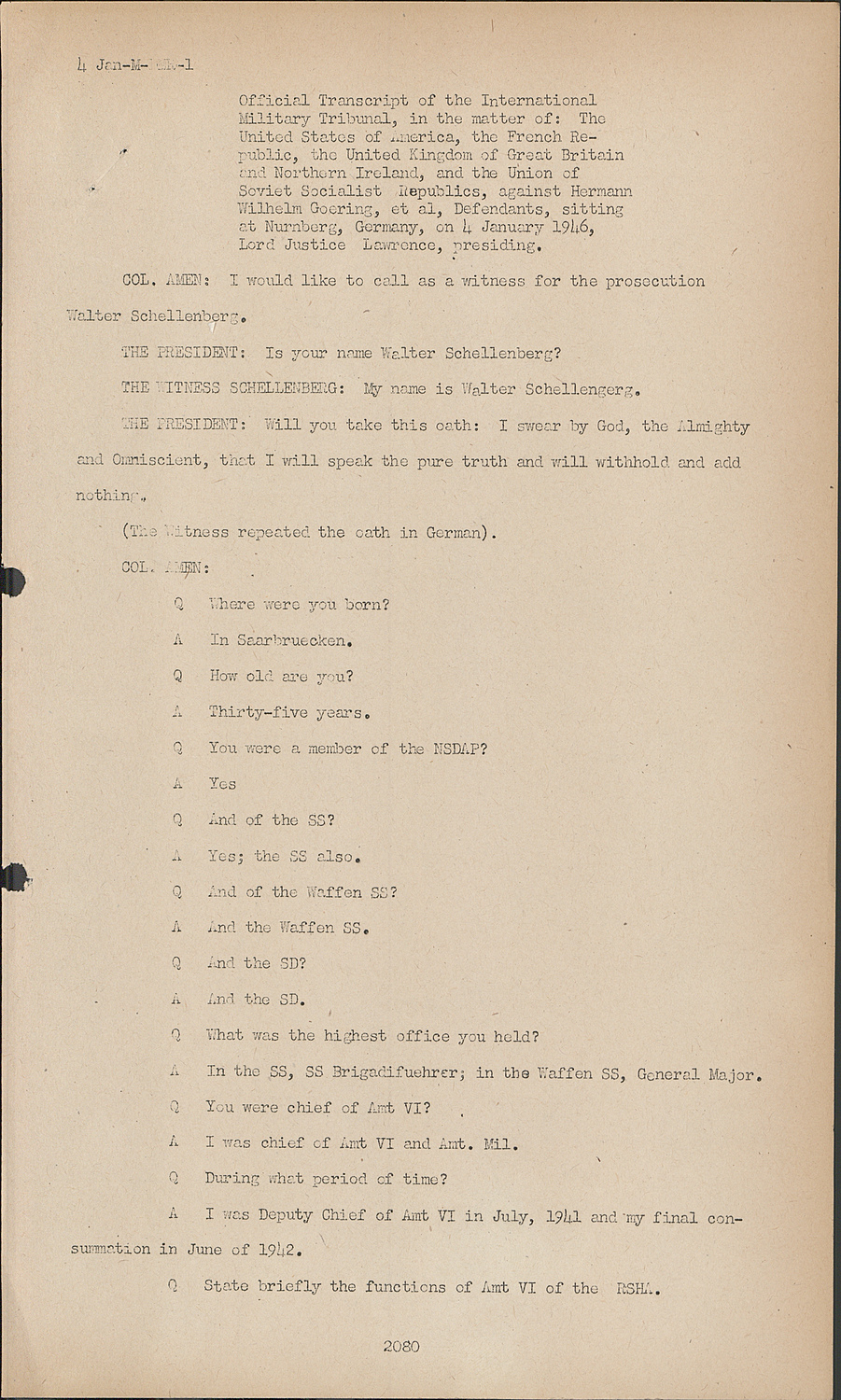
Official Transcript of the International Military Tribunal, in the matter of:
The United States of America, the French Re public, the United Kingdom of Great Britain and Northern Ireland, and the Union of Soviet Socialist Republics, against Hermann Wilhelm Goering, et al, Defendants, sitting at Nurnberg, Germany, on 4 January 1946, Lord Justice Lawrence, presiding.
COL. AMEN:I would like to call as a witness for the prosecution Walter Schellenberg.
THE PRESIDENT:Is your name Walter Schellenberg?
THE WITNESS SCHELLENBERG:My name is Walter Schellengerg.
THE PRESIDENT:Will you take this oath: I swear by God, the Almighty and Omniscient, that I will speak the pure truth and will withhold and add nothing.
(The Witness repeated the oath in German).
COL. AMEN:
Q Where were you born?
A In Saarbruecken.
Q How old are you?
A Thirty-five years.
Q You were a member of the NSDAP?
A Yes Q And of the SS?
A Yes; the SS also.
Q And of the Waffen SS?
A And the Waffen SS.
Q And the SD?
A And the SD.
Q What was the highest office you held?
A In the SS, SS Brigadifuehrer; in the Waffen SS, General Major.
Q You were chief of Amt VI?
A I was chief of Amt VI and Amt. Mil.
Q During what period of time?
A I was Deputy Chief of Amt VI in July, 1941 and my final consummation in June of 1942.
Q State briefly the functions of Amt VI of the RSHA.
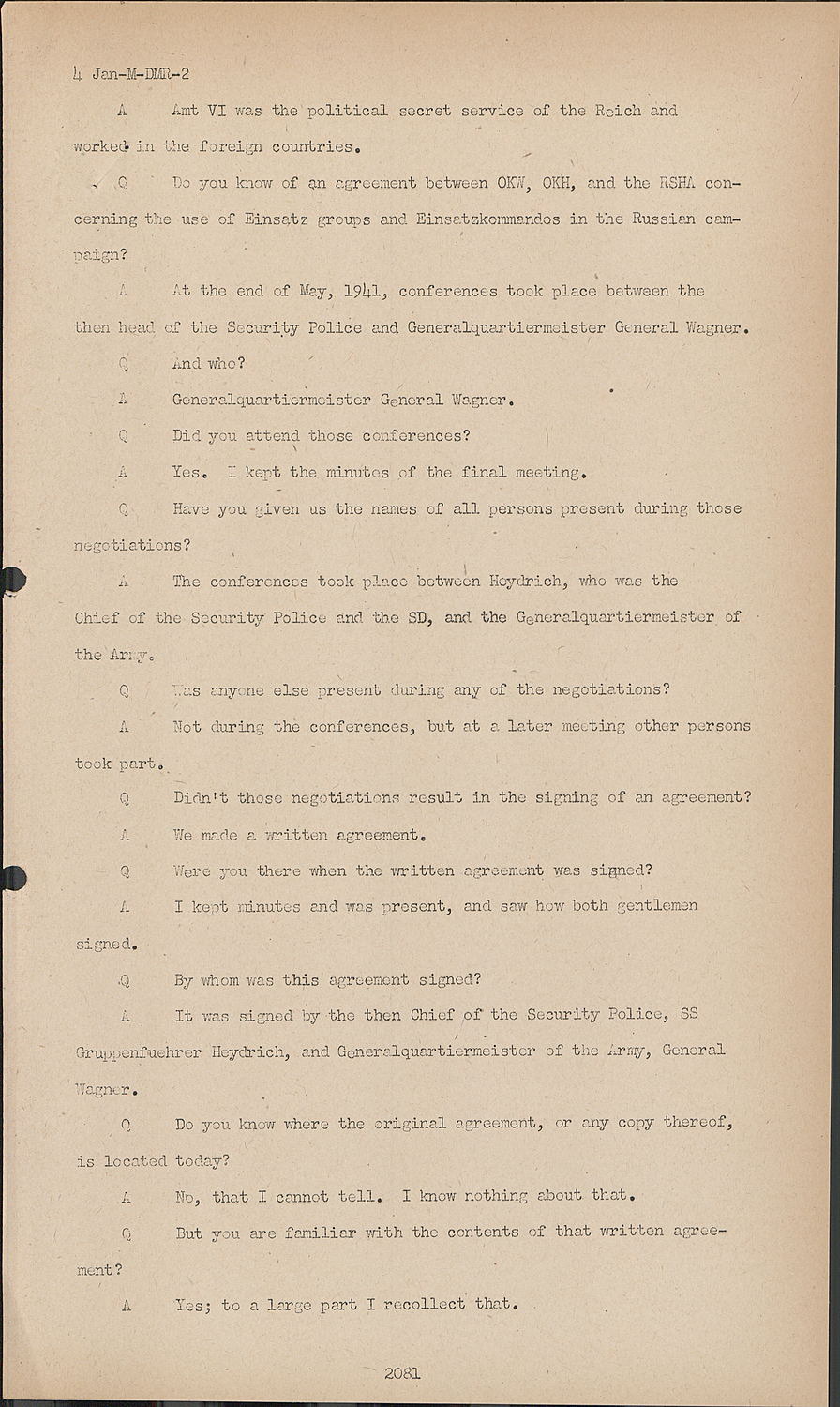
A Amt VI was the political secret service of the Reich and worked in the foreign countries.
QDo you know of an agreement between OKW, OKH, and the RSHA concerning the use of Einsatz groups and Einsatzkommandos in the Russian campaign?
AAt the end of May, 1941, conferences took place between the then head of the Security Police and Generalquartiermeister General Wagner.
QAnd who?
AGeneralquartiermeister General Wagner.
QDid you attend those conferences?
AYes. I kept the minutes of the final meeting.
QHave you given us the names of all persons present during those negotiations?
AThe conferences took place between Heydrich, who was the Chief of the Security Police and the SD, and the Generalquartiermeister of the Army.
QWas anyone else present during any of the negotiations?
ANot during the conferences, but at a later meeting other persons took part.
QDidn't those negotiations result in the signing of an agreement?
AWe made a written agreement.
QWere you there when the written agreement was signed?
AI kept minutes and was present, and saw how both gentlemen signed.
QBy whom was this agreement signed?
AIt was signed by the then Chief of the Security Police, SS Gruppenfuehrer Heydrich, and Generalquartiermeister of the Army, General Wagner.
QDo you know There the original agreement, or any copy thereof, is located today?
ANo, that I cannot tell. I know nothing about, that.
QBut you are familiar with the contents of that written agreement?
AYes; to a large part I recollect that.