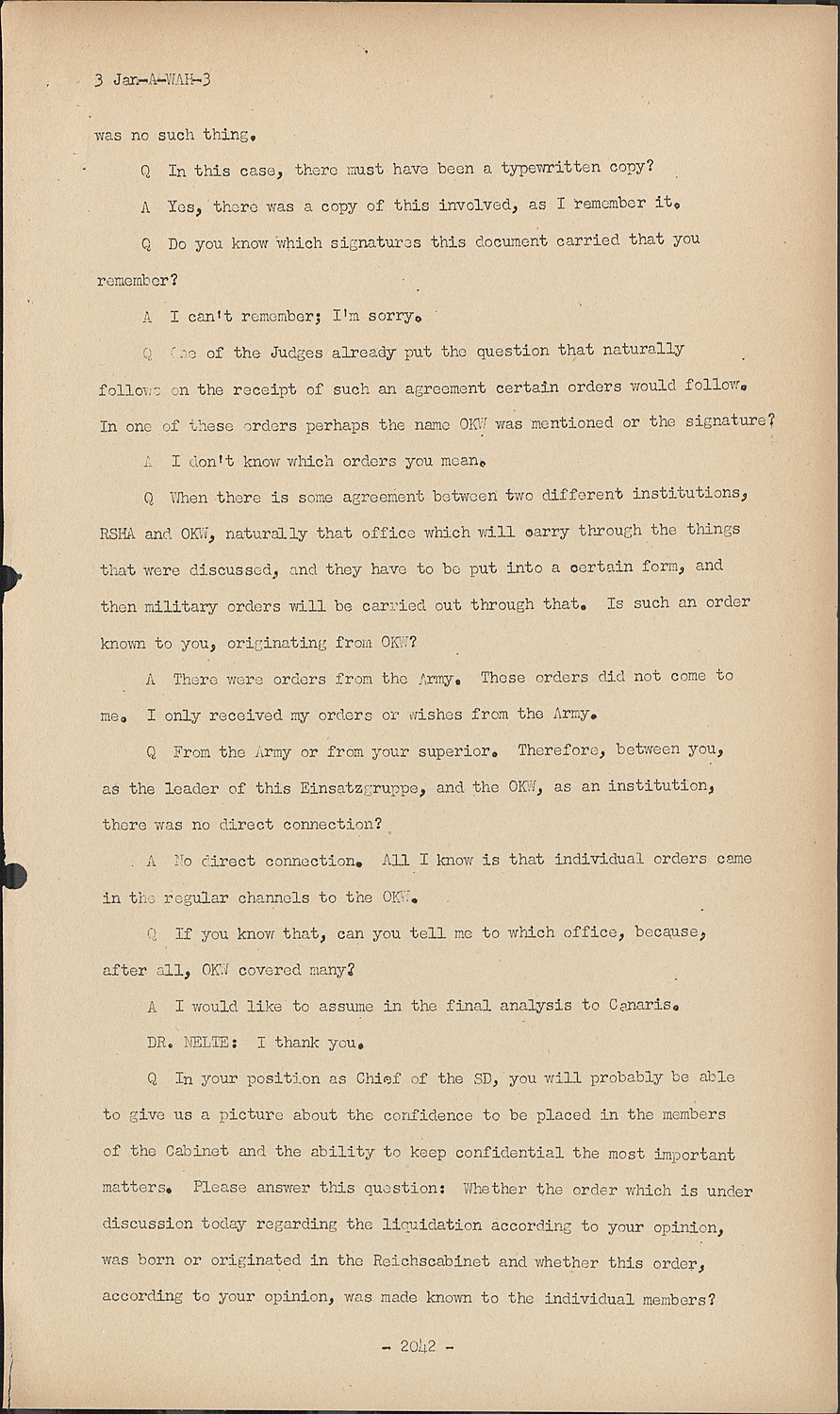
QIn this case, there must have been a typewritten copy?
AYes, there was a copy of this involved, as I remember it.
QDo you know which signatures this document carried that you remember?
AI can't remember; I'm sorry.
QOne of the Judges already put the question that naturally follows on the receipt of such an agreement certain orders would follow. In one of these orders perhaps the name OKW was mentioned or the signature?
AI don't know which orders you mean.
QWhen there is some agreement between two different institutions, RSHA and OKW, naturally that office which will Carry through the things that were discussed, and they have to be put into a certain form, and then military orders will be carried out through that. Is such an order known to you, originating from OKW?
AThere were orders from the Army. These orders did not come to me. I only received my orders or wishes from the Army.
QFrom the Army or from your superior. Therefore, between you, as the leader of this Einsatzgruppe, and the OKW, as an institution, there was no direct connection?
ANo direct connection. All I know is that individual orders came in the regular channels to the OKW.
QIf you know that, can you tell me to which office, because, after all, OKW covered many?
AI would like to assume in the final analysis to Canaris.
DR. NELTE:I thank you.
QIn your position as Chief of the SD, you will probably be able to give us a picture about the confidence to be placed in the members of the Cabinet and the ability to keep confidential the most important matters. Please answer this question: Whether the order which is under discussion today regarding the liquidation according to your opinion, was born or originated in the Reichscabinet and whether this order, according to your opinion, was made known to the individual members?
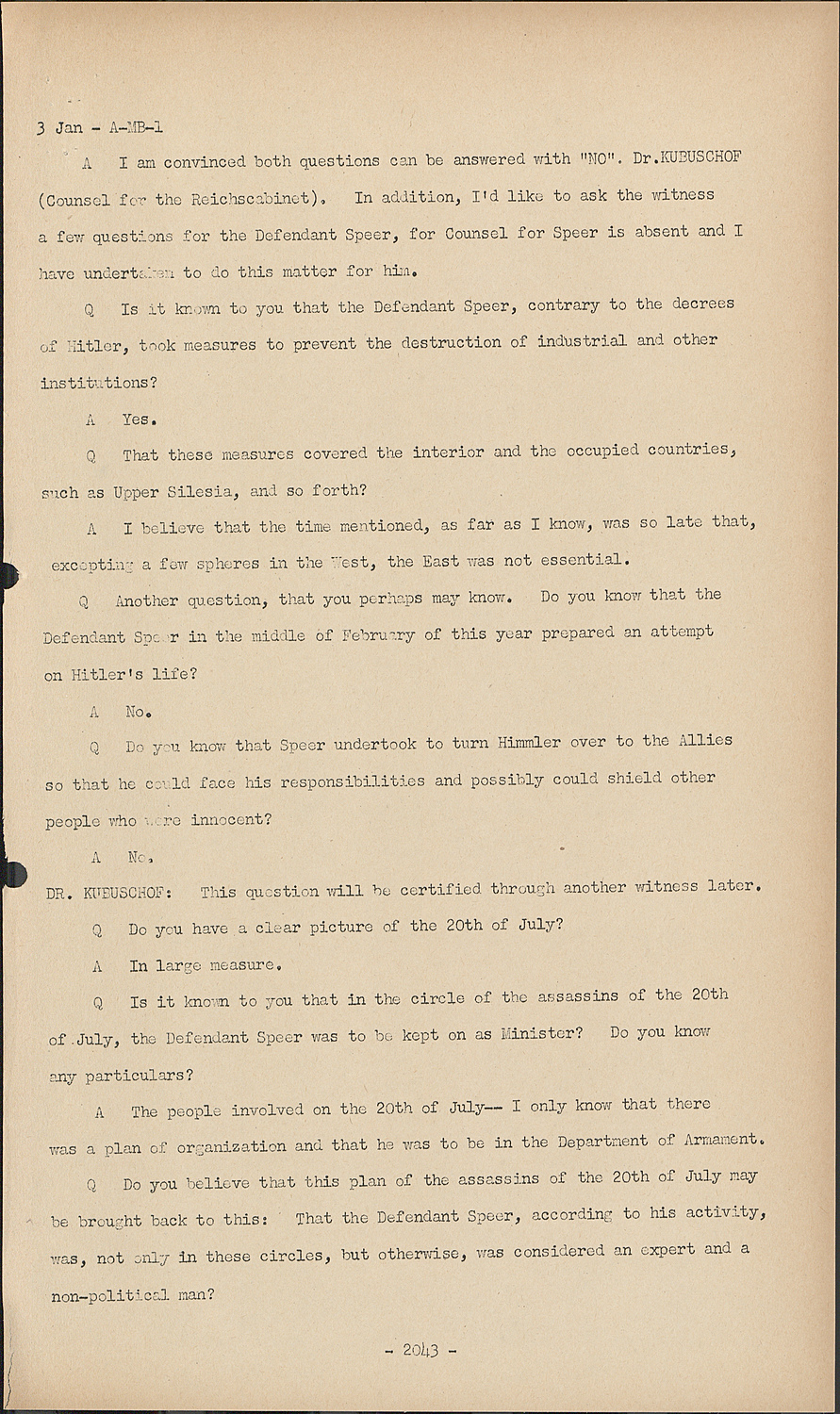
A I am convinced both questions can be answered with "NO". Dr. KUBUSCHOF (Counsel for the Reichscabinet). In addition, I'd like to ask the witness a few questions for the Defendant Speer, for Counsel for Speer is absent and I have undertaken to do this matter for him.
QIs it known to you that the Defendant Speer, contrary to the decrees of Hitler, took measures to prevent the destruction of industrial and other institutions?
AYes.
QThat these measures covered the interior and the occupied countries, such as Upper Silesia, and so forth?
AI believe that the time mentioned, as far as I know, was so late that excepting a few spheres in the West, the East was not essential.
QAnother question, that you perhaps may know. Do you know that the Defendant Speer in the middle of February of this year prepared an attempt on Hitler's life?
ANo.
QDo you know that Speer undertook to turn Himmler over to the Allies so that he could face his responsibilities and possibly could shield other people who were innocent?
ANo. DR. KUBUSCHOF: This question will be certified through another witness later.
QDo you have a clear picture of the 20th of July?
AIn large measure.
QIs it known to you that in the circle of the assassins of the 20th of-July, the Defendant Speer was to be kept on as Minister? Do you know any particulars?
AThe people involved on the 20th of July-- I only know that there was a plan of organization and that he was to be in the Department of Armament.
QDo you believe that this plan of the assassins of the 20th of July may be brought back to this: That the Defendant Speer, according to his activity, was, not only in these circles, but otherwise, was considered an expert and a non-political man?
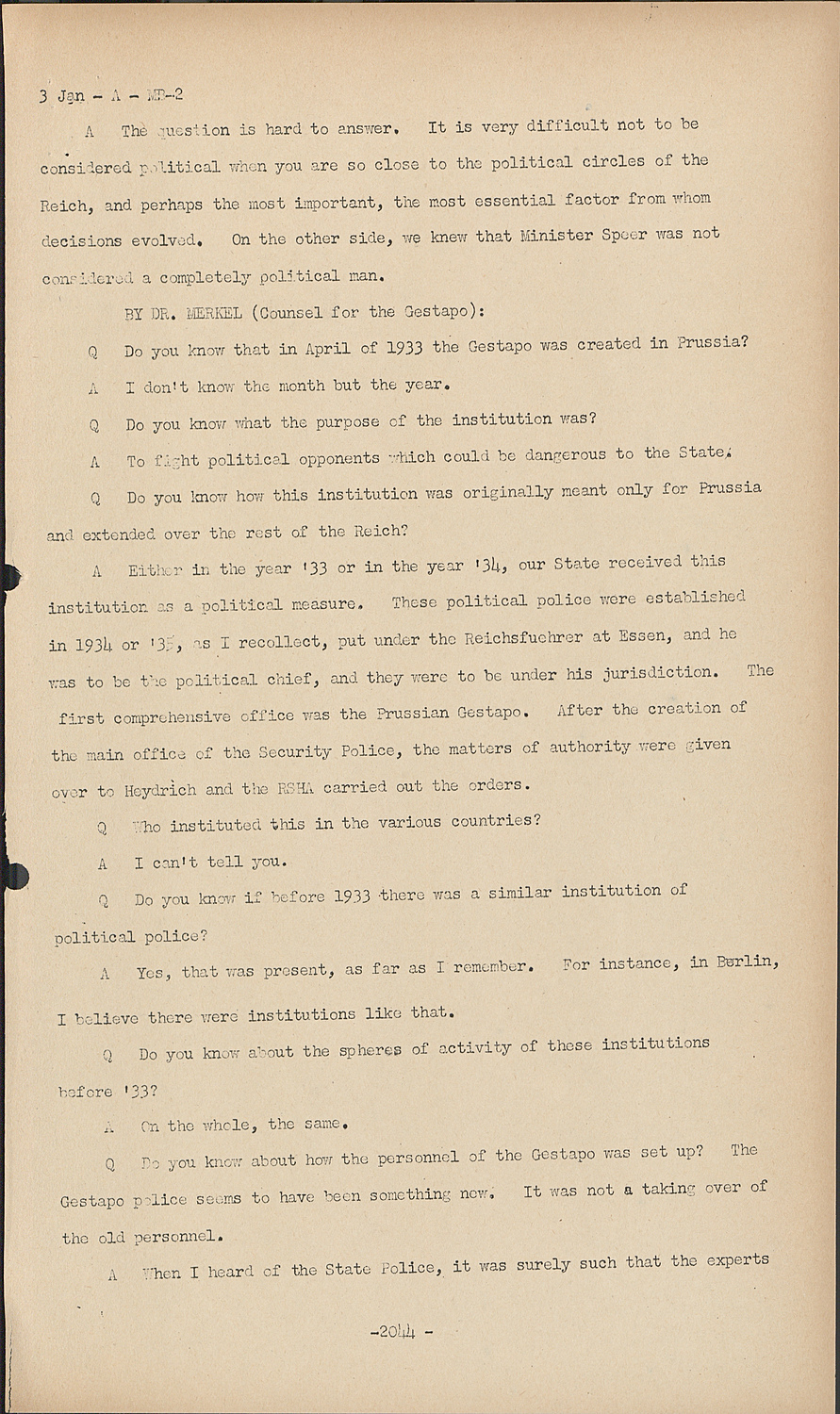
A The question is hard to answer. It is very difficult not to be considered political when you are so close to the political circles of the Reich, and perhaps the most important, the most essential factor from whom decisions evolved.
On the other side, we knew that Minister Speer was not considered a completely political man.
BY DR.MERKEL (Counsel for the Gestapo):
QDo you know that in April of 1933 the Gestapo was created in Prussia?
AI don't know the month but the year.
QDo you know what the purpose of the institution was?
ATo fight political opponents which could be dangerous to the State.
QDo you know how this institution was originally meant only for Prussia and extended over the rest of the Reich?
AEither in the year 133 or in the year 134, our State received this institution as a political measure. These political police were established in 1934 or '35, as I recollect, put under the Reichsfuehrer at Essen, and he was to be the political chief, and they were to be under his jurisdiction. The first comprehensive office was the Prussian Gestapo.
After the creation of the main office of the Security Police, the matters of authority were given over to Heydrich and the RSHA carried out the orders.
QWho instituted this in the various countries?
AI can't tell you.
QDo you know if before 1933 there was a similar institution of political police?
AYes, that was present, as far as I remember. For instance, in Berlin, I believe there were institutions like that.
QDo you know about the spheres of activity of these institutions before '33?
AOn the whole, the same.
QDo you know about how the personnel of the Gestapo was set up? The Gestapo police seems to have been something new. It was not a taking over of the old personnel.
AWhen I heard of the State Police, it was surely such that the experts of the Criminal Police were taken over and that the leading men in the State Police offices, that is, in the regular offices of the State Police, for the most part came from the inner administration, and they were taken from the inner administration of the country, and the same thing would hold true for the experts of Amt 4 and the Gestapo.
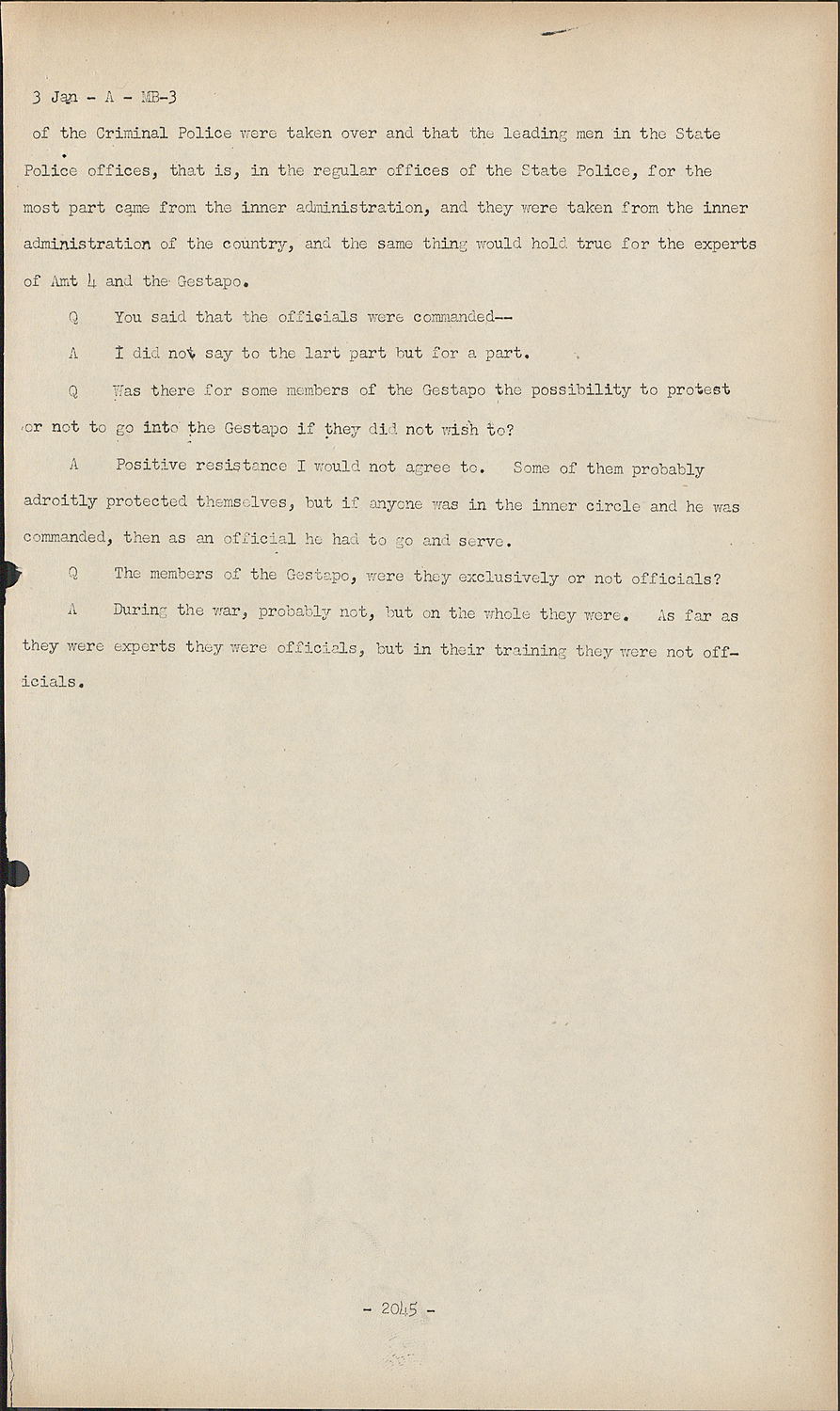
QYou said that the officials were commanded-
AI did not say to the lart part but for a part.
QWas there for some members of the Gestapo the possibility to protest or not to go into the Gestapo if they did not wish to?
APositive resistance I would not agree to. Some of them probably adroitly protected themselves, but if anyone was in the inner circle and he was commanded, then as an official he had to go and serve,
QThe members of the Gestapo, were they exclusively or not officials?
ADuring the war, probably not, but on the whole they were. As far as they were experts they were officials, but in their training they were not officials.
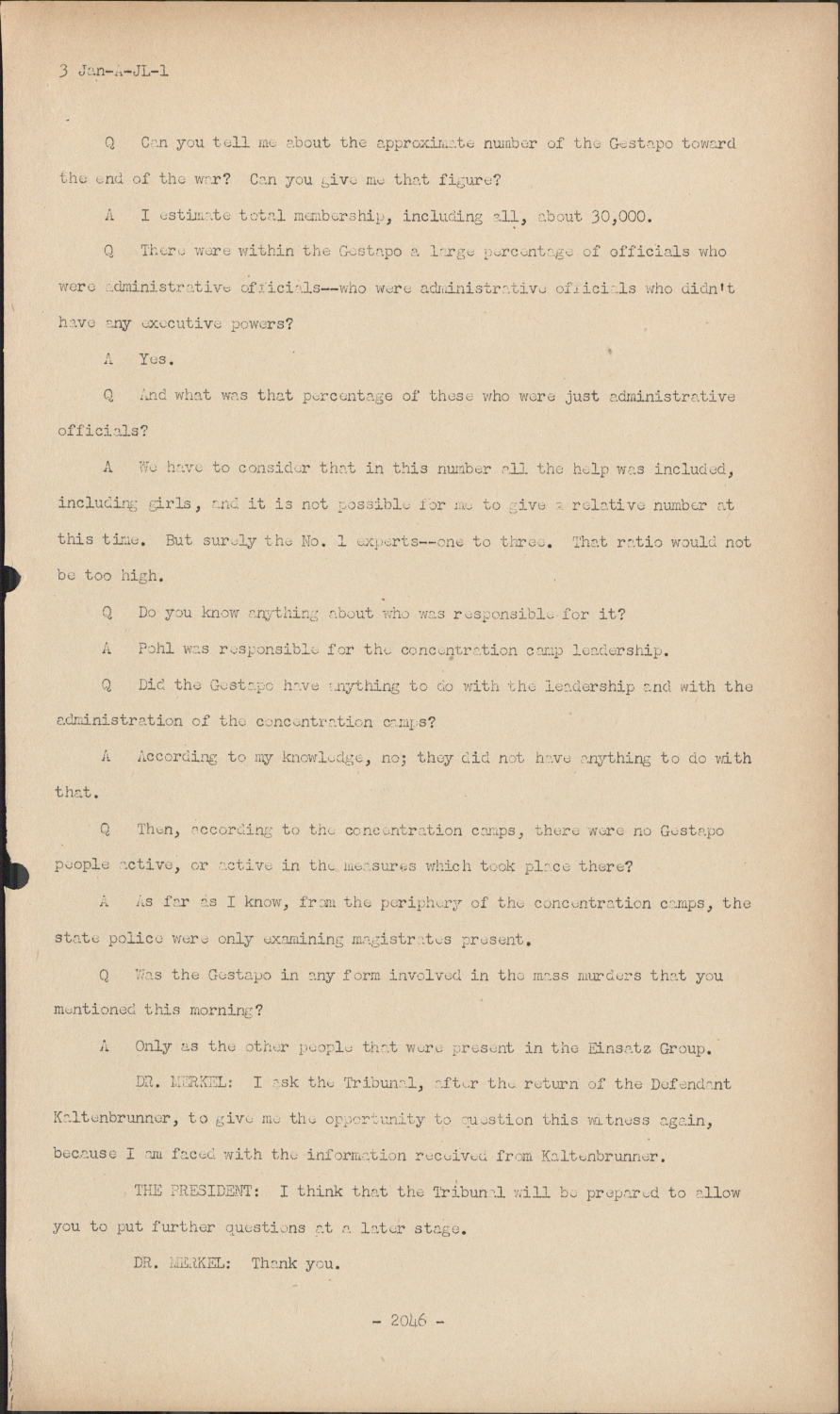
Q Can you tell me about the approximate number of the Gestapo toward the end of the war?
Can you give me that figure?
AI estimate total membership, including all, about 30,000.
QThere were within the Gestapo a large percentage of officials who were administrative officials--who were administrative officials who didn't have any executive powers?
AYes.
QAnd what was that percentage of these who were just administrative officials?
AWe have to consider that in this number all the help was included, including girls, and it is not possible for me to give a relative number at this time. But surely the No. 1 experts--one to three. That ratio would not be too high.
QDo you know anything about who was responsible for it?
APohl was responsible for the concentration camp leadership.
QDid the Gestapo have anything to do with the leadership and with the administration of the concentration camps?
AAccording to my knowledge, no; they did not have anything to do with that.
QThen, according to the concentration camps, there were no Gestapo people active, or active in the measures which took place there?
AAS far as I know, from the periphery of the concentration camps, the state police were only examining magistrates present.
Q was the Gestapo in any form involved in the mass murders that you mentioned this morning?
AOnly as the other people that Were present in the Einsatz Group.
DR. MERKEL:I ask the Tribunal, after the return of the Defendant Kaltenbrunner, to give me the opportunity to question this witness again, because I am faced with the information received from Kaltenbrunner.
THE PRESIDENT:I think that the Tribunal will be prepared to allow you to put further questions at a later stage.
DR. MERKEL:Thank you.
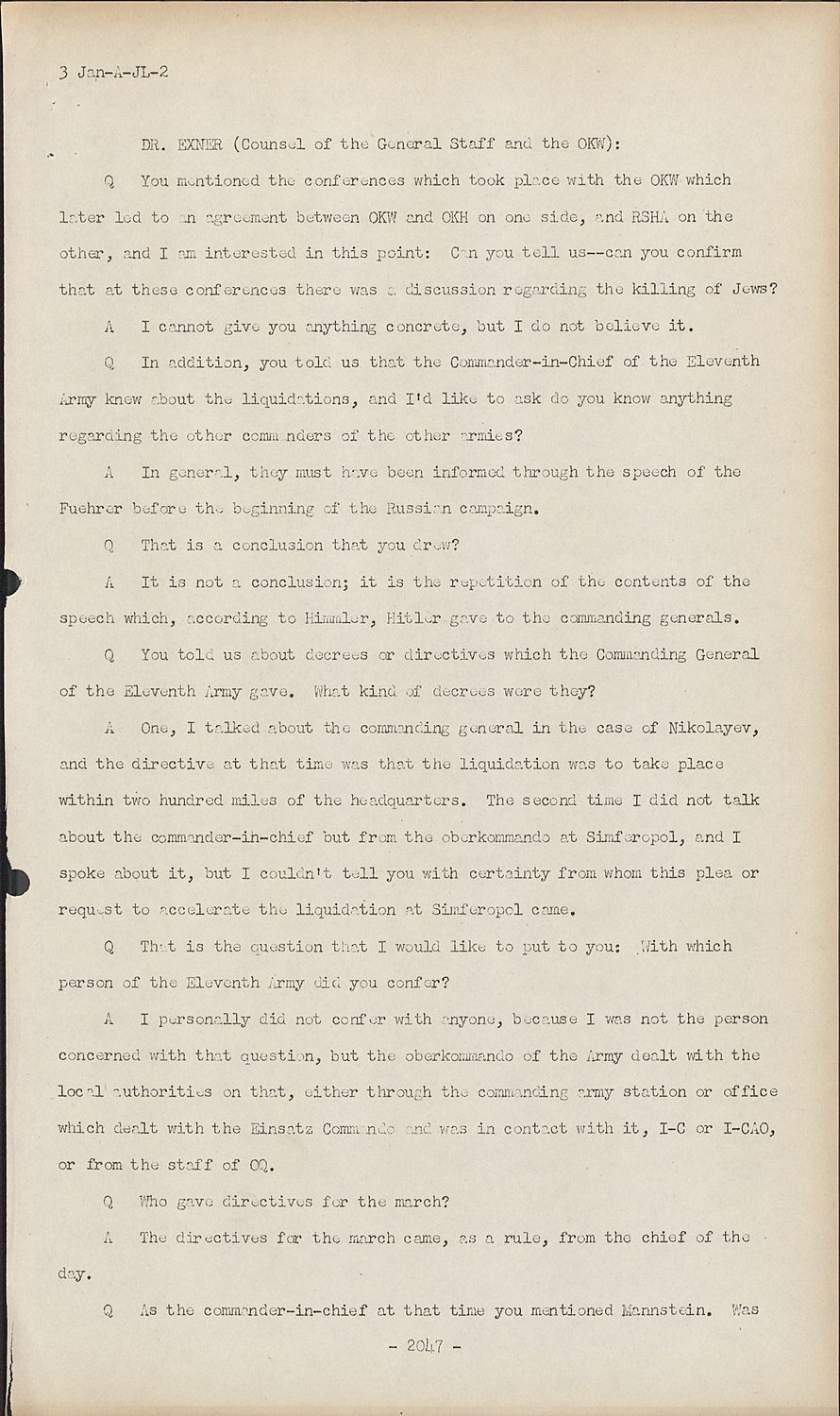
DR. EXNER (Counsel of the General Staff and the OKW):
QYou mentioned the conferences which took place with the OKW which later led to an agreement between OKW and OKH on one side, and RSHA on the other, and I am interested in this point: Can you tell us--can you confirm that at these conferences there was a discussion regarding the killing of Jews?
AI cannot give you anything concrete, but I do not believe it.
QIn addition, you told us that the Commander-in-Chief of the Eleventh Army knew about the liquidations, and I'd like to ask do you know anything regarding the other commanders of the other armies?
AIn general, they must have been informed through the speech of the Fuehrer before the beginning of the Russian campaign.
QThat is a conclusion that you drew?
AIt is not a conclusion; it is the repetition of the contents of the speech which, according to Himmler, Hitler gave to the commanding generals.
QYou told us about decrees or directives which the Commanding General of the Eleventh Army gave. What kind of decrees were they?
AOne, I talked about the commanding general in the case of Nikolayev, and the directive at that time was that the liquidation was to take place within two hundred miles of the headquarters. The second time I did not talk about the commander-in-chief but from the oberkommando at Simferopol, and I spoke about it, but I couldn't tell you with certainty from whom this plea or request to accelerate the liquidation at Simferopol came.
QThat is the question that I would like to put to you: With which person of the Eleventh Army did you confer?
AI personally did not confer with anyone, because I was not the person concerned with that question, but the oberkommando of the Army dealt with the local authorities on that, either through the commanding army station or office which dealt with the Einsatz Commando and was in contact with it, I-C or I-CAO, or from the staff of OQ.
QWho gave directives for the march?
AThe directives for the march came, as a rule, from the chief of the day.
QAs the commander-in-chief at that time you mentioned Mannstein. Was there an order in this matter that was signed by von Mannstein?
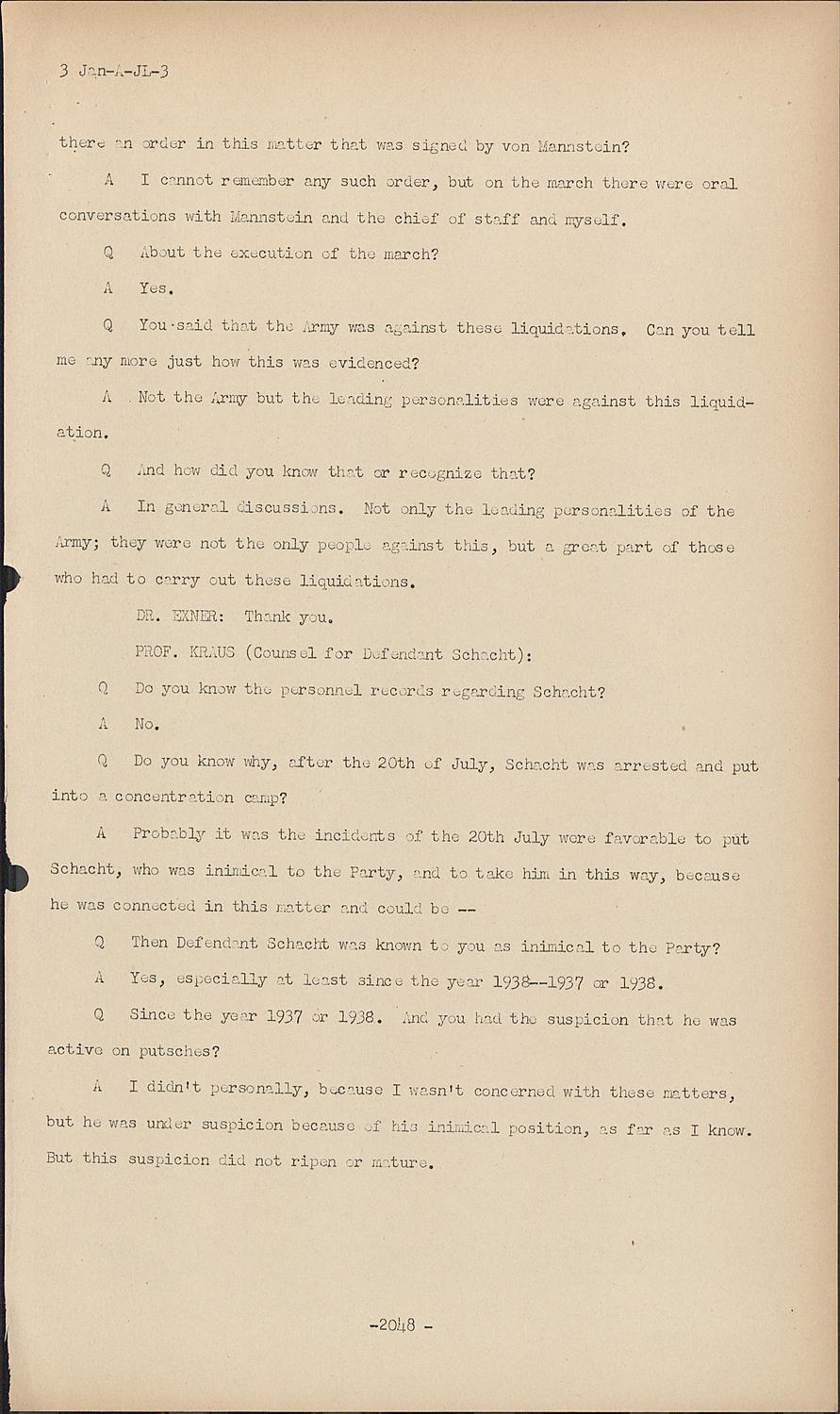
AI cannot remember any such order, but on the march there were oral conversations with Mannstein and the chief of staff and myself.
QAbout the execution of the march?
AYes.
QYou said that the Army was against these liquidations. Can you tell me any more just how this was evidenced?
ANot the Army but the leading personalities were against this liquidation.
QAnd how did you know that or recognize that?
AIn general discussions. Not only the leading personalities of the Army; they were not the only people against this, but a great part of those who had to carry out these liquidations.
DR. EXNER:Thank you.
PROF.KRAUS (Counsel for Defendant Schacht):
QDo you know the personnel records regarding Schacht?
ANo.
QDo you know why, after the 20th of July, Schacht was arrested and put into a concentration camp?
AProbably it was the incidents of the 20th July were favorable to put Schacht, who was inimical to the Party, and to take him in this way, because he was connected in this matter and could be -
QThen Defendant Schacht was known to you as inimical to the Party?
AYes, especially at least since the year 1938--1937 or 1938.
QSince the year 1937 or 1938. And you had the suspicion that he was active on putsches?
AI didn't personally, because I wasn't concerned with these matters, but he was under suspicion because of his inimical position, as far as I know. But this suspicion did not ripen or mature.
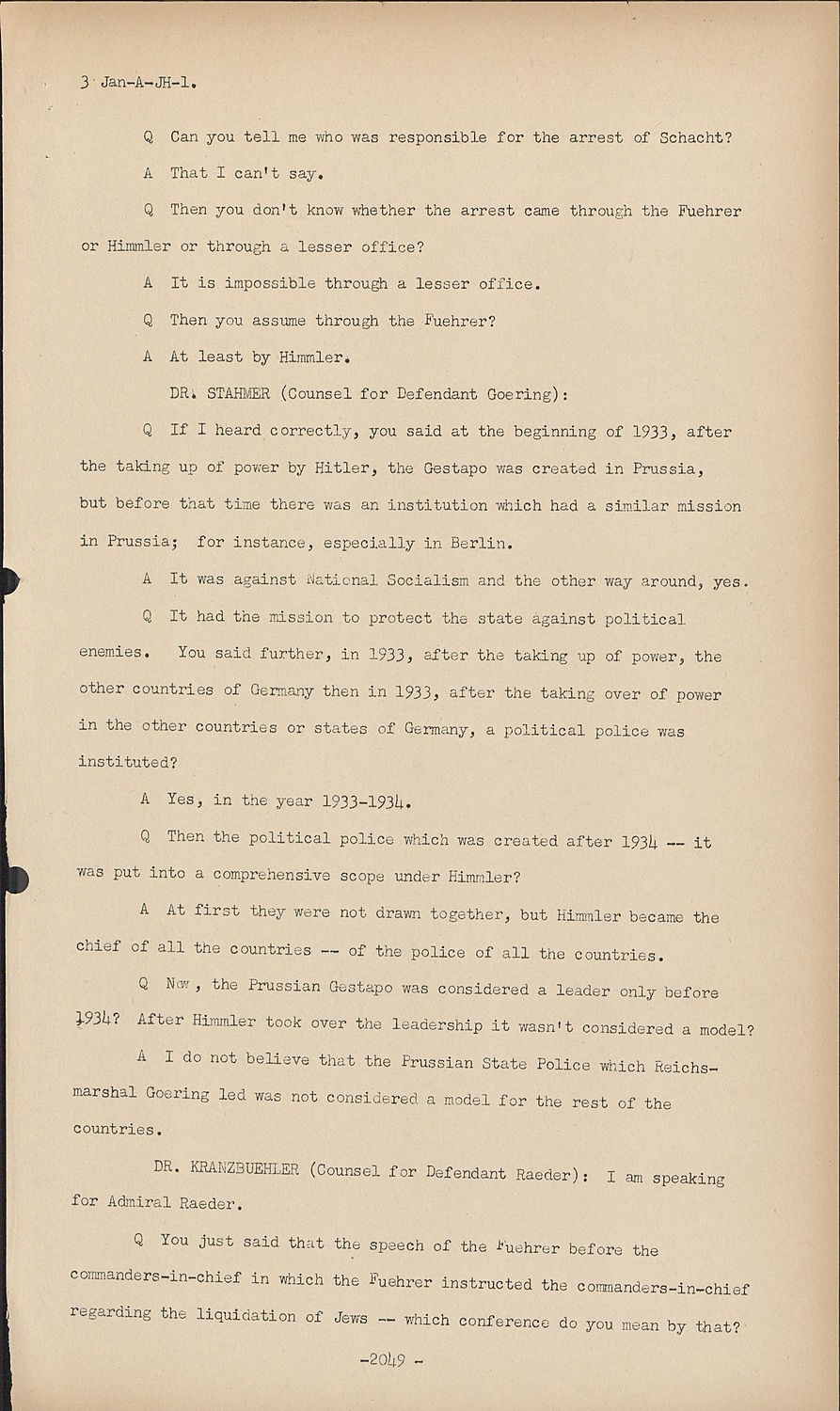
Q Can you tell me who was responsible for the arrest of Schacht?
AThat I can't say.
QThen you don't know whether the arrest came through the Fuehrer or Himmler or through a lesser office?
AIt is impossible through a lesser office.
QThen you assume through the Fuehrer?
AAt least by Himmler.
DR.STAHMER (Counsel for Defendant Goering):
QIf I heard correctly, you said at the beginning of 1933, after the taking up of power by Hitler, the Gestapo was created in Prussia, but before that time there was an institution which had a similar mission in Prussia; for instance, especially in Berlin.
AIt was against National Socialism and the other way around, yes.
QIt had the mission to protect the state against political enemies. You said further, in 1933, after the taking up of power, the other countries of Germany then in 1933, after the taking over of power in the other countries or states of Germany, a political police was instituted?
AYes, in the year 1933-1934.
QThen the political police which was created after 1934 -- it was put into a comprehensive scope under Himmler?
AAt first they were not drawn together, but Himmler became the chief of all the countries -- of the police of all the countries.
QNow, the Prussian Gestapo was considered a leader only before 1934? After Himmler took over the leadership it wasn't considered a model?
AI do not believe that the Prussian State Police which Reichsmarshal Goering led was not considered a model for the rest of the countries.
DR.KRANZBUEHLER (Counsel for Defendant Raeder): I am speaking for Admiral Raeder.
QYou just said that the speech of the Fuehrer before the commanders-in-chief in which the Fuehrer instructed the commanders-in-chief regarding the liquidation of Jews -- which conference do you mean by that?
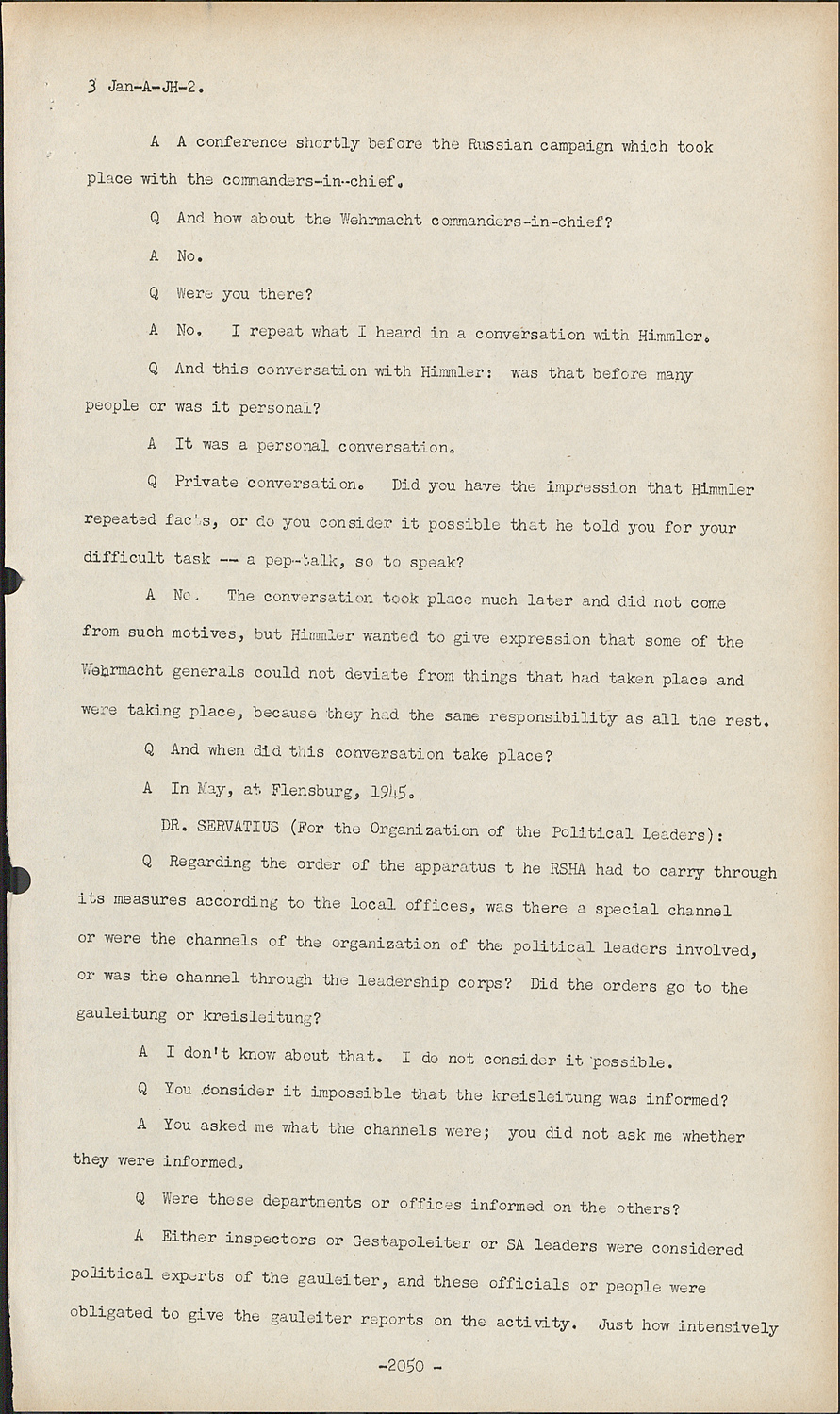
A A conference shortly before the Russian campaign which took place with the commanders-in-chief.
QAnd how about the Wehrmacht commanders-in-chief?
ANo.
QWere you there?
ANo. I repeat what I heard in a conversation with Himmler.
QAnd this conversation with Himmler: was that before many people or was it personal?
AIt was a personal conversation.
QPrivate conversation. Did you have the impression that Himmler repeated facts, or do you consider it possible that he told you for your difficult task -- a pep-talk, so to speak?
ANo, The conversation took place much later and did not come from such motives, but Himmler wanted to give expression that some of the Wehrmacht generals could not deviate from things that had taken place and were taking place, because they had the same responsibility as all the rest.
QAnd when did this conversation take place?
AIn May, at Flensburg, 1945.
DR.SERVATIUS (For the Organization of the Political Leaders):
QRegarding the order of the apparatus t he RSHA had to carry through its measures according to the local offices, was there a special channel or were the channels of the organization of the political leaders involved, or was the channel through the leadership corps? Did the orders go to the gauleitung or kreisleitung?
AI don't know about that. I do not consider it possible.
QYou Consider it impossible that the kreisleitung was informed?
AYou asked me what the channels were; you did not ask me whether they were informed.
QWere these departments or offices informed on the others?
AEither inspectors or Gestapoleiter or SA leaders were considered political experts of the gauleiter, and these officials or people were obligated to give the gauleiter reports on the activity. Just how intensively that was carried on I don't know.
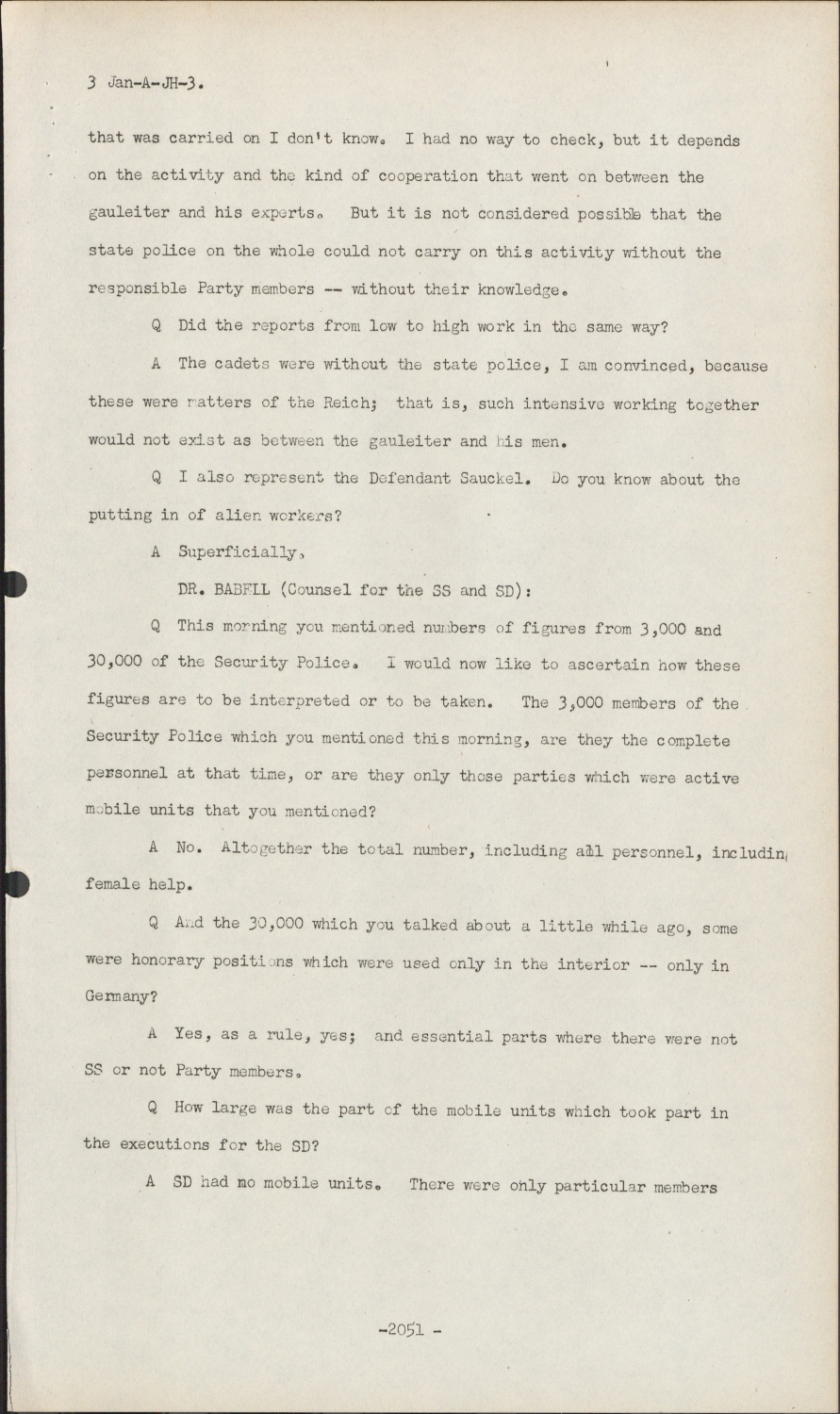
I had no way to check, but it depends on the activity and the kind of cooperation that went on between the gauleiter and his experts.
But it is not considered possible that the state police on the whole could not carry on this activity without the responsible Party members -- without their knowledge.
QDid the reports from low to high work in the same way?
AThe cadets were without the state police, I am convinced, because these were matters of the Reich; that is, such intensive working together would not exist as between the gauleiter and his men.
QI also represent the Defendant Sauckel. Do you know about the putting in of alien workers?
ASuperficially.
DR.BABELL (Counsel for the SS and SD):
QThis morning you mentioned numbers of figures from 3,000 and 30,000 of the Security Police. I would now like to ascertain how these figures are to be interpreted or to be taken. The 3,000 members of the Security Police which you mentioned this morning, are they the complete personnel at that time, or are they only those parties which were active mobile units that you mentioned?
ANo. Altogether the total number, including all personnel, including female help.
QAnd the 30,000 which you talked about a little while ago, some were honorary positions which were used only in the interior -- only in Germany?
AYes, as a rule, yes; and essential parts where there were not SS or not Party members.
QHow large was the part of the mobile units which took part in the executions for the SD?
ASD had no mobile units. There were only particular members of the SD and they were commanded to work with these offices.
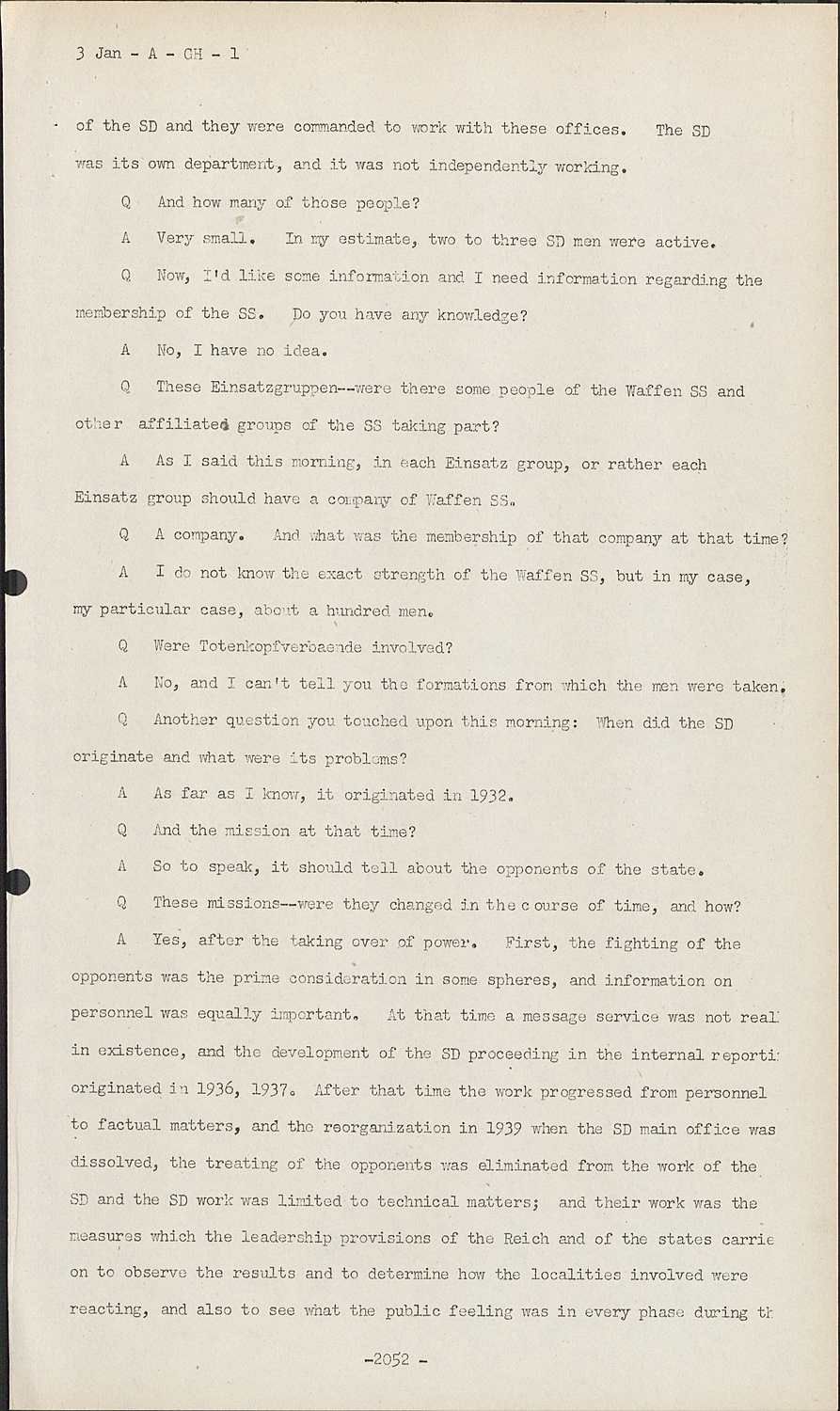
The SD was its own department, and it was not independently working.
QAnd how many of those people?
AVery small. In my estimate, two to three SD men were active.
QNow, I'd like some information and I need information regarding the membership of the SS. Do you have any knowledge?
ANo, I have no idea.
QThese Einsatzgruppen--were there some people of the Waffen SS and other affiliated groups of the SS talking part?
AAs I said this morning, in each Einsatz group, or rather each Einsatz group should have a company of Waffen SS.
QA company. And what was the membership of that company at that time?
AI do not know the exact strength of the Waffen SS, but in my case, my particular case, about a hundred men.
QWere Totenkopfverbaende involved?
ANo, and I can't tell you the formations from which the men were taken.
QAnother question you touched upon this morning: When did the SD originate and what were its problems?
AAs far as I know, it originated in 1932.
QAnd the mission at that time?
ASo to speak, it should tell about the opponents of the state.
QThese missions--were they changed in the course of time, and how?
AYes, after the taking over of power. First, the fighting of the opponents was the prime consideration in some spheres, and information on personnel was equally important. At that time a message service was not real in existence, and the development of the SD proceeding in the internal reporti originated In 1936, 1937. After that time the work progressed from personnel to factual matters, and the reorganization in 1939 when the SD main office was dissolved, the treating of the opponents was eliminated from the work of the SD and the SD work was limited to technical matters; and their work was the measures which the leadership provisions of the Reich and of the states carrie on to observe the results and to determine how the localities involved were reacting, and also to see what the public feeling was in every phase during th war and howpublic opinion was working during the war.

It was, as a matter of fact, the only critical position within the Reich which, according to objectives views, could report to the top leadership positions of the country, and I'd like to point out that the Party did not make legitimate this work up until 1945.
The only real legitimate reason for this work came from Goering and after the beginning of the war, at the conferences of the Reich Defense Council, to bring the other departments to point out mistake to the other departments of the Reich, and this critical expert work after 1939 was the chief content of the SD interior department; that was their chief work.
QAnother question. How far did the SD--how were they active in concentration camps?
AWe would have to differentiate between SD interior and SD Ausland. SD Ausland,--I can't give you any information; but the chief, Schellenberg, is present and will give you information. As far as Amt III is concerned, I know no single case that SD Inland had anything to do with concentration camps.
QNow, a personal question. From whom did you have the orders of the liquidation of the Jews and so forth? From whom, did you receive them? In what form?
AMy mission was not liquidation, but I had the staff of the Einsatz commando, and the Einsatz commando had had from Berlin those orders from Himmler, Heydrich, and Streckenbach. They had received this order from Berlin, and this order was again given by Himmler at Nikolaiev.
QYou personally were not concerned with the execution of these order.
AI led the Einsatz group, and in that sphere I had the mission to see how the Einsatz commandos were carrying through the orders that they had received.
QDid you have no thought, no qualms, against these orders?
AYes, I certainly did.
QAnd how is it that they were carried out regardless?
ABecause it was impossible for me to see that a subordinate leader can not carry through the orders that were given to him by the leadership of the state.
QYou had that opinion by yourself or secretly, and this same position or attitude was taken by most people involved, not just by you, out of the circle of the men who had to execute these orders? Didn't some of these people tell you that they would like to relieve you of these missions?
AI can't remember any concrete example. Some of these men were relieved whom I didn't believe had the nerve to carry through these executions, and I sent them home.
QWas the cloak of legality given to these orders?
AI do not exactly understand. The order was given so that the legalit; the matter of legality, was not the concern of the people who had to carry these orders out, because the oath of obedience was upon all these people.
QThe particular man,--could he try to go against these orders?
ANo; the result would have been a court martial.
THE PRESIDENT:Yes, Colonel Amen. Do you wish to re-examine?
COLONEL AMEN:Just a very few questions, Your Honor.
REDIRECT EXAMINATION
BY COLONEL AMEN:
QWhat organization furnished the supplies to the Einsatz Groups?
AThe Reichssicherheitshaumptamt took care of these things.
QWhat organization furnished weapons to the Einsatz Groups?
AThe weapons were handled in the same way.
QWhat organization assigned personnel to the Einsatz Groups?
AThe Organization and Personnel Ant of the RSHA.
QAnd these activities of supplies required personnel in addition to the operating members?
A Yes.
COLONEL MEN:I have no more questions.
THE PRESIDENT:That will do; thank you.
COLONEL MEN:The next witness to be called by the prosecution is Dieter Wisliceny That witness will be examined by Lt. Col. Smith W. Brookhart, Jr. BY THE PRESIDENT:
QWhat is your name?
ADieter Wisliceny
QWill you repeat this oath? I swear by God, the Almighty and Omniscient that I will speak the pure truth and will withheld and add nothing (Witness repeated oath in German.)
BY COLONEL BROOKHART:
QHow old are you?
AI am thirty-four years old.
QWhere were you born?
AI was born at Regulofken in East Prussia.
QWere you a member of the NSDAP?
AYes, I was a member of the NSDAP.
QSince what year?
AFirst, before 1933, I entered in the springy and finally entered again in 1933.
QWere you a member of the SS?
AYes, I entered the SS in 1934.
QWere you a member of the Gestapo?
AIn 1934 I entered the SD.
QWhat rank did you achieve?
AIn 1940 I was promoted to Hauptsturmfuehrer.
QDo you know Adolf Eichmann?
AYes, I know Eichmann since 1934. In 1934, at about the same time, we joined the SD together. Until 1937 we were in the same department.
QDid you know Eichmann personally?
A We knew each other very well. We went to the same school, and I know his family very well.
QWhat was his position?
AEichmann was in the RSHA, chief of Section IV, Gestapo.
QSection IV or a subsection, and if so which subsection?
AHe led Section IV-A-4. This section had two spheres; the church and the other Jewish problem.
QYou have before you a diagram showing the position of subsection IV-A-4-b from the RSHA?
AYes.
QDid you prepare this diagram?
AYes, I made the diagram myself.
QDoes it correctly portray the organizational setup showing the sections dealing with Jewish problems?
AYes. It concerns the section at the beginning of the year 1944, and its personnel.
QReferring to this chart and the list of leading personnel as shown in the lower Section of the paper, were you personally acquaited with each of the individuals named therein?
AYes; I knew all of them myself.
QWhat was the particular mission of IV-A-4-b of the RSHA?
AThis section, IV-A-4-b, was concerned with the Jewish question. Eichmann had special powers from Mueller, the chief of Amt IV, and from the Chief of the Security Police. He was responsible for the so-called solution of the Jewish question in all of Germany and all occupied countries.
QWere there distinct periods of activity affecting the Jews?
AYes.
QDescribe to the Tribunal the approximate periods and the different types of activity.
AYes. Until the year 1940 the general policies were in Germany and in the occupied countries to settle this through planned immigration. The second phase, the concentration of Jews in Poland and the rest of the occupied territories in the East; to have them concentrated in Ghettos. This period was approximately until the beginning of 1942.
And the third period, the final solution of this problem, the planned destruction of the Jewish race.
This period covered the period until October 1944; until Himmler gave the order to stop this period of destruction or annihilation.
(A recess was taken from 1520-1530.) BY COL. BROOKHART:
QWhen did you first become associated with Section IV A 4 of the R.S.H.A.?
AThat was in 1940. Eichmann suggested to me to go to Bradislav as a counsellor on the Jewish question, to the Slovakian Government.
QThereafter how long did you hold that position?
AUntil the spring of 1943 I was at Bratislav, then almost a year in Greece, and then from March, 1944, until December, 1944, I was with Eichmann in Hungary. In January, 1945, I left Eichmann's apartment.
QIn your official section, Section IV A 4, did you learn of any order which directed the annihilation of all Jews?
AYes, I received this order from Eichmann in the summer of 1942.
QTell the Tribunal under what circumstances about 17,000 Jews were taken from Slovakia to Poland as workers, and what the substance of the order was, in the spring of 1942.
AAbout 17,000 Jews were taken from Slovakia to Poland as workers. There was an agreement with the Slovakian Government, and it was requested whether the members of the families of these workers could not also be taken into Poland. Originally Eichmann declined this request.
In April or perhaps the beginning of May, 1942, Eichmann told me that from now on families could be taken to Poland. Eichman himself in May of 1942 was at Bratislav and taled with the re sponsible members of the Slovakian Government.
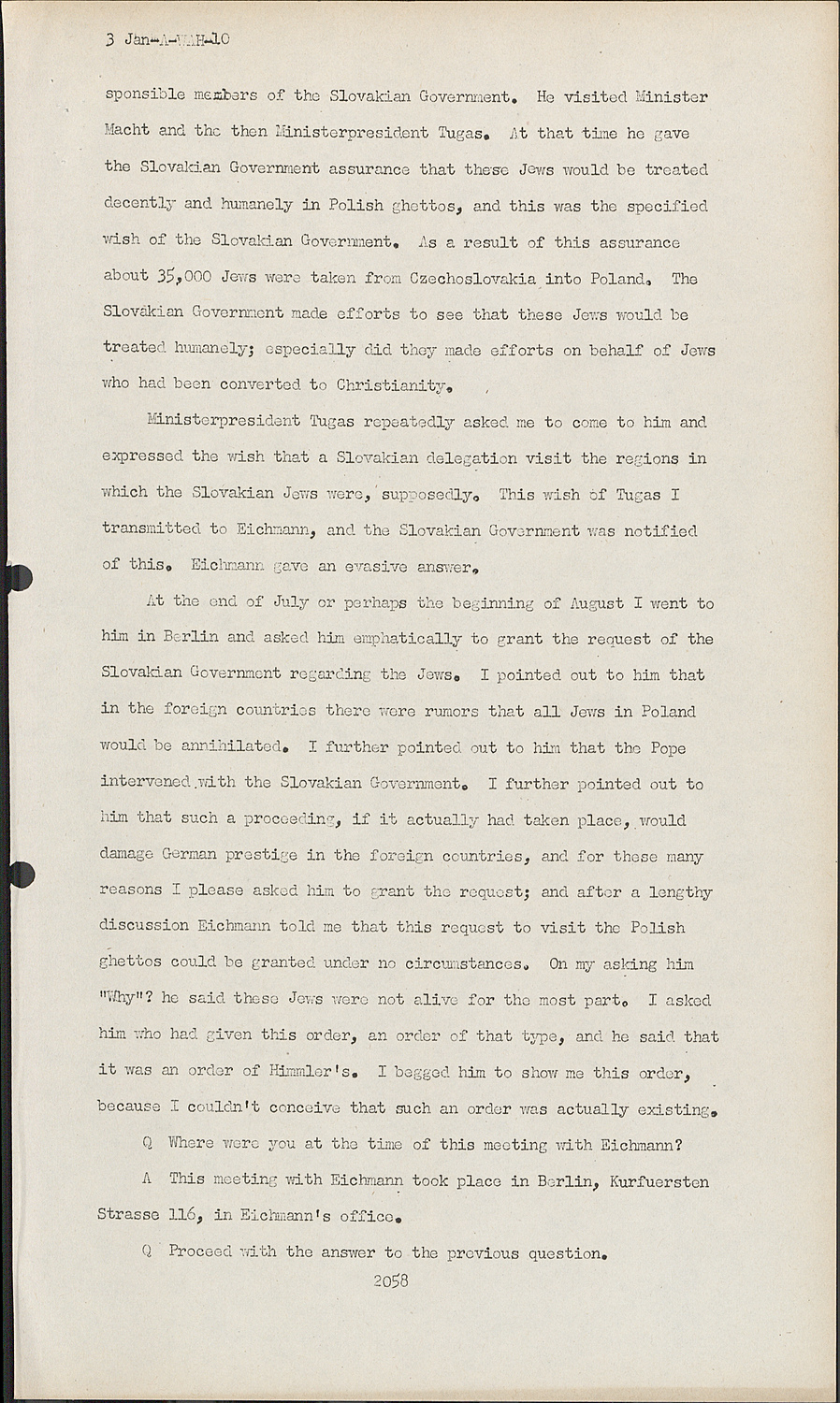
He visited Minister Macht and the then Ministerpresident Tugas.
At that time he gave the Slovakian Government assurance that these Jews would be treated decently and humanely in Polish ghettos, and this was the specified wish of the Slovakian Government. As a result of this assurance about 35,000 Jews were taken from Czechoslovakia into Poland, The Slovakian Government made efforts to see that these Jews would be treated humanely; especially did they made efforts on behalf of Jews who had been converted to Christianity.
Ministerpresident Tugas repeatedly asked me to come to him and expressed the wish that a Slovakian delegation visit the regions in which the Slovakian Jews were, supposedly. This wish of Tugas I transmitted to Eichmann, and the Slovakian Government was notified of this. Eichmann gave an evasive answer.
At the end of July or perhaps the beginning of August I went to him in Berlin and asked him emphatically to grant the request of the Slovakian Government regarding the Jews. I pointed out to him that in the foreign countries there were rumors that all Jews in Poland would be annihilated. I further pointed out to him that the Pope intervened with the Slovakian Government. I further pointed out to him that such a proceeding, if it actually had taken place, would damage German prestige in the foreign countries, and for these many reasons I please asked him to grant the request; and after a lengthy discussion Eichmann told me that this request to visit the Polish ghettos could be granted under no circumstances. On my asking him "Why"? he said these Jews were not alive for the most part. I asked him who had given this order, an order of that type, and he said that it was an order of Himmler's. I begged him to show me this order, because I couldn't conceive that such an order was actually existing.
QWhere were you at the time of this meeting with Eichmann?
AThis meeting with Eichmann took place in Berlin, Kurfuersten Strasse 116, in Eichmann's office.
QProceed with the answer to the previous question.
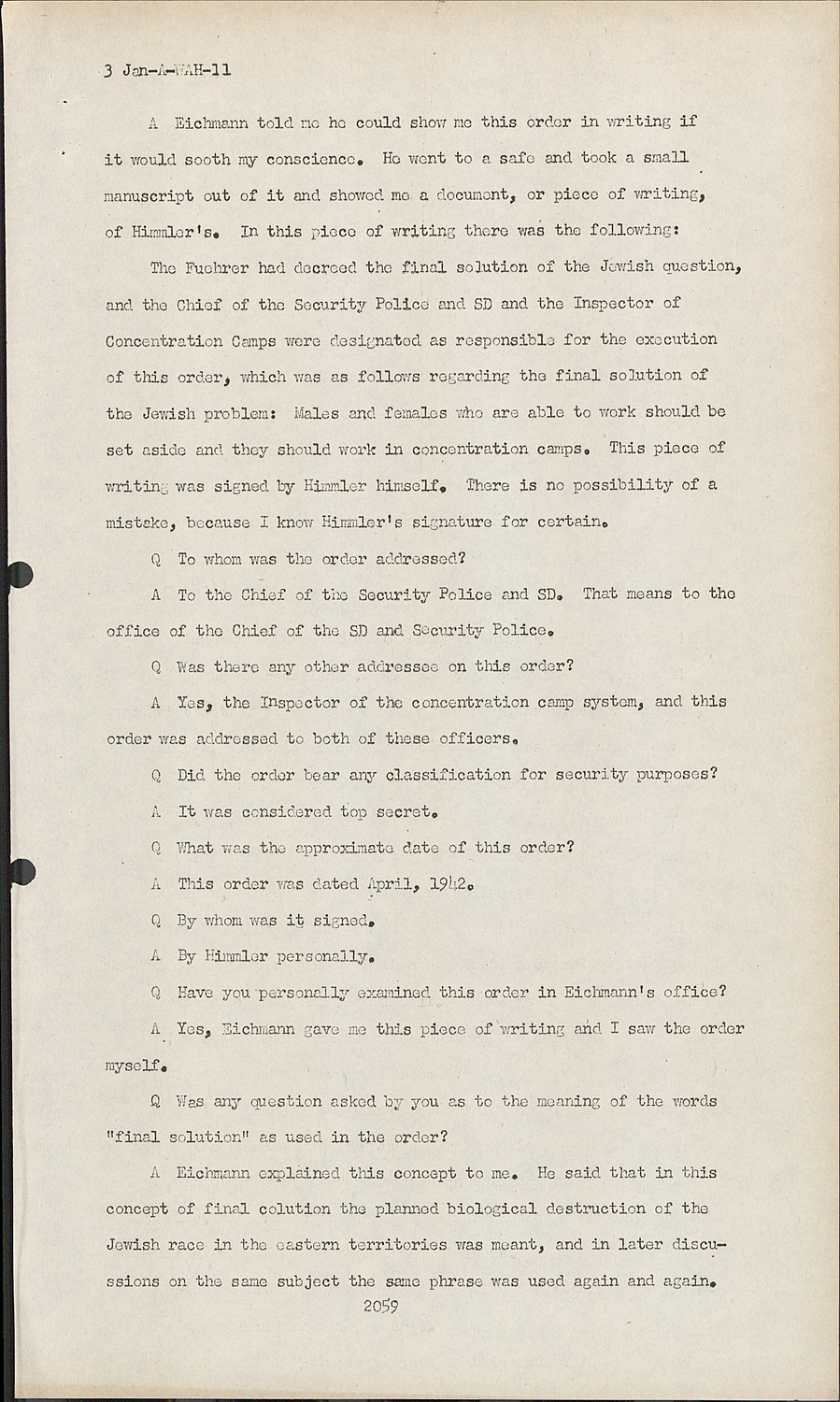
A Eichmann told me he could show me this order in writing if it would sooth my conscience.
He went to a safe and took a small manuscript out of it and showed me a document, or piece of writing, of Himmler's. In this piece of writing there was the following:
The Fuehrer had decreed the final solution of the Jewish question, and the Chief of the Security Police and SD and the Inspector of Concentration Camps were designated as responsible for the execution of this order, which was as follows regarding the final solution of the Jewish problem: Males and females who are able to work should be set aside and they should work in concentration camps. This piece of writing was signed by Himmler himself. There is no possibility of a mistake, because I know Himmler's signature for certain.
QTo whom was the order addressed?
ATo the Chief of the Security Police and SD. That means to the office of the Chief of the SD and Security Police.
QWas there any other addressee on this order?
AYes, the Inspector of the concentration camp system, and this order was addressed to both of these officers.
QDid the order bear any classification for security purposes?
AIt was considered top secret.
QWhat was the approximate date of this order?
AThis order was dated April, 1942.
QBy whom was it signed.
ABy Himmler personally.
QHave you personally examined this order in Eichmann's office?
AYes, Eichmann gave me this piece of writing and I saw the order myself.
QWas any question asked by you as to the meaning of the words "final solution" as used in the order?
AEichmann explained this concept to me. He said that in this concept of final colution the planned biological destruction of the Jewish race in the eastern territories was meant, and in later discussions on the same subject the same phrase was used again and again.
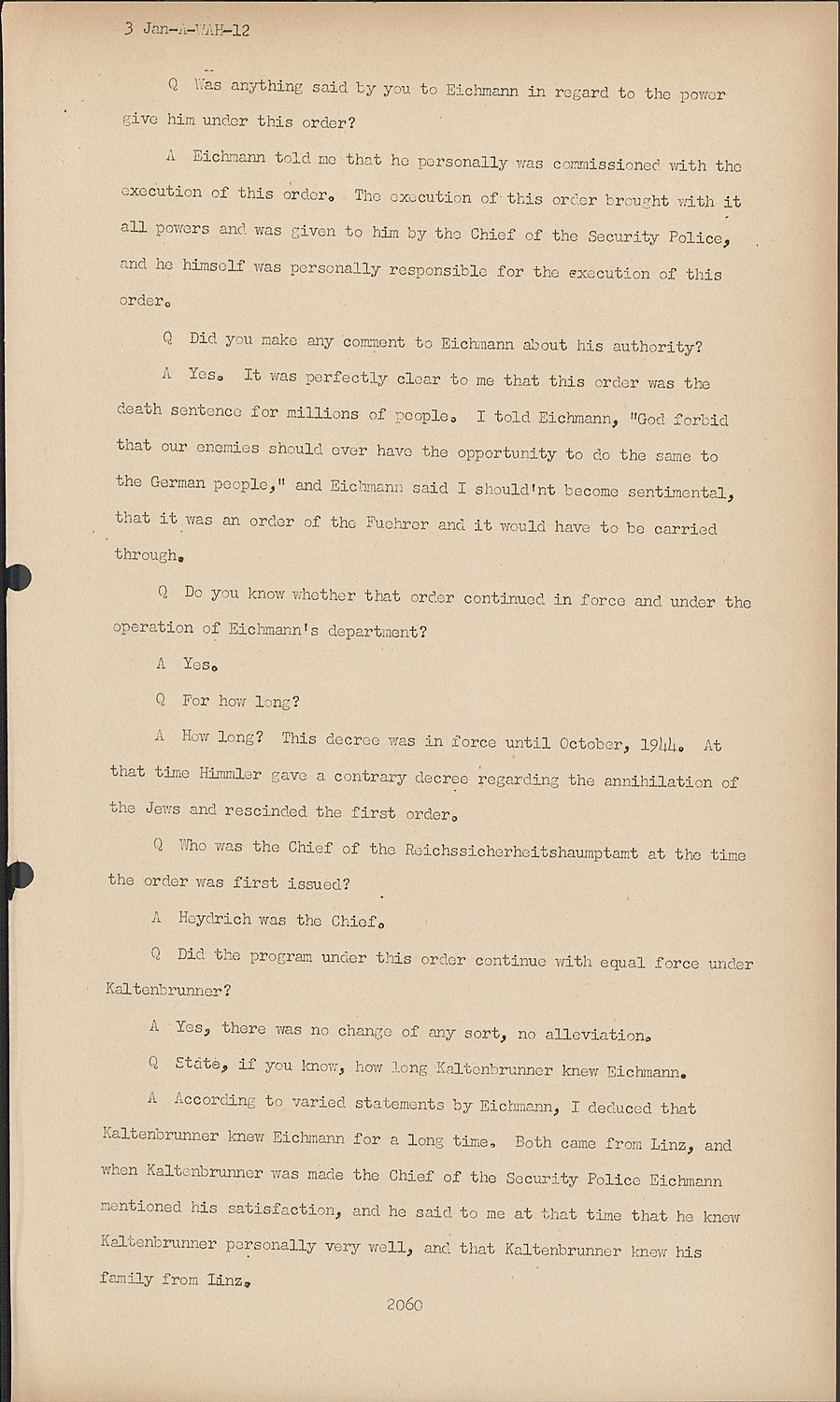
Q Was anything said by you to Eichmann in regard to the power give him under this order?
AEichmann told me that he personally was commissioned with the execution of this order. The execution of this order brought with it all powers and was given to him by the Chief of the Security Police, and he himself was personally responsible for the execution of this order.
QDid you make any comment to Eichmann about his authority?
AYes. It was perfectly clear to me that this order was the death sentence for millions of people. I told Eichmann, "God forbid that our enemies should over have the opportunity to do the same to the German people," and Eichmann said I should'nt become sentimental, that it was an order of the Fuehrer and it would have to be carried through.
QDo you know whether that order continued in force and under the operation of Eichmann's department?
AYes.
QFor how long?
AHow long? This decree was in force until October, 1944. At that time Himmler gave a contrary decree regarding the annihilation of the Jews and rescinded the first order.
QWho was the Chief of the Reichssicherheitshaumptamt at the time the order was first issued?
AHeydrich was the Chief.
QDid the program under this order continue with equal force under Kaltenbrunner?
AYes, there was no change of any sort, no alleviation.
QState, if you know, how long Kaltenbrunner knew Eichmann.
AAccording to varied statements by Eichmann, I deduced that Kaltenbrunner knew Eichmann for a long time. Both came from Linz, and when Kaltenbrunner was made the Chief of the Security Police Eichmann mentioned his satisfaction, and he said to me at that time that he knew Kaltenbrunner personally very well, and that Kaltenbrunner knew his family from Linz.