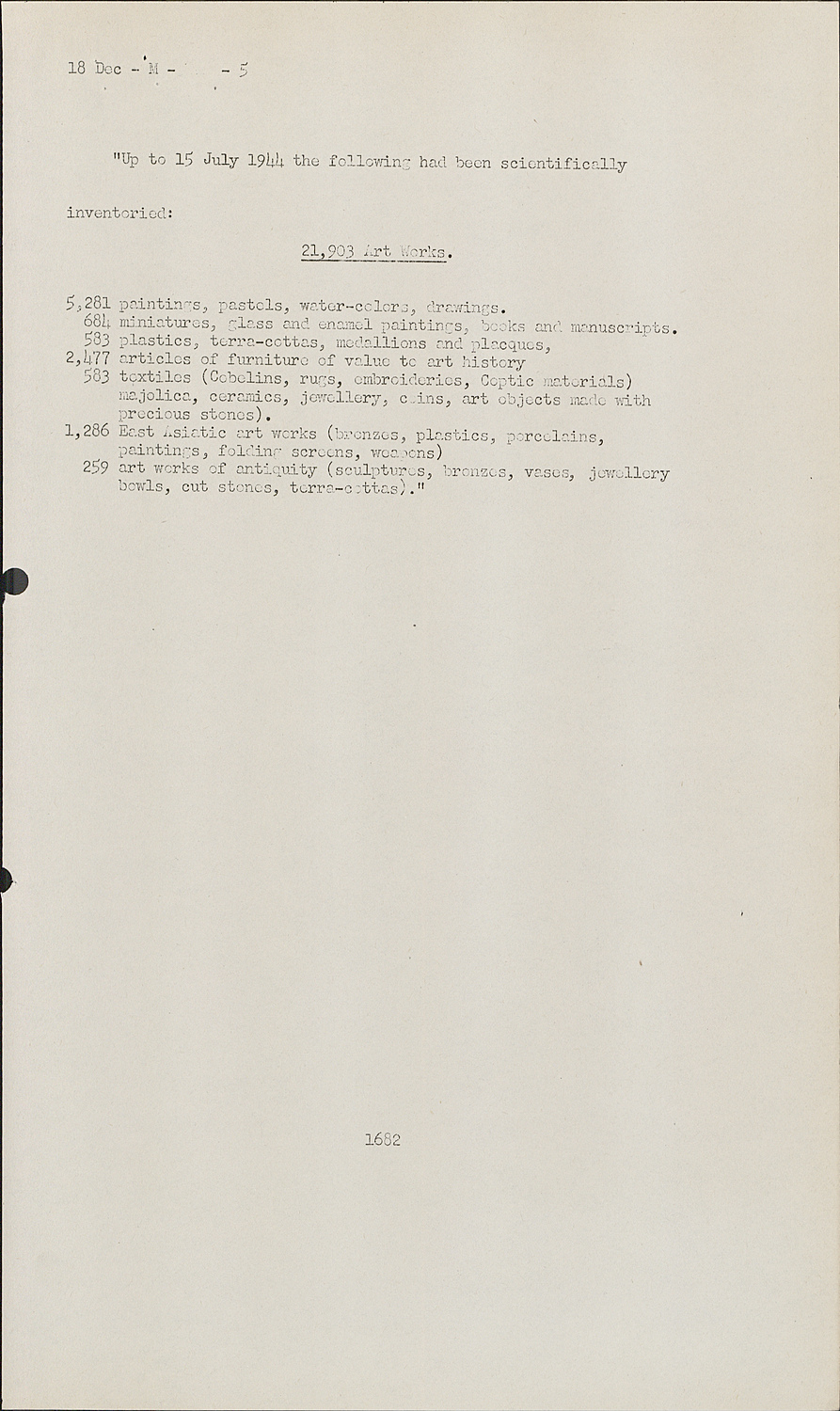
"Up to 15 July 1944 the following had been scientifically inventoried:
21,903 Art Works. 5,281 paintings, pastels, water-colors, drawings.
684 miniatures, glass and enamel paintings, books and manuscripts.
583 plastics, terra-cottas, medallions and placques, 2,477 articles of furniture of value to art history 583 textiles (Cobelins, rugs, embroideries, Coptic materials) majolica, ceramics, jewellery, coins, art objects made with precious stones). 1,286 East Asiatic art works (bronzes, plastics, porcelains, paintings, folding screens, weapons) 259 art works of antiquity (sculptures, bronzes, vases, jewellery bowls, cut stones, terra-cottas)." The mere statement that 21,903 art works have been seized does not furnish an adequate conception of their value.
I refer again to the statement in the document thus quoted: The extraordinary artistic and material value of the seized art works cannot be expressed in figures, and that they are objects of such a unique character that their evaluation is entirely impossible. These thirty-nine volumes are by no means a complete catalogue. They present, at the most, pictures of about 2,500 of the art objects seized, and I ask you to imagine that this catalogue had been completed and in the place of thirty-nine volumes we had 350 to 400 volumes. In other words, if they were prepared in inventory form as these thirty-nine volumes to cover all of them, it would take 350 to 400 volumes.
We had arranged, your Honors, to project just a few of these on the screen but before we do that, which is the end of this part of the presentation, I should like to call your Honors' attention to document 015-PS. It is dated April 16, 1943. It is a copy of a letter from Rosenberg to Hitler. The occasion for the writing of this letter was the birthday of the Fuehrer, to commemorate which Rosenberg presented some folders of photographs of pictures seized by the Einsatzstab. I imagine, although we have no authentic evidence, that probably some of these were prepared for that occasion. In the closing paragraph of the letter, Document 015-PS, he says:
"I beg of you, my Fuehrer, to give me a chance during my next audience to report to you orally on the whole extent and scope of this art seizure action. I beg you to accept a short written intermediate report of the progress and extent of the art seizure action, which will be used as a basis for this later oral report, and also accept three copies of the temporary picture catalogues which, too, only show part of the collection you own. I shall deliver further catalogues which are now being compiled, when they are finished."
Rosenberg then closes with this touching tribute to the aesthetic tastes of the Fuehrer, tastes which were satisfied at the expense of a continent, and I quote:
"I shall take the liberty during the requested audience to give you, my Fuehrer, another twenty folders of pictures, with the hope that this short occupation with the beautiful things of art which are nearest to your heart will send a ray of beauty and joy into your revered life."
THE PRESIDENT:Will you read all the passage that you began; five lines above that?
COLONEL STOREY:Just a moment, sir.
THE PRESIDENT:Beginning with the words, "These photos represent -
COLONELSTOREY: "These photos represent an addition to the collection of fifty-three of the most valuable objects of art delivered some time ago to your collection. This folder also shows only a small percentage of the exceptional work and extent of these objects of art seized by my service command, Dienststelle, in France, and put into a safe place in the Reich."
If your Honors please, at this time we would like to project on the screen a few of these photographs. The photographs of paintings which we are now about to project on the screen are taken from a single volume of the catalogue and are merely representative of the many volumes of pictures of similar works. The other items, photos of which are to be projected, were picked from various volumes on special subjects. For example, the Gobelin tapestry which you are about to see is merely one picture from an entire volume of tapestry illustrat Each picture that you will see is representative of a number of volumes of similar pictures, and each volume from which these single pictures were taken represents approximately a tenth of the total number of volumes which would be necessary to illustrate all the items actually plundered by the Einsatzstab. We will now have the slides; just a few of them.
This first picture is a portrait of a woman, painted by the Italian painter Palma Vecchio.
The next picture is a Portrait of a Woman, by the Spanish painter Velasquez.
This picture is a portrait of Lady Spencer, by the English painter Sir Joshua Reynolds.
This picture is a painting by the French painter Watteau.
This is a painting of the Three Graces, by Rubens.
This is a portrait of an Old Woman, by the famous painter Rembrandt.
This painting of a Young Woman, is by the Dutch painter van Dyck.
Now, this picture is a sample of 16th century jewelry in gold and enamel, decorated with pearls.
This is a 17th century Gobelin tapestry.
This picture is of a Japanese painting from the catalogue volume on East Asiatic Art.
This is an example of famous china.
This is a picture of a silver-inlaid Louis XIV cabinet.
The last picture is of a silver altar piece of the 15th or 16th century, of Spanish origin.
That is the last picture.
I all your attention again that each of the pictures you have just seen is merely representative of a large number of similar items illustrated in the thirty-nine volume catalogue, which is in itself only partially complete. There is little wonder that the Fuehrer's occupation with these beautiful things of art, which were nearest to his heart, should have sent a ray of beauty and joy into his revered life. I doubt that any museum in the world, whether the Metropolitan in New York, the British Museum in London, the Louvre in Paris or the Tretiakov Gallery in Moscow could present such a catalogue as this; in fact, should they pool their treasures the result would certainly fall short of the art collection that Germany amassed for itself, at the expense of the other nations of Europe. Never in history has a collection so great been amassed with so little scruple.
It is refreshing, however, to know that the victorious Allied armies have recovered most of such treasures, principally hidden away in salt mines, tunnels, and secluded castles, and the proper governmental agencies are now in the process of restoring these priceless works of art to their rightful owners.
I shall next refer to Document 154-PS, which is a letter dated the 5th of July 1942, from Doctor Lammers, Reichs Minister and Chief of the Chancellory, to the highest Reich authorities and services directly subordinate to the Fuehrer. This letter states and implements the Hitler order that was introduced in evidence, and explains that the Fuehrer delegated authority to Rsenberg's staff to search for and seize cultural property by virtue of Reichsleiter Rosenberg's position as representative of the Fuehrer for the supervision of the whole ideological and political education of the NSDAP.
The Tribunal will recall, however, that it is by virtue of holding this office that Defendant Rosenberg occupied a place within the Reichsleitung or Party Directorate of the Leadership Corps.
That is U.S. Exhibit 370, and it is simply offered for the purpose of showing the address to the highest Reich authorities and services directly subordinate to the Fuehrer.
In a letter to the Defendant Bormann, dated the 23rd of April 1941, the Defendant Rosenberg protested against the arbitary removal by the SD and other public services--libraries, monastaries, and other institutions--and he proposed that in the claims, by the SD and his representative, the final regulation as to the confiscation should be made by the Gauleiter. This letter has been offered previously as 071-PS, and I quote, beginning with next to the last sentence at the bottom of page one of the English translation--I am sorry, your Honor, that is in the other book, and I will--it is in that big book. I am sorry, this refers to the big book.
THE PRESIDENT:You cited 071 this morning.
COLONEL STOREY:Yes, sir, and I will forego that at the moment, your Honor, because it refers back to the other book. Finally, in connection with the presentation of this subject, I submit that the summary of evidence establishes that the defendants and their conspirators, Rosenborg and Bormann, acting in their capacity as political leaders of the Leadership Corps of the Nazi Party and as members thereof, participated in the conspiracy or common plan alleged in Count I of the Indictment, and committed acts constituting the crimes alleged. Accordingly, we submit (1) The Leadership Corps of the Nazi Party is a group or organization in the sense in which those terms are used in Article 9 of the Charter; (2) The defendants and their conspirators, Rosenberg, and Bormann, committed the crimes defined in Article 6 of the Charter, and in that capacity as members of the political leaders of the Leadership Corps of the Nazi Party.
It was at all times the primary and central design and purpose of the Leadership Corps of the Nazi Party to direct, engage, and participate in the execution of the conspiracy which contemplated and involved the commission of the crimes as defined in Article 6 of the Charter.
And I should like now to call attention again to a chart which was identified in the beginning - I believe by Major Wallis - and it was taken from the book, "The Face of the Party"--taken from the publication which is entitled, "The Face of the Party". This chart emphasizes clearer than I can state the total and thorough control over the life of the German beginning at the age of ten at the bottom of the chart, and continuing through the various categories on up through.
Notice the age of ten to fourteen, the Jungvolk. Then it goes to the Adolph Hitler School on the right, twelve to eighteen. The Hitler Jugend, fifteen to eighteen. The SA; the NSKK; NSFK; nineteen to twenty. And then the labor service over at the left. And then again to the SA; SS; NSKK; NSFK; and then into the Wehrmacht, and on up through to the top box on the left of the top row of men, the political leaders of the NSDAP.
And then finally all of those buildings up there, as I understand, are the academies of the NSDAP.
And then finally at the top to the politi cal leaders of the German Volk, showing the evolution.
This is the final exhibit, and with that I close the presentation of the Leadership Corps.
The next presentation is the Reich Cabinet, the Reichsregierung. We will take just a few moments; three or four moments.
If your Honors please, there is one thing Colonel Seay salled my attention to.
I simply refer to it for the record. In one of the previous documents, 090-PS, which is in the other document book, there was a state ment that clearly established that the expenses of the Einsatzstab Rosenbel that is, the staff's operational expenses, were financed by the Nazi Party.
Document 090-PS, which is already in evidence, and which I overlooked mentioning.
If the Tribunal please, I now offer document Book "X", which I believe has been passed to your Honors, and also we have prepared-- also, Colonel Dostert's staff has prepared a chart of the Reichsregierung in different languages, and I believe your Honors have copies.
There is one copy here in German that I shall be glad to pass to counsel who are especially concerned with this case.
They have one copy in German. I don't know who it is-
THE PRESIDENT:You mean counsel for the Reich Cabinet?
COLONEL STOREY:Yes, sir. May I say also by preliminary reference, that we examined the records in the collection office this morning, and only one letter of intervention has been filed in behalf of the Reichs Cabinet, and that was by the Defendant Keitel.
As I understand, only one has been filed, and that was by the Defendant Keitel.
We will now consider the Reichsregierung. Some preliminary remarks about this group have already been placed before the Tribunal by Mr. Albrecht in his comments upon the Government chart.
It will be necessary, however, for sake of coherence, to repear briefly some of the statements made by him, and therefore we beg the indulgence of the Tribunal The Reichsregierung, meaning Reich Cabinet, unlike most of the other groups named in the indictment, was not especially created by the Nazi party to carry out or implement its nefarious schemes and purposes.
The Reichsregierung -- commonly referred to as the Cabinet -- had, before the Nazis came to power, a place in the constitutional and political history of the country.
As with other cabinets of duly constituted governments, the executive power of the realm was concentrated in that body.
The Nazi conspirators realized this only too well. Their aim for totalitarian control over the State could not be secured -- they realized -- except by acquiring, holding and utilizing the top level machinery of theState.
And this they did. Under the Nazi regime the Reichsregierung gradually became a primary agent of the Nazi Party with functions and policies formulated in accordance with the objectives and methods of the Party itself.
The institution of the Reichsregierung became--at first gradually and then with more rapidity--polluted by the infusion of the Nazi conspirators into the Cabinet. Many of them--16 to be exact--sit before you today in the dock. There was no plan, scheme or purpose--however vile or inhuman or illegal in any sense of the word--that was not clothed with the semblance of legality by the Nazi Reichsregierung. It is for that reason that we will ask this Tribunal--after the proof has been offered-to declare that body, as defined in the Indictment, to be a criminal organization. The proof will be divided into two main categories-the first of which will tend to establish the composition and nature of the Reichsregierung under the Nazis, as well as delineating briefly its functions and powers; while the second will tend to establish--and conclusively we believe--the reasons why the brand of criminality should be affixed to that group.
The term Reichsregierung literally translated reads "Reich Government". Actually, as we said, it was commonly taken to refer to the ordinary Reich Cabinet. In the Indictment the term Reichsregierung is defined to include, not only those persons who were members of the ordinary Reich Cabinet, but also persons who were members of the Council of Ministers for the Defense of the Reich and the Secret Cabinet Council. However, the really important subdivision of the three is--as the proof will show--the ordinary cabinet. Between it and the other two there was in reality only an artificial distinction. There existed, in fact, a unity of personnel, action, functions, and purpose that obliterated any academic separation. As used in the Indictment, the term "ordinary cabinet" means Reich Ministers, that is, heads of departments of the central government; Reich Ministers without portfolio; State Ministers acting as Reich Ministers; and other officials entitled to take part in meetings.
I might state here that, altogether, there were 48 persons who held positions in the ordinary cabinet.
Seventeen of them are defendants before the Tribunal. Bormann is absent. Of the remaining 31, eight are believed to be dead.
Into the ordinary cabinet were placed the leading Nazi collaborators, the trusted henchmen, and then, when new governmental agencies or bodies were created, either by Hitler or the cabinet itself, the constituents of these new bodies were taken from the roles of the ordinary cabinet.
In 1933, when the first Hitler cabinet was formed on the 30th of January, there were ten ministries that could be classified as departments of the central government. I have here a typed copy of the minutes of the first meeting of that cabinet. These were found in the files of the Reichs Chancellery and bear the typed signature of one Weinstein, who was described in the minutes as responsible for the protocol, the counsellor of the ministry. That document already appears in Document B, but I again refer the Tribunal to Page 4 of the translation, which is Document 351, as shown in your Document Book, and contains a list of those present.
THE PRESIDENT: 351-PS?
COLONEL STOREY:Yes, sir, 351-PS, US Exhibit 389.
The ten ministers referred to therein are set forth. They are -and I read:
"Reichsminister Foreign Affairs, the Defendant Von Neurath; Reichsminister of the Interior, the defendant Frick; Reichsminister of Finance, von Krosigk; Reichsminister of Economy," and then I skip to the bottom of the page: "Reichsminister of Food and Agriculture, Dr. Hugenberg; Reichsminister of Labor, Seldte; Reichsminister of Justice --" No name is given. The post was filled two days later by Guertner; Reichs Defense Minister, von Blomberg; and the Reichs Postmaster General and Reichsminister for Transportation, von Eltz Ruebenach.
In addition, you will note that the defendant Goering was there as a Reichsminister. He had no portfolio then, and as Reichs Commissar for Aviation.
Dr. Peregke was there as Reichs Commissar for Procurement of Labor.
Two State Secretaries were present; Dr. Lammers of the Reichs Chancellery and Dr. Meissner of the Reichs Presidential Chancellery.
THE PRESIDENT:In the copy I have, the defendant Goering appears as the Reichs Minister for Aviation.
COLONEL STOREY:Yes, sir. I mentioned that he appears as Reichs Minister and as Reichs Commissar for Aviation.
THE PRESIDENT:I don't see that. Oh, I see. I was reading from the first two pages of the document. You were reading from page 4?
COLONEL STOREY:Yes.
THE PRESIDENT:Very well.
COLONEL STOREY:I am informed that the Ministry was created later, but it is given as Reichs Commissar for Aviation.
In addition, the defendant Funk was present as Reichs Press Chief, and the defendant von Papen was present as Deputy of the Reichs Chancellor and Reichs Commissar for the State of Prussia.
Not long after that date new ministries or departments were created into which leading Nazi figures were placed. On 13 March 1933 the Ministry of Popular Enlightenment and Propaganda was created. The decree setting it up appears in the 1933 Reichsgesetzblatt, Part I, page 104, our document 2029-PS.
I assume that the Court will take judicial notice of the laws and decrees, as we have mentioned in the previous proceeding.
The late Goebbels was named as Reich Minister of Popular Enlightenment and Propaganda. On 5 May 1933 the Ministry of Air; Reichsgesetzblatt 1933, Part I, page 241; our document 2089-PS. On 1 May 1934 the Ministry of Education. I refer to 1934 Reichsgesetzblatt, Part I, page 365, our document 2078-PS. On 16 July 1935 the Ministry for Church Affairs, 1935 Reichsgesetzblatt, Part I, page 1029, our document 2090-PS. The defendant Goering was made Air Minister; Berhard Rust, Gauleiter of South Hanover, was named Education Minister, and Hans Kerrl named Minister for Church Affairs.
Two ministries were added after the war started. On 17 March 1940 the Ministry of Armaments and Munitions was established.
1940 Reichsgesetzblatt, Part I, page 513, our document 2091-PS. The late Dr. Todt, a high Party official, was appointed to this post. The defendant Speer succeeded him. The name of this department was changed to "Armaments and War Production" in 1943. 1943 Reichsgesetzblatt, Part I, page 529, our document 2092-PS. On 17 July 1941, when the seizure of Eastern territories was in progress, the Ministry for the Occupied Eastern Territories was created.
The decree appointing the defendant Rosenberg to the post of Minister of this department has already been received in evidence as USA Exhibit 319.
During the years 1933 to 1945 one ministry was dropped--that of Defence, which was later called War. This took place in 1938 when on 4 February Hitler took over command of the whole Armed Forces. At the same time he created the "Chief of the Supreme Command of the Armed Forces" or, in other words, the Chief of the OKW. This was the defendant Keitel. The decree accomplishing this change is published in the 1938 Reichsgesetzblatt, Part I at page 111. It appears in our Document Book as 1915-PS, and I would like to quote a brief portion of that decree. It begins at the bottom of the second paragraph:
"He--"referring to the Chief of the Supreme Command of the Armed Forces--" is equal in rank to a Reichs Minister.
"At the same time, the supreme command takes the responsibility for the affairs of the Reichs Ministry of War, and by my order, the chief of the supreme command of the Armed Forces exercises the authority formerly belonging to the Reichs Minister."
Another change in the composition of the cabinet during the years in question should be noted. The post of vice-chancellor was never refilled after the defendant von Papen left on 30 July 1934.
In addition to the heads of departments that I have outlined, the ordinary cabinet also contained Reich Ministers without portfolio. Among these were the defendants Hans Frank, Seyss-Inquart, Schacht, after he left the Economics Ministry, von Neurath, after he was replaced as Ministry of the Interior. There were other positions that also were an integral part of the cabinet. These were the Deputy of the Fuehrer, the defendant Hess, and later his successor, the Leader of the Party Chancellery, the defendant Martin Bormann; the Chief of Staff of the SA, Ernst Roehm, for the seven months prior to his assassination; the Chief of the Reich Chancellery, Lammers, and as we have already mentioned, the Chief of the OKW, the defendant Keitel. These men had either the title of or rank of Reich Minister. I have already read portions of the law creating the Chief of the OKW where his importance in Cabinet affairs is delineated.
The importance of the defendants Hess and Bormann will be soon expounded, while that of the Chief of the Reich Chancellery, Lammers will also soon become self-evident.
But there were others, such as State Ministers Acting as Reich Ministers. Only two persons fell within this category--the Chief of the Presidential Chancellery, Otto Meissner, and the State Minister of the Protectorate of Bohemia and Moravia, K. H. Frank. In addition, the Indictment names--as belonging to the ordinary cabinet "others entitled to take part in Cabinet meetings." Many governmental agencies were created by the Nazis between the years 1933 and 1945, but the peculiarity of such creations was that in most instances such new posts were given the right to participate in cabinet meetings. Here the list is long but significant. Thus, those entitled to take part in Cabinet meetings were the Commanders in Chief of the Army and the Navy; the Reich Forest Master; the Inspector General for Water and Power; the Inspector General of German Roads; the Reich Labor Leader; the Reich Youth Leader; the Chief of the Foreign Organization in the Foreign Office; the Reichsfuehrer SS and Chief of the German Police in the Reich Ministry of the Interior, the Prussian Finance Minister; and the Cabinet Press Chief.
These, then, were the posts and some of the personnel in the ordinary cabinet. They were all positions of such common knowledge and notoriety that the Tribunal can judicially notice. Further, they all appear on the chart, entitled "Organization of the Reich Government" which was authenticated by the defendant Frick and is in evidence as Exhibit USA No. 3, which Mr. Albrecht introduced on the second day of the trial. They are also provable by laws and decrees published in the Reichsgesetzblatt and by notices in the semi-official monthly publication entitled "Das Archiv" which was edited by an official of the Ministry of Popular Enlightenment and Propaganda--all of which are also within the judicial notice purview of this Tribunal.
Does Your Honor wish to adjourn at 12:45?
THE PRESIDENT:Yes, perhaps we had better.
(Whereupon at 1245 hours the hearing of the Tribunal adjourned to reconvene at 1400 hours.)
Official transcript of the International Military Tribunal, in the matter of:
The United States of America, the French Repub lic, The United Kingdom of Great Britain and Northern Ireland, and the United of Soviet Socialist Republics, against Her mann Wilhelm Goering, et al, Defendants, sitting at Nurnberg, Germany, on 18 Dec ember 1945, 1400-1700, Lord Justice Lawrence, presiding.
COLONEL STOREY:If the Tribunal please, the persons who held these posts in the ordinary cabinet varied between the years 1933 to 1945. Although it is not encumbent upon us to prove who they were-since the group and not the individuals are under consideration--nevertheless their names are already before this Tribunal in the original governmental chart, USA Exhibit No. 3. Since it will be of interest to the Tribunal to see what persons--and 17 of them are defendants--held what positions in the Cabinet, a table has been prepared which lists all the departments and posts I have mentioned and the encumbents thereof during the years 1933 to 1945. The German equivalents of the titles are also shown and, with the permission of the Tribunal, I will now distribute this table to its numbers. Copies have likewise been filed in the Defendants Information Center, The table also is annotated with citations to sources verifying the facts shown--all of which, however--were of common knowledge during the period in question.
Diverting from the text: This is simply prepared for the convenience of the Tribunal in connection with studying the briefs, and the documents. As I said at the outset, the proof will show that there was only an artificial distinction between the ordinary cabinet, the Secret Cabinet Council and the Council of Ministers for the Defense of the Reich. This is evidenced in the first instance by the unity of personnel between the three subdivisions. Thus, on 4 February 1938, Hitler created the Secret Cabinet Council. If your Honors will refer to this big chart, you will notice under 1938, there is a red line pointing down to the Secret Cabinet Council created during that year. This decree appears in the 1938 Reichsgesetzblatt, Part I, at page 112. It is in our document book as Document 2031-PS and I should like to quote from this document.
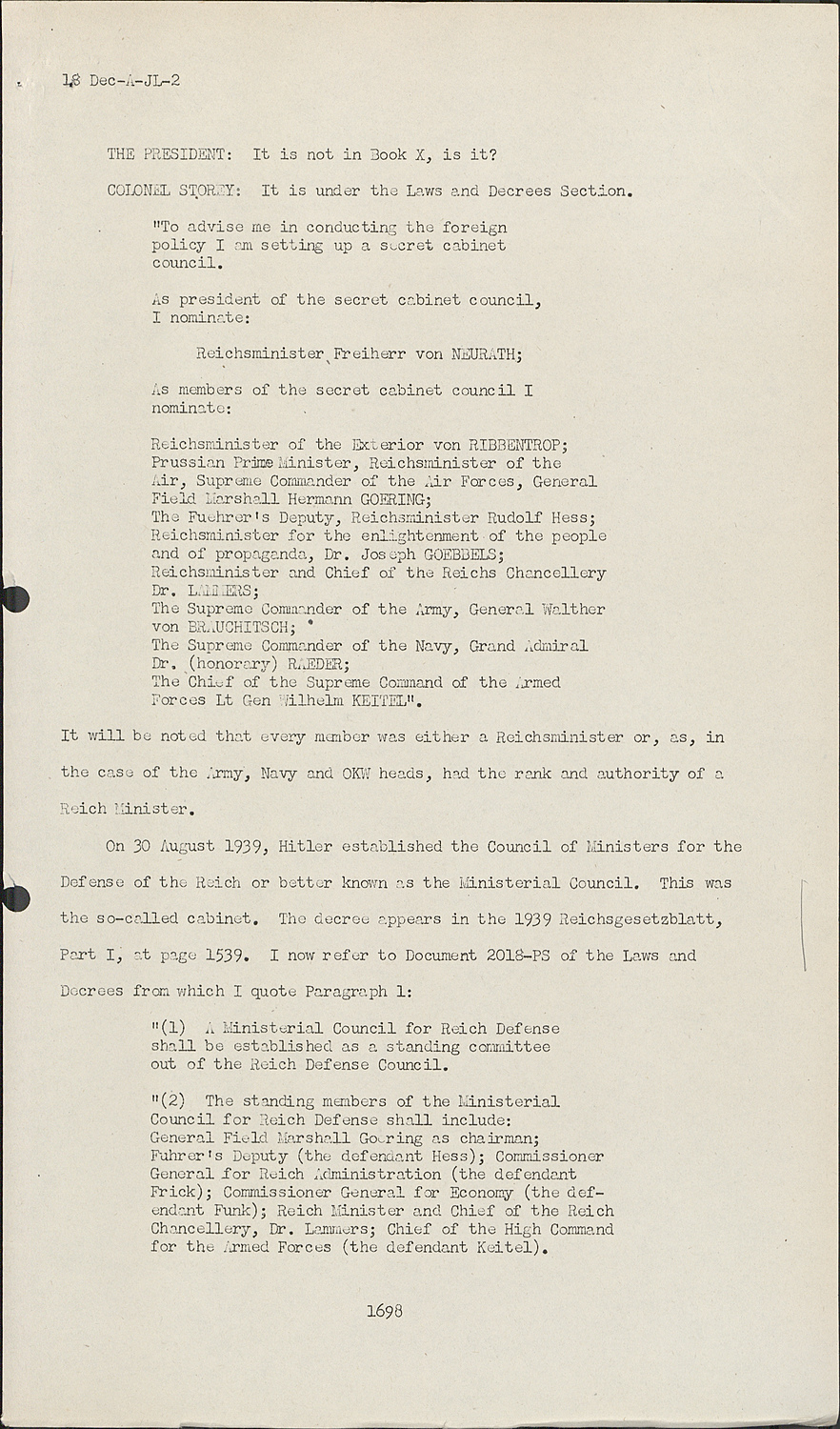
THE PRESIDENT: It is not in Book X, is it?
COLONEL STOREY:It is under the Laws and Decrees Section.
"To advise me in conducting the foreign policy I cm setting up a secret cabinet council.
As president of the secret cabinet council, I nominate:
Reichsminister Freiherr von NEURATH;
As members of the secret cabinet council I nominate:
Reichsminister of the Exterior von RIBBENTROP;
Prussian Prime Minister, Reichsminister of the Air, Supreme Commander of the Air Forces, General Field Marshall Hermann GOERING;The Fuehrer's Deputy, Reichsminister Rudolf Hess;Reichsminister for the enlightenment of the people and of propaganda, Dr. Joseph GOEBBELS;Reichsminister and Chief of the Reichs Chancellery Dr. LAMMERS;The Supreme Commander of the Army, General Walther von BRAUCHITSCH;The Supreme Commander of the Navy, Grand Admiral Dr. (honorary) RAEDER;The Chief of the Supreme Command of the Armed Forces Lt Gen Wilhelm KEITEL". It will be noted that every member was either a Reichsminister or, as, in the case of the Army, Navy and OKW heads, had the rank and authority of a Reich Minister.
On 30 August 1939, Hitler established the Council of Ministers for the Defense of the Reich or better known as the Ministerial Council. This was the so-called cabinet. The decree appears in the 1939 Reichsgesetzblatt, Part I, at page 1539. I now refer to Document 2018-PS of the Laws and Decrees from which I quote Paragraph 1:
"(1) A Ministerial Council for Reich Defense shall be established as a standing committee out of the Reich Defense Council.
"(2) The standing members of the Ministerial Council for Reich Defense shall include:
General Field Marshall Goering as chairman;
Fuhrer's Deputy (the defendant Hess); Commissioner General for Reich Administration (the defendant Frick); Commissioner General for Economy (the def endant Funk); Reich Minister and Chief of the Reich Chancellery, Dr. Lammers; Chief of the High Command for the Armed Forces (the defendant Keitel). "(3) The chairman may draw on other members of the Reich Defense Council including further personalities for advice."
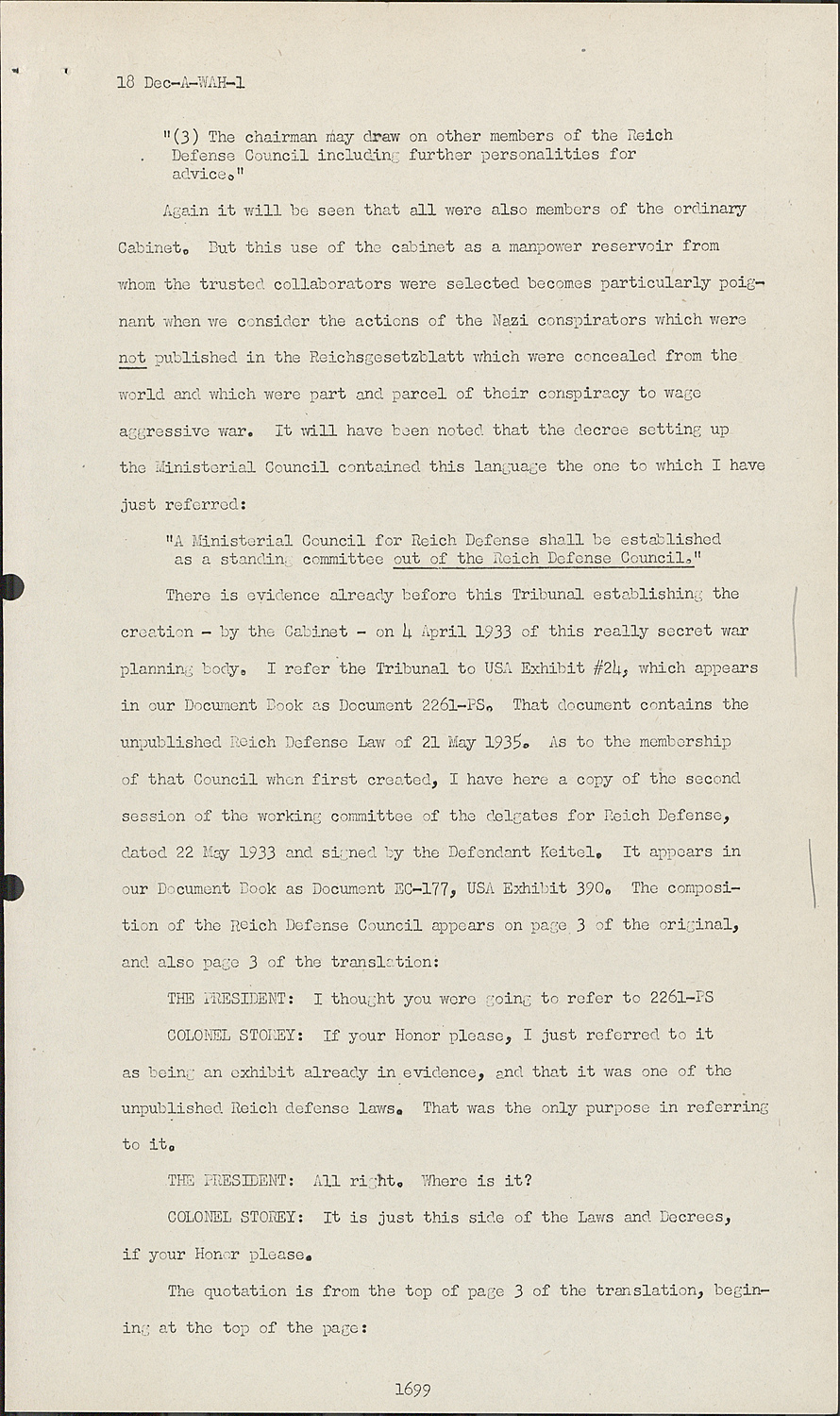
Again it will be seen that all were also members of the ordinary Cabinet. But this use of the cabinet as a manpower reservoir from whom the trusted collaborators were selected becomes particularly poignant when we consider the actions of the Nazi conspirators which were not published in the Reichsgesetzblatt which were concealed from the world and which were part and parcel of their conspiracy to wage aggressive war. It rail have been noted that the decree setting up the Ministerial Council contained this language the one to which I have just referred:
"A Ministerial Council for Reich Defense shall be established as a standing committee out of the Reich Defense Council."
There is evidence already before this Tribunal establishing the creation - by the Cabinet - on 4 April 1933 of this really secret war planning body. I refer the Tribunal to USA Exhibit #24, which appears in our Document Book as Document 2261-PS. That document contains the unpublished Reich Defense Law of 21 May 1935. As to the membership of that Council when first created, I have here a copy of the second session of the working committee of the delgates for Reich Defense, dated 22 May 1933 and signed by the Defendant Keitel. It appears in our Document Book as Document EC-177, USA Exhibit 3901. The composition of the Reich Defense Council appears on page 3 of the original, and also page 3 of the translation:
THE PRESIDENT:I thought you were going to refer to 2261-PS
COLONEL STOREY:If your Honor please, I just referred to it as being an exhibit already in evidence, and that it was one of the unpublished. Reich defense laws. That was the only purpose in referring to it.
THE PRESIDENT:All right. Where is it?
COLONEL STOREY:It is just this side of the Laws and Decrees, if your Honor please.
The quotation is from the top of page 3 of the translation, begining at the top of the page:
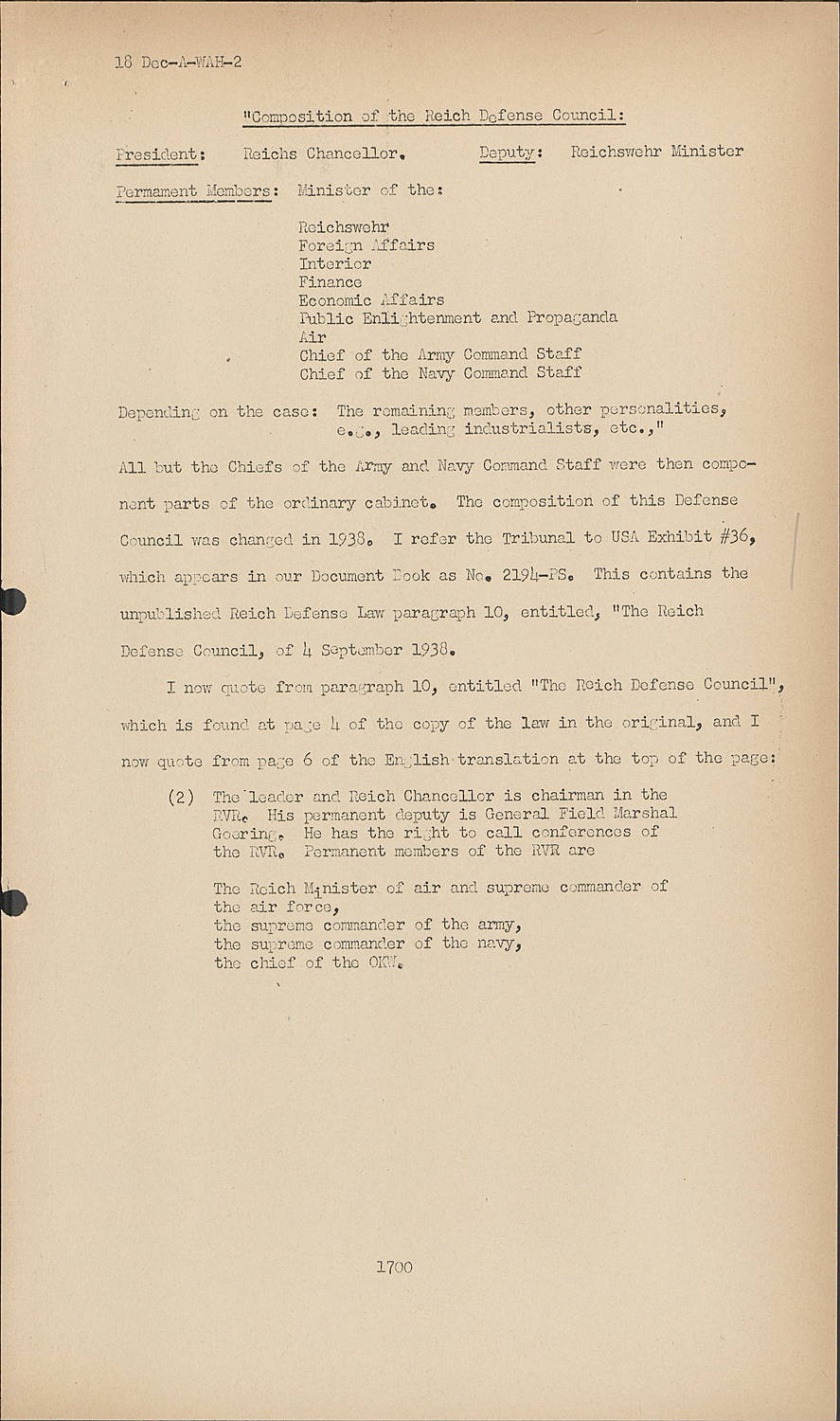
"Composition of the Reich Defense Council:
President: Reichs Chancellor. Deputy: Reichswehr Minister Permanent Members: Minister of the:
Reichswehr Foreign Affairs Interior Finance Economic Affairs Public Enlightenment and Propaganda Air Chief of the Army Command Staff Chief of the Navy Command Staff Depending on the case:
The remaining members, other personalities, e.g., leading industrialists, etc.
," All but the Chiefs of the Army and Navy Command Staff were then component parts of the ordinary cabinet. The composition of this Defense Council was changed in 1938. I refer the Tribunal to USA Exhibit #36, which appears in our Document Book as No. 2194-PS. This contains the unpublished Reich Defense Law paragraph 10, entitled, "The Reich Defense Council, of A September 1938.
I now quote from paragraph 10, entitled "The Reich Defense Council", which is found at page 4 of the copy of the law in the original, and I now quote from page 6 of the English translation at the top of the page:
(2) The leader and Reich Chancellor is chairman in the
RVR.His permanent deputy is General Field Marshal Goering.
He has the right to call conferences of the RVR.
Permanent members of the RVR are The Reich Minister of air and supreme commander of the air force, the supreme commander of the army, the supreme commander of the navy, the chief of the OKW.
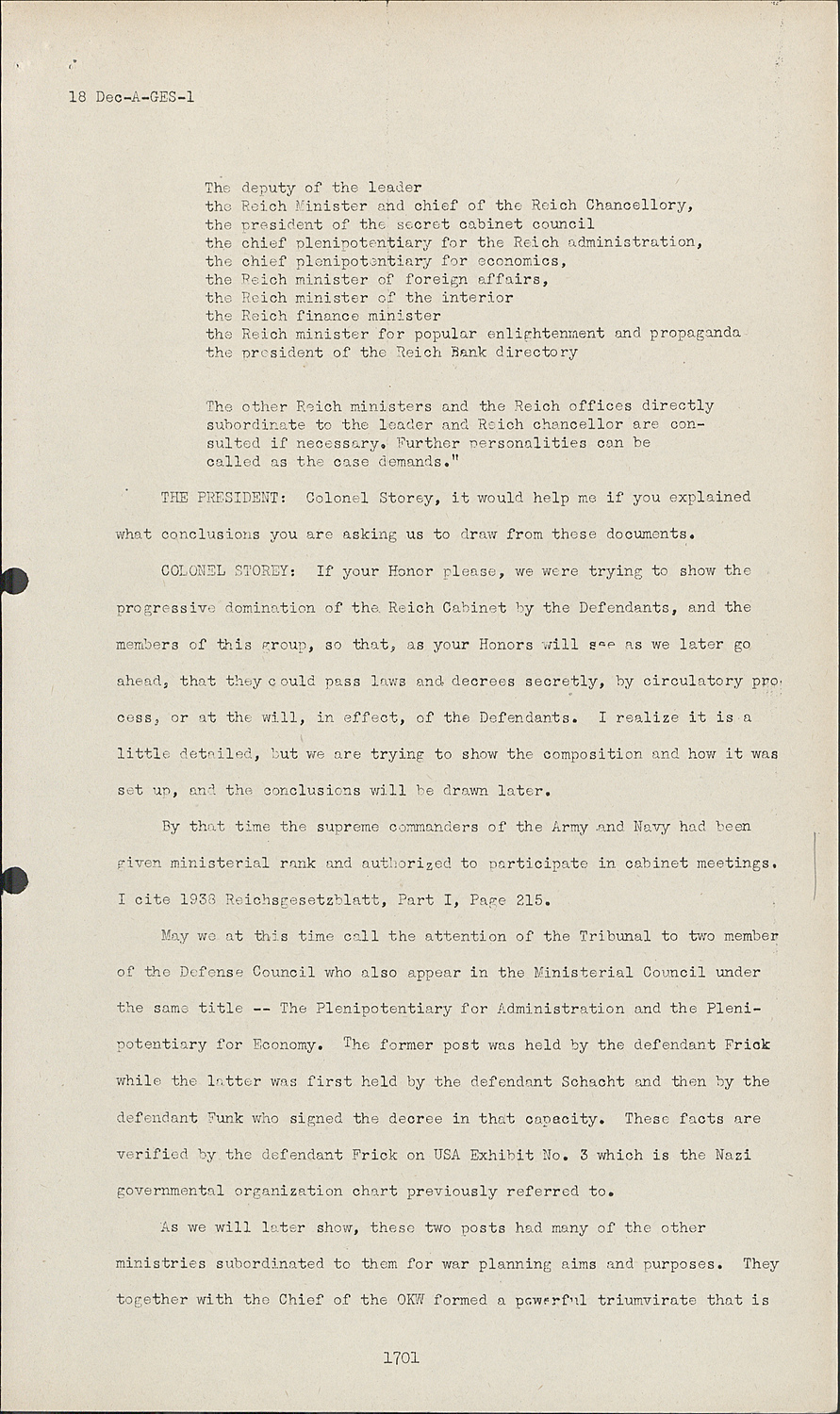
The deputy of the leader the Reich Minister and chief of the Reich Chancellory, the president of the secret cabinet council the chief plenipotentiary for the Reich administration, the chief plenipotentiary for economics, the Reich minister of foreign affairs, the Reich minister of the interior the Reich finance minister the Reich minister for popular enlightenment and propaganda the president of the Reich Bank directory The other Reich ministers and the Reich offices directly subordinate to the leader and Reich chancellor are con sulted if necessary.
Further personalities can be called as the case demands."
THE PRESIDENT:Colonel Storey, it would help me if you explained what conclusions you are asking us to draw from these documents.
COLONEL STOREY:If your Honor please, we were trying to show the progressive domination of the Reich Cabinet by the Defendants, and the members of this group, so that, as your Honors will see as we later go ahead, that they could pass laws and decrees secretly, by circulatory pro cess, or at the will, in effect, of the Defendants.
I realize it is a little detailed, but we are trying to show the composition and how it was set up, and the conclusions will be drawn later.
By that time the supreme commanders of the Army and Navy had been given ministerial rank and authorized to participate in cabinet meetings.
I cite 1938 Reichsgesetzblatt, Part I, Page 215.
May we at this time call the attention of the Tribunal to two member of the Defense Council who also appear in the Ministerial Council under the same title -- The Plenipotentiary for Administration and the Pleni potentiary for Economy.
The former post was held by the defendant Frick while the latter was first held by the defendant Schacht and then by the defendant Funk who signed the decree in that capacity.
These facts are verified by the defendant Frick on USA Exhibit No. 3 which is the Nazi governmental organization chart previously referred to.
As we will later show, these two posts had many of the other ministries subordinated to them for war planning aims and purposes.
They together with the Chief of the OKW formed a powerful triumvirate that is shown in the three boxes down from 1935 to 1938 known as the "3-Man College" which figured prominently -- as the proof will disclose -- in the plans and preparations to wage aggressive war.