The decree of punishment is uncertain.
The scope of the penalties fixed in Law No. 10 of the Control Council, which ranges up to the death penalty, offers no legal protection if their interpretation is left to the free decision of the various national tribunals, which may subsequently sit in judgment. The judgment of the Tribunal might engender new mischief.
The Tribunal must see to it that the goal, which it seeks to attain, will be attained. The punishment must not become a revenge. The measure of punishment must not be based on the theory that millions of victims necessarily implies the guilt of millions, which would be brought to punishment.
If the basic aim of the judgment is to deter, the following must be borne in mind:
None who appeared before this Tribunal has attempted to justify the crimes which are the fundament of this trial.
All who appeared here divorced themselves from these crimes.
No one has declared that the extermination of the Jews had been necessary, or that a war of aggression was a goal worth striving for, or that the persecution of the Church and the concentration camp atrocities were official.
Only if this had been the case would this be a trial involving an ideology which should be eliminated.
That is why there is no typical pioneer for this ideology, who would have said "I have millions behind me, or I cannot do otherwise, God help me." The millions were set in motion by another goal for which they fought. This goal was not the world of crime, but the shining radiance of socialism. The masses saw the miracle of the rise to power succeed a period of misery and were strengthened in their belief. They are ready to believe once more.
The foundation to this belief is the justice of the verdict against the organizations by which the entire population will be affected.
This verdict shall inaugurate the era of a new international law and punish those who are responsible for the war. It is only just that the old jurisdiction should disappear from the stage of world history, which punished the entire people by imposing territorial annexations and economic contributions in the peace treaties without regard to guilt.
Today it is threatened by the two-fold and three-fold punishment, by the peace treaty, by law No. 10 of the Control Council, and by the law for de-Nazification.
We are still in a state of war and this trial has been called the continuation of the war effort.
But there must be peace and "Should war not end with war, whence that shall come the peace?"
THE PRESIDENT:Dr. Servatius, the Tribunal observes with appreciation that you have kept within the limit of time which the Tribunal hoped would be kept to by all Counsel on behalf of the organizations. You have made your speech within half a day, but some of the other speeches which have been deposited for translation appear to be very much longer than yours, and the Tribunal wishes me to point out to those Counsel that they will have to make their speeches also within half a day.
The Tribunal will now adjourn.
(A recess was taken.)
THE PRESIDENT: We call on Dr. Merkel.
DR.MERKEL (Defense Counsel for the Gestapo): Mr. President, Your Honors, in the case of the proceedings against the individual defendants, the perpetrations of individuals were examined. During the proceedings against the Organizations, the question we are concerned with is whether into the leg life of this world a new basic principle is to be introduced. The trial of the Gestapo is given its significance by the conception of the Prosecution that the Gestapo had been the most important instrument of power of the Hitler regime.
If I am to defend the Gestapo, it is with the knowledge that a terrible reputation is associated with that name; alas, even that horror and fear are radiated by it, and that the waves of hatred close over this name.
The words, I am about to speak will be spoken without regard for the opinions of the day because I hope to be able to present factual and legal evidence which will place this High Tribunal in a position :
1. To examine, whether by sentencing the organizations, a legal development will be introduced which will serve humanity.
2. To establish the truth regarding the Gestapo and by this :
3. To liberate innocent amongst the former members of the Gestapo from an unfortunate fate.
The first two tasks necessitate the answering of the question which represents a preliminary problem connected with the problem of the Gestapo as a whole.
No allegation made by the prosecution has shaken me more than the ass*---* tion of the British Chief Prosecutor that the Germans, after six years of Nazi domination and through replacing the Christian ethical teachings, by a Godlike admiration for the Fuehrer, and by the cult of the blood, had become a degenerate nation. If this judgment is just, then the facts of its existence, apart from the circumstances just mentioned, is due to yet another extraordinary factor -- a factor of a character so unusual that history hardly known it: The symptoms of the demon, the demon in Hitler, and the infiltration of the demon's spirit into his regime and into the institutions which he created and employed.
How far Hitler was a demon has been illustrated by Goethe's words already quoted from "Dichtung und Wahrheit" by my colleague Dr. Dix :" ......he (The demon-man) radiates an enormous force ... all ethical forces, united, cannot defeat it ... it attracts the masses.
.. and it is from such remarks that the queer, yet dynamic slogan may have arisen : Nemo contra deum, nisi deus ipse."
The effect of the demonic in the greater world has become clear to you in some of the cases of the individual defendants. The case of the Gestapo will demonstrate to you how an institution of the State was repeatedly misused by the demonic leaders of that State.
And here during the discussion of this preliminary question, yet another interest must arise, the interest of the legal significance of the demonic for this trial. In order to satisfy that interest I shall give another short quotation from Goethe:
"Demonism furnishes one of the moral orders of the world where power interferes although it does not oppose." According to these words, the cruic* point is that two powers, parts of the history of this world, are decisive. "The conflict of which", as Mr. Justice Jackson said in agreement with the poet Goethe, "Forms much of the history of humanity: the world order and the demonism". The juridical of this judgment for our constellation will become clear from the following considerations :
The moral world order was represented by the traditional orders. Opposed to this, Hitler represented the power which was directly opposed to them, and nevertheless incapacitated them. In this trial the aim must be to exterminate the remains of this demonic power. Can this and should this be done in accordance with the agreed principal of the victorious model world order, or can it be done by other methods ?
Here we have the first juridical alternative of this trial clearly be us and this from two of the greatest of the possible perspectives, i.e., in considering the differences between the moral world order and the demonic.
Controversial points of view dominate the present attitude with which to view these matters. The Charter on one hand relies upon the agreed own principals of the moral world order. It wishes to see judgment passed against the representatives of the demonism the individual defendants, and the or-ganizations, by means of an orderly trial, a proper indictment, with appoint defense counsel and resulting in appropriate findings.
On the other hand, "law of the Charter" itself, according to the words of Mr. Jackson, is "a new law" with principals which contradict the age-old traditional legal concepti*--* As examples, I quote the assumption of collective guilt and the introduction of laws with retroactive effects.
In this way it becomes apparent that the leading throughts directing this trial are in opposition to each other. It is a common task for all of us to recognize this fact and also through joint efforts on the part of the prosecution, the defense, and the Tribunal to arrive at a "concordantia discordantium."
My leading argument as defense counsel for the Gestapo will have to be devoted, therefore, to the question of how the rules of the Charter are to be understood, according to which the Tribunal can declare during the trial against Goering, Kaltenbrunner or Frick that the Gestapo was a criminal organization.
Once again I must come back to the principal consideration. If two powers of historic importance to this world decide the moral world order and the demonic, then if this world is to be cleansed, the moral world order must be victorious. But is the moral world order empowered to conduct the fight against its opponent with exceptional rules which differ, themselves, from the basic principles of moral world order ? For the sake of the purity of its character and its victory, moral world order must only fight with weapon of its won categoric imperative, and that without any compromise. Because it is thus that the opponents of Hitler fought during the six years of war, relying on the principles of the Atlantic Charter. But is it right that they the declared representatives of the moral order, should now, with the battle of arms at an end, conduct the final struggle against demonism with such exceptional rules ? That would be an impossibility. Would it not create the impression that the victorious powers, particularly in the realm of e did not have sufficient confidence in the center of their own being ?
As a result, for coming generations this maxim would develop "That which is useful to the victor is right."
The relentless "Vee victis" would have been raised to a dais, whereas the victors had especially emphasized that they entered the lists for justice, and because of justice. With the word "Justice" the signatory powers have called the Tribunal into existence by stating in paragraph one of the Charter "An International Military Tribunal shallbe set up in order to pass a just judgment."
They gave the word "Justice" emphasis by having Part IV of the Charter headed "Regulations for a Just Proceeding", and then they used precautions in that regulations contained in paragraphs 9 and 10 are regulations that may be applied.
The victors had the wish to ***e organizations with a reputation such as the Gestpo who would not understand that, declared criminal, but they took care to make paragraphs nine and ten a regulation which had to be applied. In that way justice became the first premise of the Tribunal. Within its limits, therefore, the regulations that may be applied under paragraphs nine end ten are to be handled as if the entire stipulation had the following wording; "If the Court consider it just, it may declare the organizations criminal." In this way the entire decision rests on the concept of justice.
Justice in its truest formis an attribute of God -- "God is Just." This sentence has penetrated our consciousness in the sense that God will callto account only him who is really guilty according to the word of Jesaya "I have called you by name."
In that way since this principle has been assured, there is much contemplation according to which organizations and their members must be dealt with In the main, two things are involved, the members of the organizations and their families, who make up at least fifteen million people. Now we have to see that this remarkable but terrible proverbproves itself true because of the judgment: "No one can do anything against the moral world order without the moral world order itself."
From this, the following conclusion arises for my final plea: That the question put by the Charter to the prosecution, to the defense, and to the Court, whether rules of exception are admissible, whether above all the organizations are to be considered collectively capable of guilt, whether laws with retroactive power may be applied -- a question that must be answered in the negative.
The counter-question, whether the world in the future can be protected on the basis of the individual system from demon catastrophes, and whether the Hitler catastrophe did not prove the opposite, I should like to answer to this effect: The protection of the world against such catastrophes is not a question of a system, but rather a question for determined men who rest secure in the moral world order.
The significance and the consequences of the demand voiced by the prosecution to have the organizations declared criminal are of tremendous scope Reason enough, that defense counsel must examine with the utmost thoroughness, and in every direction possible, whether the bases are present which can carry an indictment of such consequence in the sense of justice under the moral world order.
First of all I should like to establish all emphasis as the first and most Important result of my examination. A group (Gemeinschaft) can not be declared guilty. For criminal guilt means the realization of conditions which are punishable not only according to objective but also according to subjective aspects. In other words, a crime can be punishable only, and must have been committed deliberately; according to natural concepts. We can speak of intent only with the single individual but not in the case of a group, and if in this connection foreign laws are referred to, this, in the final analysis, is a confusion with the coinciding will of numerous individual persons directed toward a fixed aim.
However, the problem of collective guilt lies in a sense much deeper. The thought to reject collective guilt goes back into the most ancient time. It originated in the Old Testament and through the Greeks and Christianity, it spread over the entire world. In this way it has become the penal guiding principle of the entire moral world order. In Roman days this sentence was expressed clearly "Societas delinquere non-potest." In modern times we have retained the thought of individual guilt.
On the 20th of February 1946, the Pope said in his radio speech that it was a mistake to assert that one could treat a person as guilty and responsible merely because he had belonged to a certain organization, without taking the trouble to investigate in the individual case whether the person in question had made himself personally guilty through his actions or his failure to act.
That was on infringement on the Rights of God.
In the same sense the Hague Rules on Land Warfare of 1907 in Article 50 expressly prohibit the infliction of fines because of the actions of individuals for which the population cannot be considered co-responsible.
Finally, the former State Secretary, K.H. Frank, was condemned to death and executed, because he had among other things, had the village of Lidice wiped out because of the conduct of individual inhabitants of the village. That is to say, the fact that he had assumed collective guilt of the village community and inflicted a collective punishment on the village, was counted as a crime. Thus, in our case, it cannot be proper to punish an organization as a whole collectively, because of the crimes of individuals.
With these brief references I believe I have proved that the basis of the accusation against the Organizations is not firmly established. I agree with the legal statements of Mr. Jackson only insofar as he concludes his legal observations with the statement that: "It is completely unbearable from such thinking according to the letter of the law to reject personal impunity." The personal impunity of the individual members of an organizat in connection with the punishable actions committed within the organization cannot be derived from the rejection of collective guilt; rather, the culpability of the individual for the punishable actions committed by him can be emphasized.
The legal basis of the whole trial against the individuals and organizations here accused is the Charter created by the United Nations. The defense has already taken an opportunity to express doubts about the Charter. I refer to that.
I want to bring out one point of view once more. If, in case an organization is declared criminal, the former members are to be punished because of their mere membership, then they must pay for something which was legally permitted at the time of the action. Thus the Charter establis norms with retroactive force. The legal principle, however, which prohibit laws with retroactive force, is firmly established in the law of all civili states.
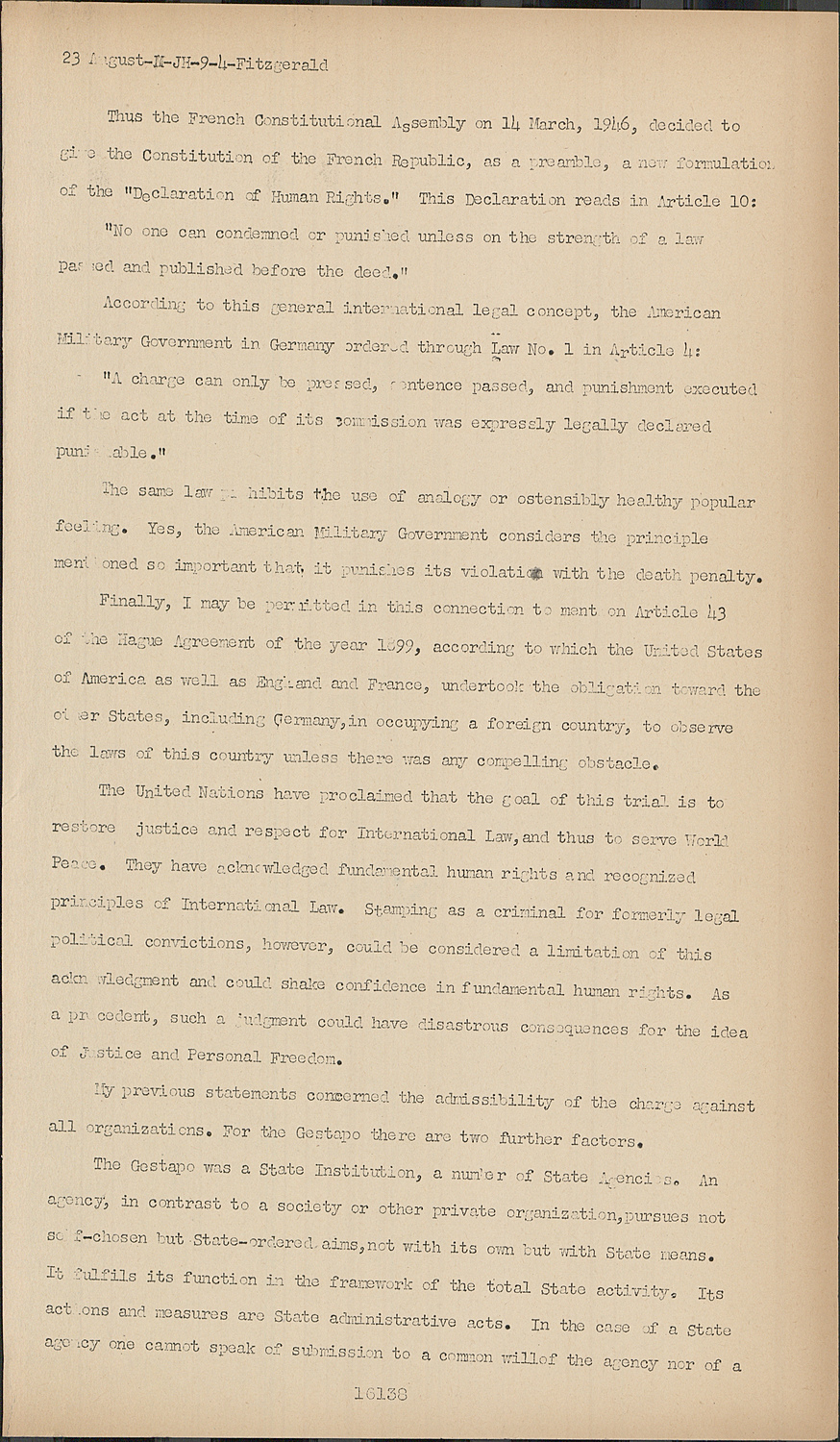
Thus the French Constitutional Assembly on 14 March, 1946, decided to give the Constitution of the French Republic, as a preamble, a now formulation of the "Declaration of Human Rights."
This Declaration reads in Article 10:
"No one can condemned or punished unless on the strength of a law paused and published before the deed."
According to this general international legal concept, the American Military Government in Germany ordered through Law No. 1 in Article 4:
"A charge can only be pressed, sentence passed, and punishment executed if the act at the time of its commission was expressly legally declared punishable."
The same law prohibits the use of analogy or ostensibly healthy popular feeling. Yes, the American Military Government considers the principle mentioned so important that it punishes its violation with the death penalty.
Finally, I may be permitted in this connection to ment on Article 43 of the Hague Agreement of the year 1899, according to which the United States of America as well as England and France, undertook the obligation toward the other States, including Germany,in occupying a foreign country, to observe the laws of this country unless there was any compelling obstacle.
The United Nations have proclaimed that the goal of this trial is to restore justice and respect for International Law,and thus to serve World Peace. They have acknowledged fundamental human rights and recognized principles of International Law. Stamping as a criminal for formerly legal political convictions, however, could be considered a limitation of this acknowledgment and could shake confidence in fundamental human rights. As a precedent, such a judgment could have disastrous consequences for the idea of Justice and Personal Freedom.
My previous statements concerned the admissibility of the charge against all organizations. For the Gestapo there are two further factors.
The Gestapo was a State Institution, a number of State Agencies. An agency, in contrast to a society or other private organization,pursues not self-chosen but State-ordered aims,not with its own but with State means. It fulfils its function in the framework of the total State activity. Its actions and measures are State administrative acts. In the case of a State agency one cannot speak of submission to a common willof the agency nor of a union, more or less, by agreement for a common purpose.
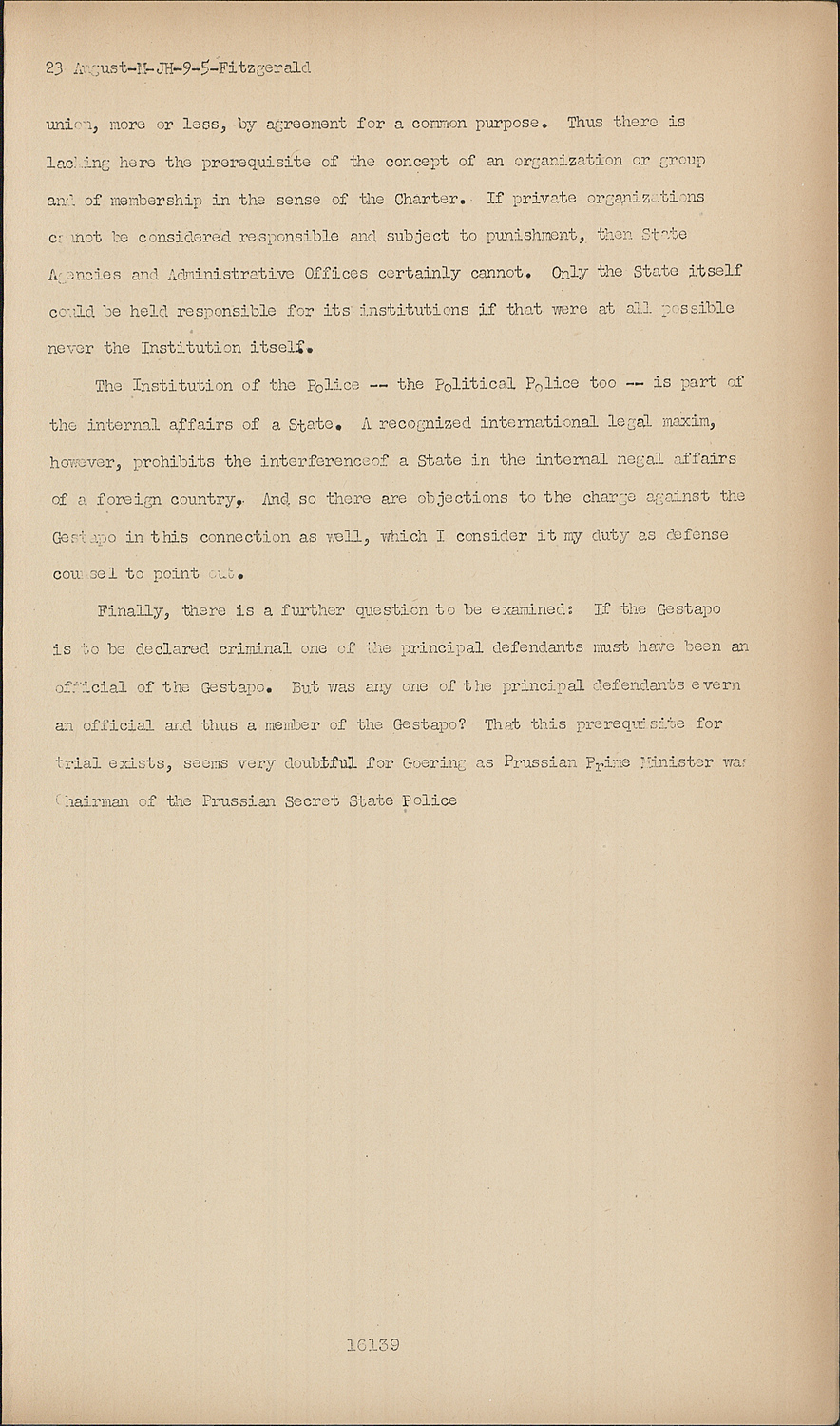
Thus there is lacking here the prerequisite of the concept of an organization or group and of membership in the sense of the Charter.
If private organizations cannot be considered responsible and subject to punishment, then State Agencies and Administrative Offices certainly cannot. Only the State itself could be held responsible for its institutions if that were at all possible never the Institution itself.
The Institution of the Police -- the Political Police too -- is part of the internal affairs of a State. A recognized international legal maxim, however, prohibits the interferenceof a State in the internal negal affairs of a foreign country. And so there are objections to the charge against the Gestapo in this connection as well, which I consider it my duty as defense counsel to point out.
Finally, there is a further question to be examined: If the Gestapo is to be declared criminal one of the principal defendants must have been an official of the Gestapo. But was any one of the principal defendants e vern an official and thus a member of the Gestapo? That this prerequisite for trial exists, seems very doubtful for Goering as Prussian Prime Minister was Chairman of the Prussian Secret State Police and could give orders to it but he did not belong to it.
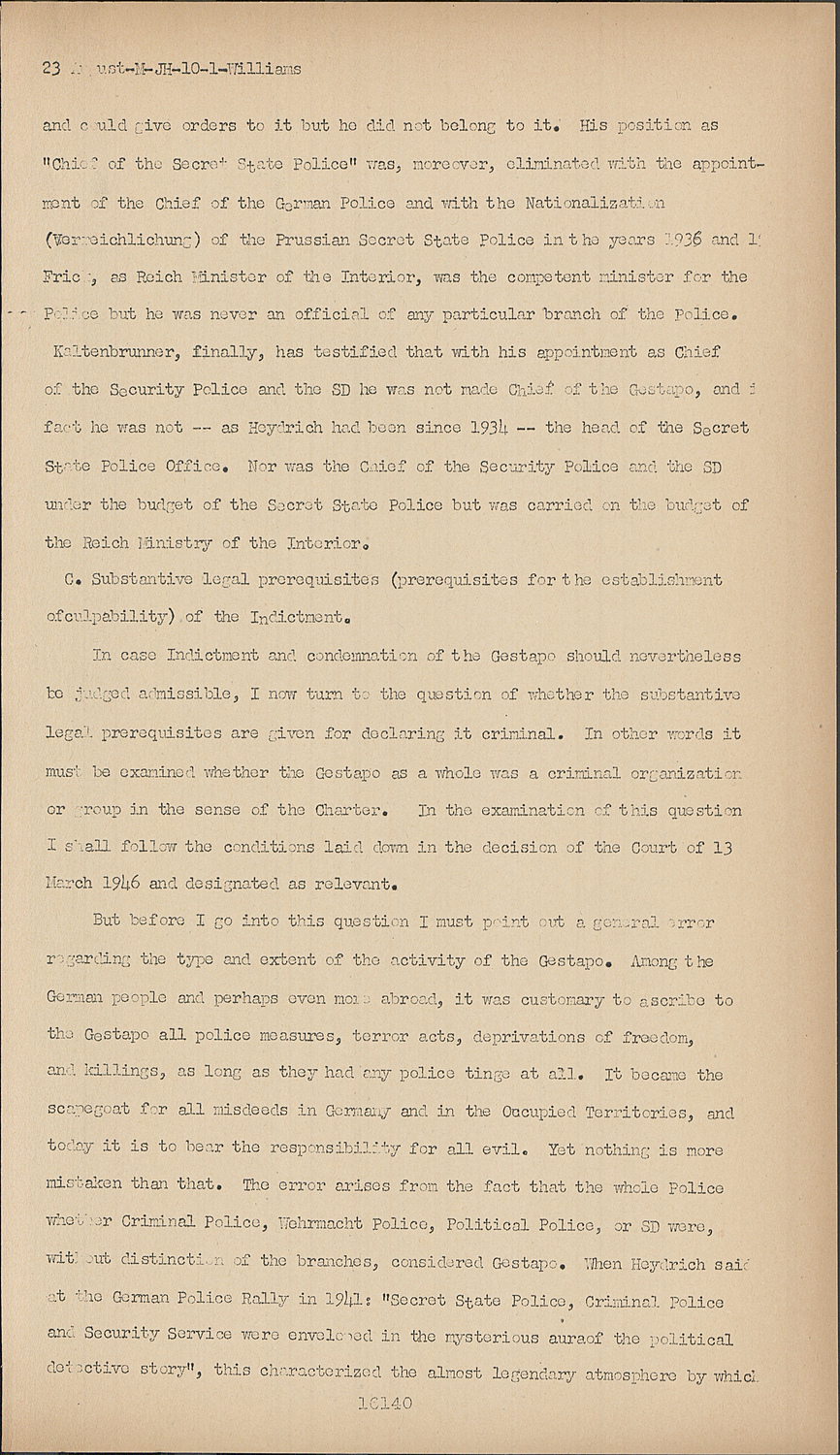
His position as "Chief of the Secret State Police" was, moreover, eliminated with the appointment of the Chief of the German Police and with the Nationalization (Verreichlichung) of the Prussian Secret State Police in the years 1936 and 19 Frick, as Reich Minister of the Interior, was the competent minister for the Police but he was never an official of any particular branch of the Police.
Kaltenbrunner, finally, has testified that with his appointment as Chief of the Security Police and the SD he was not made Chief of the Gestapo, and i fact he was not -- as Heydrich had been since 1934 -- the head of the Secret State Police Office. Nor was the Chief of the Security Police and the SD under the budget of the Secret State Police but was carried on the budget of the Reich Ministry of the Interior.
C.Substantive legal prerequisites (prerequisites for the establishment ofculpability) of the Indictment.
In case Indictment and condemnation of the Gestapo should nevertheless be judged admissible, I now turn to the question of whether the substantive legal prerequisites are given for declaring it criminal. In other words it must be examined whether the Gestapo as a whole was a criminal organization or group in the sense of the Charter. In the examination of this question I shall follow the conditions laid dorm in the decision of the Court of 13 March 1946 and designated as relevant.
But before I go into this question I must point out a general error regarding the type and extent of the activity of the Gestapo. Among the German people and perhaps even more abroad, it was customary to ascribe to the Gestapo all police measures, terror acts, deprivations of freedom, and killings, as long as they had any police tinge at all. It became the scapegoat for all misdeeds in Germany and in the Occupied Territories, and today it is to bear the responsibility for all evil. Yet nothing is more mistaken than that. The error arises from the fact that the whole Police whether Criminal Police, Wehrmacht Police, Political Police, or SD were, without distinction of the branches, considered Gestapo. When Heydrich said at the German Police Rally in 1941; "Secret State Police, Criminal Police and Security Service were enveloped in the mysterious auraof the political detective story", this characterized the almost legendary atmosphere by which the Gestapo in particular is surrounded to the present day.
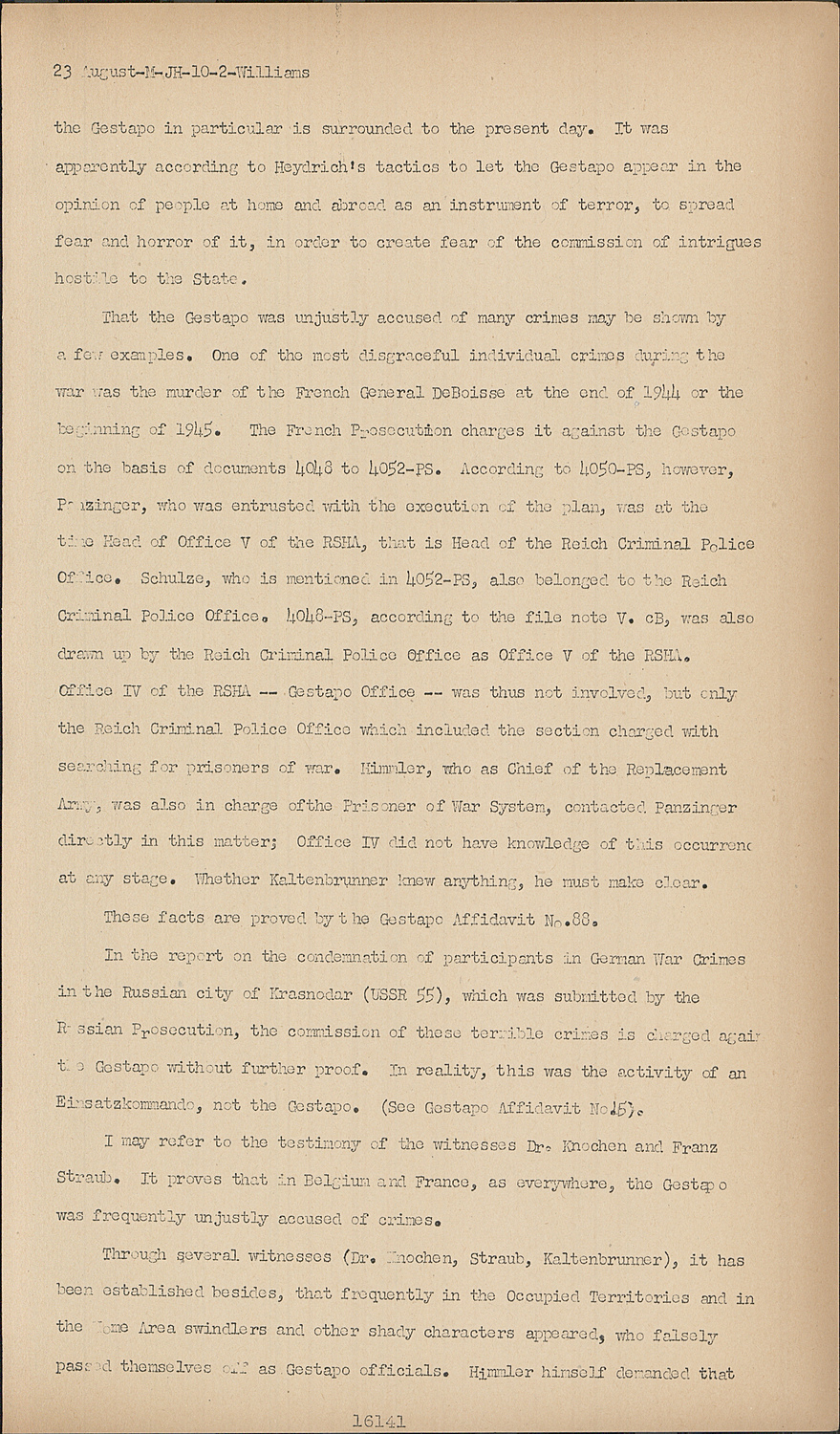
It was apparently according to Heydrich's tactics to let the Gestapo appear in the opinion of people at home and abroad as an instrument of terror, to spread fear and horror of it, in order to create fear of the commission of intrigues hostile to the State.
That the Gestapo was unjustly accused of many crimes may be shown by a few examples. One of the most disgraceful individual crimes during the war was the murder of the French General DeBoisse at the end of 1944 or the beginning of 1945. The French Prosecution charges it against the Gestapo on the basis of documents 4048 to 4052-PS. According to 4050-PS, however, Panzinger, who was entrusted with the execution of the plan, was at the time Head of Office V of the RSHA, that is Head of the Reich Criminal Police Office. Schulze, who is mentioned in 4052-PS, also belonged to the Reich Criminal Police Office. 4048-PS, according to the file note V. cB, was also drawn up by the Reich Criminal Police Office as Office V of the RSHA. Office IV of the RSHA -- Gestapo Office -- was thus not involved, but only the Reich Criminal Police Office which included the section charged with searching for prisoners of war. Himmler, who as Chief of the Replacement Army, was also in charge ofthe Prisoner of War System, contacted Panzinger directly in this matter; Office IV did not have knowledge of this occurrence at any stage. Whether Kaltenbrunner know anything, he must make clear.
These facts are proved by the Gestapo Affidavit No.88.
In the report on the condemnation of participants in German War Crimes in the Russian city of Krasnodar (USSR 55), which was submitted by the Russian Prosecution, the commission of these terrible crimes is charged again the Gestapo without further proof. In reality, this was the activity of an Einsatzkommando, not the Gestapo. (See Gestapo Affidavit No.5).
I may refer to the testimony of the witnesses Dr. Knochen and Franz Straub. It proves that in Belgium and France, as everywhere, the Gestapo was frequently unjustly accused of crimes.
Through several witnesses (Dr. Knochen, Straub, Kaltenbrunner), it has been established besides, that frequently in the Occupied Territories and in the home Area swindlers and other shady characters appeared, who falsely passed themselves off as Gestapo officials. Himmler himself demanded that such false Gestapo officials should be handed over to the concentration camps.
(See Gestapo Exhibit No.34 - USA 207;) Gestapo Affidavit No.68.
As indicated, the Supreme Commander of Sipo, Heydrich, was not entirely without responsibility for the false opinion about the Gestapo. Thus he consciously furthered the rumor that the Gestapo knew everything politically suspicious because it spied on the population. This could not be true as is proved by the fact that the approximately 15,000 to 16,000 Gestapo officia in question, even if they had watched and spied on the people, would have been by far inadequate for this purpose (Dr. Best).
The crimes which Gestapo/members actually committed are not to be excused But it is equally certain that many things occurred for which the Gestapo officials are not responsible, and that it was customarily not examined and differentiated whether certain deeds or misdeeds were carried out by members of the Gestapo or the Kripo, the SS or the SD, or even by native criminals. If, in the interest of combating crimes, it is judged proper in a penal condemnation to give a choice as regards the deed in the sense that punishment is to be inflicted whether the established deed falls under this or that pena law, such a choice can never be given as regards the person of the perpetrator. In other words: it would not be just to ascribe a deed to the Gestapo if the guilt of its members is not absolutely established.
As already said, the Gestapo is no union of persons in the technical sense and probably also in the sense of the charter. Its constitution, its aims and tasks and the methods employed by it cannot fundamentally be designated as criminal. The position of the political police, its special tasks and the measures to be taken by it, of course demanded the form of organization especially adapted to these purposes. In this connection I consider a separatebut still comprehensive presentation of the organization and personnel structure of the Gestapo all the more important since the court in its decisions of 14 January and 13 March 1946, showed that it might ascribe decisive importance to the clarification of this question.
Your Lordship, in order not to tire the Court with the presentation of the organizational structure and the personnel structure, I shall not read th next mine pages, but shall ask the Court to take judicial notice of them.
I draw the special attention of the Court to pages 20 to 24. They deal with the fundamental difference between administrative and execution officials, the technical personnel, the employees, the emergency service workers, and the groups of persons who were taken over as units into the Gestapo -- the Secret Field Police, the Customs Border Protection, the Military Counter-Intelligence, and affiliated units.
I now continue on Page 24 at the top.
The above mentioned State-organism of the political police with its character as a branch of the State administration was outside the stricture of the NSDAP and its organizations. The Gestapo was not dominated by the Party; to the contrary, its assumption of independence within the State and outside the structure of the Party was to serve the purpose to proceed in cases of perpetrations committed by Party members with measures of the State in particular. If Himmler as Vice-Fuehrer SS became the chief of the Political P* in all counties and later in the Reich in 1933, then the oganizations of the County Police were without influence in that connection. Nothing important changed, in fact, with regard to their activities. The Political Police in the German counties, when they were reconstructed in 1933, were mostly staffed with officials from the previous police authorities; not even directing official were Party members in every case. Even later these officials who had been taken over were not replaced by Party members. Only to a small extent, and on as employees and workmen for technical duties, such as drivers, teleprint operators and auxiliaries, were persons from the Party, the SS and the SA taken over.
This distance from the Party and its affiliated organizations appears to contradict the so-called assimilation of the Gestapo into the SS. This assimilation merely meant on affiliation by name to the SS. The reason for the assimilation was the following:
The system of professional civil servants had been introduced into the Gestapo, and maintained. On the other hand,civil serv ants were partly not particularly respected by the Party because of their political or nonpolitical past. In order to strengthen their authority during the carrying out of their duties, in particular when acting against national socialists, they were to appear in uniform, as witness Dr. Best has testified -- who has described himself as the "motor" of this assimilation.
With this assimilation the Gestapo officials -- as, incidentally, also criminal police officials who were also to be assimilated -- were formally listed among the SD formations of the SS, though they remained solely under the jurisdiction of their own superiors without doing any SSor SD duties. Furthermore, the assimilation was only carried out slowly and to an inconsiderable degree. At the outbreak of war in 1939 only approximately 3,000 of the members of th Gestapo, out of a total of 20,000, had been assimilated. It is significant that Himmler, by no means liked to see the Gestapo appear publicly wearing SS uniforms, as becomes evident from Document USA-447.
During the war even non-assimilated persons had to wear the SS uniform on certain duties without being members of the SS. Apart from that the SS did not control the police or exert any type of influence upon its activitie it was only in Himmler 's person that there was personal union in the leader ship of the two.
With reference to this statement I refer you to the testimony of Dr. Be The Gestapo as a whole had nothing to do with the SD, which, as is known, was purely an organization of the Party.
Personal union only existed in the position of the chief of the SIPO and the SD (Heydrich, later Kaltenbrunner), which was accidental,however, and did not form an organizational or functional interconnection.
In no case was the SD centralized with the Gestapo in order to form a system of police.
The SD did not have to support the Gestapo in its tasks,it had no police tasks whatever.
The officials of the Gestapo did not, by any means, consider themselve members of a uniform organization with the SS and the SD. Every member of one of the three organizations knew that he belonged to an independent institution serving independent purposes.
Although the Gestapo was, therefore, in no way organizally or, from the point of view of duties, connected with the party, it was, nevertheless, not altogether detached from the administrative tasks of the State being, as it was, a State authority. To the contrary, on every level interconnection existed with the general and interior administration. The higher administrative organizations, The ministers of the Interior in the counties, the Supreme Presidents and Government Presidents were entitled to receive reports and issue instructions. Evidence has, in fact, shown that the majority of all State Police actions were carried out by the district and local police organizations and the Gendarmerie. This fact particularly furnishes on indication how serious, and doubtful it is to indict the Gestapo as an institution of the State. Because, thinking consequently, the officials of the aforementioned administrative organizations as well as those working in a State Police capacity would have to be indicted together with the Gestapo, and that thought alone appears absurd.
If it is impossible for these reasons to speak of a coordination of personnel in the case of the Gestapo, then it is equally impossible to speak of a membership in the sense of the indictment, and the demands of voluntary service were even less fulfilled. Not one of the witnesses examined was able to justify this, the Prosecution's allegation, to the contrary, all witnesses had to testily that as a matter of principle membership of the Gestapo was generally not on a voluntary basis.
The assignment of officials to the Gestapo took place, to a large extend in that manner, that from a previous organization they were transferred to a organization of the Gestapo. The order for transfer had to be obeyed on the strength of the existing civil servants law. Severe disciplinary disadvantages would have been the result of a refusal and very probably the the loss of the position held; and had such a refusal been based on the statement that for reasons of conscience the officials did not agree with activities of the Gestapo then he would, as would have any civil servant in a similar case, become subject to disciplinary proceedings or even penal proceedings resulting in the loss of his position and hard earned privileges and, apart from that, he would even have gone to a concentration camp.
Replacements of civil servants for the Gestapo were organized in such a way that, in accordance with police civil service law, 90% were drawn from the former protection police officials who wished to become original police officials, whereas only 10% could be taken from other professions.
Aspirants from the protection police could not, however, freely decide whether to join the Gestapo or Kripo; they were allotted by the "assignment department of the police " at Potsdam to the Gestapo or the Kripo, according to requirements and, even, against their will. Incidentally, we are here concerned with protection police officials with 8 to 12 years service, as well as old police officials who had been in the police service already before 1933.
It was almost impossible for an official to break loose from the Gestapo, apart from general reasons such as death, sickness and dismissal because of a crime. During war the Gestapo, just like the entire police, was considered as being on active service and was subject to military discipline so that resignation was totally impossible. It was even prohibited to volunteer for military service at the front.
The same principles of assignment and retirement also applied to the institutions under the jurisdiction of the Gestapo, such as Border Police, Military Counter Intelligence, and Customs Police, not to forget the numerous Emergency Service employees who, at times, represented nearly one-half the total personnel strength.
From those statements mostly based on the testimony and affidavits particularly from the witnesses Best, Knochen and Hoffmann, the following becomes apparent: The Gestapo consisted of a multitude of State organization But in the case of such an organization one cannot mention members of that organization in the same way as members of a private organization. For that reason there was no membership of the Gestapo and even less a voluntary one; on the contrary, there was only a public-legal position of a civil servant.
The question also whether the aim and task of the Gestapo was criminal must be answered in the negative. The aim of the Gestapo -- just like that of any political police -- was the protection of the people and the State against attacks of elements hostile to the State against its existence or its free development. Accordingly, the task of the Gestapo is defined in paragraph 1 of the Law of the 10th of February 1936, (Gestapo Exhibit No. 7) as follows: I quote:
"The Secret State Police has the task to investigate all currents dangerous to the State and combat them; to collect and exploit the result of such investigation; to inform the government of the State and other authorities of results important for them, keep them informed and supply them with suggestions."
Those tasks of the Gestapo, in their character, were the same as those of the Political Police before 1933, and as those of any Political police in foreign countries. What is to be understood by "currents hostile to the State" depends upon the respective political structure of a State. A change in the political leadership cannot retroactively render illegal the activities of a political police which have been directed against forces other than those hostile to the State. The activities of the Gestapo had been legally regulated by instructions issued by the State. Its tasks consisted, in the first place and mainly in the investigation of politically punishable actions in accordance with the general penal code in which connection the officials of the Gestapo became active as auxiliary officials of the Public Prosecutor's Department and it further consisted of the prevention of such actions through preventive measures.
Now, of course, the methods of the Gestapo are made the basis of serious accusations against it in three ways. They are even hold against them as crimes. One method is the protective custody and transfer of person to concentration camps. I know even when I only mention that name it radiates something like the cold breath of graves. But even then imposing of protective custody was governed by exact regulations. Protective custody which in addition is not a specifically German or specifically national socialist invention, was recognized as legal in several findings of the Reich Courts, the Prussian Supreme Administrative Court, and also Constitutional Courts.
A second method -- that of the so-called third degree interrogation -must, to put it mildly, give cause to serious misgivings. On the other hand, this method was only rarely used (see particularly witness Dr. Best), and then only by order from the highest authorities and never to force a confession.
This method as well which we shall discuss further in connection with the discussion of the individual crimes was regulated by law and even during the time of the war (compare Gestapo Exhibit No. 60).
And, finally, the Prosecution is accusing the Gestapo particularly to the effect that it was not bound by law but rather that it acted purely arbitrarily. In reply to this, I should like to say that if it is established in two laws (dealing with the Anschluss of Austria and the annexation of the Sudetenland) that the chief of the German Police can take measures going beyond the existing laws, in that way arbitrary police power is not legalized; rather, we are concerned with a typical legal transfer of the authority to establish police law. Measures in the sense of a general sort which could be issued even if in the annexed countries no laws existed as yet in this regard but which were, nevertheless, binding for the population and the executive power of the police because the necessary authority had been granted by the head of the State.
The principle that no individual case could be carried out along arbitrary lines, but rather that exact regulations existed and were to be observed in all executive actions, was strictly adhered to. (Witness Dr. Best).
It never even occurred to Gestapo officials, at least not before the war, that they might be accused of arbitrary actions from abroad. The tasks and methods, which were for all the world to see legally restricted and which did not apply only to the members of the Gestapo, cannot be considered criminal by the world, a world which not only formally recognized the German Reich Government, who carried the sole responsibility in this matter, but a world which repeatedly showed its recognition to the German people.
If foreign countries had objected to the aims pursued by the Gestapo, it would not have been conceivable that numerous foreign police systems worked in close collaboration with the German Gestapo, a collaboration by the way which was not negotiated through diplomatic circles and that foreign police officials visited the German Gestapo, obviously with the insertion of learning from it (compare Gestapo Affidavit Nos. 26 and 89). In any event, because of this, the individual Gestapo official must have considered his activity internationally recognized.
The aims, tasks and methods of the Gestapo remained constant even during the war. Insofar as other acts were intended for it, other than the acts described, they must be evaluated as acts foreign to the police and outside the organization. Later we shall deal with the Einsatzgruppen, their composition their activity and their relation to the Gestapo.
Following the Indictment, I shall now turn to the questions as to whether the Gestapo participated in a joint plan for the committing of crimes and whether it participated as a deliberate part of the whole in the sense of the Indictment in the so-called Nazi conspiracy. In order to deal with those questions,it appears necessary to examine, first of all, just which crimes it can be proved were committed by the Gestapo.
In order to characterize an organization as criminal, just as in the case of an individual, only typical aspects may be considered; that is, only such actions and characteristics which are in accord with the peculiar nature of the respective organization.
Therefore, incidents cannot be used which, oven though they took place within the organization, must be considered as foreign to the organization, in this case foreign to the police; and furthermore actions may not be cited winch were committed by individual members.
In order to determine the fact whether those aspects are to be considered criminal , German law should be consulted, which does not deviate from the Views held by other civilized countries in the designation of general criminality.