A Gauleiter has different possibilities for gaining an insight and his knowledge and experience is greater than that of a local group leader.
The political leader, who is a professional, must be judged differently than one who is acting in a honorary capacity.
Only if proof of a joint conspiracy is furnished could they be put on the some level. But that conspiracy in particular is yet to be established.
When examining the incriminating documents, the difference of this responsibility becomes evident. There are instructions given at the Higher level of which merely the smallest circle had gained knowledge; their are instructions meant only to be communicated generally to political leaders, which, however, did not pass through the entire channel of orders. There are instructions which issued in a certain part of the Reich independently did not become known in other Gaus.
There are measures carried out by the highest political leaders which only became known to them because of special state positions and which therefore did have no contact with the apparatus of the party.
The difference in position has in fact been recognized by the prosecution during their case against the political leaders and accordingly, the members of the local group staffs and the auxiliaries of the Zell and Blockleiters have been omitted from the proceedings. It is in accordance with this principle that over and above this the degree of responsibility on the part of the remaining groups must be examined.
The position by which the Zell and Blockleiters are still included in the proceedings, whereas members of the staffs of the local groups who held a similar or even higher rank are not included, is due to the fact that in the manual of organization they have been described as "Hoheitstraeger".
The significance of the manual of organizations is misunderstood by the prosecution. The book was a theoretical work and has been described as such by the officials of the Reichs organization leader, Ley.
The designation "Hoheitstraeger" was given to Zell and Blockleiters for merely constructive reasons, because in that way they could be included in the territorial organization.
This construction led to it that a Black leader appears as an important Hoehitstraeger, whereas a Reichs leader lacks this same characteristic; on the other hand, the Blockleiter falls, as a Hoheitstraeger into the same category in the Reichs as the Fuehrer , Affidavit Hederich in which connection I draw your attention to P.L.No 27, Deputy Chairman of the Investigating Commission for N.S. Literature : Affidavit P.L.No. 25 Schmidt, head of the Chief Department of the Reichs organization Chief, affidavit P.L. -No. 26 Foertsch, Gau-Organization chief Munich-Upper Bavaria.
Accordingly, in the book of Chief Section Leader Dr. Lingg, entitled "Administration of the NSDAP" which appeared in 1940, Zell and Block leiters are not listed as Hoheitstraeters. The designation, Hoheitstraeger only goes down as far as the level of local group leader (Ortsgruppenleiter).
In the same manner a decree of the party chancellery, dated the 8th of October, 1937, does not induce the Zell and Blockleiters among the Hoheitstraegen(Document R.L. No. 2). There, only four Hoheits territories are mentioned and they end with the local group, Ortsgruppenleiter.
This follows an announcement from Hitler dated 25 April, 1941 regarding authority to enter damaged property after an air raid. There once again Zell and Blockleiters are not induced amongst the Hoheitstraeger.
Equally, the periodical "Der Hoheitstraeger", submitted by the prosecution as Document 2660-PS, for the purpose of proving the special character of the Zell and Blockleiter shows that the periodical was only dispatched to ranks up to and including local group leaders. (See Document P.L. No. 25)
THE PRESIDENT:Dr. Servatius, are your pages in the German the same as the English pages or not ?
DR. SERVATIUS:I haven't had time to check them, my Lord. They ought to be the same. I am now on page 54.
THE PRESIDENT:Yes. I want you to go back to page 53 for a moment. I didn't understand your argument at the bottom of page 53. This is what it says in the English :"The designation 'Hoheitstraeger' was given to Zell and Blockleiters for merely constructive reasons ...." I don't know what the word "constructive" means there; and it goes on : "... because in that way they could be included in the territorial organization.
This construction led to it that a Block leader appears as an important Hoheitstraeger, whereas a Reich leader lacks this same characteristic ... " What do you mean by "Reich Leader "? Is that the same as a "Reichsleiter"?
DR. SERVATIUS:Reichsleiter, my Lord.
THE PRESIDENT:Then on the next page, page 54 you go on to say in the third paragraph : "In the same manner a decree of the party chancellery, dated the 8th of October, 1937, does not include the Zell and Blockleiters among the Hoheitstraeger (Document R.L. NO. 2). There, only four Hoheits territories are mentioned and they end with the local group, Ortsgruppenleiter.' Well, that is equivalent to saying, isn't it, that the Reichsleiters are Hoheitstraegers ?
DR. SERVATIUS:No. On the level of the Reich there is only one Hoheitstraeger and that is Adolf Hitler himself, the Fuehrer, whereas Reichsleiters are not Hoheitstraegers since they, themselves, had not allotted territories. That was the Fuehrer only, therefore, and from the point of view of structure, construction, organization, the point was that there was the Reich and Fuehrer and then comes the Gauleiters, Reichsleiters and Ortsgruppenleiters and there it ends.
I continue with the last paragraph. In addition, a further instruction of the party chancellery was issued on 7 December 1943, in which the Block and Zell leaders are not counted amongst Hoheitstraegers.
(Document P.L.No.24) But not only from the point of view of form, also from the point of view of their activity, the Zell and Block leaders were not persons to whom special privileges and authority was granted; their activities have been described by witnesses examined before this Tribunal; it consisted in practical assistance. These political leaders were acting for the administration of the party or during war time to an ever-increasing degree carrying out social work in order to alleviate the distress after air-attacks to which was added practical assistance in resettlement and the prevention of damage during air raid alerts. It was a self-sacrificing and strenuous work which was demanded from these persons.
These political leaders did not occupy a predominant position. Interest-
ing in this connection is Document P.L.No. 9, the Appendix to the announcement from the Deputy of the Fuehrer, dated 12 July 1940. It appears from this that contrary to the actual Hoheitstraeger, the political reliability of Zell and Block leaders had still to be established , if they desired to apply for a marriage loan or any other type of financial assistance.
That such people could not be regarded as generally suitable for the duties of a say is a certainty/
It also becomes clear that they had no tasks of political leadership; they were mostly ordinary people who lacked the time and the knowledge for such work. The fact that from certain more highly educated circles, individual persons were appointed as Blockleiters also shows that it was not their political ability which was to be used in this connection.
Particularly important in this connection is the Document P.L. No. 24 just mentioned, regarding "Hints for Leadership of the Party Chancellery" These "Hints for Leadership" are issued as is stated in the Document "For the Speedy Political Information of the Hoheitstraeger, that is, the Gau, Kreis and local group leaders, and for one Support of Leadership Work."
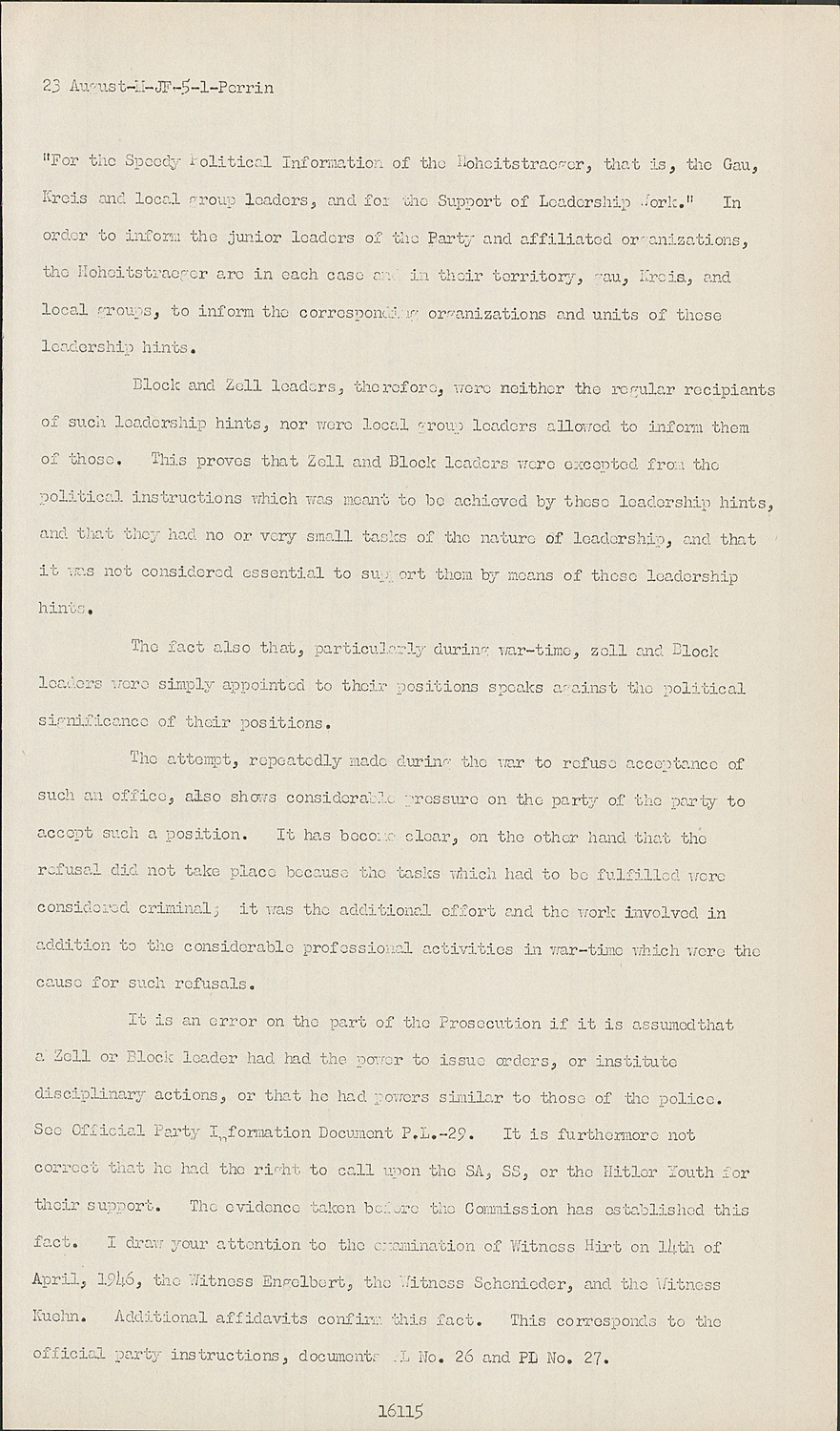
In order to inform the junior leaders of the Party and affiliated organizations, the Hoheitstraeger are in each case an in their territory, gau, Kreis, and local groups, to inform the corresponding organizations and units of these leadership hints.
Block and Zell leaders, therefore, were neither the regular recipients of such leadership hints, nor were local group leaders allowed to inform them of those. This proves that Zell and Block leaders were executed from the political instructions which was meant to be achieved by these leadership hints, and that they had no or very small tasks of the nature of leadership, and that it was not considered essential to support them by means of these leadership hints.
The fact also that, particularly during war-time, zell and Block leaders were simply appointed to their positions speaks against the political significance of their positions.
The attempt, repeatedly made during the war to refuse acceptance of such an office, also shows considerable pressure on the party of the party to accept such a position. It has become clear, on the other hand that the refusal did not take place because the tasks which had to be fulfilled were considered criminal; it was the additional effort and the work involved in addition to the considerable professional activities in war-time which were the cause for such refusals.
It is an error on the part of the Prosecution if it is assumed that a Zell or Block leader had had the power to issue orders, or institute disciplinary actions, or that he had powers similar to those of the police. See Official Party Information Document P.L.-29. It is furthermore not correct that he had the right to call upon the SA, SS, or the Hitler Youth for their support. The evidence taken before the Commission has established this fact. I draw your attention to the examination of Witness Hirt on 14th of April, 1946, the Witness Engelbert, the Witness Schenieder, and the Witness Kuehn. Additional affidavits confirm this fact. This corresponds to the official party instructions, documents PL No. 26 and PL No. 27.
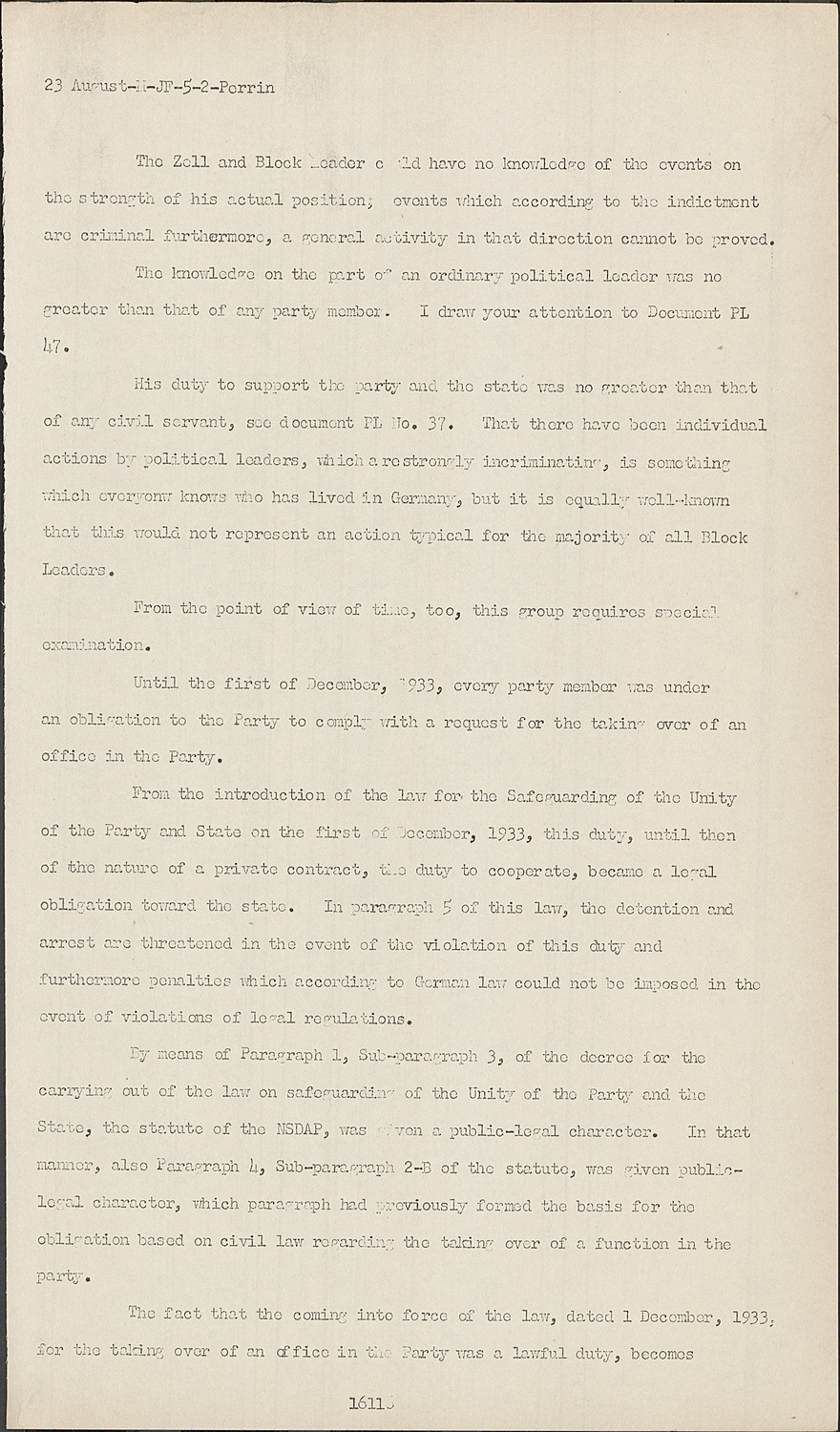
The Zell and Block Leader could have no knowledge of the events on the strength of his actual position; events which according to the indictment arc criminal furthermore, a general activity in that direction cannot be proved.
The knowledge on the part of an ordinary political leader was no greater than that of any party member. I draw your attention to Document PL 47.
His duty to support the party and the state was no greater than that of any civil servant, see document PL No. 37. That there have been individual actions by political leaders, which a restrongly incriminating, is something which everyone knows who has lived in Germany, but it is equally well-known that this would not represent an action typical for the majority of all Block Leaders.
From the point of view of time, too, this group requires special examination.
Until the first of December, 1933, every party member was under an obligation to the Party to comply with a request for the taking over of an office in the Party.
From the introduction of the law for the Safeguarding of the Unity of the Party and State on the first of December, 1933, this duty, until then of the nature of a private contract, tie duty to cooperate, became a legal obligation toward the state. In paragraph 5 of this law, the detention and arrest are threatened in the event of the violation of this duty and furthermore penalties which according to German law could not be imposed in the event of violations of local regulations.
By means of Paragraph 1, Sub-paragraph 3, of the decree for the carrying out of the law on safeguarding of the Unity of the Party and the State, the statute of the NSDAP, was given a public-legal character. In that manner, also Paragraph 4, Sub-paragraph 2-B of the statute, was given publiclegal character, which paragraph had previously formed the basis for the obligation based on civil law regarding toe taking over of a function in the party.
The fact that the coming into force of the law, dated 1 December, 1933, for the taking over of an office in the Party was a lawful duty, becomes argumentum e contrario, also from a specific statement contained in Paragraph 20 of the Reichs Labor Law dated 26 June, 1935, according to which members of the Reichs Labor service are entitled to refuse the acceptance of an honorary function in the services of the Party.
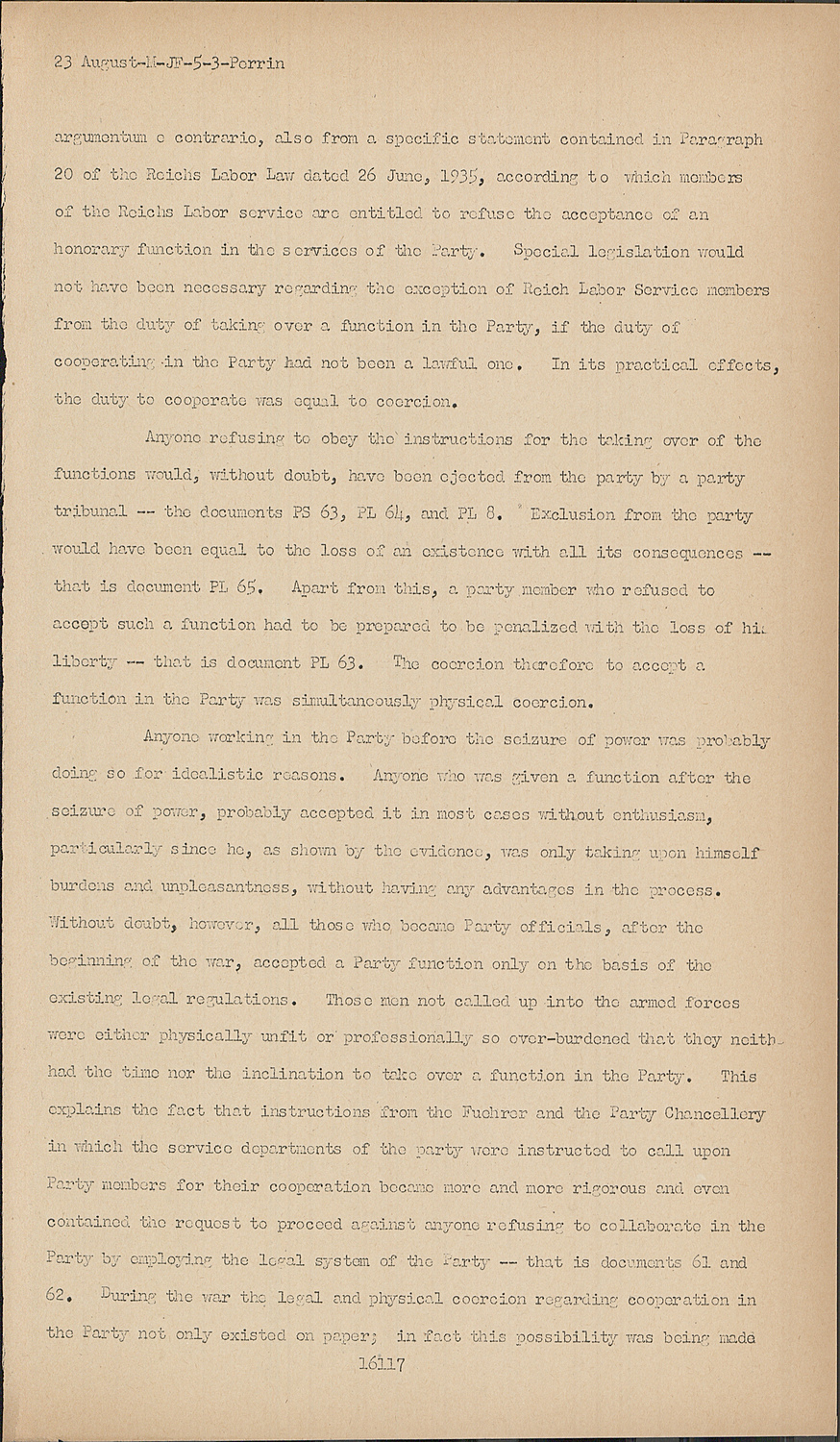
Special legislation would not have been necessary regarding the exception of Reich Labor Service members from the duty of taking over a function in the Party, if the duty of cooperating in the Party had not been a lawful one. In its practical effects, the duty to cooperate was equal to coercion.
Anyone refusing to obey the instructions for the taking ever of the functions would, without doubt, have been ejected from the party by a party tribunal -- the documents PS 63, PL 64, and PL 8. Exclusion from the party would have been equal to the less of an existence with all its consequences -that is document PL 65. Apart from this, a party member who refused to accept such a function had to be prepared to be penalized with the loss of his liberty -- that is document PL 63. The coercion therefore to accept a function in the Party was simultaneously physical coercion.
Anyone working in the Party before the seizure of power was probably doing so for idealistic reasons. Anyone who was given a function after the seizure of power, probably excepted it in most eases without enthusiasm, particularly since he, as shown by the evidence, was only taking upon himself burdens and unpleasantness, without having any advantages in the process. Without doubt, however, all those who become Party officials, after the beginning of the war, accepted a Party function only on the basis of the existing legal regulations. Those men not called up into the armed forces were either physically unfit or professionally so over-burdened that they neither had the time nor the inclination to take over a function in the Party. This explains the fact that instructions from the Fuehrer and the Party Chancellery in which the service departments of the party were instructed to call upon Party members for their cooperation became more and more rigorous and even contained the request to proceed against anyone refusing to collaborate in the Party by employing the local system of the Party -- that is documents 61 and 62. During the war the legal and physical coercion regarding cooperation in the Party not only existed on paper; in fact this possibility was being made use of to the largest possible decree, which is proved by document No. 8.The assumption is justified, therefore, that if anyone became a functionary and political leader during the war, this was regularly the outcome of the legal instructions and the result of the threat of being prosecuted by the legal system of the Party.
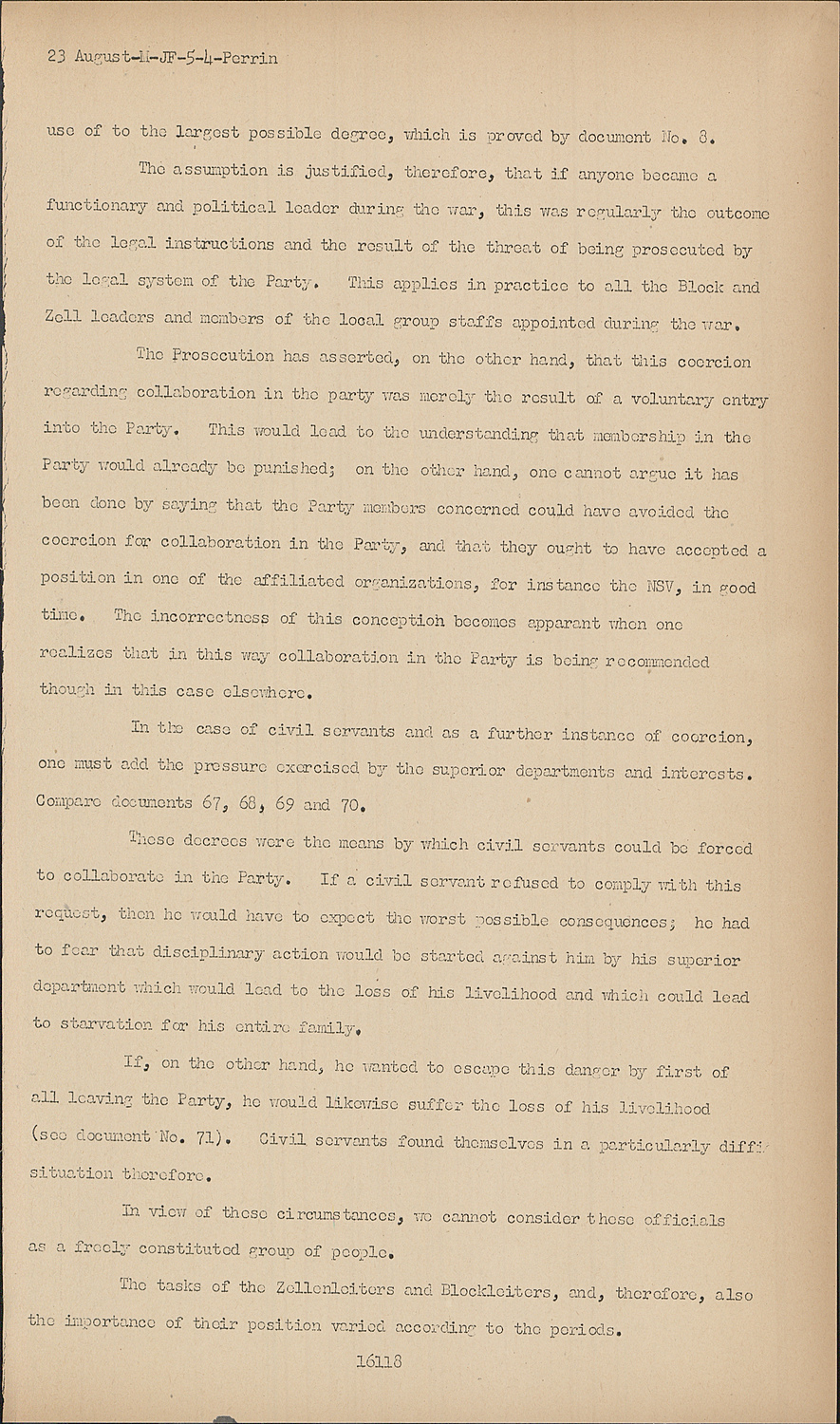
This applies in practice to all the Block and Zell leaders and members of the local group staffs appointed during the war.
The Prosecution has asserted, on the other hand, that this coercion regarding collaboration in the party was merely the result of a voluntary entry into the Party. This would lead to the understanding that membership in the Party would already be punished; on the other hand, one cannot argue it has been done by saying that the Party members concerned could have avoided the coercion for collaboration in the Party, and that they ought to have accepted a position in one of the affiliated organizations, for instance the NSV, in good time. The incorrectness of this conception becomes apparent when one realizes that in this way collaboration in the Party is being recommended though in this case elsewhere.
In the case of civil servants and as a further instance of coercion, one must add the pressure exercised by the superior departments and interests. Compare documents 67, 68, 69 and 70.
These decrees were the means by which civil servants could be forced to collaborate in the Party. If a civil servant refused to comply with this request, then he would have to expect the worst possible consequences; he had to fear that disciplinary action would be started against him by his superior department which would lead to the less of his livelihood and which could lead to starvation for his entire family.
If, on the other hand, he wanted to escape this danger by first of all leaving the Party, he would likewise suffer the loss of his livelihood (see document No. 71). Civil servants found themselves in a particularly difficult situation therefore.
In view of these circumstances, we cannot consider these officials as a freely constituted group of people.
The tasks of the Zellenleiters and Blockleiters, and, therefore, also the importance of their position varied according to the periods.
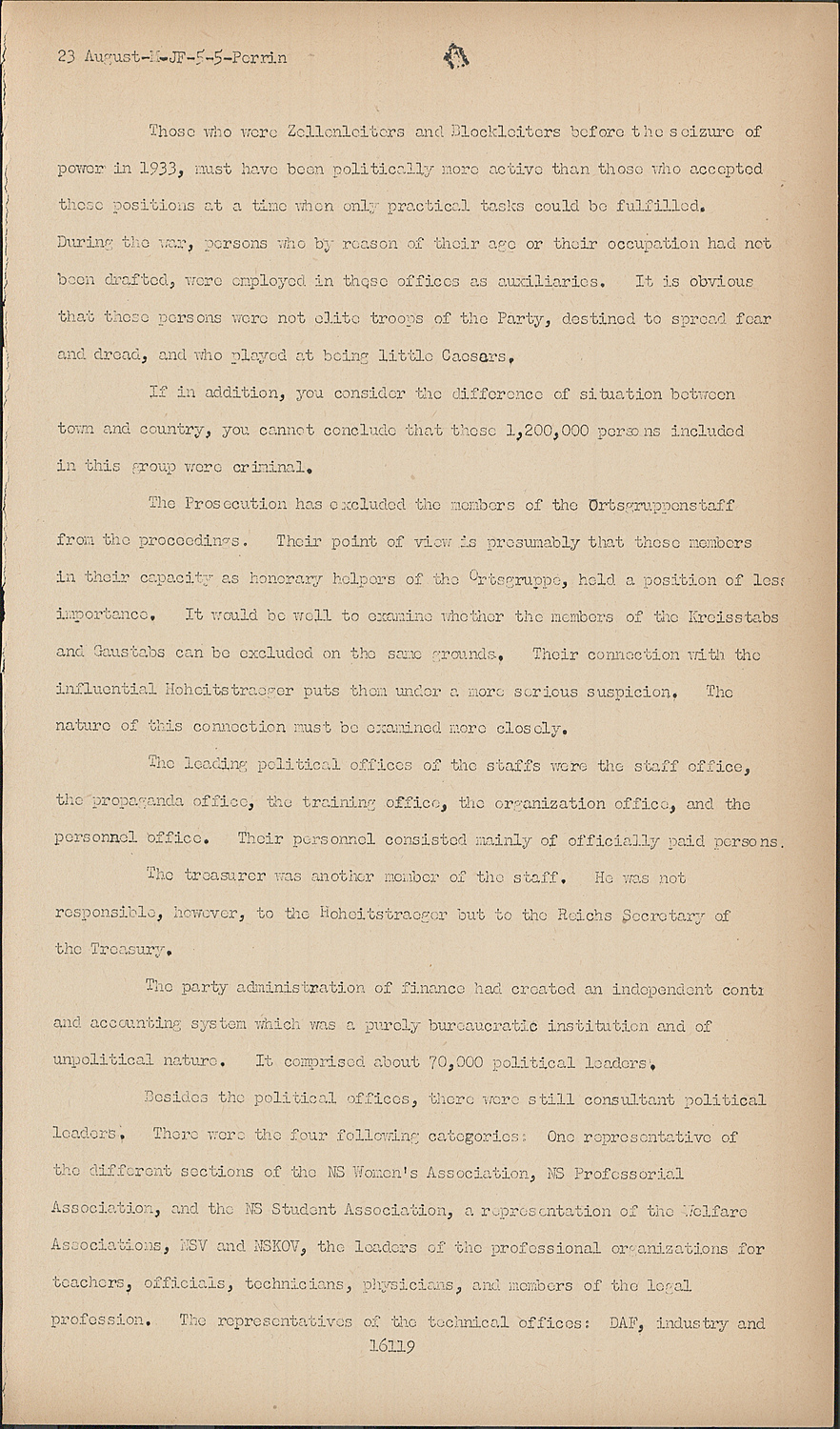
Those who were Zellenleiters and Blockleiters before the seizure of power in 1933, must have been politically more active than those who accepted these positions at a time when only practical tasks could be fulfilled.
During the war, persons who by reason of their age or their occupation had not been drafted, were employed in those offices as auxiliaries. It is obvious that these persons were not elite troops of the Party, destined to spread fear and dread, and who played at being little Caesars.
If in addition, you consider the difference of situation between town and country, you cannot conclude that these 1,200,000 persons included in this group were criminal.
The Prosecution has excluded the members of the Ortsgruppenstaff from the proceedings. Their point of view is presumably that these members in their capacity as honorary helpers of the Ortsgruppe, held a position of less importance. It would be well to examine whether the members of the Kreisstabs and Gaustabs can be excluded on the same grounds. Their connection with the influential Hoheitstraeger puts them under a more serious suspicion. The nature of this connection must be examined more closely.
The leading political offices of the staffs were the staff office, the propaganda office, the training office, the organization office, and the personnel office. Their personnel consisted mainly of officially paid persons.
The treasurer was another member of the staff. He was not responsible, however, to the Hoheitstraeger but to the Reichs Secretary of the Treasury.
The party administration of finance had created an independent cont*--* and accounting system which was a purely bureaucratic institution and of unpolitical nature. It comprised about 70,000 political leaders.
Besides the political offices, there were still consultant political leaders. There were the four following categories; One representative of the different sections of the NS Women's Association, NS Professorial Association, and the NS Student Association, a representation of the Welfare Associations, NSV and NSKOV, the leaders of the professional organizations for teachers, officials, technicians, physicians, and members of the legal profession. The representatives of the technical offices: DAF, industry and commerce, agrarian policy, etc.
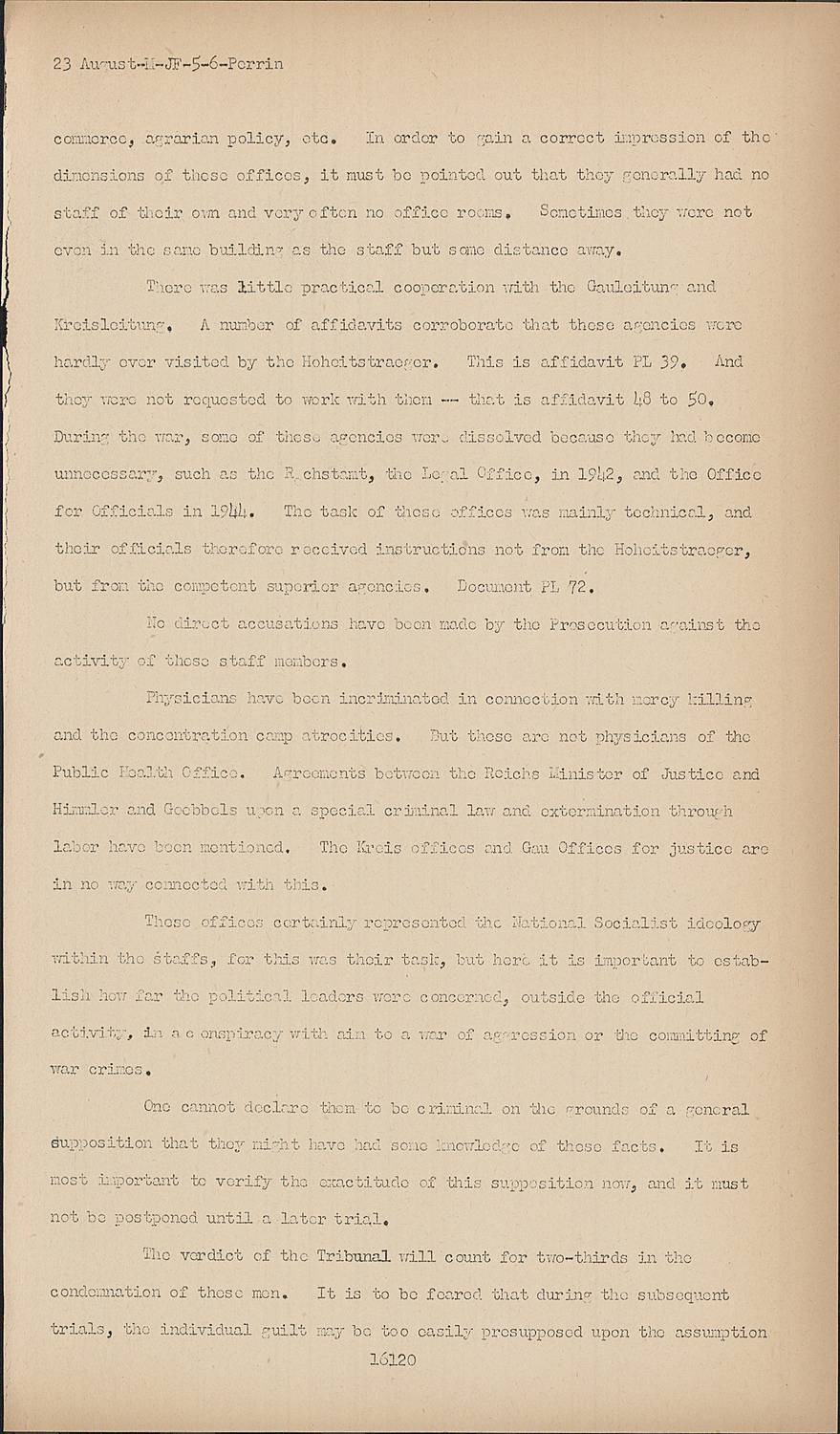
In order to gain a correct impression of the dimensions of these offices, it must be pointed out that they generally had no staff of their own and very often no office rooms.
Sometimes they were not even in the sane building as the staff but some distance away.
There was little practical cooperation with the Gauleitung and Kreisleitung. A number of affidavits corroborate that these agencies were hardly ever visited by the Hoheitstraeger. This is affidavit PL 39. And they were not requested to work with them -- that is affidavit 48 to 50. During the war, some of these agencies were dissolved because they had become unnecessary, such as the Rechstamt, the Legal Office, in 1942, and the Office for Officials in 1944. The task of these offices was mainly technical, and their officials therefore received instructions not from the Hoheitstraeger, but from the competent superior agencies. Document PL 72.
No direct accusations have been made by the Prosecution against the activity of these staff members.
Physicians have been incriminated in connection with mercy killing and the concentration camp atrocities. But these are not physicians of the Public Health Office. Agreements between the Reichs Minister of Justice and Himmler and Goebbels upon a special criminal law and extermination through labor have been mentioned. The Kreis offices and Gau Offices for justice are in no way connected with this.
These offices certainly represented the National Socialist ideology within the staffs, for this was their task, but here it is important to establish how far the political leaders were concerned, outside the official activity, in a conspiracy with aim to a war of aggression or the committing of war crimes.
One cannot declare them to be criminal on the grounds of a general supposition that they might have had some knowledge of these facts. It is most important to verify the exactitude of this supposition now, and it must not be postponed until a later trial.
The verdict of the Tribunal will count for two-thirds in the condemnation of these men. It is to be feared that during the subsequent trials, the individual guilt may be too easily presupposed upon the assumption of their general guilt.

In the judging of the typical offices, it must not be forgotten that about 140,000 persons are concerned who were employed in an honorary capacity.
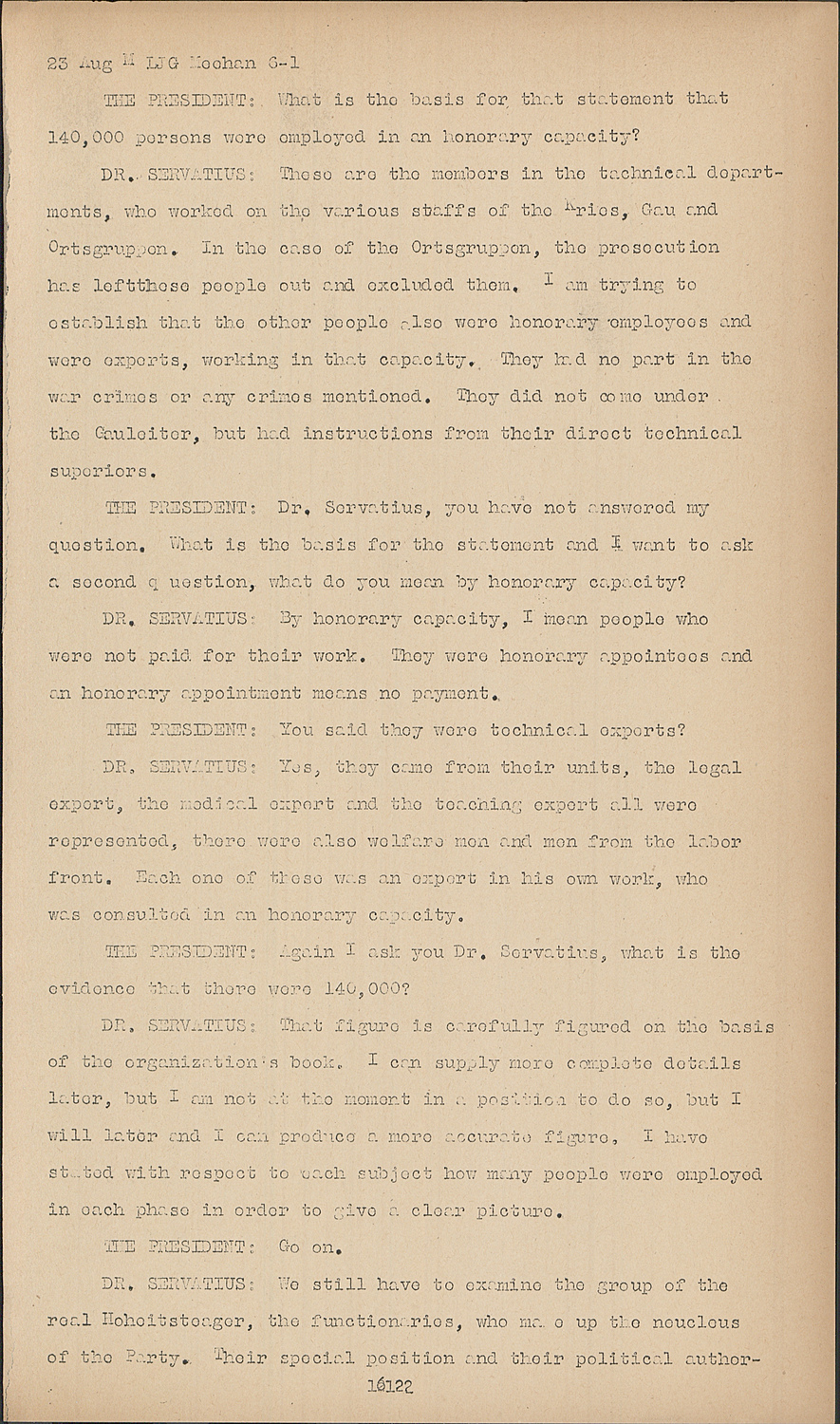
THE PRESIDENT: What is the basis for that statement that 23 Aug M LJG Meehan 6-1 140,000 persons were employed in an honorary capacity?
DR. SERVATIUS:These are the members in the technical departments, who worked on the various staffs of the Kries, Gau and Ortsgruppen. In the case of the Ortsgruppen, the prosecution has left these people out and excluded them. I am trying to establish that the other people also were honorary employees and were exports, working in that capacity. They had no part in the war crimes or any crimes mentioned. They did not come under the Gauleiter, but had instructions from their direct technical superiors.
THE PRESIDENT:Dr. Servatius, you have not answered my question. What is the basis for the statement and I want to ask a second question, what do you mean by honorary capacity?
DR. SERVATIUS:By honorary capacity, I mean people who were not paid for their work. They were honorary appointees and an honorary appointment means no payment.
THE PRESIDENT:You said they were technical exports?
DR. SERVATIUS:Yes, they came from their units, the legal expert, the medical expert and the teaching expert all were represented, there were also welfare men and men from the labor front. Each one of these was an export in his own work, who was consulted in an honorary capacity.
THE PRESIDENT:Again I ask you Dr. Servatius, what is the evidence that there were 140,000?
DR. SERVATIUS:That figure is carefully figured on the basis of the organizations book. I can supply more complete details later, but I am not at the moment in a position to do so, but I will later and I can produce a more accurate figure. I have stated with respect to each subject how many people were employed in each phase in order to give a clear picture.
THE PRESIDENT:Go on.
DR. SERVATIUS:We still have to examine the group of the real Hoheitsteager, the functionaries, who make up the neucleus of the Party. Their special position and their political author
August 29, Afternoon
ity distinguished them, and set them apart from the other political 23 Aug M LJG Meehan 6-2 leaders, but their position was varied.
Whereas the Ortsgruppenleiter is restricted in his sovereignty rights to the circle of the Party, membership in his Ortsgruppe, the authority of the Higher Party Leaders, (Hoeheren Parteifuehrer) goes beyond Party limits concerning themselves with the rights of those who do not belong to the Party.
Only the Kreis and Gauleiter have the right for exercising political judgment toward outsiders and in that way determines the fate of those outsiders. At the same time and in this way, they are exerting great influence on the life of all.
The decision which they make is one of their own judgment. This fact is the sign of carrying full responsibility themselves. The Ortsgruppenleiter will only be asked to furnish proof for the judgment. He is only an executive organ and devoid of any independence.
Externally the difference is shown by the fact that the Ortsgruppenleiter acts only on an honorary basis without pay. Through his work, he is prevented from concerning himself in a comprehensive answer with all that is happening as this profession prevents him. It was especially the case during the war when need directed all thoughts and powers towards your own problems.
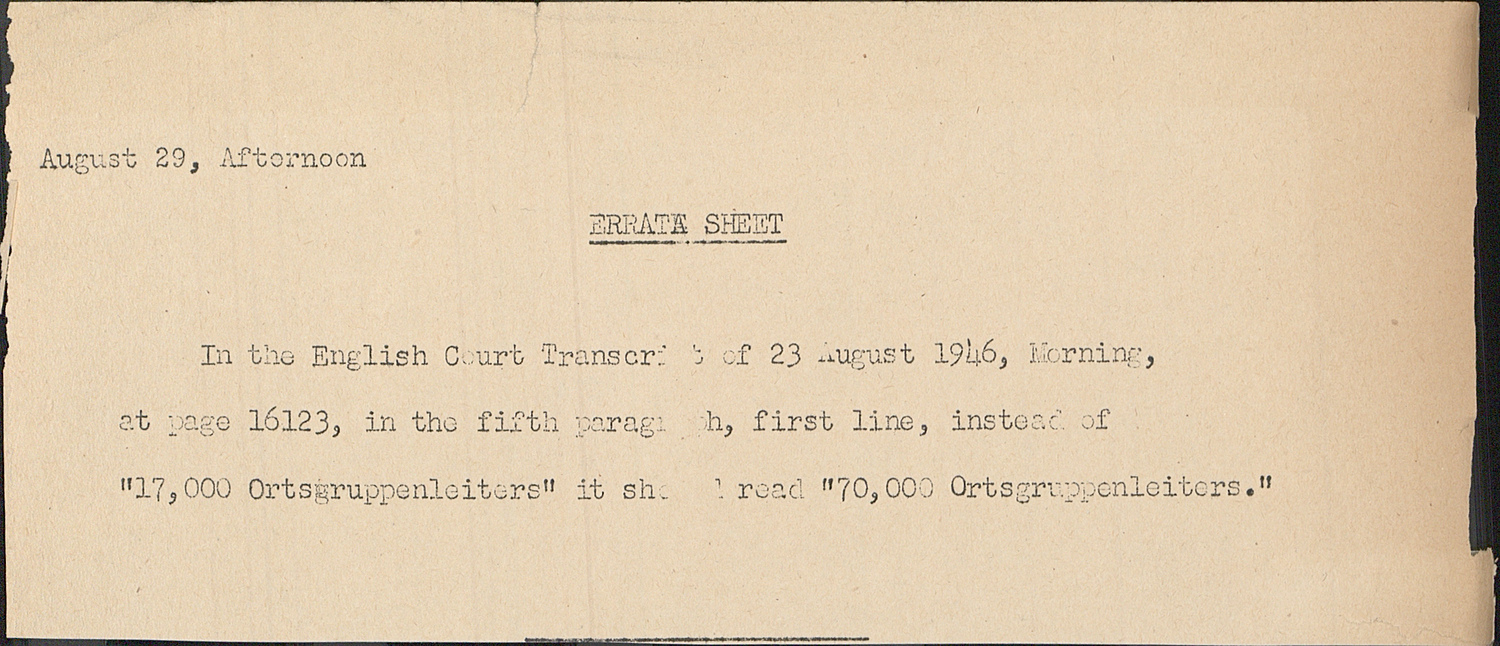
The 17,000 Ortsgruppenleiters were members of the lower middle class, who had not previously been politically active and who lacked experience in this dangerous matter.
Most of the Ortegruppens were in the country, where country work preceeded alongside the activity, which had been brought in. The testimony given by witness Wegscheider before this Tribunal gave a true picture of the situation.
The position of the Ortsgruppenleiter becomes particularly clear when we compare his responsibility with that of the higher Party leader, who was appointed by Hitler directly.
Because of his connection with the highest leadership, the probability of a greater knowledge is greater with the higher Party leader.
This trial has shown that the separation of the "ressorts" 23 Aug M LJG Meehan 6-3 and the artificial tearing apart of administration and police has played an important role.
But, because of the merging of many functions, and because many strings were gathered in one hand, at least the highest Party leaders could see when everything was not as it should be on critical points.
The question is: Whether a Gau or Kreisleiter could set his mind at rest, because everything was as it should be in his sector and that the suspicious incident was taking place outside his domain, or his ressorts?
We have to answer this question in the negative. He had to supply himself with the knowledge, taking his own sovereign rights into account, for he was the only who had deprived another of any possibility whatsoever of concerning himself with these things. He had the right, and therewith also the obligation to be active because of his office.
He had become the sole public figure, and therefore, had concerned himself with public matters.
Actually, those Gau and Kreisleiters, who were examined here did concern themselves with events as they occurred. They investigated the transporting of the Jews. They endeavored to get into concentration camps and investigate the conditions of foreign workers. They voiced their misgivings and they protested.
Were they doing their duty that way? In this connection, we had to examine the question of the sharing of responsibility. It is not possible that all concerned themselves with everything. At the lowest levels, there are practical concerns of a local nature, and they could not be concerned with the problems found at the top level. Not every shock can be transmitted to the entire machine.
The Kreisleiter, who passes on reports upon separate incidents to the Gauleiter, particularly In a dictatorial state, must be credited with this separation, but he must concern himself with the result of his reports, and draw his own conclusions.
This is more so the case with the Gauleiter, in view of his 23 Aug M LJG Meehan 6-4 superior position.
There exists a limit where the daily routine is no longer concerned and moral principles are being touched upon. When one was in Himmler's sphere of influence, did one really have to drive on, regardless of that which would happen? An answer to this question has been attempted several times. Must are really demand an action immediately and without compromise. Is it really "All or nothing?" Can one afford to let things take their course, or is it "Now or never?" Must one define guilt and merit and can one hope for reformation? Is it sufficient to remain at one's post when one disapproved, or hopes to prevent worse by remaining, or does one become guilty too by remaining and keeping up appearances? Has he who always anxiously makes an effort share any justification? Must he take up the struggle against adversed circumstances, even if his own life seems needlessly jeopardised, or should he submit to it an d bow to fate?
"To be or not to be," that is the question.
An answer cannot be found without minute examination of the legal basis of the guilt, the knowledge and sanction and criminal negligence.
If the criminal nature of this group is to be established, these questions must first be decided upon.
Such an examination can be carried out for individual cases only. It is practically possible in the case of a group of two thousand Kreisleiters and Gauleiters. These persons are I known, their actions took place in public and are not difficult to clear up.
There remains the group of the Reichsleiter. The same views are applicable to them as to the Gauleiters.
Himmler, who only had the take of Reichsleiter, cannot be counted with this group. (Document PL 59A.) That position, however, is of great legal importance to all political leaders. They include the principle defendants. According to Article IX of the Statute, the conviction of the group can only be announced in connection with the actions of the principle defendants.
The trial brief only mentions Rosenberg and Bormann. Only annex B of the supplement to the trial brief added four more Reichsleiters, thus including the Gauleiters Sauckel and Streicher.
Frick, too, held only the rank of Reichsleiter, which is in contradiction with the direct inclusion of his actions.
There the other principle defendants are concerned, one must examine whether they committed the acts with which they have been incriminated in their capacity as political leaders, or in another capacity.
The prosecution has recognized the legal significance of this distinction by referring in the summary of the trial brief only to those deeds of Rosenberg and Bormann, with which they are charged in their capacity as political leaders. That is page 75 of the Trial Brief.
One must not depart from this distinction. The ruling of Article IX of the Statute is not merely a purely formal rule of procedure for the trial. It is a pertinent limitation of the criminal groups.
The group is not to be formed arbitrarily and lawlessly by the prosecution, but there must be some connection between it and the act of one of the principle defendants. This is only possible if one of the principle defendants acted within the corps of political leaders. The connection does not exist where the effect of the action of one of the principle defendants does not effect all levels of the political leaders; this is to be considered in passing judgment on the lower grades.
The connection is lacking in the case of the principle defendants, whose connection with the political leaders was established only later, with the exception of Hess.
In the case of Rosenberg, the actions with which he is charged were essentially in the state sector, where he was active as Reichs Minister for the occupied territories.
The actions of Bormann, as chief of the party chancellery from 1941, are decisive for the judgment of political lenders. As a result of the absence of this principle defendant, however, it is precarious to base the condemnation of the group on either, since there was no close investigation of the occurrances. For the most important charges, it would have to be cleared up whether Bormann acted as chief of the party chancellery, or as secretary of the Fuehrer outside of the party machine, or whether he acted independantly contrary to all instructions. That is Document 53.
It is noteworthy that Hess, Bormann's superior, is not included in the original trial brief, although until 1941 he was deputy of the Fuehrer and the party.
Presumably, the prosecution was at that time of the opinion that he could not be charged with any action in connection with the Corp of Political Leaders, which would indicate a criminal character. This is a significant point of view for the judgment of the group, as far as time is concerned.
The actions of Gauleiters Sauckel and Streicher cannot be taken as standard for the Political Leaders as a whole. As Gauleiters they can only act in their district. The actions with which they are charged in this trial they undertook outside of their function as Political Leaders -- as plenipotentiary general for labor commitment or as a newspaper publisher.
I want to present two legal viewpoints which can be of significance for the judgment. One idea is the retroactiveness of the verdict. I do not want to attack it as legally inadmissible since the Charter has ordered it, but since the verdict is at the discretion of the Tribunal, fairness con be onserved here.
Retroactiveness in an individual trial can be justified by the fact that perpetrator was warned and had to realize.
It is different with the great number of little Political Leaders, who are made responsible for a conspiracy only indirectly through their leaders.
The second point of view is the lack of legal hearing. In these proceedings before the Tribunal, the preliminary decision is reached, which is decisive for every member of the organization. Therefore, everyone was given the right to request a legal hearing. Only comparatively few have made use of this right.
One must assume that many have no knowledge of their right, or have no opportunity to submit their applications to the Court. There are applications from only about one-third of the camps of the English and American Zones; from the French Zone from only two camps; but particular reference should be made to some areas from which no applications at all have been received.
There are no applications from Austria, and the camps there could not be visited. The permission of the Military Authorities was given, but the approval of the Control Counsel was not received. This is noteworthy since there are special circumstances in this case which might possibly exonerate the members; special treatment and judgment, especially in regard to time is advisable.
Nor are there any applications from the Soviet Zone, although the official announcement is said to have been made. I myself only recently had an opportunity to visit two camps. Those interned there declared that they know nothing of their right to a hearing; not all wanted to submit applications.
For these districts, therefore, the defense was in a rather critical state as regards evidence. For these zones a few Political Leaders were heard who could be reached in British or American camps. Although one obtains a certain picture in this way, the talking of evidence before the Commission has shown that there may be testimony of significance for the defense.
Thus a Kreisleiter of the West was able to testify that the construction of the West Wall had convinced people there of Hitler's defensive intentions. A Kreisleiter of the North referred to the Fleet Treaty with Britain, which the coastal population considered a sign of the will for peace. Other witnesses have brought forward noteworthy reasons from the church membership of the Political Leaders in their district.
The real significance of the limitation could be judged only after a hearing, so that a judgment on this subject is not yet admissible.
The question is also however of considerable significance for the trial. The charter has guaranteed the opportunity of a hearing. Every provision of form has its deeper sense and it is basicly significant. Here legal hearing is held up as a democratic principle in contrast to rejected police methods. This principle was put forth jointly by the signatory powers and the Tribunal must see to it that it is observed. This is an unrenounceablc rejection, which I hereby expressly assert.
THE PRESIDENT:Mr. Biddle would like to know exactly what you mean by the last two sentences.
DR. SERVATIUS:I did not hear what you have said.
THE PRESIDENT:Mr. Biddle would like to know, Dr. Servatius, what you mean by your last two sentences, "Here legal hearing is held up as a democratic principle in contrast to rejected police methods. This principle was put forth jointly by the signatory powers and the Tribunal must see to it that it is observed. This is an unrenounceable rejection, which I hereby expressly assert." Does that mean anything?
DR. SERVATIUS:Mr. President, I wanted to see that I cannot forfeit the right to raise the objection that the hearings in entire territories have not been made possible. The entire Soviet zone is an objection and an argument, which I cannot forego and which should be taken into further consideration later.
THE PRESIDENT:Go on.
DR. SERVATIUS:The divergent practice in the interpretation of Article 9 of the Statute must be noted from another point of view also.
There is a danger of divergent interpretation of rulings of the Tribunal against the organizations.
In addition to a general definition of the organization as a whole, it is essential also that the degree of guilt or innocence of any one group, or individual therein be adjudicated separately, in the interests of any sub-sequent proceedings.