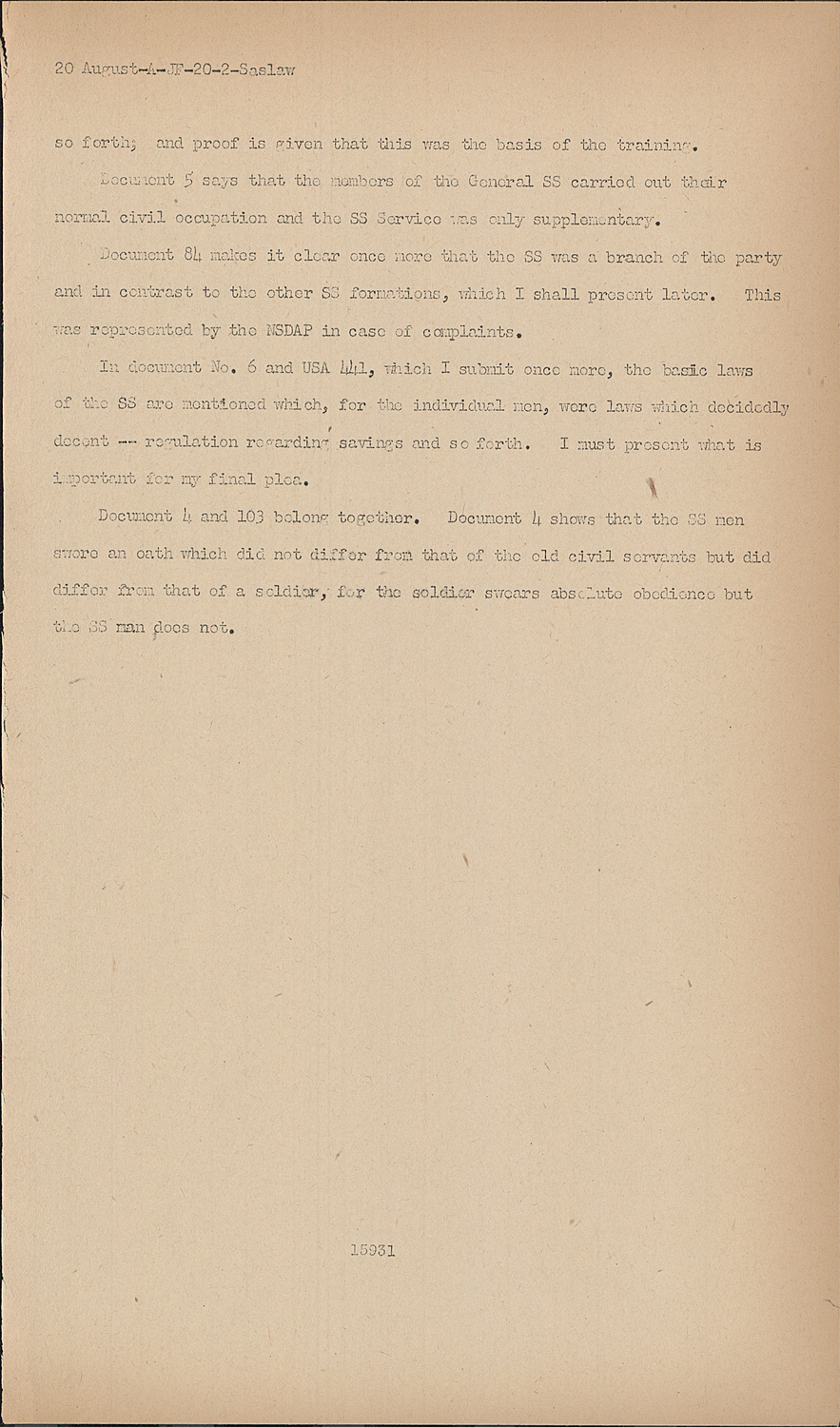
Document 5 says that the members of the General SS carried out their normal civil occupation and the SS Service was only supplementary.
Document 84 makes it clear once more that the SS was a branch of the party and in contrast to the other SS formations, which I shall present later. This was represented by the NSDAP in case of complaints.
In document No. 6 and USA 441, which I submit once more, the basic laws of the SS are mentioned which, for the individual men, were laws which decidedly decent -- regulation regarding savings and so forth. I must present what is important for my final plea.
Document 4 and 103 belong together. Document 4 shows that the SS men swore an oath which did not differ from that of the old civil servants but did differ from that of a soldier, for the soldier swears absolute obedience but the SS man does not.
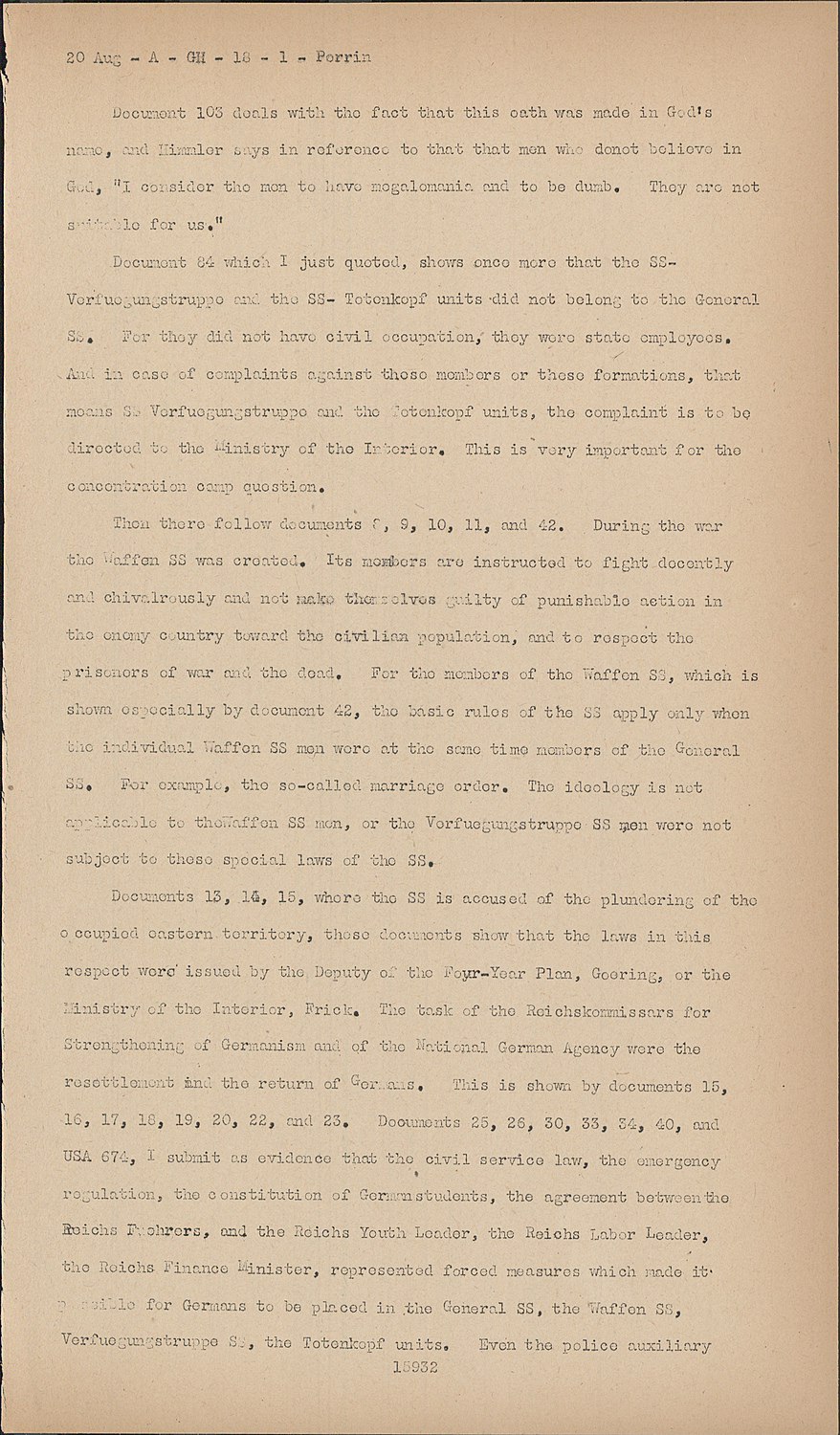
Document 103 deals with, the fact that this oath was made in God's name, and Himmler says in reference to that that men who donot believe in God, "I consider the men to have megalomania and to be dumb.
They are not suitable for us."
Document 04 which I just quoted, shows once more that the SSVerfuegungstruppe and the SS- Totenkopf units did not belong to the General SS. For they did not have civil occupation, they were state employees. And in case of complaints against these members or these formations, that means SS Verfuegungstruppe and the Totenkopf units, the complaint is to be directed be the Ministry of the Interior. This is very important for the concentration camp question.
Then there follow documents 8, 9, 10, 11, and 42. During the war the Waffen SS was created. Its members are instructed to fight decently and chivalrously and not make themselves guilty of punishable action in the enemy country toward the civilian population, and to respect the prisoners of war and the dead. For the members of the Waffen SS, which is shown especially by document 42, the basic rules of the SS apply only when the individual Waffen SS men were at the same time numbers of the General SS. For example, the so-called marriage order. The ideology is not applicable to theWaffen SS men, or the Verfuegungstruppe SS men were not subject to these special laws of the SS.
Documents 13, 14, 15, where the SS is accused of the plundering of the o ccupied eastern territory, those documents show that the laws in this respect were issued by the Deputy of the Four-Year Plan, Goering, or the Ministry of the Interior, Frick. The task of the Reichskommissars for Strengthening of Germanism and of the National German Agency were the resettlement and the return of Germans. This is shown by documents 15, 16, 17, 18, 19, 20, 22, and 23. Documents 25, 25, 30, 33, 54, 40, and USA 674, I submit as evidence that the civil service law, the emergency regulation, the constitution of Germanstudents, the agreement between the Reichs Fuehrers, and the Reichs Youth Leader, the Reichs Labor Leader, the Reichs Finance Minister, represented forced measures which made it possible for Germans to be placed in the General SS, the Waffen SS, Verfuegungstruppe SS, the Totenkopf units. Even the police auxiliary assistants were forcibly placed in the SS Women's Auxiliary.
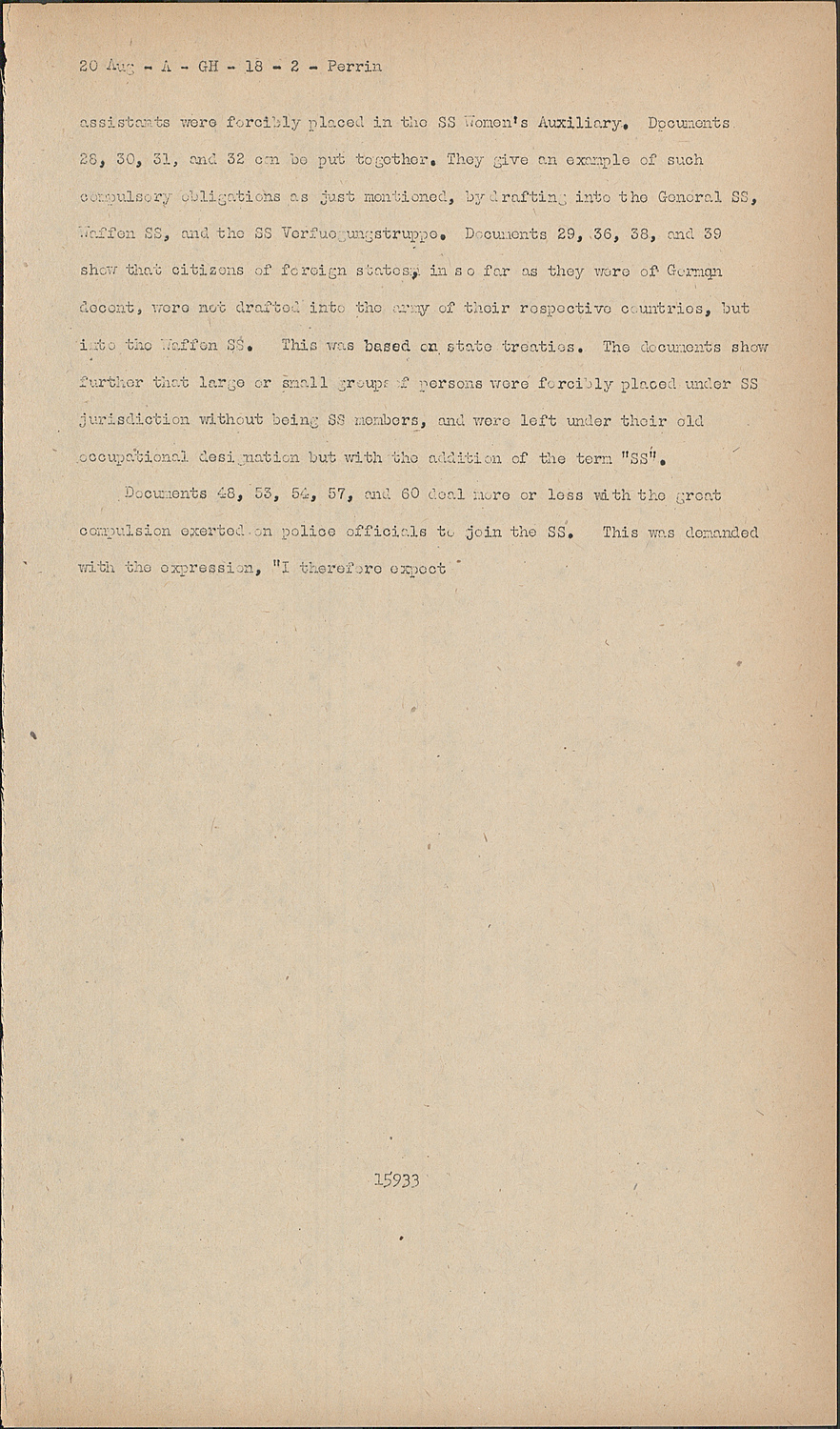
Documents 28, 30, 31, and 32 can be put together.
They give an example of such compulsory obligations as just mentioned, by drafting into the General SS, Waffen SS, and the SS Verfuegungstruppe, Documents 29, 36, 38, and 39 show that citizens of foreign states, in so far as they were of German decent, were not drafted into the army of their respective countries, but into the Waffen SS. This was based on state treaties. The documents show further that large or small groups of persons were forcibly placed under SS jurisdiction without being SS members, and were left under their old occupational designation but with the addition of the tern "SS".
Documents 48, 53, 54, 57, and 60 deal more or less with the great compulsion exerted on police officials to join the SS. This was demanded with the expression, "I therefore expect that so-and-so will join.
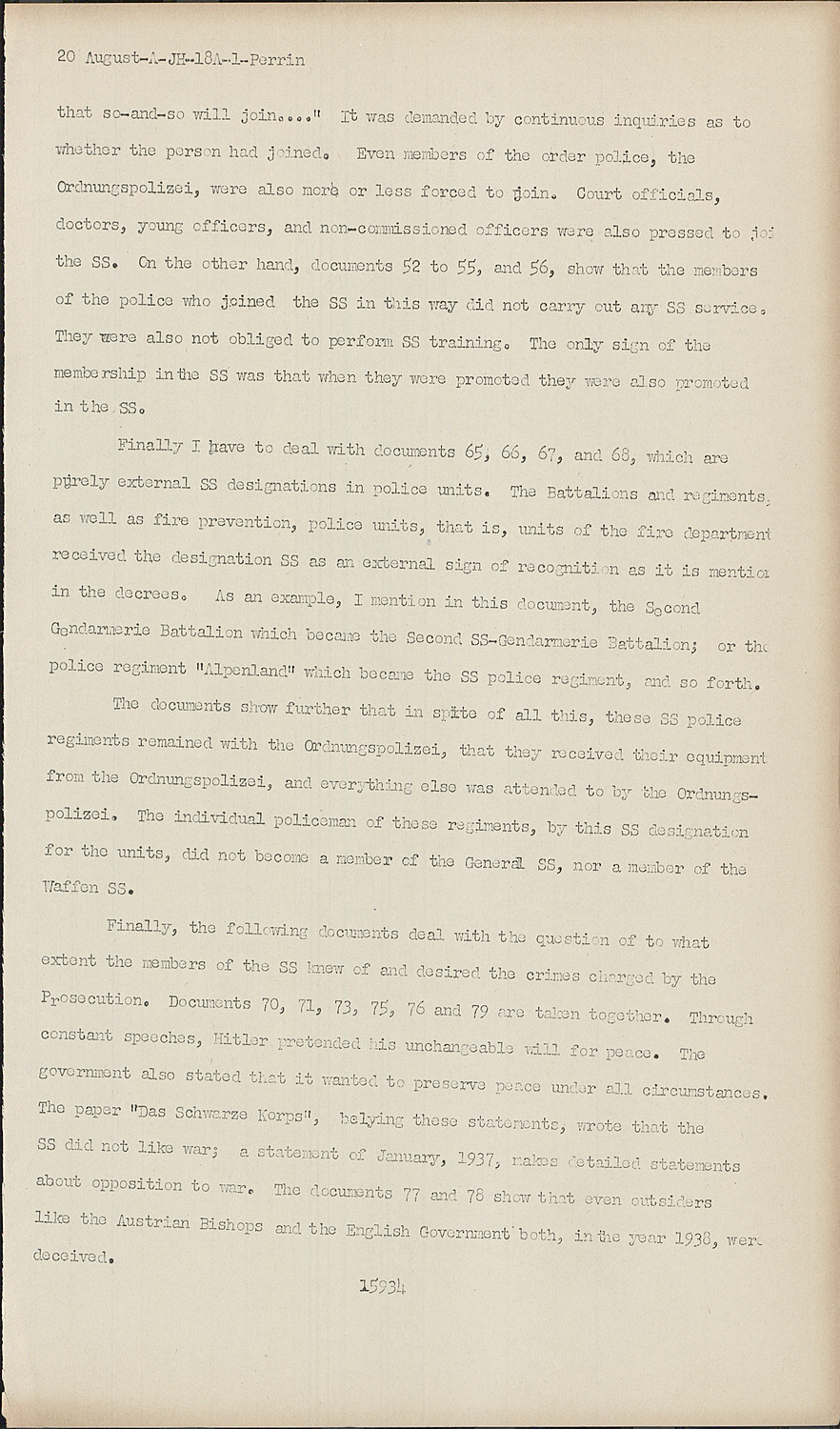
..." It was demanded by continuous inquiries as to whether the person had joined.
Even members of the order police, the Ordnungspolizei, were also more or less forced to join. Court officials, doctors, young officers, and non-commissioned officers were also pressed to join the SS. On the other hand, documents 52 to 55 and 56, show that the members of the police who joined the SS in this way did not carry out any SS service, They were also not obliged to perform SS training. The only sign of the membership in the SS was that when they were promoted they were also promoted in the SS.
Finally I have to deal with documents 65, 66, 67, and 63, which are purely external SS designations in police units. The Battalions and regiments as well as fire prevention, police units, that is, units of the fire department received the designation SS as an external sign of recognition as it is mention in the decrees. As an example, I mention in this document, the Second Gendarmerie Battalion which became the Second SS-Gendarmerie Battalion; or the police regiment "Alpenland" which became the SS police regiment, and so forth.
The documents show further that in spite of all this, these SS police regiments remained with the Ordnungspolizei, that they received their equipment from the Ordnungspolizei, and everything else was attended to by the Ordnungspolizei. The individual policeman of these regiments, by this SS designation for the units, did not become a member of the General SS, nor a member of the Waffen SS.
Finally, the following documents deal with the question of to what extent the members of the SS knew of and desired the crimes charged by the Prosecution. Documents 70, 71, 73, 75, 76 and 79 are taken together. Through constant speeches, Hitler pretended his unchangeable will for peace. The government also stated that it ranted to preserve peace under all circumstances. The paper "Das Schwarze Korps", belying those statements, wrote that the SS did not like war; a statement of January, 1937, mates detailed statements about opposition to war. The documents 77 and 76 show that even outsiders like the Austrian Bishops and the English Government both, in tie gear 1933, were deceived.
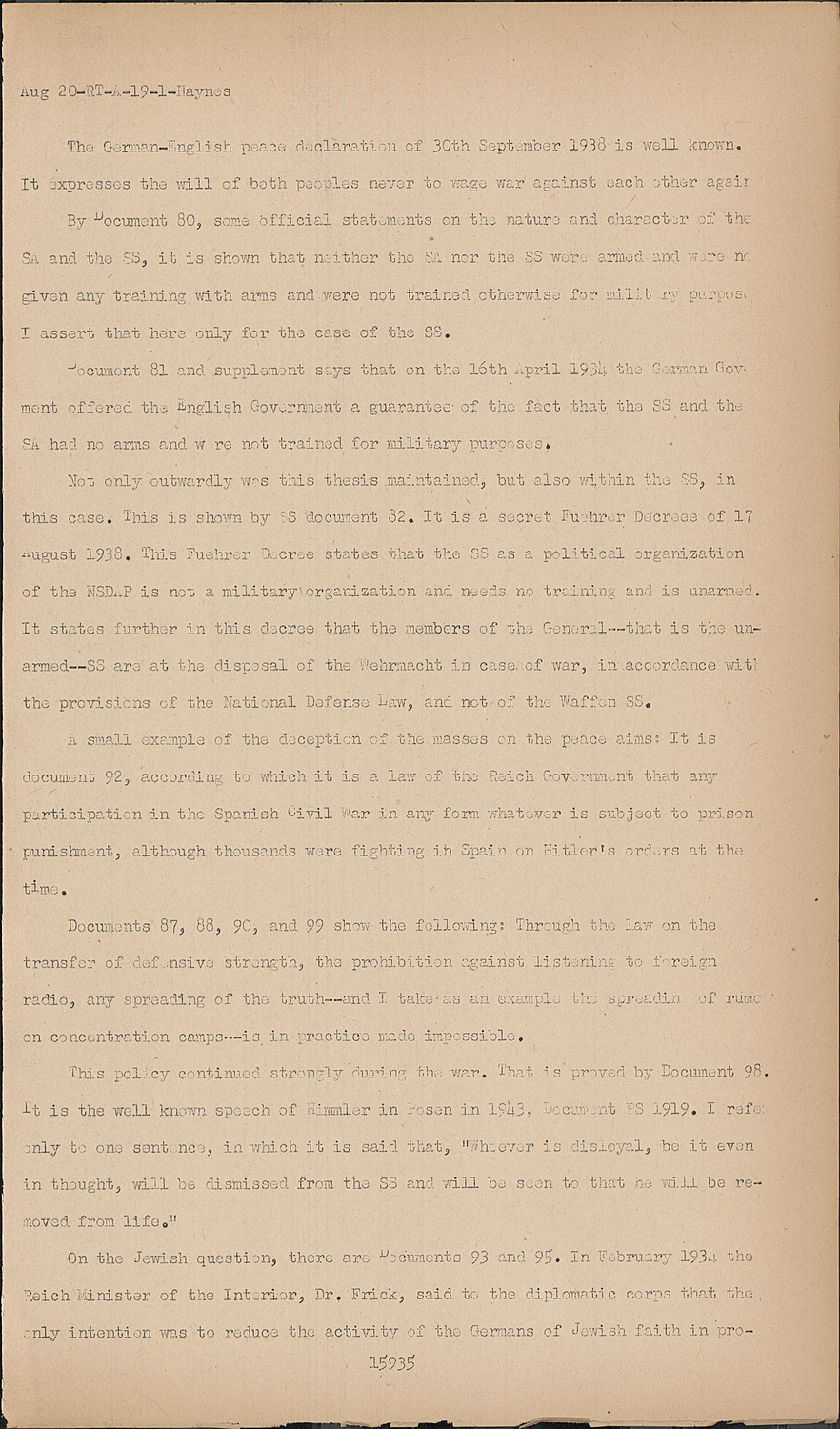
The German-English peace declaration of 30th September 1938 is well known.
It expresses the will of both peoples never to wage war against each other again By document 80, some official statements on the nature and character of the SA and the SS, it is shown that neither the SA nor the SS were armed and were no given any training with arms and were not trained otherwise for military purpose I assert that here only for the case of the SS.
Document 81 and supplement says that on the 16th April 1934 the German Government offered the English Government a guarantee of the fact that the SS and the SA had no arms and were not trained for military purposes.
Not only outwardly was this thesis maintained, but also within the SS, in this case. This is shown by SS document 82. It is a secret Fuehrer Decreee of 17 August 1938. This Fuehrer Decree states that the SS as a political organization of the NSDAP is not a military organization and needs no training and is unarmed. It states further in this decree that the members of the General--that is the unarmed--SS are at the disposal of the Wehrmacht in case, of war, in accordance within the provisions of the National Defense Law, and not of the Waffen SS.
A small example of the deception of the masses on the peace aims: It is document 92, according to which it is a law of the Reich Government that any participation in the Spanish Civil war in any form what ever is subject to prison punishment, although thousands were fighting in Spain on Hitler's orders at the time.
Documents 87, 88, 90, and 99 show the following: Through the law on the transfer of defensive strength, the prohibition against listening to foreign radio, any spreading of the truth--and I take as an example the spreading of rumor on concentration camps--is in practice made impossible.
This policy continued strongly during the war. That is proved by Document 98. It is the well known speech of Himmler in Posen in 1943, Document PS 1919. I refer only to one sentence, in which it is said that, "Whoever is disloyal, be it even in thought, will be dismissed from the SS and will be seen to that he will be removed from life."
On the Jewish question, there are documents 93 and 95. In February 1934 the Reich minister of the Interior, Dr. Frick, said to the diplomatic corps that the only intention was to reduce the activity of the Germans of Jewish-faith in pro portion to other Germans, but it is expressly denied that forced emigration of those citizens would be undertaken.
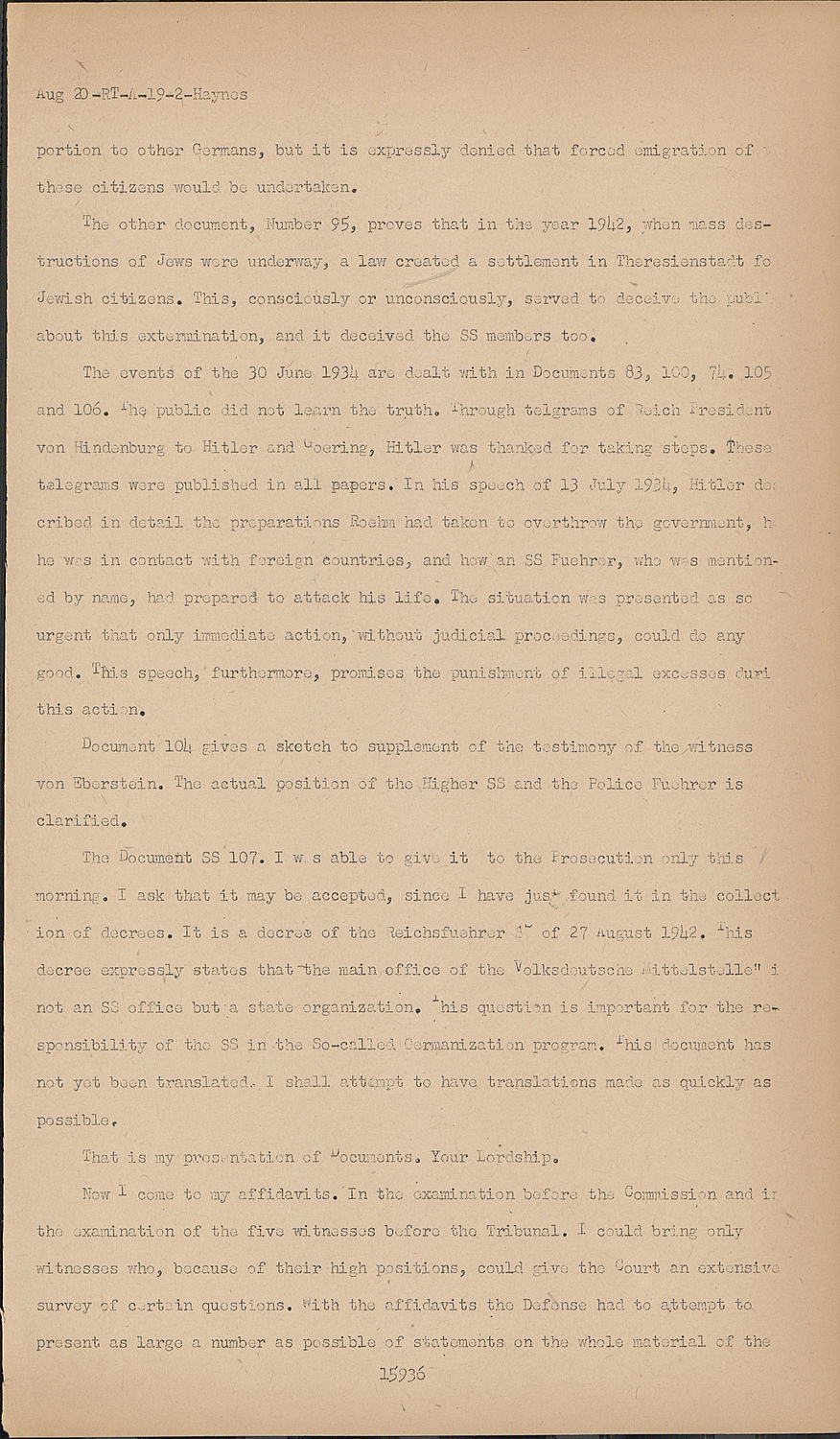
The other document, Number 95, proves that in the year 1942, when mass destructions of Jews were underway, a law created a settlement in Theresienstadt for Jewish citizens. This, consciously or unconsciously, served to deceive the public about this extermination, and it deceived the SS members too.
The events of the 30 June 1935 are dealt with in Documents 83, 100, 75. 105 and 106. The public did not learn the truth. Through telgrams of Reich President von Hindenburg to Hitler and Goering, Hitler was thanked for taking steps. These telegrams were published in all papers. In his speech of 13 July 1935, Hitler described in detail the preparations Roehm had taken to overthrow the government, how he was in contact with foreign countries, and how an SS Fuehrer, who was mentioned by name, had prepared to attack his life. The situation was presented as so urgent that only immediate action, without judicial proceedings, could do any good. This speech, furthermore, promises the punishment of illegal excesses during this action.
Document 104 gives a sketch to supplement of the testimony of the witness von Eberstein. The actual position of the Higher SS and the Police Fuehrer is clarified.
The Document SS 107. I was able to give it to the Prosecution only this morning. I ask that it may be accepted, since I have just found it in the collect ion of decrees. It is a decree of the Reichsfuehrer as of 27 August 1952. This decree expressly states that the main office of the Volksdeutsche Mittelstelle" i not an SS office but a state organization. This question is important for the responsibility of the SS in the So-called Germanization program. This document has not yet been translated. I shall attempt to have translations made as quickly as possible.
That is my presentation of Documents. Your Lordship.
Now I come to my affidavits. In the examination before the Commission and in the examination of the five witnesses before the Tribunal. I could bring only witnesses who, because of their high positions, could give the Court an extensive survey of certain questions. With the affidavits the Defense had to attempt to present as large a number as possible of statements on the whole material of the Indictment, if possible, so that the Court might obtain an insight into the knowledge and deeds of the mass of small, people.
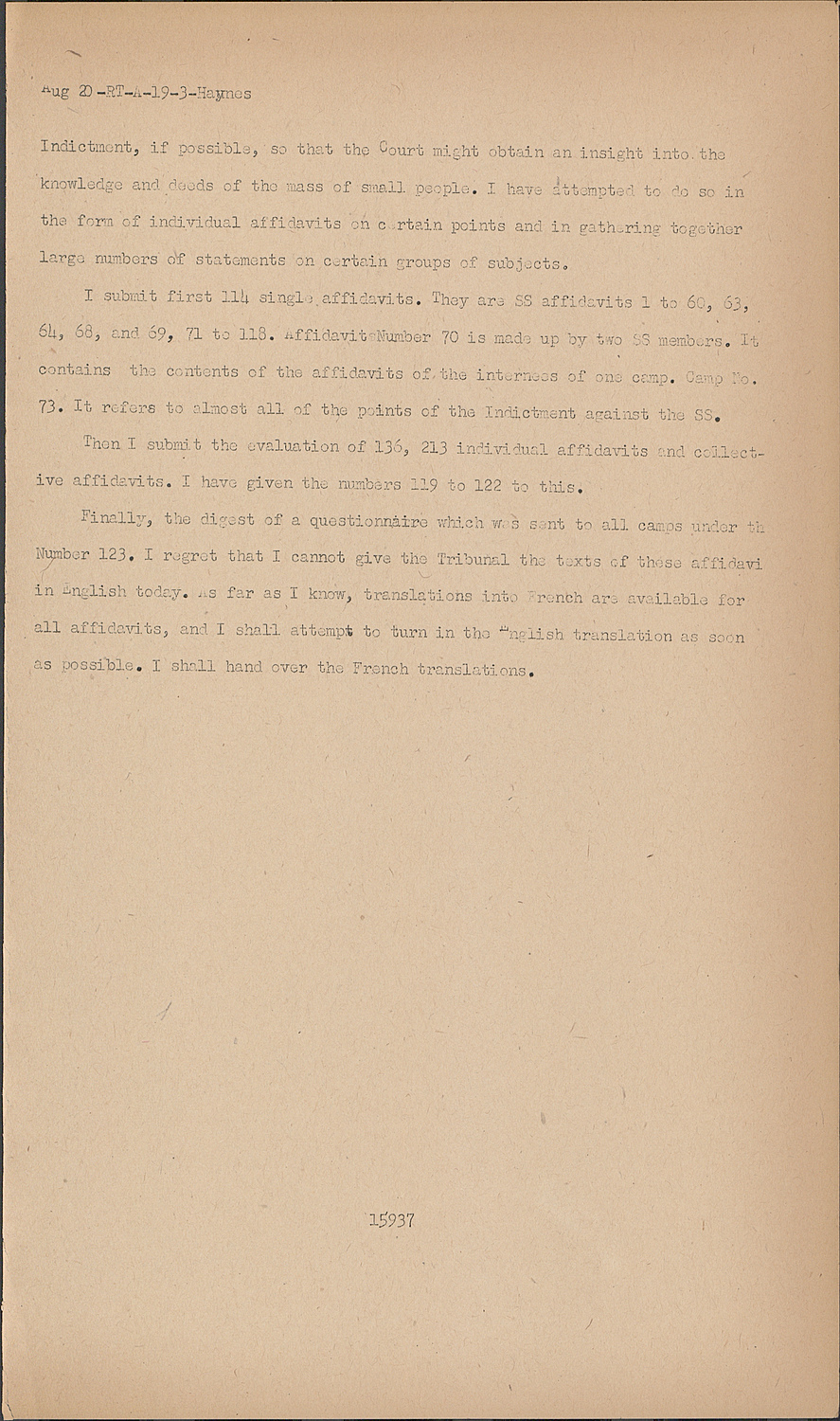
I have attempted to do so in the form of individual affidavits on certain points and in gathering together large numbers of statements on certain groups of subjects.
I submit first 114 single affidavits. They are SS affidavits 1 to 60, 63 64, 65, 66, and 69, 71 to 118. Affidavit Number 70 is made up by two SS members. It contains the contents of the affidavits of the internees of one camp. Camp No. 73. If refers to almost all of the points of the Indictment against the SS.
Then I submit the evaluation of 136, 213 individual affidavits and collective affidavits. I have given the numbers 119 to 122 to this.
Finally, the digest of a questionnaire which was sent to all camps under the Number 123. I regret that I cannot give the Tribunal the texts of those affidavit in English today. As far as I know, translations into French are available for all affidavits, and I shall attempt to turn in the English translation as soon as possible. I shall hand ever the French translations.
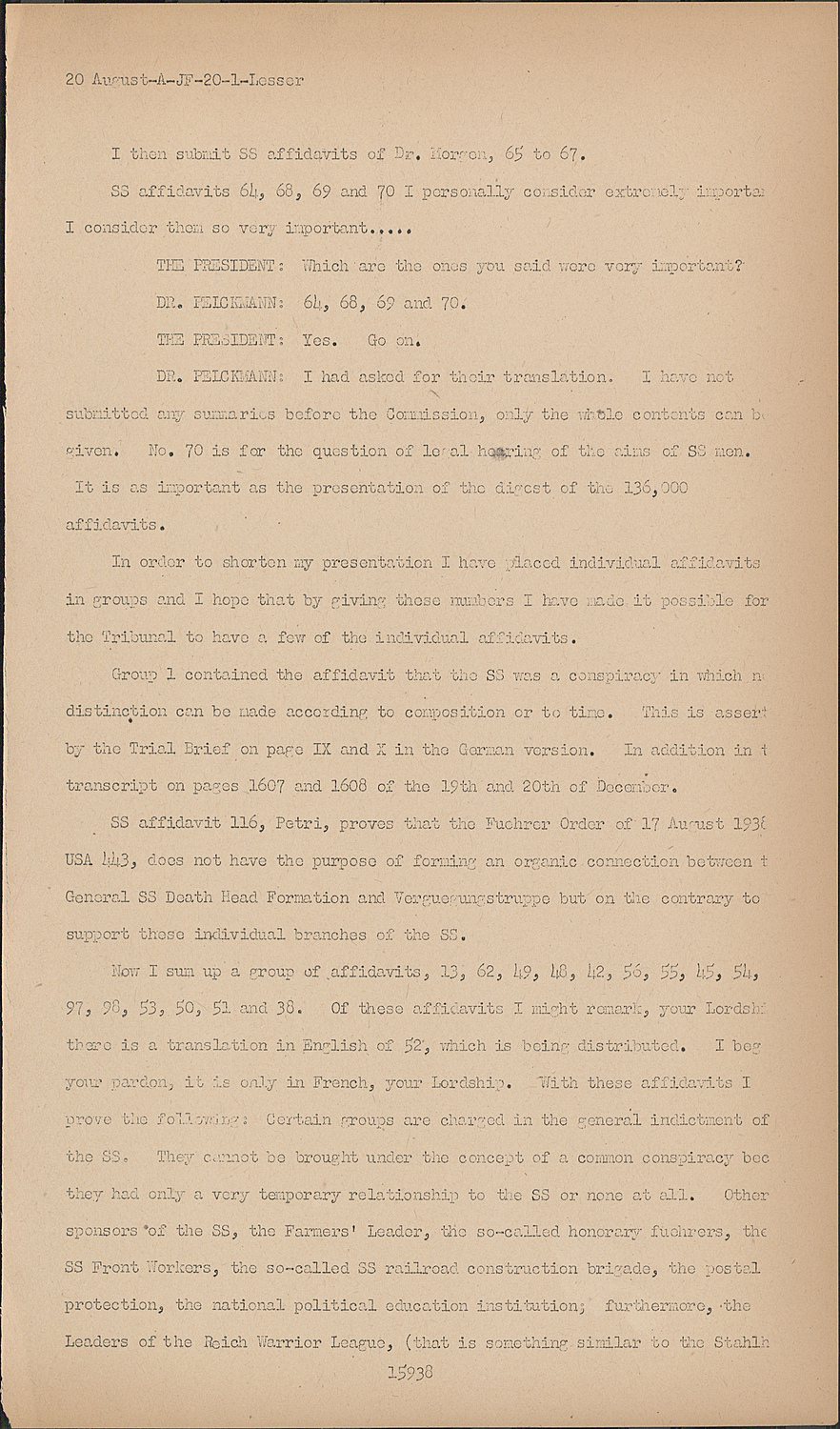
I then submit SS affidavits of Dr. Morgen, 65 to 67.
SS affidavits 65, 68, 69 and 70 I personally corridor extremely important I consider them so very important.....
THE PRESIDENT:Which are the ones you said were very important?
DR.PELCKMANN: 64, 68, 69 and 70.
THE PRESIDENT:Yes. Go on,
DR. PELCKMANN:I had asked for their translation. I have not submitted any summaries before the Commission, only the whole contents can be given. No. 70 is for the question of legal hearing of the aims of SS men.
It is as important as the presentation of the digest of the 136,000 affidavits.
In order to shorten my presentation I have placed individual affidavits in groups and I hope that by giving these numbers I have made it possible for the Tribunal to have a few of the individual affidavits.
Group 1 contained the affidavit that the SS was a conspiracy in which a distinction can be made according to composition or to time. This is asserted by the Trial Brief on page IX and X in the German version. In addition in the transcript on pages 1607 and 1608 of the 19th and 20th of December.
SS affidavit 116, Petri, proves that the Fuehrer Order of 17 August 1938 USA 443, does not have the purpose of forming an organic connection between the General SS Death Head Formation and Verguegungstruppe but on like contrary to support those individual branches of the SS.
Now I sum up a croup of affidavits, 13, 62, 49, 48, 42, 56, 55, 45, 54, 97, 98, 53, 50, 51 and 38. Of these affidavits I might remark, your Lordship there is a translation in English of 52, which is being distributed. I beg your pardon, it is only in French, Your Lordship. With these affidavits I prove the following; Certain groups are charged in the general indictment of the SS. They cannot be brought under the concept of a common conspiracy bee they had only a very temporary relationship to the SS or none at all. Other sponsors of the SS, the Farmers' Leader, the so-called honorary fuehrers, the SS Front Workers, the so-called SS railroad construction brigade, the postal protection, the national political education institution; furthermore, the Leaders of the Reich Warrior League, (that is something similar to the Stahlh the SS sport communities; furthermore, the Reiter Groups which were transferred to the SS, known as so-called SS Reiter Stuerme, which had exactly the same characteristics and history as the SA Reiter Stuerme; and furthermore the students who were taken into the SS on a compulsory basis.
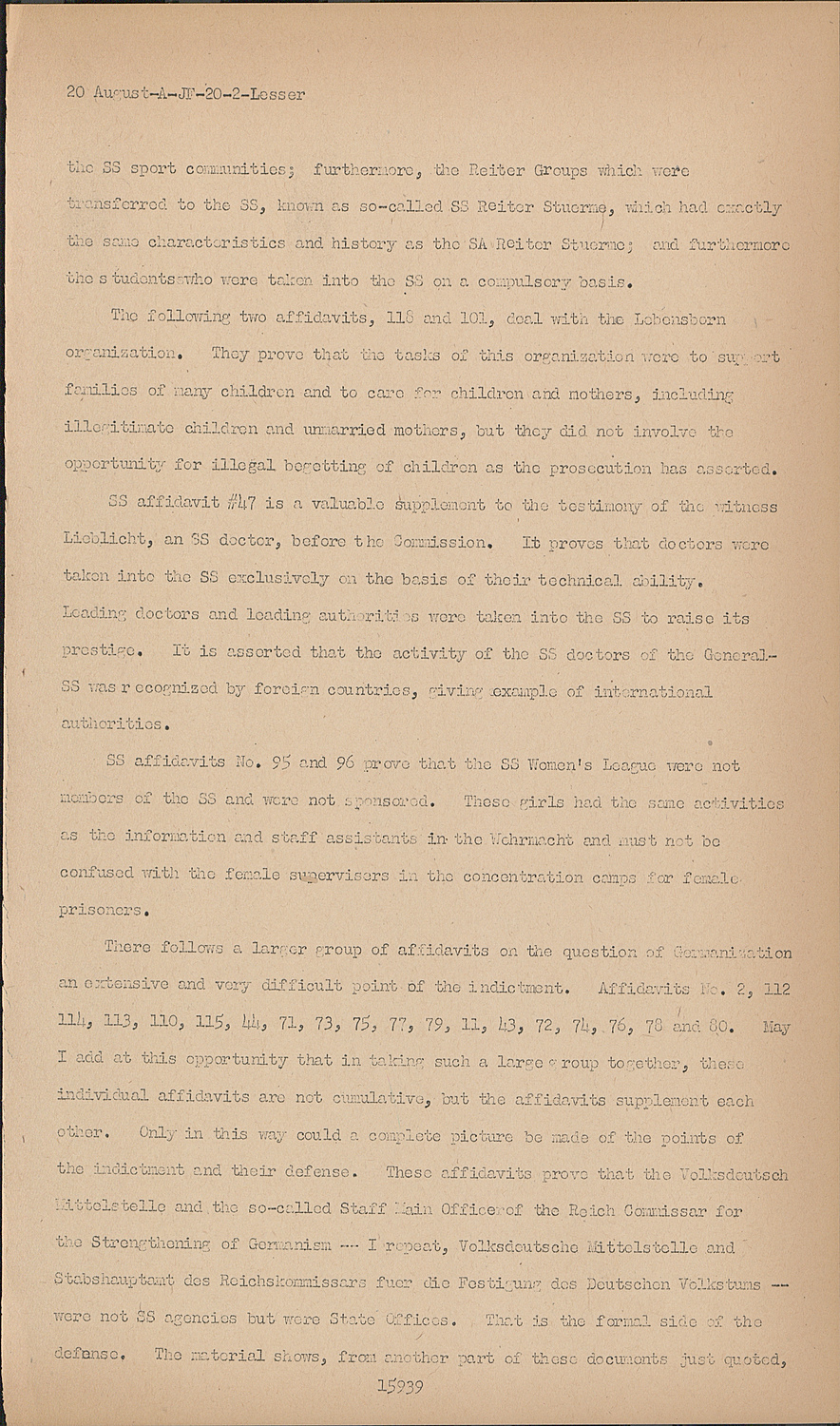
The following two affidavits, 118 and 101, deal with the Lebensborn organization. They prove that the tasks of this organization were to support families of many children and to care for children and mothers, including illegitimate children and unmarried mothers, but they did not involve the opportunity for illegal begetting of children as the prosecution has assorted.
SS affidavit #47 is a valuable Supplement to the testimony of the witness Lieblicht, an SS doctor, before the Commission. It proves that doctors were taken into the SS exclusively on the basis of their technical ability. Leading doctors and leading authority is were taken into the SS to raise its prestige. It is assorted that the activity of the SS doctors of the GeneralSS was recognized by foreign countries, giving example of international authorities.
SS affidavits No. 95 and 96 prove that the SS Women's League were not members of the SS and were not sponsored. These girls had the some activities as the information and staff assistants in the Wehrmacht and must not be confused with the female supervisors in the concentration camps for female prisoners.
There follows a larger group of affidavits on the question of Germanization an extensive and very difficult point of the indictment. Affidavits No. 2, 112 115, 113, 110, 115, 55, 71, 73, 75, 77, 79, 11, 53, 72, 75, 76, 78 and 80. May I add at this opportunity that in taking such a large group together, these individual affidavits are not cumulative, but the affidavits supplement each other. Only in this way could a complete picture be made of the points of the indictment and their defense. These affidavits prove that the Volksdeutsche Mittelstelle and the so-called Staff Main Office-of the Reich Commissar for the Strengthening of Germanism -- I repeat, Volksdeutsche Mittelstelle and Stabshauptamt des Reichskommissars fuer die Festigung des Deutsehen Volkstums -were not SS agencies but were State Offices. That in the formal side of the defense. The material shows, from another part of these documents just quoted, that the SS did not have anything to do with the evacuation measures, Germanization measures, and the settlement of Germans in the occupied territories.

SS affidavit 89 proves that the Chief of the Prisoner of War System, even after Himmler's appointment, was a purely Wehrmacht office.
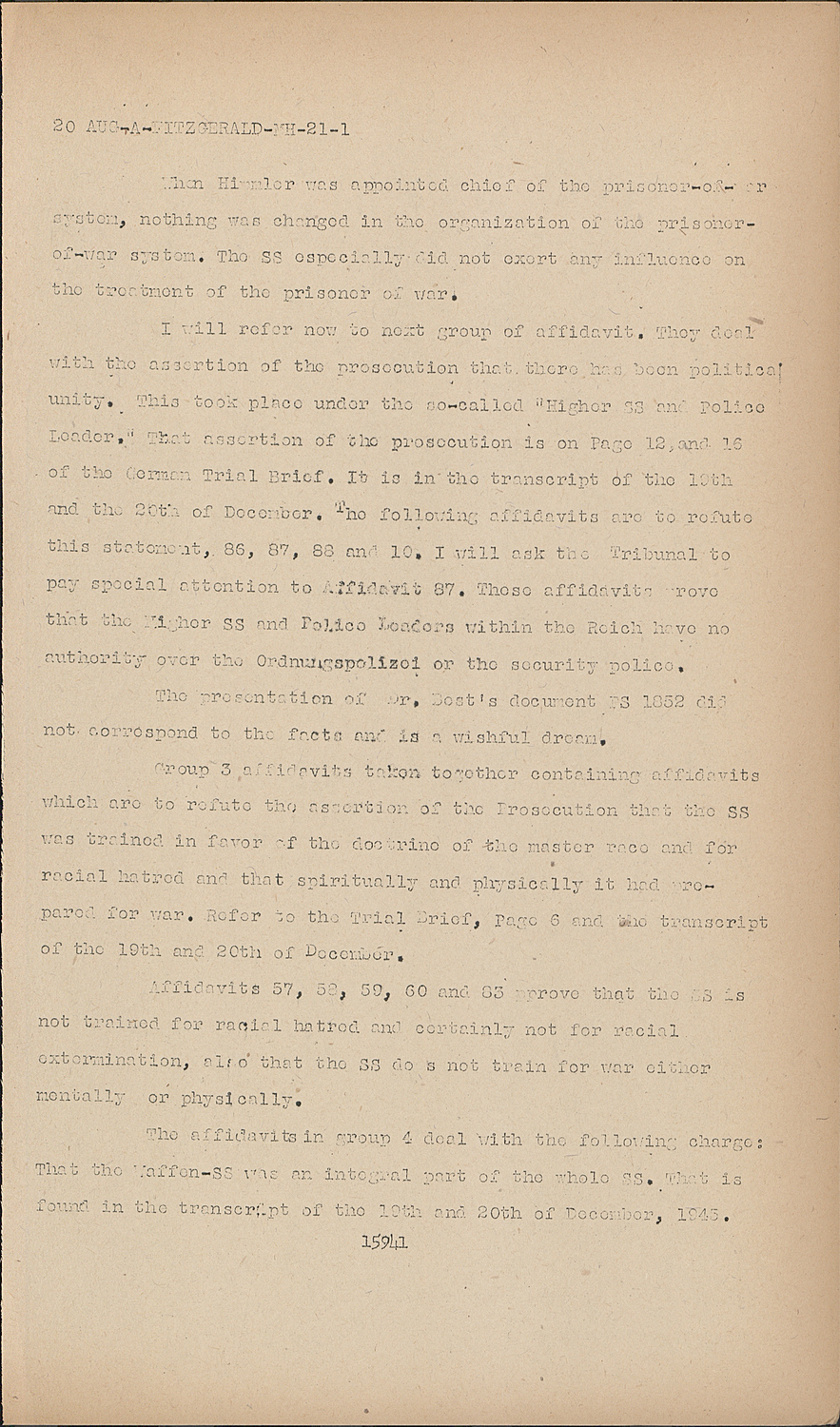
When Himmler was appointed chief of the prisoner-of-Her System, nothing was changed in the organization of the prisonerof-war system.
The SS especially did not exert any influence on the treatment of the prisoner of war.
I will refer now to next group of affidavit. They deal with the assertion of the prosecution that there has been political unity. This took place under the so-called "Higher SS and police Leader." That assertion of the prosecution is on Page 12,and 16 of the German Trial Brief. It is in the transcript of the 19th and the 20th of December. The following affidavits are to refute this statement, 86, 87, 83 and 10. I will ask the Tribunal to pay special attention to Affidavit 87. These affidavits rove that the Higher SS and Police Leaders within the Reich have no authority over the Ordnungspolizei or the security police, The presentation of war, Best's document PS 1052 did not correspond to the facts and is a wishful dream.
Group 3 affidavits taken together containing affidavits which are to refute the assertion of the Prosecution that the SS was trained, in favor of the doctrine of the master race and for racial hatred and that spiritually and physically it had repared for war. Refer to the Trial Brief, page 5 and the transcript of the 19th and 20th of December.
Affidavits 57, 50, 59, 60 and 83 prove that the SS is not trainee, for racial hatred and certainly not for racial extermination, also that the SS does not train for war either mentally or physically.
The affidavits in group 4 deal with the following charge: That the Waffen-SS me an integral part of the whole SS. That is found in the transcript of the 19th and 20th of December, 1943.
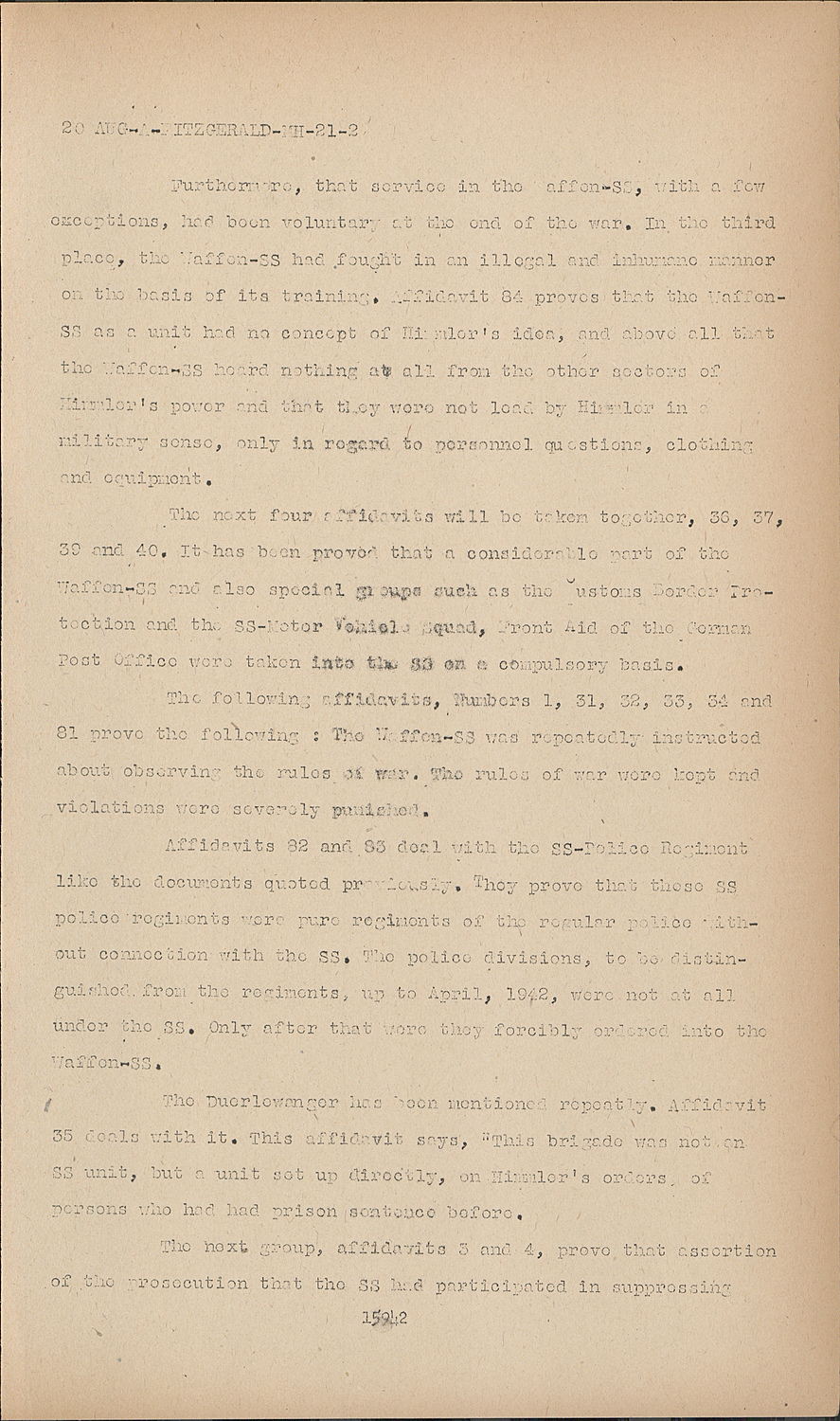
Furthermore, that service in the Waffen-SS, with a few exceptions, had been voluntary at the end of the war.
In the third place, the Waffen-SS had fought in an illegal and inhumane manner on the basis of its training.
Affidavit 84 proves that the Waffen SS as a unit had no concept of Himmler's idea, and above all that the Waffen-SS heard nothing at all from the other sectors of Himmler's power and that they were not lead by Himmler in a military sense, only in regard to personnel questions, clothing and equipment.
The next four affidavits will be taken together, 36, 37, 39 and 40.
It has been proved that a considerable part of the Waffen-SS and also special groups such as the Customs Border Pro tection and the SS-Motor Vehicle Squad, Front Aid of the German foot Office were taken into the SS on a compulsory basis.
The following affidavits, numbers 1, 31, 32, 33, 34 and 81 prove the following : The Waffen-SS was repeatedly instructed above observing the rules of war.
The rules of war were kept and violations were severely published.
Affidavits 32 and 03 deal with the SS-Police Regiment like the documents quoted previously.
They prove that these SS police regiments were pure regiments of the regular police with out connection with the SS.
The police divisions, to be distin guished, from the regiments, up to April, 1942, were not at all under the SS.
Only after that were they forcibly ordered into the Waffen-SS.
The Duerlewanger has been mentioned repeatly. Affidavit 35 deals with it.
This affidavit says, "This brigade was not an SS unit, out a unit set up directly, on Himmler's orders, of persons who had had prison sentence before.
The next group, affidavits 3 and 4, prove that assertion of the Prosecution that the SS had participated in suppressing the SA on June 30, 1934, is false.
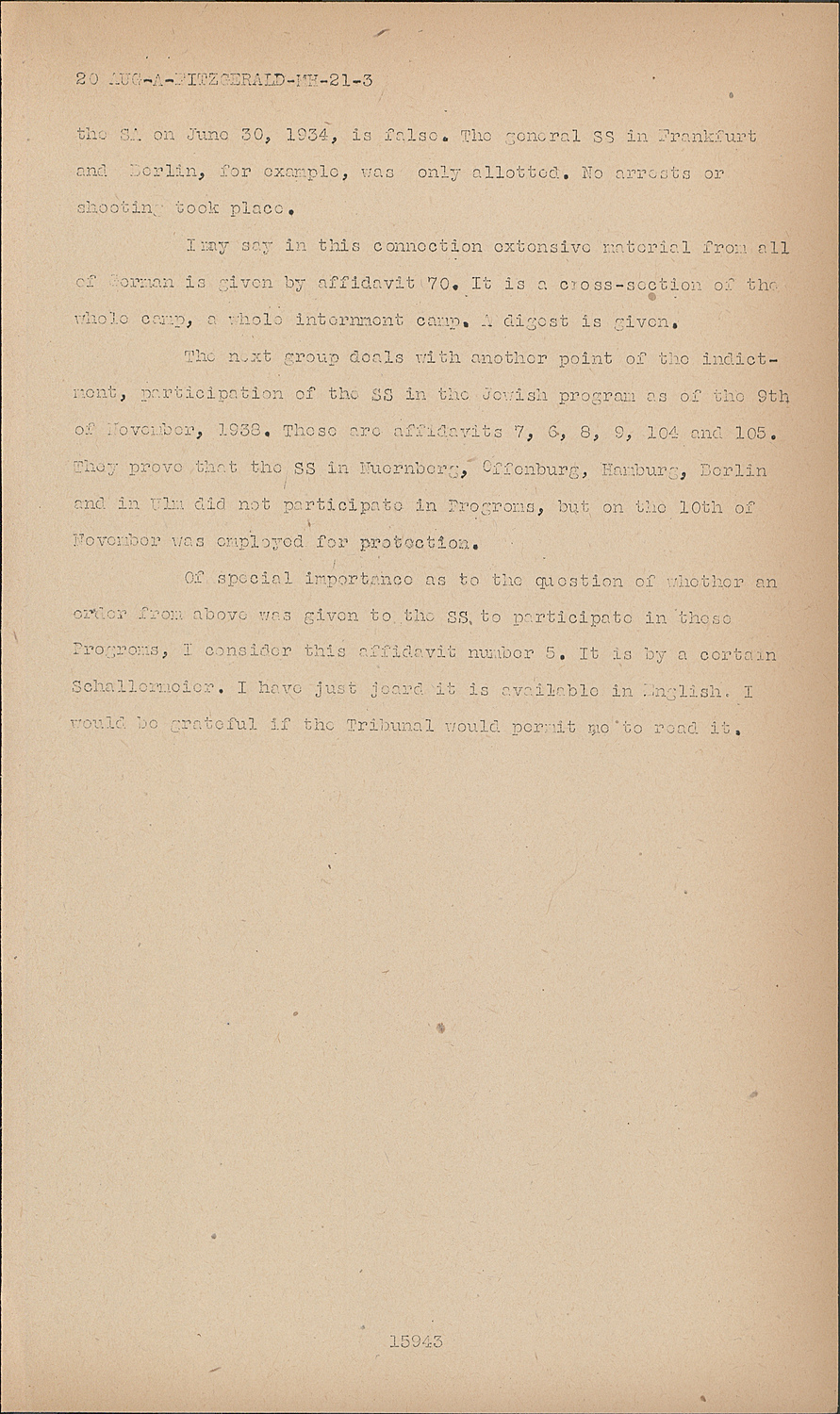
The general SS in Frankfurt and Berlin, for example, was only allotted.
No arrests or shooting took place.
I may say in this connection extensive material from all of German is given by affidavit 70. It is a cross-section of the whole camp, a whole internment camp. A digest is given.
The next group deals with another point of the indictment, participation of the SS in the Jewish program as of the 9th of November, 1938. These are affidavits 7, 6, 8, 9, 104 and 105. They prove that the SS in Nuernberg, Offenburg, Hamburg, Berlin and in Ulm did not participate in Programs, but on the 10th of November was employed for protection.
Of special importance as to the question of whether an error from, above was given to the SS, to participate in those Programs, I consider this affidavit number 5. It is by a certain Schallermeier. I have just jeard it is available in English. I would be grateful if the Tribunal would permit me to read it.
THE PRESIDENT: Has it been digested in the transcript 20 Aug A LJG Karr 22-1 before the Commissioners?
DR. PELCKMANN: It is digested in the transcript, your Lordship. I do not want to read the whole document but may I read only part of it once more, something which is especially important.
"About 3 a.m. on November 10 (this is Schallermeir speaking) the Reichsfuehrer dictated to me in my room a declaration running as follows:
" I went on 9 November to the Fuehrer and towards 11:30 p.m. the Gruppenguehrer Wolf came to me and informed me about the orders issued by the Gau Propaganda Office in Munich. (I emphasize Gau Propaganda office.) I asked the Fuehrer what orders he had to give me. The Fuehrer replied that the SS had to keep out of this action. The State Police were to provide safety for Jewish property and see that the Jews themselves were protected. The General SS, who remained in barracks, were only to be helpers on protective measures if absolutely necessary. I passed on this command of the Fuehrer to Gruppenfuehrer Heydrich for the State Police Headquarters and to the Oberabschnittsfuehrers for the General SS at once. When I asked the Fuehrer I had the impression that he knew nothing about what was happening. The order came from the Reich Propaganda Headquarters and I presume that Goebbels had started this action in his lust for power which had struck me for some while past and in his empty-headedness, just when the foreign political situation was at its worse.'" May I correct myself.
If I said this was Schallermeier that was a mistake. This quotation was dictated by Himmler; Himmler dictated these paragraphs.
And now the author of the affidavit goes on:
"I had to type this dictation personally."
It states that the statement of Himmler was locked up in the safe.
A very good view of the participation or non-participation of the SS in these events of 9 November is given to the Tribunal 20 Aug A LJG Karr 22-2 by affidavit number 70, a digest from a camp.
The next group includes the following affidavits; 14, 15, 16, 19, 20, 21, 23, 25. It deals with circumstances in the concentration camps. These affidavits are to prove that treatment in the concentration camps, which these witnesses described only in general, were satisfactory. Mistreatment of prisoners was severely punished.
There are numerous examples on this subject in the affidavit number 70, which I have mentioned in the digest of many affidavits in the collective affidavit 119, 122.
As to the question of the authority in the concentration camps and the role which this played within the SS organization, the affidavit SS and 100 are important. They prove that the income of concentration camps from the labor of prisoners was not turned over to the SS, in particular not to the Waffen SS but this income was entered on the budget of the German Reich.
The next group includes affidavits regarding experiments on living human doings. I consider them valuable only as to the question as to what the SS men know of those experiments.
Affidavit 17 is to prove that in Dachau they were volunteers for freezing experiments after they had been given a physical examination and special food.
Affidavit 107 also deals with these experiments.
The following group of affidavits, 18, 22, 27, and 28 deal with the question of secrecy regarding crimes, especially crimes in concentration camps and to refute the assertion of the Prosecution on page 3418 and 3420 of the German transcript, that the whole German population know of the atrocities in concentration camps. That would include the SS men outside concentration camps.
These four affidavits prove that of all persons who came in contact in any way with concentration camps statements of secrecy were demanded; furthermore that the guards of the concentration camps did not have any insight into the actual protective custody camps and that in part even within the commandateurs one section 20 Aug A LJG 22-3 Karr was not informed about the activity of the other section.
On the sane question of the knowledge of the members of the SS I consider very important affidavit number 24. In answer to the express question of a Waffen SS fuehrer, who reported to him, Himmler said that in the concentration camps everything was in order; that the prisoners word given satisfactory treatment, Himmler made this statement to the whole officers' corps of the 17th SS Division.
Affidavit 117 proves that the extreme secrecy rules in the Fuehrer's headquarters wont so far that crimes in concentration camps, extermination of Jews and the activity of the Einsatzkommandos that nothing was learned about these things.
I take three affidavits together, 63, 93 and 94. They also indicate extreme secrecy within Himmler's sphere and in particular extreme secrecy in the inspection of concentration comps. They notorious speech of Himmler's at Posen in October 1943 is known to the Tribunal. It was hold before Obergruppenfuehrers of the SS.
The Schneider affidavit, number 29, says the following: Schneider was warned by Himmler personally to keep silence about the Posen speech if he was fond of his life.
Affidavit 41, indicates that the Economic and Administrative main Office was competent for concentration camp administration through Amtsgruppe D. This affidavit emphasizes the extra-ordinary secrecy within this administrative organization.
Affidavit 12 reports that the adjutant of the chief of the SS main office inquired of the RSHA and also inquired of the WVHA Amtsgruppe D in 1943.
The Chief of the SS Personnel Main Office inquired whether rumors about the murder of Jews were true.
The offices mentioned answered that these rumors were untrue. They were enemy propaganda.
THE PRESIDENT:We shall break off now, Doctor, please. Will you be much longer in your summaries of these affidavits ?
Dr. PELCKMANN: No, Your Lordship, these affidavits will not take much longer but a resume of the mass affidavits which I must give so that the Tribunal will know what these mass affidavits deal with, that will take a little longer.
(The Tribunal adjourned until 21 August 1946, at 1000 hours.)
OFFICIAL TRANSCRIPT OF THE INTERNATIONAL MILITARY
TRIBUNAL IN THE MATTER OF THE UNITED STATESOF AMERICA, THE FRENCH REPUBLIC, THE UNITED KINGDOM
OF GREAT BRITAIN AND NORTHERN IRELAND, AND THE
UNION OF SOVIET SOCIALIST REPUBLICS AGAINST
HERMANN WILHELM GOERING ET AL, DEFENDANTS, SITTING
AT NURNBERG, GERMANY, ON AUGUST 21, 1946, 1000-1700
LORD JUSTICE LAWRENCE, PRESIDING.
THE PRESIDENT:One moment, Dr. Pelckmann, although perhaps you can help me.
In view of a letter which has been addressed to the Tribunal signed by most of counsel for the organizations but not, I think, by Dr. Servatius, dated 15 August, 1946, the Tribunal would be glad to knew from counsel for the organizations how long they anticipate those who remain to present their documents and affidavits think they will take in doing so and in in what order they propose to make their speeches and whether they are ready or will be ready when the time comes to make these speeches because the Tribunal is very anxious and is not prepared to postpone the presentation of those speeches.
Therefore, the Tribunal thinks it is proper at this time to ascertain, as far as possible, whether the speeches will be ready in due time, I see that Dr. Kubuschok is not here.
Dr. Pelckmann is here and perhaps he can tell us as far as he is concerned and Dr. Servatius.
DR. PELCKMANN: Perhaps I will need two more hours. I believe my colleague, Dr. Laternser, will need one day for his speech.
How long the SA will take I do not know. As to how long we shall take with the pleas, I can only repeat what was said in the letter because we were occupied with the taking of testimony until a few days ago and then with the presentation of documents and affidavits. But I believe that on Monday we could all begin with our pleas. As far as I knew, my colleague, Servatius, would already be ready to his plea.
We announced in the letter that we could hand in our pleas at the end of the week if we count on three days for the translation and mimeographing. If one or the other of us could hand in the manuscript on Friday, we could begin on Monday or Servatius could begin at the end of the week. I personally, If I may say so, would not be ready before Monday.
THE PRESIDENT:You will be ready by Monday?
DR. PELCKMANN:Not before Monday.
THE PRESIDENT:I think I ought to point out to the counsel for the organizations that the letter was addressed to the Tribunal on the 15th of August, which is six days ago, so that they have had six days since then in which to get their speeches ready. I have also pointed out to each one in turn of the counsel for the organizations that it is quite unnecessary and it is wasting the time of the Tribunal to take so much time in commenting upon their affidavits and other documents; and the time would have been very much better spent in preparing their speeches. But I gather from what you say -- and perhaps Dr. Servatius will be able to tell the Tribunal whether he agrees with it, and Dr. Laternser, too -- that the counsel for the organizations will in all probability be ready to go on with their speeches on Monday and not to request any delay after that. Dr. Servatius, I understand, is ready to go on at once.
DR. PELCKMANN:Your Lordship, perhaps I may say one more thing. The documents and affidavits are being commented on at somewhat greater length than seems necessary to the Court. This is because the Court said the following, if I recall correctly, when the time of the speeches was set at three hours, it was said at the same time that the attorneys would have an opportunity to make comments on their presentation of affidavits and documents so that the time of three hours for the speech would remain for other purposes. We concluded from that that we would have an opportunity to comment on the evidence now in the presentation of documents and affidavits.
THE PRESIDENT:Yes, but counsel for the organizations must realize that all these affidavits are summarized in writing before us; and therefore simply to repeat the summary which we have in writing, of course, does not really help us at all.
You have mentioned in the absence of Dr. Laternser, who I see is now present, that Dr. Laternser, you think, would be likely to take one day on these documents.
DR. PELCKMANN:Yes, he told me last night that he would need a day.
THE PRESIDENT:Let me hear what he is going to say. Dr. Laternser, in your absence, what I was saying was that the Tribunal had had this letter of the 15th of August, which was written six days ago, and that the Tribunal would like to know how long counsel for the organizations anticipate they will take over their documents and whether they would be ready to go on with their speeches immediately thereafter. In answer to that, Dr. Pelckmann told me that he would take two more hours and that he heard from you that you would be likely to take one day.
I think the Tribunal world be very disinclined, very much disinclined, to listen to one whole day upon the documents.
DR. LATERNSER:Mr. President, I believe that I will certainly need a day. Please consider the following: The American prosecution used two days to present their evidence. The Russian prosecution used many days for their evidence against the General Staff. I believe that within the framework assigned to me, I face considerable difficulties, and then I need only one day. That is a fraction of the time which the prosecution used to present the evidence against the General Staff, if that is not too much -- ?
THE PRESIDENT:Dr. Laternser, you are leaving out consideration altogether of the fact that we have set up these Commissions and the fact that you have been before these Commissions not only for one day but for many days.
DR. LATERNSER:Mr. President, I presented the affidavits to the Commission. This was of a formal nature. The purpose of my presentation of evidence as to bring a certain order so that the Court may see to what point of the indictment the individual affidavits are to apply.