
THE PRESIDENT: I am told that I may have misunderstood 7 Aug A LJG 17-1 what you were saying to me just before the Tribunal adjourned and that you were asking whether you might be allowed to call some other witness in place of one of the witnesses you had already applied for.
Is that so?
DR. PELCKMANN:Yes.
THE PRESIDENT:Well, whom is it you went to call?
DR. PELCKMANN:Since I know the wish of the Court to shorten the proceedings, I had endeavored to ask the other witnesses the questions which I had intended for the fifth witness. I believe I succeeded in this, but from the interest that the Tribunal took in the question of the investigation of concentration camps I saw that it might be very expedient, and I must say that it would be in the interest of the defense, if the judge, Dr. Morgen, mentioned by the witness Reinecke, might be examined briefly on these matters. I would be in a position to examine this witness immediately and the witness Hinderfeld, who was to be examined, I would not need.
THE PRESIDENT:To examine Dr. Morgen and to give up one of the other witnesses, is that right?
DR. PELCKMANN:Yes.
THE PRESIDENT:Very well, the Tribunal -- he has been called before the Commission I suppose, hasn't he?
DR. PELCKMANN:No, Your Lordship. There are affidavits from him. May I explain briefly why I could not examine him before the Commission? On the first of July the witness arrived here in Nurnberg after I had searched for him for a long time. Up to that time the witness was in Dachau without my being able to find out about it. On the first of July I was so busy with the last examinations before the Commission; for example, the witness Eberstein, and the witness Reinecke I examined only on the 5th and 6th of July before the Commission, so that I could not prepare the testimony of this witness. As a result, I was only able, after the end of the activity of the Commission, to prepare affidavits with him. These are, I believe, 65 and 67, but these affidavits do not show matters as clearly as if I 7 Aug A LJG 17-2 were to examine him now, Your Lordship, and I suggest that the Tribunal might examine him as briefly as possible.

THE PRESIDENT:Who is the witness you were intending to dispense with?
DR. PELCKMANN:Hinderfeld.
THE PRESIDENT:Mr. Elwyn Jones, what view do the prosecution take of this application?
MR. ELWYN JONES:I suggest, My Lord, that it might be possible for a fuller affidavit to be taken by this witness and that might possibly meet the case. But in view of the fact that the defense are abandoning one witness, I wouldn't press that view, but I do respectfully suggest that, in view of the time that has been taken on this organization, an affidavit might be appropriate, particularly as Dr. Pelckmann has evidence on matters dealing with that part of the case in which the Tribunal is especially interested.

THE PRESIDENT: What do you say to that, Dr. Pelckmann? Couldn't you put the same questions to this witness, and couldn't he incorporate into his affidavit the point you want him to?
He already had three affidavits.
DR. PELCKMANN:Certainly, your Lordship. I will only state the following. The Prosecution called a witness, Sievers, in order to support their position and I think that if I want to support the testimony of the witness Reinecke by calling another witness here that might be more or less on the same basis, and by the testimony of the witness, the matters of the concentration camps, the secret sphere of the concentration camps, and the introduction of the court into it might be cleared up much better for the court here than by an affidavit.
THE PRESIDENT:Is this witness of yours, is he here?
DR. PELCKMANN:He is in the witness building.
THE PRESIDENT:Are you proposing to call him next?
DR. PELCKMANN:I would do it. If the Prosecution wishes to call their two witnesses first I could interrupt, your Lordship.
THE PRESIDENT:Dr. Pelckmann, have you any idea as to how long you will be with this witness if you do call him?
DR. PELCKMANN:Forty-five minutes to an hour.
THE PRESIDENT:Well, then, if you wish it, and then you dispense with calling the witness Dr. Hindenberg or whatever his name is. You may call Dr. Morgen.
DR. PELCKMANN:Thank you, your Lordship. I call the witness Dr. Morgen.
MR. ELWYN JONES:The witness is, of course, in the prison building at the moment. Perhaps it would be more convenient to call the next witness.
THE PRESIDENT:Sievers, isn't it?
MR. ELWYN JONES:No, the witness Izrael Eisenberg, whose affidavit is document number D-939, GB-563.
THE PRESIDENT:Eisenberg.
MR. ELWYN JONES:Yes, your Lordship, Eisenberg.
THE PRESIDENTS:Marshal, will you bring in Eisenberg and send for Morgen.
Will you state your full name, please.

THE WITNESS: Israel Eisenberg.
THE PRESIDENT:Will you repeat this oath after me?
I swear by God, the Almighty and Omniscient, that I will speak the pure truth, and will withhold and add nothing.
(The witness repeated the oath)
THE PRESIDENT:You may sit down.
DIRECT EXAMINATION BY MR. ELWYN JONES:
QWitness -- I just want to put the statement to the witness, my Lord -- witness, you are Israel Eisenberg of 203 Reinsburg Stratsse, Stuttgar
AYes.
QWill you look at the affidavit D-939, exhibit GB-563. Just look at it. Is that year statement?
AYes, I signed it.
QAnd is it true?
AYes, it is.
QWitness, I notice you have a scar on your face. Will you tell the Tribunal how it was caused?
AYes, I can tell the Tribunal. In 1942, at the end of October 1942 I was shot together with many thousands of Jews. The bullets hit my left cheek and I was lying there from 9:30 until 4:30 in the morning. At 4:30 in the morning, when people were cleaning the corpses, I was taken with another man whose name was Stagel. Only the two of us survived.
QAnd how many were killed on that occasion?
AIt was 9:30 in the evening and there were groups composed of 1,000 and mere people who were conducted to a field and I was among them. They shot at us and I was lying on the field until 4:30 in the morning.
QNow, just after this last question, who were the killers?
AThe killers were SS men in SS uniforms.
MR. ELWYN JONES:I have no further questions, my Lord.

BY DR. PELCKMANN:
QWitness, I know your affidavit --- As far as I can see from it, you were in Lublin, at first in Lublin. Were there other SS men there, too, whom you know?
AYes, I know many of them. I was working in the SS staff as a fitter-electrician and I came there very frequently in order to make electrical installations there.
Q.In your affidavit you have given some names --- Riedel Mohrwinkel and Schrammek.
AYes, I know them personally.
QThey were on this staff?
AYes, they were on the staff and the staff was located on Warschau Street 21.
QDo you also know exactly the ranks which you mentioned in your affidavit as belonging to these persons?
AYes, I know them,
QWhat, for example, was Riedel?
ARiedel was Unterscharfuehrer.
QAnd Mohrwinkel?
AAt first he was a Rottenfuehrer and as a result of this action he was promoted to Unterscharfuehrer.
QYou just said that Riedel was an Unterscharfuehrer. In your affidavit you said he was an Oberscharfuehrer.
AHe had white threads on his epaulettes.
QNow, I show you a picture. Please tell me whether that is Riedel or Mohrwinkel and what is the rank of this SS man
AThis man is neither Mohrwinkel nor Riedel.
QAnd what is his rank?
AIt seems to me that he is a Rottenfuehrer because there is nothing on his epaulettes and only a patch on his sleeve Q Thank you.

Now, I shall show you another picture. If I remember the other picture correctly, this would also have to be a rottenfuehrer?
AI cannot tell with certainty but the other one had on his epaulettes a white thread all round and here I see a double thread in this photo.
QThank you witness.
DR PELCKMANN: I have no more questions, your Lordship.
THE PRESIDENT: The witness can retire.
- - - - -
DR. PELCKMANN: For the information of the high Tribunal. I should like to say that these photographs came from the book on the Warsaw atrocities, submitted by the prosecution yesterday, which was in Polish and the photographs are not men of the Waffen SS at all but policemen. The witness did not notice that.
THE PRESIDENT: The witness said he had never seen them before. The witness said he had never seen the man before. We don't need to argue about it. Now, who is your next witness?
DR. PELCKMANN: May I submit these pictures to the Tribunal? They are in the Polish book, in Polish, on pages Roman numberal one and eleven.
THE PRESIDENT: You can certainly put them in if you think it worthwhile; but, now, will you get on with your case. Is there another witness that you are going to call before Dr. Morgen?
DR. PELCKMANN: Yes; the witness Sievers was called by the prosecution, your Lordship.

THE PRESIDENT: Well, is he here?
THE MARSHALL: Yes, Mr. President.
THE PRESIDENT: Well, call him then.
THE MARSHALL: Both witnesses are here now, your Honor, both Sievers and Morgan.
THE PRESIDENT: We will go on with Sievers now.
MR. ELWYN JONES: Wou did indicate, my Lord, it might be more convenient for Dr. Pelckmann to finish with his witness before Dr. Sievers.
THE PRESIDENT: I don't think you mind. Call Dr. Morgan then.
GEORG KONRAD MORGAN a witness, took the stand and testifies as followe : BY THE PRESIDENT:
QWill you state your full name please?
AGeorg Konrad Morgen.
QWill you repeat this oath after me:
I swear by God, the Almighty and Omniscient, that I will speak the pure truth and will withhold and are nothing.
(The witness repeated the oath.)
THE PRESIDENT: You may sit down.
DIRECT EXAMINATION BY DR. PELCKMANN:
QWitness, because of the significance of your testimony I will first ask you in detail about your person. Were you an SS Sturmfuehrer of the Reserve?
AYes.
QPlease speak slowly and wait a little after every question. What training did you have?

A I studied at the University of Frankfurt on the Main --Rome, Berlin; at the academy at the Hague and the Institute for World Economy and sea traffic in Kiel.
I passed the first examination. Before the war I was a judge at the Landgericht in Stettin.
QWere you a specialist and criminologist in the penal code?
ANo, I had specialized in International Law but later, during the war, I had to deal with criminal matters and had special achievement a in that field.
QHow did you come to the SS?
AI was taken over involuntarily into the General SS. In 1933, I belonged to the group for youth physical training which was taken over as a body. I was drafted at the beginning of the war.
QWhat rank did you have?
AIn the General SS I was Staffelanwaerter and Rottenfuehrer. In the Waffen SS I was Sturmfuehrer of the Reserve.
AWhat example can you give that you did not believe you were joining a conspiracy when you joined the SS--- very briefly, please.
AIn 1936 I published, a book on war propaganda and the prevention of war. This book, at the time of a threat of war, showed ways and means to prevent war. The book was examined by the Party and published. I could not assume that the SS or the policy of the Reich government were directed towards war.
QHow did you come to the investigations in the concentration camp.

A At the order of the Reichsfuehrer SS, because of my special abilities in the criminal field, I was appointed to the Reich Criminal Police Office in Berlin.
Shortly after I arrived there, I was given an assignment to investigate the case of corruption in Weimar. The accused was a member of the concentration camp of Weimar-- Buchenwald. The investigation soon led to the person of the former Commandant Koch, through many of his subordinates and in addition, they affected a number of the other concentration camps. As these investigations became more extensive, I received powers from the Reichsfuehrer SS to be generally active in such investigations in concentration camps.
QWhy was the special authorization from the Reichsfuehrer necessary?
AFor the guards of the concentration camps, the SS and Police Courts were competent; that is, the courts in whose district the concentration camp was located. For that reason, because of its limited jurisdiction, the Court was not able to have any effect beyond its district, and on these investigations it was important to be able to work in many districts; in addition, it was necessary to use specialists in the criminal field; that is, the criminal police but the criminal police could not carry on any investigation directly among the troops and only through the combination of juridical and criminal police activity was it possible to clear this up and for this purpose, I was given this special authorization from the Reichsfuehrer.

Q Now, how extensive did this investigation become?
7 Aug A LJG 20-1 Cumoletti You can be brief because the witness Reinecke answered this point in part.
AI investigated Buchenwald, Auschwitz, Sachsenhausen, Oranienburg, Herzogenbosch, Krakow, Plaschow, Warsaw, and the concentration camp Dachau. After others.
QHow many cases did you investigate? How many death sentences were passed?
AI investigated about 800 cases, that is, about 300 documents, and one document affected several cases. About 200 were tried during my activity. Five Commandants of concentration camps were arrested by me personally. Two were shot after being tried.
QWere shot?
AYes. Aside from the Commandants, there were other different sentences against Fuehrers and Unterfuehrers.
Q.Did you yourself have an opportunity of visiting inside and seeing the conditions of the concentration camps?
AYes, I had the approval to visit the concentration camps myself. Only a very few persons had this permission. Before the beginning of the investigations, I examined the concentration camps in question in all its details, and especially the important arrangements. I visited them repeatedly. I paid surprise visits. I was in Buchenwald for 8 months. I lived there. I was in Dachau for one or two months.
QSo many visitors at concentration camps say they were deceived. Do you consider it possible that you too were a victim of such deceit?
AI was not a visitor to a concentration camp. I had settled down there for a permanent residence. During such a long time it is impossible to be deceived. In addition, the Commissioners from the Reichcommissar office worked under my instructions. I placed them directly in the Concentration Camps. In addition, I went to say that in spite of these very intensive efforts, I was not able to learn of all crimes.
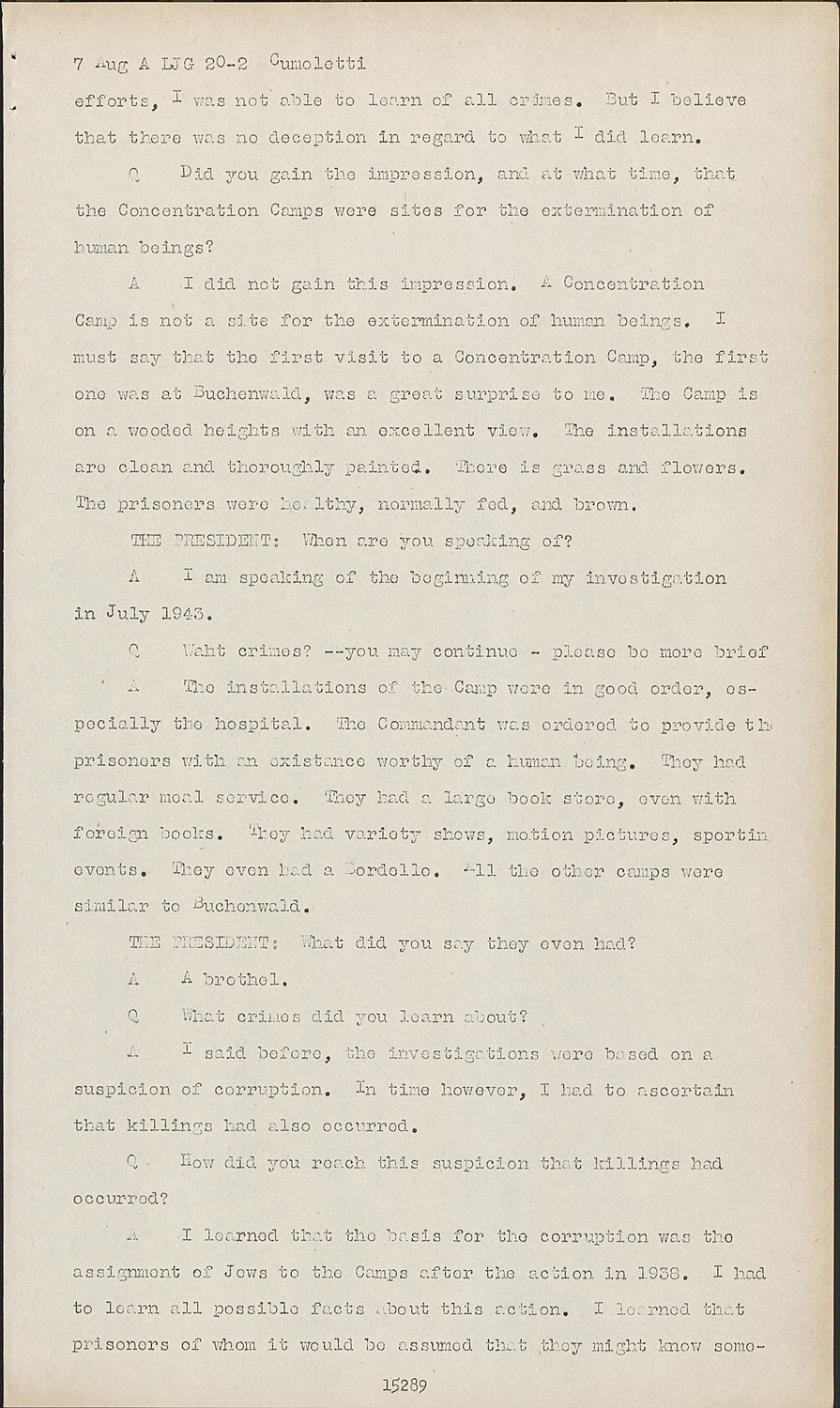
But I believe 7 Aug A LJG 20-2 Cumoletti that there was no deception in regard to what I did learn.
QDid you gain the impression, and at what time, that the Concentration Camps were sites for the extermination of human beings?
AI did not gain this impression. A Concentration Camp is not a site for the extermination of human beings. I must say that the first visit to a Concentration Camp, the first one was at Buchenwald, was a great surprise to me. The Camp is on a wooded heights with an excellent view. The installations are clean and thoroughly painted. There is grass and flowers. The prisoners were healthy, normally fed, and brown.
THE PRESIDENT:When are you speaking of?
AI am speaking of the beginning of my investigation in July 1945.
QWhat crimes? --you may continue - please be more brief
AThe installations of the Camp were in good order, especially the hospital. The Commandant was ordered to provide the prisoners with an existance worthy of a human being. They had regular meal service. They had a large book store, even with foreign books. They had variety shows, motion pictures, sportin events. They even had a Bordello. All the other camps were similar to Buchenwald.
THE PRESIDENT:What did you say they even had?
AA brothel.
QWhat crimes did you learn about?
AI said before, the investigations were based on a suspicion of corruption. In time however, I had to ascertain that killings had also occurred.
QHow did you reach, this suspicion that killings had occurred?
AI learned that the basis for the corruption was the assignment of Jews to the Camps after the action in 1938. I had to learn all possible facts about this action. I learned that prisoners of whom it would be assumed that they might know some thing about these signs of corruption, had in the majority died.
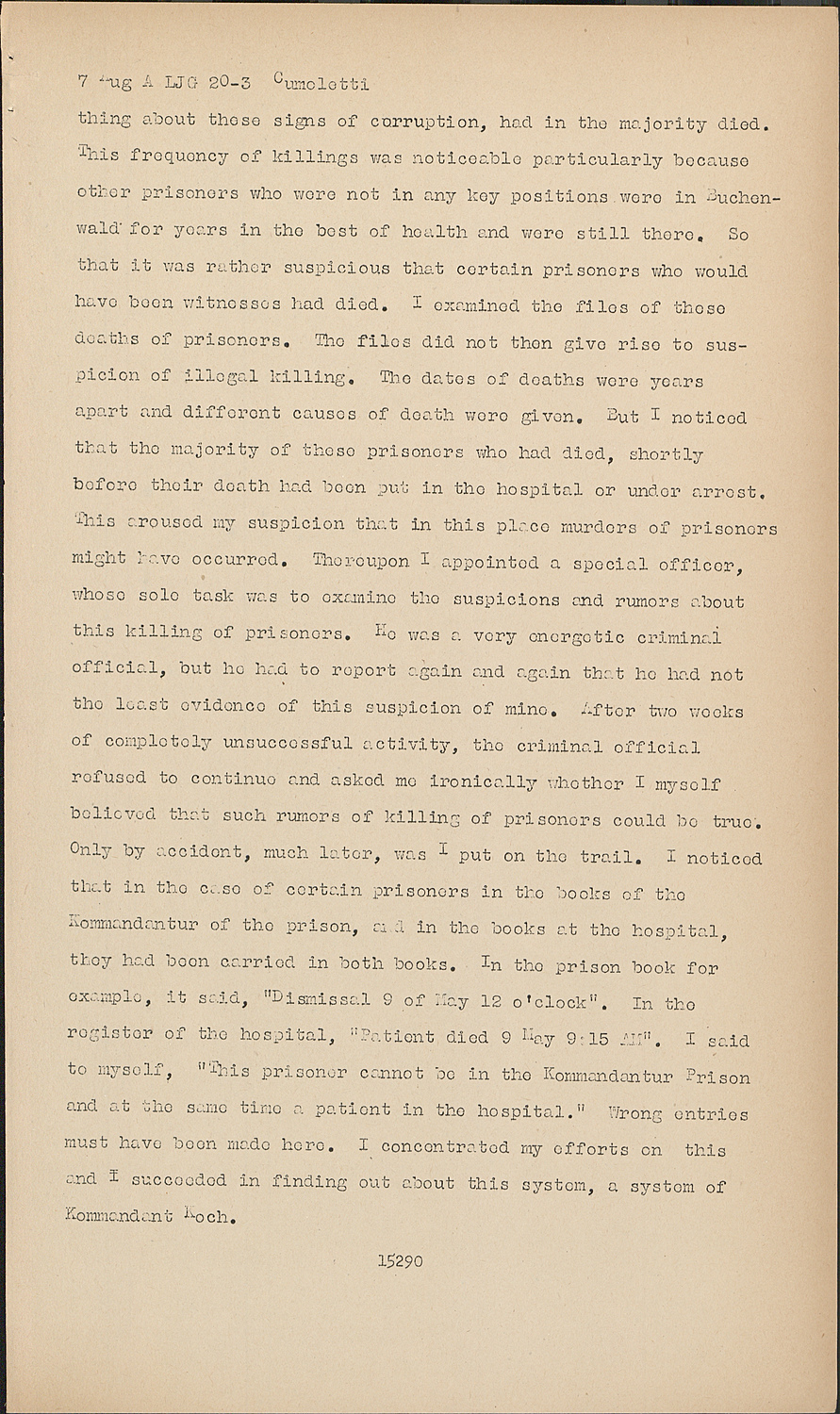
7 Aug A LJG 20-3 Cumoletti This frequency of killings was noticeable particularly because other prisoners who were not in any key positions were in Buchenwald for years in the best of health and were still there. So that it was rather suspicious that certain prisoners who would have been witnesses had died. I examined the files of these deaths of prisoners. The files did not then give rise to suspicion of illegal killing. The dates of deaths were years apart and different causes of death were given. But I noticed that the majority of these prisoners who had died, shortly before their death had been put in the hospital or under arrest. This aroused my suspicion that in this place murders of prisoners might have occurred. Thereupon I appointed a special officer, whose sole task was to examine the suspicions and rumors about this killing of prisoners. He was a very energetic criminal official, but he had to report again and again that he had not the least evidence of this suspicion of mine. After two weeks of completely unsuccessful activity, the criminal official refused to continue and asked me ironically whether I myself believed that such rumors of killing of prisoners could be true. Only by accident, much later, was I put on the trail. I noticed that in the case of certain prisoners in the books of the Kommandantur of the prison, and in the books at the hospital, they had been carried in both books. In the prison book for example, it said, "Dismissal 9 of May 12 o'clock". In the register of the hospital, "Patient died 9 May 9:15 AM". I said to myself, "This prisoner cannot be in the Kommandantur Prison and at the same time a patient in the hospital." Wrong entries must have been made here. I concentrated my efforts on this and I succeeded in finding out about this system, a system of Kommandant Koch.
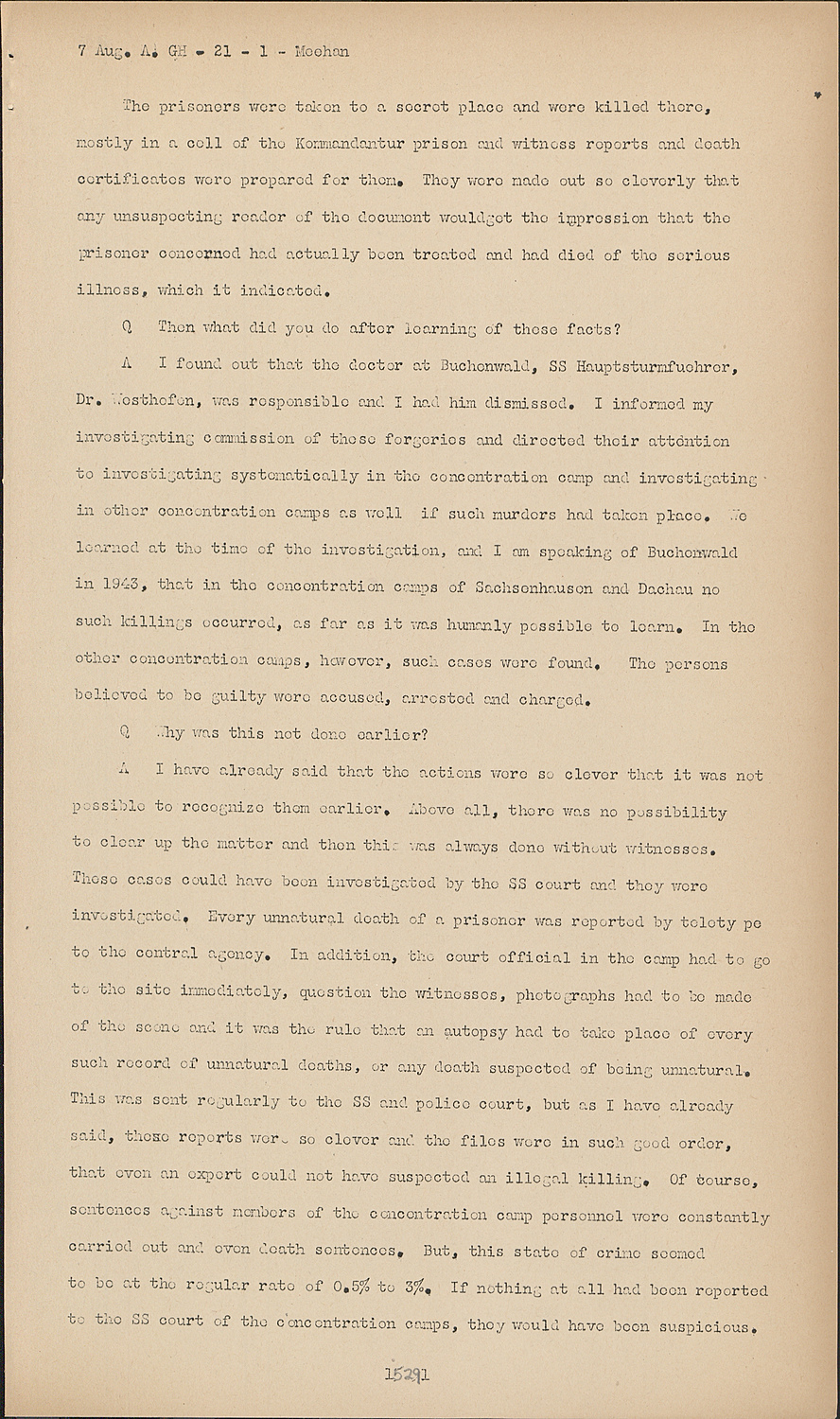
The prisoners were taken to a secret place and were killed there, mostly in a cell of the Kommandantur prison and witness reports and death certificates were prepared for them.
They were made out so cleverly that any unsuspecting reader of the document would get the impression that the prisoner concerned had actually been treated and had died of the serious illness, which it indicated.
QThen what did you do after learning of these facts?
AI found out that the doctor at Buchenwald, SS Hauptsturmfuehrer, Dr. Westhefen, was responsible and I had him dismissed. I informed my investigating commission of those forgeries and directed their attention to investigating systematically in the concentration camp and investigating in other concentration camps as well if such murders had taken place. We learned at the time of the investigation, and I am speaking of Buchenwald in 1943, that in the concentration camps of Sachsenhausen and Dachau no such killings occurred, as far as it was humanly possible to learn. In the other concentration camps, however, such cases were found. The persons believed to be guilty were accused, arrested and charged.
QWhy was this not done earlier?
AI have already said that the actions were so clever that it was not possible to recognize them earlier. Above all, there was no possibility to clear up the matter and then this was always done without witnesses. These cases could have been investigated by the SS court and they were investigated. Every unnatural death of a prisoner was reported by teletype to the central agency. In addition, the court official in the camp had to go to the site immediately, question the witnesses, photographs had to be made of the scene and it was the rule that an autopsy had to take place of every such record of unnatural deaths, or any death suspected of being unnatural. This was sent regularly to the SS and police court, but as I have already said, these reports were so clover and the files were in such good order, that even an expert could not have suspected an illegal killing. Of course, sentences against members of the concentration camp personnel were constantly carried out and even death sentences. But, this state of crime seemed to be at the regular rate of 0.5% to 3%, If nothing at all had been reported to the SS court of the concentration camps, they would have been suspicious.
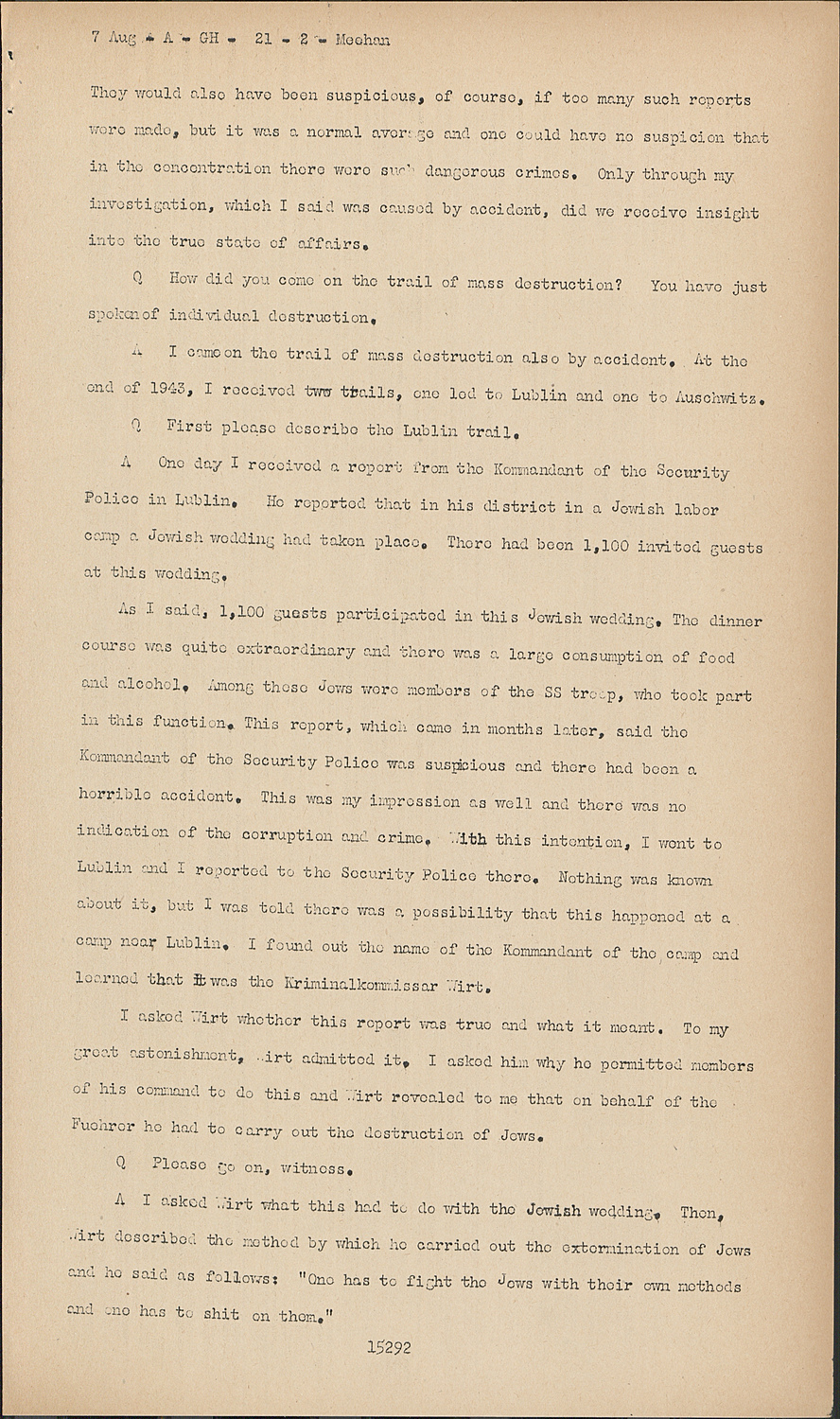
They would also have been suspicious, of course, if too many such reports were made, but it was a normal average and one could have no suspicion that in the concentration there were such dangerous crimes.
Only through my investigation, which I said was caused by accident, did we receive insight into the true state of affairs.
QHow did you come on the trail of mass destruction? You have just spoken of individual destruction.
AI come on the trail of mass destruction also by accident. At the end of 1943, I received two trails, one led to Lublin and one to Auschwitz.
QFirst please describe the Lublin trail.
AOne day I received a report from the Kommandant of the Security Police in Lublin. He reported that in his district in a Jewish labor camp a Jewish wedding had taken place. There had been 1,100 invited guests at this wedding.
As I said, 1,100 guests participated in this Jewish wedding. The dinner course was quite extraordinary and there was a large consumption of food and alcohol. Among those Jews were members of the SS troop, who took part in this function. This report, which came in months later, said the Kommandant of the Security Police was suspicious and there had been a horrible accident. This was my impression as well and there was no indication of the corruption and crime. With this intention, I went to Lublin and I reported to the Security Police there. Nothing was known about it, but I was told there was a possibility that this happened at a camp near Lublin. I found out the name of the Kommandant of the camp and learned that it was the Kriminalkommissar Wirt.
I asked Wirt whether this report was true and what it meant. To my great astonishment, Wirt admitted it, I asked him why he permitted members of his command to do this and Wirt revealed to me that on behalf of the Fuehrer he had to carry out the destruction of Jews.
QPlease go on, witness.
AI asked Wirt what this had to do with the Jewish wedding. Then, Wirt described the method by which he carried out the extermination of Jews and he said as follows: "One has to fight the Jews with their own methods and one has to shit on them."
Wirt built up an enormous destruction maneuver. He selected Jews as service column leaders, then those Jews brought along other Jews, who worked under them.
With these smaller or medium sized details of Jews, he began to build up the extermination camp. He extended this staff of Jews and with these Jews, Wirt carried out the extermination of the Jews.
Wirt said that he had four extermination camps and about 5,000 Jews were working at the extermination of Jews and the seizure of Jewish property.
In order to win Jews for this business of extermination and plundering of their fellow Jews, Wirt gave then freedom and, so to speak, gave them a financial part in the exploitation of the victims. As a result of this attitude, this Jewish wedding had come about.
Then I asked Wirt how he killed Jews with those Jewish agents of his. Wirt described the whole procedure that went off like a film every time. The extermination camps were in the East of the Government General and in big forests or uninhabited lands. They were built up like a village. The inhabitants expected to come into a city or settlement. The train drove into what looked like a railroad station. The operating personnel and the train personnel left the area. Then the cars were opened and the Jews got out. They were surrounded by the Jewish details, and Kriminal Kommissar Wirt or one of his representatives made a speech. He said, "Jews, you were brought here to be resettled, but before we organize this future Jewish state, you must of course learn how to work. You must pick up a new occupation. You will learn that here. First, every one must take off his clothes so that your clothes can be disinfected and you can be bathed so that no epidemics will be brought into the camp."
After he had found such calming words for his victims, they took up the road to death. Men and women were separated. At the first station, one had to give his hat; at the next one, his coat, his collar, his shirt, down to his shoes and socks. These places were set up like checkrooms, and the person was given a check at each one so that the people believed that they would get their things back. The other Jews had to accept the things and hurry up the new arrivals so that they could not have time to think. The whole thing was like an assembly line. At the last stop they reached a big room. It was said that this was the bath. When the last one was in, the doors were shut and the gas was let into the room.
As soon as death had set in, the ventilators were started so that the air could be breathed again. The doors were opened, and the Jewish workers removed the bodies. By means of a special procedure which Wirt had invented, they were burned in the open air without the use of fuel.
Q Was Wirt a member of the SS?
ANo, he was Kriminal Kommissar in Stuttgart.
QDid you ask Wirt how he arrived at this devilish system?
QWhen Wirt took over the extermination of the Jews, he was already a specialist in mass destruction of human beings. He had previously carried out the task of removing the incurably insane. On behalf of the Fuehrer himself, through the Chancellery of the Fuehrer, at the beginning of the war he had set up a detail, probably from agents and spies of the criminal police. Wirt described how he went about carrying out this assignment. He received no aid, no instructions, but had to do it all by himself. He was given an institution in Brandenburg. There he undertook his experiments. After much consideration and nary individual experiments, he care to his later system, and then this system was used on a large scale.
A commission of doctors previously investigated the files, and those insane who were considered to be incurable were put on a separate list. Then the institution one day was told to send these patients to another institution. From this institution the patient was transferred again, often more than once. Finally he came to Wirt's institution. There he was killed by gas and cremated.
This system which deceived the institutions and made them unknowing accomplices, this system that he worked out with very few assistants for being able to exterminate large numbers of people, this system Wirt now employed with a few improvements in the extermination of Jews. He was also given the assignment by the Fuehrer's Chancellery to exterminate the Jews.
QThe statements which Wirt made must have surpassed human imagination. Did you believe Wirt?
AAt first it seemed completely fantastic to me, but in Lublin I saw one of his camps. It was a camp in which I found part of the property of his victims. From the number of them -- there were a great number of watches piled up -- I had to realize that atrocities were being committed here. I was shown the valuables. I never saw so much money, especially foreignmoney -- all kinds, from all over the world. In addition, there were gold bars.
I also saw that the headquarters from which Wirt directed his operations was very small and inconspicuous. He had only three or four people working there for him, I spoke to them too.
I watched his courier arrive from Berlin, Tiergarten Strasse, the Fuehrer's Chancellery.
I investigated Wirt's mail.
Of course, I did not do all of this at this first visit. I was there frequently. I prosecuted Wirt up to his death.
QDid Wirt give you names of people who were connected with this operation?
ANot many names were mentioned for the simple reason that the number of those who participated could be counted on one's fingers. I remember one name: I think the name was Blankenburg, in Berlin.
THE PRESIDENT:Well, we had better adjourn now. We have already been 50 minutes.
(The Tribunal adjourned until 1000 hours, 8 August 1946).
OFFICIAL TRANSCRIPT OF THE INTERNATIONAL MILITARY TRIBUNAL IN THE MATTER OF THE UNITED STATES OF AMERICA, THE FRENCH REPUBLIC, THE UNITED KINGDOM OF GREAT BRITAIN AND NORTHERN IRELAND, AND THE UNION OF SOVIET SOCIALIST REPUBLICS AGAINST HERMANN WILHELM GOERING ET AL, DEFENDANTS, SITTING AT NURNBERG GERMANY, ON AUGUST 8, 1946, 1000-1300 , LORD JUSTICE LAWRENCE PRESIDING.
GEORG KONRAD MORGEN -- Resumed DIRECT EXAMINATION -- Continued BY DR. PELCKMANN ( Counsel for the SS):
Q.Witness, I have two pictures to show to you which have nothing to do with your examination concerning the concentration camps.
DR. PELCKMANN:They are the same pictures, your Lordship, which I showed to the witness Eisenberger yesterday. They have now received an exhibit number from me, Exhibit SS No. 2 and exhibit SS No. 3. As I said yesterday, they are taken from the book in the Polish language which the Prosecution submitted a few days ago, on pages IX and XI. BY DR. PELCKMANN:
Q.What is the rank of this SS man, witness.
A.That cannot be an SS man. That man is not wearing an SS uniform. I never saw such a uniform. On the left arm, the man wears the insignia of the police.
Q.That is enough, witness. That is enough for the Court. I will show you the second photograph Please answer the question equally briefly.
A.That is not an SS uniform either, but an imaginary uniform.
Q.Witness, yesterday you had begun the description of the so-called extermination camps and the system of the extermination camps, but I should like to go back to conditions In the concentration camps which are to be distinguished from the so-called extermination camps.
You had given a description of the impression given by this camp which Was extraordinarily pleasant. So that there may be no false impression, will you please describe what the general negative observations were that you made.
A.I was asked for my impressions of the concentration camps, whether I gained the impression that they were extermination camps.
I had to say that this impression could not arise. I did not mean to say that the concentration camps were sanitoria or a paradise for the prisoners.
If they had been that, my investigations would have been senseless.
Through these investigations I gained insight into the bad side of the concentration camps. The concentration camps were establishments which, from a false principle had to give rise to crimes. When I speak of the principle, I mean the following : The prisoner was sent to the concentration camp through the RSHA. A political agency decided about his freedom, and its decision was final. The prisoner was put in a position of having no legal rights. Once in the concentration camp, it was almost impossible to regain his freedom. Although, at regular intervals, the cases were reviewed the procedure was so complicated that aside from exceptional cases the majority were not affected. The camp, the RSHA, and the agency which had assigned the individual to the camp had to agree to his released. Only if these three agencies reached agreement could release be effected.