Official transcript of the International Military Tribunal, in the matter of:
The United States of America, the French Rep ublic, The United Kingdom of Great Britain and Northern Ireland, and the Union of Soviet Socialist Republics, against Hermann Wilhelm Goering, et al, Defendants, sitting at Nurnberg, Germany, on 13 December 1945, 1000-1300, Lord Justice Lawrence, presiding.
MR. THOMAS A. DODD:May it please the Tribunal, at the close of yesterday's session, we were discussing and had just completed reading the excerpts from the interrogation of the 6th day of October 1945 wherein the Defendant Alfred Rosenberg was questioned.
There have already been introduced Documents 017-PS, and 019-PS, and I have read excerpts from them. The Tribunal will recall that they are letters written by the Defendant Sauckel to the Defendant Rosenberg, requesting the assistance of the Defendant Rosenberg in the recruitment of additional foreign laborers. I refer to them in passing, by way of recapitualtion, with respect to the Defendant Sauckel's participation in this slave labor program, and also the assistance of the Defendant Rosenberg, Also the Defendant Sauckel received help from the Defendant Seyss-Inquart, who was the Reichskommisar for the Occupied Netherlands.
I refer again to the transcript of the interrogation under oath of the Defendant Sauckel, which was read from yesterday, and I now refer to another part of it. The transcript of this interrogation will be found in the rear of the Document Book. It is the very last document and I wish to quote particularly from it. It is the first question:
"Q. For a moment, I want to turn our attention to Holland. It is my understanding that the quotas for the workers from Holland were agreed upon, and then the numbers given to the Reichskommisar Seyss-Inquart to fulfill, is that correct?
"A. Yes, that is correct.
"Q. After the quota was "given to Seyss-Inquart, it was his mission to fulfill it with the aid of your representatives; was it not?
"A. Yes, This was the only possible thing for me to do and the same applied to other countries."
And the Defendant Hans Frank, who was the Governor General of the Gov-
ernment General of Poland, participated in the filling of Defendant Sauckel's quota requirements.
I refer again to the interrogation of the Defendant Sauckel and to Page 1 of the excerpts from the transcript of this interrogation, as it appears in the Document Book:
"Q. Was the same procedure substantially followed of allocating quotas in the General Government Poland?
"A. Yes. I have to basically state again that the only possibility I had in carrying through these missions was to get in touch with the highest German military authority in the respective country and to transfer to them the orders of the Fuehrer and ask them very urgently, as I have always done, to fulfill these orders.
"Q. Such discussions in Poland, of course, were with the General Governor Frank?
"A. Yes. I spent a morning and afternoon in Krakov twice or three times, and I personally spoke to General Governor Frank. Naturally, there was also present Secretary Dr. Goebble."
The SS, as in most matters involving the use of force and brutality, also extended its assistance. We refer to Document No. 1292-PS, which is USA Exhibit No. 225. This document, 1292-PS, is the report of the Reichschancellor Lammers of a conference with Hitler, which was attended by, among others, the Defendant Sauckel, the Defendant Speer, and Himmler the Reichsfuehrer SS. I turn to Page 2 of the document, beginning with the third line from the top of the page of the English text; and it is Page 4, Paragraph 2 of the German text. The quoting reads as follows:
"The Plenipotentiary for Employment and Labor, Sauckel, declared that he will attempt with fanatical determination to obtain these workers. Until now, he has always kept his promises as to the number of workers to be furnished. With the best of intentions, however, he is unable to make a definite promise for 1944. He will do everything in his powers to furnish the requested manpower in 1944. Whether it will succeed depends primarily on what German enforcement agents will be made available. His project cannot be carried out with domestic enforcement agents."
There are additional quotations, as the. Tribunal may observe, in this very part from which I have been reading, but I intend to refer to them again a little further on.
The Defendant Sauckel participated in the formulation of the overall Labor requirements for Germany and passed out quotas to be filled, by and with the assistance of the individuals and agencies referred to, in the certain knowledge that force and brutality were the only means whereby his demands could be met. Turning to Document 1292-PS again, and quoting from Page 1:
"A conference took place with the Fuehrer today which was attended by: the Plenipotentiary for the Employment of Labor, Gauleiter Sauckel; the Secretary for Armament and War Production, Speer; the Chief of the Supreme Command of the Army, General Field Marshal Keitel; General Field Marshal Milch; the Minister of the Interior, Reichsfuehrer of the SS, Himmler, and myself. (The Minister for Foreign Affairs and the Minister of National Economy hah repeatedly asked to be permitted to participate prior to the Conference, but the Fuehrer did not wish their attendance.)
"The Fuehrer declared in his introductory remarks:
'I want a clear picture:
(1) How many workers are required for the maintenance of German War Economy?
(a) For the maintenance of present output?
(b) To increase its output?
(2) How many workers can be obtained from Occupied Countries, or how many can still be gained in the Reich by suitable means (increased output)? For one thing, it is this matter of making up for losses by death, infirmity, the constant fluctuation of workers, and so forth; and further it is a matter of procuring additional workers.
' "The Plenipotentiary for the Employment of Labor, Sauckel, declared that, in order to maintain the present pool of workers, he would have to add at least 2 1/2 but probably 3 million new workers in 1944.
Otherwise production would fall off. Reichsminister Speer declared that he needs an additional 1.3 million laborers. However, this would depend on whether it will be possible to increase production of iron ore. Should this not be possible, he would need no additional workers. Procurement of additional workers from occupied territory would, however, be subject to the condition that these workers will not be withdrawn from armament and auxiliary industries already working there. For this would mean a decrease of production of these industries which he could not tolerate. Those, for instance, who are already working in France in industries mentioned above, must be protected against being sent to work in Germany by the Plenipotentiary for the Employment of Labor. The Fuehrer agreed with the opinions of Reichminister Speer and emphasized that the measures taken by the Plenipotentiary for the Employment of Labor should order no circumstances, which would lead to the withdrawal of workers from armament and auxiliary industries working in occupied territories, because such a shift of workers would only cause disturbance of production in occupied countries.
"The Fuehrer further called attention to the fact that at least 250,000 laborers will be required for preparations against air attacks in the field of civilian air raid protection. For Vienna alone 2000 2500 are required immediately. The Plenipotentiary for the Employment of Labor must add at least 4 million workers to the manpower pool, considering that he requires 2 1/2 million workers for maintenance of the present level, that Reich Minister Speer needs 1.3 million additional workers, and that the above-mentioned preparations for security measures against air attacks call for 0.25 million laborers."
Referring again to Page 2, the first full paragraph of the English text of this document; and Page 5, Paragraph 1 of the German text:
"The Reichfuehrer SS explained that the enforcement agents put at his disposal are extremely few, but that he would try helping the Sauckel project to succeed by increasing them and working them harder.
The Reichfuehrer SS made immediately available 200 to 2500 men from concentration camps for air raid preparations in Vienna."
Passing the next paragraph of this document, and continuing with the paragraph entitled "Results of the Conference," and quoting it directly after the small figure 1:
"The Plenipotentiary for Employment of Labor shall procure at least four million new workers from occupied territories."
Moreover, as Document 3012-PS, which has already been offered as USA Exhibit 190, revealed, the Defendant Sauckel in requesting the assistance of the Army for the recruitment of one million men and women from the occupied Eastern territories, informed the Defendant Keitel that prompt action was required and that, as in all other occupied countries, pressure had to be used if other measures were not successful. Again, as revealed by Document 018-PS, which has been offered, and from which excerpts have been read, the Defendant Sauckel was informed by the Defendant Rosenberg, that the enslavement of foreign labor was achieved by force and brutality. Notwithstanding his knowledge of conditions, the Defendant Sauckel continued to request greater supplies of manpower from the areas in which the most ruthless methods had been applied. Indeed, when German Field Commanders on the Eastern Front attempted to resist or restrain the Defendant Sauckel's demands, because forced recruitment was swelling the ranks of the partisans and making the Army's task more difficult, Sauckel sent a telegram to Hitler, in which he implored him, Hitler, to intervene.
I make reference to Document No. 401 II PS, which bears USA Exhibit No. 226. This document is a telegram from the Defendant Sauckel to Hitler, dated the 10 day of March, 1943. It is a father long message, but I wish to call particularly to the attention of the Tribunal the last paragraph on Page 1 of the English text. It is Page 2, Paragraph 5 of the German text.
Quoting the last paragraph of the English text:
"Therefore, my Fuehrer, I ask you to abolish all orders, which oppose the obligation of foreign workers for labor, and to report to me kindly whether the concept of the mission presented here is still right."
Turning to Paragraph 5 on the first page of this English text, we find these words, quoting them directly:
"If the obligation for labor and the forced recruiting of workers in the East is not possible any more, then the German war industries and agriculture cannot fulfill their tasks to the full extent."
The next paragraph:
"I myself have the opinion that our Army leaders should not give credence under any circumstances to the atrocity and propaganda campaign of the partisans. The Generals themselves are greatly interested that the support for the troops is made possible in time. I should like to point out that hundreds of thousands of excellent workers going into the field as soldiers now, cannot possibly be substituted by German women not used to work, even if they are trying to do their best. Therefore, I have to use the people of the eastern territories."
THE PRESIDENT:I think you should read the next paragraph.
MR.DODD: "I myself report to you that the workers belonging to all foreign nations are treated humanely and correctly, and cleanly, are fed and housed well and are even clothed. On the basis of my own services with foreign nations, I go as far as to state that never before in the world were foreign workers treated as correctly as is now happening, in the hardest of all wars, by the German people."
In addition to being responsible for the recruitment of foreign civilian labor by force, Defendant Sauckel was responsible for the conditions under which foreign workers were deported to Germany and for the treatment to which they were subjected within Germany.
We have already referred to the conditions under which these imported persons were transported to Germany, and we have read from Document 2241-PS-3 to show that Sauckel knew of these conditions. Yesterday we referred at length to the brutal, degrading, and inhumane conditions under which these laborers worked and lived within Germany. We invite the attention again of the Tribunal to Document 3044-PS, already offered as USA Exhibit No.206. It is Regulation No. 4 of 7 May 1942, issued by Sauckel, as the Plenipotentiary General for the Mobilization of Labor, concerning recruitment, care, lodging, feeding and treatment of foreign workers of both sexes. By this decree, Defendant Sauckel expressly directed that the assembly and operation of rail transports and the supplying of food therefor was the responsibility of his agents until the transports arrived in Germany. By the same regulation, Defendant Sauckel directed that within Germany the care of foreign industrial workers was to be carried out by the German Labor Front, and that the care of foreign agricultural workers was to be carried out by the Reich Food Administration. By the terms of the regulation, Sauckel reserved for himself ultimate responsibility for all aspects of care, treatment, lodging and feeding of foreign workers while in transit to and within Germany.
I refer particularly to the English text of this Document 3044-PS, USA Exhibit No. 206, and the part of it that I make reference to is at the bottom of page 1 in the English text, and it appears at page 518 of the volume in the German text. Quoting directly from the English text:
"The care of foreign labor will be carried out.
"a) up to the Reich border by my commissioners or --- in the occupied areas by the competent military or civil labor mobilization agencies.
Care of the labor will be carried out in cooperation with the respective competent foreign organization.
"b) Within the area of the Reich
1) By the German Labor Front in the cases of non-agricultural workers.
2) By the Reich Food administration in the case of agricultural workers.
"The German Labor Front and the German Food Administration are bound by my directives in the carrying out of their tasks of caring for the workers.
"The agencies of the labor mobilization administration are to give far-reaching support to the German Labor Front and the German Food Administration in the fulfilment of their assigned tasks.
"My competence for the execution of the care for foreign labor is not prejudiced by the assignment of these tasks to the German Labor Front and the Reich Food Administration."
THE PRESIDENT :Mr. Dodd, don't you think that that sort of passage is the sort of passage which might be summarized and not read, because all that it is really stating is that Sauckel, his department and commissioners, were responsible, and that is what he is saying.
MR. DODD:Yes, indeed, Your Honor, we spelled it out, thinking that perhaps under the rule of getting it into the record, it must be read fully. I quite agree.
THE PRESIDENT:A summary will be quite sufficient, I think.
MR. DODD:In the same document, I should like to make reference to the data on page 3, paragraph III of the English text, which indicates, under the title of "Composition and operation of the transports," that this function is the obligation of the representatives of the Defendant Sauckel; and in paragraph "c", on page 5 of the English text, under the title of "Supply for the Transport," after setting out some responsibility for the office of the German Workers Front, the Defendant Sauckel states that for the rest, his offices effect the supply for the transport.
The Defendant Sauckel had an agreement -with the head of the German Labor Front, Dr. Robert Ley, and in this agreement, the Defendant Sauckel emphasized his ultimate responsibility by creating a central inspectorate, charged with examining the working and living conditions of foreign workers. We refer to Document 1913-PS, USA Exhibit No. 227. This agreement between the Defendant Sauckel, and the then chief of the German Labor Front, is published in the 1943 edition of the Reichsarbeitsblatt, Part I, at page 588. It is a rather lengthy agreement, and I shall not read it all, or any great part of it, except such part as will indicate the basic agreements between the Defendant Sauckel and Ley, with respect to the foreign workers and their living conditions and working conditions.
On the first page of the English text:
"The Reichsleiter of the German Labor Front, Dr. Ley, in collaboration with the Plenipotentiary General for the Arbeitseinsatz, Gauleiter Sauckel, will establish a 'central inspection' for the continuous supervision of all measures concerning the care of the foreign workers mentioned under 1. This will have the designation:
'Central inspection for care of foreign workers.'" Paragraph 4, marked with the Roman numeral IV, in the same text, states:
"The offices of the administration of the Arbeitseinsatz will be constantly informed by the 'central inspection for the care of foreign workers' of its observations, in particular, immediately in each case in which action of State organizations seems to be necessary."
I should also like to call the attention of the Tribunal to this paragraph, which is quoted on the same page. It is the fourth paragraph down, after the small number 2, and it begins with the words:
"The authority of the Plenipotentiary General for the Arbeitseinsatz, to empower the members of his staff and the presidents of the state employment offices to get direct information on the conditions regarding the employment of foreigners in the factories and camps, will remain untouched."
We have already offered to the Court proof that the Defendant Sauckel was responsible for compelling citizens of the occupied countries, against their will, to manufacture arms and munitions, and to construct military fortifications for use in war operations against their own country and its allies.
He was, moreover, responsible for having compelled prisoners of war to produce arms and munitions for use against their own countries and their actively resisting allies.
Thedecree appointing Sauckel indicates that he was appointed Plenipotentiary General for manpower for the express purpose, among others, of integrating prisoners of war into the German war industry; and in a series of reports to Hitler, Sauckel described how successful he had been in carrying out that program. One such report states that in a single year, the Defendant Sauckel had incorporated 1,622,829 prisoners of war into the German economy.
I refer to Document No. 407 V-PS, which is U.S.A. Exhibit 228. It is a letter from the Defendant Sauckel to Hitler, on the 14th of April, 1943. Although the figures in the document have been contained in another document, this is the first introduction of this particular document. Quoting from paragraphs numbered 1 and 2 of the English text, it begins:
"My Fuehrer, After having been active as Plenipotentiary for Arbeitseinsatz for one year, I have the honor to report to you that 3,638,056 new foreign workers have been added to the German war economy between April 1st of the last year and March 31st of this year."
THE PRESIDENT:Are you reading Paragraph 1?
MR. DODD:Yes, Your Honor.
THE PRESIDENT:It says five million, not three.
MR. DODD:I think it is three million, if Your Honor pleases.
THE PRESIDENT:It should be three?
MR. DODD:I think so. The original looks to us like three.
Passing on a little bit, with particular reference to the prisoners of war, we find this statement:
"Besides the foreign civilian workers, another 1,622,829 prisoners of war are employed in the German economy."
A later report states that 846,511 additional f oreign laborers and prisoners of war were incorporated into the German war industry, and quoting from Document 407-IX PS, which is also a letter from the Defendant Sauckel to Hitler, I read in part from page 1, paragraphs 1 and 2:"My Fuehrer:
I beg to be permitted to report to you on the situation of the Arbeitseinsatz for the first five months of 1943.
For the first time, the following number of new foreign laborers and prisoners of war were employed in the German war industry:
Total: 846,511."
This use of prisoners of war in the manufacture of armaments allocated by the Defendant Sauckel, was confirmed by the Defendant Speer, who stated that 40 per cent of all prisoners of war were employed in the production of weapons and munitions, and in subsidiary industries. I wish to refer briefly to paragraphs 6, 7 and 8, on page 15 of the English text of an interrogation of the Defendant Speer, on the 18th of October 1945, which was offered and referred to yesterday, and has the U.S.A. Exhibit No. 220. Quoting from Paragraphs 6, 7 and 8, on page 15, paragraph 1, on page 2 of the German text. There are two questions which will establish the background for this answer:
"Q Let me understand, when you wanted labor from prisoners of war, did you requisition prisoners of war separately, or did you ask for a total number of workers?
"A Only Schmelter can answer that directly. As far as the commitment of prisoners of war for labor goes, it was effected through employment offices of the Stalags.
I tried several times to increase the total number of prisoners of war that were occupied in the production at the expense of the other demand factors.
"Q Will you explain that a little more?
"A In the last phase of production, that is, in the year 1944, when everything collapsed, I had 40 per cent of all prisoners of war employed in the production.
I wanted to have this percentage increased.
"Q And when you say 'employed in the production', you mean in these subsidiary industries that you have discussed, and also in the production of weapons and munitions, is that right?
"A Yes. That is the total extent of my task."
MR. BIDDLE:What do you mean by "subsidiary industries," Mr. Dodd? Is that war industries?
MR. DODD:Yes, sir; war industries, as we understand it. It was referred to many times by these defendants as the component parts of the place.
I also would like to call the attention of the Tribunal again to the Minutes of the 36th Meeting of the Central Planning Board, Document R-124, from which we read a number of excerpts yesterday, and remind the Tribunal that in the report of the Minutes of that meeting, the Defendant Speer stated that:
"90,000 Russian prisoners of war employed in the whole of the armament industry are for the greatest part skilled men."
We should like, at this point, to turn to the special responsibility of the Defendant Speer and to discuss the evidence of the various crimes committed by Defendant Speer in planning and participating in the vast program of forcible deportation of the citizens of occupied countries. He was the Reich Minister of Armaments and Munitions, and Chief of the Organization Todt, both of which positions he acquired on the 15th of February 1942, and by virtue of his later acquisition of control over the armament offices of the Army, Navy and Air Force, and the production offices of the Ministry of Economics, the Defendant Speer was responsible for the entire war production of the Reich, as well as for the construction of fortifications and installations for the Wehrmacht. Proof of the positions held by the Defendant Speer is supplid in his own statement, as contained in Document 2980-PS, which has already been offered to the Tribunal, and which bears U.S.A. Exhibit No. 18.
The industries under the Defendant Speer's control were really the most important users of manpower in Germany; and thus, according to the Defendant Sauckel, Speer's labor requirements received unconditional priority over all ether demands for labor. We refer to the transcript of the interrogation of the Defendant Sauckel, on the 22nd of September, 1945. It is U.S.A. Exhibit 230. It is next to the last document in the document book. I wish to refer to page 1 of that document, paragraph 4. It is a brief reference, the last answer on the page.
The question was asked of the Defendant Sauckel:
"Q Except for Speer, they would give the requirements in general for the broad field, but in Speer's work, he would get them allocated by industry, and so on; is that right?
"A The others I only got whatever was left. Because Speer told me once in the presence of the Fuehrer that I an here to work for Speer and that mainly I am his man."
The Defendant Speer has admitted under oath that he participated in the discussions, during which the decision to use foreign forced labor was made. He has also said that he concurred in the decision, and that it was the basis for the program of bringing foreign workers into Germany by compulsion. I make reference to the interrogation of the Defendant Speer, of the 18th of October, 1945. It bears the U.S.A. Exhibit No. 220. We have already read from it; and I particularly refer to the bottom of page 12, and the top of page 13 of the English text:
"Q But is it clear to you Mr. Speer, that in 1942 when the decisions were being taken concerning the use of forced foreign labor that you participated in the discussions yourself?
"A. Yes.
"Q So that I take it that the execution of the program of bringing foreign workers into Germany by compulsion under Sauckel was based on earlier decisions that had been taken with your agreement?
"A Yes, but I must point out that only a very small part of the manpower that Sauckel brought into Germany was made available to me, a far larger part of it was allocated to other departments that demanded them".This admission is confirmed by the minutes of Speer's conference with Hitler on 10, 11 and 12 August 1942, in document R124, which has been offered here and from which excerpts have been read.
Page 34 of that document, paragraph 1 of the English text, has already been quoted, and those excerpts have been read before the Tribunal yesterdays.
The Tribunal will recall that the Defendant Speer related the outcome of his negotiations concerning the forcible recruitment of a million Russian laborers for the German armaments industry, and this use of force was again discussed by Hitler and Defendant Speer on the 4th day of January, 1943 as shown by the excerpts read from the document 536-PS 13, where it was decided that stronger measures were to be used to accelerate the conscription of French civilian workers.
We say the Defendant Speer demanded foreign workers for the industries under his control and used these workers with the knowledge that they had been deported by force and were being compelled to work, Speer has stated under oath in his interrogation of 18th October, 1945, page 5, paragraph 9 of the English text, quoting it directly:
"I do not wish to give the impression that I want to deny the fact that I demanded manpower and foreign manpower from Sauckel very energetically."
He has admitted that he knew he was obtaining foreign labor, a large part of which was forced labor, and referring again to that same interrogation of the 18th of October 1945, and to pages 8 and 9 of the English text and page 10 of the German text:
"Q So that during the period when you were asking for labor, it seems clear, does it not, that you knew you were obtaining foreign labor as wall as domestic labor in response to your requests, and that a large part of the foreign labor was forced labor.
"A Yes "Q So that, simply by way of illustration, suppose that on January 1 1944 you require 50,000 workers for a given purpose, would you put in a requisition for 50,000 workers, knowing that in that 50,000 there would be forced foreign workers?
"A Yes.
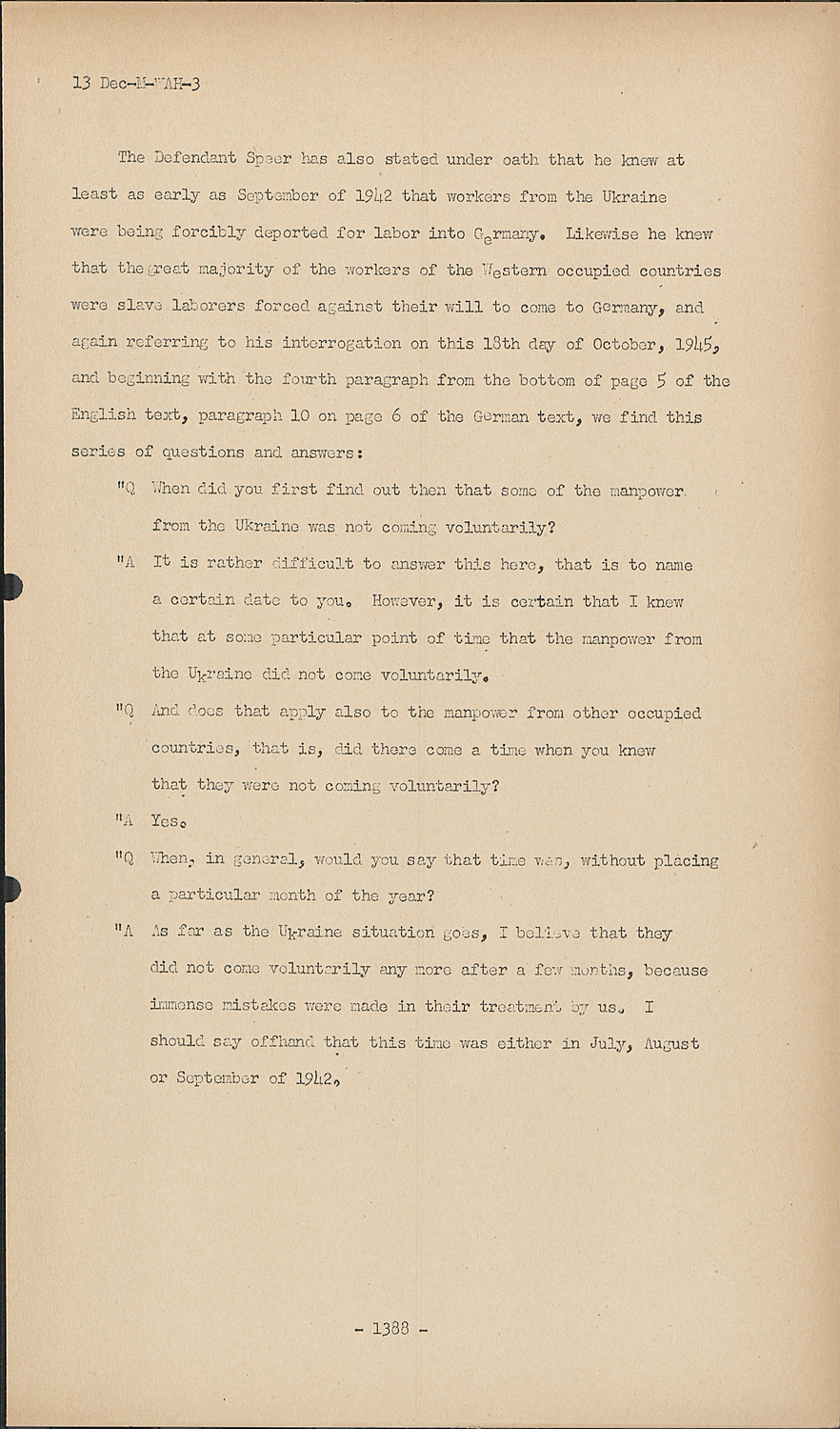
The Defendant Speer has also stated under oath that he knew at least as early as September of 1942 that workers from the Ukraine were being forcibly deported for labor into Germany.
Likewise he knew that the great majority of the workers of the Western occupied countries were slave laborers forced against their will to come to Germany, and again referring to his interrogation on this 18th day of October, 1945, and beginning with the fourth paragraph from the bottom of page 5 of the English text, paragraph 10 on page 6 of the German text, we find this series of questions and answers:
"Q When did you first find out then that some of the manpower from the Ukraine was not coming voluntarily?
"A It is rather difficult to answer this here, that is to name a certain date to you.
However, it is certain that I knew that at some particular point of time that the manpower from the Ukraine did not come voluntarily.
"Q And does that apply also to the manpower from other occupied countries, that is, did there come a time when you knew that they were not coming voluntarily?
"A Yes.
"Q When, in general, would you say that time was, without placing a particular month of the year?
"A As far as the Ukraine situation goes, I believe that they did not come voluntarily any more after a few months, because immense mistakes were made in their treatment by us.
I should say offhand that this time was either in July, August or September of 1942.
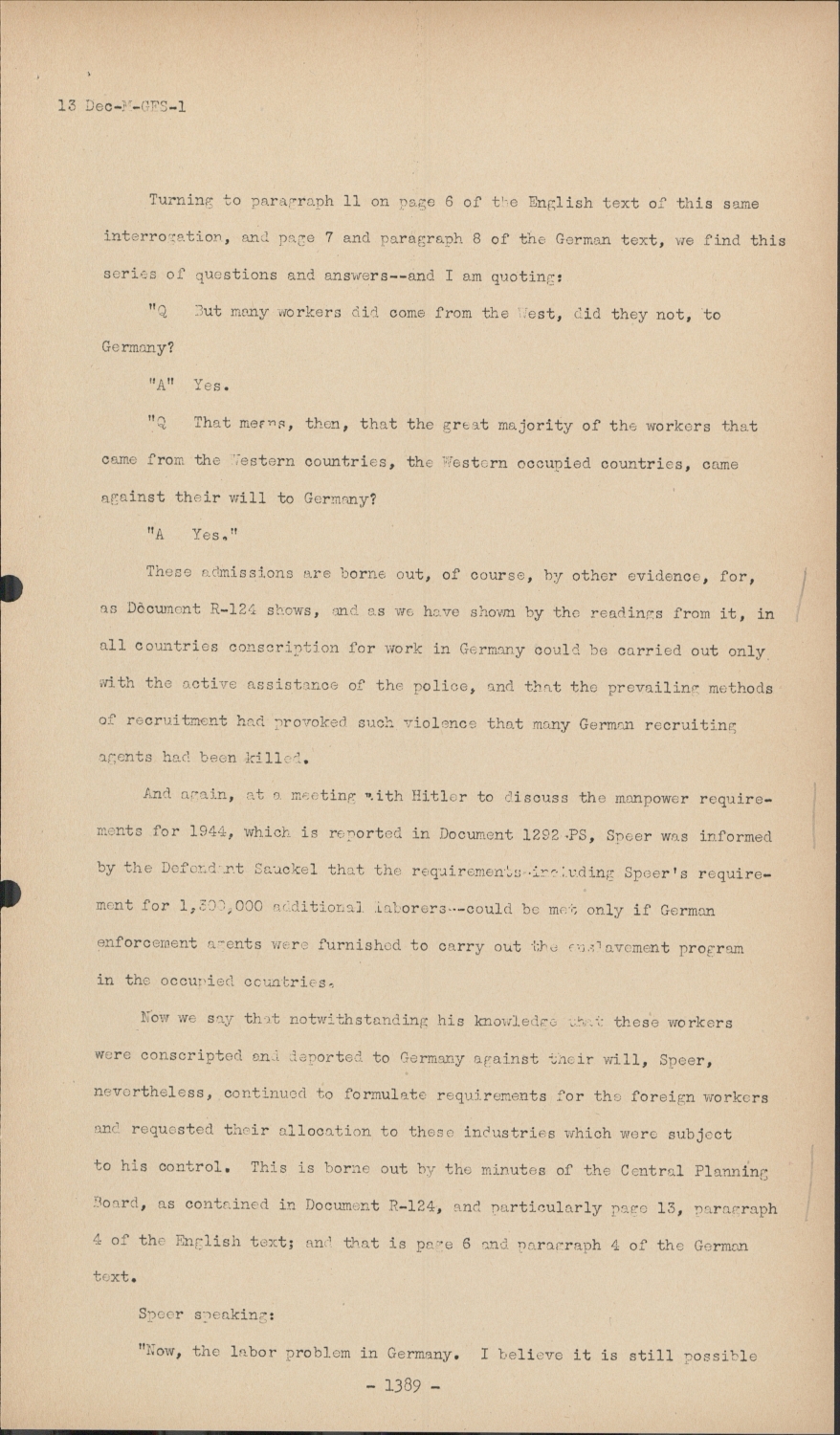
Turning to paragraph 11 on page 6 of the English text of this same interrogation, and page 7 and paragraph 8 of the German text, we find this series of questions and answers--and I am quoting:
"Q But many workers did come from the West, did they not, to Germany?
"A Yes.
"Q That means, then, that the great majority of the workers that came from the Western countries, the Western occupied countries, came against their will to Germany?
"A Yes."
These admissions are borne out, of course, by other evidence, for, as Document R-124 shows, and as we have shown by the readings from it, in all countries conscription for work in Germany could be carried out only with the active assistance of the police, and that the prevailing methods of recruitment had provoked such violence that many German recruiting agents had been killed.
And again, at a meeting with Hitler to discuss the manpower requirements for 1944, which is reported in Document 1292-PS, Speer was informed by the Defendant Sauckel that the requirements-including Speer's requirement for 1,300,000 additional Laborers--could be met only if German enforcement agents were furnished to carry out the enslavement program in the occupied countries.
Now we say that notwithstanding his knowledge that these workers were conscripted and deported to Germany against their will, Speer, nevertheless, continued to formulate requirements for the foreign workers and requested their allocation to these industries which were subject to his control. This is borne out by the minutes of the Central Planning board, as contained in Document R-124, and particularly page 13, paragraph 4 of the English text; and that is page 6 and paragraph 4 of the German text.
Speer speaking:
"Now, the labor problem in Germany. I believe it is still possible to transfer some from the western territories.
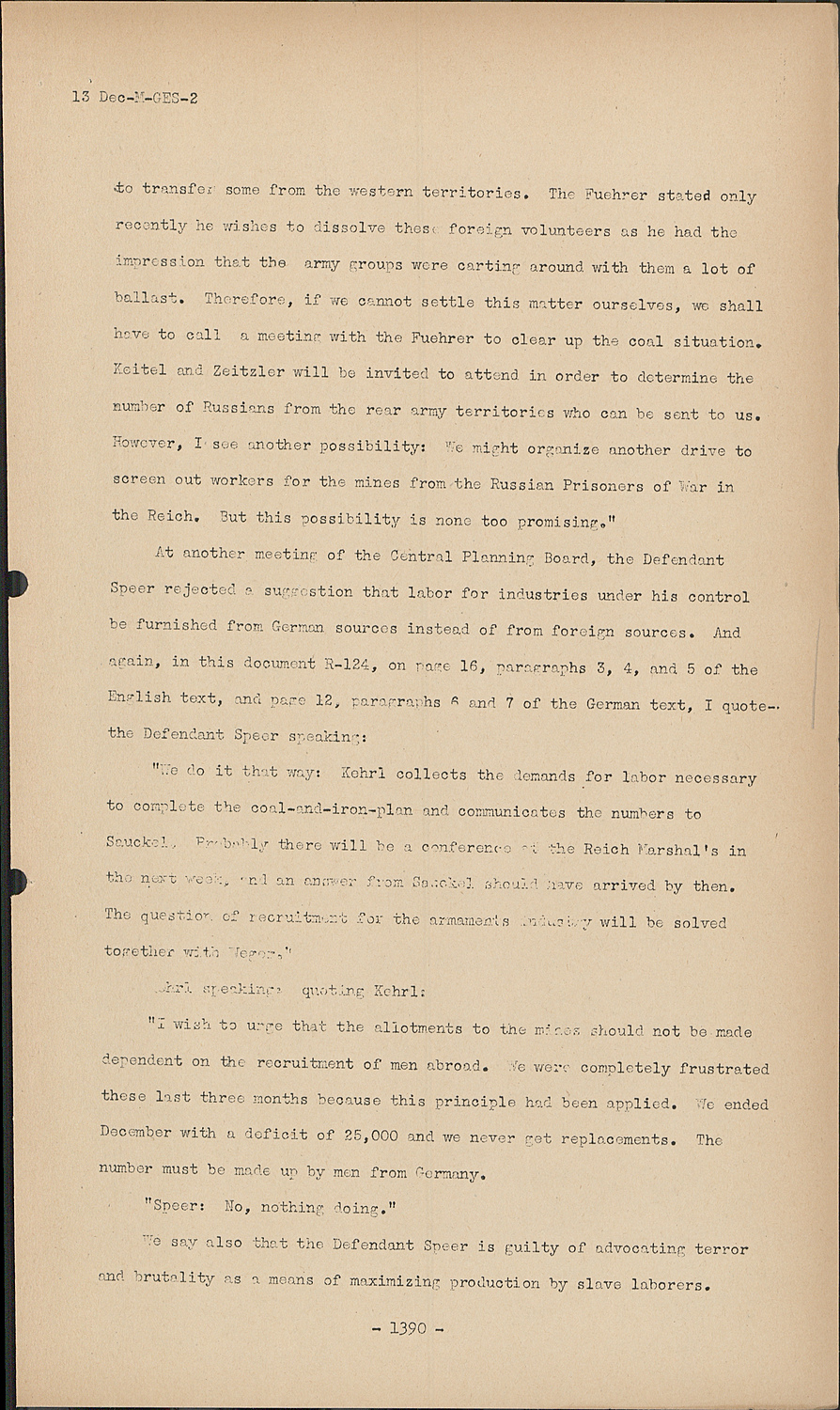
The Fuehrer stated only recently he wishes to dissolve these foreign volunteers as he had the impression that the army groups were carting around with them a lot of ballast.
Therefore, if we cannot settle this matter ourselves, we shall have to call a meeting with the Fuehrer to clear up the coal situation.
Keitel and Zeitzler will be invited to attend in order to determine the number of Russians from the rear army territories who can be sent to us.
However, I see another possibility: We might organize another drive to screen out workers for the mines from the Russian Prisoners of War in the Reich.
But this possibility is none too promising."
At another meeting of the Central Planning Board, the Defendant Speer rejected a suggestion that labor for industries under his control be furnished from German sources instead of from foreign sources.
And again, in this document R-124, on page 16, paragraphs 3, 4, and 5 of the English text, and page 12, paragraphs 6 and 7 of the German text, I quote the Defendant Speer speaking:
"We do it that way: Kehrl collects the demands for labor necessary to complete the coal-and-iron-plan and communicates the numbers to Sauckel.
Probably there will be a conference of the Reich Marshal's in the next week, and an answer from Sauckel should have arrived by then.
The question of recruitment for the armaments industry will be solved together with Weger."
Kehrl speaking; quoting Kehrl:
"I wish to urge that the allotments to the mines should not be made dependent on the recruitment of men abroad.
He were completely frustrated these last three months because this principle had been applied.
We ended December with a deficit of 25,000 and we never get replacements.
The number must be made up by men from Germany.
"Speer: No, nothing doing."
We say also that the Defendant Speer is guilty of advocating terror and brutality as a means of maximizing production by slave laborers.
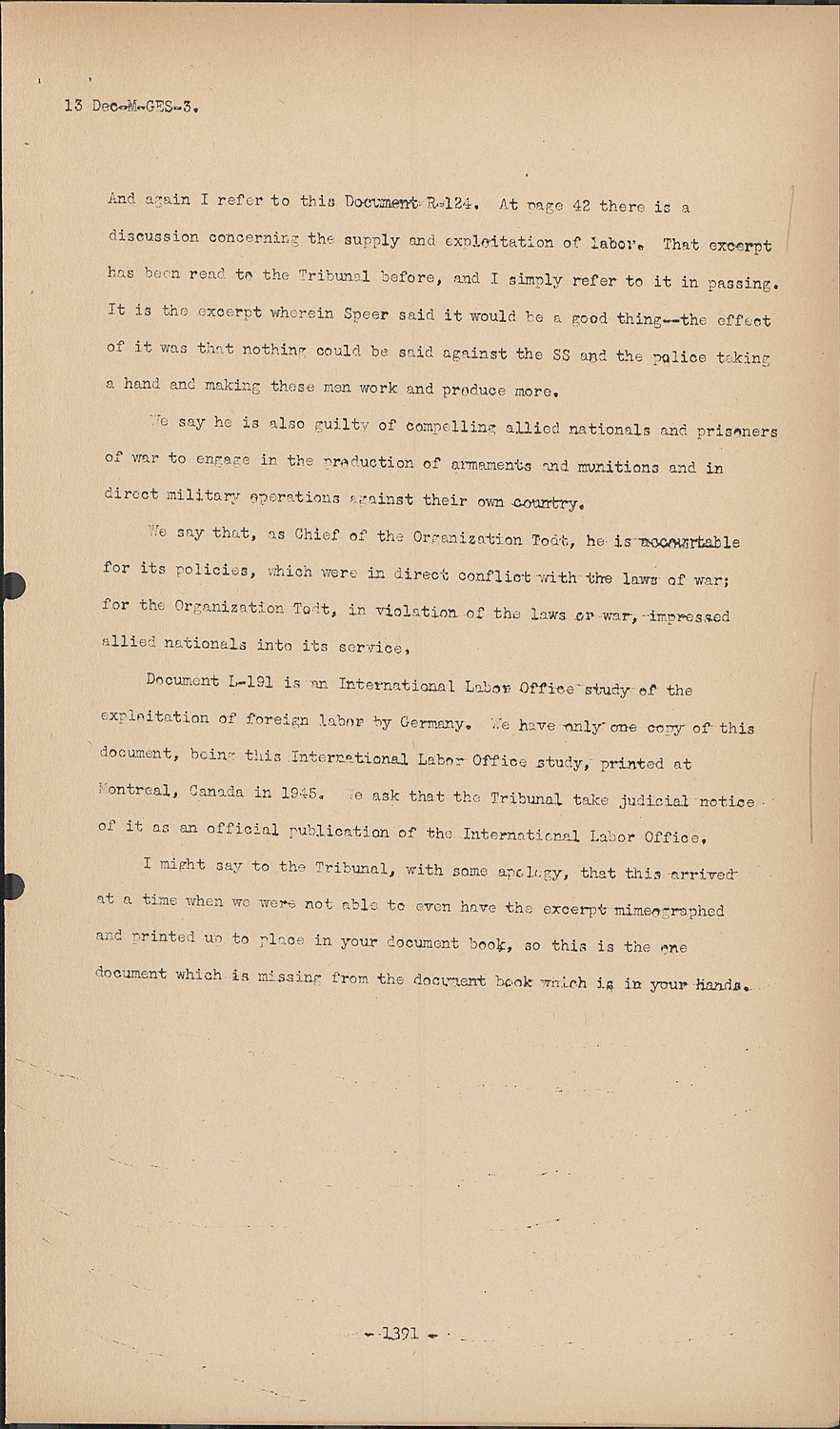
And again I refer to this Documeunt R-124. At page 42 there is a discussion concerning the supply and exploitation of labor.
That excerpt has been read to the Tribunal before, and I simply refer to it in passing.
It is the excerpt wherein Speer said it would be a good thing--the effect of it was that nothing could be said against the SS and the police taking a hand and making these men work and produce more.
We say he is also guilty of compelling allied nationals and prisoners of war to engage in the production of armaments and munitions and in direct military operations against their own country.
We say that, as Chief of the Organization Todt, he is accountable for its policies, which were in direct conflict with the laws of war;for the Organization Todt, in violation of the laws or war, impressed allied nationals into its service, Document L-191 is an International Labor Office study of the exploitation of foreign labor by Germany.
We have only one copy of this document, being this International Labor Office study, printed at Montreal, Canada in 1945.
We ask that the Tribunal take judicial notice of it as an official publication of the International Labor Office.
I might say to the Tribunal, with some apology, that this arrived at a time when we were not able to even have the excerpt mimeographed and printed up to place in your document book, so this is the one document which is missing from the document book which is in your hands.