The minutes of Speer's conference with Hitler on the 20th, 21st, and the 22nd days of September 1942, Document R 124, which is in evidence as U.S.A. Exhibit No. 179, and I wish to refer particularly to page 34 of the English text. These are defendant Speer's minutes on this conference. I'm quoting from page 34, paragraph 36, beginning at the middle of the page, and it's at the top of page 26 in the German text:
"I pointed out to the Fuehrer that, apart from an insignificant amount of work, no possibility exists of organizing armament production in the concentration camps, because: (1) the machine tools required are missing; (2) there are no suitable premises. Both these assets would be available in the armaments industry, if use could be made of them by a second shift.
"The Fuehrer agrees to my proposal, that the numerous factories set up outside towns for ARP reasons, should release their workers for supplementing the second shift in town factories and should in return be supplied with labor from the concentration camps - also two shifts.
"I pointed out to the Fuehrer the difficulties which I expect to encounter if Reichsfuehrer SS Himmler should be able, as he requests, to exercise authoritative influence over these factories. The Fuehrer, too, does not consider such an influence necessary.
"The Fuehrer, however, agrees that Reichsfuehrer SS Himmler should draw advantages from making his prisoners available; he should get equipment for his division.
"I suggest to give him a share in kind (war equipment) in radio to the working hours done by his prisoners. A three to five per cent share is discussed, the equipment also being calculated according to working hours. The Fuehrer would agree to such a solution.
"The Fuehrer is prepared to order the additional delivery of this equipment and weapons to the SS, according to a list submitted to him."
After a demand for concentration camp labor had been created, and after a mechanism had been set up by the defendant Speer for exploiting this labor in armament factories, measures were evolved for increasing the supply of victims for extermination through work.
A steady flow was assured by the agreement between Himmler and the Minister of Justice mentioned above, which was implemented by such programs as the following, and I refer to document L 61, marked U.S.A. Exhibit No. 177, and I wish to quote from paragraph 3. That document, the Tribunal will recall, is the defendant Sauckel's letter dated the 26th of November 1942 to the Presidents of the Landes Employment Offices, and I wish to quote paragraph 3 of that letter.
"The Poles who are to be evacuated as a result of this measure will be put into concentration camps and put to work where they are criminal or social elements."
General measures were supplemented by special drives for persons who would not otherwise have been sent to concentration camps.
THE PRESIDENT:Didn't you read that this morning?
MR. DODD:Yes, I did, Your Honor. I was reading it again with particular reference to this phase.
For example, for "reasons of war necessity" Himmler ordered that at least 35,000 prisoners qualified for work should be transferred immediately to concentration camps.
I now offer in evidence Document No. 1063 PS D, which is Exhibit U.S.A. No. 139.
This document is a Himmler order dated the 17th of December 1942. The order provides, and I quote in part, beginning with the first paragraph of that document:
"For reasons of war necessity not to be discussed further here, the Reichsfuehrer SS and Chief of the German Police on the 14th of December 1942 has ordered that until the end of January 1943, at least 35,000 prisoners qualified for work, are to be sent to the concentration camps. In order to reach this number, the following measures are required: (1) As of now (so far until 1 February 1943) all eastern workers or such foreign workers who have been fugitives, or who have broken contracts, and who do not belong to allied, friendly or neutral States a re to be brought by the quickest means to the nearest concentration camps.
(2) The commanders and the commandants of the security police and the security service, and the chiefs of the State Police Headquarters will check immediately on the basis of a close and strict ruling:
(a) the prisons (b) the labor reformatory camps.
"All prisoners qualified for work, if it is essentially and humanly possible, will be committed at once to the nearest concentration camp, according to the following instructions, for instance also if penal procedures were to be established in the near future. Only such prisoners who in the interest of investigation procedures are to remain absolutely in solitary confinement can be left there.
"Every single laborer counts!"
Measures were also adopted to insure that this extermination through work was practiced with maximum efficiency. Subsidiary concentration camps were established near important war plants. The defendant Speer has admitted that he personally toured Upper Austria and selected sites for concentration camps near various munitions factories in the area. I'm about to refer to the transcript of an interrogation under oath of the defendant Albert Speer.
THE PRESIDENT:Mr. Dodd, do you understand that the last document you read, 1063 PS D to refer to prisoners of war or prisoners in ordinary prisons or what?
MR. DODD:We understood it to refer to prisoners in ordinary prisons. In view of the Tribunal's ruling this morning, I think I should state that, with respect to this interrogation of defendant Speer, we had provided the defendants' counselors with the entire text in German. It happens to be a brief interrogation, and so we were able to complete that translation, and it has been in their information center.
DR.FLAECHSNER (for defendant Speer): In reference to the interrogation which the prosecutor just mentioned I would like to say the following:
It is true that we have received the German transcript of the English protocol, if this could be called a protocol. In comparison of the English text with the German transcript it is seen that during the transcript of the English text as well as the German translation, the comparison with the English text with the German text, that in the English text as well as in the German transcript there are several mistakes which I believe are attributed to an error of the interrogator. I believe, therefore, that the so-called protocol, also the English text, does not actually give the contents of what the defendant Speer actually said curing the interrogation or what he wanted to say at that time. It would not serve the establishment of the truth if this protocol would ever be used.
THE PRESIDENT:Mr. Dodd, when was the German translation given to counsel for the defendant?
MR. DODD:About four days ago, your Honor.
THE PRESIDENT:Mr. Dodd, is there any certification by the Interrogator as to the English translation?
MR. DODD:There is, your Honor. There is a certification at the end of the interrogation by the Interrogator and by the Interpreter, and by the Reporter as well.
There are three certifications.
THE PRESIDENT:I think the best course would be in those circumstances to receive the interrogation now. You will have an opportunity, by calling the defendant, to show in what way he alleges, or you allege, that the interrogation is inaccurately translated.
DR. FLAECHSNER:Thank you, sir.
MR. DODD:May I respectfully refer your Honors to the last document in the Document Book, four pages from the end?
THE PRESIDENT:Which page do you refer to?
MR. DODD:I refer to the page bearing the number 16 of the English text of the transcript of the interrogation and page 21 of the German text. The answer quoted is:
"The fact that we were anxious to use workers from concentration camps in factories and to establish small concentration camps near the factories in order to use the manpower that was available there was a general fact.
But it did not only come up in connection with this trip."
THE PRESIDENT:I think I ought to say to Defendant's Counsel that if he had waited until he heard that piece of evidence read, he would have seen it was quite unnecessary to make any objection.
MR. DODD:Defendant Goering endorsed this use of concentration camp labor and asked for more.
We refer to our document 1584-PS, Part 1, which is U.S.A. Exhibit No. 221.
This document is a teletype from Goering to Himmler dated 14th February, 1944.
I quote from the document beginning with the second sentence:
"At the same time I ask you to put at my disposal as great a number of concentration camp (KZ-) convicts as possible for air armament, as this kind of manpower proved to be very useful according to previous experience.
The situation of the air war makes subterranean transfer of industry necessary.
For work of this kind concen tration camp (KZ-) convicts can be especially well concentrated at work and in the camp."
Defendant Speer subsequently assumed responsibility for this program, and Hitler promised Speer that if the necessary labor for the program could not be obtained, a hundred thousand Hungarian Jews would be brought in by the SS.
Speer recorded his conferences with Hitler on April 6th and April 7th, 1944, in document R 124, which is U.S.A. Exhibit No. 179, already in evidence.
I quote from page 36 of the English text, page 29 of the German text as follows.
"Suggested to the Fuehrer that, due to lack of builders and equipment, the second big building project should not be set up in German territory, but in close vicinity to the border on suitable soil (preferable on gravel base and with transport facilities) on French, Belgian or Dutch territory.
The Fuehrer agrees to this suggestion if the works could be set up behind a fortified zone.
French territory speaks mainly the fact that it would be much easier to procure the necessary workers.
Nevertheless, the Fuehrer asks an attempt be made to set up the second works in a safer area, namely in the Protectorate.
If it should prove impossible there, too, to get hold of the necessary workers, the Fuehrer himself will contact the Reichsfuehrer "SS" and will give an order that the required 100,000 men are to be made available by bring ing in Jews from Hungary.
Stressing the fact that the building organization was a failure, the Fuehrer demands that these works must be built by the O.T. exclusively and that the workers should be made available by the Reichs fuehrer "SS". He wants to hold a meeting shortly in order to discuss details with all the men concerned."
The unspeakably brutal, inhumane, and degrading treatment inflicted on Allied nationals and other victims of concentration camps while they were being literally worked to death is described in document L 159, which is not in the document book.
The document is an official report prepared by a U.S. Congressional Committee, U.S. Senate Document No. 47, which inspected the liberated camps at the request of General Eisenhower.
It bears U.S.A. Exhibit No. 222.
I quote first from page 14 the last paragraph and from the first two paragraphs on page 15 of the English text, "The treatment accorded to these prisoners in the concentration camps was generally as follows:
They were herded together in some wooden barracks not large enough for one-tenth of their number. They were forced to sleep on wooden frames covered with wooden boards in tiers of two, three and even four, sometimes with no covering, sometimes with a bundle of dirty rags serving both as pallet and coverlet.
"Their food consisted generally of about one-half of a pound of black bread per day and a bowl of watery soup for noon and night, and not always that. Owing to the great numbers crowded into a small space and to the lack of adequate sustenance, lice and vermin multiplied, disease became rampant, and those who did not soon die of disease or tortue began the long, slow process of starvation. Notwithstanding the deliberate starvation program inflicted upon these prisoners by lack of adequate food, we found no evidence that the people of Germany as a whole were suffering from any lack of sufficient food or clothing. The contrast was so striking that the only conclusion which we could reach was that the starvation of the inmates of these camps was deliberate.
"Upon entrance into these camps, newcomers were forced to work either at an adjoining war factory or were placed 'in commando' on various jobs in the vicinity, being returned each night to their stall in the barracks. Generally a German criminal was placed in charge of each 'block' or shed in which the prisoners slept. Periodically he would choose the one prisoner of his block who seemed the most alert or intelligent or showed the most leadership qualities. These would report to the guards' room and would never be heard from again. The generally accepted belief of the prisoners was that these were shot or gassed or hanged and then cremated. A refusal to work or an infraction of the rules usually meant flogging and other types of torture, such as having the fingernails pulled out, and in each case usually ended in death after extensive suffering. The policies described constituted a calculated program of planned torture and extermination on the part of those who were in control of the German Government..."
I quote next from page 11 of the English text beginning with the second sentence of paragraph 2, a description of Camp Doro at Nordhausen, page 12, paragraph 1 of the German text as follows:
"On the whole, we found this camp to have been operated and administered much in the same manner as Buchenwald had been operated and managed. When the efficiency of the workers decreased as a result of the conditions under which they were required to live, their rations were decreased as punishment. This brought about a vicious circle in which the weak became weaker and were ultimately exterminated."
Such was the cycle of work, torture, starvation and death for concentration camp labor - labor which Defendant Goering while requesting that more of it be placed at his disposal said had proved very useful; labor which Defendant Speer was "naxious" to use in the factories under his control.
The policy underlying this program, the manner in which it was executed, and the responsibility of the conspirators in connection with it has been dwelt upon at length. Therefore, at this point we should like to discuss the special responsibility of the Defendant Sauckel.
The Defendant Sauckel's appointment as Plenipotentiary General for Manpower is explained probably first of all by his having been an old and trusted Nazi. He has certified in Document 2974-PS, dated 17 November 1945, which is already in evidence before this Tribunal as U.S.A. Exhibit Number 15, that he held the following positions:
Starting; with his membership in the NSDAP, he was thereafter a member of the Reichstag. He was Gauleiter of Thuringia. He was a member of the Thuringian legislature. He was Minister of Interior and head of Thuringian State Ministry. He was Reichsstatthalter for Thuringia. He was an SA Obergruppenfuehrer, SS Obergruppenfuehrer. He was administrator for the Berlin-Suhler Waffen and Fahrzeugwerke in 1935. He was head of the Gustloff Werke Nationalsozialistische Industrie-Stiftung, 1936, and the Honorary Head of the foundation. And from the 21st day of March 1942 until 1945 he was the General Plenipotentiary for Labor Allocation.
Sauckel's official responsibilities are borne out by evidence. His appointment as Plenipotentiary General for Manpower was effected by a decree of the 21st of March, 1945, which we have read and which was signed by Hitler, Lammers, and the Defendant Keitel.
And by that decree Sauckel was given authority as well as responsibility subordinate only to that of Hitler and Goering, who was the head of the Four Year Plan, but subordinate only to those two for all matters relating to recruitment, allocation, and handling of foreign and domestic manpower.
The Defendant Goering, to whom Sauckel was directly responsible, abolished the recruitment and allocation agencies of his Four Year Plan and delegated their powers to the Defendant Sauckel, and placed his farreaching authority as deputy for the Four Year Plan at Sauckel's disposal.
In Document 1666-PS, a second 1666-PS, but of another date, the 27th of March, 1942, I ask the Tribunal to take judicial notice of this original decree which, is published in the 1942 Reichsgesetzblatt, Part I, at Page 180:
"In pursuance of the Fuehrer's Decree of 21 March 1942, I decree as fallows:
"1. My manpower-sections are hereby abolished (circular letter of 22 October 1936). Their duties (recruitment and allocation of manpower, regulations for labor conditions) are taken over by the Plenipotentiary General for Arbeitseinsatz, who is directly under me.
"2. The Plenipotentiary General for Arbeitseinsatz will be responsible for regulating the conditions of labor (wage policy) employed in the Reich.
Territory, having regard to the requirements of Arbeitseinsatz.
"3. The Plenipotentiary General for Arbeitseinsatz is part of the Four Year Plan.
In cases where new legislation is required, or existing laws required to be modified, he will submit appropriate proposals to me.
"4. The Plenipotentiary General for Arbeitseinsatz will have at his disposal for the performance of his task the righ delegated to me by the Fuehrer for issuing instructions to the higher Reich authorities, their branches and the Party offices, and their associated organisms and also the Reich Protector, the General-Governor, the Commander-in-Chief, and heads of the civil administrations.
In the case of ordinances and instructions of fundamental importance a report is to be submitted to me in advance."
Document Number 1903-PS is a Hitler Decree of the 30th of September 1942, giving the Defendant Sauckel extraordinary powers over the civil and military authority of the territories occupied by Germany.
We ask that judicial notice he taken by this Tribunal of the original decree, which is published in Volume II, Page 510, of the Verfuegungen/Anordnungen Bekanntgaben, published by the Party Chancellory.
This decree states as follows:
"I herewith authorize the Deputy General for the Arbeitseinsatz, Reich-governor and district-leader (Gauleiter) Fritz Sauckel to take all necessary measures for the enforcement of my decree referring to a Deputy General for the Arbeitseinsatz of 21 March 1942 (Reichsgesetzblatt I, page 179) according to his own judgment in the Greater German Reich, in the Protectorate, and in the Government General as well as in the occupied territories, measures which will safeguard under all circumstances the regulated deployment of labor for the German war economy.
For this purpose he may appoint commissioners to the bureaus of the military and civilian administration.
These are subordinated directly to Deputy General for the Arbeitseinsatz.
In order to carry their tasks, they are entitled to issue directives to the competent military and civilian authorities in charge of the Arbeitseinsatz and of wage policy.
"More detailed directives will be issued by the Deputy General for the Arbeitseinsatz.
"Fuehrer-Headquarters, 30 September 1942. The Fuehrer, signed Adolph Hitler."
Within one month after his appointment, the Defendant Sauckel sent Defendant Rosenberg his "Labor Mobilization Program."
This pro gram, Document 016-PS, is already in evidence as USA Exhibit 168, and it envisaged the recruitment by force and the exploitation of the entire labor resources of the conquered areas and of prisoners of war in the interests of the Nazi war machine at the lowest conceivable degree of expenditure to the German State.
The Defendant Sauckel states--and I refer now to the bottom of Page VI of the English text of that document.
It is Page 9, Paragraph 2, of the German text, and I quote as follows:
"It must be emphasized, however, that an additional tremendous number of foreign labor has to be found for the Reich.
The greatest pool for that purpose are the occupied territories of the East.
Con sequently, it is an immediate necessity to use the human reserves of the conquered Soviet Territory to the fullest extent.
Should we not succeed in obtaining the necessary amount of labor on a voluntary basis, we must immediately institute conscription or forced labor.
Apart from the prisoners of war still in the occupied territories, we must, therefore, requisition skilled or unskilled male and female labor from the Soviet Territory from the are of 15 up for the labor mobilization."
Passing to Page XI of the English text, first paragraph, and of Page 17, Paragraph 4 of the German text, I quote as follows directly:
"The complete employment of all prisoners of war as well as the use of a gigantic number of new foreign civilian workers, men and women, has become an undisputable necessity for the solution of the mobilization of labor program in this war."
The Defendant Sauckel proceeded to implement this plan, which he submitted with certain basic directives.
He provided that if voluntary recruitment of foreign workers was unsuccessful compulsory service should be instituted.
Document 3044-PS is the Defendant Sauckel's Regulation Number 4, dated the 7th of May, 1942.
We ask that the Tribunal take judicial notice of the original regulation published in Volume II, Pages 516 to 527 of the Verfuegungen/Anordnungen Bekanntgaben, to which I have pre viously referred.
Reading from Page 1, Paragraph 3, of theEnglish text:
"The recruitment of foreign labor will be done on the fundamental basis of volunteering.
Where, however, in the occupied territories the appeal for volunteers does not suffice, obligatory service and drafting must, under all circumstances, be resorted to.
This is an indisputable requirement of our labor situation."
Sauckel provided also for the allocation of foreign labor in the order of its importance to the Nazi war machine. We refer to Document 3044- (A)-PS, which is the Defendant Sauckel's Regulation Number 10, and ask that the Court take judicial notice of the original regulation, published in Volume II, Verfuegungen/Anordnungen/Bekanntgaben, at Pages 531 to 533. Paragraph 3 of this regulation I quote as follows:
"The resources of manpower that are available in the occupied territories are to be employed primarily to satisfy the requirements of importance for the war in Germany itself. In allocating the said labor resources in the Occupied Territories, the following order of priority will be observed:
"(a) Labor required for the troops, the occupation authorities, and the civil authorities.
"(b) Labor required for the German armaments.
"(c) Labor required for food and agriculture.
"(d) Labor required for industrial work other than armaments.
"(e) Labor required for industrial work in the interests of the population of the territory in question.
The Defendant Sauckel, and agencies subordinate to him, exercised exclusive authority over the recruitment of workers from every area in Europe occupied by, controlled by, or friendly to the German nation. He affirmed, himself-- the Defendant Sauckel did-- this authority in a decree, Document No. 3044-PS, already in evidence as United States Exhibit No. 206. I refer to paragraph 5 on page 1 of the English text of that document, and I am quoting it directly:
"The recruitment of foreign labor in the areas occupied by Germany, in allied, friendly or neutral states will be carried out exclusively by my commissioners, or by the competent German military or civil agencies for the tasks of labor mobilization."
THE PRESIDENT:Haven't you read that already?
MR. DODD:No, I have not, if Your Honor please. We have referred to that decree before, but we have not referred to this portion of it.
I am passing to Paragraph II, 1-a on page 2, and quoting, again, directly:
"For the carrying out of recruitment in allied, friendly, or neutral foreign countries, my commissioners are solely responsible."
In addition, the following defendants, who were informed by Sauckel of the quotas of foreign laborers which he required, collaborated with Sauckel and his agents in filling these quotas:
The Defendant Keitel, Chief of the OKW--which was the Supreme Command-who collaborated with Sauckel.
We refer now to Document No. 3012-PS-1, which is USA Exhibit No. 190. This document is the record of a telephone conversation of the Chief of the Economic Staff East of the German Army, and it is dated March 11, 1943. I wish to quote from the first two paragraphs of the document as follows:
"The plenipotentiary for the Arbeitseinsatz, Gauleiter Sauckel, points out to me, in an urgent teletype, that the Arbeitseinsatz in German agriculture, as well as all the most urgent armament programs, ordered by the Fuehrer, make the most rapid procurement of approximately one million women and men from the newly occupied territories an imperative necessity. For this purpose, Gauleiter Sauckel demands the shipment of 5,000 workers daily beginning 15 March; 10,000 workers male and female beginning 1 April from the newly occupied territories."
I am passing down to the next paragraph:
"In consideration of the extraordinary losses of workers, which occurred in German war industry because of the developments of the past months, it is now necessary that the recruiting of workers be taken up again everywhere with all emphasis.
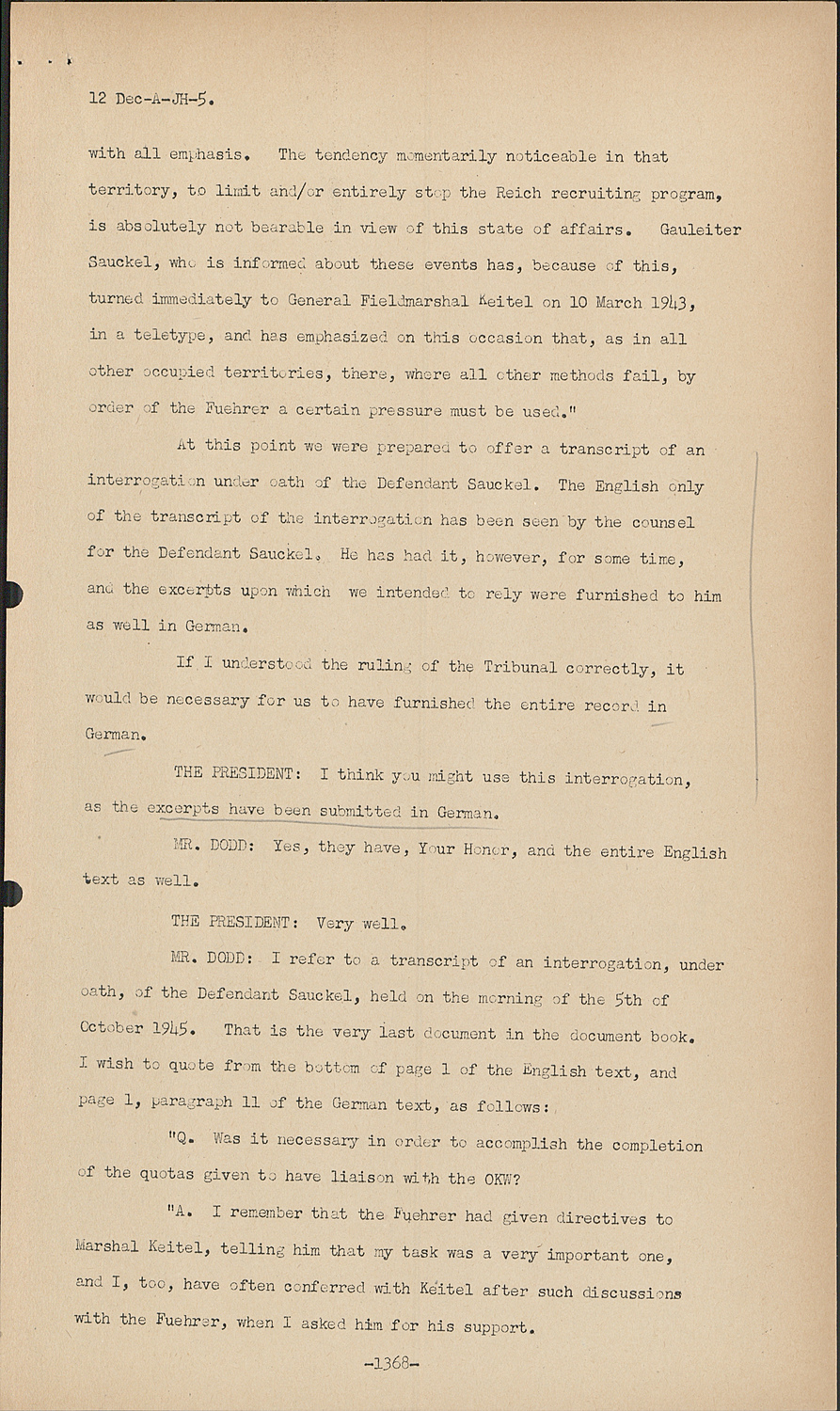
The tendency momentarily noticeable in that territory, to limit and/or entirely stop the Reich recruiting program, is absolutely not bearable in view of this state of affairs.
Gauleiter Sauckel, who is informed about these events has, because of this, turned immediately to General Fieldmarshal Keitel on 10 March 1943, in a teletype, and has emphasized on this occasion that, as in all other occupied territories, there, where all other methods fail, by order of the Fuehrer a certain pressure must be used."
At this point we were prepared to offer a transcript of an interrogation under oath of the Defendant Sauckel. The English only of the transcript of the interrogation has been seen by the counsel for the Defendant Sauckel. He has had it, however, for some time, and the excerpts upon which we intended to rely were furnished to him as well in German.
If I understood the ruling of the Tribunal correctly, it Would be necessary for us to have furnished the entire record in German.
THE PRESIDENT:I think you might use this interrogation, as the excerpts have been submitted in German.
MR. DODD:Yes, they have, Your Honor, and the entire English text as well.
THE PRESIDENT:Very well.
MR. DODD:I refer to a transcript of an interrogation, under oath, of the Defendant Sauckel, held on the morning of the 5th of October 1945. That is the very last document in the document book. I wish to quote from the bottom of page 1 of the English text, and page 1, paragraph 11 of the German text, as follows:
"Q. Was it necessary in order to accomplish the completion of the quotas given to have liaison with the OKW?
"A. I remember that the Fuehrer had given directives to Marshal Keitel, telling him that my task was a very important one, and I, too, have often conferred with Keitel after such discussions with the Fuehrer, when I asked him for his support.
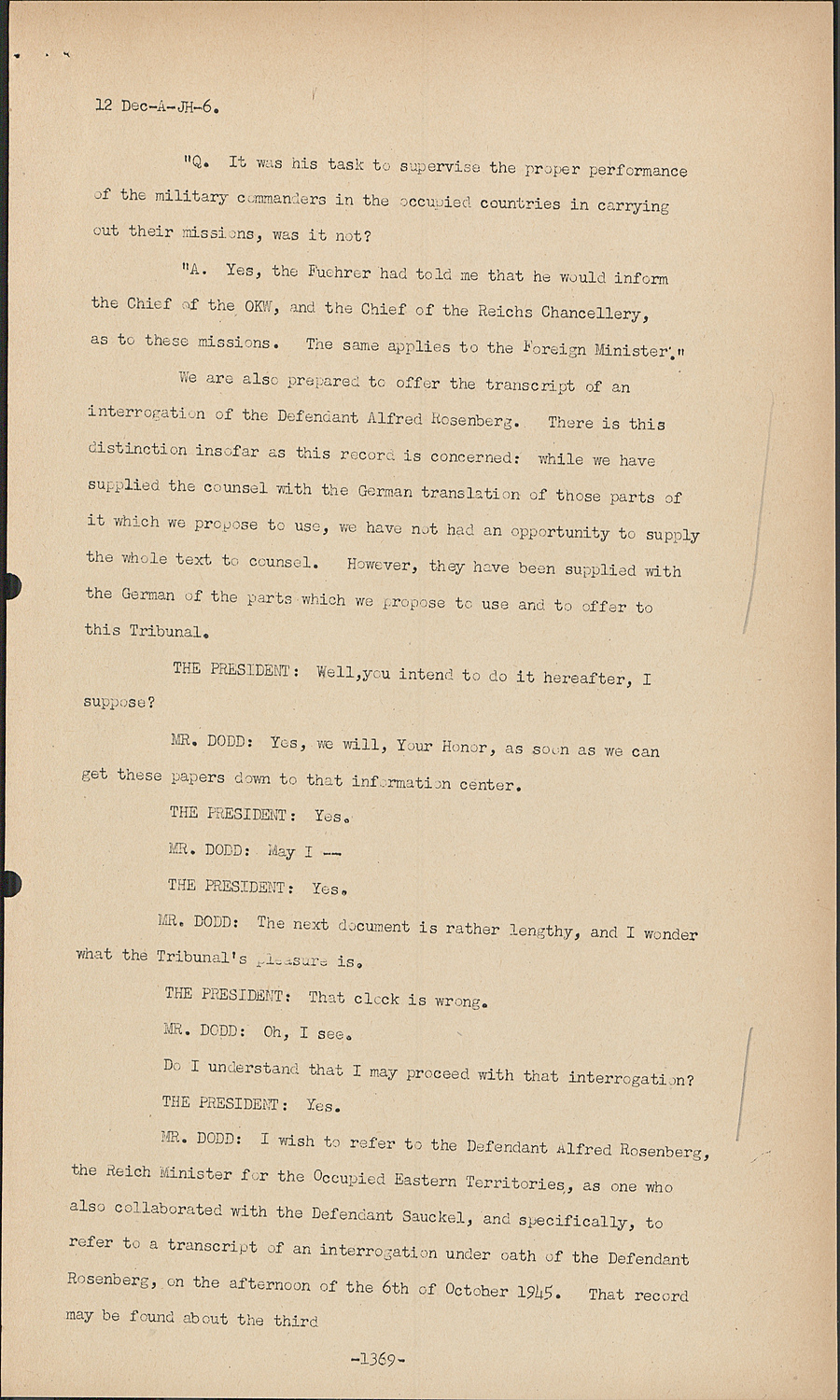
"Q. It was his task to supervise the proper performance of the military commanders in the occupied countries in carrying out their missions, was it not?
"A. Yes, the Fuehrer had told me that he would inform the Chief of the OKW, and the Chief of the Reichs Chancellery, as to these missions. The same applies to the Foreign Minister."
we are also prepared to offer the transcript of an interrogation of the Defendant Alfred Rosenberg. There is this distinction insofar as this record is concerned: while we have supplied the counsel with the German translation of those parts of it which we propose to use, we have not had an opportunity to supply the whole text to counsel. However, they have been supplied with the German of the parts which we propose to use and to offer to this Tribunal.
THE PRESIDENT:Well, you intend to do it hereafter, I suppose?
MR. DODD:Yes, we will, Your Honor, as soon as we can get these papers down to that information center.
THE PRESIDENT:Yes.
MR. DODD:May I -
THE PRESIDENT:Yes.
MR. DODD:The next document is rather lengthy, and I wonder what the Tribunal's pleasure is.
THE PRESIDENT:That clock is wrong.
MR. DODD:Oh, I see.
Do I Understand that I may proceed with that interrogation?
THE PRESIDENT:Yes.
MR. DODD:I wish to refer to the Defendant Alfred Rosenberg, the Reich Minister for the Occupied Eastern Territories, as one who also collaborated with the Defendant Sauckel, and specifically, to refer to a transcript of an interrogation under oath of the Defendant Rosenberg, on the afternoon of the 6th of October 1945. That record may be found about the third from the last of the interrogation records in the document book, and I wish to read from page 1 of the transcript:
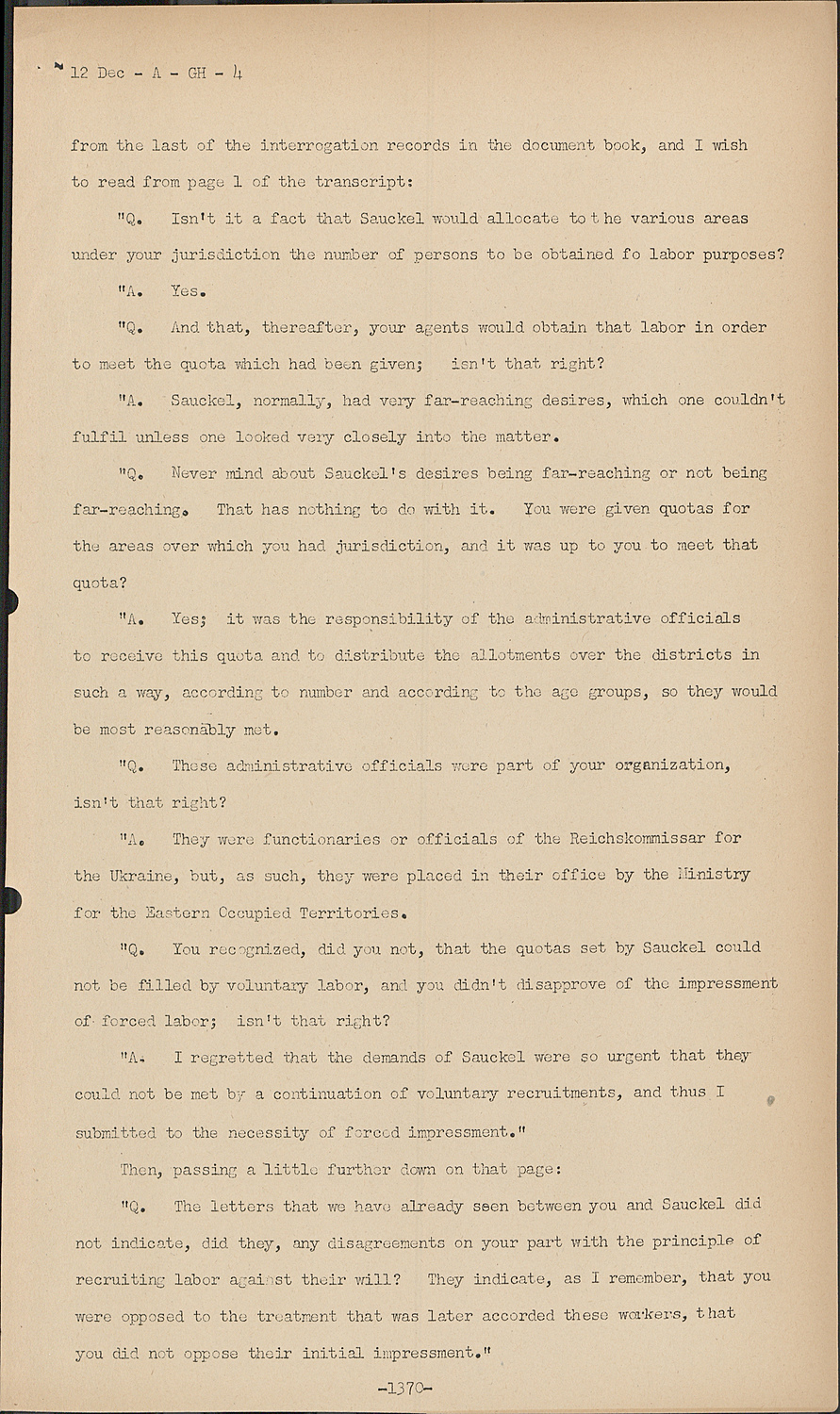
"Q. Isn't it a fact that Sauckel would allocate to the various areas under your jurisdiction the number of persons to be obtained fo labor purposes?
"A. Yes.
"Q. And that, thereafter, your agents would obtain that labor in order to meet the quota which had been given; isn't that right?
"A. Sauckel, normally, had very far-reaching desires, which one couldn't fulfil unless one looked very closely into the matter.
"Q. Never mind about Sauckel's desires being far-reaching or not being far-reaching. That has nothing to do with it. You were given quotas for the areas over which you had jurisdiction, and it was up to you to meet that quota?
"A. Yes; it was the responsibility of the administrative officials to receive this quota and to distribute the allotments over the districts in such a way, according to number and according to the age groups, so they would be most reasonably met.
"Q. These administrative officials were part of your organization, isn't that right?
"A. They were functionaries or officials of the Reichskommissar for the Ukraine, but, as such, they were placed in their office by the Ministry for the Eastern Occupied. Territories.
"Q. You recognized, did you not, that the quotas set by Sauckel could not be filled by voluntary labor, and you didn't disapprove of the impressment of forced labors isn't that right?
"A. I regretted that the demands of Sauckel were so urgent that they could not be met by a continuation of voluntary recruitments, and thus I submitted to the necessity of forced impressment."
Then, passing a little further down on that page:
"Q. The letters that we have already seen between you and Sauckel did not indicate, did they, any disagreements on your part with the principle of recruiting labor against their will? They indicate, as I remember, that you were opposed to the treatment that was later accorded these workers, that you did not oppose their initial impressment."
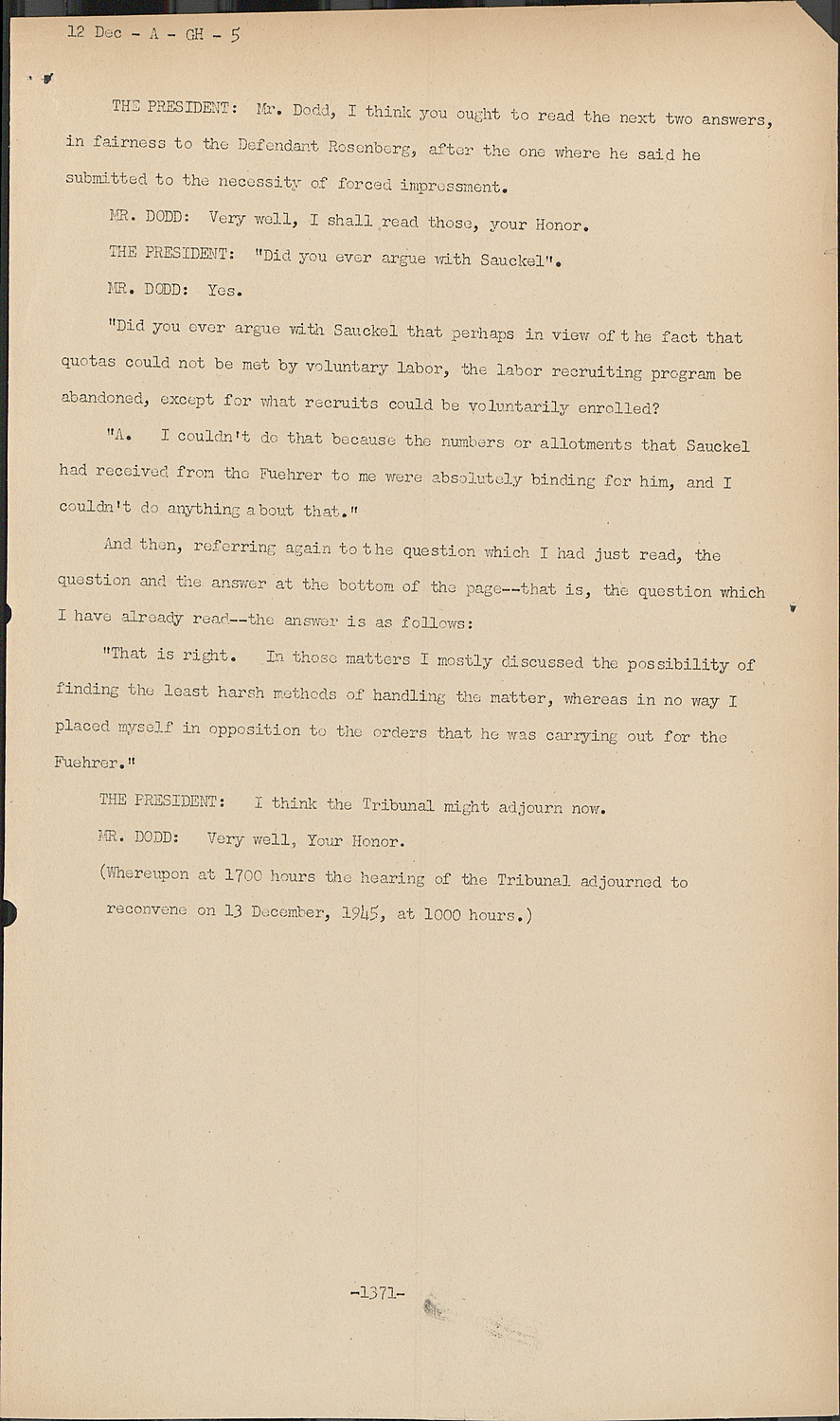
THE PRESIDENT: Mr. Dodd, I think you ought to read the next two answers, in fairness to the Defendant Rosenberg, after the one where he said he submitted to the necessity of forced impressment.
MR. DODD:Very well, I shall read those, your Honor.
THEPRESIDENT: "Did you ever argue with Sauckel".
MR. DODD:Yes.
"Did you ever argue with Sauckel that perhaps in view of t he fact that quotas could not be met by voluntary labor, the labor recruiting program be abandoned, except for what recruits could be voluntarily enrolled?
"A. I couldn't do that because the numbers or allotments that Sauckel had received from the Fuehrer to me were absolutely binding for him, and I couldn't do anything about that."
And then, referring again to the question which I had just read, the question and the answer at the bottom of the page--that is, the question which I have already read--the answer is as follows:
"That is right. In those matters I mostly discussed the possibility of finding the least harsh methods of handling the matter, whereas in no way I placed myself in opposition to the orders that he was carrying out for the Fuehrer."
THE PRESIDENT:I think the Tribunal might adjourn now.
MR. DODD:Very well, Your Honor.
(Whereupon at 1700 hours the hearing of the Tribunal adjourned to reconvene on 13 December, 1945, at 1000 hours.)