Beyond this the prosecution holds all defendants responsible for ever, crime presented here.
The notion "conspiracy" is being used for motivating this common liability.
If the consequences were drawn from this extravagant accusation then each defense counsel would have to deal with all details presented by the prosecution. The obvious impossibility to use up so much time of the tribunal shows how questionable the basis of the accusation is.
Therefore I have to confine myself to examining the participation in the conspiracy from the viewpoint of the actual and legal position of the foreign minister in the third Reich.
Conspiracy in the sense of the Charter and of the Indictment means a sort or form of participation in a punishable act. This kind of offence was until now, unknown to German and continental legal thinking. It existed only in the Anglosaxon law. In this legal sphere conspiracy means participation in a punishable act which requires, as a minimum symptom, an agreement to commit a crime.
A further pre-requisite is that the mutual plan causes the perpetration of a definite punishable offence.
The Charter proceeds from this form of participation in a crime in declaring punishable all offences stated in Paragraph 6, assuming the existence of a conspiracy or a common plan, as a special form of participation in these crimes. The Charter then stipulates, in Paragraph 6a, another special form of conspiracy declaring punishable the participation in a common plan of conspiracy to carry out offensive wars or wars violating international treaties.
Under the conception "mutual plan" ythe Charter and the Indictment obviously understand something that reaches beyond the sphere of conspiracy. Mr. Justice Jackson himself admitted that the application of the conspiracy as an offence, according to Anglosaxon law, was exceeded and a conception created which is not yet juridically determinable.
Both forms of conspiracy constitute a liability for a l l acts committed by a n y o n e person carrying out both these forms of conspiracy.
The indictment uses conspiracy as a pattern in order to make the participants in this alleged conspiracy appear as a whole.
The conspirators are all on board of a pirate ship which, contrary to law and justice of all nations, engages in robbery and therefore is outlawed anyone who punishes the crew helps to restore justice.
At first glance this picture appears to be attractive. However, on closer inspection, it becomes obvious that it is only a matter of a catchwor which tries to apply the community of the ship's crew, united with the ship for better or worse, to the place of the -- by no means a comparison more complicated conditions of a modern state organization. The ships of all nations are according to established, commonly recognized and uncontested conceptions, authorized to combat piracy on the high seas upon encountering a pirate. The criminal jurisdiction of almost all nations knows explicit regulations for combatting them. The peculiarity of this offence in distinction from o t h e r acts punishable in every country, whether committed again own or foreign nationals -for example white slavery traffic acts, acts of forging coins, and so forth- is the circumstance that the jurisdiction is carried out on the high seas. Therefore, the mistaken idea may arise that a crime in the sphere of international law is concerned. This however, is not the case. Piracy is a common offence, the prosecution of which is, by international law, permitted not only, in coastal waters but also on the high seas belonging to all nations. The basis for this conception was laid in the United States in the beginning of the last century by decisions rendered by Chief Justice Marshal.
The acts with which Herr von Ribbentrop is charged were committed at a time during which the German Reich and its opponents confronted one another first in peace and then in war, on the stage of international relations. An example taken from the sphere of international conception of a conspiracy of an entire state apparatus. Besides, the arrow hits the archer himself. In the first place, the idea of the statem which according to the conception of the traditional international law is the only carrier of rights and duties, is being destroyed so that the persons standing behind it and acting on its behalf nay separately be made liable to criminal prosecution.
As usually only few persons acted directly as participants in the acts charged, the multitude of these people is then again compressed into an artificial whole, in order to hold them responsible also for these acts which were not committed by them.
Here the criticism of the jurist had to set in. According to our perception of law and also to the perception of law of all civilized nations, the criminal responsibility is tied only to a few basic rules showing but few divergences. According to continental law only such persons can be held responsible for a punishable act who deliberately or negligently contribute to a definite act. By unanimous conception the perpetrator, therefore, is supposed to know the plan to which he allegedly contributed; to foresee and approve of the acts committed in executing it.
The participation in the form of conspiracy was until now known as an offense only to a limited legal circle. Therefore it is familiar only in a part of the legal systems of these nations who carry on or have joined in the present proceedings. It was completely unknown to the German Idea of Law and therefore to Herr von Ribbentrop at the time of his political activity. Conspiracy as a form of complicity marks a much wider range of actions as criminal than Herr von Ribbentrop could have anticipated at the time of his activities in the field of foreign policy.
But even if this form of complicity is assumed as a base for legal findings according to the charter, neither the official position as Reich Foreign minister, hold by Herr von Ribbentrop nor theindividual acts committed by him in this capacity made him liable of becoming a member of a conspiracy.
The case of von Ribbentrop, shows in particular, how, through the introduction of the concept of a conspiracy, responsibilities are getting interlocked, which have nothing whatever to do with each other, if we take into account the official position and authority as well as the personal attitude of the individual conspirators.
The prosecution , however, compresses, in order to achieve their aim, into an unity artifically, and subsequently created a number of actions and individuals , chosen at random, which do not form any natural amity and of which most of them had nothing to do with each other at all.
If we followed the charter and the indictment, there would appear as result the fact - wholly alien to any actual and legal thought - that Herr von Ribbentrop, while personally and actually, as thoroughly proven by evidence, completely eliminated from any influence on the occupied Eastern territories, would have to bear the responsibility for war crimes and crimes against humanity committed there, whereas, for instance, the defendant Streicher although he headedhis special department, would be answerable for the foreign policy.
If one confirms the existence of a conspiracy to commit war crimes and crimes against humanity would practically result in making Herr von Ribbentrop and the Foreign Office responsible for such crimes, whereas evidence has shown that this very office has always tried to observe the rules of warfare, according to international law, and to adhere to the Geneva Convention even if this involved a severe struggle with Hitler.
The conspiracy to commit war crimes and crimes against humanity can only refer to actual offenses against rules of war, either individual actions, as e.g. the execution of escaped British Air Force officers, or certain measures incompatible with the adopted rules of war. At any rate, the unity of conspirators ought to refer to a specific action or specific groups of action of the same nature. It is impossible to hold a defendant responsible for actions not approved by him, or which he has tried to prevent. I think the prosecution will agree, that there simply cannot, exist any conspiracy to commit crimes against the usages and customs of war. This concept is so controversial and is so undetermined inpractice of the states and in the theory of international law, that individual acts, which, in the course of a war, may be considered as war crimes could not form a part of the plans of the conspirators. It must also be considered that the development of means and methods of war modifies also the contents of the concept of war crimes. Therefore, there cannot be but a conspiracy to commit specific or war crimes or war crimes of the same kind. Therefore, any one of the so-called conspirators cannot be held responsible for each and every action which an objective judgment must define afterwards as a war crime. Particularly, it would not meet the purpose of the guilty, if the defendant would be punished, according to the general and artificial concept of conspiracy exclusively, even for such war crimes which they tried to prevent with all their efforts.
THE PRESIDENT:The Tribunal will recess now.
(A recess was taken).
DR. HORN:With permission of the Tribunal, I shallcontinue on Page 79 of my final plea.
This point of view applies particularly to Herr von Ribbentrop. Not only did the military conduct of war not belong to this sphere, but he was, as was proven by evidence, expressly excluded from it by a repeated order of Hitler.
His department had only insofar to do with war crimes as they led to negotiations with foreign powers.
Moreover, the fact, for instance, that after the terrible air raid bombardment of Dresden, the execution of 10,000 allied prisoners of war, was prevented on Herr von Ribbentrop's initiative with Hitler, proves that he has done, when informed of imminent war crimes, what was in his power to do and within his influence. These arguments and the result of evidence show how unjust it would be to share the point of view held by the prosecution, e.g. to hold a Foreign Minister with reduced authority responsible for crimes against usages of war and humanity, the more so, as it has been conclusively proven that he was excluded from any influence on the conduct of war.
With the court's permission, I shall now deal with the alleged conspiracy for planning and preparation of aggressive wars and of violation of treaties. Within the frame of such a conspiracy, the defendant is apparently to be held responsible in his capacity as Minister for Foreign Affairs and the office formerly held by him in the diplomatic service.
This kind of conspiracy appears to deal with any act or plan which have any connection with war, its preparation, outbreak and course. Any individual act within this enormous complex of concepts is irrelevant in itself from the point of view of criminal law, and has had, until now, never been conceived as a crime called "outbreak of war." This kind of conspiracy does not contain any facts which come under the crimes, so far known by any system of criminal law in the world.
Therefore, I cannot but investigate this complex from the point of view of von Ribbentrop's ministerial position and his relation to the German Reich which waged the various wars.
Herr von Ribbentrop, since the 4th of February 1938, held the position of a Minister of Foreign Affairs of the German Reich. As shown by the evidence, Herr von Ribbentrop was called to his office at a time when the actual leadership of foreign policy had already passed to Hitler in his double as capacity of Reich Chancellor and head of the state.
I have submitted/a document Hitler's speech of July 19th 1940, held atthe Kroll opera house, whore he emphasized that Herr von Ribbentrop had had to handle for years foreign policy according to Hitler's political directives. Herr von Ribbentrop, there fore, did not possess the position of a minister, as customary in modern constitutions.
As shown in above-mentioned speech, he did not possess it either in fact or in law. This is shown by an examination of the public law of the Third Reich.
According to constitutional law, as it has developed in modern states in the course of the 19th and in the beginning of the 20th century, the department of the Minister of Foreign Affairs belongs to the executive functions.
The Minister for Foreign Affairs has to share the responsibility of conducting foreign policy with the Prime Minister. This involves in a parliamentary democracy, responsibility to the representatives of the people; in a monarchical or presidential constitution to the head of the state. This responsibility is actually of political importance only, and infers the resigning of a minister from his office when he does not enjoy any longer the confidence of parliament or of the head of the state. Most constitutions make provisions for indicting a minister by the representatives of the people in case of violation of official duties. But even when convicted by a constitutional court in a kind of criminal procedure, the minister is not punished, but his actions are merely declared to have been illicit.
Both possibilities to call ministers to account were provided by the German constitution of the Weimar republic. By the way, the possibility of indicting a minister has never been made use of.
Constitutional law of the Third Reich utterly changed this state of affairs. A short time after Hitler had come to power, parliament was asked, with reference to existing internal difficulties to give its consent of an "Enabling Act" (Ermaechtigungsgesetz). The German people and its representatives expected at the time that this authorization was to be used temporarily, and merely for the removal of actual distress. This law became, however, the foundation of a complete transformation of the constitution.
The possibility of being responsible to a parliament did not longer exist. It changed into the responsibility towards the Fuehrer and ReichChancellor, in whose person the authority given up by parlaiment now rested. Now there remained but one responsibility: that towards the head of the state. Starting from this parliamentary authorization all functions, derived from the power of the state, concentrated more and more in Hitler personally. The traditional division of power, the result of more than a century old struggle for constitutional rights became an empty shell by joining together all means of power and thereby obsolete.
The power was concentrated in the hand of the Fuehrer, who had it applied by his plenipotentiaries separately. The theory of the state-law of the Third Reich designated this as change from the actual to the functional division of power.
The single Minister, after this change had taken place, did not act any longer under his own responsibility but only by the order (Auftrag) he had received from the head of the state. What applied to the individual, also applied to the former Reich-Cabinet. It had no influence any longer on stateleadership but was a common conception for various branches of administration technically separated. As the political tasks no longer existed with which normally the Ministers as a group had to deal with -- and so to the cabinet -the tasks of the council of the Ministers were done automatically by the weight of the facts. Therefore, as the hearing of witnesses has shown, it never met during von Ribbentrop's period of office.
Even the title "Minister" did not signify any longer the head of a department of administration (Reichsressort) but became a mere title expressing a rank.
The result of this reform was that the Minister for Foreign Affairs also did not have any longer the right to set down the directives of foreign policy. The hearing of evidence has shown this fact also in the form of speeches and utterances of Hitler, in which he, e.g. after the Rhineland occupation and the "Anschluss" of Austria said, that he brought about these, as he called them "great decisions" against the will of his advisers by his own decision and referring to his responsibility towards the German people and history. Seen from the state-law point of view this means that no minister had the possibility of preventing the decisions. Also from the state-law point of view he was not authorized to examine the legality of the Fuehrer's decisions. Because from the just-described concentration of all functions of state power in Hitler's person followed that he was authorized to carry out legislative and executive functions. A special form of the act of legislation was no longer provided for in the Third Reich. Also there was no measure by which from the contents of the Fuehrer's decisions one could draw conclusions, whether he acted in his capacity as law-giver or as head of the executive.
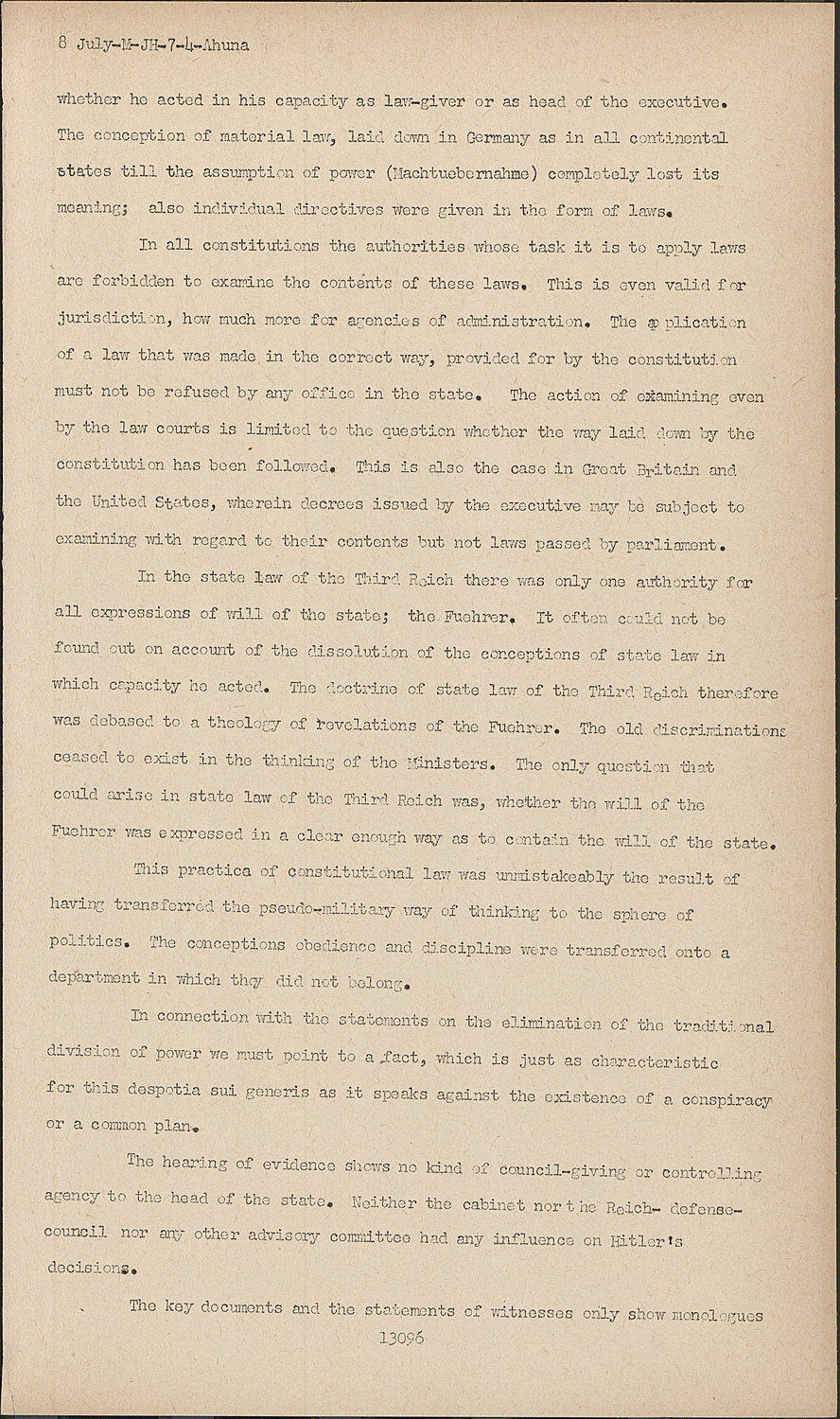
The conception of material law, laid down in Germany as in all continental states till the assumption of power (Machtuebernahme) completely lost its meaning; also individual directives were given in the form of laws.
In all constitutions the authorities whose task it is to apply laws are forbidden to examine the contents of these laws. This is even valid for jurisdiction, how much more for agencies of administration. The application of a law that was made in the correct way, provided for by the constitution must not be refused by any office in the state. The action of examining even by the law courts is limited to the question whether the way laid down by the constitution has been followed. This is also the case in Great Britain and the United States, wherein decrees issued by the executive may be subject to examining with regard to their contents but not laws passed by parliament.
In the state law of the Third Reich there was only one authority for all expressions of will of the state; the Fuehrer. It often could not be found out on account of the dissolution of the conceptions of state law in which capacity he acted. The doctrine of state law of the Third Reich therefore was debased to a theology of revelations of the Fuehrer. The old discriminations ceased to exist in the thinking of the Ministers. The only question that could arise in state law of the Third Reich was, whether the will of the Fuehrer was expressed in a clear enough way as to contain the will of the state.
This practice of constitutional law was unmistakeably the result of having transferred the pseudo-military way of thinking to the sphere of politics. The conceptions obedience and discipline were transferred onto a department in which they did not belong.
In connection with the statements on the elimination of the traditional division of power we must point to a fact, which is just as characteristic for this despotia sui generis as it speaks against the existence of a conspiracy or a common plan.
The hearing of evidence shows no kind of council-giving or controlling agency to the head of the state. Neither the cabinet nor the Reich- defensecouncil nor any other advisory committee had any influence on Hitler's decisions.
The key documents and the statements of witnesses only show monologues of Hitler before an increasing audience.
All, that has the appearance of a council, is in reality reception of orders.
The hearing of evidence has shown it to be certain, that efforts to influence Hitler could at the most lead to reactions not to be precalculated.
Herr von Ribbentrop and several of the other defendants, without doubt, had considerable power in their own sphere which did not interest Hitler. They were, however, completely denied to participation in the great decisions on war or peace, armistice, peace offers etc.
In the position of Foreign Minister, as held by Herr von Ribbentrop, an independent personality could not be tolerated. Herr von Ribbentrop was aware of this as Under Secretary of State von Steengracht has testified here. He stated: Hitler could have use for an Under Secretary for foreign affairs but not for a Minister of foreign politics.
This development of practice of constitution and government can hardly be reconciled with the thought of a common plan and conspiracy. The conspiracy demands, as we have seen, a combination and agreement in aims at which the participants form their will freely. The political practice of the Third Reich only knew the acclamation.
So far, my examinations have been based on the norms of actual criminal law as laid down in par.
6. I should not like to close my statement without drawing the Court's attention to the relation between politics and law.
The essential contents of politics is and remains, in the life of sovereign states, the defence of the interests of one's own people. In order not to let this interpretation of politics become debased to unscrupulousness, international life has established the concept of the settlement of interests, and diplomacy as representative of this principle. It has been diplomacy which has had an essential influence in establishing the principles of international relations and, therefore, of international law. The imperfection of international legal order is caused by the co-existence of many countries, which were acting on a base of equality. Its Achillean heel was the lack of any superior authority which could have been in a position to ensure the existence of legal order in the same way as the authority of a state is able to do within its own borders. For all the time unrestrained display of forces has, therefore, played a far greater part in the international sphere. Statesmen are committed to take care of their people's interests. If they fail in their politics then the countries they were acting for, have to bear the consequences, and they themselves are judged by the judgement of history. But in a legal sence they were responsible only to their proper country for acts which their country was charged with; acts looked upon as infringing international law. The foreign country injured by the action in question could not hold responsible the acting individual . The partition erected by international law, respectful of national sovereignty, between the acting individual and foreign powers, was only removed in the case of war crimes, whereof I have spoken.
At any rate, such was at the beginning of world war II, the conception of international law, and it was not affected by any opposing attempts.
The chief French prosecutor gave a reason for the indictment of leading men of the late regime the fact that a German government, which might be able to take jurisdiction in these cases, was no longer in existence.
I have the fullest esteem for this most elegant argumentation, but it cannot remain hidden to a critical observer that such a sharp logic has led to a false conclusion. Any organized resistance headed by a national government came to an end when the German Wehrmacht was utterly defeated and the whole of the German territory occupied by the Allies.
The 4 principal victorious powers, which form this tribunal, acquired, together with actual authority, a legal title recognized by international law concerning any decision as to the fate of the German national territory. They could have divided up Germany. But they chose another way. In the Berlin declaration of June 5, 1945, they assumed "supreme authority within Germany, including all the powers possessed by the German government, the High Command and any state, municipal or local government or authority." But this was all. The declaration expressly emphasized that the transfer of the said authority did not effect the annexation of Germany.
The exercise of the claimed powers was transferred to the Control Commission, composed of the commanders-in-chief of the four occupation zones.
Since the Berlin declaration Germany is in a transitory state still lasting at present. At the Potsdam conference held in July 1945 the four powers have come, among themselves, to further agreements, made public by means of the statement of August 2, 1945. The Potsdam "Agreement for the establishing of a Council of Foreign Ministers" transfers to the said council the preparation of a peace settlement, which is to be ratified by a German government "when a government suitable for this purpose has been constituted." A second agreement provides regulations concerning Germany under allied control Those wordings make it clear that Germany is to remain a national state, that it is being placed under allied control and that the establishment of a German government is planned.
This government is to accept, at a future date, peace conditions. This involves a government which is in a position to enter into commitments towards foreign powers as an internationally qualified partner.
The victors have accordingly chosen to exercise their power for decision given to them by conquest in such a manner as not to destroy the German State. During the transition period they themselves exercise the functions of the temporarily non-existing - German government. We are therefore entitled to take the Potsdam Declaration as a foothold for the legal interpretation of Germany's position.
The German state, accordingly, has not been annihilated. Germany is burdened with obligations, which arose from her past. This is possible only, when the state upon whose attitude the obligation is based on and the one who must answer for it are countenanced as one and the same legal body.
Though the German State, at the moment, is not in position to act according to International law through its own organs, it has not vanished from the sphere of the international legal order.
The final deductions of Mr. de Menthon cannot be accepted in view of the fact that his suppositions are wrong. Therefore the jurisdiction of the victorious powers over German Nationals with regard to acts connected with National Socialistic policy cannot be based on current International Law. Thus, the Charter deviates from the international legal order. Furthermore it contradicts fundamental principles of criminal law.
If the French prosecutor is of the opinion that the Tribunal exercises the Authority of the German state to punish, a state which according to the opinion of Mr. de Menthon does not exist at this time, then he must logically apply the sentence "nullum crimen sine lege" to the criminal law existing in Germany. An act could therefore be made punishable only, if at the time of its commitment it was punishable according to the German law. This does not apply to personal criminal responsibility for the violation of international treaties and assurances, as well as for the participation in the conspiracy and the common plan.
In recognition of this, the Control Council for Germany in its proclamation No.3 has reinstituted in the system of German criminal law, two international principles, wherefrom the Hitler Regime had deviated : namely, prohibiting retroaction and analogy.
The political criminal concepts of the Charter create new legal principles which have to be considered as the germ of a code of world law. Herr v. Ribbentrop, at the time these incriminating events took place, lacked the perception of such a code of world law. One can dispense with the principle, that a crime can be punished only if its elements are stated in advance, only in the very few cases in which the cruelty of the act is so evident that its deserved punishment is beyond doubt. This could hold true for crimes which, in consequence of certain measures of the abnormal amorality of the Hitler Regime, were during the last years not punished in Germany.
I have heretofore presented the evidence from the point of view of the valid International Law and the charter which you Mr. President, in the cession of 20 June 1946, have again stressed as the basis for legal findings in these proceedings.
Up to how, the code of international law has been unable to solve the problems which are to be decided here.
On the basis of these shortcomings, the second world war broke out. The repercussions of this catastrophy - which could not be prevented by this legal order - cannot be fully evaluated today.
To prevent their recurrences in the future, this is the high aim of humanity as expressed in the treaty of London of 8 August 1945. That the objectives of this treaty could not be reached is shown with alarming certainty by the fact, that on the very day on which the charter of this Court was proclaimed as a now law of the world, the war between the Soviet Union and Japan broke out. Its possibility had been predicted to the allies of the Soviet-Union 6 months prior to that. To justify it, it was pointed out that Russia had to settle an old account with Japan. In other words, this typifies a case of an unprovoked attack.
I have illustrated, that the attack and the attacker cannot be defined by a general definition inside the sphere of the phenomena of reality. The attacker can only be branded by a World authority. This supreme organ of humanity must possess not only an actual but also a moral authority. Universal trust must be put in its impartial judgment. It must be an Areopagus which stands above the conflicting parties and before which these parties can only appear, searching for justice, but not to participate in it as judges.
We are in a period of transition from an old law, under whose rule the ruins around us were created, to a new code of world law, which takes shape but is as yet not morally and effectively consolidated.
To judge and punish the acts which were committed by the former Foreign Minister Herr von Ribbentrop, his share in the happenings, the limits of his capability, and his own personal guilt is a difficult task, taxing human endurance almost beyond strength in this period of transgressions and development.
THE PRESIDENT :We will call on Dr. Nelte, Counsel for the Defendant Keitel.
DR. NELTE (Counsel for the defendant Keitel): "We must approach our task with so much inner deliberation and mental integrity that this trial will later appear to posterity as the fulfilment of human longing for justice."
These words of Justice Jackson in his opening indictment speech must be the guiding principle for all those who have been entrusted with the noble task of contributing to the search for truth in this trial. That this truth cannot be absolute the prosecutors Justice Jackson and M. Dubost have already stated. The purpose of the indictment is not to determine the historical aspect, let alone the historical development of this short but so tragically important period, but instead to find out whether, and to what extent, the defendants sitting on this bench partook in the events which have affected the entire world by their consequences, and which have brought such indescribable misery upon it, and not least upon the German people.
In this trial the Prosecution case stated through one of its qualified spokesmen that it was its task to submit material that would incriminate the defendants, and submit only such incriminating evidence.
Thus, in contrast to the principle of objective accusation which dominates the German criminal proceedings, it made clear its definitely biased standpoint in an indictment which obliges the defense to submit all circumstances and consider
THE PRESIDENT:I have already corrected this misstatement which you have made in your speech here, in dealing with one of theother speeches for the defense. It is not the practice of the prosecution to conceal any evidence which tends in favor of the accused.
DR. NELTE:I am afraid I can't hear.
THE PRESIDENT:What I said was that I had already corrected the erroneous view which is expressed in this paragraph in your speech, that it is the practice of the prosecution to conceal anything they know which may tend in favor of the accused.
DR. NELTE:Mr. President, on this very spot Mr. Justice Jackson stated, "We cannot serve two masters", when he replied to the statement that according to German criminal law the prosecution would also have to produce material in favor of the defendants.
What I am stating here is not said in order to raise any type of accusation against the prosecution. To the contrary, from the point of view for which it stood it has done everything that was possible.
I merely wanted to justify my point of view as defendant's counsel and say why -
THE PRESIDENT:The only reason I interrupted you was because of the sentence in your speech, "It made clear its definitely biased standpoint." In the second paragraph, the second sentence of that paragraph, you say, "Thus, in contrast to the principle of objective accusation which dominates the German criminal proceedings, it made clear" -- that is, the prosecution made clear -- "its definitely biased standpoint in an indictment..."
DR. NELTE:I said "one-sided", that contrary to the governing principle of German criminal procedure, which is objective indictment, it has made clear its definitely one-sided standpoint of indictment which obliges the defense to submit all circumstances and considerations which are indispensable for an objective administration of justice.
THE PRESIDENT:Go on. It may be a different translation.
DR. NELTE:For this purpose, it is first necessary to clarify certain concepts whichare needed for the perception of responsibility and guilt. As far as concepts of International and Constitutional law are concerned, they have been examined and presented by Professor Dr. Jahrreis.
With regard to the sphere of the soldier I should like to make some fundamental statements.
There have been repeated references here to the concepts of soldierly conduct, obedience, loyalty, performance of duty and patriotism. It is my belief that all men recognize those concepts to be good. But it is permissible to say that not all of those concepts are unequivocal. Thus are proposed: "best soldierly conduct" and "militarism", "natural obedience" and "despicably blind obedience", "the categoric imperative of the performance of duty", and "the exaggerated sense of responsibility", "the deep love for the country", and "chauvinism".
We see that all those concepts can run through the scale of good and evil. The origin and the essence of these concepts is everywhere the same, but the form they take on through tradition and education, and thus the effects they have, vary greatly.
However, if this is the case, who then should differentiate and decide whether the feeling is still in the realm of good or has already reached the sphere of evil?
We are all of us living in a world whose century-old striving has aimed at the creation of order. Order is certainly a relative concept, too, but it is everywhere the establishment of the relationship of human beings to each other which guarantees the best possible means of living peacefully side by side in view of the intrinsic character of each country.
This holds true both for the state and for the relationship between nations.
Who should determine in this order what is right and what is wrong? The criterion for this might be, according tohitherto acquired knowledge, only a constitutional, i.e. a national one. The drawing closer of the nations in world traffic and general civilization brought withthem the result that the various national concepts became adjusted to each other in spite of many difference. It must be admitted that this process of adjustment suffered a harmful sot-back through certain national-socialist doctrines and their methods. Nevertheless, the principle remains inviolable that the criterion of right or wrong must be a national one if order is not to be dissolved. The only thing worth striving for is the adjustment of nations and national fundamental concepts to each other as is now being attempted through world organization.
If the national criterion, i.e. the national judgment of good and bad, right and wrong, was well-established in any case up to now, the concepts were never deprived of their relativity, especially when national differences existed for other reasons. A convincing example of this is the opinion expressed about the resistance movement.
All countries celebrate what is considered to be the highest form of patriotism when someone risks his life for his country and exposes himself to the greatest danger. According to the Hague Rules of Land Warfare it is a fact that such a resistance movement is forbidden. We have here a clear example of the contrast between ethical and legal evaluation. This proves that there are no absolute concepts of good and bad, or right and wrong, and that above all written law there are unwritten laws which acquit the wrongdoer because he obeyed higher laws.
Those higher laws, however, also depend on subjective and national - i.e. collectively subjective - considerations.
If non believe something to be good or right this faith may come into existence out of an actually higher law, a truly higher idea, but it may also grew out of a misled faith, out of a false idea. Who wishes to or who is able to judge whether a faith or an idea was or was not right? History has proven that usually the successful idea is recognized as right, to a certain extent because it is the judgment of God. I do not wish to decide whether that is always true. The question here, however, is whether the people whoso guilt is to be judged, acted in good faith, in accordance with such an idea and such a faith. If divine judgment has shown this faith to be wrong, the question remains open whether it was for comprehensible or explainable reasons that people could believe the idea to be good.
This question constitutes the problem which concerns not only defendant Keitel but also the entire German nation. According to the speech of the French prosecution not only the defendants in this trial are the really guilty ones but the entire German nation.
The extent raid importance of this thesis are tremendous. Should the Tribunal - if only in the grounds for its decision - come to the conclusion that the entire German nation is guilty, every German for incalculable time will bear the brand of Cain which finally must load to the destruction of this people, and its dissolution.
It has been stated most authoritatively that there is no intention here of accusing the entire German people. Through unconditional surrender we are left entirely to the mercy of the victorious powers. It was said however, that the verdict of this tribunal is to be just. Here in this court it is not clemency or inclemency which are to be the guiding principle, but justice. Justice does not mean mildness. A verdict, however, will only be just if it takes into consideration all the circumstances which underlie the actions and conduct of the defendants. There is no excuse for what has happened and for what forms the subject of this indictment. I ca only try to give you an analysis. The misery, the misfortune that has fallen on the entire human race is so great that words do not suffice to express i t. The German people, especially after having learned the catastrophe that has befallen the nations in the West and East and the Jews, is shaken with horror and pity for the victims.
The German nation knows what this misfortune means; for it is stricken as hardly any other people is, not only in the military field but through the sinister consequences of air attacks, through the loss of millions of its youth in the field, through evacuations and escapes in ice and snow.
We know, therefore, what it means to be in misery, to have to suffer.
But while other nations are able to look upon this misery and misfortune as a chapter of the past and in the protection of constitutional order have the comfor-ting hope of returning to an orderly existence and a happy future, there still rests upon this nation the gloom of despair.
By affirming the guilt of the entire nation the verdict of this Tribunal would perpetuate this despair. The German people does not expect to be acquitted. It does not expect the cloak of Christian charity and oblivion to be spread over all that has happened. The German nation is ready to the last to take the consequences upon itself. It is willing to accept its fate and to do everything to participate in removing the consequences. It hopes, however, that the Souls and hearts of the rest of mankind will not be so hardened that the existing tension, in fact the existing gulf between this nation and the rest of mankind will remain.
Your taks your Honors, is a terribly hard one. We not only speak different languages, all of us feel with the soul of our own country. Much of what has happened in this country will seem incomprehensible to you. The feelings of the German people in its different categories are not your feelings. One of the most essential points, especially in the case of the soldiers, seems to me the way of judging what is felt to be liberty. In this country, too, the ideal of liberty was proclaimed. All of us know that the most extreme form of liberty is anarchy. No state desires anarchy because it means surrender of its own existence. If therefore, all countries agree that the absolute concept of freedom is never worth striving for and can never be sanctioned, there results, perforce, relativity of the concept of freedom. No concept has been so misused as the concept of freedom and yet every political system proclaim, freedom as the greatest of all blessings. By that, I by no means wish to say that the concept of freedom as proclaimed by National Socialism was the right solution. What I do wish to say, however, is that national socialism also knew the concept of freedom and made it clear to the people through propaganda that its conception of freedom was the right one. National Socialism was aided in this by the fact that under the effects of the Treaty of Versailles Germany could indeed make no claim to be really free. The limitations of its sovereignty were so pronounced and so evident that it was easy for national socialism to proclaim the fight for freedom of the fatherland.