Official transcript of the International Military Tribunal in the matter of:
The United States of America, the French Republic, the United Kingdom of Great Britain and Northern Ireland, and the Union of Soviet Socialist Republics against Hermann Wilhelm Goering, et al, Defendants, sitting at Nuernberg, Germany, on 12 December 1945, 1000-1230, Lord Justice Lawrence presiding.
THE PRESIDENT:The Tribunal will adjourn this morning at 12:30 for a closed session and sit again at 2:00 o'clock.
MR. DODD:May it please the Tribunal, I should like to report to the Tribunal this morning with reference to the questions which arose yesterday afternoon concerning three documents.
After adjournment we found that Document 2220-PS was in the defendants' information center in photostatic form, and that the two other documents, being respectively the two entries from the Frank diary, were also there but in a different form. The Frank diary consists of some 40-odd volumes we of course were not able to photostat, so we had placed instead in the defendants' room the excerpts. As a matter of fact, we had placed the entire document book there.
DR. ALFREDSEIDL: (Counsel for Defendant Frank): Yesterday the prosecution shaved documents concerning the Defendant Frank, Numbers 2233-PS-A and 2233-PS-B, USA 173, USA 174. These are not ordinary documents, but excerpts from the diary of Frank. Six weeks ago in writing I made the motion to have this diary, which consists of 42 heavy, thick volumes, submitted to me. I first made this request on the 2nd of December. The second time--pardon me, that was the 2nd of November; the 16th of November for the second time; the third time on the 18th; and for the fourth time I requested it on the 3rd of December.
Up to now I have not, I am sorry to say, received this diary, and I would like to ask the Court that this diary be submitted to me; because a piece of evidence is involved which Frank, the defendant, when he was arrested gave to the officers who were arresting him, and this material is to serve in his favor.
I am not in a position in a few days to work over this wealth of material, and I would like to ask the Court that this diary be put at my disposal as soon as possible.
In this connection I would like to call the attention of the Court to another point. The Court has already granted that the four addresses or speeches which Frank made in Germany in 1942, and which led to his dismissal by Hitler from his offices, chiefly in the Party, and I'd like to have this material put at my disposal for evidence through the General Secretary of the Court. This was done, or I was notified of this, on the 4th of December, but up to this day I have not received copies of these speeches. I would be very grateful if the Court would attend to this matter, that the official wishes of the Court would be carried out, and that these documents would be put into my hands.
THE PRESIDENT:The Tribunal will look into these matters with the General Secretary of the Tribunal, and doubtless it Trill be able to arrange that you should have these documents submitted to you in the defendants' counsel information center.
DR. SEIDL:Thank you.
THE PRESIDENT:Yes, Mr. Dodd.
MR. DODD:May I refer briefly to the discussion that we were engaged in yesterday in order to take up the train of thought.
I wish to remind the Tribunal that we were discussing or had just completed a discussion of Document L-61, which had to do with a letter written by the Defendant Sauckel to the Presidents of the "Landes" Employment Offices. I had read two excerpts from that letter.
Referring to the letter, we say that the Nazi campaign of force and terror and abduction was described in another letter to the Defendant Frank, which we wish to refer to as Document Number 1526-PS.
THE PRESIDENT:Before you pass from that, Mr. Dodd, has either the original or the photostatic copy been shown to Sauckel's Counsel?
MR. DODD:Oh, yes, sir. A photostatic copy was in the defendants' counsel information room, and after adjournment yesterday we got the original and handed it to him here in this room.
THE PRESIDENT:And he saw it?
MR. DODD:Yes, sir.
THE PRESIDENT:Very well.
MR. DODD:This document, Number 1526-PS, USA Exhibit 178, is a letter written by the Chairman of the Ukrainian Main Committee, at Cracow, in February 1943, and I wish to read from the third page of the English text, beginning with the second paragraph. The same passage appears in the German text at Page 2, Paragraph 5. I quote:
"The general nervousness is still more enhanced by the wrong methods of finding labor which have been used more and more frequently in recent months.
"The wild and ruthless man-hunt as exercised everywhere in towns and country, in streets, squares, stations, even in churches, at night in houses, has badly shaken the feeling of security of the inhabitants. Everybody is exposed to the danger, to be seized anywhere and at any time by members of the police, suddenly and unexpectedly, and to be brought into an assembly camp.
None of his relatives knows what has happened to him, only months later one or the other gives news of his fate by a postcard."
I wish to turn in this same document to enclosure 5 on Page 8 of this document, which I quote:
"In November of last year an inspection of all males of the age groups 1910 to 1920 was ordered in the area of Zaleschozyki (district of Czortkow). After the men had appeared for inspection, all those who were chosen were arrested at once, loaded into trains and sent to the Reich. Such recruiting of laborers for the Reich also took place in other areas of this district. Following some interventions the action was then stopped."
The resistance of the Polish people to this enslavement program and the necessity for increased force were described by Defendant Sauckel's deputy, one Timm, at a meeting of the Central Planning Board, which was, by the way, Hitler's war-time planning agency. It was made up of the Defendant Speer, Field Marshal Milch and State Secretary Koerner. The Central Planning Board was the highest level economic planning agency, exercising production controls by allocating raw materials and labor to industrial users.
Now, Document R-124, USA Exhibit No. 179. This document consists of excerpts from minutes of the meetings of this Central Planning Board, and minutes of conference between the Defendant Speer and Hitler. Only the excerpts, of course, from these minutes upon which we rely are being offered in evidence. I would say to the Tribunal, however, that the balance of the minutes are available, can be made available if the Tribunal so desires.
This deputy of Sauckel, his name being Timm, made a statement at the 36th Conference of the Central Planning Board, and it appears on Page 14, Paragraph 2, of the English text of Document R-124, and on Page 10, Paragraph 2, of the German text:
"Especially in Poland the situation at the moment is extraordinarily serious. It is well known that vehement battles occurred just because of these actions. The resistance against the administration established by us is very strong. Quite a number of our men have been exposed to increased dangers, and it was just in the last two or three weeks that some of them were shot dead, e.g., the Head of the Labor Office of Warsaw who was shot in his office, and yesterday another man again.
This is how matters stand presently, and the recruiting itself, even if done with the best will, remains extremely difficult unless police reinforcements are at hand."
Deportation and enslavement of civilians reached unprecedented levels in the so-called Occupied Eastern Territories. These wholesale deportations resulted directly from labor demands made by the Defendant Sauckel on the Defendant Rosenberg, who was the Reichsminister for the Occupied Eastern Territories, and his subordinates, and also on the Armed Forces demand made directly on the Armed Farces by the Defendant Sauckel.
On the 5th of October 1942, far example, the Defendant Sauckel wrote to the Defendant Rosenberg, stating that 2 million foreign laborers were required, and that the majority of these would have to be drafted from the recently occupied Eastern Territories and especially from the Ukraine.
I wish to refer at this point to Document 017-PS, which bears USA Exhibit Number 180. This letter from the Defendant Sauckel to the Defendant Rosenberg I wish to quite in full. It begins by saying:
"The Fuehrer has worked out new and most urgent plans for the armament which require the quick mobilization of two more million foreign labor forces. The Fuehrer therefore has granted me, for the execution of my decree of 21 March 1942, new powers for my new duties, and has especially authorized me to take whatever measures I think are necessary in the Reich, the Protectorate, the General Gouvernement, as well as in the occupied territories, in order to assure at all costs an orderly mobilization of labor for the German armament industry. The additional required labor force will have to be drafted for the majority from the recently occupied Eastern Territories, especially from the Reichskommissariat Ukraine. Therefore, the Reichskommissariat Ukraine must furnish:
"225,000 labor farces by 31 December 1942 and 225,000 more by 1 May 1942. "I ask you to inform Reichskommissar Gauleiter party fellow member Koch about the new situation and requirements and especially to see to it that he will support personally in any possible way the execution of this new requirement.
"I have the intention to visit Party member Koch shortly and I would be grateful to you if you could inform me as to where and when I could meet him for a personal discussion.
Right now though, I ask that the procurement be taken up at once with every possible pressure and the commitment of all powers, especially also of the experts of the Labor offices. All the directives which had limited temporarily the procurement of Eastern laborers are annulled. The Reichs procurement for the next months must be given priority over all other measures.
"I do not ignore the difficulties which exist for the execution of this new requirement, but I am convinced that with the ruthless commitment of all resources, and with the full cooperation of all those interested, the execution of the new demands can be accomplished for the fixed date. I have already communicated the new demands to the Reichskommissar Ukraine via mail. In reference to our long distance phone call of today I will send you the text of the Fuehrer's decree at the beginning of next week."
I should like to remind the Tribunal that we have referred previously on yesterday afternoon to this Reichskommissar Gauleiter Party fellow-member, Koch, and we quoted him as stating, the Tribunal will recall "We are the master race. We must be hard," etc.
On the 17th day of March 1943, the Defendant Sauckel wrote again to the Defendant Rosenberg, and on this occasion he demanded the importation of another 1,000,000 men and women from the Eastern territories within the following four months. I wish to refer at this point to Document No.019-PS, which bears USA Exhibit No. 181. Quoting that latter in full:
"After a protracted illness my Deputy for Labor Supply in the occupied Eastern Territories, State Councillor Peukert, is going there to regulate the labor supply both for Germany and the territories themselves.
"I ask you sincerely, dear party member Rosenberg, to assist him to your utmost on account of the pressing urgency of Peukert's mission.
Already now I may thank you for the hitherto good reception accorded to Peukert.
He himself has been charged by me with the absolute and completely unreserved cooperation with all bureaus of the Eastern Territories.
Especially the labor supply for the German agriculture, and likewise for the most urgent armament production programs ordered by the Fuehrer make the fastest importation of approximately 1 million women and men from the Eastern Territories within the next four months at most.
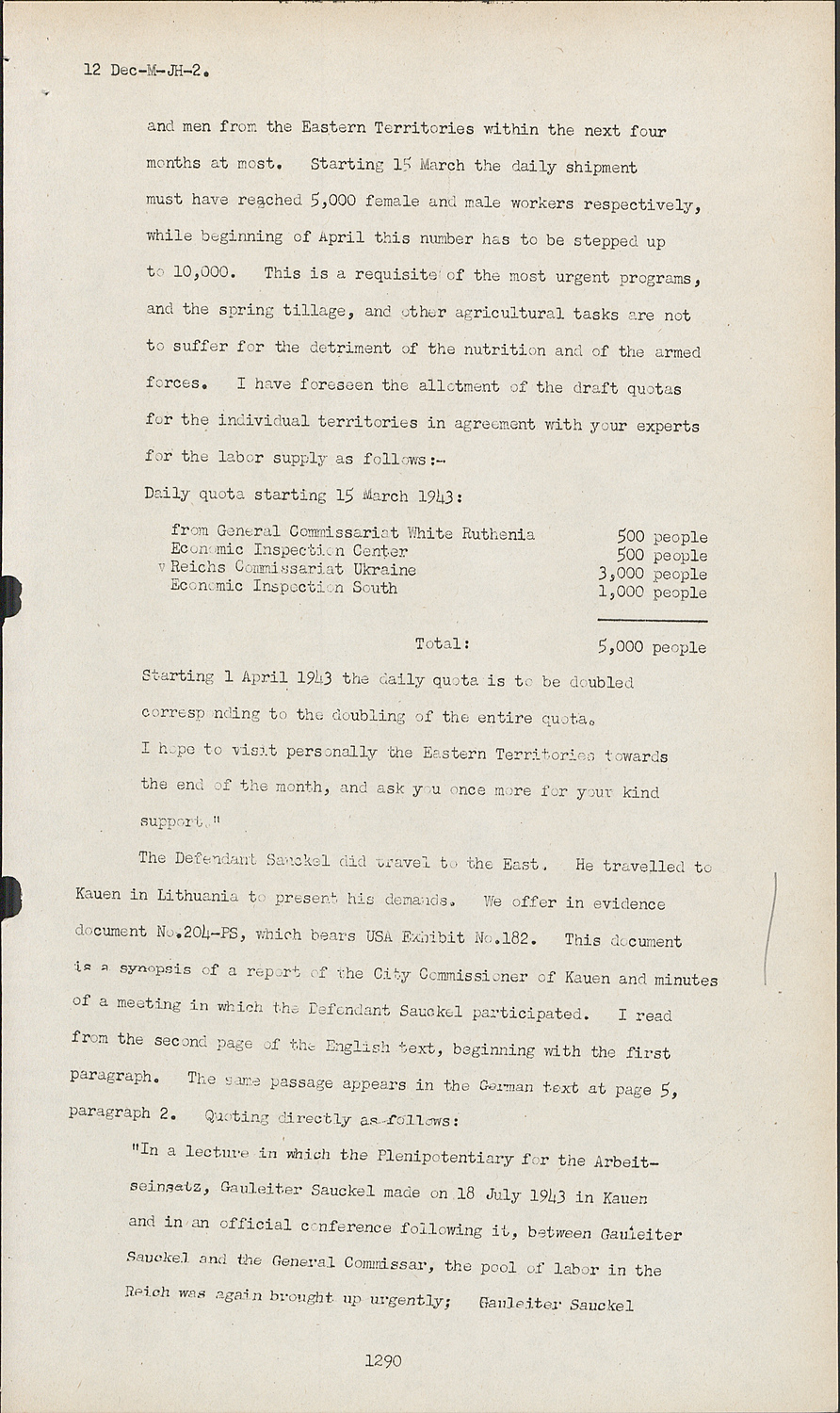
Starting 15 March the daily shipment must have reached 5,000 female and male workers respectively, while beginning of April this number has to be stepped up to 10,000.
This is a requisite of the most urgent programs, and the spring tillage, and other agricultural tasks are not to suffer for the detriment of the nutrition and of the armed forces.
I have foreseen the allotment of the draft quotas for the individual territories in agreement with your experts for the labor supply as follows:
Daily quota starting 15 March 1943:
from General Commissariat White Ruthenia 500 people Economic Inspection Center 500 people Reichs Commissariat Ukraine 3,000 people Economic Inspection South 1,000 people -----------Total:
5,000 people Starting 1 April 1943 the daily quota is to be doubled corresponding to the doubling of the entire quota.
I hope to visit personally the Eastern Territories towards the end of the month, and ask you once more for your kind support."
The Defendant Sauckel did travel to the East. He travelled to Kauen in Lithuania to present his demands. We offer in evidence document No.204-PS, which bears USA Exhibit No.182. This document is a synopsis of a report of the City Commissioner of Kauen and minutes of a meeting in which the Defendant Sauckel participated. I read from the second page of the English text, beginning with the first paragraph. The same passage appears in the German text at page 5, paragraph 2. Quoting directly as follows:
"In a lecture in which the Plenipotentiary for the Arbeit seinsatz, Gauleiter Sauckel made on 18 July 1943 in Kauen and in an official conference following it, between Gauleiter Sauckel and the General Commissar, the pool of labor in the Reich was again brought up urgently; Gauleiter Sauckel again demanded that Lithuanian labor be furnished in greater volume for the purposes of the Reich."
THE PRESIDENT:Who was the General Commissar, Rosenberg?
MR. DODD:The Plenipotentiary for the Arbeitseinsatz?
THE PRESIDENT:No, the General Commissar.
MR. DODD:His name is not known to us. He was apparently a local functionary in the Party.
THE PRESIDENT:Very well.
MR. DODD:The Defendant Sauckel also visited Riga in Latvia, to assert his demands, and the purpose of this visit is described in Document No.2280-PS, bearing USA Exhibit No.183. This document is a letter from the Reich Commissar for the Ostland to the Commissioner General in Riga and it is dated the 3rd of May 1943. I wish to read from page 1 of the English text, beginning with the first paragraph:
"Following the basic statements of the Plenipotentiary General for manpower, Gauleiter Sauckel on the occasion of his visit to Riga on the 21st of April 1943, it was decided in view of the critical situation and in disregard of all adverse considerations, that a total of 183,000 workers have to be supplied from the Ostland for the Reich territory.
This task must absolutely be accomplished within the next four months and at the latest must be completed by the end of August."
Here again we are not informed as to the name identity of the Reich Commissar for the Ostland.
Sauckel asked the German Army for assistance in the recruitment and deportation of civilian labor from the Eastern Territories. We refer now to Document No.3010-PS, which bears USA Exhibit No.184.
THE PRESIDENT:Mr. Dodd, were you saying that it wasn't known from whom that document emanated?
MR. DODD:No, sir. We say it is a letter from the Reichskommissar for the Ostland to the Commissioner General in Riga, but we don't know their names specifically at the time of the writing of the letter.
THE PRESIDENT:You don't know who the Reichskommissar of the Eastern Territories was?
MR. DODD:We don't know him by that title, "The Reichskommissar for the Ostland".
THE PRESIDENT:Very well.
MR. DODD:Lohse, I am now informed, was his name. I understood that we did not know it. Lohse, L-o-h-s-e.
THE PRESIDENT:All right.
MR. DODD:Referring to this Document 3010-PS, this document is a secret organization order of the Army Group South, dated the 17th day of August, 1943. I wish to read from the first page of the English text, the first two paragraphs, as follows:
"The Plenipotentiary General for Labor Employment ordered the recruitment and employment of all born during two years for the whole, newly occupied Eastern territory in Decree Az.
VIA 5780.28 (Inclosure 1), copy of which is inclosed.
The Reich Minister for Armament and Munition approved this order.
"According to this order by the Plenipotentiary General for Labor Employment (BGA) you have to recruit and to transport to the Reich immediately all labor force in your territory born during 1926 and 1927.
The decree relative labor duty and labor employment in the theater of operations of the newly occupied Eastern territory of the 6 February 1943 and the executive orders therefore are the authority for the execution of this measure.
Enlistment must be completed by 30 Sept.
43 at the latest."
We say it is clear that the demands made by the Defendant Sauckel resulted in the deportation of civilians from the occupied Eastern territories. The Defendant Speer has recorded conferences with Hitler on 10, 11 and 12 August 1942 and this record is contained in Document R-124, which is already in as U.S.A. Exhibit 179. I now wish to quote from Page 34, of that same document in paragraph 1 of the English text. In the German text it appears at Page 23, paragraph 2. Quoting directly:
"Gauleiter Sauckel promises to make Russian labor available for the fulfilment of the iron and coal program and reports that - if required - he can supply a further million Russian laborers for the German armament industry up to and including Oct.
1942. So far, he has already supplied 1 million for industry and 700,000 for agriculture.
In this connection the Fuehrer states that the problem of providing labor can be solved in all cases and to any extent;he authorizes Gauleiter Sauckel to take all measures required.
"He would agree to any necessary compulsion in the East as well as in the West if this question could not be solved on a voluntary basis."
In order to meet these demands of 1,700,000, 100,000 here and there, the Nazi conspirators made terror, and violence and arson, as we said yesterday, fundamental instruments of their labor enslavement policy. Twenty days after the Defendant Sauckel's demands of the 5th of October, 1942, a top official in the Defendant Rosenberg's Ministry described the measures taken to meet these demands. I wish to refer now to document No. 294-PS, which is U.S.A. Exhibit No. 185. This document is a top secret memorandum dated the 25th of October, 1942, signed by one Braeutigam. I wish to quote from page 4 of the English text starting with the last paragraph, as follows.
In the German text it appears at page 8, paragraph 2. Quoting directly:
"We now experienced the grotesque picture of having to recruit millions of laborers from the Occupied Eastern Territories, after prisoners of war have died of hunger like flies, in order to fill the gaps that have formed within Germany.
Now the food question no longer existed.
In the prevailing limitless abuse of the Slavic humanity "recruiting" methods were used which probably have their origin in the blackest periods of the slave trade.
A regular manhunt was inaugurated.
Without consideration of health or age the people were shipped to Germany where it turned out immediately that more than 100,000 had to be sent back because of serious illnesses and other incapabilities for work."
The Defendant Rosenberg wrote himself concerning these brutalities to the instigator of them, the Defendant Sauckel, and we refer now to document No. 018-PS, which bears U.S.A. Exhibit No. 186.
THE PRESIDENT:Mr. Dodd, from where did that top secret document come?
MR. DODD:It came from the files of the Defendant Rosenberg.
This document, 018-PS, is a letter from, the Defendant Rosenberg to the Defendant Sauckel, and it is dated the 21st day of December 1942, with attachments. I wish to quote from page 1 of the English text starting at the middle of the second paragraph which reads as follows:
"The report I have received show, that the increase of the guerilla bands in the occupied Eastern Regions is largely due to the fact that the methods used for procuring laborers in these regions are felt to be forced measures of mass deportations, so that the endangered persons prefer to escape their fate by withdrawing into the woods or going to the guerilla bands."
Passing now to page 4 of the same English text, there is an attachment to Rosenberg's letter consisting of parts excerpted from letters of residents of the occupied Eastern territories, excerpted by Nazi censors apparently.
In the German text it appears at page 6, paragraphs 1 and 2. Starting the quotation:
"At our place, new things have happened. People are being taken to Germany.
On Dec. 5, some people from the Kowkuski district were scheduled to go, but they didn't want to and the village was set afire.
They threatened to do the same thing in Borowytschi, as not all who were scheduled to depart wanted to go.
Thereupon 3 truck loads of Germans arrived and set fire to their houses.
In Wrasnytschi 12 houses and in Borowytschi 3 houses were burned.
"On Oct. 1 a new conscription of labor forces took place. From what has happened, I will describe the most important to you.
You can not imagine the bestiality. You probably remember what we were told about the Soviets during the rule of the Poles.
At that time we did not believe it and now it seems just as incredible.
The order came to supply 25 workers, but no one reported.
All had fled. Then the German militia came and began to ignite the houses of those who had fled.
The fire became very violent, since it had not rained for 2 months.
In addition the grain stacks were in the farm yards.
You can imagine what took place.
The people who had hurried to the scene were forbidden to extinguish the flames, beaten and arrested, so that 7 homesteads burned down.
The policemen meanwhile ignited other houses.
The people fall on their knees and kiss their hands, but the policemen beat them with rubber truncheons and threaten to burn down the whole village.
I don't know how this would have ended if I Sapurkany had not intervened.
He promised that there would be laborers by morning, During the fire the militia went throught the adjoining villages, seized the laborers, and brought them under arrest.
Wherever they did not find any laborers, they detained the parents, until the children appeared.
That is how they raged throughout the night in Bielosirka.
The workers which had not yet appeared till then, were to be shot.
All schools were closed and the married teachers were sent to work here, while the un married ones go to work in Germany.
They are now catching humans like the dog-catchers used to catch dogs.
They are al ready hunting for one week and have not yet enough.
The imprisoned workers are locked in at the school house.
They cannot even go out to perform their natural functions, but have to do it like pigs in the same room.
People from many villages went on a certain day to a pilgrimage to the monastery Potschaew.
They were all arrested, locked in, and will be sent to work.
Among them there are lame, blind and aged people".Despite the fact that the Defendant Rosenberg wrote this letter with this attachment, we say he nevertheless countenanced the use of force in order to furnish slave labor to Germany and admitted his responsibility for the "unusual and hard measures" that were employed.
I refer to excerpts from the transcript of an interrogation under oath of the Defendant Rosenberg on the 6th of October 1945, which is U.S.A. Exhibit 187, and I wish to quote from page 1 of the English text starting with the ninth paragraph.
THE PRESIDENT: You haven't given us the PS number.
MR DODD: It has no PS number.
THE PRESIDENT: I beg your pardon. Has a copy of it been given to Rosenberg's Counsel?
MR DODD: Yes, it has been. It is at the end of the document book, if Your Honors please, the document book the Tribunal has.
THE PRESIDENT: I see.
DR. ALFREDTHOMA (Counsel for Defendant Rosenberg): I am Mr. Thoma.
I represent Rosenberg. I am objecting to the reading of this document, and for the following reasons:
The Defendant was asked about it in the preliminary hearings several times, and he declared that Sauckel had his authority from the Fuehrer, and he was Plenipotentiary for the Four Year Plan; and he acted accordingly with authority.
But on top of that, he wanted voluntary actions, and these were carried through.
Sauckel agreed in case the quotas were met.
Rosenberg further declared that his ministry, many times, wanted the quotas to be lowered, and in some cases this was granted.
This document, which is going to be presented, does not say anything about these lowerings of the quotas.
The document, which is to be present ed, only contains fragments of this declaration.
In order to give the Court a complete picture, and to give the Defense the possibility of a comprehensive picture, I ask the Court to ask the Prosecution to show the whole document; and before this document is presented officially, to take recourse with the Defense, in order to pre vent all misunderstandings.
THE PRESIDENT:I am not sure that I understand your objection. You say, as I understood it, that Sauckel had authority from Hitler; is that right?
DR. THOMA:Yes.
THE PRESIDENT:And that Rosenberg was carrying out that authority.
DR. THOMA:Yes.
THE PRESIDENT:But all that Counsel for the Prosecution is attempt in, to do at the moment is to put in evidence an interrogation of Rosenberg.
With reference to that, you ask that he should out in the whole interrogation
DR. THOMA:Yes.
THE PRESIDENT:Well, we don't know yet whether he intends to put in the whole interrogation or a part of it.
DR. THOM: I know only this one thing: I have the document, which the Prosecution wishes to submit, in my hands, and I gather from it that only fragments of the whole interrogation minutes are contained therein:
and it does not say anything about Rosenberg's always insisting that only volunteers were to be taken, and that Rosenberg always wanted the quotas to be lowered.
He demanded the lowering. But this is not shown in the document that is to be submitted.
THE PRESIDENT:If Counsel for the Prosecution reads a part of the interrogation, and you wish to refer to another part of the interrogation, in order that the part he has read should not be misleading, you will be at liberty to do so, when he has read his part of the interrogation; is that clear?
DR. THOMA:Yes. Then I please ask the Tribunal to ask Counsel for the Prosecution whether the document, which he intends to produce, con tains the whole declaration of Rosenberg.
THE PRESIDENT:Mr. Dodd, were you going to put in the whole of Rosenberg's interrogation?
MR. DODD:No, Your Honor, I was not prepared to put in the whole of Rosenberg's interrogation, but only certain parts of it.
These parts are available, and have been for sometime, to Counsel.
The whole of the Rosenberg interrogation, in English, was given to Sauckel's Counsel, how ever, and he has the entire text of it, the available copy that we have.
THE PRESIDENT:Has Counsel for Rosenberg not got the entire document?
MR. DODD:He only has the excerpt that we propose to read into the record here at this time.
DR. THOMA: May I please speak?
THE PRESIDENT:Mr. Dodd, the Tribunal considers that if you propose to put in a part of the interrogation, the whole interrogation ought to be submitted to the Defendants' Counsel, that then you may read what part you like of the interrogation, and then Defendants' Counsel may refer to any other part of the interrogation directly, if it is necessary for the purpose of explaining the part which has been read by Counsel for the Prosecution. So before you use this interrogation, Rosenberg's counsel must have a copy of the whole interrogation.
MR. DODD:I might say, Your Honor, that we turned over the whole interrogation to counsel for the Defendant Sauckel, and we understood that he would make it available to all other Defense Counsellors. Apparently, that didn't happen.
DR. THOMA:Blank you, My Lord.
DR. SERVATIUS:Last night I received from the prosecution these documents in English. That, of course, is efficient for me, but Counsel for the other defendants are not in position to follow the English text, so that certain difficulties have arisen, and I have to have the time to interpret these matters for my colleagues, or perhaps the prosecution could give us the German text, for the interrogation took place in German, was translated into English, so that the original German text should be at hand.
Those are the difficulties, and I would, like to have the German translation as soon as possible.
MR. DODD.With reference to the so-called German text, the original is in English text. These interrogations were made through an interpreter and they were transcribed in English so that the original text is an English text, and that is what was turned over to the Attorney for the Defendant Sauckel with the understanding that it would be made available to all other counsellors.
THE PRESIDENT:But of course that doesn't quite meet their difficulties because they don't all of them speak English, or are not all able to read English, so I am afraid you must wait until Rosenberg's counsel has got a copy of the entire interrogation in his own language.
MR. DODD:Very well.
Passing on beyond the document which we have just referred to, and which we now withdraw in view of the ruling, which we will offer at a later date after we have complied with the ruling of the Court, we have a letter dated the 21st clay of December 1942, which is Document 018 PS, and which bears USA Exhibit No. 186 -- which, by the way, is a letter from the Defendant Rosenberg to the Defendant Sauckel -- and I wish to quote from page 1, paragraph 3 of the English text. In the German text it appears at page 4, paragraph 1. Quoting directly:
"Even if I do not close my eyes to the necessity that the numbers demanded by the Reichs Minister for weapons and ammunition as well as by the agricultural economy justify unusual and hard measures, I have to ask, due to the responsibility for the occupied Eastern Territories which lies upon me, that in the accomplishment of the ordered tasks such measures be excluded, the toleration and prosecution of which will some day be held against me, and my collaborators."
In the Ukraine area, arson was indeed used as a terror instrument to enforce these conscription measures, and we refer now to Document No.254 PS, which is USA Exhibit No. 188. This document is from an official of the Rosenberg Ministry and was also found in the Rosenberg file. It is dated June 29, 1943 and encloses a copy of a letter from one Paul Raab, a district commissioner in the territory of Wassikow, to the Defendant Rosenberg. I wish to quote from Raab's letter, page 1, starting with paragraph 1 of the English text which reads as follows:
"According to a charge by the supreme command of the armed forces" -
THEPRESIDENT (interposing): Mr. Dodd, I thought you said the date of it was the 29th of June 1943.
MR. DODD: Yes, I did, Your Honor. That was the date on the document.
THE PRESIDENT:The document I have appears to have the original document as June 29, 1945, and the date below is 7/5/44.
MR. DODD:We'll get the original document I'm sorry, Your Honor.
There are two errors here. The document is dated the 29th of June, 1944.
THE PRESIDENT: '44?
MR. DODD: '44.
THE PRESIDENT:I see. And the enclosure is 7/6/44?
MR. DODD:Yes.
"According to a charge by the supreme command of the armed forces that I burned down a few houses in the territory of Wassikow, Ukraine, belonging to insubordinate people ordered for work-duty. This accusation is true."
Passing now to the third paragraph:
"During the year of 1942, the conscription of workers was accomplished by way of propaganda. Only very rarely was force necessary. Only in August 1942, measures had to be taken against two families in the villages Glewenka and Salisny-Chutter, each of which were to supply one person for labor. Both were requested in June for the first time, but didn't obey although requested repeatedly. They had to be brought up by force, but succeeded twice to escape from the collecting camp, or when being on transport. Before the second arrest, the fathers of both of the men were taken into custody, to be kept as hostages and to be released only when their sons would show up. When, after the second escape, rearrest of both the fathers and boys was ordered, the police patrols ordered to do so, found the houses to be empty."
Passing to paragraph 4, it is stated, and I quote directly:
"That time I decided to take measures" -
THEPRESIDENT: (Interposing): Shouldn't you read on at the top of that page 2? You had read, hadn't you, "I ordered the burning down of the houses of the fugitives"?
MR. DODD: Yes, I have.
THE PRESIDENT:I thought you were to go on after that "The result was...." Do you see?
MR.DODD: "The result was that in the future the people obeyed willingly."
THE PRESIDENT:Wait a minute. My colleague doubts whether you have read the passage at the bottom of page 1. I thought you had read it, beginning, "That time I decided to take measures....."
MR. DODD:No, I was just beginning to read it.
THE PRESIDENT:I beg your pardon.
MR. DODD:That is the fourth paragraph:
"That time I decided to take measures to show the increasingly rebellious Ukrainian youth that our orders have to be followed. I ordered the burning down of the houses of the fugitives."
Would Your Honor like to have the rest of that paragraph?
THE PRESIDENT:I think you should read the next few lines.
MR.DODD: "The result was that in the future people obeyed willingly orders concerning labor obligations. However, the measure of burning houses has not become known for the first time by my actions, but was suggested in a secret letter from the commissioner for the commitment of labor as a forced measure in case other measures should fail. This harsh punishment was accepted by the population with satisfaction."