Poland was the first victim. The Defendant Frank as Governor of the Government General of Poland announced that under his program 1,000,000 workers were to be sent to Germany and he recommended that police surround Polish villages and seize the inhabitants for deportation.
I wish to refer to Document No.1375-PS which is USA Exhibit No.172. This document is a letter from the Defendant Frank to the Defendant Goering and it is dated the 25th day of January, 1940. I wish to quote from the first page of the English text, starting with the first paragraph, and in the German text, again, it appears at page 1 of the first paragraph, and quoting directly:
"In view of the present, requirements of the Reich for the defense industry, it is at present fundamentally impossible to carry on long term economic policy in the General-Gouvernement.
Rather, it is necessary so to steer the economy of the Generalgouvernement that it will, in the shortest possible time, accomplish results representing the maximum that can be gotten out of the economic strength of the Generalgouvernement for the immediate strengthening Of our capacity for defense.
In particular the following performances are expected of the total economy of the Generalgouvernement" I wish to pass on a little bit in this text to the second page and particularly to paragraph g, of the English text.
In the German text, the same passage appears on page 3 in paragraph g. I am quoting directly again:
"Supply and transportation of at least 1 million male and female agricultural and industrial workers to the Reich - among them at least 750,000 agricultural workers of which at least 50% must be women - in order to guarantee agricultural production in the Reich and as a replacement for industrial workers lacking in the Reich."
The methods by which these workers were to be supplied were considered by the Defendant Frank, as revealed in the document which we now refer to.
It is an entry in the Defendant Frank's own Diary, to which we have assigned our Document No. 2233-PS-A, and which we offer as USA Exhibit 173. The portion which I shall read is the entry for Friday, the 10th May 1940. It appears in the document book as 2233-PS-A, on the third page, in the centre of the page. Just above are the words "page 23", paragraph 1, to the left, just above it:
"Then the Governor General deals with the problem of the Compulsory Labor Service of the Poles.
Upon the demands from the Reich it has now been decreed that compulsion may be exercised in view of the fact that sufficient manpower was not voluntarily available for service inside the German Reich.
This compulsion means the possibility of arrest of male and female Poles.
Because of these measures a certain disquietude had developed which, according to individual reports, was spreading very much, and which might produce difficulties everywhere.
General Fieldmarshal Goering some time ago pointed out in his long speech the necessity to deport into the Reich a million workers.
The supply so far was 160,000.
However, great difficulties had to be overcome.
Therefore it would be advisable to consult the district and town chiefs in the execution of the compulsion, so that one could be sure from the start that this action would be reasonably successful.
The arrest of young Poles when leaving church service or the cinema would bring about an increasing nervousness of the Poles.
Generally speaking, he had no objections at all if the rubbish, capable of work yet often loitering about, would be snatched from the streets.
The best method for this, however, would be the organization of a raid, and it would be absolutely justifiable to stop a Pole in the street and to question him what he was doing, where he was working etc."
I should like to refer to another entry in the diary of the Defendant Frank, and I offer in evidence an extract from the entry made on the 16th day of March 1940, which appears in the document books as 2233-PS - B, and it has USA Exhibit 174.
I wish particularly to quote from the third page of the English text:
"The Governor General remarks that he had long negotiations in Berlin with representatives of the Reich Ministry for Finance and the Reich Ministry for Food.
One has made the urgent demand there that Polish farm workers should be sent to the Reich in greater numbers.
He has made the statement in Berlin that he, if it is demanded from him, can naturally exercise force in such a manner that he has the police surround a village and get the men and women, in question, out by force, and then send them to Germany.
But one can also work differently, besides these police measures, by retaining the unemployment compensation of those workers in question."
THE PRESIDENT:One part of the document is dated 16 March 1948.
MR. DODD:That is clearly an error in the translation, your Honor. It is the 16th of March 1940. It is a mistake in the mimeographing.
The instruments of force and terror used to carry out this program reached into many phases of Polish life. German labor authorities raided churches and theatres, seized those present and shipped them back to Germany. This appears in a memorandum to Himmler, which we offer in evidence as document No.2220-PS, and it bears USA Exhibit No.175. This memorandum is dated the 17th day of April 1943, and it was written by Dr. Lammers, the chief of the Reichs Chancellory, and deals with the situation in the Government General of Poland.
DR. SERVATIUS:My name is Servatius. I represent the defendant Sauckel. I would like to call the attention of the court to the fact that the last three documents which have been read were not made available to me.
They are not contained in the original list of documents; and I checked just now, and I can't find them in other lists either. I would like to have the opportunity to review these documents, and to discuss them with my client.
Perhaps I can make another additional statement. The day before yesterday, I received a number of interrogational material, and I was told that this was not the writing down of the interrogation, but that an interpreter gave his speeches.
THE PRESIDENT:I didn't hear what you said last. I heard what you said about the last three documents not being available to you, and you went on to say something about interrogations.
DR. SERVATIUS:Yes, regarding the interrogation material which was submitted to me, I would like to make a slight objection. This material cannot have the truth of evidence, because my client had not seen them. They were not read to him, and he has not signed them. It is written material in the English language which the Defendant does not understand, or understands but poorly. I also take another case of the Defendant here, and material contained in this other interrogation seems to -- I would like to have the opportunity to speak with representatives of the Prosecution and check to see how I can agree with the using of these material documents, and I object to the using of the documents tomorrow.
THE PRESIDENT:As I understand it, you said to us that the last three documents were not available to you and that they were not in the original list. Is that right?
DR. SERVATIUS:Temporarily not. I would like to have the opportunity to check these documents beforehand. They were read without my seeing them before.
THE PRESIDENT:And then you went on to deal with the interrogations which haven't been put into evidence.
DR. SERVATIUS:This interrogating material will probably be used today, and I would like to call attention to the fact that if this material is used in evidence tomorrow, that I would like to have a chance to speak with the Prosecution beforehand, and that I object to the use of this material until I had such time.
THE PRESIDENT:Mr. Dodd, do you know what the circumstances are about these three documents which haven't been supplied.
MR. DODD:I do not, your Honor. They have been placed in the Defendants' Information Center and they partly have been in the information list. It may be that through some oversight the remarks in the diary were neglected.
MR. SERVATIUS: In these documents I have there is no number on them, and they begin--and the first one begins with "Sauckel" and starts with page 10--question and answer, page 11, page 12.
It is not a coherent document.
They are just fragments from a memorandum, and I would like to check the authenticity of the document.
THE PRESIDENT:Counsel for the Prosecution will supply you with these documents at the adjournment this afternoon:
and with reference to the interrogation, if they propose to use any interrogation in the trial tomorrow, they can also supply you with any documents which are material to that interrogation.
MR. SERVATIUS:I am very much agreed to that.
MR. DODD:I believe I was referring to Document No. 2220-PS.
THE PRESIDENT:That is right. You haven't begun to read it yet.
I don't think so.
MR. DODD:I don't think so. I propose to read from the fourth page of the English text, paragraph 2 at the top or the page, particularly the last two sentences of the paragraph; and in German text the passage is found in page 10, paragraph 1. Quoting directly, it is as follows.
"As things were, the utilization of manpower had to be enforced by means of more or less forceful methods, such as the instances when certain groups appointed by the Labor Offices caught church and movie-goers here and there and transported them into the Reich.
That such methods not only undermine the people's willingness to work and the people's confidence to such a degree that it cannot be checked even with terror, is just as clear as the consequences brought about by a strengthening of the political resistance movement."
That is the end of the quotation. We say that Polish farmland was confiscated with the aid of the SS and was distributed to German inhabitants or held in trust for the German community, and the farm owners were employed as laborers, or transported to Germany against their will.
We referred to Document No. 1352-PS, which bears USA Exhibit No. 176.
This document is a report of the SS, and it bears the title "Achievement of Confiscations of Polish Agricultural Enterprises with the Purpose to Transfer the Poles to the Old Reich and to employ them as Agricultural Workers."
I wish to read from the first page of the English text beginning with the fifth paragraph; and in the German text it appears on page 9, paragraph 1 on that page.
Quoting: "It is possible without difficulty to accomplish the confiscation of small agricultural enterprises in the villages in which larger agricultural enterprises have been already confiscated and are under the management of the East German Corporation for agricultural development."
And then passing down three sentences, there is this statement which I quote.
"The former owners of Polish farms, together with their families will be transferred to the old Reich by the employment agencies for employment as farm workers.
In this way many hundreds of Polish agricultural workers can be placed at the disposal of agriculture in the old Reich in the shortest and simplest manner.
This way the most pressing shortage is removed that is now in a very dis agreeable manner felt especially in the root-crop districts."
Pursuant to the directions of the Defendant Sauckel, his agents and the SS men deported Polish men to Germany without their families, thereby accomplishing one of the basic purposes of the program, the supplying of labor for the German war effort, and at the same time weakening the reproductive potential of the Polish people.
I wish to refer directly to Document L-61, which bears USA Exhibit No. 177.
This document is a letter from the Defendant Sauckel to the Presidents of the "Landes" Employment Offices.
It is dated the 26th day of November, 1942, and I want to read from the first paragraph of that letter which states as follows.
"In agreement with the Chief of the Security Police and the SD, Jews who are still in employment are, from now on, to be evacuated from the territory of the Reich and are to be replaced by Poles, who are being deported from the General Government."
And passing to the third paragraph of that same letter, we find this statement.
Quoting: "The Poles who are to be evacuated as a result of this measure will be put into concentration camps and put to work where they are criminal or social elements.
The remaining Poles where they are suitable for labor will be transported without family into the Reich, particularly to Berlin, where they will be put at the "disposal of the labor allocation offices to work in armament factories instead of the Jews who are to be replaced."
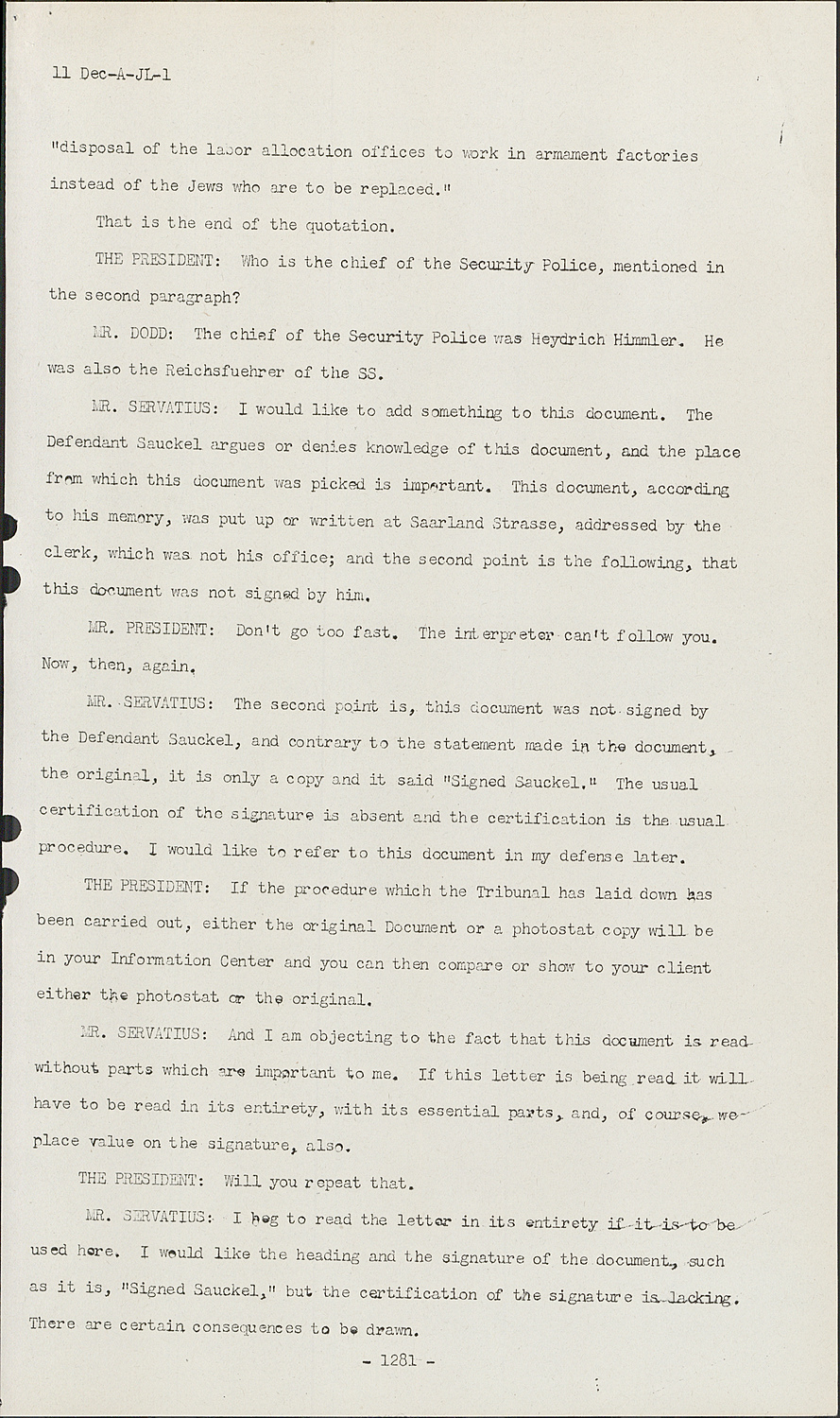
That is the end of the quotation.
THE PRESIDENT:Who is the chief of the Security Police, mentioned in the second paragraph?
MR. DODD:The chief of the Security Police was Heydrich Himmler. He was also the Reichsfuehrer of the SS.
MR. SERVATIUS:I would like to add something to this document. The Defendant Sauckel argues or denies knowledge of this document, and the place from which this document was picked is important. This document, according to his memory, was put up or written at Saarland Strasse, addressed by the clerk, which was not his office; and the second point is the following, that this document was not signed by him.
MR. PRESIDENT:Don't go too fast. The interpreter can't follow you. Now, then, again.
MR. SERVATIUS:The second point is, this document was not signed by the Defendant Sauckel, and contrary to the statement made in the document, the original, it is only a copy and it said "Signed Sauckel." The usual certification of the signature is absent and the certification is the usual procedure. I would like to refer to this document in my defense later.
THE PRESIDENT:If the procedure which the Tribunal has laid down has been carried out, either the original Document or a photostat copy will be in your Information Center and you can then compare or show to your client either the photostat or the original.
MR. SERVATIUS:And I am objecting to the fact that this document is read without parts which are important to me. If this letter is being read it will have to be read in its entirety, with its essential parts, and, of course, we place value on the signature, also.
THE PRESIDENT:Will you repeat that.
MR. SERVATIUS:I beg to read the letter in its entirety if it is to be used here. I would like the heading and the signature of the document, such as it is, "Signed Sauckel," but the certification of the signature is lacking. There are certain consequences to be drawn.
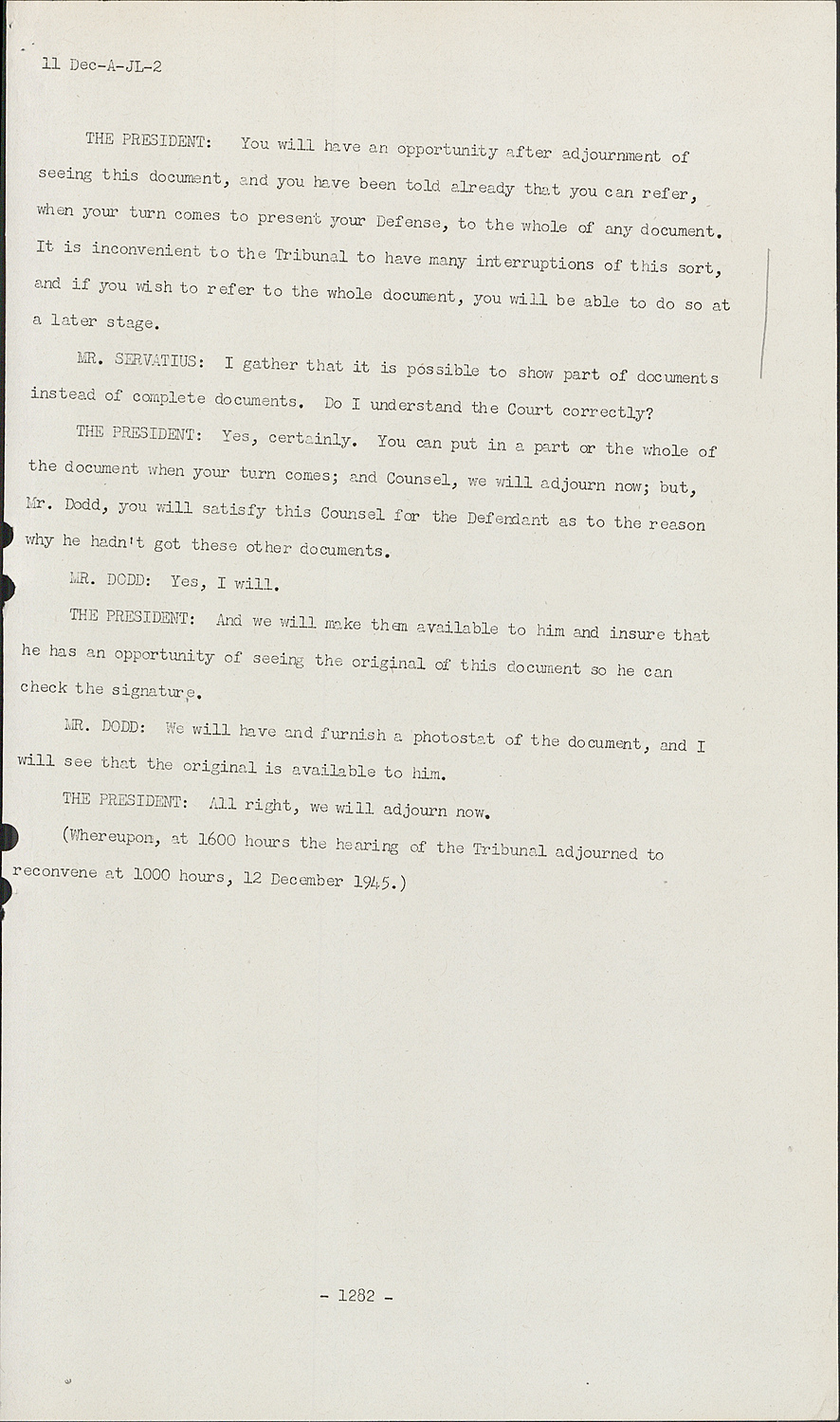
THE PRESIDENT: You will have an opportunity after adjournment of seeing this document, and you have been told already that you can refer, when your turn comes to present your Defense, to the whole of any document.
It is inconvenient to the Tribunal to have many interruptions of this sort, and if you wish to refer to the whole document, you will be able to do so at a later stage.
MR. SERVATIUS:I gather that it is possible to show part of documents instead of complete documents. Do I understand the Court correctly?
THE PRESIDENT:Yes, certainly. You can put in a part or the whole of the document when your turn comes; and Counsel, we will adjourn now; but, Mr. Dodd, you will satisfy this Counsel for the Defendant as to the reason why he hadn't got these other documents.
MR. DODD:Yes, I will.
THE PRESIDENT:And we will make than available to him and insure that he has an opportunity of seeing the original of this document so he can check the signature.
MR. DODD:We will have and furnish a photostat of the document, and I will see that the original is available to him.
THE PRESIDENT:All right, we will adjourn now.
(Whereupon, at 1600 hours the hearing of the Tribunal adjourned to reconvene at 1000 hours, 12 December 1945.)
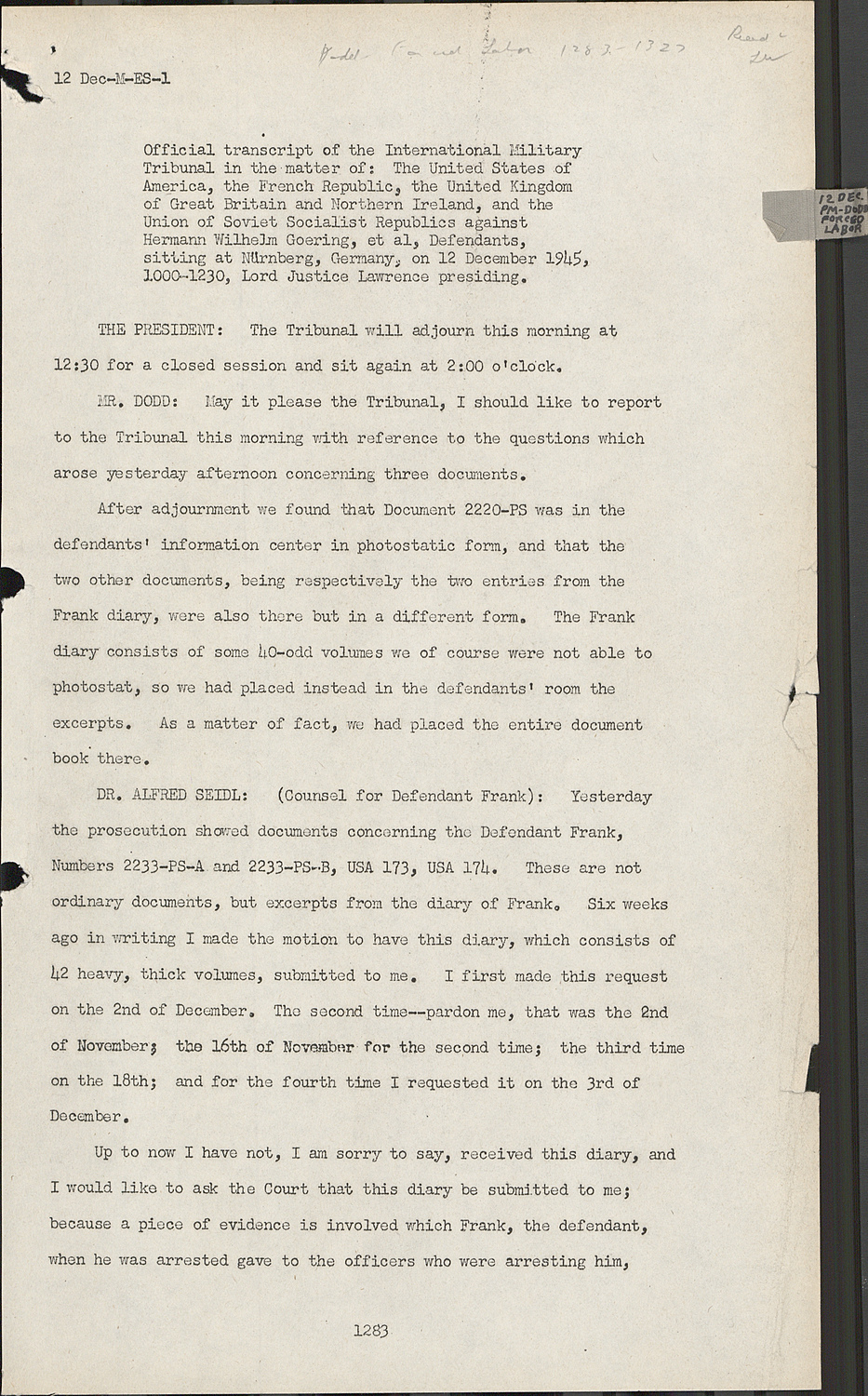
Official transcript of the International Military Tribunal in the matter of:
The United States of America, the French Republic, the United Kingdom of Great Britain and Northern Ireland, and the Union of Soviet Socialist Republics against Hermann Wilhelm Goering, et al, Defendants, sitting at Nuernberg, Germany, on 12 December 1945, 1000-1230, Lord Justice Lawrence presiding.
THE PRESIDENT:The Tribunal will adjourn this morning at 12:30 for a closed session and sit again at 2:00 o'clock.
MR. DODD:May it please the Tribunal, I should like to report to the Tribunal this morning with reference to the questions which arose yesterday afternoon concerning three documents.
After adjournment we found that Document 2220-PS was in the defendants' information center in photostatic form, and that the two other documents, being respectively the two entries from the Frank diary, were also there but in a different form. The Frank diary consists of some 40-odd volumes we of course were not able to photostat, so we had placed instead in the defendants' room the excerpts. As a matter of fact, we had placed the entire document book there.
DR. ALFREDSEIDL: (Counsel for Defendant Frank): Yesterday the prosecution shaved documents concerning the Defendant Frank, Numbers 2233-PS-A and 2233-PS-B, USA 173, USA 174. These are not ordinary documents, but excerpts from the diary of Frank. Six weeks ago in writing I made the motion to have this diary, which consists of 42 heavy, thick volumes, submitted to me. I first made this request on the 2nd of December. The second time--pardon me, that was the 2nd of November; the 16th of November for the second time; the third time on the 18th; and for the fourth time I requested it on the 3rd of December.
Up to now I have not, I am sorry to say, received this diary, and I would like to ask the Court that this diary be submitted to me; because a piece of evidence is involved which Frank, the defendant, when he was arrested gave to the officers who were arresting him, and this material is to serve in his favor.
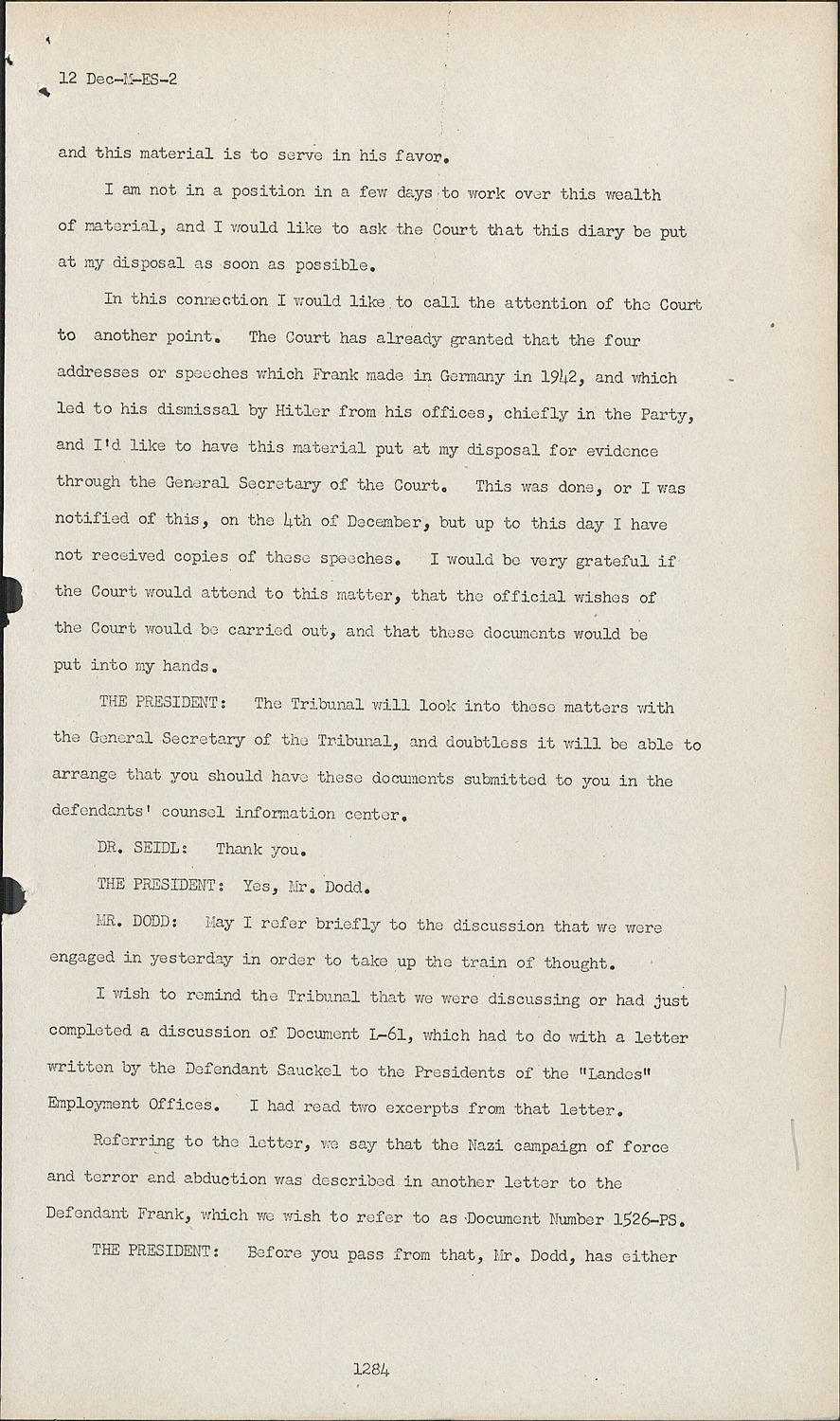
I am not in a position in a few days to work over this wealth of material, and I would like to ask the Court that this diary be put at my disposal as soon as possible.
In this connection I would like to call the attention of the Court to another point. The Court has already granted that the four addresses or speeches which Frank made in Germany in 1942, and which led to his dismissal by Hitler from his offices, chiefly in the Party, and I'd like to have this material put at my disposal for evidence through the General Secretary of the Court. This was done, or I was notified of this, on the 4th of December, but up to this day I have not received copies of these speeches. I would be very grateful if the Court would attend to this matter, that the official wishes of the Court would be carried out, and that these documents would be put into my hands.
THE PRESIDENT:The Tribunal will look into these matters with the General Secretary of the Tribunal, and doubtless it Trill be able to arrange that you should have these documents submitted to you in the defendants' counsel information center.
DR. SEIDL:Thank you.
THE PRESIDENT:Yes, Mr. Dodd.
MR. DODD:May I refer briefly to the discussion that we were engaged in yesterday in order to take up the train of thought.
I wish to remind the Tribunal that we were discussing or had just completed a discussion of Document L-61, which had to do with a letter written by the Defendant Sauckel to the Presidents of the "Landes" Employment Offices. I had read two excerpts from that letter.
Referring to the letter, we say that the Nazi campaign of force and terror and abduction was described in another letter to the Defendant Frank, which we wish to refer to as Document Number 1526-PS.
THE PRESIDENT:Before you pass from that, Mr. Dodd, has either the original or the photostatic copy been shown to Sauckel's Counsel?
MR. DODD:Oh, yes, sir. A photostatic copy was in the defendants' counsel information room, and after adjournment yesterday we got the original and handed it to him here in this room.
THE PRESIDENT:And he saw it?
MR. DODD:Yes, sir.
THE PRESIDENT:Very well.
MR. DODD:This document, Number 1526-PS, USA Exhibit 178, is a letter written by the Chairman of the Ukrainian Main Committee, at Cracow, in February 1943, and I wish to read from the third page of the English text, beginning with the second paragraph. The same passage appears in the German text at Page 2, Paragraph 5. I quote:
"The general nervousness is still more enhanced by the wrong methods of finding labor which have been used more and more frequently in recent months.
"The wild and ruthless man-hunt as exercised everywhere in towns and country, in streets, squares, stations, even in churches, at night in houses, has badly shaken the feeling of security of the inhabitants. Everybody is exposed to the danger, to be seized anywhere and at any time by members of the police, suddenly and unexpectedly, and to be brought into an assembly camp.
None of his relatives knows what has happened to him, only months later one or the other gives news of his fate by a postcard."
I wish to turn in this same document to enclosure 5 on Page 8 of this document, which I quote:
"In November of last year an inspection of all males of the age groups 1910 to 1920 was ordered in the area of Zaleschozyki (district of Czortkow). After the men had appeared for inspection, all those who were chosen were arrested at once, loaded into trains and sent to the Reich. Such recruiting of laborers for the Reich also took place in other areas of this district. Following some interventions the action was then stopped."
The resistance of the Polish people to this enslavement program and the necessity for increased force were described by Defendant Sauckel's deputy, one Timm, at a meeting of the Central Planning Board, which was, by the way, Hitler's war-time planning agency. It was made up of the Defendant Speer, Field Marshal Milch and State Secretary Koerner. The Central Planning Board was the highest level economic planning agency, exercising production controls by allocating raw materials and labor to industrial users.
Now, Document R-124, USA Exhibit No. 179. This document consists of excerpts from minutes of the meetings of this Central Planning Board, and minutes of conference between the Defendant Speer and Hitler. Only the excerpts, of course, from these minutes upon which we rely are being offered in evidence. I would say to the Tribunal, however, that the balance of the minutes are available, can be made available if the Tribunal so desires.
This deputy of Sauckel, his name being Timm, made a statement at the 36th Conference of the Central Planning Board, and it appears on Page 14, Paragraph 2, of the English text of Document R-124, and on Page 10, Paragraph 2, of the German text:
"Especially in Poland the situation at the moment is extraordinarily serious. It is well known that vehement battles occurred just because of these actions. The resistance against the administration established by us is very strong. Quite a number of our men have been exposed to increased dangers, and it was just in the last two or three weeks that some of them were shot dead, e.g., the Head of the Labor Office of Warsaw who was shot in his office, and yesterday another man again.
This is how matters stand presently, and the recruiting itself, even if done with the best will, remains extremely difficult unless police reinforcements are at hand."
Deportation and enslavement of civilians reached unprecedented levels in the so-called Occupied Eastern Territories. These wholesale deportations resulted directly from labor demands made by the Defendant Sauckel on the Defendant Rosenberg, who was the Reichsminister for the Occupied Eastern Territories, and his subordinates, and also on the Armed Forces demand made directly on the Armed Farces by the Defendant Sauckel.
On the 5th of October 1942, far example, the Defendant Sauckel wrote to the Defendant Rosenberg, stating that 2 million foreign laborers were required, and that the majority of these would have to be drafted from the recently occupied Eastern Territories and especially from the Ukraine.
I wish to refer at this point to Document 017-PS, which bears USA Exhibit Number 180. This letter from the Defendant Sauckel to the Defendant Rosenberg I wish to quite in full. It begins by saying:
"The Fuehrer has worked out new and most urgent plans for the armament which require the quick mobilization of two more million foreign labor forces. The Fuehrer therefore has granted me, for the execution of my decree of 21 March 1942, new powers for my new duties, and has especially authorized me to take whatever measures I think are necessary in the Reich, the Protectorate, the General Gouvernement, as well as in the occupied territories, in order to assure at all costs an orderly mobilization of labor for the German armament industry. The additional required labor force will have to be drafted for the majority from the recently occupied Eastern Territories, especially from the Reichskommissariat Ukraine. Therefore, the Reichskommissariat Ukraine must furnish:
"225,000 labor farces by 31 December 1942 and 225,000 more by 1 May 1942. "I ask you to inform Reichskommissar Gauleiter party fellow member Koch about the new situation and requirements and especially to see to it that he will support personally in any possible way the execution of this new requirement.
"I have the intention to visit Party member Koch shortly and I would be grateful to you if you could inform me as to where and when I could meet him for a personal discussion.
Right now though, I ask that the procurement be taken up at once with every possible pressure and the commitment of all powers, especially also of the experts of the Labor offices. All the directives which had limited temporarily the procurement of Eastern laborers are annulled. The Reichs procurement for the next months must be given priority over all other measures.
"I do not ignore the difficulties which exist for the execution of this new requirement, but I am convinced that with the ruthless commitment of all resources, and with the full cooperation of all those interested, the execution of the new demands can be accomplished for the fixed date. I have already communicated the new demands to the Reichskommissar Ukraine via mail. In reference to our long distance phone call of today I will send you the text of the Fuehrer's decree at the beginning of next week."
I should like to remind the Tribunal that we have referred previously on yesterday afternoon to this Reichskommissar Gauleiter Party fellow-member, Koch, and we quoted him as stating, the Tribunal will recall "We are the master race. We must be hard," etc.
On the 17th day of March 1943, the Defendant Sauckel wrote again to the Defendant Rosenberg, and on this occasion he demanded the importation of another 1,000,000 men and women from the Eastern territories within the following four months. I wish to refer at this point to Document No.019-PS, which bears USA Exhibit No. 181. Quoting that latter in full:
"After a protracted illness my Deputy for Labor Supply in the occupied Eastern Territories, State Councillor Peukert, is going there to regulate the labor supply both for Germany and the territories themselves.
"I ask you sincerely, dear party member Rosenberg, to assist him to your utmost on account of the pressing urgency of Peukert's mission.
Already now I may thank you for the hitherto good reception accorded to Peukert.
He himself has been charged by me with the absolute and completely unreserved cooperation with all bureaus of the Eastern Territories.
Especially the labor supply for the German agriculture, and likewise for the most urgent armament production programs ordered by the Fuehrer make the fastest importation of approximately 1 million women and men from the Eastern Territories within the next four months at most.
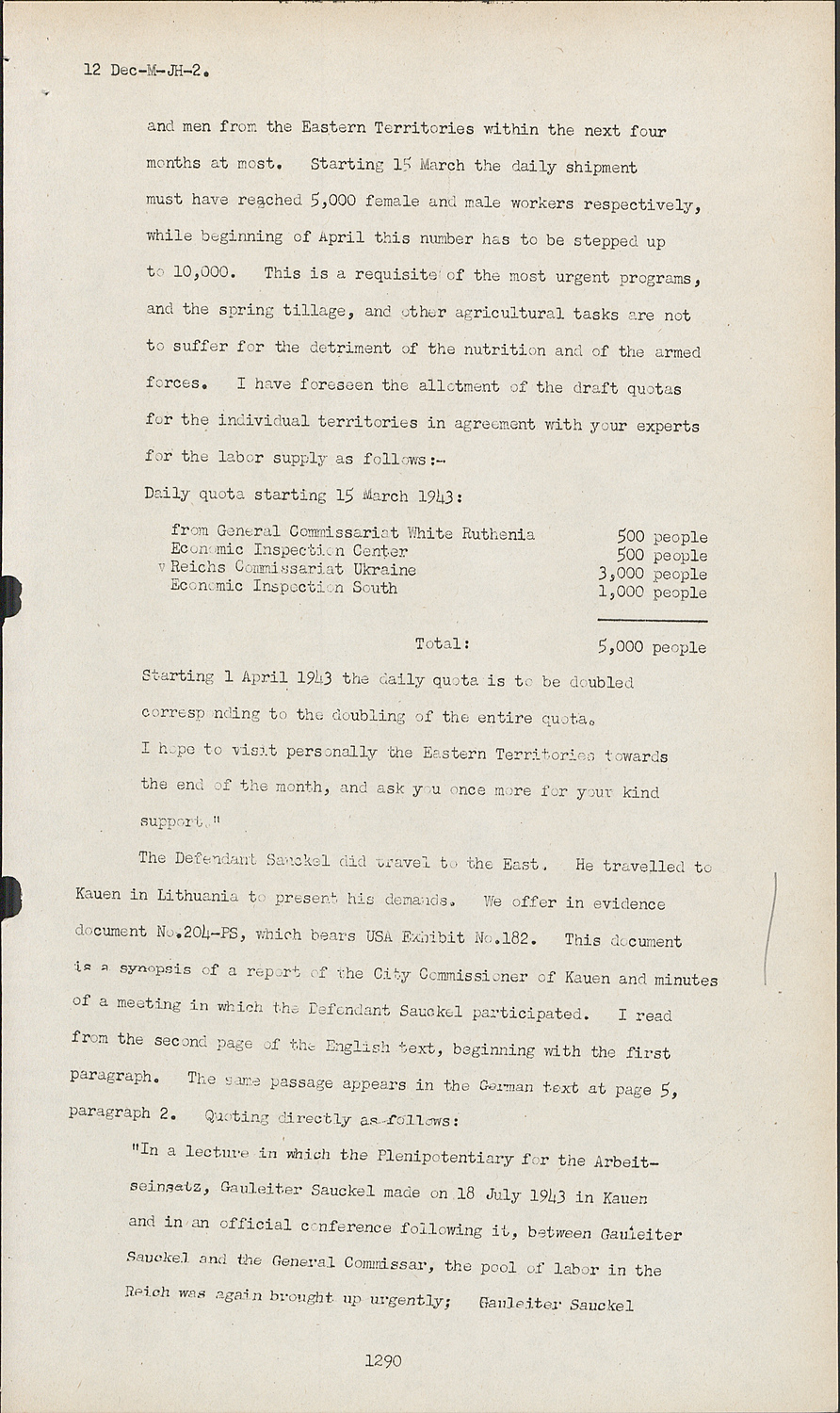
Starting 15 March the daily shipment must have reached 5,000 female and male workers respectively, while beginning of April this number has to be stepped up to 10,000.
This is a requisite of the most urgent programs, and the spring tillage, and other agricultural tasks are not to suffer for the detriment of the nutrition and of the armed forces.
I have foreseen the allotment of the draft quotas for the individual territories in agreement with your experts for the labor supply as follows:
Daily quota starting 15 March 1943:
from General Commissariat White Ruthenia 500 people Economic Inspection Center 500 people Reichs Commissariat Ukraine 3,000 people Economic Inspection South 1,000 people -----------Total:
5,000 people Starting 1 April 1943 the daily quota is to be doubled corresponding to the doubling of the entire quota.
I hope to visit personally the Eastern Territories towards the end of the month, and ask you once more for your kind support."
The Defendant Sauckel did travel to the East. He travelled to Kauen in Lithuania to present his demands. We offer in evidence document No.204-PS, which bears USA Exhibit No.182. This document is a synopsis of a report of the City Commissioner of Kauen and minutes of a meeting in which the Defendant Sauckel participated. I read from the second page of the English text, beginning with the first paragraph. The same passage appears in the German text at page 5, paragraph 2. Quoting directly as follows:
"In a lecture in which the Plenipotentiary for the Arbeit seinsatz, Gauleiter Sauckel made on 18 July 1943 in Kauen and in an official conference following it, between Gauleiter Sauckel and the General Commissar, the pool of labor in the Reich was again brought up urgently; Gauleiter Sauckel again demanded that Lithuanian labor be furnished in greater volume for the purposes of the Reich."
THE PRESIDENT:Who was the General Commissar, Rosenberg?
MR. DODD:The Plenipotentiary for the Arbeitseinsatz?
THE PRESIDENT:No, the General Commissar.
MR. DODD:His name is not known to us. He was apparently a local functionary in the Party.
THE PRESIDENT:Very well.
MR. DODD:The Defendant Sauckel also visited Riga in Latvia, to assert his demands, and the purpose of this visit is described in Document No.2280-PS, bearing USA Exhibit No.183. This document is a letter from the Reich Commissar for the Ostland to the Commissioner General in Riga and it is dated the 3rd of May 1943. I wish to read from page 1 of the English text, beginning with the first paragraph:
"Following the basic statements of the Plenipotentiary General for manpower, Gauleiter Sauckel on the occasion of his visit to Riga on the 21st of April 1943, it was decided in view of the critical situation and in disregard of all adverse considerations, that a total of 183,000 workers have to be supplied from the Ostland for the Reich territory.
This task must absolutely be accomplished within the next four months and at the latest must be completed by the end of August."
Here again we are not informed as to the name identity of the Reich Commissar for the Ostland.
Sauckel asked the German Army for assistance in the recruitment and deportation of civilian labor from the Eastern Territories. We refer now to Document No.3010-PS, which bears USA Exhibit No.184.
THE PRESIDENT:Mr. Dodd, were you saying that it wasn't known from whom that document emanated?
MR. DODD:No, sir. We say it is a letter from the Reichskommissar for the Ostland to the Commissioner General in Riga, but we don't know their names specifically at the time of the writing of the letter.
THE PRESIDENT:You don't know who the Reichskommissar of the Eastern Territories was?
MR. DODD:We don't know him by that title, "The Reichskommissar for the Ostland".
THE PRESIDENT:Very well.
MR. DODD:Lohse, I am now informed, was his name. I understood that we did not know it. Lohse, L-o-h-s-e.
THE PRESIDENT:All right.
MR. DODD:Referring to this Document 3010-PS, this document is a secret organization order of the Army Group South, dated the 17th day of August, 1943. I wish to read from the first page of the English text, the first two paragraphs, as follows:
"The Plenipotentiary General for Labor Employment ordered the recruitment and employment of all born during two years for the whole, newly occupied Eastern territory in Decree Az.
VIA 5780.28 (Inclosure 1), copy of which is inclosed.
The Reich Minister for Armament and Munition approved this order.
"According to this order by the Plenipotentiary General for Labor Employment (BGA) you have to recruit and to transport to the Reich immediately all labor force in your territory born during 1926 and 1927.