The Government of the Reich guarantees Belgium's European and colonial territory, as well as her dynasty, on condition that no resistance is offered.
Should there be any resistance, Belgium will risk the destruction of her country and loss of her independence. It is therefore, in the interests of Belgium that the population be called upon to cease all resistance and that the authorities be given the necessary instructions to make contact with the German Military Commend."
My Lord, the so-called ultimatum handed in some hours after the invasion had started, is Document TC-57, which is the last document of three in the bundle. It is the document I handed in and it becomes GB-112. My Lord, it is a long document and I will read to the Tribunal such parts at the Tribunal thinks advisable:
"The Reich Government" - it begins - "has for a long time had no doubts as to what was the chief aim of the British and French war policy. It consists of the spreading of the war to other countries, and of the misuse of their peoples as auxiliary and mercenary troops for England and France.
"The last attempt of this sort was the plan to occupy Scandinavia with the help of Norway, in order to set up a now front against Germany in this region. It was only Germany's last minute action which upset the projects. Germany has furnished documentary evidence of this before the eyes of the world.
"Immediately after the British-French action in Scandinavia miscarried, England and France took up their policy of war expansion in another direction. In this respect, while the retreat in flight of the British troops from Norway was still going on, the English Prime Minister announced that, as a result of the altered situation in Scandinavia, England was once more in a position to go ahead with the transfer of the full weight of her navy to the Mediterranean, and that English and French units were already on the way to Alexandria. The Mediterranean now became the centre of English-French war propaganda. This was partly to gloss over the Scandinavian defeat and the big loss of prestige before their own people and before the world, and partly to make it appear that the Balkans had been chosen for the next theatre of war against Germany.
"In reality, however, this apparent shifting to the Mediterranean of English-French war policy had quite another purpose.
It was nothing but a diversion manoeuvre in grand style, to deceive Germany as to the direction of the next English-French attack. For, as the Reich Government has long been aware, the true aim of England and France is the carefully prepared and now immediately imminent attack on Germany in the West, so as to advance through Belgium and Holland to the region of the Ruhr.
"Germany has recognized and respected the inviolability of Belgium and Holland, it being of course understood that these two countries in the event of a war of Germany against England and France would maintain the strictest neutrality.
"Belgium and the Netherlands have not fulfilled this condition."
THE PRESIDENT:Mr. Roberts, do you think it is necessary to read this in full?
MR. ROBERTS:No, I don't. I was going to summarize these charges. If your Lordship would be good enough to look at the bottom of the first Page, you will see the so-called ultimatum complaining of the hostile expressions in the Belgian and Netherlands Press; and then, My Lord, in the second paragraph, over the page, there is an allegation of the attempts of the British Intelligence to bring a revolution into Germany with the assistance of Belgium and the Netherlands.
Then, My Lord, in paragraph three, reference is made to military preparation of the two countries; and in paragraph four, it is pointed out that Belgium has fortified the Belgium Frontier.
A complaint is made in regard to Holland in paragraph five, that British aircraft have flown over the Netherlands country.
There are, My lord, other charges made against the neutrality of these two countries, although no instances are given. I don't think I need refer to anything on page three of the Document.
Page four, My Lord, I would like, if I might, to read the middle paragraph:
"In this struggle for existence forced upon the German people by England and France, the Reich Government is not disposed to await sub missively the attack by England and France and to allow them to carry the war over Belgium and the Netherlands into German territory."
And, My Lord, I just emphasize this sentence and then I read no further. "It has therefore now issued the command to German troops to ensure the neutrality of these countries by all the military means at the disposal of the Reich."
My Lord, it is unnecessary, in my submission, to emphasize the falsity of that statement. The world now knows that for months preparations had been made to violate the neutrality of these three countries. This Document is saying "The orders to do so have now been issued."
My Lord, a similar Document, similar in terms altogether, was handed to the representatives of the Netherlands Government; and, My Lord, TC 60, that will be GB 113, which is the last Document but one in the bundle. My Lord, that is a memorandum to the Luxemberg Government, which enclosed with it a copy of the Document handed to the Governments of Belgium and the Netherlands.
My Lord, I only desire to emphasize the second paragraph of TC 60: "In defence against the imminent attack, the German troops have now received the order to safeguard the neutrality of these two countries ***".
My Lord, the last Document TC 59, which I formerly put in, that is I am told, BG 111. It is in.
My Lord, that is the dignified protest of the Belgium Government against the crime which was committed against her. My Lord, those are the facts supporting the charges of the violation of treaties and assurances against these three countries and supporting the allegation of the making of an aggressive war against them. My Lord, in the respectful submission of the Prosecution here, the story is a very plain, a very simple one, a story of perfidy, dishonor, and shame.
COLONEL PHILLIMORE:May it please the Tribunal, it is my task to present the evidence on the wars of aggression and wars in breach of treaties against Greece and Yugoslavia. The evidence which I shall put in to the Tribunal has been prepared in collaboration with my American colleague, Lt. Colonel Krucker.
The invasion of Greece and Yugoslavia by the Germans, which took place in the early hours of the morning of the 6th of April, 1941, constituted direct breaches of The Hague Convention of 1899, on the pacific settlement of international disputes and of the Kellogg-Briand Pact of 1928. Those breaches are charged, respectively, at paragraphs one and thirteen of Appendage C of the Indictment. Both have already been put in by my learned friend, Sir David Maxwell-Fyfe, who also explained the obligation of the German Government to the Governments of Yugoslavia and Greece under those Pacts.
In the case of Yugoslavia, the invasion further constituted a breach of an expressed assurance by the Nazis, which is charged at Paragraph 26 of Appendage C. This assurance was originally given in a German Foreign Office release made in Berlin on the 28th of April, 1938, but was subsequently repeated by Hitler himself on the 6th of October 1939, in a speech he made in the Reichstag, and it is in respect of this last occasion that the assurance is specifically pleaded in the Indictment.
May I ask the Tribunal to turn now to the first document in the Document Book, which is Book No. 5. The first Document is PS 2719, which has already been put in as GB 58. This is the text of the German Foreign Office release on the 28th of April, 1938, and I would read the beginning and then the last paragraph but one on the page:
"Berlin, 28 April 1938. The State Secretary of the German Foreign Office to the German Diplomatic Representatives.
"As a consequence of the re-union of Austria with the Reich, we have now new frontiers with Italy, Yugoslavia, Switzerland, Liechtenstein, and Hungary. These frontiers are regarded by us as final and inviolable. On this point the following special declarations have been made:
And then to the last paragraph:
"3. Yugoslavia.
"The Yugoslav Government have been informed by authoritative German quarters that German policy has no aims beyond Austria, and that the Yugoslav frontier would in any case remain untouched. In his speech made at Graz on 3 April, the Fuehrer and Chancellor stated that, in regard to the re-union of Austria, Yugoslavia and Hungary had adopted the same attitude as Italy. We were happy to have frontiers there which relieved us of all anxiety about providing military protection for them.
Then I may pass to the second document in the book, TC 92, and offer that as GB 114.
This is an extract from a speech made by Hitler on the occasion of the dinner in honor of the Prince Regent of Yugoslovia on June 1, 1939. I may read the extract in full:
"The German friendship for the Yugoslav nation is not only a spontaneous one.
It gained depth and durability in the midst of the tragic confusion of the world, war.
The German soldier then learned, to appreciate and respect his extremely brave opponent.
I believe that this feeling was reciprocated. This mutual res pect finds confirmation in common political, cultural and economic interests.
We therefore look upon your Royal Highness's present visit as a living proof of the accuracy of our view, and at the same time on that account we derive from it the hope that German-Yugoslav friendship may continue further to develop in the future and to grow ever closer.
"In the presence of your Royal Highness, however, we also per ceive a happy opportunity for a frank and friendly exchange of views which, and of this I am convinced, in this sense can only be fruitful to our two peoples and States.
I believe this all the more because a firmly established reliable relationship of Germany and Yugoslavia, now that, owing to historical events, we have become neighbors with common boundaries fixed for all time, will not only guarantee lasting peace between our two peoples and countries, out can also represent an element of calm to our nerve-wracked continent.
This peace is the goal of all who are disposed to perform really constructive work."
Just to pause to comment, that as we now know this speech was made at the time when Hitler had already decided upon the European war. I think I am right in saying it was a week after the Reichschancellery conference known as the Schmundt note, to which the Tribunal was referred more than once. The reference to "nerve-wracking continent" might perhaps be contributed to the war of nerve which Hitler had himself been conducting for many months.
Now I pass on to a document which is specifically applied at para-
graph 26 as the Assurance Breach, the next document in the bundle, TC 43. German Assurance to Yugoslavia of the 6 October 1939, and which has already been put in as GB 80. This is the extract from the document on "Dokumente der deutschen Politik:
"Immediately after the completion of the Anschluss I informed Yugoslavia that, from now on, the frontier with this country would also be an unalterable one, and that we only desire to live in peace and friendship with her."
That, despite the obligation of Germany under the Convention of 1899, and the Kellogg-Briand Pact, and under the Assurance which I have read, the fate of both Greece and Yugoslavia had, as we now know, been sealed ever since the meeting between Hitler and the defendant Ribbentrop and Ciano at Obersalzburg, the 12th and 13th of August. 1939.
We will pass to the next bundle-the next document in the bundle which is TC 77. That document has already been put in as GB 48, and the passages to which I would draw Your Honor's attention are and have been already quoted, I think, by my learned friend, the Attorney General; those passages are on page 2 in the last paragraph: "Very generally speaking until neutral discordant," and then again on pages 7 and 8, which is a part quoted by the Attorney General, and particularly by Colonel Jones, the foot of page 7, on the second day of the meeting, the words beginning, "In general, however, success by one of tire Axis partners--" to Italy to - "their backs free for a work against the west."
THE PRESIDENT:Is that not quoted?
COLONEL PHILLIMORE:Yes, sir
THE PRESIDENT:Was not page 7 quoted before?
COLONEL PHILLIMORE:Both of these passages have been quoted before, and if I might sum up the effect of the meeting as revealed by the document as a whole, it shows Hitler and the defendant Ribbentrop only two the months after/dinner to the Prince Regent seeking to persuade Italy to make war on Yugoslavia at the same time that Germany commences hos-tilities against Poland, as Hitler had decided to do in the near future.
Ciano was evidently in an entire agreement with Hitler and Ribbentrop as to the desirability to liquid ting Yugoslavia, and himself anxious to take the Silician State, but that Italy was not yet ready for a general European war. This despite all these persuasions which Hitler and the defendant Ribbentrop exerted at the meeting, it became necessary for the Nazi conspirators to reassure their intended victim, Yugoslavia, and since that time for Italy to maintain its position, and don't enter a war when German invaded Poland, because the Germans were not ready themselves to strike on the Balkans. I state for this reason that on the 6th October through Hitler's speech, they repeated the assurance they had made in April 1938. This matter is shortened up after the defeat of the Allied Army in May and June 1940, the Italian Government declared war on France, and that subsequently at three o'clock in the morning on the 28th October 1940 the Italian Minister presented to the Greek Government with a 3-R ultimatum, upon the expiring of which the Italian troops were all invading the soil of Greece.
If I may quote to the Tribunal the words in which the Italian Minister reported that event. "The president of council has assured himself an outstanding--"
THE PRESIDENT:You have referred, to a document?
COLONEL PHILLIMORE:It is not in any one document. It is merely carrying the story to the next document. "The president of council has assured himself an outstanding place in Greek history, and then the future may bring this foresight and quality in preparing his country for war, and his courage in rejecting without demur the Italian ultimatum when delivered in the small hours of that October morning, will surely obtain an honorable mentioning in the story of European statescraft. That means to fight until Italy is completely defeated, and thus declare the purpose of the whole Greek nation."
I turn now to the next document in that bundle, that is, PS 2762, a letter from Hitler to Mussolini, which I put in as GB 115.
They are not related. I think this is clear from the contents, that it was written shortly after the Italian invasion of Greece. It has been quoted in full by the Attorney General, but I think it would assist the Tribunal if I read just the last two paragraphs of the extract:
"Jugoslavia must become disinterested, but if possible by even being positively interested in our point of view, cooperate in cleaning up the Greek question.
Without security on the part of Jugoslavia, no successful operation in the Balkans is to be risked.
* - - - - - - - - - * "I must, however, unfortunately, observe that conducting a war in the Balkans is not possible before March.
Therefore, any threatening move towards Jugoslavia would be useless, since the impossibility of a materialization of such threats before March is well known to the Serbian general staff.
Therefore, Jugoslavia must be won, if at all possible, by other ways and means."
I think the reference in the first two lines of his having been with Mussolini for the last fourteen days indicates probably that was about the middle of November, about that, of the Italian attack.
THE PRESIDENT:Could you give us the date of the Italian attack?
COLONELPHILLIMORE: 28 November 1940.
THE PRESIDENT:Thank You.
COLONEL PHILLIMORE:You are welcome. As the Tribunal will see from the succeeding document, it was at this time that Hitler was making plans for the offensive in the Spring of 1941, which included the invasion of Greece from the north.
Only from this letter is to compare how it was an integral part of those pacts that Jugoslavia should be introduced to cooperate, and how useless to maintain an disinterested attitude towards the liquidation of the other Balkan States.
I pass now to the next document in the bundle PS-44, which becomes GB-116.
It is a "Top Secret Directive." It is from an issue from Fuehrer's Headquarters, signed by Hitler, and initialed by the defendant, Jodl, dated 12 November 1940.
I may read the first two lines, and then pass to paragraph 4 on the third page:
"Directive No. 18.
The preparatory measures of Supreme HQ for the prosecution of the war in the near future are to be made along the following lines:"
Then after reading the operations as bearing against Gibralter, and its offensive against Egypt, we will read paragraph four on the third page:
"Balkans The commander-i n-chief of the Army will make preparations for occupying the Greek mainland north of the Eagean Sea in case of need, entering through Bulgaria, and thus make possible the use of German air force units against targets in the Eastern Mediterranean, in particular against those English air bases which are threatening the Rumanian oil area.
"In order to be able to face all eventualities and keep Turkey in check, the use of an army group of an approximate strength of ten divisions is to be the basis for the planning and the calculations of deployment.
It will not be possible to count on the railway, leading through Yugoslavia, for moving these forces into position.
"So as to shorten the time needed for the deployment, preparations will be made for an early increase in the German Army mission in Roumania, the extent of which must be submitted to me.
The commander-in-chief of the Air Force will make preparations for the use of German Air Force units in the South East Balkans and for aerial reconnaissance on the southern border of Bulgaria, in accordance with the intended ground operations."
I don't think I need trouble the Tribunal with the rest. The next document in the bundle is PS-1541, which I offer in evidence as GB-117.
That is a Directive issued for an actual attack on Greece. Before reading it might be convenient if I summarized the position of the Italian in vading forces at that time, as this is one of the factors mentioned by Hitler in the Directive.
I will make it very short. I can use the words of the Reichsminister as reported:
"Morale of the Greek Army throughout, has been at the highest and our own naval and land forces at the front has done much to maintain it.
The relative power of modern facilities has driven back the captured superior Italian forces more frequently than now at the point of abandonment.
The modern Greeks have thus shown that they are not unworthy of the ancient tradition of that country, and that they like their distant forebearers are prepared to fight against us in main taining their freedom."
In fact, the Italians were getting the worse of it, and it was time that Hitler came to the rescue.
On quoting this Directive of 17 September 1940 which the Top Military Secret, Direction number 20:
Operation Marita, and it shows the distribution of it, of course, to the Commander of the Navy, that would, of course include the defendant Raeder;one to the Commander of the Air Force, which would be the defendant Goering.
The Supreme Command of the Armed Forces, Keitel, and the Command Staff, I take it, would, rightly be the defendant Jodl.
I shall read first the two paragraphs, and then summarize the next two, if I may:
"The result of the battles in Albania is not yet decisive.
Because of a dangerous situation in Albania it is double necessary that the British endeavour be foiled to create a basis under the protection of a Balkan front, which would be dangerous above all to Italy as well as to the Rumanian oil fields.
My plan, therefore, is (a) to form a slowly increasing task force in Southern Rumania within the next months.
(b) After the setting in of favorable weather, probably in March, to send the task force for the occupation of the Aegean North coast by way of Bulgaria, and if necessary to occupy the entire Greek mainland (Operation Marita) The support of Bulgaria is to be expected."
The next paragraphs give the forces, and then the operation, and para graph 4 is the operation Marita itself.
You will perhaps read back:
"The Military preparations which will produce exceptional political results in the Balkans demands the exact control of all the necessary measures by the General Staff.
The transport through Hungary, and the arrival in Rumania will be reported step by step by the General Staff of the Armed forces, and are to be explained at first as a strengthening of the German Army mission in Rumania.
"Consultations with the Rumanians, or the Bulgarians which may point intentions as well as notification of the Italians are each sub ject to my consent, also the sending of scouting missions and advanced parties."
I don't think I'll trouble you going over the rest. Referring to the next document, PS-448, which I put in as GB-118, is again a "Top Secret Directive" carrying the plan a little farther, but which deals with decisiv action of the Turkey forces, and of the Italians in Albania.
I read, if I may, the first short paragraph, and then the paragraph at the foot of the page.
"The situation in the Mediterranean Theater of Operations de mands for strategical political and psychological reasons German assistance, due to employment of superior forces by England against our allies."
And the paragraph three, after dealing with the forces to be trans ferred to Albania, the Directive sets out the duty of the German forces, what the duties of the German forces will be:
"a) To serve in Albania for the time being as a reserve for an emergency case, should new crisis arise there.
b) To ease the burden of the Italian Army group when later attacking with the aim:
To tear open the Greek defense front on a decisive point for a far-reaching operation.
To open up the straits west of Salonika from the back in order to support thereby the frontal attack of List's Army."
That directive was signed by Hitler, and, as can be seen on the original which I have put in, it was initialed by both the Defendant Keitel and the Defendant Jodl.
Here again, of course a copy went to the Defendant Raeder, and I take it that for Intelligence it would probably reach the Defendant Ribbentrop.
I pass to C-134, the next document in the bundle, which becomes GB-119. This records a conference which took place on the 19th and 20th of January between the Defendant Keitel and the Italian General, Guzzoni, and which was followed by a meeting between Hitler and Mussolini, at which the Defendants Ribbentrop, Keitel, and Jodl Were present.
I need not trouble the Tribunal with the meeting with the Italians, but if you would pass to Page 3 of the document there is a paragraph there in the speech which the Fuehrer made which is perhaps just worth reading, the speech by the Fuehrer on the 20th of January 1941, in the middle of Page 3. It sets out that the speech was made after the conference with the Italians and then shows who was present.
On the German side I would call your attention to the Minister of Foreign Affairs, Chief of the Supreme Command of the Armed Forces, and the Chief of the Armed Forces Operational Staff. That is, of course, the Defendants Ribbentrop, Keitel, and Jodl; and on the Italian side, the Duce, Ciano, and then the General.
It is the last paragraph that I would wish to read:
"The massing of troops in Romania serves a threefold purpose:
"a. An operation against Greece.
"b. Protection of Bulgaria against Russia and Turkey.
"c. Safeguarding the guarantee to Roumania.
"Each of these tasks requires its own group of forces, altogether therefore very strong forces whose deployment far from our base requires a long time.
"Desirable that this deployment is completed without interference from the enemy. Therefore disclose the game as late as possible. The tendency will be to cross the Danube at the last possible moment and to line up for attack at the earliest possible moment."

I pass to the next document, PS-1746, which I offer as GB-120. That document is in three parts.
It consists, in the first place, of a conference between Field Marshal List and the Bulgarians, on the 8th of February.
The Second part and the fifth part deal with later events, and I will, if I may, come back to them at an appropriate time.
I would read the first and the last paragraphs on the first page of this document.
"Minutes of questions discussed between the representatives of the Royal Bulgarian General Staff and the German Supreme Command - General Field Marshal List - in connection with the possible movement of German troops through Bulgaria and their commitment against Greece and possibly against Turkey, if she should involve herself in the war."
And then the Last paragraph on the page shows the plan being concerted with the Bulgarians:
Paragraph 3: "The Bulgarian and the German general staff will take all measures in order to camouflage the preparation of the operations and to assure in this way the most favorable conditions for the execution of the German operations as planned.
"The representatives of the two general staffs consider it to be suitable to inform their governments that it will be good to take the necessity of secrecy and surprise into consideration when the three-power treaty is signed by Bulgaria in order to assure the success of the military operations."
I pass then to the next document, C-59. I offer that as GB-121. It is a further top secret directive of the 19th of February. I need not, I think, read it. All that is set out of importance is the date for the Operation Marita. It sets out that the bridge across the Danube is to be begun on the 28th of February, the river crossed on the 2nd of March, and the final orders to be issued on the 26th of February at the latest.
It is perhaps worth noting that on the original which I have put in the actual dates are filled in in the handwriting of the Defendant Keitel.
It is perhaps just worth setting out the position of Bulgaria at this moment. Bulgaria adhered to the three-power pact on the 1st of March-
THE PRESIDENT: What year?
COL. H. PHILLIMORE:Of 1941. And on the same day the entry of German troops into Bulgaria began in accordance with the Plan Marita and the directives to which I have referred the Tribunal.
The landing of British troops in Greece on the 3d of March, in accordance with the guarantee given in the spring of 1939 by His Majesty's Government, may have accelerated the movement of the German forces; but, as the Tribunal will have seen, the invasion of Greece had been planned long beforehand and was already in progress at this time.
I pass now to the next document in the bundle, C-167, which I would put in as GB-122. I am afraid it is not a very satisfactory copy, but the original which I have put in shows that both the Defendants Keitel and Jodl were present at the interview with Hitler which this extract records.
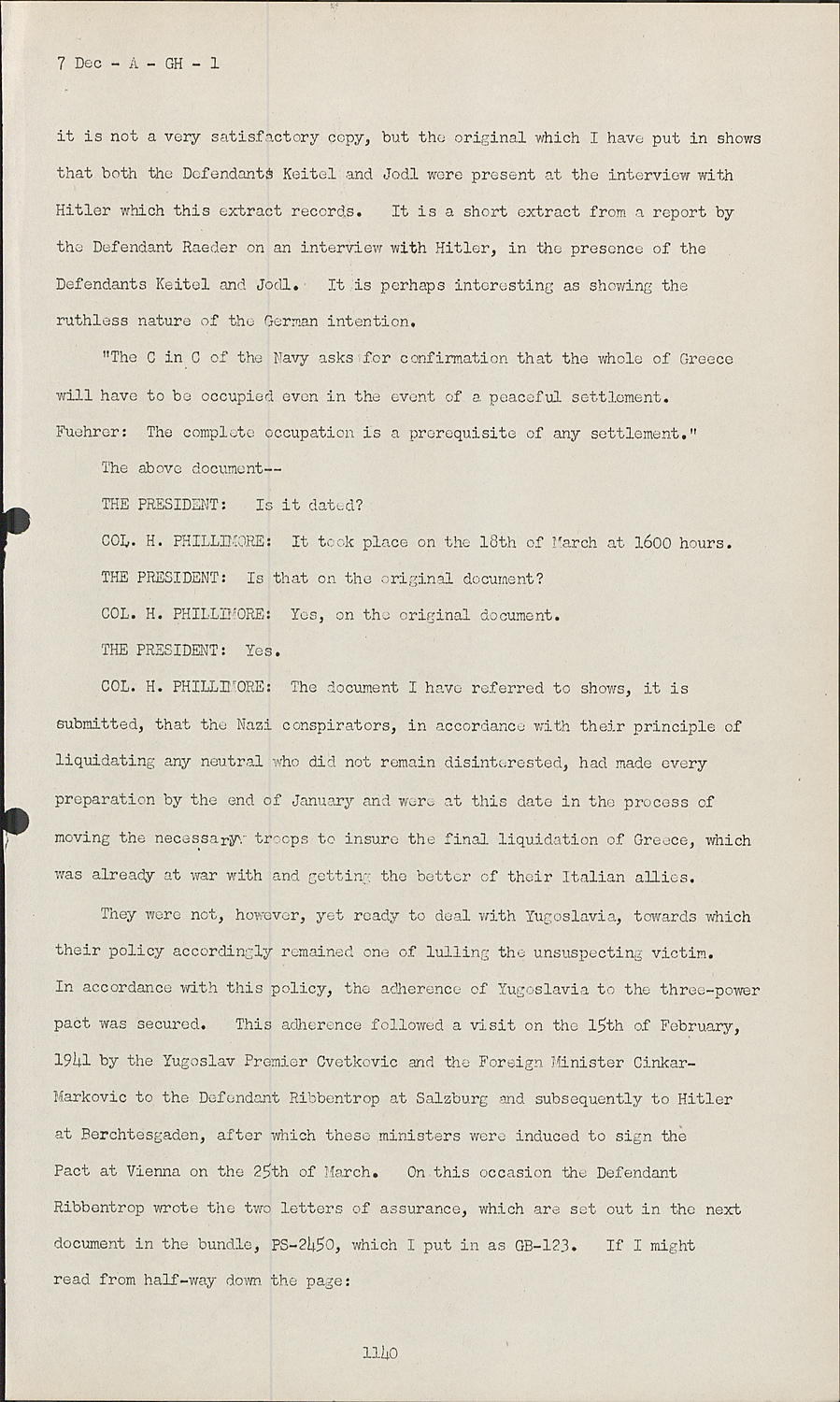
It is a short extract from a report by the Defendant Raeder on an interview with Hitler, in the presence of the Defendants Keitel and Jodl. It is perhaps interesting as showing the ruthless nature of the German intention.
"The C in C of the Navy asks for confirmation that the whole of Greece will have to be occupied even in the event of a peaceful settlement. Fuehrer: The complete occupation is a prerequisite of any settlement."
The above document-
THE PRESIDENT:Is it dated?
COL. H. PHILLIMORE:It took place on the 18th of March at 1600 hours.
THE PRESIDENT:Is that on the original document?
COL. H. PHILLIMORE:Yes, on the original document.
THE PRESIDENT:Yes.
COL. H. PHILLIMORE:The document I have referred to shows, it is submitted, that the Nazi conspirators, in accordance with their principle of liquidating any neutral who did not remain disinterested, had made every preparation by the end of January and were at this date in the process of moving the necessary troops to insure the final liquidation of Greece, which was already at war with and getting the better of their Italian allies.
They were not, however, yet ready to deal with Yugoslavia, towards which their policy accordingly remained one of lulling the unsuspecting victim. In accordance with this policy, the adherence of Yugoslavia to the three-power pact was secured. This adherence followed a visit on the 15th of February, 1941 by the Yugoslav Premier Cvetkovic and the Foreign Minister CinkarMarkovic to the Defendant Ribbentrop at Salzburg and subsequently to Hitler at Berchtesgaden, after which these ministers were induced to sign the Pact at Vienna on the 25th of March. On this occasion the Defendant Ribbentrop wrote the two letters of assurance, which are set out in the next document in the bundle, PS-2450, which I put in as GB-123. If I might read from half-way down the page:
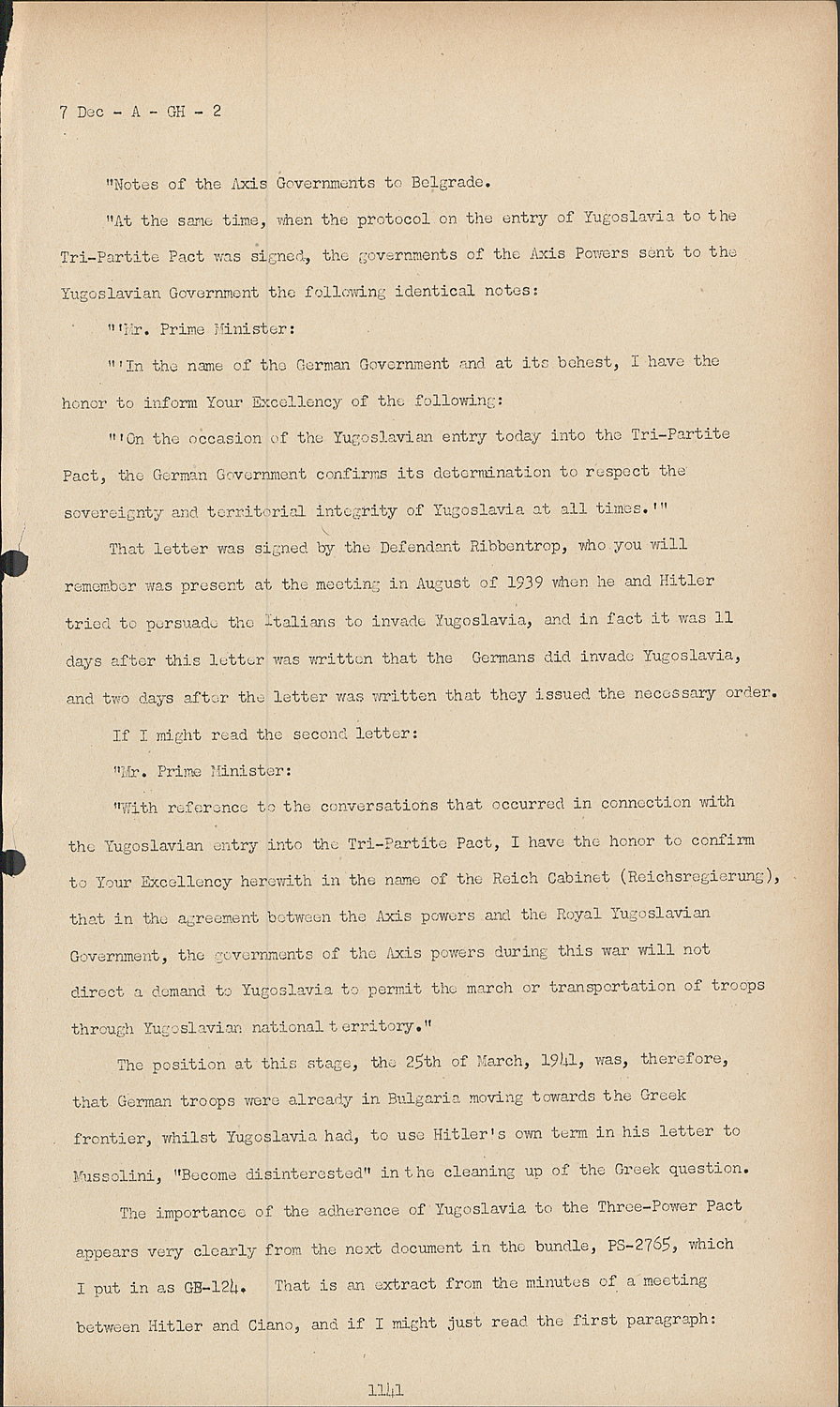
"Notes of the Axis Governments to Belgrade.
"At the same time, when the protocol on the entry of Yugoslavia to the Tri-Partite Pact was signed, the governments of the Axis Powers sent to the Yugoslavian Government the following identical notes:
"'Mr. Prime Minister:
"'In the name of the German Government and at its behest, I have the honor to inform Your Excellency of the following:
"'On the occasion of the Yugoslavian entry today into the Tri-Partite Pact, the German Government confirms its determination to respect the sovereignty and territorial integrity of Yugoslavia at all times.'" That letter was signed by the Defendant Ribbentrop, who you will remember was present at the meeting in August of 1939 when he and Hitler tried to persuade the Italians to invade Yugoslavia, and in fact it was 11 days after this letter was written that the Germans did invade Yugoslavia, and two days after the letter was written that they issued the necessary order.
If I might read the second letter:
"Mr. Prime Minister:
"With reference to the conversations that occurred in connection with the Yugoslavian entry into the Tri-Partite Pact, I have the honor to confirm to Your Excellency herewith in the name of the Reich Cabinet (Reichsregierung), that in the agreement between the Axis powers and the Royal Yugoslavian Government, the governments of the Axis powers during this war will not direct a demand to Yugoslavia to permit the march or transportation of troops through Yugoslavian national territory."
The position at this stage, the 25th of March, 1941, was, therefore, that German troops were already in Bulgaria moving towards the Greek frontier, whilst Yugoslavia had, to use Hitler's own term in his letter to Mussolini, "Become disinterested" in the cleaning up of the Greek question.
The importance of the adherence of Yugoslavia to the Three-Power Pact appears very clearly from the next document in the bundle, PS-2765, which I put in as GB-124. That is an extract from the minutes of a meeting between Hitler and Ciano, and if I might just read the first paragraph:
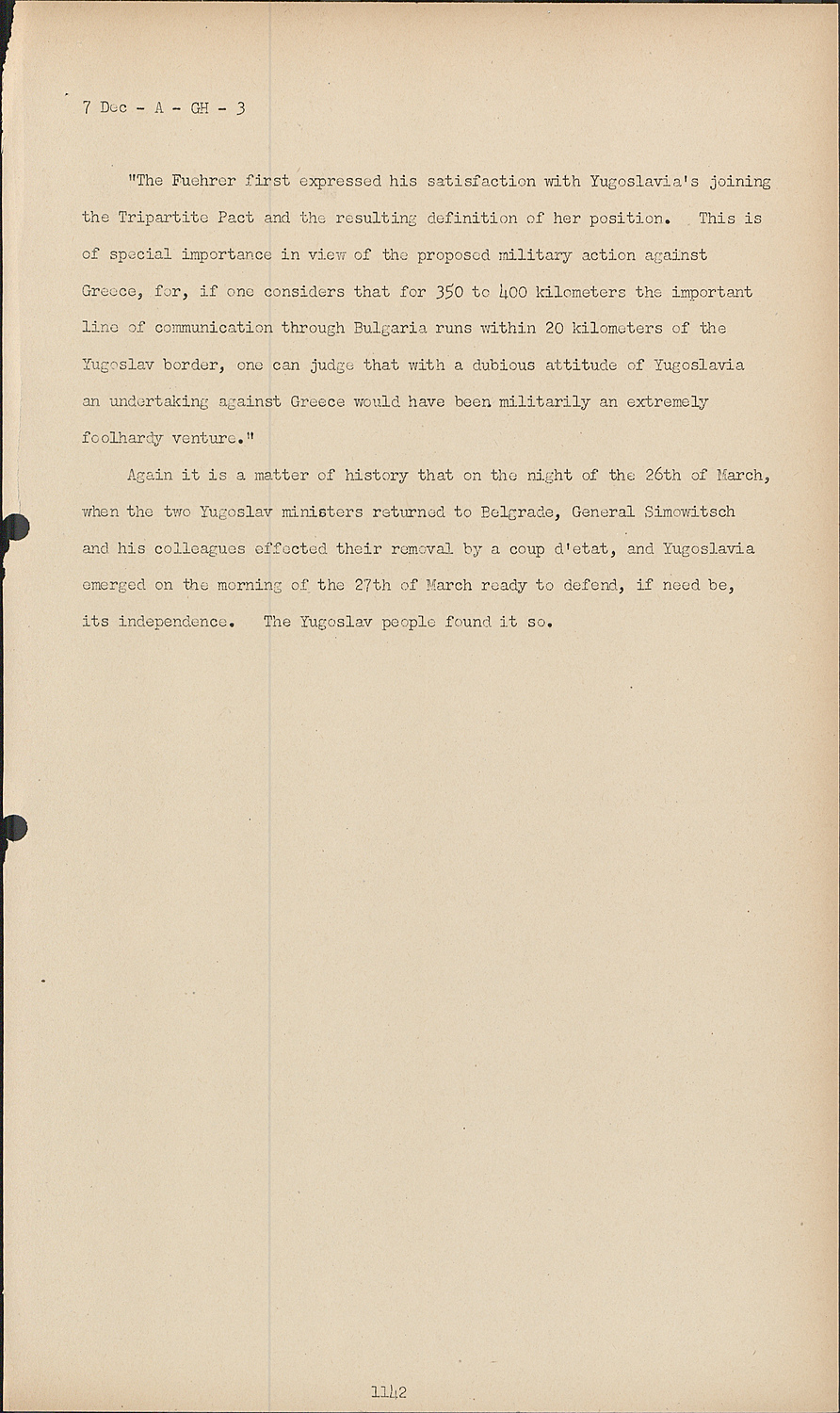
"The Fuehrer first expressed his satisfaction with Yugoslavia's joining the Tripartite Pact and the resulting definition of her position.
This is of special importance in view of the proposed military action against Greece, for, if one considers that for 350 to 400 kilometers the important line of communication through Bulgaria runs within 20 kilometers of the Yugoslav border, one can judge that with a dubious attitude of Yugoslavia an undertaking against Greece would have been militarily an extremely foolhardy venture."
Again it is a matter of history that on the night of the 26th of March, when the two Yugoslav ministers returned to Belgrade, General Simowitsch and his colleagues effected their removal by a coup d'etat, and Yugoslavia emerged on the morning of the 27th of March ready to defend, if need be, its independence. The Yugoslav people found it so.