In certain cases there were special negotiations with individual guerrilla units and, though limited to certain occasions and periods, they were most successful.
Q.Do you know General von Pannewitz?
A.Yes. General von Pannewitz was the Commander of the 1st Kosack Division.
Q.When, please?
A.It must have been during 1943.
Q.Is it correct that this General, as the Commander of that 1st Voluntary Kosack Division, had one complaint to the OKW about difficulties he was having in his division?
A.Yes. General von Pannewitz is an old regimental comrade of mine and he visited me at the headquarters, and on that occasion, during the summer of '43 or maybe during the autumn, he told me in detail about the state of affair the position and the difficulties which he was experiencing, particularly because of the Eastern policy of the government regarding the morale of his unit At that time he was complaining particularly about the fact that the government policy had no national aims for his Division, and he had certain further complaints about difficulties which the dependents had who were partly in trek or were to be settled.
Q.Did Jodl concern himself with that episode?
A.Yes. At the time, after I had the visit, I reported the conversation to the Colonel General and I asked him, in the interests of our voluntary units to exercise his influence.
Q.Influence on whom do you mean?
A.Influence on the Fuehrer.
Q.But you told me that this wasn't any of Jodl's tasks -
THE PRESIDENT:What is the relevancy of this, about some General who commanded a Kosack Division and that he had difficulties with morale? What has that got to do with this case?
DR. JAHRREISS:Mr. President, these are a few preparatory questions and the actual question now comes. It is a question of jurisdiction, responsibility I was just about to ask the witness the decisive question.
THE PRESIDENT:What relevancy have the preparatory questions go to the decisive question? How can a visit of this General have anything to do with it? What is the decisive question?
DR. JAHRREISS:Mr. President, if I am to give you the reason for that, then I will have to tell the witness what I went him to tell me. Then my question is a suggestive and leading one.
THE PRESIDENT:Well, that is not an unusual thing in this Court.
DR. JAHRREISS:Yes, but then I didn't wait to make that mistake.
THE PRESIDENT:Well, go on. The Tribunal hopes that you won't take up too much time over these preliminary questions which are leading to decisive ones.
DR. JAHRREISS:I am sorry, but I didn't understand.
THE PRESIDENT:I said, the Tribunal hopes that you will not take up too much time with these preparatory questions before the decisive one.
DR. LATERNSER:Dr. Laternser, counsel for the General Staff and the OKW. Mr. President, I can abbreviate the questions I want to put to the witness a great deal because in this case -
THE PRESIDENT:Dr. Laternser, why are you at the microphone?
DR. LATERNSER:I think, My Lord, Dr. Jahrreiss said he had no further questions, that he was finished.
DR. JAHRREISS:Mr. President, there was a misunderstanding. The witness has, in fart, just answered my question.
THE PRESIDENT:He has answered it, has he?
DR. JAHRREISS:Yes, he has answered it. I merely wanted to underline it a bit more but then you did not want me to.
THE PRESIDENT:Then you have finished, have you, Dr. Jahrreiss?
DR. JAHRREISS:Yes. I now have no further questions to the witness.
DR. LATERNSER:Mr. President, I can abbreviate the examination a great deal because I have an affidavit from the witness which he made on the 20th of May, 1946. If this is my turn, or when my turn comes, I propose to submit that affidavit to the Tribunal so that I can't then be excused of not having ascertained the facts when the witness was available in the Court room. I now propose to ask the witness at once whether the contents of that affidavit of the 20th of May, 1946 are correct.
BY DR. LATERNSER:
QMr. Witness, are the contents of the affidavit you have given me, dated the 20th of May, 1946, correct?
AThey are.
QThank you. Mr. Witness, do you know General Hausinger?
AYes, I do.
QThe prosecution, in their case against the General Staff, have submitted Affidavit No. 20, U.S.A. Exhibit No. 564, and on Page 2, Figure 4, this General is making the following statement; I quote: "It has always been my personal view that the treatment of civilians in operational areas and the methods of the bandit fighting in the operational zone was a useful opportunity to the political and military leaders to carry out their aims; that is to say, to bring about the systematic reduction of Slavs and Jews, I want to ask you now, can you explain how General Hausinger could have arrived at that view?
AI have worked closely with General Hausinger and quite often I have talked to him about the question of the guerrilla fighting. As far as I am concerned, he has never said anything to me which might express this view and I can not explain this statement of his because it is opposed to the principles of the military leaders regarding the conducting of the guerrilla war.
QThank you. Why was the jurisdiction over the bandit fighting in the East in 1943, as well as in Italy during 1943 and '44, transferred to Himmler by order of the Fuehrer?
AIt was always the view of the Fuehrer, that the guerrilla war was predominantly a task for the police and that police forces should be more suitable to carry it through then the sometimes somewhat aged security unit of the Army, such as we could place at the disposal of that task.
Just how far Himmler was keen to create a new position of power in that connection, that I don't know, how far he might have hypnotized the Fuehrer about that.
QWhat was the attitude of the Armed Forces Command Staff of the OKW regarding the Fuehrer order?
AIt has got to be emphasized first of all in this connection that so far as operational areas were concerned, there was no change. Operational areas, until the end, and as far as guerrilla warfare was concerned, too, can under the orders of the Army Commanders. In the remaining territory the Army Forces Command Staff were not altogether in agreement with this new arrangement because we were hoping that the Reichsfuehrer SS would be in a position to draw on his reserves, unknown as they were to us, and use them in these zones so that we would get a few men out.
QDo you remember, Witness, that the Commander Southwest urged that he should be excepted from this transfer of jurisdiction from him to Himmler?
AGeneral Westphal and I had a few conversations about that case and I consider it possible that he might have made such a suggestion at that time.
QDid you say that you yourself did discuss that with the Commander Southwest?
AYes, I talked to the Chief.
QAs you have just said, you were in the Central Department before the war, the Central Department of the Army General Staff, and I know there, too, the higher positions were being dealt with. Now I want to ask you what the principles were on the strength of which Army commanders were appointed?
AThese appointments took place in accordance with ability and seniority whereas peace time appointments formed the skeleton of the war time organization.
QWere these appointments of senior officers carried out strictly on military principles?
AThese nominations took place entirely on the strength of military considerations and retired officers, some of whom I am convinced left because of political pressure, were placed in responsible positions for the event of a mobilization.
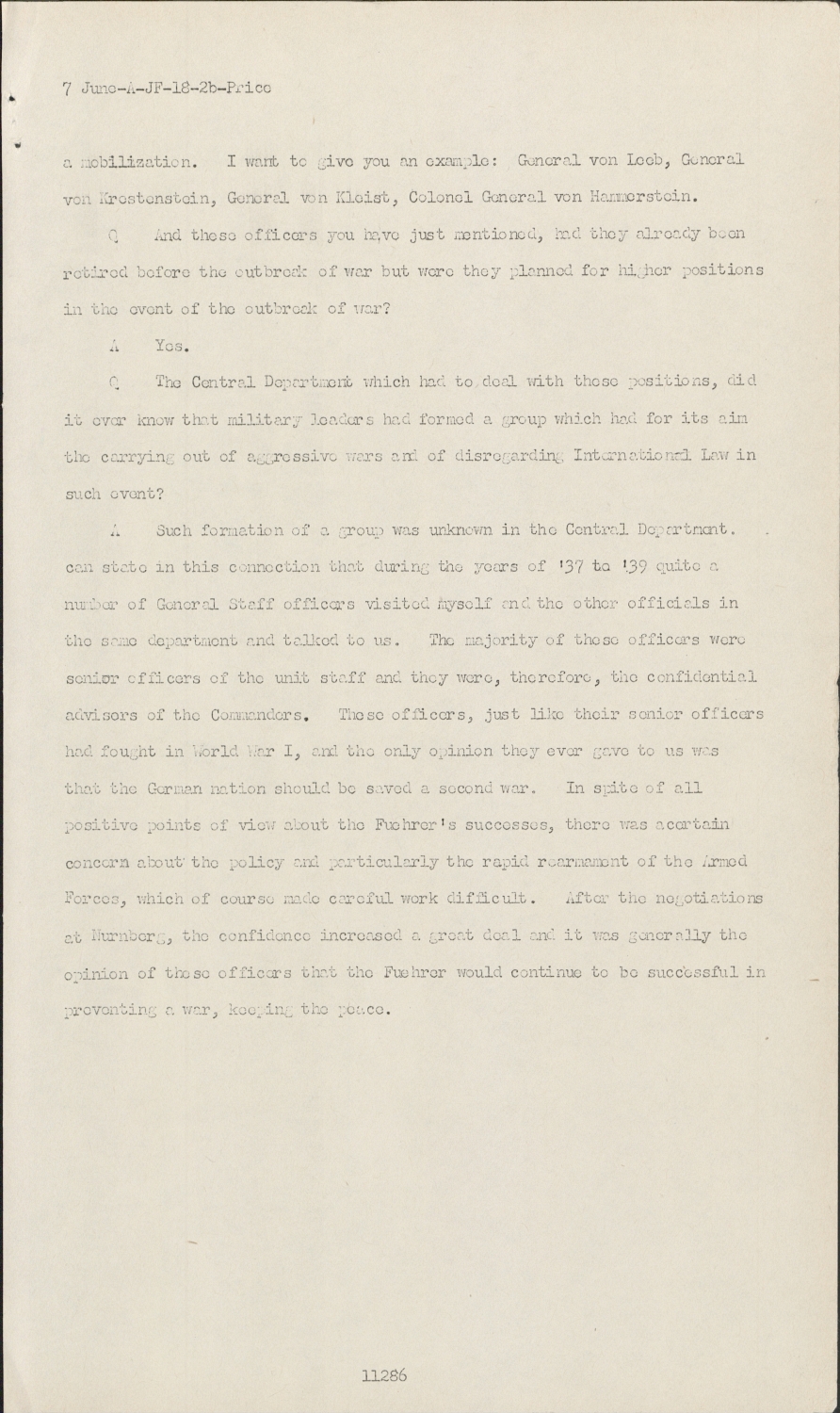
I want to give you an example: General von Leeb, General von Krestenstein, General von Kleist, Colonel General von Hammerstein.
QAnd these officers you have just mentioned, had they already been retired before the outbreak of war but were they planned for higher positions in the event of the outbreak of war?
AYes.
QThe Central Department which had to deal with these positions, did it ever know that military leaders had formed a group which had for its aim the carrying out of aggressive wars and of disregarding International Law in such event?
ASuch formation of a group was unknown in the Central Department. can state in this connection that during the years of '37 to '39 quite a number of General Staff officers visited myself and the other officials in the same department and talked to us. The majority of these officers were senior officers of the unit staff and they were, therefore, the confidential advisors of the Commanders. These officers, just like their senior officers had fought in World War I, and the only opinion they ever gave to us was that the German nation should be saved a second war. In spite of all positive points of view about the Fuehrer's successes, there was acertain concern about the policy and particularly the rapid rearmament of the Armed Forces, which of course made careful work difficult. After the negotiations at Nurnberg, the confidence increased a great deal and it was generally the opinion of these officers that the Fuehrer would continue to be successful in preventing a war, keeping the peace.
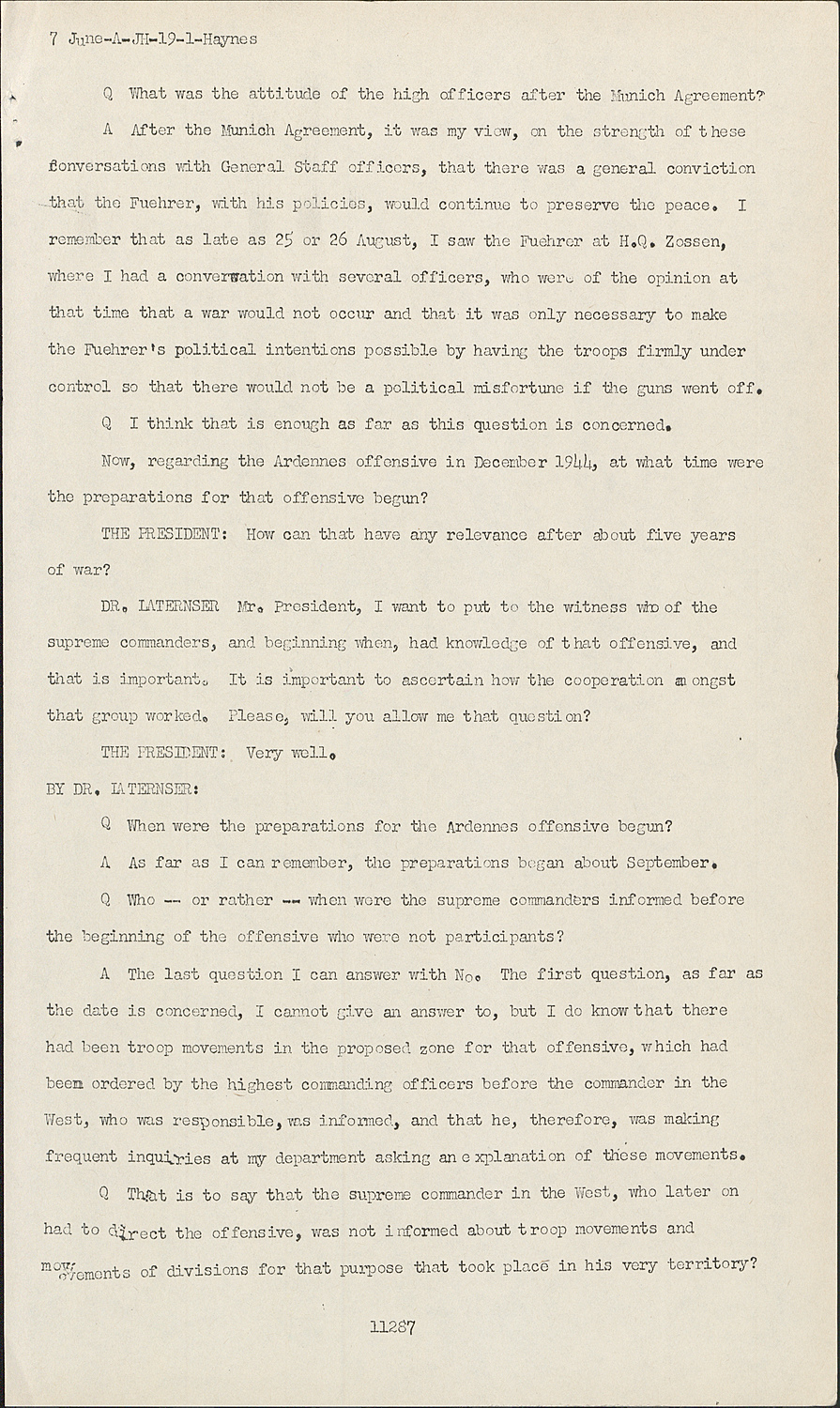
Q What was the attitude of the high officers after the Munich Agreement?
AAfter the Munich Agreement, it was my view, on the strength of these conversations with General Staff officers, that there was a general conviction that the Fuehrer, with his policies, would continue to preserve the peace. I remember that as late as 25 or 26 August, I saw the Fuehrer at H.Q. Zossen, where I had a conversation with several officers, who were of the opinion at that time that a war would not occur and that it was only necessary to make the Fuehrer's political intentions possible by having the troops firmly under control so that there would not be a political misfortune if the guns went off.
QI think that is enough as far as this question is concerned.
Now, regarding the Ardennes offensive in December 1944, at what time were the preparations for that offensive begun?
THE PRESIDENT:How can that have any relevance after about five years of war?
DR. LATERNSERMr. President, I want to put to the witness who of the supreme commanders, and beginning when, had knowledge of that offensive, and that is important. It is important to ascertain how the cooperation amongst that group worked. Please, will you allow me that question?
THE PRESIDENT:Very well. BY DR. LATERNSER:
QWhen were the preparations for the Ardennes offensive begun?
AAs far as I can remember, the preparations began about September.
QWho -- or rather -- when were the supreme commanders informed before the beginning of the offensive who were not participants?
AThe last question I can answer with No. The first question, as far as the date is concerned, I cannot give an answer to, but I do know that there had been troop movements in the proposed zone for that offensive, which had been ordered by the highest commanding officers before the commander in the West, who was responsible,was informed, and that he, therefore, was making frequent inquiries at my department asking an explanation of these movements.
QThat is to say that the supreme commander in the West, who later on had to direct the offensive, was not informed about troop movements and movements of divisions for that purpose that took place in his very territory?
A Yes, that is the situation. Later on, of course, he was informed.
DR. LATERNSER:Thankyou. I have no further questions.
THE PRESIDENT:The Tribunal willadjourn.
(The Tribunal adjourned until 8 June 1946, 1000 hours).
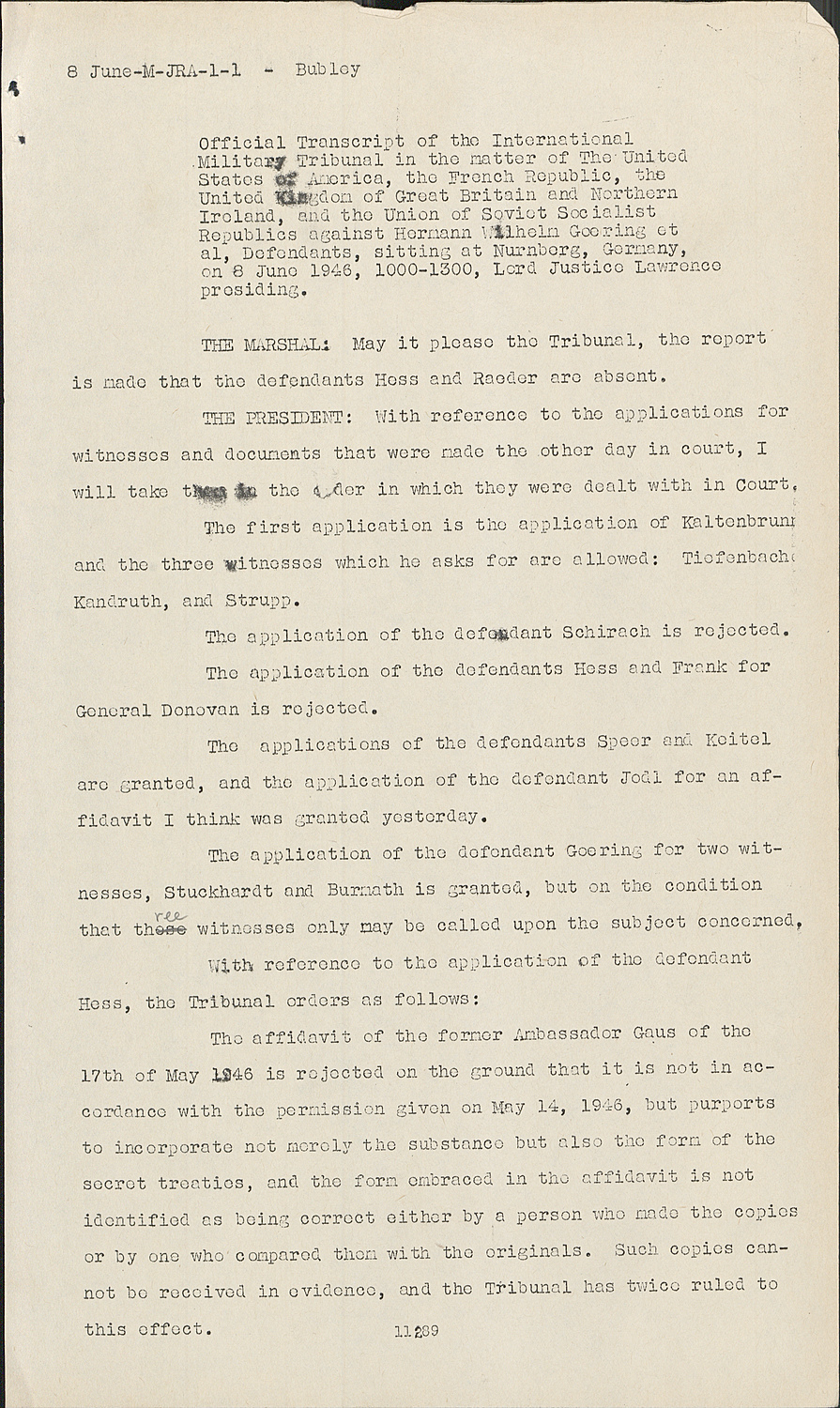
Official Transcript of the International Military Tribunal in the matter of The United States of America, the French Republic, the United Kingdom of Great Britain and Northern Ireland, and the Union of Soviet Socialist Republics against Hermann Wilhelm Goering et al, Defendants, sitting at Nurnberg, Germany, on 8 June 1946, 1000-1300, Lord Justice Lawrence presiding.
THE MARSHAL: May it please the Tribunal, the report is made that the defendants Hess and Raeder are absent.
THE PRESIDENT: With reference to the applications for witnesses and documents that were made the other day in court, I will take that to the order in which they were dealt with in Court, The first application is the application of Kaltenbrunn and the three witnesses which he asks for are allowed:
Tiefenbache Kandruth, and Strupp.
The application of the defendant Schirach is rejected.
The application of the defendants Hess and Frank for General Donovan is rejected.
The applications of the defendants Speer and Keitel are granted, and the application of the defendant Jodl for an affidavit I think was granted yesterday.
The application of the defendant Goering for two witnesses, Stuckhardt and Burmath is granted, but on the condition that three witnesses only may be called upon the subject concerned, With reference to the application of the defendant Hess, the Tribunal orders as follows:
The affidavit of the former Ambassador Gaus of the 17th of May 1946 is rejected on the ground that it is not in accordance with the permission given on May 14, 1946, but purports to incorporate not merely the substance but also the form of the secret treaties, and the form embraced in the affidavit is not identified as being correct either by a person who made the copies or by one who compared them with the originals. Such copies cannot be received in evidence, and the Tribunal has twice ruled to this effect.
The matter of importance to the issues before the Tribunal is not the form of the treaties, but their contents, and evidence of their contents is already before the Tribunal by the testimony of three witnesses.
The admission of this affidavit would add nothing to the proof before the Tribunal. The same is true of the proposal to call, as a witness, Gaus, who would only support evidence as to the contents of the treaties which has not been contradicted.
The motion of the 23rd of May 1946 to reconsider the Tribunal's formed decision, and the motion of the 24th of May 1946 to call Gaus as a witness, are accordingly denied.
There is one other matter with which the Tribunal proposes to deal, and it is this: In the future, counsel for the organizations which the Prosecution has asked the Tribunal to decla to be criminal will not be permitted to examine or to cross examine any witnesses other than the defendants in this court. If they wish to examine or to cross examine these witnesses, they must call them before the commissions which are now sitting for the taking of evidence on the questions with which the organizations are concerned.
That is all.
DR. KUBOSCHOK (Counsel for defendant von Papen): I should like to voice one request for the case of von Papen.
On the 6th of June I submitted a written request. This was discussed with the prosecution, and the General Secretary has advised me to bring this matter to the attention of the Court.
Prince Erbach-Schoenberg has filled out an interrogatory. His answers, however, are partially incorrect and sometimes misleading, and therefore a supplement is necessary. I am suggesting that Prince Erbach-- who is in the American occupied zone in Gmunden, Austria -- be transported to Nurnberg and that he be interrogated, outside of this Court but in the presence of the prosecution, to supplement this interrogatory.
My deputy has received a letter from Graf Feil -- who is in Bad Ischl, also in the American occupied zone of Austria, not far from Gmunden, the residence of Prince Erbach -- in which he has testified and made statements in detail about the contacts which the defendant von Papen had with the circle of the assaasins of July 20th.
Since this question was raised by the witness Gisevius, the defense feels that it is forced, even though otherwise we would not stress this fact, to discuss thismatter in the course of evidence. Most likely this matter will be covered through an affidavit.
At the same time, I am asking that Count Feil, together with Prince Erbach, be transported to Nurnberg so that, in the presence of the prosecution he can depose an affidavit. The transporting here of both of these witnesses is absolutely essential, because the case of von Papen is imminent and it is almost impossible to take care of these matters by correspondence.
THE PRESIDENT:Dr. Kubuschok, will you draw our attention to the particular points in which you say that the interrogaroty of Prince ErbachSchoenberg is incomplete or misleading?
DR. KUBUSCHOK:In connection with one of the preveding questions of this interrogatory, Prince Erbach answered that it had been the wish of the defendant von Papen to have the solution of his task brought about through a peaceful development rather than through force. Then, in connection with a question which follows, as to whether the defendant von Papen acted in accordance with these basic political principles, the witness answered as follows:
"As long as I was there, I had the impression that the defendant von Papen acted in accordance with these basic principles. That means the bringing about of connections in a peaceful manner rather then with force."
This last statement is contrary to the first half of his answer. Apart from that, this latter sentence -
THE PRESIDENT:Are you saying that that answer is incomplete or contradictory?
DR. KUBUSCHOK:There is a contradiction in the second half. "Rather than by force" is contrary to the first half of his reply, since he said that he acted according to these principles.
THE PRESIDENT:The answer that I have got is: "As long as I was there, I had the impression that the defendant von Papen acted according to this policy of establishing relations through peaceful means rather than force."
There is nothing contradictory in that, in English.
DR. KUBUSCHOK:In the German text it says "rather than with force." In the English version the objection is to the word "rather".
THE PRESIDENT:It means the same thing. It means that he wanted to establish the relations by peaceful means rather than with forceful means. "Not by force" he means.
DR. KUBUSCHOK:In my text it says "rather than by force".
THE PRESIDENT:That is the same thing.
DR. KUBUSCHOK:This version might cause the assumption that the defendant von Papen did not even consider or contemplate peaceful means. We want to prive, in accordance with the foregoing sentence, that he rejected other means than peaceful ones.
However, if the High Tribunal will give this interpretation as was just uttered by the Court, then I have no further objections and I do not wish to press this point.
THE PRESIDENT:It couldn't mean anything else in English. I don't know what it could mean in German.
DR. KUBUSCHOK: In the German version it would mean: "I would prefer peaceful means, but in the last analysis, if need be, other than peaceful means would have to be considered."
That would be the interpretation of the German version. We want to establish and confirm that none other than peaceful methods were ever considered.
SIR DAVIDMAXWELL-FYFE: To save any trouble, I should like to assure the Tribunal that the prosecution accepted the answer in the sense which Your Lordship has just put it. We shouldn't suggest for a moment that Prince Erbach would make any other answer that in the sense the Tribunal has accepted it.
THE PRESIDENT:Perhaps a way of meeting the difficulty would be if you would agree to read the words in the sense "and not by force."
SIR DAVIDMAXWELL-FYFE: If your Lordship pleases.
THE PRESIDENT:Yes.
DR. KUBUSCHOK:Then, of course, I quite agree, and I should like to have the decision of the Tribunal as to whether Graf Feil will be transported here so that he can depose an affidavit.
THE PRESIDENT:You mean the other witness?
DR. KUBUSCHOK:The second witness, Count Feil, who write this letter, which we wish to submit to the High Tribunal in the form of an affidavit.
THE PRESIDENT:We will consider that when we have heard Sir David.
Are there any other inconsistencies or contradictions which you wish to draw our attention to in the Prince's interrogatory?
Has the letter of Count Feil been translated?
DR. KUBUSCHOK:Not yet, My Lord, but it is a rather simple letter. However, we can not prove the identity of the letter, and that is why we wanted the affidavit.
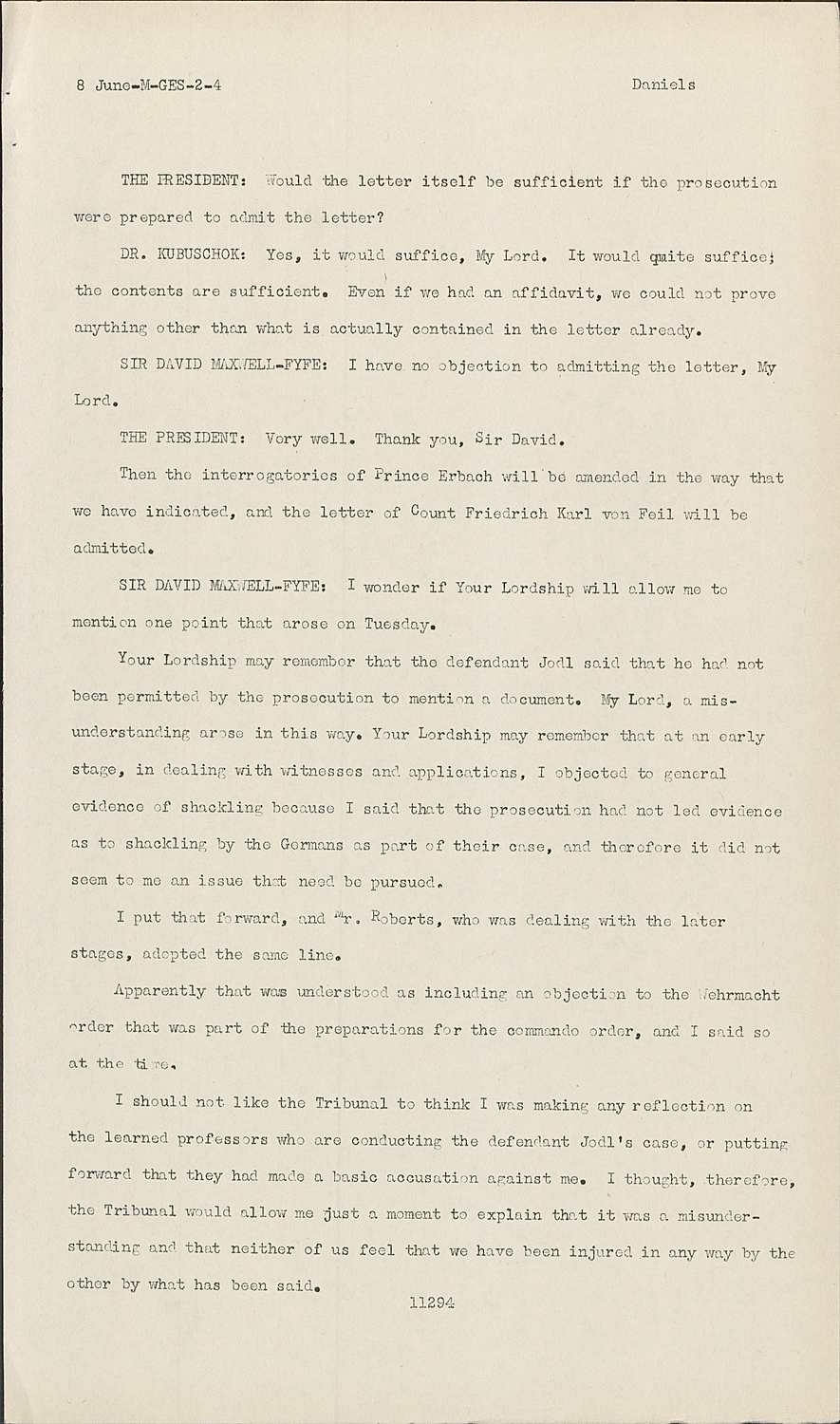
THE PRESIDENT: Would the letter itself be sufficient if the prosecution were prepared to admit the letter?
DR. KUBUSCHOK:Yes, it would suffice, My Lord. It would quite suffice; the contents are sufficient. Even if we had an affidavit, we could not prove anything other than what is actually contained in the letter already.
SIR DAVIDMAXWELL-FYFE: I have no objection to admitting the letter, My Lord.
THE PRESIDENT:Very well. Thank you, Sir David.
Then the interrogatories of Prince Erbach will be amended in the way that we have indicated, and the letter of Count Friedrich Karl von Feil will be admitted.
SIR DAVIDMAXWELL-FYFE: I wonder if Your Lordship will allow me to mention one point that arose on Tuesday.
Your Lordship may remember that the defendant Jodl said that he had not been permitted by the prosecution to mention a document. My Lord, a misunderstanding arose in this way. Your Lordship may remember that at an early stage, in dealing with witnesses and applications, I objected to general evidence of shackling because I said that the prosecution had not led evidence as to shackling by the Germans as part of their case, and therefore it did not seem to me an issue that need be pursued.
I put that forward, and Mr. Roberts, who was dealing with the later stages, adopted the same line.
Apparently that was understood as including an objection to the Wehrmacht order that was part of the preparations for the commando order, and I said so at the time.
I should not like the Tribunal to think I was making any reflection on the learned professors who are conducting the defendant Jodl's case, or putting forward that they had made a basic accusation against me. I thought, therefore, the Tribunal would allow me just a moment to explain that it was a misunderstanding and that neither of us feel that we have been injured in any way by the other by what has been said.
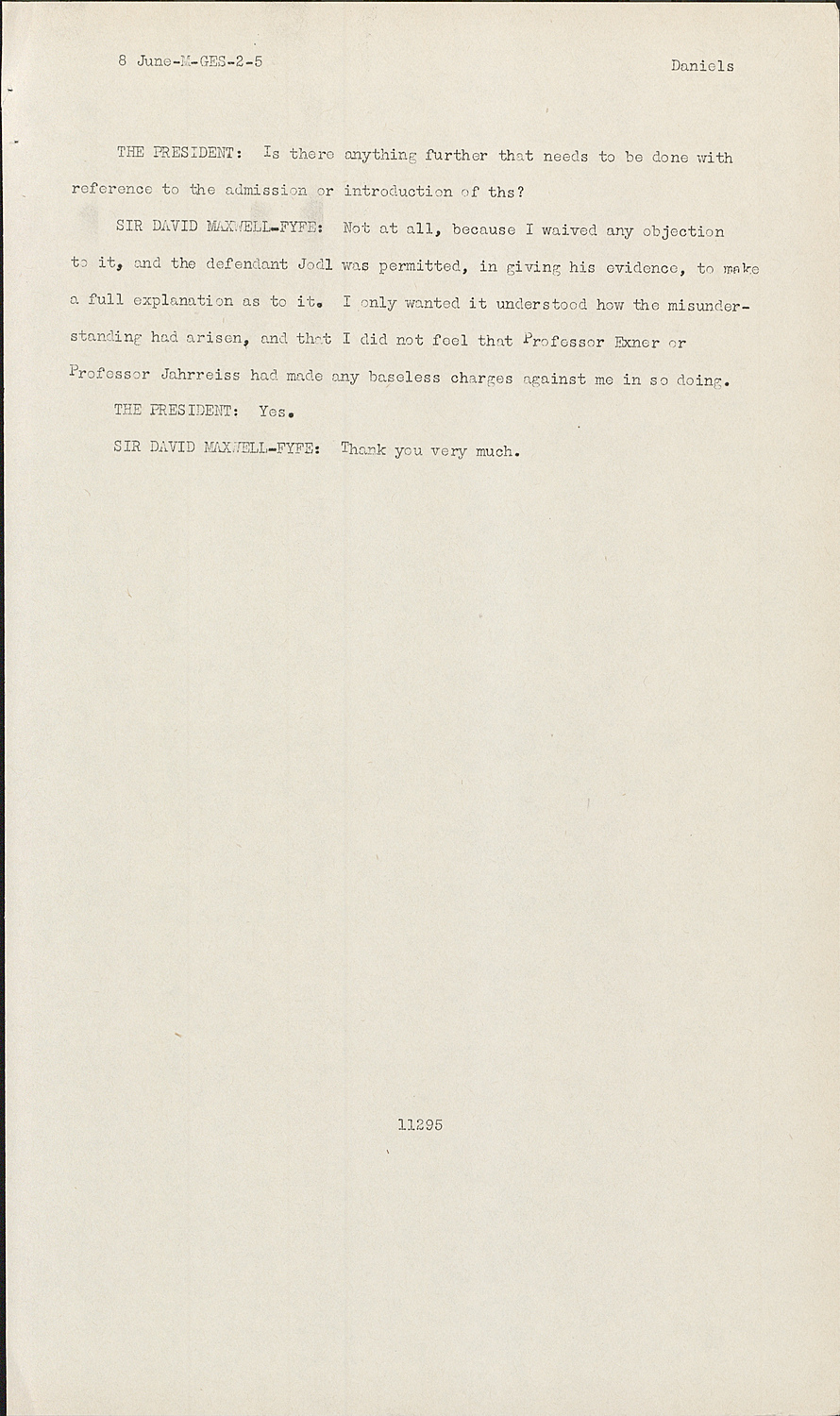
THE PRESIDENT: Is there anything further that needs to be done with reference to the admission or introduction of ths?
SIR DAVIDMAXWELL-FYFE: Not at all, because I waived any objection to it, and the defendant Jodl was permitted, in giving his evidence, to make a full explanation as to it. I only wanted it understood how the misunderstanding had arisen, and that I did not feel that Professor Exner or Professor Jahrreiss had made any baseless charges against me in so doing.
THE PRESIDENT:Yes.
SIR DAVIDMAXWELL-FYFE: Thank you very much.
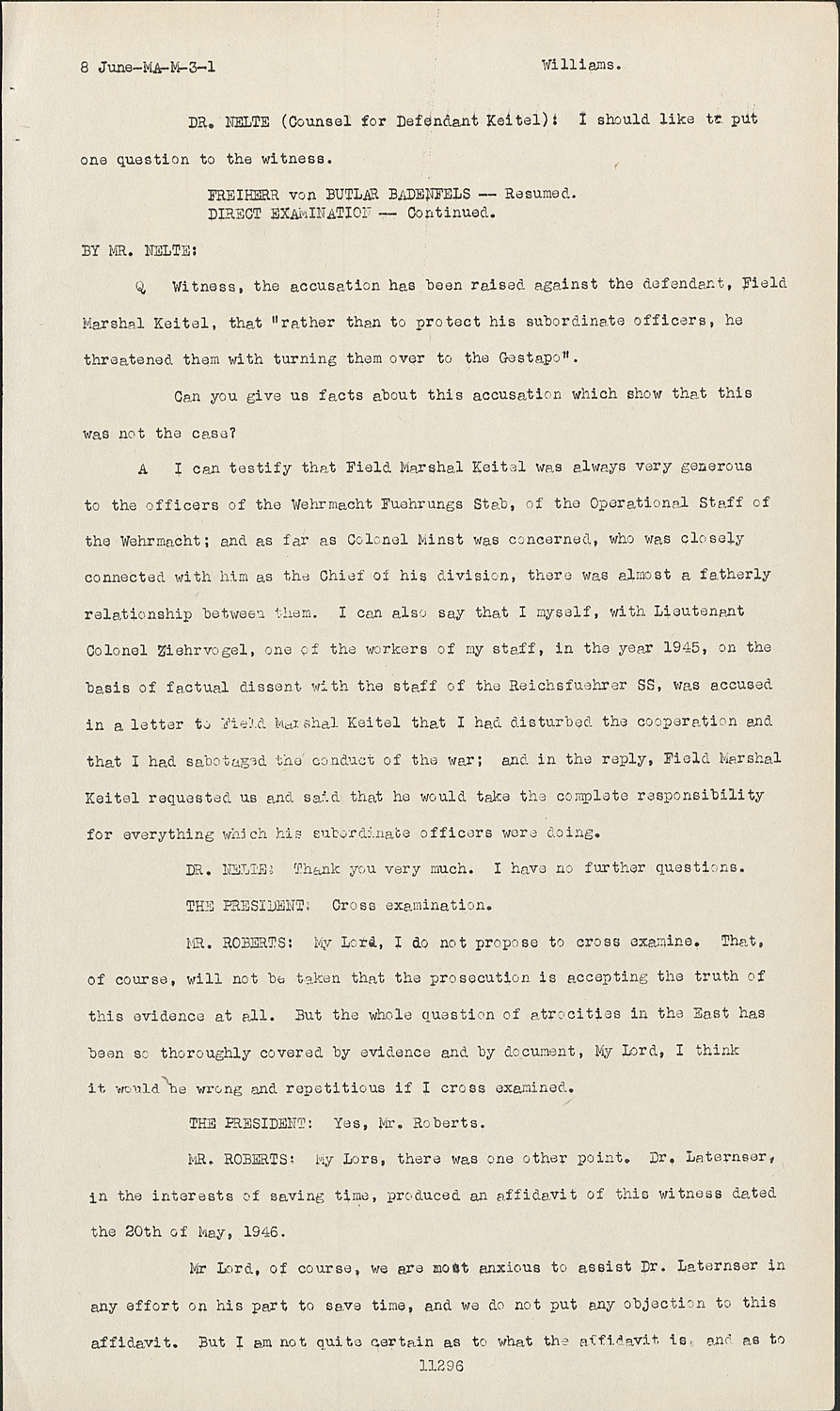
DR. NELTE (Counsel for Defendant Keitel): I should like to put one question to the witness.
FREIHERR von BUTLAR BADENFELS -- Resumed.
DIRECT EXAMINATION -- Continued. BY MR. NELTE:
QWitness, the accusation has been raised against the defendant. Field Marshal Keitel, that "rather than to protect his subordinate officers, he threatened them with turning them over to the Gestapo".
Can you give us facts about this accusation which show that this was not the case?
AI can testify that Field Marshal Keitel was always very generous to the officers of the Wehrmacht Fuehrungs Stab, of the Operational Staff of the Wehrmacht; and as far as Colonel Minst was concerned, who was closely connected with him as the Chief of his division, there was almost a fatherly relationship between them. I can also say that I myself, with Lieutenant Colonel Ziehrvogel, one of the workers of my staff, in the year 1945, on the basis of factual dissent with the staff of the Reichsfuehrer SS, was accused in a letter to Field Marshal Keitel that I had disturbed the cooperation and that I had sabotaged the conduct of the war; and in the reply, Field Marshal Keitel requested us and said that he would take the complete responsibility for everything which his subordinate officers were doing.
DR. NELTE: Thank you very much. I have no further questions.
THE PRESIDENT: Cross examination.
MR. ROBERTS: My Lord, I do not propose to cross examine. That, of course, will not be taken that the prosecution is accepting the truth of this evidence at all. But the whole question of atrocities in the East has been so thoroughly covered by evidence and by document, My Lord, I think it would be wrong and repetitious if I cross examined.
THE PRESIDENT: Yes, Mr. Roberts.
MR. ROBERTS: My Lord, there was one other point. Dr. Laternser, in the interests of saving time, produced an affidavit of this witness dated the 20th of May, 1946.
Mr Lord, of course, we are most anxious to assist Dr. Laternser in any effort on his part to save time, and we do not put any objection to this affidavit. But I am not quite certain as to what the affidavit is, and as to whether it has been put in as an exhibit, in which case if should he given a number, or whether it should go to the Commission.
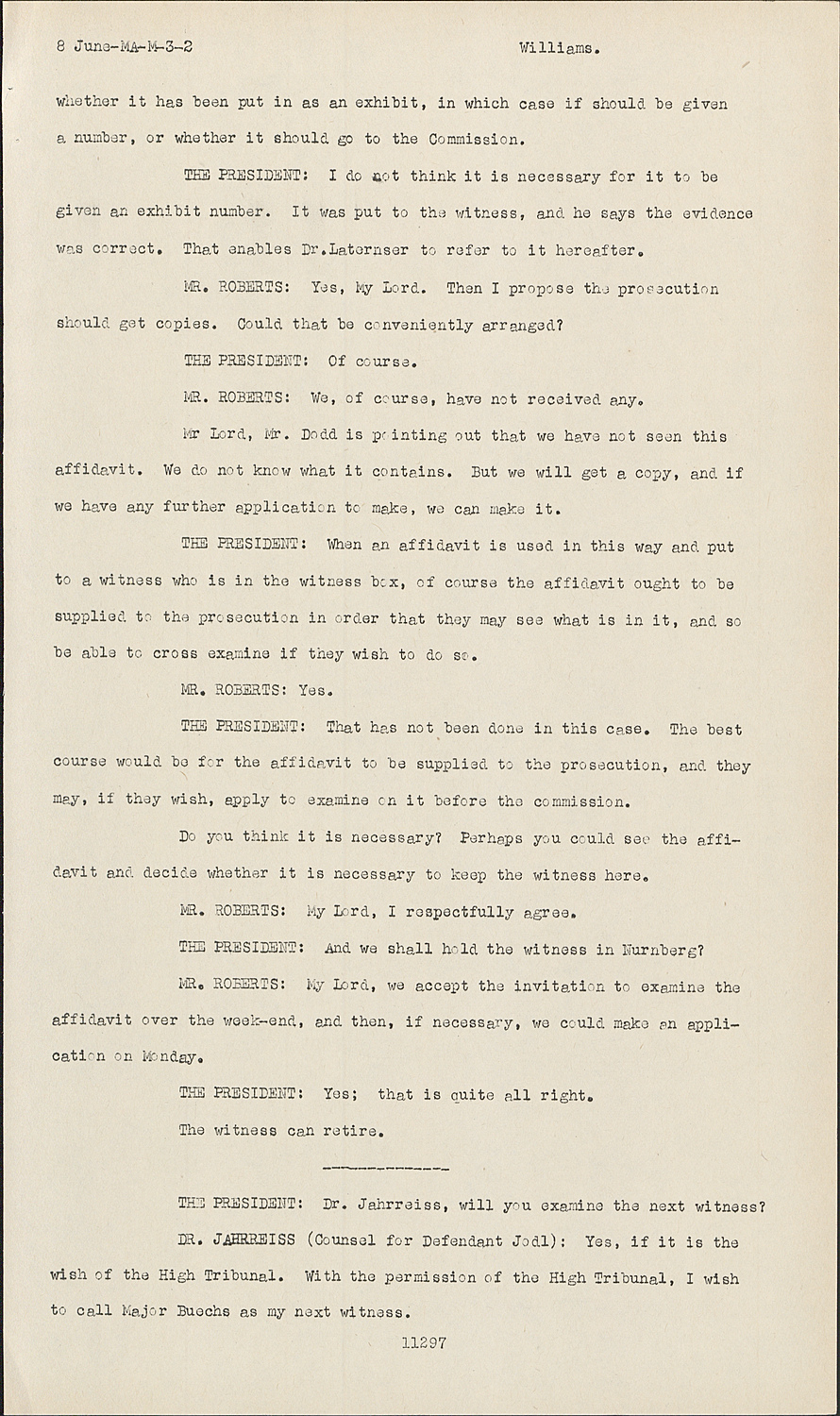
THE PRESIDENT: I do not think it is necessary for it to be given an exhibit number. It was put to the witness, and he says the evidence was correct. That enables Dr.Laternser to refer to it hereafter.
MR. ROBERTS: Yes, My Lord. Then I propose the prosecution should get copies. Could that be conveniently arranged?
THE PRESIDENT: Of course.
MR. ROBERTS: We, of course, have not received any.
Mr Lord, Mr. Dodd is printing out that we have not seen this affidavit. We do not know what it contains. But we will get a copy, and if we have any further application to make, we can make it.
THE PRESIDENT: When an affidavit is used in this way and put to a witness who is in the witness box, of course the affidavit ought to be supplied to the prosecution in order that they may see what is in it, and so be able to cross examine if they wish to do so.
MR. ROBERTS: Yes.
THE PRESIDENT: That has not been done in this case. The best course would be for the affidavit to be supplied to the prosecution, and they may, if they wish, apply to examine on it before the commission.
Do you think it is necessary? Perhaps you could see the affidavit and decide whether it is necessary to keep the witness here.
MR. ROBERTS: My Lord, I respectfully agree.
THE PRESIDENT: And we shall hold the witness in Nurnberg?
MR. ROBERTS: My Lord, we accept the invitation to examine the affidavit over the week-end, and then, if necessary, we could make an application on Monday.
THE PRESIDENT: Yes; that is quite all right.
The witness can retire.
-------------
THE PRESIDENT: Dr. Jahrreiss, will you examine the next witness?
DR. JAHRREISS (Counsel for Defendant Jodl): Yes, if it is the wish of the High Tribunal. With the permission of the High Tribunal, I wish to call Major Buechs as my next witness.
MAJOR HERBERT BUECHS, a witness, took the stand and testified as follows.
BY THE PRESIDENT:
QWill you state your name, please?
AHerbert Buechs.
QWill you repeat this oath after me:
I swear by God, the Almighty and Omniscient, that I will speak the pure truth and will withheld nothing and add nothing.
(The witness repeated the oath.)
THE PRESIDENT: You may sit down.
DIRECT EXAMINATION BY DR. JAHRREISS:
QWitness, what position did you have in the last years of the war?
AFrom the 1st of November, 1943, I was a General Staff Officer of the Luftwaffe, with the chief of the Wehrmacht Fuehrungs Stab, the Wehrmacht Operational Staff. And in that capacity, I was an adjutant with Colonel General Jodl.
QAnd were you in this position until the end of the war?
AI was in this position until the end, until my arrest on the 23 rd of May, 1945.
THE PRESIDENT:Witness, would you consider the lights? When that yellow light goes on, it means that you are going too fast; and if you would try to make a pause after the question comes through to you, that would be much better.
THE WITNESS:Very well. BY DR. JAHRREISS:
QWitness, during this time in which you were in the Fuehrer's headquarters, did you see that the headquarters was in different areas?
AYes. In East Prussia, I was in the headquarters in Berlin, and in the year 1944, in Berchtesgaden.
QIt has been mentioned that at the Fuehrer's headquarters, there was a party clique allegedly. Do you know anything about that?
AIf I understand with that expression a circle of people which I would choose to call Fegelein, Bormann and Burgdorf.
Q You would say that that was a clique?
AThese were three gentlemen who were in very close personal and official contact, and to the outside world created this impression of being a clique.
QWere they in a very close personal relationship with themselves or with others?
ANot only among themselves did they have a close relationship, but I also observed that these three gentlemen had a very strong influence on Adolf Hitler himself.
THE PRESIDENT:Dr. Jahrreiss, would you ascertain the names of the three again? They did not come to us quite clearly.
DR. JAHRREISS:Yes. BY DR. JAHRREISS:
QMajor, will you please give us the names distinctly of these three gentlemen you just mentioned?
AFegelein: He was the liaison officer, with Himmler, to Adolf Hitler. Then Bormann, who was the head of the party chancellory and the deputy of the party; and General Burgdorf, who had a dual position as chief of the army personnel office and at the same time as chief adjutant of the Wehrmacht with the Fuehrer.
QDid Colonel General Jodl have an official connection with each of these three gentlemen?
AI should start with Fegelein. Fegelein as liaison officer of Himmler was, as far as the Fuehrer was concerned, that man to whom he turned in all questions of material, equipment, and personnel of the Waffen SS divisions. When these questions were discussed and the use of these divisions in the course of the military situation came up, and in this connection when the situation reports came up, there were many common points within the sphere of work of Fegelein. But, on the other hand, the general official connection between Jodl and Fegelein was very, very slight.
Q And how about Bormann?
AAs far as Bormann was concerned, as Deputy of the Party, Colonel General Jodl always strongly delineated his sphere of influence. If there were unjustified accusations against the Wehrmacht or if there was any interference, he always rejected this interference or these accusations. It witnessed this especially while the war was being carried on on German soil. There were frequently frictions with those Gauleiters who had been designated to be Reichs Commissars, and on this occasion it witnessed that Colonel General Jodl, when he received complaints from Bormann or letters from Bormann, dealt with these letters in a rather abrupt marginal note and returned these letters, and in that way he showed his attitude. If he was not successful in dealing with the matter in that way, he was not slow in telling the Fuehrer just how he felt, and then he brought about a decision on the Fuehrer's part in writing.
QAnd the third of these gentlemen mentioned, Burgdorf?
AAs far as General Burgdorf was concerned, to my recollection, Colonel General Jodl had very little official contact with him, although Burgdorf had to handle the personnel, the filling of positions, and he discussed these matters with the Fuehrer. In this case, I saw that General Burgdorf first of all discussed these matters with the Fuehrer alone, so that Colonel General Jodl had very, ver* little influence in that direction.
QNow I should like to know from you, Witness, how the personal relation was between Colonel General Jodl and each of these three gentlemen?
AJodl rejected Fegelein; he was averse to him and I believe Jodl, even at that time, fully realized his character defects. I was there when he called Fegelein to account and put him in his place. As far as Bormann is concerned, I should say Colonel General Jodl had no relationship with him at all. I believe there was no association outside the official one, no personal relationship at all. And the same things that I said about Fegelein I believe also applies to the relationship with General Burgdorf, whom Colonel General Jodl did not like personally.
QNow I shall turn to a different point. Witness, do you know anything about this matter, that in the last phase of the war there were considerations that certain hostile aviators, which were in hand, would be turned over to the popular rage? Did you hear about that?
A Yes. I recall in the spring of '44, at Berchtesgaden, the Fuehrer, in a rather heated way, demanded that Allied flyers who made Emergency landings in Germany not be protected by the Wehrmacht against the enraged populace.
This demand had been based on reports according to which a Kreisleiter of the Party and an officer of the Luftwaffe had protected an Allied aviator. At that time the Fuehrer made this demand in a very sharp and a very heated manner. He demanded that the Wehrmacht issue corresponding orders so that a stop would be put to this once and for all.
QDid Colonel General Jodl have the demand put to him also by Hitler?
AThis demand was made at a conference at which Jodl was present, but Colonel General Jodl did not have any direct connection with the treatment of this question for this was not a purely military matter with which Jodl would be concerned.
QDid the Colonel General make any statement at all in this report?
AColonel General Jodl, as well as all other gentlemen, rejected this demand and, on his part, did everything possible in order to attempt to dissuade the Fuehrer from this demand, and immediately he tried, by taking a critical attitude, to establish the action which would be taken so as not to infringe on International Law in dealing with aviators.
QI really do not need to ask you about this for we have proof through documen in this matter, but tell me, was it possible, if, as you have described, Hitler was enraged and stormed and demanded a decree, was it possible to pursue a delaying action?
AIn the case in which the Fuehrer, in the heat of his first rage, demanded something like that, it was impossible for these gentlemen to whom this demand was put to do anything at that moment, to contradict or perhaps to refuse the carrying through of this order.