Q In which cases was that contract extended?
AThe contract was extended then the worker voluntarily wanted to continue his services or when extraordinary emergencies or loss of manpower in that particular industry justified an extension. Then that had to be discussed with the liaison man.
QAnd besides the civilian workers there were also prisoners of war used in Germany. What did you have to do with that use of manpower?
AThe commitment of prisoners of war was quite complicated, because it had to take place in accord with and under agreement with the General in charge of prisoner-of-war affairs. For me, it was very difficult to develop this so-called technique of commitment. That is a concept which I shall try to explain:
There existed the Geneva Convention, according to which prisoners of war could not be used in armament, ammunition industries. If, however, the prisoners of war were not used in the armament industry , then that meant that so and so many German women and workers were replaced and put into those industries in which the Geneva Convention prohibited the use of prisoners of war, and that is, in their place prisoners of war were used. And that was done in agreement with the office of the General for prisoners of war.
QAnd who saw to it that the Geneva Convention was kept?
AThe General for the Affairs of Prisoners of War, we ourselves, that is, the Administration for Labor Commitment,were adhering to the principle of the Geneva Convention and several times they compiled a catalogue of those types of labor for which prisoners of war could be used. Also, during my time, in 1943 and 1944, that was published as a special publication -- the so-called blue publication.
QHave you known about cases where prisoners of war were used contrary to the Geneva Convention?
ACertain agreements, arrangements, were made with the French Government so far as volunteers were concerned, and in part also for Eastern workers.
QWho was responsible for the lodging and feeding and care of prisoners of war?
AExclusively the office of the General for the Affairs of Prisoners of War.
QIs it known to you that millions of war prisoners had perished at the time you assumed office?
AIt became known to me before I assumed office that in the so-called Kesselschlachten in the East a great number of prisoners of war perished because they had been weakened by the long duration of those battles and there were great difficulties in the way of their evacuation, even on our side.
No more details are known to me.
QAt the beginning of the activities, you had to do with prisoners war, didn't you? What could you find out at that time, or did you take any initiative?
AI found out that some of the Russian prisoners of war were terribly undernourished.
QWhat did you do?
ATogether with the General for the Affairs of Prisoners of war, I s** to it that all these prisoners of war -- as far as I know and remember, there were only 70,000 in the Reich at that time -- should be billeted with German farmers, German peasants, with an expression which we called "Aufpeppeln", that is feed them back into health. And there was an obligation connected with it, to feed these prisoners of war for at least three months without putting them to work. For that, the peasants received the assurance that un the end of the war this prisoner of war should stay with him for work.
QDuring the course of the war did these prisoners of war personally change into free laborers?
AYes. The use of French workers especially took place only on the basis of agreement with the French Government. These agreements were concluded under the sponsorship of the German Ambassador at Paris, on the basis of task with which I was charged by the Fuehrer and by the Reichsmarshal. These qu* were dealt with and agreements were made. The first quota was 250,000 French workers, and as a counter-measure for the use of these voluntary workers -- and I emphasize voluntary in this connection -- there were to be and were 50,000 French prisoners of war who had been peasants, who were returned to the French Government and put at their disposal for agricultural purposes, so that French agriculture would be facilitated.
Q And what was really "the relief"?
AWhat was really "the relief" was an agreement between the French Government and my office that for three French workers who came to Germany one French prisoner of war would be put at liberty and put at the disposal of his hone country. And this was done on the decree of the Fuehrer. That is, this prisoner returned home.
QAnd who was responsible for this agreement?
AThis agreement was concluded on the basis of a discussion between the French Prime Minister and myself. I was much in favor of this agreement, for I myself during the First World War spent five years behind barbed wire.
QWas it an improvement for the prisoners to return home?
AYes, they returned home.
QAnd how did the civilian population react to that? That is, how did the people feel who had to go to Germany?
AThis was an act of comradeship and according to the reports I received the feeling was favorable.
QThen in practice, on the basis of one prisoner of war, did three workers come?
ANo, everything was done in the same way. These workers were free. They were not prisoners in Germany.
QDid they have to come to Germany for an unlimited period of time?
ANo, they stayed according to the length of their contract, just like the others.
QWhat was the duration of a contract?
AAbout nine months.
QThen it worked itself out that after nine months the prisoners of war, as well as the other workers, could return home?
AYes; this very exchange necessitated new quotas and new agreements with the French Government, for there always had to be replacements.
Q Were those negotiations carried on under a certain pressure?
ANo; but I wish that you would hear witnesses on this. They were carried out on a free diplomatic basis.
QTo what extent was this relief carried through, on a large or limited scale?
AIt was carried out on the basis of 250,000 workers who were to go to Germany.
QThe French Prosecution in their official report said that only weak and ill people were sent back, that is, people who couldn't work anyw* What do you have to say as to that?
AAccording to my knowledge, French prisoners of war, French soldier were sent back, and the sending back, the selection of those soldiers to be sent back, was not in my sphere but the duty of the General in charge the prisoner-of-war system; and I consider it entirely possible that sick soldiers were sent back to their home country in thisway and on their own wish. But certainly it was not the intention to send only sick people or elderly soldiers, but applied to all soldiers.
QThere was a seconc course which was followed; there was a law whi* was to alleviate conditions. What was that?
AThe alleviation institute was a third agreement, with the follow provisions: In Germany French prisoners of war received the same contract as all other French civilian workers when a new French worker came to Germany.
QThat was the relation or ration of one to one.
AOne to one.
QDid those French workers obligate themselves indefinitely or was the time limited, or was it handled -
AIt was handled in the some way as the relief measures.
QThis statute, was it hailed by the French soldiers or did they disapprove of it?
AIt was not disapproved; it was hailed, depending on the attitude of the soldier. A portion of them rejected it, but the others hailed it For, this measure saw to it that the worker would receive a high wage and that he would be outside barbed wire. And I myself saw how an entire c** hailed this statute, and it was shown that the gate and barbed wire were were done away with, and there was no further surveillance any more.
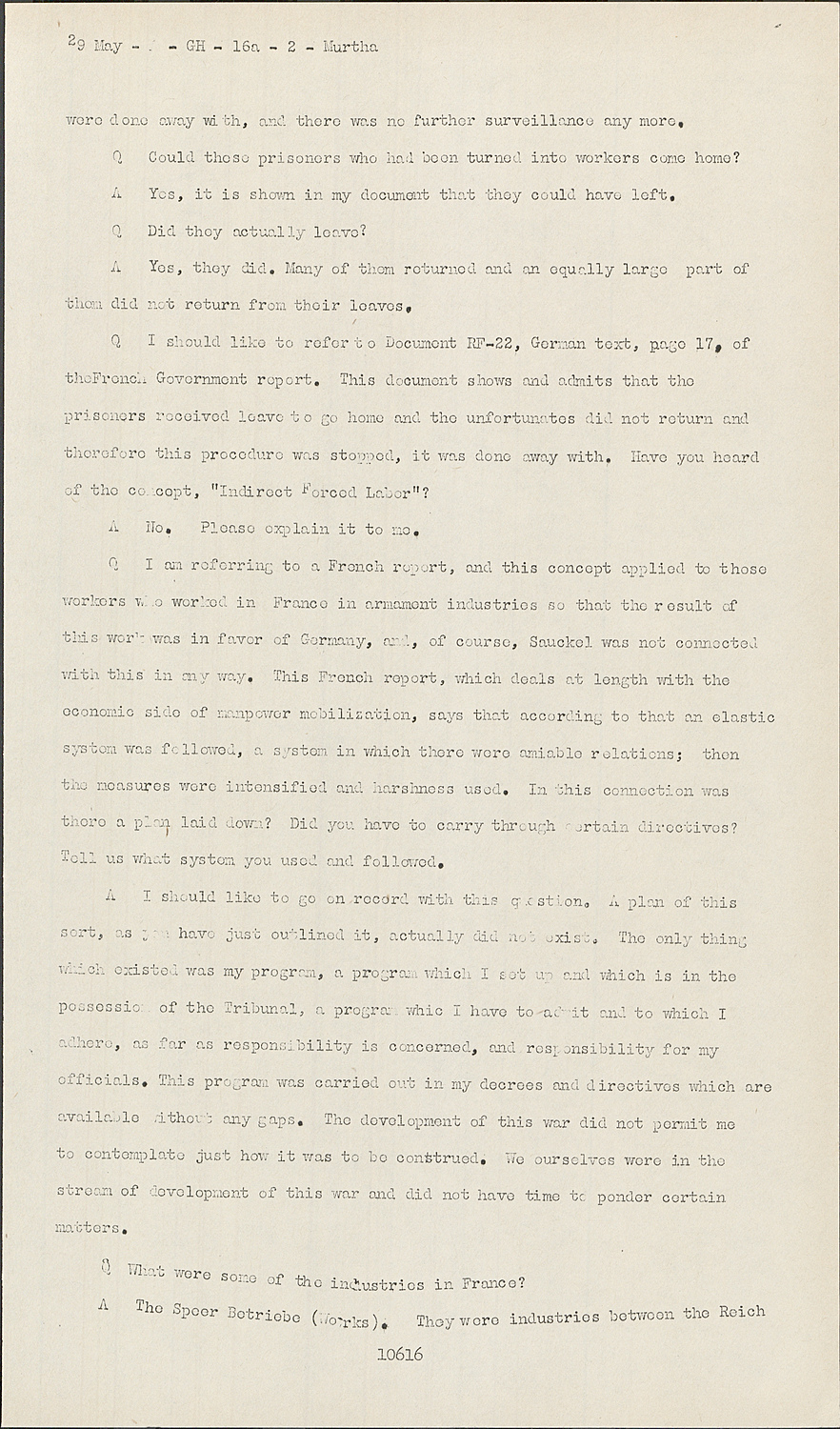
QCould these prisoners who had been turned into workers come home?
AYes, it is shown in my document that they could have left.
QDid they actually leave?
AYes, they did. Many of them returned and an equally large part of then did not return from their leaves.
QI should like to refer to Document RF-22, German text, page 17, of theFrench Government report. This document shows and admits that the prisoners received leave to go home and the unfortunates did not return and therefore this procedure was stopped, it was done away with. Have you heard of the concept, "Indirect Forced Labor"?
ANo. Please explain it to me.
QI am referring to a French report, and this concept applied to those workers who worked in France in armament industries so that the result of this work was in favor of Germany, and, of course, Sauckel was not connected with this in any way. This French report, which deals at length with the economic side of manpower mobilization, says that according to that an elastic system was followed, a system in which there were amiable relations; then the measures were intensified and harshness used. In this connection was there a plan laid down? Did you have to carry through certain directives? Tell us what system you used and followed.
AI should like to go on record with this question. A plan of this sort, as you have just outlined it, actually did not exist. The only thing which existed was my program, a program which I set up and which is in the possession of the Tribunal, a program whic I have to admit and to which I adhere, as far as responsibility is concerned, and responsibility for my officials. This program was carried out in my decrees and directives which are available without any gaps. The development of this war did not permit me to contemplate just how it was to be construed. We ourselves were in the stream of development of this war and did not have time to ponder certain matters.
QWhat were some of the industries in France?
AThe Speer Betriebe (Works). They were industries between the Reich Minister, Speer, and I believe the French Economy Minister, Bichelonne.
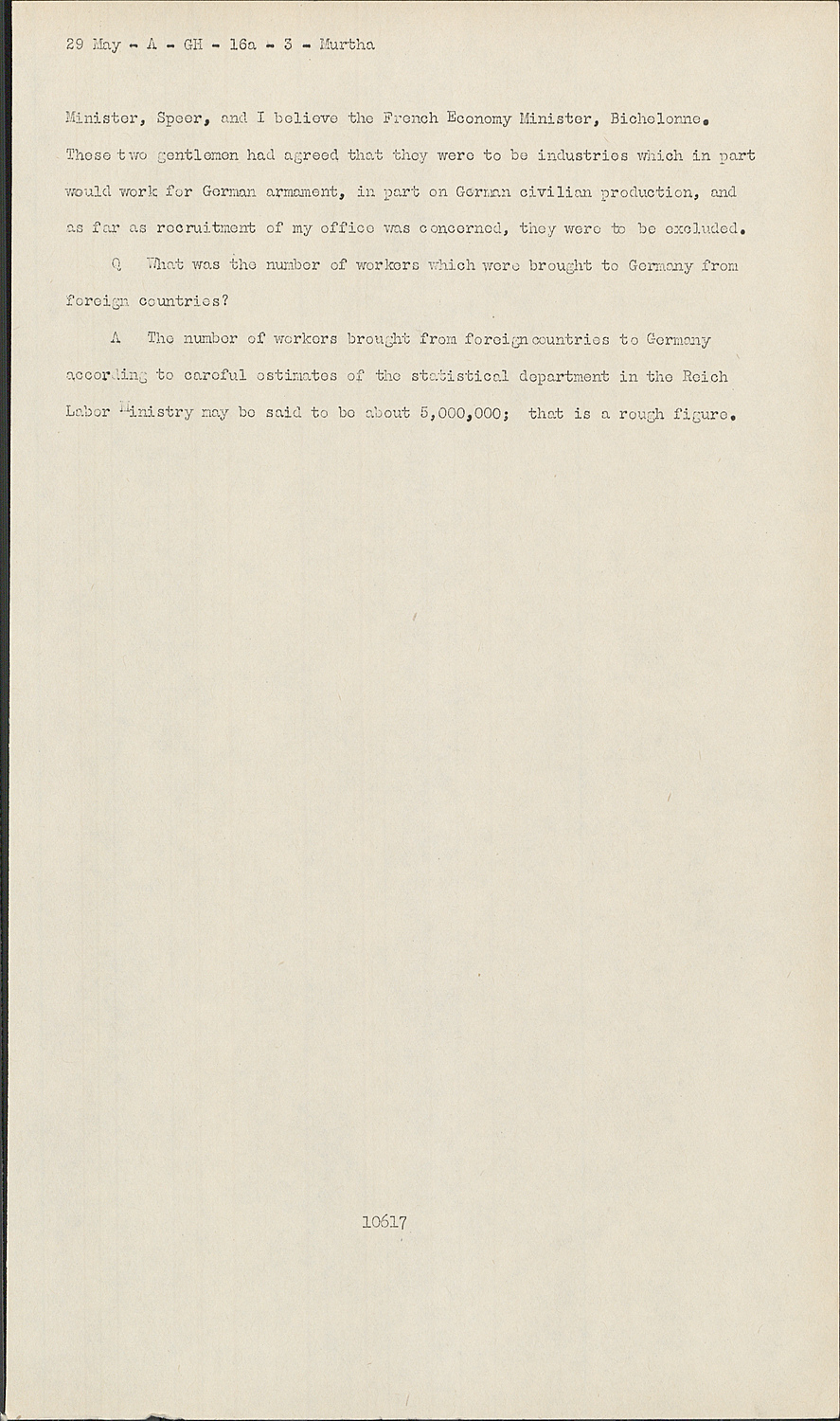
Those two gentlemen had agreed that they were to be industries which in part would work for German armament, in part on German civilian production, and as far as recruitment of my office was concerned, they were to be excluded.
QWhat was the number of workers which were brought to Germany from foreign countries?
AThe number of workers brought from foreign countries to Germany according to careful estimates of the statistical department in the Reich Labor Ministry may be said to be about 5,000,000; that is a rough figure.
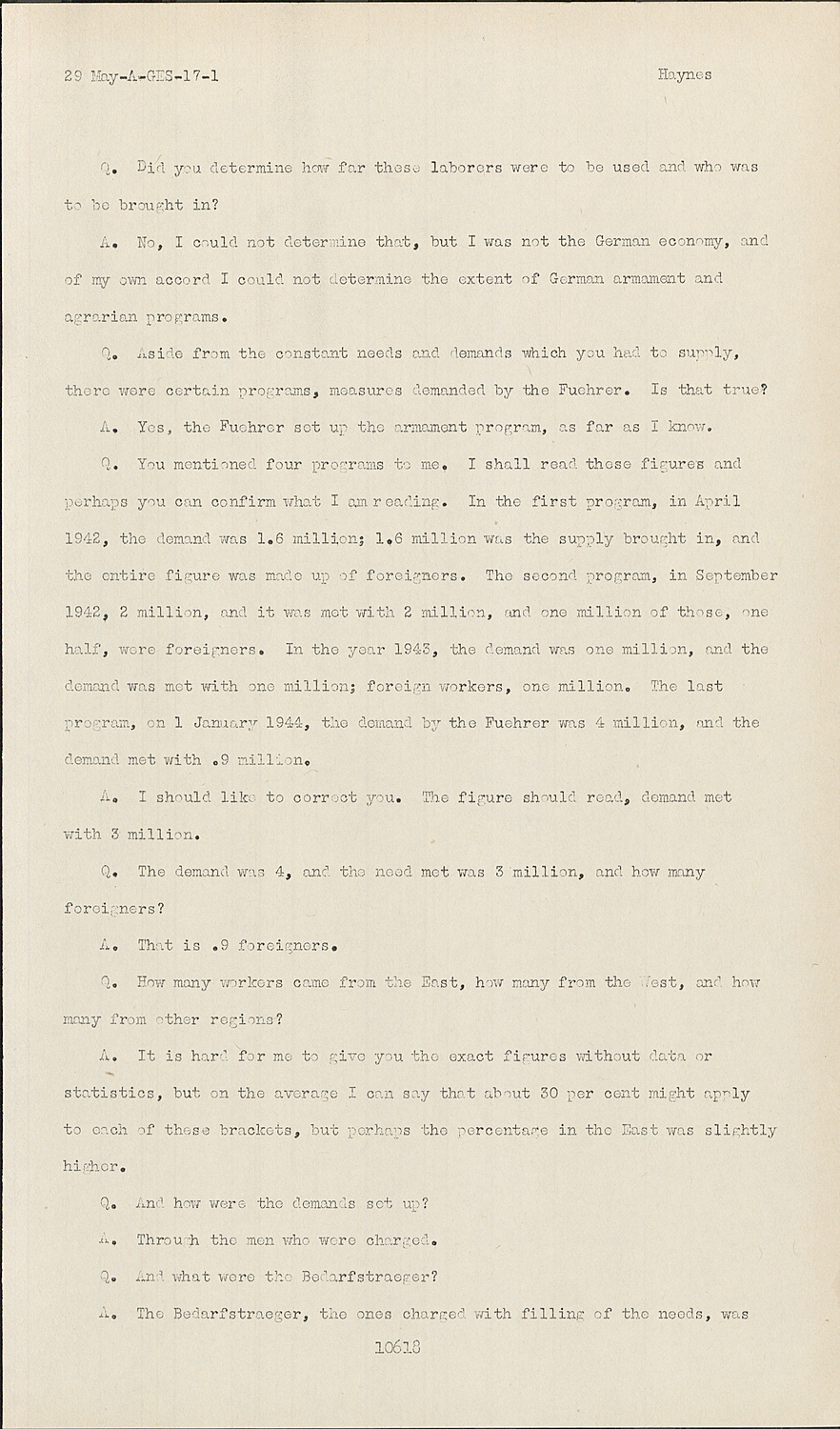
Q. Did you determine how far these laborers were to be used and who was to be brought in?
A.No, I could not determine that, but I was not the German economy, and of my own accord I could not determine the extent of German armament and agrarian programs.
Q.Aside from the constant needs and demands which you had to surely, there were certain programs, measures demanded by the Fuehrer. Is that true?
A.Yes, the Fuehrer set up the armament program, as far as I know.
Q.You mentioned four programs to me. I shall read these figures and perhaps you can confirm what I am reading. In the first program, in April 1942, the demand was 1.6 million; 1.6 million was the supply brought in, and the entire figure was made up of foreigners. The second program, in September 1942, 2 million, and it was met with 2 million, and one million of those, one half, were foreigners. In the year 1943, the demand was one million, and the demand was met with one million; foreign workers, one million. The last program, on 1 January 1944, the demand by the Fuehrer was 4 million, and the demand met with .9 million.
A.I should like to correct you. The figure should read, demand met with 3 million.
Q.The demand was 4, and the need met was 3 million, and how many foreigners?
A.That is .9 foreigners.
Q.How many workers came from the East, how many from the West, and how many from other regions?
A.It is hard for me to give you the exact figures without data or statistics, but on the average I can say that about 30 per cent might apply to each of these brackets, but perhaps the percentage in the East was slightly higher.
Q.And how were the demands set up?
A.Through the men who were charged.
Q.And what were the Bedarfstraeger?
A.The Bedarfstraeger, the ones charged with filling of the needs, was the armament Ministry, the Agricultural Ministry, the Reichsbahn, mines and so forth; various ministries and large concerns.
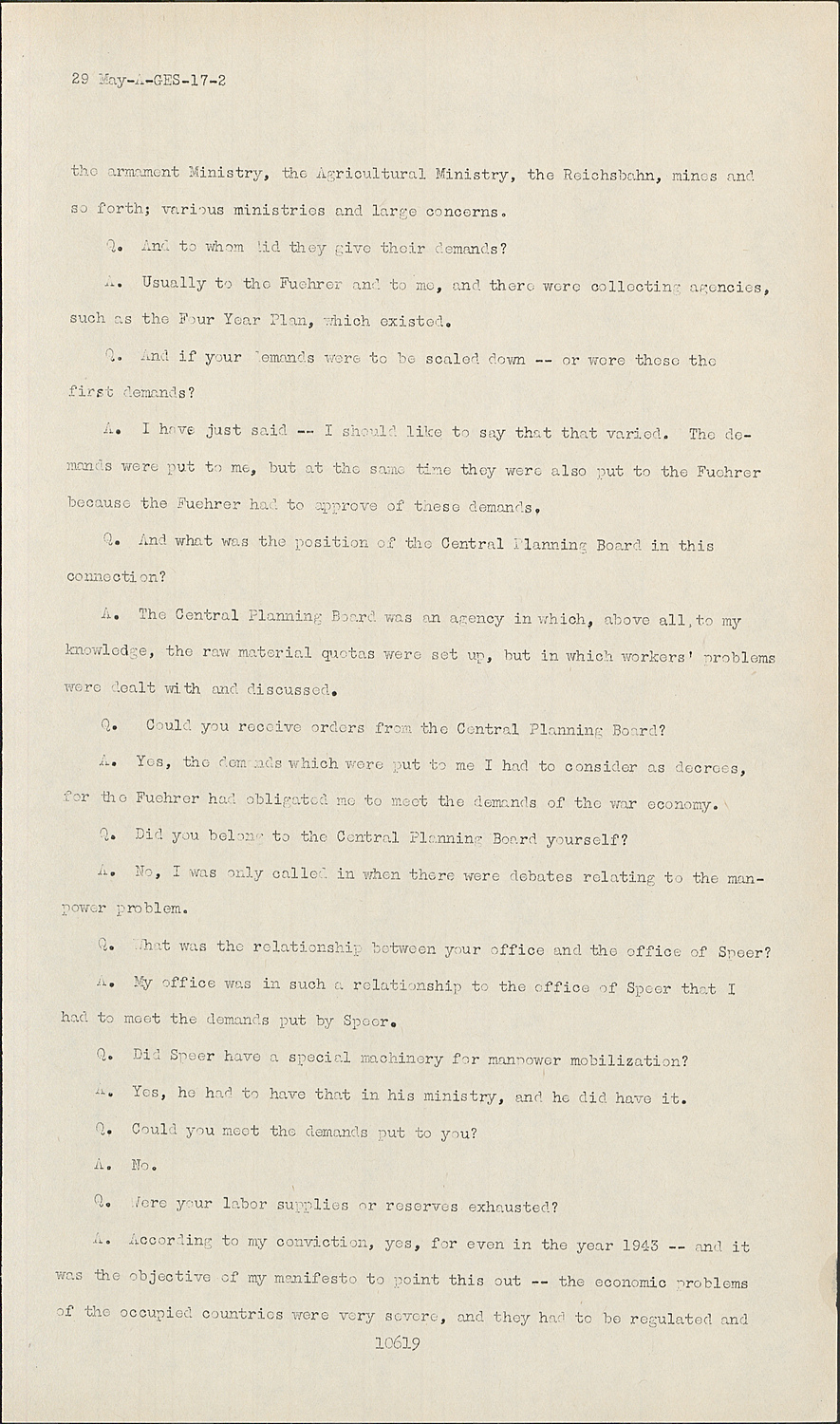
Q.And to whom id they give their demands?
A.Usually to the Fuehrer and to me, and there were collecting agencies, such as the Four Year Plan, which existed.
Q.And if your demands were to be scaled down -- or were these the first demands?
A.I have just said -- I should like to say that that varied. The demands were put to me, but at the same time they were also put to the Fuehrer because the Fuehrer had to approve of these demands.
Q.And what was the position of the Central planning Board in this connection?
A.The Central Planning Board was an agency in which, above all to my knowledge, the raw material quotas were set up, but in which workers' problems were dealt with and discussed.
Q.Could you receive orders from the Central Planning Board?
A.Yes, the demands which were put to me I had to consider as decrees, for the Fuehrer had obligated me to meet the demands of the war economy.
Q.Did you belong to the Central Planning Board yourself?
A.No, I was only called in when there were debates relating to the manpower problem.
Q.What was the relationship between your office and the office of Speer?
A.My office was in such a relationship to the office of Speer that I had to meet the demands put by Speer.
Q.Did Speer have a special machinery for manpower mobilization?
A.Yes, he had to have that in his ministry, and he did have it.
Q.Could you meet the demands put to you?
A.No.
Q.Were your labor supplies or reserves exhausted?
A.According to my conviction, yes, for even in the year 1943 -- and it was the objective of my manifesto to point this out -- the economic problems of the occupied countries were very severe, and they had to be regulated and settled, so that there would be no confusion.
Q.What were the Labor reserves present in Germany?
A.In Germany beginning with or after 1943, there were no manpower reserves which we could use: Many discussions took place about this problem but the chief demand for German workers was for specialized labor, miners and workers in heavy industries.
Q.And how about manpower reserves in France which were to be utilized?
A.I must say that from our point of view, with respect to our economic point of view, there was a very extensive reserve there.
Q.Do you wish to say that on a comparative basis the economic power of Germany was far more exhausted than that of the occupied countries?
A.Perhaps I can cite an example in a comparison with the first world war. In the first world war, in the mobilization of labor, ten to twelve million Germans were used. In this war about 25 German men and women were used, and about half of the second figure were women. In Germany these women were not included in the labor mobilization who were active in the Red Cross or other welfare agencies. These women could not be included in my statistics, but other countries used these figures.
Q.I have a concluding question. In your capacity or activity as Plenipotentiary for Labor, seen from today, what is your attitude toward the use of foreign labor in general?
AIt is very hard for me to answer this question. I myself and the German people as well had to be of the opinion that this war -- and in order to be truthful, I have to include the Party -- we did not wish this war nor were we responsible for it. We are of the opinion and attitude that we had to do our duty for our people.
THE PRESIDENT:Dr. Servatius -BY DR. SERVATIUS:
QYou are not to give us an extensive answer, but rather to give us a brief answer on whether today you consider your activity justified or not. Just be brief, please.
AAs far as the war situation and the Germaneconomy are concerned, and with that point of view, and the way in which I looked at my manpower mobilization, I considered it justified and above all, inevitable -- that it had to take place, for the countries which we occupied and Germany were an area that could not be separated; without Mi exchange of Eastern and Western workers, we could not have existed in Germany for even one day. The German people were used in work to the utmost.
DR. SERVATIUS:I have concluded my questioning of the defendant. BY DR. THOMA (Counsel for defendant Rosenberg):
QWitness, did the East Ministry try repeatedly to decrease the totals set down by you?
ANot only the East Ministry tried, to do that; I myself tried to do that, to lower the demand with the Fuehrer and the other members who were responsible.
QI should like torefer to document 054-PS, a document which describes the abuses in recruiting and transporting of Eastern workers. I should like to put several questions to you in this regard. Did you personally try to take steps to stop the abuses which are listed here?
AYes, of course. Please interrogate my witnesses on this.
QDid you notice that this report deals with the city and the region of Charkov in the Ukraine, and do you know that this entire district was never under the civilian administration of the East Ministry?
AYes, I know that, and I testified that this report was sent to an army office, rather than to me, and the army had its own agencies for this purpose.
QIn this report did you notice especially the first paragraph on the first page (a) that, "With few e xceptions the Ukrainian people were being used in the Reich in isolated cases in small industrial enterprises."
AWill you please tell no the spot?
QThat is on page 1,the last paragraph.
ASir, I do not have the place yet. There are several documents like that.
QThat is the second paragraph.
AYes, I have found it.
QIt says there that these Ukrainian people who were being used to work in the Reich were very much satisfied with conditions and that the Ukrainians who were in certain camps were complaining; is that correct?
AYes. In my testimony I quoted the places in whichthe author of the letter said that this took place in the first few months. Immediately had this situation checked and improved. I called the Reich Labor Minister to give out a now regulation for this, and that was on the basis of this complaint.
QDid you yourself visit the occupied Eastern territories, and in Riga, Kovno, Sitomir did you speak to the administrative officers there?
ANot only did I speak to the administrative officers there, but in Russia I compiled this manifesto and had it published there, and everything that is contained in the manifesto was given to the offices and the agencies there.
QIs it correct that you emphasized the special urgency of a Fuehrer decree?
AThat was my duty; that was at I was there for.
QThat does not seem to be just right from the legal point of view, for your actual authority came from Goering. He was the Plenipotentiary for the Four Year Plan, and you were with him.
AYes, that is correct. Fuehrer, Goering, Four Year Plan; that was the progression.
QThen, if you mention a task from the Fuehrer, you use that expression to give a certainemphasis?
ANo, that was not my intention. The Fuehrer charged me with certain things. For instance, the loss of German soldiers was to be made up. and those were missions which I received directly from the Fuehrer through Goering on the basis of the demand.
QWas that a written order to you?
AYes, they were written.
QWritten by Hitler personally?
AYes, from Hitler and from Goering, from both of them.
QDo you recall that you made an agreement with Rosenberg to the of feet that Eastern workers in Germany, after their return to their own country, were to receive land so that they would not be at a disadvantage as compared with the people who had remained?
AYes, that was set down between Rosenberg and myself; that is correct.
QDid this actually take place?
AJust how far this was carried out, I am unable to state. That was a task of the Eastern ministry, and I assumed that it was carried out.
QDo you recall that Rosenberg constantly advocated the doing away with of the Eastern emblem?
ARosenberg and I were active for the elimination of this Eastern emblem. There is a letter to the Reichsfuehrer SS, who rejected this, and at the end of 1943 or the beginning of 1944 we were successful in doing away withthis Eastern emblem, and it was replaced by a national emblem.
QWhy was this emblem to be done away with?
AThis Eastern emblem was to be done away with for various reasons, but, above all, so that the Eastern workers would not feel that they were being discriminated against by having a special emblem.
QYou said that youdid not recall, except for the complaints that you talked over with Rosenberg, having received other complaints. Numerous complaints were received by the Central Agency for Eastern Peoples, and they were checked by the D.A.F. constantly. Did the D.A.F. report to you on this?
A The D.A.F., the German Labor Front, reported that they were acting in accordance with my directives, that they tried to put a stop to abuses.
That was its obligation. In order to stop these abuses, the D.A.F. should not have turned to me but, rather, to a special branch of the Reich Labor Ministry.
Q Did you make sure whether this agency stopped these abuses?
AI installed my own inspection agencies, as Dr. Servatius mentioned, but this was the only authorized, agency which had the authority to use coercion but the Reich Labor Minister was its immediate superior.
DR. THOMA:I have no further question, and thank you. BY THE PRESIDENT:
QWhat is the emblem that you have been speaking about?
AThe eastern Emblem consisted of a square; it had a blue inscription "East"; it had a blue border and on the responsibility of the Reich Leader SS, it had to be worn first on the right chest; later on, on the sleeve and later, on my responsibility, a national emblem was chosen -- I believe the Russian color blue, or as the people themselves wished the color to be. DR. NELTE: Dr. Nelte, on behalf of Keitel. BY DR. NELTE:
QMr. Sauckel, the defendant Keitel and the OKW are accused by the prosecution under the point "deportation of civilian people for the purpose of manpower mobilization." You were interrogated on this matter before the beginning of this proceeding, to the effect whether the OKW and Keitel, as Chief of the OKW, participated in the recruitment of people in the occupied countries. A series of things which are not clear, which are contained in some of the record, have been cleared up by your testimony and in answering the last question of my colleague, Dr. Thoma, you made it clear to us that the organizational official channel is as follows: G.B.A., Four Year Plan Goering, and Fuehrer, Is that correct?
AOn the whole, yes.
QI am interested in determining whether in this official channel, the OKW was included, as far as a matter of competence is concerned,or whether the Fuehrer as commander-in-chief of the Wehrmacht -- the Fuehrer?
AI myself was not a soldier and as far as details were concerned, I am not familiar with the organization and the details of the OKW and of the OKH and it was hard for a layman to keep these matters separate. It is correct that as far as the field of use of workers in occupied countries where army groups were competent, the OKH was the superior; therefore, regulations for workers as applying to the occupied countries which was under the sovereignty of the army, laws or directives from the General Staff of the army had to apply.
QYou mean General Quarter master of the army, perhaps?
A AGeneral Quartermaster was, as far as I know, next to the commanderin-chief of the army.
QAnd with this, you would like to say that the OKW and the defendant Keitel, as far as the taking of these people for recruitment problem of workers in occupied countries, had no competence in this direction?
AFor this question, there was no competence present in this way -I came in connection with Fieldmarshal Keitel in this way, that the Fuehrer repeatedly asked me to ask Fieldmarshal Keitel to give his decree, as far as the army is concerned, and transmit those decrees by telephone otherwise.
QAnd what about the question of the workers. Did the OKW and, specifically, Keitel as Chief of the OKW, have a competent function for the question of the use of workers at home?
ANo. For the use of workers took place in those economic branches for which they were needed and there was no connection with the OKW at all.
DR. NELTE:Thank you very much.
THE PRESIDENT:Do any members of the prosecution wish to crossexamine?
CROSS EXAMINATION BY M. HERZOG:
QDefendant Sauckel, you joined the National Socialist Party in 1925, didn't you? Isn't that correct?
AI joined the National Socialist Party for the first time as a simple member and that began in 1923. When the Party was reorganized in 1925, I again became a member.
QFrom as early as 1921, you supported, the policy of National Socialism, didn't you?
AFrom 1921 onwards, I supported a German policy, for in 1921, I did not belong to the Party. I knew of the Party and I was interested for it, but that is perhaps all.
QBut didn't you, as early as that date, make speeches in favor of National Socialism?
A perhaps; beginning with the year, the middle of 1921 onwards, I made speeches in favor of Germany, not expressly for the Party, and I spoke about the things that were close to my heart.
QYou have been a Gauleiter, haven't you; a member of the Landrat, Minister for Home Affairs, and Reichsstatthalter, or Governor of Thuringia. Is it exact that in this quality, you carried out the Nazification of your Gau?
AI was Prime Minister for Thuringia beginning with August of 1932 and I was Minister of the Interior as well.
QI am asking you the question again: Is it exact that as Gauleiter and Reichsstatthalter or Governor of Thuringia, you carried out the Nazification of your Gau?
AThe Nazification? -- that was a conflict with which I was neither familiar nor do I consider it correct. I recruited for the National Socialist Workers Party and I worked for it.
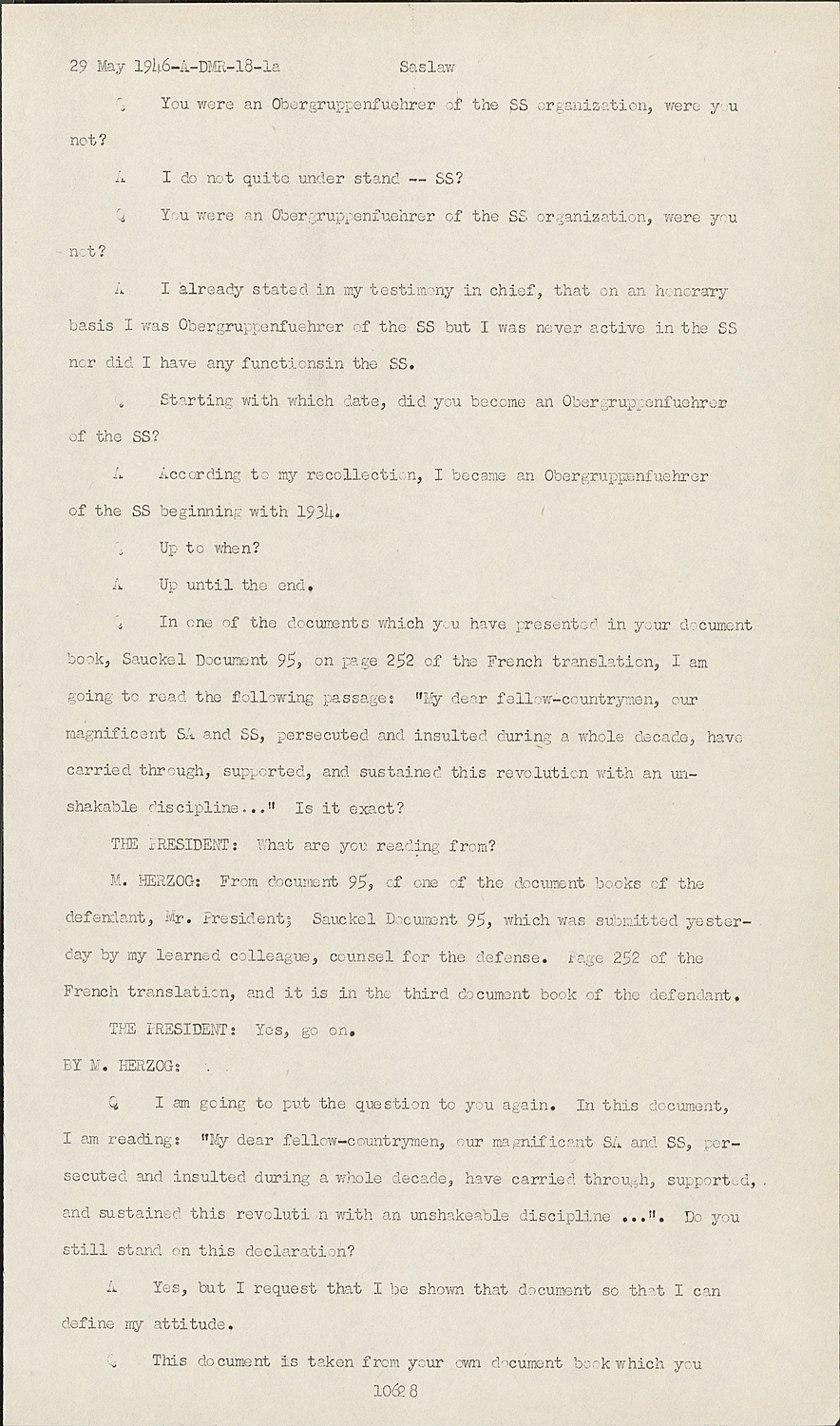
Q You were an Obergruppenfuehrer of the SS organization, were you not?
AI do not quite under stand -- SS?
QYou were an Obergruppenfuehrer of the SS organization, were you not?
AI already stated in my testimony in chief, that on an honorary basis I was Obergruppenfuehrer of the SS but I was never active in the SS nor did I have any functionsin the SS.
QStarting with which date, did you become an Obergruppenfuehrer of the SS?
AAccording to my recollection, I became an Obergruppenfuehrer of the SS beginning with 1934.
QUp to when?
AUp until the end.
QIn one of the documents which you have presented in your document book, Sauckel Document 95, on page 252 of the French translation, I am going to read the following passage: "My dear fellow-countrymen, our magnificent SA and SS, persecuted and insulted during a whole decade, have carried through, supported, and sustained this revolution with an unshakable discipline..." Is it exact?
THE PRESIDENT:What are you reading from?
M. HERZOG:From document 95, of one of the document books of the defendant, Mr. President; Sauckel Document 95, which was submitted yesterday by my learned colleague, counsel for the defense. Page 252 of the French translation, and it is in the third document book of the defendant.
THE PRESIDENT:Yes, go on. BY M. HERZOG:
QI am going to put the question to you again. In this document, I am readings "My dear fellow-countrymen, our magnificant SA and SS, persecuted and insulted during a whole decade, have carried through, supported, and sustained this revelution with an unshakeable discipline ...". Do you still stand on this declaration?
Yes, but I request that I be shown that document so that I can define my attitude.
This document is taken from your own document book which you yourself submitted?
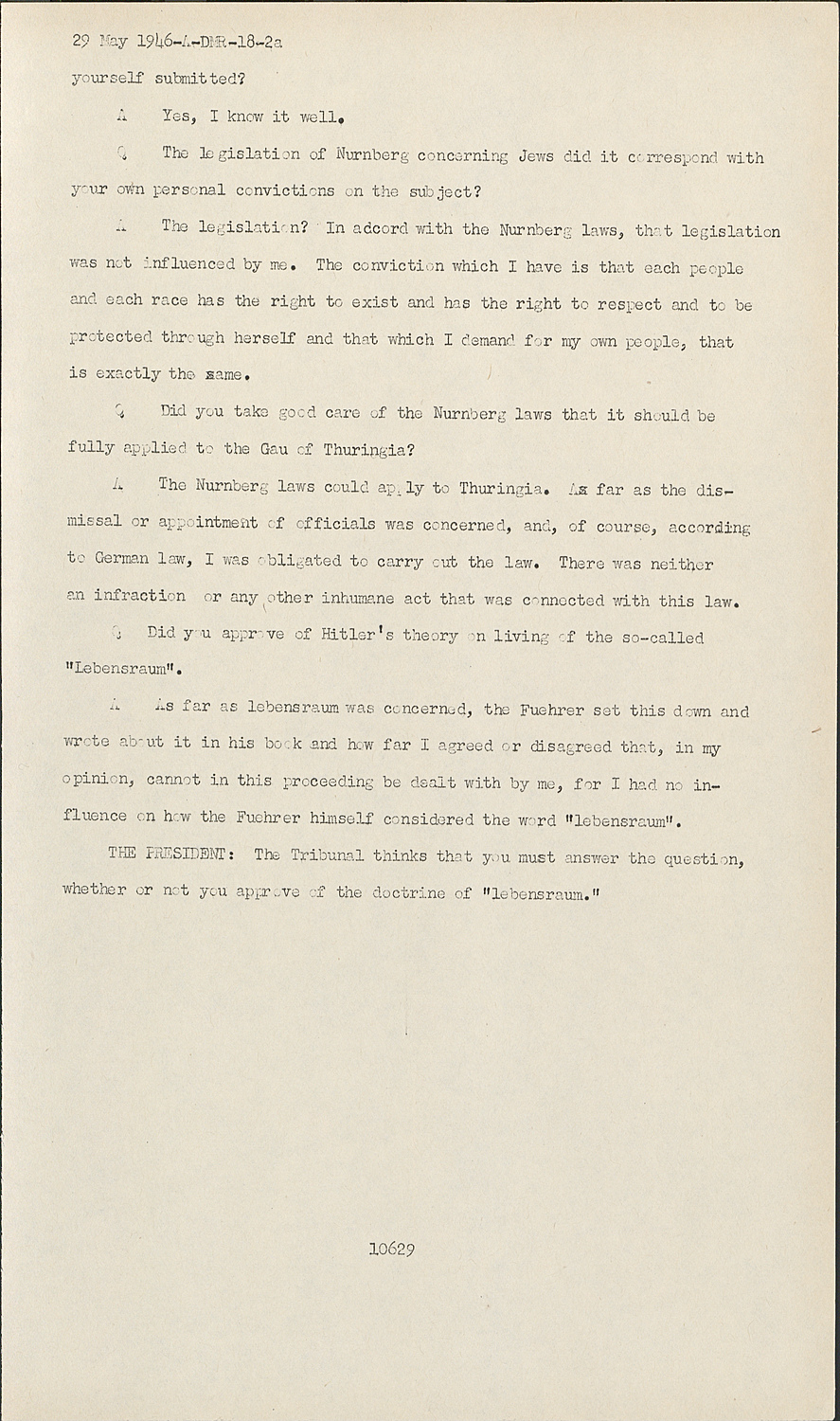
AYes, I know it well.
QThe legislation of Nurnberg concerning Jews did it correspond with your own personal convictions on the subject?
AThe legislation? In adcord with the Nurnberg laws, that legislation was not influenced by me. The conviction which I have is that each people and each race has the right to exist and has the right to respect and to be protected through herself and that which I demand for my own people, that is exactly the same.
QDid you take good care of the Nurnberg laws that it should be fully applied to the Gau of Thuringia?
AThe Nurnberg laws could apply to Thuringia. As far as the dismissal or appointment if officials was concerned, and, of course, according to German law, I was obligated to carry cut the law. There was neither an infraction or any other inhumane act that was connected with this law.
QDid you approve of Hitler's theory on living of the so-called "Lebensraum".
AAs far as lebensraum was concerned, the Fuehrer set this down and wrote about it in his book and how far I agreed or disagreed that, in my opinion, cannot in this proceeding be dealt with by me, for I had no influence on how the Fuehrer himself considered the word "lebensraum".
THE PRESIDENT:The Tribunal thinks that you must answer the question, whether or not you approve of the doctrine of "lebensraum."
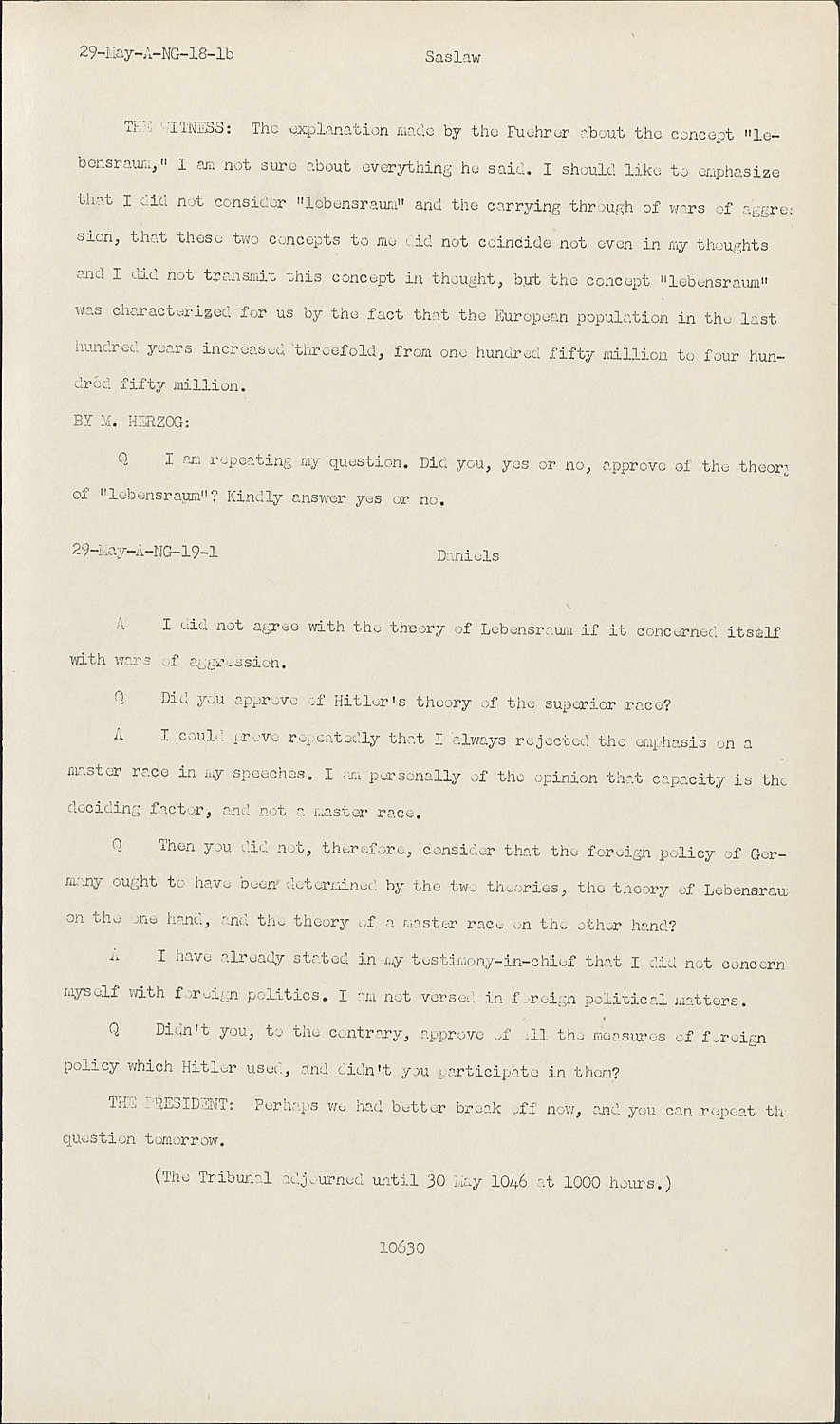
THE WITNESS: The explanation made by the Fuehrer about the concept "le-
bensraum," I am not sure about everything he said. I should like to emphasize that I did not consider "lebensraum" and the carrying through of wars of aggres sion, that these two concepts to me did not coincide not even in my thoughts and I did not transmit this concept in thought, but the concept "lebensraum" was characterized for us by the fact that the European population in the last hundred years increased threefold, from one hundred fifty million to four hundred fifty million. BY M. HERZOG:
QI am repeating my question. Did you, yes or no, approve of the theory of "lebensraum"? Kindly answer yes or no. 29-May-A-NG-19-1 Daniels
AI did not agree with the theory of Lebensraum if it concerned itself with wars of aggression.
QDid you approve of Hitler's theory of the superior race?
AI could prove repeatedly that I always rejected the emphasis on a master race in my speeches. I personally of the opinion that capacity is the deciding factor, and not a master race.
QThen you did not, therefore, consider that the foreign policy of Germany ought to have been determined by the two theories, the theory of Lebensraum on the one hand, and the theory of a master race on the other hand?
AI have already stated in my testimony-in-chief that I did not concern myself with foreign politics. I am not versed in foreign political matters.
QDidn't you, to the contrary, approve of all the measures of foreign policy which Hitler used, and didn't you participate in them?
THE PRESIDENT:Perhaps we had butter break off now, and you can repeat the question tomorrow.
(The Tribunal adjourned until 30 May 1046 at 1000 hours.)
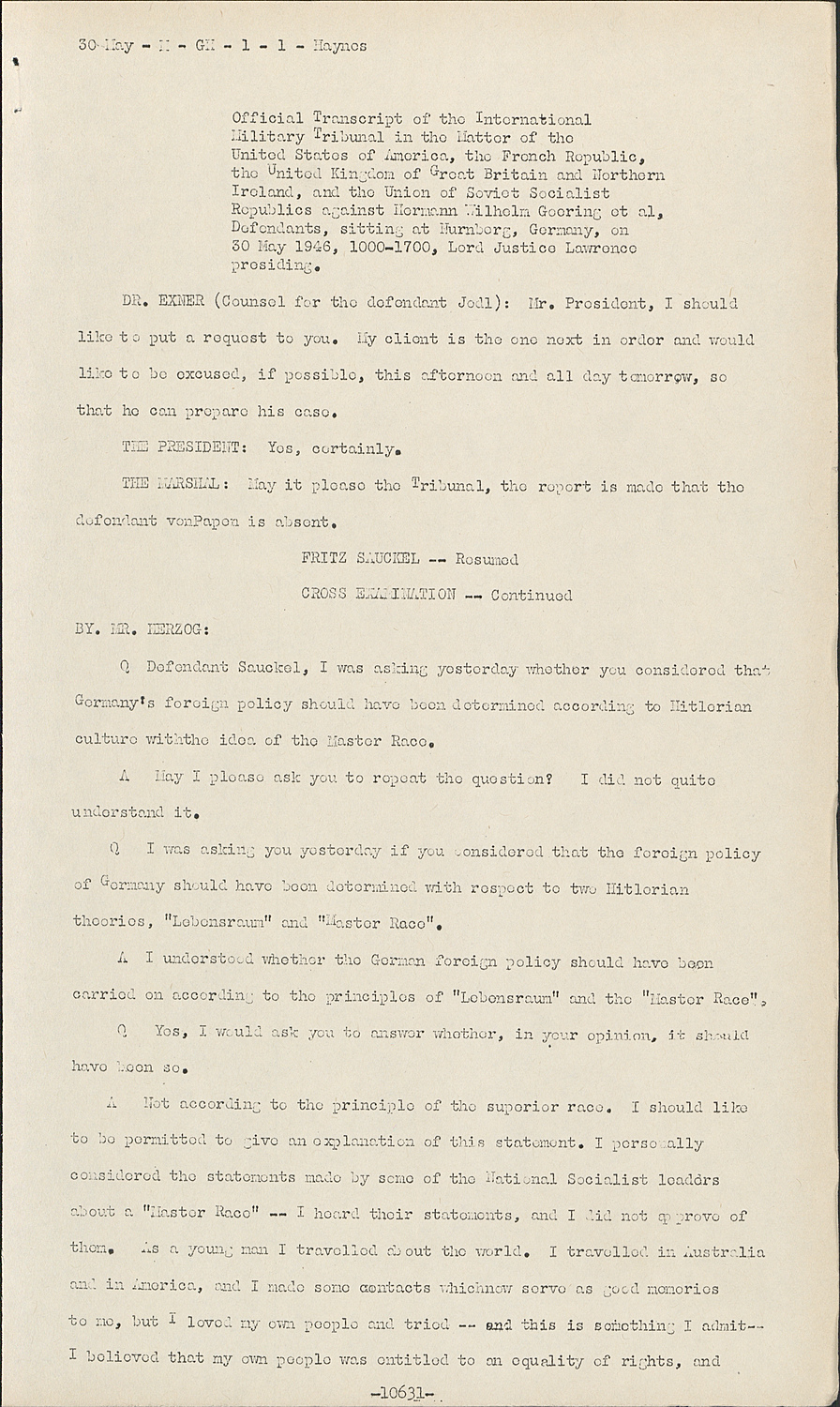
Official Transcript of the International Military Tribunal in the Matter of the United States of America, the French Republic, the United Kingdom of Great Britain and Northern Ireland, and the Union of Soviet Socialist Republics against Hermann Wilhelm Goering et al, Defendants, sitting at Nurnberg, Germany, on 30 May 1946, 1000-1700, Lord Justice Lawrence presiding.
DR.EXNER (Counsel for the defendant Jodl): Mr. President, I should like to put a request to you. My client is the one next in order and would like to be excused, if possible, this afternoon and all day tomorrow, so that he can prepare his case.
THE PRESIDENT:Yes, certainly.
THE MARSHAL:May it please the Tribunal, the report is made that the defendant vonPapen is absent.
FRITZ SAUCKEL -- Resumed CROSS EXAMINATION -- Continued BY.
MR. HERZOG:
QDefendant Sauckel, I was asking yesterday whether you considered that Germany's foreign policy should have been determined according to Hitlerian culture withthe idea of the Master Race.
AMay I please ask you to repeat the question? I did not quite understand it.
QI was asking you yesterday if you considered that the foreign policy of Germany should have been determined with respect to two Hitlerian theories, "Lebensraum" and "Master Race".
AI understood whether the German foreign policy should have been carried on according to the principles of "Lebensraum" and the "Master Race"?
QYes, I would ask you to answer whether, in your opinion, it should have been so.
ANot according to the principle of the superior race. I should like to be permitted to give an explanation of this statement. I personally considered the statements made by some of the National Socialist leaders about a "Master Race" -- I heard their statements, and I did not approve of them. As a young man I travelled about the world. I travelled in Australia and in America, and I made some contacts whichnow serve as good memories to me, but I loved my own people and tried -- and this is something I admit-I believed that my own people was entitled to an equality of rights, and that was the position I represented.