"Visits to theatres, motion pictures or other cultural entertainment are strictly prohibited for farm workers of Polish nationality."
And under No. 12there is a vital provision which says that workers of Polish nationality may be physically punished.
Please comment on this document and tell us just how far you agree with this document and the views expressed there.
AFirst of all, I should like to point out that it is dated the 6th of March, 1941, that is, it is more than a year before I assumed office. Such a nonsensical and impossible decree was never made known to me during my term of office.
Since I am now being confronted with the document and am seeing it, I should like to refer to the decrees which I issued independently of the past, the fact that prior decrees were superseded and no longer valid. Regardless of such nonsensical decrees and directives, no matter which agency in the Reich issued them, my decrees were published in this manuals. Because of the time factor and because of my respect for the Tribunal, I shall not ask that the Tribunal look at all of them, but I should ask thatI be permitted to quote just one sentence from the manifest which has already been referred to, in order to refute the nonsense. The manifest says that just and fair treatment be accorded to these workers and that the directives and their supplements be issued at least every three months to the people in charge of enterprises. The people in charge were reminded of these decrees and that adherence to these decrees and directives was to be kept in mind all the time.
QDoes the manifest close therewith?
AThat is a paragraph from the manifest, dealing with the just and humane treatment of these workers, that they were to have food and free time and so forth.
QYou issued many, many decrees and directives. Was there any resistance towards your basic directives, and if so, what did you do thereupon?
AAs soon as I noticed that there was resistance, naturally I emphasized my decrees and referred to them, for these decrees had been approved by the Fuehrer and were to apply to my sphere of influence.
QAs far as care and welfare were concerned, did the DAF play a part?
And what was the task of the Deutsche Arbeits Front?
AThe task of the DAF was the care of German workers and the looking after their interest, as such; as a matter of course, it had to concern itself with the welfare of foreign workers as well. That was its natural task, to work along the lines of and to be a corrective measure when it came to administrative positions, a function carried out in other countries by unions.
QWhat task did the entrepreneurs have?
AEntrepreneurs had the task, as far as their enterprises were concerned, of regulating the total production, and of course, they were responsible for their workers and the foreign workers which had been assigned to them.
QWere they responsible in the first place or was the German Labor Front responsible?
AThe first line of responsibility remained with the entrepreneurs.
Q Now, the workers mostly were housed in camps. Who guided the installations of these camps?
AThe direction and installation of these camps, in the final analysis, was under the Deutsche Gewerbeaufsicht (German Trade Supervision), and that was under the German Labor Ministry. Gewerbeaufsicht had to survey the measures of compulsion used by entrepreneurs and people who did not comply with the regulations and used compulsion.
QDid you yourself take measures to dispose of conditions in the camps?
AI dealt with the camps, but all of these actions were realized by the German Labor Ministry, which was the competent authority.
QWhat were the living conditions within the camps? Who was responsible there?
AIn the camps the person who was responsible was the Camp Commandant. This person, in agreement with the D.A.F. and the works manager, was put in service, and to my knowledge -- this was not my sphere of influence -- this man had to be confirmed and certified to by the Security Division.
QYou are talking about the Sicherheitsbehoerde. That is, the security authorities. To what extent was the police active in the surveillance of these camps and the keeping of discipline ?
AAs far as discipline was concerned, that was the task of the Camp Commandant, and it did not have any connection with the police. In my opinion, as is true in every State, the police had surveillance and control rights, and the nature of the industry was to be kept secret. Beyond that, the police had no function.
QWere these camps shut off from the outside world? How were things like that when you assumed office?
AWhen I assumed office, the camps of the Eastern workers were shut off form the world, and they were surrounded with barbed wire. To me, this idea was incompatible with producing work, and I worked with much energy against this shutting off, and I brought this about, so that there was no barbed wire used, and other measures which were to limit the Eastern workers I tried to do away with, so that the picture which was presented yesterday actually was realized. I wanted a willingness to work and I considered that anything other than what I wanted would be incompatible with the work problem.
QAs far as the food problem is concerned, how was the nutrition of these foreign workers?
AThe feeding of these foreign workers coincided with the bases that applied to the feeding of the German people, and the people who had to work hardest received additional food.
QDid this actually apply and obtain when you assumed office?
AWhen I assumed office and received the order from the Fuehrer that in addition to the foreign workers who were already in the Reich, I was to bring in another quota of foreign workers, the first step which I took was to visit the Reich Nutrition Minister, for to me it was a matter of course that bringing in of foreign workrs would, first of all, entail a feeding problem, and that this was the first problem, for poorly fed workers, even if they want to, cannot turn out satisfactory work. In many, many conversations, and referring to the Reichsmarshal and the Fuehrer, I brought about the feeding schedule that was put down in laws. It was not easy to do this, for feeding in Germany was always a difficult problem, but without these laws it would not have been possible for me to carry through my task.
QRegarding the food problem, things have been mentioned here which tell us about terrible abuses. Did not anything like that come to your attention, or did you not yourself have any knowledge of this?
AAs far as abuses in the feeding situation was concerned, as far as the work camps are concerned, I never had any catastrophic reports about anything like that as far as civilian workers were concerned. I again tried to have this matter controlled constantly and checked constantly. The works managers themselves were very serious about the matter of provisions.
QIn a decree to the Gau Work Offices, did you not turn to them and rather criticize conditions which obtained?
AImmediately after I assumed office, when the Gauleiters were appointed Plenipotentiaries for Labor in their Gaus, I called their attention to the food problem and obligated them to give complete attention to the matter of food and billetting. I had work from two gaus that my directives had notbeen taken seriously enough. In one case I immediately travelled to Essen personally and remedied the situation there. One was the matter of the barbed wire.
In the other case in Bavarian Ostmark I also intervened personally.
Beyond that I used these two incidents in order to write to the leaders of the gaus and German provinces and states and again stressed the importance of their adhering to these decrees.
DR. SERVATIUS:I am referring to Document 19, which is found in English Book I, page 54, Document Sauckel 19.
THE PRESIDENT: 19?
DR. SERVATIUS:In my document book, Number 19 in the first document book, page 54. Only a portion of this is in print. This is a copy of a decree and letter to the Gauleiter Offices and Gauleiters. It says the following:
"If in a Gau district the statement was recently made: Should any one in the Gau have to freeze next winter, the first ones to freeze should be the Russians (that is the Russian civilian laborers mobilized for work in the Gau), such an utterance shows plainly that in that region of the Gau the contact between the administrative office of labor mobilization and the competent political offices is as yet not close enough; for it is one of the most important tasks in the mobilization of labor and in the collaboration between you and the Gauleiters as my deputies for the mobilization of labor, to see to it that the foreign labor recruited for work in the German armament industry and food economy be looked after in such manner as to enable them to give the maximum in efficiency. It would therefore be entirely wrong to think of protection against want only for German fellow countrymen, and to be satisfied unhesitatingly with inadequate provisions for laborers of foreign origin. On the contrary, the need is to be aware constantly of the fact that in order to bring about victory, a maximum of efficiency must be demanded not only of the German fellow countrymen but also of the foreign workers, and that it would be absurd first to go to the expense which is considerable for German economy of hauling foreign labor into the country, to arrange for work and then to fall in their proper care, with a resultant decline in their efficiency or possibly even their ruin."
In conclusion, there is a request to follow the decrees of Sauckel. BY DR. SERVATIUS:
QHow about the clothing of foreign workers?
A The clothing of foreign workers from the Western regions gave us relatively little trouble, for these workers had comparatively good clothing, but the clothing of the Eastern workers was a problem.
On behalf of the Eastern workers, I applied for a quota of clothing for them, applying to two and a half million workers, that they receive a complete change of under and outer clothing. For that, 10,000 workers were required to supply this quota of clothing, as well as 30,000 tons of raw materials. Therefore, all possible concern was taken for the clothing, and this clothing actually was issued.
DR. SERVATIUS:The French Delegation submitted the document RF No.5. This is a recruiting statement "Foreigners work in Germany." I submitted this, and the High Tribunal again took official notice of this document. I should like to submit it again and refer to three pictures contained therein. The essential thing about these pictures is that the workers coming from the East, many of them, arrived barefoot, and later we see pictures where these female workers are seen well dressed, working in Germany , where it can be seen that their clothing problems had been alleviated.
THE PRESIDENT: Is this Sauckel 5?
DR. SERVATIUS:It is the French Delegation, your Honor, RF No 5. BY DR. SERVATIUS:
QHow about the time of work? Who regulated the working hours?
AThe working hours were regulated and set down on the basis of the Fuehrer Decrees, and later on, by Reich Minister Dr. Goebbels. The carrying through of these decrees was my sphere.
QWhat was the average time of work?
ADuring the war in Germany, one could hardly talk about the average working time. There was the legal working time of eighrt hours. Anything beyond eight hours had to be considered as overtime and paid a s such.
First of all, in the year 1943, the average working time per week was set down for 54 hours. Then, when Reich Minister Dr. Goebbels became Reich Plenipotentiary for the entire war effort, against my objections and against the objec tions of other offices but on the basis of the authority which he had, he proclaimed a 10-hour work day for all businesses. He demanded the 10-hour day and proclaimed it. However, this could not be carried through, for in many industries and offices work had to be regulated according to the difficulties which appeared at that time, that is, the problem of raw materials, the problem of power, fuel, and so fourth.
In exceptional cases, which were not too infrequent, as far as productivity demanded it 11 and 12 hours of work applied. German workers, as well, worked longer hours, and of course they were compensated correspondingly.
QDealing with the French document RF-22, on page 101 of the German to the following is set down.
"From the reports of displaced workers who had returned home, it can be seen that the average capacity par week was at least 72 hours," Then the source of this information is mentioned, but that does not seem to be important of this time.
"Sixty-four hour weeks were not infrequent. Cases of 100-hour weeks in installments of 30 to 38 hours duration were mentioned."
What can you tell us about this? Did you know of cases like that?
AI cannot comment on these reports, for I do not know whether we are concerned with people who were being used in concentration camps or whether the were used in another sector as civilian workers, the sector which was my responsibility.
It is, of course, correct that in very exceptional cases there were period of time in which long hours of work applied, and that was determined by the in. dustry, and the German workers were obligated to work. But if this applied, a corresponding rest period had to be interspersed.
However, where these people mentioned in that document worked, that I can not determine from the document and I cannot give you any information.
QHow about free time?
AFree time was at the disposal for the workers.
QAnd who regulated free time?
AThe regulation of free time was under the DAF, the German Labor Front
QHow about the use of children and young people?
AUnder the German Reich Law, children under 12 years of age are not permitted to work. As to children under 14, just a few may be used in agriculture, a few hours a day.
QDid you issue decrees about working hours for children?
AI issued decrees and observed them, for the laws were already in existance when they applied.
QNow I shall have shown to you Document 345-PS, which is a letter writ ten by the Reich minister Rosenberg addressed to Dr. Lammers, dated the 20th of July 1944.
THE PRESIDENT:Has this been put in before? Has this been offered in evidence before?
DR. SERVATIUS:This document was submitted several days ago in cross examination. I myself have just received it now. BY DR. SERVATIUS:
QI shall quote only the contents of the document dealing with the recruitment of young people. Referring to the age group 15 to 20, they were to be used in the Reich during the time of war. Then the document refers to the taking of young people in the age group of 10 to 14 into the Reich, and that is the "H*** Action". It says also that the objective of this action is the better care of these youthful workers of the HJ, and the use of apprentices in German economy, and that these measures have already been taken in agreement with the GBA, that is, with you.
Some of these suggestions are to be put in now. Please comment on them and tell us whether you were responsible for the use of these young people.
ANo, I had nothing whatever to do with this action, and in the roster of addresses, my name is nut mentioned.
QTherefore, there were no special directives?
ANo. This was an incident with which I did not concern myself.
QThen I should like to submit another letter to you, a letter which was mentioned in connection with the Schirach case and submitted by the Prosecution. It is document 1137-PS, a letter dated 19/10/44/
On page 3 of this document, the following is set down:
"The following workers have been supplied to Germany: First of all, 3,500 young men and 500 girls for the Junkers works; second, 2,000 young men and 700 girls to the Todt Organization, from the Occupied Eastern Regions. Therefore, through the offices which are under the Hitler youth, 5,500 boys and 1,200 girls were put at the disposal of the armament industry."
Were you responsible for the use of this labor, or did it have anything to do with you at all?
ANo.
Q.How were these people brought into the armament industry?
AWell, I personally am unable to explain that, but it can be seen that on basis of an agreement with the Eastern Ministry, this took place.
During the proceedings here, I heard that we were not concerned with young people for whom work was prohibited. I was under the impression that this was an order, but I had nothing to do with it and my office had no concern with it.
QHow about the use of women, that is, foreign women, for labor purposes?
AWomen from foreign countries were used in the same way as German women were used.
QI have a document 025-PS which has been submitted. This is US Exhibit 698, which has been submitted very recently, and which is not contained in the document books.
These are the minutes of a session which took place with you, and on which occasion you dealt with the use of foreign female labor, In the third paragraph it says;
"In this way, the Fuehrer has sanctioned the use of 400 to 500 thousand female workers in the eastern regions for domestic purposes, and GBA" -- that is you --"has been charged with the carrying through of this action which is to be concluded in approximately three months."
It says further:
"It is in accord with the specific wish of the Fuehrer that as many women as possible shall be Germanized."
Will you please comment on this.
A Yes; here we are concerned with the decree from the Fuehrer for German domestic life, especially in order to alleviate conditions applied to German peasant women.
Four hundred to five hundred thousand female workers were to be brought into the Reich from the Eastern Region. I should like to mention, in referring to the minutes, that I did not set down these minutes, neither did my office, but most likely that these minutes were set down on the basis of notes which rather some gentleman took -- four hundred to five hundred thousand female workers to be used in the home ---I should like to remark that they were to be brought into the Reich only on a voluntary basis; in fact, only perhaps thirteen to fifteen thousand---I believe the figure was---came into the Reich. The concept to Germanize, this concept as used here, refers only to the volunteer desire on the part of these people to perhaps later on remain in Germany voluntarily.
QHow about medical attention which the foreign workers received? Some things have been mentioned here and it has been said that "if the worker can no longer work, he is no longer a concern of ours;" that that supposedly is the basic principle of yours; that it is further stated that "work, food, and pay has to be determined if the worker can he longer work---then he is just something that we no longer are concerned with." What can you say in regard to these accusations?
AI should like to have you tell me just where I said that and where this is.
QThis is laid down in the record; that is, the minutes of the session; I have the page, the German, 2789. It says there "If the worker can no longer work, he is no longer any concern of ours." Did you represent this principle?
AOn the contrary; there are hundreds of precise and clear decrees given out by me. These decrees are written down in the Reichsgesetzblatt. They are also present in special issues sent to the employment agencies and all of my statements are set down exact ly, that the foreign workers were brought into the Reich---as far as their treatment is concerned, when they were sick, this treatment was accorded them in line with German laws and of course there was insurance as well.
THE PRESIDENT:Dr. Servatius, were you putting to the defendant a document where it was alleged he had said that after they were unfit to work, that it is no more his concern? Was it the document you were putting to him?
DR. SERVATIUS:This document was submitted regarding the female workers about whom he is alleged to have said that they were to be Germanized. I have loft that document, your Honor, and now I have turned to the question of medical attention.
THE PRESIDENT:You mean that was in 025-PS, US 698.
DR. SERVATIUS:This document 025 refers to female workers only but we have left that question. We have disposed of that. I turned to another question, that of medical welfare but I am no longer dealing with the question of female workers. BY DR. SERVATIUS:
QDid you receive reports about catastrophic conditions as far as the state of health was concerned, that there was not enough medical care for the foreign workers?
ANo. Not only German physicians became or got to be company physicians in those industries, and they had to deal with the hygienic conditions of health for the workers there, but also from the home countries of the foreign workers numerous positions and medical auziliary personnel was hired and put to use in these camps.
QHow did you check the carrying through of your decrees and what other agencies of control operated?
AThese other control agencies, first of all --
DR. SERVATIUS:Just a moment. I should like to refer to document No. 2. In this document, I have put down these control agencies and agencies of inspections. They are put down in a comprehensive picture, diagrams. It is document No. 2. I should like to explain this diagram briefly. In the center, you have the Reich plan or ministry under Seldte. Underneath that, the surveillance during peace and the industry and construction police.
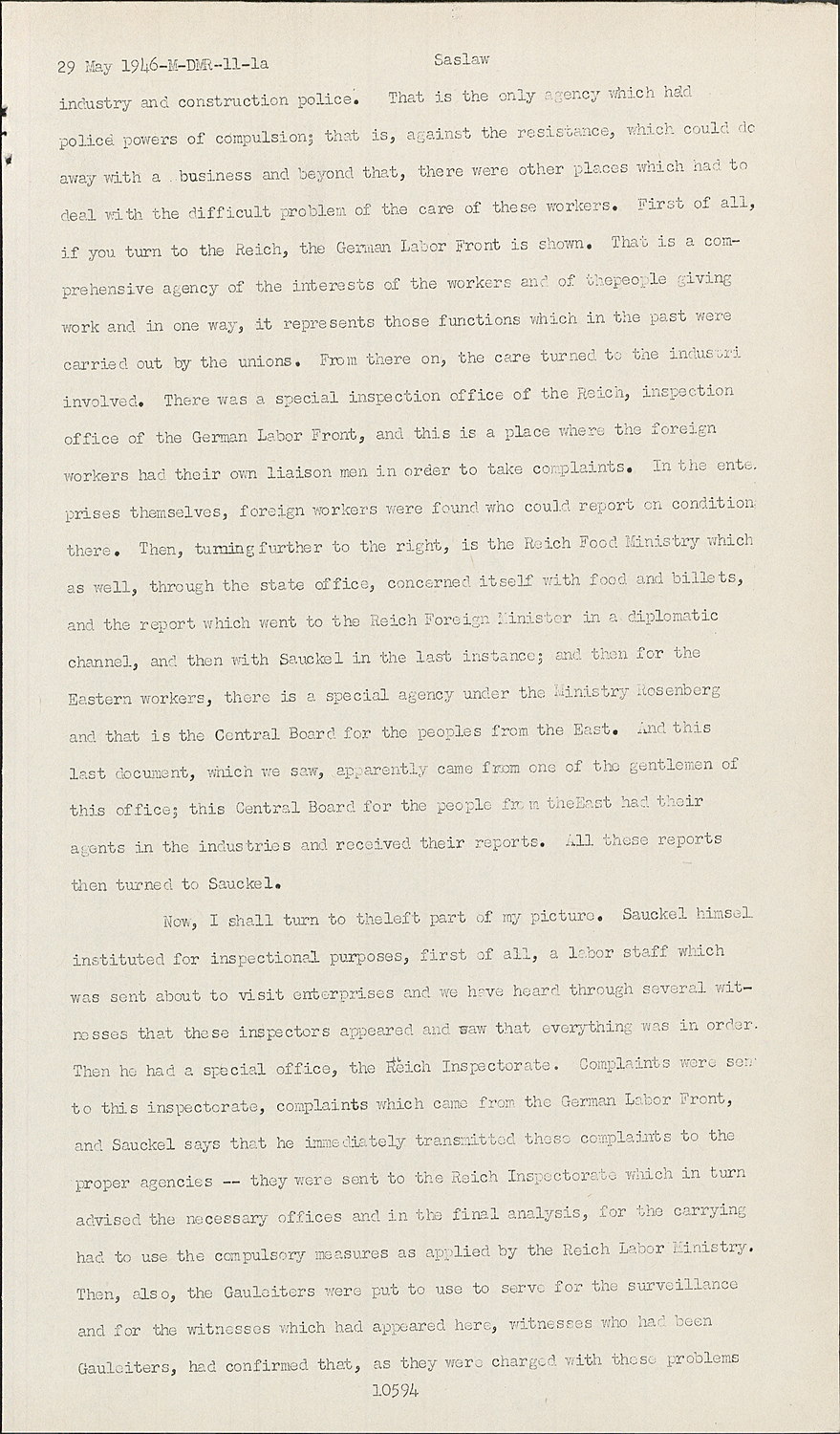
That is the only agency Which had police powers of compulsion; that is, against the resistance, which could do away with a business and beyond that, there were other places which had to deal with the difficult problem of the care of these workers.
First of all, if you turn to the Reich, the German Labor Front is shown. That is a comprehensive agency of the interests of the workers and of thepeople giving work and in one way, it represents those functions which in the past were carried out by the unions. From there on, the care turned to the industrial involved. There was a special inspection office of the Reich, inspection office of the German Labor Front, and this is a place where the foreign workers had their own liaison men in order to take complaints. In the enterprises themselves, foreign workers were found who could report on condition there. Then, turning further to the right, is the Reich Food Ministry which as well, through the state office, concerned itself with food and billets, and the report which went to the Reich Foreign Minister in a diplomatic channel, and then with Sauckel in the last instance; and then for the Eastern workers, there is a special agency under the Ministry Rosenberg and that is the Central Board for the peoples from the East. And this last document, which we saw, apparently came from one of the gentlemen of this office; this Central Board for the people from theEast had their agents in the industries and received their reports. All these reports then turned to Sauckel.
Now, I shall turn to theleft part of my picture. Sauckel himself instituted for inspectional purposes, first of all, a labor staff which was sent about to visit enterprises and we have heard through several witnesses that these inspectors appeared and saw that everything was in order. Then he had a special office, the Reich Inspectorate. Complaints were sent to this inspectorate, complaints which came from the German Labor Front, and Sauckel says that he immediately transmitted these complaints to the proper agencies -- they were sent to the Reich Inspectorate which in turn advised the necessary offices and in the final analysis, for the carrying had to use the compulsory measures as applied by the Reich Labor Ministry. Then, also, the Gauleiters were put to use to serve for the surveillance and for the witnesses which had appeared here, witnesses who had been Gauleiters, had confirmed that, as they were charged with these problems and that they acted in accordance.
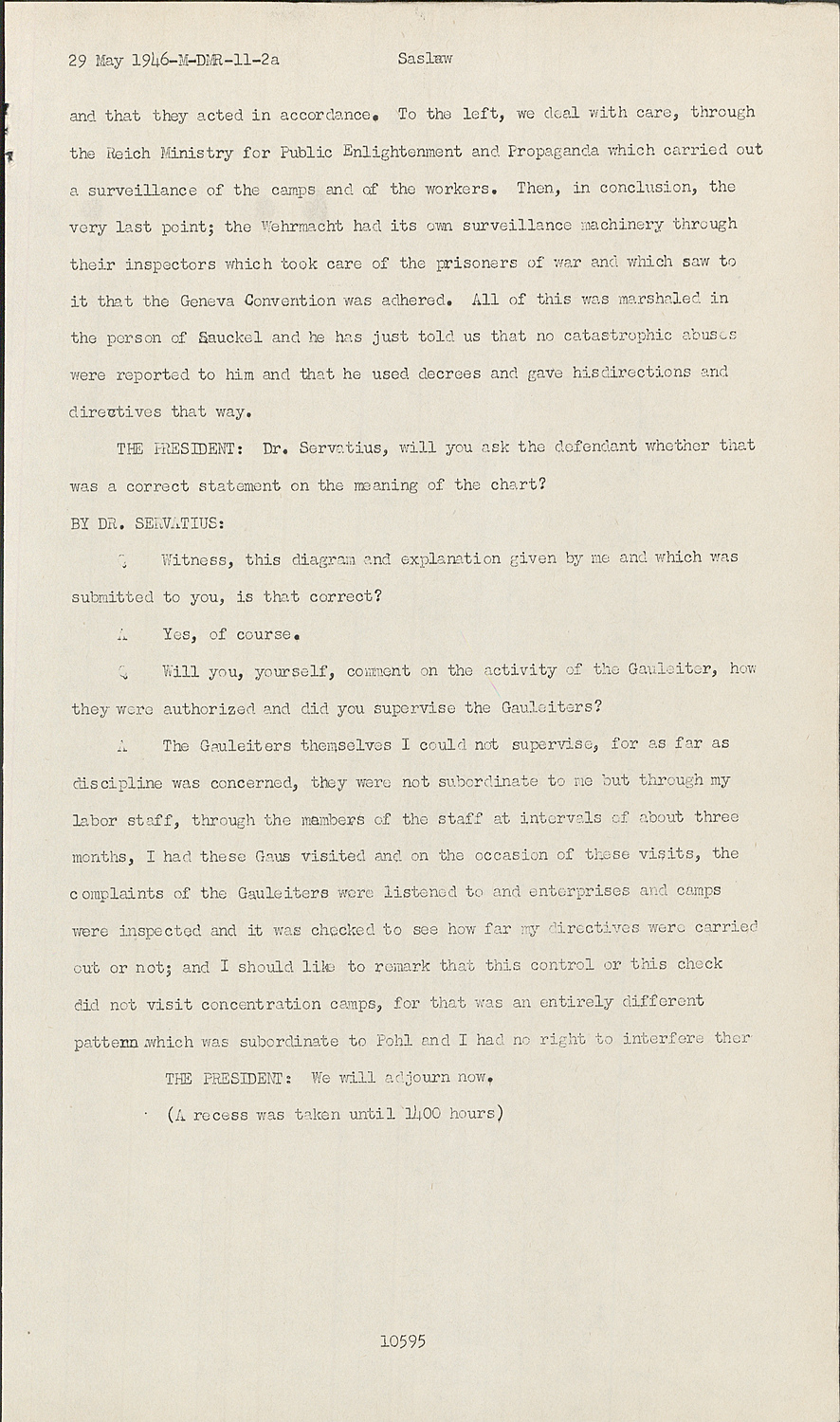
To the left, we deal with care, through the Reich Ministry for Public Enlightenment and Propaganda which carried out a surveillance of the camps and of the workers.
Then, in conclusion, the very last point; the Wehrmacht had its own surveillance machinery through their inspectors which took care of the prisoners of war and which saw to it that the Geneva Convention was adhered. All of this was marshaled in the person of Sauckel and he has just told us that no catastrophic abuses were reported to him and that he used decrees and gave hisdirections and directives that way.
THE PRESIDENT:Dr. Servatius, will you ask the defendant whether that was a correct statement on the meaning of the chart? BY DR. SERVATIUS:
QWitness, this diagram and explanation given by me and which was submitted to you, is that correct?
AYes, of course.
QWill you, yourself, comment on the activity of the Gauleiter, how they were authorized and did you supervise the Gauleiters?
AThe Gauleiters themselves I could not supervise, for as far as discipline was concerned, they were not subordinate to me but through my labor staff, through the members of the staff at intervals of about three months, I had these Gaus visited and on the occasion of these visits, the complaints of the Gauleiters were listened to and enterprises and camps were inspected and it was checked to see how far my directives were carried out or not; and I should like to remark that this control or this check did not visit concentration camps, for that was an entirely different pattern which was subordinate to Pohl and I had no right to interfere there
THE PRESIDENT:We will adjourn now.
(A recess was taken until 1400 hours)
AFTERNOON SESSION (The hearing reconvened at 1400 hours, 29 May 1946)
DR.KUBUSCHOK (Counsel for defendant von Papen): I ask permission for the defendant von Papen to be absent from the court sessions tomorrow morning and afternoon, as I need a longer conversation with him for the preparation of his defense, which I would otherwise not be able to bring about. Dr. Flexner will be present during the session.
THE PRESIDENT:Yes.
THE MARSHAL:If it please the Tribunal, a report is made that the defendant Goering is absent.
THE PRESIDENT:As I said this morning, the Tribunal will rise at 4 this afternoon.
FRITZ SAUCKEL -- Resumed DIRECT EXAMINATION -- Continued BY DR. SERVATIUS:
QWe had come to the inspections, but I should like to go back to one question.
You said that the leade of industrial units was responsible for the workers. Did that also apply to the prisoners of war and inmates of concentration camps?
ANo. As far as the prisoner of war camps were concerned, the Army was responsible, or that part of the armed forces under whose authority these prisoners of war were kept.
To my know,so far as the inmates of concentration camps were concerned, even if they worked, only the Concentration camps themselves were responsible for them; that is, the administration.
QYou had installed a Department 9, of Reich Inspectors in the Reich Ministry of Labor. What were the tasks of that inspection department?
AI had installed that inspection deparment, which had not existed before, in the Ministry of Labor because I wanted to see, in the entire area of the Reich and in the occupied territories where German enterprise and German labor contracts were valid, that the unity of these contracts and their execution should be examined, that unified administrative regulations should be examined and brought about, and also to see whether my decrees were carried out concerning food and lodging, and to what extent it was necessary to change them.
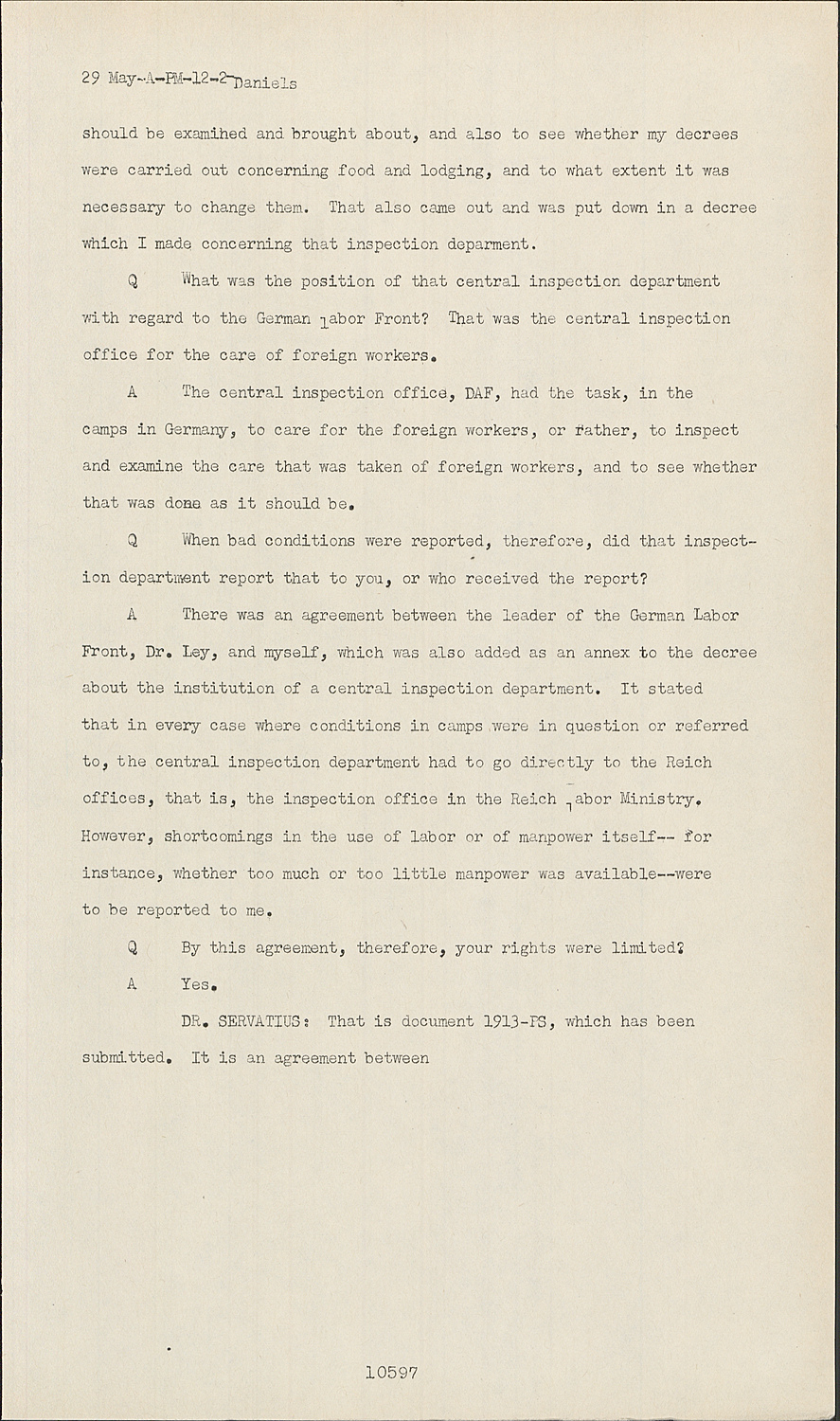
That also came out and was put down in a decree which I made concerning that inspection deparment.
QWhat was the position of that central inspection department with regard to the German labor Front? That was the central inspection office for the care of foreign workers.
AThe central inspection office, DAF, had the task, in the camps in Germany, to care for the foreign workers, or rather, to inspect and examine the care that was taken of foreign workers, and to see whether that was done as it should be.
QWhen bad conditions were reported, therefore, did that inspection department report that to you, or who received the report?
AThere was an agreement between the leader of the German Labor Front, Dr. Ley, and myself, which was also added as an annex to the decree about the institution of a central inspection department. It stated that in every case where conditions in camps were in question or referred to, the central inspection department had to go directly to the Reich offices, that is, the inspection office in the Reich labor Ministry. However, shortcomings in the use of labor or of manpower itself-- for instance, whether too much or too little manpower was available--were to be reported to me.
QBy this agreement, therefore, your rights were limited?
AYes.
DR. SERVATIUS: That is document 1913-PS, which has been submitted. It is an agreement between Sauckel and Dr. Ley of the 20th of September, 1943; it is USA 227.
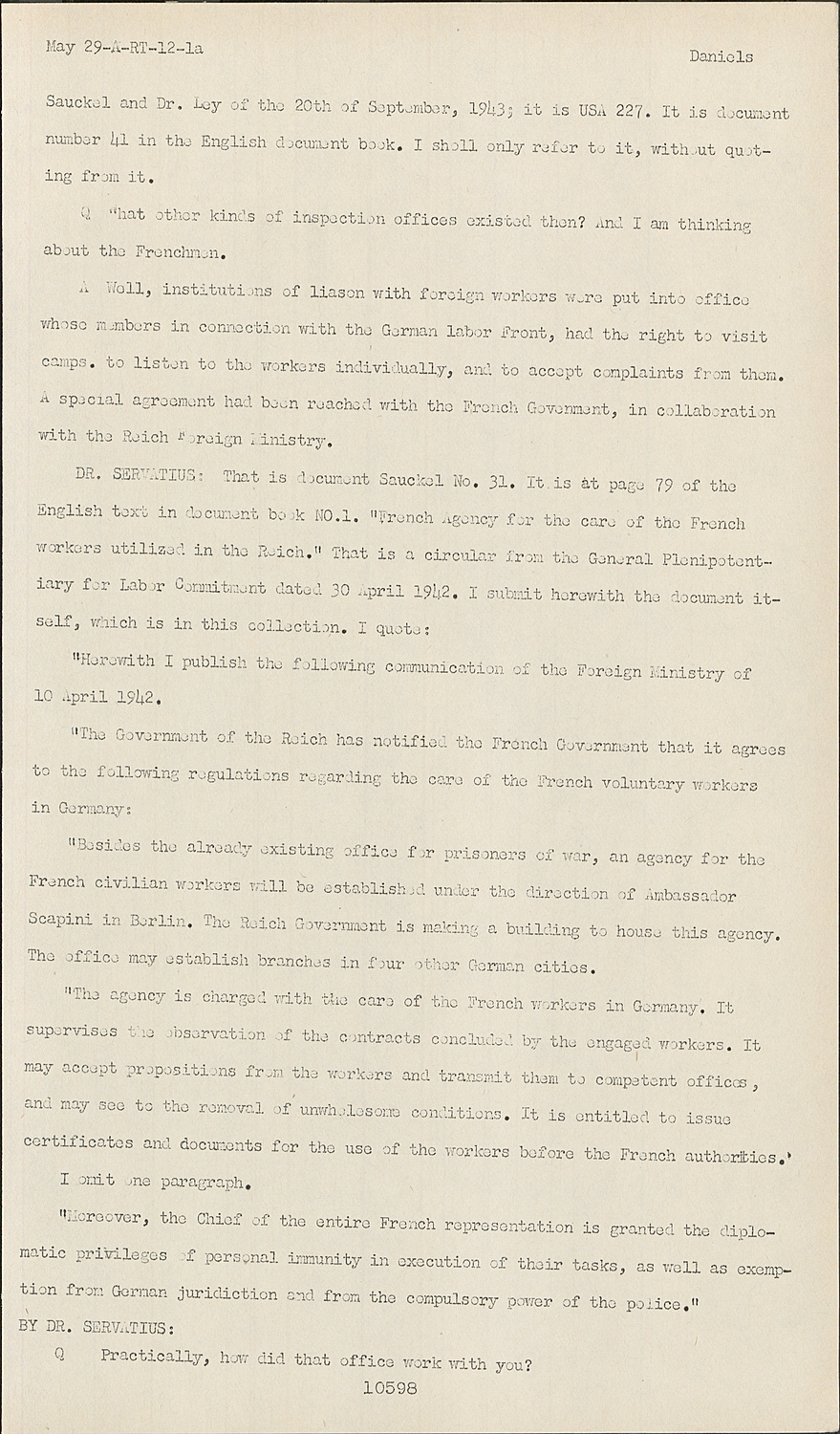
It is document number 41 in the English document book.
I shall only refer to it, without quoting from it.
QWhat other kinds of inspection offices existed then? And I am thinking about the Frenchman.
AWell, institutions of liason with foreign workers were put into office whose members in connection with the German labor front, had the right to visit camps, to listen to the workers individually, and to accept complaints from them. A special agreement had been reached with the French Govenment, in collaboration with the Reich foreign Ministry.
DR. SERVATIUS:That is document Sauckel No. 31. It is at page 79 of the English text in document book No.1. "French Agency for the care of the French workers utilized in the Reich." That is a circular from the General Plenipotentiary for Labor Commitment dated 30 April 1942. I submit herewith the document itself, which is in this collection. I quote:
"Herewith I publish the following communication of the Foreign Ministry of 10 April 1942.
"The Government of the Reich has notified the French Government that it agrees to the following regulations regarding the care of the French voluntary workers in Germany:
"Besides the already existing office for prisoners of war, an agency for the French civilian workers will be established under the direction of Ambassador Scapini in Berlin. The Reich Government is making a building to house this agency. The office may establish branches in four other German cities.
"The agency is charged with the care of the French workers in Germany. It supervises the observation of the contracts concluded by the engaged workers. It may accept propositions from the workers and transmit them to competent offices, and may see to the removal of unwholesome conditions. It is entitled to issue certificates and documents for the use of the workers before the French authorities."
I omit one paragraph.
"Moreover, the Chief of the entire French representation is granted the diplomatic privileges of personal immunity in execution of their tasks, as well as exemption from German juridiction and from the compulsory power of the police." BY DR. SERVATIUS:
QPractically, how did that office work with you?
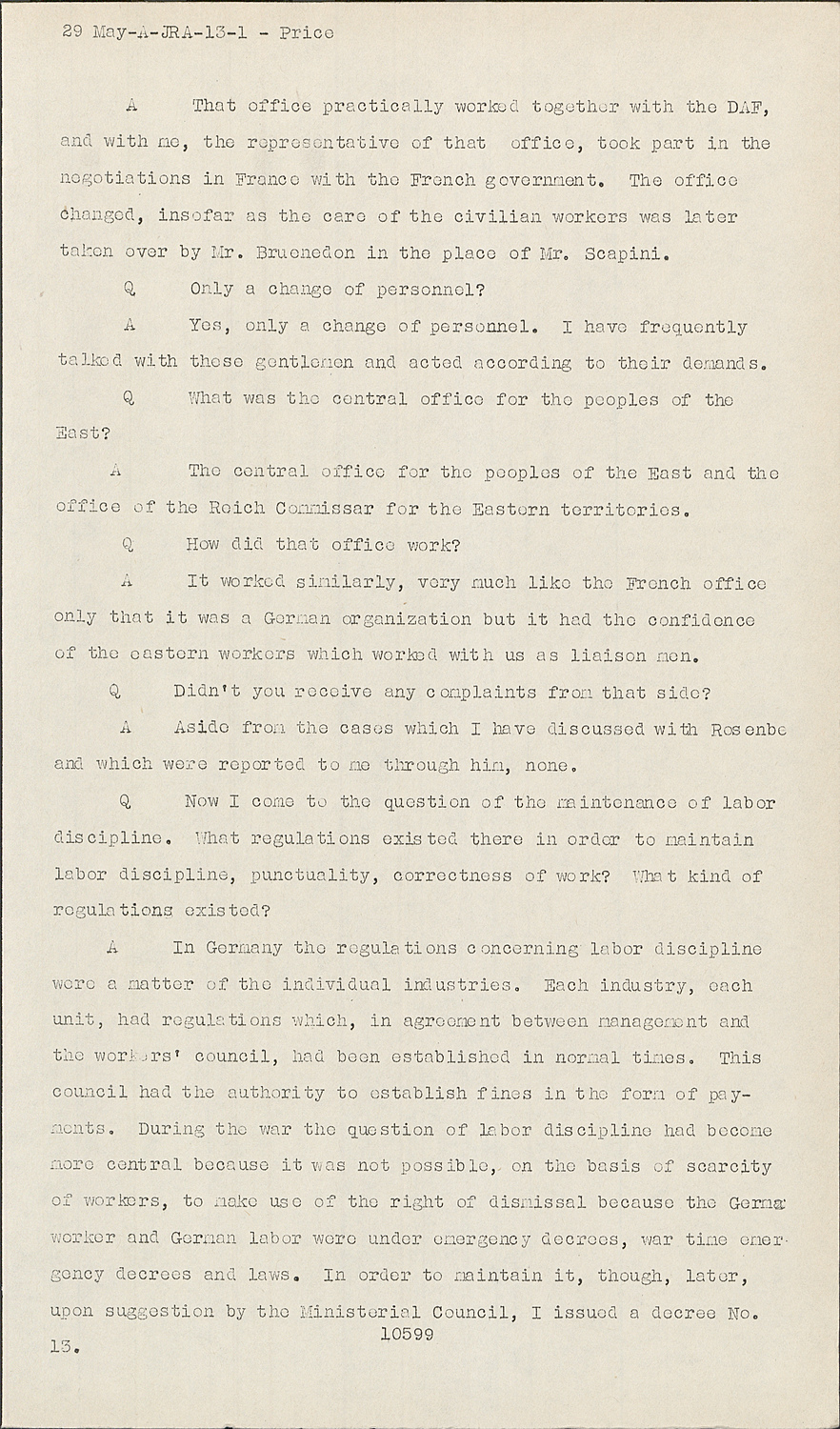
A That office practically worked together with the DAF, and with me, the representative of that office, took part in the negotiations in France with the French government.
The office changed, insofar as the care of the civilian workers was later taken over by MR. Bruenedon in the place of Mr. Scapini.
QOnly a change of personnel?
AYes, only a change of personnel. I have frequently talked with these gentlemen and acted according to their demands.
QWhat was the central office for the peoples of the East?
AThe central office for the peoples of the East and the office of the Reich Commissar for the Eastern territories.
QHow did that office work?
AIt worked similarly, very much like the French office only that it was a German organization but it had the confidence of the eastern workers which worked with us as liaison men.
QDidn't you receive any complaints from that side?
AAside from the cases which I have discussed with Rosenberg and which were reported to me through him, none.
QNow I come to the question of the maintenance of labor discipline, What regulations existed there in order to maintain labor discipline, punctuality, correctness of work? What kind of regulations existed?
AIn Germany the regulations concerning labor discipline were a matter of the individual industries. Each industry, each unit, had regulations which, in agreement between management and the workers' council, had been established in normal times. This council had the authority to establish fines in the form of payments. During the war the question of labor discipline had become more central because it was not possible, on the basis of scarcity of workers, to make use of the right of dismissal because the German worker and German labor were under emergency decrees, war time emergency decrees and laws. In order to maintain it, though, later, upon suggestion by the Ministerial Council, I issued a decree No. 13.
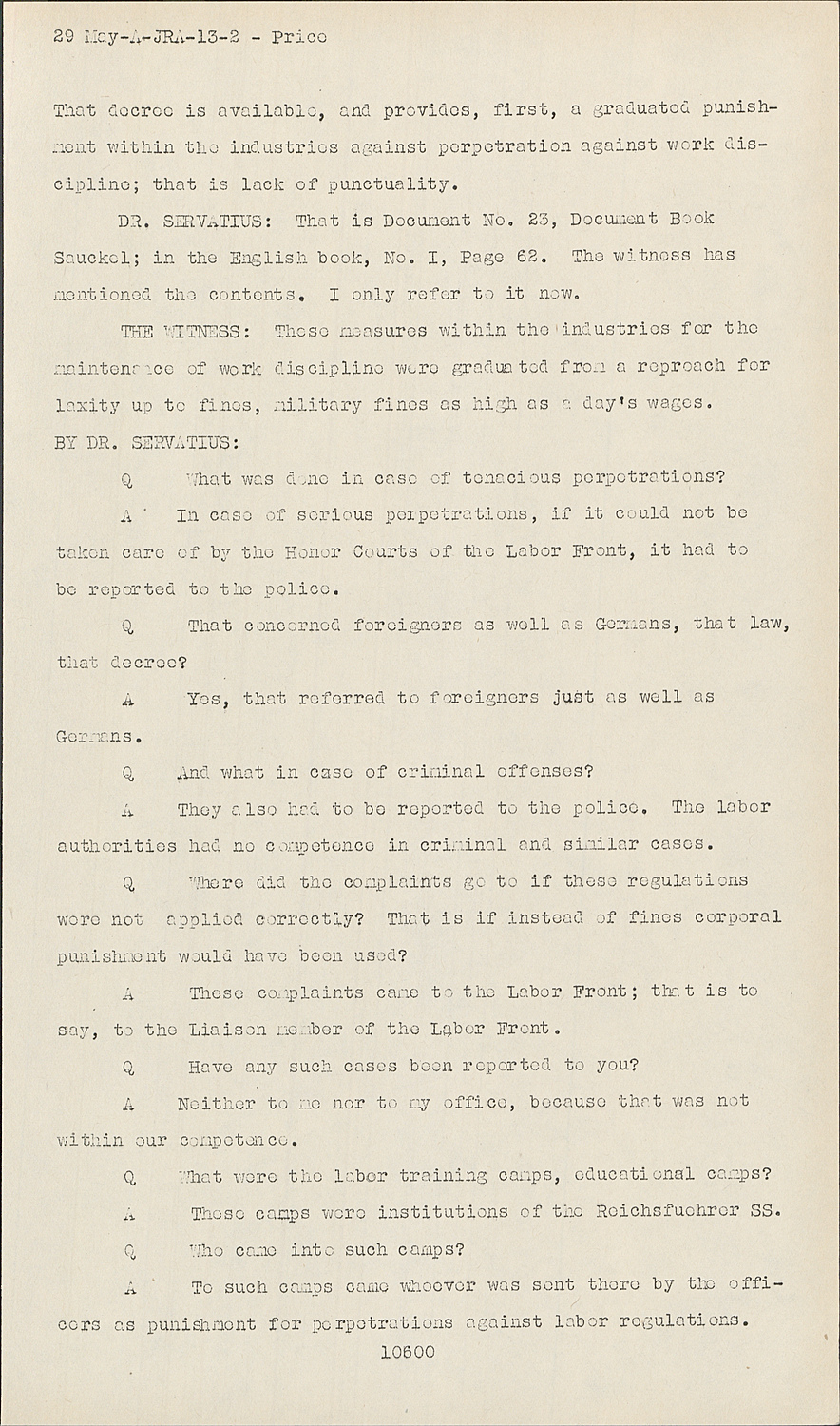
That decree is available, and provides, first, a graduated punish-
ment within the industries against perpetration against work discipline; that is lack of punctuality.
DR. SERVATIUS:That is Document No. 23, Document Book Sauckel; in the English book, No. I, Page 62. The witness has mentioned the contents. I only refer to it now.
THE WITNESS:These measures within the industries for the maintenance of work discipline were graduated from a reproach for laxity up to fines, military fines as high as a day's wages. BY DR. SERVATIUS:
QWhat was done in case of tenacious perpetrations?
AIn case of serious perpetrations, if it could not be taken care of by the Honor Courts of the Labor Front, it had to be reported to the police.
QThat concerned foreigners as well as Germans, that law, that decree?
AYes, that referred to foreigners just as well as Germans.
QAnd what in case of criminal offenses?
AThey also had to be reported to the police. The labor authorities had no competence in criminal and similar cases.
QWhere did the complaints go to if these regulations were not applied correctly? That is if instead of fines corporal punishment would have been used?
AThese complaints came to the Labor Front; that is to say, to the Liaison member of the Labor Front.
QHave any such cases been reported to you?
ANeither to me nor to my office, because that was not within our competence.
QWhat were the labor training camps, educational camps?
AThese camps were institutions of the Reichsfuehrer SS.
QWho came into such camps?
ATo such camps came whoever was sent there by the officers as punishment for perpetrations against labor regulations.
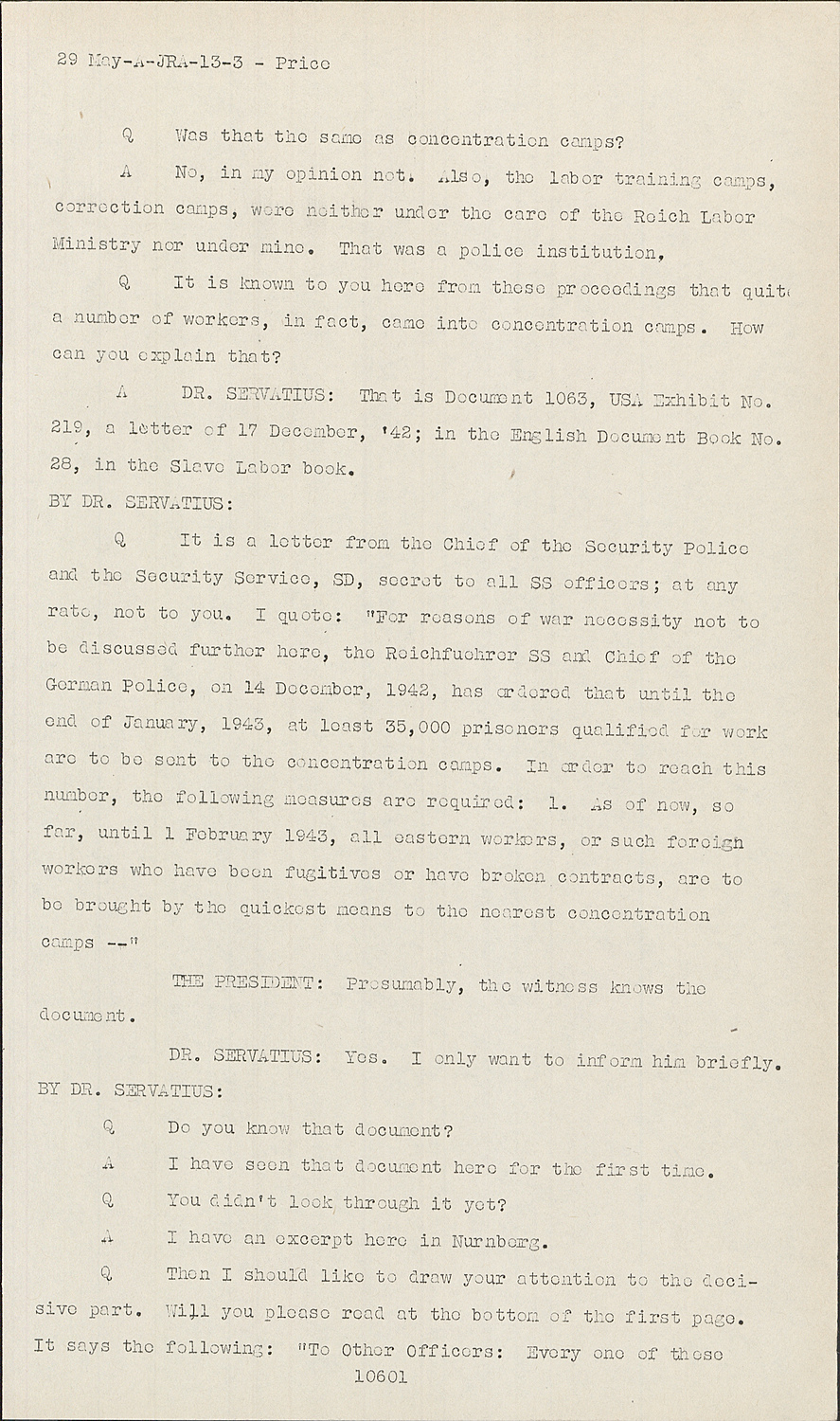
Q Was that the same as concentration camps?
ANo, in my opinion not. Also, the labor training camps, correction camps, were neither under the care of the Reich Labor Ministry nor under nine. That was a police institution.
QIt is known to you here from these proceedings that quite a number of workers, in fact, came into concentration camps. How can you explain that?
A DR. SERVATIUS:That is Document 1063, USA Exhibit No. 219, a letter of 17 December, '42; in the English Document Book No. 28, in the Slave Labor book. BY DR. SERVATIUS:
QIt is a letter from the Chief of the Security police and the Security Service, SD, secret to all SS officers; at any rate, not to you. I quote: "For reasons of war necessity not to be discussed further here, the Reichfuehrer SS and Chief of the German Police, on 14 December, 1942, has ordered that until the end of January, 1943, at least 35,000 prisoners qualified for work are to be sent to the concentration camps. In order to reach this number, the following measures are required: 1. As of now, so far, until 1 February 1943, all eastern workers, or such foreign workers who have been fugitives or have broken contracts, are to be brought by the quickest means to the nearest concentration camps --"
THE PRESIDENT: Presumably, the witness knows the document.
DR. SERVATIUS: Yes. I only want to inform him briefly. BY DR. SERVATIUS:
QDo you know that document?
AI have seen that document here for the first time.
QYou didn't look through it yet?
AI have an excerpt here in Nurnberg.
QThen I should like to draw your attention to the decisive part. Will you please read at the bottom of the first page. It says the following: "To Other Officers: Every one of these measures has to be described as absolutely necessary measures of security with causes given and taken from the individual case so that complaints can be prevented and complaints avoided."