That document, 3954-Ps, is also now available to the Tribunal in French, Russian, German, and English; and we offer it as USA Exhibit 877.
Then, Mr President, a motion picture film was shown during this cross examination of the defendant Funk; and the Tribunal inquired as to whether or not we would be prepared to submit affidavits to give the source, and so on. We are now prepared to do so; and we offer first an affidavit by Captain Sam Harris who arranged to have the pictures taken. which becomes USA Exhibit 876. The second affidavit is by the photographer who actually took the picture. We offer that as USA Exhibit 875 Finally, I should also like to clear up one other matter.
On March 25, during the cross examination of the witness Bohle, witness for the defendant Hess, Colonel Amen quoted from the interrogation of von Strumpel, which appears in the record beginning at Page 6482. We have the pertinent portions translated into the operating languages of the Tribunal, and we ask that this interrogation, which bears our document number 3800-PS, be admitted in evidence as USA Exhibit 880.
I believe, Mr President, that clears up all of the documents that we have not offered formally, up to this date.
THE PRESIDENT:Now, counsel for the defendant Sauckel.
DR. SEVATIUS (Counsel for the defendant Sauckel): With the permission of the Tribunal, I now call defendant Sauckel to the witness stand.
THE PRESIDENT:Certainly.
ERNST FRIEDRICH CHRISTOPHSAUCKEL, defendant, took the stand and testified as follows: BY THE PRESIDENT:
QWill you state your full name?
AErnst Friedrich Christoph Sauckel.
QWill you repeat this oath after me: I swear by God, the Almighty and Omniscient, that I will speak the pure truth and will withold and add nothing.
(The witness repeated the oath.)
THE PRESIDENTYou may sis down.
DIRECT EXAMINATION BY DR. SERVATIUS:
QMr. Witness, please describe your carrer to the Tribunal.
AI was born as the only child of the postman Friedrich Sauckel at Hassfurt on the Main near Bamberg. I attended elementary school at Schweinfurt and the secondary school.
QHow long were you at the Secondary school?
AI was there for five years Attendance at that school was possible through my mother who was a seamstress, since my father was Very badly paid. Since she was suffering from a heart disease, it became clear to me that I would not be able to study, and I obtained their permission to become a sailor, thus creating my own carrer for myself.
QYou joined the merchant marine, or where did you go?
AFirst of all I went to the Norwegian and Swedish merchant navy, so that, in accordance with sailors' traditions, I would be trained on sailing ships and learn the life of a sailor and the life aboard from the beginning.
QHow old were you at the time?
AAt that time I was fifteen and a Half.
QWhat were you earning?
AAs a cabin boy on a Norwegian sailing ship, I was earning, in addition to free food, five Kronen.
QAnd then during the time you were a sailor, where did you go?
A During my life as a sailor, which labor on was completed on German sailing ships, I sailed all the seas and visited all the continents.
QDid you cone in contact with foreign families?
AThrough the Young Men's Christian Association, I came into contact particularly in Australia and North America and South America with families of these states.
QWhere were you when the first world war statrted?
AOn a German sailing ship during a journey to Australia; when the ship was captured on the high seas, I landed in French captivity.
QHow long did you stay there?
AFive years, until November 1919.
QAnd did you return home then?
AI returned home at that time then, yes.
QAnd then what did you do?
AMy training and my study of navigation which I had to carry out had been completed, but since the savings of my time as a sailor had disappeared during the German inflation, I could no longer go to pass my examinations, and there were few German ships. There were many unemployed German seamen so that I decided that I should work in a factory in my home town of Schweinfurt.
QDid you remain in your home town?
AAt first I remained. I was learning in the ball bearing factory of Fischer the trade of a lathe worker and machinest, to save enough money so that I would later be able to attend an engineers college.
Q where you politically active at that time?
AAfter having despised during my sailors life to be politically directed, loving as I did my sailor's lofe, which I still love today, conditions forced me to define my own attitude to the political problems of the time.
No one in Germany at the time could do otherwise.
Years before I had loft a beautiful country, and I could not return to that country without finding it basically chanced and in an upheaval. There was considerable psychological and material emergency.
Q.Did you join any party?
A.No, I was working in a factory which people in my home town used to describe as "ultra red". I was working in the tool shop, and on my right and on my left there were worker, among others my present father-in-law, Social Democrats, Communists, and Anarchists, and during all of the intervals of work, there were discussions, so that, whether one wanted to or not, one had to become involved in the social troubles of that time.
Q.You are mentioning your father-in-law. Did you marry just then?
A.I married in 1923. I married the daughter of a German worker whom I am still happily married today and have four children.
Q.When did you join the Party?
A.I finally joined the Party in 1923 after I Previously had a loose connection with it.
Q.What was the cause for your doing that?
A.In those days I had read a speech of Hitler's. He had expressed in that speech the thought that the German factory worker, the German laborer, would have to get together with the intellectual workers in Germany, and that the controversies between the proletariat and the middle class would have to be bridged by their getting to know each other. This would create a now people, a now community, and only such a community above the classes, above the proletariat, could overcome the dire needs of those days and the split in the German mation between the parties and the confessions could only be bridged in that manner.
I was so impressed be those words, I was so deeply impressed that this idea of bridging seemingly unbridgeable gaps became the dominant idea of my life. If I may say so, I did that all the more because I was aware of the fact that the German people and the German character was inclined to go to extremes.
I had personally to find the right way. As I have already said, I had hardly been interested in political questions. My good parents, who are no longer alive, had educated me in a strictly Christian sense but also in a very patriotic sense. My life, however, when I went to sea, continued in sailors' quarters. I would lead saltpeter in Chili. I would work on heavy timber jobs in Canada. I would lead coal on the equator, and I sailed around Cape Horn several times. All of this was hard work.
Q.Please, will you come back to the question of the Party?
A.I am at the moment talking about the question of the Party, because we must all somehow give reasons how we did get there. I myself, and that I want to say -
THE PRESIDENT:I stated at the beginning of the defendants' case that we had heard this account from the defendant Goering and that we did not propose to hear it again from twenty defendats'. It seems to me that we are having it inflicted upon us by nearly every one of the defendants.
DR. SERVATIUS:I believe, Mr. President, that we are concerned with getting some sort of an impression of the defendant himself. Seen from various points of view, the facts look different.
THE PRESIDENT:We have had half an hour, almost, of it now.
DR. SERVATIUS:I shall now limit it, Mr. President. BY DR. SERVATIUS:
Q.The Party was dissolved in 1923, and there was a new foundation in 1925, and you joined it, did you not?
A.Yes.
Q Were you active in the Party or were you just a member?
ABeginning with 1925 I was active in the Party.
QAnd what position did you have?
AI was the manager of the Gau Thuringia.
QDid you do that just to get work and just to earn your living, or what was your reason?
AAs the manager of the Gau Thuringia, I was earning 150 marks. Any other profession would have supplied me with quarters and more money.
QWhen did you meet Hitler?
AI met him briefly in 1925.
QWhen did you become Gauleiter?
AI became Gauleiter in 1927.
QAnd how were you nominated?
AI was appointed by letter.
QDid you have any special instructions which might point at any secret intentions of the Party?
AAt that time we were strictly instructed that the Party would in no way be engaged in any secret goings on, that it would be public.
QWho was your predecessor?
ADr. Dinter.
QWhy was he relieved?
ADr. Dinter was relieved of his duties because he had founded a new religious movement in the Party, or wanted to.
QIn 1929, you became a member of the Thuringian Diet.
AYes.
QWere you elected?
AI was elected, as would be the case in every parliamentary election
QWas there dictatorship already at the time?
ABut that wasn't possible in accordance with the Thuringian constitution by which the country was governed.
QHow was it dissolved?
AThe Parliament was dissolved by a law published by the Reich Government.
Q Then in 1932 you were a member of the County Government of Thuringia.
How did you get into that position?
AIn 1932, in the month of June, there were elections for the Thuringian Parliament, and the National Socialist German Workers Party obtained 26 out of 60 seats.
QWas dictatorship mentioned in that connection?
ANo, parliamentary principles were used to elect a government.
QYou had a majority in the Thuringian Government and you could use your influence.
AThe central parties, by an absolute majority, elected a National Socialist Government.
QWhat happened to the old civil servants? Were they dismissed?
AI myself became the chairman of that government and old officials, without exception, remained in their offices.
QAnd what did that first National Socialist government concern itself with, politically speaking, I mean.
AThe internal political sector only allowed one question at that time, and that was the removal of an unimaginable emergency which is exceeded only today.
DR. SERVATIUS: In this connection, Mr. President, may I submit two government reports. I only wish to draw your attention briefly to two passages. One is the report contained in Document No. 96, which shows the activities of the government fight against the social emergency, and if you will glance through it -- it is important to know what is not contained in it -- there is no mention of the question of war or any such matters, but again and again is mentioned the alleviation of the dire needs of the time and what is important is the work that was being done. In Document No. 97, on page 45 there is a statement of the work which this government was carrying out, the construction of bridges, construction of roads, and so on, and there is in no way mentioned any aggressive intention.
Then, at the same time, I present Document No. 95. That is a book called "Fritz Sauckel's Fighting Speeches." Here, too, the book is remarkable because of that is not contained in it, namely, belligerent preparations for a war, and again here we find that the emergency is being dealt with, which becomes clear from the individual articles. These are speeches made during a number of years, and which all show in what direction the defendant Sauckel was being active.
Again, In 1932, there is a speech mentioning the misery of the time, and it ends with a speech in which once more the concern regarding the removal of social need, and the preservation of peace are again and again referred to.
The Tribunal will no doubt be able to read the articles in my document bock. BY DR. SERVATIUS:
QIn 1932 you became Reichstatthalter of Thuringia. How did you achieve that position?
AReichspresident Reichsmarschall von Hindenburg appointed me Reichsstatthalter of Thuringia.
QWhat were the instructions you received when you took up your offices?
AWhen I started as Reichsstatthalter, I received instructions to form a new Thuringian government since the Reichsstatthalter had wanted to keep out of administrative difficulties of the German county.
QYou needn't tell us these technical difficulties. I am thinking of the political task you received.
AI received the political task of administering Thuringia as Reichsstatthalter within the existing Reich law, to stand for unity within the Reich.
QUnity of the Reich. And did that mean the absorption of others, in particular the official organizations in Thuringia?
ANo. Administrativebodies remained.
QYou held the position of Gauleiter and the position of Governor. What was the aim of that?
ABoth positions and their organizations were strictly separated. On the side of the Governor there were officials and civil servants, and in the other side of the Gauleiter there were employees of the Party. Both positions were kept strictly separate and they were run apart from each other, as would be the case in any other state where members of the party have party positions simultaneously with other positions.
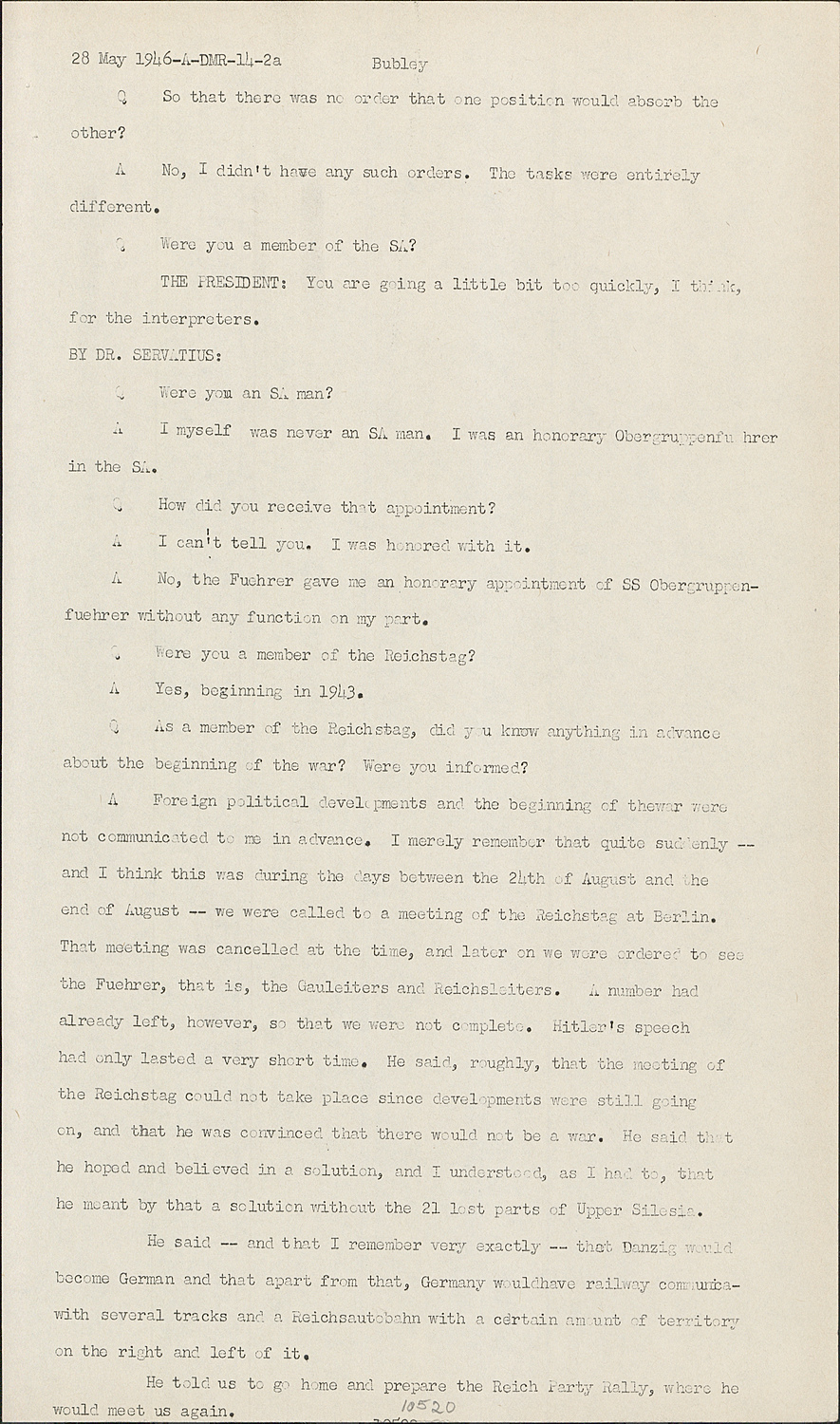
Q So that there was no order that one position would absorb the other?
ANo, I didn't have any such orders. The tasks were entirely different.
QWere you a member of the SA?
THE PRESIDENT: You are going a little bit too quickly, I think, for the interpreters. BY DR. SERVATIUS:
QWere you an SA man?
AI myself was never an SA man. I was an honorary Obergruppenfuehrer in the SA.
QHow did you receive that appointment?
AI can't tell you. I was honored with it.
ANo, the Fuehrer gave me an honorary appointment of SS Obergruppenfuehrer without any function on my part.
QWere you a member of the Reichstag?
AYes, beginning in 1943.
QAs a member of the Reichstag, did you know anything in advance about the beginning of the war? Were you informed?
AForeign political developments and the beginning of thewar were not communicated to me in advance. I merely remember that quite suddenly -and I think this was during the days between the 24th of August and the end of August -- we were called to a meeting of the Reichstag at Berlin. That meeting was cancelled at the time, and later on we were ordered to see the Fuehrer, that is, the Gauleiters and Reichsleiters. A number had already left, however, so that we were not complete. Hitler's speech had only lasted a very short time. He said, roughly, that the meeting of the Reichstag could not take place since developments were still going on, and that he was convinced that there would not be a war. He said that he hoped and believed in a solution, and I understood, as I had to, that he meant by that a solution without the 21 lost parts of Upper Silesia.
He said -- and that I remember very exactly -- that. Danzig would become German and that apart from that, Germany wouldhave railway communicawith several tracks and a Reichsautobahn with a certain amount of territory on the right and left of it.
He told us to go home and prepare the Reich Party Rally, where he would meet us again.
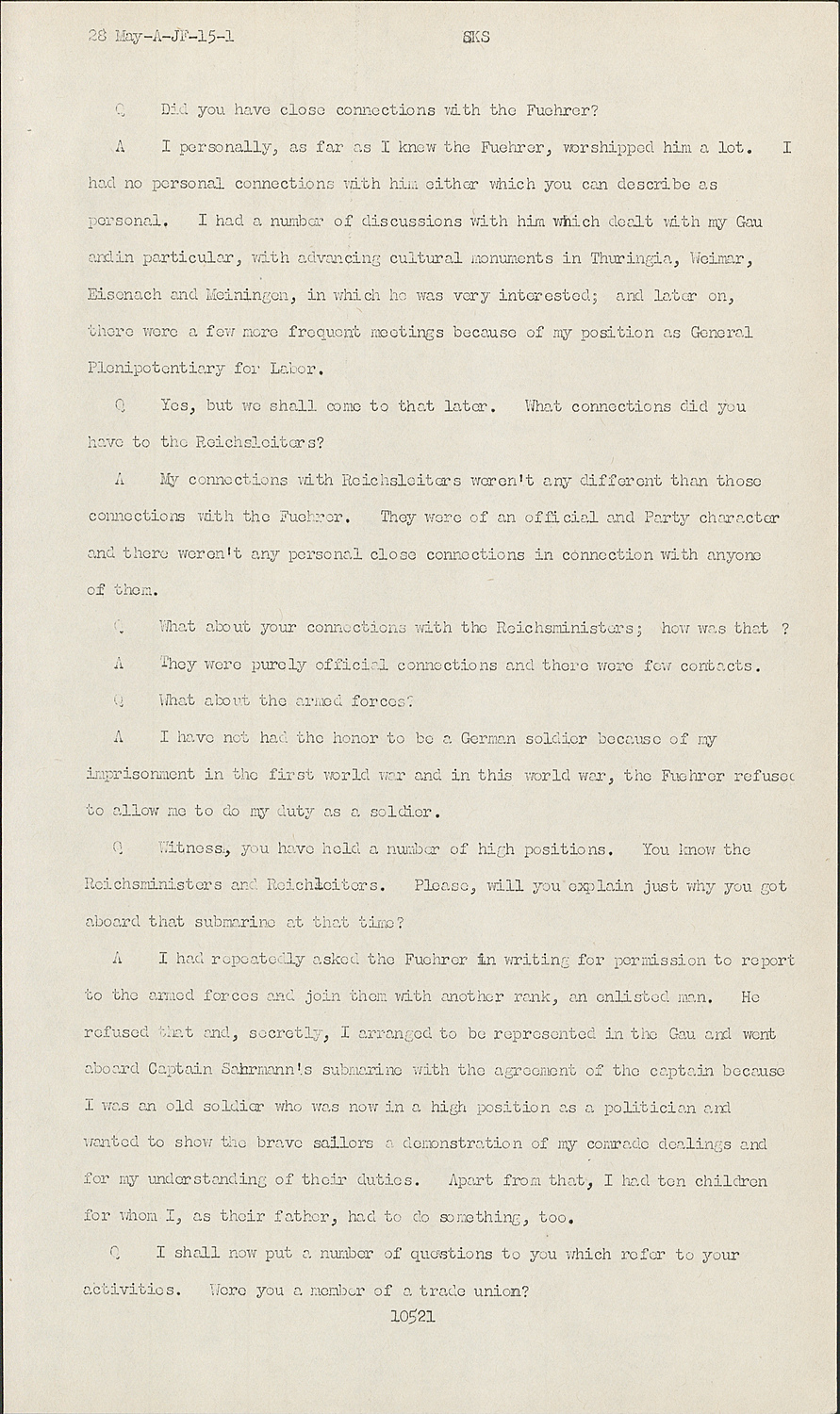
Q Did you have close connections with the Fuehrer?
AI personally, as far as I knew the Fuehrer, worshipped him a lot. I had no personal connections with him either which you can describe as personal. I had a number of discussions with him which dealt with my Gau and in particular, with advancing cultural monuments in Thuringia, Weimar, Eisenach and Meiningen, in which he was very interested; and later on, there were a few more frequent meetings because of my position as General Plenipotentiary for Labor.
QYes, but we shall come to that later. What connections did you have to the Reichsleiters?
AMy connections with Reichsleiters weren't any different than those connections with the Fuehrer. They were of an official and Party character and there weren't any personal close connections in connection with anyone of them.
QWhat about your connections with the Reichsministers; how was that?
AThey were purely official connections and there were few contacts.
QWhat about the armed forces?
AI have not had the honor to be a German soldier because of my imprisonment in the first world war and in this world war, the Fuehrer refused to allow me to do my duty as a soldier.
QWitness, you have held a number of high positions. You know the Reichsministers and Reichleiters. Please, will you explain just why you got aboard that submarine at that time?
AI had repeatedly asked the Fuehrer in writing for permission to report to the armed forces and join them with another rank, an enlisted man. He refused that and, secretly, I arranged to be represented in the Gau and went aboard Captain Sahrmann's submarine with the agreement of the captain because I was an old soldier who was now in a high position as a politician and wanted to show the brave sailors a demonstration of my comrade dealings and for my understanding of their duties. Apart from that, I had ten children for whom I, as their father, had to do something, too.
QI shall now put a number of questions to you which refer to your activities. Were you a member of a trade union?
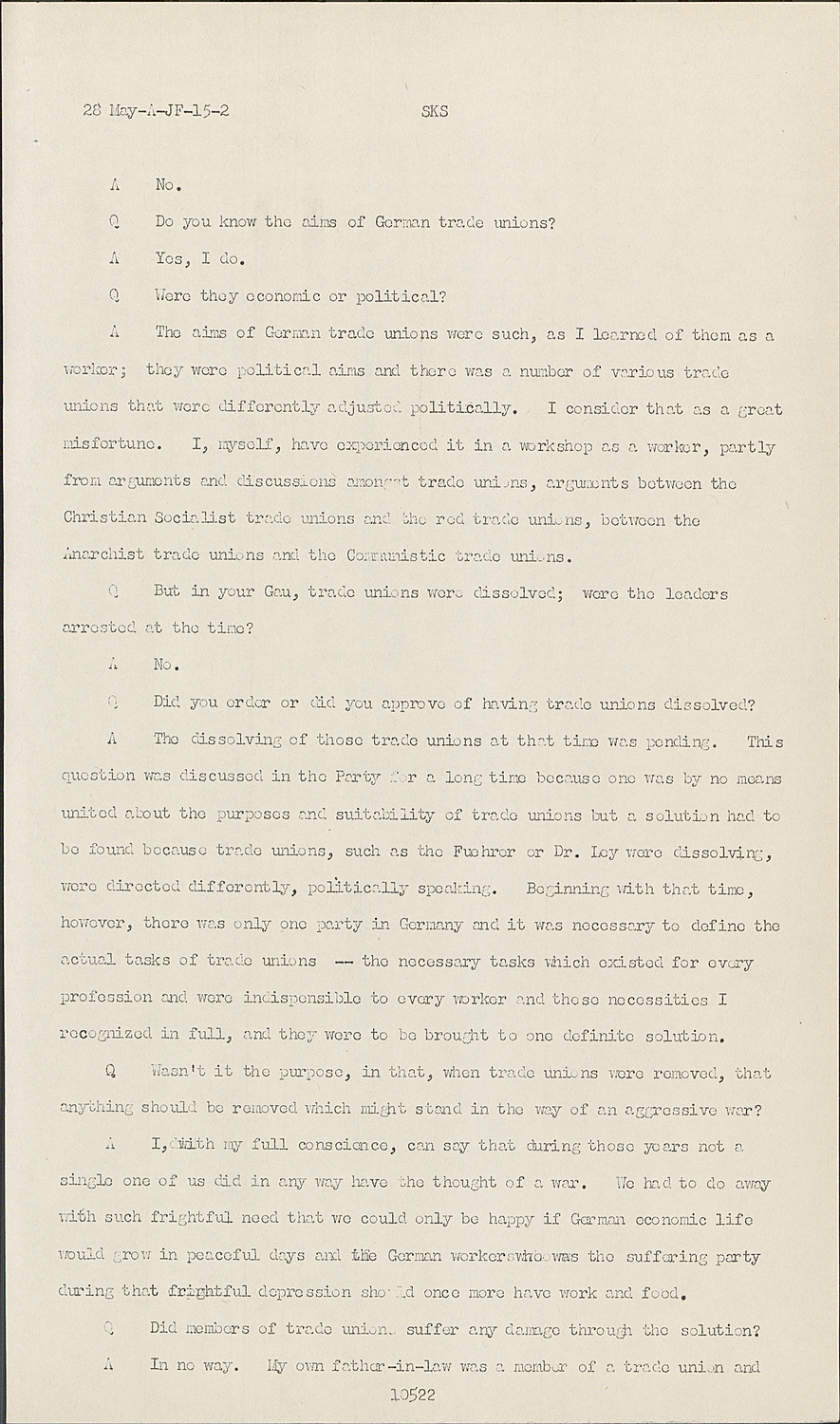
A No.
QDo you know the aims of German trade unions?
AYes, I do.
QWere they economic or political?
AThe aims of German trade unions were such, as I learned of them as a worker; they were political aims and there was a number of various trade unions that were differently adjusted politically. I consider that as a great misfortune. I, myself, have experienced it in a workshop as a worker, partly from arguments and discussions amongst trade unions, arguments between the Christian Socialist trade unions and the red trade unions, between the Anarchist trade unions and the Communistic trade unions.
QBut in your Gau, trade unions were dissolved; were the leaders arrested at the time?
ANo.
QDid you order or did you approve of having trade unions dissolved?
AThe dissolving of these trade unions at that time was pending. This question was discussed in the Party for a long time because one was by no means united about the purposes and suitability of trade unions but a solution had to be found because trade unions, such as the Fuehrer or Dr. Ley were dissolving, were directed differently, politically speaking. Beginning with that time, however, there was only one party in Germany and it was necessary to define the actual tasks of trade unions -- the necessary tasks which existed for every profession and were indispensible to every worker and these necessities I recognized in full, and they were to be brought to one definite solution.
QWasn't it the purpose, in that, when trade unions were removed, that anything should be removed which might stand in the way of an aggressive war?
AI, with my full conscience, can say that during these years not a single one of us did in any way have the thought of a war. We had to do away with such frightful need that we could only be happy if German economic life would grow in peaceful days and the German worker who was the suffering party during that frightful depression she and once more have work and food.
QDid members of trade union suffer any damage through the solution?
AIn no way. My own father-in-law was a member of a trade union and is still a member of a trade union today and whom I asked again and again, whom I never persuaded to join the Party, he being a Social Democrat, and didn't join the Party at any time but he confirmed it, even when he was getting old and couldn't work any mere, that the German worker's front was carrying out all the duties which he as an old trade union member -- and on the strength of his long membership of the trade union -- knew that they carried it out and that he had the full benefit of it.
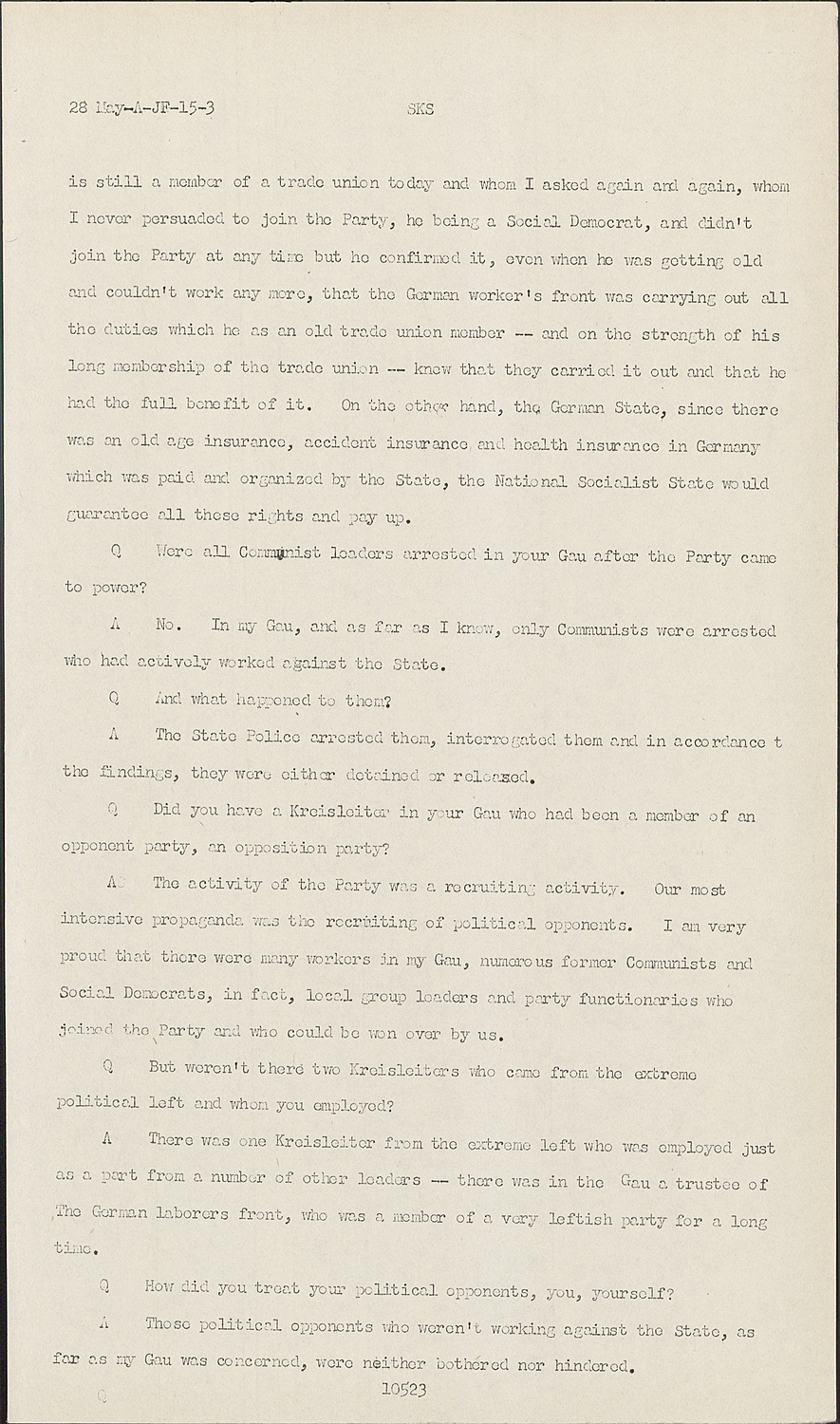
On the other hand, the German State, since there was an old age insurance, accident insurance and health insurance in Germany which was paid and organized by the State, the National Socialist State would guarantee all these rights and pay up.
QWere all Communist leaders arrested in your Gau after the Party came to power?
ANo. In my Gau, and as far as I know, only Communists were arrested who had actively worked against the State.
QAnd what happened to them?
AThe State Police arrested them, interrogated them and in accordance to the findings, they were either detained or released.
QDid you have a Kreisleiter in your Gau who had been a member of an opponent party, an opposition party?
AThe activity of the Party was a recruiting activity. Our most intensive propaganda was the recruiting of political opponents. I am very proud that there were many workers in my Gau, numerous former Communists and Social Democrats, in face, local group loaders and party functionaries who joined the Party and who could be won over by us.
QBut weren't there two Kreisleiters who came from the extreme political loft and whom you employed?
AThere was one Kreisleiter from the extreme left who was employed just as a part from a number of other loaders -- there was in the Gau a trustee of The German laborers front, who was a member of a very leftish party for a long time.
QHow did you treat your political opponents, you, yourself?
AThose political opponents who weren't working against the State, as far as my Gau was concerned, were neither bothered nor hindered.
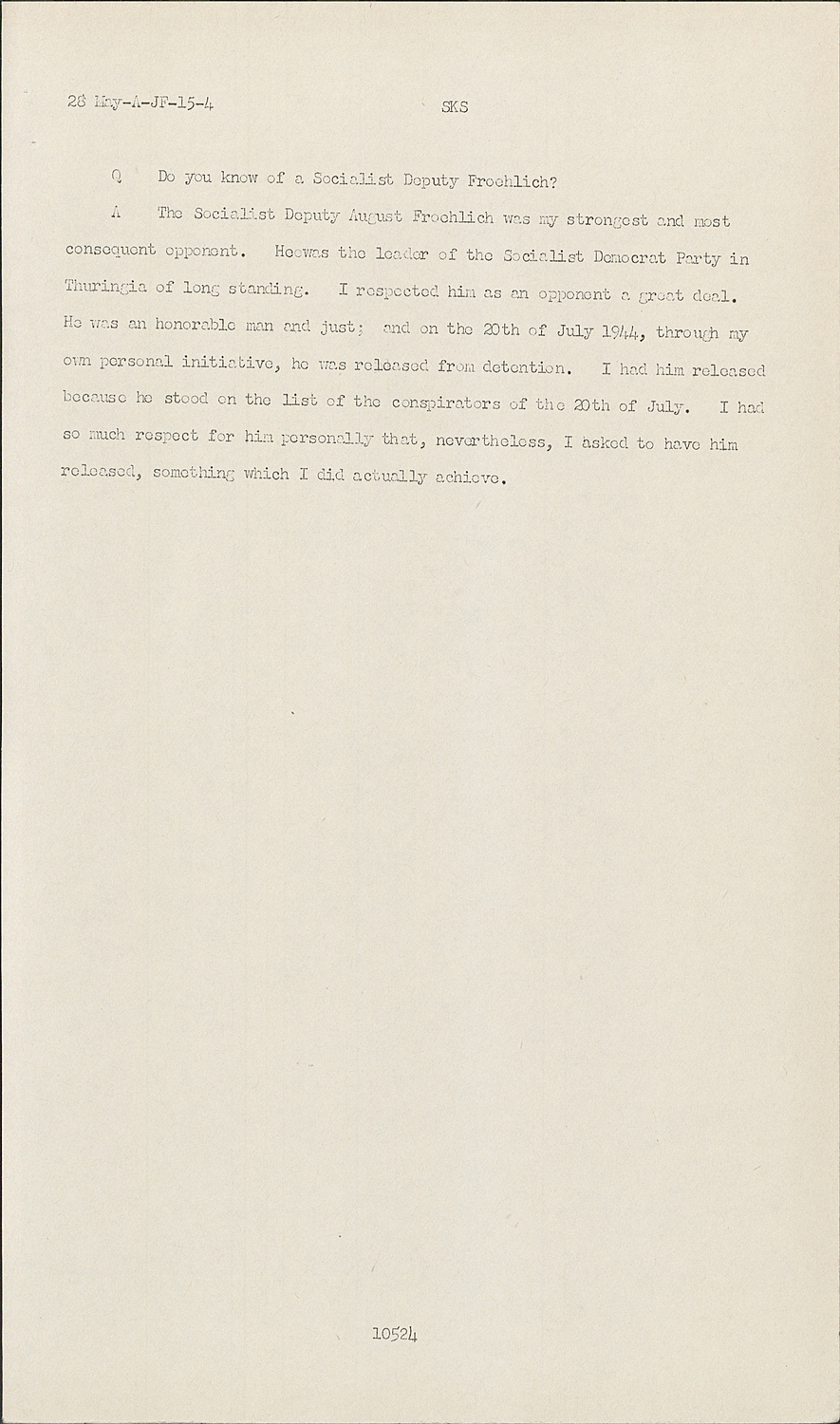
Q Do you know of a Socialist Deputy Froehlich?
AThe Socialist Deputy august Froehlich was my strongest and most consequent opponent. Ho was the leader of the Socialist Democrat Party in Thuringia of long standing. I respected him as an opponent a great deal. He was an honorable man and just; and on the 20th of July 1944, through my own personal initiative, he was released from detention. I had him released because he stood on the list of the conspirators of the 20th of July. I had so much respect for him personally that, nevertheless, I asked to have him released, something which I did actually achieve.
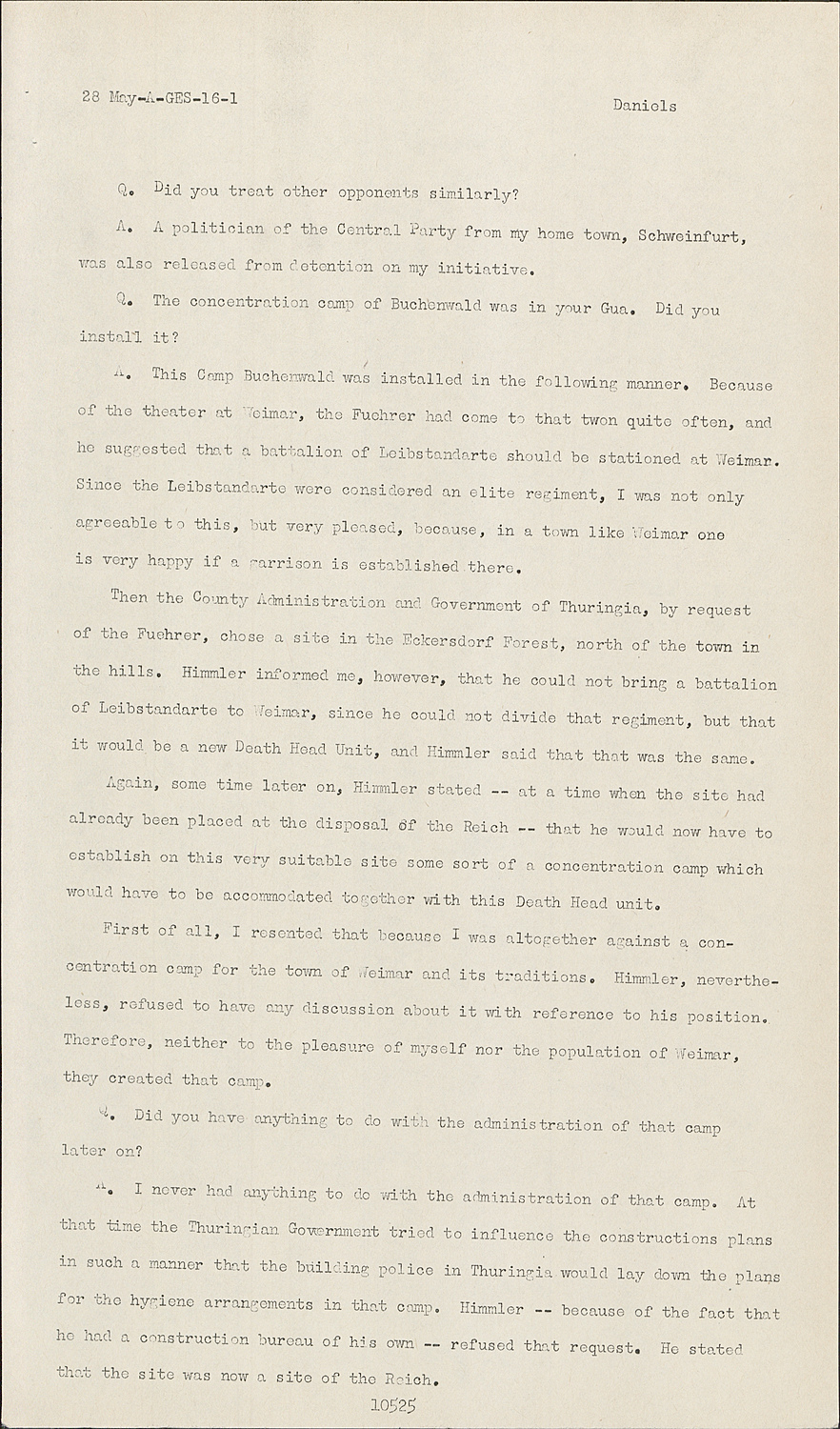
Q. Did you treat other opponents similarly?
A.A politician of the Central Party from my home town, Schweinfurt, was also released from detention on my initiative.
Q.The concentration camp of Buchenwald was in your Gua. Did you install it ?
A.This Camp Buchenwald was installed in the following manner. Because of the theater at Weimar, the Fuehrer had come to that twon quite often, and he suggested that a battalion of Leibstandarte should be stationed at Weimar. Since the Leibstandarte were considered an elite regiment, I was not only agreeable to this, but very pleased, because, in a town like Weimar one is very happy if a garrison is established there.
Then the County administration and Government of Thuringia, by request of the Fuehrer, chose a site in the Eckersdorf Forest, north of the town in the hills. Himmler informed me, however, that he could not bring a battalion of Leibstandarte to Weimar, since he could not divide that regiment, but that it would be a new Death Head Unit, and Himmler said that that was the same.
Again, some time later on, Himmler stated -- at a time when the site had already been placed at the disposal of the Reich -- that he would now have to establish on this very suitable site some sort of a concentration camp which would have to be accommodated together with this Death Head unit.
First of all, I resented that because I was altogether against a concentration camp for the town of Weimar and its traditions. Himmler, nevertheless, refused to have any discussion about it with reference to his position. Therefore, neither to the pleasure of myself nor the population of Weimar, they created that camp.
Q.Did you have anything to do with the administration of that camp later on?
A.I never had anything to do with the administration of that camp. At that time the Thuringian Government tried to influence the constructions plans in such a manner that the building police in Thuringia would lay down the plans for the hygiene arrangements in that camp. Himmler -- because of the fact that he had a construction bureau of his own -- refused that request. He stated that the site was now a site of the Reich.
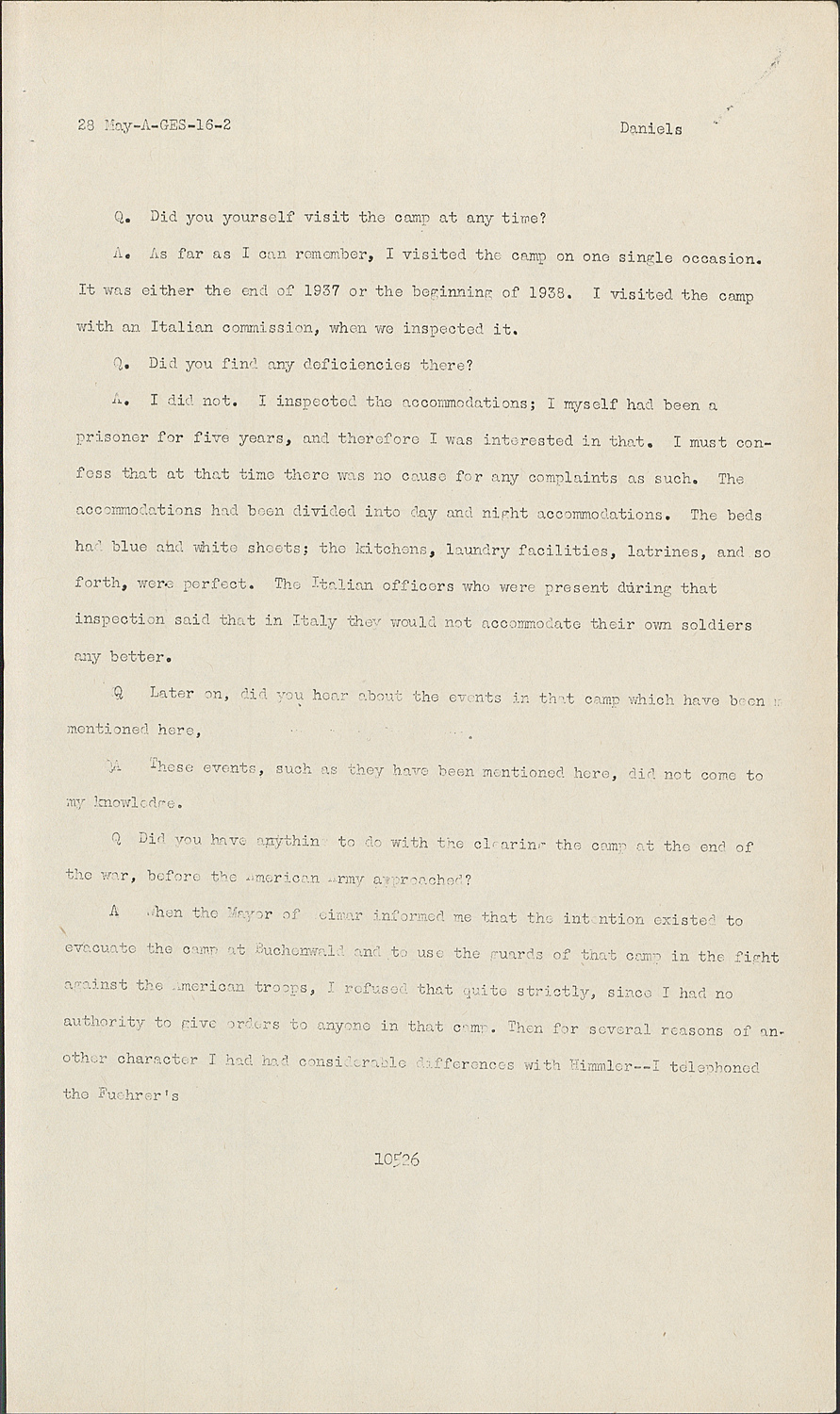
Q. Did you yourself visit the camp at any time?
A.As far as I can remember, I visited the camp on one single occasion. It was either the end of 1937 or the beginning of 1938. I visited the camp with an Italian commission, when we inspected it.
Q.Did you find any deficiencies there?
A.I did not. I inspected the accommodations; I myself had been a prisoner for five years, and therefore I was interested in that. I must confess that at that time there was no cause for any complaints as such. The accommodations had been divided into day and night accommodations. The beds had blue and white sheets; the kitchens, laundry facilities, latrines, and so forth, were perfect. The Italian officers who were present during that inspection said that in Italy the would not accommodate their own soldiers any better.
QLater on, did you hoar about the events in that camp which have been mentioned here,
AThese events, such as they have been mentioned here, did not come to my knowledge.
QDid you have anything to do with the clearing the camp at the end of the war, before the American Army approached?
AWhen the Mayor of Weimar informed me that the intention existed to evacuate the camp at Buchenwald and to use the guards of that camp in the fight against the American troops, I refused that quite strictly, since I had no authority to give orders to anyone in that come. Then for several reasons of another character I had had considerable differences with Himmler--I telephoned the Fuehrer's apartment in Berlin and stated that an evacuation or a march-back of prisoners into the territory cast of the Saale was impossible, nonsensical, that it could not be carried out from the point of view of feeding, and I demanded that that camp should be handed over to the American occupation troops in an orderly manner.
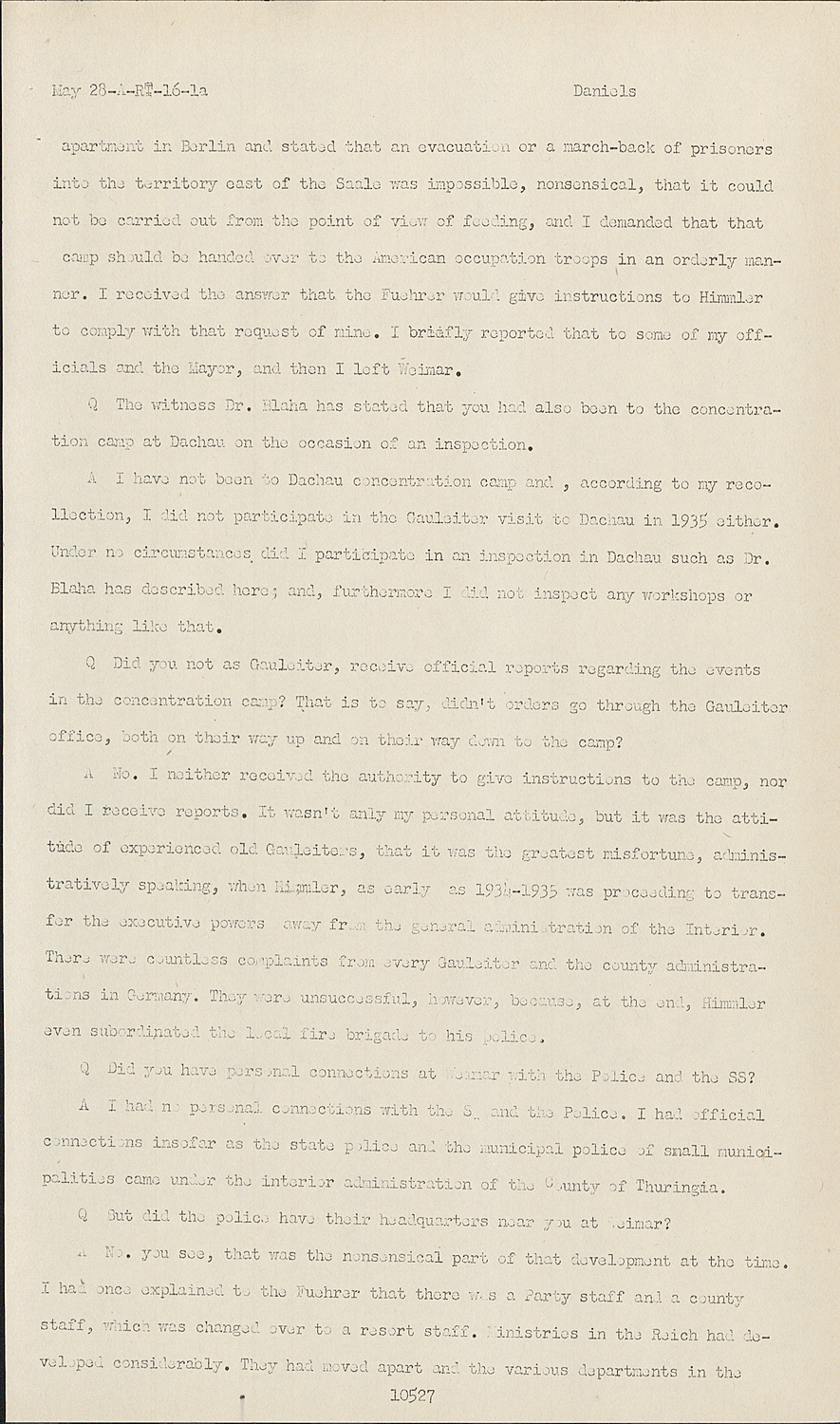
I received the answer that the Fuehrer would give instructions to Himmler to comply with that request of nine. I briefly reported that to some of my officials and the Mayor, and then I left Weimar.
QThe witness Dr. Blaha has stated that you had also been to the concentration camp at Dachau on the occasion of an inspection.
AI have not been to Dachau concentration camp and, according to my recollection, I did not participate in the Gauleiter visit to Dachau in 1935 either. Under no circumstances did I participate in an inspection in Dachau such as Dr. Blaha has described here; and, furthermore I did not inspect any workshops or anything like that.
QDid you not as Gauleiter, receive official reports regarding the events in the concentration camp? That is to say, didn't orders go through the Gauleiter office, both on their way up and on their way down to the camp?
ANo. I neither received the authority to give instructions to the camp, nor did I receive reports. It wasn't only my personal attitude, but it was the attitude of experienced old Gauleiters, that it was the greatest misfortune, administratively speaking, when Himmler, as early as 1934-1935 was proceeding to transfer the executive powers away from the general administration of the Interior. There were countless complaints from every Gauleiter and the county administrations in Germany. They were unsuccessful, however, because, at the end, Himmler even subordinated the local fire brigade to his polices.
QDid you have personal connections at Weimar with the Police and the SS?
AI had no personal connections with the SS and the Police. I had official connections insofar as the state police and the municipal police of small municipalities came under the interior administration of the County of Thuringia.
QBut did the police have their headquarters near you at Weimar?
ANo. you see, that was the nonsensical part of that development at the time. I had once explained to the Fuehrer that there was a Party staff and a county staff, which was changed over to a resort staff. Ministries in the Reich had developed considerably. They had moved apart and the various departments in the administration did not in any way cooperate.
They did rut tally either. Until 1934 Thuringia and its Ministry of the Interior had a police administration independently, of its own.
At the beginning, at that time, the headquarters of the SS and the Police Fuehrer went to Cassel so that Himmler, contrary to the customary organization of the state and organization of the Party. would once more find now fields for his police. That was something which expressed itself in Central Germany because of the fact that the Higher SS and Police Leader for Weimar and the County of Thuringia was stationed in Cassel, whereas the Prussian part of the Gau of Thuringia--that is to say the town of erfurt, which is 20 kilometers away from Cassel--was looked after by a Higher SS and Police Leader who was stationed at Magdesburg.
That such a development did not in any way appeal to us, and that this would create a great deal of disgust amongst the experienced administrators is something which must be quite clear.
QBut the question is this: Did you cooperate with these sources, and did you have a great deal of friendly contact with the officials in question? Did you have to know, therefore, what was going on in Buchenwald?
ATo the contrary. There was a continuous battle; there was a neutral sealing off in the various organizations. During such a time in the development of this world that was most unfortunate and quite unforgivable, and most impossible for any administration.
QWas there persecution of the Jews in your Gau?
ANo.
QWhat about the Jewish laws and their carrying through?
AThese Jewish laws were announced in Nurnberg. There were actually very few Jews in Thuringia.
QWeren't there any perpetrations in connection with the well-konwn events which have repeatedly become the subject of this trial? I am thinking of the murder of the Ambassador in Paris.
AI cannot recollect in detail now the events or the episodes in Thurin gia. As I told you, there were only a few Jews in Thuringia. The Gauleiters were in Munich at that time. They had no influence on that development because, as I say, that happened during the night when all the Gauleiters were in Munich.
QMy question is this. What happened in your Gau of Thuringia, and what instructions did you give?
AThere may have been a few places in Thuringia where a window was smas* I can't tell you that in detail.
I can't even tell you where or whether there were synagogues in Thuringia.
QNow one question regarding your own personal property.
On the occasion of your 50th birthday the Fuehrer gave you a present. How much was it?
AIn October of 1945, on the occasion of my 50th birthday, I was surprise when an adjutant of the Fuchrer delivered a letter from the Fuehrer.
In that letter there was a check amounting to 250.000 marks. I told the adjutant that I could not possibly accept that. Of course, I was very much surprised. The Fuehr 's adjutant -- and that was the little Bormann, the old Bormann, and not Reichs loiter Bormann--told me that the Fuehrer knew quite well that I had neither more nor any real estate property and that this was a sort of bank account for my children. He told me not to hurt the Fuehrer's feelings.
After that adjutant had quickly departed, I talked to one of my officials, a friend of mine, the President of the State Bank of Thuringia. I asked him to come and see me, but, unfortunately he has been refused as a witness.
THE PRESIDENT:Can he not tell us whether he ultimately accepted it or no BY DR. SERVATIUS:
QLet us drop that question. What happened to the money?
A That money was placed in a special account in the State Bank of Thuringia through this bank president whom I was mentioning.
QWhat other income did you have from your official positions?
AOnly the income of the salary of the Reich's town governor.
QHow much was that?
AThe salary of the Reich minister, I can't tell you for certain. I, as a sailor, have never concerned myself with it. I think it was something like thirty thousand marks.
QAnd what property do you have today apart front 'that donation in that bank account?
AI have not saved anything and I have not owned anything.
DR. SERVATIUS: That, Mr. President, brings me to the end of those general questions and I am now coming to the special questions relating to labor THE PRESIDENT:
We will adjourn.
(A short recess was taken.)
DR. SERVATIUS: To aid the Court I have prepared a plan on the direction of the Arbeitseinsatz, Neibor Committment, which is to give an understanding about how the individual authorities cooperated and how the Einsatz was put into operation. I will concern myself primarily with the problem of obtaining the necessary workers, that is the question of how the workers were obtained. As for the use made of the workers, that is the needs of industry, I will concern myself only slightly. This is more a matter of Speer's defense which does not quite agree with my point of view. They are small matters about which I made mistakes because I did not understand these matters completely when I prepared the plan; but there are no basic differences.
If I may explain the plan briefly, at the top the "Fuehrer" in red; under him the "Four-Year Plan"; under him as part of the Four-Year Plan -
THE PRESIDENT:Wait a minute.
DR. SERVATIUS:At the top the "Fuehrer" in red; under hint the "Four-Year Plan"; then the Sauckel agency, the department generally for the labor committment, directly under the Four-Year Plan. He gets his orders from the Fuehrer through the Four-Year Plan, or directly, according to the nature of the Fuehrer.
Sauckel's Agency is the Reich Ministry. It is below to the loft, below the Sauckel agency which is in brown.
It is the big area edged in yellow. Sauckel was only incorporated into the Reich Labor Ministry and a few officers were put at his disposal. There remained the Reich Labor Minister and the whole Labor Ministry. In the course of time Sauckel's position become somewhat stronger. Individual departments were incorporated into his field and he obtained personal powers in part, but the Reich Labor Ministry remained until the end.
I should now like to explain how the Arbeitseinsatz was put into operation. Through a committment in the cast, the bit losses in the winter, there arose a need for two million soldiers. The Wehrmacht, marked in green at the top next to "The Fuehrer", "OKW" demands soldiers from the factories. It is marked here in the green field below the "OKW". The line leads, at the bottom to the left, to the concerns marked with thirty million workers . The Wehrmacht withdraws two million workers but can do that only after new workers arc there. That was the moment when Sauckel was put into office in order to obtain those workers. The number of men needed at the change in the high offices by the people marked at the top in yellow, those are the supreme officers: Armament of Production Ministry, Air Ministry, Ships, Traffic, and so forth. They report their demands to the Fuehrer and he decides what is needed Sauckel's task is followed, out as follows: Let us go back to the brown box. In the field to the right where the boxes are rimmed in blue are the highest authorities in the occupied territories, Reichsminister for the Eastern Territories, Rosenberg; then the military authorities; and since it was handled a little differently in each country, the various countries, Belgium, France, Holland, and so forth, are marked here.