SIR DAVID MAXWELL-FYFE: No, that is my short point. I don't want to discuss the merits of my points because that is the issue that I am saying is irrelevant.
THE PRESIDENT:What about No. 11?
SIR DAVID MAXWELL FYFE:I am not disposed to object to any of the other documents, my Lord.
THE PRESIDENT:Are there any others -
SIR DAVIDMAXWELL-FYFE: No. 11, I can see a possible argument on that and therefore I won't object to it. The other documents, certainly we have no objection to the ordinances of the Fuehrer's Deputy.
THE PRESIDENT:All under "B"
SIR DAVIDMAXWELL-FYFE: Yes. The Prosecution make no objection to these.
THE PRESIDENT:Yes.
Now, what do you say to Sir David's objection to these documents, 1 to 7?
DR. BERGOLD:Well, your Lordship, I have already made my point of view clear in my application. In order to save the time of the Court, I will merely refer to this written application. I won't say any more at the moment on the subject, but if your Lordship wants me to explain it here now I am ready to do so.
THE PRESIDENT:The Tribunal will consider the matter.
SIR DAVID MAXWELL FYFE:Did your Lordship wish to deal with the other outstanding applications or would you prefer to deal with that later on at the end of the case of von Schirach?
THE PRESIDENT:I don't think we have the papers here. We were only going to deal with the Bormann application.
(Mr. Dodd of the American Prosecution came to the lectern) Mr. Dodd, we have a document here, D-880, said to be extracts from testimony of Admiral Raeder, taken at Nurnberg on the 10th of November, 1945, by Major Monigan.
Have you offered that document in evidence or not?
MR. DODD:May I have a minute to check it? I am not certain.
THE PRESIDENT:Yes, and we will give you the document.
MR. DODD:I believe not; I don't believe it has been offered in evidence.
THE PRESIDENT: Yes, and we will give you the document.
MR. DODD:I believe not; I don't believe it has been offered in evidence.
THE PRESIDENT:It seems to have been handed up yesterday or the day before -
MR. DODD:I think through a mistake.
THEPRESIDENT: -- or last week. Yes. But you will find out about that and let us know.
MR. DODD:Very well, sir. Would you like to havethis copy back.
(Paper handed up to the Bench.)
THE PRESIDENT: Dr. Sauter, you were still examining Gustav Hoepken, weren't you?
GUSTAVHOEPKEN, a witness called in behalf of the Defendant Raeder, resumed the stand and testified as follows:
DIRECT EXAMINATION (continued) BY DR. SAUTER:
QDr. Hoepken, ire stopped yesterday when discussing the question whethter the Defendant von Schiracht during his period in Vienna was opposed to the church or was tolerant in this connection. The last answer you gave me yesterday referred to the relationship of the Defendant von Schiracht to the Viennese Cardinal, Innitzer. Is it correct that at the suggestion and with the knowledge of the Defendant von Schiracht during his Vienna period you periodically had talks with a Catholic clergyman there, a dean, Professor Ens, for the purpose of discussing church questions with him and removing differences which might arise?
AYes, that is true. The Dean, Professor Ens, was not -- as you assume -Catholic,-but Protestant. He was Dean of the theoligical faculty of the University of Vienna. On the occasion of his visits he discussed many church and religious questions with me. I discussed thorn with him. We then asked me to report on them to Mr. von Schiracht and if it was possible to obtain relief. This was done as far as possible.
QDo you know that the Defendant von Schiracht, for example, ordered that is the Party Christmas songs were to be sung but the old Christian Christmas hymns?
AYes, I know that at Party Christmas celebrations of the Hitler Youth and Christmas celebrations for wounded soldiers the old Christian Christmas carols, such as, "Es Ist Ein Ros Entsprungen," "Silent Night, Holy Night" -
THE PRESIDENT:This is surely not a matter which is worthy to be given in evidence.
QWitness, do you know that the Defendant von Schiracht in the official magazine of the Hitler Youth had a special edition published with regard to the humane treatment of the Eastern peoples, and when was that?
AI know that it was the quarterly, April-June of 1943.
Q Do you know that in the same official magazine of the Hitler Youth at the request of the Defendant Bormann, a special edition was to appear but that von Schiracht refused it?
AI know that it was requested by the Propaganda Ministryat that time and also by the party chancellory, von Schiracht refused each time.
QWitness, do you know that von Schiracht once inspected a concentration cam.
AYes, I know that.
QWhich one?
AThe concentration camp Fauthausen.
QIn regard to this point which has already been cleared up by the testimony of other witnesses, I am interested only in one question. When was this visit to Fauthausen?
AI cannot say exactly. I can say with certainty, however, that it was not after April, 1943.
QWhy can you say that?
AIn April 1943 I was released from the hospital began my service in Vienna. From that day on I know until April, 1945, I know every day where von Schirachs was. In addition immediately after my arrival in Vienna in April, 1943 when I asked him, since because of my wound I was rather run down physically, and I was also a sport teacher, I asked him whether I might between seven and eight in the morning carry on a little sport.
THE PRESIDENT:We don't want to know about the itness' health, do we? BY DR. SAUTER:
QWitness, you heard what the President just said. I have already told you I am interested in wean this visit to Fauthausen was. You see if I understand you correctly
THE PRESIDENT:He said he couldn't say when it was and it was after April, 1913. He said he couldn't say when it was.
DR. SAUTER:Mr. President, I believe you misunderstood the witness. Witness, please pay attention. I understood the witness to say that it was before April, 1943. The visit must have been before April. 1943. It could not have been later.
THE PRESIDENT:He also said, according to the conversation I heard and took down that he couldn't say when the particular time was.
DR. SAUTER:Yes, but through the testimony of the witness I should like to settle the fact that it was not later than April, 1943.
May-28-M-RT-3-2
THE PRESIDENT:But he said it. He said, "I can't say when it was, but it was not after April, 1943." We said; "On April, 1943, I was released from the hospital and began my service in Vienna. I knew every day where Schirach was." I have got all that written dorm.
DR. SAUTER: Very well. BY DR. SAUTER:
QWitness, in this conversation about his visit to Kauthausen did the Defendant, von Schirach, tell you anything, that at this visit he had heard of Atrocities, mistreatment, et cetera?
ANo, he said nothing about that.
QNow, I turn to the question of the deportation of Jews from Vienna. As far as I know you were an ear witness of a conversation between the Reich fuehrer SS Himmler and the defendant, Schirach, will you tell us what was said in this conversation on the qestion of deportation of Jews?
AI believe it was in November, 1943, Himmler and Schiracht were in last Prussia. In the car Himmler asked von Schirach: "Tell me, von Schirach, how many Jews are still in Vienna?" von Schirach answered: "I cannot say exactly. I estimate forty to fifty thousand." And Himmler said: "I must evacuate the Jews quickly from Vienna". And Schirach said: "The Jews don't give any difficulty, especially since they are wearing the yellow star." And Himmler said: "The fuehrer is already angry that Vienna in this point, as in many others, is an exception, and I am instructing my SS agencies to carry this matter out quickly." That is what I remember of this conversation.
Q Do you know anything of the speech of the anti-semitic speech of the defendant, von Schirach, in September 1942, at a Congress in Vienna, which the Prosecution submitted to the Court.
AYes, the context of the speech is known to us.
QI want to know whether you know anything about it, especially whether Schirach said anything to you about why he made this anti-semitic speech?
AFrom the press officer Guenther Kaufman mentioned yesterday, I know directly after this speech von Schirach instructed Guenther Kaufman that the point from the speech should be telephoned to the D N B in Berlin, with the remark he had every reason to make a concession to Borhmann on this point.
QWhy a concession?
AI assume that Schirach knew that his position in Vienna, was precarious, and that he constantly heard this, especially from the party chancellor that he should take a stricter course in Vienna.
QYou were Chief of the Central Bureau with Schirach in Vienna. In this capacity, did all of Schirach's mail go through you?
ANot all of his mail, but the great majority of it. Mail stamped "direct to personal" did not go through my hands.
QDid the other mail?
AThat went through my office.
QWitness, we have here a number of documents which have been submitted to the Court. They are the activity and situation reports for the Chief of the Security Police made, I believe, monthly or weekly, and which have been submitted from Vienna, Since you know the situation in the Central Bureau in Vienna, I now give you various of these documents. Please look at the documents and then tell us whether from these documents which are photostatic copies, you can tell whether these reports of the SS to you, came to you, to the defendant, von Schirach, or whether they went to a different office. I call your especial attention to the manner in which these documents are annotated. Please note on the individual documents who signs the document and what was done with the document after that, laid then please tell us who these officials are from the document code of the Reich Defense Commission, for instance, a Dr. Fisher, et cetera.
DR. SAUTER: Those are the documents, Mr. President, about which the Court asked questions the other day.
THE PRESIDENT:I did not hear the questions exacrly. It appears to me to be a great number of questions. Well, let's get on, Dr. Sauter. We shall have to consider these documents and the witness ought to be able to give his answer.
DR. SAUTER: Yes. Mr. President, of course, the witness has to look at the document first.
He must note what officials initial the documents and what the officials did with them. That is what I am asking the witness, in order to ascertain -
THE PRESIDENT:I should have thought that he had seen these documents before.
DR. SAUTER:No; they were just handed over in cross examination. I could not discuss them previously with the witness.
THE PRESIDENT:They were certainly handed over before this morning.
DR. SAUTER:To the witness, no; to me, yes.
THE PRESIDENT:Well, get on, Dr. Sauter; get on. BY DR. SAUTER:
QMr. Witness, what do you learn from these documents? Did they come to the attention of the defendant von Schirach, or how were they dealt with?
AThese documents did not go through the central bureau. As I see here, they are signed by a Dr. Felber. I know him. He was the assistant to the Regierungspresident in Vienna for all matters which dealt with the Reich defense commissioner.
From the treatment given these documents, I must assume that the Berlin SD agency sent them directly to the office of the Regierungspresident, and from there they were put into the files, as I see here. I do not see any signature of von Schirach on here.
QThe Regierungspresident was a certain Dellbruegge; and this De. Felber whom you mentioned was an official of the Regierungspresident?
AYes.
QAnd if such a document as you have there, where did the post office or other agency deliver them? To you or to the Regierungspresident in his own office, or how was that?
AI take it that these must already have sent directly to the Regierungspresident, who had his own office for receiving mail.
QWhat shows you that the defendant von Schirach had no knowledge of those documents?
A Because he did not initial these documents. Otherwise, if documents were submitted to him, they were initialed; and these documents, as I see, were not initialed by him.
THE PRESIDENT:I do not think the prosecution suggested that they were initialed by von Schirach. It was quite clearly brought out in von Schirach's evidence that he had not initialed them, and that fact was not challenged by Mr. Dodd.
DR. SAUTER:Mr. President, I believe that a decisive weight should be placed on the fact whether defendant von Schirach had any knowledge of these documents.
THE PRESIDENT:Why do you keep asking whether they were initialed by him or not? That fact, as I have pointed out, has already been proved and not challenged. BY DR. SAUTER:
QMr. Witness, I have here a collection of further documents under the number 3876-PS. They are further reports from the chief of the security police. There is another address on these. It says here, "To the Reich Defense Commissioner for the Defense District 17" -- that was Vienna -- "for the attention of Regierungsrat Dr. Fischer in Vienna."
I am interested in knowing who Dr. Fischer was. Was he in the central bureau, or who was he?
AI know no Dr. Fischer, either in the central bureau or in the Reich governor's office.
QThen how do you explain the fact that in these reports it always says, "To the Reich Defense Commissioner for the Defense District 17, for the attention of Regierungsrat Dr. Fischer"?
AI assume that is a co-worker of Oberregierungsrat Dr. Sauper, who worked on these matters specifically. And since I see they were secret letters, they were addressed to himpersonally.
QDid the Regierungspresident Dr. Dellbruegge report to the defendant von Schirach on such matters as far as you know, or have one of his officials report it?
AThe Regierungspresident, in affairs of the Reich governor and Reich defense commissioner, reported directly to Mr. von Schirach. I was not present at these conversations; consequently I cannot say to what extent he reported to von Schirach on these matters.
QIf the Regierungspresident or one of his officials reported to the defendant von Schirach on those reports, would that be shown on the document?
AProbably yes. Then the Regierungspresident or the official would have had to write on them, "Reported to the Reich Governor."
QOn the documents which I submitted to you, there is no such indication?
AOn those three documents, no.
QOn the documents which are here, there is no such thing, either. Do you conclude from that that the defendant von Schirach received no report on them?
AI must conclude that von Schirach was not informed on these matters.
QMr. Witness, the defendant von Schirach was chief of the state administration in his capacity as Reich governor, as well as chief of the local administration as mayor, and finally chief of the party as Gauleiter. Now, we hear that in each of these capacities he had a permanent representative.
I should like to know who normally administered the affairs of the Reich defense commissioner and the Reich governor; that is, the state administration?
AI have already said that it was the Regierungspresident, Dr. Dellbruegge.
QAnd then what did the defendant von Schirach do in the field of state administration?
AHe was given regular reports by the Regierungspresident. Von Schirach made his decision, and those decisions were then carried by the officials, or deputies.
QIf I understand you correctly, the defendant von Schirach concerned himself only with such matters as were reported to him by the Regierungspresident, or which were brought tohis attention in writing; is that true?
AYes, that is true.
QMr. Witness, were you yourself a member of the SS?
A No, I was never a member of the SS.
QOf the SA?
ANo.
QDo you know that these three permanent representatives whom the defendant von Schirach had in Vienna, the Regierungspresident, the Deputy Gauleiter, and the mayor, were all SS Fuehrers?
AYes, I know that.
QHow does that happen? Did the defendant von Schirach select these men himself, or how do you explain the fact that all of his three representatives were SS Fuehrers?
AThe Deputy Gauleiter, Scharizer, was an honorary SS Fuehrer. As far as I recall, he was Oberbefehlsleiter of the party. When von Schirach came to Vienna, Scharizer had already been occupied several years as Deputy Gauleiter.
I do not know when the Regierungspresident, Dr. Dellbruegge, came to Vienna; but I assume either before or else at the same time as von Schirach. Moreover, the Regierungspresidents were appointed by the Ministry of the Interior; so von Schirach could hardly have had any influence to refuse or select a particular Regierungspresident.
As for the mayor, the situation was similar. He was SS Brigadefuehrer Blaschke; he was also appointed by the Ministry of the Interior.
QBy the Ministry of the Interior?
AYes.
QWhen was that?
AI believe that was in 1944, in January or February of 1944.
QDo you know that this SS Brigadefuehrer Blaschke, before the time of the defendant von Schirach, was employed in Vienna as a state counsellor, and I believe also as vice-mayor?
AHe was state counsellor before; and I believe he was vice mayor, but before I came to Vienna.
Q Do you know that the defendant von Schirach for a long time opposed the SS official being appointed mayor of Vienna?
AI estimate that he opposed this for a half year or three quarters of a year, and I believe later he did not let the Ministry of the Interior issue a final confirmation as mayor.
QWitness, what was the relationship of the defendant von Schirach to the SS and to the SS officers? Was it especially friendly or cordial? What was it?
AAs far as I know, Schirach associated with the SS Fuehrer as far as officially necessary and no more.
QWas he friendly with SS men?
ANo, I knew of no such friendships.
QDid he not express to you his attitude toward the SS?
AI have already said that he always had the feeling that he was under a certain supervision, and for that reason he was rather distrustful.
QDistrustful?
ADistrustful of the SS.
QWitness, do you know how the defendant received his information on foreign press reports?
AHe received them from the Reich Propaganda Office in Vienna. They were excerpts which the propaganda Ministry, in collaboration with the Reich Press Chief, Dr. Dietrich, issued. As far as I know, however, they were selected and screened.
QDid you live for a long time with von Schirach in Vienna?
AFrom 1944 on I lived in Schirach's house.
QYou took your meals with him?
AYes, I took my meals with him.
QDid not the defendant von Schirach obtain information from the foreign radio?
ANo, I do not believe so. With me and a few other co-workers, after every meal he listened to the official German news services. Besides, if he had done so, according to my opinion, it would have become known very soon. He was of the opinion that he was being-
THE PRESIDENT:The witness can only tell us what he know. How could he know whether von Schirach ever listened to any foreign news?
If he does not know, why do you not take him on to something else?
DR. SAUTER:The witness said, Mr. President, that in the letter Vienna period, since the spring of 1944 I believe he said, he lived in the house of the defendant Schirach.
THE PRESIDENT:He said that, and he said that he did not think he heard foreign news. What more can he give? What more evidence can he give on that subject?
DR. SAUTER:I wanted to hear that, Mr. President.
THE PRESIDENT:But he said it already. I have taken it down. Why do you not go on to something else? BY DR. SAUTER:
QWitness, do yon know that in the last weeks of resistance, an order came to Vienna from Berlin, according to which all defeatists, whether men or women, were to be hanged? What attitude did Schirach take on this order?
AI know that the so-called court martials were to be set up with the purpose of speedily condemning people who objected to the management of the war or who showed themselves to be defeatists. This court martial was set up in Vienna or appointed, rather, but it did not meet once, and it did not pronounce any judgments.
QDid the court martial or the defendant von Schirach carry on any proceedings at all?
ANo, not to my knowledge.
THE PRESIDENT:That fact, again, was given in evidence by von Schirach and was not cross examined to -- that that court martial did not meet. BY DR. SAUTER:
QWitness, do you know anything about the fact that in the last weeks an order came for combat partisan formations in civilian clothes, and what was von Schirach's attitude to that?
AI do not know that partisan formations were to be set up, but that a "Freikorps Hitler" was to be set up. They were to be in civilian clothes. Schirach ordered that no people from the Reichsgau Vienna were to be assigned to this Freikorps.
QWhy not?
ABecause at that time he considered resistance senseless. Secondly, because he considered it contrary to international law.
QMy last question: You were with Schirach to the last, until he left Vienna?
AYes.
QDid Schirach give an order to destroy bridges or churches, residential quarters, and so forth?
ANo, I do not know of that. Orders to blow up bridges or for any defense measures were given only by the military authorities, as far as I knew.
QBut not by Schirach?
ANo.
DR. SAUTER:Mr. President,I have no more questions to put to this witness.
THE PRESIDENT:Does any other Defendant's Counsel want to ask questions?
(no response)
THE PRESIDENT:The Prosecution?
CROSS EXAMINATION BY MR. DODD:
QMr. Witness, would you see all of the files of Von Schirach's office during the time that you were his adjutant?
AI have already told you, or I told the defense lawyer, that most of the mail went through the Central Bureau.
QI want to show you a document that is in evidence here and ask you if you can tell us whether or not you have seen this before. Have you ever seen that documentbefore?
A I do not know this document officially, since, as I see, it is dated 28 May 1942, at which time I was an officer in the Luftwaffe.
AWell, then, you didn't mean the Tribunal to understand that you were familiar with everything that was in von Schirach's files, because certainly this document was there during the years that you were his adjutant, but you never saw it. It is marked Central Bureau, and you had charge of these very files, yet you never saw this teletype to Bormann, so you certainly didn't knew everything that was in his files, did you?
AI said that the majority of the mail went through my office, but, of course, since I was not in Vienna atthis timebut only went to Vienna in April, 1943, I did not look up all the documents and letters in the file of the Reich Governor. That would have taken years.
THE PRESIDENT:A translation just came through to me that you went to Vienna in April 1942. Is that right?
A THE INTERPRETER:April, 1943. BY MR. DODD?
QLet me ask you something else. You were there in the last days, I assume, when the city was taken by the Allied Forces, were you?
AUntil April 1945 I was in Vienna.
QWhat was done withSchirach's files when the end was very obviously coming? What did you do with all those files over which you had control?
AI was not in charge of any files. I was chief of the bureau.
QWell, you knew what I mean -- chief of the bureau or of the office where these files were kept. What did you do with the files?
AI gave no orders in this connection.
QDo you know what became of the files?
ANo, I do not.
QYou certainly know they were taken out of the office sometime before the city was captured; don't you know that?
ANo, I don't know that.
QWere the files therethe last day that you were there?
AProbably, yes.
Q I don't want a "probably". I want to know if you know and if you do, to tell us.
Were they there or not the last day that you were in the office?
AI gave no orders to destroy then or to remove them.
QI didn't ask you if you gave orders. I asked you if you know what became of them and whether or not they were in the office the last day you were there?
AI do not know what happened to them. whether they were still there on the last day I cannot say.
QDon't you know that they were all moved to a salt mine in Austria?
ANo, I don't know that.
QYou have never heard that, or that they were taken out of that office and were later found by the Allied Forces in a salt mine?
ANo, I don't know that.
QI don't mean that you heard they were found there, but you certainly knew that they were taken out of the office?
ANo, I don't know, I gave no orders.
QWell, now, let me put this proposition to you, and perhaps you can give an explanation to the Tribunal. This document that I have just shown to you and these reports that you examined for Dr.Sauter were all found in Schirach's files in a salt mine. Would you have any explanation for that?
ANo, I cannot explain that.
QThey were found together. Would that mean anything to you, or would you have any explanation for it?
ANo, I can texplain that only that proabably the chief of the Reich Governor's office or one of his official who was in charge of these things gave the order to that effect, without my knowledge, without any order from me.
QTell the Tribunal exactly what day you closed up your office in Vienna or the last day that you were in this office.
AThat was on the third or fourth of April, probably.
QWhen was the city taken?
AThe city, as I read in the papers later, was taken on 18 April.
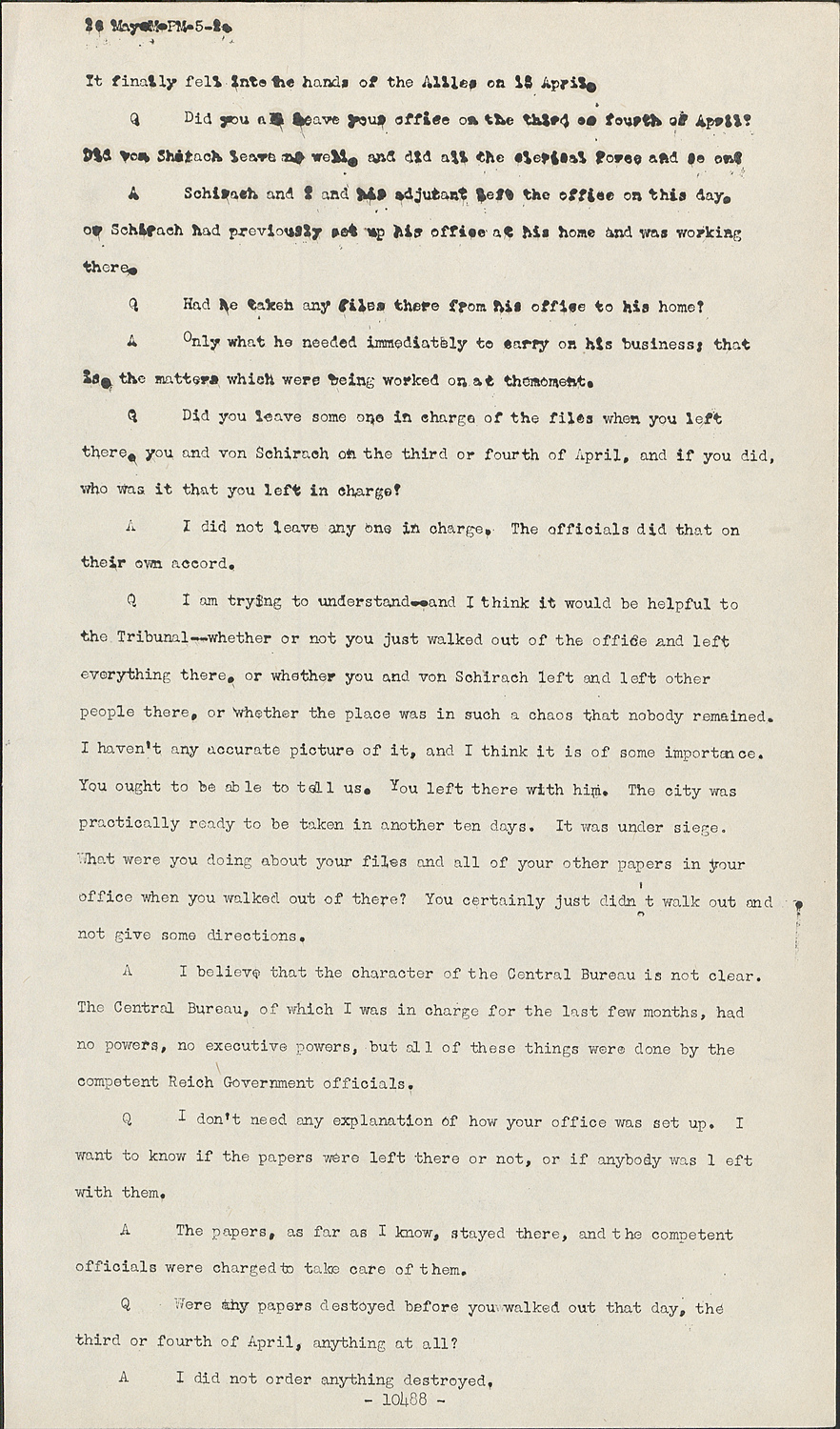
It finally fell Into the hands of the Ailles on 16 April.
QDid you as leave your office on the third or fourth of April? Did von Shirach leave as well, and did all the several force and so and
ASchirach and I and his adjutant left the office on this day. on Schirach had previously act up his office at his home and was working there.
QHad he taken any files there from his office to his home?
AOnly what he needed immediately to carry on his business; that the matters which were being worked on at themoment.
QDid you leave some one in charge of the files when you left there, you and von Schirach on the third or fourth of April, and if you did, who was it that you left in charge?
AI did not leave any One in charge. The officials did that on their own accord.
QI am trying to understand--and I think it would be helpful to the Tribunal--whether or not you just walked out of the office and left everything there, or whether you and von Schirach left and left other people there, or Whether the place was in such a chaos that nobody remained. I haven't any accurate picture of it, and I think it is of some importance. You ought to be able to tell us. You left there with him. The city was practically ready to be taken in another ten days. It was under siege. what were you doing about your files and all of your other papers in your office when you walked out of there? You certainly just didn't walk out and not give some directions.
AI believe that the character of the Central Bureau is not clear. The Central Bureau, of which I was in charge for the last few months, had no powers, no executive powers, but all of these things were done by the competent Reich Government officials.
QI don't need any explanation of how your office was set up. I want to know if the papers where left there or not, or if anybody was l eft with them.
AThe papers, as far as I know, stayed there, and the competent officials were charged to take care of them.
QWere any papers destoyed before you walked out that day, the third or fourth of April, anything at all?
AI did not order anything destroyed.
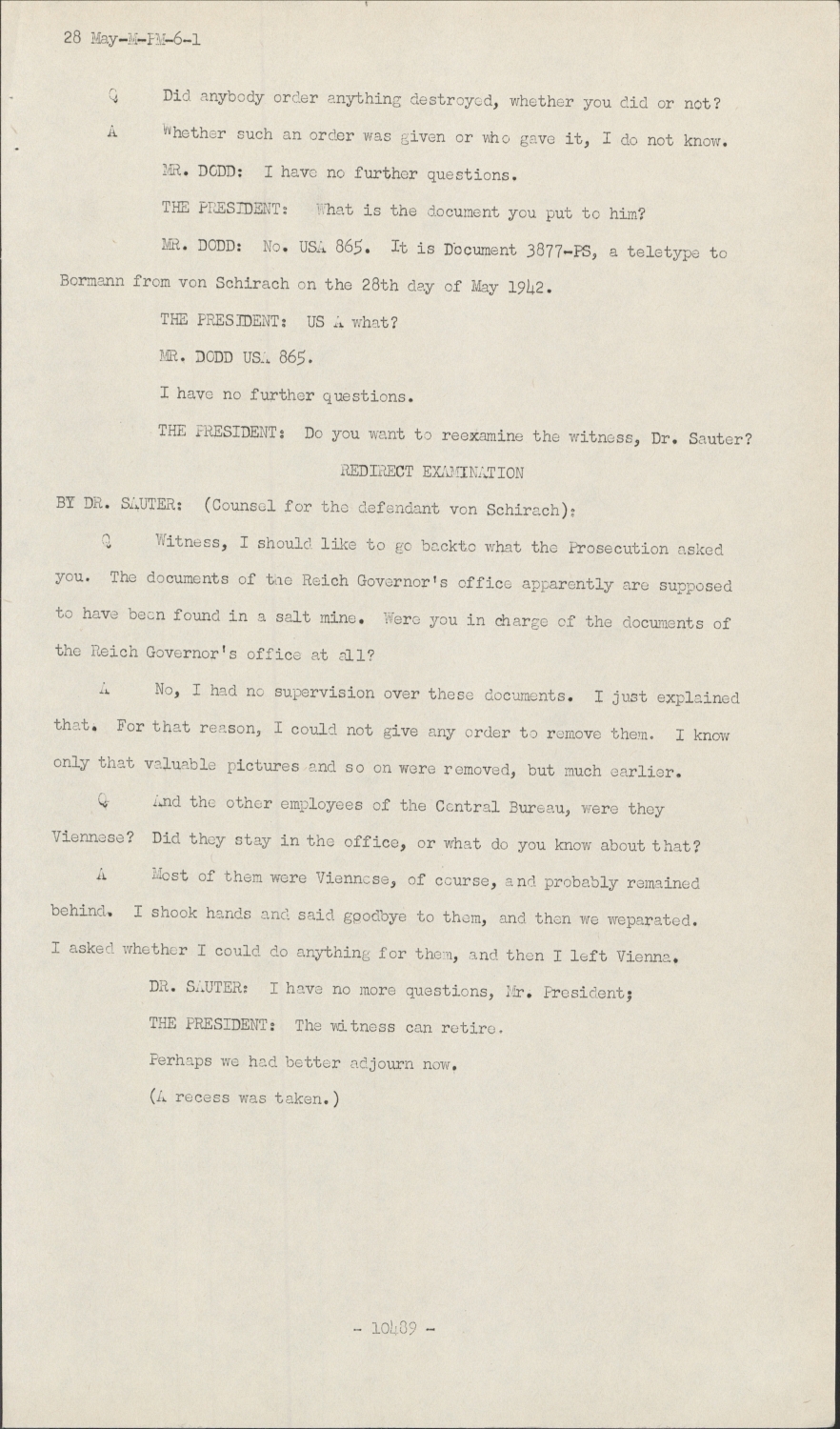
Q Did anybody order anything destroyed, whether you did or not?
AWhether such an order was given or who gave it, I do not know.
MR. DODD:I have no further questions.
THEPRESIDENT: what is the document you put to him?
MR. DODD:No. USA 865. It is Document 3877-PS, a teletype to Bormann from von Schirach on the 28th day of May 1942.
THE PRESIDENT:US A what?
MR. DODD USA 865.
I have no further questions.
THE PRESIDENT:Do you want to reexamine the witness, Dr. Sauter?
REDIRECT EXAMINATION BY DR. SAUTER: (Counsel for the defendant von Schirach):
QWitness, I should like to go backto what the Prosecution asked you. The documents of the Reich Governor's office apparently are supposed to have been found in a salt mine. Were you in charge of the documents of the Reich Governor's office at all?
ANo, I had no supervision over these documents. I just explained that. For that reason, I could not give any order to remove them. I know only that valuable pictures and so on were removed, but much earlier.
QAnd the other employees of the Central Bureau, were they Viennese? Did they stay in the office, or what do you know about that?
AMost of them were Viennese, of course, and probably remained behind. I shook hands and said goodbye to them, and then we weparated. I asked whether I could do anything for them, and then I left Vienna.
DR. SAUTER: I have no more questions, Mr. President;
THE PRESIDENT: The witness can retire.
Perhaps we had better adjourn now.
(A recess was taken.)
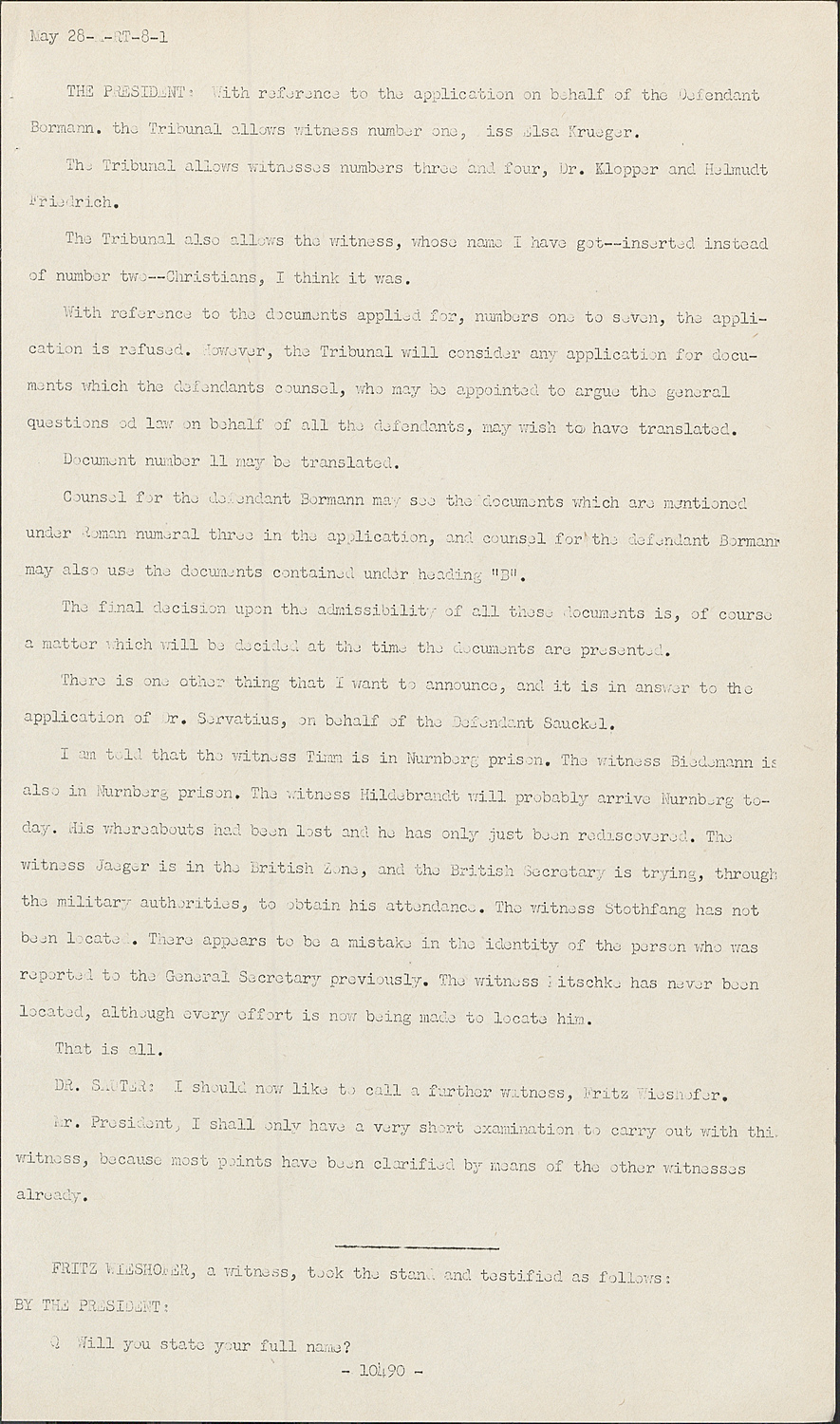
THE PRESIDENT: With reference to the application on behalf of the Defendant Bormann.
the Tribunal allows witness number one, Miss Elsa Krueger.
The Tribunal allows witnesses numbers three and four, Dr. Klopper and Helmudt Friedrich.
The Tribunal also allows the witness, whose name I have got--inserted instead of number two--Christians, I think it was.
With reference to the documents applied for, numbers one to Seven, the application is refused. However, the Tribunal will consider any application for documents which the defendants counsel, who may be appointed to argue the general questions ed law in behalf of all the defendants, may wish to have translated.
Document number 11 may be translated.
Counsel for the dependant Bormann may see the documents which are mentioned under Roman numeral three in the application, and counsel for the defendant Bormann may also use the documents contained under heading "B".
The final decision upon the admissibility of all these documents is, of course a matter which will be decided at the time the documents are presented.
There is one other thing that I want to announce, and it is in answer to the application of Dr. Servatius, on behalf of the Defendant Sauckel.
I am told that the witness Timm is in Nurnberg prison. The witness Biedemann is also in Nurnberg prison. The witness Hildebrandt will probably arrive Nurnberg today. His whereabouts had been lost and he has only just been rediscovered. The witness Jaeger is in the British zone, and the British Secretary is trying, through the military authorities, to obtain his attendance. The witness Stothfang has not been locate . There appears to be a mistake in the identity of the person who was reported to the General Secretary previously. The witness Mitschke has never been located, although every effort is now being made to locate him.
That is all.
DR. SAUTER:I should, now like to call a further witness, Fritz Wieshofer.
Mr. President, I shall only have a very short examination to carry out with this witness, because most points have been clarified, by means of the other witnesses already.
FRITZWIESHOFER, a witness, took the stand and testified as follows: BY THE PRESIDENT:
QWill you state your full name?
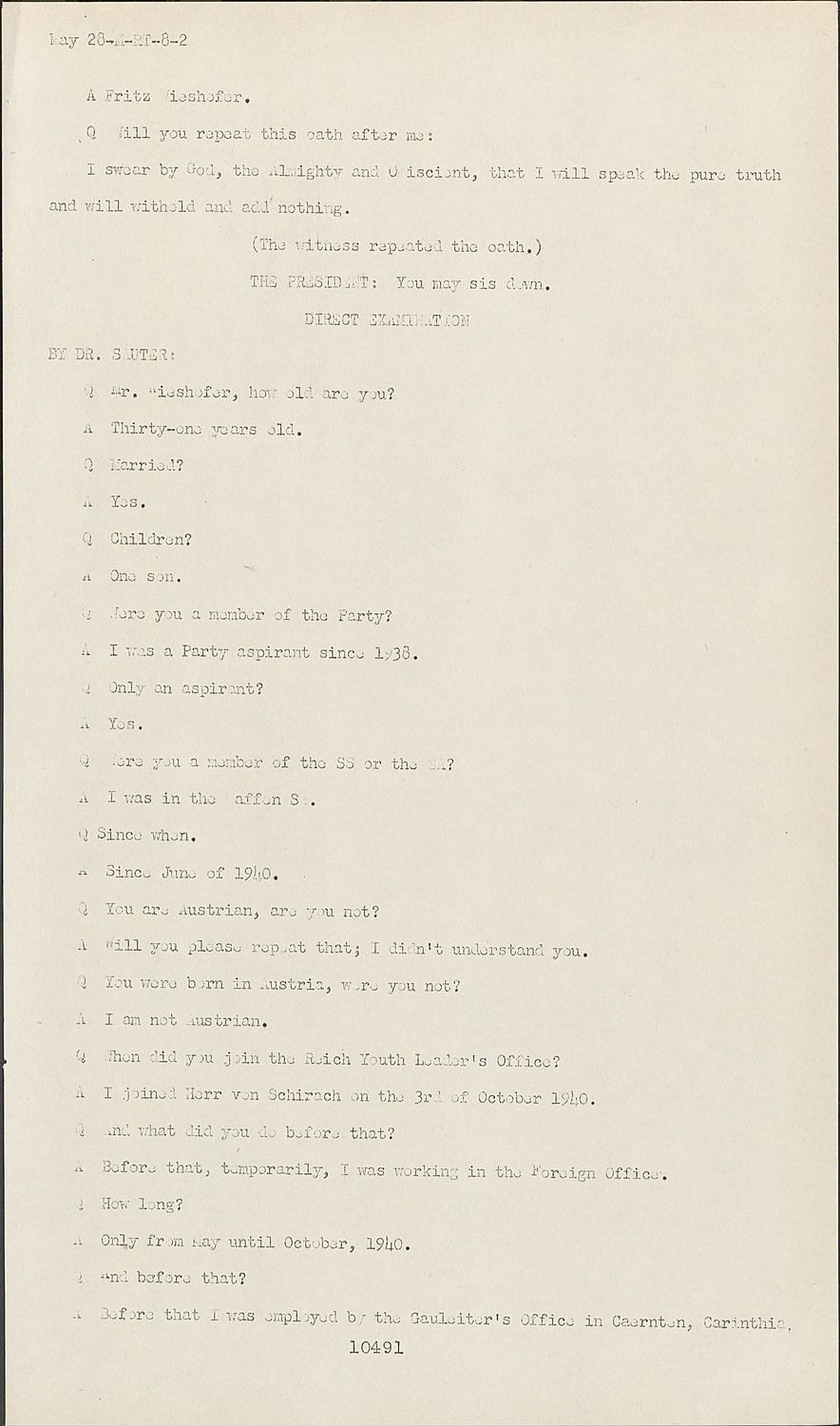
A Fritz Wieshofer.
QWill you report this oath after me:
I swear by God, the Almighty and Omiscient, that I will speak the pure truth and will witheld and add nothing.
(The witness repeated the oath.)
THE PRESIDENT: You may sis clam.
DIRECT EXAMINATION BY DR. SAUTER:
QMr. Wieshofer, how old are you?
AThirty-one years old.
QMarried?
AYes.
QChildren?
AOne son.
QWere you a member of the Party?
AI was a Party aspirant since 1938.
QOnly an aspirant?
AYes.
QWere you a member of the SS or the ...?
AI was in the Waffen SS.
QSince when.
ASince June of 1940.
QYou are Austrian, are you not?
AWill you please repeat that; I didn't understand you.
QYou were born in Austria, warn you not?
AI am not Austrian.
QWhen did you join the Reich Youth Leader's Office?
AI joined Herr von Schirach on the 3rd of October 1940.
QAnd what did you de before that?
ABefore that, temporarily, I was working in the Foreign Office.
QHow long?
AOnly from may until October, 1940.
QAnd before that?
ABefore that I Was employed by the Gauleiter's Office in Caernten, Carinthia.