Then you go on to say that it was the work of the British agents and that it originated in Berlin. You sign it, "Heil Hitler, Dein, Schirach."
Do you remember sending that telegram to Bormann?
AI just listened to the English translation. I should like to see the German original, please.
QVery well.
THE PRESIDENT:Mr. Dodd, you read, I thought, a British "coastal" town, did you not?
MR. DODD:No, "cultural", I meant to say, Mr. President.
THE PRESIDENT:Yes, that is what I have got.
MR. DODD:Yes, it is "cultural". BY MR. DODD:
QIncidentally, I call your attention, Mr. Witness, to the word "cultural You have expressed such a great interest in culture.
THE PRESIDENT:Would it be all right to break off now, or do you want to go on?
MR. DODD:I hoped I could finish. I won't be many minutes, but I do have one or two rather important documents that I would Like to put to the witness.
Mr. President, if we recess, may I ask that the witness not be talked to by his counsel over night? I think it is only fair, when a witness is under corss-examination,that he not have conversations with his counsel.
THE WITNESS: I should like to say to this document --
DR. SAUTER:Mr. President, I should like to have this question clarified as to whether as a defense attorney I may talk with my client. Just a little while ago Mr. Dodd questioned the right of my talking with my client and , of course, I acquisced, But, If I am told now that I may not speak with my client until the end of the cross-examination, and if the cross-examination will be continued on Monday, then that would mean that I might not speak with my client tomorrow, and the day after not at all. But, in order to defend him and for his defense, I must have the opportunity to discuss the matters which were brought up here today and to discuss then with my client.
Mr DODD: Mr. President, I will withdrew my request. I forgot we were going over until Monday. I do think it is the ordinary rule, but I do think it might present some difficulty for the counsel here.
I want to be fair with the Tribunal. During the recess Dr. Sauter approached the witness stand and I did tell him then that I did not think he should talk with him during the recess while he was under cross-examination.
THE PRESIDENT:Well, it is the British rule, but I think under the circumstances we had better let Dr. Sauter -
MR DODD:I quite agree. I was not thinking we would go beyond tomorrow but I do not want to interfere with his consortaion over the weekend.
(The Tribunal adjourned until 27 May 1946, at 10000 hours.)
Official Transcript of the International Military Tribunal in the Matter of The United States of America, the French Republic, the United Kingdom of Great Britain and Northern Ireland, and the Union of Soviet Socialist Republics against Herman Wilhelm Goering et al, Defendants, sitting at Nurnberg, Germany, on 27 May 1946, 1000-1300, Lord Justice Lawrence presiding.
MR. DODD: Mr. President, I would like to make certain that I did offer the following documents in evidence:
3914-PS, which would become USA-863; 3943-PS, which would become USA-964; and 3877-PS, which would become USA-86 5.
THE PRESIDENT: Give me the first one.
MR. DODD: 3914-PS, which is USA-863.
THE PRESIDENT: Yes.
BALDUR von SCHIRACH, one of the Defendants, resumed the witness-stand and testified further as follows:
CROSS-EXAMINATION (continued) BY MR. DODD:
Q.Mr. Witness, at the close of the session on Friday we had just handed to you a copy of the teletype message to Martin Bormann. I had read it to you over this transmission system. I wish to ask you now if you sent that message to Bormann.
AYes, I did despatch that teletype message. And I should like to give an explanation in this connection -
QMay I interrupt you for a minute and ask, for the little while that we will be talking, that you wait a moment after the question is given. It would help with the interpreting. I will try to do the same. And perhaps we will work a little better together.
AFirst of all, then, I want to state why I was on terns of "Du," the friendly "you," with Bormann. Bormann comes from the same town where I come from. I knew him from Weimar, but only slightly. When in 1928 or 1929, he came to Munich he paid a visit to me and because he was the older of us he offered no the "Du" on that occasion. We maintained that until in 1943 he on his own account, own initiative, dropped that form and addressed me in his letters with the less personal form of "Sic."
Now, as far as the text of this teletype message is concerned, we were in the third year of the war. The Czech population both in the former Protectorate of Bohemia and Moravia as well as Vienna had remained perfectly quiet. In the Protectorate conditions were almost like peacetime conditions. I had a very strong check of the population in Vienna. Because of the attempt on Heydrich's life I had to anticipate that there might be trouble in the Protectorate which no doubt would have serious repercussions in Vienna. This was the time when the German troops were advancing on the peninsula of Kertsch. It was a time when nothing could be allowed to happen behind our front. And simultaneously with the news of the murder of the Protector I received official notification that the attempt, as it is mentioned in this document, had been carried out by British agents and with a British weapon.
During that sane month we had learned from Armed Forces reports that British Bombers had attacked living quarters in Hamburg and Paris and that they had attacked German cultural monuments at Kiel. Consequently I suggested reprisal measures, so as to ascertain the British guilt in this attempt to the world and so as to prevent serious trouble in Czechoslovakia. That's all I have to say. And this teletype message is genuine.
May I at this opportunity also come to a difficulty regarding translation during the cross-examination on Friday, if I May? On that occasion the German word, "Retter," was translated into English, "Saviour." A difficulty in translating from German and into English exists in this case. It is an expression which I have used in my book when I described the Fuehrer as a "Retter," a rescuer, a saviour. the difficulty is that you can only translate the German word with "saviour." But "saviour" in the German re-translation means "the holy man, the saintly man." So as to make it quite clear what the German "Retter" is meant to express in the English, I should have to use an auxiliary sentence and I would have to say that the exact translation would be "rescuer."
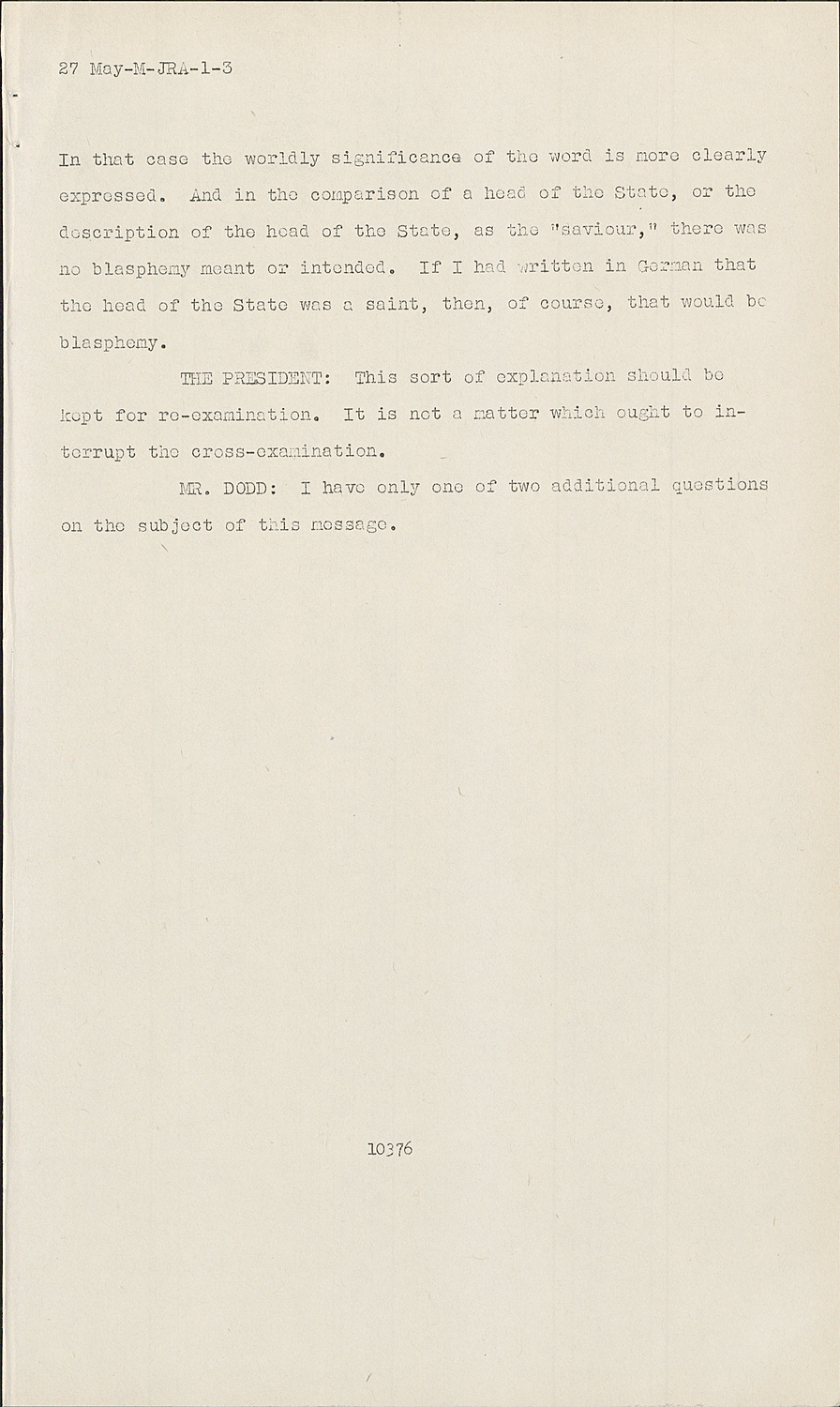
In that case the worldly significance of the word is more clearly expressed.
And in the comparison of a head of the State, or the description of the head of the State, as the "saviour," there was no blasphemy meant or intended. If I had written in German that the head of the State was a saint, then, of course, that would be blasphemy.
THE PRESIDENT: This sort of explanation should be kept for re-examination. It is not a matter which ought to interrupt the cross-examination.
MR. DODD: I have only one of two additional questions on the subject of this message.
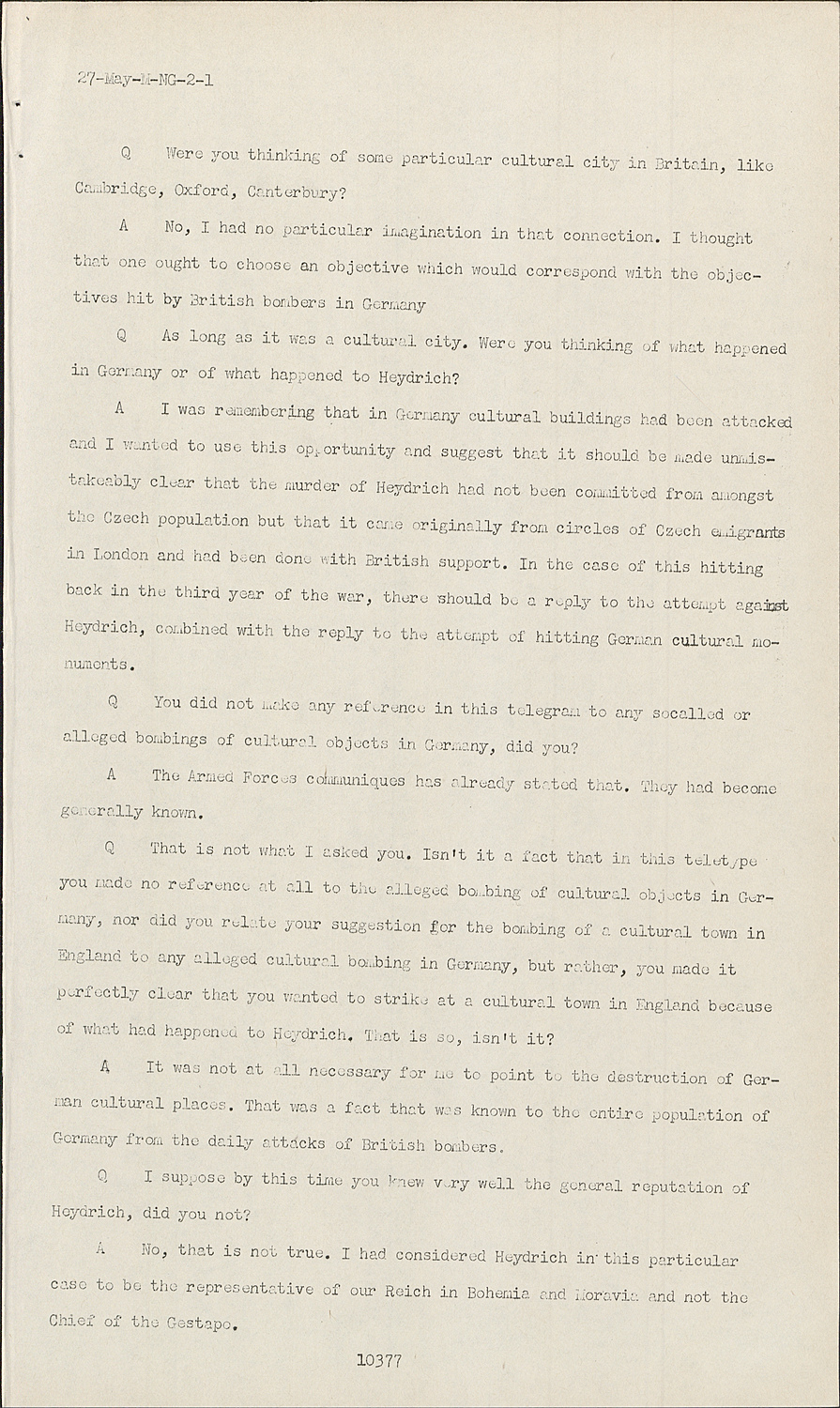
Q Were you thinking of some particular cultural city in Britain, like Cambridge, Oxford, Canterbury?
ANo, I had no particular imagination in that connection. I thought that one ought to choose an objective which would correspond with the objectives hit by British bombers in Germany
QAs long as it was a cultural city. Were you thinking of what happened in Germany or of what happened to Heydrich?
AI was remembering that in Germany cultural buildings had been attacked and I wanted to use this opportunity and suggest that it should be made unmistakeably clear that the murder of Heydrich had not been committed from amongst the Czech population but that it came originally from circles of Czech emigrants in London and had been done with British support. In the case of this hitting back in the third year of the war, there should be a reply to the attempt against Heydrich, combined with the reply to the attempt of hitting German cultural monuments.
QYou did not make any reference in this telegram to any socalled or alleged bombings of cultural objects in Germany, did you?
AThe Armed Forces communiques has already stated that. They had become generally known.
QThat is not what I asked you. Isn't it a fact that in this teletype you made no reference at all to the alleged bombing of cultural objects in Germany, nor did you relate your suggestion for the bombing of a cultural town in England to any alleged cultural bombing in Germany, but rather, you made it perfectly clear that you wanted to strike at a cultural town in England because of what had happened to Heydrich. That is so, isn't it?
AIt was not at all necessary for me to point to the destruction of German cultural places. That was a fact that was known to the entire population of Germany from the daily attacks of British bombers.
QI suppose by this time you knew very well the general reputation of Heydrich, did you not?
ANo, that is not true. I had considered Heydrich in this particular case to be the representative of our Reich in Bohemia and Moravia and not the Chief of the Gestapo.
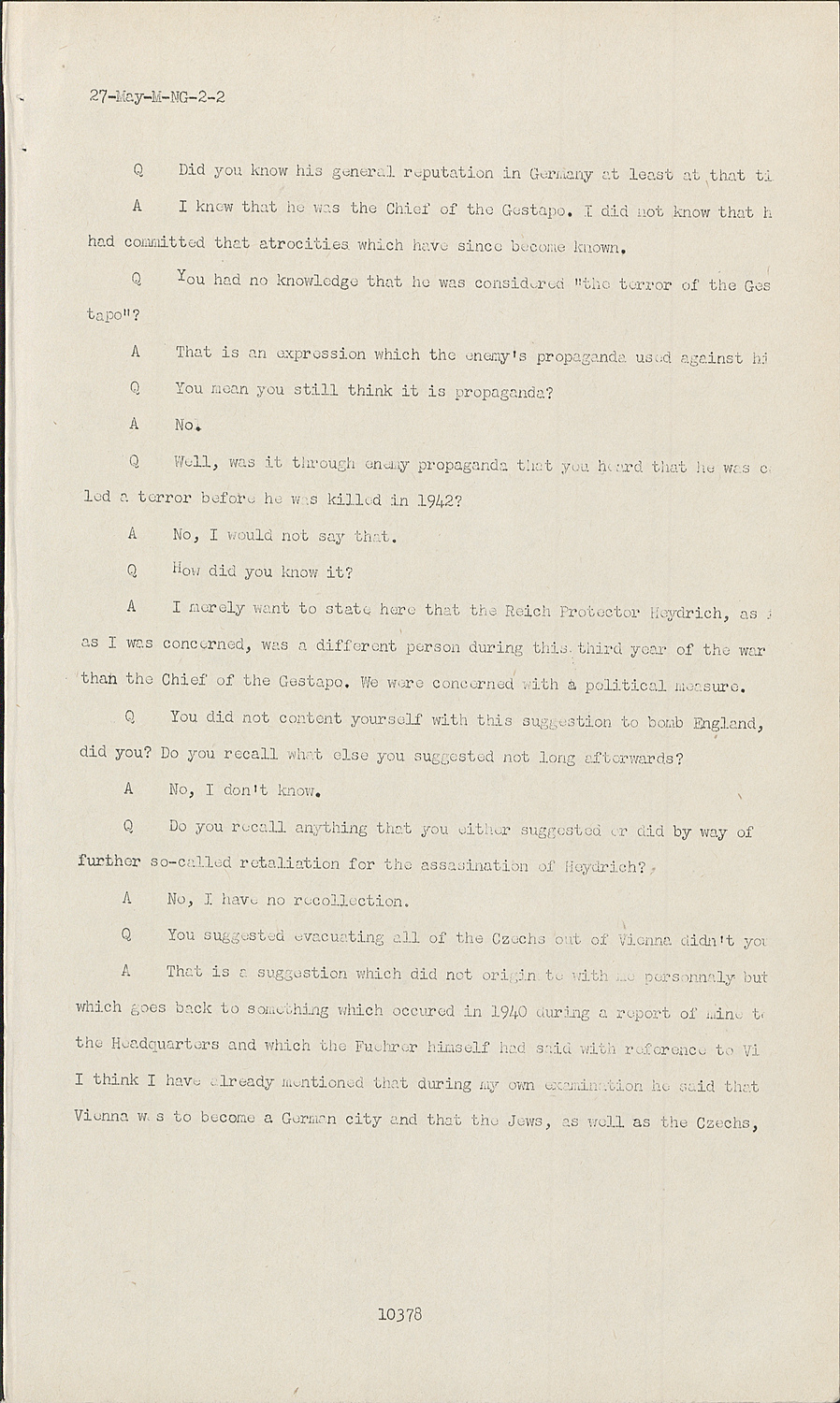
Q Did you know his general reputation in Germany at least at that ti
AI knew that he was the Chief of the Gestapo. I did not know that he had committed that atrocities which have since become known.
QYou had no knowledge that he was considered "the terror of the Ges tapo"?
AThat is an expression which the enemy's propaganda used against hi
QYou mean you still think it is propaganda?
ANo.
QWell, was it through enemy propaganda that you heard that he was caled a terror before he was killed in 1942?
ANo, I would not say that.
QHow did you know it?
AI merely want to state here that the Reich Protector Heydrich, as*--* as I was concerned, was a different person during this third year of the war than the Chief of the Gestapo. We were concerned with a political measure.
QYou did not content yourself with this suggestion to bomb England, did you? Do you recall what else you suggested not long afterwards?
ANo, I don't know.
QDo you recall anything that you either suggested or did by way of further so-called retaliation for the assasination of Heydrich?
ANo, I have no recollection.
QYou suggested evacuating all of the Czechs out of Vienna didn't you
AThat is a suggestion which did not origin to with me personnaly but which goes back to something which occured in 1940 during a report of mine to the Headquarters and which the Fuehrer himself had said with reference to Vi I think I have already mentioned that during my own examination he said that Vienna was to become a German city and that the Jews, as well as the Czechs, were gradually to be evacuated from Vienna.
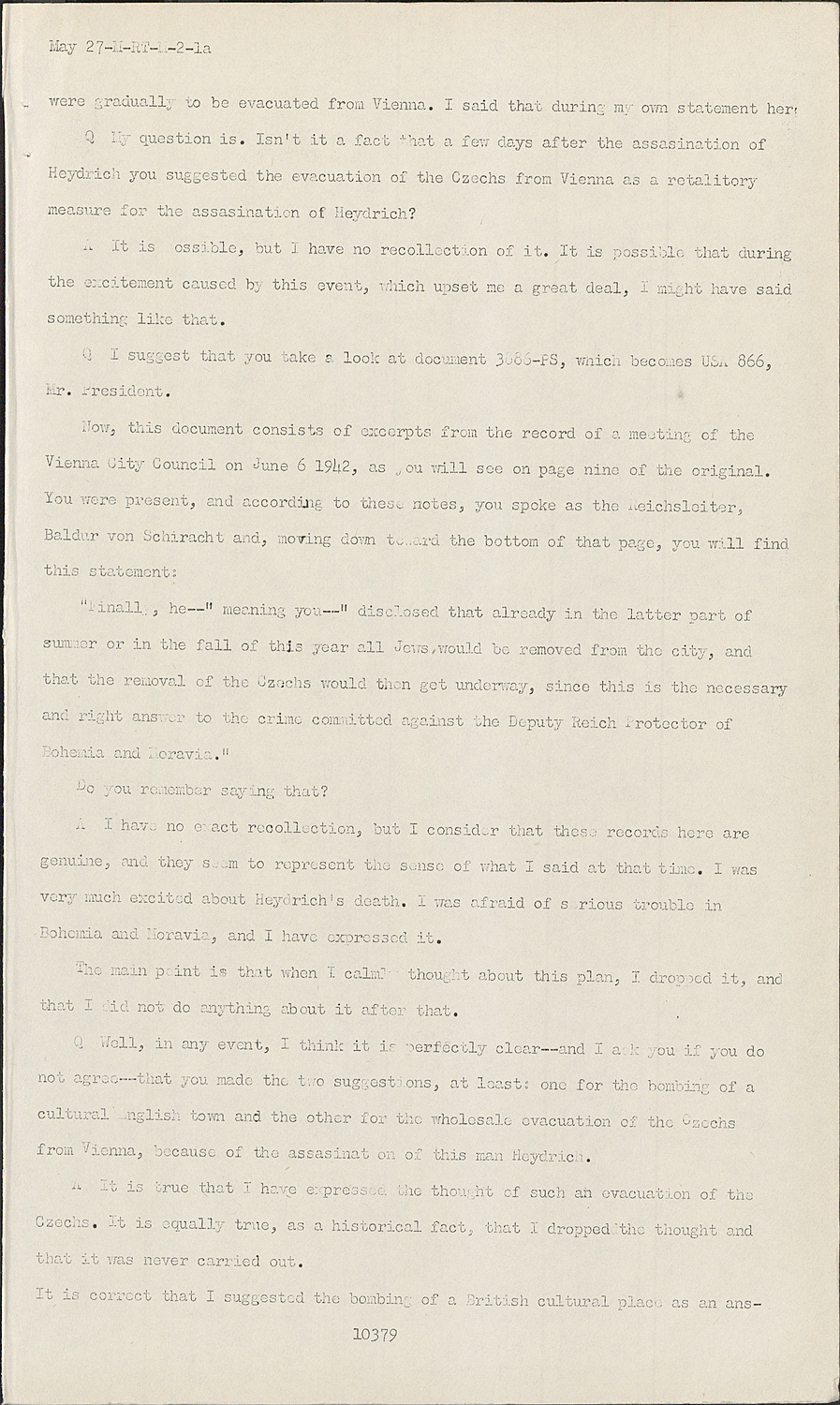
I said that during my own statement here
QMy question is. Isn't it a fact that a few days after the assasination of Heydrich you suggested the evacuation of the Czechs from Vienna as a retalitory measure for the assasination of Heydrich?
AIt is possible, but I have no recollection of it. It is possible that during the excitement caused by this event, which upset me a great deal, I might have said something like that.
QI suggest that you take a look at document 3886-PS, which becomes USA 866, Mr. President.
Now, this document consists of excerpts from the record of a meeting of the Vienna City Council on June 6 1942, as you will see on page nine of the original. You were present, and according to these notes, you spoke as the Reichsleiter, Balder von Schiracht and, moving down toward the bottom of that page, you will find this statement:
"Finally, he--" meaning you--" disclosed that already in the latter part of summer or in the fall of this year all Jews would be removed from the city, and that the removal of the Czechs would then get underway, since this is the necessary and right answer to the crime committed against the Deputy Reich Protector of Bohemia and Moravia."
Do you remember saying that?
AI have no exact recollection, but I consider that these records here are genuine, and they seem to represent the sense of what I said at that time. I was very much excited about Heydrich's death. I was afraid of serious trouble in Bohemia and Moravia, and I have expressed it.
The main point is that when I calmly thought about this plan, I dropped it, and that I did not do anything about it after that.
QWell, in any event, I think it is perfectly clear--and I ask you if you do not agree--that you made the two suggestions, at least: one for the bombing of a cultural English town and the other for the wholesale evacuation of the Czechs from Vienna, because of the assasination of this man Heydrich.
AIt is true that I have expressed the thought of such an evacuation of the Czechs. It is equally true, as a historical fact, that I dropped the thought and that it was never carried out. It is correct that I suggested the bombing of a British cultural place as an ans wer to the attempts against Heydrich and the answer to the numerous bombardments of German cultural places in the third year of the war during a time when they are vital matters for the German people concerned.
QIncidentally, Hitler also suggested the wholesale evacuation of the Czec from Czechoslavakia as a punishment for the murder of Heydrich, didn't he?
AI don't know about that.
QHow I want to turn to something else and see if we can get through here rather seen this morning. You recall that on Friday we talked about your relation ship with the SS and with similar and I want to ask you this morning if it isn't a fact, Mr. Witness, that you worked very closely with Himmler and his SS from almost the earliest days right down to almost the last days of your regime in Vienna. I wish you would answer that quest on.
AI should like to answer that question in great detail.
QIt does not require great detail in the first answer, but later, if you feel that you have some necessary explanation, I feel you will be permitted to give it. Will you tell the Tribunal first of all, if you did closely cooperate with Himmler and his SS from the earliest days of our public office to the very late days of your public office?
AClose collaboration in that sense, that Himmler might have had consider influence upon education did not exist.
QLet us stop right there and inquire a little bit. Isn't it a fact that Himmler assigned SS personnel to you youth organisation for the training purpose of your young people? You can answer that very simply. Did he or did he not?
ATraining purposes, educational purposes?
QYes.
AI don't know anything about that. The fact that liason officers were as would not be unusual because practically all ministries and organizations had liaison officers, but I have no recollection of what you might be referring to.
Q.I think we had better clear this up first, and I ask you that you look at document 3931-PS, which is a new document which becomes USA 867, Mr. President.
THE PRESIDENT:It will become what?
MR. DODD: USA 867. BY MR. DODD:
Q.Now, Mr. Witness, if you will look at this document, you will observe that it is a message which you sent to "Dear Party Member Bormann" in August of 1941. It is quite long, and there won't be any necessity. I am sure, for reading all of it, but I want to direct your attention to some parts of it that might help your memory with respect to the SS.
By way of a preliminary question, the SA apparently had suggested that it take over some of the training of young people,hadn't it, some time in the summer of 1941?
A.I think it was on Thursday that I said during my examination that in the spring of 1939 the SA had attempted to dominate the pre-military education of youth of two certain ages. I think that such attempts were repeated in 1941.
Q.You were complaining to Bormann about it when you wrote this message? You recall now, from just looking at the letter, that that is the whole substance of the letter -- a complaint about the attempt of the SA to directly control the training of some young people in the Hitler Youth Organization.
A.As far as this long telepring letter is concerned, I can not tell you anything about it without reading it through.
Q.Well, let's see. If you will turn -- It is the second page of the English text. You don't have any pages there. I think it is all one. It is all a teletype, but it is about -- not too far down on the first part of it. First of all, I want to have you see if you can find the statement that "The Hitler Youth has considered it necessary from the very beginning to make the Party itself the agency for the direction and administration of its military training."
Do you find that passage?
A.No.
Q.Well, you willfind the paragraph numbered (1) on your teletype, small Arabic number one. You will find they start to be numbered, (1), (2), (3), and so on. Do you find that, Mr. Witness?
A.I have got (1), yes.
Q.All right. If we hit someplace that we agree on, then we can move on. If you have found that number (1), that says that "For more than one year an agreement in draft form has been submitted to the SA--" Do you find that? "-- which requests that SA-cadre be furnished for the military training of the youth," and that the SA leadership did not comply with this request. Will you move down further in number (3), and following (3 ), three or four paragraphs, you will find -- it is in capital letters, by the way, what I want to call your attention to; I assume it is in capital letters in the German:
"I would be happy if the SA would put personnel at my disposal for support for this purpose, similar to the way in which the SS and the police have been doing for a long time already."
R. DODD:In the English, Mr. President, that is at the bottom of page four and the top of page five.
MR. DODD: In the English, Mr. President, that is at the bottom of page four and at the top of page five.
BY MR. DODD:
QDid you find that sentence?
AI haven't found it yet.
QIt is almost at the end of the teletype. Have you found it?
AYes.
QYou say there that you would be happy if the SA would put personnel at your disposal for support of this purpose, similar to the way in which the SS and the police have been doing for a long time already and you are referring -- if you will read back to the paragraph just ahead of that sentence -- to the training of the young people. You talk about Hitler schools and the training of Hitler youth. Now, it is perfectly clear, is it not, that you did have assistance from the SS, according to your own methods, from the SS and police for a long time before you sent this message?
ADuring the war, yes; since 1939 we had a war and when the war broke out we created army training camps, pr-army training camps and there I was looking after the training of youth. The army could not supply sufficient instructors and the SA couldn't do so either. The SS could place at my disposal a few young officers and so could the police.
QSo it was only from the beginning of the war that you had personnel from the SS and police for the training of young people was it?
AI do not believe that apart from that, we have used SS instrutors for anything. We had, as I have stated, a leadership corps, a leader corps, which came from the youngsters which we created.
QI ask you again, do you want the Tribunal to understand that it was only from the beginning of the war that you had the assistance of SS and police personnel assigned to your youth organization for the training of young people?
AI cannot answer that question absolutely clearly and that is for the following reasons: Take skiing, for instance; if we had a training camp, then it was possible that one of the instructors might have been an SA man or an SS man because he happened to be good or interested in that sport but I can't think of any other case where such a collaboration has taken place.
QAre you able to say that you did not have SS personnel assigned for training purposes; and I am not talking about some isolate ski-master, I am talking about a regular program of assistance from the SS to you in your training of young people.
AAs far as pre-military training is concerned, it was only through this teletype message that I asked for training purposes. Apart from that, I do not recollect where any such collaboration has taken place.
QDo you know the term "High-Action? "H-O-C-H-A-K-T-I-O-N."
AHigh Action?
QYes.
AI can't remember it. I do not know what it might mean.
QWell, you have been in the courtroom every day. Don't you remember that there was proof offered here by the prosecution concerning the defendant Rosenberg and an action termed "High Action."
ANo, I can't at the moment say that I do remember. I don't know.
QDon't you remember that there was some talk here in the courtroom about the seizing of young people in the East and forcing them to be brough to Germany, forty or fifty thousand youths at the ages of ten to fourteen? You remember that, don't you, and that one of the purposes was to destroy the biological potentiality of these people. You don't know what I refer to?
AThat is an action which I now remember in connection with this trial. The only thing I can say officially in that connection is this: It was during the war -- I can't tell you exactly which year -- Axmann informed me that he had accommodated a large number of young people near Junker's, the Junker's works at Dessau, in special hostels for this purpose, apprentices, and that these youngsters were extremely well accommodated there and very well looked after. I was not in any way concerned with this action before it took place but I have stated at the beginning of my examination here that as far as the action of youth in this war is concerned, I assumed responsibility and I adhere to that statement. I do not think, however, that youth is to be held responsible in this connection because I remember from fellow-defendant Rosenberg's statements, that he had complied with the wishes of the army and army group in that connection.
QWell, we have the document here. It is already in evidence as USA 171 -- the Tribunal is familiar with it -- and I would like to call your attention to the fact that in this document it says that Rosenberg agreed to the program of seizing or apprehending forty to fifty thousand youths at the ages of ten to fourteen and the transportation of them to the Reich; it also said that this program can be accomplished with the help of the officers of the Hitler youth through the Youth Bureau of Rosenberg's ministry; and it also said that a number of these young people were to be detailed to SS and SS auxiliaries. Now, what I want to ask you particularly is what you know about that program and how the Hitler youth cooperated in it?
AI can't tell you any more about that program than what I have already stated.
QYou were in charge of the war commitment of the Hitler youth, weren't you, the Kriegseinsatz?
AThe war commitment of German youth was directly under the orders of the Reich Youth Leader. As far as my own knowledge is concerned, I can only speak generally but not about special cases.
QMr. Witness, I ask you again, weren't you appointed and didn't you serve as the person responsible for the war commitment of youth in Germany? Now, I have got the document to show your appointment if you want to see it.
AYes; I don't want to deny it. In 1939 and 1940, as long as I was the Reich Youth Leader, I have myself directed that war commitment.
QI am talking about an appointment that was made even later than 1939 or 1940. You were appointed the person in charge of the war commitment of German youth by the Fuehrer at his headquarters in March of 1942, weren't you?
APlease, will you be good enough to show me this document -- but I consider it possible, I have no exact recollection.
Q It is 3933-PS, US -868. You don't know you were appointed in charge of the war commitment for youth without being shown the document?
ANo. Only, I can't tell you from my recollection what the exact date was. I had been under the impression that I had been responsible for the commitments beginning in 1939.
QAll right, that is all I wanted to establish, that you were in fact responsible for it and continued to be responsible for it right up to the end of the war. I understood you to say a minute ago that the Reich Youth Leader was the man responsible rather than yourself?
ANo. I have said that I could only give you general information and no special information because the action is, regarding war commitment, a matter for Axmann; but I do not in any way want to influence my own responsibility by saying that.
QVery well. I think we are sufficiently clear about the fact that you were certainly named to the position no matter how you now wish to "water" your responsibility. What do you say is the date when you first became responsible for the war commitment of youth?
AAs far as my memory tells me, I had been responsible since 1939, at the outbreak of war, but I now see that this decree wasn't signed until 1942.
QAll right; we will agree them from that date, March 1942, you were responsible. Now, I want to ask you to look at another document.
AJust a moment, there is something I have to say to that. This is a draft and I don't know about that--when it might have been signed-- I can't say, therefore, that during these days of March in 1942, the actual decree was signed by Hitler--by Axmann. Here, Axmann is informing me that the draft of the decree is now going to the Chief of the Reich Chancellory, who will ask the Reich authorities for their agreement and that----
Q You do not need to read it, really. What are you saying now? Are you saying that maybe it was not signed, or maybe you were not appointed, or are you going to say that you were appointed?
Will you please give us an answer?
ANot at all, really. I cannot say for certain that the date of the publication of this decree is definitely March, 1942. It may have been that it was not until May.
QI am not attaching any great importance to the date. I want you to look at 345-PS, which we offer as U.S.A. 869. This may help you on this Heu-Action program; that is, with respect to your memory.
Now, this is a telegram that the defendant Rosenberg sent to Dr. Lammers at the Reich Chancellery for the Fuehrer Headquarters on the 20th of July, 1944. You will observe that in the first paragraph there is stated:
"In accordance with an agreement between the Reich Marshal as Supreme Commander of the Air Force, the Reichsfuehrer SS, the Youth Fuehrer of the German Reich and the Reich Minister for the Occupied Eastern Territories, the recruiting of youthful Russians, Ukrainians, White Russians", and so on, "will take place on a volunteer basis for Kriegseinsatz in the Reich", "Kriegseinsatz" being a program that you were responsible for clearly at that time.
Now, moving down, I want to call your attention to Paragraph 3, and I want to remind you of the Heu-Action paragraph that is already in evidence. This telegram says:
"On the basis of a suggestion by military offices, the seizing and turning over of youths between the ages of 10-14 into the Reich territories will take place (Heu-Action) in a part of the operational territory, since the youths in the operational territory present a not insignificant burden."
It goes on to say "The aim of the action is a further disposal of the youths by placing them in the Reich Youth Movement and the training of apprenctices for the German economy in a form similar to that which has been done in agreement with the General Plenipotentiary for Arbeitseinsatz (GBA) with White Russian Youths, which already shows results."
I particularly call your attention to that last phrase , "which already shows results."
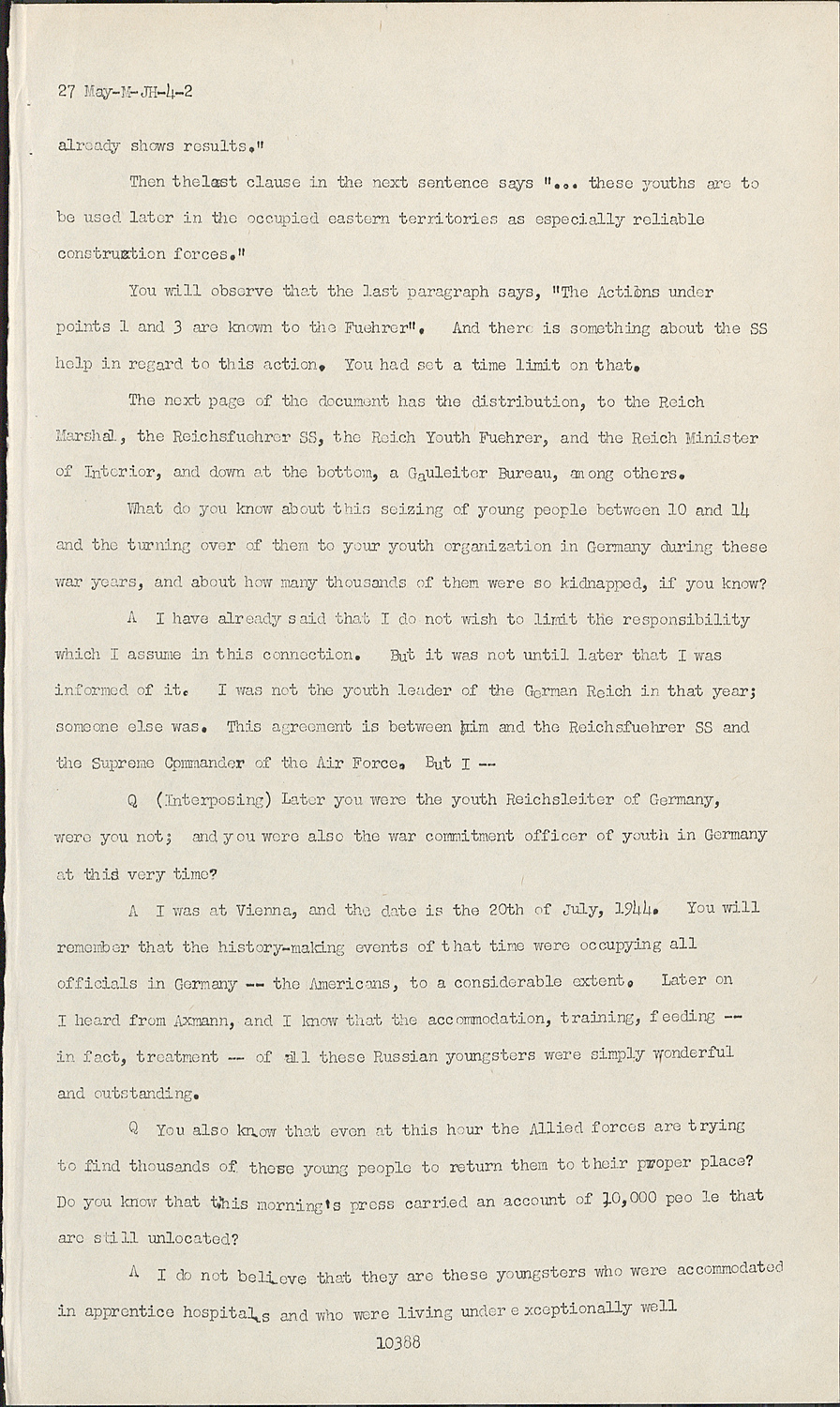
Then thelast clause in the next sentence says "... these youths are to be used later in the occupied eastern territories as especially reliable construction forces."
You will observe that the last paragraph says, "The Actions under points 1 and 3 are known to the Fuehrer". And there is something about the SS help in regard to this action. You had set a time limit on that.
The next page of the document has the distribution, to the Reich Marshal, the Reichsfuehrer SS, the Reich Youth Fuehrer, and the Reich Minister of Interior, and down at the bottom, a Gauleiter Bureau, among others.
What do you know about this seizing of young people between 10 and 14 and the turning over of them to your youth organization in Germany during these war years, and about how many thousands of them were so kidnapped, if you know?
AI have already said that I do not wish to limit the responsibility which I assume in this connection. But it was not until later that I was informed of it. I was not the youth leader of the German Reich in that year; someone else was. This agreement is between him and the Reichsfuehrer SS and the Supreme Commander of the Air Force. But I -
Q (Interposing) Later you were the youth Reichsleiter of Germany, were you not; and you were also the war commitment officer of youth in Germany at this very time?
AI was at Vienna, and the date is the 20th of July, 1944. You will remember that the history-making events of that time were occupying all officials in Germany -- the Americans, to a considerable extent. Later on I heard from Axmann, and I know that the accommodation, training, feeding -in fact, treatment -- of all these Russian youngsters were simply wonderful and outstanding.
QYou also know that even at this hour the Allied forces are trying to find thousands of these young people to return them to their proper place? Do you know that this morning's press carried an account of 10,000 people that are still unlocated?
AI do not believe that they are these youngsters who were accommodated in apprentice hospitals and who were living under exceptionally well organized circumstances, and extremely well trained for their profession?
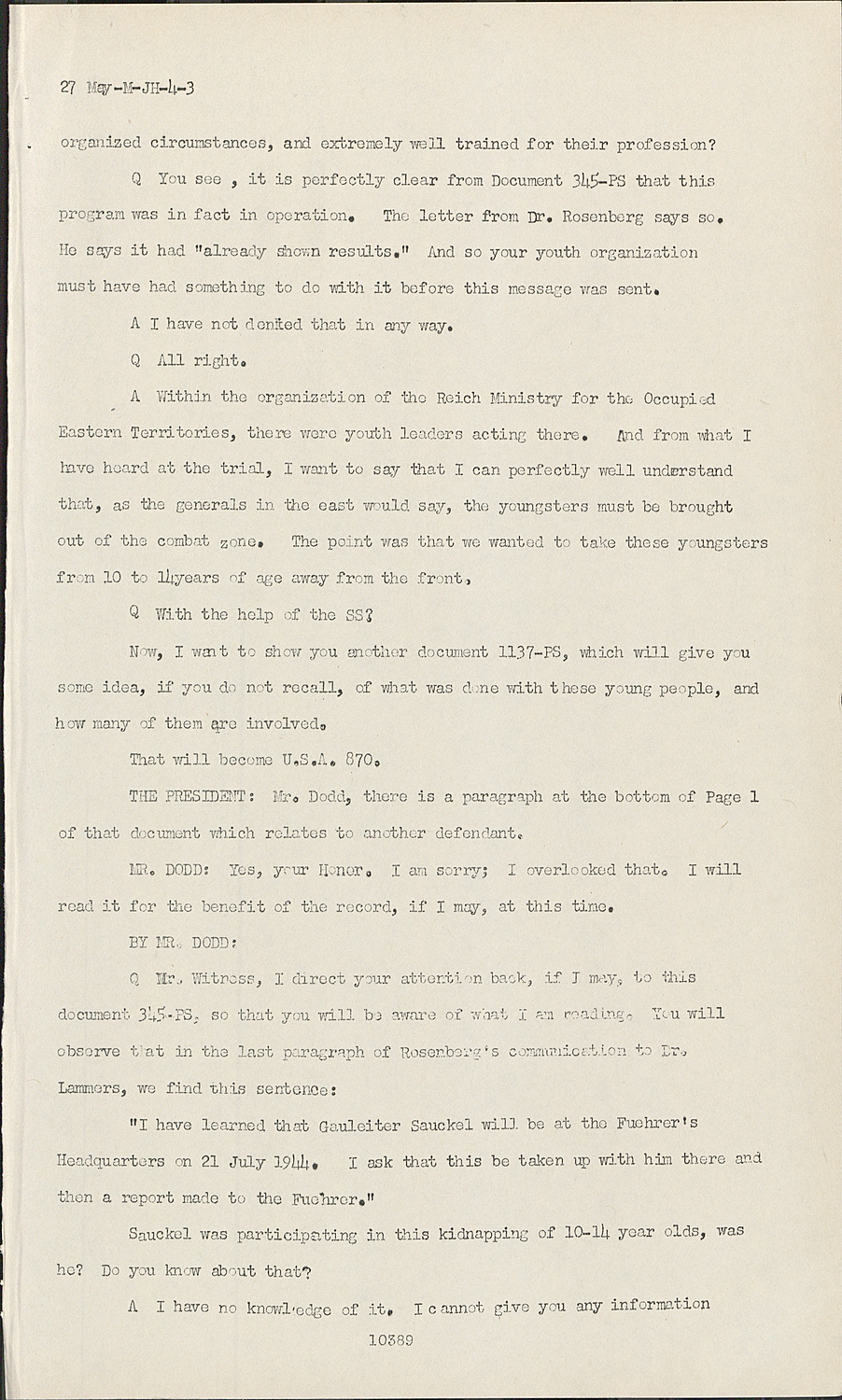
QYou see , it is perfectly clear from Document 345-PS that this program was in fact in operation. The letter from Dr. Rosenberg says so. He says it had "already shown results." And so your youth organization must have had something to do with it before this message was sent.
AI have not denied that in any way.
QAll right.
AWithin the organization of the Reich Ministry for the Occupied Eastern Territories, there were youth leaders acting there. And from what I have heard at the trial, I want to say that I can perfectly well understand that, as the generals in the east would say, the youngsters must be brought out of the combat zone. The point was that we wanted to take these youngsters from 10 to 14years of age away from the front.
QWith the help of the SS?
Now, I want to show you another document 1137-PS, which will give you some idea, if you do not recall, of what was done with these young people, and how many of them are involved.
That will become U.S.A. 870.
THE PRESIDENT:Mr. Dodd, there is a paragraph at the bottom of Page 1 of that document which relates to another defendant.
MR. DODD:Yes, your Honor. I am sorry; I overlooked that. I will read it for the benefit of the record, if I may, at this time.
BY MR. DODD:
QMr. Witness, I direct your attention back, if I may, to this document 345-PS, so that you will be aware of what I am reading. You will observe that in the last paragraph of Rosenberg's communication to Dr. Lammers, we find this sentence:
"I have learned that Gauleiter Sauckel will be at the Fuehrer's Headquarters on 21 July 1944. I ask that this be taken up with him there and then a report made to the Fuehrer."
Sauckel was participating in this kidnapping of 10-14 year olds, was he? Do you know about that?
AI have no knowledge of it. I cannot give you any information on that subject.
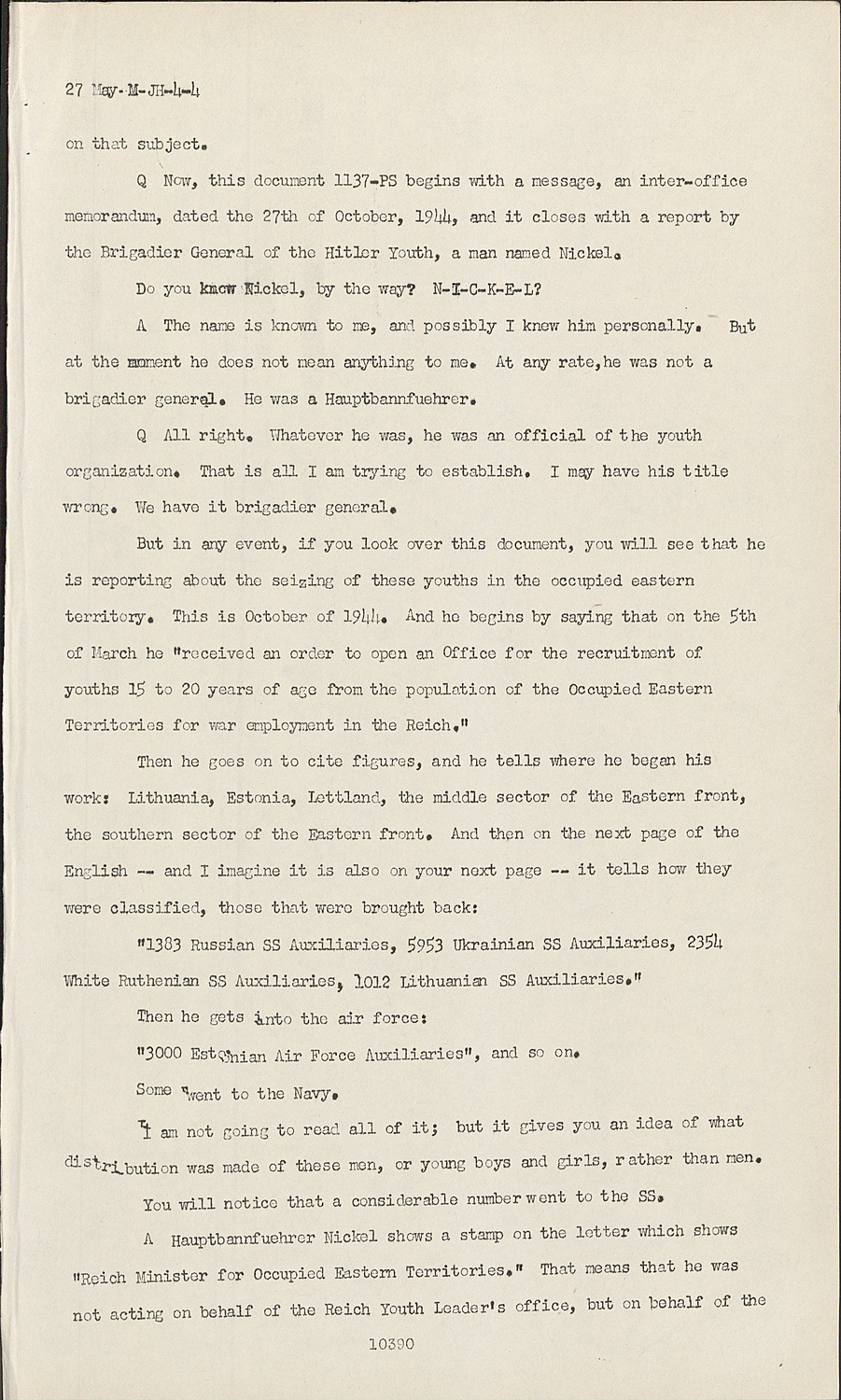
QNow, this document 1137-PS begins with a message, an inter-office memorandum, dated the 27th of October, 1944, and it closes with a report by the Brigadier General of the Hitler Youth, a man named Nickel.
Do you know Nickel, by the way? N-I-C-K-E-L?
AThe name is known to me, and possibly I know him personally. But at the moment he does not mean anything to me. At any rate,he was not a brigadier general. He was a Hauptbannfuehrer.
QAll right. Whatever he was, he was an official of the youth organization. That is all I am trying to establish. I may have his title wrong. We have it brigadier general.
But in any event, if you look over this document, you will see that he is reporting about the seizing of these youths in the occupied eastern territory. This is October of 1944. And he begins by saying that on the 5th of March he "received an order to open an Office for the recruitment of youths 15 to 20 years of age from the population of the Occupied Eastern Territories for war employment in the Reich."
Then he goes on to cite figures, and he tells where he began his work: Lithuania, Estonia, Lettland, the middle sector of the Eastern front, the southern sector of the Eastern front. And then on the next page of the English -- and I imagine it is also on your next page -- it tells how they were classified, those that were brought back:
"1383 Russian SS Auxiliaries, 5953 Ukrainian SS Auxiliaries, 2354 White Ruthenian SS Auxiliaries, 1012 Lithuanian SS Auxiliaries."
Then he gets into the air force:
"3000 Estenian Air Force Auxiliaries", and so on.
Some went to the Navy.
I am not going to read all of it; but it gives you an idea of what distribution was made of these men, or young boys and girls, rather than men.
You will notice that a considerable number went to the SS.
AHauptbannfuehrer Nickel shows a stamp on the letter which shows "Reich Minister for Occupied Eastern Territories." That means that he was not acting on behalf of the Reich Youth Leader's office, but on behalf of the Reich Eastern Ministry.
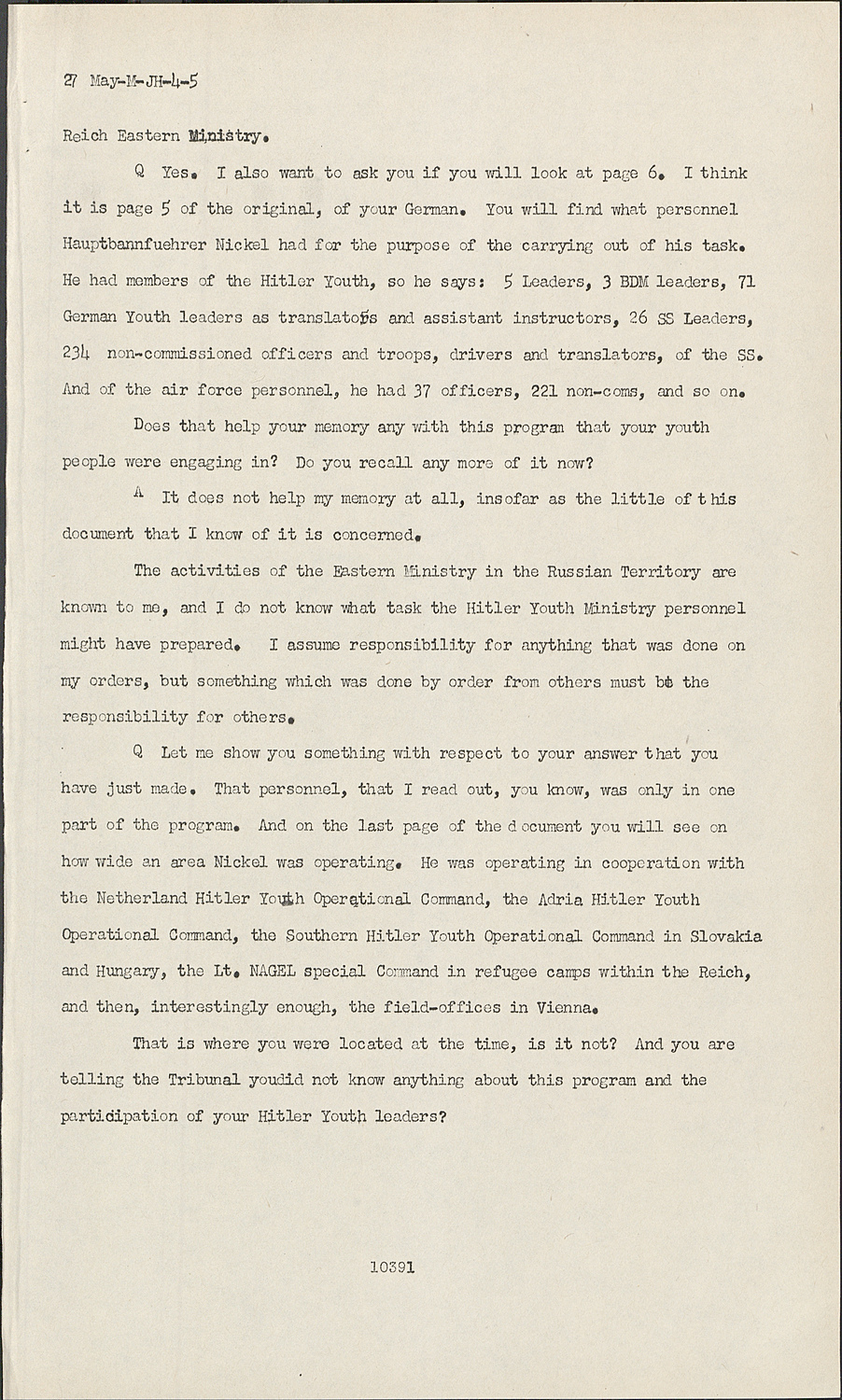
QYes. I also want to ask you if you will look at page 6. I think it is page 5 of the original, of your German. You will find what personnel Hauptbannfuehrer Nickel had for the purpose of the carrying out of his task. He had members of the Hitler Youth, so he says; 5 Leaders, 3 BDM leaders, 71 German Youth leaders as translators and assistant instructors, 26 SS Leaders, 234 non-commissioned officers and troops, drivers and translators, of the SS. And of the air force personnel, he had 37 officers, 221 non-coms, and so on.
Does that help your memory any with this program that your youth people were engaging in? Do you recall any more of it now?
AIt does not help my memory at all, insofar as the little of this document that I know of it is concerned.
The activities of the Eastern Ministry in the Russian Territory are known to me, and I do not know what task the Hitler Youth Ministry personnel might have prepared. I assume responsibility for anything that was done on my orders, but something which was done by order from others must be the responsibility for others.
QLet me show you something with respect to your answer that you have just made. That personnel, that I read out, you know, was only in one part of the program. And on the last page of the document you will see on how wide an area Nickel was operating. He was operating in cooperation with the Netherland Hitler Youth Operational Command, the Adria Hitler Youth Operational Command, the Southern Hitler Youth Operational Command in Slovakia and Hungary, the Lt. NAGEL special Command in refugee camps within the Reich, and then, interestingly enough, the field-offices in Vienna.
That is where you were located at the time, is it not? And you are telling the Tribunal youdid not know anything about this program and the participation of your Hitler Youth leaders?