A No, I didn't know anything about that, either.
THE PRESIDENT:I think he said he didn't know of any violations. BY MR. ELWYN JONES:
QI am putting to you certain matters, and I suggest to you, Herr Minister, that it may well be that you were being deceived during this time. Do you agree with me about that?
AI wouldn't deny deception, but I can't confirm it either. I can only tell you that I didn't know of the construction of a submarine.
QI want you to look at the document C-156. This is a new extract from Captain Schusler's "Fight of the Navy against Versailles." The entry is on pages 43 and 44 of that book. You will see that the following entry appears on pages 43 and 44.
"In 1930 Bartenbach succeeded in laying the foundations in Finland also for the construction of a U-boat corresponding to the military demands of the German Navy. The Navel Chief of Staff, Admiral Dr. (h.c.) Raeder, decided, as a result of the reports of the Chief of the General Naval Office, Rear Admiral Housiger v. Waldegg, and of Captain Bartenbach, to supply the means required for the construction of the boat in Finland. A 250-ton plan was chosen for this boat, so that the amount of 1 1/2 million Reichsmarks was sufficient for carrying out of the project.
"The fundamental intention was to create a type of boat which would permit the inconspicuous preparation of the largest possible number of units which could be assembled at shortest possible notice."
Now, Herr Minister, did you know that one and a half million Reichsmarks were spent in 1930 in connection with that U-boat construction?
AI have stated this morning that in the Reich Ministry of the Interior I was a minister from 1926 to 1930. I think it is necessary that these dates should be more carefully defined. I left on the 30th of March 1930, and if the era of 1930 is generally mentioned, then it isn't impossible that everything that is mentioned here happened after the 30th of March 1930.
QYou have said that the rearmament that went on when you were connected with the Government of Germany was purely defensive. When did you realize that the Nazi Government's rearmament was not defensive but aggressive? At what date did you come to that conclusion?
A On the 30th of January 1933, thereafter. When Hitler became Reich Chancellor, I was aware that this was war, at the same time considering my political views.
QSo that you realized from the first day of Nazi power that the Nazi Government intended to use force or the threat of force to achieve its political aims; is that right?
AI don't know whether to know and to be convinced is identical. I was convinced of it, and so were my political friends.
QI want to ask you one or two questions about the defendant Papen. Did Papen use force in carrying out the Putsch which brought him to power in July 1932?
A Personally, von Papen didn't exercise such force, but he ordered it.
When on themorning of the 20th of July, 1932, I refused as Chief of the Prussian Ministry of the Interior to surrender the office to the successor who had been nominated by von Papen, I told him that I was not willing to do so. And, so asto give emphasis to my protest, I also stated that I would only give way to face. That force was applied on the evening of the 20th of July in my office. The newly appointed Police President of Berlin appeared, accompanied by two police officers. I asked these gentlemen whether they were sent by the Reichspresident or the Reich Chancellor and had been giventhe power to carry out this execution. When they answered with "yes," I stated that -- so as not to give the order for blood shed -- I would leave my office.
QDid the defendant Papen, when he secured power, purge the police and the government of anti-Nazis?
AThere are numerous indications that the intention existed that the police should be cleared of anti-Nazis and that other men were to be brought into the police, men who suited Papen, who were devoted to von Papen, and, later, the National Socialists.
QI want to ask you one or two questions about the defendant Goering.
The defendant Goering has stated, and the entry on page 5837 of the transcript of the proceedings, that the institution ofprotective custody existed in Germany before the Nazis came into power . Is that true?
AThe institution of protective custody existed, I would say, in theory, and it was in the Police administration Law, in Paragraph 15. As far as I can remember, the application of protective custody never did happen, however, while I was in office. The regulations contained in Paragraph 15 of the Police administration Law did state definitely, however, that if some one was to be taken into protective custody, then the administration was obliged to bring him before a judge within 24 hours.
That is in no way identical with that protective custody which, foryears, was decreed against peaceful members of the State by the Nazi regime.
Q And, of course, there were no concentration camps in pre-Nazi Germany, I take it?
ANever.
QHow many of your political associates and colleagues of the Social Democratic Party were murdered in concentration camps while Goering was still Chief of the Gestapo?
AThe estimate is very di fficult to make. You might say 500, and you might quote 2,000. Reliable information is now being collected My estimate is that at least 1,500 Social Democrats, or members and functionaries of trade unions, or editors, were murdered.
QAnd how many Communist leaders do you think were murdered during Goering's period of power over the Gestapo?
AI would assume that if you include among Communist leaders also the functionaries of trade unions, who called themselves members of the Communist Party, then some similar figure would probably come up.
QDid Goering personally have any knowledge of these murders?
AThat I cannot say. If I were to answer that question, then I have to ask myself what I might have done in a case where it was one of my duties to administer camps in which the fate of tens of thousands was being decided. I am not sure whether this is of any interest to you, but I might give you one or two examples from my own experiences.
In 1925 I had to create a camp for refugees from Poland.
QYou need not trouble to go into that, Herr Minister.
AAt any rate, I would have considered it my foremost task that, in camps which I had installed, there should be inquiries made to find out whether the principles of humanity were being adhered to.
It was not my impression that that was done.
My police officials always had their attention drawn to it that everyone in those camps should be humanly treated. I told them that never should the call again be heard in Germany, "Help against police."
Arr est orders were issued by me against members of the police when I had the impression that defenseless prisoners were ill-treated by members of the Protective Police.
QAs Minister of the Interior, did you become familiar with the organized terror of the SA against the non-Nazi population of Germany during the years after 1921?
AThe observation of the so-called armed organizations, during the years of my office, was one of my most important tasks. The roughest organization of all these turned out to be the SA. They were the rowdy battalions and, with the arrogance with which they sang their songs, they forced themselves into the streets. They clared the streets for themselves where there was no opposition for them.
Another part of their program was rough songs. One of their songs was: "Put the bigshots and the Jews against the wall and fight them."
Wherever the SA could exorcise their terror unhindered, they acted in such a manner. They had indoor battles against people who thought differently. Those weren't the ordinary little fights between political fighters during election fights. That was organized terror.
When the first Jewish boycott occurred in 1933, they stood guard to prevent those members of the population from buying in Jewish shops, when they had been accustomed to buying there. As it may be known to the Tribunal, they carried out the terror of the 8th of November, 1936, and organized it.
Also, in 1930; they damaged numerous Jewish shops in Berlin, perhaps as an introduction for the meeting of the Reichstag which, at that time, as is known, was entered by the National Socialists to the extent of 107 members.
QFinally, I want to ask you one ortwo questions about the defendant Schacht.
When did you first discover Schacht's relations with the Nazi leaders?
AIn 1931 I had information from the Police Administration in Berlin that there had been talks between Mr. Schacht and the leaders of the National Socialist German Workers Party.
Q Did you have any connection with Schacht in 1944?
AIf you are interested, I actually refused to have such connections. Schacht, as far as political matters were concerned--and although I held him in highest esteem as an economic expert--was known to me as quite an uncertain character. Through becoming a member of the Habsburg Party, Schacht betrayed the cause of democracy. That wasn't only an act of ungratefulness, because the Democrats helped him to the post of President of the Reichsbank, but it was a great mistake because he and others, who participated in the Habsburg Front, helped the National Socialists into their positions and made them appear respectable.
Any connections with Schacht with reference to the 20thof July 1944, were, therefore, not acceptable to me.
When, in the autumn of 1943, there were certain attempts made to bring me into a group which was to overthrow the Hitler Government, I said, because of Schacht and other circumstances, I refused to enter.
QWhat was your reason for that?
AI just hinted; there were reasons. My friend Neuster and, among other Social Democrats, Leuchtner, Weber, and Mass, and I, discussed the composition of such a government. Leuchtner informed me that probably a general should become the President of the Reich, and another general the Minister for War. I pointed out that, quite probably, Schacht would have to be given the role of financial or economic dictator because, earlier, Schacht's suitability for such a post was meant to be proved, and his actual or possible con-nections with American business circles were to be investigated.
These connections of Schacht, to use National Socialist words, between plutocracy and militarism, appeared to me against the cause of democracy, and in particular against Social Democrats. That appeared to me so compromising that I was under no circumstances willing to be a member of a cabinet in which Schacht might be financial dictator.
MR. ELWYN JONES:Thank you.
THE PRESIDENT:Did you wish to re-examine?
REDIRECT EXAMINATION BY DR. SIEMERS:
QMinister Severing, the prosecutor has just talked about the construction of a U-boat in Finland and the construction of a U-boat in Cadis. With regard to the construction of the U-boat in Cadis, he has referred to D-854. I presume that this document is unknown to you.
THE PRESIDENT:Well, Dr. Siemers, the witness said he knew nothing about either of those instances.
DR. SIEMERS:Thank you. BY DR. SIEMERS:
QCan you not remember that between Grand Admiral Raeder and Reichswehrminister Greener--during that discussion--that Finland U-boat was mentioned?
AI do not remember.
QA principle question, please. Is it true that the agreement which was made on the 18th of October, 1928, meant that the Chief of the Naval Command Staff had the duty of informing the Reich Armed Forces Minister and that he, the Reichswehr Minister, in turn, had the duty of informing the other members of the Cabinet?
AAs far as I remember, the agreement or the promise of the two chiefs of the Army Command was that the Cabinet should be kept informed about every question. That was technically possible only in the manner which I have just indicated, that is to say, that the Minister would first of all, be informed.
Then he, in turn, would pass this information on to the Cabinet.
QSo that there was no duty on Raeder's part to currently inform you or report to you or appear before the Cabinet?
AThat would have been quite an unusal measure, and the meeting of the 18th October was unusual; the members of the Cabinet were either only ministers or their representatives.
Q So that technically the matter would be handled through the Reichswehr Minister?
AYes, and politically through the Cabinet.
DR. SIEMERS:Thank you very much. I have no further questions. BY DR. KUBUSCHOK (counsel for defendant von Papen):
QWhat legal regulation was the basis for the removal of yourself from the Ministry of the Interior?
AThe release?
QThe release, yes.
AIt was Article 48.
QWho, based on Article 48, issued emergency decrees?
AIt was done by the Reichspresident, who alone was entitled to do so.
QThe fact that, on the 20th of July, under the circumstances which you have described, you were removed from office -- was that based on the fact that von Papen and Hindenburg, who were giving these orders, had the view that the emergency decree was legal, whereas it was your point of view that a legal basis for the emergency decree did not exist, and that, consequently, you remained in your office?
AI wasof the opinion, which was later confirmed by the Reich Court, that the Reichspresident had the power, through Article 48,to issue decrees for the maintenance of calm and order. If Prussian Ministers, and particularly a police minister, did not give him sufficient guarantee for this peace and order and its maintenance, then he had the right to relieve us of our functions. That was particularly true lf the police, but any other executive measures as well.
He did not have the right, however, to release us or discharge us as ministers.
QIs it known to you that the highest court in Germany, the State Court, on the 25th of October, 1932, made a decision according to which the decree of the Reichspresident of the 20th of July, 1932, was correct under the Constitution in so far as it appointed the Reich Chancellor as Reich Commissioner for Prussia and in so far asit deprived Prussian Ministers of certain powers which the other was to take over himself?
A I have just quoted that order.
QRight. Then one more question: Did von Papen as Reich Commissioner at the time he carried out certain personnel changes bring National Socialists into the police force?
AThat isn't known to me. The political character of the police officials couldn't outwardly be recognized. That was the case with government presidents, police presidents, but not in the case of every protective police official.
(Short interruption due to mechanical difficulties.)
QIs it correct that the post of the president of the police in Berlin was filled by von Papen with the former police president of Melcher, Essen, who even in your time was the police president in a large area?
AThat is correct.
DR. KUBUSCHOK:Thank you.
THE PRESIDENT:Now, then, the witness can retire and the Tribunal will now adjourn.
How many more witnesses have you got?
DR. SIEMERS:I now have the other witnesses, von Weizsaecker and Admiral Schulte-Moenting. Schulte-Moenting will take a little longer, whereas Weizsaecker as far as I am concerned, will be very short.
THE PRESIDENT:All right.
(A recesswas taken.)
- - -
DR. SIEMERS:If it please the High Tribunal, I should like to call my next witness, Freiherr von Weizsaecker.
ERNST VONWEIZSAECKER, a witness, took the stand and testified as follows: BY THE PRESIDENT:
QWill you state your full name, please?
AErnst von Weizsaecker.
QWill you repeat this oath after me:
I swear by God, the Almighty and Omniscient, that I will speak the pure truth and will withhold and add nothing.
(The witness repeated the oath.)
THE PRESIDENT:You may sit down.
- - -
DIRECT EXAMINATION BY DR. SIEMERS:
QMr. von Weizsaecker, at the beginning of the war you were State Secretary in the Foreign Office,is that correct?
AYes.
QYou will recallthat on the 3rd of September,1939 -- the first day of the war between Germany and England -- the English passenger ship Athenia was torpedoed northwest of Scotland. On this ship there were American passengers. The sinking of the ship naturally drew a great deal of attention and I should like to have you tell us how this matter was treated politically, and especially through you.
AI remember this incident. I am not certain, however, whether it was a British or an American ship. In any event, this incident alarmed me greatly at that time. I inquired of the SKL to determine whether a German warship was guilty in any way in the sinking. After I received the answer, "No," I spoke to an American, Mr. Alexander Kirk, and told the American charge d'affaires that a German man-of-war had not participated, was not guilty in the sinking of the Athenia. I asked the charge d'affaires to take cognizance of this fact and to cable to Washington as soon as possible to the effect that any such report was very important in our joint interests, that is in the interests of Germany and America.
Q Mr. von Weizsaecker, you had been in contact with the Navy before taking these steps?
AYes.
QDid you, at this first conversation, speak with Grand Admiral Raeder himself or did you speak with some other officer?
AThat is impossible for me to say, but I did receive the information. I am sorry I can't tell you as to this detail, but I did receive the answer that there was no German man-of-war involved and that satisfied me.
QIn connection with this affair, either on the same day or shortly thereafter, did you visit Grand Admiral Raeder and discuss this matter with him
AI believe I recall that, yes.
QDid Raeder on this occasion tell you that it could not have been a German U-boat since the reports coning in from the U-boats were to the effect that the distances were too great, that the distance would have been about 7500 miles?
ARaeder informed me to the effect that it could not have been a German U-boat. The details about the distance involved, the distance from the point of the sinking and the presence of U-boats, this may have been a fact which he mentioned, but I cannot tell you this with certainty today.
QAt this conversation with Raeder, did you, as well, talk about the fact that everything would have to be done in order to avoid a war with the United States, such as referring to incidents like the Lusitania in the first World War?
AMost certainly, yes, with emphasis, for at this time I recalled similar incidents from the First World War and I remembered these incidents very clearly. I called his attention to the urgent necessity to avoid any operation at sea which might in any way expand the war and, as I said in those days, any action which would have decreased the neutral substance.
QDid Raeder agree with your opinion?
ATo my firm recollection, yes.
QAre you convinced, Mr. von Weizsaecker, that Raeder gave you truthfu reports about the Athenia?
AYes, of course.
Q Now, on the 27th of September 1939, U-boat No 30 returned from its mission; that id it returned about three weeks after the sinking and the Commandant reported that by mistake he had sunk the Athenia.
He reported that he did not notice his mistake right away but afterwards through the various wireless messages. Now at the end of September Reader heard of this fact and discussed this matter with Hitler in order to determine what the course of action would be from now on. Hitler gave the decree to keep quiet, to maintain silence Of course, all of these matters have been discussed here already, and I would like to have you tell me whether you knew of these facts which were subsequent established; that is the sinking through a German U-boat, whether you received any knowledge of that?
ANo, not at all.
QDid you jear of Hitler's decree that you maintain silence; did you h about that?
ANo, not about that either.
QNow, I should like to submit to you Document No 3260 PS and I should like to have you look at it. This is an article entitled "Churchill Sinks the Athenia". That is taken from the Voelkischer Beobachter on the date of the 23rd of October 1939. Do you recall this article?
AYes.
QI should like to have you read it first.
DR. SIEMERS:Mr. President, in order to assist the High Tribunal, I would like to state this is GB 218. It is found in Document Book No 10, British Document Book 10, page 97, correction, page 99. BY DR. SIEMERS:
QMr. von Weizsaecker, you have read this article and I should like to have you tell us whether you recall this article, whether you recall having re it at the time?
AI do recall that this article appeared at that time.
QThen will you please tell me what was your attitude at that time when you heard about this article?
AI considered it as a piece of perverse imagination.
QThen you condemned this article?
ANaturally.
QEven though at that time you did not know that it was a German U-boat that sunk the ship?
AThe question of whether it was a German U-boat or not could have nothing to do with my judgement of the article.
QThen you considered that this article should be condemned even if it had not been a German U-boat?
AYes, of course.
QThe Prosecution asserts that Grand Admiral Raeder was responsible for the bringing about of this article and is accusing him very gravely on moral counts because of it, and the accusation is especially grave since, as we have seen, Raeder -- and contrary to your testimony -- at this time knew that it was a German U-boat which sunk the Athenia. Do you consider an action like this on the part of Raider as possible? Do you think that it might be -
THE PRESIDENT:Dr. Siemers, you can only ask the witness what he knew and what he did. You can't ask him to speculate about what Raeder did.
DR. SIEMERS:I beg your pardon, Mr. President. I believe that, according to the affidavit of Dietmann this morning, it would be possible for the witness to state his opinion; but I will dispense with the asking of this question. BY DR. SIEMERS:
QMr. von Wiezsaecker, did you at that time hear that Raeder was responsible for this article?
ANo, I did not hear that and if I had I would never have believed it. I consider that was out of the question entirely, that he would have been responsible for an article like that or would have written an article like that.
QTo your knowledge, could this article be traced back to the Propaganda Ministry?
AI can only answer that question negatively. It is not to be traced back to Raeder and not to the Foreign Office.
QMr. von Wiezsaecker, are you in a position to judge, as far as the well known violations of the Navy against the Treaty of Versailles, were especially grave points involved?
AI can only answer that question indirectly. I do not know the details but I consider it practically inconceivable that there may have been grave infringements for just the Sector of the Navy. As for the keeping of the Stipulations of the Treaty by the Navy, we can check the records of the Navy very easily.
One cannot build ships without their being seen. Therefore, I must assume that these violations were of in insignificant nature.
QMr. von Wiezsaecker, in your opinion, did the Defendant Raeder prepare a war of aggression or do you know of any concrete case from which the attitude
THE PRESIDENT:Dr. Siemers, that is the very charge against the Defendant Raeder which the Tribunal has got to decide. BY DR. SIEMERS:
QMr. von Weizsaecker, in February, 1939. were you on a train from Hamburg to Berlin together with Grand Admiral Raeder and did you discuss matters with him?
AYes.
QWhat was the reason for your conversation and what was the topic of your conversation?
AIt is correct that together with Admiral Raeder I travelled by train from Hamburg to Berlin. I met him after the launching of a ship in Hamburg. On this occasion the admiral told me that he had just given a report to Hitler and in this report he said he had made it quite clear that the state of armament, so far as the Navy was concerned, would prohibit a war against England for year hence. I believe that that is the answer to the question you are asking me.
Q That was in February, 1939?
AIt was the launching of the ship "Bismark".
QThen it is known to the High Tribunal for this launching is set down in the record.
AIt must have been in the spring, in February or March.
QAt that time, through this declaration on thepart of Raeder, did that have a calming influence on you?
AI considered this declaration on the part of Raeder very pleasing.
THE PRESIDENT:Well, we do not care whether it had a calming influence on him or not.
QIn your opinion, did Raeder speak as a naval expert or as a politician end did he have an influence on Hitler and in which way?
THE PRESIDENT:Dr. Siemers, the witness can tell us what Raeder said, but he really cannot tell us in what capacity he was speaking, whether as a politician or an admiral. If youwant to know whether he had his uniform on -
QMr. von Wiezsaecker, did you have any discussion with Raeder or with other personalities as well?
AWhat about?
QAbout the influence of Raeder on Hitler.
AIt is known to me that political arguments set forth by soldiers hardly had any influence on Hitler, except perhaps in a technical sense and along those lines an influence might have been effective.
QMr. von Wiezsaecker, in the winter of 1938 to '39, the usual diplomatic dinner took place in Berlin and, to my knowledge, you were present at this dinner. On this occasion Raeder spoke with Sir NevileHenderson about the question of the -
THE PRESIDENT:Dr. Siemers, why do you not ask him instead of telling him. You are telling him what happened.
DR. SIEMERS:No.
THE PRESIDENT:Yes, you are.
DR. SIEMERS:I beg your pardon, Mr. President. This conversation was not a conversation between Henderson and von Wiezsaecker. BY DR. SIEMERS:
QI am asking you, Mr. Wiezsaecker, did you have any conversation to that effect with Sir NevileHenderson or with other British diplomats or do you know anything about the attitude of those British diplomats?
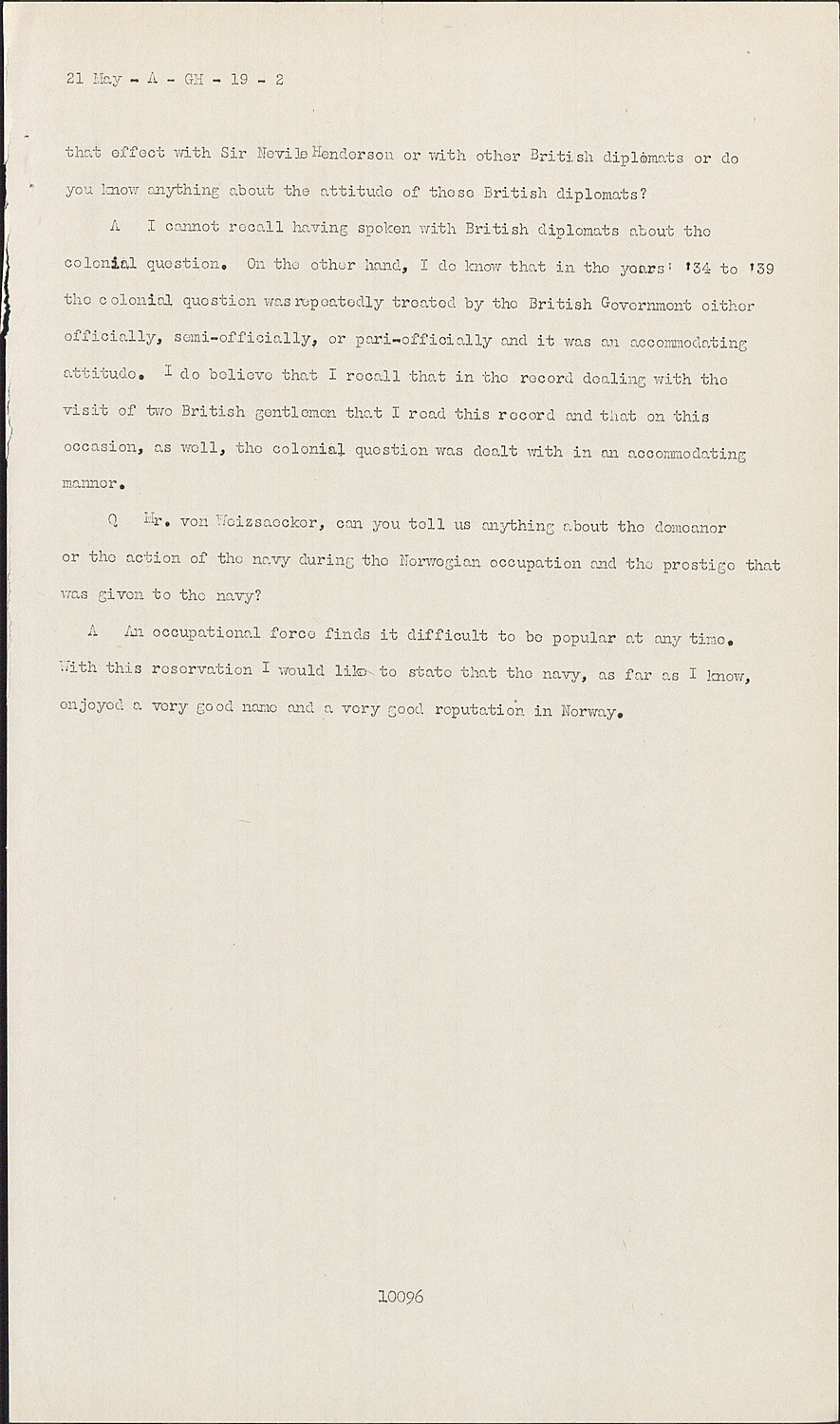
AI cannot recall having spoken with British diplomats about the colonial question. On the other hand, I do know that in the years' '34 to '39 the colonial question wasrepeatedly treated by the British Government either officially, semi-officially, or pari-officially and it was an accommodating attitude. I do believe that I recall that in the record dealing with the visit of two British gentlemen that I read this record and that on this occasion, as well, the colonial question was dealt with in an accommodating manner.
QMr. von Wiezsaecker, can you tell us anything about the demeanor or the action of the navy during the Norwegian occupation and the prestige that was given to the navy?
AAn occupational force finds it difficult to be popular at any time. With this reservation I would like to state that the navy, as far as I know, enjoyed a very good name and a very good reputation in Norway.
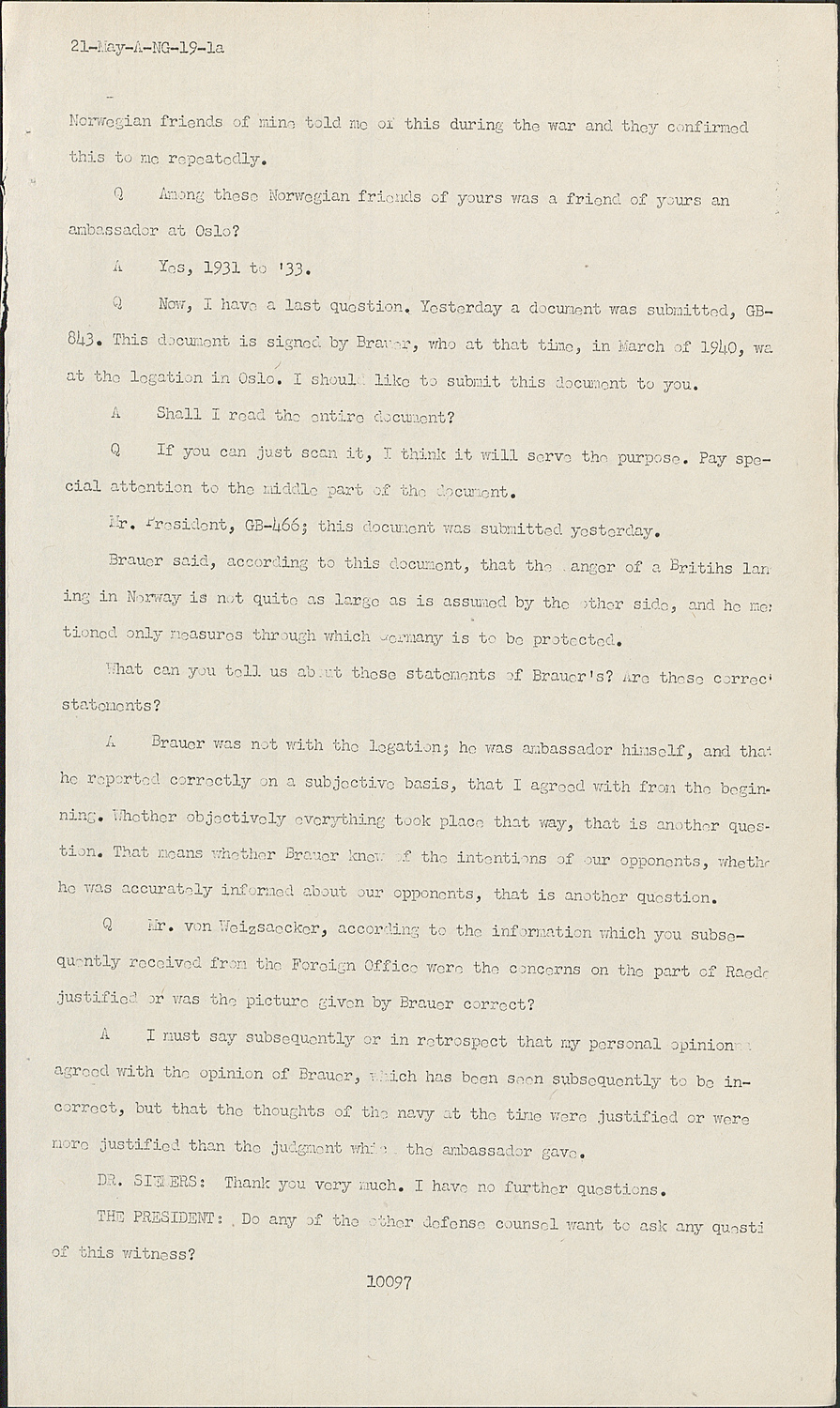
Norwegian friends of mine told me on this during the war and they confirmed this to me repeatedly.
QAmong these Norwegian friends of yours was a friend of yours an ambassador at Oslo?
AYes, 1931 to '33.
QNow, I have a last question. Yesterday a document was submitted, GB843. This document is signed by Brauer, who at that time, in March of 1940, wa at the legation in Oslo. I should like to submit this document to you.
AShall I read the entire document?
QIf you can just scan it, I think it will serve the purpose. Pay special attention to the middle part of the document.
Mr. President, GB-466; this document was submitted yesterday.
Brauer said, according to this document, that the anger of a Britihs landing in Norway is not quite as large as is assumed by the other side, and he mentioned only measures through which Germany is to be protected.
What can you tell us about these statements of Brauer's? Are those correct statements?
ABrauer was not with the legation; he was ambassador himself, and that he reported correctly on a subjective basis, that I agreed with from the beginning. Whether objectively everything took place that way, that is another question. That means whether Brauer knew of the intentions of our opponents, whether he was accurately informed about our opponents, that is another question.
QMr. von Weizsaecker, according to the information which you subsequently received from the Foreign Office were the concerns on the part of Raeder justified or was the picture given by Brauer correct?
AI must say subsequently or in retrospect that my personal opinion agreed with the opinion of Brauer, which has been seen subsequently to be incorrect, but that the thoughts of the navy at the time were justified or were more justified than the judgment when the ambassador gave.
DR.SIEMERS:Thank you very much. I have no further questions.
THE PRESIDENT :Do any of the other defense counsel want to ask any question of this witness?
BY DR. SEIDL (Counsel for defendant Hess):
QMr. Witness, on the 23rd of August 1939, between Germany and the Soviet Union a non-aggression pact was concluded. Beyond this non-aggression pact on this day between the two governments, were other agreements made between these two governments?
GENERAL RUDENKO:Mr. President, the witness is called to answer to the defense questions which are Mentioned in the application of Dr. Siemers. I consider that the question which has been put to him by the defense has nothing to do with the case at hand and, therefore, ought to be ruled out.
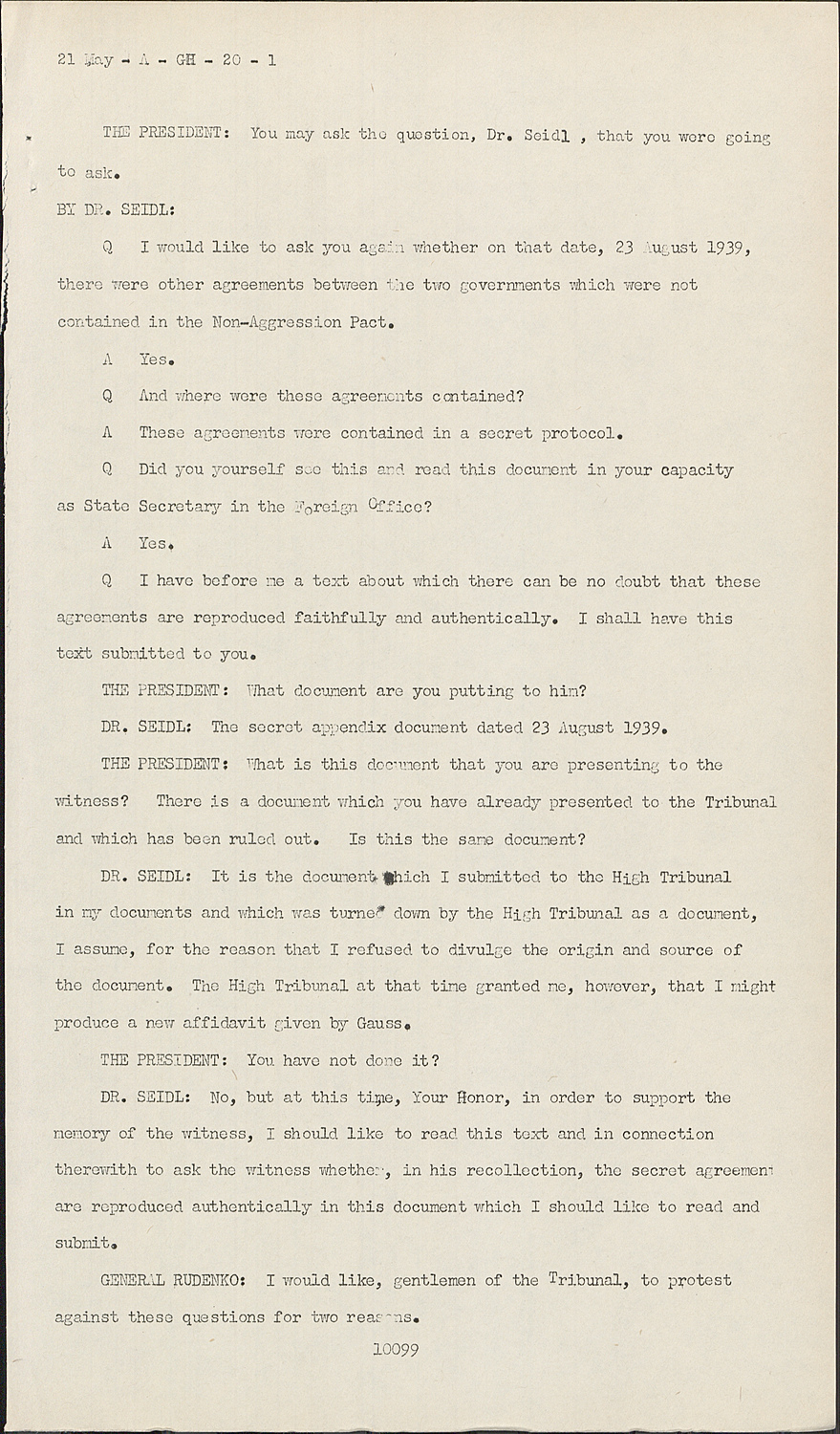
THE PRESIDENT: You may ask the question, Dr. Seidl , that you were going to ask.
BY DR. SEIDL:
QI would like to ask you again whether on that date, 23 August 1939, there were other agreements between the two governments which were not contained in the Non-Aggression Pact.
AYes.
QAnd where were these agreements contained?
AThese agreements were contained in a secret protocol.
QDid you yourself see this and read this document in your capacity as State Secretary in the Foreign Office?
AYes.
QI have before me a text about which there can be no doubt that these agreements are reproduced faithfully and authentically. I shall have this text submitted to you.
THE PRESIDENT:What document are you putting to him?
DR. SEIDL:The secret appendix document dated 23 August 1939.
THE PRESIDENT:What is this document that you are presenting to the witness? There is a document which you have already presented to the Tribunal and which has been ruled out. Is this the same document?
DR. SEIDL:It is the document which I submitted to the High Tribunal in my documents and which was turned down by the High Tribunal as a document, I assume, for the reason that I refused to divulge the origin and source of the document. The High Tribunal at that time granted me, however, that I might produce a new affidavit given by Gauss.
THE PRESIDENT:You have not done it?
DR. SEIDL:No, but at this time, Your Honor, in order to support the memory of the witness, I should like to read this text and in connection therewith to ask the witness whether, in his recollection, the secret agreement are reproduced authentically in this document which I should like to read and submit.
GENERAL RUDENKO:I would like, gentlemen of the Tribunal, to protest against these questions for two reasons.