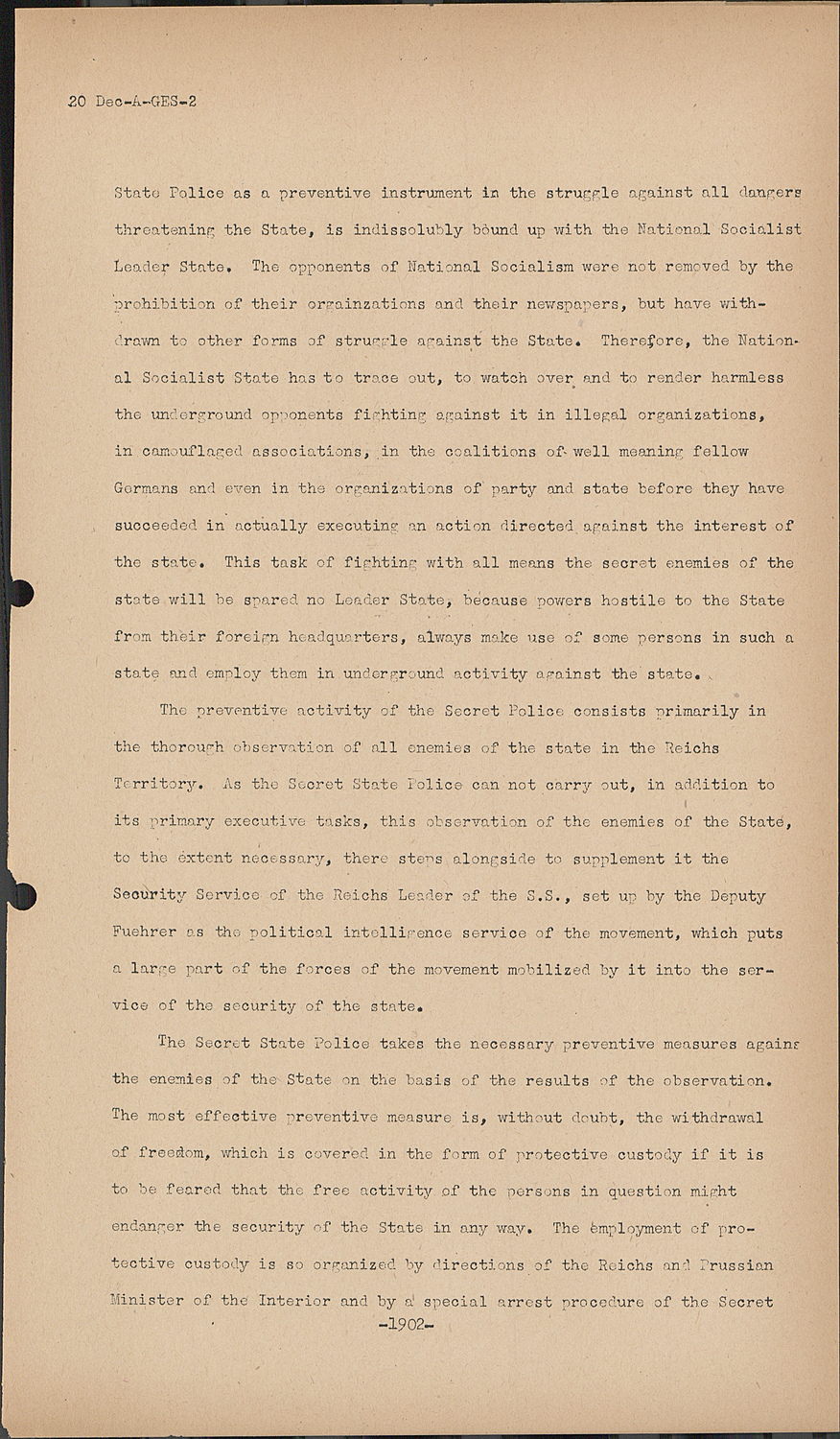
The opponents of National Socialism were not removed by the prohibition of their orgainzations and their newspapers, but have with drawn to other forms of struggle against the State.
Therefore, the Nation al Socialist State has to trace out, to watch over and to render harmless the underground opponents fighting against it in illegal organizations, in camouflaged associations, in the coalitions of well meaning fellow Germans and even in the organizations of party and state before they have succeeded in actually executing an action directed against the interest of the state.
This task of fighting with all means the secret enemies of the state will be spared no Leader State, because powers hostile to the State from their foreign headquarters, always make use of some persons in such a state and employ them in underground activity against the state.
The preventive activity of the Secret Police consists primarily in the thorough observation of all enemies of the state in the Reichs Territory.
As the Secret State Police can not carry out, in addition to its primary executive tasks, this observation of the enemies of the State, to the extent necessary, there steps alongside to supplement it the Security Service of the Reichs Leader of the S.S., set up by the Deputy Fuehrer as the political intelligence service of the movement, which puts a large part of the forces of the movement mobilized by it into the ser vice of the security of the state.
The Secret State Police takes the necessary preventive measures agains the enemies of the State on the basis of the results of the observation.
The most effective preventive measure is, without doubt, the withdrawal of freedom, which is covered in the form of protective custody if it is to be feared that the free activity of the persons in question might endanger the security of the State in any way.
The employment of pro tective custody is so organized by directions of the Reichs and Prussian Minister of the Interior and by a special arrest procedure of the Secret State Police that, so far as the preventive fight against the enemies of the State permits, continuous guarantees against the mis-use of the protective custody are also provided."
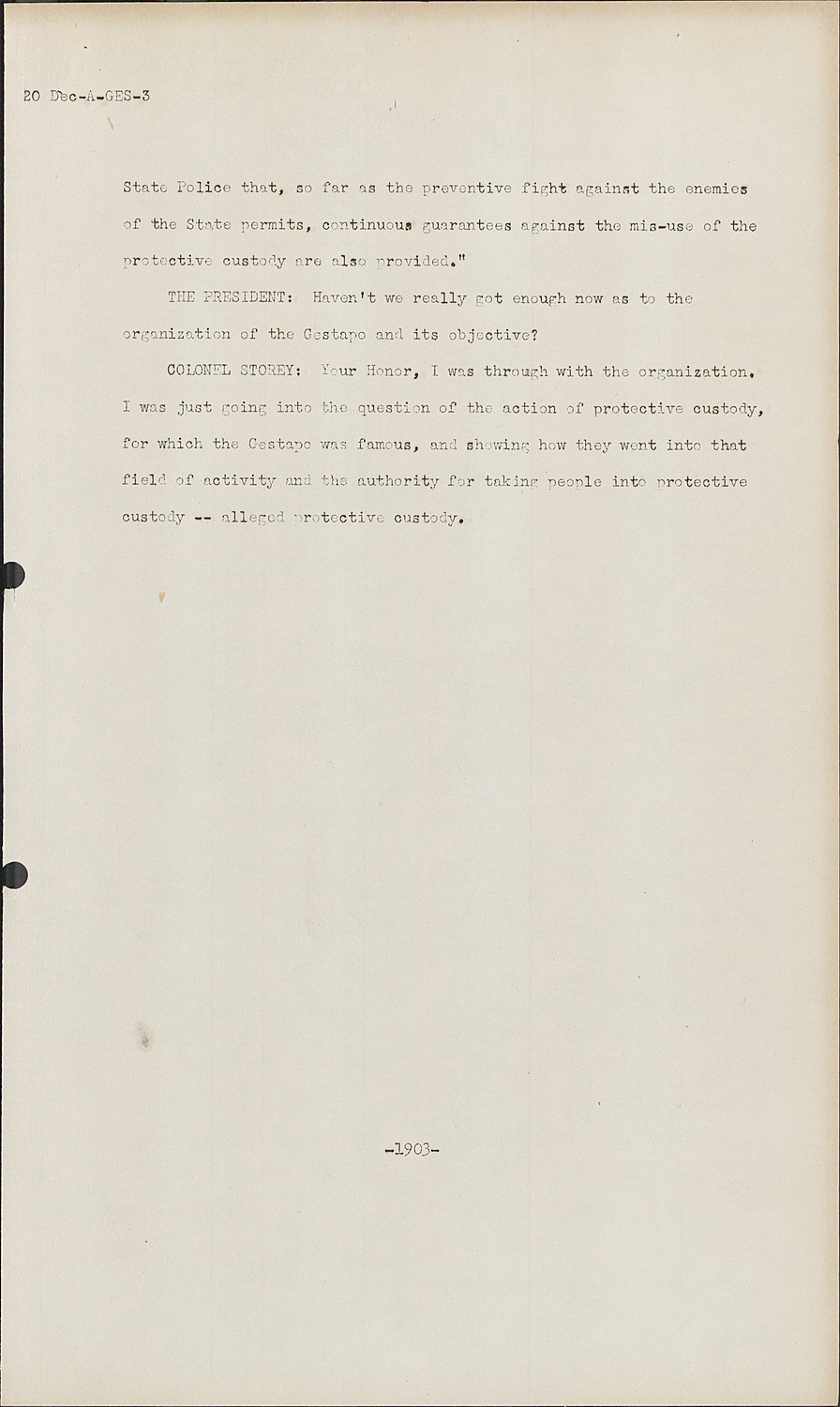
THE PRESIDENT: Haven't we really got enough now as to the organization of the Gestapo and its objective?
COLONEL STOREY: Your Honor, I was through with the organization.
I was just going into the question of the action of protective custody, for which the Gestapo was famous, and showing how they went into that field of activity and the authority for taking people into protective custody -- alleged protective custody.
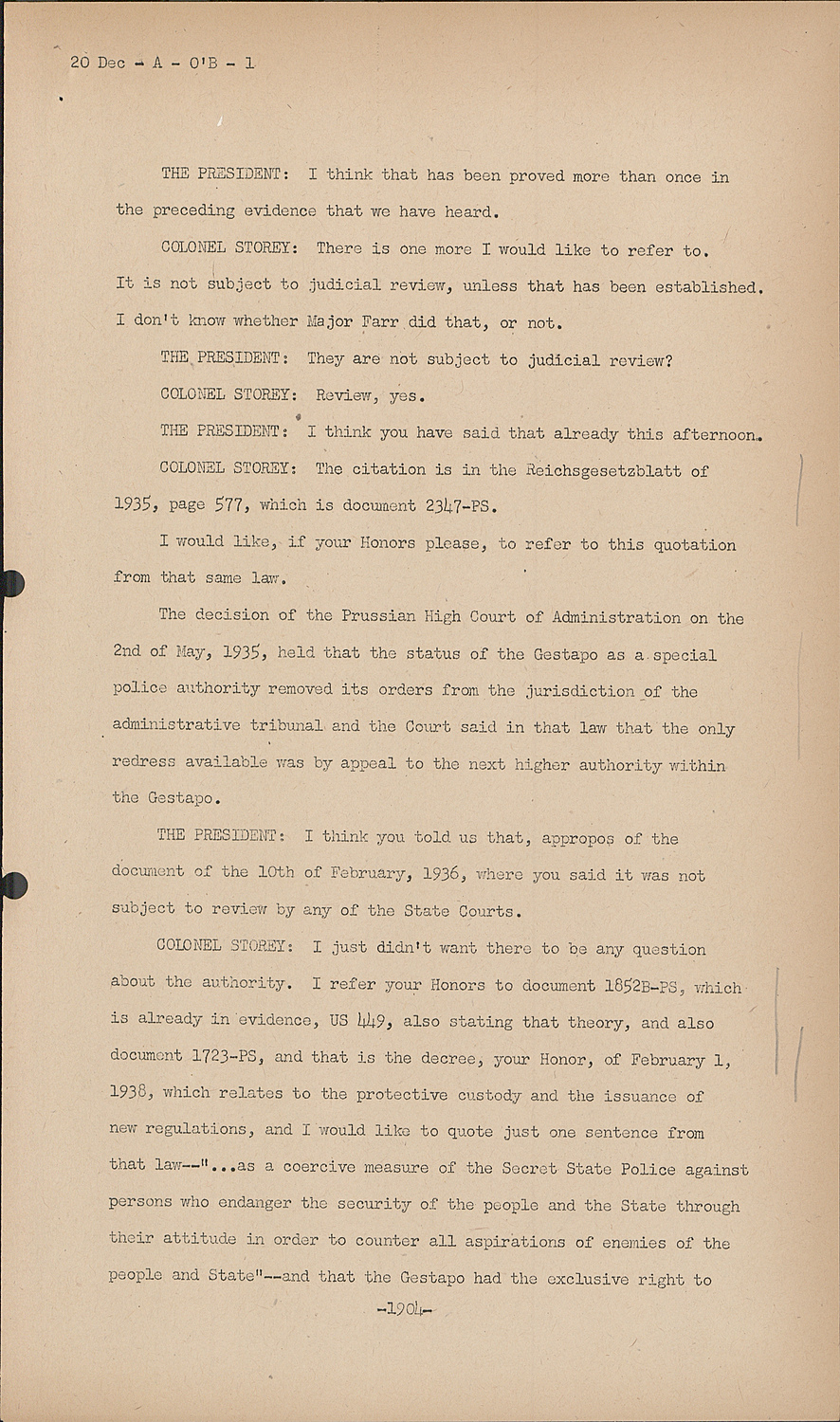
THE PRESIDENT: I think that has been proved more than once in the preceding evidence that we have heard.
COLONEL STOREY:There is one more I would like to refer to.
It is not subject to judicial review, unless that has been established.
I don't know whether Major Farr did that, or not.
THE PRESIDENT:They are not subject to judicial review?
COLONEL STOREY:Review, yes.
THE PRESIDENT:I think you have said that already this afternoon.
COLONEL STOREY:The citation is in the Reichsgesetzblatt of 1935, page 577, which is document 2347-PS.
I would like, if your Honors please, to refer to this quotation from that same law.
The decision of the Prussian High Court of Administration on the 2nd of May, 1935, held that the status of the Gestapo as a special police authority removed its orders from the jurisdiction of the administrative tribunal and the Court said in that law that the only redress available was by appeal to the next higher authority within the Gestapo.
THE PRESIDENT:I think you told us that, appropos of the document of the 10th of February, 1936, where you said it was not subject to review by any of the State Courts.
COLONEL STOREY:I just didn't want there to be any question about the authority.
I refer your Honors to document 1852B-PS, which is already in evidence, US 449, also stating that theory, and also document 1723-PS, and that is the decree, your Honor, of February 1, 1938, which relates to the protective custody and the issuance of new regulations, and I would like to quote just one sentence from that law--"...as a coercive measure of the Secret State Police against persons who endanger the security of the people and the State through their attitude in order to counter all aspirations of enemies of the people and State"--and that the Gestapo had the exclusive right to order protective custody and that protective custody was to be executed in the State concentration camps.
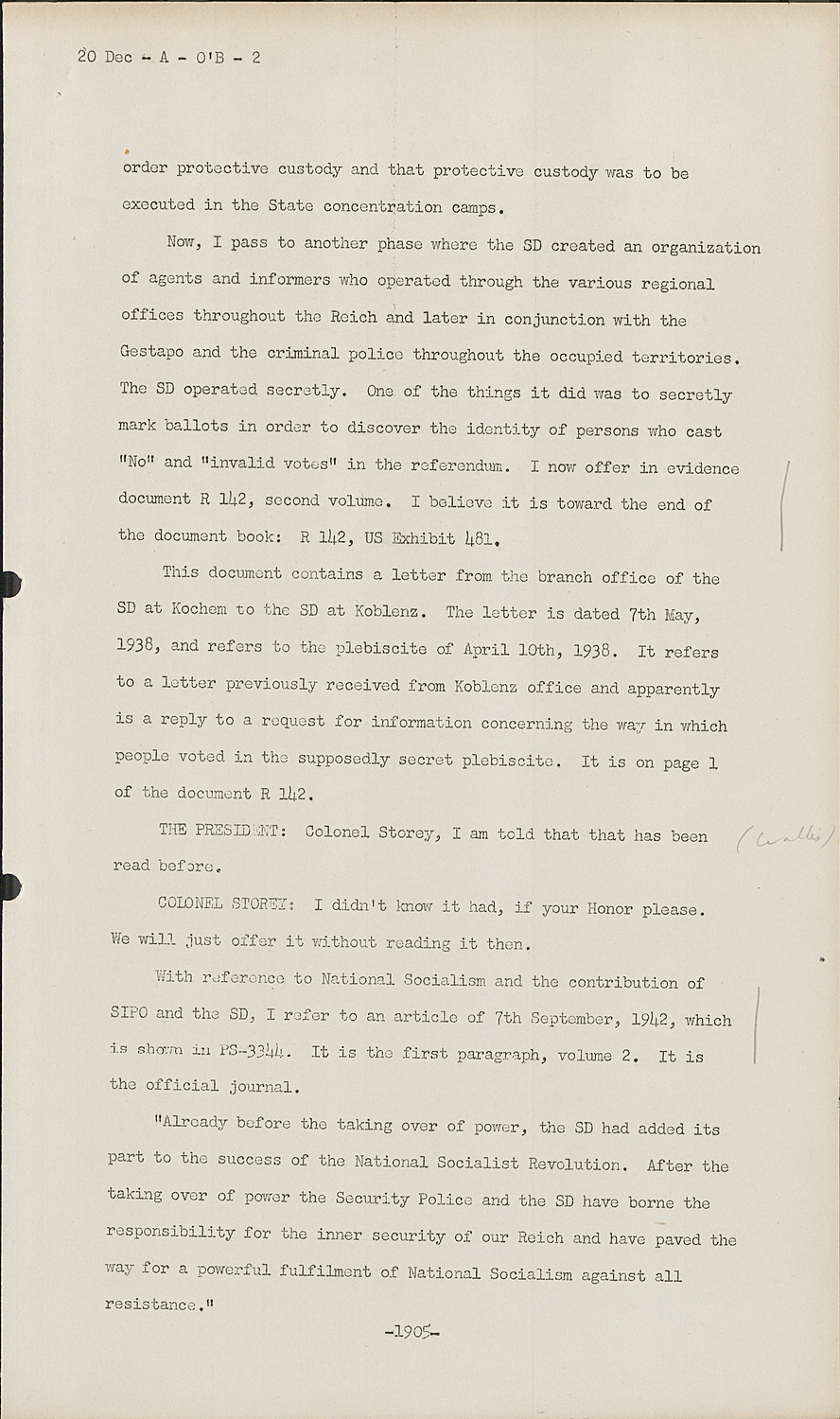
Now, I pass to another phase where the SD created an organization of agents and informers who operated through the various regional offices throughout the Reich and later in conjunction with the Gestapo and the criminal police throughout the occupied territories.
The SD operated secretly. One of the things it did was to secretly mark ballots in order to discover the identity of persons who cast "No" and "invalid votes" in the referendum.
I now offer in evidence document R 142, second volume.
I believe it is toward the end of the document book:
R 142, US Exhibit 481.
This document contains a letter from the branch office of the SD at Kochem to the SD at Koblenz.
The letter is dated 7th May, 1938, and refers to the plebiscite of April 10th, 1938.
It refers to a letter previously received from Koblenz office and apparently is a reply to a request for information concerning the way in which people voted in the supposedly secret plebiscite.
It is on page 1 of the document R 142.
THE PRESIDENT:Colonel Storey, I am told that that has been read before.
COLONEL STOREY:I didn't know it had, if your Honor please.
We will just offer it without reading it then.
With reference to National Socialism and the contribution of SIPO and the SD, I refer to an article of 7th September, 1942, which is shown in PS-3344. It is the first paragraph, volume 2. It is the official journal.
"Already before the taking over of power, the SD had added its part to the success of the National Socialist Revolution.
After the taking over of power the Security Police and the SD have borne the responsibility for the inner security of our Reich and have paved the way for a powerful fulfilment of National Socialism against all resistance."
In connection with the criminal responsibility of SD and the Gestapo, it will be considered with respect to certain war crimes and crimes against humanity, which were in principal part committed by the centralized political police system.
The development, organization and tasks have been considered before.
In some instances the crimes were committed in cooperation or in conjunction with other groups or organizations.
Now, in order to look into the strength of these various organizations, I have some figures here that I would like to quote to your Honors.
The SIPO and SD was composed of the Gestapo, Kripo and SD.
The Gestapo was the largest, and it has a membership of about 40,000 to 50,000 in 1934 and 1935.
That is an error; it is 1943 to 1945.
It was the political force of the Reich.
THE PRESIDENT:Did you say the date was wrong?
COLONEL STOREY:Yes, it is '43 to'45.
THE PRESIDENT:Very well.
THE TRIBUNAL; (Mr. Diddle): Where are you speaking from?
COLONEL STOREY:Document 3033-PS, and it is an affidavit of Walter Schellenberg, one of the former officials I referred to a moment ago.
I believe, if Your Honor please, to get it in the record, I'll read the whole affidavit. Document 3033-PS.
"The SIPO and SD was composed of the Gestapo, KRIPO and SD. In 1943-45 the Gestapo had a membership of about 40,000 to 50,000; the KRIPO had a membership of about 15,000; and the SD had a membership of about 3,000. In common usage, and even in orders and decrees the term "SD" was used as an abbreviation for the term "SIPO and SD". In most such cases actual executive action was carried out by personnel of the Gestapo rather than of the SD or the KRIPO. In occupied territories members of the Gestapo frequently were SS uniforms with SD insignia. Now members of the Gestapo and the SD were taken on a voluntary basis. This has been stated and sworn to by me today the 21st of November 1945." And then, subscribed and sworn to before Lt. Harris, 21 November, 1945.
I think I ought to say here, if Your Honors please, that it is our information that a greaty many of the members of the Gestapo were also members of the SS. We have heard various statements of the amount, but nave noddirect authority. Some authorities say as much as 75 per cent, but still we have no direct evidence on that.
I now offer in evidence document 2753-PS, which is US Exhibit 482. It is an affidavit of Alfred Helmut Naujocks, 2751-PS, dated November 20, 1945. This affidavit particularly refers to the actual occurrences in connection with the Polish border incident. I believe it was referred to by the witness Lahousen when he was on the stand.
I, ALFRED HELMUT NAUJOCKS, being first duly sworn, depose and state as follows:
1. I was a member of the SS from 1931 to 19 October 1944 and a member of the SD from its creation in 1934 to January 1941. I served as a member of the Waffen-SS from February 1941 until the middle of 1942.
Thereafter, I served in the Economic Department of the Military Administration of Belgium from September 1942 to September 1944.
I surrendered to the Allies on 19 October 1944.
2. On or about 10 August 1939, the chief of the SIPO and SD, Heydrich, personally ordered me to simulate an attack on the radio station near Gleiwitz near the Polish border and to make it appear that the attacking force consisted of Poles. Heydrich said, "Practical proof is needed for these attacks of the Poles for the foreign press as well as for German propaganda purposes." I was directed to go to Gleiwitz with five or six other SD-men and wait there until I received a code word from Heydrich indicating that the attack should take place. My instructions were to seize the radio station and to hold it long enough to permit a Polish speaking German who would be put at my disposal to broadcast a speech in Polish. Heydrich told me that this speech should state that the time had come for conflict between Germans and Poles and that the Poles should get together and smash down any Germans from whom they met resistance. Heydrich also told me at this time that he expected an attack on Poland by Germany in a few days.
requested permission of Heydrich to return to Berlin but was told to stay 3. I went to Gleiwitz and waited there fourteen days.
Then I in Gleiwitz. Between the 25th and 31st of August I went to see Heinrich Mueller, head of the Gestapo, who was then nearby at Oppeln. In my presence Mueller discussed with a man named Mehlhorn plans for another border incident, in which it should be made to appear that Polish soldiers were attacking German troops. Germans in the approximate strength of a company were to be used. Mueller stated that he had 12 or 13 condemned criminals who were to be dressed in Polish uniforms and left dead on the ground of the scene of the incident, to show that they had been killed while attacking. For this purpose they were to be given fatal injections by a doctor employed by Heydrich. Then they were also to be given gunshot wounds. After the incident members of the press and other persons were to be taken to the spot of the incident. A police report was subsequently to be prepared.
4. Mueller told me that he had an order from Heydrich to make one of those criminals available to me for the action at Gleiwitz. The code name by Which he referred to these criminals was "Canned Goods".
5. The incident at Gleiwitz in which I participated was carried out on the evening preceding the German attack on Poland. As I recall, war broke out on the 1st of September 1939. At noon of the 31st August I received by telephone from Heydrich the code word for the attack which was to take place at 8 o'clock that evening. Heydrich said, "In order to carry out this attack report to Mueller for Canned Goods." I did this and gave Mueller instructions to deliver the man near the radio station. I received this man and had him laid down at the entrance to the station. He was alive but he was completely unconscious. I tried to open his eyes. I could not recognize by his eyes that he was alive, only by his breathing. I did not see the shot wounds but a lot of blood was smeared across his face. He was in civilian clothes.
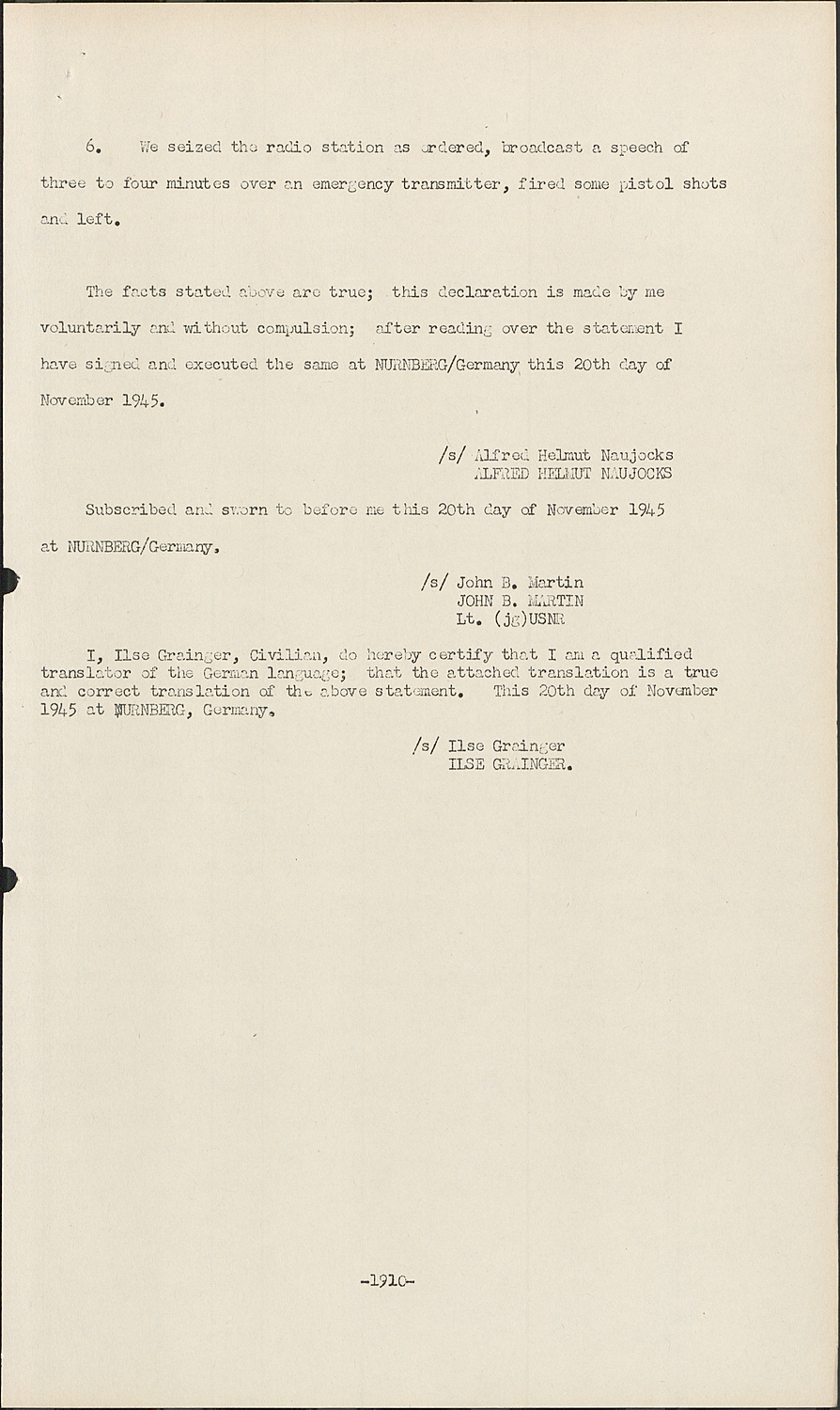
three to four minutes over an emergency transmitter, fired some pistol shots 6. We seized the radio station as ordered, broadcast a speech of and left.
The facts stated above are true; this declaration is made by me voluntarily and without compulsion; after reading over the statement I have signed and executed the same at NURNBERG/Germany this 20th day of November 1945.
/s/ Alfred Helmut Naujocks ALFRED HELMUT NAUJOCKS Subscribed and sworn to before me this 20th day of November 1945 at NURNBERG/Germany.
/s/ John B. Martin JOHN B. MARTIN Lt. (jg)USNR I, Ilse Grainger, Civilian, do hereby certify that I am a qualified translator of the German language; that the attached translation is a true and correct translation of the above statement.
This 20th day of November 1945 at NURNBERG, Germany.
/s/ ILse Grainger ILSE GRAINGER.
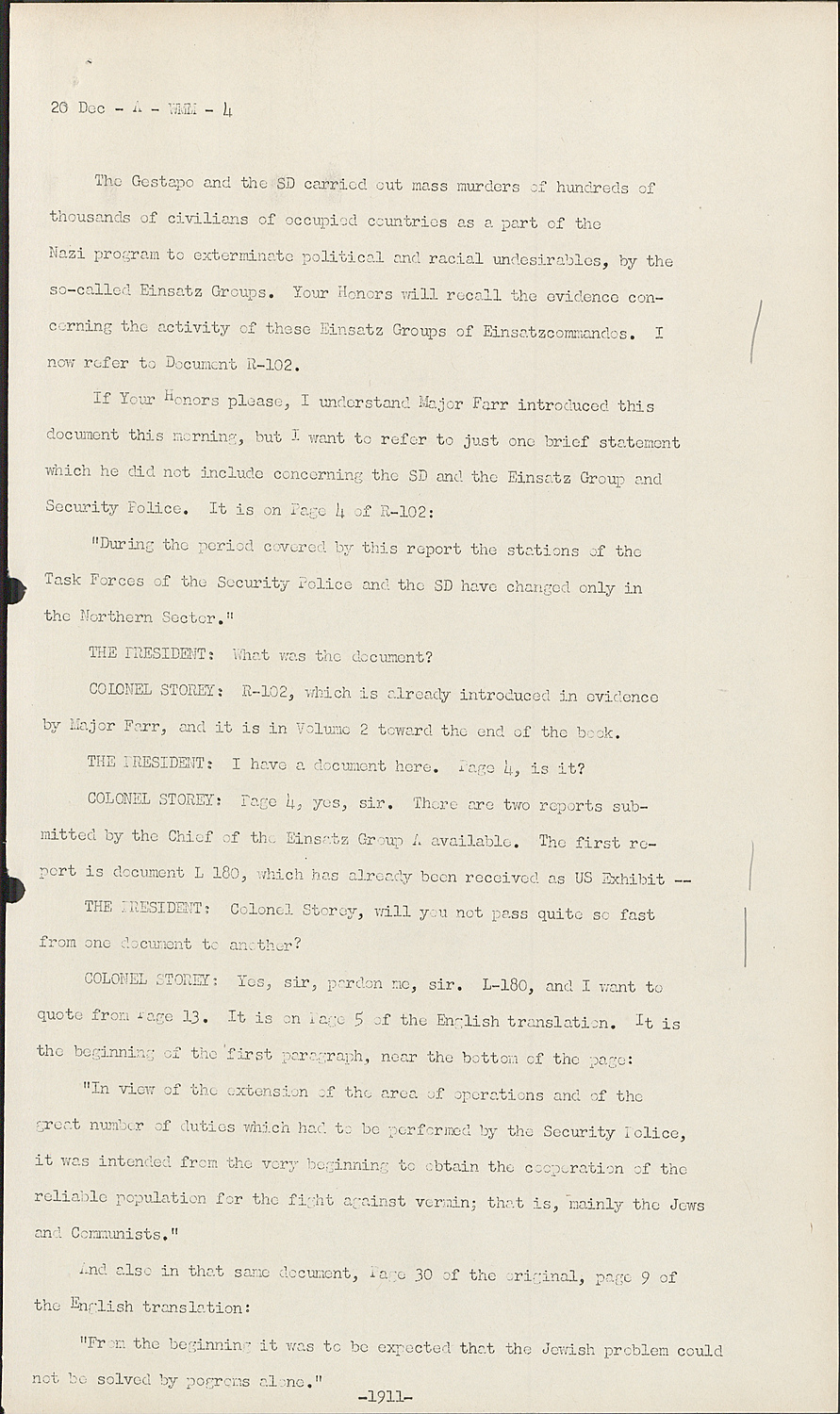
The Gestapo and the SD carried out mass murders of hundreds of thousands of civilians of occupied countries as a part of the Nazi program to exterminate political and racial undesirables, by the so-called Einsatz Groups.
Your Honors will recall the evidence concerning the activity of these Einsatz Groups of Einsatzcommandos. I now refer to Document R-102.
If Your Honors please, I understand Major Farr introduced this document this morning, but I want to refer to just one brief statement which he did not include concerning the SD and the Einsatz Group and Security Police. It is on Page 4 of R-102:
"During the period covered by this report the stations of the Task Forces of the Security Police and the SD have changed only in the Northern Sector."
THE PRESIDENT:What was the document?
COLONEL STOREY:R-102, which is already introduced in evidence by Major Farr, and it is in volume 2 toward the end of the book.
THE PRESIDENT:I have a document here. Page 4, is it? COLONEL STOREY: Page 4, yes, sir. There are two reports submitted by the Chief of the Einsatz Group A available. The first report is document L 180, which has already been received as US Exhibit -
THE PRESIDENT:Colonel Storey, will you not pass quite so fast from one document to another?
COLONEL STOREY:Yes, sir, pardon me, sir. L-180, and I want to quote from page 13. It is on page 5 of the English translation. It is the beginning of the first paragraph, near the bottom of the page:
"In view of the extension of the area of operations and of the great number of duties which had to be performed by the Security Police, it was intended from the very beginning to obtain the cooperation of the reliable population for the fight against vermin; that is, mainly the Jews and, Communists."
And also in that same document, Page 30 of the original, page 9 of the English translation:
"From the beginning it was to be expected that the Jewish problem could not be solved by pogroms alone."
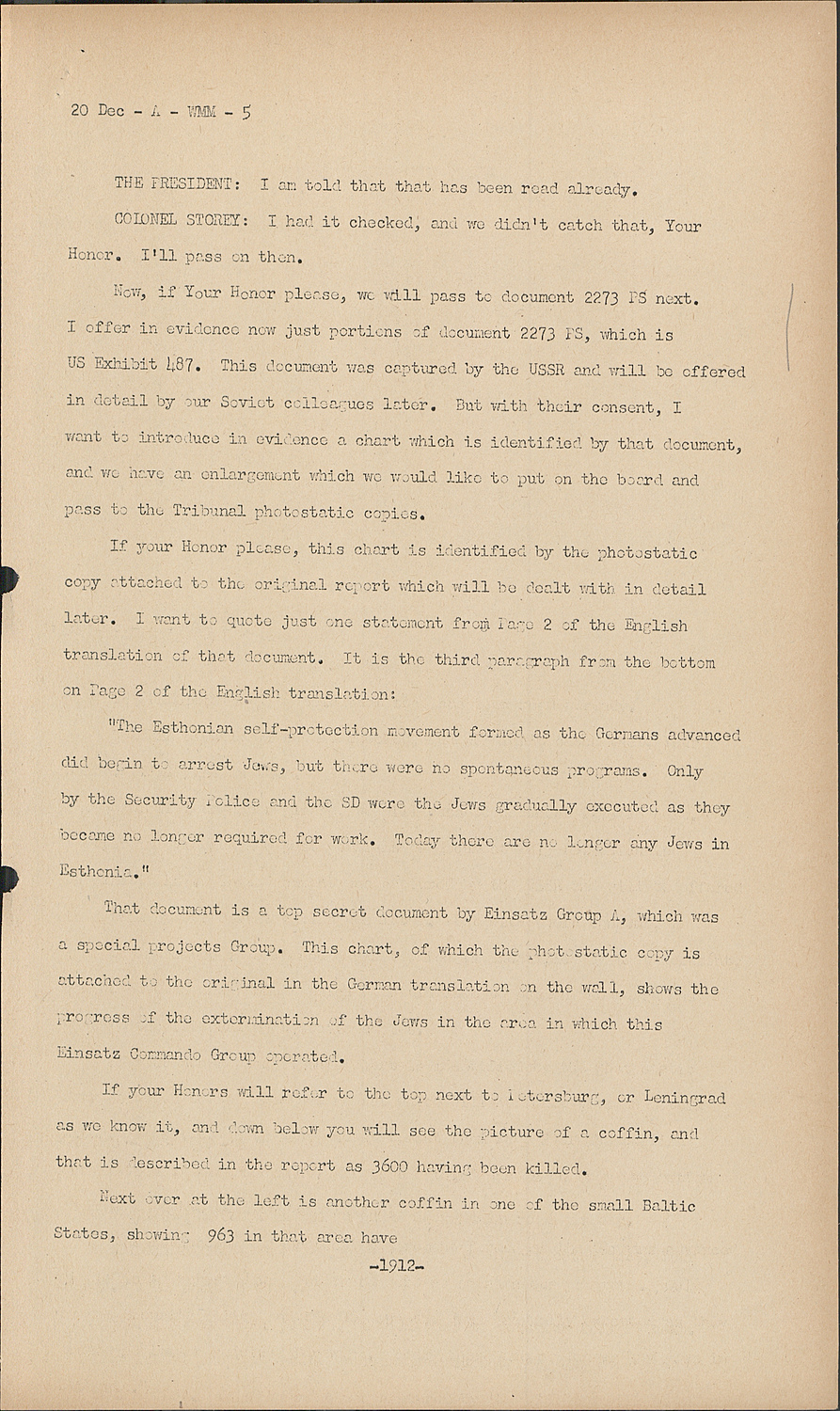
THE PRESIDENT: I am told that that has been read already.
COLONEL STOREY:I had it checked, and we didn't catch that, Your Honor. I'll pass on then.
Now, if Your Honor please, we will pass to document 2273 PS next. I offer in evidence now just portions of document 2273 PS, which is US Exhibit 487. This document was captured by the USSR and will be offered in detail by our Soviet colleagues later. But with their consent, I want to introduce in evidence a chart which is identified by that document, and we have an enlargement which we would like to put on the board and pass to the Tribunal photostatic copies.
If your Honor please, this chart is identified by the photostatic copy attached to the original report which will be dealt with in detail later. I want to quote just one statement from Page 2 of the English translation of that document. It is the third paragraph from the bottom on Page 2 of the English translation:
"The Esthonian self-protection movement formed as the Germans advanced did begin to arrest Jews, but there were no spontaneous programs. Only by the Security Police and the SD were the Jews gradually executed as they became no longer required for work. Today there are no longer any Jews in Esthonia."
That document is a top secret document by Einsatz Group A, which was a special projects Group. This chart, of which the photostatic copy is attached to the original in the German translation on the wall, shows the progress of the extermination of the Jews in the area in which this Einsatz Commando Group operated.
If your Honors will refer to the top next to Petersburg, or Leningrad as we know it, and down below you will see the picture of a coffin, and that is described in the report as 3600 having been killed.
Next over at the left is another coffin in one of the small Baltic States, showing 963 in that area have been put in the coffin.
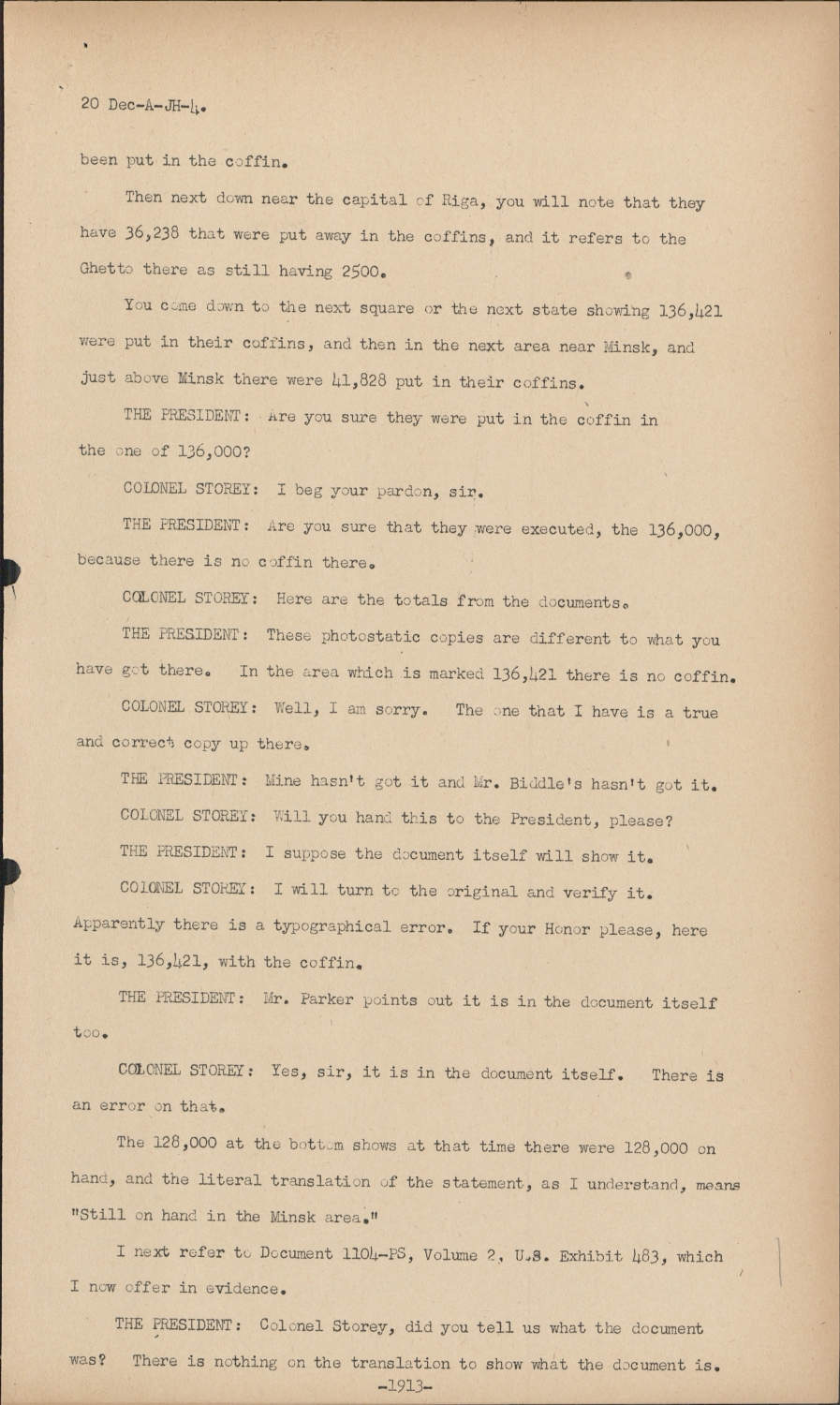
Then next down near the capital of Riga, you will note that they have 36,238 that were put away in the coffins, and it refers to the Ghetto there as still having 2500.
You come down to the next square or the next state showing 136,421 were put in their coffins, and then in the next area near Minsk, and just above Minsk there were 41,828 put in their coffins.
THEPRESIDENT: are you sure they were put in the coffin in the one of 136,000?
COLONEL STOREY:I beg your pardon, sir.
THE PRESIDENT:Are you sure that they were executed, the 136,000, because there is no coffin there.
COLONEL STOREY:Here are the totals from the documents.
THE PRESIDENT:These photostatic copies are different to what you have got there. In the area which is marked 136,421 there is no coffin.
COLONEL STOREY:Well, I am sorry. The one that I have is a true and correct copy up there.
THE PRESIDENT:Mine hasn't got it and Mr. Biddle's hasn't got it.
COLONEL STOREY:Will you hand this to the President, please?
THE PRESIDENT:I suppose the document itself will show it.
COLONEL STOREY:I will turn to the original and verify it. Apparently there is a typographical error. If your Honor please, here it is, 136,421, with the coffin.
THE PRESIDENT:Mr. Parker points out it is in the document itself too.
COLONEL STOREY:Yes, sir, it is in the document itself. There is an error on that.
The 128,000 at the bottom shows at that time there were 128,000 on hand, and the literal translation of the statement, as I understand, means "Still on hand in the Minsk area."
I next refer to Document 1104-PS, Volume 2, U.S. Exhibit 483, which I now offer in evidence.
THE PRESIDENT:Colonel Storey, did you tell us what the document was? There is nothing on the translation to show what the document is.
COLONEL STOREY: If your Honor please, it is a report of the special purpose Group A, a top secret report, or the Einsatz Group A, in other words, making a record of their activities in these areas, and this chart was attached showing the areas covered.
THE PRESIDENT:Special group of the Gestapo?
COLONEL STOREY:The special group that was organized of the Gestapo and the SD in that area. In other words, a commando group.
As I mentioned, your Honor, they organized these special commando groups to work in and behind the armies as they consolidated their gains in occupied territories, and your Honors will hear from other reports of these Einsatz groups as we go along in this presentation. In other words, Einsatz means special action or action groups, and they were organized to cover certain geographical areas behind the immediate front lines.
THE PRESIDENT:Yes, but they were groups, were they, of the Gestapo?
COLONEL STOREY:The Gestapo and SD.
THE PRESIDENT:Well, that is part of the Gestapo.
COLONEL STOREY:There were some of the Kripo in it too.
Now, the next document is 1104-PS, dated October 30, 1941. This document shows on that date the Commissioner of the territory of Sluzk wrote a report to the Commissioner General of Minsk, in which he severely criticized the actions of the Einsatz Commandos of the SIPO and the SD operating in his area for the murder of the Jewish population of that area, and I quote the English translation on page 4 of that document, beginning at the first paragraph:
"on 27 October in the morning at about 8 o'clock a first lieutenant of the police battalion Number 11 from Kauen appeared and introduced himself as the adjutant of the battalion commander of the security police. The first lieutenant explained that the police battalion had received the assignment to effect the liquidation of all Jews here in the town of Sluzk within two days.
The battalion commander with his battalion in strength of four companies, two of which were made up of Lithuanian partisans, was on the march here and the the action would have to begin instantly. I replied to the first lieutenant that I had to discuss the action in any case first with the commander. About half an hour later the police battalion arrived in Sluzk. Immediately after the arrival the conference with the battalion commander took place according to my request. I first explained to the commander that it would not very well be possible to effect the action without previous preparation, because everybody had been sent to work and that it would lead to terrible confusion. At least it would have been his duty to inform me a day ahead of time. Then I requested him to postpone the action one day. However, he rejected this with the remark that he had to carry out this action everywhere and in all towns and that only two days were allotted for Sluzk. Within these two days, the town of Sluzk had to be cleared of Jews by all means."
That report was made to the Reich Commissioner for the Eastern territories through Gauleiter Heinrich Lusch at Riga. lour Honors will recall that he was referred to in other presentations.
Now, skipping over to Page 5: The first paragraph, I'd like to quote it:
"For the rest, as regards the execution of the action, I must point out to my deepest regret that the latter bordered already on sadism. The town itself offered a picture of horror during the action. With indescribable brutality on the part of both the German police officers and particularly the Lithuanian partisans, the Jewish people, but also among them white Ruthenians, were taken out of their dwellings and herded together. Everywhere in the town shots were to be heard and in different streets the corpses of shot Jews accumulated. The White Ruthenians were in greatest distress to free themselves from the encirclement. Regardless of the fact that the Jewish people, among whom were also tradesmen, were mistreated in a terribly barbarous way in the face of the White Ruthenian people, the White Ruthenians themselves were also worked over with rubber clubs and rifle butts. There was no question of an action against the Jews any more. It rather looked like a revolution."
And then I skip down to the next to the last paragraph on that same page:
"In conclusion I find myself obliged to point out that the police battalion has looted in an unheard of manner during the action, and that not only in Jewish houses but just the same in those of the White Ruthenians. Anything of use such as boots, leather, cloth, gold and other valuables, has been taken awry. On the basis of statements of members of the armed forces, watches were town off the arms of Jews in public, on the street, and rings were pulled off the fingers in the most brutal manner. A major of the finance department reported that a Jewish girl was asked by the police to obtain immediately 5,000 rubles to have her father released. This girl is said to have actually gone everywhere in order to obtain the money."
There is another paragraph with reference to the number of copies, and that is on the first of the three pages of the translation that I'd like to call your Honors' attention to. The last paragraph on Page 3 of the translation:
"I am submitting this report in duplicate so that one copy may be forwarded to the Reich Minister. Peace and order cannot be maintained in White Ruthenia with methods of that sort. To bury seriously wounded people alive who worked their way out of their graves again is such a base and filthy act that the incident as such should be reported to the Fuehrer and Reich Marshal.
"The civil administration of White Ruthenia makes very strenuous efforts to win the population over to Germany in accordance with the instructions of the Fuehrer. These efforts cannot be brought in harmony with the methods described herein."
Signed by the Commissioner General for White Ruthenia.
And then on the 11th of November 1941, he forwards it to the Reich Minister for Occupied Countries, in Berlin.
THE PRESIDENT: Who was there at that time?
COLONEL STOREY:The Reich Commissioner I believe it was shown for the Eastern occupied country was the Defendant Rosenberg. I think that is correct. On the same date by separate letter the Commissioner General of White Ruthenia to the Reich Commissioner for the Eastern Territories that he had received money, valuables, and other objects taken by the police in the action at Sluzk, and other regions, all of which had been deposited with the Reich Credit Institute for the disposal of the Reich Commissioner.
On 21 November 1941 a report on the Sluzk incident was sent to the personal reviewer of the permanent deputy of the Minister of the Reich with a copy to Heydrich, the Chief of the Security Police and SD. That is shown on the first page of document No. 1104.
The activities of the Einsatz Groups continued throughout 1943 and 1944 under KALTENBRUNNER as Chief of the Security Police and SD. Under adverse war conditions, however, the program of extermination was to a large extent changed to one of rounding up slave labor for Germany.
I next refer to document No.3012-PS, which has heretofore been introduced as U.S.A. Exhibit No.190, which is a letter from the Headquarters of a Sondercommando, a group or section known as Einsatz Group C, dated 19 March 1943. This letter summarizes the real activities and methods of the Gestapo and SD, and I would like to refer to the additional portion of the letter, to those previously quoted on page 2, of document 3012-PS, and I believe I will read the first page, the beginning of the first paragraph:
"It is the task of the Security Police and the Security Service, SD, to discover all enemies of the Reich, and fight against them in the interest of security in the zone of operations, especially to guarantee the security of the Army. Besides the annihilation of active opponents; other elements who by virtue of their opinions that their past may appear in part as enemies under favorable condi-tions are to be eliminated through preventive measures.
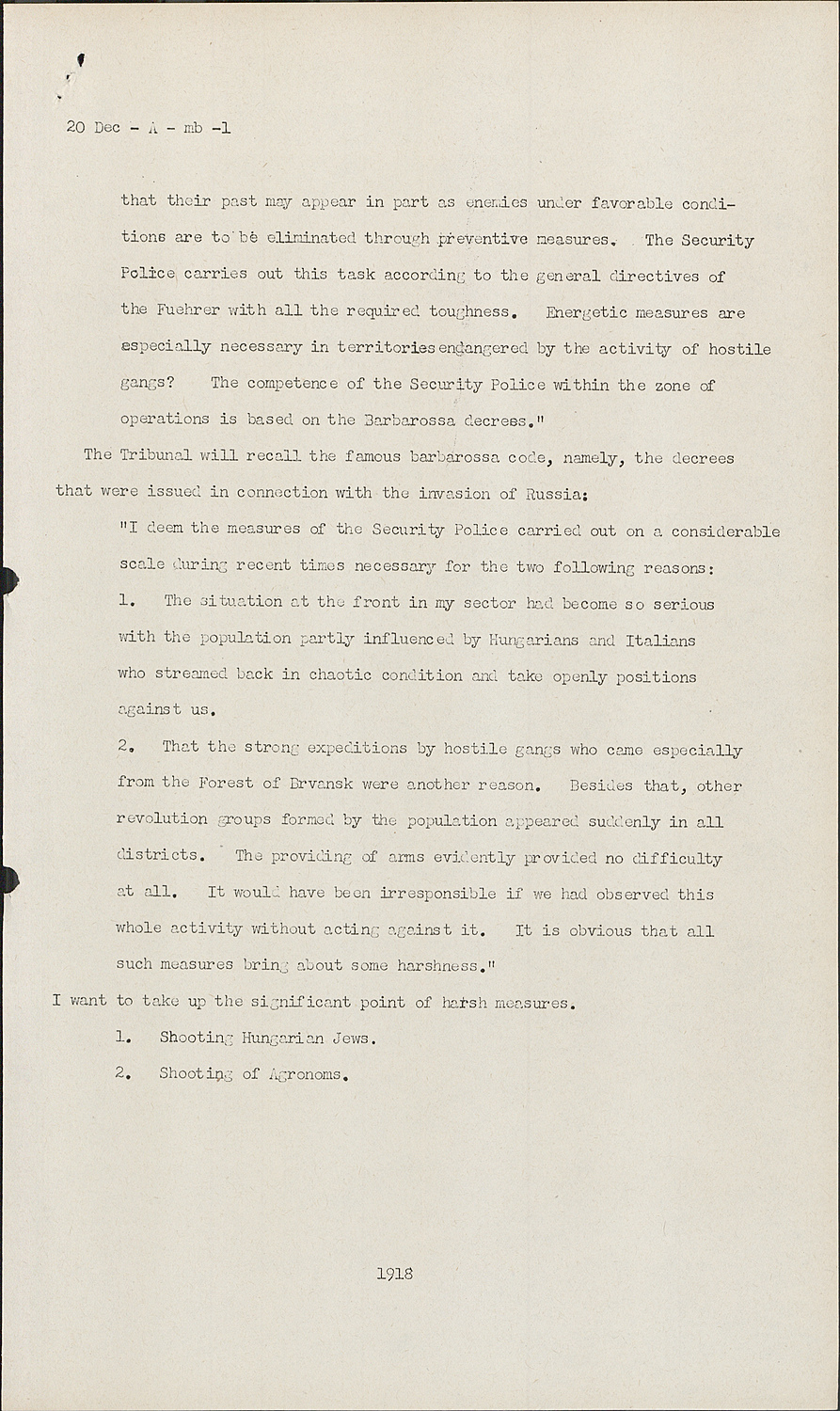
The Security Police carries out this task according to the general directives of the Fuehrer with all the required toughness.
Energetic measures are especially necessary in territories endangered by the activity of hostile gangs?
The competence of the Security Police within the zone of operations is based on the Barbarossa decrees."
The Tribunal will recall the famous barbarossa code, namely, the decrees that were issued in connection with the invasion of Russia:
"I deem the measures of the Security Police carried out on a considerable scale during recent times necessary for the two following reasons:
1. The situation at the front in my sector had become so serious with the population partly influenced by Hungarians and Italians who streamed back in chaotic condition and take openly positions against us.
2. That the strong expeditions by hostile gangs who came especially from the Forest of Brvansk were another reason.
Besides that, other revolution groups formed by the population appeared suddenly in all districts.
The providing of arms evidently provided no difficulty at all.
It would have been irresponsible if we had observed this whole activity without acting against it.
It is obvious that all such measures bring about some harshness."
I want to take up the significant point of harsh measures.
1. Shooting Hungarian Jews.
2. Shooting of Agronoms.
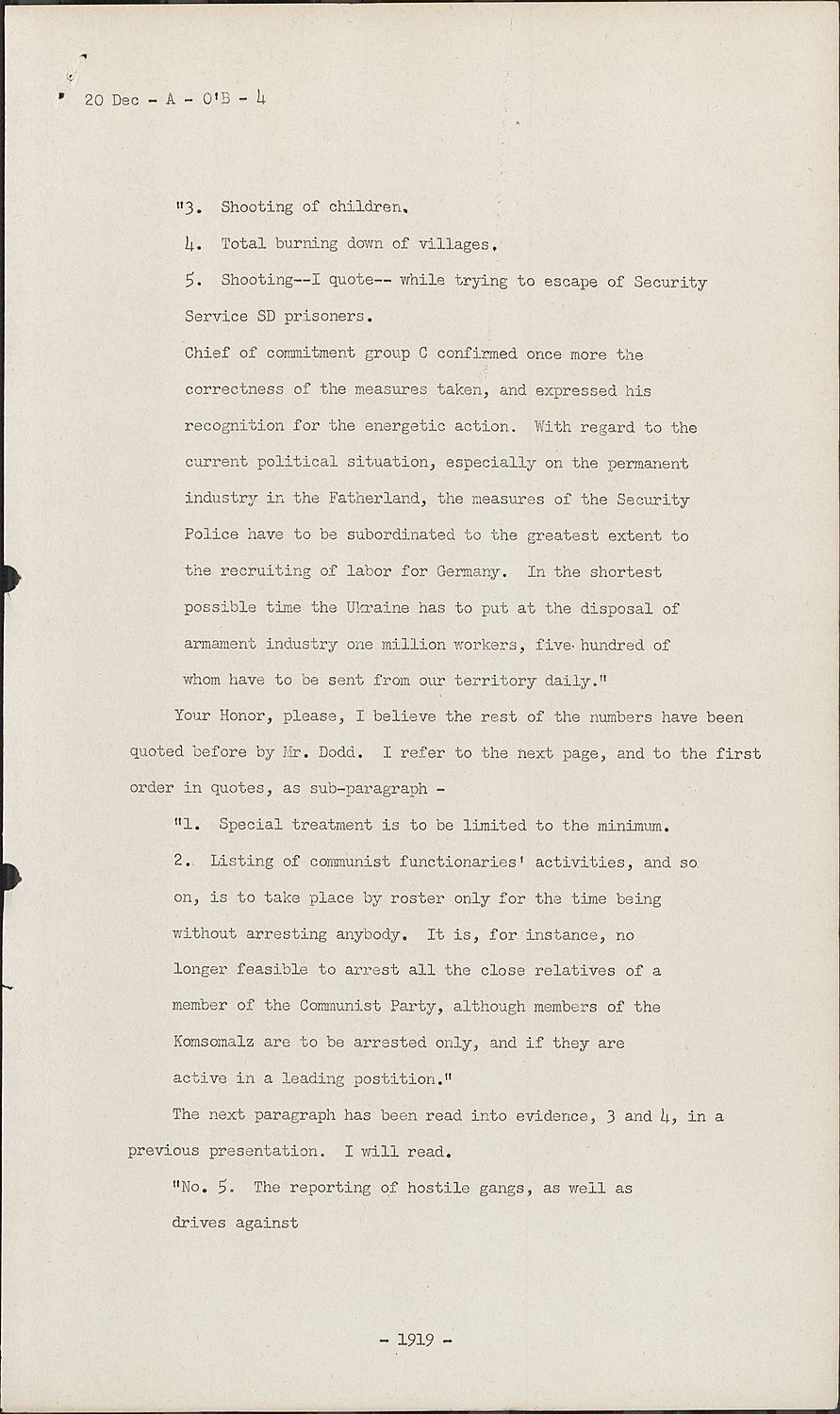
"3. Shooting of children.
4. Total burning down of villages.
Service SD prisoners.
Chief of commitment group C confirmed once more the correctness of the measures taken, and expressed his recognition for the energetic action.
With regard to the current political situation, especially on the permanent industry in the Fatherland, the measures of the Security Police have to be subordinated to the greatest extent to the recruiting of labor for Germany.
In the shortest possible time the Ukraine has to put at the disposal of armament industry one million workers, five hundred of whom have to be sent from our territory daily."
Your Honor, please, I believe the rest of the numbers have been quoted before by Mr. Dodd.
I refer to the next page, and to the first order in quotes, as sub-paragraph "1. Special treatment is to be limited to the minimum.
2. Listing of communist functionaries' activities, and so on, is to take place by roster only for the time being without arresting anybody.
It is, for instance, no longer feasible to arrest all the close relatives of a member of the Communist Party, although members of the Komsomalz are to be arrested only, and if they are active in a leading postition."
The next paragraph has been read into evidence, 3 and 4, in a previous presentation.
I will read.
"No. 5. The reporting of hostile gangs, as well as drives against "them is not effected hereby.
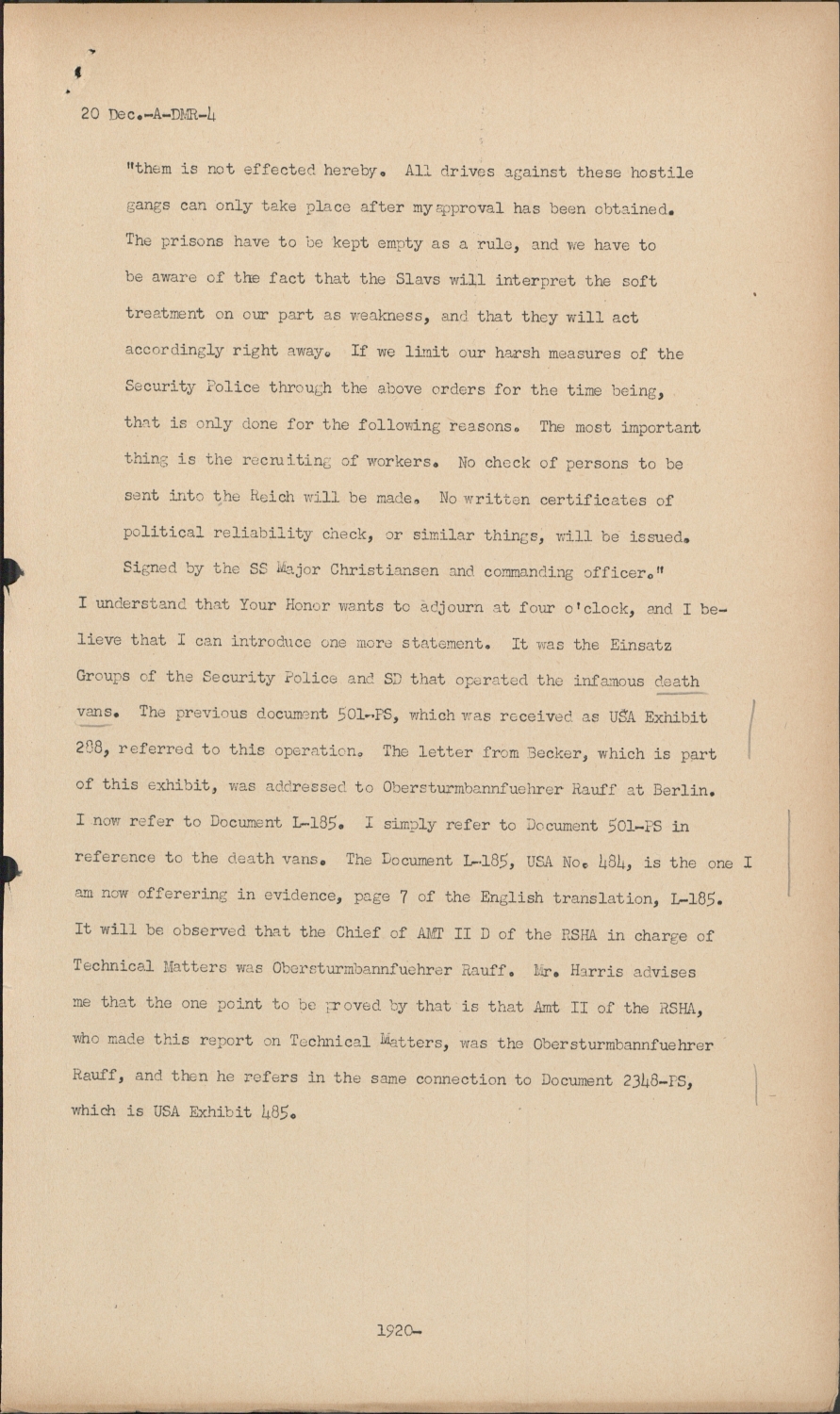
All drives against these hostile gangs can only take place after my approval has been obtained.
The prisons have to be kept empty as a rule, and we have to be aware of the fact that the Slavs will interpret the soft treatment on our part as weakness, and that they will act accordingly right away.
If we limit our harsh measures of the Security Police through the above orders for the time being, that is only done for the following reasons.
The most important thing is the recruiting of workers.
No check of persons to be sent into the Reich will be made.
No written certificates of political reliability check, or similar things, will be issued.
Signed by the SS Major Christiansen and commanding officer." I understand that Your Honor wants to adjourn at four o'clock, and I believe that I can introduce one more statement. It was the Einsatz Groups of the Security Police and SD that operated the infamous death vans. The previous document 501-PS, which was received as USA Exhibit 288, referred to this operation. The letter from Becker, which is part of this exhibit, was addressed to Obersturmbannfuehrer Rauff at Berlin. I now refer to Document L-185. I simply refer to Document 501-PS in reference to the death vans. The Document L-185, USA No. 184, is the one I am now offerering in evidence, page 7 of the English translation, L-185. It will be observed that the Chief of AMT II D of the RSHA in charge of Technical Matters was Obersturmbannfuehrer Rauff. Mr. Harris advises me that the one point to be proved by that is that Amt II of the RSHA, who made this report on Technical Matters, was the Obersturmbannfuehrer Rauff, and then he refers in the same connection to Document 2348-PS, which is USA Exhibit 485.
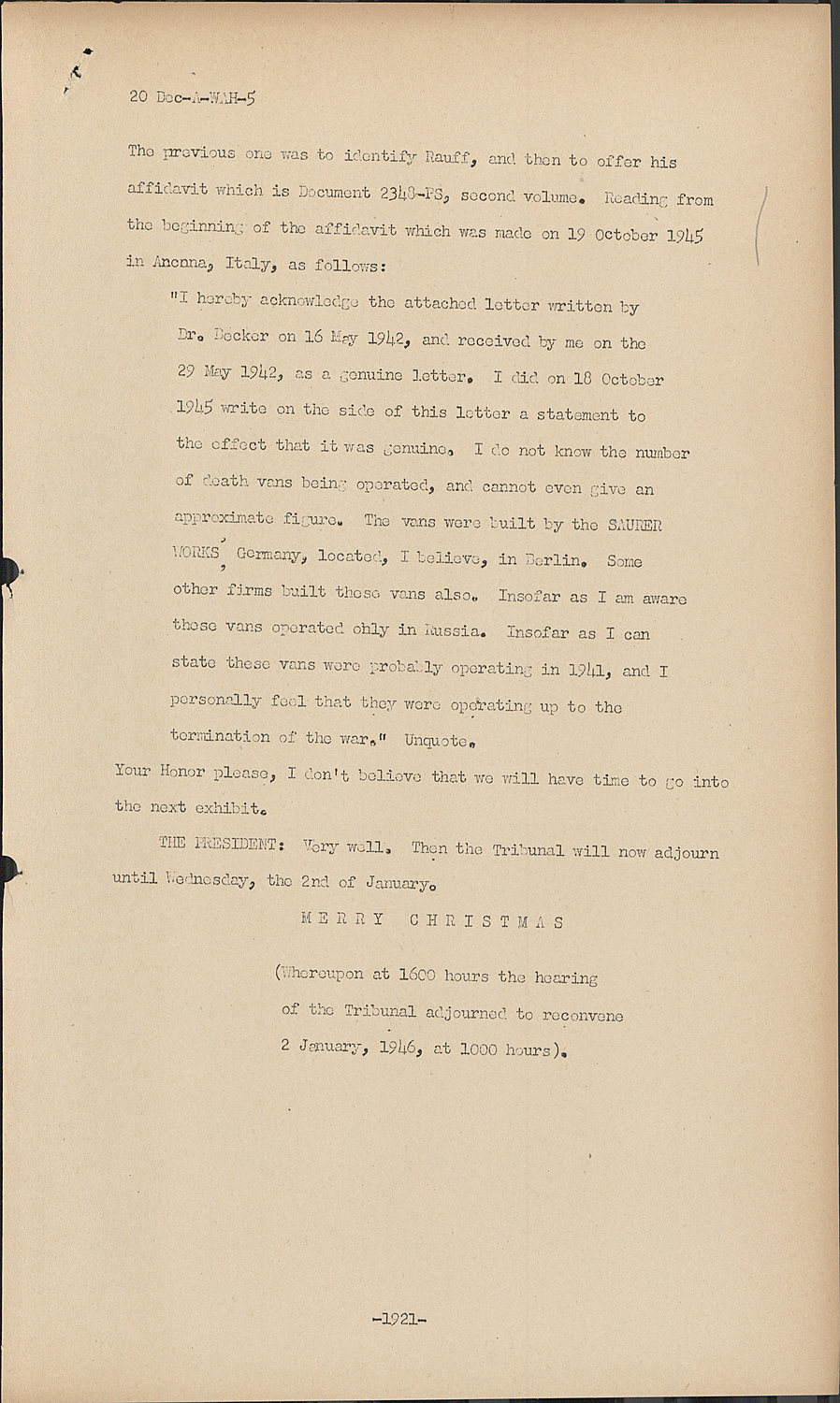
The previous one was to identify Rauff, and then to offer his affidavit which is Document 2343-PS, second volume.
Reading from the beginning of the affidavit which was made on 19 October 1945 in Ancona, Italy, as follows:
"I hereby acknowledge the attached letter written by Dr. Becker on 16 May 1942, and received by me on the 29 May 1942, as a genuine letter.
I did on 18 October 1945 write on the side of this letter a statement to the effect that it was genuine.
I do not know the number of death vans being operated, and cannot even give an approximate figure.
The vans were built by the SAURER WORKS, Germany, located, I believe, in Berlin.
Some other firms built these vans also.
Insofar as I am aware those vans operated only in Russia.
Insofar as I can state these vans were probably operating in 1941, and I personally feel that they were operating up to the termination of the war."
Unquote. Your Honor please, I don't believe that we will have time to go into the next exhibit.
THE PRESIDENT:Very well. Then the Tribunal will now adjourn until Wednesday, the 2nd of January.
M E R R Y C H R I S T M A S (Whereupon at 1600 hours the hearing of the Tribunal adjourned to reconvene 2 January, 1946, at 1000 hours). Official transcript of the International Military Tribunal, in the matter of: