Since it has not been denied that the defendants were commanders of einsatz units, they clearly would fall within the provisions of Article 347, American Rules of Land Warfare. This Article 347 was repealed in 1944, but it has here been discussed at length because Defense Counsel made much of it, and because it was still law at the time the Einsatzgruppen were operating.
In further confirmation of the interpretation above given of Article 347, reference is made to Article 64 of the American Articles of War which announces punishment for the disobedience of any lawful command of a superior officer. Obviously if the order is unlawful he may not be punished for refusing to obey it.
The subject of Superior Orders is not so confusing and complicated as it had been made by some legal commentators. In considering the law in this matter we must keep in mind that fundamentally there are some legal principles that stand out like oak trees. Much underbrush has grown up in the vicinity and they seem to confuse the view. But even the most casual observation will catch on the legal landscape these sturdy oaks which announce that:
1. Every man is presumed to intend the consequences of his act.
2. Every man is responsible for those acts unless it be shown that he did not act of his own free will.
3. Deciding the question of free will, all the circum stances of the case must be considered because it is impossible to read what is in a man's heart.
Dr. Aschenauer correctly referred to one of these trees in Lord Manfield's charge to the jury in Stratton's case, (1780) Howell, State Trials, Vol. 21, p. 1062-1224:
"A state of emergency is a reason for justification, since nobody can be guilty of a crime without having in tended it.
If there is irresistible, plysical duress, then the acting person has no volition with regard to the deed."
Was there irresistible, physical duress? Was there volition with regard to the deed? The answering of these two questions will serve as safe guides in applying the criteria herein announced in the discussion on the subject of Superior Orders.
NON-INVOLVEMENT Several of the defendants pleaded Not Guilty on the ground that they were in no way involved in the homocidal operations of the einsatz units.
These denials of participation took various forms. It was stated that the defendant, although traveling with the kommando, never learned of executions and certainly did not participate in them, it was asserted that, although the defendant participated in executions, the executees were partisans, saboteurs, looters, end the like; and it was also claimed on behalf of some of the defendants that, although they actually ordered and supervised executions, these executions always followed an investigation in the case involved. No one was shot unless he was proved guilty of a crime.
How thorough were these investigations if and when they took place? An order issuing from the Fuehrer's headquarters on June 6, 1941 -that is, 15 days before the beginning of the Russian war -- spoke of the conduct of the German forces entering Russia, One paragraph discussed the disposition of political commissars who "for the time being" were not to be executed unless they committed or were suspected of hostile acts. Then came this very significant instruction:
"As a matter of principle in deciding the question whether guilty or not guilty, the personal impression which the commis sar gives of his mentality and attitude will have precedence over facts which may be improvable."
Thus kommando leaders were not only empowered but encouraged to execute a man more on his looks than on evidence. One of the defendants corroborated this practice. He was asked what he would do if he came upon a person speaking to four or five people in a room, advocating Communism but in no way opposing the Germans. The defendant replied:
"I would have got a look at the man, and if I was under the impression that he would put his theoretical conviction into deed, in that case I would have had him shot.
The actual speech or lecture could not be decided upon theoreti cally."
He was asked further:
"So that you would listed to the speech and then you would look at him under a micro scope, and after this big look, if you thought he might have done something, then you would have him shot.
That is what we understood by your answer?"
And the reply was a categorical "Yes".
Many of the so-called investigations, moreover, were merely inquiries for the purpose of obtaining from the victim information which would enable the executioners to locate and seize other victims. For instance, the defendant Ott testified from the witness stand, as will be noted later, how arrested persons were arrested, "investigated", and shot.
Several of the Defense Counsel have argued that their clients were soldiers and that their only job was combat. But if the job with the Einsatzgruppen was strictly military, why did the High Command not send military men to do it? Why did they choose Ohlendorf who had had no military training of any kind to head a military organization? Very few of the kommando leaders had been soldiers, and the brief three or four weeks' training at Pretzsch, prior to marching into Russia, consisted only of drilling and target practice on the rifle range. It is obvious that they were being sent into Russia not as combat soldiers, but as ideological exponents. In the field they were a travelling RSHA, they were a Gestapo on wheels.
Report No. 128 describes the executions by Einsatzgruppe C of 80,000 persons and explains that 8,000 of them were "convicted of anti-German or Bolshevistic activities".
The report goes on further to say:
"Even though approximately 75,000 Jews have been liquidated in this manner, it is already at this time evident that this cannot be a possible solution of the Jewish problem."
The report-writer explains that, in small towns and villages, they had achieved a complete liquidation of the "Jewish problem, and that, in the larger cities, after executions, all Jews had disappeared". It is evident from this statement that the main objective of the kommandos was to kill Jews, not partisans.
Counsel for Sandberger, in his final argument, quoted from the United States Basic Field Manual, Rules of Land Warfare:
"If the people of a country, or any portion thereof, already occupied by an army rise against it, they are violators of the laws of war and are not entitled to their pro tection."
Dr. von Stein, however, failed to show that the people in the respective German-occupied areas took part in any uprising. On the contrary, it was the einsatz leaders who attempted to stir up popular tumult by instigating pogroms.
The defendant Haensch declared that, during the entire time he served in Russia, he never saw a Jew, and that he never heard of the Fuehrer-Order. Although his kommando, prior to his arrival in Russia, had admittedly slaughtered thousands of Jews, no one ever told him of this nor did he ever hear of it. This is simply incredible. And, in support of this admittedly incredulous utterance, an even more extraordinary assertion was made by his attorney, namely, that Heydrich was anxious for Haensch not to know about these things since they had nothing to do with his work in Berlin.
In defense of Blobel, who admitted in a pre-trial statement that his kommando had killed 10,000 to 15,000 people, his attorney declared in a final summation that Blobel's duties were purely administrative-adding, to be sure that these administrative duties were to be interpreted in their "widest sense".
One of Blobel's administrative duties was to conduct executions. History will be his debtor for the authoritative account he rendered on mass-executions from the standpoint of the spirit and philosophy of slayer and slain. He was asked at the trial whether the doomed, as they were being led to their waiting graves, ever attempted to break away before the shots were fired. He replied that there was no resistance and this surprised him greatly. The following interrogation then occurred:
"Q. You mean that they resigned themselves easily to what was awaiting them?
A. Yes, that was the case. That was the case with these people.
Human life was not as valuable as it was with us.
They did not care so much.
They did not know their own human value.
Q. In other words, they went to their death quite happily?
A. I would not say that they were happy.
They knew what was going to happen to them.
Of course, they were told what was going to happen to them, and they were resigned to their fate, and that is the strange thing about these people in the East.
Q. And did that make the job easier for you, the fact that they did not resist?
A. In any case the guards never met any re sistance, or, at least, not in Sokal.
Everything went very quietly. It took time, of course,, and I must say that our men who took part in these executions suffered more from nervous exhaustion than those who had to be shot.
Q. In other words, your pity was more for the men who had to shoot than for the victims?
A. Our men had to be cared for.
. . . . . . . .
Q. And you felt very sorry for them?
A. Yes, these people experiences a lot, psychologically."
Thus, to murder was added criminal impertinence. The victim is shown to be inhuman while the executioner is to be pitied. The condemned is put in the wrong and the slayer in the right. A person is robbed of his all -- his very life -- but it is the assassin who is the sufferer.
To these people "human life was not as valuable as it was to us". Thus we behold the moral supremacy of the murderer over the depravity of the massacred. "Our men who took part in the executions suffered more from nervous exhaustion that those who had to be shot."
Here in cogent language is symbolized the whole story of the simple "administrative duties" of one of the leaders of the Einsatzgruppen in land not his own.
Court No. II, Case No. IX Partisans Many of the defendants admitting that they had conducted executions, explained that they had not killed any innocent persons but had merely shot partisans, to be sure, not in combat, but punitively.
This bald statement in itself does not suffice to exonerate one from a charge of unlawful killings. Article I of the Hague Regulations provides:
"The laws, rights, and duties of war apply not only to armies, but also to militia and volunteer corps fulfill ing the following conditions:
1. To be commanded by a person responsible for his subordinates.
2. To have a fixed distinctive emblem recognizable at a distance.
3. To carry arms openly; and 4. To conduct their operations in accordance with the laws and customs of war."
It is unnecessary to point out that, under these provisions, an armed civilian found in a tree top sniping at uniformed soldiers, is not such a lawful combatant, and can be punished even with the death penalty, if he is proved guilty of the offense.
But this is far different from saying that resistance fighters in the war against an invading army, if they fully comply with the conditions just mentioned, can be put outside the law by the adversary. As the Hague Regulations state expressly, if they fulfill the four conditions, "the laws, rights and duties of war" apply to them in the same manner as they apply to regular armies.
Many of the defendants seem to assume that by merely characterizing a person a partisan he may be shot out of hand. But it is not so simple as that. If the partisans are organized and are engaged in what International Law regards as legitimate warfare for the defense of their own country, they are entitled to be protected as combatants.
The record shows that in many of the areas where the Court No. II, Case No. IX Einsatzgruppen operated, the so-called partisans had wrested considerable territory from the German occupant, and that military combat action of some dimensions was required to re-occupy those areas.
In belligerent occupation the occupying power does not hold enemy territory by virtue of any legal right. On the contrary, it merely exercises a precarious and temporary actual control. This can be seen from Article 42 of the Hague Regulations which grants certain well limited rights to a military occupant only in enemy territory which is "actually placed" under his control.
In reconquering enemy territory which the occupant has lost to the enemy, he is not carrying out a police performance but a regular act of war. The enemy combatants in this case are, of course, also carrying out a war performance. They must, on their part, obey the laws and customs of warfare, and if they do, and then are captured, they are entitled to the status and rights of prisoners of war.
The language used in the official German reports, received in evidence in this case, show, however, that combatants were indiscriminately punished only for having fought against the enemy. This is contrary to the law of war.
THE PRESIDENT: The Presiding Judge continues with the reading.
Reprisals From time to time the word "reprisals" has appeared in the Einsatzgruppen reports.
Reprisals in war are the commission of acts which, although illegal in themselves, may, under the specific circumstances of the given case, become justified because the guilty adversary has himself behaved illegally, and the action is taken in the last resort, in order to prevent the adversary from behaving illegally in the future. Thus, the first prerequisite to the introduction of this most extraordinary remedy is proof that the enemy has behaved illegally. While generally the persons who become victims of Court No. II, Case No. IX the reprisal are admittedly innocent of the acts against which the reprisal is to retaliate, there must at least be such close connection between these persons and these acts as to constitute a joint responsibility.
Article 50 of the Hague Regulations states unequivocally:
"No general penalty, pecuniary or otherwise, shall be inflicted upon the population on account of the acts of individuals for which they cannot be regarded as jointly and severally responsible."
Thus when, as one report says, 859 out of 2,1000 Jews shot in alleged reprisal for the killing of 21 German soldiers near Topola, were taken from concentration camps in Yugoslavia, hundreds of miles away, it is obvious that a flagrant violation of International Law occurred and outright murder resulted. That 2,100 people were killed in retaliation for 21 deaths only further magnifies the criminality of this savage and inhuman so-called reprisal.
Hyde, International Law, Vol. III, page 35, has this to say on reprisals:
"A belligerent which is contemptuous of conventional or customary prohibitions is not in a position to claim that its adversary when responding with like for like, lacks the requisite excuse."
If it is assumed that some of the resistance units in Russia or members of the population did commit acts which were in themselves unlawful under the rules of war, it would still have to be shown that these acts were not in legitimate defense against wrongs perpetrated upon them by the invader. Under International Law, as in Domestic Law, there can be no reprisal against reprisal. The assassin who is being repulsed by his intended victim may not slay him and then, in turn, plead self-defense.
Reprisals, if allowed, may not be disproportionate to the wrong for which they are to retaliate. The British Manual of Warfare, after insisting that reprisals must be taken only in last resorts, states:
Court No. II, Case No. IX "459.
....Acts done by way of reprisals must not, however, be excessive and must not exceed the degree of violation com mitted by the enemy."
Similarly, Article 358 of the American Manual states:
"(b) When and how employed:
Reprisals are never adopted merely for revenge, but only as an unavoid able last resort to induce the enemy to desist from illegitimate prac tices.
....
(c) Form of reprisals:
The acts resorted to by way of reprisals.
....should not be ex cessive or exceed the degree of violations committed by the enemy."
Stowell, in the American Journal of International Law, quotes General Halleck on this subject:
"Retaliation is limited in extent by the same rule which limits punishment in all civilized governments and among all Christian people -- it must never degenerate into savage or bar barous cruelty."
(Stowell American Journal of International Law, Vol.
36, p. 671) The Einsatzgruppen reports have spoken for themselves as to the extent to which they respected the limitations laid down by International Law on reprisals in warfare.
CRIMINAL ORGANIZATIONS Article 9 of the London Charter provided, inter alia, as follows:
"At the trial of any individual member of any group or organization the Tri bunal may declare (in connection with any act of which the individual may be convicted) that the group or organiza tion of which the individual was a member was a criminal organization."
Article 10 provided that the criminality of such groups and organizations declared criminal by the International Military Tribunal was to be considered proved and not to be questioned in any succeeding proceedings. Control Council Law No. 10 defined membership in any Court No. II, Case No. IX organization declared criminal by the International Military Tribunal as a crime.
The trial briefs on both sides in this case have devoted a great deal of space to the discussion of Count III in the Indictment. To the extent that the discussion has to do with the facts, it is welcome and helpful. So far as the law on the subject is concerned, it has been stated completely and definitively by the Judgment of the International Military Tribunal and therefore needs no amplification here. The International Military Tribunal declared the SS, SD and the Gestapo to be criminal organizations within the purview of the London Charter. The pertinent provisions of that Judgment declaring these organizations criminal and defining the categories of membership therein, follow:
(At this point the following was not read but at the direction of the President is included in the transcript:)
SS "The SS was utilized for purposes which were criminal under the Charter involving the persecution and extermination of the Jews, brutalities and killings in con centration camps, excesses in the admin istration of occupied territories, the administration of the slave labor program and the mistreatment and murder of prison ers of war.
....In dealing with the SS the Tribunal includes all persons who had been officially accepted as members of the SS including the members of the Allgemeine SS, members of the Waffen SS, members of the SS Totenkopf Verbaende, and the members of any of the different police forces who were members of the SS.
"The Tribunal declares to be criminal within the meaning of the Charter the group composed of those persons who had been officially accepted as members of the SS as enumerated in the preced ing paragraph who became or remained members of the organization with know ledge that it was being used for the commission of acts declared criminal by Article 6 of the Charter, or who were personally implicated as members of the organization in the commission of such crimes, excluding, however, Court No. II, Case No. IX those who were drafted into membership by the State in such a way as to give them no choice in the matter, and who had commit ted no such crimes.
The basis of this finding is the participation of the organization in War Crimes and Crimes against Humanity connected with the war;this group declared criminal cannot in clude, therefore, persons who had ceased to belong to the organizations enumera ted in the preceding paragraph prior to 1 September 1939."
GESTAPO AND SD "The Gestapo and SD were used for purposes which were criminal under the Charter in volving the persecution and extermination of the Jews, brutalities, and killings in concentration camps, excesses in the ad ministration of occupied territories, the administration of the slave labor program, and the mistreatment and murder of prison ars of war.
....In dealing with the Gestapo the Tribunal includes all executive and ad ministrative officials of Amt IV of the RSHA or concerned with Gestapo administra tion in other departments of the RSHA and all local Gestapo officials serving both inside and outside of Germany, including the members of the Frontier Police, but not including the members of the Border and Customs Protection or the Secret Field Police, except such members as have been specified above.
....In dealing with the SD the Tribunal includes Aemter III, VI, and VII of the RSHA and all other members of the SD, including all local representatives and agents, honorary or otherwise, whether they were technically members of the SS or not, but not including honorary informers who were not members of the SS, and members of the Abwahr who were transferred to the SD.
"The Tribunal declares to be criminal with in the meaning of the Charter the Group composed of those members of the Gestapo and SD holding the positions enumerated in the preceding paragraph who became or remained members of the organization with knowledge that it was being used for the commission of acts declared crim inal by Article 6 of the Charter, or who were personally implicated as members of the organization in the commission of such crimes.
The basis for this finding is the participation of the organization in War Crimes and Crimes against Humanity connected with the war; this group de clared criminal cannot include, therefore, persons who had ceased to hold the posi tions enumerated in the preceding para graph prior to 1 September 1939.
Court No. II, Case No. IX.
"In dealing with the Gestapo the Tribunal includes all executive and administra tive officials of Amt IV of the RSHA or concerned with Gestapo administration in other departments of the RSHA and all local Gestapo officials serving both inside and outside of Germany, including the members of the Frontier Police, but not including the members of the Border and Customs Protection or the Secret Field Police, except such members as have been specified above."
(At this point the President continues reading:)
In order to avoid unnecessary repetition in the individual judgments the Tribunal here declares that where it finds a defendant guilty under Count III it will be because it has found beyond a reasonable doubt from the entire record that he became or remained a member of the criminal organization involved subsequent to September 1, 1939 under the conditions declared criminal in the Judgment of the International Military Tribunal.
CRIMES AGAINST HUMANITY These defendants are charged with war crimes and crimes against humanity.
The concept of war crimes is not a new one. From time immemorial there have existed rules, laws and agreements which kept opposing forces within bounds in the matter of the conduct of warfare, the treatment of prisoners, wounded persons, civilian noncombatants, and the like. Those who violated these rules were subject to trial and prosecution by both the country whose subjects they were and by the country whose subjects they maltreated.
But an evaluation of international right and wrong, which heretofore existed only in the heart of mankind, has now been written into the books of men as the law of Humanity. This law is not restricted to events of war. It envisages the protection of humanity at all times. The crimes against which this law is directed are not unique. They have unfortunately been occurring since the world began, but not until now were they listed as international offenses. The first count of the Indictment in this case charges the defendants with Court No. II, Case No. IX.
crimes against humanity. Not crimes against any specified country, but against humanity.
Humanity is the sovereignty which has been offended and a Tribunal is convoked to determine why. This is not a new concept in the realm of morals, but it is an innovation in the empire of the law. Thus a lamp has been lighted in t he dark and tenebrous atmosphere of the fields of the innocent dead.
Murder, torture, enslavement and similar crimes which heretofore were enjoined only by the respective nations now fall within the prescription of the family of nations. Thus murder becomes no less murder because directed against a whole race instead of a single person. A Fuehrer-Order, announcing the death of classifications of human beings can have no more weight in the scales of international justice than the order of a highwayman or pirate.
Despite the gloomy aspect of history, with its wars, massacres and barbarities, a bright light shines through it all if one recalls the efforts made in the past in behalf of distressed humanity. President Theodore Roosevelt in addressing the American Congress, said in 1903:
"There are occasional crimes committed on so vast a scale and of such peculiar horror as to make us doubt whether it is not our mani fest duty to endeavor at least to show our disapproval of the deed and our sympathy with those who have suffered by it."
President William McKinley in April 1898, recommended to Congress that roops be sent to Cuba "in the cause of humanity-
and to put an end to the barbarities, bloodshed, starvation, and horrible miseries now existing there, and which the parties to the conflict are either unable or unwilling to stop or mitigate."
These two American presidents were but expressing the yearning of all mankind for amedium by which crimes against humanity could be stopped and the instigators puniched. One recommended diplomatic protest, the other armed intervention. Both methods have been used but they do not express the ideal. The former is often ineffectual and the latter achieves its benevolent objective only at further expenditure of blood. No recourse was had to law because there was no jurisprudence on the subject, nor was there any legal procedure to punish the offenders. Humanity could only plead at the doors of the mighty for a crumb of sympathy and a drop of compassion.
But now it has been seen that humanity need not supplicate for a tribunal in which to proclaim its rights. Humanity need not plead for justice with sobs, tears, and piteous weeping. It has been de monstrated here that the inalienable and fundamental rights of common man need not lack for a court to proclaim them and for a marshal to execute the court's judgments. Humanity can assert itself by law.
It has taken on the robe of authority.
Following the London Agreement of August 8, 1945 between the four Allied powers, 19 other nations expressed their adherence to that Agreement. In giving effect to the London Agreement and the Charter pursuant thereto, as well as the Moscow Declaration of October 30, 1943, the Allied Control Council formulated its Law No. 10 which treated, among other things, of crimes against humanity. Those who are indicted under this provision, however, are not responding alone to the nations which have approved the principles expressed in the London and Moscow Agreements, they are answering to humanity itself, humanity which has no political boundaries end no geographical limitations. Humanity is man itself. Humanity is the race which will go on in spite of all the fuehrers and dictators that little brains and smaller souls can elevate to platforms of tinsel poised on bastions of straw.
Crimes against humanity are acts committed in the course of wholesale and systematic violation of life and liberty. It is to be observed that insofar as international jurisdiction is concerned the concept of crimes against humanity does not apply to offenses for which the criminal code of any well-ordered State makes adequate provision. They can only come within the purview of this basic code of humanity because the State involved, owing to indifference, impotency or complicity, has been unable or has refused to halt the crimes and punish the criminals.
At the VIIIth Conference for the Unification of Penal Law held on July 11, 1947 the Counselor of the Vatican defined crimes against humanity in the following language:
"The essential and inalienable rights of man cannot vary in time and space.
They cannot be interpreted and limited by the social conscience of a people or a particular epoch for they are essentially immutable and eternal.
Any injury...
done with the intention of extermination, mutilation or enslavement, against the life, freedom of opinion.
....the moral or physical integrity of the family.
....or the dignity of the human being, by reason of his opinion, his race, caste, family or profession, is a crime against humanity."
The International Military Tribunal, operating under the London Charter, declared that the Charter's provisions limited the Tribunal to consider only those crimes against humanity which were committed in the execution of or in connection with crimes against peace and war crimes.
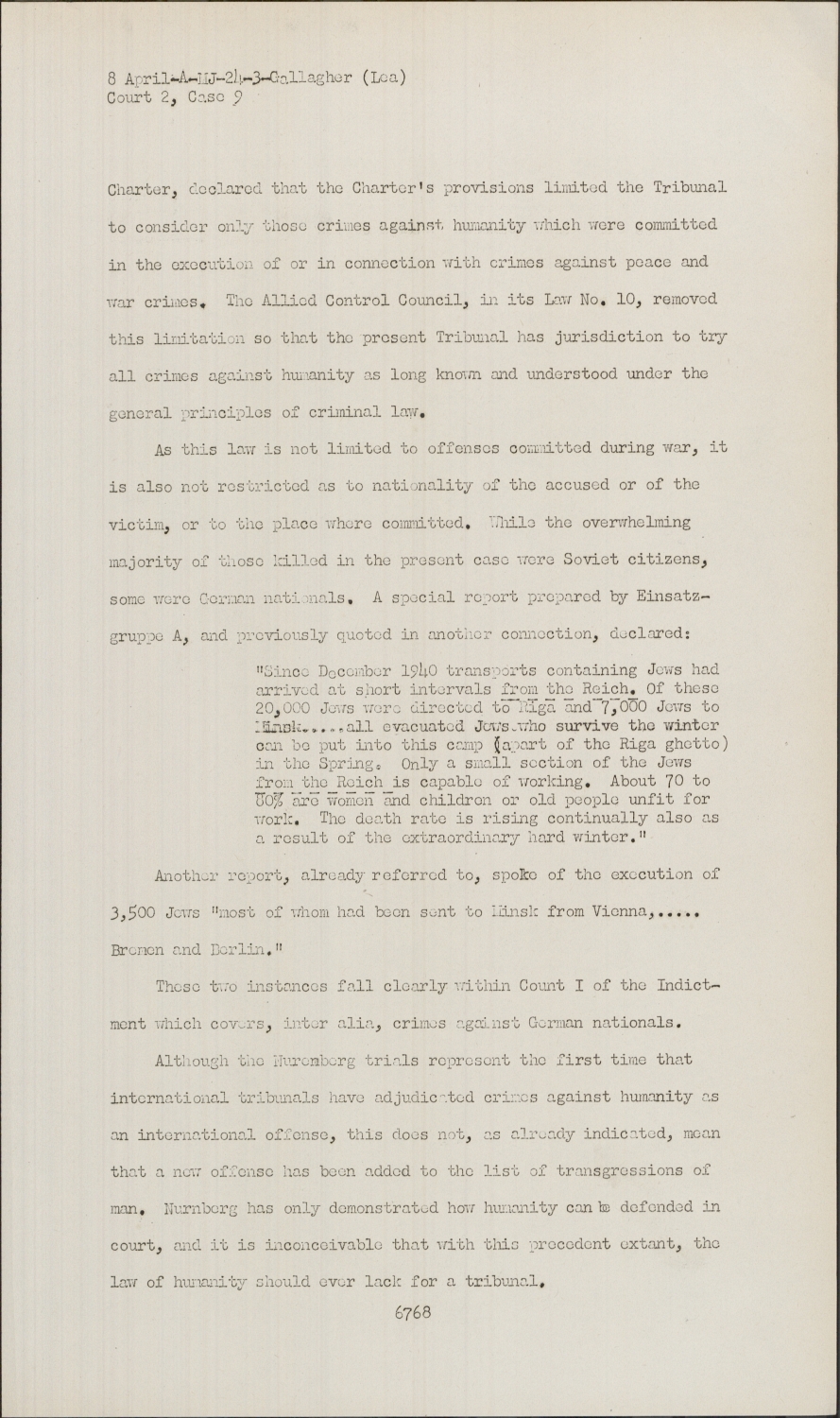
The Allied Control Council, in its Law No. 10, removed this limitation so that the present Tribunal has jurisdiction to try all crimes against humanity as long known and understood under the general principles of criminal law.
As this law is not limited to offenses committed during war, it is also not restricted as to nationality of the accused or of the victim, or to the place where committed, while the overwhelming majority of those killed in the present case were Soviet citizens, some were German nationals. A special report prepared by Einsatzgruppe A, and previously quoted in another connection, declared:
"Since December 1940 transports containing Jews had arrived at short intervals from the Reich.
Of these 20,000 Jews were directed to Riga and 7,000 Jews to *---*.....all evacuated Jews who survive the winter can be put into this camp (apart of the Riga ghetto) in the Spring.
Only a small section of the Jews from the Reich is capable of working.
About 70 to 80% are women and children or old people unfit for work.
The death rate is rising continually also as a result of the extraordinary hard winter."
Another report, already referred to, spoke of the execution of 3,500 Jews "most of whom had been sent to Minsk from Vienna,..... Bremen and Berlin."
These two instances fall clearly within Count I of the Indictment which covers, inter alia, crimes against German nationals.
Although the Nuremberg trials represent the first time that international tribunals have adjudicated crimes against humanity as an international offense, this does not, as already indicated, mean that a new offense has been added to the list of transgressions of man. Nurnberg has only demonstrated how humanity can be defended in court, and it is inconceivable that with this precedent extant, the law of humanity should ever lack for a tribunal.
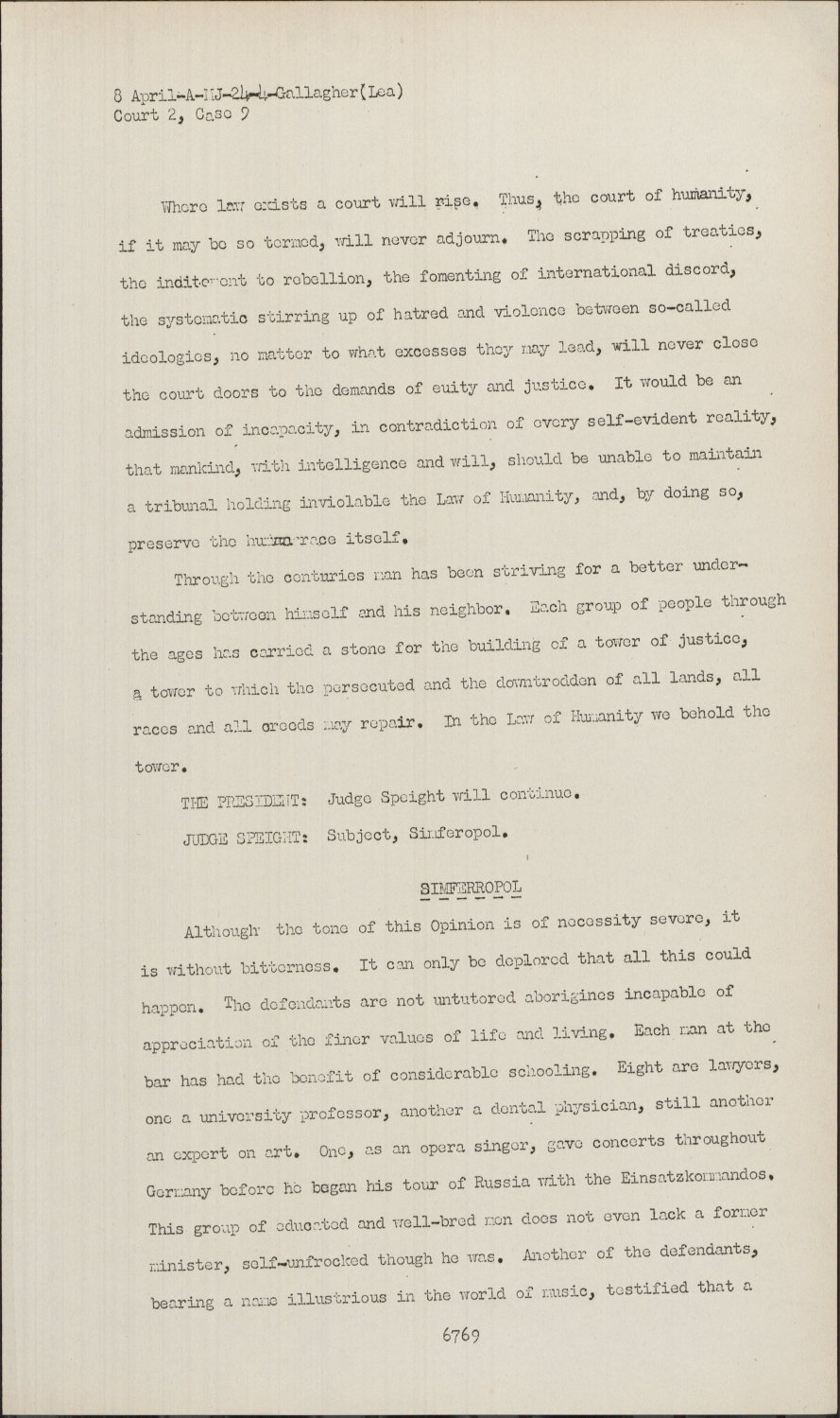
Where law exists a court will rise. Thus, the court of humanity, if it may he so termed, will never adjourn. The scrapping of treaties, the inditement to rebellion, the fomenting of international discord, the systematic stirring up of hatred and violence between so-called ideologies, no matter to what excesses they nay lead, will never close the court doors to the demands of euity and justice. It would be an admission of incapacity, in contradiction of every self-evident reality, that mankind, with intelligence and will, should be unable to maintain a tribunal holding inviolable the Law of Humanity, and, by doing so, preserve the human race itself.
Through the centuries man has been striving for a better understanding between himself and his neighbor. Each group of people through the ages has carried a stone for the building of a tower of justice, a tower to which the persecuted and the downtrodden of all lands, all races and all creeds may repair. In the Law of Humanity we behold the tower.
THE PRESIDENT:Judge Speight will continue.
JUDGE SPEIGHT:Subject, Simferopol.
SIMFERROPOL Although the tone of this Opinion is of necessity severe, it is without bitterness.
It can only be deplored that all this could happen. The defendants are not untutored aborigines incapable of appreciation of the finer values of life and living. Each man at the bar has had the benefit of considerable schooling. Eight are lawyers, one a university professor, another a dental physician, still another an export on art. One, as an opera singer, gave concerts throughout Germany before he began his tour of Russia with the Einsatzkommandos. This group of educated and well-bred non does not even lack a former minister, self-unfrocked though he was. Another of the defendants, bearing a name illustrious in the world of music, testified that a branch of his family reached back to the creator of the "Unfinished Symphony", but one must remark with sorrow that it is a far cry from the Unfinished Symphony of Vienna to the finished Christmas massacre of Simferopol, in which the hapless defendant took an important part.
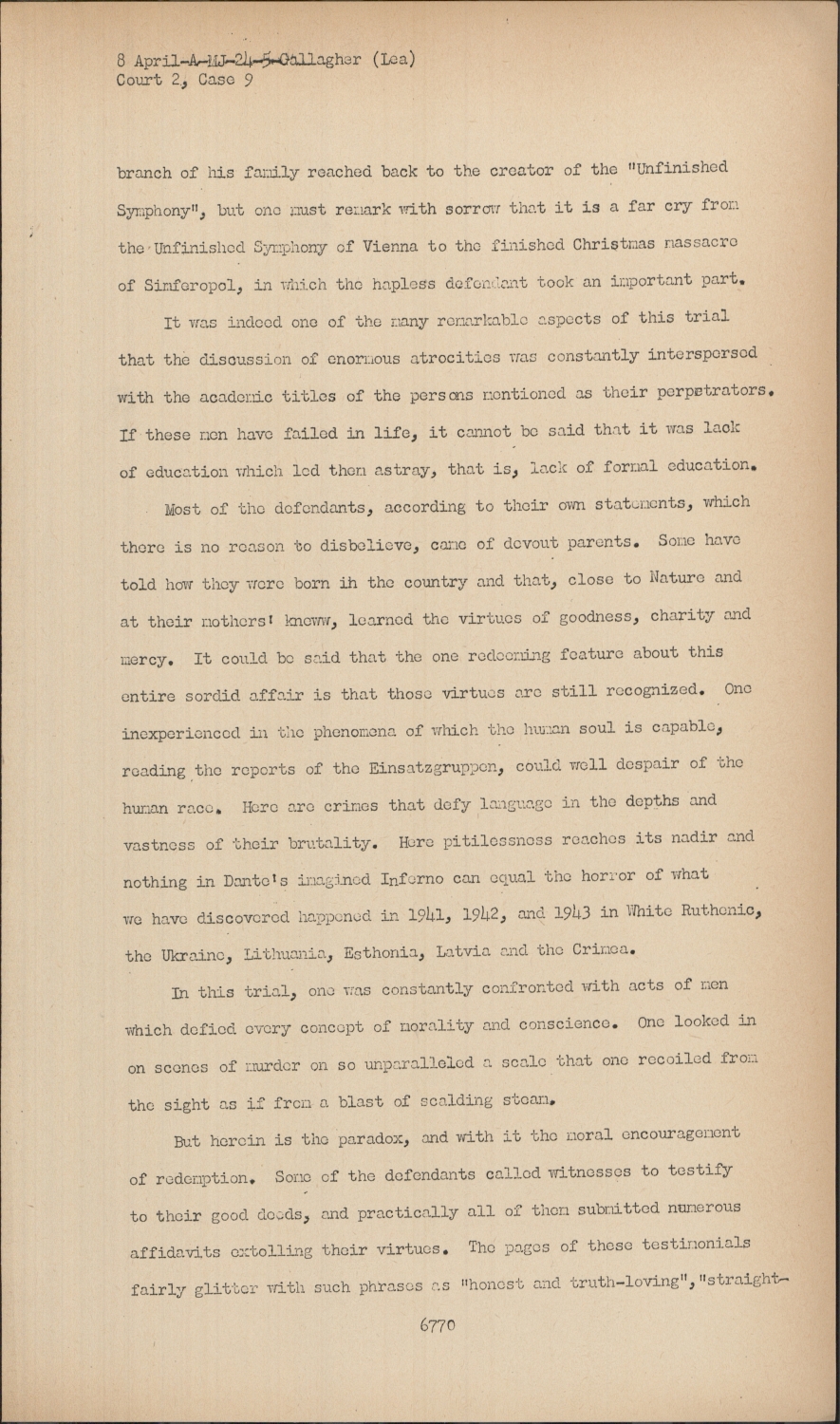
It was indeed one of the many remarkable aspects of this trial that the discussion of enormous atrocities was constantly interspersed with the academic titles of the persons mentioned as their perpetrators. If these men have failed in life, it cannot be said that it was lack of education which led them astray, that is, lack of formal education.
Most of the defendants, according to their own statements, which there is no reason to disbelieve, came of devout parents. Some have told how they were born in the country and that, close to Nature and at their mothers' kneww, learned the virtues of goodness, charity and mercy. It could be said that the one redeeming feature about this entire sordid affair is that those virtues are still recognized. One inexperienced in the phenomena of which the human soul is capable, reading the reports of the Einsatzgruppen, could well despair of the human race. Here are crimes that defy language in the depths and vastness of their brutality. Here pitilessness reaches its nadir and nothing in Dante's imagined Inferno can equal the horror of what we have discovered happened in 1941, 1942, and 1943 in White Ruthenic, the Ukraine, Lithuania, Esthonia, Latvia and the Crimea.
In this trial, one was constantly confronted with acts of men which defied every concept of morality and conscience. One looked in on scenes of murder on so unparalleled a scale that one recoiled from the sight as if from a blast of scalding steam.
But herein is the paradox, and with it the moral encouragement of redemption. Some of the defendants called witnesses to testify to their good deeds, and practically all of them submitted numerous affidavits extolling their virtues. The pages of these testimonials fairly glitter with such phrases as "honest and truth-loving", "straight thinking and friendly manner", "industrious, assiduous and good-natured", "of a sensitive nature", "absolutely honest".Through the acrid smoke of the executing rifles, through the fumes of the gas vans, through the unuttered last words of the one million slaughtered, the defendants have recalled the precepts gained at their mothers' knee.
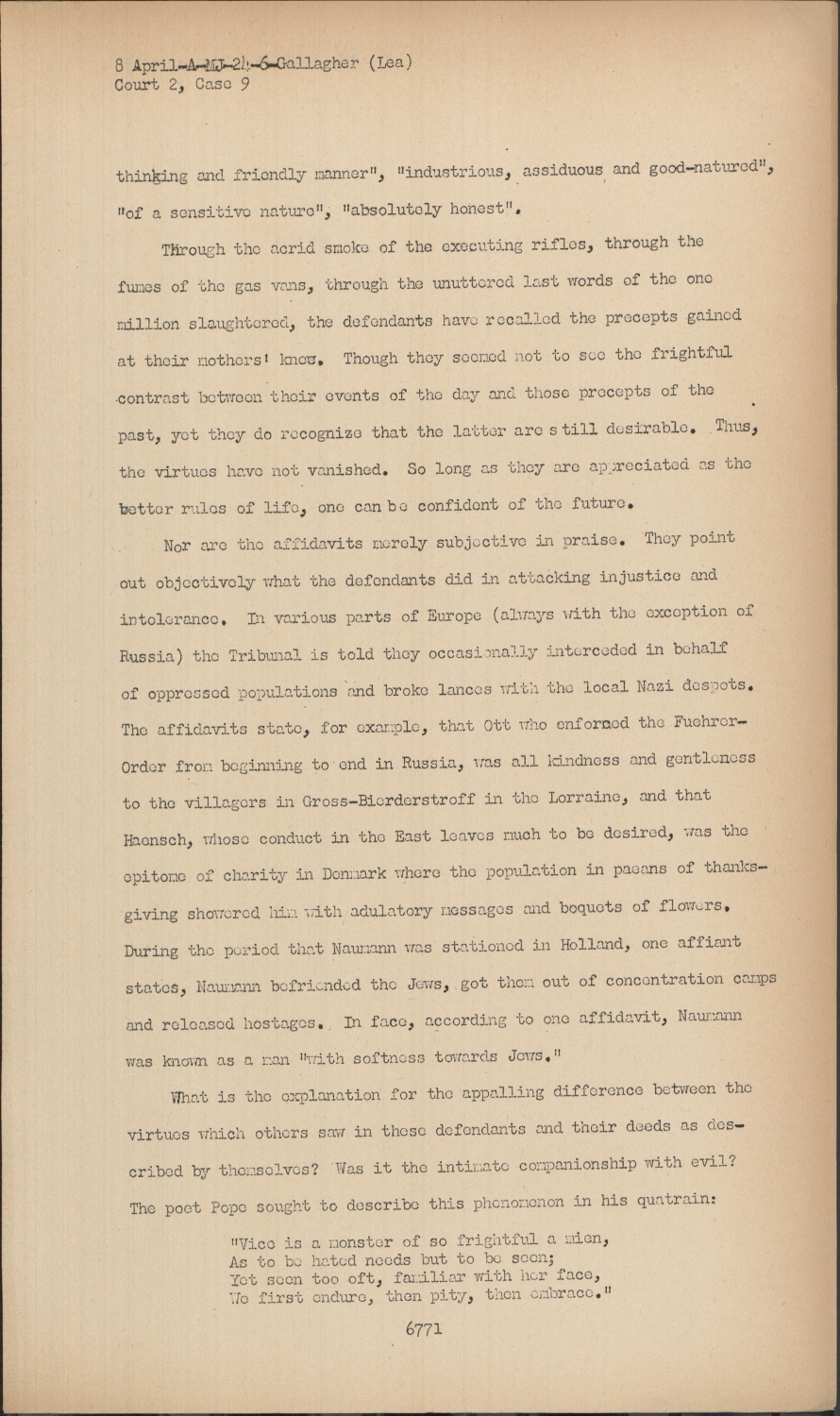
Though they seemed not to see the frightful contrast between their events of the day and those precepts of the past, yet they do recognize that the latter are still desirable. Thus, the virtues have not vanished. So long as they are appreciated as the better rules of life, one can be confident of the future.
Nor are the affidavits merely subjective in praise. They point out objectively what the defendants did in attacking injustice and intolerance. In various parts of Europe (always with the exception of Russia) the Tribunal is told they occasionally interceded in behalf of oppressed populations and broke lances with the local Nazi despots. The affidavits state, for example, that Ott who enforced the FuehrerOrder from beginning to end in Russia, was all kindness and gentleness to the villagers in Gross-Bierderstroff in the Lorraine, and that Haensch, whose conduct in the East leaves much to be desired, was the epitome of charity in Denmark where the population in paeans of thanksgiving showered him "with adulatory messages and boquets of flowers. During the period that Naumann was stationed in Holland, one affiant states, Neumann befriended the Jews, got them out of concentration camps and released hostages. In face, according to one affidavit, Naumann was known as a man "with softness towards Jews."
What is the explanation for the appalling difference between the virtues which others saw in these defendants and their deeds as described by themselves? Was it the intimate companionship with evil? The poet Pope sought to describe this phenomenon in his quatrain:
"Vice is a monster of so frightful a mien, As to be hated needs but to be seen;Yet seen too oft, familiar with her face, We first endure, then pity, then embrace."