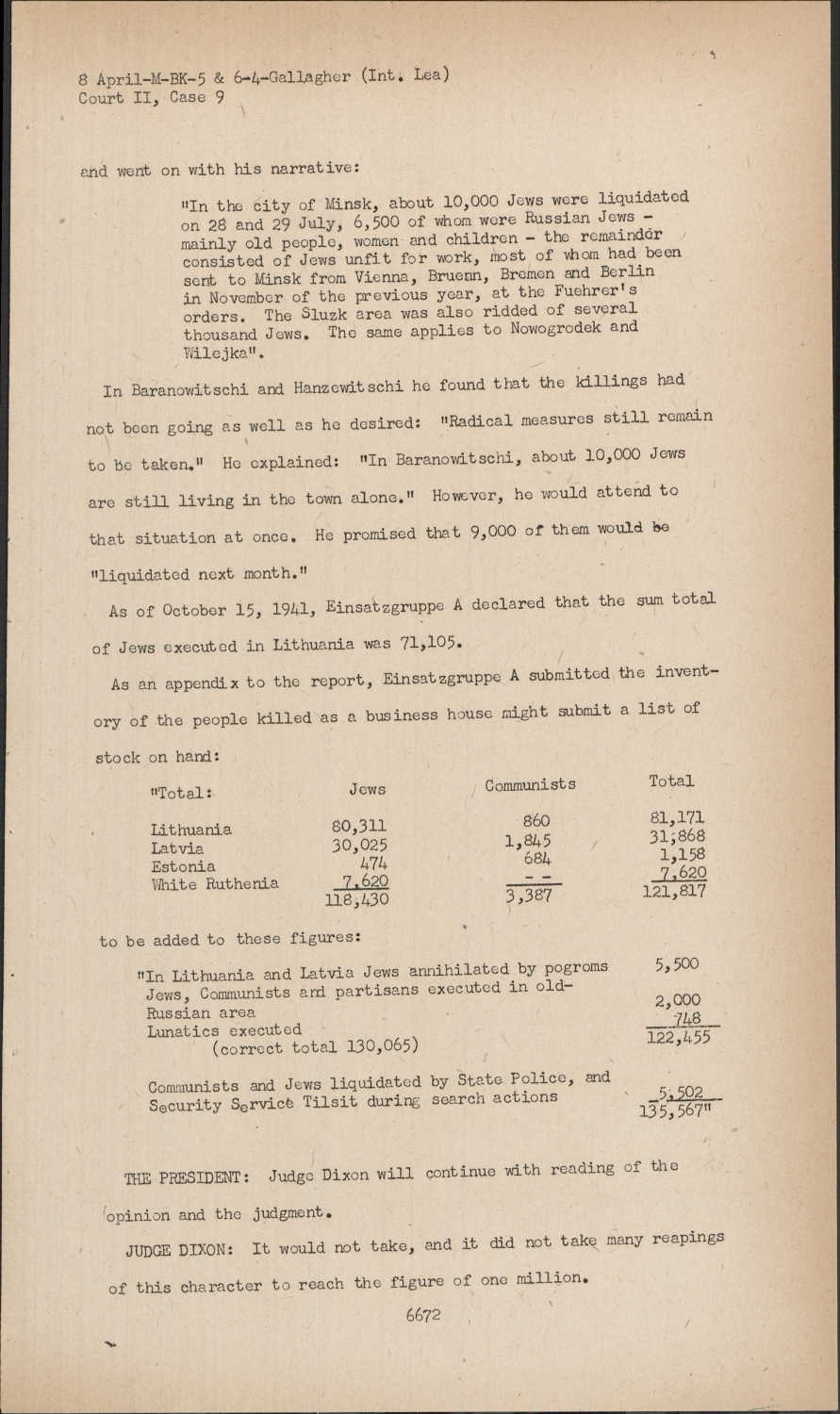
"In the city of Minsk, about 10,000 Jews were liquidated on 28 and 29 July, 6,500 of whom were Russian Jews mainly old people, women and children - the remainder consisted of Jews unfit for work, most of whom had been sent to Minsk from Vienna, Bruenn, Bremen and Berlin in November of the previous year, at the Fuehrer's orders.
The Sluzk area was also ridded of several thousand Jews.
The same applies to Nowogrodek and Wilejka".In Baranowitschi and Hanzewitschi he found that the killings had not been going as well as he desired:
"Radical measures still remain to be taken." He explained: "In Baranowitschi, about 10,000 Jews are still living in the town alone." However, he would attend to that situation at once. He promised that 9,000 of them would be "liquidated next month."
As of October 15, 1941, Einsatzgruppe A declared that the sum total of Jews executed in Lithuania was 71,105.
As an appendix to the report, Einsatzgruppe A submitted the inventory of the people killed as a business house might submit a list of stock on hand:
"Total: Jews Communists Total Lithuania 80,311 860 81,171 Latvia 30,025 1,845 31,868 Estonia 474 684 1,158 White Ruthenia 7.620 - - 7,620 ------ ----- -----to be added to these figures:
"In Lithuania and Latvia Jews annihilated by pogroms 5,500 Jews, Communists and partisans executed in old Russian area 2,000 Lunatics executed 748 ------(correct total 130,065) 122,455 Communists and Jews liquidated by State Police, and Security Service Tilsit during search actions 5,502 ------135,567"
THE PRESIDENT:Judge Dixon will continue with reading of the opinion and the judgment.
JUDGE DIXON:It would not take, and it did not take many reapings of this character to reach the figure of one million.
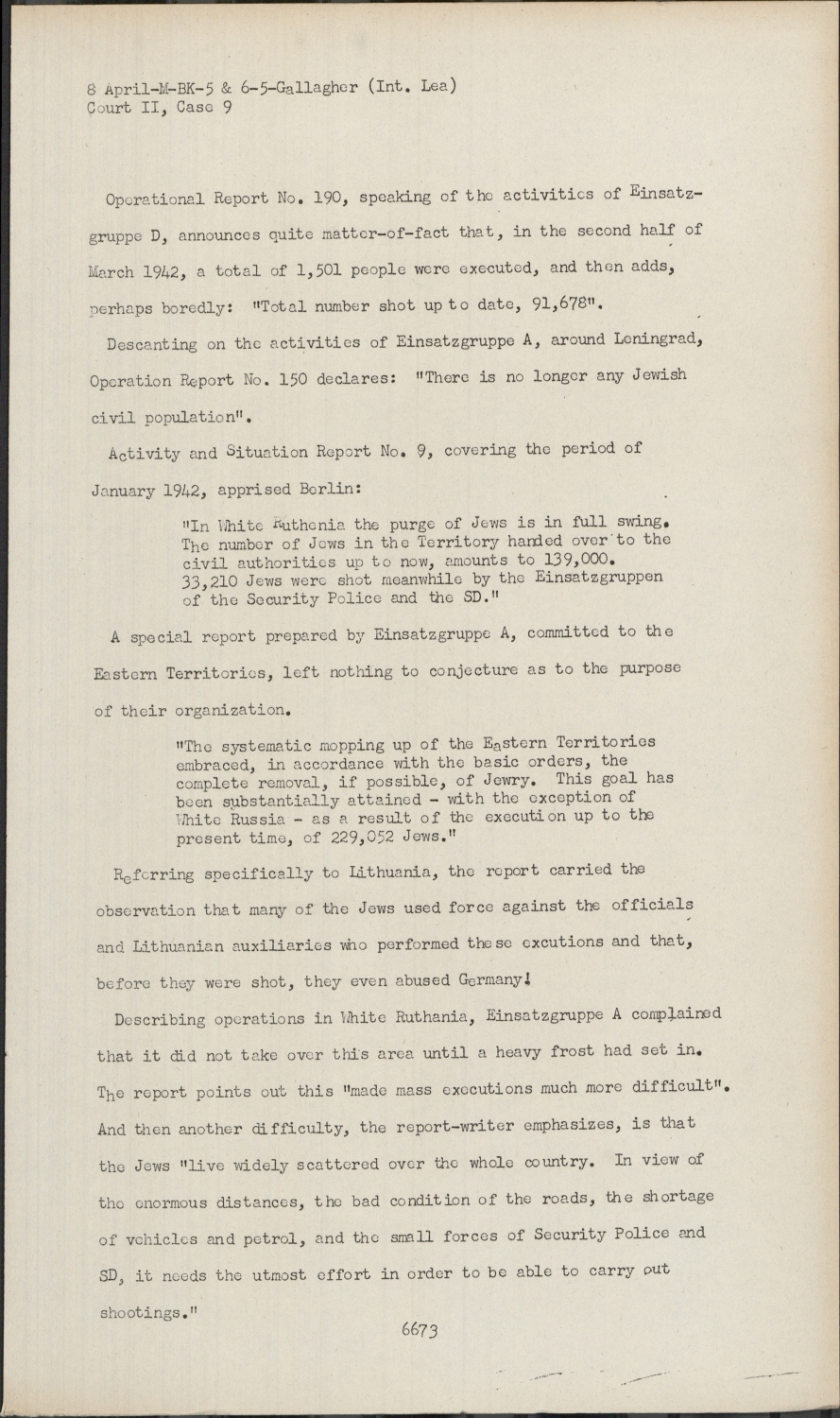
Operational Report No. 190, speaking of the activities of Einsatzgruppe D, announces quite matter-of-fact that , in the second half of March 1942, a total of 1,501 people were executed, and then adds, perhaps boredly: "Total number shot up to date, 91,678".
Descanting on the activities of Einsatzgruppe A, around Leningrad, Operation Report No. 150 declares: "There is no longer any Jewish civil population".
Activity and Situation Report No. 9, covering the period of January 1942, apprised Berlin:
"In White Ruthenia the purge of Jews is in full swing.
The number of Jews in the Territory handed over to the civil authorities up to now, amounts to 139,000.
33,210 Jews were shot meanwhile by the Einsatzgruppen of the Security Police and the SD."
A special report prepared by Einsatzgruppe A, committed to the Eastern Territories, left nothing to conjecture as to the purpose of their organization.
"The systematic mopping up of the Eastern Territories embraced, in accordance with the basic orders, the complete removal, if possible, of Jewry.
This goal has been substantially attained - with the exception of White Russia - as a result of the execution up to the present time, of 229,052 Jews."
Referring specifically to Lithuania, the report carried the observation that many of the Jews used force against the officials and Lithuanian auxiliaries who performed these excutions and that, before they were shot, they even abused Germany!
Describing operations in White Ruthania, Einsatzgruppe A complained that it did not take over this area until a heavy frost had set in. The report points out this "made mass executions much more difficult". And then another difficulty, the report-writer emphasizes, is that the Jews "live widely scattered over the whole country. In view of the enormous distances, the bad condition of the roads, the shortage of vehicles and petrol, and the small forces of Security Police and SD, it needs the utmost effort in order to be able to carry out shootings."
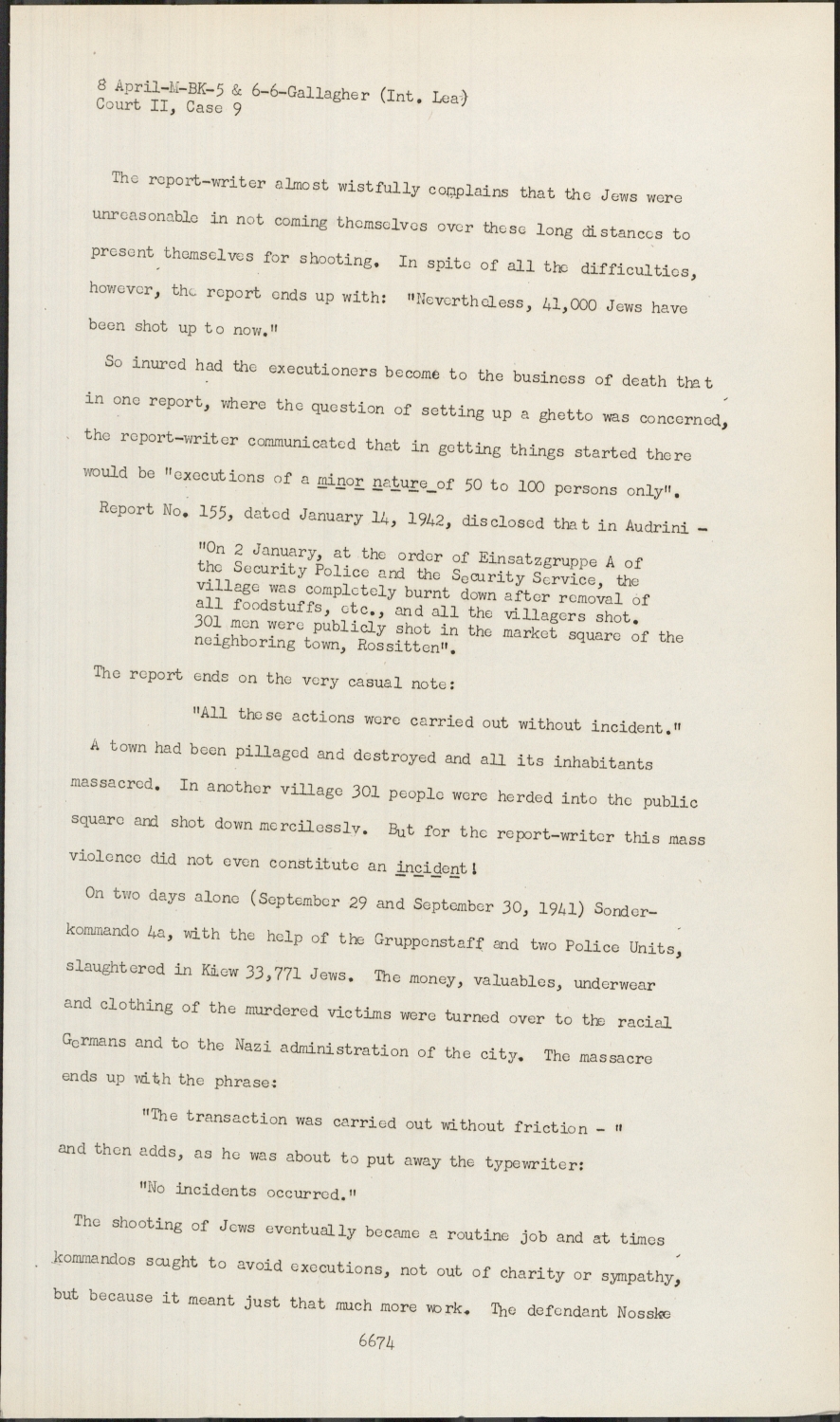
The report-writer almost wistfully complains that the Jews were unreasonable in not coming themselves over these long distances to present themselves for shooting. In spite of all the difficulties, however, the report ends up with: "Nevertheless, 41,000 Jews have been shot up to now."
So inured had the executioners become to the business of death that in one report, where the question of setting up a ghetto was concerned the report-writer communicated that in getting things started there would be "executions of a minor nature of 50 to 100 persons only".
Report No, 155, dated January 14, 1942, disclosed that in Audrini "On 2 January, at the order of Einsatzgruppe A of the Security Police and the Security Service, the village was completely burnt down after removal of all foodstuffs, etc.
, and all the villagers shot.
301 men were publicly shot in the market square of the neighboring town, Rossitten".The report ends on the very casual note:
"All these actions were carried out without incident."
A town had been pillaged and destroyed and all its inhabitants massacred. In another village 301 people were herded into the public square and shot down mercilessly. But for the report-writer this mass violence did not even constitute an incident!
On two days alone (September 29 and September 30, 1941) Sonderkommando 4a, with the help of the Gruppenstaff and two Police Units, slaughtered in Kiew 33,771 Jews. The money, valuables, underwear and clothing of the murdered victims were turned over to the racial Germans and to the Nazi administration of the city. The massacre ends up with the phrase:
"The transaction was carried out without friction - " and then adds, as he was about to put away the typewriter:
"No incidents occurred."
The shooting of Jews eventually became a routine job and at times kommandos sought to avoid executions, not out of charity or sympathy, but because it meant just that much more work. The defendant Nosske testified to a caravan of from 6,000 to 7,000 Jews who had been driven across the Dnjester River by the Rumanians into territory occupied by the German forces, and whom he guided back across the river.
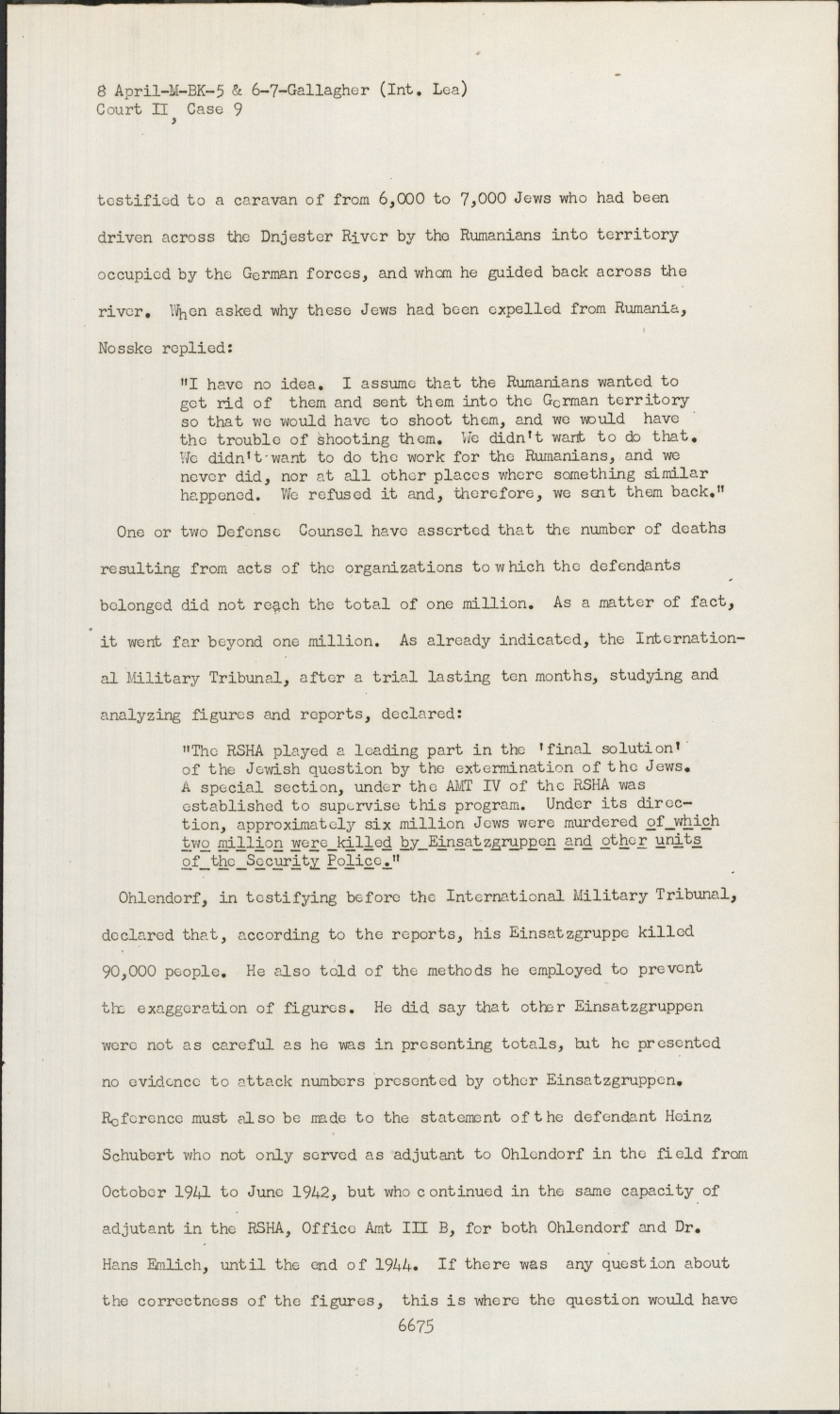
When asked why these Jews had been expelled from Rumania, Nosske replied:
"I have no idea. I assume that the Rumanians wanted to get rid of them and sent them into the German territory so that we would have to shoot them, and we would have the trouble of shooting them.
We didn't want to do that.
We didn't want to do the work for the Rumanians, and we never did, nor at all other places where something similar happened.
We refused it and, therefore, we sent them back."
One or two Defense Counsel have asserted that the number of deaths resulting from acts of the organizations to which the defendants belonged did not reach the total of one million. As a matter of fact, it went far beyond one million. As already indicated, the International Military Tribunal, after a trial lasting ten months, studying and analyzing figures and reports, declared:
"The RSHA played a leading part in the 'final solution' of the Jewish question by the extermination of the Jews.
A special section, under the AMT IV of the RSHA was established to supervise this program.
Under its direc tion, approximately six million Jews were murdered of which two million were killed by Einsatzgruppen and other units of the Security Police."
Ohlendorf, in testifying before the International Military Tribunal, declared that, according to the reports, his Einsatzgruppe killed 90,000 people. He also told of the methods he employed to prevent the exaggeration of figures. He did say that other Einsatzgruppen were not as careful as he was in presenting totals, but he presented no evidence to attack numbers presented by other Einsatzgruppen. Reference must also be made to the statement of the defendant Heinz Schubert who not only served as adjutant to Ohlendorf in the field from October 1941 to June 1942, but who continued in the same capacity of adjutant in the RSHA, Office Amt III B, for both Ohlendorf and Dr. Hans Emlich, until the end of 1944. If there was any question about the correctness of the figures, this is where the question would have been raised, but Schubert expressed no doubt nor did he say that these individuals who were momently informed in the statistics entertained the slightest doubt about them in any way.
Schubert showed very specifically the care which was taken to prepare the reports and to avoid errors:
"The Einsatzgruppe reported in two ways to the Reich Security Head Office.
Once through radio, then in writing.
The radio reports were kept strictly secret and, apart from Ohlendorf, his deputy Standartenfuehrer Willi Seibert and the head telegraphist Fritsche, nobody, with the exception of the radio personnel, was alloed to enter the radio station.
This is the reason why only the above-mentioned persons had knowledge of the exact contents of these radio reports.
The reports were dictated directly to Fritsche by Ohlendorf or Seibert.
After the report had been sent off by Fritsche I received it for filing.
In cases in which numbers of executions were reported a space was left open, so that I never knew the total amount of persons killed.
The written reports were sent to Berlin by courier.
These reports contained exact details and des criptions of the places in which the actions had taken place, the course of the operations, losses, number of places destroyed and persons killed, arrest of agents, reports on interrogations, reports on the civilian sector, etc."
The defendant Blume testified that he completely dismissed the thought of ever filing a false report because he regarded that as unworthy of himself.
THE PRESIDENT:The Tribunal will now be in recess fifteen minutes.
THE MARSHAL:The Tribunal will be in recess until 11:15 o'clock.
(recess)
THE MARSHAL:The Tribunal is again in session.
THE PRESIDENT:Judge Dixon continues with the reading of the opinion and judgment.
JUDGE DIXON:Then, the actual figures mentioned in the reports, staggering though they are, do by no means tell the entire story. Since the objective of the Einsatzgruppen was to exterminate all people falling in the categories announced in the Fuehrer-Order, the completion of the job in any given geographical area was often simply announced with the phrase: "There is no longer any Jewish population." Cities, towns and villages were combed by the kommandos and when all Jews in that particular community were killed, the report-writer laconically telegraphed or wrote to Berlin that the section in question was "freed of Jews". Sometimes the extermination area covered a whole country like Esthonia or a large territory like the Crimea. In determining the numbers killed in a designation of this character one needs merely to study the atlas and the census of the period in question. Sometimes the area set aside for an execution operation was arbitrarily set according to kommandos. Thus one finds in the reports such entries as: "The fields of activity of the kommandos is freed of all Jews."
And then there were the uncounted thousands who dies a death premeditated by the Einsatz units without their having to do the killing. When Jews were herded into a few miserable houses which were fenced off and called a "ghetto", this was incarceration -- but incarceration without a prison warden to bring them food. The reports make it abundantly clear that in these ghettos death was rampant, even before the Einsatz units began the killing off of the survivors. When, in a given instance, all male Jews and Jewesses over the age of 12 were executed, there remained, of course, all the children under 12. They were doomed to perish. Then there were those who were worked to death. All these fatalities are unmistakably chronicled in the Einsatz Reports, but do not show up in their statistics.
In addition, it must be noted that there were other vast numbers of victims of the Einsatzgruppen who did not fall under the executing rifles.
In many cities, towns end provinces hundreds and thousands of fellow-citizens of those slain fled in order to avoid a similar fate. Through malnutrition, exposure, lack of medical attention and particularly, if one thinks of the aged and the very young, of exhaustion, most if not all of those refugees perished. These figures, of course, do not appear in the Einsatzgruppen Reports, but the criminal responsibility for their deaths falls upon the Fuehrer-Order program as much as the actual shooting deaths.
Employment as Labor Before Execution At times, part of the Jewish population in a given community was temporarily spared, not for humanitarian reasons, but for economic purposes.
Thus, a report from Esthonia specifies:
"The arrest of all male Jews of over 16 years of age has been nearly finished.
With the exception of the doctors and the Elders of the Jews who were appointed by the Special Kommandos, they were executed by the Self-Protection Units under the control of the Spe cial Detachment 1 a. Jewesses in Pernau and Reval of the age groups from 16 to 60 who are fit for work were arrested and put to peat-cutting or other labor."
(L-180) In Lithuania, however, the executions went so fast that there was a great shortage of doctors for the non-Jewish population:
"More than 60% of the dentists were Jews; more than 50% of the other doctors as well.
The disappearance of these brings about an extreme shortage of doctors which cannot be overcome even by bringing in doctors from the Reich."
(L-180) A report from the Ukraine in September 1941 recommends that the Jews be killed by working and not by shooting:
"There is only one possibility which the German ad ministration in the Generalgouvernement has neglec ted for a long time:
Solution of the Jewish prob lem by extensive labor utilization of the Jews.
This will result in a gradual liquidation of the Jewry -- a development, which corresponds to the economic conditions of the country."
(NO-3151) In the cities of Latvia, German agencies used Jews as forced unpaid manpower, but there was always the danger that, despite these economic advantages to the Germans, the security police would shoot the working Jews.
(NO-3146) Einsatzgruppe C reports in September 1941:
"Difficulties have arisen, in so far as Jews are often the only skilled workers in certain trades.
Thus, the only harness-makers and the only good tailors at Nowo-Ukrainka are Jews.
At other places also only Jews can be employed for carpentry and locksmith work.
"In order not to endanger reconstruction and the repair work also for the benefit of transient troop units, it has become necessary to exclude provisionally especially the older Jewish skilled workers from the executions."
(NO-3146) In a certain part of the Ukraine, described as between Krivoi-Rog and Dnepropetrovsk, collective farms, known as Colchoses,were found to be operated by Jews.
They were described in the report as being of low intelligence but since they were good workers the einsatz commander did not liquidate them. However, the report goes on to say that the einsatz commander was satisfied with merely shooting the Jewish managers. (NO-3153) The Nazi Commissioner-General for White Ruthenia, reporting in July 1942, expressed quite frankly his desire to strike down all Jews in one murderous stroke.
However, he was willing to stay his arm temporarily until the requirements of the Wehrmacht should be satisfied:
"I myself and the SD would certainly much prefer that the Jewish population in the District General of White Ruthenia should be eliminated once and for all when the economic requirements of the Wehrmacht have fallen off.
For the time being, the necessary require ments of the Wehrmacht who is the main employed of the Jewish population are still being considered."
(3428-PS) Operation Report No. 11, dated July 3, 1941, also explains that in the Baltic region the Wehrmacht is not "for the time being" in a position to dispense with the manpower of the Jews still available and fit for work.
(NO-4537) It must not be assumed, however, that once being assigned to work the Jews were free from molestation.
Einsatzgruppe B, reporting on affairs in Witebsk, declared:
"By appointed Jewish Council, so far about 3,000 Jews registered.
Badges for Jews introduced.
At present they are being employed with clearing rub ble.
For deterrent, 27 Jews, who had not come to work, were publicly shot in the streets."
(NO-2954) One report-writer, describing conditions in Esthonia, complained that as the Germans advanced, the Esthonians arrested Jews but did not kill them.
He shows the superior methods of the Einsatzgruppe:
"Only by the Security Police and the SD were the Jews gradually executed as they became no longer required for work."
(2273-PS) He then adds as an obvious deduction:
"Today there are no longer any Jews in Esthonia."
Just as a heartless tradesman may work a superannuated horse until he has drained from its body the last ounce of utility, so did the action unit in Minsk dispose of the Jews:
"In Minsk itself--exclusive of Reich Germans -- there are about 1,800 Jews living, whose shooting must be post poned in consideration of their being used as labor."
(2273-PS) In White Ruthenia the kommando leaders were instructed on orders of Heydrich to suspend the killing of Jews until after they had brought in the harvest.
Instigation to Pogroms Certain Einsatzkommandos committed a crime which, from a moral point of view, was perhaps even worse than their own directly committed murders, that is, their inciting of the population to abuse, maltreat and slay their fellow citizens.
To invade a foreign country, seize innocent inhabitants and shoot them is a crime, the mere statement of which is its own condemnation. But to stir up passion, hate, violence and destruction among the people themselves, aims at breaking the moral backbone, even of those the invader chooses to spare. It sows seeds of crime which the invader intends to bear continuous fruit, even after he is driven out.
On the question of criminal knowledge it is significant that some of those responsible for these shameless crimes endeavored to keep them secret. SS-Brigadier General Stahlecker, head of Einsatzgruppe A, reporting on activities of Einsatzgruppe A, stated in October 1941 that it was the duty of his Security Police to set in motion the passion of the population against the Jews. "It was not less important", the report continued, "In view of the future to establish the unshakable and provable fact that the liberated population themselves took the most severe measures against the Bolshe vist and Jewish enemy quite on their own, so that the directions by German author ities could not be found out."
(L-180) In Riga this same Stahlecker reported:
"Similarly, native anti-Semitic forces were induced to start pogroms against Jews during the first hours after cap ture, though this inducement proved to be very difficult.
Following out ord ers, the Security Police was determined to solve the Jewish question with all possible means and most decisively.
But it was desirable that the Security Po lice should not put in an immediate ap pearance, at least in the beginning, since the extraordinarily harsh measures were apt to stir even German circles.
It had to be shown to the world that the na tive population itself took the first ac tion by way of natural reaction against the suppression by Jews during several decades and against the terror exercised by the Communists during the preceding period."
(L-180) Stahlecker was surprised and disappointed that in Lithuania it was not so easy to start pogroms against the Jews.
However, after certain prodding and assistance, results were attained. He reports:
"Klimatis, the leader of the partisan unit, mentioned above, who was used for this pur pose primarily, succeeded in starting a pogrom on the basis of advice given to him by a small advanced detachment acting in Kowno, and in such a way that no German order or German instigation was noticed from the outside.
During the first pogrom in the night from 25 to 26 June the Lith uanian partisans did away with more than 1,500 Jews, set fire to several synagogues or destroyed them by other means and burn ed down a Jewish dwelling district con sisting of about 60 houses.
During the following nights about 2,300 Jews were made harmless in a similar way.
In other parts of Lithuania similar actions fol lowed the example of Kowno, though small er and extending to the Communists who had been left behind."
(L-180) In working up special squads to initiate and carry through pogroms in Lithuania and Latvia, Stahlecker made it a point to select men who for personal reasons had a grudge against the Russians.
Somehow these squads were then made to believe that by killing Jews they were avenging themselves on the Russians for their own griefs.
Activity and Situation Report No. 6, prepared in October 1941, complained that Einsatz units operating in Estonia could not provoke "spontaneous, anti-Jewish demonstration with ensuing pogroms" because "adequate enlightment was lacking". However, as stated before, not everything was lost because under the direction of the Einsatzgruppe of the Security Police and Security Service, all male Jews over the age of 16, with the exception of doctors and Jewish Elders, were arrested and killed. The report then states: "At the conclusion of the operation there will be only 500 Jewesses and children left in the Ostland".
Hermann Friedrich Graebe, manager and engineer in charge of a German building firm in Sdolbunow, Ukraine, has described in graphic language just how a pogrom operates. When he heard that a pogrom was being incubated he called on the commanding officer of the town, SS-Sturmbannfuehrer Putz, to ascertain if the story had any basis in fact since he, Graebe, employed some Jewish workers whom he wished to protect. Sturmbannfuehrer Putz denied the rumors. Later, however, Graebe learned from the Area Commissioner's deputy, Stabsleiter Beck, that a pogrom was actually in the making but he exacted from Graebe the promise not to disclose the secret. He even gave Graebe a certificate to protect his workers from the pogrom. This amazing document reads:
"Messrs. JUNG R o w n o The Jewish workers employed by your firm are not affected by the pogrom.
You must transfer them to their new place of work by Wednesday, 15 July 1942, at the latest.
From the Area Commissioner Beck".
That evening the pogrom broke. At ten o'clock SS-men and Ukrainian militia surged into the Ghetto, forcing doors with beams and crossbars. Let Graebe tell the story in his own words:
"The people living there were driven on to the street just as they were, regardless of whether they were dressed or in bed.
Since the Jews in most cases refused to leave their houses and resisted, the SS and militia applied force.
They finally succeeded, with strokes of the whip, kicks and blows, with rifle butts in clearing the houses.
The people were driven out of their houses in such haste that small children in bed had been left behind in several instances.
In the street women cried out for their children and children for their parents.
That did not prevent the SS from driving the people along the road, at running pace, and hitting them, until they reached a waiting freight train.
"Car after car was filled, and the screaming of women and children, and the cracking of whips and rifle shots resounded unceasingly.
Since several families or groups had barricaded themselves in especially strong buildings, and the doors could not be forced with crowbars or beams, these houses were now blown open with handgrenades.
Since the Ghetto was near the railroad tracks in Rowno, the younger people tried to get across the tracks and over a small river to get away from the Ghetto area.
As this stretch of country was beyond the range of the electric lights, it was illuminated by signal rockets.
"All through the night these beaten, hounded and wounded people moved along the lighted streets.
Women carried their dead children in their arms, children pulled and dragged their dead parents by their arms and legs down the road toward the train.
Again and again the cries 'Open the door! Open the door!' echoed through the Ghetto."
Despite the immunity guaranteed his Jewish workers by Commissioner Beck, seven of them were seized and taken to the collecting point. Graebe's narrative continues:
"I went to the collecting point to save these seven men.
I saw dozens of corpses of all ages and both sexes in the streets I had to walk along.
The doors of the houses stood open, windows were smashed.
Pieces of clothing, shoes, stockings, jackets, caps, hats, coats, etc.
were lying in the street.
At the corner of the house lay a baby, less than a year old with his skull crushed.
Blood and brains were spattered over the house wall and covered the area immediately around the child.
The child was dressed only in a little skirt.
The commander, SS Major Puetz, was walking up and down a row of about 80 - 100 male Jews who were crouching on the ground.
He had a heavy dog whip in his hand. I walked up to him, showed him the written permit of Stabs leiter Beck and demanded the seven men whom I recognized among those who were crouching on the ground.
Dr. Puetz was very furious about Beck's concession and nothing could persuade him to release the seven men.
He made a motion with his hand encircling the square and said that anyone who was once here would not get away.
Although he was very angry with Beck, he ordered me to take the people from 5 Bahnhof strasse out of Rowno by 8 o'clock at the latest.
"When I left Dr. Puetz, I noticed a Ukrainian farm cart, with two horses.
Dead people with stiff limbs were lying on the cart, legs and arms projected over the side boards.
The cart was making for the freight train. I took the remaining 74 Jews who had been locked in the house to Sdolbunow."
5,000 Jews were massacred in this pogrom.
Special Kommando 7 which, as heretofore indicated, had shot the 27 Jews on the streets of Witebsk, announced in its report:
"The Ruthenian part of the population has approved of this.
Large-scale execution of Jews will follow immediately."
The active cooperation of the action units with the accomplishment of pogroms is evidenced by one report where the Sipo and SD want some of the credit for the murders committed:
"As a result of the pogroms carried out by the Lithua nians, who were nevertheless substantially assisted by Sipo and SD, 3,800 Jews in Kauen and 1,200 in the smaller town were eliminated."
In some areas special groups were set up:
"In addition to this auxiliary police force, 2 more independent groups have been set up for the purpose of carrying out pogroms.
All synagogues have been destroyed; 400 Jews have already been liquidated."
THE PRESIDENT:The presiding judge continues with the reading: Heading, Appropriation of Personal Effects and Valuables While no explanation was ever given as to why the Nazis condemned the Jews to extermination, the public record shows that they counted on substantial material advantage.
The levying of enormous indemnities against persons considered by the Nazis as Jews or halfJews and the expropriation of their property in Germany as well as in the countries occupied by it, brought huge returns to the coffers of the Reich. And even in the dread and grim business of mass slaughter, a definite profit was rung up on the Nazi cash register. For example, Situation Report No. 73, dated 4 September 1941 reporting on the executions carried out by a single unit, Einsatzkommando 8, makes the cold commercial announcement:
"On the occasion of a purge at Tscherwen 125,880 rubels were found on 139 liquidated Jews and were confiscated.
This brings the total of the money confiscated by Einsatz kommando 8 to 1,510,399 rubels up to the present day."
Situation Report No. 133, dated 14 November 1941, shows the progress made by this unit in a little over two months:
"During the period covered by this report, Einsatzkommando 8 confiscated a further 491,705 rubels as well as 15 gold rubels.
They were entered into the ledgers and passed to the Administration of Einsatzkommando 8. The total amount of rubels so far secured by Einsatzkommando 8 now amounts to 2,511,226 rubels."
On 26 October 1941, Situation Report No. 125 gave Einsatzkommando 7b credit for 46,700 rubels taken from liquidated Jews, Einsatzkommando 9 credit for 43,825 rubels and "various valuables in gold and silver", and recorded that Einsatzkommando 8 had increased the amount of its loot to the sum of 2,019,521 rubels.
Operation and Situation Report No. 31, dated July 1941, rendering an account of operations in Lithuania, recorded the taking of "460,000 rubels in cash as well as a large number of valuables" from liquidated Jews. The report stated further:
"The former Trade Union Building in Wilna was secured for the German Labor Front (DAF) at their request, likewise the money in the trade union accounts in banks, totalling 1.5 million rubels."
Although engaged in an ideological enterprise, supposedly undertaken on the highest ethnic and cultural level, executants of the program were not above the most petty and loathsome thievery. In the liquidation of Jews in Zhitomir and Kiew the reporting Einsatzkommando collected 137 trucks full of clothing. The report does not say whether the clothing was torn from the victims while they were still alive or after they had been killed. This stolen raiment was turned over to the National Socialist People's Welfare Organization.
One of the defendants related how during the winter of 1941 he was ordered to obtain furcoats for his men, and that since the Jews had so much winter clothing, it would not matter much to them if they gave up a few fur coats. In describing an execution which he attended, the defendant was asked whether the victims were undressed before the execution. He replied: "No, the clothing wasn't taken - this was a fur coat procurement operation."
A document issuing from Einsatzgruppe D headquarters (February 1942) speaks of the confiscation of watches in the course of anti-Jewish activities. The term "confiscate" does not change the legal or moral character of the operation. It was plain banditry and highway robbery. The gold and silver watches were sent to Berlin, others were handed over to the Wehrmacht (rank and file) and to members of the Einsatzgruppe itself "for a nominal price" or even gratuitously if the circumstances warranted that kind of liberality with these blood-stained articles. This report also states that money seized was transmitted to the Reich Bank, except "for a small amount required for routine purposes (wages etc.)". In other words the executioners paid themselves with money taken from their victims.
The same Einsatzgruppe, reporting on the hard conditions under which some Ethnic German families were living in Southern Russia, showed that it helped by placing Jewish homes, furniture, children's beds, and other equipment at the disposition of the Ethnic Germans. These houses and equipment were taken from liquidated Jews.
Einsatzgruppe C, proudly reporting on its accomplishments in Korowo (September 1941), stated that it organized a regular police force to clear the country of Jews as well as for other purposes. The men enlisted for this purpose, the report goes on to say, received "their pay from the municipality from funds seized from Jews".
Whole villages were condemned, the cattle and supplies seized, (that is stolen), the population shot and then the villages themselves destroyed.
Villages were razed to the ground because of the fact, or under the shallow pretense, that some of the inhabitants had been aiding or lodging partisans.
The reports abound with itemization of underwear, clothing, shoewear, cooking-utensils, etc., taken from the murdered Jews.
In Poltawa, 1,538 Jews were shot and their clothing was handed over to the mayor who, according to the report covering this action, "gave special priority to the Ethnic Germans when distributing it".
Even those who were destined for death through the gas vans had to give up their money and valuables and sometimes their clothes before breathing in the carbon monoxide.
Money and valuables taken from victims were sent to Berlin to the Reich Ministry of Finance. When a Jewish Council of Elders was appointed to register the Jews for the ostensible purpose of resettlement, the Council was also requested to submit the financial situation of the Jews. This facilitated the despoiliation of their possessions which went hand in hand with their execution.
Court No. II, Case No. IX.
Prisoners of War The extermination program on racial and political grounds also extended to prisoners of war.
Even in the first weeks of Germany's war against Russia, large numbers of civilians from the invaded areas were indiscriminately thrown into prisoner of war camps, run by the P.O.W. department of the High Command of the Wehrmacht. On 17 July 1941, Heydrich issued Operational Order No. 8, which contained "directives" for the Einsatz units "detailed to permanent P.W. camps (Stalags) and Transit camps (Dulags)". These directives not only grossly violated the provisions of the Hague Regulations on prisoners of war and civilians in belligerently occupied territories and of century-old rules and customs of warfare, but outraged every principle of humanity. They provided for nothing less than the cold-blooded mass-murder of prisoners of war, and of civilians held in P.W. camps. The directives state as their "purpose":
"The Wehrmacht must immediately free it self of all those elements among the pri soners of war who must be regarded as Bolshevist influence.
The special situa tion of the campaign in the east, there fore, demands special measures (Italics original) which have to be carried out in a spirit free from bureaucratic and ad ministrative influences, and with an eager ness to assume responsibility."
The directives instruct the Einsatz units as to which categories of persons to seek out "above all". This list mentions in detail all categories and types of Russian Government officials, all influential communist party officials, "the leading personalities of the economy", "the Soviet Russian intellectuals", and as a separate category -- the category which was again to yield the largest number of victims of this "action" -
"All Jews" It, in fact, emphasized that in -"taking any decisions, the racial origin has to be taken into consideration."
Concerning executions, the directives specified:
Court No. II, Cass No. IX.
"The executions must not be carried out in the camp itself or in its immediate neighborhood.
They are not public and are to be carried out as inconspicuously as possible."
Further:
" "In order to facilitate the execution of the purge, a liaison-officer is to be sent to Generalmajor von Hindenburg, Commander-in-Chief of the P.W. camps in the Army Corps Area, East Prussia, in Koenigsberg, Prussia, and to General leutnant Herrgott, Commander-in-Chief of the P.W. camps in the General Gouvern ment in Kieloe."
Under this program doctors, if found in the POW camps, were doomed either because they were "Russian intellectuals" or because they were Jews. However, by 29 October 1941, Heydrich found it necessary to rule:
"Because of the existing shortage of physicians and medical corps personnel in the camps, such persons, even if Jews, are to be excluded from the segregation and to be left in the P.W.camps, except in particularly well founded cases."
Another passage in this order of Heydrich vividly demonstrates to what extent the Reich went officially in flouting the most basic rules of international law and the principles of humanity:
"The chiefs of the Einsatzgruppen decide on the suggestions for execution on their own responsibility and give the Sonder kommandos the corresponding orders."
It is apparent that all those involved in this program were aware of its illegality:
"This order must not be passed on in writing -- not even in the form of an excerpt.
District commanders for Prisoners of war and commanders of Transit camps must be notified verb ally."
It is to the credit of an occasional army officer that he objected to this shameful and degrading repudiation of the rules of war. In one report we find:
Court No. II, Case No. IX.
"As a particularly clear example the conduct of a camp commander in Winniza is to be mentioned who strongly ob jected to the transfer of 362 Jewish prisoners of war carried out by his deputy and even started court martial proceedings against the deputy and two other officers."
General Fieldmarshal von Reichenau, commanding the Sixth Army, however, was not so chivalrous as the officer indicated. The report states further:
"Generalfeldmarshal von Reichenau has, on 10 October 1941, issued an order which states clearly that the Russian soldier has to be considered on prin ciple a representative of Bolshevism and has also to be treated accordingly by the Wehrmacht."
Perhaps the nadir in heartlessness and cowardice was reached by these murder groups when one of the kommandos brutally killed helpless, wounded prisoners of war. Einsatzgruppe C, reporting (November 1941) on an execution performed by Sonderkommando 4a, stated:
"....the larger part were again Jews, and a considerable part of these were again Jewish prisoners of war who had been handed over by the Wehrmacht.
At Borispol, at the request of the com mander of the Borispol POW-Camp, a platoon of Sonderkommando 4a shot 752 Jewish prisoners of war on 14 October 1941 and 357 Jewish prisoners of war on 10 October 1941, amongst them some commissioners and 78 wounded Jews, handed over by the camp physician."
PRESIDENT: The next heading, METHODS OF EXECUTION How were the executions conducted?
What was the modus operandi? On this subject history need not remain in the dark. Several of the executioners have themselves cleared away all mystery as to just how they accomplished their extraordinary deeds. Defendant Paul Blobel, who stated that his sonderkommando killed between 10,000 and 15,000 people, described in some detail one performance he personally directed. Specifying that from 700 to 1,000 persons were Court No. II, Case No. IX.