can not be drafted to service on the basis of the Emergency Service regulation".
And he continues:
"It may not be concluded from that this an "indispensable" status based on the Defense Law could not have been altered by an Emergency Service draft. Rather, the procedure was such that an Emergency Service draft could overrule an "indispensable" status for a civil service, i.e. outside of the Defense Law, without any trouble. In practice this was handled in such a way that the man drafting for emergency service had to negotiate with the civilian office for which the "indispensable" status applied, for instance with the town administration."
Finally, Dr. Holz also made statements which are based on his practical experience of many years with regard to the question as to whether one could evade the Emergency Service Decree. He states that he does not know of one single case where somebody would have dared to make an attempt of evading the draft for emergency service. Everybody knew that such a behavior would have been interpreted as political unreliability or as sabotage and that his behavior would have caused state police interference with the customary consequences, such as commitment to a concentration camp. Finally, Dr. Holz declared that he did not experience a single case in his practice where a person liable to emergency service would have succeeded in evading the draft.
Thus it is evident: It is not very commendable to trap a defendant today by applying judicial theories based on the decrees and laws of the Third Reich.
Whether somebody, on the basis of voluntary application or as a consequence of his career as civil servant or by being drafted into emergency service, had come into the mysterious sphere of the RSHA, Heydrich's threat applied to all of them, namely that the very attempt voluntarily to resign would mean concentration camp and physical extermination of the renegade.
It is astonishing how the defendant von Radetzky nevertheless, about a dozen times, ventured to get out of the liability for emergency service. First of all he asked his employer, the Repatriation Office for Ethnic Germans, to requisition him; Radunski in his affidavit of 14 November 1947 (Doc. Book Radetzky II, page 60, Doc. No. 15, Exh. 5) stated that von Radetzky's application for re-employment with with the Repatriation Office for Ethnic Germans was not processed by chief of staff Behrends because the latter shunned quarrels with the SD in personnel matters. At every change of commanders with Sonderkommando Ha, von Radetzky repeated his risky attempt, he troubled his Baltic friend von Freytag-Loeringhoven, who for a certain time was Ic of Army Group Center, to assist him in this dangerous game. He repeatedly informed first one person then the other, in Einsatzgruppe I, of his wishes, always hoping perhaps some time to contact the right man and to discover the right way. A gracious fate protected the defendant von Radetzky so that this, not only dangerous, but I may say, also naive playing with fire did not one day become a flame, consuming him. As regards his naivety, I must in this connection refresh your memory that von Radetzky told us how he sent two memoranda from Shitomir to the Reich Minister for the Occupied Eastern Territories , one concerning the treatment of the Jewish question, hoping thus to effect a change of the German policy in the East. One must have been a Baltic German of the mould of a Radetzky with so much ignorance about the actual conditions on the one hand and with so much faith in the good of human nature on the other, in order at all to get the idea of writing such a memorandum. Maybe this imperturbably decent and good character of the defendant von Radetzky is the reason why his desires were not taken amiss and why he was not treated in agreement with Heydrich's threat. With this confiding naivery he seriously and obstinately purused his goal and first of all succeeded in being granted leave from the middle of December 1941 until the middle of March 1942; and then h e was very fortunate in finally finding a man right in the center of the RSHA with whom he not only could speak openly but who even promised him his full support; this was defendant Schulz, at that time Personnel Officer in the RSHA, with whose assistance von Radetzky , after long, vain efforts, finally succeeded in being released from Eastern assignment (Einsatz).At the conclusion of its statements on Gestapo and SD, the IMT declares verbatim as follows (page 108 of the quoted edition):"The Tribunal declares the group of such members of the Gestapo and the SD to be criminal according to the sense of the statutes as held the positions enumerated in the previous section, as were members of the organizations or remained so, although they knew that these were being used for the performance of deeds which according to Article 6 of the statute have been declared to be criminal and such as being members of the organization personally participated in the perpetrated in the perpetration of such crimes."
With regard to the case of the defendant von Radetzky the following amy be said in summarizing: (1) the defendant was not a member of the SD in the sense of this sentence, since he joined the service of the Einsatzgruppe and the RSHA on the basis of a civilian draft, the so-called Emergency Service obligation, and never in any way voluntarily; (2) he cannot be reproached for having stayed in the service since he made every effort that reasonably may be expected from him, considering the situation at that time, in order to escape this service, rendered involuntarily and reluctantly, and he did so immediately employing every opportunity offering itself regardless of possible consequences as we could see from his discussion with the Chief of the Einsatzgruppe Thomas. A third point speaks in favor of the defendant von Radetzky: Not only was he not a member of the SD, he also never participated in the perpetration of the crimes mentioned in the sentence of the IMT.
The Prosecution seems to attempt to substantiate in a double way the individual responsibility of the defendant v. RADETZKY; (1) by ascribing to him a special position and authority in Sonderkommando 4a on the basis of his rank in the General SS, saying: this very authority makes the defendant appear guilty; (2) by presenting his mere belonging to Sonderkommando 4a as evidence for his criminal participation in executions; one could assume that it was impossible to have belonged to Sonderkommando 4a as an officer without being entangled with these things.
I have already stated that neither the uniform nor the rank hold in the General SS are evidence for the authority and the sphere of responsibility of the defendant within Sonderkommando 4a; in addition, that his duties to begin with were adjusted to the purpose of his emergency service obligation. It is still necessary to discuss the further development of the activity of the defendant v. RADETZKY with Sonderkommando 4a in order to remove every doubt about the miscarriage of the argumentation of the Prosecution concerning the individual guilt of this defendant.
As a preamble to these discussions I can use the thesis of the Prosecution expresses at the conclusion of its opening statement of 29 September 1947, saying that the defendants were under the obligation, if not by their conscience then by law, to refrain from such an activity. The story of the activity of the defendant v. RADETZKY is nothing but a successful attempt, attended by equal shares of good luck and ability, to stay out. Since he also regarded his activity as interpreter as dangerous-under no circumstances would he have to deal with interrogations - he merely restricted himself to reporting and thus gradually severed his connections with Sonderkommando 4a altogether, he became liaison officer to the army and in this practical manner achieved what was not possible for him in any other way.
From the affidavit of the former departmental head III with the Staff of Einsatzgruppe C, Karl HENNICKE, of 28 November 1947(Doc. Book I RADETZKY II, page 76, Doc.No. 20, Exh. 14) I quote his statement with regard to v. RADETZKY's activity as follows:
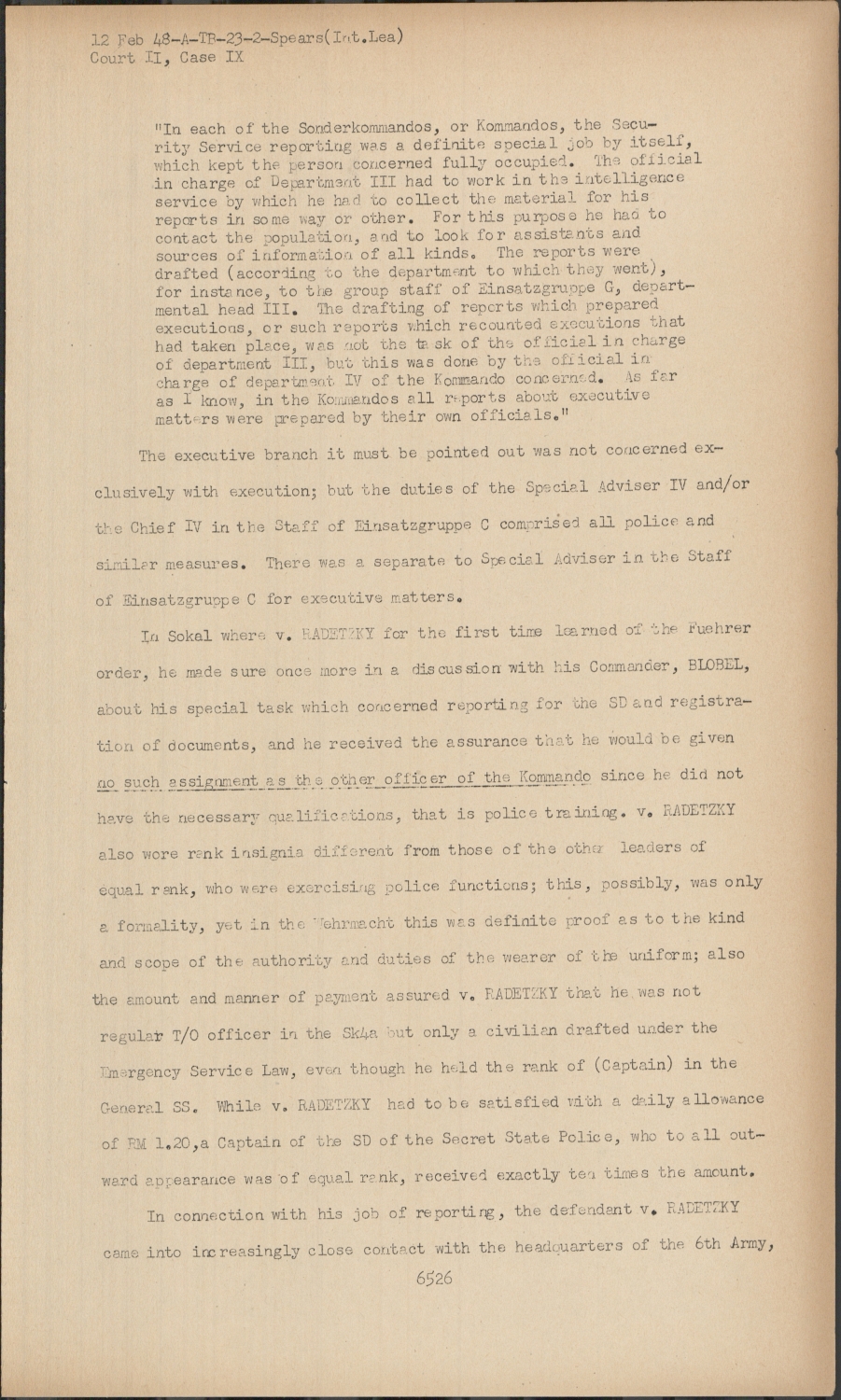
"In each of the Sonderkommandos, or Kommandos, the Secu rity Service reporting was a definite special job by itself, which kept the person concerned fully occupied.
The official in charge of Department III had to work in the intelligence service by which he had to collect the material for his reports in some way or other.
For this purpose he had to contact the population, and to look for assistants and sources of information of all kinds.
The reports were drafted (according to the department to which they went), for instance, to the group staff of Einsatzgruppe G, depart mental head III.
The drafting of reports which prepared executions, or such reports which recounted executions that had taken place, was not the task of the official in charge of department III, but this was done by the official in charge of department IV of the Kommando concerned.
As far as I know, in the Kommandos all reports about executive matters were prepared by their own officials."
The executive branch it must be pointed out was not concerned exclusively with execution; but the duties of the Special Adviser IV and/or the Chief IV in the Staff of Einsatzgruppe C comprised all police and similar measures. There was a separate to Special Adviser in the Staff of Einsatzgruppe C for executive matters.
In Sokal where v. RADETZKY for the first time learned of the Fuehrer order, he made sure once more in a discussion with his Commander, BLOBEL, about his special task which concerned reporting for the SD and registration of documents, and he received the assurance that he would be given no such assignment as the other officer of the Kommando since he did not have the necessary qualifications, that is police training, v. RADETZKY also were rank insignia different from those of the other leaders of equal rank, who were exercising police functions; this, possibly, was only a formality, yet in the Wehrmacht this was definite proof as to the kind and scope of the authority and duties of the wearer of the uniform; also the amount and manner of payment assured v. RADETZKY that he was not regular T/O officer in the Sk4a but only a civilian drafted under the Emergency Service Law, even though he held the rank of (Captain) in the General SS. While v. RADETZKY had to be satisfied with a daily allowance of RM 1.20,a Captain of the SD of the Secret State Police, who to all outward appearance was of equal rank, received exactly ten times the amount.
In connection with his job of reporting, the defendant v. RADETZKY came into increasingly close contact with the headquarters of the 6th Army, be it on the distributing or the receiving end, for their duty, too consisted of reporting and thus their interests ran parallel to those of v. RADETZKY.
Here he saw for himself an opportunity to escape the narrowmindedness of the Kommando after his initial attempt to resign had failed. He worked his way intentionally toward the position of a Liaison officer since only in this way could he escape the constant danger of being drafted for executive work. Thus he succeeded in becoming detached from the Kommando as early as one month after the invasion of Russia.
He was sent on temporary duty with the G-II of the A03 (Army High Command Section 3) of the 6th Army, a Major LULEY, whose affidavit of 7 October 1947 can be found on p. 42 of my Doc. Bk. 1 (Exh. 15, Doc. No. 11); LULEY reports that from - August 1941 until the middle of December 1941 v. RADETZKY maintained constant local contact with him and that after he took leave of absence at that time for several months he resumed his functions on his return from furlough. Through his well-informed reports on the situation in agriculture, commerce, and industry von RADETZKY had attracted above all the attention of the economic secitons of the Army and now as Liaison officer with the Army had a special opportunity of reporting from a central point, and it was here that he found one of the few places where, in an indirect manner and a form unique under the prevailing circumstances, he was able to point out the effects of the Fuehrer order. In his closer entourage at that time was also the Liaison Official of the Reich Ministry for Foreign Affairs, Councillor of Legation von SCHUBERT, whose affidavit of 1 November 1947 can be found on page 72 of my Doc.Bk.II (Exh. 17, Doc. No. R 19). Von SCHUBERT, also had to file reports, in his case with the Reich Ministry for foreign Affairs, and they dealt with the morale of the Soviet Army on the basis of the material arriving at G-II from prisoner of war statements, furthermore with the morale of the population in the occupied territory, the supply situation of the population, cultural affairs, such as re-ortanization of the school system, and with the re-organization of the self-administration of the population. Von SCHUBERT received many an idea for his reports from Von RADETZKY, who also gave him hints with regard to offices and persons who would give him further enlightenment.
Von RADETZKY, in this connection, proved to be an outstanding expert while revealing at the same time that he was a most severe critic and opponent of the official German policy toward the East.
May it please the Tribunal, I need not continue with the chronological report of the further official assignments and the career of the defendant, Von RADETZKY. With the help of affidavits from many witnesses I have been able to demonstrate without any gap whatsoever von RADETZKY's activity during the period from June 1941 until the beginning of 1944 and beyond, and in such a manner that for any given part of this period there are always several statements available. I therefore, need not carry on this presentation since the Tribunal can easily gain from the perusual of my document books a precise picture without any further argumentation on my part; this picture clearly and distinctly shows the following:
Von RADETZKY, who in June 1941 was drafted as a "person rendering emergency service without an employment contract" in an assignment as interpreter and expert on the country with Sk4a and who at once was used, in addition, as Special Advisor III for reports to the SD, soon, that is as of August 1941, was given the assignment as Liaison Officer with the Army and he exercised these functions at various Army headquarters until he resigned from Sk4a, and even thereafter. He could not be drafted for executive tasks in the Sk4a since he formally held only a rank in the SS; since he had had no training in police work, in other words since helacked technical qualifications, he could not at all be utilized in this field and he actually was not utilized in the security police work of which the so-called executive matters formed a part. For this reason, i.e. the fact that he was not a full-time and technically trained police officer, Von RADETZKY wielded no power of command in the Sk4a, and, therefore, never could become a Chief of the Kommando or of a Vorkommando or Sup-Kommando nor could he ever become deputy to such a Leader, and he never did.
Von RADETZKY succeeded in getting the assignment as Liaison Officer with the army and in maintaining himself in this office "since he was able to move about in military circles and possessed the necessary poise" to quote the fitting remarks which the witness BENDT made in his affidavit of 21 January 1948, Doc.
Bk. RADETZKY IV, Doc. No. 36, but also certainly because, from a technical point of view he was a stranger within the Sk4a and could not be given an other assignment. Logical thinking will lead yet to the following conclusion:
1) If v. RADETZKY constantly was Liaison Officer with the Army, then he must have been geographically separated from his Kommando; one would have to expect the existence of special circumstances if one were to assume that he participated all the same in executions; there was for him all the less reason for this since his capacity and time were efficiently made use of at another place, i.e. within his assignment as Liaison Officer, not to speak of his additional time-consuming task of reporter within the scope of duties of Department III. Furthermore; As Liaison Officer with the Army he was under constant observation and could be watched better than if he would have trudged along within the unit of the Sk4a; all the more elucidating and valuable are the unanimous statements by the witnesses to the effect that Von RADETZKY never had anything to do with executions and even less ever was Deputy of the Chief of the Kommando. And thirdly; if Von RADETZKY exercised either as Chief of a Sub-kommando or as Acting Commander of the Sonderkommando or in any other way security police functions within the scope of activities of the Sonderkommando - a situation that, as we know, never materialized - then why was he kept on as Liaison Officer to the Army? One certainly could have assigned him a position of greater responsibility and with better prospects in the Security Police Service, as the witness BENDT, who certainly is an expert in such questions, correctly pointed out. There is yet another question to which one cannot find a sensible answer; why should it have been just Von RADETZKY who was used in executive matters as long as there was a sufficient number of technically trained officers available? Neither in his personality, nor in his training nor in reports of events or similar documents, nor in testimonies do we find an answer to these questions.
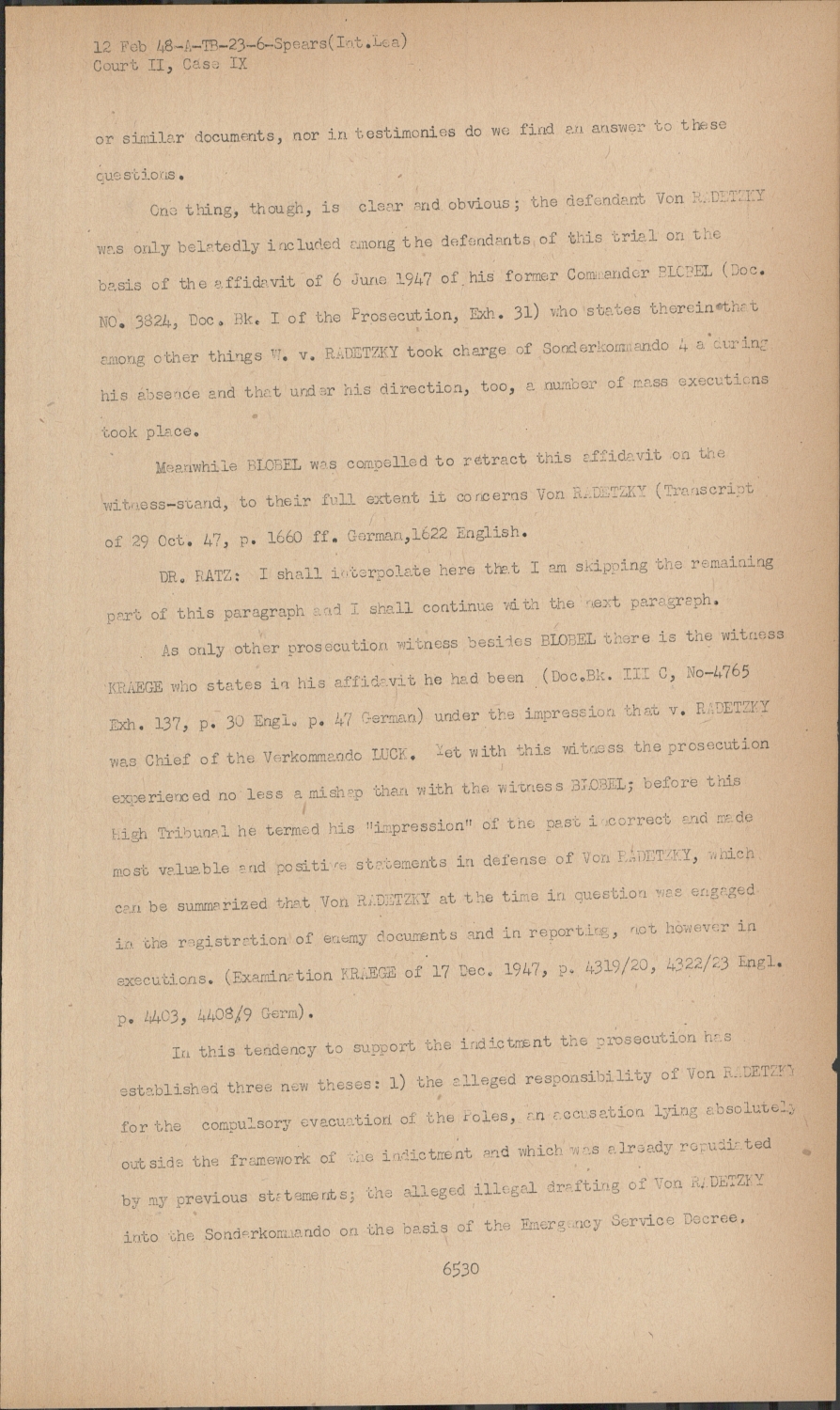
One thing, though, is clear and obvious; the defendant Von RADETZKY was only belatedly included among the defendants of this trial on the basis of the affidavit of 6 June 1947 of his former Commander BLOBEL (Doc. NO. 3824, Doc. Bk. I of the Prosecution, Exh. 31) who states therein that among other things W. v. RADETZKY took charge of Sonderkommando 4 a during his absence and that under his direction, too, a number of mass executions took place.
Meanwhile BLOBEL was compelled to retract this affidavit on the witness-stand, to their full extent if concerns Von RADETZKY (Transcript of 29 Oct. 47, p. 1660 ff. German,1622 English.
DR. RATZ:I shall interpolate here that I am skipping the remaining part of this paragraph and I shall continue with the next paragraph.
As only other prosecution witness besides BLOBEL there is the witness KRAEGE who states in his affidavit he had been (Doc.Bk. III C, No-4765 Exh. 137, p. 30 Engl. p. 47 German) under the impression that v. RADETZKY was Chief of the Verkommando LUCK. Yet with this witness the prosecution experienced no less a mishap than with the witness BLOBEL; before this high Tribunal he termed his "Impression" of the past incorrect and made most valuable and positive statements in defense of Von RADETZKY, which can be summarized that Von RADETZKY at the time in question was engaged in the registration of enemy documents and in reporting, not however in executions. (Examination KRAEGE of 17 Dec. 1947, p. 4319/20, 4322/23 Engl. p. 4403, 4408/9 Germ).
In this tendency to support the indictment the prosecution has established three new theses: 1) the alleged responsibility of Von RADETZKY for the compulsory evacuation of the Poles, an accusation lying absolutely outside the framework of the indictment and which was already repudiated by my previous statements; the alleged illegal drafting of Von RADETZKY into the Sonderkommando on the basis of the Emergency Service Decree.
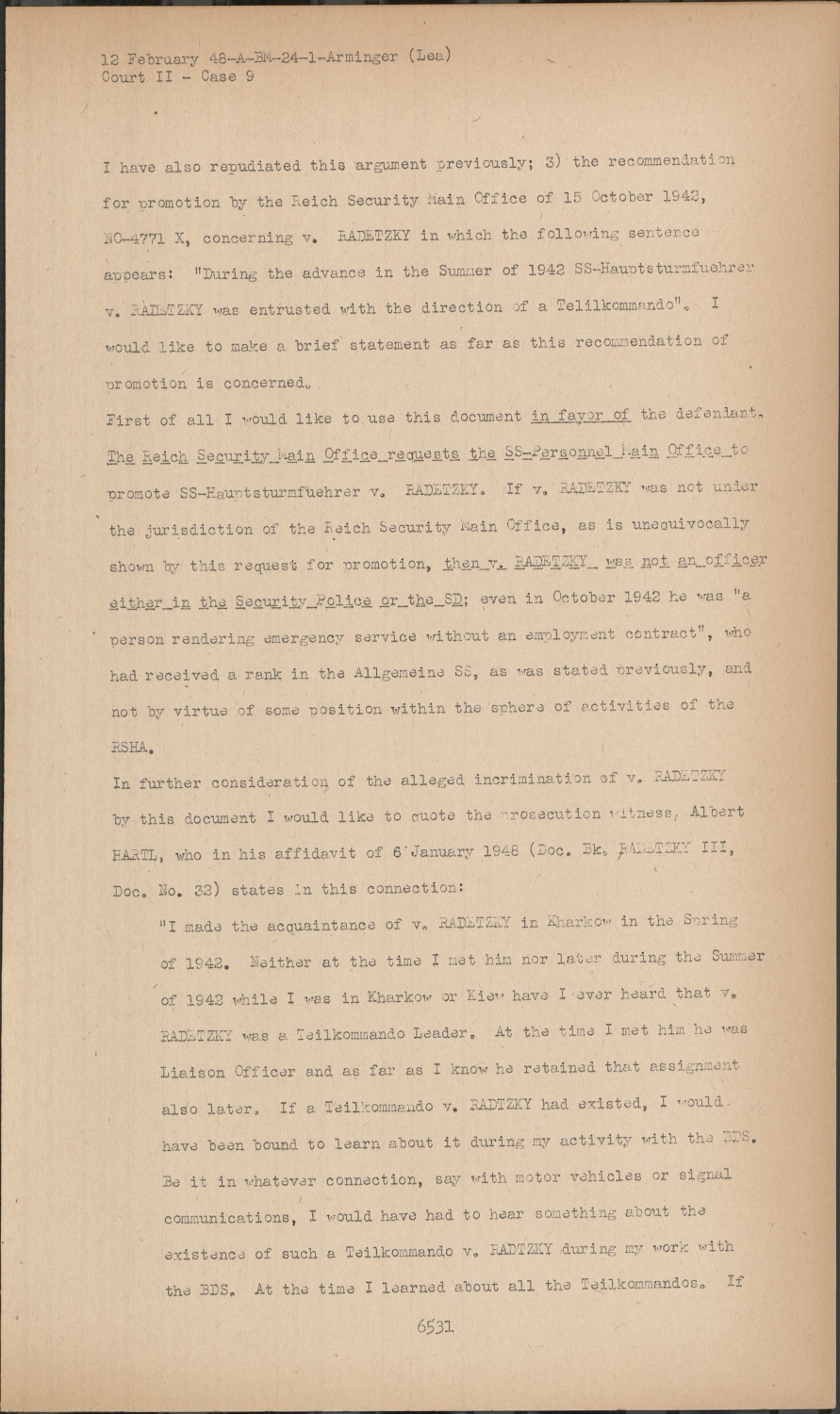
I have also repudiated this argument previously; 3) the recommendation for promotion by the Reich Security Main Office of 15 October 1942, NO-4771 X, concerning v. RADETZKY in which the following sentence appears: "During the advance in the Summer of 1942 SS-Hauptsturmfuehrer v. RADETZKY was entrusted with the direction of a Telilkommando". I would like to make a brief statement as far as this recommendation of promotion is concerned. First of all I would like to use this document in favor of the defendant. The Reich Security Main Office requests the SS-Personnel Main Office to promote SS-Hauptsturmfuehrer v. RADETZKY. If v. RADETZKY was not under the jurisdiction of the Reich Security main Office, as is unequivocally shown by this request for promotion, then v. RADETZKY was not an officer either in the Security Police or the SD; even in October 1942 he was "a person rendering emergency service without an employment contract", who had received a rank in the Allgemeine SS, as was stated previously, and not by virtue of some position within the sphere of activities of the RSHA. In further consideration of the alleged incrimination of v. RADETZKY by this document I would like to quote the prosecution witness. Albert HARTL, who in his affidavit of 6 January 1948 (Doc. Bk. RADETZKY III, Doc. No. 32) states In this connection:
"I made the acquaintance of v. RADETZKY in Kharkow in the Spring of 1942.
Neither at the time I met him nor later during the Summer of 1942 while I was in Kharkow or Kiev have I ever heard that v.RADETZKY was a Teilkommando Leader.
At the time I met him he was Liaison Officer and as far as I know he retained that assignment also later.
If a Teilkommando v. RADTZKY had existed, I would have been bound to learn about it during my activity with the BDS.
Be it in whatever connection, say with motor vehicles or signal communications, I would have had to hear something about the existence of such a Teilkommando v. RADTZKY during my work with the BDS.
At the time I learned about all the Teilkommandos. If there had been a Teilkommando v. RADETZKY I would remember it with near-certainty."
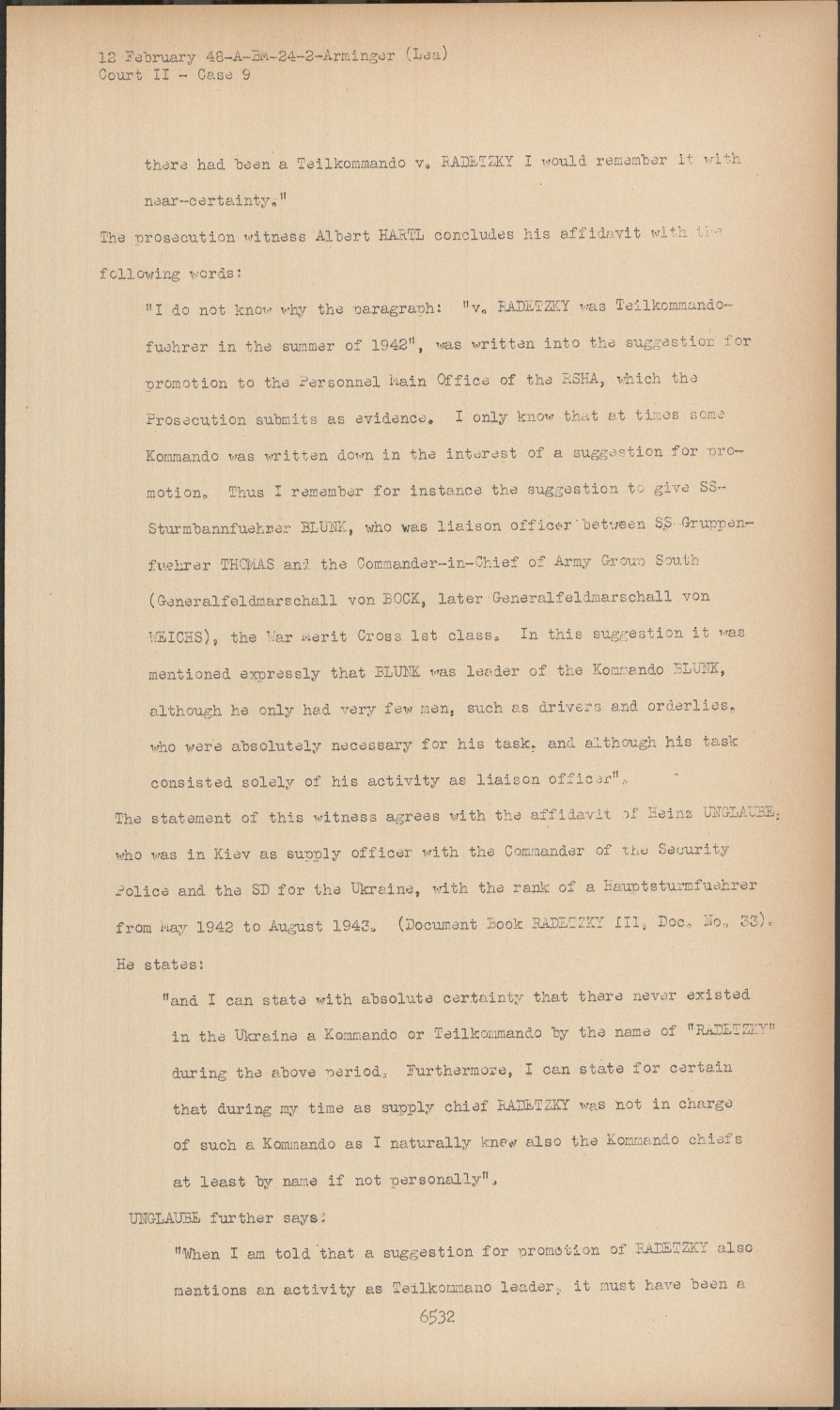
The prosecution witness Albert HARTL concludes his affidavit with the following words:
"I do not know why the paragraph: "v. RADETZKY was Teilkommando fuehrer in the summer of 1942", was written into the suggestion for promotion to the Personnel main Office of the RSHA, which the Prosecution submits as evidence.
I only know that at times some Kommando was written down in the interest of a suggestion for pro motion.
Thus I remember for instance the suggestion to give SS Sturmbannfuehrer BLUNK, who was liaison officer between SS Gruppen fuehrer THOMAS and the Commander-in-Chief of Army Group South (Generalfeldmarschall von BOCK, later Generalfeldmarschall von WEICHS), the War Merit Cross 1st class.
In this suggestion it was mentioned expressly that BLUNK was leader of the Kommando BLUNK, although he only had very few men, such as drivers and orderlies, who were absolutely necessary for his task, and although his task consisted solely of his activity as liaison officer". The statement of this witness agrees with the affidavit of Heinz UNGLAUBE, who was in Kiev as supply officer with the Commander of the Security Police and the SD for the Ukraine, with the rank of a Hauptsturmfuehrer from May 1942 to August 1943.
(Document Book RADETZKY III, Doc. No. 33). He states:
"and I can state with absolute certainty that there never existed in the Ukraine a Kommando or Teilkommando by the name of "RADETZKY" during the above period.
Furthermore, I can state for certain that during my time as supply chief RADETZKY was not in charge of such a Kommando as I naturally knew also the Kommando chiefs at least by name if not personally". UNGLAUBE further says:
"When I am told that a suggestion for promotion of RADETZKY also mentions an activity as Teilkommano leader, it must have been a matter of form in order to lend a better basis to the suggestion for promotion.
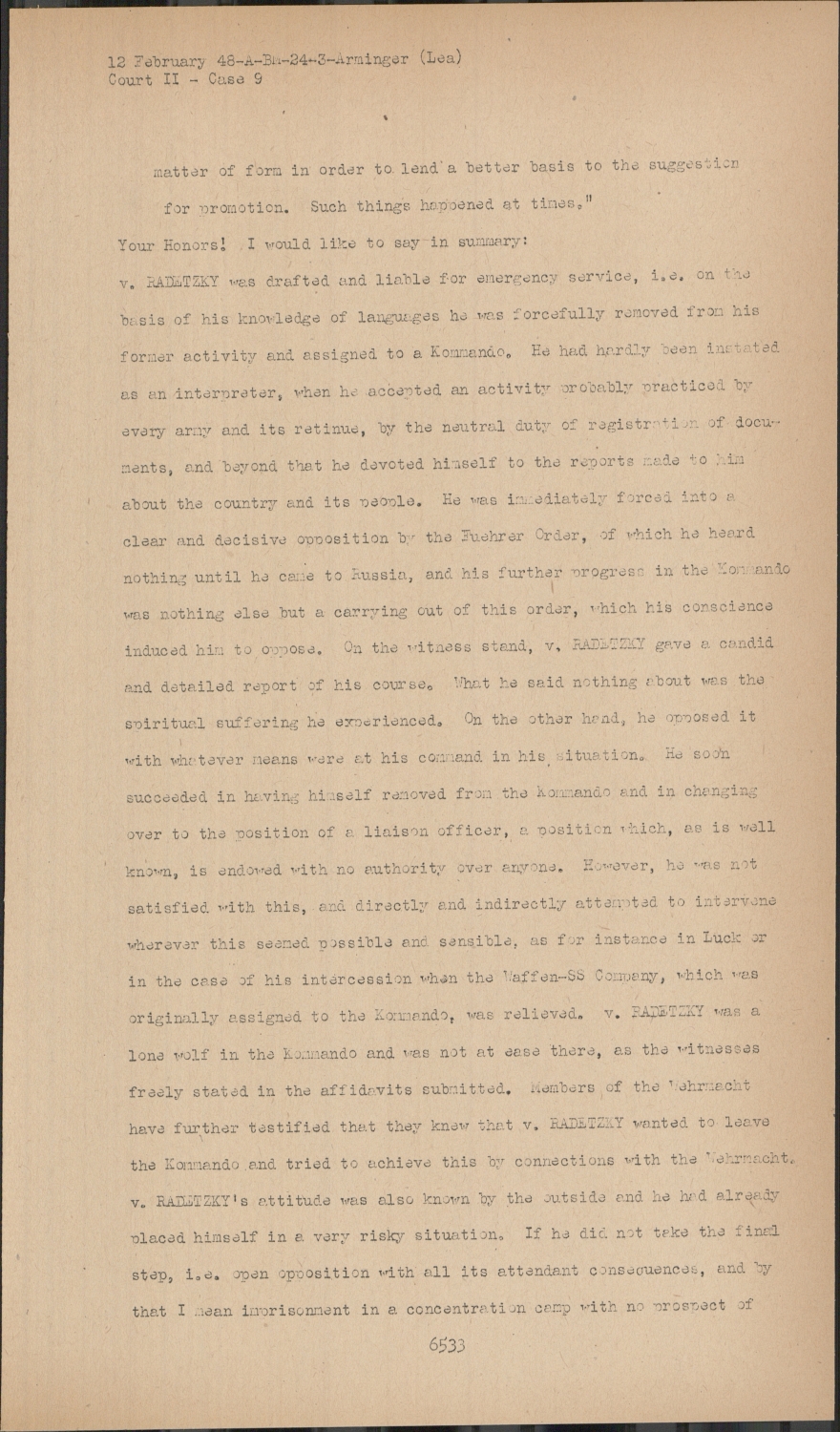
Such things happened at times." Your Honors! I would like to say in summary: v. RADETZKY was drafted and liable for emergency service, i.e. on the basis of his knowledge of languages he was forcefully removed from his former activity and assigned to a Kommando. He had hardly been instated as an interpreter, when he accepted an activity probably practiced by every army and its retinue, by the neutral duty of registration of documents, and beyond that he devoted himself to the reports made to him about the country and its people. He was immediately forced into a clear and decisive opposition by the Fuehrer Order, of which he heard nothing until he came to Russia, and his further progress in the Kommando was nothing else but a carrying out of this order, which his conscience induced him to oppose. On the witness stand, v. RADETZKY gave a candid and detailed report of his course. What he said nothing about was the spiritual suffering he experienced. On the other hand, he opposed it with whatever means were at his command in his situation. He soon succeeded in having himself removed from the Kommando and in changing over to the position of a liaison officer, a position which, as is well known, is endowed with no authority over anyone. However, he was not satisfied with this, and directly and indirectly attempted to intervene wherever this seemed possible and sensible, as for instance in Luck or in the case of his intercession when the Waffen-SS Company, which was originally assigned to the Kommando, was relieved. v. RADETZKY was a lone wolf in the Kommando and was not at ease there, as the witnesses freely stated in the affidavits submitted, members of the Vehrmacht have further testified that they knew that v. RADETZKY wanted to leave the Kommando and tried to achieve this by connections with the Vehrmacht v. RADETZKY's attitude was also known by the outside and he had already placed himself in a very risky situation. If he did not take the final step, i,e. open opposition with all its attendant consequences, and by that I mean imprisonment in a concentration camp with no prospect of ever regaining his freedom, this happened because he had nothing directly to do with carrying out given orders:
in retrospect, one cannot in all fairness demand this of him today. In the course of the presentation of evidence, I have demonstrated that v. RADETZKY was only a nominal SS-Fuehrer and that he was not amember of the RSHA or one of the offices under it, and that he was never fully recognized. This was his position within the Kommando, in which he had no support and no influence of any sort. If v. RADETZKY had held the position ascribed to him by the Prosecution, this would have to have been expressed in one way or another in the documents. He would not have been secretly given the fictitious activity of a Teilkommandofuehrer in his last mention for promotion, if he had actually held the position of a deputy or a department chief. He certainly would have shown a different official development than was actually the case. We know that until the end he was employed only in subordinate or secondary positions. I have already explained why the defendant has even been put in the dock, why he of all persons was chosen from among the hundreds of SS-Fuehrers and thousands of members of the Einsatzgruppe. On the basis of the BLOBEL affidavit, the Prosecution could not assume anything else but that v. RADETZKY was actually active in this sense; thereupon they held v. RADETZKY responsible for a series of actions in which they supposed he had participated. Their surmise was completely refuted by BLOBEL's authentic disavowal on the witness stand and by the entire presentation of evidence. To be sure, BLOBEL neglected to say who actually represented him; but even that, I believe, has now been cleared up beyond a shadow of a doubt. v. RADETZKY's defense was made especially difficult from the beginning by the fact that he had no friends and no correspondents available from the period of his assignment to the East. Luck was kind to us, however, and helped us find an unexpected number of witnesses who were willing and in a position to confirm under oath everything v. RADETZKY himself had said concerning his activity and his conduct in the Last in all points and for all periods of time which came into consideration for us.
However, on the other hand, it is a lamentable fact that no other human community can mourn so many losses as the Baltic German ethnic group which was resettled at the beginning of the war, so that in spite of everything, many important witnesses were still not available. In addition to this, the six members of the defendant's family managed to save only their lives and nothing else when they fled from the East, so that important documents of the defendant could no longer be obtained. However, as I said, I have succeeded in suite of this in presenting complete proof for the activity of the defendant in the East, which is contained in 35 statements under oath and which refutes in detail the charges of the Prosecution, while confirming the statements of the defendant. Today there can not be the slightest doubt concerning that which I was able to say even in my Opening Statement to the court, that v. RADETZKY was not involved in any criminal act. Still another glance at the character of the defendant: He gave freely of his assistance to poor, afflicted people whenever they asked for his aid, without considering him elf; above all, until the end of the war, he rendered such extensive help to political and racial persecutees in the Baltic German Immigrant Advisory Office that he exposed himself to serious personal danger. After the surrender, he turned his energies to a broad program of re-education in the internment camp, and here again he proved that he not only wanted to wait until justice showed him his furure position; he helped people discover a place in the newly developing order, so that they could again become useful members of society.
THE PRESIDENT:Dr. Ratz, I have had a chance to glance at this and I notice that in the last paragraph of this summation there appears a sentence which I cannot believe you sincerely mean. I want you to look at this before you read it and see if there is a sentence in that last paragraph that you would want to omit.
DR. RATZ:You mean, Your Honor, the sentence immediately before the end?
THE PRESIDENT:Yes.
DR. RATZ:Then I can only imagine, Your Honor, that you mean the two sentences before the last.
THE PRESIDENT:Well, that's up to you. You have the paragraph before you and this should strike you in the eye as being a very improper statement. If it doesn't strike you, then we will have to call it to your attention, but it should certainly he very obvious to you that that is no remark to make in court, so I will leave it up to you whether you want to read it or not.
DR. RATZ:Your Honor, I can only understand through interpretation that it does not correspond to the German, that the translation does not correspond to the German phrasing, because in the German form it is completely all right, but I shall omit these two sentences. I believe that as such there should be no misgivings according to the German version.
THE PRESIDENT:You know that this Tribunal is here to do justice and justice alone.
DR. RATZ:Yes.
THE PRESIDENT:The Tribunal is interested only in ascertaining the truth, and certainly the statement as it appears in English cannot be accepted.
DR. RATZ:I can only say, Your Honors, that I never had any other opinion and that not even remotely did I want to say anything else. It thus can only be a translation which does not give the sense of the original, but I shall omit these two sentences, and I would ask you to believe that not even remotely did I have in mind to say anything which would not find the approval of the Tribunal.
THE PRESIDENT:You may proceed.
DR. RATZ:In conclusion I would like to state:
Before this court I can dispense with all legal arguments con cerning the question of v. RADETZKY's criminal participation in the crimes which took place; he did not voluntarily enter upon this course and did not for one moment voluntarily pursue it; did nothing, abetted nothing and agreed to nothing of anything which is under indictrment here.
What the defendant v. RADETZKY did and what he proclaimed to be his thoughts and feelings was nothing but opposition and refusal, and clearly recognizable evasion to the very Unit of what could be expected with regard to what his conscience had forbidden him to do. I shall withdraw the next two sentences. Therefore, I can ask with complete confidence for the acquittal of the defendant v. RADETZKY?
THE PRESIDENT:The Tribunal will now recess until 8:30 this evening when it will hear the final plea in behalf of the Defendant Haensch. We presume that counsel will be here at that time and we repeat what we said today: that such statements as are ready, that is, the defendants' final statements, will be taken to Room 106 as soon as possible.
Anyone who is working on the final statement whether it be a defendant or a counsel may be excused from this evening's session, if the proper motion is made to the Tribunal.
DR.RATZ (ATTORNEY FOR THE DEFENDANT VON RADETZKY): Your Honors. I ask that the Defendant von Radetzky be excused from this evening's session in order to prepare his final statement.
THE PRESIDENT:Yes, the Defendant von Radetzky will be excused from attendance in court this evening.
MR. GLANCY:Your Honors, I see one of the other defendants is interested in being excused. Perhaps his request can be made by one of the defense counsel now present, if the men in the dock would so indicate.
THE PRESIDENT:That is the Defendant Ruehl. Would you like to be excused this evening?
THE DEFENDANT RUEHL:Yes, if Your Honors please.
THE PRESIDENT:The Defendant Ruehl will be excused from attendance in court this evening so that he may work on his final statement.

The Tribunal will understand that all defendants have either by this time prepared their final statements or will have then ready, at the very latest at nine o'clock tomorrow morning so that the necessary translations may be made.
The Tribunal will now be in recess until this evening at 8:30.
(A recess was taken until 2030 hours.)
12 Feb 1948_E_MSD_25_1_Gallagher (Juelich) (Court met pursuant to recess 1830 hours, 12 February 1948)
THE MARSHAL:The Tribunal is again in session.
THE PRESIDENT:You may proceed.
DR. KRAUSE:Dr. Drause for the defendant Haensch. Your Honor, the defendant Haensch, together with all other defendants in the case, has been accused of having committed three different offenses: Crimes against humanity, war-crimes and membership in organizations declared criminal by the International Military Tribunal. The first two counts are closely linked to each other as they both refer to the same fact i.e. the activity of the defendant as a leader of the Sonderkommando IV b, I shall, therefore, deal with this matter in the first part of this plea and in the second part with those accusations which refer to the defendant's membership in the SD and the SS. Document In the garrison strength roster of the report Book IIA of the of events No. 156 of 16 January 1942, the defendant Prosecution, is mentioned for the first time as the leader of P. 61 Doc. No. the Sonderkommanso IV b. The prosecution No-3405 Exh. No. 42 concludes from this that he was in charge of this Kommando at least from this day onward.
However, this assumption is, incorrect.
Doc. Book The defendant himself has always given the IIIC of Prosecution, p. 54 middle of March 1943 as the date of his taking-over Doc. No. No-4567 Exh. No. 140 of command, even in his affidavit of 21 July 1942 and later on as a witness in court giving his reasons in detail.
transcript According to this, although he was already appointed p. 3273 ff.
leader of the SK IV b in January he did not receive his marching orders until several weeks afterwards, i.e. end of February 1942, because his predecessor, Sturmbannfuehrer Braune, who, in January 1942 was in 12 Feb 1948_E_MSD_25_2_Gallagher (Juelich) Berlin, for some reason unknown was sent back to the Kommando.
Sturmbannfuehrer Braune is not identical with the defendant.
The Defendant, together with Obersturm bannfuehrer Dr. Erwin Weinmann, leader of SK IV a man who was simultaneously appointed did not leave Berlin for the front until the end of February 1942.
However, this journey was interrupted for at least four days in Lwov because inclement weather had caused a break-down of traffic and once more in Kiew again for four days, as the defendant had to report there to the chief of the Einsatzgruppe C, Dr. Thomas.
He arrived at the Kommando on 15 March 1942, at the earliest.
This statement of the defendant is borne out by the following facts:
Haensch Doc. According to Herbert Dassler's affidavit of 23 Book I, p. 11 October 1947 the defendant was present at Dassler's Doc. No.2 Exh. No.6 birthday-party in the latter's apartment in Berlin on 25 January 1942, and was his guest again two weeks later, i.e. already in February 1942.
This is also confirmed by Frau Lisa Krueger-Martius in her affidavits of 29 September and 2 November 1947.
Her husband was a boyhood friend of the defendant and had introduced him to Dassler.
Haensch Frau Krueger-Martius is also aware of the fact Doc.Book I,p.3 and that the defendant did not start upon his journey Book II p. 2. to the east until the end of February 1942. Doc. No.3 and 17 Exh. No.7 and 20 Haensch Frau Else Neveling and Frau Erika Cohlon, two follow Doc Bk 1 and tenants of the house at Berlin-Zehlendorf, Hartmannweilerweg Doc. Bk II p.4. 16, in which the defendant had his apartment, made stateDoc. 1 & 18 Exh. No. 5 ments to the same effect. I refer to their affidavits of and 21 20 October and 20 November 1947.
12 Feb 1948_E_MSD_25_3_Gallagher (Juelich) Frau Neveling also substantiated these facts in her state ments that the defendant took leave of her and her husband before he left, which was not before her husband's birthday, (Haensch which is in the middle of February.
Up to and including 7 Doc. BK IV p3, February 1942 the dentist Dr. H.D. Maennel in Berlin-Zehlendorf, DOC.31 Exh.33 treated the defendand, as the former stated in his affidavit of 19 January 1948, and which can also be seen from the index-card, and of those of his assistant Frau Jauer.
Frau Jauer confirmed that she set up the file index herself, and that she had made all entries herself, except the one of 26 November 1941, which might have been made by her sister.
She has assured us that all entries made by her had been made at the time indicated by her, and that they are true in every respect.
She persisted in this testimony during the thorough cross examination, even after the expert opinion had been submitted to her.
During all her statements she displayed such calmness and consistency only to be found in people with a clear conscience.
The opinion of the Prosecution that the witness made herself guilty of perjury on the basis of the expert opinion, and that on the basis of this the index card lost its probative value, I am unable to share.
The expert has declared that the new address Sven Hedin Platz, 8, and the entry dated 7 February 1942, added subsequently on the index card did derive from the one and the same person.
However, that this person was a different one from that person who made the other entries.
On this point, however, I believe, I can already state that in this the expert is undoubtedly mistaken.
The nature of the handwriting on the card proved, if I disregard the entry of 26 November 1941, even to a layman's eye such numerous clearly corresponding characteristics, in spite of certain irregularities, that I am firmly convinced that only 12 Feb 1948_E_MSD_25_4_Gallagher (Juelich) one person can be considered the writer.