COURT NO. II, CASE NO. IX.
AFTERNOON SESSION The hearing reconvened at 1355 hours.
THE MARSHAL:The Tribunal is again in session.
DR. SCHWARZ:I now come to point IV, the position and responsibility of the defendant. Counts I and II of the indictment.
Pages 1 - 23 of the trial-brief show that in the indictment the defendant is reproached with his activity as Chief of Einsatzgruppe A. At the same time reproaches are levelled against him, which do not concern the affairs of Einsatzgruppe A, but incidents in the field of the civil administration, in fact the office of the Reich Commissioner for the Ostland.
As regards the actual domain of Einsatzgruppe A not a single concrete reproach can be made. There is no assertion, still less any evidence of any case of murder occurring either in the SK Ia or in the Commandos Krasnowardeisk or Leknia - the only two commandos of which Einsatzgruppe A was composed.
Therefore, as far as Heinz Jost is indicted in his capacity of Chief of Einsatzgruppe A, the indictment gives an entirely wrong idea. Of Jews, Communists and Partisans of whom considerably more than 100,000 were, according to the Prosecution, allegedly assassinated in the area under the control of Einsatzgruppe A, not a single person was murdered during the period in which the defendant Jost was in charge; more details will follow later. Even according to the statements of the Prosecution, out of considerably more than 100,000 assassinated persons only about 1,300 persons were killed while the defendant was in charge, i.e. an infinitesimal fraction of the number which the Prosecution asserts were killed in the area of Einsatzgruppe A. This must be emphasized since the Prosecution has assigned to the defendant a position not due to him.
The defendant cannot be held responsible for the actions of his predecessors.
I have stated that the defendant can in no way be hald responsible in his capacity as Chief of Einsatzgruppe A, since the incidents described under Nos. 6 S and T of the indictment took place in the area of the office of the Reich Commissioner for the Ostland which was under civil administration; it must now, for safety's sake, be investigated whether the defendant can be held responsible for these incidents in his capacity as Commander of the SIPO and of the SD (security service) for the Ostland, although as regards the time when they occurred the defendant cannot be charged with these incidents.
I have submitted the whole evidence concerning this question in my trial brief on pages 36 - 43 to which I refer here.
According to this, the area of the office of one Reich Commissioner Ostland was composed of the territories of Esthonia, Latvia, Lithuania and White Ruthenia. The Reich Commissioner was in charge; he had powers that cannot be compared to those of the Chief of any other agency since he was subordinated directly to the Fuehrer.
The Reich Commissioner held supreme responsibility, He was the immediate superior of the Higher SS and Police leader who, on his part, was the superior of the Commander of the SIPO and of the SD, consequently of the defendant Jost.
ACommissar General was chief of each country and was invested with actual powers. He was the superior of the local SS and Police leader to whom the Commander of the SIPO and the SD were in turn subordinate.
This hierarchy shows the position of the Commander of the SIPO and SD. However, this title does not represent the actual state of things.
According to the statements of the co-defendant Ohlendorf and the witness Erlich, the Commander of the SIPO and the SD Ostland had, in practice, the position of an Inspector (a post which was usual in the Reich territory) and not the position of a real Commander (transcripts of 14 October 1947, German page 592, English page 586, cross examination Ohlendorf - trial-brief for Heinz Jost page 41 - affidavit Erlich, Dec. Book Jost III, German and English page 13.)
The above as well as the drafts of organization plans which have been submitted (Doc. Book Jost III, page 14/15) illustrate that the power of command of the Commander of the SIPO in the Ostland was restricted.
In view of the differing structure of the territories in question, the extent of the area - about 400,000 qkm and in a country without roads and railways it is natural that responsibility can in practice only rest with the local agencies which must, therefore, have the necessary powers; in this case it was first of all the Commissioner General and, under him the SS and Police leader who exercised these powers. This fact is apparent from the letter which the Commissioner General in White Ruthenia sent to the Reich Commissioner, and in which the Commissioner General complains about a campaign against Jews.
The complaint was not submitted to the Commander of the SIPO and the SD, but, as I said, to the competent SS and Police leader locally. The statements of Sandberger and of witness Hartel give particulars about the responsibility of the SS and Police leader; they confirm the above assertions.
Apart from this restriction which was imposed by the organization of the Civil Administration, the defendant Jost was also limited in his work by Heydrich as soon as he took up his duties. Actually the restriction ordered by Heydrich only confirmed the existing state of things.
On this basis it is clear and conclusive that the defendant is not responsible for individual executive measures carried out locally.
The subsequent discussion of the individual charges raised by the Prosecution will show the same result.
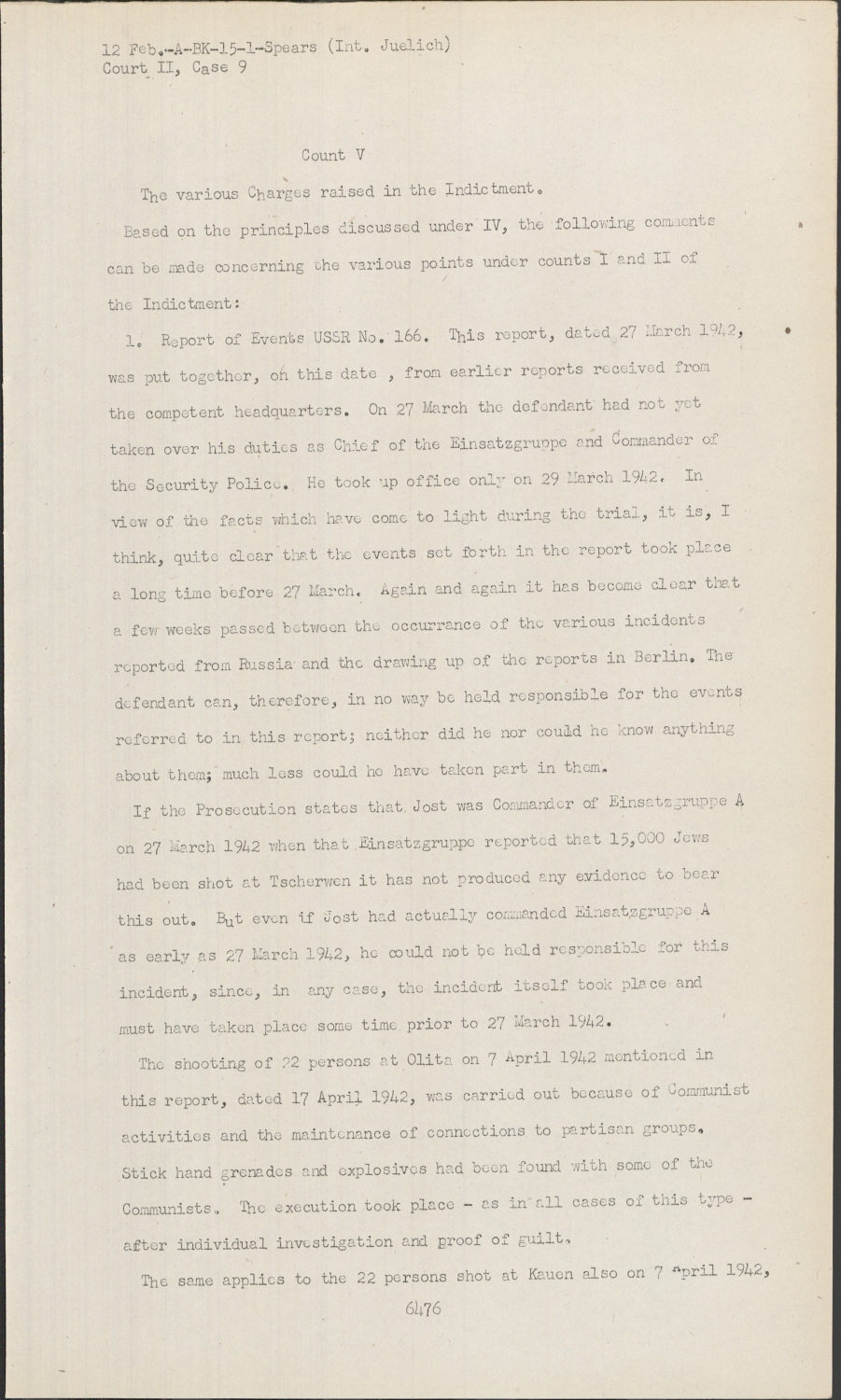
The various Charges raised in the Indictment.
Based on the principles discussed under IV, the following comments can be made concerning the various points under counts I and II of the Indictment:
1. Report of Events USSR No. 166. This report, dated 27 March 1942, was put together, on this date , from earlier reports received from the competent headquarters. On 27 March the defendant had not yet taken over his duties as Chief of the Einsatzgruppe and Commander of the Security Police. He took up office only on 29 March 1942. In view of the facts which have come to light during the trial, it is, I think, quite clear that the events set forth in the report took place a long time before 27 March. Again and again it has become clear that a few weeks passed between the occurrance of the various incidents reported from Russia and the drawing up of the reports in Berlin. The defendant can, therefore, in no way be held responsible for the events referred to in this report; neither did he nor could he know anything about them; much less could he have taken part in them.
If the Prosecution states that, Jost was Commander of Einsatzgruppe A on 27 March 1942 when that Einsatzgruppe reported that 15,000 Jews had been shot at Tscherwen it has not produced any evidence to bear this out. But even if Jost had actually commanded Einsatzgruppe A as early as 27 March 1942, he could not be held responsible for this incident, since, in any case, the incident itself took place and must have taken place some time prior to 27 March 1942.
The shooting of 22 persons at Olita on 7 April 1942 mentioned in this report, dated 17 April 1942, was carried out because of Communist activities and the maintenance of connections to partisan groups. Stick hand grenades and explosives had been found with some of the Communists. The execution took place - as in all cases of this type after individual investigation and proof of guilt.
The same applies to the 22 persons shot at Kauen also on 7 April 1942, in whose case the investigation showed that they had indulged in Communist propaganda up to the last moment.
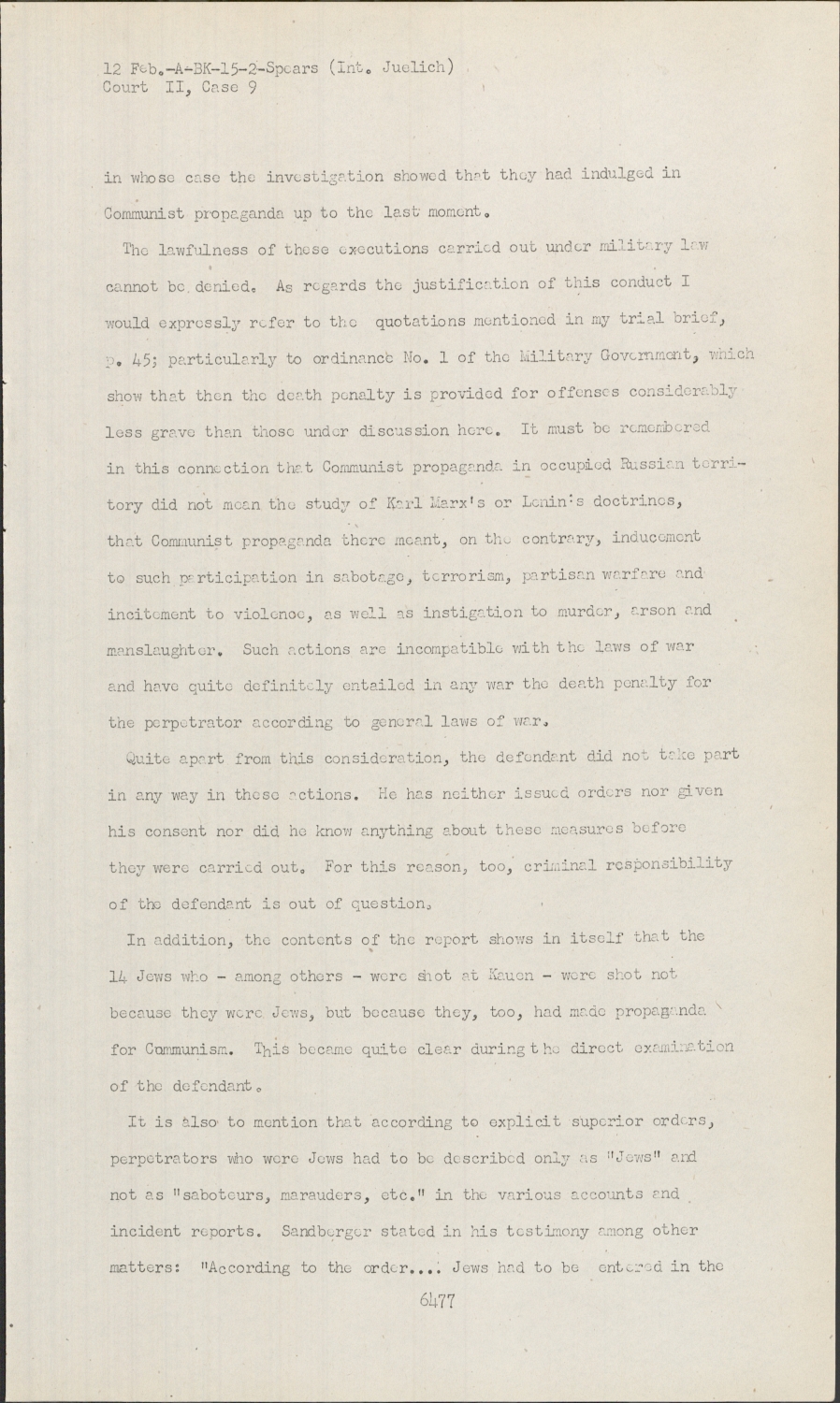
The lawfulness of these executions carried out under military law cannot be denied. As regards the justification of this conduct I would expressly refer to the quotations mentioned in my trial brief, p. 45; particularly to ordinance No. 1 of the Military Government, which show that then the death penalty is provided for offenses considerably less grave than those under discussion here. It must be remembered in this connection that Communist propaganda in occupied Russian territory did not mean the study of Karl Marx's or Lenin's doctrines, that Communist propaganda there meant, on the contrary, inducement to such participation in sabotage, terrorism, partisan warfare and incitement to violence, as well as instigation to murder, arson and manslaughter. Such actions are incompatible with the laws of war and have quite definitely entailed in any war the death penalty for the perpetrator according to general laws of war.
Quite apart from this consideration, the defendant did not take part in any way in these actions. He has neither issued orders nor given his consent nor did he know anything about these measures before they were carried out. For this reason, too, criminal responsibility of the defendant is out of question.
In addition, the contents of the report shows in itself that the 14 Jews who - among others - were shot at Kauen - were shot not because they were Jews, but because they, too, had made propaganda for Communism. This became quite clear during the direct examination of the defendant.
It is also to mention that according to explicit superior orders, perpetrators who were Jews had to be described only as "Jews" and not as "saboteurs, marauders, etc." in the various accounts and incident reports. Sandberger stated in his testimony among other matters: "According to the order.... Jews had to be entered in the column headed 'Jews' even when they were treated as Communists."
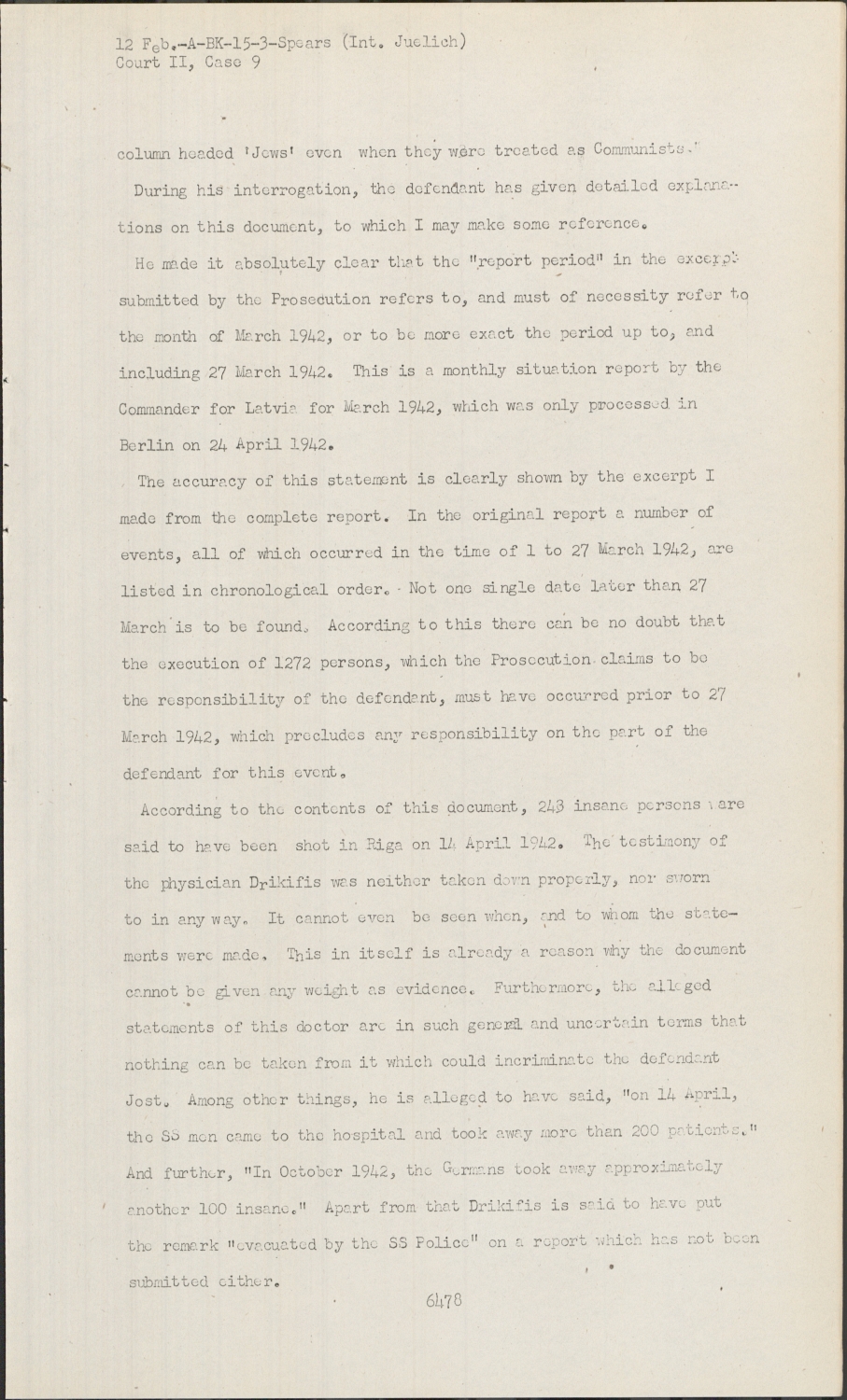
During his interrogation, the defendant has given detailed explanations on this document, to which I may make some reference.
He made it absolutely clear that the "report period" in the excerpt submitted by the Prosecution refers to, and must of necessity refer to the month of March 1942, or to be more exact the period up to, and including 27 March 1942. This is a monthly situation report by the Commander for Latvia for March 1942, which was only processed in Berlin on 24 April 1942.
The accuracy of this statement is clearly shown by the excerpt I made from the complete report. In the original report a number of events, all of which occurred in the time of 1 to 27 March 1942, are listed in chronological order. Not one single date later than 27 March is to be found. According to this there can be no doubt that the execution of 1272 persons, which the Prosecution claims to be the responsibility of the defendant, must have occurred prior to 27 March 1942, which precludes any responsibility on the part of the defendant for this event.
According to the contents of this document, 243 insane persons ware said to have been shot in Riga on 14 April 1942. The testimony of the physician Drikifis was neither taken down properly, nor sworn to in anyway. It cannot even be seen when, and to whom the statements were made. This in itself is already a reason why the document cannot be given any weight as evidence. Furthermore, the alleged statements of this doctor are in such general and uncertain terms that nothing can be taken from it which could incriminate the defendant Jost. Among other things, he is alleged to have said, "on 14 April, the SS men came to the hospital and took away more than 200 patients." And further, "In October 1942, the Germans took away approximately another 100 insane." Apart from that Drikifis is said to have put the remark "evacuated by the SS Police" on a report which has not been submitted either.
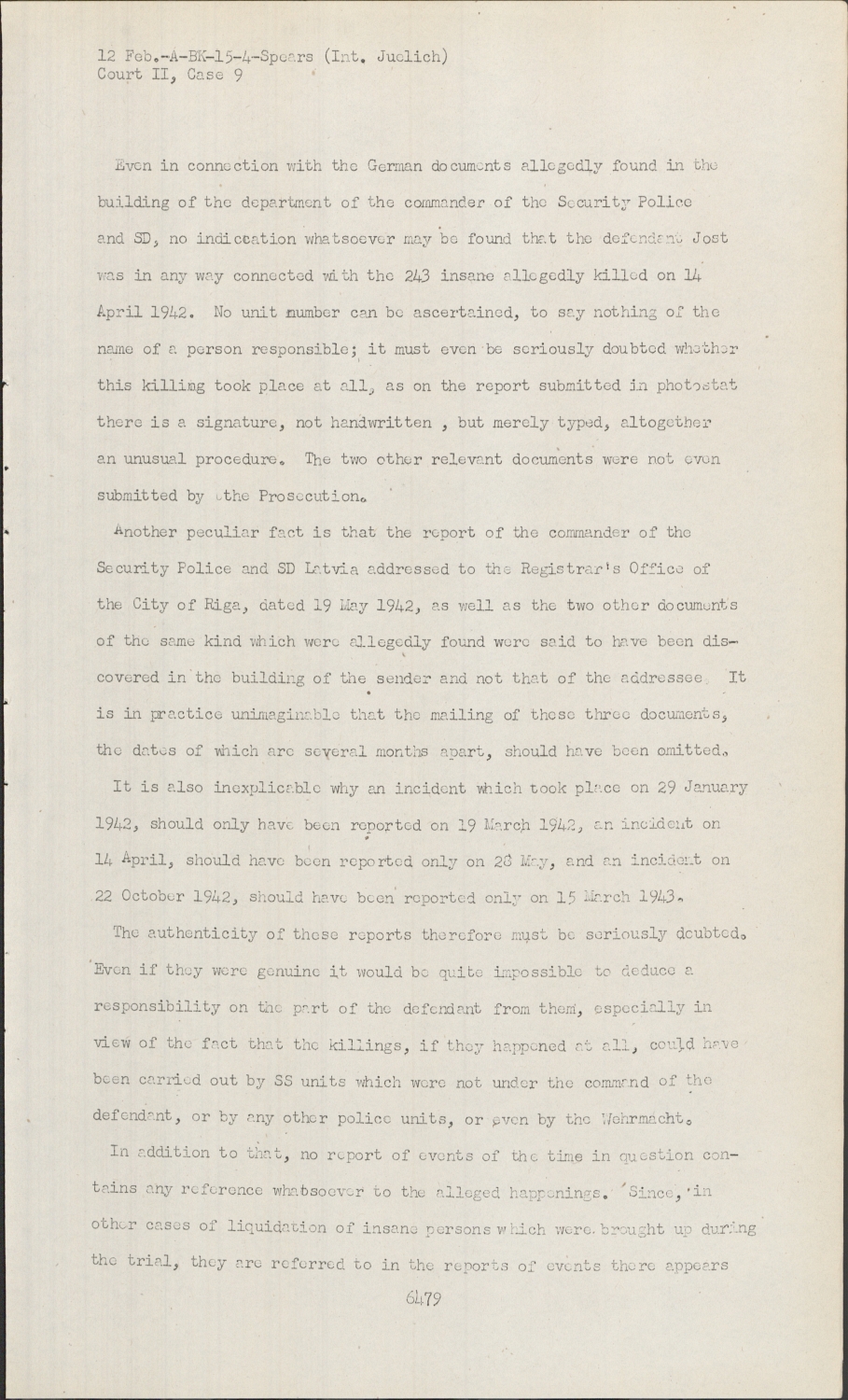
Even in connection with the German documents allegedly found in the building of the department of the commander of the Security Police and SD, no indiccation whatsoever may be found that the defendant Jost was in any way connected with the 243 insane allegedly killed on 14 April 1942. No unit number can be ascertained, to say nothing of the name of a person responsible; it must even be seriously doubted whether this killing took place at all, as on the report submitted in photostat there is a signature, not handwritten, but merely typed, altogether an unusual procedure. The two other relevant documents were not even submitted by the Prosecution.
Another peculiar fact is that the report of the commander of the Security Police and SD Latvia addressed to the Registrar's Office of the City of Riga, dated 19 May 1942, as well as the two other documents of the same kind which were allegedly found were said to have been discovered in the building of the sender and not that of the addressee. It is in practice unimaginable that the mailing of these three documents, the dates of which are several months apart, should have been omitted.
It is also inexplicable why an incident which took place on 29 January 1942, should only have been reported on 19 March 1942, an incident on 14 April, should have been reported only on 28 May, and an incident on 22 October 1942, should have been reported only on 15 March 1943.
The authenticity of these reports therefore must be seriously doubted. Even if they were genuine it would be quite impossible to deduce a responsibility on the part of the defendant from them, especially in view of the fact that the killings, if they happened at all, could have been carried out by SS units which were not under the command of the defendant, or by any other police units, or even by the Wehrmacht.
In addition to that, no report of events of the time in question contains any reference whatsoever to the alleged happenings. Since, in other cases of liquidation of insane persons which were brought up during the trial, they are referred to in the reports of events there appears to be no reason why these happenings should not have been reported.
These circumstances almost force one to draw the conclusion that the alleged killings did not take place at all.
In any case, it cannot be ascertained that the defendant gave an order for the killings or that he was involved in any way in the happenings of 14 April 1942, which are the only ones occurring during the period of his responsibility.
When the Prosecution stresses that this document was introduced at the International Military Tribunal and therefore has special value as evidence, then it may be pointed out that the happenings at Katyn could not be cleared up by the International Military Tribunal either. Considering everything it is absolutely plausible that the defendant neither knew before the 14 April 1942, of planned measure against the insane, nor after the 14 April 1942 heard of the alleged execution of such a measure.
Amongst other things it is stated in this report, "On 9 May 1942, 28 members of the Partisan organization White Ruthenia were publicly executed by hanging in the city area of Minsk . Furthermore, 251 persons, mainly Partisans and Jews were shot on the same day."
From the difference in the method of execution, the Prosecution believes itself able to draw the conclusion that of the 251 persons, at least part of them were Jews who were executed because they were Jews.
There is no doubt about it that the first group of 28 people executed were Partisans who were sentenced on the basis of a previous court trial and that this was a deterring measure brought about by the fact that the Partisan situation in the city area of Minsk had become so tense and serious at that time, that the Wehrmacht considered such measures necessary, and even Commissar General Kobe who, according to the Prosecution's own statements, was pro-Jewish and by no means particularly aggresssive, could not say anything against them.
This may be taken, partly directly and partly indirectly, from the Prosecution Document, Document Vol. 5-A, Document No. 2262.
From the course of events, together with the abovementioned documents, one may conclude, without laying oneself open to a charge of indulging in wishful interpretation here, that the 251 persons not executed publicly were all Partisans or at least such persons who were guilty of some infringement of the laws of warfare which carried the death penalty. This is supported by the fact that the 251 persons were not all Jews, in other words, it was not a proper action against Jews. The same applies here as in the abovementioned case of Olita of 7 April 1942 (C. 2), or Kauen. The fact that the number of Jews among those executed was shown separately from the others does not by any means prove that they were executed merely because they were Jews. As was the case on other occasions, this was probably done only to determine how many Jews were taking part in Partisan, or other activities. (Statements Sandberger, transcript of 17 November 1947, German page 2461, English page 2410).
As was mentioned during the taking down of evidence, it was not at all customary to carry out actual executions of Jews as understood by the Prosecution, together with the execution of Partisans, etc, On the other hand, Jews, as far as they themselves were Partisans, were, of course, shot together with other Partisans, as undoubtedly was the case here. In addition to this it must in particular be considered that, according to orders given, the executions of Jews were to be carried out as inconspicuously as possible. This fact, too, speaks against the assumption that the Jews in question were supposed to have been executed merely because they were Jews. At the time under discussion many thousands of Jews were still living in Minsk, so that, if one had wanted to carry out an action against Jews, one would not have confined oneself to a small number, and moreover carried out the executions together with those of the Partisans. Hence, the argument of the Prosecution concerning the interpretation of Document NO-5188, Exh.
326, is wrong.
How serious the position was in Minsk at that time is shown by the following sentence in the document, "In Minsk, an action was carried out against a railroad terrorist group; 126 persons were arrested. The number of those arrested shows thedangerous strength of this terrorist - and Partisan group" .
Document No. 3876, Exh. 223 in Document Book 5-A gives exhaustive information of the participation of Jews in the Partisan, movement and illegal activities.
After a general survey on the Partisan activities on pages 84-85 of the document book, page 54/55 of the original report, which, as I have just found out, are not included in the English text, details are given on pages 87/88 of the document book, pages 57/59 of the original about the considerable strength of the Partisan groups - up to the strength of a battalion - in white Ruthenia and Minsk.
Page 57 of the original states:
"In Minsk the chief of a partisan recruitment agency, a Jew, was arrested. In a fresh campaign against the partisan movement in White Ruthenia it has been possible so far to arrest 163 people. Numberous pistols, hand grenades, machine guns, carbines and ammunition were seized. Investigations so far have disclosed the following:
The Chief of the Minsk partisan movement had appointed a staff, composed of 10 departments, whose heads were all Bolshevist officers or army administrative officials. ROKOV, the Chief of the Soviet Partisan Movement of Ninsk, and numberous other leaders were arrested. The staff had set itself the task of poisoning the Commissar General, contaminating wells and water installations in Minsk and reconnoitring military objects. Several bacterial cultures were seized. The reconnoitring of military objects was already for advanced."
This is followed by details on the strength of the individual partisan groups, which consists of 200 to 400 men. Furthermore it is stated:
"Side by side with the Partisan Department there is the Party in Minsk, which exercises a certain control. It was possible to arrest the organizer of the Party machine, the Grusinian Jew Mustafa (page 59 of original) LELIKURDGLY. The management of the Party was in the hands of a committee consisting of seven persons. An illegal group of 60 Ghetto Jews financed Party activities, procured weapons, and continued to reinforce the Partisan group. 60 to 80 Jews were sent from the ghetto to join the Partisans. Several receiving sets as well as bandaging materials and drugs were seized in the home of the Jew DELIKURDGLY. Furthermore a perfectly functioning printing shop was dismantled and 8 typewriters confiscated."
This report, which is more fully reproduced in the German Document Book 5-A than in the English Document Book 5-A and bears the report dated March 1942, reveals that both recruitment for the Partisan movement and the organization of the Party, which is hardly separate from the Partisan movement, were essentially in the hands of Jews, that strong group of Jews - 60 men - effected the financing and procured weapons, and that strong groups of 60 to 80 Jews were sent to the Partisans.
This fact explains the number of Partisan - including Jewish partisan-shootings on 9 May 1942. It proves that the actions of 9 May were necessary, justified, and therefore legal according to martial law. It may be assumed that the shootings of 9 May 1942 were the outcome of the events of March 1942, in that the partisans, including the Jews, who had been arrested in March 1942 and who had participated, received their punishment on 9 May 1942 after having been tried previously.
This then eliminates any criminal and punishable conduct on the part of the defendant JOST,insofar as any responsibility whatever for the shootings Of 9 may 1942 could possibly be ascribed to him. This holds good, if for no other reason, then because of the fact that the defendant gave no order, nor did he participate in any way in this case. The relevant orders, as the document shows, were on the contrary given direct by the Commissar General in charge of that domain, or by the Wehrmacht. This fact then clarifies the fundamental question of responsibility for incidents in areas under civilian administration.
Furthermore it is not without significance in this connection that HEYDRICH had given the respective commander a respite for the enactment of the action against the Jews in White Ruthenia until after the harvest had been brought in. (transer 22 Oct. 1947, German page 1158 English page 1151, direct examination JOST- transcript 20 January 1948, direct examination STREUCH - affidavit ZENNER, Document Book I STRAUCH.
The statements cited above also prove that HEYDRICH was in Minsk at the time, as he had indicated to the defendant on the occasion of the discussion in Riga on 31 march 1 April 1942. In view of the respite greats by HEYDRICH to STRAUCH, but postponing the Jewish executions until after the harvest had been brought in, there was no reason whatever for such executions in May 1942, insofar as they were not, as explained above, executions connected with partisan or other punishable activities.
This fact too, shows that the events of 9 May 1942 were not an actual anti-Jewish campaign.
The defendant is moreover cleared of the charge of responsibility for events in White Ruthenia during the time from March until September 1942, as, according to HEYDRICH's declarations, events in White Ruthenia were no particular concern of his, and he was above all things not responsible for executive measures, as is proved by the above described incident.
Summing up of the evidence under IV and V.
1. The Prosecution is unable to bring a charge of, and much less to prove, one single execution in the entire domain of Einsatzgruppe A, namely Krasnowardeisk and Loknia, during the time from 29 March 1942 to roughly 2 September 1942, which was the defendant's term of office as chief of Einsatzgruppen A; nor has any other punishable action or deed been brought forward.
2. Concerning the events outside the domain of Einsatzgruppe A. i.e., in the Reich Commissariat Ostland, and the Main districts (Generalbezirke) it may be regarded as proved that the events dealt with in action reports 186, doc. NO-3236, exh. 109 and action report 195, exh. 56, doc. No. 3277, date from the time before the defendant took office.
The contents of Doc. USSR-41, exh. 101, are not proved, Punishable conduct of the defendant JOST in particular cannot be regarded as having been proved.
This leaves the events of action report No. 193, NO-3261, exh. 55, with 22 shootings on 7 April 1942 in Olita for active Communist Activity and contact with Partisan groups, and the shooting of 22 persons in Kauen, for proved Communist propaganda activities, and finally the shooting of 253 partisans in Minsk on 9 May 1942.
These are the events which occurred within 5 months in an area of the size of Greater Germany.
The defendant JOST may not be charged with any other events in white Ruthenia for.the following previously discussed, reasons:
the independence of the area, the defendant's position as Commander of the Sipo and the
SDOstland, which was similar to that of an inspector, the specific restriction of his executive powers, through HEYDRICH, due to the vastness and complexity of the area and the consequences arising therefrom, but especially in view of the defendant's attitude regarding the enactment of the Fuehrer-order, which I shall discuss in detail.
For the rest, reference may as a precaution, be made in this connection to the statements and argumentation of the co-defendant STRAUCH, as well as to those of the other co-defendants, inasfar as they relevent.
If thus the evaluation of the objective material already reveals that the charge against JOST cannot be upheld, then it will be shown even more clearly through the clarification of the subjective part of the facts and the description of the situation that would have arisen if the defendant had really acted as the Prosecution asserts, namely if he had enacted the issued orders in a formal and strict manner, that the defendant cannot be charged with any punishable offense.
The defendant's attitude toward the execution problem and the consequences of his attitude.
During the last days of March 1942, JOST met Sturmbannfuehrer HENNICKE whom he had in known previously, in Smolensk. The subject of the execution problem was brought up during the conversation, and the defendant stated unequivocally that he would never let himself be drawn into such things. The defendant's statements gave HENNICKE the impression that if need be, JOST would certainly act accordingly.
Shortly after this talk, as HENNICKE further reports, a radio message for the defendant was received, conferring on him the position of chief of Einsatzgruppe A, and BdS for the Ostland. The radio message greatly perturbed and depressed the defendant, who told HENNICKE that he would, not comply with this command without protest, but would contact HEYDRICH immediately to have it revoked.
HENNICKE had the impression that these remarks were in keeping with JOST's inner most attitude toward these matters, and that he wished to have no further dealings whatever with the Sipo and the SD. (Affidavit HENNICKE, JOST's examination).
These remarks of the defendant Jost unmistakeably show his attitude toward the assignment, and his intentions to escape such an appointment. They are in conformity with his psychological make-up and character as described earlier.
The defendant's words were soon followed by action.
Immediately upon arrival in Riga he tried to contact Heydrich, but failed at first. However, he soon had an opportunity of speaking to Heydrich, as the latter arrived in Riga himself at the end of March 1942. The contents of his talk which the defendant had with him and especially his attempt to have his assignment and the Fuehrer-Order revoked, are explained in greater detail in Jost's statements in the witness box. ( Transcript of 21 October 1947, German page 1162/64, English page 1146/49).
Though Jost was unable, during this discussion, to obt in a revocation of the assignment, he nevertheless achieved the restriction of his assignment, and tasks at least so far as duties and duration were concerned. On this occasion the defendant adopted the attitude which he had already previously explained to Hennicke, and he declares in particular that he was unable to carry out measures such as were here demanded of him.
By his protests he managed to obtain from Heydrich a promise of a possible transfer, and that, at least for the moment he would receive no specific instructions for a continued execution of the Fuehrer-Order. In support of the above I refer to:
Affidavits Nyhoegen, and Annemarie Jost On another occasion, shortly after this conference with Heydrich, Jost ventures to speak to his local superior, the Higher SS and Police Leader Jeckeln, about the Fuehrer Order.
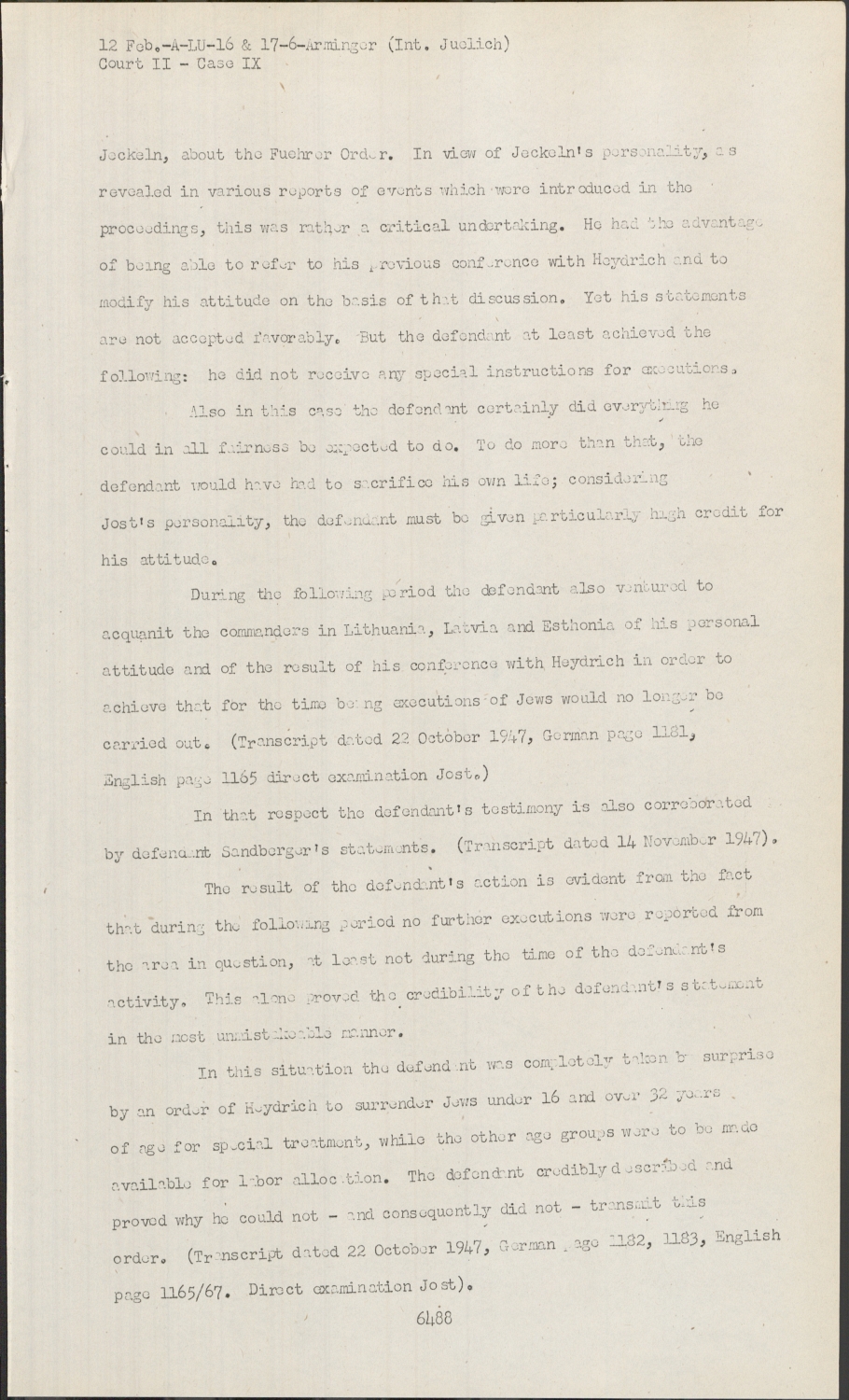
In view of Jeckeln's personality, as revealed in various reports of events which were introduced in the proceedings, this was rather a critical undertaking. He had the advantage of being able to refer to his previous conference with Heydrich and to modify his attitude on the basis of that discussion. Yet his statements are not accepted favorably. But the defendant at least achieved the following: he did not receive any special instructions for executions.
Also in this case the defendant certainly did everything he could in all fairness be expected to do. To do more than that, the defendant would have had to sacrifice his own life considering Jost's personality, the defendant must be given particularly high credit for his attitude.
During the following period the defendant also ventured to acquanit the commanders in Lithuania, Latvia and Esthonia of his personal attitude and of the result of his conference with Heydrich in order to achieve that for the time being executions of Jews would no longer be carried out. (Transcript dated 22 October 1947, German page 1181, English page 1165 direct examination Jost.)
In that respect the defendant's testimony is also correborated by defendant Sandberger's statements. (Transcript dated 14 November 1947).
The result of the defendant's action is evident from the fact that during the following period no further executions were reported from the area in question, at least not during the time of the defendant's activity. This alone proved the credibility of the defendant's statement in the most unmistakeable manner.
In this situation the defendant was completely taken by surprise by an order of Heydrich to surrender Jews under 16 and over 32 years of age for special treatment, while the other age groups were to be made available for labor allocation. The defendant credibly described and proved why he could not - and consequently did not - transmit this order. (Transcript dated 22 October 1947, German age 1182, 1183, English page 1165/67. Direct examination Jost).
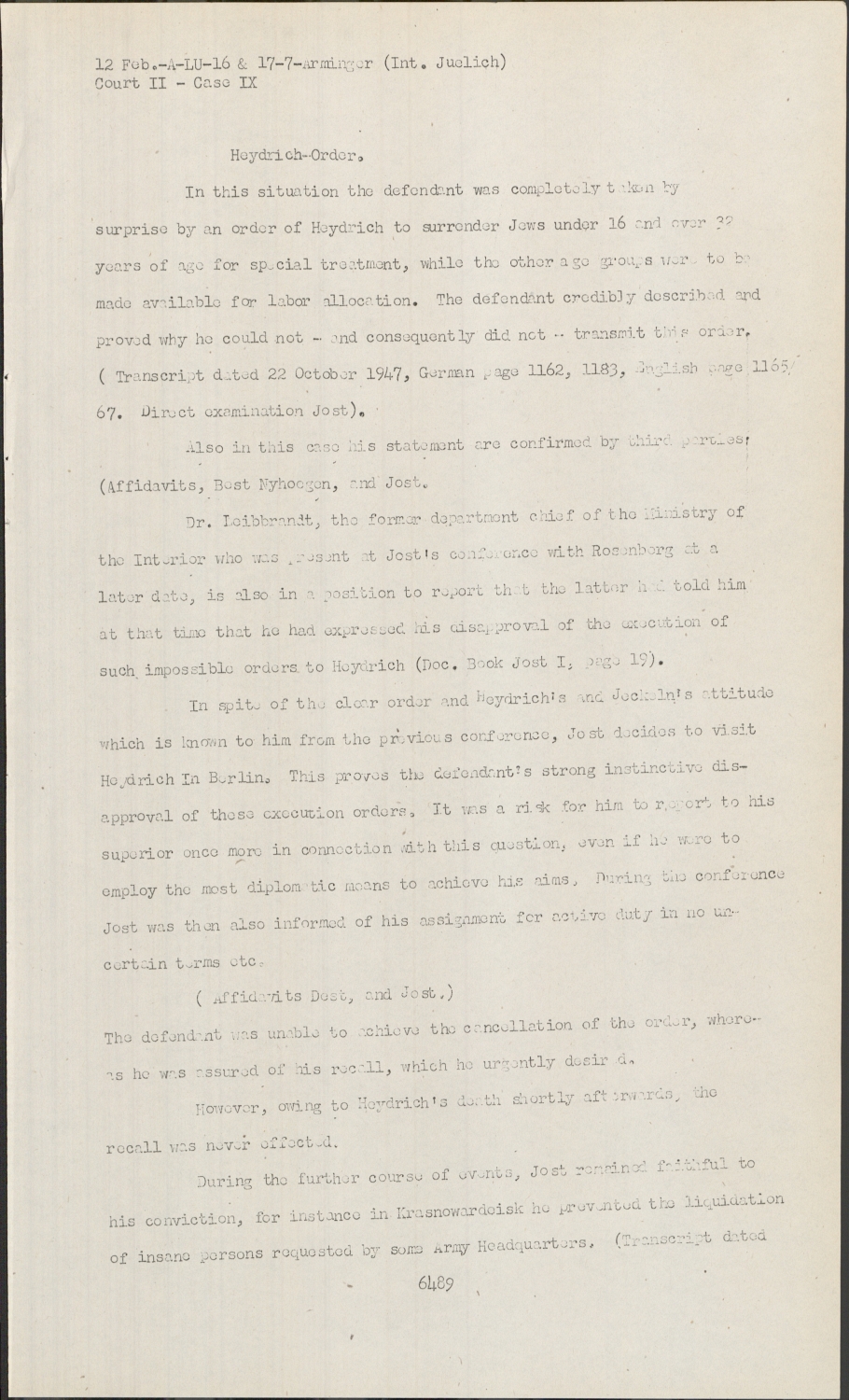
Heydrich-Order.
In this situation the defendant was completely taken by surprise by an order of Heydrich to surrender Jews under 16 and over 32 years of ago for special treatment, while the other age groups were to be made available for labor allocation. The defendant credibly described and proved why he could not - and consequently did not - transmit this order, ( Transcript dated 22 October 1947, German page 1162, 1183, English page 1165/ 67. Direct examination Jost).
Also in this case his statement are confirmed by third parties (Affidavits, Best Nyhoegen, and Jost.
Dr. Leibbrandt, the former department chief of the Ministry of the Interior who was present at Jost's conference with Rosenberg at a later date, is also in a position to report that the latter had told him at that time that he had expressed his disapproval of the execution of such impossible orders to Heydrich (Doc. Book Jost I, page 19).
In spite of the clear order and Heydrich's and Jeckeln's attitude which is known to him from the previous conference, Jost decides to visit Heydrich In Berlin. This proves the defendant's strong instinctive disapproval of these execution orders. It was a risk for him to report to his superior once more in connection with this question, even if he were to employ the most diplomatic means to achieve his aims. During the conference Jost was then also informed of his assignment for active duty in no uncertain terms etc.
( Affidavits Dest, and Jost.) The defendant was unable to achieve the cancellation of the order, where as he was assured of his recall, which he urgently desired.
However, owing to Heydrich's death shortly afterwards the recall was never effected.
During the further course of events Jost remained faithful to his conviction, for instance in Krasnowardeisk he prevented the liquidation of insane persons requested by some Army Headquarters. (Transcript dated 22 October 1947, German p. 1189, English p. 1172.
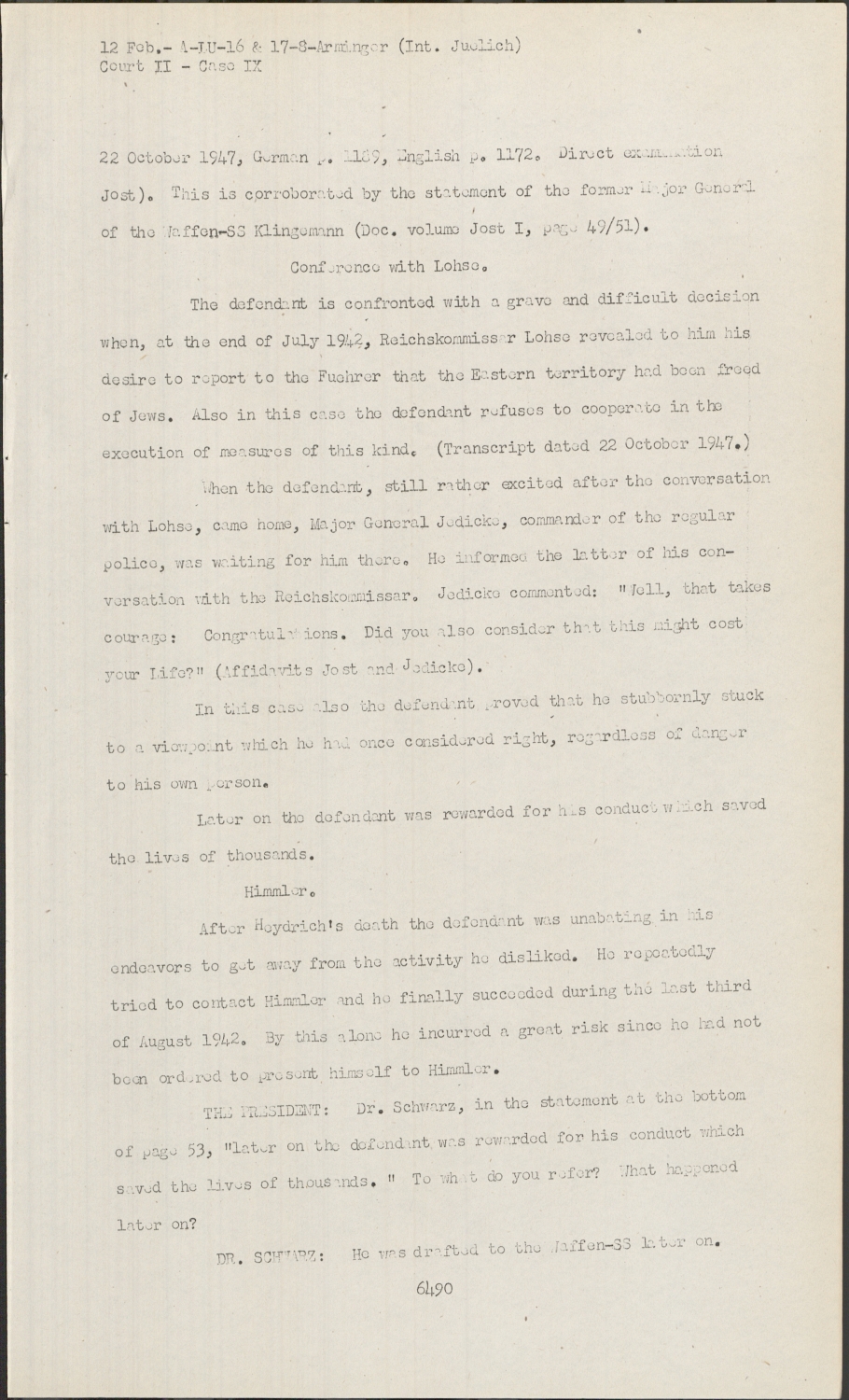
Direct examination Jost). This is corroborated by the statement of the former Major General of the Waffen-SS Klingemann (Doc. volume Jost I, page 49/51).
Conference with Lohse.
The defendant is confronted with a grave and difficult decision when, at the end of July 1942, Reichskommissar Lohse revealed to him his desire to report to the Fuehrer that the Eastern territory had been freed of Jews. Also in this case the defendant refuses to cooperate in the execution of measures of this kind. (Transcript dated 22 October 1941.)
When the defendant, still rather excited after the conversation with Lohse, came home, Major General Jedicke, commander of the regular police, was waiting for him there. He informed the latter of his conversation with the Reichskommissar. Jedicke commented: "Well, that takes courage: Congratulations. Did you also consider that this might cost your life?" (Affidavits Jost and Jedicke).
In this case also the defendant proved that he stubbornly stuck to a viewpoint which he had once considered right, regardless of danger to his own person.
Later on the defendant was rewarded for his conduct which saved the lives of thousands.
Himmler.
After Heydrich's death the defendant was unabating in his endeavors to get away from the activity he disliked. He repeatedly tried to contact Himmler and he finally succeeded during the last third of August 1942. By this alone he incurred a great risk since he had not been ordered to present himself to Himmler.
THE PRESIDENT:Dr. Schwarz, in the statement at the bottom of page 53, "later on the defendant was rewarded for his conduct which saved the lives of thousands. " To what do you refer? What happened later on?
DR. SCHWARZ:He was drafted to the Waffen-SS later on.
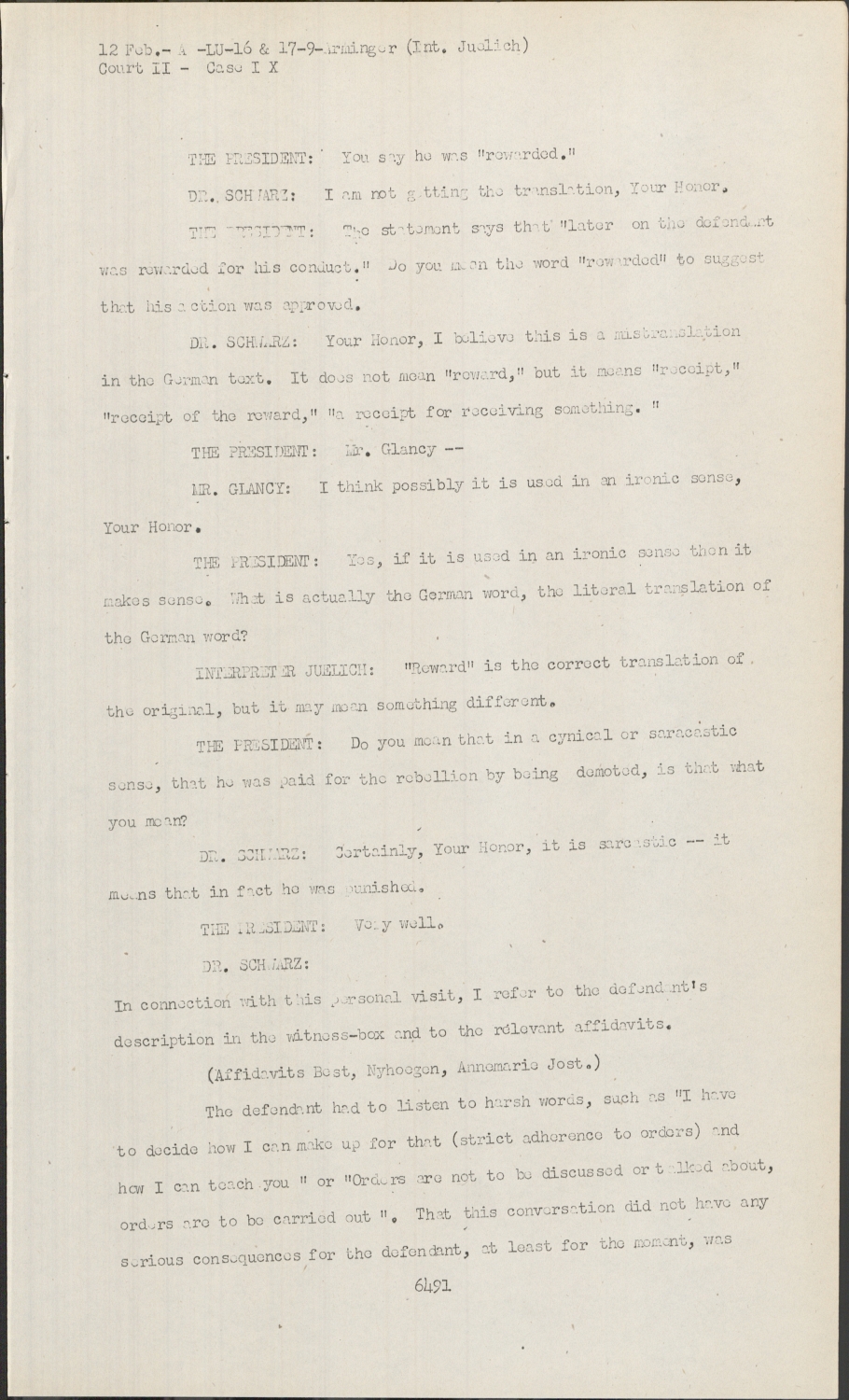
THE PRESIDENT:You say he was "rewarded."
DR. SCHWARZ:I am not getting the translation, Your Honor.
THE PRESIDENT:The statement says that "later on the defendant was rewarded for his conduct." Do you moon the word "rewarded" to suggest that his action was approved.
DR. SCHWARZ:Your Honor, I believe this is a mistranslation in the German text. It does not mean "reward," but it means "receipt," "receipt of the reward," "a receipt for receiving something. "
THE PRESIDENT:Mr. Glancy -
MR. GLANCY:I think possibly it is used in an ironic sense, Your Honor.
THE PRESIDENT:Yes, if it is used in an ironic sense then it makes sense. What is actually the German word, the literal translation of the German word?
INTERPRETERJUELICH: "Reward" is the correct translation of the original, but it may mean something different.
THE PRESIDENT:Do you mean that in a cynical or saracastic sense, that he was paid for the rebellion by being demoted, is that what you mean?
DR. SCHWARZ:Certainly, Your Honor, it is sarcastic -- it means that in fact he was punished.
THE PRESIDENT:Very well.
DR.SCHWARZ: In connection with this personal visit, I refer to the defendant's description in the witness-box and to the relevant affidavits.
(Affidavits Best, Nyhoegen, Annemarie Jost.)
The defendant had to listen to harsh words, such as "I have to decide how I can make up for that (strict adherence to orders) and how I can teach you " or "Order are not to be discussed or talked about, orders are to be carried out ". That this conversation did not have any serious consequences for the defendant, at least for the moment, was probably due to the fact that Himmler took Jost's poor state of health into consideration.