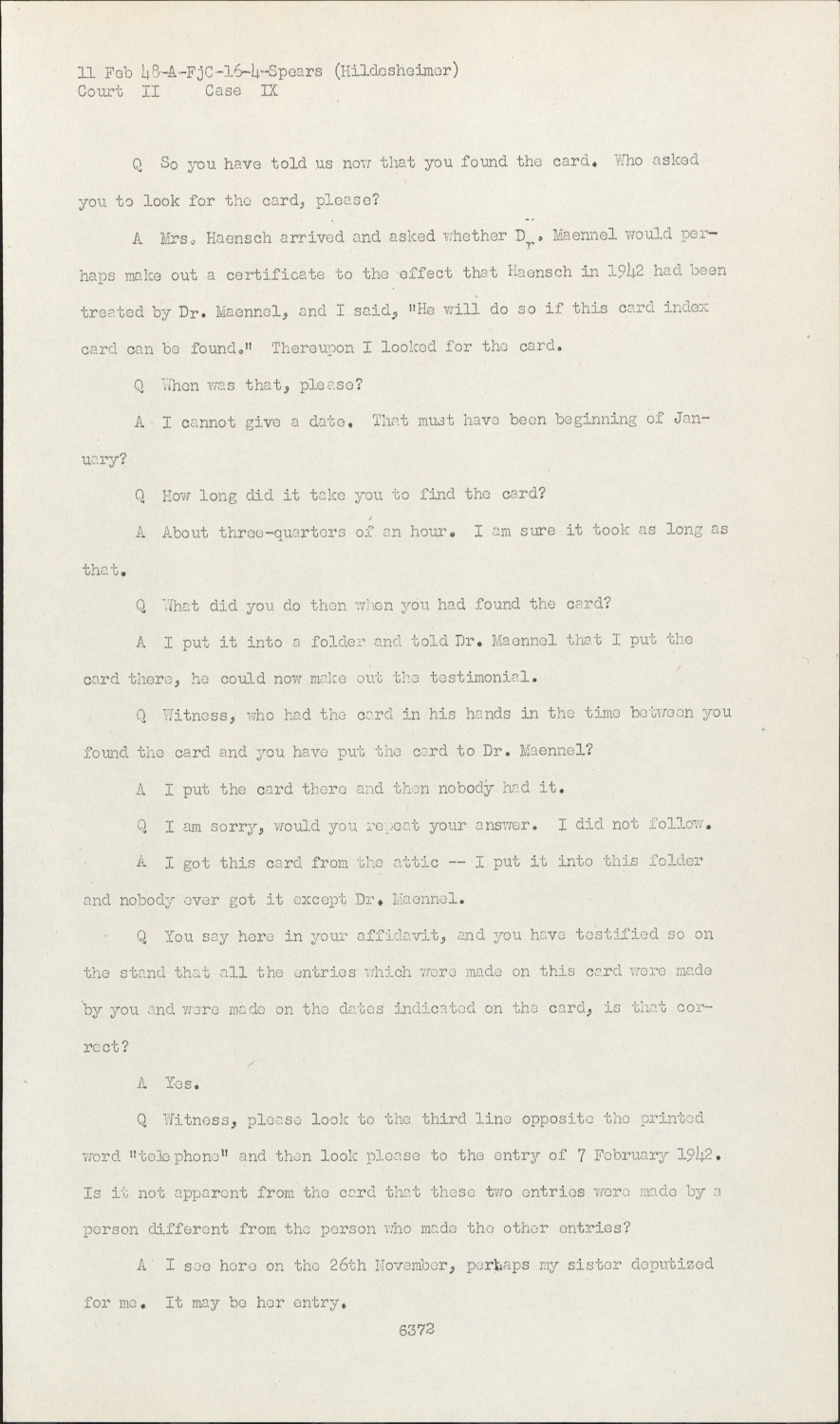
QSo you have told us now that you found the card. Who asked you to look for the card, please?
AMrs. Haensch arrived and asked whether Dr. Maennel would perhaps make out a certificate to the effect that Haensch in 1942 had been treated by Dr. Maennel, and I said, "He will do so if this card index card can be found." Thereupon I looked for the card.
QWhen was that, please?
AI cannot give a date. That must have been beginning of January?
QHow long did it take you to find the card?
AAbout three-quarters of an hour. I am sure it took as long as that.
QThat did you do then when you had found the card?
AI put it into a folder and told Dr. Maennel that I put the card there, he could now make out the testimonial.
QWitness, who had the cord in his hands in the time between you found the card and you have put the card to Dr. Maennel?
AI put the card there and then nobody had it.
QI am sorry, would you re cat your answer. I did not follow.
AI got this card from the attic -- I put it into this folder and nobody over got it except Dr. Maennel.
Q you say here in your affidavit, and you have testified so on the stand that all the entries which were made on this card were made by you and were made on the dates indicated on the card, is that correct?
AYes.
QWitness, please look to the third line opposite the printed word "telephone" and then look please to the entry of 7 February 1942. Is it not apparent from the card that these two entries were made by a person different from the person who made the other entries?
AI see here on the 26th November, perhaps my sister deputized for me. It may be her entry.
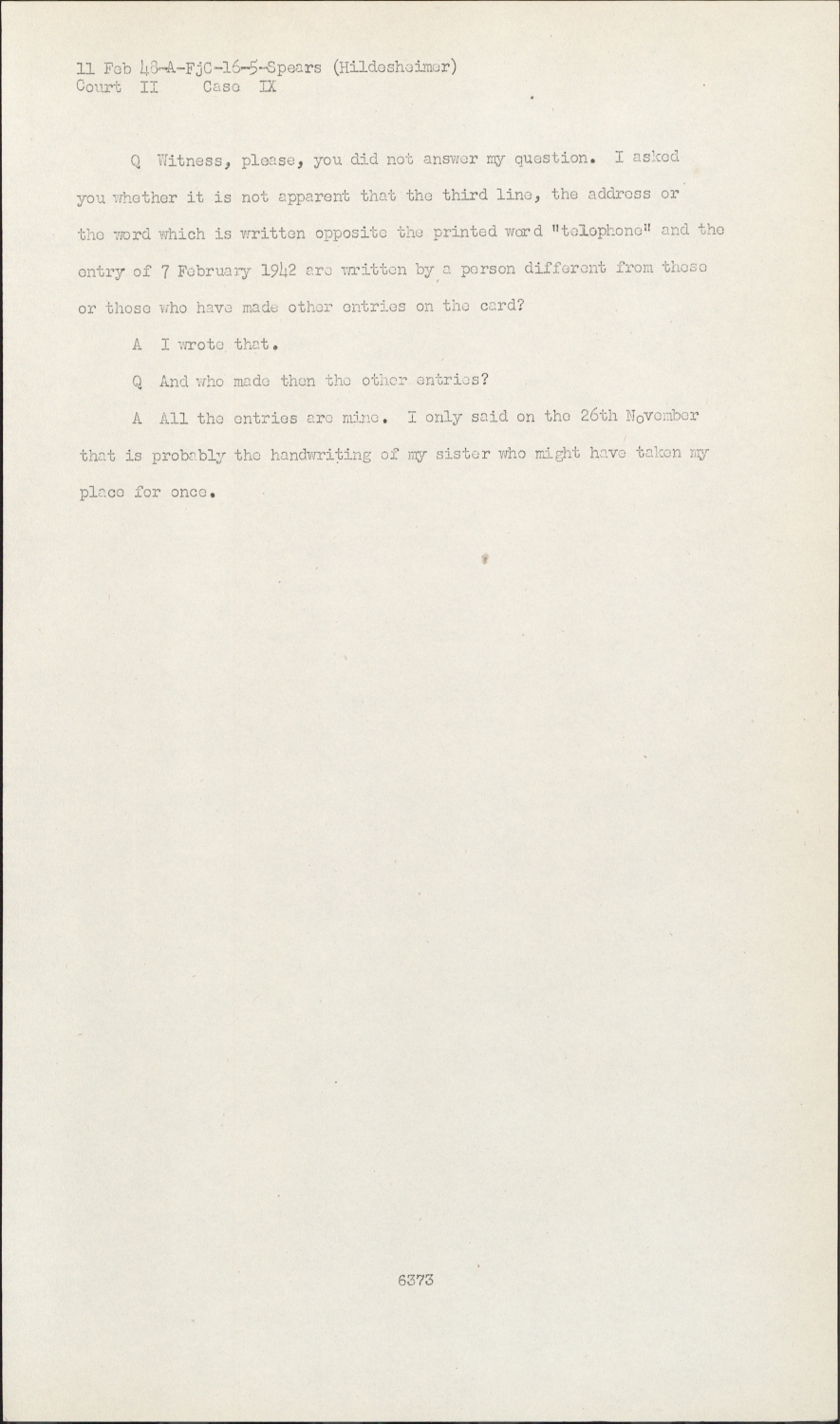
QWitness, please, you did not answer my question. I asked you whether it is not apparent that the third line, the address or the word which is written opposite the printed ward "telephone" and the entry of 7 February 1942 are written by a person different from those or those who have made other entries on the card?
AI wrote that.
QAnd who made then the other entries?
AAll the entries are mine. I only said on the 26th November that is probably the handwriting of my sister who might have taken my place for once.
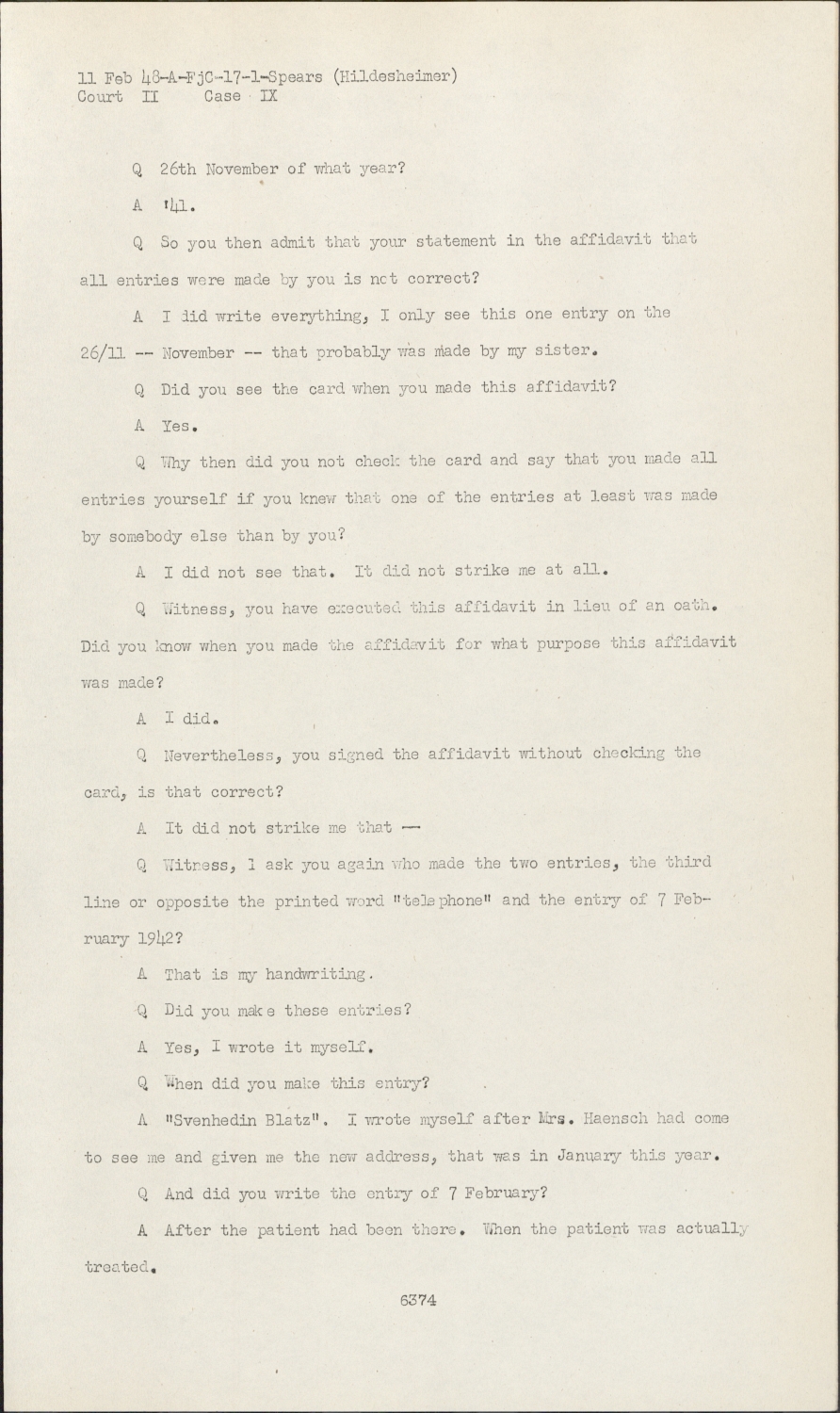
Q 26th November of what year?
A 41.
QSo you then admit that your statement in the affidavit that all entries were made by you is not correct?
AI lid write everything, I only see this one entry on the 26/11 -- November -- that probably was made by my sister.
QDid you see the card when you made this affidavit?
AYes.
QWhy then did you not check the card and say that you made all entries yourself if you knew that one of the entries at least was made by somebody else than by you?
AI did not see that. It did not strike me at all.
QWitness, you have executed this affidavit in lieu of an oath. Did you know when you made the affidavit for what purpose this affidavit was made?
AI did.
QNevertheless, you signed the affidavit without checking the card, is that correct?
AIt did not strike me that -
QWitness, I ask you again who made the two entries, the third line or opposite the printed word "telephone" and the entry of 7 February 1942?
AThat is my handwriting.
QDid you make these entries?
AYes, I wrote it myself.
QWhen did you make this entry?
A "Svenhedin Blatz". I wrote myself after Mrs. Haensch had come to see me and given me the new address, that was in January this year.
QAnd did you write the entry of 7 February?
AAfter the patient had been there. When the patient was actually treated.
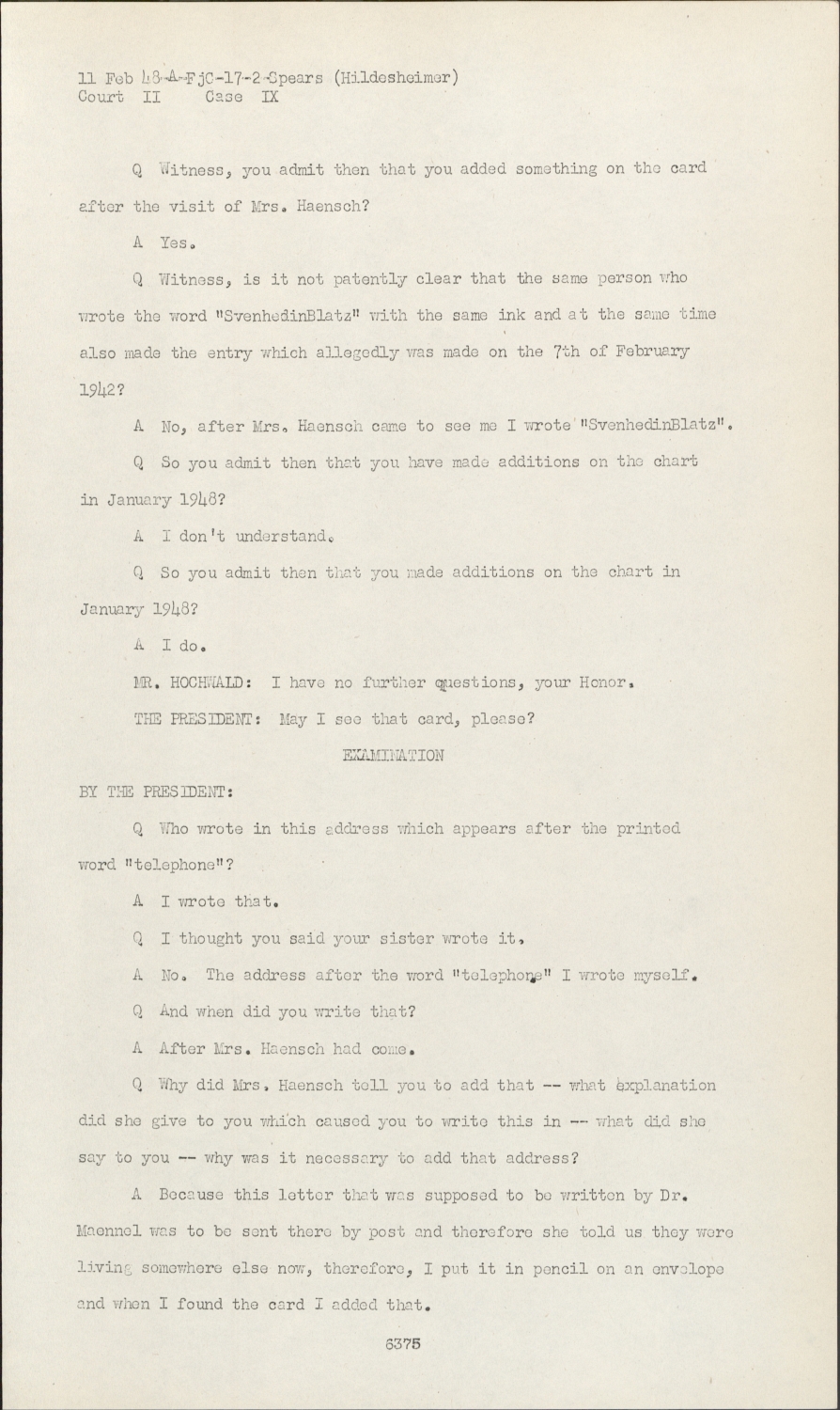
QWitness, you admit then that you added something on the card after the visit of Mrs. Haensch?
AYes.
QWitness, is it not patently clear that the same person who wrote the word "SvenhedinBlatz" with the same ink and at the same time also made the entry which allegedly was made on the 7th of February 1942?
ANo, after Mrs. Haensch came to see me I wrote "SvenhedinBlatz".
QSo you admit then that you have made additions on the chart in January 1948?
AI don't understand.
QSo you admit then that you made additions on the chart in January 1948?
AI do.
MR. HOCHWALD:I have no further questions, your Honor.
THE PRESIDENT:May I see that card, please?
EXAMINATION BY THE PRESIDENT:
QWho wrote in this address which appears after the printed word "telephone"?
AI wrote that.
QI thought you said your sister wrote it.
ANo. The address after the word "telephone" I wrote myself.
QAnd when did you write that?
AAfter Mrs. Haensch had come.
QWhy did Mrs. Haensch tell you to add that -- what explanation did she give to you which caused you to write this in -- What did she say to you -- why was it necessary to add that address?
ABecause this letter that was supposed to be written by Dr. Maennel was to be sent there by post and therefore she told us they were living somewhere else now, therefore, I put it in pencil on an envelope and when I found the card I added that.
QWell, did Mrs. Haensch tell you to add this to the card?
ANo.
QWell, we still don't understand why it was necessary tto add that address to the card.
AI wrote it down on the card because we were going to send this to Mrs. Haensch. I had written the address on an envelope and generally one throws these envelopes away, and therefore I put it on the card.
QWell, why didn't you give the card to her when she was there?
AI hand't found it then. It was only the next day that I went upstairs and looked for the card.
QWell, then did you mail it to her?
ANo. Mrs. came here to fetch the letter.
QWhy was it so important to have the address on the card if she was going to call for it personally?
AI didn't know that she would come. She actually did come on the next but one day and the letter had not been made yet.
QWell, what did she say when she asked for the card, that you were to mail the card to her?
ANo, not the card, only the letter by Dr. Maennel -- the --the medical certificate which she had asked for, that is what she wanted.
QThe affidavit you mean?
ANo, only the letter to the effect that Dr. Haensch had been treated in 1942.
QWell, why was it necessary to add that information to this card which had nothing to do with the mailing of the certificate?
AI had found the index card, and as I had written it just bythe-way on this envelope, I also put it on this card. There is nothing unusual about it, I just put it there.
QWell, you think there is nothing unusual about changing a permanent record?
AWe regularly do that when patients have moved and change their address and they tell us about these addresses, we put them on the index card.
QAnd at the same time that you added this address, did you add this item of February 7?
ANo, I only added only the address.
QWhich entry was made by your sister?
THE PRESIDENT:Let her point it out and then show me. BY THE PRESIDENT:
QHow many other entries were made by anybody else?.
ANone.
QSo that your sister ma do the entry of November 26 and everything also on the card was written by you?
AYes.
QIs that correct?
AYes.
QNow, you remembered Dr. Haensch coming there for treatment, do you? Do you remember that Walter Haensch came there for treatment in 1941, 1942, and 1943?
AAfter Frau Haensch had said whether Dr. Maennel would make out a medical certificate, I assumed that the patients had been there and therefore I looked for the card index card.
QWell, then after you had spoken with Mrs. Haensch, did you recall Haensch having been there for treatment?
ANo.
QWell, then why did you say in your affidavit that from this activity "Dr. Walter Haensch" then with the address "is known to me"-why did you say that if he wasn't known to you?
AI had already looked for the card and found it, after I made out the affidavit and therefore I knew, as I had written it myself, that Dr. Haensch had been treated, only from this card.
QDid you remember his first name?
ANo. The first name, if it was not contained on the index card, I did not know it.
QWell, this affidavit says that Haensch was known to you. Do you mean that?
AI only know Dr. Haensch from the treatment he received.
QWell, then you do know that Haensch came there for treatment?
AYes, After I had seen the card, I know it -- I know that he had been there.
QThen you know that Haensch had come there for treatment? A Yes.
QNow, this card indicates that he was treated over a period of three years, about 12 times, is that right?
AYes.
QHow many visits would the average patient have at your office for one treatment?
AThat depends on the treatment.
QWell, I said "the average", would you say that this was more than the average or less than the average, you were treating from 80 to 100 patients per day, weren't you?
AYes.
QWell, were they different patients every day, or would some repeat?
AWell, they kept coming after 8 days sometimes after 3 or 4, days until the treatment had been completed.
QYes, and can you give an estimate as to the average number of times one patient would be treated before his treatment was complete?
ARoughly throe to four times. That depends on what is wrong.
QAll right, now, if you were having from 80 to 100 patients per day, do you realize how many visits there would be in a year's time? Say, on the average of 90 per day, let us say 300 days per year. Do you realize into what figure that goes?
A I.Yes.
QThat would be 27,000.
AYes.
QAnd over a period of 3 years that would 81,000 visits wouldn't it?
AWell, now, of course, patients kept returning. They are not always now patients.
QWell, that is the reason I asked you about how many visits one patient would have before his treatment would be completed and you told me on the average of 3 or 4 treatments.
AWell, I only mean to say, if only one or two teeth are being treated, then he has to return 4 to 5 times; if, of course, he has pain again after about 8 weeks -- well, of course, that is very difficult to say.
QVery well, now you have a recollection of Haensch, haven't you, of Haensch coming there during 1941, 1942, and 1943 -- you remember his coming there, don't you?
AI don't remember it now, but he must have been there because I made the entries on the index card, other wise, the index card would not even exist.
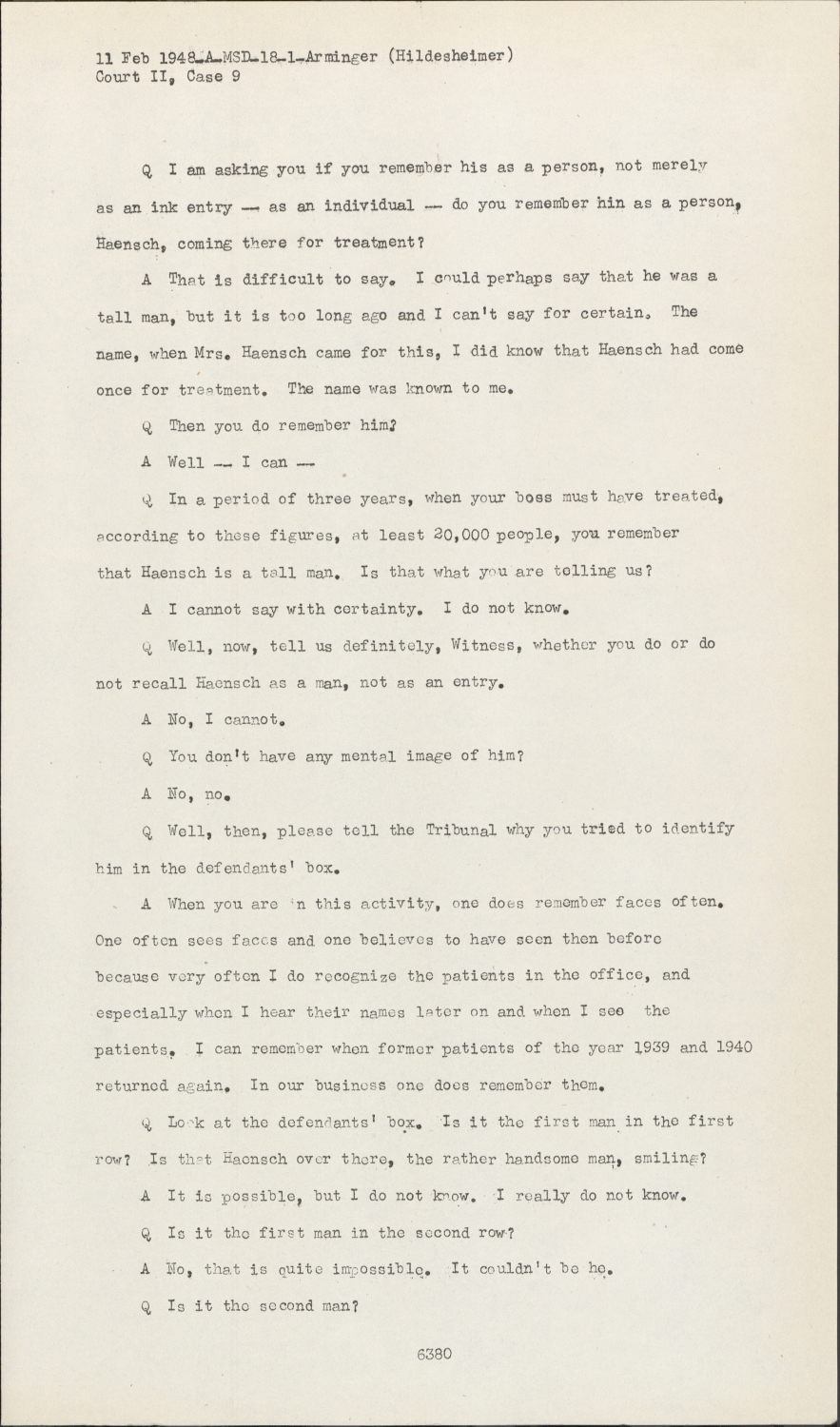
11 Feb 1948_A_MSD_18_1_Arminger (Hildesheimer)
QI am asking you if you remember his as a person, not merely as an ink entry -- as an individual -- do you remember hin as a person, Haensch, coming there for treatment?
AThat is difficult to say. I could perhaps say that he was a tall man, but it is too long ago and I can't say for certain, The name, when Mrs. Haensch came for this, I did know that Haensch had come once for treatment. The name was known to me.
QThen you do remember him?
AWell -- I can -
QIn a period of three years, when your boss must have treated, according to these figures, at least 20,000 people, you remember that Haensch is a tall man. Is that what you are telling us?
AI cannot say with certainty. I do not know.
QWell, now, tell us definitely, Witness, whether you do or do not recall Haensch as a man, not as an entry.
ANo, I cannot.
QYou don't have any mental image of him?
ANo, no.
QWell, then, please tell the Tribunal why you tried to identify him in the defendants' box.
AWhen you are in this activity, one does remember faces often. One often sees faces and one believes to have seen then before because very often I do recognize the patients in the office, and especially when I hear their names later on and. when I see the patients. I can remember when former patients of the year 1939 and 1940 returned again. In our business one does remember them.
QLook at the defendants' box. Is it the first man in the first row? Is that Haensch over there, the rather handsome man, smiling?
AIt is possible, but I do not know. I really do not know.
QIs it the first man in the second row?
ANo, that is quite impossible. It couldn't be he.
QIs it the second man?
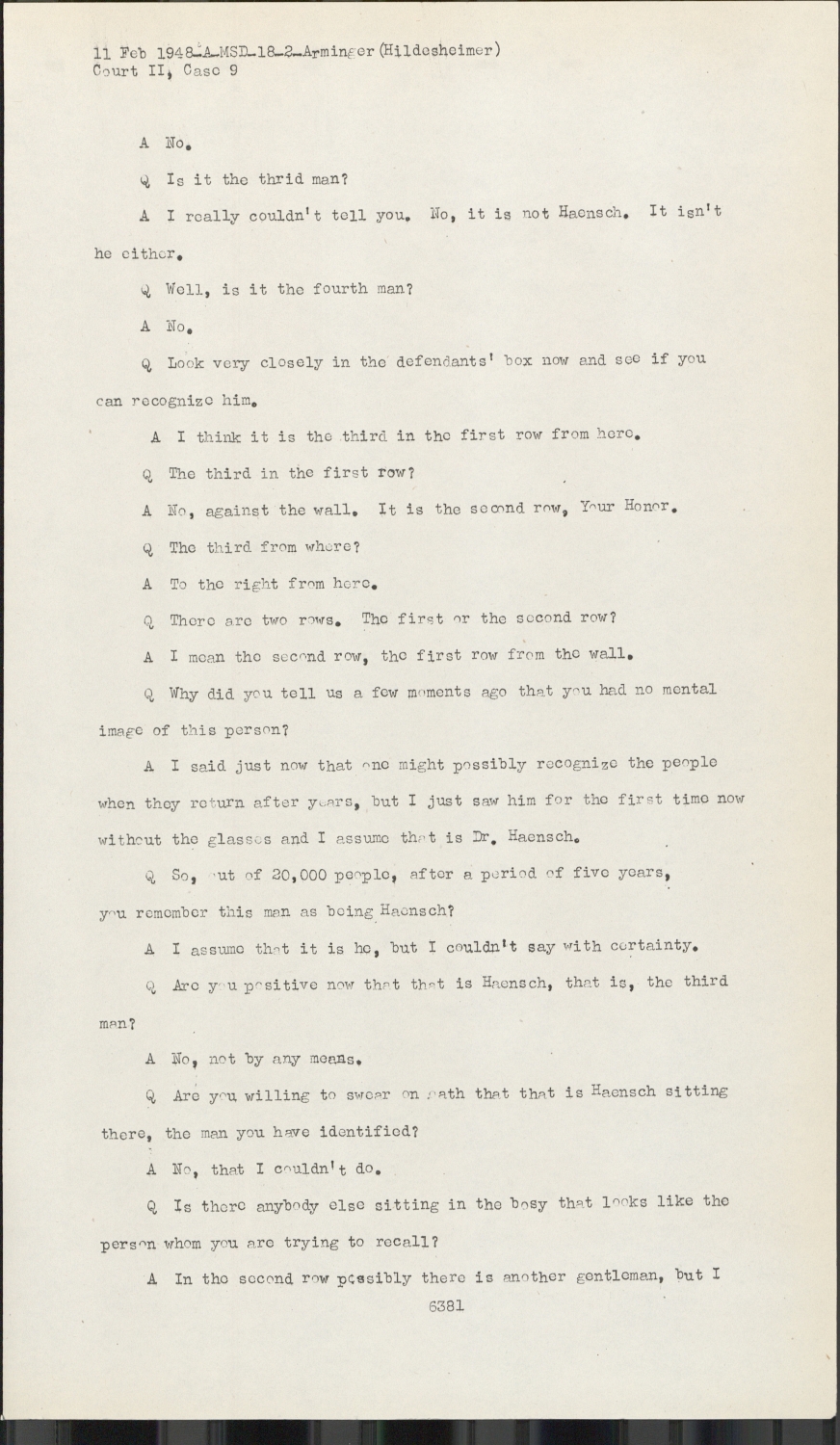
11 Feb 1948_A_MSD_18_2_Arminger (Hildesheimer)
ANo.
QIs it the thrid man?
AI really couldn't tell you. No, it is not Haensch. It isn't he either.
QWell, is it the fourth man?
ANo.
QLook very closely in the defendants' box now and see if you can recognize him.
AI think it is the third in the first row from here.
QThe third in the first row?
ANo, against the wall. It is the second row, Your Honor.
QThe third from where?
ATo the right from here.
QThere are two rows. The first or the second row?
AI mean the second row, the first row from the wall.
QWhy did you tell us a few moments ago that you had no mental image of this person?
AI said just now that one might possibly recognize the people when they return after years, hut I just saw him for the first time now without the glasses and I assume that is Dr. Haensch.
QSo, out of 20,000 people, after a period of five years, you remember this man as being Haensch?
AI assume that it is he, but I couldn't say with certainty.
QAre you positive now that that is Haensch, that is, the third man?
ANo. not by any means.
QAre you willing to swear on oath that that is Haensch sitting there, the man you have identified?
ANo, that I couldn't do.
QIs there anybody else sitting in the bosy that looks like the person whom you are trying to recall?
AIn the second row possibly there is another gentleman, but I 11 Feb 1948_A_MSD_18_3_Arminger (Hildesheimer) am not sure.
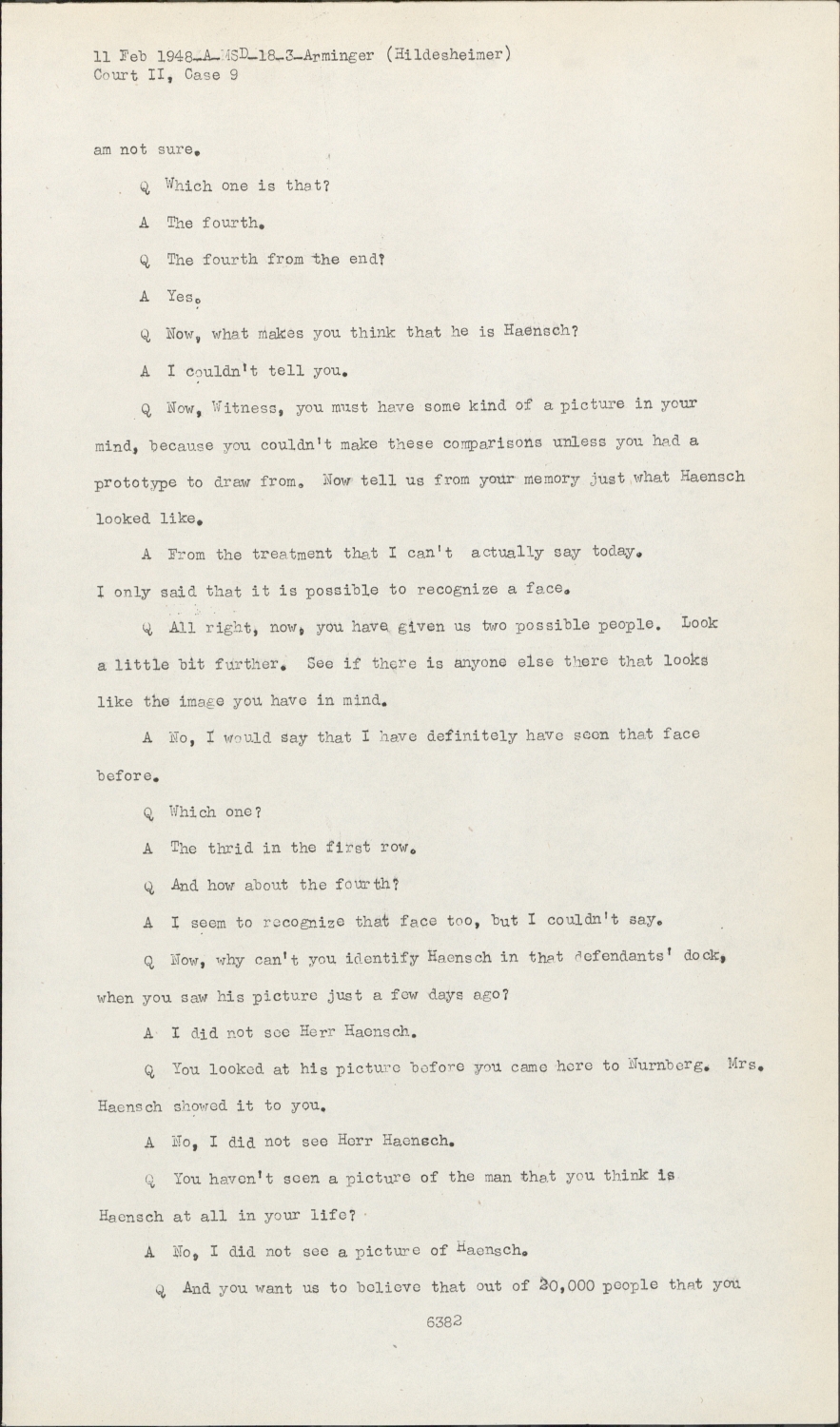
QWhich one is that?
AThe fourth.
QThe fourth from the end?
AYes.
QNow, what makes you think that he is Haensch?
AI couldn't tell you.
QNow, Witness, you must have some kind of a picture in your mind, because you couldn't make these comparisons unless you had a prototype to draw from. Now tell us from your memory just what Haensch looked like.
AFrom the treatment that I can't actually say today. I only said that it is possible to recognize a face.
QAll right, now, you have given us two possible people. Look a little bit further. See if there is anyone else there that looks like the image you have in mind.
ANo, I would say that I have definitely have seen that face before.
QWhich one?
AThe thrid in the first row.
QAnd how about the fourth?
AI seem to recognize that face too, but I couldn't say.
QNow, why can't you identify Haensch in that defendants' dock, when you saw his picture just a few days ago?
AI did not see Herr Haensch.
QYou looked at his picture before you came here to Nurnberg. Mrs Haensch showed it to you.
ANo, I did not see Herr Haensch.
QYou haven't seen a picture of the man that you think is Haensch at all in your life?
ANo, I did not see a picture of Haensch.
QAnd you want us to believe that out of 20,000 people that you 11 Feb 1948_A_MSD_18_4_Arminger (Hildesheimer) saw over a period of three years, that you can recall one individual person?
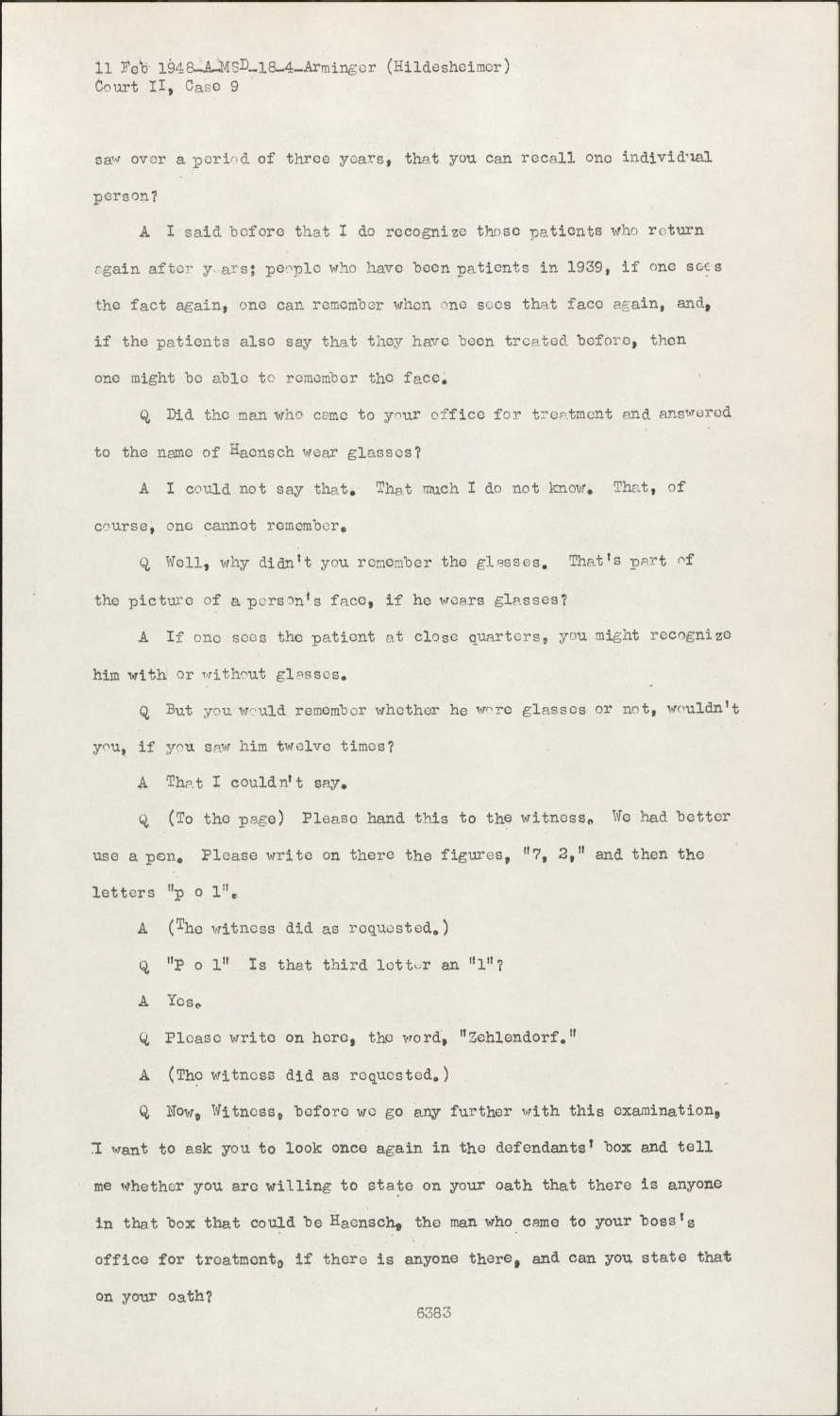
AI said before that I do recognize those patients who return again after years; people who have been patients in 1939, if one sees the fact again, one can remember when one sees that face again, and, if the patients also say that they have been treated before, then one might be able to remember the face.
QDid the man who came to your office for treatment and answered to the name of Haensch wear glasses?
AI could not say that. That much I do not know. That, of course, one cannot remember.
QWell, why didn't you remember the glasses. That's part of the picture of a person's face, if he wears glasses?
AIf one sees the patient at close quarters, you might recognize him with or without glasses.
QBut you would remember whether he were glasses or not, wouldn't you, if you saw him twelve times?
AThat I couldn't say.
Q (To the page) Please hand this to the witness. We had bettor use a pen. Please write on there the figures, "7, 2," and then the letters "p o l".
A (The witness did as requested.)
Q "P o l" Is that third letter an "1"?
AYes.
QPlease write on here, the word, "Zehlendorf."
A (The witness did as requested.)
QNow, Witness, before we go any further with this examination, I want to ask you to look once again in the defendants' box and tell me whether you are willing to state on your oath that there is anyone in that box that could be Haensch, the man who came to your boss's office for treatment, if there is anyone there, and can you state that on your oath?
11 Feb 1948_A_MSD_18_5_Arminger (Hildesheimer)
ANo, under oath, I can't state that that is Dr. Haensch.
QNow, Witness, please indicate why it is that you drew this totaling line on April 23 and then later wrote the figures "7, 2." Why does "7, 2" follow 23-4?
A.That was a treatment which was not charged for, and therefore it wasn't added in.
Q.Why wouldn't this item, "7,2" be above the totaling line, since it precedes it in date?
A.That is a treatment which is not charged for and therefore it is not entered.
Q.Why don't you charge for polishing?
A.That is part of the treatment and it isn't charged for as a rule.
Q.What kind of a treatment was given prior to polishing? Some fillings, a filling ?
A.Yes, yes, a filling was made.
Q.Yes, and after every filling, there is a polishing, isn't there?
A/ Yes, every patient is asked to come for a polishing,
Q.Now, please tell the Tribunal why there isn't a polishing entry after the fillings which were introduced on the last item of that card?
A.The patient probably did not appear again, otherwise it. would have been entered.
Q.And why didn't he appear?
A.That I. do not know.
Q.Well, he apprared for the first tine. Why didn't he appear the second time?
A.Every patient is asked after a filling has been made, to come again within the next eight days, to come again for polishing,
Q.You say, after eight days?
A.Yes.
Q.Is that right?
A.Well, that again depends -
Q.Tell me how many days intervened?
A.A few days. In any case the patient is asked to come back.
Q.Tell me how many days intervened between January 14 and February, Is that eight days?
A.No.
Q.It is three weeks, isn't it?
A.Yes.
Q.Now-
A.It doesn't really matter, the date when the patient returns. I said every patient is asked to come back, but when he does come back it does not matter to us.
Q.Is polishing part of the job, part of the repair work?
A.Yes, it is important.
Q.It is important?
A.Yes, it is of considerable importance.
Q.Now, no patient goes to a dental parlor just for fun, does he? No one goes for entertainment purposes.
A.No.
Q.On the contrary, it is proverbial that one tried to avoid going to a dentist until the situation is such that he just must go. That's understood, isn't it?
A.Yes.
Q.But when a patient is confronted with the necessity of having his teeth attended to, then he goes, doesn't he?
A.Yes.
Q.Now, this patient was so much concerned about his teeth in February 1942 that he came back for that polishing process, didn't he?
A.I don't know whether he worried, but in any case he was there.
Q.He came. The record shows he came.
A.He must have been there. Otherwise the entry would not have been made.
Q.Now, can you explain to us what process of reasoning caused this patient not to come for those other fillings in 1943?
A.I do not know.
Q.The same doctor, the same patient, the same clerk, the same kind of work. Yet he reacted differently, when it came to the two fillings which were introduced. You have no explanation for that?
A.We cannot go and fetch the patients by force, if they don't come back for polishing, It happens quite often.
Q.Did you send the police after him to come back on February
Q.Did you send the fire department for him to have his teeth polished on February 7?
A.No.
Q.No came voluntarily, didn't he?
A.Obviously.
Q.Do you know why he didn't cone voluntarily a few months later
A.No, that I do not know.
Q.Is ther any other item on here that doesn't call for payment?
A.Ho. I would have to look at the card again. I would have to see it again.
Q.All right. Please look at the card and tell me if there are any otheritems there which do not call for payment.
A.Yes, there is a trepanation, so-called, which I never charge for, in the first treatment, that is, there follows either an extraction of -
Q.Let us see the card.
A.Where there is an extraction.
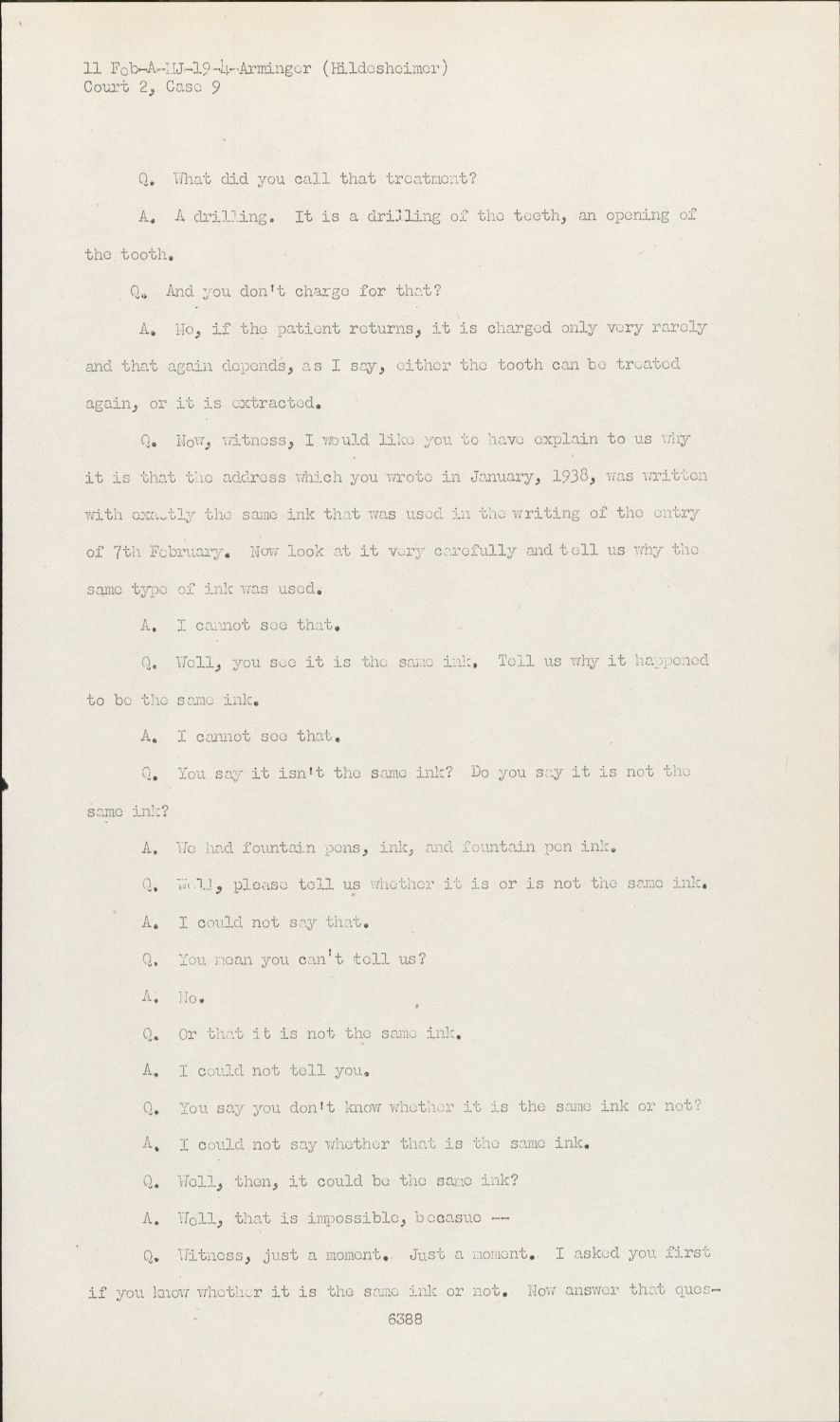
Q.What did you call that treatment?
A.A drilling. It is a drilling of the teeth, an opening of the tooth.
Q.And you don't charge for that?
A.No, if the patient returns, it is charged only very rarely and that again depends, as I say, either the tooth can to treated again, or it is extracted.
Q.Now, witness, I would like you to have explain to us why it is that the address watch you wrote in January, 1938, was written with exactly the same ink that was used in the writing of the entry of 7th February. Now look at it very carefully and tell us why the same type of ink was used.
A.I cannot see that.
Q.Well, you see it is the same ink, Tell us why it happened to be the same ink.
A.I cannot see that.
Q.You say it isn't the same ink? Do you say it is not the same ink?
A.We had fountain pens, ink, and fountain pen ink.
Q.Well, please tell us Whether it is or is not the same ink.
A.I could not say that.
Q.You mean you can't tell us?
A.No.
Q.Or that it is not the same ink.
A.I could not tell you.
Q.You say you don't know whether it is the same ink or not?
A.I could not say whether that is the same ink.
Q.Well, then, it could be the sane ink?
A.Moll, that is impossible, becasue -
Q. witness, just a moment. Just a moment. I asked you first if you know whether it is the same ink or not. How answer that ques tion.
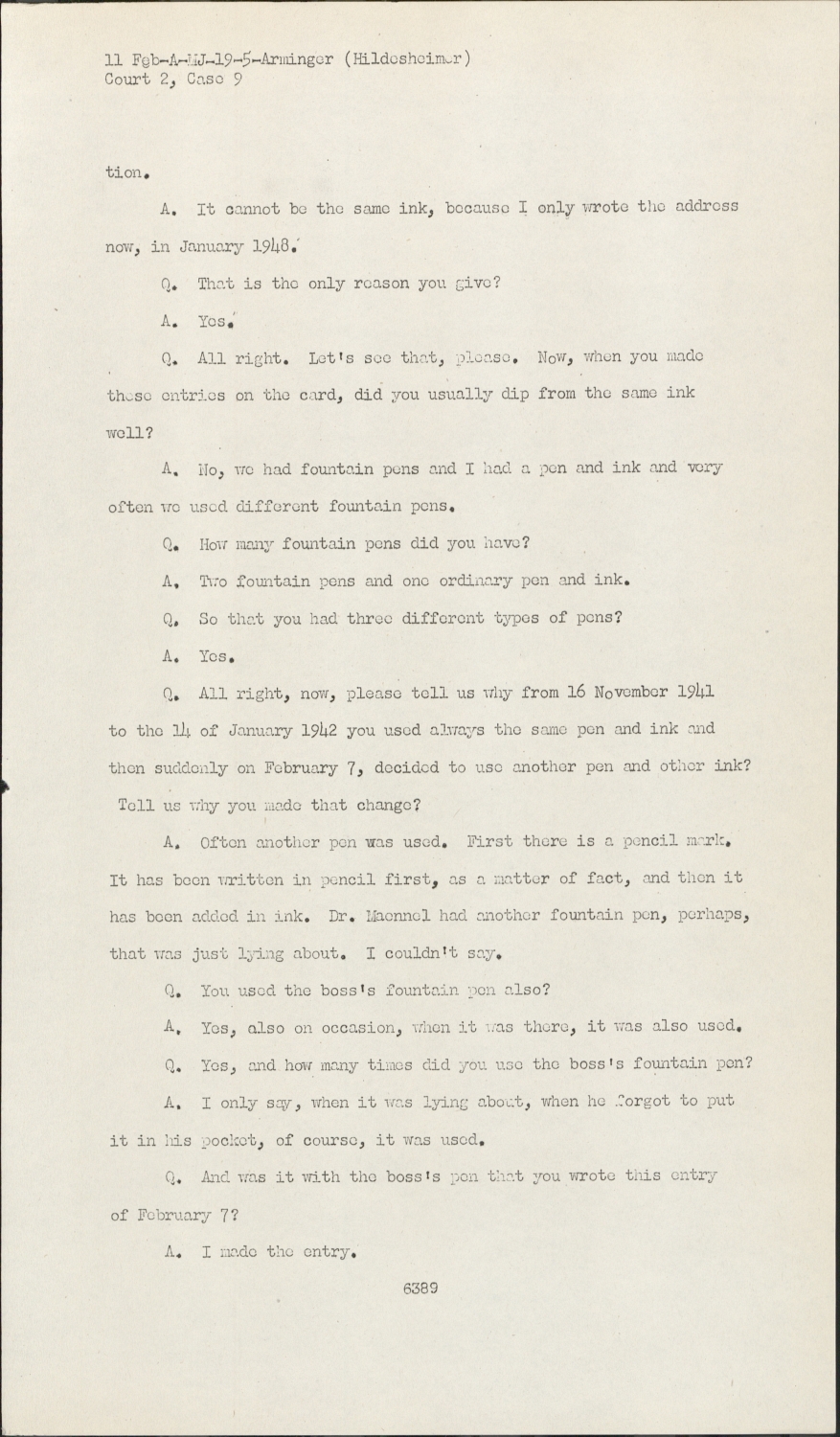
A.It cannot be the same ink, because I only wrote the address now, in January 1948.
Q.That is the only reason you give?
A.Yes.
Q.All right. Let's see that, please. Now, when you made these entries on the card, did you usually dip from the same ink well?
A.No, We had fountain pens and I had a pen and ink and very often we used different fountain pens.
Q.How many fountain pens did you have?
A.No, fountain pens and one ordinary pen and ink.
Q.So that you had three different types of pens?
A.Yes.
Q.All right, now, please tell us why from 16 November 1941 to the lit of January 1942 you used always the some pen and ink and then suddenly on February 7, decided to use another pen and other ink? Tell us why you made that change?
A.Often another pen was used. First there is a pencil mark. It has been written in pencil first, as a matter of fact, and then it has been added in ink. Dr. Maennel had another fountain pen, perhaps, that was just lying about. I couldn't say.
Q.You used the boss's fountain pen also?
A.Yes, also on occasion, when it was there, it was also used.
Q.Yes, and how many times did you use the boss's fountain pen?
A.I only say, when it was lying about, when he forget to put it in his pocket, of course, it was used.
Q.And was it with the boss's pen that you wrote this entry of February 7?
A.I made the entry.
Q.Was it with his pen?
A.That I couldn't say today, what land of fountain pen that was.
THE PRESIDENT:The witness will not be allowed to speak to anyone during the recess which will take place for fifteen minutes.
( A recess was taken.)
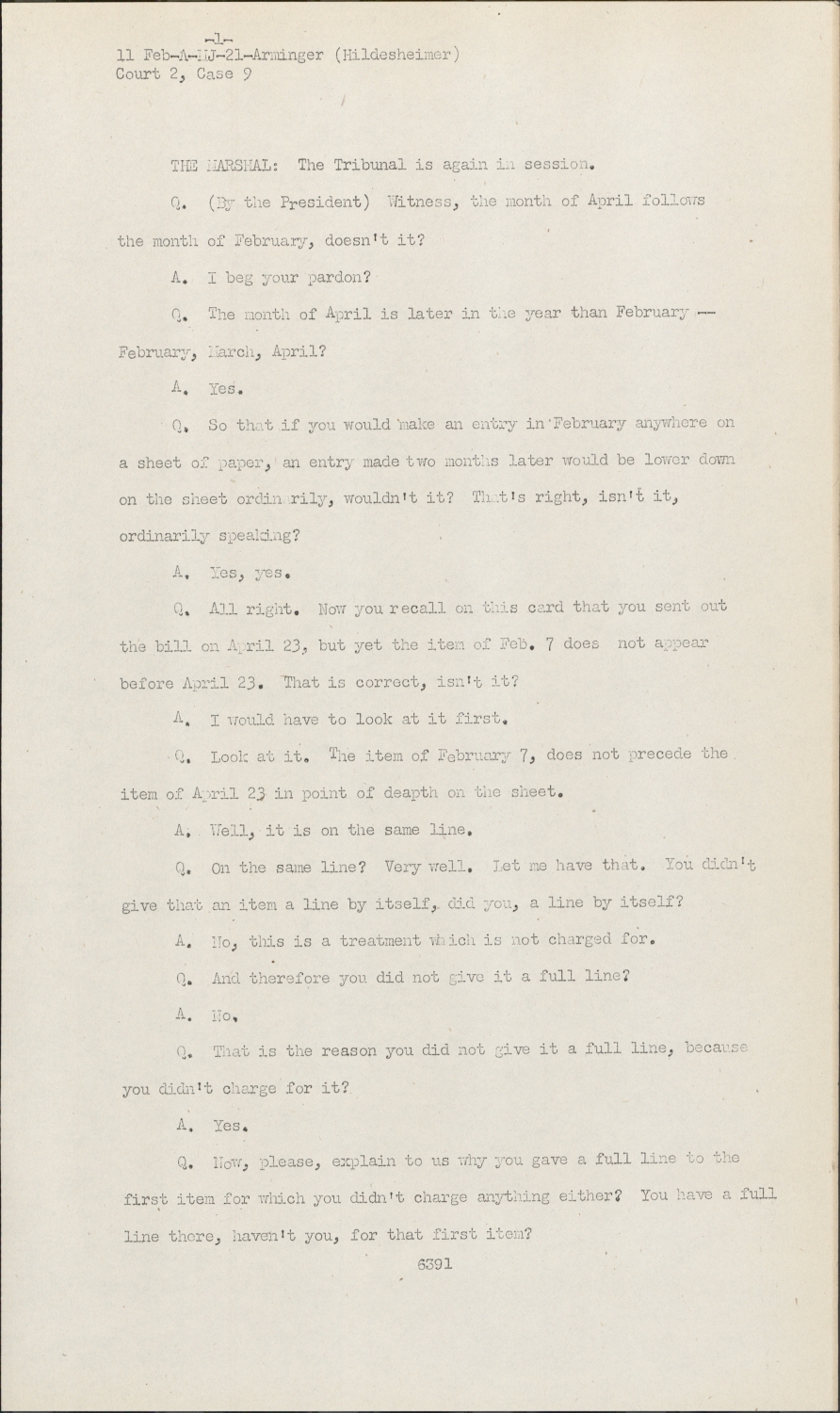
THE MARSHAL:The Tribunal is again in session.
Q. (By the President) Witness, the month of April follows the month of February, doesn't it?
A.I beg your pardon?
Q.The month of April is later in the year than February -February, March, April?
A.Yes.
Q.So that if you would make an entry in February anywhere on a sheet of paper, an entry made two months later would be lower down on the sheet ordinarily, wouldn't it? That's right, isn't it, ordinarily speaking?
A.Yes, yes.
Q.All right. Now you recall on this card that you sent out the bill on April 23, but yet the item of Feb, 7 does not appear before April 23. That is correct, isn't it?
A.I would have to look at it first.
Q.Look at it. The item of February 7, does not precede the item of April 23 in point of deapth on the sheet.
A.Well, it is on the same line.
Q.On the same line? Very well. Let me have that. You didn't give that an item a line by itself, did you, a line by itself?
A.No, this is a treatment which is not charged for.
Q.And therefore you did not give it a full line?
A.No.
Q.That is the reason you did not give it a full line, because you didn't charge for it?
A.Yes.
Q.Now, please, explain to us why you gave a full line to the first item for which you didn't charge anything either? You have a full line there, haven't you, for that first item?