You understand this, don't you?
AYes.
QAnd that is why I say you had to know Herr Mahnke for some time a little closer so that he told you that "We celebrated our chief's birthday." Of, do you think that-
AYes, Professor Six celebrated his birthday in Russia.
QDo you recall the day or the date when this was or when Herr Mahnke told you about it?
ANo, I cannot tell you the exact day.
MR. FERENCZ:The witness has testified already three or four times that she does not know the date. This is not cross examination. This is a defense witness. We have permitted all kinds of leading questions to be put, without objecting. However, I would like to remind the Defense Counsel that this is a defense witness and that if she has answered three or four times that should be adequate.
THE PRESIDENT:Yes. I do not think you need to press that any more, Doctor.
DR. ULMER:Very well, I shall cease to ask about this, Your Honor. BY DR. ULMER:
QFrau Wetter, how did it happen that you yourself remembered your diary when you were asked about these matters after my interrogation? When was this?
AWell, you see, it was like this concerning this diary. When I was asked by Nuernberg, they asked me immediately when did Professor six leave Russia and I said I do not know the exact date.
Professor Six was in Russia only for a short time while I was there, but I cannot tell you the date because that was six years ago.
QYou told that to the gentleman who came after me, who asked you again about this?
AYes, at the time I did not go through the affidavit, I just believed everything and I thought everything was all right and I trusted you fully. Dr. Ulmer, I did not think -
QDon't you trust me any more, now?
AYes, well, I am not talking about it. What I mean is-
AAre you of the opinion that I am not worthy of your confidence?
AA little.
QHow do you mean that?
AYou just told me that you know that the date is incorrect. You told me that afterwards and you did that purposely.
QThe second interrogator did tell you that.
AYes, and then I was to say exactly, to explain how I had already determined the definite date. They told me, "Well, do you have any papers from that time", and they took some of my papers and among them was my diary. I did not know whether anything was contained in it. I only had a little bit from that time left and they said it was so important that I determine the date when I saw Dr. Six. They said it was of importance. I didn't know why. And I tried to think as hard as I could, Dr. Ulmer.
QVery well, I am not reproaching you. You say that they took some of your papers, that is what you said. How was this done?
ABecause they needed them.
QHow did they take them? Did they tell you, "What papers do you have left from that time?"
AYes, they told me that.
QWhat kind of papers you had left?
AYes because I could not remember the date any more. I did not know that the date was contained in this affidavit. I really did not know.
QBut in your copy it is contained -
AYes, afterwards they told me, "How did it happen that the 20th of August is mentioned here?"
QYou do have the copies still, don't you?
AYes, I do.
QVery well, and then you handed in all papers?
AYes.
QTo the interrogator?
AYes.
QAnd, if you would be good enough to repeat this more clearly, What did he say that I said to you?
AI have said it before. "How about this date which is contained here?" They showed me the copy by you. And how it happened that this day is in there. I said, "I don't know just how it happened." So they told me, "But Dr. Ulmer knew that the date is wrong," Because I thought I don't want to harm Professor Six at all, really I don't, and so I said perhaps my diary might help. Certainly I don't want to do that. I don't want to bother my conscience about that.
QBut you are not supposed to. But, that is what I told you in Stuttgart. They explained to you that I had not been quite honest with you?
AYes, they told me that later.
QThat was told to you by the gentleman who interrogated you for the second time?
AYes. I didn't quite remember this date so exactly, but I thought you were quite sure of it. I said to you at the time, "I only know that Professor Six was a very short time in Russia." I told you that right in the beginning. But you will understand this, Dr. Ulmer. Six years ago -one remembers when one was married and when a child was born, but apart from that I didn't even remember the date when I came to Germany. I had to look it up on papers as well.
QDuring this interrogation, were you told at all that if you did not Know this immediately what the exact date was, that they would have to keep you, detain you?
ANo.
QThat any unpleasantness would arise for you?
ANo.
QDo you remember that you had certain misgivings about making out this affidavit with me? Because you thought perhaps you might be reproached by the Russians because of this? Do you recall that?
AYes.
QIn reply, did I tell you certainly no one in any American Tribunal or any one who has to do with it will ever - just because you act as a witness for a defendant now - will ever make any difficulties for you and tell the Russians about it?
AYou told me that I wouldn't be asked here as a witness at all.
QI said I assumed that you won't be called here as a witness by me remember. Do you remember that exactly, I told you that if you give me the affidavit then I won't need to call you as witness? Please say what you would like to. I don't want to influence you at all. I don't want to look at you. I am not trying to force you to any answer.
ANo, you are not forcing me. You said it certainly would not happen because everything I know was from a human point of view only. And so I asked you whether the judges would also consider the human impression -
QAnd what did I tell you then?
AYes.
QDid I not tell you expressly then, as a witness in this trial no one in this entire American Tribunal would ever make any difficulties for you with the Russian authorities about this? Didn't I tell you that?
AWell, you know, Mr. Ulmer, if I had committed an offense by signing the affidavit I have to bear the responsibility for it and I am willing to bear the responsibility.
I assume all the responsibility.
QDidn't you say that it night perhaps be unpleasant for you because of your child, which was everything that mattered to you, and that because of the child you did not want to have any difficulties because of being brought into this trial?
AI beg your pardon?
QI think you said that because of your child you wanted to avoid under all circumstances to have difficulties because you had been brought into this trial.
ANot because of the child, but you told me that my testimony would be quite irrelevant and there was never any question about it. You said, "We won't need you as a witness here on the stand and that it will be quite enough".
QI am surprised about one thing which is missing in my affidavit that I did not write in that you knew nothing about it that Six killed anyone or had anyone killed -
AI beg your pardon.
MR. FERENCZ:The last statement was, "I wondered if something is missing from the affidavit," What the Defense Counsel wonders has nothing to do with what this witness is here to testify to.
THE PRESIDENT:You have submitteed the affidavit, Dr. Ulmer, and certainly you are assumed to knew what it contains. So any reflection on what it does not contain might not be important at this time.
DR. ULMER:Would you repeat that, please?
THE PRESIDENT:You made a remark that you were in perplexity about what was or was not in the affidavit. You are assumed to know what is in the affidavit. So your self-perplexity is of no concern.
DR. ULMER:I see. Well, Your Honor, I am of course also concerned about my personality. In order to show the Tribunal that I never tried to force the witness to give a date which perhaps she did not remember at the time, that is -
THE PRESIDENT:You have just made a statement, "I wonder why", and then you referred to something that was or was not in the affidavit. It was not in the nature of a question to the witness.
DR. ULMER:No.
THE PRESIDENT:Do you mean that it is a discrepancy between what appears in her copy of the affidavit and what appears in your copy?
DR. ULMER:There is no difference between the witness' copy and mine. That is exactly the same. The one I have is the carbon copy of the typewritten original of this affidavit.
THE PRESIDENT:Well, you began to make a remark, when Mr. Ferencz objected, and that remark seemed to put you into a state of doubt as to why a certain statement was or was not in the affidavit. Whatever is in the affidavit is before you, so you can question on that.
DR. ULMER:That is what I got from the witness and what I discussed with the witness. And I had the impression or else I would not have entered it in the affidavit that this was exactly what the witness is trying to say and wants to say, because she still remembers it. That is all. Perhaps I thought aloud just now. I said I am surprised, I can't Imagine how the 20th of August can get in there because the date, 20 August - this witness was the first witness whom I personally interrogated who mentioned this date, 20 August. On my own, I couldn't suddenly think about this date, 20 August. I remember at the beginning when Mr. Ferencz questioned the witness it was said that before I came the witness was given a list or something like that of what they thought that she would have to testify to as witness or what she could testify to. BY DR. ULMER:
QIsn't that what it was, Frau Vetter? Frau Six brought something that was written down to you and said they would like or they thought that you could testify as to this?
AYes.
QAnd did you then tell Frau Six, "No, I cannot be witness for all that?
AYes, those points which I simply could not confirm I of course could not be witness for.
QAnd you said that you were only for a few hours every day in the anteroom of the office of the Advance Commander Moscow?
AYes.
QAnd then when I came, did I not tell you, Frau Vetter - Please, didn't Frau Six cross out a number of things from the notes?
AYes.
QAnd didn't I come then and tell you Frau Six told me that you could not testify on all these points as I had imagined you could do?
AYes.
QDid I try in any way to persuade you to say a little more?
ANo.
QTherefore did I include anything in the affidavit except what remained from those notes which Frau Six brought to you originally?
AYes.
THE PRESIDENT:I didn't quite catch that question and answer.
DR. ULMER:Your Honor, I said originally, for the first time, the witness was approached by the wife of the defendant -
THE PRESIDENT:It isn't necessary to repeat all that. Your last question was, did you include in the affidavit anything which was not left on the notes which had been submitted by Frau Six; and she answered, yes.
DR. ULMER:I beg your pardon, Your Honor. My question was meant to say, did I want more from you than was contained in the written notes with which previously Frau Six had approached you, and since those things which you could not remember from those notes exactly were taken out, and what remained -
THE PRESIDENT:But her answer is in the affirmative. Are you aware of that? In effect she says, "Yes, you wanted more than what appeared on those notes." Now, I want you to be aware of the reply.
DR. ULMER:She said I wanted more than what remained? BY DR. ULMER:
QIs that right, Frau Vetter? Were you trying to say that?
ANo, I didn't have the written notes with me.
QYes, I know, but I had them with me. I had something in my hand, some documents on which I could interrogate you. And I want to ask you, did I try to ask you about more things than you had told Frau Six about previously, more than you actually remembered?
ANo.
DR. ULMER:Is this clarified how, Your Honor?
THE PRESIDENT:Yes, it is clarified. I was of the impression that her answer would be no, in view of what had preceded that question, but the answer came out yes. But it is clear now.
DR. ULMER:Perhaps it was owing to a rather complicated manner of putting questions by me. BY DR. ULMER:
QIs there perhaps a difference in dates, in the manner the calendar is divided? Is there a difference between the Russian and German calendar?
AI do not know. There might be. I do not know.
QI do not know either.
ANeither do I.
QThe Russian year, according to the calendar, and the Russian Christmas is different from the German one, I believe.
AThat is quite possible, I really wouldn't know.
QYou don't know that either?
ANo.
QHow long had Smolensk been in the hands of the Germans, as far as you can recall, when you dared to go back to Smolensk?
AWhen I dared to go back?
QBut -
AYes, I even dared when Smolensk was still in the hands of the Russians.
QBut surely you left it because fighting and shooting were going on?
AYes, like everybody else.
QThat is what I mean. Yes, and then you dared to go back when everything was over?
AYes.
QAnd now I ask you how long after this fighting and shooting, how much later after Smolensk had been in German hands and the fighting was over -
AI cannot tell you the exact dates.
QNo, you are not supposed to, Frau Vetter. I would only be interested in - did you hear that Smolensk had fallen and that you decided to return.
AYes, of course. First I saw the German troops in the village and then I quickly returned to the city.
QVery soon after that you returned to the city. Did you hear from your country men in Smolensk how long the Germans had been there already?
ANo, I did not ask that.
QThat didn't interest you either?
AI do not know, Dr. Ulmer, that is a long time ago.
QYou cannot tell me therefore. Do you remember that after the defendant Sic with his advance kommando Moscow was in Smolensk there was --
AWhen were they there? When did they come to Smolensk?
QFrau Vetter, I do not want to tell you any any date in order not to influence you. Let us just assume they were there, and when you came they were already there and now I ask you just one thing: Do you remember that later on a larger unit of such people came, I mean, Nebe, with this staff?
AYes, yes.
QYou remember that?
AYes, and they lived on another floor.
QWere you already there when Nebe came, or when you came were Six and Nebe both there already.
AI beg your pardon?
QWhen you returned to Smolensk and came to the NKWD Building for or Police Building the first time were Six and Nebe there already or was only Six there and then you came and when you had been there some other unit came under Nebe who, according to you, were accommodated on a floor above.
APlease don't talk to me in such a manner, Dr. Ulmer. I am not a child.
QI don't know how I could hurt you by the way I am asking then questions. I really don't know.
AI mean, I can't tell you the date when Herr Nebe moved in, but I believe I remember that -- I am always afraid to say days. It might have been weeks, but I know that some different people came who had their offices on a higher floor of the building and I was only told that Nebe -- I never talked to him. I don't know him, but they said that he had a much higher rank, but I never saw him, with Professor Six.
QMy question, is, when you were already there, did Nebe only come after you were already there?
ANo, I don't think so.
QBut when you came there, Nebe was already there?
ABut how am I supposed to know whether he was in the room already or not? I know that later on a whole unit moved in but what kind of people they were, I only knew that they were on another floor.
QYes, and he lived there too, Herr Nebe?
AHe also lived higher, but not where Dr. Augsburg and Professor Six were.
QOf this unit, later on you were told about it then, that it was Nebe who had a much higher rank?
AYes.
QWell, you were there already and then some more people came there whom you didn't know and who moved into the NKWD Building.
MR. FERENCZ:We must object to the defense counsel trying to put words in the witness' mouth. The witness has said she does not know and is unable to testify to it.
DR. ULMER:No, your Honor. I have tried to ask witness whether she knows that this unit came and moved in one floor higher. That is my question.
MR. FERENCZ:I must object also to any leading questions being put to the witness.
THE PRESIDENT:This is your own witness, Dr. Ulmer and you can't cross-examine her nor may you lead here, because she is, in effect, your own witness.
DR. ULMER:Your Honor, I don't know whether your Honor is of the opinion that the question has already been answered. Otherwise, I will have to put it again. It is very simple: whether Frau Vetter knows or whether she recalls that after she had arrived, another unit moved into this Police Building.
THE WITNESS:Yes, I told you, yes. They were on a higher floor. They came later. But what....
DR. ULMER:Thank you, your Honor, in that case I don't want to impress the witness any more. I have no further questions. I am sorry that I had to confuse the witness so much.
THE WITNESS:You did not confuse me.
DR. ULMER:I mean pschologically that I had to hurt you.
RECROSS EXAMINATION BY MR. FERENCZ:
QFrau Vetter, did you say that you knew that Nebe arrived in the NKWD Building after you had been there?
AI beg your pardon.
THE PRESIDENT:Do you wish to object, Dr. Ulmer?
DR. ULMER:Your Honor, when I asked this question before, the prosecutor objected to it. Your Honor sustained the objection and the witness answered it. Now I am objecting that the prosecution is putting this question to the witness again, because I want to say that obviously they are trying to make this witness uncertain of what she had already said.
THE PRESIDENT:He is cross-examining, Dr. Ulmer, he is allowed to ask questions of that character. BY MR. FERENCZ:
QFrau Vetter, did you say that you know that Nebe arrived in the NKWD Building after you had been there?
AWell, I merely was able to say that another unit moved in. When I came they weren't there, but whether Nebe was there already, that I cannot know, I merely heard about Herr Nebe that he had a higher rank and he was chief of the people on the floor above us.
QBut it might have been any police unit which moved in?
AWell, I don't know what kind of a unit it was. I cannot tell you.
QThank you. Frau Vetter, did Dr. Ulmer tell you at the time you signed the affidavit that the date 20 August was very important?
ADr. Ulmer did not tell me that the 20th of August was a very important date, in fact, we did not talk about exact dates at all. I only said that Professor Six was good in Russia.
QDid you hear Dr. Ulmer say just a little while ago that you mentioned the 20th of August as the date?
ANo, I myself certainly did not mention the 20th of August, I don't know. You must know yourself that if you were a sked dates six or five years ago, no one would be able to answer that, not even what happened a year ago. One can't remember exactly. That is asking too much.
MR. FERENCZ:No further questions, your Honor.
DR. ULMER:Neither have I.
EXAMINATION BY THE PRESIDENT:
QHow many times did you see Professor Six in Smolensk?
AI saw him very often, but I talked to Professor Six only about my personal affairs, not about official matters. Professor Six, I am sure, will be able to say that himself that concerning official matters, concerning the tasks of Professor Six, I personally never talked with Dr. Six. I always had to deal with Dr. Augsburg, and Dr. Augsburg certainly didn't do anybody any harm. I cannot imagine that.
QHow many times -
AMay I say something more? May I say something more?
QYes.
AHerr, Dr. Augsburg always said that Professor Six was a very good man and that he was very sorry for him that he had come just into this organization.
QHow many times did you talk to Professor Six?
AWell, I didn't count. How can I say how often?
QWell, if you don't know, you don't need to say that you do.
AThat's right. They did not tell me what I would have to say as a witness.
QDo you know what was the population of Smolensk, that is, the number of people? Generally, how large a city was it?
ANo, that I cannot say. I am afraid I can't say exactly.
QWell, not exactly, but do you have any idea? Can you compare it with some German city, with Stuttgart, for instance?
AIt's about the same as -- I am trying to think with which city I could compare it. Perhaps like Ansbach -- Well, I don't know Ansbach so well. Perhaps something the size of Ansbach, or I don't know exactly. It is a provincial town, a small provincial town.
QDid you associate with the people in the town very much?
AYes.
QWell, you didn't live right in Smolensk, did you?
AFormerly, I did live in Smolensk.
QNo, I mean after the occupation?
ANo, also before the occupation.
QDid you live in Smolensk during the period of the German occupation?
ANo, during that time I was in the village. I went to the village. I only went to the village while the town was being bombed.
QWell, during the time that the German Armed Forces were in Smolensk, did you live in Smolensk?
AWhen the Germans captured the city? No, at that time I was in the village. I was in the village when the Germans moved in.
QThen did you come back to live to Smolensk?
AWell, I wanted to inquire about my husband, first of all, and then I wanted to go back to my apartment.
QYes, well, I am asking you, did you come back to live in Smolensk?
AYes, of course.
QAnd then you took up residence again in your original apartment?
ANo, not at all. The apartment had been looted. The Russians had looted it and there was nothing left.
QAll I wanted to know was whether you came back to Smolensk, and once more took up living in the town of Smolensk.
AYes, I remained there.
QYou got another apartment?
AYes, I lived with a woman. I did not know. She took me up.
THE PRESIDENT:Does Counsel have any other questions?
REDIRECT EXAMINATION BY DR. ULMER (attorney for the defendant Six):
QDoes the witness know -- she said she went to the village when the city was occupied -
ANot when it was occupied, when it was bombed.
QYes, bombed. Do you know how long you were in the village?
AYes, two months.
QTwo months? You are quite sure of that, or because you looked in your diary?
AI know it.
QYou know it?
AYes.
EXAMINATION BY THE PRESIDENT:
QYou returned to Smolensk and then once more you took up living in Smolensk, is that correct?
AYes, yes, that's right.
QNow, do you know about how long you were living in Smolensk after you had returned to Smolensk, how long you were living there when Professor Six left to go back Germany?
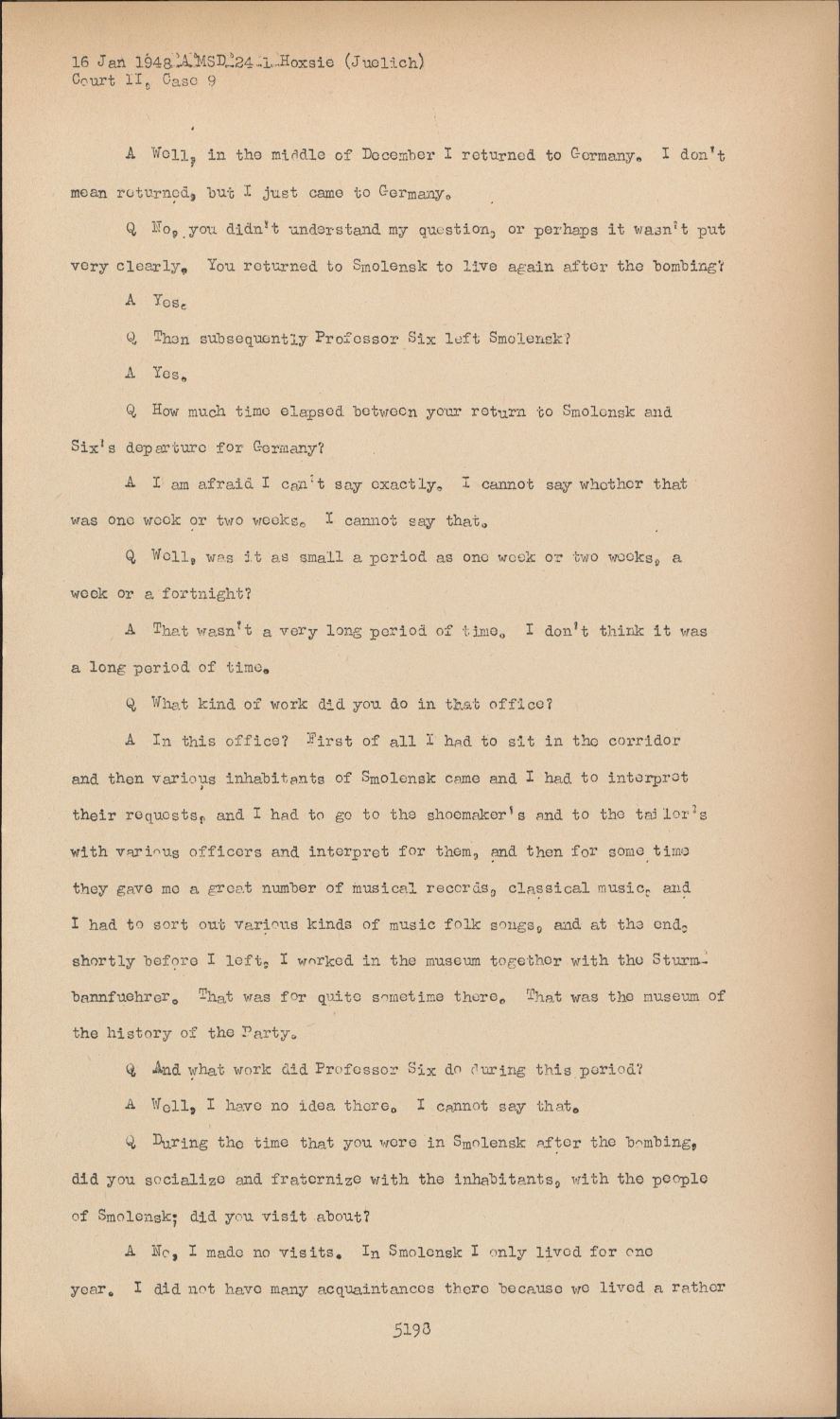
AWell, in the middle of December I returned to Germany. I don't mean returned, but I just came to Germany.
QNo, you didn't understand my question, or perhaps it wasn't put very clearly. You returned to Smolensk to live again after the bombing?
AYes.
QThen subsequently Professor Six left Smolensk?
AYes.
QHow much time elapsed between your return to Smolensk and Six's departure for Germany?
AI am afraid I can't say exactly. I cannot say whether that was one week or two weeks. I cannot say that.
Q.Well, was it as small a period as one week or two weeks, a week or a fortnight?
AThat wasn't a very long period of time. I don't think it was a long period of time.
QWhat kind of work did you do in that office?
AIn this office? First of all I had to sit in the corridor and then various inhabitants of Smolensk came and I had to interpret their requests, and I had to go to the shoemaker's and to the tailor's with various officers and interpret for them, and then for some time they gave me a great number of musical records, classical music, and I had to sort out various kinds of music folk songs, and at the end, shortly before I left. I worked in the museum together with the Sturmbannfuehrer. That was for quite sometime there. That was the museum of the history of the Party.
QAnd what work did Professor Six do during this period?
AWell, I have no idea there. I cannot say that.
QDuring the time that you were in Smolensk after the bombing, did you socialize and fraternize with the inhabitants, with the people of Smolensk; did you visit about?
ANo, I made no visits. In Smolensk I only lived for one year. I did not have many acquaintances there because we lived a rather quiet life.
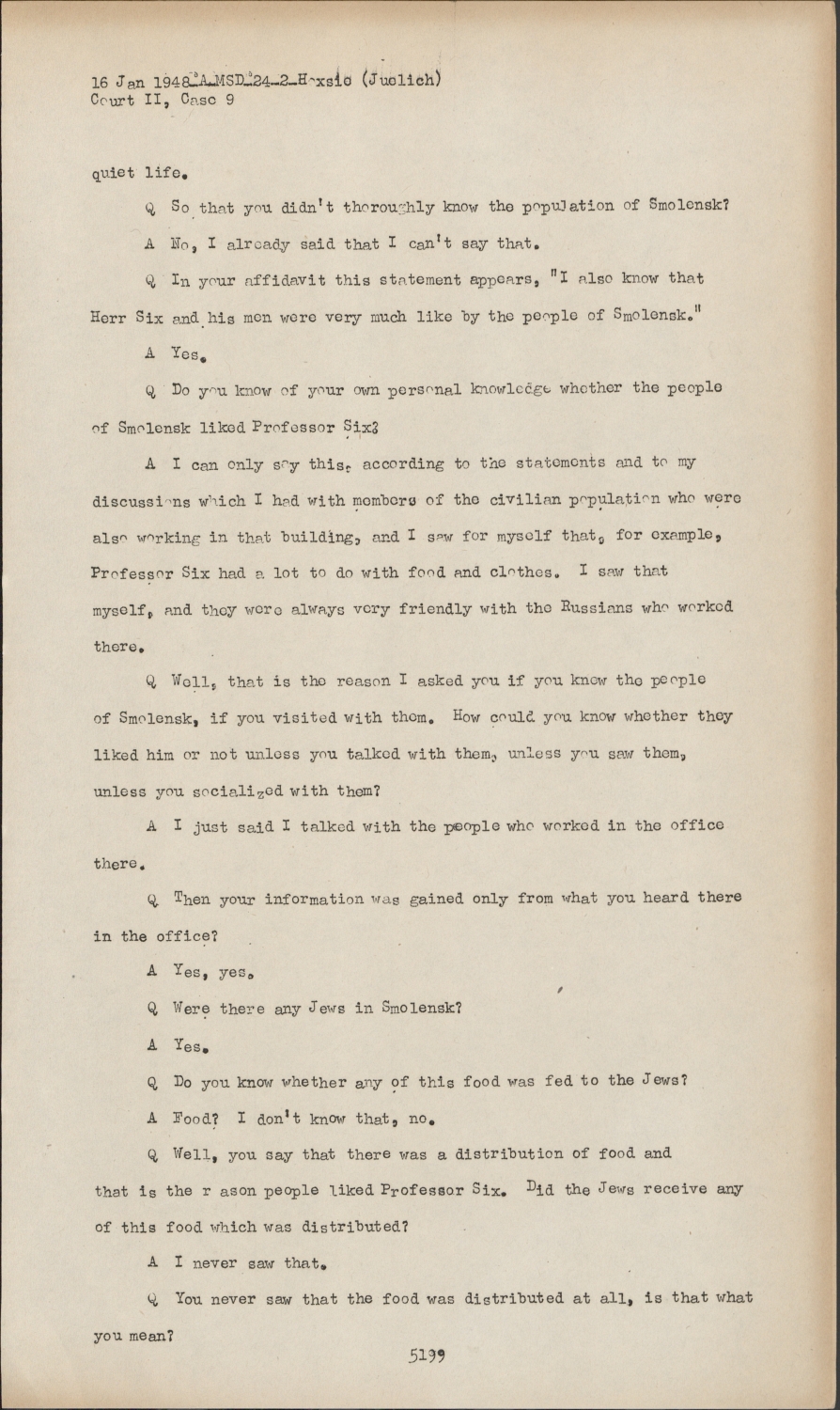
QSo that you didn't thoroughly know the population of Smolensk?
ANo, I already said that I can't say that.
QIn your affidavit this statement appears, "I also know that Herr Six and his men were very much like by the people of Smolensk."
AYes.
QDo you know of your own personal knowledge whether the people of Smolensk liked Professor Six?
AI can only say this, according to the statements and to my discussions which I had with members of the civilian population who were also working in that building, and I saw myself that, for example, professor Six had a lot to do with food and clothes. I saw that myself, and they were always very friendly with the Russians who worked there.
QWell, that is the reason I asked you if you knew the people of Smolensk, if you visited with them. How could you know whether they liked him or not unless you talked with them, unless you saw them, unless you socialized with them?
AI just said I talked with the people who worked in the office there.
QThen your information was gained only from what you heard there in the office?
AYes, yes.
QWere there any Jews in Smolensk?
AYes.
QDo you know whether any of this food was fed to the Jews?
AFood? I don't know that, no.
QWell, you say that there was a distribution of food and that is the reason people liked Professor Six. Did the Jews receive any of this food which was distributed?
AI never saw that.
QYou never saw that the food was distributed at all, is that what you mean?
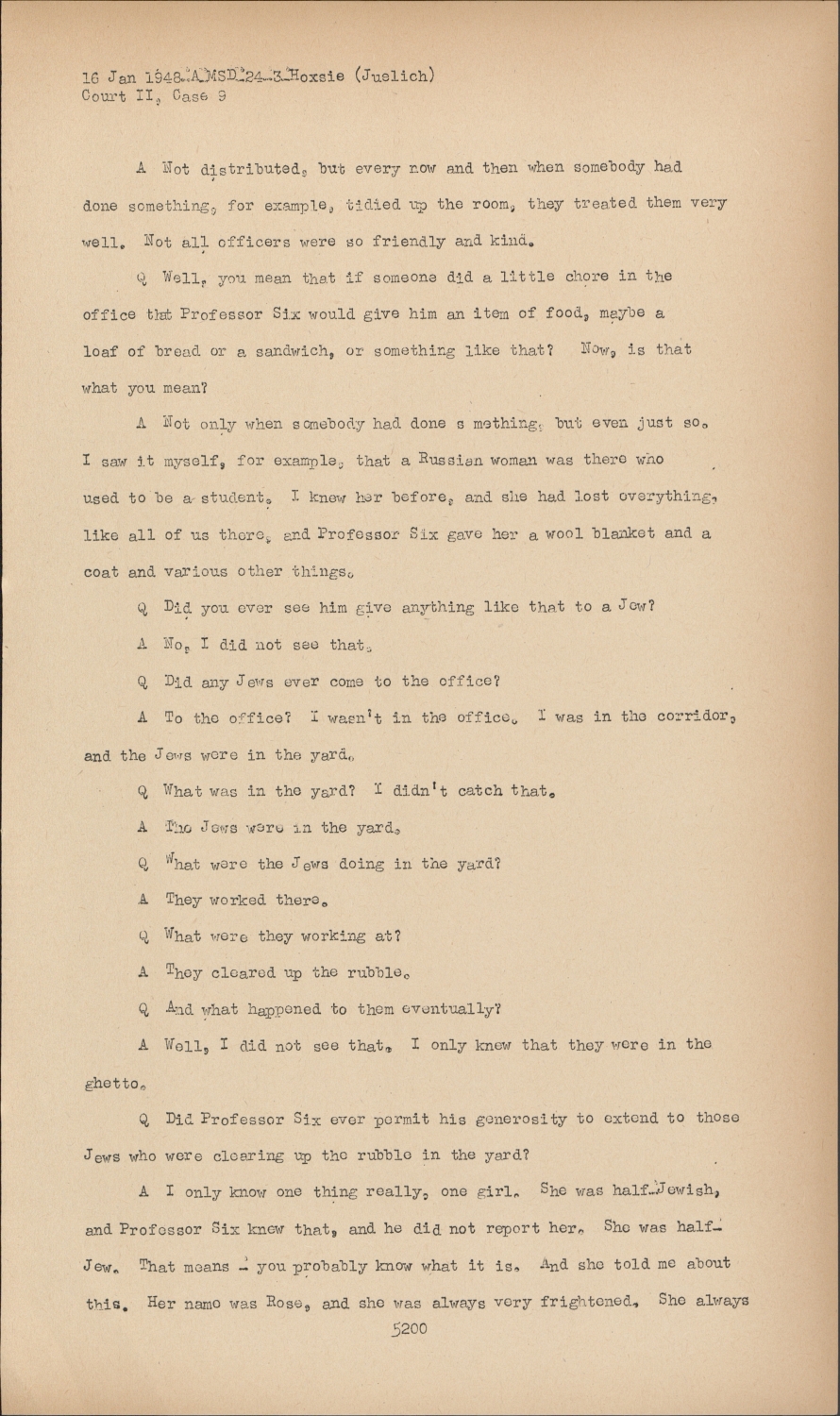
ANot distributed, but every now and then when somebody had done something, for example, tidied up the room, they treated them very well. Not all officers were so friendly and kind.
QWell, you mean that if someone did a little chore in the office that Professor Six would give him an item of food, maybe a loaf of bread or a sandwich, or something like that? Now, is that what you mean?
ANot only when somebody had done something, but even just so. I saw it myself, for example. that a Russian woman was there who used to be a student. I knew her before, and she had lost everything. like all of us there, and Professor Six gave her a wool blanket and a coat and various other things.
QDid you ever see him give anything like that to a Jew?
ANo, I did not see that.
QDid any Jews ever come to the office?
ATo the office? I wasn't in the office. I was in the corridor, and the Jews were in the yard.
QWhat was in the yard? I didn't catch that.
AThe Jews were in the yard.
QWhat were the Jews doing in the yard?
AThey worked there.
QWhat were they working at?
AThey cleared up the rubble.
QAnd what happened to them eventually?
AWell, I did not see that. I only knew that they were in the ghetto.
QDid Professor Six ever permit his generosity to extend to those Jews who were clearing up the rubble in the yard?
AI only know one thing really, one girl. She was half-Jewish, and Professor Six knew that, and he did not report her. She was halfJew. That means - you probably know what it is. And she told me about this. Her name was Rose, and she was always very frightened. She always said "Professor Six knows this," and she still remained there.
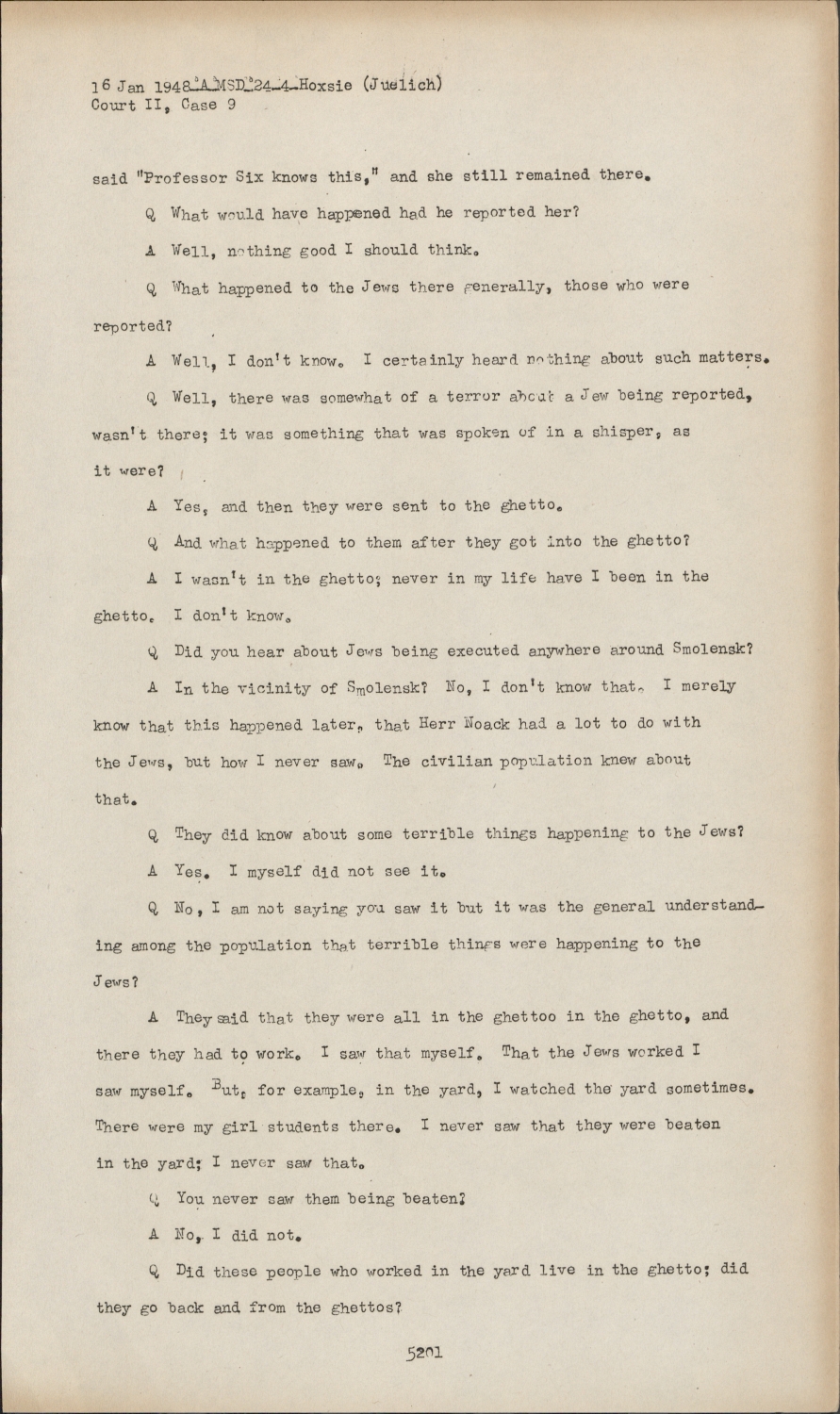
QWhat would have happened had he reported her?
AWell, nothing good I should think.
QWhat happened to the Jews there generally, those who were reported?
AWell, I don't know. I certainly heard nothing about such matters.
QWell, there was somewhat of a terror about a Jew being reported, wasn't there: it was something that was spoken of in a shisper, as it were?
AYes, and then they were sent to the ghetto?
QAnd what happened to them after they got into the ghetto?
AI wasn't in the ghetto; never in my life have I been in the ghetto. I don't know.
QDid you hear about Jews being executed anywhere around Smolensk?
AIn the vicinity of Smolensk? No, I don't know that. I merely know that this happened later, that Herr Noack had a lot to do with the Jews, but how I never saw. The civilian population knew about that.
QThey did know about some terrible things happening to the Jews?
AYes. I myself did not see it.
QNo, I am not saying you saw it but it was the general understanding among the population that terrible things were happening to the Jews?
AThey said that they were all in the ghettoo in the ghetto, and there they had to work. I saw that myself. That the Jews worked I saw myself. But, for example, in the yard, I watched the yard sometimes. There were my girl students there. I never saw that they were beaten in the yard; I never saw that.
QYou never saw them being beaten?
ANo, I did not.
QDid these people who worked in the yard live in the ghetto; did they go back and from the ghettos?