QFrankfurt on the Oder River?
AYes, Frankfurt on the Oder.
QWeren't you to go to Riga, not to Frankfurt on the Oder River?
AWell, that was Berlin, Frankfurt on the Oder and them well, Figuero, Fruehr.
THE PRESIDENT:Dr. Gick -
DR. GICK:Yes.
THE PRESIDENT:Witness Strauch. Witness Strauch, please look at me. You are in court and you are charged with serious crimes. we are aware of the fact that you have been ill and that on certain occasions you are afflicted with seizures, but we are not aware that between these seizures you are not fully mentally capable of understanding and participating in ordinary conversations. Now, your demonstration this morning is not very convincing of a willingness to cooperate with your attorney. We do not believe that you purposely are giving unresponsive answers, but we are of the opinion that you are being very careless. Now, if you think that by giving irresponsible answers that you are helping your case, you are making a very bad mistake, Now, we want you to take hold of yourself and answer intelligently, The medical records do not show that you are incapable of answering questions intelligently. Now, please, in a very calm and tranquil way listen and answer and answer Intellingently.
Now, Dr. Gick, we will call to your attention that in this very brief survey which I have made, after Mr. Glancy called to my attention the page on which I could find the documents, that there are two documents here to which you could well direct your attention at once, namely, the letter from the Commissioner Kube and the affidavit made by Sandberger, both of which charge this present defendant with crimes. Now, direct your attention, please, to these specific charges to begin with. Are you familiar with the document, PS-3428on page 30 of Document Book III-A? That is, it begins on 30. On page 32 you will find the reference to Strauch in which it is alleged that he participated in some way in executions which eventually mounted to 55,000.
DR. GICK:Your Honor, I do not have the document with me. I already pointed out that I Started the direct examination of the defendant in November 1947 - I started working on it, I mean - but that about the beginning of December it was no longer possible
THE PRESIDENT:Just a moment, Dr. Gick, are you familiar with this document?
DR. GICK:Yes, I know the document.
THE PRESIDENT:Well, then, ask the witness about the statements in that document.
DR. GICK:Your Honor, may I not develop this chronologically? In Latvia the defendant was also charged with several things, for instance, the Jeckeln Action.
THE PRESIDENT:Very well. Very well. That is what I would like to have you do. Proceed to the direct charges. I only chose this one because it is the first one that came to my attention. You choose any one you desire. Now, please, have the defendant answer to the charges and don't tire him out with what can be omitted until later on, if we find then that it is relevant.
BY DR. GICK:
QHerr Strauch, it is important to know when, in fact, you did come to Riga. Do you know when you came to Riga?
AIs it so terribly important for me to know this?
QYes, we have to know the time, the date.
AI think we had come to Raki in - on the 12th or the 14th - 14 -14 Jantsen.
QHerr Strauch, I Shall come back to this later. Please reply to my following question - what office did you hold in Riga?
AI did not get it. Please answer again. However, I did not carry out any office. I did not -
QYou were in Charge of an SS or SD office in Riga. That is, you were transferred there in order to take over an office.
What office was this?
AWell, I don't know. I don't know.
QIn Riga were you the commander of the Security police and SD?
AYes.
QWere you the Chief of Einsatzkommando 2?
AYes, a commander of an Einsatzkommando 2.
QI did not understand you. Please repeat.
AI was Chief of the Kommando, Einsatz Chief 2.
QWere you Commander of the SD and the Security Police?
AI was commander of the Einsatzkommando - I was Chief of the Einsatz - of the Chief -- the commander of the Einsatzkommando 2 no, it is wrong again. Well, I had nothing to do with the kommando, but immediately as commander -- as Chief of the Einsatzkommando, I went to Riga.
QYou just said - you just said you had nothing to do with the Einsatzkommando.
AYes, I said that.
QYou said you became Chief of the Einsatzkommando. That does not agree.
ANoo, I have nothing to do with it. I am not Chief of the Einsatzkommando but I was commander of the Einsatzkommando. Do you understand me now?
QNo, I am asking you, were you commander of the Security Police and the SD in Latvia stationed in Riga?
ARight. That's it. Kommando Chief -- Chief of the kommando of the Einsatzkommando - Latvia.
QWho was the commander of the Security Police and the SD in Riga?
AThat was before my time, when I arrived - yes, who was it? In any case I had a predecessor - I don't know any more who it was.
QIn Latvia, had they n ot set up a civilian administration when you came to Latvia?
AYes, the civilian administration had been organized and established and the predecessor, I was to be trained and I was well, this work was kept away from me. I was to be trained first for three days or so. That is how it was to remain and then during the time when I was there for three days, the predecessor was retained there and that was Patz.
QWho was Patz?
APatz was an SS Sturmbamfuehrer.
QWhat was his office as Chief?
AHe was Commander of the Kommando, Commander of the Security police.
QCommander of the Security Police? And you were to become Patz' successor?
AIt was to be like this that he - that I should be the chief of the Kommando which was advancing but we wre merely the administrative office.
QYou were merely the administrative office?
AYes, I was merely the administrative office.
QWere you chief of the Administrative office?
AYes, I was chief of the Administrative office in Chena.
QIn Chena?
AI was in Riga.
QRiga? And the chief of which office were you?
AChief of the Security Police of the Kommando of the Security Police and SD.
Q you were then Commander of the Security Police and SD?
AYes, of the SD.
QNow I am asking you again, were you Einsatzkommando Chief II, number II?
AWell, with some certainty I can still say -- Well, for example, I had nothing to do with the State Police. One could say that and then, for example, I did not have to give any orders to the State Police and they had people - as Commander one did not have to give any orders and one did not have to make decisions.
QAs a commander?
AAs chief of the Einsatzkommando.
QDo you remember, Herr Strauch, when you broke your arm in Riga?
THE PRESIDENT:Dr. Gick, now the important thing is not when, where, and how he broke his arm but whether he killed and Jews. Now, ask hii that - did he kill any Jews? That's what he is charged with you know.
DR. GICK:Your Honor, here for example a date is of important, namely the 3th November 1941, That was the day when the so-called Jeckeln operation is supposed to have taken place in Latvia. I am now discussing those dates because I want to show whether Strauch was still commander on that day, chief of the Einsatzkommando or not.
THE PRESIDENT:Well, why not ask him that question? Why not ask him that question - that's the way to find out instead of going around Robin Hood's barn.
DR. GICK:In my opinion I have to create a basis for this which should help the defendant to answer this question what happened.
THE PRESIDENT:But why not have him answer first. Then, if any explanation is in order ample opportunity is permitted but you see the difficulties you are having. So, try to got to the pivotal point. Now ask him about this Jeckeln action. Was he commander at this time in Jeckeln?
DR. GICK:Your Honor, you will see we cannot. I shall now put this specific question.
THE PRESIDENT:Well, now, Dr. Gick, if you are anticipating that you can't proceed, that doesn't show that you are very anxious to cooperate either. You are already saying now we won't be able to proceed. How do you know? Has thedefendant told you he won't be able to proceed?
DR. GICK:Your Honor, I realize the witness cannot remember any dates.
THE PRESIDENT:Listen, Dr. Gick, you do not need to repeat to us what we through our own senses are able to scertain. Proceed to the question.
BY DR. GICK:
QHerr Strauch, where were you on 30 November 1941?
AI don't get that at all.
QI asked you were you were on 30 November 1941?
THE PRESIDENT:Now tell him what happened on that day.
AWell I believe that - this question - this discussion which took place, took place on 11 November 1941.
QHerr Strauch, do you know anything about a Jeckeln action?
AYes, I know something about a Jeckeln action.
QWhat happened during this Jeckeln operation?
AThe following happened during this Jeckeln operation. The SS_Obergruppenfuehrer Jeckeln, who has now been condemned - what do you call it? Well, he was killed somewhere and there his wife was waiting for him and relatives and did not get any news and suddenly it was published in the paper that SS_Obergruppenfuehrer Jeckeln had died. And then he was dead, that's all.
THE PRESIDENT:Captain Carpenter and Dr. Bayer, will you please come to the bench.
(Captain Carpenter and Dr. Bayer conferred at the bench with the Tribunal)
THE PRESIDENT:Witness, up until a very short time ago you were thoroughly capable of intelligently carrying on conversations. There was no indication when you were in the courtroom the other time and since then up until a few days ago that you weren't thoroughly capable of comprehending question. Now we again ask you to pay attention to the question and use all yourmental forces to respond to the question and don't let your mind wander. We think with a little bit of will you can answer intelligently and respond factually to the questions which are put to you. Do you understand me?
AYes.
THE PRESIDENT:Now, please try to answer your attorney and Dr. Gick will continue.
BY DR. GICK:
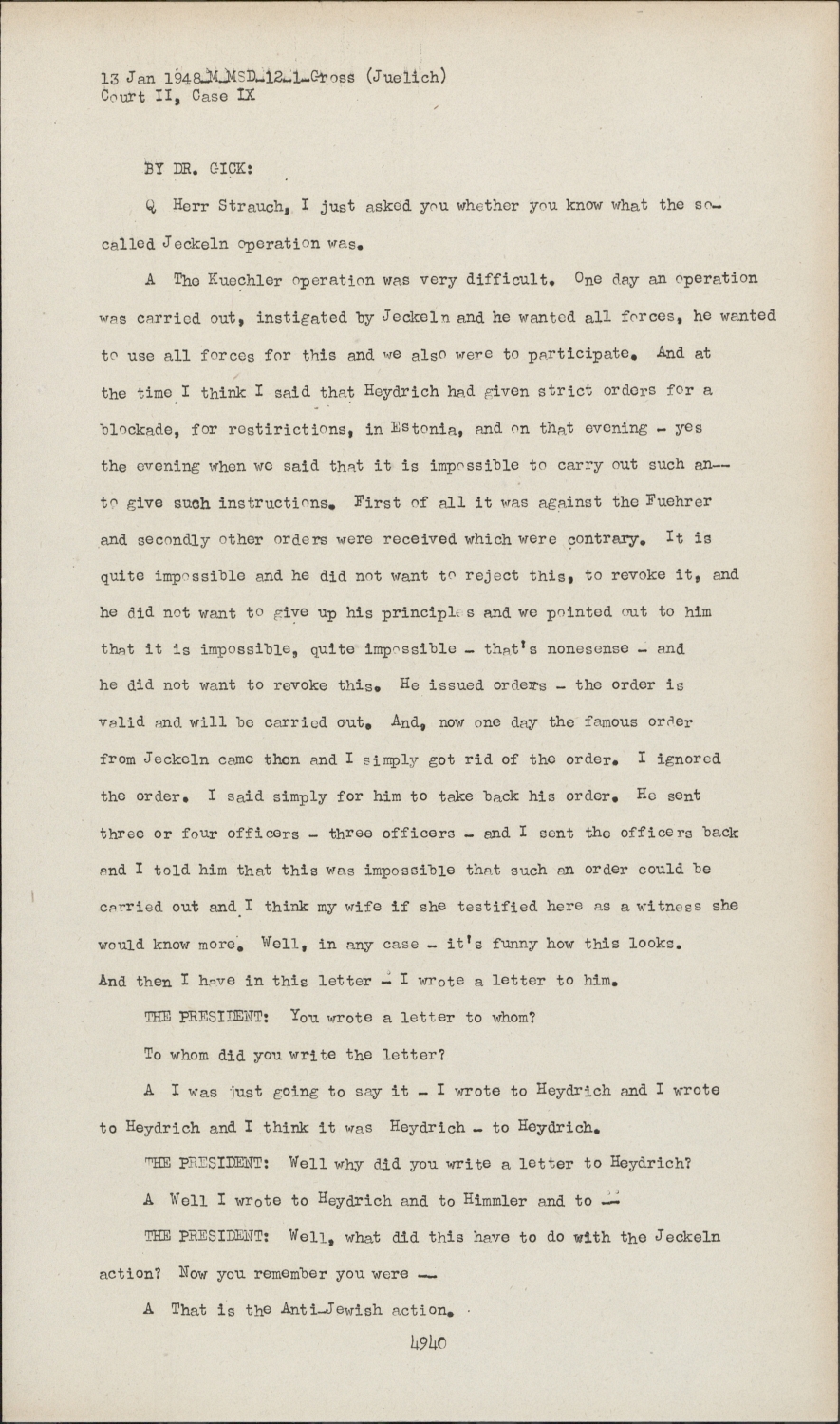
QHerr Strauch, I just asked you whether you know what the socalled Jeckeln operation was.
AThe Kuechler operation was very difficult. One day an operation was carried out, instigated by Jeckeln and he wanted all forces, he wanted to use all forces for this and we also were to participate. And at the time I think I said that Heydrich had given strict orders for a blockade, for restirictions, in Estonia, and on that evening - yes the evening when we said that it is impossible to carry out such an-to give such instructions. First of all it was against the Fuehrer and secondly other orders were received which were contrary. It is quite impossible and he did not want to reject this, to revoke it, and he did not want to give up his principles and we pointed out to him that it is impossible, quite impossible - that's nonesense - and he did not want to revoke this. He issued orders - the order is valid and will be carried out. And, now one day the famous order from Jeckeln came then and I simply got rid of the order. I ignored the order. I said simply for him to take back his order. He sent three or four officers - three officers - and I Sent the officers back and I told him that this was impossible that such an order could be carried out and I think my wife if she testified here as a witness she would know more. Well, in any case - it's funny how this looks. And then I have in this letter - I wrote a letter to him.
THE PRESIDENT:You wrote a letter to whom?
To whom did you write the letter?
AI was just going to say it - I wrote to Heydrich and I wrote to Heydrich and I think it was Heydrich - to Heydrich.
THE PRESIDENT:Well why did you write a letter to Heydrich?
AWell I wrote to Heydrich and to Himmler and to -
THE PRESIDENT:Well, what did this have to do with the Jeckeln action? Now you remember you were -
AThat is the Anti-Jewish action
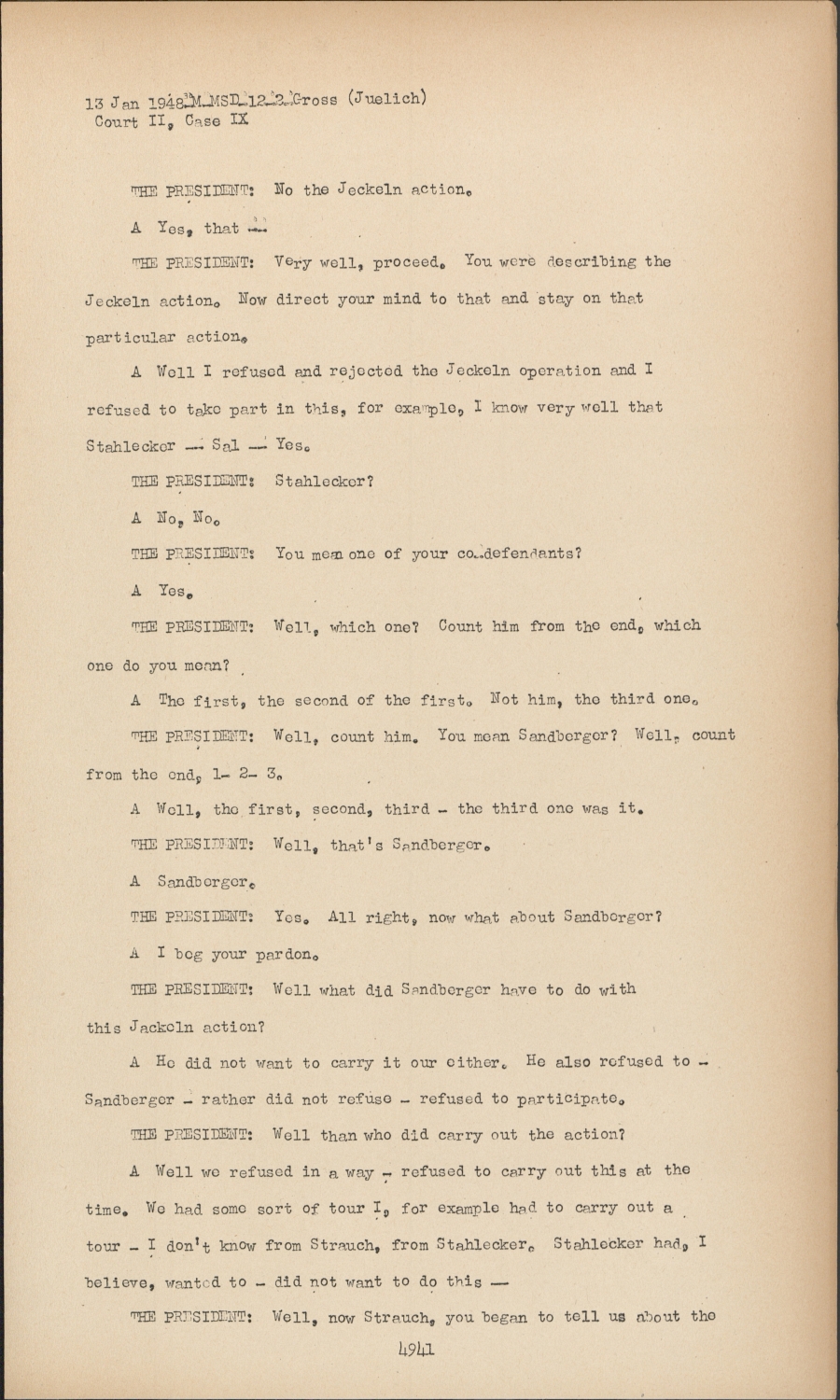
THE PRESIDENT:No the Jeckeln action.
AYes, that -
THE PRESIDENT:Very well, proceed. You were describing the Jeckeln action. Now direct your mind to that and stay on that particular action.
AWell I refused and rejected the Jeckeln operation and I refused to take part in this, for example, I know very well that Stahlecker -- Sal -- Yes.
THE PRESIDENT:Stahlecker?
ANo, no.
THE PRESIDENT:You mean one of your co*defendants?
AYes.
THE PRESIDENT:Well, which one? Count him from the end, which one do you mean?
AThe first, the second of the first. Not him, the third one.
THE PRESIDENT:Well, count him. You mean Sandberger? Well, count from the end, 1- 2- 3.
AWell, the first, second, third - the third one was it.
THE PRESIDENT:Well. that's Sandberger.
ASandberger.
THE PRESIDENT:Yes. All right, now what about Sandberger?
AI beg your pardon.
THE PRESIDENT:Well what did Sandberger have to do with this Jackeln action?
AHe did not want to carry it our either. He also refused to Sandberger - rather did not refuse - refused to participate.
THE PRESIDENT:Well than who did carry out the action?
AWell we refused in a way - refused to carry out this at the time. We had some sort of tour i, for example had to carry out a tour - I don't know from Strauch, from Stahlecker. Stahlecker had, I believe, wanted to - did not want to do this -
THE PRESIDENT:Well, now Strauch, you began to tell us about the Jeckeln action and you spoke very well.

You spoke clearly and outlined the situation. New if you will just take hold of yourself
AI don't get it all
THEPRESIDENT: if you will just determine to answer, I am sure that you can. It's that you then lose control or interest but if you just will hard enough I am confident that you can answer the questions.
AYes, I heard you, your Honor.
THE PRESIDENT:Are you willing to answer our questions?
ACertainly I am prepared.
THE PRESIDENT:And you know that you are a defendant in this trial.
AOf course.
THE PRESIDENT:And you know that you are charged with very serious crimes.
AWell, I don't know if this applies to my case.
THEPRESIDENT: wELL, whether it is true or not has not been decided, and the only way we can determine whether these very serious version.
AWell I can only say what I know and I will try to make an effort to give the right --
THE PRESIDENT:The right answers. Yes. Now you will have an opportunity to rest for an hour and a half and then you will be brought back to the courtroom and at that time we want you to answer the questions.
AYes.
THE PRESIDENT:Because it is to your own benefit that you understand and answer these questions because otherwise these charges remain against you unanswered.
AYes, of course.
THEPRESIDENT: you understand that. Very well. The Tribunal will be in recess until two o'clock.

AFTERNOON SESSION (The hearing reconvened at 1415 hours, 13 January 1948.)
THE MARSHAL:The Tribunal is again in session.
DR.DURCHHOLZ (ATTORNLY FOR THE DEFENDANT SCHULZ): Your Honor, I would like the Defendant Schulz to be excused tomorrow the whole day, because I want to prepare the rest of his defense.
THE PRESIDENT:Thank you.
DR.KLINNERT (ATTORNEY FOR THE DEFENDANT SEIBERT): Your Honor, I have the same request concerning the Defendant Seibert.
THE PRESIDENT:The defendant Seibert will also be excused tomorrow.
MR. GLANCY:May it please the Tribunal, the prosecution would appreciate some information from the two attorneys who just requested the excuse of their clients as to when they intend to put in their document books.
THE PRESIDENT:We had assumed that practically all document books were already in and, if they are not, this comes as a disappointment to the Tribunal because certainly we have frequently informed counsel of the necessity of getting in these books at once. Now do the defense counsel who have just addressed the Tribunal have anything to offer in connection with Mr. Glancy's question?
DR.KLINNERT (ATTORNEY FOR THE DEFENDANTS NAUMAN AND SEIBERT): Your Honor, the documents for Nauman and Seibert have still to be submitted. so far, it has been impossible because the translation has not been concluded yet. I do hope, though, that we shall be in a position tomorrow to submit the documents.
THE PRESIDENT:Then they are already prepared. It is only a question of translation. Is that what I understand?
DR. KLINNERT:They are in the Translation Department.
THE PRESIDENT:Very well.
DR.DURCHHOLZ (ATTORNEY FOR THE DEFENDANT SCHULZ) Your Honor, I have submitted three volumes of document books and there are only a few documents which have been found later which are in the Translation COURT II CASE IX Department at the moment.

I may perhaps point out that the translation in the Translation Department takes a long time. That is the reason why I have not submitted them all yet, but I shall do so very soon.
THE PRESIEDNT:Mr. Glancy, there were a number of Schulz books presented.
MR.GLANCY:The reason I made that request was so that it would facilitate the prosecution in learning as to when and in what order the defense counsel had approximately agreed upon presenting their documents formally into evidence.
THE PRESIDENT:Yes.
MR. GLANCY:Would would appreciate it if perhaps we could get some word from the defense as to which order they desire to present their books.
THE PRESIDENT:Just as soon as we finish this case and we take up Dr. Aschenauer's documentation, we will go into the whole subject of document books.
MR. GLANCY:Thank you very much.
DRSCHWARZ (ATTORNEY FOR THE DEFENDANT JOST): Your Honor, in order to make it possible for the Tribunal to dispose of their time, I may point out that so far I have been unable to submit document books. I have not concluded them, in fact, because unfortunately three affidavits have been received too late. Therefore the document book is still in the Translation Division. I think it would be a good thing if I submit all my document books together. Therefore, I would like to be permitted to submit my document books on Thursday or Friday of this week.
THE PRESIDENT:Very well.
Now, Dr. Gick and Defendant Strauch, the Tribunal will call to the attention of both the defendant and counsel that an examination was made during the recess period of the defendant and it appears from the examination that the defendant is able to grasp questions and to answer. The examination was made by a psychiatrist from the Army hospital in Nurnberg. His affliction of itself does not becloud his brain or his mind or his memory. He may have some little difficulty, but nothing like COURT II CASE IX that which he manifested this morning, so far as medical reports are concerned at any rate.
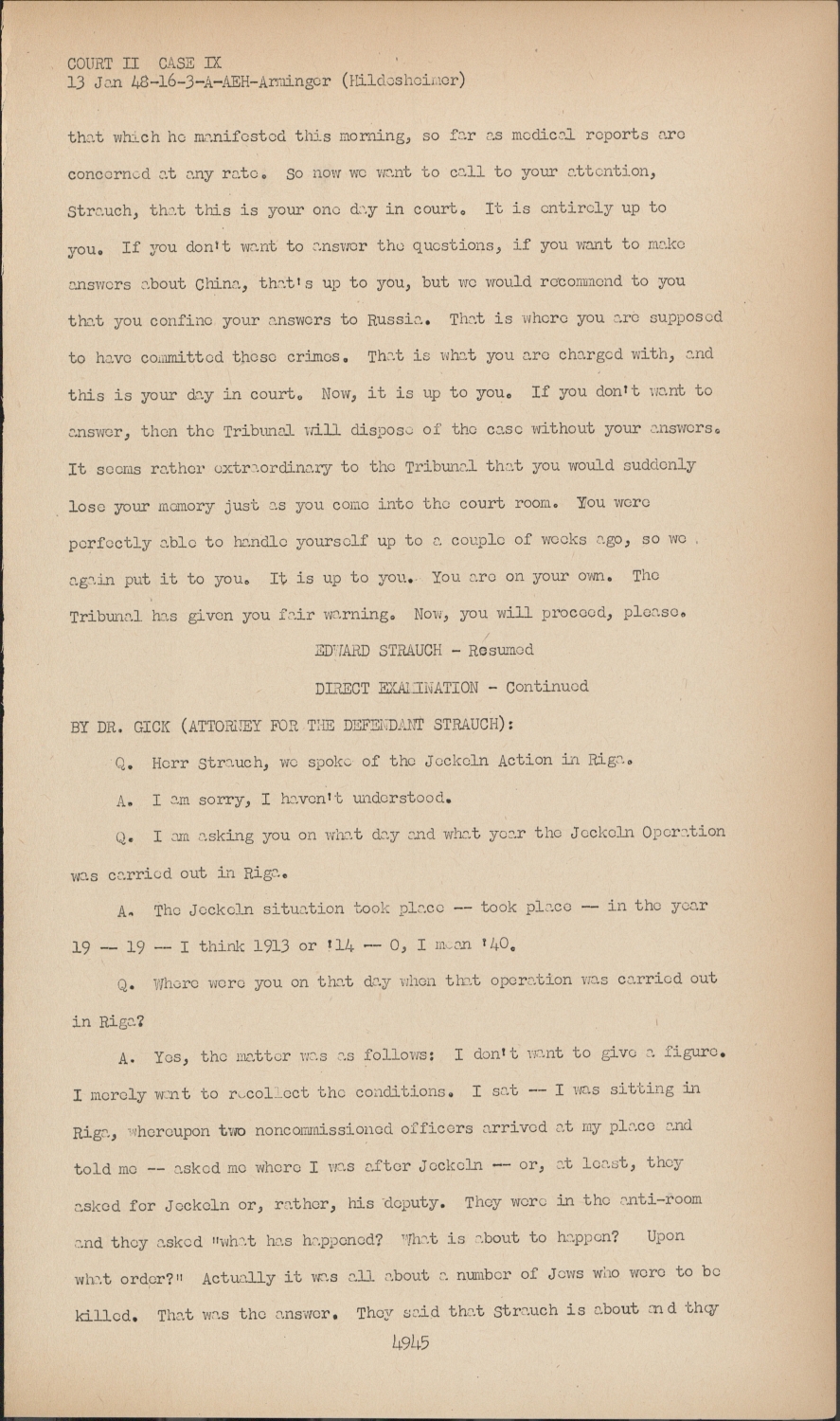
So now we want to call to your attention, Strauch, that this is your one day in court. It is entirely up to you. If you don't want to answer the questions, if you want to make answers about China, that's up to you, but we would recommend to you that you confine your answers to Russia. That is where you are supposed to have committed these crimes. That is what you are charged with, and this is your day in court. Now, it is up to you. If you don't want to answer, then the Tribunal will dispose of the case without your answers. It seems rather extraordinary to the Tribunal that you would suddenly lose you memory just as you come into the court room. You were perfectly able to handle yourself up to a couple of weeks ago, so we again put it to you. It is up to you. You are on your own. The Tribunal has given you fair warning. Now, you will proceed, please.
EDWARD STRAUCH - Resumed DIRECT EXAMINATION - Continued BY DR. GICK ( ATTORNEY FOR THE DEFENDANT STRAUCH):
Q.Herr Strauch, we spoke of the Jeckeln Action in Riga.
A.I am sorry, I haven't understood.
Q.I am asking you on what day and what year the Jeckeln Operation was carried out in Riga.
A.The Jeckeln situation took place -- took place -- in the year 19 -- 19 -- I think 1913 or !14 -- O, I mean !40.
Q.Where were you on that day when that operation was carried out in Riga?
A.Yes, the matter was as follows: I don't want to give a figure. I merely want to recollect the conditions. I sat - I was sitting in Riga, whereupon two noncommissioned officers arrived at my place and told me -- asked me where I was after Jeckeln -- or, at least, they asked for Jeckeln or, rather, his deputy. They were in the anti-room and they asked "what has happened? What is about to happen? Upon what order?" Actually it was all about a number of Jews who were to be killed. That was the answer. They said that Strauch is about and they COURT II CASE IX were to go to him, although I was ill and my arm was bandaged, or, at least, was in a plaster cast.

Then the medical officer arrived and I said -- and he said that -- that it was not possible to put troops at their disposal, because, first of all, it was too cold and, secondly, there were no people at their disposal for such matters. There were no troops, but we can't assume this task suddenly. There came a discussion and after I had listened to what was being said, I did not know who was speaking at the telephone. I only said that whoever was on the telephone should reassure himself and should quiet down. Anyway, there was nobody present.
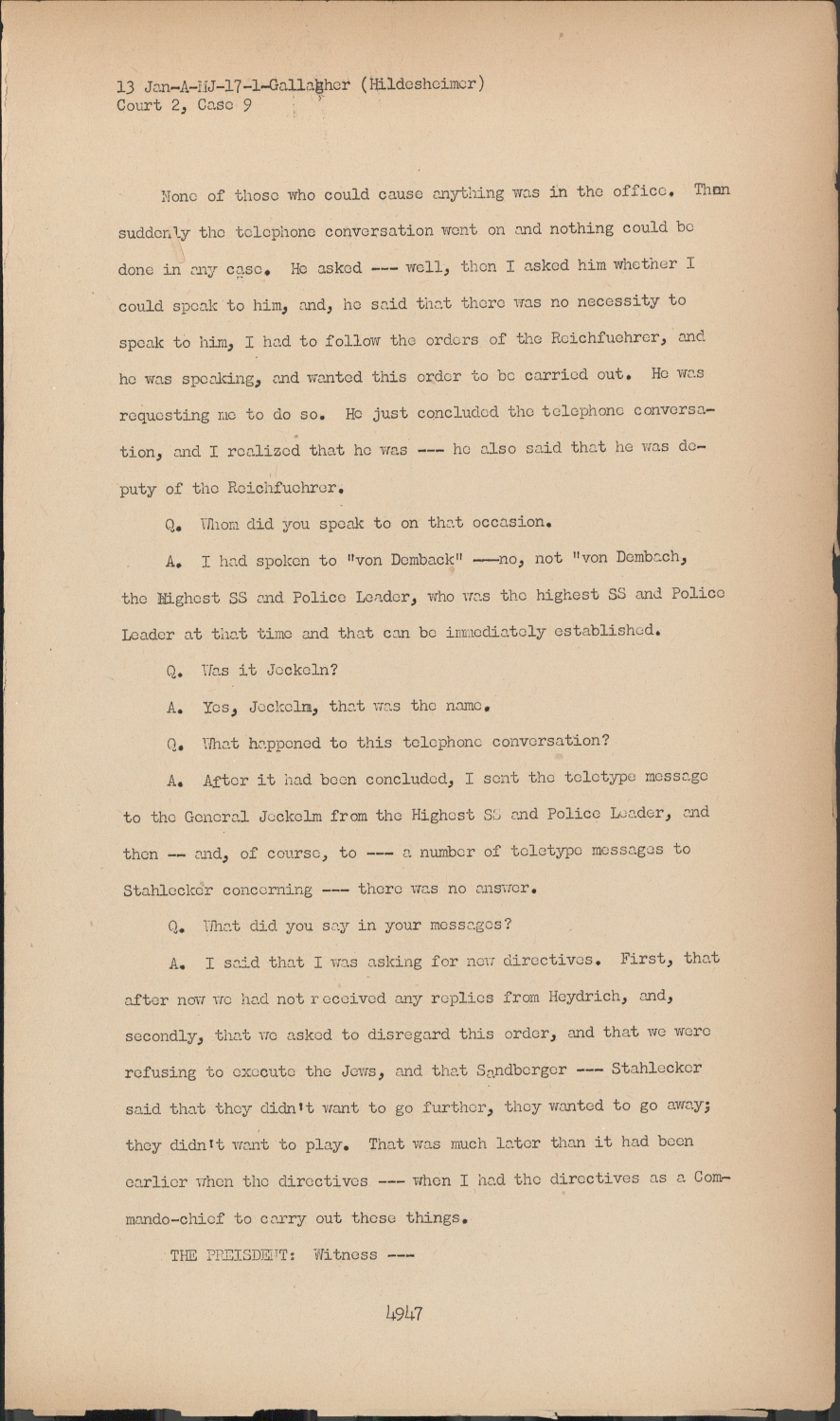
None of those who could cause anything was in the office. Then suddenly the telephone conversation went on and nothing could be done in any case. He asked --- well, then I asked him whether I could speak to him, and, he said that there was no necessity to speak to him, I had to follow the orders of the Reichfuehrer, and he was speaking, and wanted this order to be carried out. He was requesting me to do so. He just concluded the telephone conversation, and I realized that he was --- he also said that he was deputy of the Reichfuehrer.
Q.Whom did you speak to on that occasion.
A.I had spoken to "von Demback" ---no, not "von Dembach, the Highest SS and Police Leader, who was the highest SS and Police Leader at that time and that can be immediately established.
Q.Was it Jeckeln?
A.Yes, Jeckeln, that was the name.
Q.What happened to this telephone conversation?
A.After it had been concluded, I sent the teletype message to the General Jeckeln from the Highest SS and Police Leader, and then -- and, of course, to --- a number of teletype messages to Stahlecker concerning --- there was no answer.
Q.What did you say in your message?
A.I said that I was asking for new directives. First, that after now we had not received any replies from Heydrich, and, secondly, that we asked to disregard this order, and that we were refusing to execute the Jews, and that Sandberger --- Stahlecker said that they didn't want to go further, they wanted to go away; they didn't want to play. That was much later than it had been earlier when the directives --- when I had the directives as a Commando-chief to carry out these things.
THEPRESIDENT: witness --
BY DR.GICK:
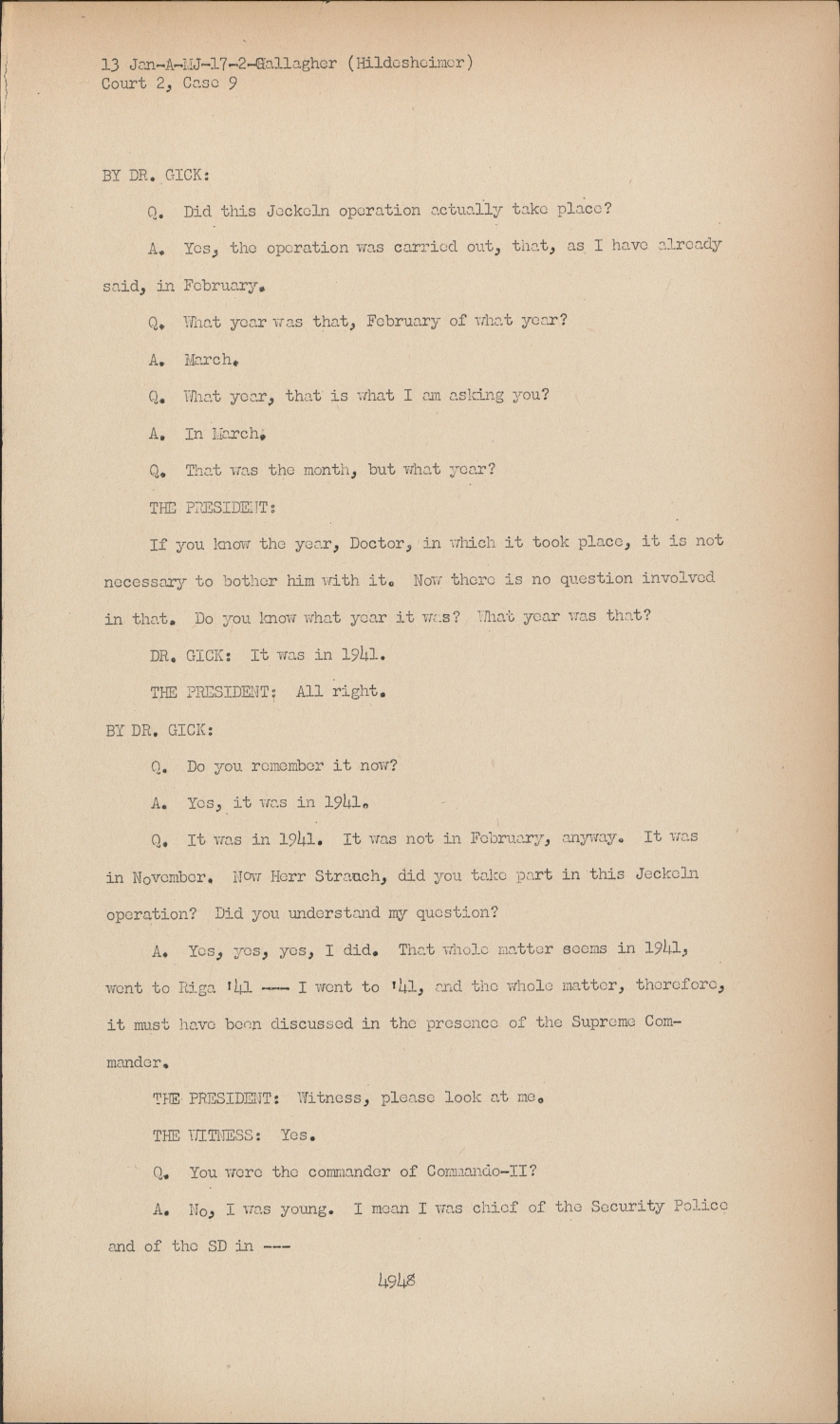
Q.Did this Jeckeln operation actually take place?
A.Yes, the operation was carried out, that, as I have already said, in February.
Q.What year was that, February of what year?
A.March.
Q.What year, that is what I am asking you?
A.In March.
Q.That was the month, but what year?
THE PRESIDENT:
If you know the year, Doctor, in which it took place, it is not necessary to bother him with it. Now there is no question involved in that. Do you know what year it was? What year was that?
DR. GICK:It was in 1941.
THE PRESIDENT:ALL right. BY DR. GICK:
Q.Do you remember it now?
A.Yes, it was in 19141.
Q.It was in 1941. It was not in February anyway. It was in November. Now Herr Strauch, did you take part in this Jeckeln operation? Did you understand my question?
A.Yes, yes, yes, I did. That whole matter seems in 1941, went to Riga '41 --- I went to '41, and the whole matter, therefore, it must have been discussed in the presence of the Supreme Commander.
THE PRESIDENT:Witness, please look at me.
THE WITNESS:Yes.
Q.You were the commander of Commando-II?
A.No, I was young. I mean I was chief of the Security Police and of the SD in --
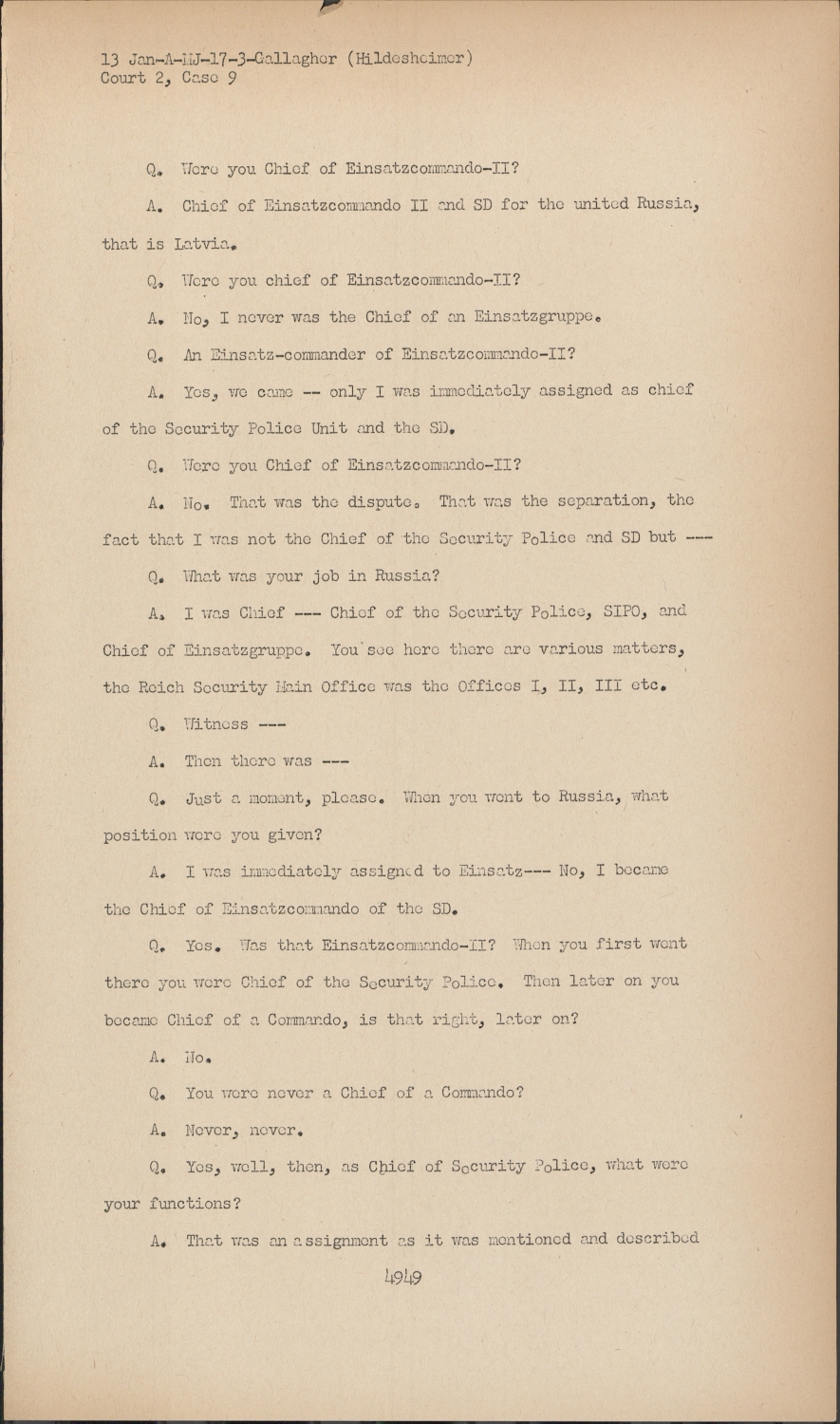
Q.Were you Chief of Einsatzcommando-II?
A.Chief of Einsatzcommando II and SD for the united Russia, that is Latvia.
Q.Were you chief of Einsatzcommando-II?
A.No, I never was the Chief of a Einsatzgruppe.
Q.An Einsatz-commander of Einsatzcommando-II?
AYes, we came - only I was immediately assigned as chief of the security Police Unit and the SD.
Q.Were you Chief of Einsatzcommando-II?
A.No. That was the dispute. That was the separation, the fact that I was not the Chief of the Security Police and SD but --
Q.What was your job in Russia?
A.I was Chief --- Chief of the Security Police, SIPO, and Chief of Einsatzgruppe. You see here there are various matters, the Reich Security Main Office was the Offices I, II, III etc.
Q.Witness --
A.Then there was --
Q.Just a moment, please. When you went to Russia, what position were you given?
A.I was immediately assigned to Einsatz---No, I became the Chief of Einsatzcommando of the SD.
Q.Yes. Was that Einsatzcommando-II? When you first went there you were Chief of the Security Police. Then later on you became Chief of a Commando, is that right, later on?
A.No.
A.No.
Q.You were never a Chief of a Commando?
A.Never, never.
Q.Yes, well, then, as Chief of Security Police, what were your functions?
A.That was assignment as it was mentioned and described by Ohlendorf, and others, that really various bits of intelligence were to be compiled and used, and were to be collected.
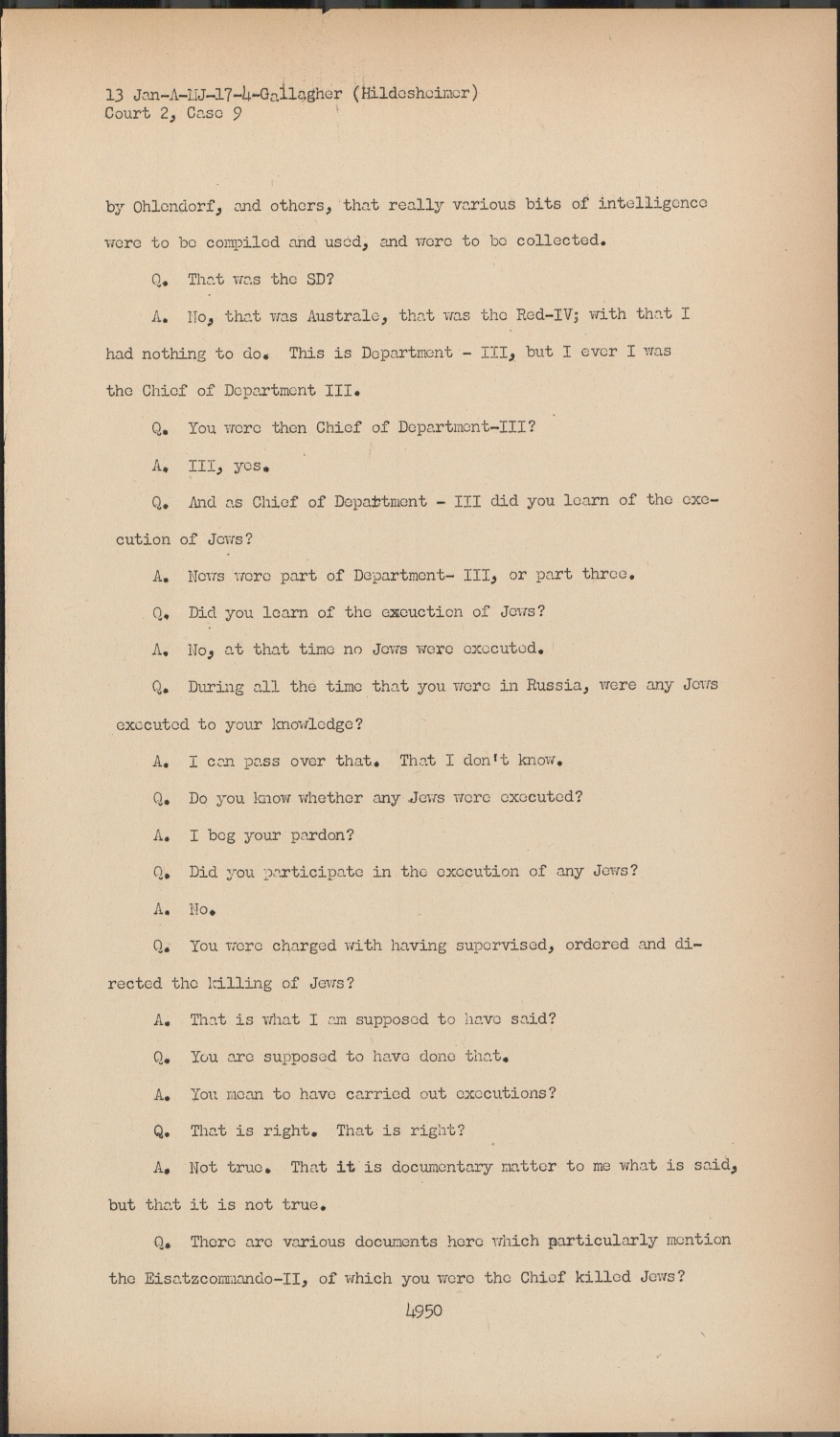
Q.That was the SD?
A.NO, that was Australe, that was the Red-Iv; with that I had nothing to do, This is Department - III, but I ever I was the Chief of Department III.
Q.You were then Chief of Department-III?
A.III, yes.
Q.And as Chief of Department - III did you learn of the exe cution of Jews?
A.News were part of Department- III, or part three.
Q.Did you learn of the execution of Jews?
A. no, at that time no Jews were executed.
Q.During all the time that you were in Russia, were any Jews executed to your knowledge?
A.I can pass over that. That I don't Know.
Q.Do you know whether any Jews were executed?
A.I beg your pardon?
Q.Did you participate in the execution of any Jews?
A.No.
Q.You were charged with having supervised, ordered and di rected the killing of Jews?
Q.You are supposed to have done that.
A.You mean to have carried out executions?
Q.That is right. That is right?
A.Not true. That it is documentary matter to me what is said, but that it is not true.
Q.There are various documents here which particularly mention the Einsatzcommando-II, of which you were the Chief killed Jews?
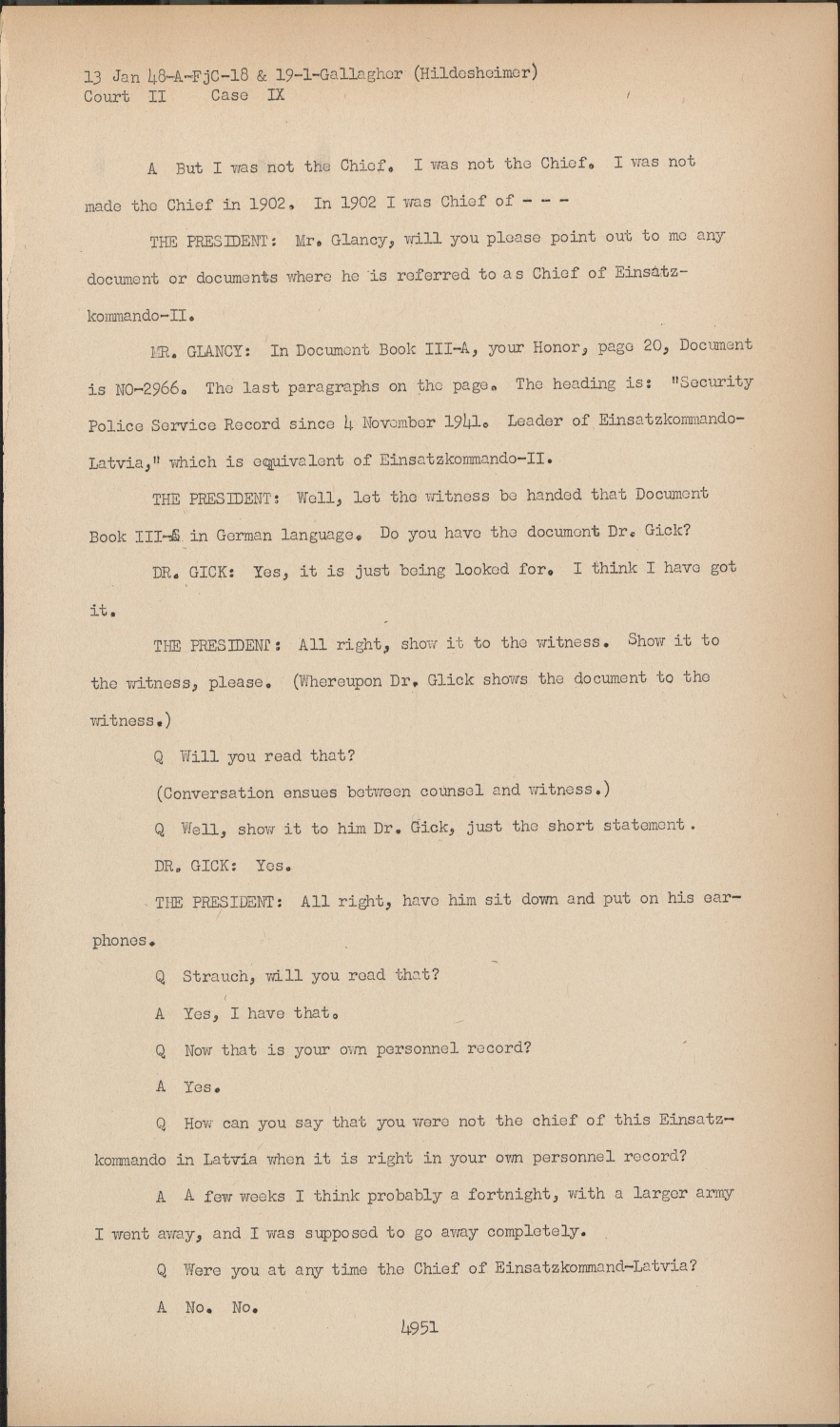
ABut I was not the Chief. I was not the Chief. I was not made the Chief in 1902. In 1902 I was Chief of - -
THE PRESIDENT:Mr. Glancy, will you please point out to me any document or documents where he is referred to as Chief of Einsatzkommando-II.
MR. GLANCY:In Document Book III-A, your Honor, page 20, Document is No-2966. The last paragraphs on the page. The heading is: "Security Police Service Record since 4 November 1941. Leader of EinsatzkommandoLatvia," which is equivalent of Einsatzkommando-II.
THE PRESIDENT:Well, let the witness be handed that Document Book III-$ in German language. Do you have the document Dr. Gick?
DR. GICK:Yes, it is just being looked for. I think I have got it.
THEPRESIDENT: all right, show it to the witness. Show it to the witness, please. (Whereupon Dr. Glick shows the document to the witness.)
QWill you read that?
(Conversation ensues between counsel and witness.)
QWell, show it to him Dr. Gick, just the short statement.
DR. GICK:Yes.
THE PRESIDENT:All right, have him sit down and put on his earphones.
QStrauch, will you read that?
AYes, I have that.
QNow that is your own personnel record?
AYes.
QHow can you say that you were not the chief of this Einsatzkommando in Latvia when it is right in your own personnel record?
AA few weeks I think probably a fortnight, with a larger army I went away, and I was supposed to go away completely.
QWere you at any time the Chief of Einsatzkommand-Latvia?
ANo. No.