
I picked them out at random.
QYes, and then did you check on them for accuracy?
AI examined them so far as I was able too whether these general regulations had been followed in the way the whole files were drawn up.
QNow, if the report indicated a certain number of executions, would you check to see that that number was correct?
AThe figure in the report and in the files?
QYes.
ANo, I assumed that that was right. That is not so important. To me it was more important that the procedure as such, as far as I could see was carried out in the proper manner, and I gained that impression during the spot checks which I made.
QYou did not attempt to check the figure in the report with the actual facts?
ANo, I did not do that. Department IV was responsible for this, and I did not think that they could change the figures at all, and I saw no reason for doing this. Why should they falsify the figures?
THE PRESIDENT:All right, thank you. The witness will be returned to the dock, and the Defendant Braune will be taken to the witness box.
(Witness excused).
ERNSTBRAUNE, a witness, took the stand and testified as follows:
DR. MAYER:Dr. Erich M. Mayer for Braune. Your Honor, I ask that the defendant be examined by me as a witness on his own behalf.
JUDGE DIXON:Defendant, raise your right hand and repeat after me, I swear by God, the Almighty and Omniscient, that I will speak the pure truth and will withhold and add nothing.
(The witness repeated the oath).
JUDGE DIXON:You may be seated.
THE PRESIDENT:Dr. Payer, what is the pronunciation of the defendant's name? I think perhaps I mispronounced it very badly.
DR. MAYER:Browna.
THE PRESIDENT:Just Brown?
DR. MAYER:Browna.
DR. FICHT:Dr. Ficht for Bibwrstein.
I beg your pardon, your Honor. I ask that Biberstein be execused for this afternoon so that his medical treatment my be continued. He is under medical care just now.
THE PRESIDENT:Yes, the Defendant Biberstein will be excused from attendance in court this afternoon.

QWitness, please tell the Tribunal your full name?
AMy name is Werner Braune.
QWhen and where were you born?
AI was born on 11 April 1909 in Meerstadt, a small village in Thuringia.
QFrom where did your parents originate?
AMy father is a business man and come from Dessau, and, my mother comes from Thuringia of a farmer's family.
QAre you married, and if so, how many children do you have?
AI am married and have four children, ten, six, four and two years of age.
QWhere did you spend your childhood, and attendance in highschool?
AI spent my childhood in my native village, and there attended the elementary school from 1915 until 1920.
QWhere did you go to school after that?
AAnd then I was sent to Sondershausen to a high school, and I attended this from 1920 until 1928, and in 1929 I graduated there.
QDuring your time at school, did you carry on any political activity?
ANo, we students were not active in a political way, but we older students were very depressed at the time about the political situation, and the weakness among our people.
QDuring your time at school do you remember any particular political events which you will always remember?
AYes, Already when I was a boy of ten or eleven years of age, I saw how the Communists from the neighboring town would come to our village and take the cattle from the farmers. I would like to say that the Communists in Central Germany already were very strong at that time.
QWhat did you do after your graduation?
AAfter I graduated I studied law, for the first four terms in Bonn, and then the Summer Term of 1930 in Munich, and the final terms from the Ball of 1930 until the Summer of 1932 in Jena.

On 9 July 1932 I passed my Referendar examination.
QWhat were your professional prospects as a scholar at the time?
AOur professional prospects were very "poor," I wanted to become an educator, but my teachers advised me against it, because there was no chance of ever getting a job as a teacher.
QWas it any better during that time concerning professional possibilities in the legal field?
ANo, it was not better for the lawyers, either. At the time in Prussia alone there were about six-thousand surplus assessors and it was not rare that in the large cities trained lawyers served as cab drivers and porters. My teachers advised me to study this subject because it was their opinion that the legal profession offered most varied opportunities all the way around, and, therefore, I became a lawyer.
QYour father was a minor employee. Did he have the financial means to let you study?
AIt was very hard for my parents, and it was a great sacrifice to send me to high school, and to let me study. Already as an older student I gave lessons myself in order to earn a little money, and as a student from the first term onwards, and during the holidays I worked for a lawyer in order to help to pay partly for my studies.
QWhen did you come in contact with National Socialist for the first time?
AThat must have been in the Winter of 1929 or 1930, when several students and myself attended a National Socialist meeting, and joined them.
QWhat impression did you gain about National Socialism during the attendance at that meeting?
AI must say I was very much impressed and enthusiastic. We students had mostly national views; we suffered greatly from the political dissension and weakness in Germany; class struggle and class hatred governed public life.

The moral decay increased. For the first time I came across a movement here which didn't want to separate people. They didn't want to emphasize class differences. but they emphasized that all Germans were alike, who were bound together by fate, and they belonged together; but I got the deepest impressions from the fact that here for the first time a movement tried to combine nationalism and socialism.
QAfter this first meeting which you attended, and from the impression which you then gained, did you continue to attend meetings of the NSDAP?
AI did not attend any further meetings at that time, but from conversations and by reading the newspapers I continued to take an interest in National Socialism. My next meeting I attended in the Summer of 1930. I remember this so exactly because it was the first public meeting where I heard Adolph Hitler speak. At the time Hitler opened the campaign for the historic election in September 1930. With the election in 1930 the National Socialist movement increased from twelve to one-hundred and seven delegates in the Reichstag.
QDuring that election did you vote for the NSDAP?
AYes.
QWhen did you join the NSDAP?
AI joined the NSDAP in the Summer of 1931, the exact date was 15 May, and I was accepted in the membership book on 1 July 1931.
QWhy did you join?
AIt was decisive for me at the time that I was aware that Bolshevism was gaining strongly in Germany, and I, as a convinced National Socialist, which I was at the time, wanted to be active in the political happenings.

QAfter that, when did you join the SA?
AI joined the SA on 9 November 1931.
QWere you active in the Party life then?
A yes, I then took an active part when I regularly attended meethings, marches, distributed leaflets, and advertised the movement from house to house. One of the nicest political tasks I ever had at the time was in a small farm village near Jena which was assigned to me, where together with a comrade, I promoted National Socialism, and I shall never forget how the people in this village, the poor farm workers and the rich farmers with their farms, who previously were almost enemies, came together under our ideas, and finally marched side by side.
QHow many SA men were there at the time in the unit of the Sturm to which you belonged?
AWhen I joined the SA we were about seventy SA men to a Sturm unit; the Reichbanner, or the Iron Front, the combination of Communists and Social Democrats at the time at least twenty to thirty times as many members as we did.
QAt the time did you have an office in the Party, or did you Wave a rank in the SA?
AUntil Hitler took power I neither had an office nor did I have a rank. I was a simple SA man.
QWhen did you finish your studies?
AI completed my studies in the Summer of 1932, I passed my examination as a Referendar.
QIn Jena?
AYes, in Jena.
QAfter four years of study, and after the final examinations what were your prospects in the profession?
AThe prospects had become worse rather than better. The conditions which I indicated before had become worse and in that time in Germany there were seven million unemployed. The referendar exams were made more difficult during my time, about fifty percent of all candidates failed.
QWhen did you pass your Doctor's exam?
AImmediately afterwards, after passing my referendar exam, I wrote my doctor's thesis, and on 27 January, and not on 27 February as shown in the SS personnel files, I passed my Doctor's exam in Jena with, the doctor's thesis, Zwangsvollstreckrung, distraint.
QWhat did you do after the doctor's exam?
AOn 1 January 1933 I started to train as a referendar, at first at the local court with the district attorney in Sonderhausen. From the Fall of 1933 until April 1934 I was at the County Court in Meiningen as referendar, and, from April 1934 until the Fall of 1934 I worked for a lawyer.
QWhen did you join the SD?
AI joined the SD in November 1934.
QAt the time were you already a member of the SS?
ANo, as before I was a member of the SA. I was a SA Obertruppfuehrer, that is the same rank, if you compare it to a military rank, as sergeant.
QDid you ever belong to the General SS, or the Allgemeine-SS?
ANo, I never belonged to the General-SS, but from the SA I was immediately transferred to the SD. I thus became a member of the SS formation, the SD.
QThrough whom did you get to the SD?
AA fellow student mentioned the SD to me, and he was the cause why I went there. He wrote to me that I should visit him in Berlin, and I did that. There he introduced me to Professor Hoehn.
QWho was Professor Hoehn, whom you just mentioned?
AProfessor Hoehn at the timewas a private lecturer or a special professor for State and constitutional law at the University of Heidelberg. He was a lecturer there. I knew him from my time as a student in Jena, because ther he prepared me for my exams as a referendar.

QWhat did Professor Hoehn tell you during that first meeting? What did he tell you about the SD?
AProfessor Hoen told me at the time that he was about to set up a new department in the SD. This department, in contrast to the work which so fax was to deal with the various opponents of Optional Socialism was to handle the different domestic spheres, that is, the situation concerning law, administration, education, economics, public health, science and the arts, and so forth.
QWhat did Hoehn tell you why it was necessary that such a new department should he founded?
AAt the time Hoehn said that after 1933 the tendency had become stronger, to says yes from the lowliest to the highest, and to say that everything was under control. Apart from that there was a tendency that a steadily growing number of leaders ceased to criticize at all, and demanded that everybody obey unconditionally. Thus, the leadership of the Reich didn't get an objective impression of the actual situation in the different spheres, and of the feelings and needs of the German people, and didn't hear anything about the effects of its measures; all of that made it necessary that an information service be established, and in particular, as public criticism didn't exist very much any more. Already then, Hoehn expressed the idea that this information service after all should be subordinated to theSupreme Commander of the State in order to give him a chance to hear about all difficulties, and all power struggles and all the troubles within the State.
QWhy did Professor Hoehn choose you in particular?
AAt a later time Hoehn once told me that one of the reasons he picked me was my critical views, my search for the truth, and my tendency not to say yes, to everything I was told.

QWhat was your attitude about the tasks which Professor Hoehn described to you through discussion and explained to you?
AI was sincerely convinced of this task, and I favored it very strongly, because I was also convinced that this development which I tried to indicate before was not a fortunate development, and that it didn't conform in every sense to what we had struggled for during the time of our fight.
QWhat special factors disappointed you in the impression you had gained during the time of your fight?
AIt is very difficult to explain this in a very few words, and I can only indicate it. I know that they were not enthusiastic at the time about the inflating development of the various units. An innumerable amount of people joined the movement, and a great number didn't quite know what National Socialism actually was? and, again, people had influence in this movement who really were a danger; a danger insofar as we were afraid that our ideas might be misunderstood in a way. Also, due to the power which many people had suddenly acquired overnight, they could not quite digest it, and it went to their heads, and the tendency grew to demand that what they did should be accepted without criticism. In all those matters there was a, certain danger, and at the time I was convinced that through objective and extensive reporting, sources of dangers and misdevelopments would be shown up on the National State, and in that way we would be able to help to stop them.
Court No. II, Case No. IX.
QThese observations, these realizations, did they not awaken any doubt about the National Socialist idea and its truth in your mind?
ANo. They never awakened any doubts. We had the opinion that these were growing pains; after all every revolutionary, spiritual movement has to go through this.
QThis didn't keep you from joining the SD on a full-time basis?
ANo, on the contrary, these mistakes were the very reasons why I joined the SD, believing that I would be able to do my small part to do away with these bad conditions.
QNow were there any other reasons for you to say yes to Professor Hoehn at the time?
AYes, Professor Hoehn promised me right from the beginning that I would be dealing with the legal and administrative questions in the SD. These were, therefore, questions which concerned my own profession, and I hoped to be able to increase my knowledge and to enlarge it.
QWere there any other reasons which helped you to make your decision?
AYes, there were also economic reasons. I already said that my parents were not in very good financial condition, and at the time I was happy to be able to earn my own living.
QWhen did you start to work for the SD?
AOn 18 November 1931 I started to work in Berlin.
QI must correct something there, witness. Surely you mean 1934?
AYes, 1934, I beg your pardon.
QWhat official situation did you find when you joined the SD?
AProfessor Hoehn had already told me that the department was still in its very early beginnings, and, actually I found the following situation: outside of Professor Hoehn who travelled to Heidelberg twice a week to give lectures, there were two referendars and I active in this department. Apart from that there were three assistants. We had neither a file department nor a file cabinet, nor did we have a record department according to subject matter. All the documents consisted of two or three Court No. II, Case No. IX.

loose bundles, and five or six men carried on the work in three attic rooms in the Prinz Albrecht Palais.
DR. MEYER:Your Honor, I have finished, one phase, and shall now come to the acceptance in the SD, and I think it is a splendid time to have the noon recess.
THE PRESIDENT:Yes, I think that is a very good idea. The Tribunal will be in recess until 1:45.
THE MARSHAL:The Tribunal will be in recess until 1345 hours.
(The court recessed until 1345 hours, 25 November 1947.)
Court No. II, Case No. IX.
AFTERNOON SESSION (The hearing reconvened at 1355 hours, 25 November 1947)
THE MARSHAL:The Tribunal is again in session.
DR. RIEDIGER:Your Honor, the Tribunal has granted me that in the case of Haensch, Mrs. Elisabeth Reimann will be heard as a witness. The witness is present. She is in a very delicate position because her father, who is 75 years old has to be operated upon. It is a complicated operation, and the father only wants to be operated upon if he can see his daughter again before undertaking it. The physician cannot wait the operation, and I would, therefore, like the Tribunal to grant me to hear the witness, Reimann, in the witness stand tomorrow morning. The prosecutor and also the defense counsel of the defendant Braune agreed to it. The examination will only take a very short time as the witness is only supposed to be asked when Haensch left fot the front.
PRESIDENT:Yes, especially in view of the fact that you tell us that the examination won't take too much time. I don't think that that little interruption will unduly spoil the continuity of the present defendant's case; so that it will be entirely in order for you to present that witness tomorrow morning.
DR. RIEDIGER:Thank you.
PRESIDENT:Yes. We might make an announcement to the defense counsel now about the weekend. Thursday is a holiday known as Thanksgiving. It is an American holiday. It comes the fourth Thursday of each November, and since it comes toward the end of the week and many like to avail themselves of that continuous three or four day period, we won't have court on Friday either, so that when we recess tomorrow afternoon we will reconvene the following Monday at the usual time. And while we are discussing things of this character, it might be well that the defense counsel who have already completed their cases see to it now that their document books are presented without undue delay to the defense information center so that the translation and the mimeographing may be done now, because if you wait until later there will be such a congestion Court No. II, Case No. IX.
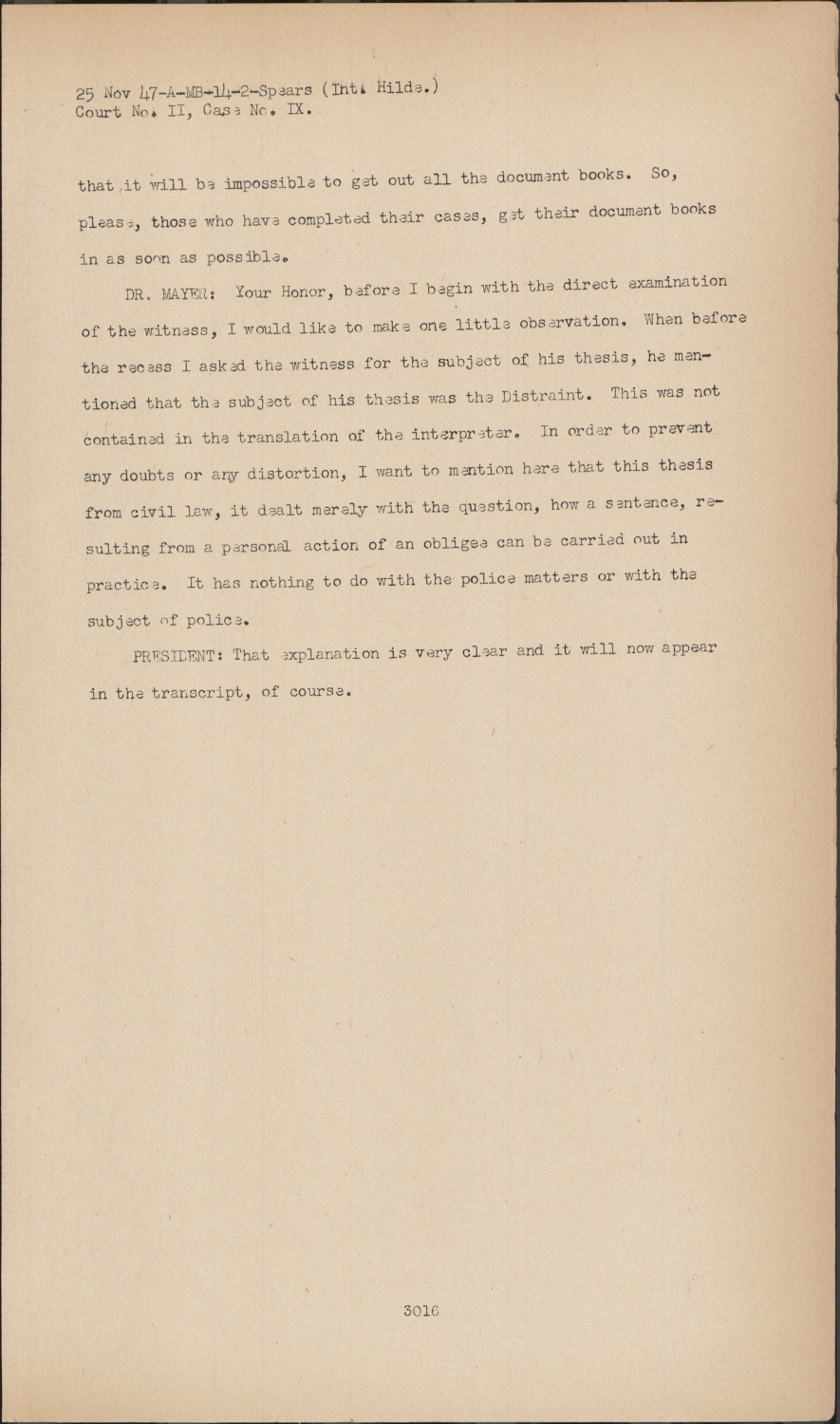
that it will be impossible to get out all the document books. So, please, those who have completed their cases, get their document books in as soon as possible.
DR. MAYER:Your Honor, before I begin with the direct examination of the witness, I would like to make one little observation. When before the recess I asked the witness for the subject of his thesis, he mentioned that the subject of his thesis was the Distraint. This was not contained in the translation of the interpreter. In order to prevent any doubts or any distortion, I want to mention here that this thesis from civil law, it dealt merely with the question, how a sentence, resulting from a personal action of an obligee can be carried out in practice. It has nothing to do with the police matters or with the subject of police.
PRESIDENT:That explanation is very clear and it will now appear in the transcript, of course.
Court No. II, Case No. IX.
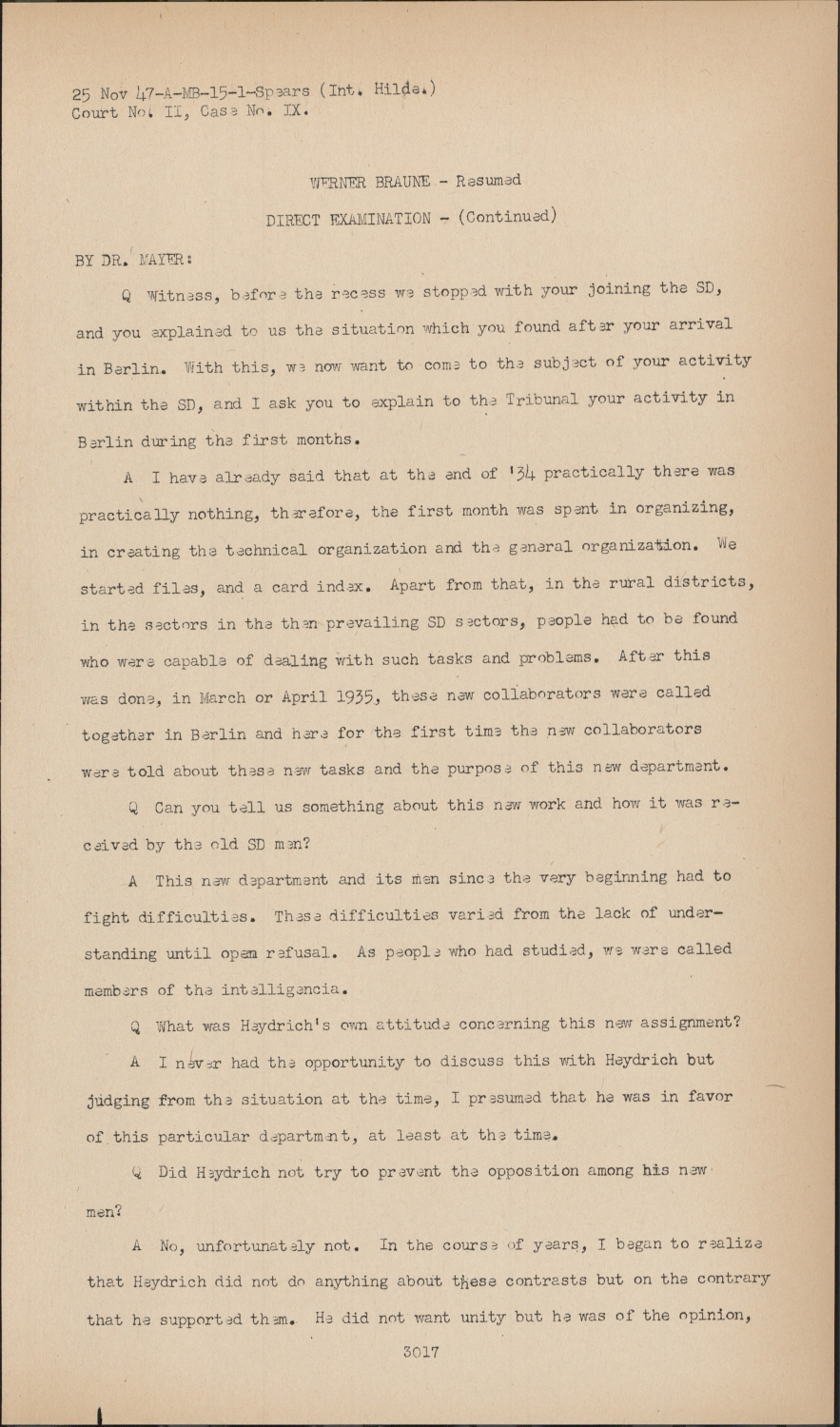
WERNER BRAUNE - Resumed DIRECT EXAMINATION - (Continued) BY DR. MAYER:
QWitness, before the recess we stopped with your joining the SD, and you explained to us the situation which you found after your arrival in Berlin. With this, we now want to come to the subject of your activity within the SD, and I ask you to explain to the Tribunal your activity in Berlin during the first months.
AI have already said that at the end of 134 practically there was practically nothing, therefore, the first month was spent in organizing, in creating the technical organization and the general organization. We started files, and a card index. Apart from that, in the rural districts, in the sectors in the then prevailing SD sectors, people had to be found who were capable of dealing with such tasks and problems. After this was done, in March or April 1935, these new collaborators were called together in Berlin and here for the first time the new collaborators were told about these new tasks and the purpose of this new department.
QCan you tell us something about this new work and how it was received by the old SD man?
AThis new department and its men since the very beginning had to fight difficulties. These difficulties varied from the lack of understanding until open refusal. As people who had studied, we were called members of the intelligencia.
QWhat was Heydrich's own attitude concerning this new assignment?
AI never had the opportunity to discuss this with Heydrich but judging from the situation at the time, I presumed that he was in favor of this particular department, at least at the time.
QDid Heydrich not try to prevent the opposition among his new men?
ANo, unfortunately not. In the course of years, I began to realize that Heydrich did not do anything about these contrasts but on the contrary that he supported them. He did not want unity but he was of the opinion, Court No. II, Case No. IX.

divide and rule.
QYou just said that you never discussed any practical problems with Heydrich. Is that quite true in spite of your activity of three and a half years in the SD main office?
AYes, that is correct. I never reported to Heydrich officially, although I was for almost four years in the SD main office. I only heard Heydrich speak on bigger meetings.
QIs the same true for Himmler?
AI never spoke to Himmler, not even a word, during my whole life.
QWhat, was your actual work in the SD?
AI have already said that the domestic spheres of law and administration was my task. In addition I was given the department education where I had to deal with student and university matters and also the department party and state which, however, never got over a sort of embryonic state.
QCan you give us a few examples and thus give us a sort of idea of the SD?
AI shall illustrate it with a few examples. On the legal field, the problem of the contrasts of the legal institutions of the state and the legal institutions of the party was dealt with. The contrasts, for instance, between the Reich Ministry of Justice on the one side, and the National Socialist Lawyers League, that is the Academy for German Law under the later Reich Minister Frank were so strong that I experienced that the Minister of Justice officially prohibited his own officials to participate in dealing with legal problems which the Academy of German Law had taken up and forbade them to participate in any of the work of the German Academy of Law. We also reported about the training problem. While until 1933 numerous assessors were without work, in 1935 already there were the first symptoms of a lack of lawyers. This again has had as its consequence that for the new generation of lawyers, conditions were made easier which were looked upon in a critical way for the purpose of agood legal training. This also was reported about. Generally, reports were made about new laws and their practical Court No. II, Case No. IX.

effects and their reception in lawyers' circles, and in larger circles of the population. In the field of administration there was the problem of the Reich reform which was dealt with mainly. The question of the increasing subdivision of the administration and in this connection the problem of a unified administration, here again, contrasts were pointed out of the lower authorities, for instance, I think in particular about the contrasts in district areas between the local counsel and the area leader, the kreisleiter. In the field of education, I remember in particular a detailed report concerning the Adolf Hitler schools. I am still convinced until this very day, that is, thanks to the SD, that these schools were not as largely as was planned,before, instituted in all districts and areas, but that it was only one of the experiments on the way to a final school reform and was also regarded as such. We reported about the problem, Hitler Youth, Parents and School, which concerned larger circles, especially after 1933. On many occasions we pointed out how unfortunate it was that the then Reichsjugendfuehrer, the leader of the German Youth, Baldur von Schirach, did not try to achieve a cooperation between the parents and school and Youth Leader, but by attacking the teachers increased these contrasts. We were of the conviction that he did not do a good service to the German youth with that.
QWitness, you have just stated that in your SD reports you criticised the existing institutions. Did you want to say that you worked against national socialism?
ANo, on the contrary. If we criticized, for instance, the Adolf Hitler schools, then this happened for the reason that we were of the conviction, and this was clearly expressed from all the voices coming from all over the country, from national socialist circles as well as from educators, that these Adolf Hitler schools were, if expressed in a slightly exaggerated manner, were very bad for national socialism. I don't want to maintain in any way that we worked against national socialism as it was understood by us. Just the contrary was true.
QDid you deal with matters of students and universities at that time?
Court No. II, Case No. IX.
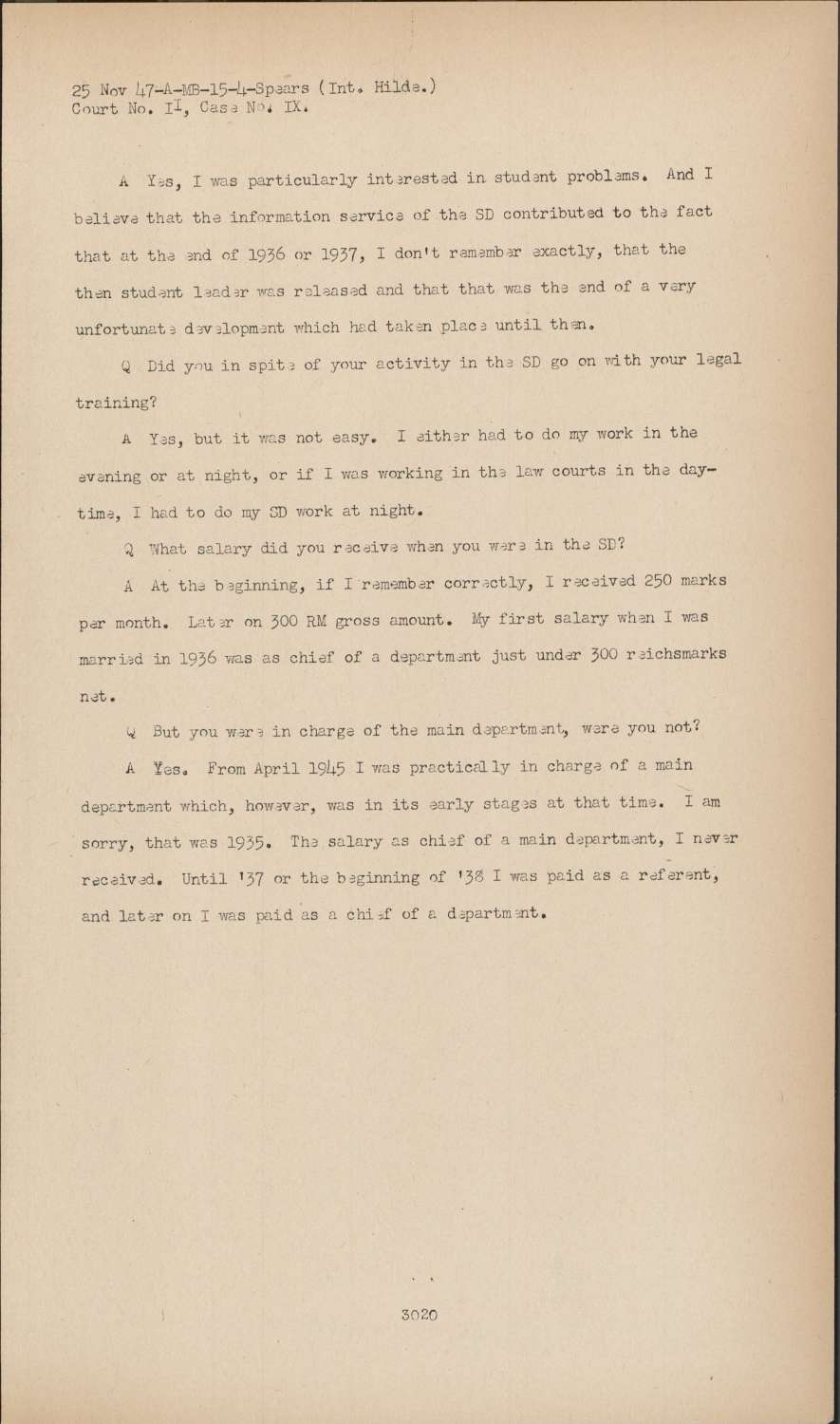
AYes, I was particularly interested in student problems. And I believe that the information service of the SD contributed to the fact that at the end of 1936 or 1937, I don't remember exactly, that the then student leader was released and that that was the end of a very unfortunate development which had taken place until then.
QDid you in spite of your activity in the SD go on with your legal training?
AYes, but it was not easy. I either had to do my work in the evening or at night, or if I was working in the law courts in the daytime, I had to do my SD work at night.
QWhat salary did you receive when you were in the SD?
AAt the beginning, if I remember correctly, I received 250 marks per month. Later on 300 RM gross amount. My first salary when I was married in 1936 was as chief of a department just under 300 reichsmarks net.
QBut you were in charge of the main department, were you not?
AYes. From April 1945 I was practically in charge of a main department which, however, was in its early stages at that time. I am sorry, that was 1935. The salary as chief of a main department, I never received. Until '37 or the beginning of '38 I was paid as a referent, and later on I was paid as a chief of a department.
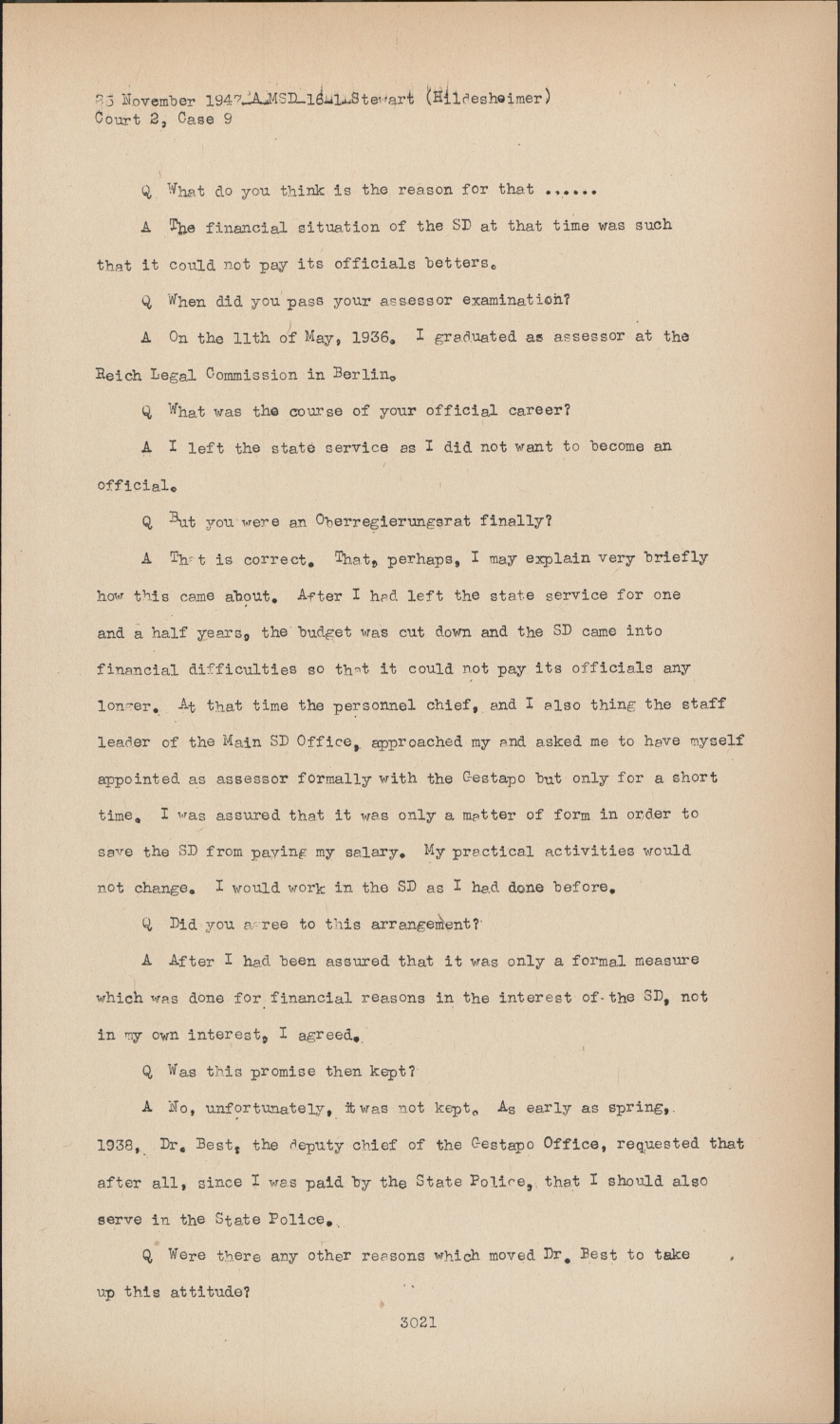
QWhat do you think is the reason for that ......
AThe financial situation of the SD at that time was such that it could not pay its officials betters.
QWhen did you pass your assessor examination?
AOn the 11th of May, 1936. I graduated as assessor at the Reich Legal Commission in Berlin.
QWhat was the course of your official career?
AI left the state service as I did not want to become an official.
QBut you were an Oberregierungsrat finally?
AThat is correct. That, perhaps, I may explain very briefly how this came about. After I had left the state service for one and a half years, the budget was cut down and the SD came into financial difficulties so that it could not pay its officials any longer. At that time the personnel chief, and I also thing the staff leader of the Main SD Office, approached my and asked me to have myself appointed as assessor formally with the Gestapo but only for a short time. I was assured that it was only a matter of form in order to save the SD from paying my salary. My practical activities would not change. I would work in the SD as I had done before.
QDid you agree to this arrangement?
AAfter I had been assured that it was only a formal measure which was done for financial reasons in the interest of the SD, not in my own interest, I agreed.
QWas this promise then kept?
ANo, unfortunately, if was not kept. As early as spring, 1938, Dr. Best, the deputy chief of the Gestapo Office, requested that after all, since I was paid by the State Police, that I should also serve in the State Police.
QWere there any other reasons which moved Dr. Best to take up this attitude?

AThe real reason was then a dispute of competency between the authorities, between the department law and administration in the Gestapo Office, which was subordinated to Dr. Best, and between my department, law and administration. Perhaps I may, in order to throw light on this development, in order to make these conflicts understandable. From the very beginning, that is, from early 1933, Heydrich on one hand was Chief of the SD, and on the other hand, he was first of all inspector of the Gestapo, but only in Bavaria, because both these agencies were in Munich at the time. It autumn, 1934, the SD Main Office was transferred to Berlin and became an independent office of the SS, and Heydrich became chief of the Gestapo Office in Berlin. The situation at that time was such that the SD, through its intelligence service, was legitimised by the party but not through its activity in the domistic service information which were dealt with at the time by Professor Hoehn. The next stept of development was, I think in November, 1936, when the Main Office Security Police was created after the appointment of the Reichsfuehrer SS as Chief of the German Police. At that time, there were certain tensions between the State Police and the SD in its enemy intelligence service, because the State Police, which dealt with the problems of opponents of the Reich, wanted for reasons understandable that they should also have to deal with the intelligence service in this particular field and thus it came about that eventually even the intelligence service was taken over more and more by the State Police. The decree concerning the separation of these two spheres from 1938 was to a certain degree only the confirmation of a state of affairs which had already been largely created before, and only 1939, when the RSHA was founded, brought a clear and final solution of these problems. All the activities concerning enemy intelligence became the task of the State Police, and Office 3 became an office merely dealing with domestic spheres. In the course of this development, the Secret State Police Office went further and expressed their misgivings and claimed authority in the field of law and administration.

THE PRESIDENT:Dr. Mayer, a certain amount of background is not only in order, but really necessary; however, do you think that it is necessary to go into a great deal of detail on these various office ramifications?
THE WITNESS:I think I may answer this. I had, just finished. I only wanted to say now that Dr. Best claimed tasks for the State Police which we claimed for the SD, and those were the conflicts which I tried, to explain, and therefore I tried to display the development. Dr. Best used this pretext and tried to solve the problem by insisting that I be appointed to the State Police Office, and therefore the source of all the trouble was once and for all eliminated.
QDid you take this transfer to the Gestapo, in spite of all these promiese, without objection?
ANo, I did not. In autumn, 1938, I was transferred as the Deputy State Police leader to Muenster.
QWhy did you not leave the SD at that time?
AIn spite of this transfer, I did not leave because I am of the opinion that one must go on with a task which one has recognised as justified, that one must not give it up just because one doesn't succeed, the first time. Furthermore, I succeeded, with the aid of Herr Ohlendorf to be appointed the Chief of the SD office in Muenster, so that I practically remained in the SD service.
QThis work of yours in the Stapo and the SD could it be combined when you were in Muenster?
ANo, it could not. I did not want to combine these two tasks because I wanted to force my remaining in the SD, and therefore I did not indulge in any activities as Deputy Chief in Muenster, but I only dealt with my SD work.
QDid you Stapo chief approve of your attitude?