AYes, that is correct. I only got the directives to go to Rostov, take over the commando, and to inspect it and then report about it.
QWho then actually informed you about your tasks when you came on the 18th of September to Rostov?
ANo one informed me about my tasks. The commando was shown to me, I inspected it, and the leader 4 arranged this.
QThat was all you did. You did not question anybody, "What am I supposed to do as commander of Einsatzkommando 6"?
AI told him, "What do you do, and how do you do it" and "Please show me".
QWho was this leader 4 who just gave you this scanty information?
AThat was an SS Hauptsturmfuehrer.
QCan you tell the Tribunal his name?
AYes. This is already in the files. His name is Heidelberger.
QDo you know whether Heidelberger was instructed by Thomas to give you information on your task?
AWhether he had received orders from Thomas, that I do not know.
QHe never told you that he was -
AHe never told me that he had any such order. In any case, I do not remember.
QThomas knew that you were a former minister and had no experience in security matters, is that right?
AYes, that is correct.

QIs it not strange what Thomas who knew that, sent you in time of war to an important unit as its leader and neither information you about the security tasks or aid he instruct anybody to give you at least the basic information which was necessary for the carrying out of your tasks?
AI have dealt with this in detail in try direct examination. From my training, my professional training and my attitude to these matters, he drew the conclusions. He did not order me to this particular position, but I was sent there from the Berlin office. Berlin detailed me to this position, and I discussed the question in detail as to whether Thomas could not have, given me another assignment. He just couldn't do so. He found a solution which satisfied both parties.
QBut for the reason if at he could not change your assignment, it would be logical to me what he would have tried to make yourself acquainted with this job, just for the simile reason that he knew that you had to stay there as commander. He should have done something to make you able to fill out this position.
AActually, of course, I can't understand it. I told Thomas that I wanted to leave, I wanted to apply for a release. This he accepted. He said, "Well, go there. Of course, you have been detailed there by Berlin; one cannot do anything about it, but please go to that place and inspect it, and we shall see about it". That I did according to my duty, and he came to the decision, as I have already said, that the leadership task within the commando should be divided between Nehring and myself.
QThat was and of October, wasn't it?
AYes.
QSo what actually from the 18th of September to the end of October you were in command of the entire Einsatzkammando 6, is that right?
ANo, not quite. I think we misunderstood each other. Nehring arrived the end of October end the meeting was at the beginning of October, which I already said in my interrogations--on the 13th of October I returned to Rostov.

QSo you were at least from the 18th of September to the beginning of October--when you went to Kiev--in command of the entire Einsatzkommando 6?
AI always was, in the final analysis. I never denied that, and it always was that way.
QIs it correct than if I assume that Nehring was always your subordinate?
AIn the final analysis, yes, because only one man can be the officer and chief of a commando, and I think I confirmed this expressly in my direct examination.
QAm I light in assuming that these four persons which you have just enumerated, the three subcommanders and the leader of office 4 who were entitled to pass sentences and ordered executions, were all the time, when they did so, your subordinates, is that correct?
AYes, I said that in detail and quite explicitly.
QYou told the Tribunal that you never heard before this trial about the Fuehrer order, is that correct?
AYes, Yes.
QThat you first found out what this order really was, clearly before your mind, when the defendant Ohlendorf testified here, is that also correct?
AYes.
QWas it known to you that there was a definite general policy in the time when you were in the East and earlier to kill all Jews there?
ANo.
QWhen did you learn about this fact for the first time?
AAlso after 1945.
QWhen?
AWell, the word, "final solution," I heard for the first time here.

QWhen did you hear it here, in the trial or in pre-trial interrogation?
AIn the interrogation. I don't know whether I was asked for it then. I can't say anything about that. I can't say whether I heard it here or somewhere else, but here one is so mixed up that one doesn't really know where it is.
QYou did not hear about the so-called "final solution" before you came to Nuernberg?
AAs far as I remember, I did not.
QThen you don't remember whether you were interrogated by Mr. Wartenberg about the extermination of the Jews?
AI don't think so, but I can't say with certainty. I can't remember it.
QWell, it is an important matter. I do think you should have a recollection when you heard about that. You do not know?
AI said yesterday, if one is interrogated, one can't keep all the impressions that one gets, especially if there are strange matters which one isn't used to.
QYou just don't know any more?
ANo.
QAm I correct in assuming that these two executions which you described to the Tribunal and which you witnessed, one by gas van and one by shooting, were carried out between the 18th of September and the beginning of October 1942?
AYes.
QWho was chief of the detachment who carried out this execution?
AIn Rostov executions were carried out by the officer of the particular service. I don't know who it was at that time, but I went there with Heidelberger, at least, I drove there with him.
QDid you have a special execution section in your Einsatzkommando?
ANo, No. I already said the whole subcommando took part in it.

The men were detailed for these tasks, with the exception of the administration and the kitchen, of course.
QEverybody else?
AYes. Well, according to the requirements of the officer, who orders how many people are to be employed in it, and I did not have to deal with it.
QWell, we will assume that all members of an Einsatzkommando with the exception of the personnel of the cookhouse and of the administration took part in -
AOf course, administration and SD have to be excepted.
QTook part in executions, all others-
AWell, I don't know. I couldn't say anything else.
QYou watched an execution by asphyxiation?
AYes.
QDid you inform yourself whether such an execution is admissible according to German criminal law?
AI already testified as to this in my direct examination, and I said that I did not order this particular way of execution, but I found it when I arrived, and I had to assume that a lawyer had regulated it, and that all decrees had been examined, and I could not pass judgment myself.
QYou never tried to satisfy your own conscience in questions of that kind?
AI did not have to satisfy any conscience.
QYou have told the Tribunal just now that you were a commander of the outfit, and that all the people who carried out these orders were under your command, and I do think that it would have been necessary if you had satisfied your own conscience if that which was going on around you, and under your supervision, was legal or not.
AI did not understand the meaning of this question.
QDid you consider it necessary to satisfy yourself whether that which was carried out under your command was legal and justified?

AI have already said that my predecessor, Moor, in Kiev told me that he had regulated everything in the proper manner and that everything was all right, and then whom I supposed to ask--whom am I supposed to ask. I knew that everything was all right, or at least I thought I knew, and I myself had no power of judgment concerning these matters.
QSo you never made inquiries in this respect?
AWhat do you mean--what happened? I saw that the execution by gas van was carried out according to order, and I saw that it was not a wild, extreme measure which somebody was doing, but that was an orderly matter which had been instituted by the authorities.
QYou testified that when you came to Rostov there were no Jews in this place?
AYes. I said in my direct examination that I never noticed any Jews.
QDid you mean to say that there were never Jews in Rostov or that there were no Jews any more when you came there?
AI can't testify anything about this because I don't know anything about it.
QWill you tell the Tribunal how many inhabitants Rostov has?
AI can only say how many there were supposed to be at that time. If I am correct--or at least according to my memory, vaguely, there must have been 200,000.
Q 250,000 now, correct?
A 250,000? Yes, about.
QDo you know how many of these inhabitants were Armenians?
ANo, I couldn't say that because I don't know whether in these 200,000 the suburb Nahichova is included.
QPossibly you can tell the Tribunal how many Armenians were living in this suburb?
ANo, I don't know how many Armenians lived there. I did not inquire about ethnic groups.

QYou have said then, explaining your statement, that is quite possible that there were some Jews, not very many in Rostov, how many would that be?
AI don't know. I said I don't know that there were any Jews. That does not mean that there is no Jew actually living there because this question was never brought up. I onlu know in general that there were no Jews, but that doesn't mean that Jews didn't come there. There was a constant wandering between the towns and villages. The town, Rostov, did not have a fixed population. Those who saw this constant migration must have been most amazed about these tremendous wanderings by all these Russians over these distances. The population fluctuated largely, some had escaped and, of course, returned on occasions to the places they came from.
QWould you say that there were more or less than 10 per cent of the population in Rostov Jewish?
AI can't testify anything concerning this because this question was never mentioned at the time.
QYou said that you assumed that it was the reason for Thomas not to inform you about the Hitler order, as this order was not valid for Rostov as there were no Jews, is that correct?
AThe answer to this question can only be my opinion. Yes.
QHow was it then with Taganrog? In Taganrog there were Jews, were there not?
AI but knew about this fact -- it was the end of May or beginning of June in 1943, and quite accidentally without any particular excitement about this fact.
QBut you knew that these Jews were registered, were they not?
AYes, I heard about that at the time.
QSo there were Jews in Taganrog, were there not?
AYes, Jews must have been there.
QWill you tell the Tribunal approximately how many?
AThat I did not know. I didn't interest myself in it as there was no cause for doing so.
QCan you tell me why it was that the Fuehrer order did not apply for these Jews in Taganrog?
AThat question I asked myself. I ask myself this question today. There were Jews.
QDid you consider at that time the registration of the Jews as the first step to their extermination?
ANo.
QYou remember that you have been interrogated here about the subject by Mr. Wartenberg?
AThe Jewish question was mentioned in Eselheide. Whether, however, it was mentioned here I can't say, because in the affidavit nothing is mentioned which surprised me at that time.

QI think there is mention, I am not quite sure. But I want to ask you another question. Is it not ---
ATaganrog, yes, that I think---
QIs it not true that Mr. Wartenberg asked you whether Jews were exterminated by you or by your unit and your answer was, approximately, "That I cannot say. I only know the Jews were registered in Taganrog. Could that be?
ANo, I said the same as I said here. The other statement is a combination.
QYou were, according to your own testimony, in charge of --before the arrival of Nehring -- in charge of the Einsatzkommando from 18 September to -- what was the date when you went to Kino -- beginning of October, is that right?
AWhat?
QWho was your deputy with the Einsatzkommando 6 at the time when you were in Kiev?
AExactly as in the time before my arrival, the Chief of 4.
QCan you tell the Tribunal how many executions approximately were carried out between the 18th of September and the day you left for Kiev?
ANo, unfortunately, I am not able to say.
QCan you tell the Tribunal who made the reports from your Einsatzkommando to the Einsatzgruppe at the time before Nehring arrived?
AI already said that information was dealt with by Department 4.
QDid you forward these reports to Einsatzkommando 6?
AI said in my direct examination that I saw one or the other of the reports. That does not mean that I remember a figure or a special event.
QWere these reports forwarded to you from Office 4 before they went to the Einsatzgruppe?
A whether I always saw them, I don't know. At that time, exactly as it was later, I had the deputy Heidelberger work on as he had done before my time, and this situation Thomas regulated to the effect that as the responsible man between myself and Heidelberger he put Nehring.
QWhat do you mean, earlier than? At the end of October, is that correct?
ANehring arrived at the end of October, yes.
QYou have told the Tribunal that every single person who was executed by Einsatzkommando 6 at the time when you were in command was thoroughly investigated and proved guilty of having committed a crime and sentenced duly to death by, as you have stated in your testimony, orderly procedure. Will you please explain to the Tribunal what you understand by the expression "orderly procedure?"
AI can only say what I found when I arrived, and I tried to explain this in my direct examination the best I could. As far as I knew, the case arrived, -- it was the Russian police who found out about the facts by investigations and sent the criminal with the documents concerning this case to the local Kommandatura. Then the Commando started working, that is, the sub-commando Rostov, investigated this case again. New interrogations were carried out and a final report was made. Then, according to my knowledge, a meeting took place with the chief of Department 4, who was the subcommando leader, and in this meeting the sentence was established.
QHow long would such a procedure take, usually?
AThat varied. I again cannot make any statements concerning this, because I did not deal with anyone of those procedures, but there was a prison where these men were imprisoned and we had enough time to deal with each individual case according to order as it had been regulated by my predecessor.
QAn approximate time, one hour, one day, one week?
AI can't say, because I did not take part in such matters. I have tried to explain and I can only repeat it again, that I wasn't to deal with such tasks as I did not know anything about them, even less than the officials. They were all criminal officials who dealt with these matters.

QIf I am not mistaken, Herr Biberstein, you have told the Tribunal that you have checked these things and that you have read sometimes some of the files.
AYes, I made spot checks.
QWhat did you find in these spot checks?
AI found out whether the person concerned had been interrogated, I found the interrogation and the statement and I was able to ascertain that all the requirements for possible execution were met.
QCan you tell the Tribunal, whether the people who were accused of these crimes could appear in this meeting where the sentence was passed?
AI don't think so.
QSo the people who passed the sentence actually never saw and never heard the defendants is that right?
ANo, that is not correct, because those who interrogated them were present.
QSome of them?
AAll of them.
QHow many people would that be in every case?
AI don't know, I wasn't present at such a meeting; therefore, I can't give any details of it. I wasn't supposed to deal with such matters and I did not want to do so.
QAll these things were carried out under your command, were they not?
AIf you like to put it that way, yes, but I didn't give any orders as far as that is concerned. I did not use the authority which I held but I left it to Nehring, in fact.
QBut you approved of that, what Heidelberger before Nehring came and what later Nehring after the end of October, 1942, did, did you?
AI did not have to be present, because there were officials well known to Thomas and with whose activities. Thomas was satisfied.

QSo you approved what -- of these measures which were carried out by these people, don't you?
AWhat else could I do, because I had no own opinion about these matters.
QThere were also sentences where people were sentenced to imprisonment. Will you tell the Tribunal whether these people were sent to a concentration camp, or whether they were kept in prison?
AThey were kept in prison at Rostov.
QWere one of these defendants ever represented by counsel in all of these procedures?
AI don't think so.
QDid they have, in the case of death sentences, the right to appeal?
ANo, I don't know anything about appeals, about the rights of appeal, no.
QAnd you cannot tell the Tribunal from your own knowledge how long such a procedure took?
AThat varied according to the cases, whether it was just one individual concerned, or whether more people were involved.
QI only want an estimate.
AAny information I could give would be the untruth, because I can't say anything about it from my knowledge.
QHow often did you make these spot checks about which you spoke? Daily? Weekly?
ANo, no.
QOnce a month?
AIt wasn't at regular intervals.
QDid Heidelberger or later Nehring report to you orally on these so-called trials?
ANo, it was not his duty to report to me about any individual event. He sometimes told me about the content matter on occasions when something special had happened.
QDid you ever investigate one of the prisoners your self?
ANo, never. I did not have any practice in interrogations. Also, it is not the task which I can deal with. I regard it as something awful not that I am thinking of myself now.
QYou have told the Tribunal that you are in no position to say any number, how many executions were carried out by Einsatzkommando 6 in your time, and that the two estimates which you gave in your two affidavits may be correct and may be incorrect. You just can't say, is that correct?

AYes.
QLet's presume for a moment that the number which you gave in these two affidavits, 2 to 3,000 is correct. You have said here in your statement that only during the four months you were in Rostov executions were carried out by Einsatzkommando 6, is that correct? Only during four months when you were in Rostov there were executions carried out all of the time when you were there?
AYou mean in Rostov?
QYes.
AIn Rostov, and of course I was in Taganrog afterwards.
QWere executions carried out in Taganrog, or were executions carried out only during the four months you were in Rostov?
ANo, during the whole time.
QAll of the time?
AYes, yes, but I don't know how many there could have taken place in Taganrog, because at that time we worked in collaboration with the divisions and the divisions acted on their own, independently, and I put this commando at the disposal of these divisions only for purposes of investigations and interrogations. I remember cases in which, for instance, the Wehrmacht put the commando into action. Whether the commando at that time independently carried out executions, I don't know. It is possible, but I don't know. In any way, they collaborated with the Wehrmacht. That was combat zone at that time.
QBut you possibly can tell the Tribunal whether at this time the numbers of executions were still reported to the RSHA, that means from you to the Einsatzgruppe, not to the RSHA?
AYou mean that reports went from the E. K. 6 to the Einsatzgruppe 6? It must have been assumed.
QWell, after the time of Rostov, even at the time when you had been already detached.
AYes, certainly, certainly.
QLet's go back to our first question. Let's assume for a minute that the number of 2 to 3,000 is correct.
You have been in the east for 9 months, haven't you?
AYes.
QSo, if the number of 2 to 3,000 is correct, it would mean that during this time, if Einsatzkommando 6 carried out executions daily, including Sundays, including Christmas and including Easter, there would be a daily average of 8 to 10 executions, provided that the number in your affidavit is correct, is that correct?
AI haven't calculated it yet, but if you did then it must be correct.
QCan you tell the Tribunal whether you consider it possible that four investigating officers -- and they were the people who investigated the cases -- could have been able to investigate, pass sentence and order executions of 8 to 10 cases a day?
AYou seem to overlook one fact, Mr. Prosecutor. The interrogations are not being carried out in the commando by the officers, but by the criminal officials. You use the word investigation officer, the secretary, the chief secretary -- all these are criminal officials who carry out investigations. The officer, the leader, is only responsible for the decisions but not for the interrogations and investigations.
QDo you think it possible.
AI can't give you an opinion, because I cannot think myself into the situation. Whether this is possible or whether it is impossible I cannot decide.
QBut you admit that it was done, do you, that it was done in that manner, that 8 to 10 sentences --
ANo, the number is fictitious, the number which you said.
QBut you have twice confirmed under oath that the number would be approximately correct, is that right?
ANo, I explained clearly how this figure came about, once in Eselheide and the second time here. I think these statements I made were quite clear and I reserved the right, and I tried to express that, that I should be allowed to a statement concerning this figure here before this Tribunal.
QWhen did you do that, in your first interrogation here?
AHere in Nurnberg.
QYour first interrogation here?
AYes, at the interrogation.
QYou have no recollection of a number from the reports which were sent to Einsatzgruppe C, is that right?
AYes, that is correct.
QHow often did you read this report?
AI don't remember.
QRegularly?
AI presume I read them quite regularly, but now I remember that during the winter there were no written reports issued.
QBut there were reports by radio, were there not?
AYes, that is possible they went by radio, but I don't know how often. I don't remember any details.
QI do think that you misunderstood my question. I asked you how often did you read them, not how often were they sent.
AThat I also do not know. I cannot give any details.
QDo you remember, whether you volunteered a statement about these reports?
AWhat was the question?
QWhen you were interrogated by Mr. Wartenberg?
AWhether I was interrogated concerning this question? Yes, I assume that I was, I can't say.
QAnd it is your contention now that these reports were made and sent by Heidelberger and later by Nehring, is that correct?
AYes, and it is possible that I signed such a report. It is possible that I was shown a report and if I saw it I must have signed it, but I don't know in detail because it was not one of my assignments.
QDon't you remember that you stated, when Mr. Wartenberg asked you about the number of executions carried out, that you had reported in these reports the number of 2 to 3,000 people?
AI went back to the Eselheide affidavit.
QNo, I asked you something completely different. I asked you whether you did not say that you have reported 2 to 3,000 killings in these reports which went to Einsatzgruppe C, nothing to do with the Eselheide affidavit?
AI mentioned the figure 2 to 3,000 in the same connection as I mentioned it in Eselheide.
QWill you explain to the Tribunal -- possibly you will answer this question with yes or no -- did you say to Mr. Wartenberg, according to your recollection, that you personally, you, Mr. Biberstein, reported to Einsatzgruppe C 2 to 3,000 killings?
ANo.
QYou never did?
AThat was never my intention to say anything of the kind.
QI would like to refresh your memory.
APlease do so.
THE PRESIDENT:Mr. Hochwald, could your refreshment take place during the recess?
MR. HOCHWALD:If your honor please, it takes one minute. I do think it would be ---
THE PRESIDENT:All right. You would prefer to do it now? Very well.
MR. HOCHWALD:I hand the original first. I offer at this time Document NO 4997 as Prosecution Exhibit 183. This, your Honor, is the interrogation of the defendant Biberstein, which was requested by Dr. Bergold. I then, in answer to the request of Dr. Bergold, I informed the Tribunal that the Prosecution will use this document at another time. I offer it now. Will your Honor turn to page 13 of the document?
DR. FICHT:Ficht, for Biberstein. Your Honor, I may make the following remark on the occasion of the presentation of this document.

As the prosecutor has already mentioned, we have requested this document at a period, when we would have been in a position to question Mr. Wartenberg about this document. I see that the document is not signed by the defendant Biberstein. Therefore, I am not in a position today to question Mr. Wartenberg today in cross examination as he has already left, but as Mr. Wartenberg has been examined in this case and could have been questioned by the Prosecution as well, I object to the submission of this document in evidence.
MR. HOCHWALD:If the Tribunal please, this is a transcript of an original record. Mr. Wartenberg has testified here as to the interrogation of the defendant Biberstein. Dr. Ficht was in a position to cross examine him, and did cross examine him. Dr. Ficht has at his disposal the defendant Biberstein. I do not see why this document should not be admissible in evidence. However, I only wanted to fulfill the wish of Dr. Bergold, which was certainly mentioned a long time after Mr. Wartenberg was on the stand here. Dr. Bergold made his application for this document last Friday, if your Honors remember. I do not see any reason why I should not be in a position to offer it.
DR. FICHT:Your Honor, I want to state that even before the examination of Mr. Wartenberg we asked for this document and that I am not in a position, and I was not in a position, at the time, to question Mr. Wartenberg in cross examination concerning these matters which are now to be submitted.
MR. HOCHWALD:The Tribunal will certainly recall that I yesterday I asked the witness very carefully and very specifically whether he was mistreated, whether something -
THE PRESIDENT:Just a minute... Dr. Ficht, please... didn't Dr. Bergold, as late as yesterday, ask for this very interrogation?
DR. FICHT:Yes.
THE PRESIDENT:Well, now, why do you object to its being presented?
DR. FICHT:That it is being submitted in evidence by the Prosecution, because I am not in a position now to cross examine Mr. Wartenberg.
THE PRESIDENT:Well, but you were not in a position to cross examine Mr. Wartenberg yesterday.
DR. FICHT:That is correct. But after I would have had the document I could have seen whether I would submit it as a document or not, and I would only nave introduced it if I had not deemed a cross examination of Dr. Wartenberg necessary.
THE PRESIDENT:But yesterday you asked for the document. Now the document is here. Now, why don't you want it since you have been asking for this?
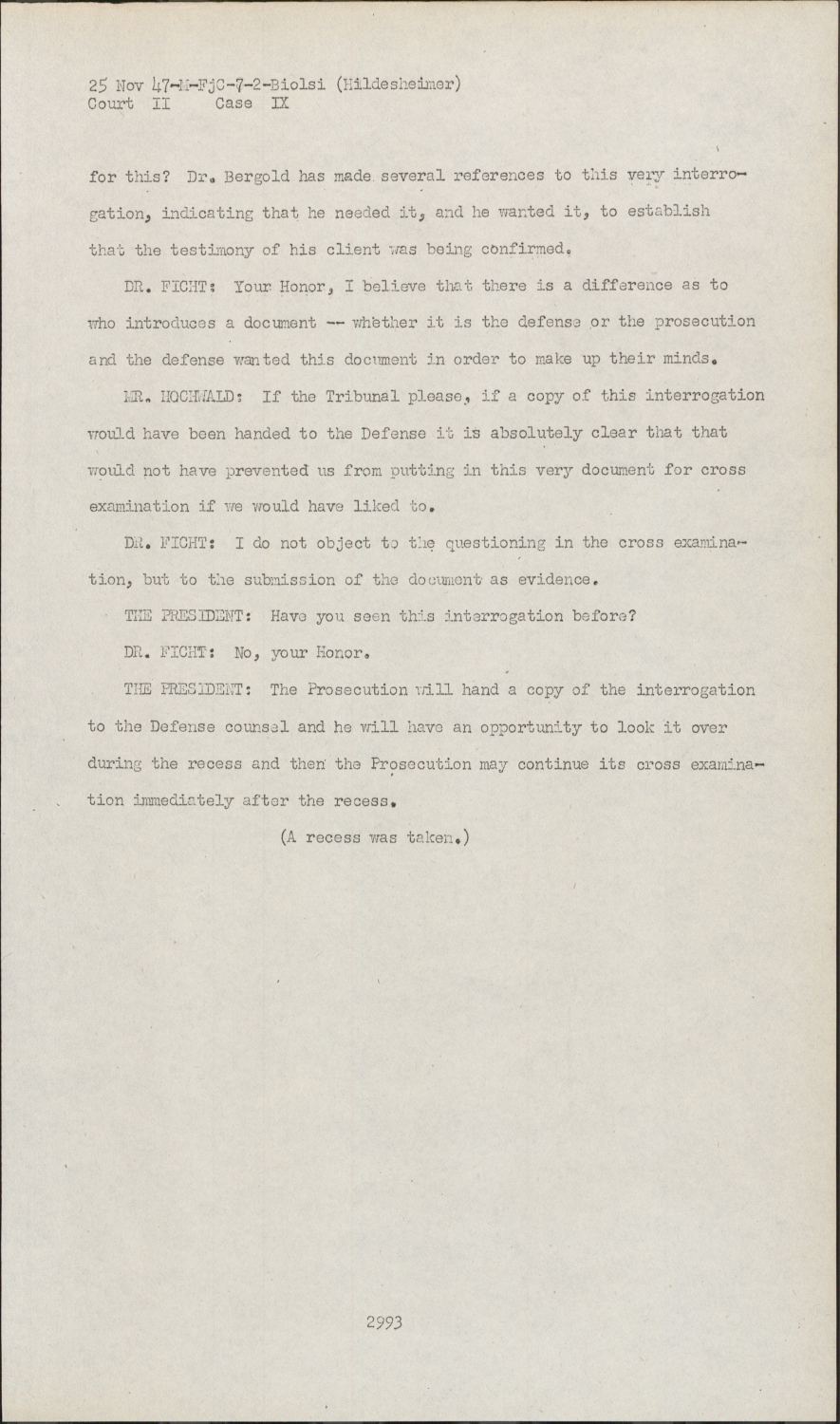
Dr. Bergold has made several references to this very interrogation, indicating that he needed it, and he wanted it, to establish that the testimony of his client was being confirmed.
DR. FICHT:Your Honor, I believe that there is a difference as to who introduces a document -- whether it is the defense or the prosecution and the defense wanted this document in order to make up their minds.
MR. HOCHWALD:If the Tribunal please, if a copy of this interrogation would have been handed to the Defense it is absolutely clear that that would not have prevented us from putting in this very document for cross examination if we would have liked to.
DR. FICHT:I do not object to the questioning in the cross examination, but to the submission of the document as evidence.
THE PRESIDENT:Have you seen this interrogation before?
DR. FICHT:No, your Honor.
THE PRESIDENT:The Prosecution will hand a copy of the interrogation to the Defense counsel and he will have an opportunity to look it over during the recess and then the Prosecution may continue its cross examination immediately after the recess.
(A recess was taken.)