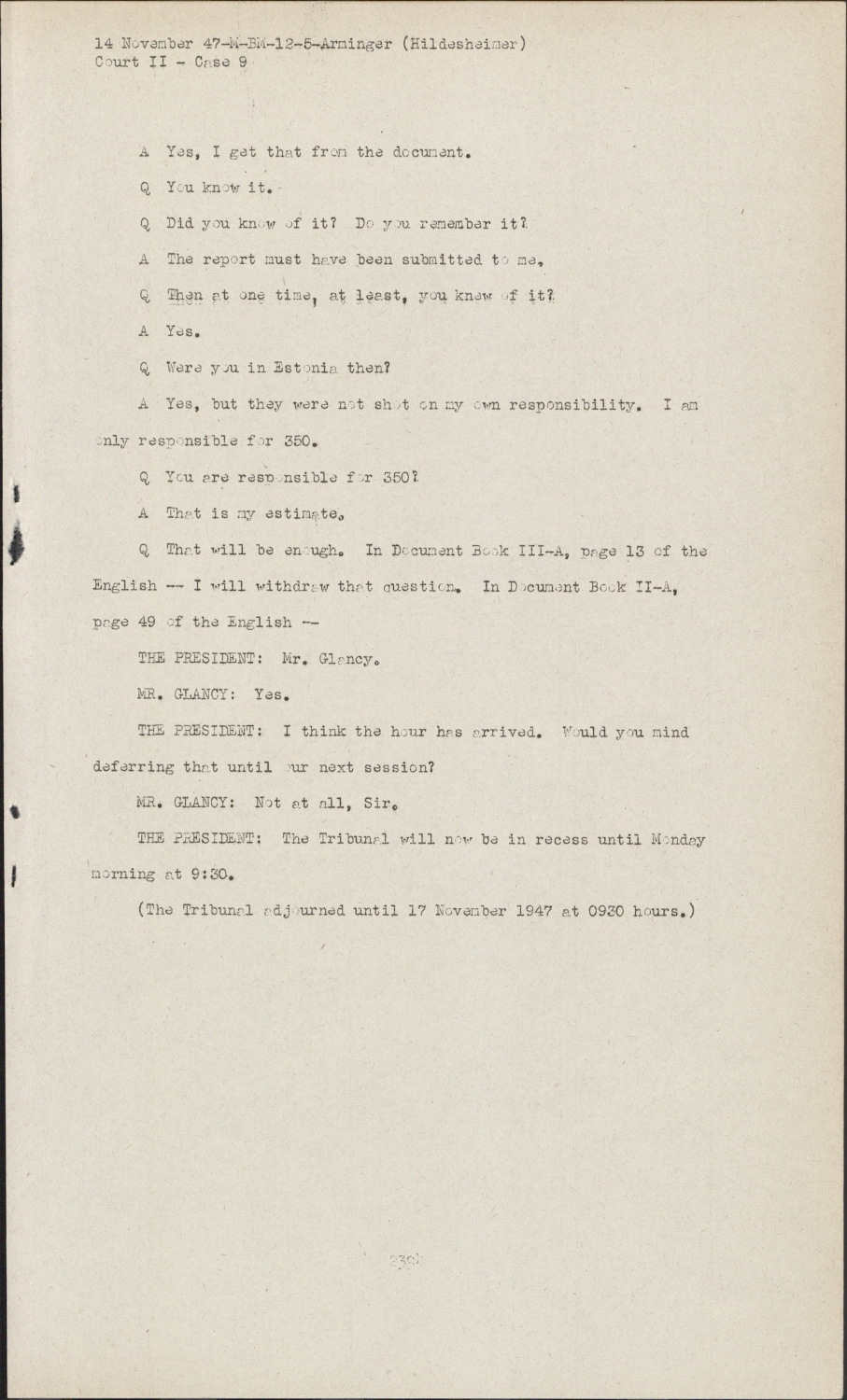
AYes, I get that from the document.
QYou know it.
QDid you know of it? Do you remember it?
AThe report must have been submitted time.
QThen at one time at least, you knew of it?
AYes.
QWere you in Estonia then?
AYes, hut they were not shot on my own responsibility. I am only responsible for 350.
QYou are responsible for 350?
AThat is my estimate.
QThat will be enough. In Document Book III-A, page 13 of the English -- I will withdraw that Question. In Document Book II-A, page 49 of the English -
THE PRESIDENT:Mr. Glancy.
MR. GLANCY:Yes.
THE PRESIDENT:I think the hour has arrived. Would you mind deferring that until our next session?
MR. GLANCY:Not at all, Sir.
THE PRESIDENT:The Tribunal will now be in recess until Monday morning at 9:30.
(The Tribunal adjourned until 17 November 1947 at 0930 hours.)
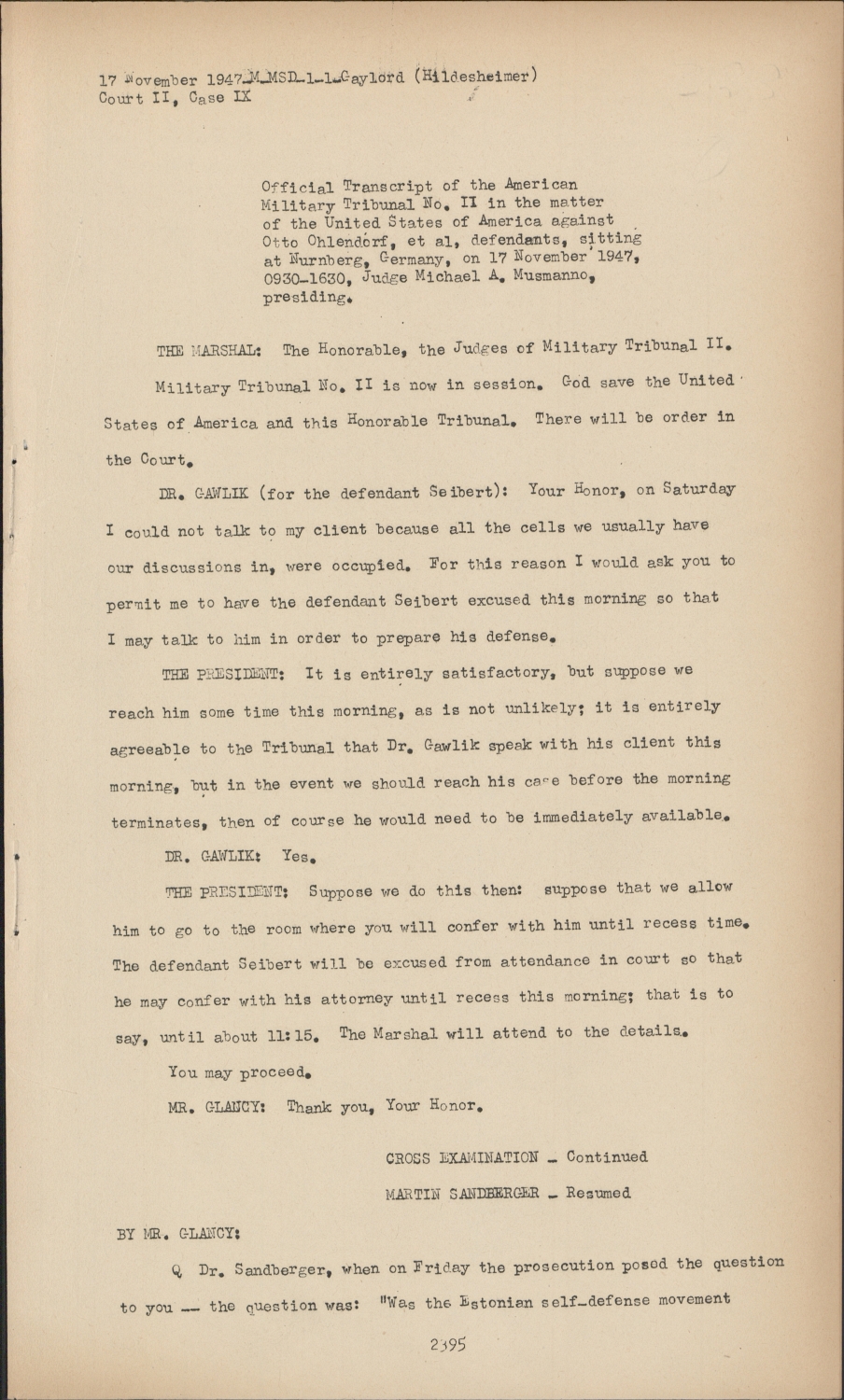
Official Transcript of the American Military Tribunal No. II in the matter of the United States of America against Otto Ohlendorf, et al, defendants, sitting at Nurnberg, Germany, on 17 November 1947, 0930-1630, Judge Michael A. Musmanno, presiding.
THE MARSHAL:The Honorable, the Judges of Military Tribunal II.
Military Tribunal No. II is now in session. God save the United States of America and this Honorable Tribunal. There will be order in the Court.
DR.GAWLIK (for the defendant Seibert): Your Honor, on Saturday I could not talk to my client because all the cells we usually have our discussions in, were occupied. For this reason I would ask you to permit me to have the defendant Seibert excused this morning so that I may talk to him in order to prepare his defense.
THE PRESIDENT:It is entirely satisfactory, but suppose we reach him some time this morning, as is not unlikely; it is entirely agreeable to the Tribunal that Dr. Gawlik speak with his client this morning, but in the event we should reach his case before the morning terminates, then of course he would need to be immediately available.
DR. GAWLIK:Yes.
THE PRESIDENT:Suppose we do this then: suppose that we allow him to go to the room where you will confer with him until recess time. The defendant Seibert will be excused from attendance in court so that he may confer with his attorney until recess this morning; that is to say, until about 11:15. The Marshal will attend to the details.
You may proceed.
MR. GLANCY:Thank you, Your Honor.
CROSS EXAMINATION - Continued MARTIN SANDBERGER - Resumed BY MR. GLANCY:
QDr. Sandberger, when on Friday the prosecution posed the question to you -- the question was: "Was the Estonian self-defense movement under your command?"
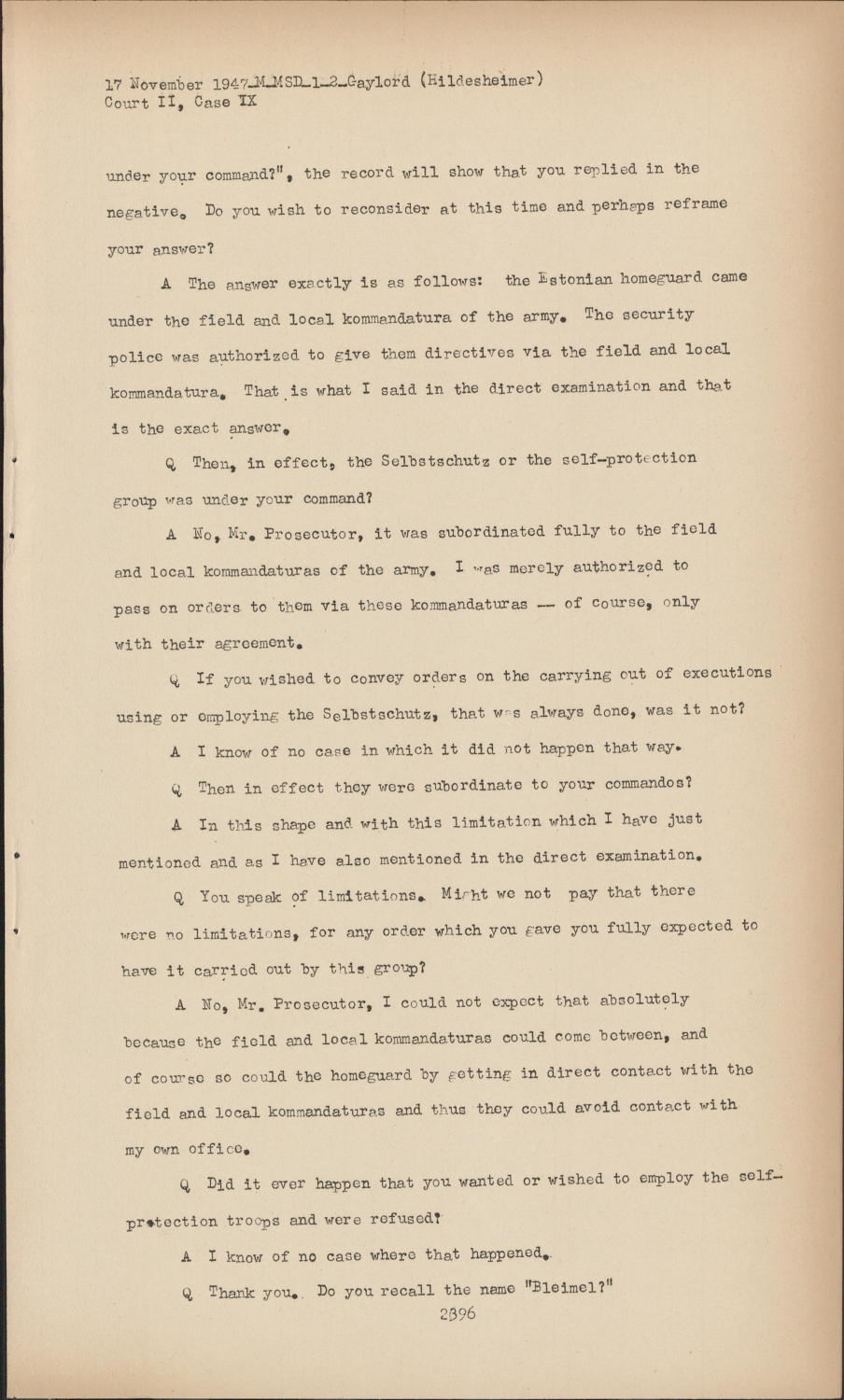
, the record will show that you replied in the negative. Do you wish to reconsider at this time and perhaps reframe your answer?
AThe answer exactly is as follows: the Estonian homeguard came under the field and local kommandatura of the army. The security police was authorized to give them directives via the field and local kommandatura. That is what I said in the direct examination and that is the exact answer.
QThen, in effect, the Selbstschutz or the self-protection group was under your command?
ANo, Mr. Prosecutor, it was subordinated fully to the field and local kommandaturas of the army. I was merely authorized to pass on orders to them via these kommandaturas -- of course, only with their agreement.
QIf you wished to convey orders on the carrying out of executions using or employing the Selbstschutz, that was always done, was it not?
AI know of no case in which it did not happen that way.
QThen in effect they were subordinate to your commandos?
AIn this shape and with this limitation which I have just mentioned and as I have also mentioned in the direct examination.
QYou speak of limitations. Might we not pay that there were no limitations, for any order which you gave you fully expected to have it carried out by this group?
ANo, Mr. Prosecutor, I could not expect that absolutely because the field and local kommandaturas could come between, and of course so could the homeguard by getting in direct contact with the field and local kommandaturas and thus they could avoid contact with my own office.
QDid it ever happen that you wanted or wished to employ the selfprotection troops and were refused?
AI know of no case where that happened.
QThank you. Do you recall the name "Bleimel?"
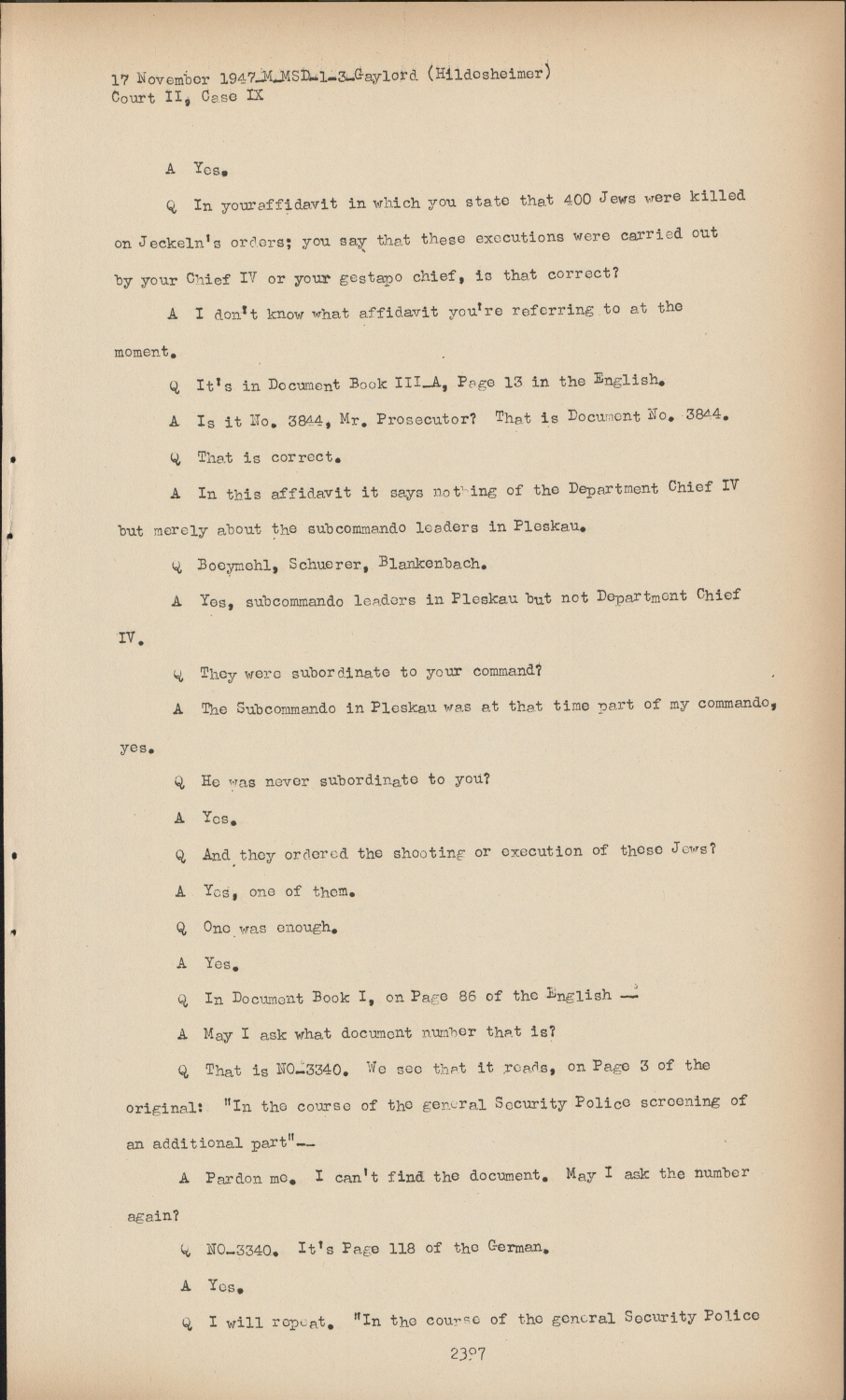
AYes.
QIn your affidavit in which yon state that 400 Jews were killed on Jeckeln's orders; you say that these executions were carried out by your Chief IV or your gestapo chief, is that correct?
AI don't know what affidavit you're referring to at the moment.
QIt's in Document Book III-A, Page 13 in the English.
AIs it No. 3844, Mr. Prosecutor? That is Document No. 3844.
QThat is correct.
AIn this affidavit it says nothing of the Department Chief IV but merely about the subcommando leaders in Pleskau.
QBoeymehl, Schuerer, Blankenbach.
AYes, subcommando leaders in Pleskau but not Department Chief IV.
QThey were subordinate to your command?
AThe Subcommando in Pleskau was at that time part of my commando, yes.
QHe was never subordinate to you?
AYes.
QAnd they ordered the shooting or execution of these Jews?
AYes, one of them.
QOne was enough.
AYes.
QIn Document Book I, on Page 86 of the English -
AMay I ask what document number that is?
QThat is NO-3340. We see that it reads, on Page 3 of the original: "In the course of the general Security Police screening of an additional part"-
APardon me. I can't find the document. May I ask the number again?
QNO-3340. It's Page 118 of the German.
AYes.
QI will repeat. "In the course of the general Security Police screening of an additional part of the civilian population around Leningrad, 140 more persons had to be shot."
Do you recall that incident when you were on the Leningrad front with the Teilkommando?
AI am sorry, I haven't found the place yet. It isn't 3340, is it?
QThat is right. It's on Page 3 of the original German.
AThe Document 3340 begins in the book, which I have, on Page 119 and has only two pages.
QI am very sorry. Do you have it now? Pare 3 of the original. A No, it only has the reported events on 173, and in this copy that I have it only has two pages.
QThat is all that I am going to refer to. Do you see the paragraph beginning: "In the course of the General Police screening of an additional part of the civilian population around Leningrad"'?
AIn the copy which I have here, Leningrad is not being talked about at all. But it says: Location: Krasnowardeisk, and behind that there are a few dots, so that means an omission.
QJust below that, read the paragraph below that.
ABehind that there are a few dots then the words: Excerpt from Page 4 of the original, and again a few dots, and then there is a line about Einsatzgruppe B that there are no reports having been received from Einsatzgruppe B; and what you are mentioning, I cannot find.
THE PRESIDENT:Mr. Glancy, you better send for the photostat then.
THE WITNESS:I am sorry. It's one page -- the page proceeding that and it has the caption: Correction. BY MR. GLANCY:
QDo you have it now, Mr. Sandberger?
AYes, I beg your pardon, it is the proceeding page. It has the caption: Correction. I cannot say anything, however, about it.
QCan you answer one or two of my questions? Can you recall for what basic reason these people were considered a threat to security?
AI can't remember it because it did not fall under my jurisdiction.
QWere you in Leningrad?
AAs I have stated, in the time between the 3rd or 4th of October 1941; but this is areport concerning Berlin, dated the 25th of February 1942.
QWere you not in the surrounding territory of Leningrad in February?
ANo.
QWere any of your command there?
AThe subcommando Krasnossele was subordinate to me, or at least as far as food and administration went, but not as regards the actual work of Department III and IV.
QWas this one of your Teilkommandos?
AAs far as food and administration is concerned, factually it was subordinate to the Commando Krasnowardeisk. This report was neither issued by myself nor did it go through my channel at all, nor did I order it.
QI want to ask you a hypothetical question. If you had a person subordinate to you who was continuously rebellious and dilatory in the carrying out of orders which you issued, would you consider him worthy of promotion?
AIt depends in what manner this person would have reported to me the reason which would have initialed his not carrying out of a directive or an order.
QIf you had issued an order, you would fully expect that order to be carried out. Isn't that military activity and custom?
ANormally, yes.
QWe are speaking of normal cases.
ABut I would have given the possibility to a subordinate to give me reasons which would have caused his hesitancy in carrying out an order, or his refusal to carry it out.
QHow long were you in command of Sonderkommando I-A?
ASpecial Kommando-I-A was subordinate to me until the first of January or the first of February 1943. I don't know exactly.
QDuring that time, would it not become apparent to your superiors if you were reluctant to carry out orders whichhad been issued to you?
AI have stated explicitly that I did talk to Stahlecker and gave him the reasons why I asked for a delay.
QPlease answer my question. Would it not become apparent to your superiors if you had been dilatory or delaying in the carrying out of standing orders?
AIt did strike my superiors that I did so. That becomes evident from his own reports from Riga and Berlin: L-180 and 111. In these reports it says that I delayed it.
QYou take a rather broad interpretation of these reports, I can assure you. On the 9th of November 1942, you were deemed so worthy and showed such a soldierly attitude--an attitude of obedience to the Fuehrer and your superiors--that you were promoted to Obersturmbannfuehrer, is that right?
AYes, that is correct.
QWhen you returned to Berlin you were looked upon with favor were you not?
AWell, there were a few people who looked at me very unfavorably.
QBut for the most part you were well considered there for your activities in the east, is that right?
AI think that Herr Ohlendorf, when he was in the witness box, grave testimony to the contrary, and I heard other people mention that my activity in the east was looked upon very negatively.
Of course, there were a few people who looked at it positively, but those were not the ones who had anything to do with my promotion.
QI see. Let us take a look at a document. It's a recommendation for your promotion from Obersturmbannfuehrer to Standartenfuehrer Did you not say that you were in ill health and therefore were not able to take part in the Wehrmacht activities or to join the Wehrmacht?
AFrom February to August -- I was-
QJust answer my question, yes or no.
APartly, yes, at certain periods.
QBefore you took your assignements with the Einsatzgruppe, you stated on direct examination that ill health--a rheumatic attack-prevented your joining the Wehrmacht.
AUp to March 1941, yes; then I asked to be released.
QReleased from what?
AReleased from the service of the RSHA--the Reich Security Main Office--in order to join the Wehrmacht.
QT join the Wehrmacht?
AYes, the Wehrmacht or the Waffen-SS, in any case, a frontal unit.
QI offer Document No. NO-5045, as Prosecution Exhibit 182. In this exhibit, we find as part of your recommendation for promotion -
THE PRESIDENT:Proceed, Mr. Glancy. BY MR. GLANCY:
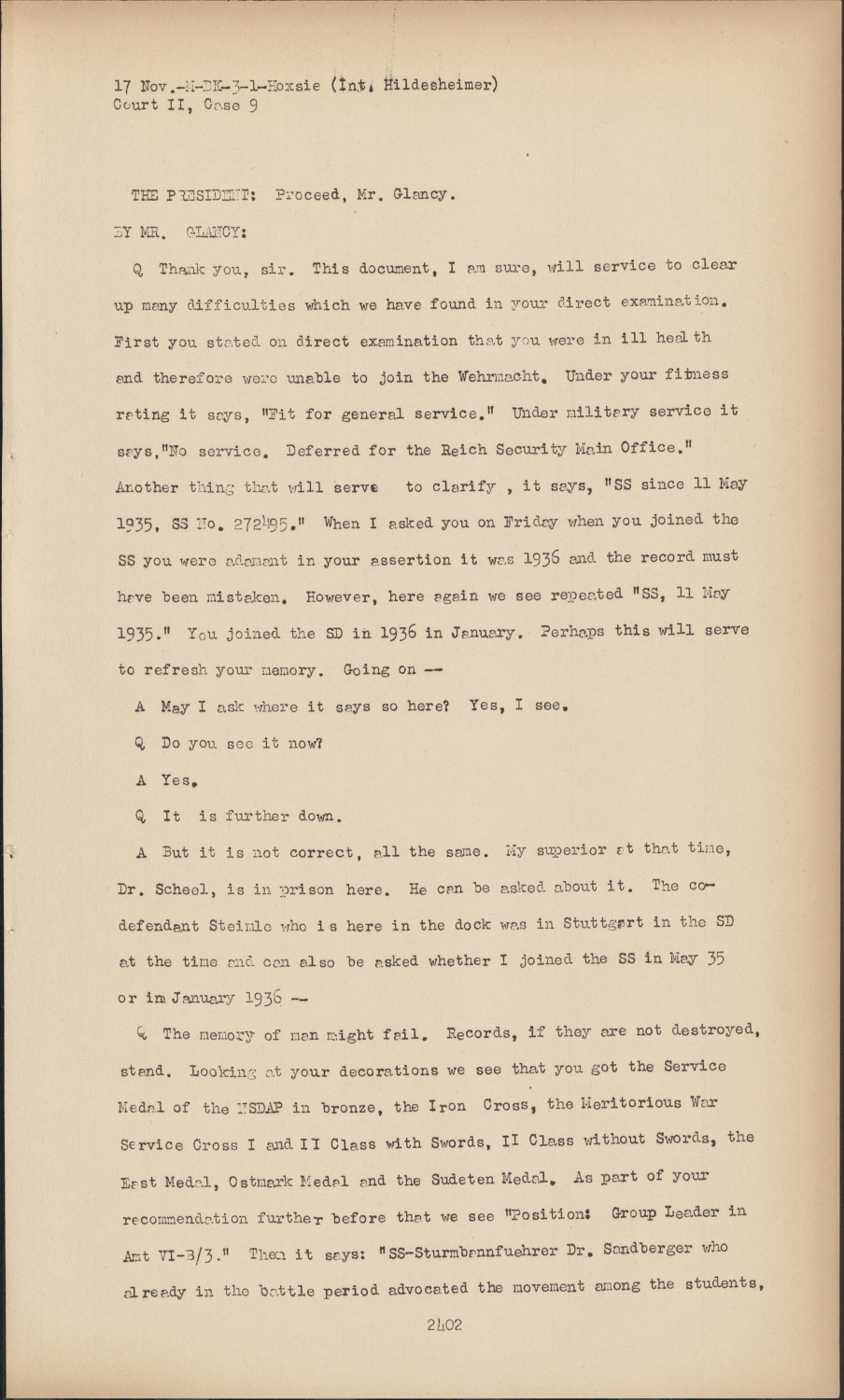
QThank you, sir. This document, I am sure, will service to clear up many difficulties which we have found in your direct examination. First you stated on direct examination that you were in ill health and therefore were unable to join the Wehrmacht. Under your fitness rating it says, "Fit for general service." Under military service it says, "No service. Deferred for the Reich Security Main Office." Another thing that will serve to clarify, it says, "SS since 11 May 1935, SS No. 272495." When I asked you on Friday when you joined the SS you were adamant in your assertion it was 1936 and the record must have been mistaken. However, here again we see repealed "SS, 11 May 1935." You joined the SD in 1936 in January. Perhaps this will serve to refresh your memory. Going on -
AMay I ask where it says so here? Yes, I see.
QDo you see it now?
AYes.
QIt is further down.
ABut it is not correct, all the same. My superior at that time, Dr. Scheel, is in prison here. He can be asked about it. The codefendant Steimle who is here in the dock was in Stuttgart in the SD at the time and can also be asked whether I joined the SS in May 35 or in January 1936 -
QThe memory of man might fail. Records, if they are not destroyed, stand. Looking at your decorations we see that you got the Service Medal of the NSDAP in bronze, the Iron Cross, the Meritorious War Service Cross I and II Class with Swords, II Class without Swords, the East Medal, Ostmark Medal and the Sudeten Medal. As part of your recommendation further before that we see "Position: Group Leader in Amt VI-B/3." Then it says: "SS-Sturmbannfuehrer Dr. Sandberger who already in the battle period advocated the movement among the students, is irreproachable in his politics and his world point of view.
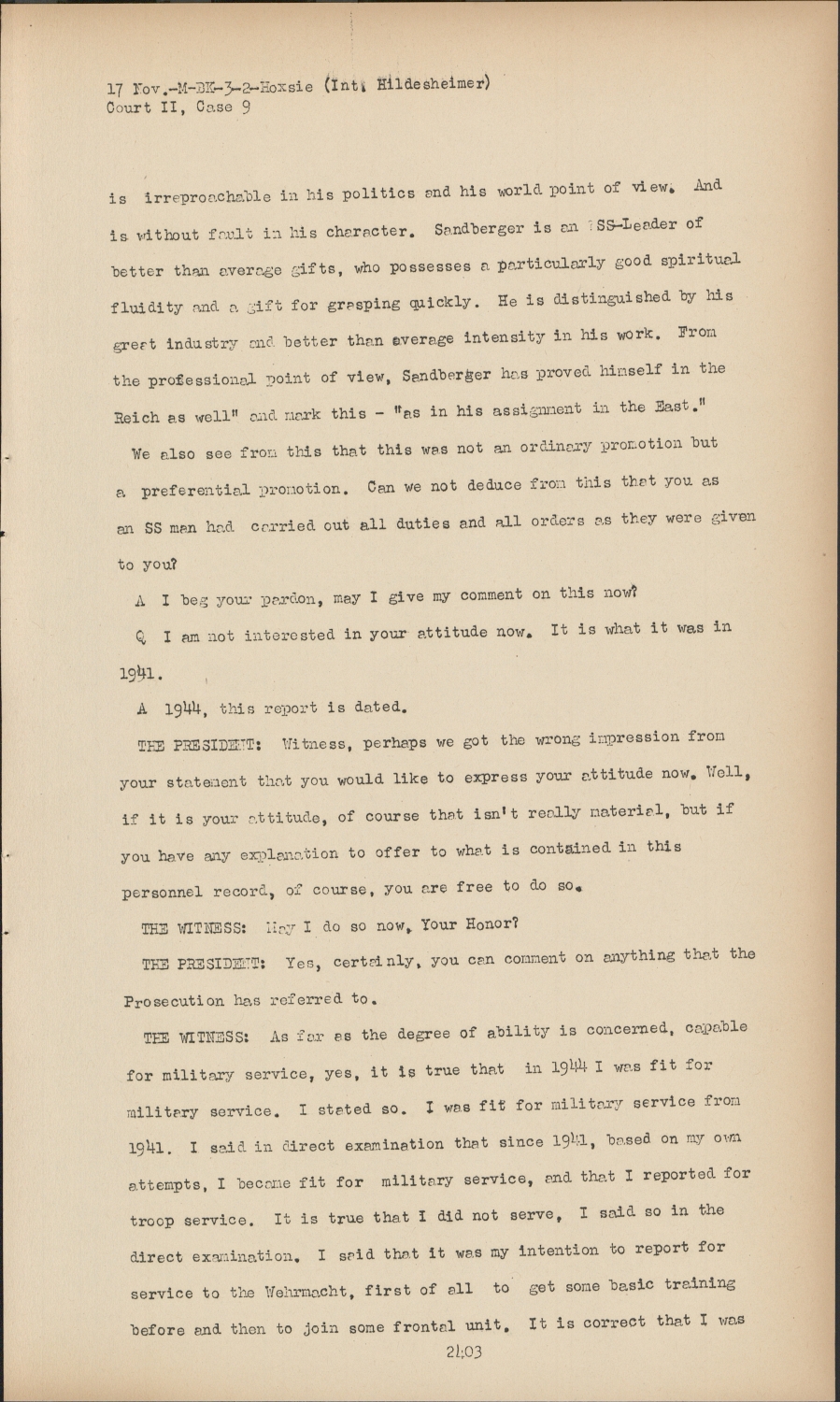
And is without fault in his character. Sandberger is an SS-Leader of better than average gifts, who possesses a particularly good spiritual fluidity and a gift for grasping quickly. He is distinguished by his great industry and better than average intensity in his work. From the professional point of view, Sandberger has proved himself in the Reich as well" and mark this - "as in his assignment in the East."
We also see from this that this was not an ordinary promotion but a preferential promotion. Can we not deduce from this that you as an SS man had carried out all duties and all orders as they were given to you?
AI beg your pardon, may I give my comment on this now?
QI am not interested in your attitude now. It is what it was in 1941.
A 1944, this report is dated.
THE PRESIDENT:Witness, perhaps we got the wrong impression from your statement that you would like to express your attitude now. Well, if it is your attitude, of course that isn't really material, but if you have any explanation to offer to what is contained in this personnel record, of course, you are free to do so.
THE WITNESS:May I do so now. Your Honor?
THE PRESIDENT:Yes, certainly, you can comment on anything that the Prosecution has referred to.
THE WITNESS:As far as the degree of ability is concerned, capable for military service, yes, it is true that in 1944 I was fit for military service. I stated so. I was fit for military service from 1941. I said in direct examination that since 1941, based on my own attempts, I became fit for military service, and that I reported for troop service. It is true that I did not serve, I said so in the direct examination. I said that it was my intention to report for service to the Wehrmacht, first of all to get some basic training before and then to join some frontal unit. It is correct that I was deferred for the RSHA.
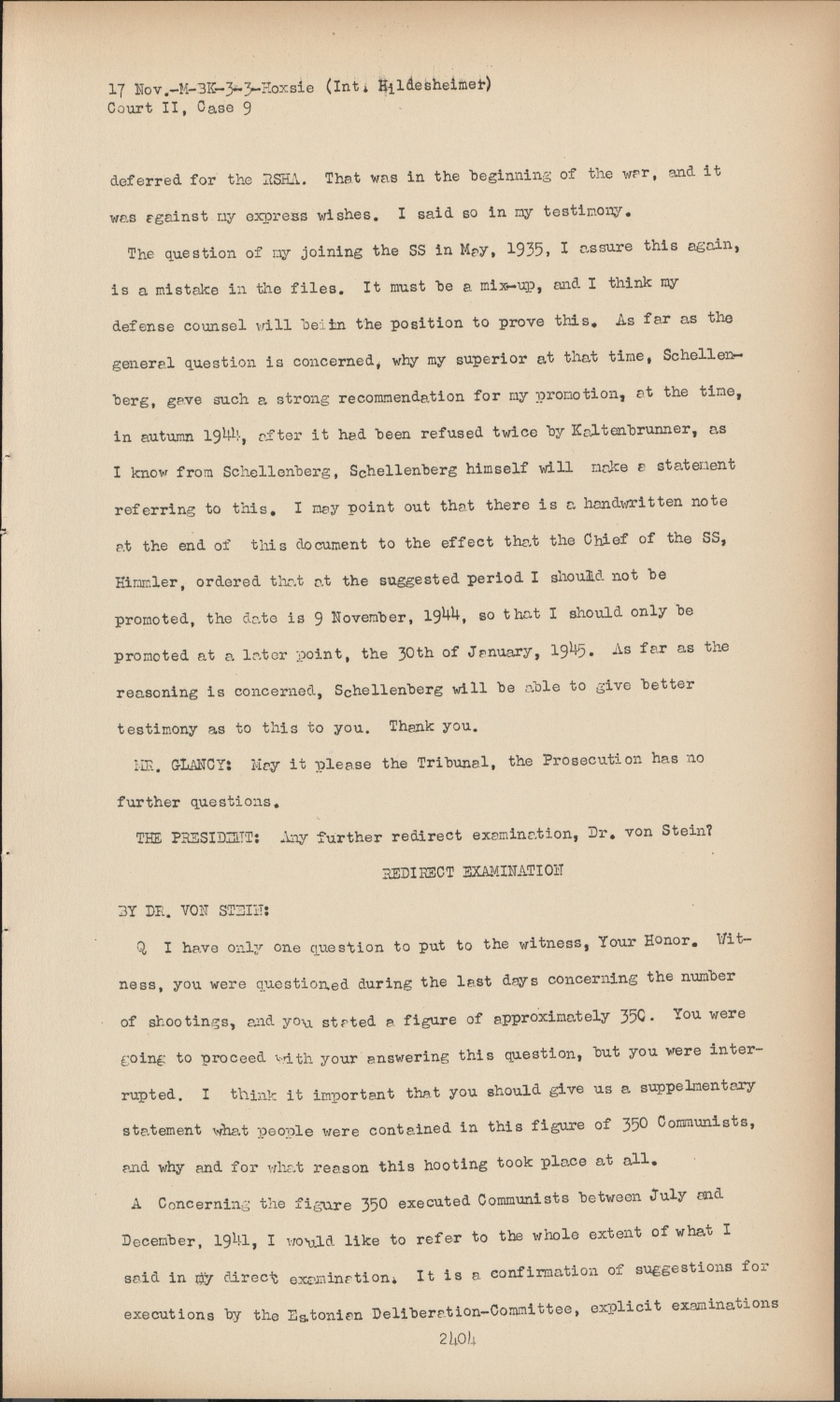
That was in the beginning of the war, and it was against my express wishes. I said so in my testimony.
The question of my joining the SS in May, 1935, I assure this again, is a mistake in the files. It must be a mix-up, and I think my defense counsel will be in the position to prove this. As far as the general question is concerned, why my superior at that time, Schellenberg, gave such a strong recommendation for my promotion, at the time, in autumn 1944, after it had been refused twice by Kaltenbrunner, as I know from Schellenberg, Schellenberg himself will make a statement referring to this. I may point out that there is a handwritten note at the end of this document to the effect that the Chief of the SS, Himmler, ordered that at the suggested period I should not be promoted, the date is 9 November, 1944, so that I should only be promoted at a later point, the 30th of January, 1945. As far as the reasoning is concerned, Schellenberg will be able to give better testimony as to this to you. Thank you.
MR. GLANCY:May it please the Tribunal, the Prosecution has no further questions.
THE PRESIDENT:Any further redirect examination, Dr. von Stein?
REDIRECT EXAMINATION BY DR. VON STEIN:
QI have only one question to put to the witness, Your Honor. Witness, you were questioned during the last days concerning the number of shootings, and you stated a figure of approximately 350. You were going to proceed with your answering this question, but you were interrupted. I think it important that you should give us a suppelmentary statement what people were contained in this figure of 350 Communists, and why and for what reason this hooting took place at all.
A Concerning the figure 350 executed Communists between July and December, 1941, I would like to refer to the whole extent of what I said in my direct examination. It is a confirmation of suggestions for executions by the Estonian Deliberation-Committee, explicit examinations and investigations according to the lines which I talked about.
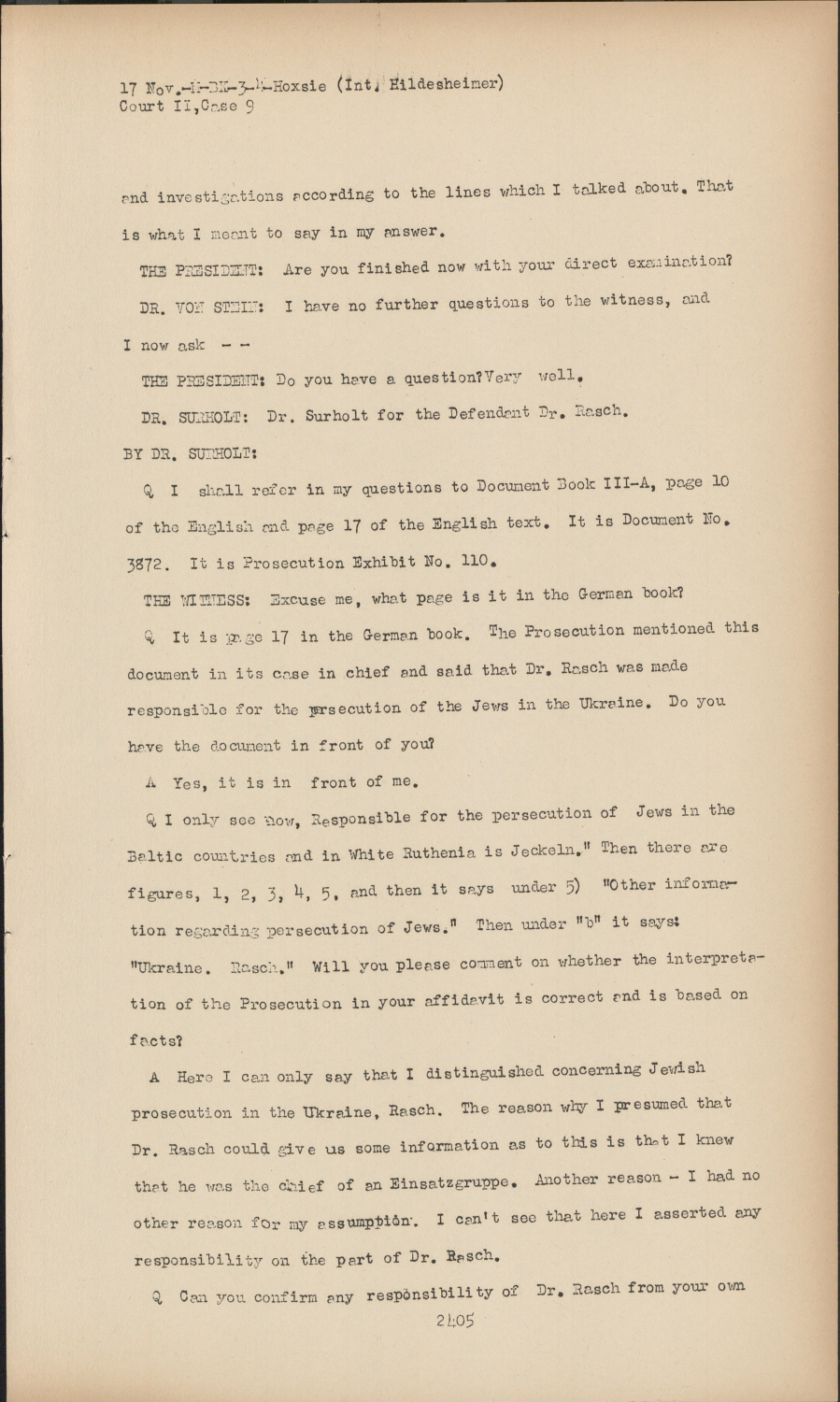
That is what I meant to say in my answer.
THE PRESIDENT:Are you finished now with your direct examination?
DR. VON STEIN:I have no further questions to the witness, and I now ask -
THE PRESIDENT:Do you have a question? Very well.
DR. SURHOLT:Dr. Surholt for the Defendant Dr. Rasch. BY DR. SURHOLT:
QI shall refer in my questions to Document Book III-A, page 10 of the English and page 17 of the English text. It is Document No. 3872. It is Prosecution Exhibit No. 110.
THE WITNESS:Excuse me, what page is it in the German book?
QIt is page 17 in the German book. The Prosecution mentioned this document in its case in chief and said that Dr. Rasch was made responsible for the persecution of the Jews in the Ukraine. Do you have the document in front of you?
AYes, it is in front of me.
QI only see now, Responsible for the persecution of Jews in the Baltic countries and in White Ruthenia is Jeckeln." Then there are figures, 1, 2, 3, 4, 5, and then it says under 5) "Other information regarding persecution of Jews." Then under "b" it says: "Ukraine. Rasch." Will you please comment on whether the interpretation of the Prosecution in your affidavit is correct and is based on facts?
AHere I can only say that I distinguished concerning Jewish prosecution in the Ukraine, Rasch. The reason why I presumed that Dr. Rasch could give us some information as to this is that I knew that he was the chief of an Einsatzgruppe. Another reason - I had no other reason for my assumption. I can't see that here I asserted any responsibility on the part of Dr. Rasch.
QCan you confirm any responsibility of Dr. Rasch from your own position?
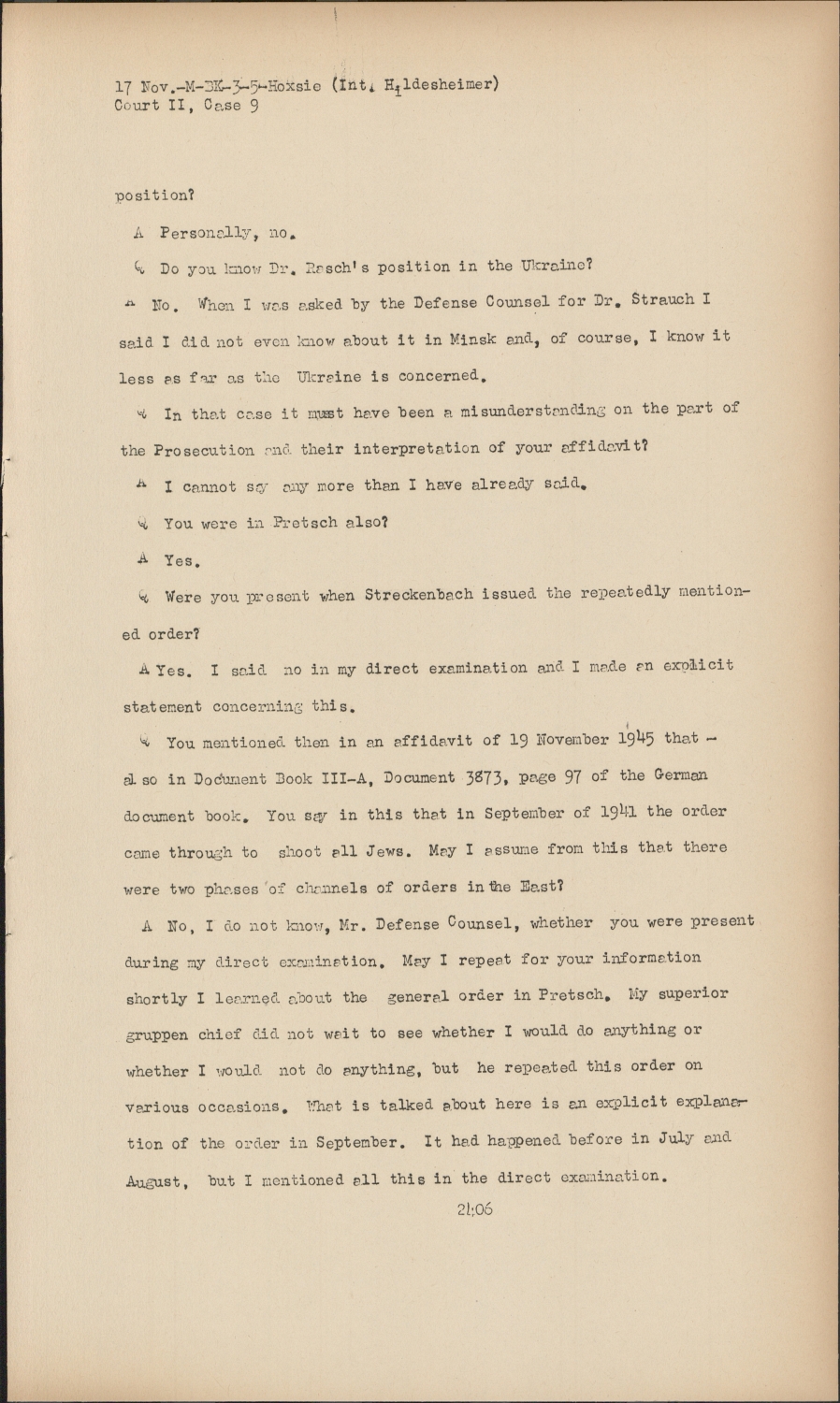
APersonally, no.
QDo you know Dr. Rasch's position in the Ukraine?
ANo. When I was asked by the Defense Counsel for Dr. Strauch I said I did not even know about it in Minsk and, of course, I know it less as far as the Ukraine is concerned.
QIn that case it must have been a misunderstanding on the part of the Prosecution and their interpretation of your affidavit?
AI cannot say any more than I have already said.
QYou were in Pretsch also?
AYes.
QWere you present when Streckenbach issued the repeatedly mentioned order?
AYes. I said no in my direct examination and I made an explicit statement concerning this.
QYou mentioned then in an affidavit of 19 November 1945 that also in Document Book III-A, Document 3873, page 97 of the German document book. You say in this that in September of 1941 the order came through to shoot all Jews. May I assume from this that there were two phases of channels of orders in the East?
ANo, I do not know, Mr. Defense Counsel, whether you were present during my direct examination. May I repeat for your information shortly I learned about the general order in Pretsch. My superior gruppen chief did not wait to see whether I would do anything or whether I would not do anything, but he repeated this order on various occasions. What is talked about here is an explicit explanation of the order in September. It had happened before in July and August, but I mentioned all this in the direct examination.
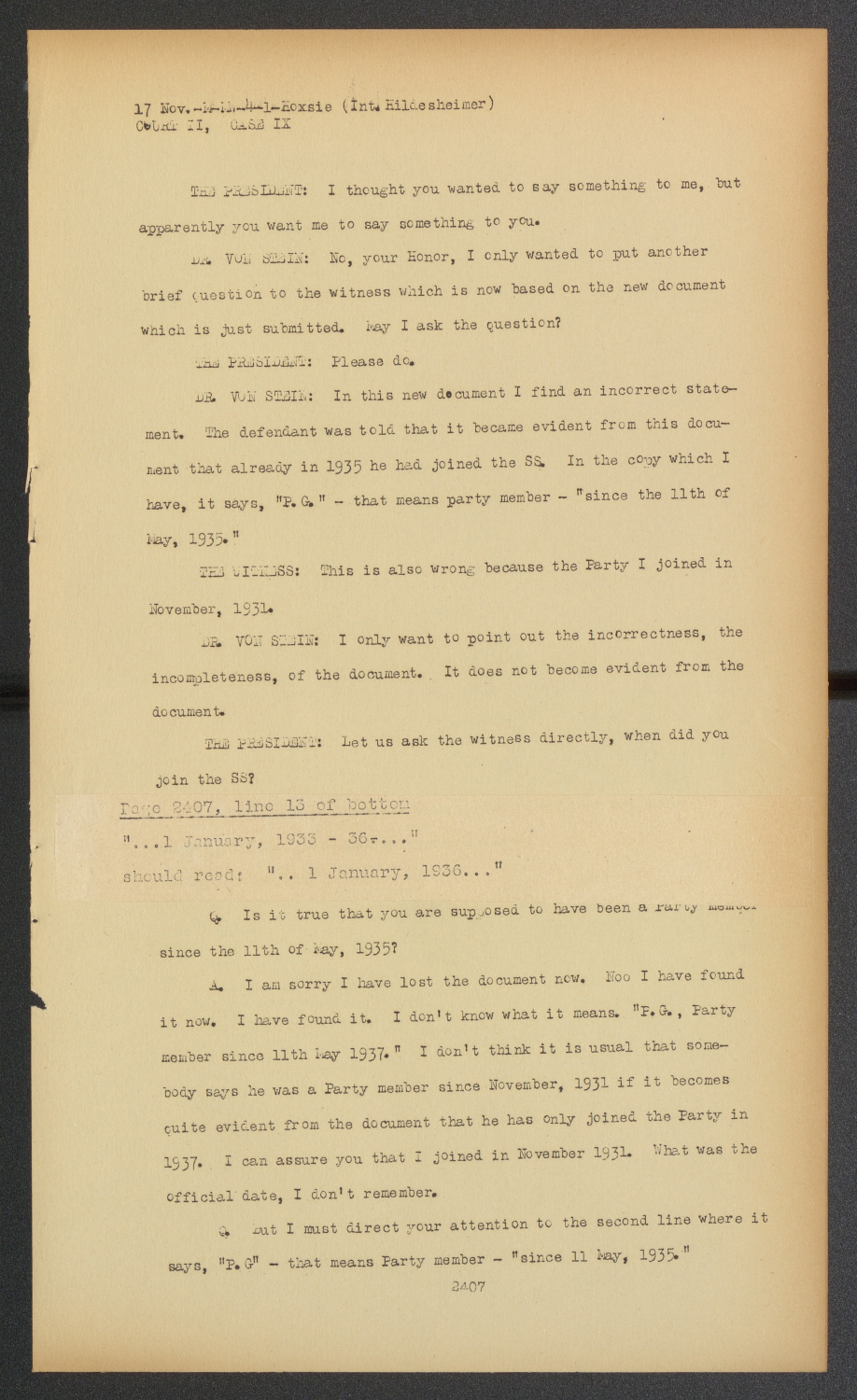
THE PRESIDENT:I thought you wanted to say something to me, but apparently you want me to say something to you.
DR. VON STEIN:No, your Honor, I only wanted to put another brief question to the witness which is now based on the new document which is just submitted. May I ask the question?
THE PRESIDENT:Please do.
DR. VON STEIN:In this new document I find an incorrect statement. The defendant was told that it became evident from this document that already in 1935 he had joined the SS. In the copy which I have, it says, "P.G." - that means party member - "since the 11th of May, 1933."
THE WITNESS:This is also wrong because the Party I joined in November, 1931.
DR. VON STEIN:I only want to point out the incorrectness, the incompleteness, of the document. It does not become evident from the document.
THE PRESIDENT:Let us ask the witness directly, when did you join the SS?
THE WITNESS:I was admitted to the SS with effect from 1 January, 1933 - '35 - and my superior was -BY DR. VON STEIN:
Q.Is it true that you are supposed to have been a Party member since the 11th of May, 1935?
A.I am sorry I have lost the document now. Noo I have found it now. I have found it. I don't know what it means. "P.G., Party member since 11th May 1937." I don't think it is usual that somebody says he was a Party member since November, 1931 if it becomes quite evident from the document that he has only joined the Party in 1937. I can assure you that I joined in November 1931. What was the official date, I don't remember.
Q.But I must direct your attention to the second line where it says, "P.G" - that means Party member - "since 11 May, 1935."
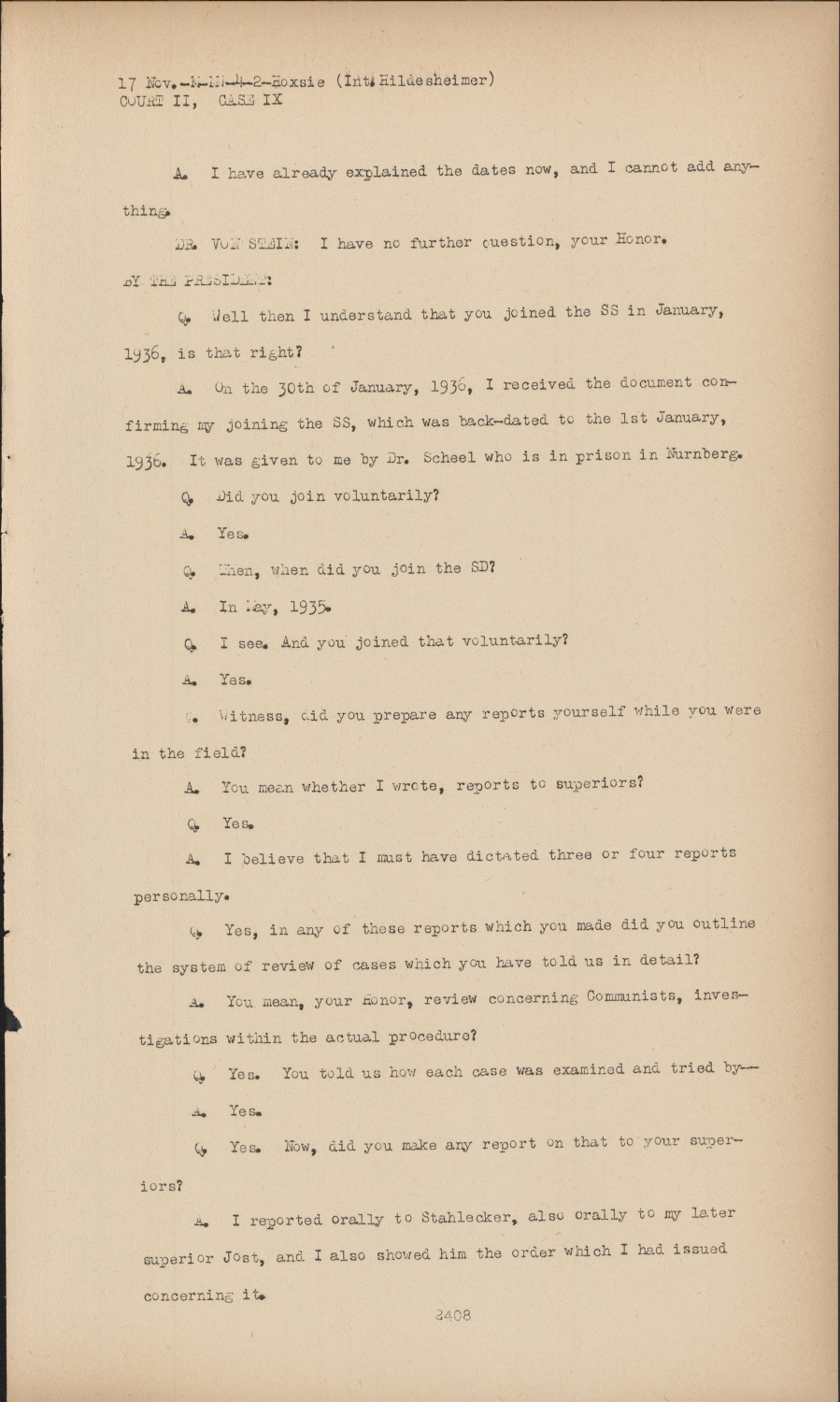
A.I have already explained the dates now, and I cannot add anything.
DR. VON STEIN:I have no further Question, your Honor. BY THE PRESIDENT:
Q.Well then I understand that you joined the SS in January, 1936, is that right?
A.On the 30th of January, 1936, I received the document confirming my joining the SS, which was back-dated to the 1st January, 1936. It was given to me by Dr. Scheel who is in prison in Nurnberg.
Q.Did you join voluntarily?
A.Yes.
Q.Then, when did you join the SD?
A.In May, 1935.
Q.I see. And you joined that voluntarily?
A.Yes.
Q.Witness, did you prepare any reports yourself while you were in the field?
A.You mean whether I wrote, reports to superiors?
Q.Yes.
A.I believe that I must have dictated three or four reports personally.
Q.Yes, in any of these reports which you made did you outline the system of review of cases which you have told us in detail?
A.You mean, your Honor, review concerning Communists, investigations within the actual procedure?
Q.Yes. You told us how each case was examined and tried by-
A.Yes.
Q.Yes. Now, did you make any report on that to your superiors?
A.I reported orally to Stahlecker, also orally to my later superior Jost, and I also showed him the order which I had issued concerning it.
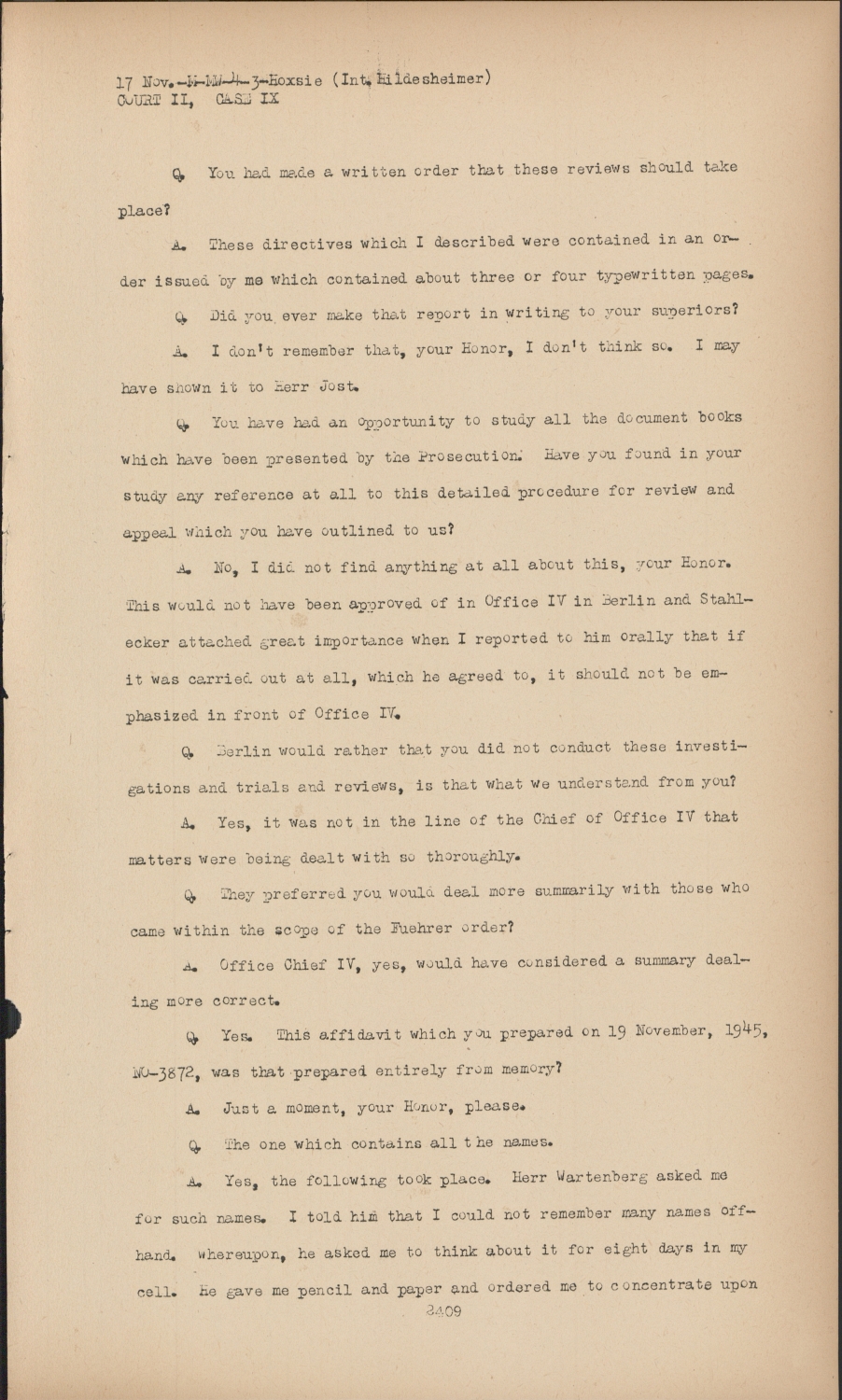
Q.You had made a written order that these reviews should take place?
A.These directives which I described were contained in an under issued by me which contained about three or four typewritten pages.
Q.Did you ever make that report in writing to your superiors?
A.I don't remember that, your Honor, I don't think so. I may have shown it to Herr Jost.
Q.You have had an opportunity to study all the document books which have been presented by the Prosecution. Have you found in your study any reference at all to this detailed procedure for review and appeal which you have outlined to us?
A.No, I did not find anything at all about this, your Honor. This would not have been approved of in Office IV in Berlin and Stahlecker attached great importance when I reported to him orally that if it was carried out at all, which he agreed to, it should not be emphasized in front of Office IV.
Q.Berlin would rather that you did not conduct these investigations and trials and reviews, is that what we understand from you?
A.Yes, it was not in the line of the Chief of Office IV that matters were being dealt with so thoroughly.
Q.They preferred you would deal more summarily with those who came within the scope of the Fuehrer order?
A.Office Chief IV, yes, would have considered a summary dealing more correct.
Q.Yes. This affidavit which you prepared on 19 November, 1945, NO-3872, was that prepared entirely from memory?
A.Just a moment, your Honor, please.
Q.The one which contains all the names.
A.Yes, the following took place. Herr Wartenberg asked me for such names. I told him that I could not remember many names offhand. Whereupon, he asked me to think about it for eight days in my cell. He gave me pencil and paper and ordered me to concentrate upon this.
He would have me called after eight days and he wanted me to have a few names by then, and he wanted me to give him then the names. After eight days he called for me and asked for these names, and he himself made up the wording from these names. This is, therefore, the result of an eight-day concentration on this subject only which was ordered by Herr Wartenberg, while in making out the other affidavits I had no opportunity to concentrate as long as that, but the questions were unprepared.
Q.Very well. In these reports we find many references to executions where we find the statement, so many Communists and so many Jews executed. If a Communist also happens to be a Jew, is he mentioned in the report as a Communist or as a Jew?
A.Your Honor, both was possible. According to orders of Einsatzgruppe A, Jews should always be mentioned under the heading "Jews", even when they were communists. But it is possible that other procedures were followed, i.e. that by mistake Jewish Communists were not mentioned under the heading "Jews" but under "Communists".
Q.Very well. Where were you between February and April, 1942?
A.In the time, February, until approximately the 10th of March, 1942, I was in Estonia, From the 10th of March, 1942.
Q.Let us have those dates again, please, now.
A.In February and approximately until the 10th of March, 1942, I was in Estonia in my own field of activities, and approximately from the 10th of March, 1942, I was on an official trip in Berlin, and then I was on leave at home.
Q. witness, let us get it a little more precisely. On March 10th you left to go to Berlin?
A.Approximately the 10th of March. It might have been the 9th or the 11th.
Q.Very well. And now, tell us where you were during the remainder of March.
A.Partly in Berlin on an official trip and partly on leave with my family.
Q.And when did you return then?
A.Excuse me, I must add something here. Partly, that is three days in March, I was in Prague. By official order, to attend the funeral of Stahlecker. During the last days of March, I don't remember the date exactly, I returned to Estonia, but on the way I fell seriously ill, and from that day on I was suffering from scarlet fever, and I was in the Department for Infectious Diseases in the hospital, Pernau, and I was absent from duty. That was until the first days of the month of May.
QAbout when did you become ill?
ADuring the last days of March. I can't say the exact date. It might have been the 25th or the 27th.
QAnd when did you return to your duties in Estonia?
AAgain I can't say the exact date. It might have been around the 5th of May.
QWhere were you hospitalized?
AIn the reserve hospital in Pernau in Estonia, which at that time was in a school in Pernau. There I was in the department for infectious diseases.
QWhen did you go to Prague?
ADuring the second part of March.
QWhy did you go to Prague?
AI got a teletype message to Berlin from Riga from the Einsatzgruppe with the official order to attend the funeral of Stahlecker in Prague. In order to comply with this order I went to Prague.
QStahlecker was buried in Prague?
AYes.
QWhat was the date of the funeral?
AI don't remember the date, it was during the second part of March.
QNow, you say you were absent from Estonia from March 10 until May 5, is that right, from your duties?
AYes.
QWhen did you actually get into Estonia, after March 10, on your return? When did you physically return to Estonia?
APernau, where I was hospitalized, is in Estonia. Therefore, in a state of ill health, I was in Estonia in the field hospital.
QWhen was that?
AThat was in the last days of the month of March.
QThen did you learn of the executions of the Jews that you had placed in Pleskau?
AI don't remember the exact date. As I said in my direct examination, this event took place a few weeks before Stahlecker's death which must have been during the second part of January or possibly in the first half of February. I learned about it a few days after it had happened.
QWhen did you say the execution occurred?
ADuring the second half of January or the first half of February.
QWell then, you were in Estonia when this occurred?
AYes.
QWell, were you there at the time of the execution?
ADuring the time of the execution I was in Reval. The execution took place in Pleskau without my knowledge.
QThat were you doing in Reval?
AThat's where I was stationed. That's where my office was, where I usually stayed. I did not know that Jeckeln would go to Pleskau on that very day and would be present in Pleskau.
QAnd then when did you actually learn of the execution?
AA few days after it had happened, during an official trip during which I also passed through Pleskau.
QAnd about when was that?
AYour Honor, I told you I couldn't state a more exact date than the second half of January or the first half of February, 1942.
QHow many days after the actual execution?
AI can't remember that exactly. They were few days, two or three days.