Now, that is the evidence.
THE WITNESS:If he had not done anything other then what you just mentioned; if he had not carried out any activity for the Communists, and didn't act as a functionary of the NKWD, then he was not executed.
THE PRESIDENT:No, I said, if he was a full Communist, carried our the functions of his office as a Communist, belonged to the Communist Party, was active, believed in the doctrines of the Communist Party, talked about Communism. Now what happened to him?
THE WITNESS:It depended, Your Honor, when he talked about Communism, whether this happened in the time after the occupation by the Germans.
THE PRESIDENT:No, up until the time the Germans arrived. All of this happened before the Germans arrived.
THE WITNESS:If he had been nothing but a mayor, and had no other functions, and had not done anything else as a Communist, he was not executed.
THE PRESIDENT:Well, didn't your Fuehrer Order say, all Communist functionaries had to be executed?
THE WITNESS:I didn't understand the Order that way, that every Communist functionary, without any distinction, and without examination of the individual case was to be executed. BY DR. VON STEIN:
QWitness, may I also address a question to yon in this case -
THE PRESIDENT:You have used the phrase over and over "Communistic activity." What do you mean by "Communistic activity"?
THE WITNESS:In Estonia when examining these cases it was understood that they had actively taken part in the killings and deportations.
THE PRESIDENT:Well, now, witness, if a man killed someone, illegally, then you would have to be concerned whether he was a Communist or not, because the law of the land would take care of him; so let's exclude these very clear cut cases of illegal killings.
Define for me the Communistic activity.
THE WITNESS:An I to understand the question to the effect that you mean such Communistic activity which would result in a death sentence, or such Communistic activity which would cause transfer into an internment camp?
THE PRESIDENT:You have used the phrase yourself, "Communistic activity." which would subject an individual to arrest and possible execution. How, what was this Communistic activity which would result in that?
THE WITNESS:Your Honor, there were Communist activities which could result in execution. There was another which could result in an internment into a camp and other activities which did not even result in internment but in many cases in a release after a few weeks. I read this in a document yesterday. 3,700 minor incriminated Communists who had also been active in Communist activity.
THE PRESIDENT:However, you have not as yet told us just what you mean by "Communist activity" which would result in a man's execution?
THE WITNESS:That cannot be explained to the full extent. May I give you some examples. One example is an active pant in an underground organization which was created so that when the Russian Army had left Estonia, they should carry on espionage and sabotage.
THE PRESIDENT:Now, that is another thing, that comes under the category of espionage and sabotage. That is now Communist activity as such?
THE WITNESS:Your Honor, these cases were to be dealt with and were classed as Communism, which consisted of sabotage and espionage, and were done for Communistic reasons and motives. Under the category Communism which I am going to explain here comes everything that happened in the service of Soviet authorities, of the Communist Party of Estonia, no matter what the activity was, sabotage or espionage, and so forth.
THE PRESIDENT:Let's get back to the original issue in this entire trial. You know that this trial is based upon the original Fuehrer Order, which has been discussed at length by every defendant who has taken the witness stand. Now you tell us what that Fuehrer Order was.
THE WITNESS:The content of the Fuehrer Order was apart from the Jews and the Gypsies -
THE PRESIDENT:Not apart from. Tell me what it was. Did it include Jews and Gypsies, to execute Jews and Gypsies?
THE WITNESS:Yes.
THE PRESIDENT:All right, now.
THE WITNESS:Jews and Gypsies and Communist functionaries and such elements who endangered the security of the country.
THE PRESIDENT:Did it include in that phrase "Communist functionaries"?
THE WITNESS:Yes.
THE PRESIDENT:You may proceed, Dr. von Stein. BY DR. VON STEIN:
QWitness, may I address the question to you again. In Estonia was anybody punished because of Communistic views?
ANo.
QWas Communist activity -
THE PRESIDENT:How, do you know that as a fact? Do you know as a fact that no person in Estonia was punished because he held Communistic views?
THE WITNESS:I ordered this expressly.
THE PRESIDENT:Do you know as a fact that no one was executed because he held Communistic views?
THE WITNESS:Under my responsibility, no.
THE PRESIDENT:Then you can not answer the question which the attorney put to you.
THE WITNESS:I beg your pardon, I understand the question to mean that the defense counsel meant my responsibility. I don't know whether he meant this.
THE PRESIDENT:You put the question again, now. BY DR. VON STEIN:
QThe question which I addressed to you was as fellows: Whether anybody was punished in Estonia merely because he held Communistic views. You said, no in reply to this, and in this connection I shall address another question to you. What have you got to prove this? I went to refer you to documents. Is it right that it can be shown from the documents that such people were released who mistakenly had at first been arrested, and later when the case was examined and.
it had been found out they were released again because they had not been active in a criminal sense, but they had been arrested merely because of Communistic views?
THE PRESIDENT:Just a moment now. That is not the question at all, Dr. von Stein. You asked the question, were any people executed in Estonia, because they held Communistic views, and his answer was a categorical no.
DR. VON STEIN:Yes.
THE PRESIDENT:All right, now I ask you, do you know that as a fact?
DR. VON STEIN:Yes, Your Honor.
THE PRESIDENT:I ask the witness, do you know as a fact that no one was executed in Estonia because he held Communistic views?
DR. VON STEIN:May I address a question to the witness in order to refresh his memory and point out the documents to him, which prove quite obviously -
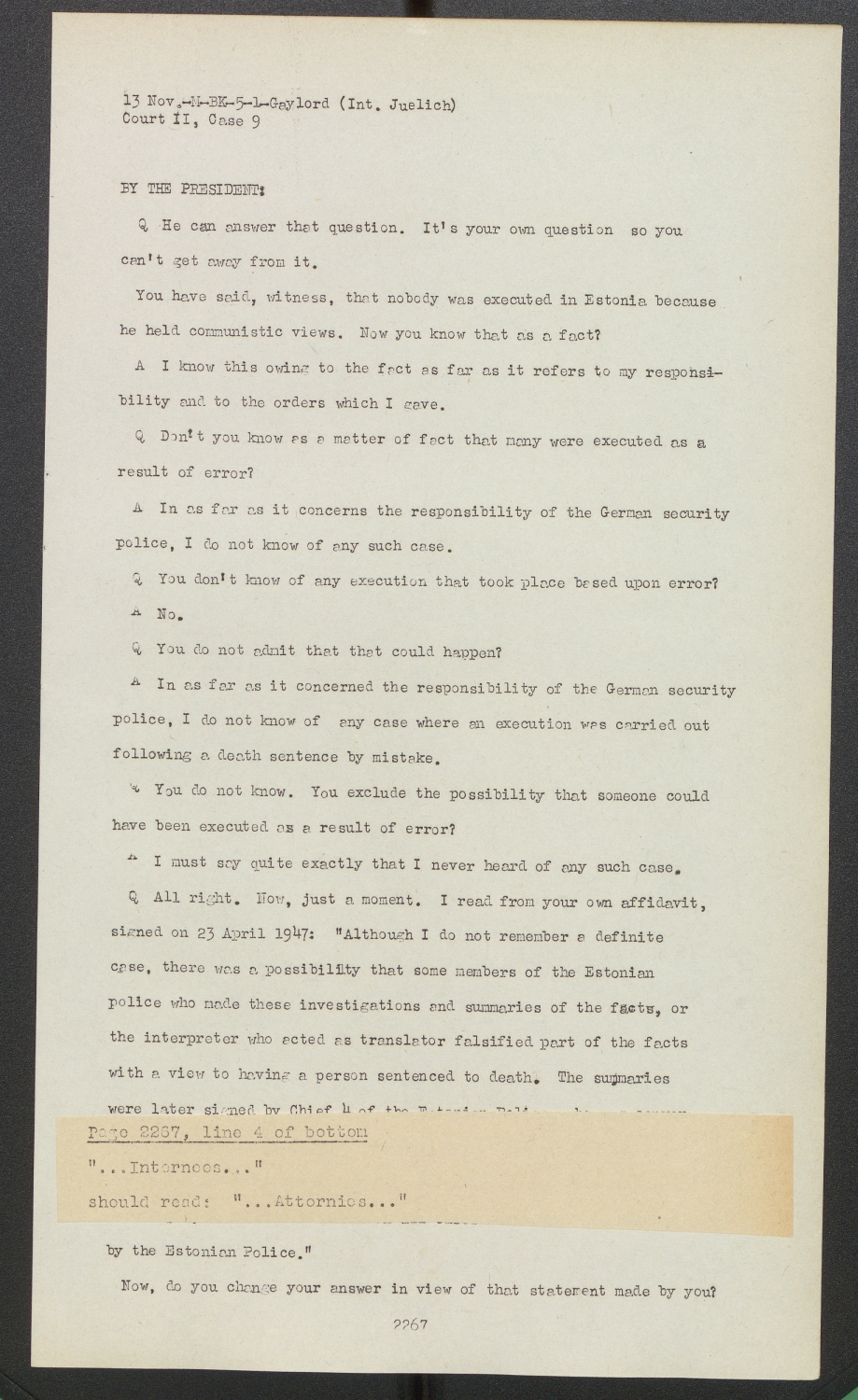
BY THE PRESIDENT:
QHe can answer that question. It's your own question so you can't get away from it.
You have said, witness, that nobody was executed in Estonia because he held communistic views. How you know that as a fact?
AI know this owing to the fact as far as it refers to my responsibility and to the orders which I save.
QDon't you know as a matter of fact that many were executed as a result of error?
AIn as far as it concerns the responsibility of the German security Police. I do not know of any such case.
QYou don't know of any execution that took place based upon error?
ANo.
QYou do not admit that that could happen?
AIn as far as it concerned the responsibility of the German security police, I do not know of any case where an execution was carried out following a death sentence by mistake.
QYou do not know. You exclude the possibility that someone could have been executed as a result of error?
AI must say quite exactly that I never heard of any such case.
QAll right. Now, just a moment. I read from your own affidavit, signed on 23 April 1947: "Although I do not remember a definite case, there was a possibility that some members of the Estonian police who made these investigations and summaries of the facts, or the interpreter who acted as translator falsified part of the facts with a view to having a person sentenced to death. The summaries were later signed by Chief 4 of the Estonian Police, who was conver ant with the German written language in part but not thoroughly.
within the staff of the German Department 4, two Estonian internees were employed who had to check on all cases which had been handled by the Estonian Police."
Now, do you change your answer in view of that statement made by you?
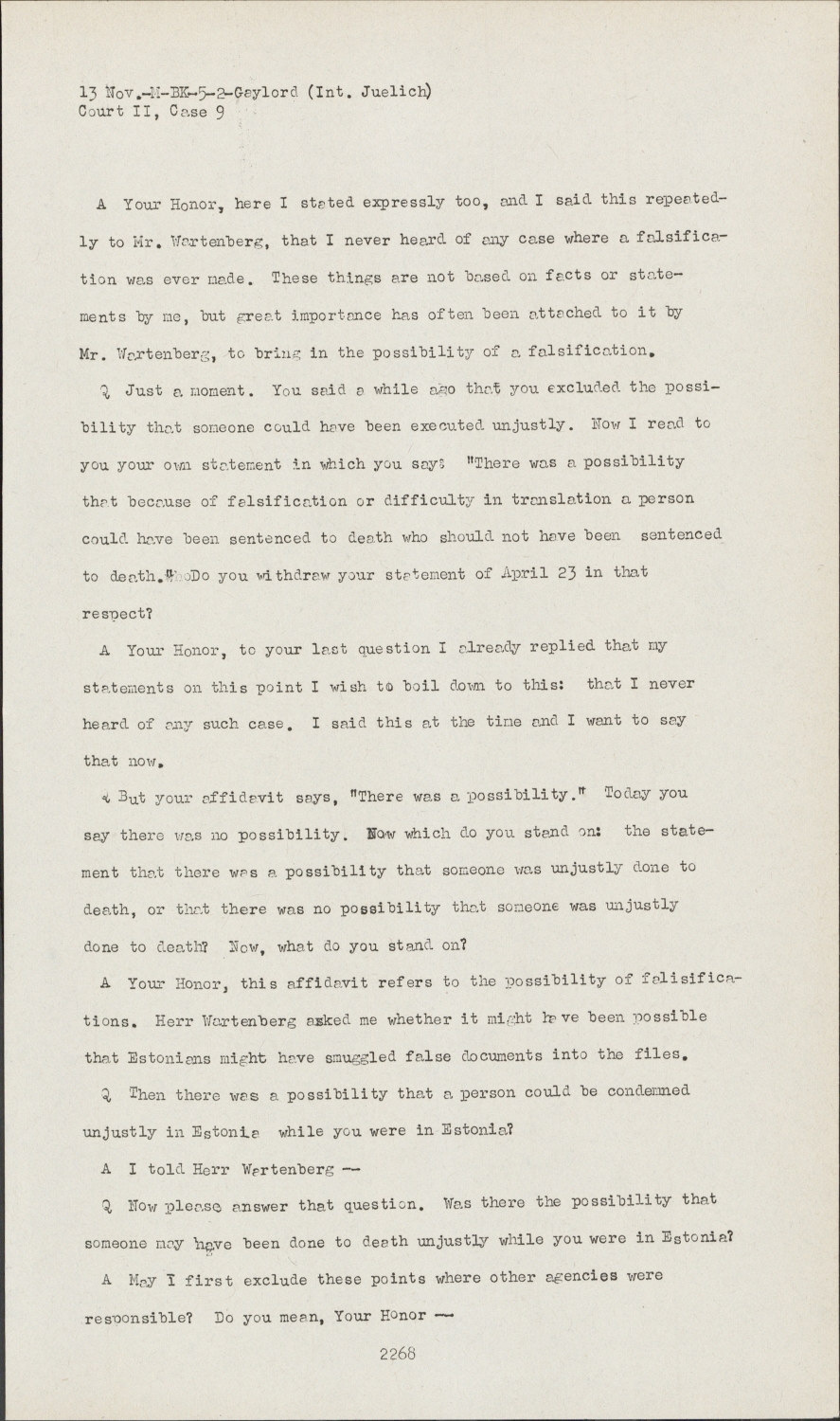
AYour Honor, here I stated expressly too, and I said this repeatedly to Mr. Wartenberg, that I never heard of any case where a falsification was ever made. These things are not based on facts or statements by me, but great importance has often been attached to it by Mr. Wartenberg, to bring in the possibility of a falsification.
QJust a moment. You said a while ago that you excluded the possibility that someone could have been executed unjustly. Now I read to you your own statement in which you say: "There was a possibility that because of falsification or difficulty in translation a person could have been sentenced to death who should not have been sentenced to death." Do you withdraw your statement of April 23 in that respect?
AYour Honor, to your last question I already replied that my statements on this point I wish to boil down to this: that I never heard of any such case. I said this at the tine and I want to say that now.
QBut your affidavit says, "There was a possibility." Today you say there was no possibility. Now which do you stand on: the statement that there was a possibility that someone was unjustly done to death, or that there was no possibility that someone was unjustly done to death? Now, what do you stand on?
AYour Honor, this affidavit refers to the possibility of falisifications. Herr Wartenberg asked me whether it might have been possible that Estonians might have smuggled false documents into the files.
QThen there was a possibility that a person could be condemned unjustly in Estonia while you were in Estonia?
AI told Herr Wartenberg -
QNow please answer that question. Was there the possibility that someone may have been done to death unjustly while you were in Estonia?
AMay I first exclude these points where other agencies were responsible? Do you mean, Your Honor -
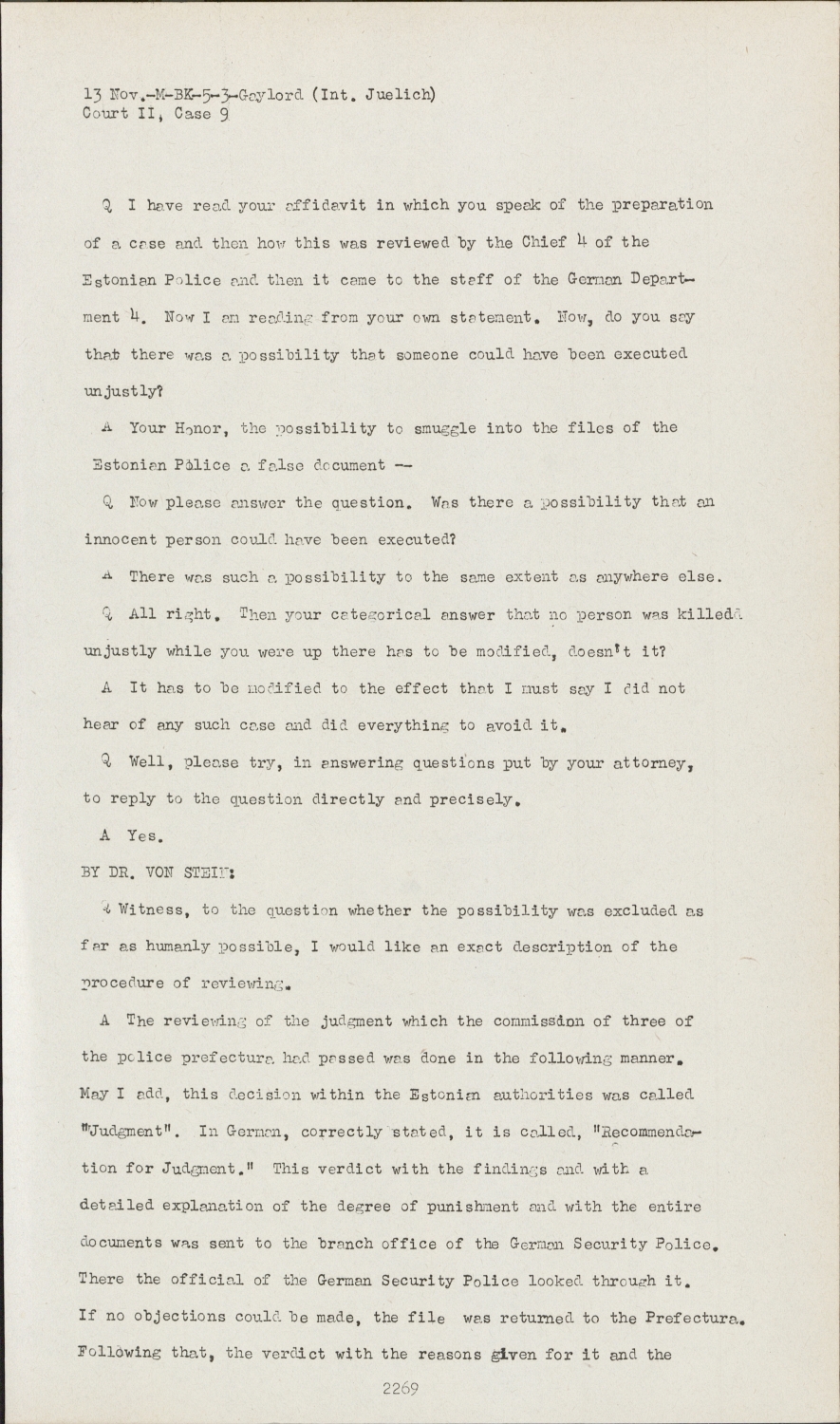
QI have read your affidavit in which you speak of the preparation of a case and then how this was reviewed by the Chief 4 of the Estonian Police and then it came to the staff of the German Department 4. Now I am reading from your own statement. Now, do you say that there was a possibility that someone could have been executed unjustly?
AYour Honor, the possibility to smuggle into the files of the Estonian Police a false document -
QNow please answer the question. Was there a possibility that an innocent person could have been executed?
AThere was such a possibility to the same extent as anywhere else.
QAll right. Then your categorical answer that no person was killed unjustly while you were up there has to be modified, doesn't it?
AIt has to be modified to the effect that I must say I did not hear of any such case and did everything to avoid it.
QWell, please try, in answering questions put by your attorney, to reply to the question directly and precisely.
AYes. BY DR. VON STEIN:
QWitness, to the question whether the possibility was excluded as far as humanly possible, I would like an exact description of the procedure of reviewing.
AThe reviewing of the judgment which the commission of three of the police prefectura had passed was done in the following manner. May I add, this decision within the Estonian authorities was called "Judgment". In German, correctly stated, it is called, "Recommendation for Judgment." This verdict with the findings and with a detailed explanation of the degree of punishment and with the entire documents was sent to the branch office of the German Security Police. There the official of the German Security Police looked through it. If no objections could be made, the file was returned to the Prefectura. Following that, the verdict with the reasons given for it and the entire documents were sent to the headquarters of the Estonian Police, the Prefectura in Revel, and later to the headquarters of the Estonian Police for internal security.
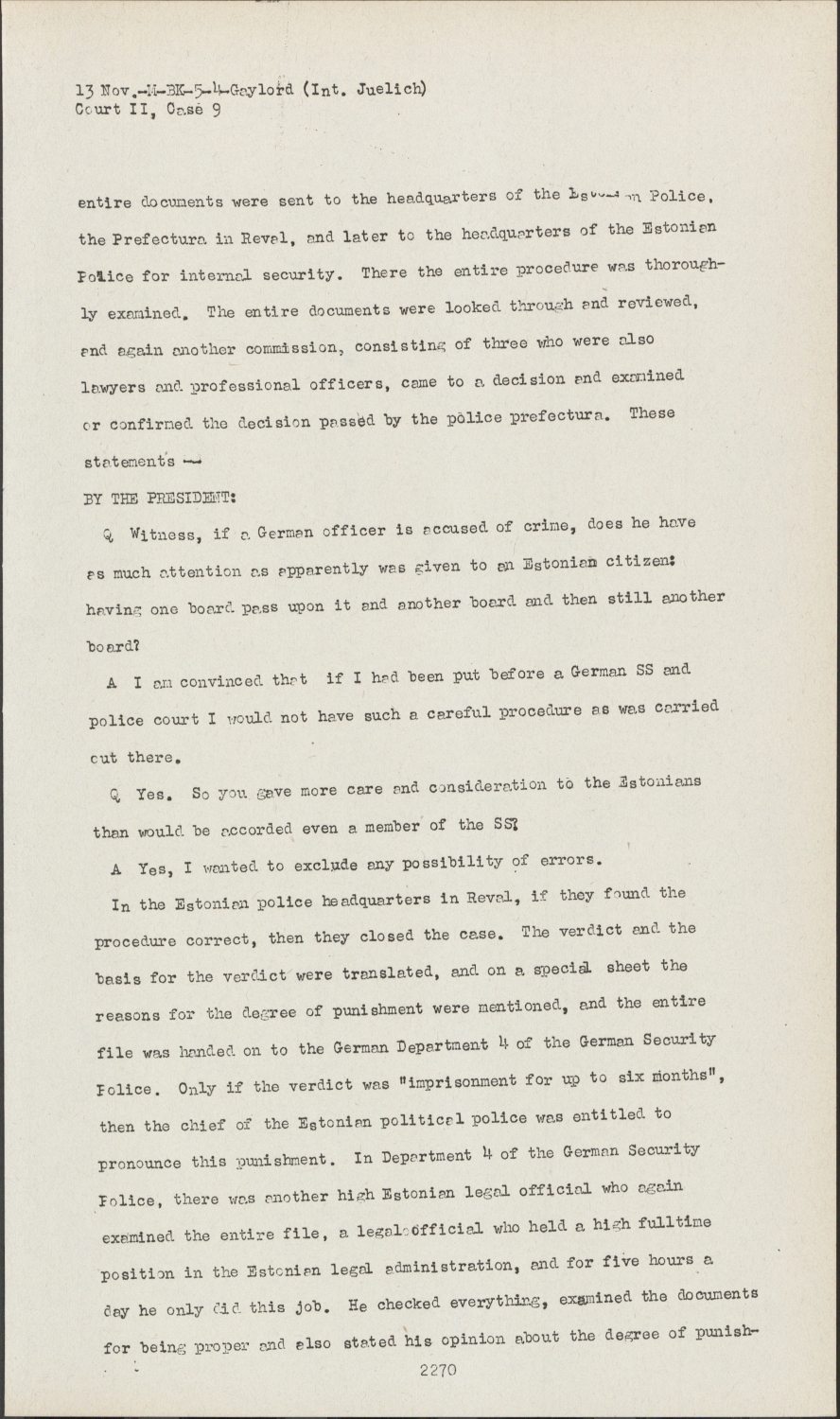
There the entire procedure was thoroughly examined. The entire documents were looked through and reviewed, and again another commission, consisting of three who were also lawyers and professional officers, came to a decision and examined or confirmed the decision passed by the police prefectura. These statements -BY THE PRESIDENT:
QWitness, if a German officer is accused of crime, does he have as much attention as apparently was given to an Estonian citizen: having one board pass upon it and another board and then still another board?
AI am convinced that if I had been put before a German SS and police court I would not have such a careful procedure as was carried cut there.
QYes. So you gave more care and consideration to the Estonians than would he accorded even a member of the SS?
AYes, I wanted to exclude any possibility of errors.
In the Estonian police headquarters in Reval, if they found the procedure correct, then they closed the case. The verdict and the basis for the verdict were translated, and on a special sheet the reasons for the degree of punishment were mentioned, and the entire file was handed on to the German Department 4 of the German Security Police. Only if the verdict was "imprisonment for up to six months", then the chief of the Estonian political police was entitled to pronounce this punishment. In Department 4 of the German Security Police, there was another high Estonian legal official who again examined the entire file, a legal official who held a high fulltime position in the Estonian legal administration, and for five hours a day he only did this job. He checked everything, examined the documents for being proper and also stated his opinion about the degree of punish ment, and returned, the file to the Estonian Security Police, if he objected to it.
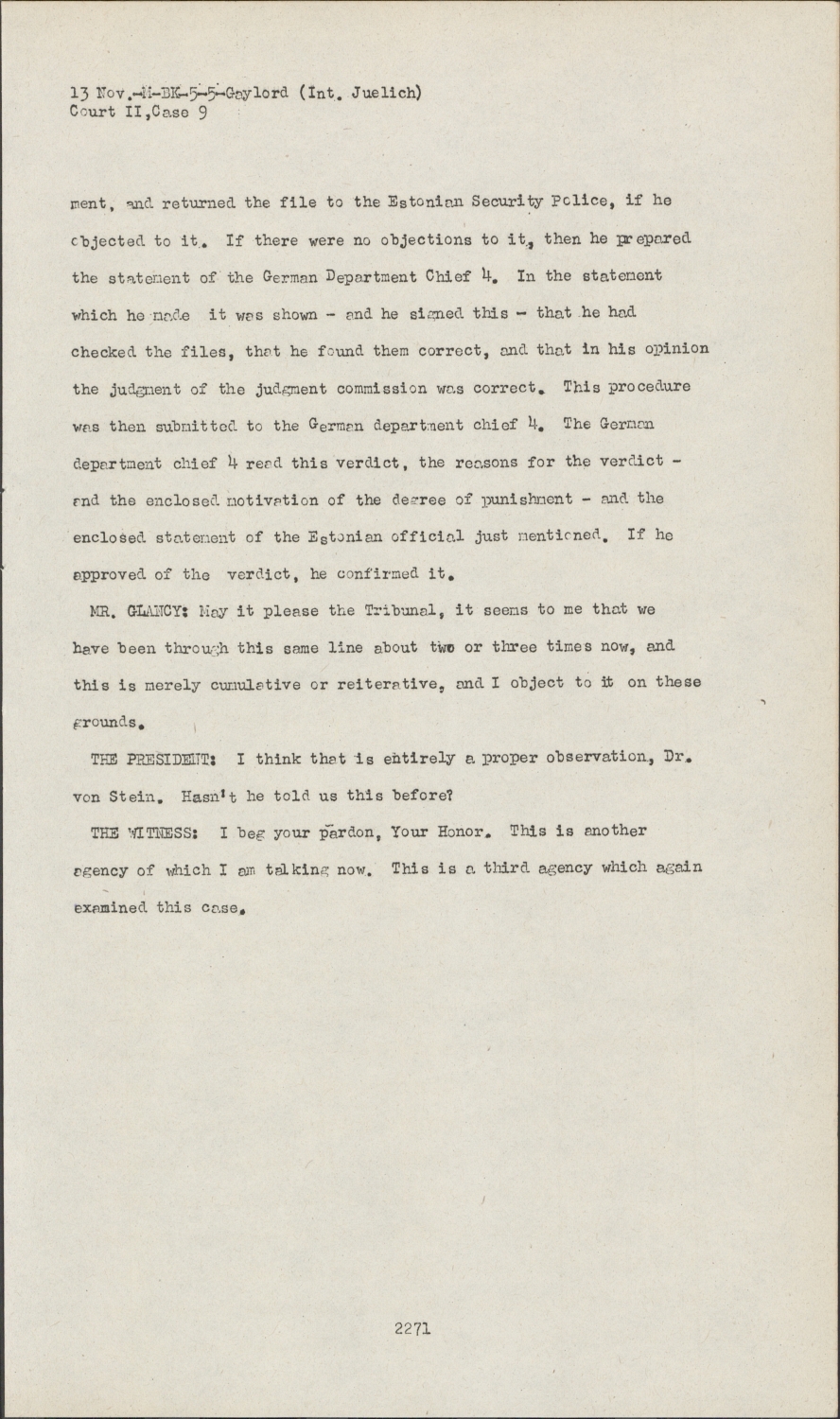
If there were no objections to it, then he prepared the statement of the German Department Chief 4. In the statement which he made it was shown - and he signed this -- that he had checked the files, that he found them correct, and that in his opinion the judgment of the judgment commission was correct. This procedure was then submitted to the German department chief 4. The German department chief 4 read this verdict, the reasons for the verdict and the enclosed motivation of the degree of punishment - and the enclosed statement of the Estonian official just mentioned. If he approved of the verdict, he confirmed it.
MR. GLANCY:May it please the Tribunal, it seems to me that we have been through this same line about two or three times now, and this is merely cumulative or reiterative, and I object to it on these grounds.
THE PRESIDENT:I think that is entirely a proper observation, Dr. von Stein. Hasn't he told us this before?
THE WITNESS:I beg your pardon, Your Honor. This is another agency of which I am talking now. This is a third agency which again examined this case.
BY THE PRESIDENT:
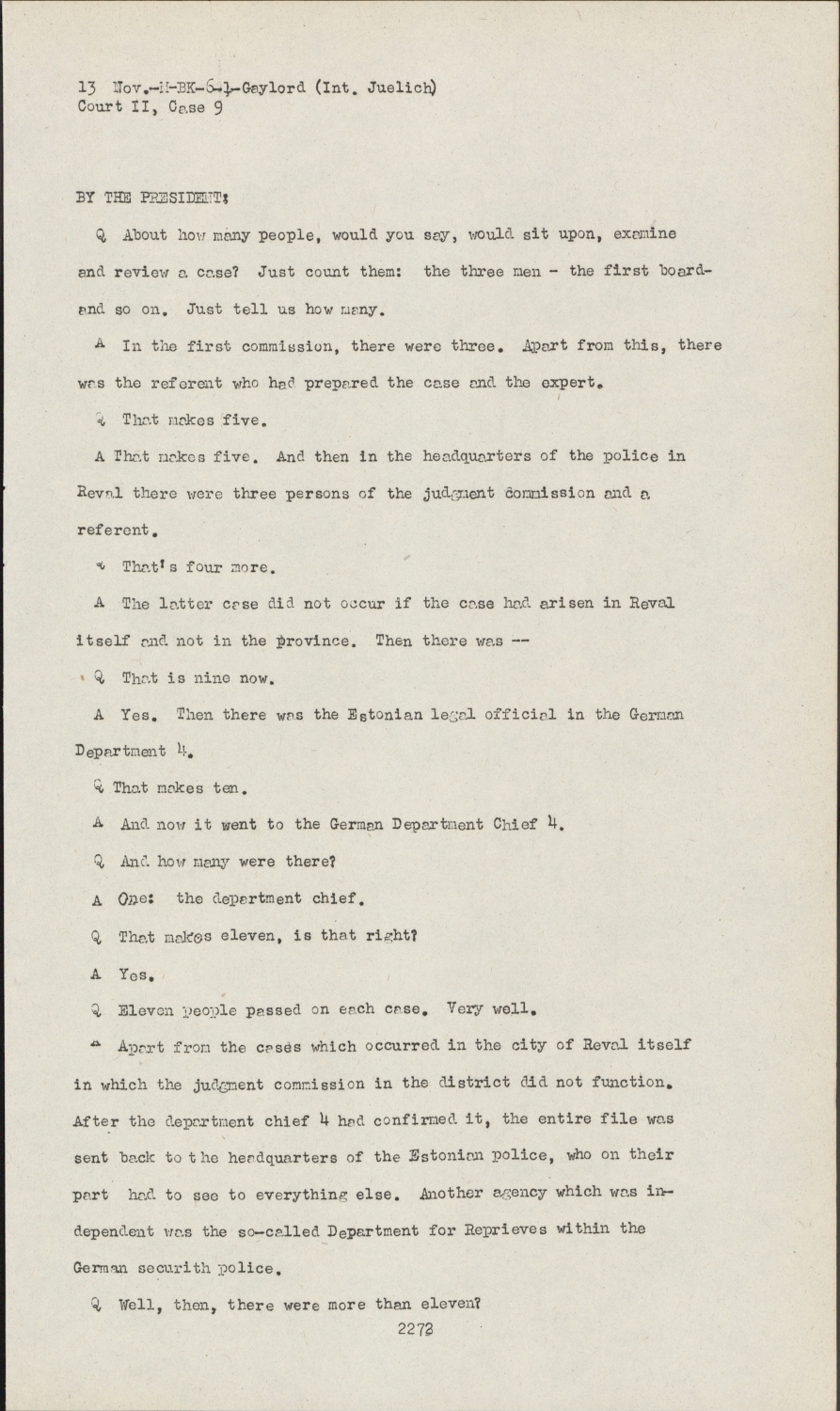
QAbout how many people, would you say, would sit upon, examine and review a case? Just count them: the three men - the first boardand so on. Just tell us how many.
AIn the first commission, there were three. Apart from this, there was the referent who had prepared the case and the expert.
QThat makes five.
AThat makes five. And then in the headquarters of the police in Reval there were three persons of the judgment commission and a referent.
QThat's four more.
AThe latter case did not occur if the case had arisen in Reval itself and not in the province. Then there was -
QThat is nine now.
AYes. Then there was the Estonian legal official in the German Department 4.
QThat makes ten.
AAnd now it went to the German Department Chief 4.
QAnd how many were there?
AOne: the department chief.
QThat makes eleven, is that right?
AYes.
QEleven people passed on each case. Very well.
AApart from the cases which occurred in the city of Reval itself in which the judgment commission in the district did not function. After the department chief 4 had confirmed it, the entire file was sent back to the headquarters of the Estonian police, who on their part had to see to everything else. Another agency which was independent was the so-called Department for Reprieves within the German securith police.
QWell, then, there were more than eleven?
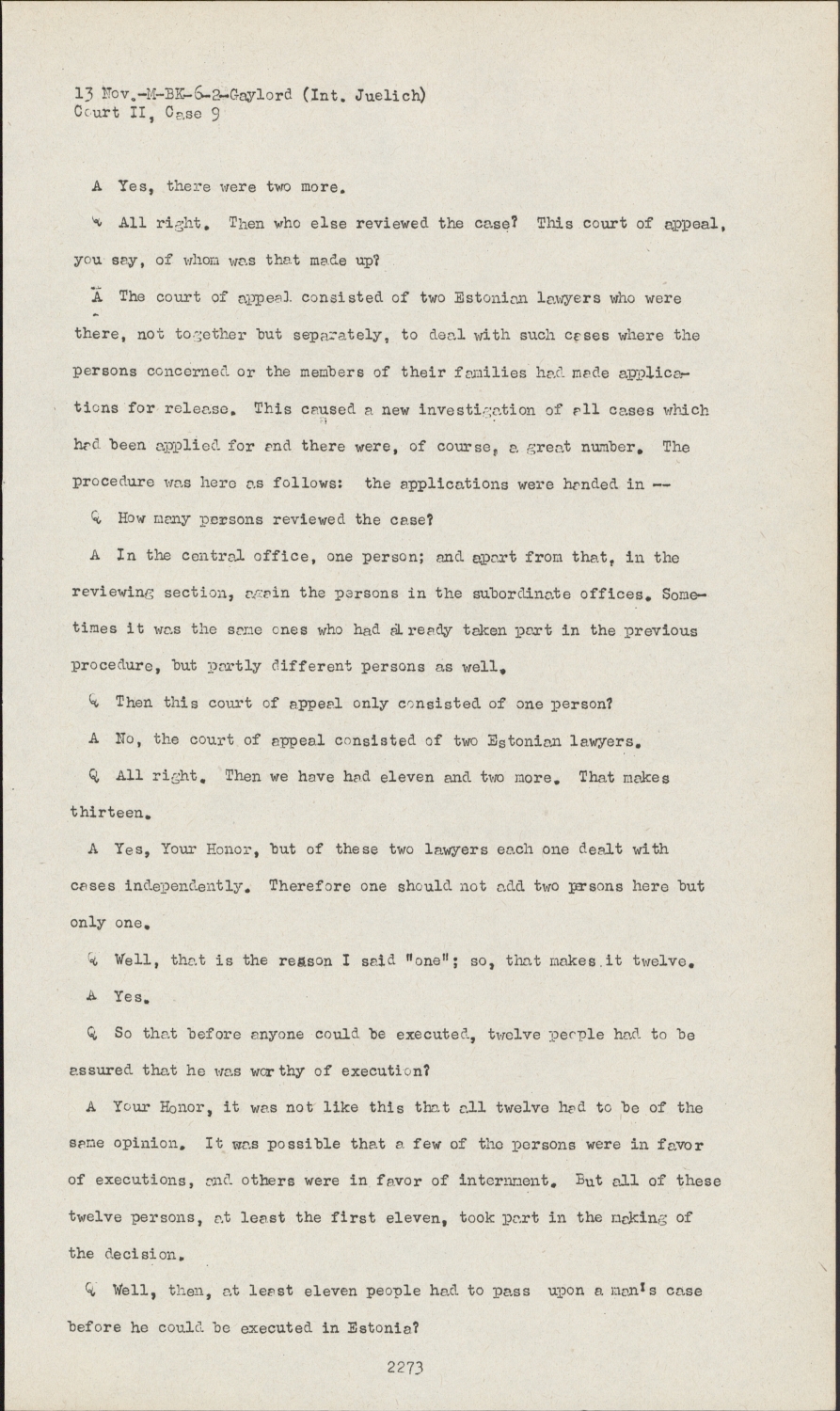
AYes, there were two more.
QAll right. Then who else reviewed the case? This court of appeal, you say, of whom was that made up?
AThe court of appeal consisted of two Estonian lawyers who were there, not together but separately, to deal with such cases where the persons concerned or the members of their families had made applications for release. This caused a new investigation of all cases which had been applied for and there were, of course, a great number. The procedure was here as follows: the applications were handed in -
QHow many persons reviewed the case?
AIn the central office, one person; and apart from that, in the reviewing section, again the persons in the subordinate offices. Sometimes it was the same ones who had already taken part in the previous procedure, but partly different persons as well.
QThen this court of appeal only consisted of one person?
ANo, the court of appeal consisted of two Estonian lawyers.
QAll right. Then we have had eleven and two more. That makes thirteen.
AYes, Your Honor, but of these two lawyers each one dealt with cases independently. Therefore one should not add two persons here but only one.
QWell, that is the reason I said "one"; so, that makes it twelve.
AYes.
QSo that before anyone could be executed, twelve people had to be assured that he was worthy of execution?
AYour Honor, it was not like this that all twelve had to be of the same opinion. It was possible that a few of the persons were in favor of executions, and others were in favor of internment. But all of these twelve persons, at least the first eleven, took part in the making of the decision.
QWell, then, at least eleven people had to pass upon a man's case before he could be executed in Estonia?
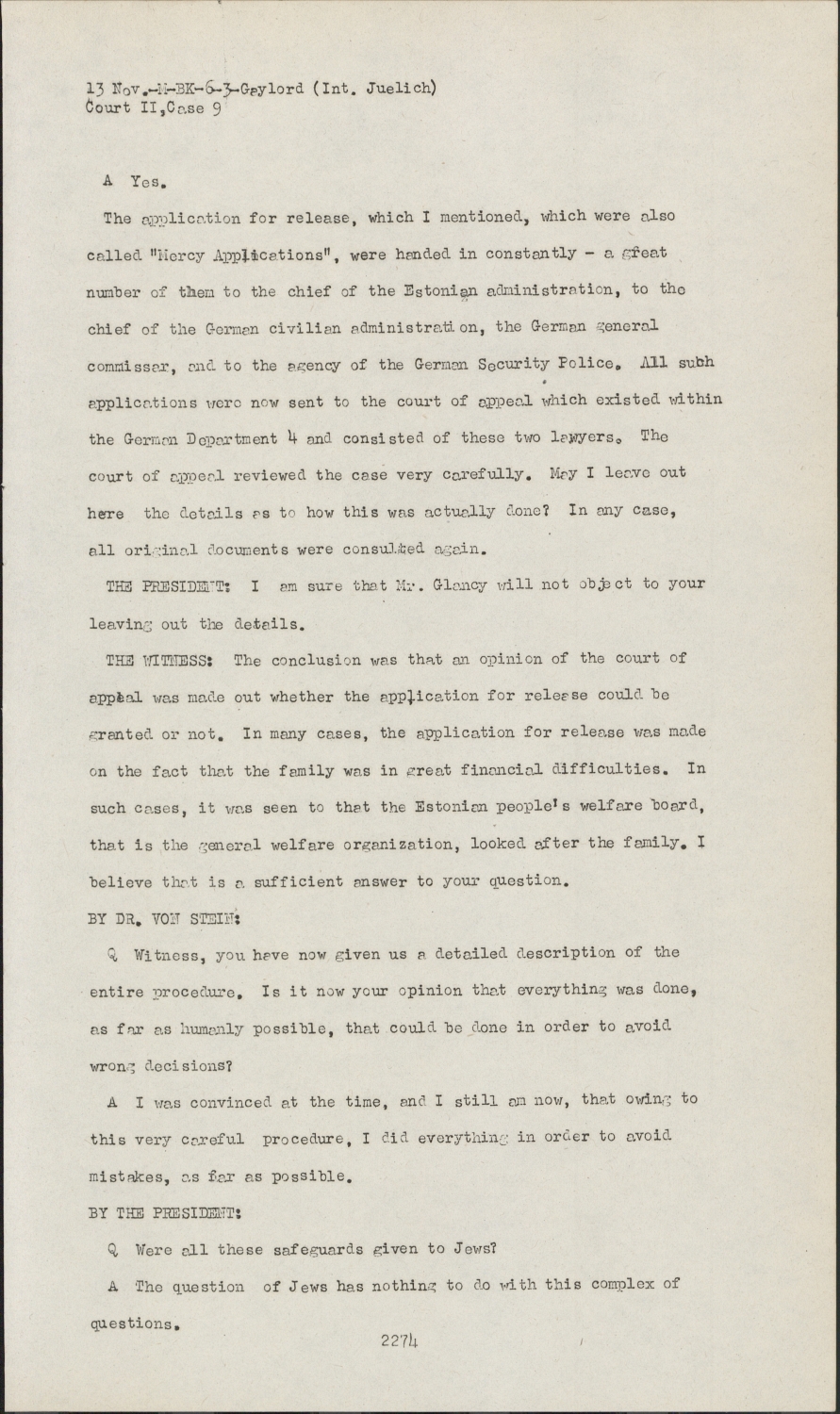
AYes.
The application for release, which I mentioned, which were also called "Mercy Applications", were handed in constantly - a great number of then to the chief of the Estonian administration, to the chief of the German civilian administration, the German general commissar, and to the agency of the German Security Police. All such applications were now sent to the court of appeal which existed within the German Department 4 and consisted of these two lawyers. The court of appeal reviewed the case very carefully. May I leave out here the details as to how this was actually done? In any case, all original documents were consulted again.
THE PRESIDENT:I am sure that Mr. Glancy will not object to your leaving out the details.
THE WITNESS:The conclusion was that an opinion of the court of appeal was made out whether the application for release could be granted or not. In many cases, the application for release was made on the fact that the family was in great financial difficulties. In such cases, it was seen to that the Estonian people's welfare board, that is the general welfare organization, looked after the family. I believe that is a sufficient answer to your question. BY DR. VON STEIN:
QWitness, you have now given us a detailed description of the entire procedure. Is it now your opinion that everything was done, as far as humanly possible, that could be done in order to avoid wrong decisions?
AI was convinced at the time, and I still am now, that owing to this very careful procedure, I did everything in order to avoid mistakes, as far as possible. BY THE PRESIDENT:
QWere all these safeguards given to Jews?
AThe question of Jews has nothing to do with this complex of questions.
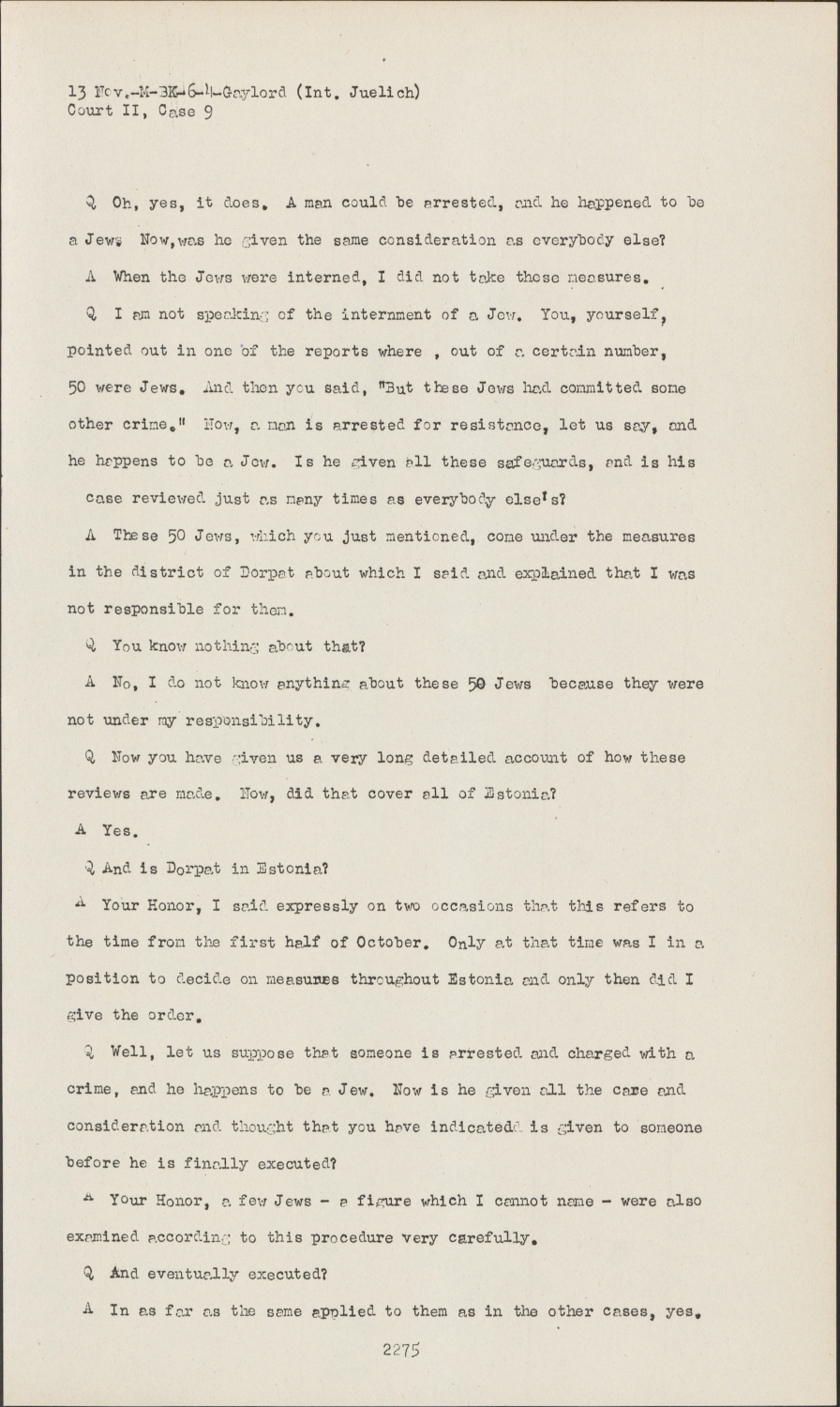
QOh, yes, it does. A man could be arrested, and he happened to be a Jews Now,was he given the same consideration as everybody else?
AWhen the Jews were interned, I did not take these measures.
QI am not speaking of the internment of a Jew. You, yourself, pointed out in one of the reports where , out of a certain number, 50 were Jews. And then you said, "But these Jews had committed some other crime." Now, a man is arrested for resistance, let us say, and he happens to be a Jew. Is he given all these safeguards, and is his case reviewed just as many times as everybody else's?
AThese 50 Jews, which you just mentioned, come under the measures in the district of Dorpat about which I said and explained that I was not responsible for them.
QYou know nothing about that?
ANo, I do not know anything about these 50 Jews because they were not under my responsibility.
QNow you have given us a very long detailed account of how these reviews are made. Now, did that cover all of Estonia?
AYes.
QAnd is Dorpat in Estonia?
AYour Honor, I said expressly on two occasions that this refers to the time from the first half of October. Only at that time was I in a position to decide on measures throughout Estonia and only then did I give the order.
QWell, let us suppose that someone is arrested and charged with a crime, and he happens to be a Jew. Now is he given all the care and consideration and thought that you have indicated is given to someone before he is finally executed?
AYour Honor, a few Jews - a figure which I cannot name - were also examined according to this procedure very carefully.
QAnd eventually executed?
AIn as far as the same applied to them as in the other cases, yes.
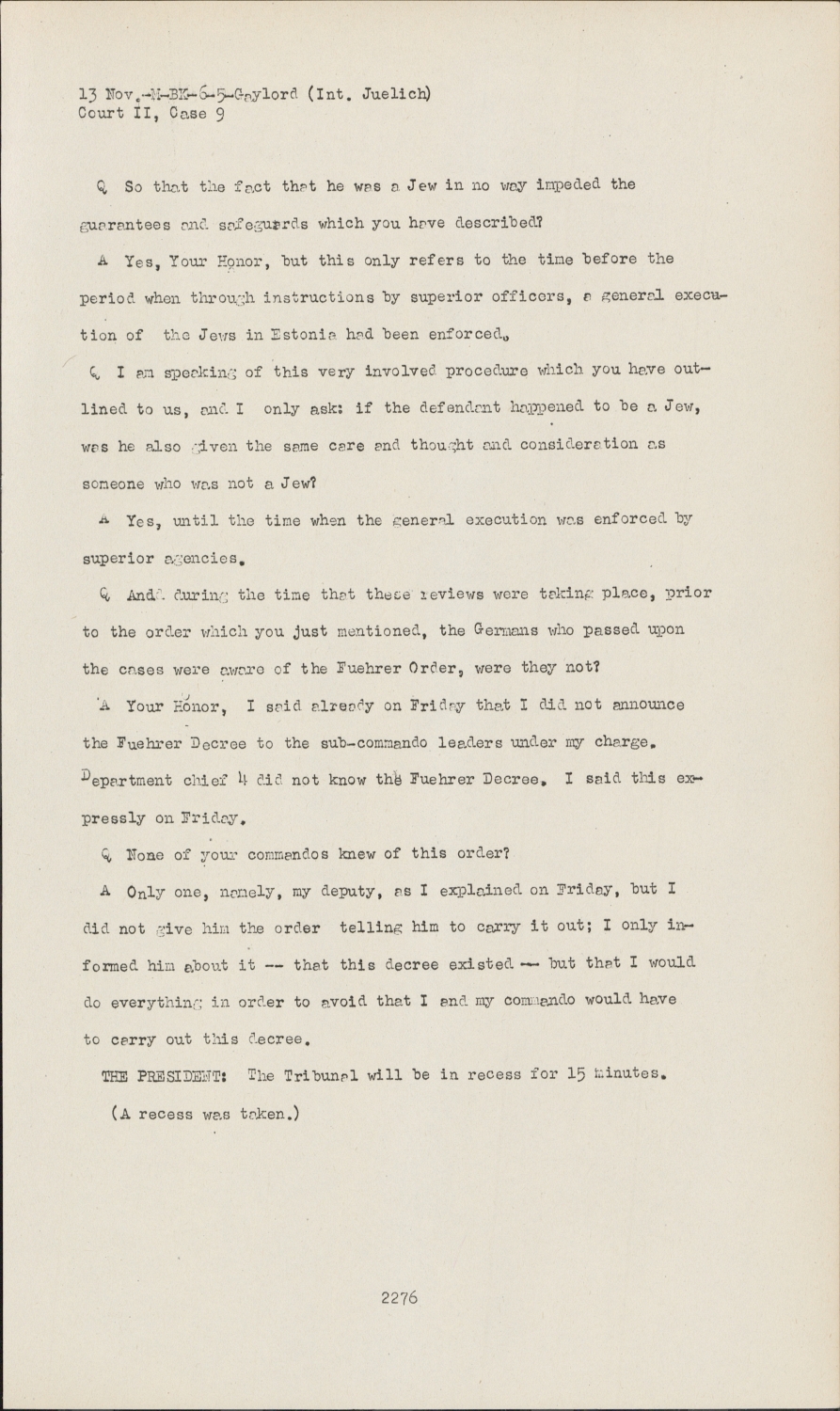
QSo that the fact that he was a Jew in no way impeded the guarantees and safeguards which you have described?
AYes, Your Honor, but this only refers to the time before the period when through instructions by superior officers, a general execution of the Jews in Estonia had been enforced.
QI am speaking of this very involved procedure which you have outlined to us, and I only ask: if the defendant happened to be a Jew, was he also given the same care and thought and consideration as someone who was not a Jew?
AYes, until the time when the general execution was enforced by superior agencies.
QAnd during the time that these reviews were taking place, prior to the order which you just mentioned, the Germans who passed upon the cases were aware of the Fuehrer Order, were they not?
AYour Honor, I said already on Friday that I did not announce the Fuehrer Decree to the sub-commando leaders under my charge. Department chief 4 did not know the Fuehrer Decree. I said this expressly on Friday.
QNone of your commandos knew of this order?
AOnly one, namely, my deputy, as I explained on Friday, but I did not give him the order telling him to carry it out; I only informed him about it -- that this decree existed -- but that I would do everything in order to avoid that I and my commando would have to carry out this decree.
THE PRESIDENT:The Tribunal will be in recess for 15 minutes.
(A recess was taken.)
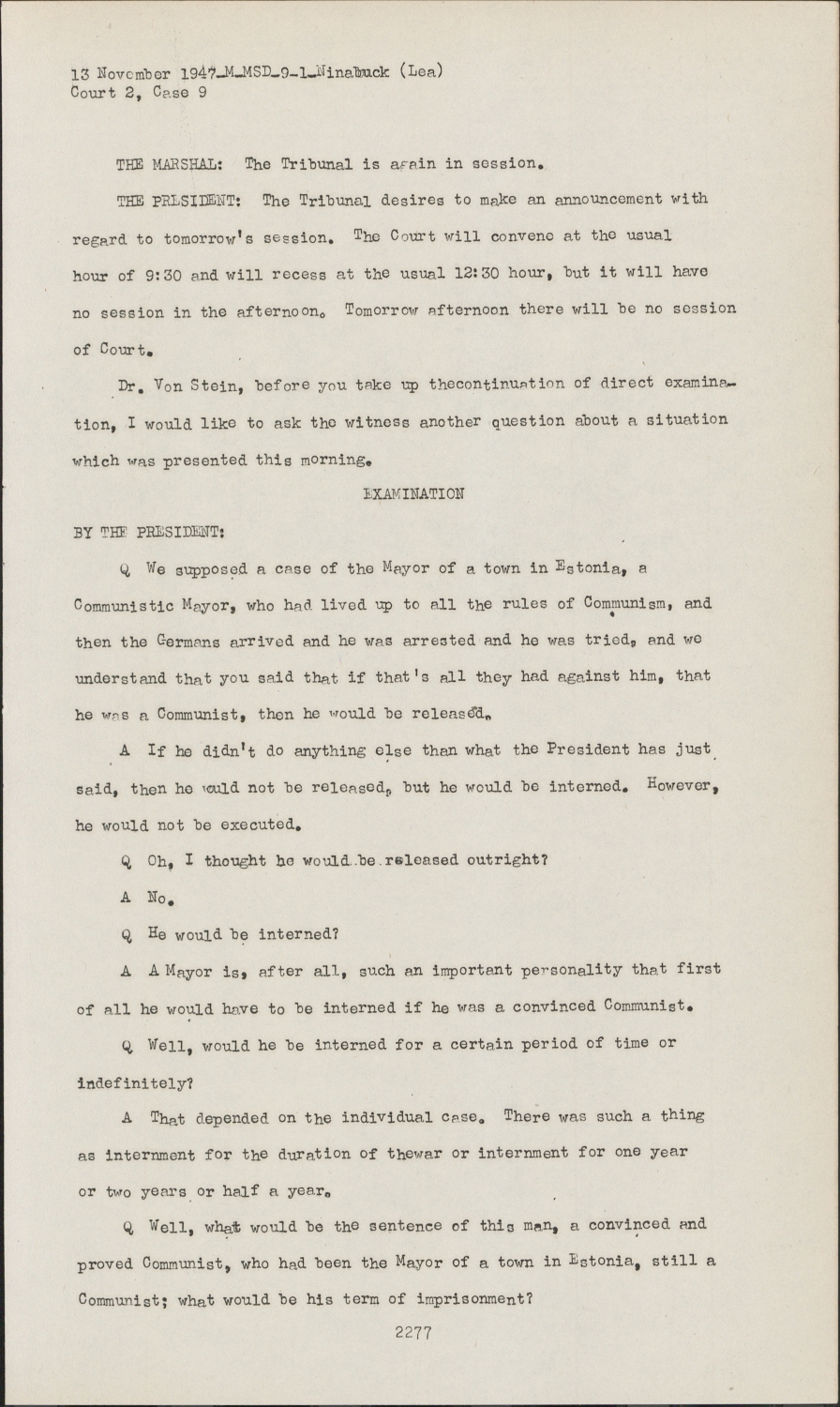
13 November 1947_M_MSD_9_1_Ninabuck (Lea)
THE MARSHAL:The Tribunal is again in session.
THE PRESIDENT:The Tribunal desires to make an announcement with regard to tomorrow's session. The Court will convene at the usual hour of 9:30 and will recess at the usual 12:30 hour, but it will have no session in the afternoon. Tomorrow afternoon there will be no session of Court.
Dr. Von Stein, before you take up thecontinuation of direct examination, I would like to ask the witness another question about a situation which was presented this morning.
EXAMINATION BY THE PRESIDENT:
QWe supposed a case of the Mayor of a town in Estonia, a Communistic Mayor, who had lived up to all the rules of Communism, and then the Germans arrived and he was arrested and he was tried, and we understand that you said that if that's all they had against him, that he was a Communist, then he would be released.
AIf he didn't do anything else than what the President has just said, then he would not be released, but he would be interned. However, he would not be executed.
QOh, I thought he would be released outright?
ANo.
QHe would be interned?
A AMayor is, after all, such an important personality that first of all he would have to be interned if he was a convinced Communist.
QWell, would he be interned for a certain period of time or indefinitely?
AThat depended on the individual case. There was such a thing as internment for the duration of thewar or internment for one year or two years or half a year.
QWell, what would be the sentence of this man, a convinced and proved Communist, who had been the Mayor of a town in Estonia, still a Communist; what would be his term of imprisonment?
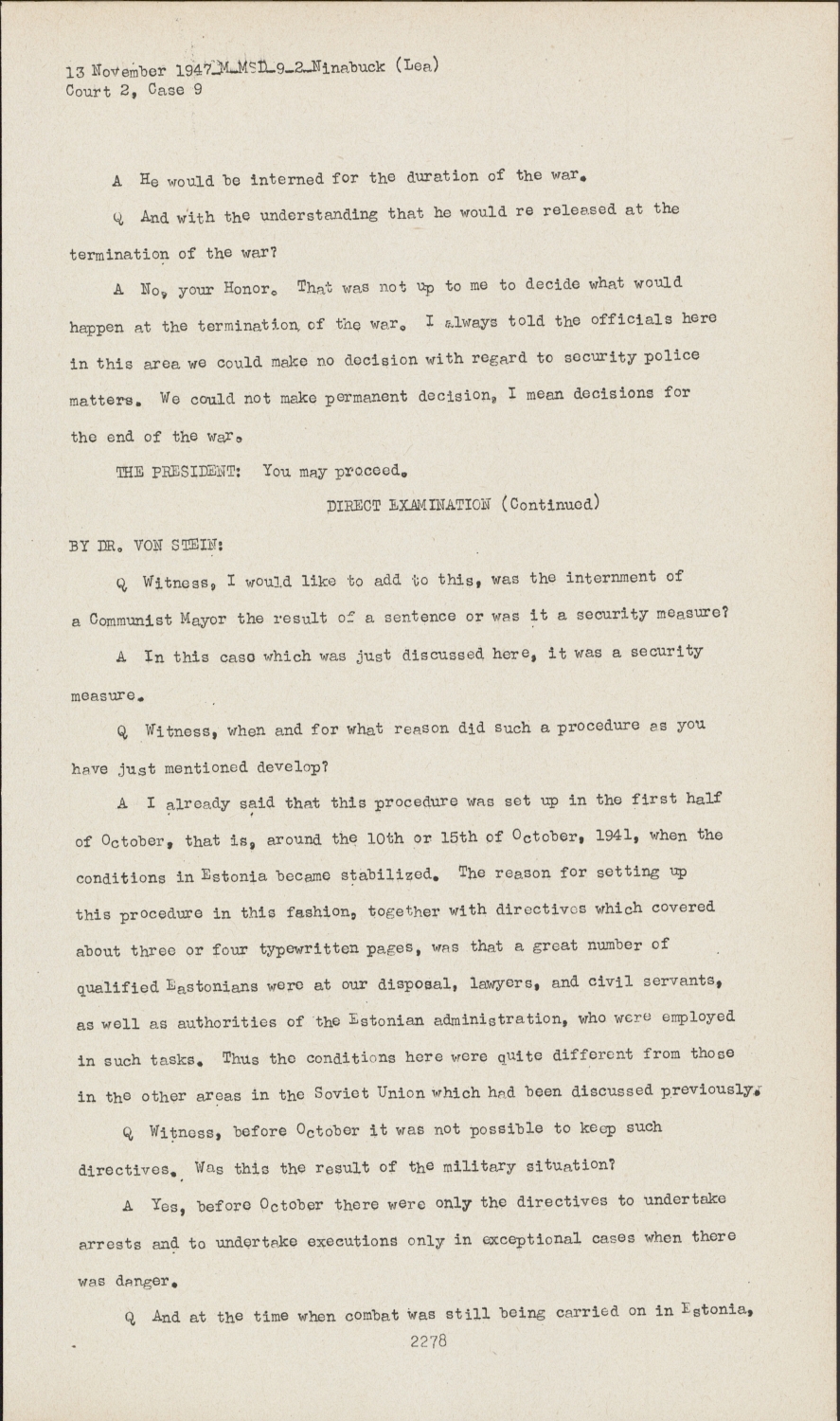
13 November 1947_M_MSD_9_2_Ninabuck (Lea)
AHe would be interned for the duration of the war.
QAnd with the understanding that he would re released at the termination of the war?
ANo, your Honor. That was not up to me to decide what would happen at the termination of the war. I always told the officials here in this area we could make no decision with regard to security police matters. We could not make permanent decision. I mean decisions for the end of the war.
THE PRESIDENT:You may proceed.
DIRECT EXAMINATION (Continued) BY DR. VON STEIN:
QWitness, I would like to add to this, was the internment of a Communist Mayor the result of a sentence or was it a security measure?
AIn this case which was just discussed here, it was a security measure.
QWitness, when and for what reason did such a procedure as you have just mentioned develop?
AI already said that this procedure was set up in the first half of October, that is, around the 10th or 15th of October, 1941, when the conditions in Estonia became stabilized. The reason for setting up this procedure in this fashion, together with directives which covered about three or four typewritten pages, was that a great number of qualified Estonians were at our disposal, lawyers, and civil servants, as well as authorities of the Estonian administration, who were employed in such tasks. Thus the conditions here were quite different from those in the other areas in the Soviet Union which had been discussed previously.
QWitness, before October it was not possible to keep such directives. Was this the result of the military situation?
AYes, before October there were only the directives to undertake arrests and to undertake executions only in exceptional cases when there was danger.
QAnd at the time when combat was still being carried on in Estonia, 13 November 1947_M_MSD_9_3_Ninabuck (Lea) was it impossible to maintain such directives?
ANo, at that time there was no independent Estonian administration in this form.
QYou spoke of thespecial objectivity of this procedure. Was the task of these police authorities limited only to finding out what was of disadvantage for the individual concerned?
ANo, not at all. It was the express duty of these police authorities to investigate everything objectively and thoroughly, even that which was favorable to the indicted man, and to bring all proof which the man who was charged was requesting. That was what was writeen in those directives and it was repeated by me orally during general conferences of Estonian policemen and during individual conversations which I had with Estonian police officials.
QDid you yourself make judgments in individual cases?
AThree times I had the chief of Department 4 submit to me his documents, and in these three cases I made the final decision which otherwise, according to the directives, was the job of the chief of Department 4.
QHow many individual cases were concerned here?
AThere were about 25 persons involved in these three cases. Among them were six death sentences.
QWhat kinds of cases were these in which the death sentences were imposed?
AThese were clear cases of espionage within this repeatedly mentioned Communist underground movement, and of volunteer functionaries of the NKWD in which cases it was clearly proven that they were a constant danger to security for the German Army, and that furthermore they had participated in a responsible manner in killing Estonian citizens on the part of the NKWD in which cases these killings, in the opinion of the Estonians, had happened without any crime.
EXAMINATION BY THE PRESIDENT:
13 November 1947_M_MSD_9_4_Ninabuck (Lea)
QWitness, now if these six people had killed Estonians and these Estonians had committed no crime, that was out end out murder so now why are you taking up the time of the Tribunal telling us that you reviewed their cases and showed that they had been resisting and that they were a threat to German security and so on? That was just a case of murder, wasn't it?
AYour Honor, these cases were investigated in this manner.....
QWell now, please tell me, had these men committed murder?
ASome of these six cases yes.
QHow many?
AI cannot remember today how many of these six cases were espionage cases.....
QNow, you sentence six men to death and you don't recall what you sentence them to death for?
AYes.
QYou don't recall? Do you or do you not recall why you sentenced them to death?
AI do not remember every case of the six cases.
QYou do remember these six cases?
ATogether, yes, but not the individual case.
QNo, Very well, yesterday you told us in the most painstaking detail what you did when you were in Pleskau. You went there, all the people you saw, whom you talked with, where those places were located, that you went to the river and washed yourself and shaved yourself, and gave us all those details on an inconsequential business as you tried to make us believe it was. Yet you do not recall why you sent sixpeople to their death; is that right?
AYour honor, yesterday you asked me what I did in Pleskau.
QAnd you toldme in great detail, didn't you?
AYes.
QNow I ask you why you sent six men to their death and you cannot even recall what it was about, much less the detail?
AYour Honor, I said I can remember that these were cases first of espionage....
QNow, you tell me in each case -- there were six of them -- one by one why you sent these people to their death. Number 1.
AI cannot do that.
QNumber 2.
AI cannot do it.
QNumber 3.
AI cannot do it in every -
QNumber 4. You cannot tell us why you sent these six people to their death?
AI can say that these six people were sentenced because of espionage and because they were functionaries of the NKWD, but I cannot say how many of these six were spies and how many were functionaries of the NKWD.
QSo the reason they were executed is because they were functionaries and members of the NKWD?
AAnd furthermore because as I have already said, they participated in killing of Estonians.
QNow, how many of these six participated in killing of Estonians?
AYour Honor, I cannot remember this.
THE PRESIDENT:You may proceed, In Von Stein, DIRECT EXAMINATION (Continued) BY DR. von STEIN:
QWhen these cases were submitted to you do you know of any incorrect statements or forgery in them?
ADuring my entire period of service in Estonia forgeries never become known to me.
QWas a forgery theoretically possible?
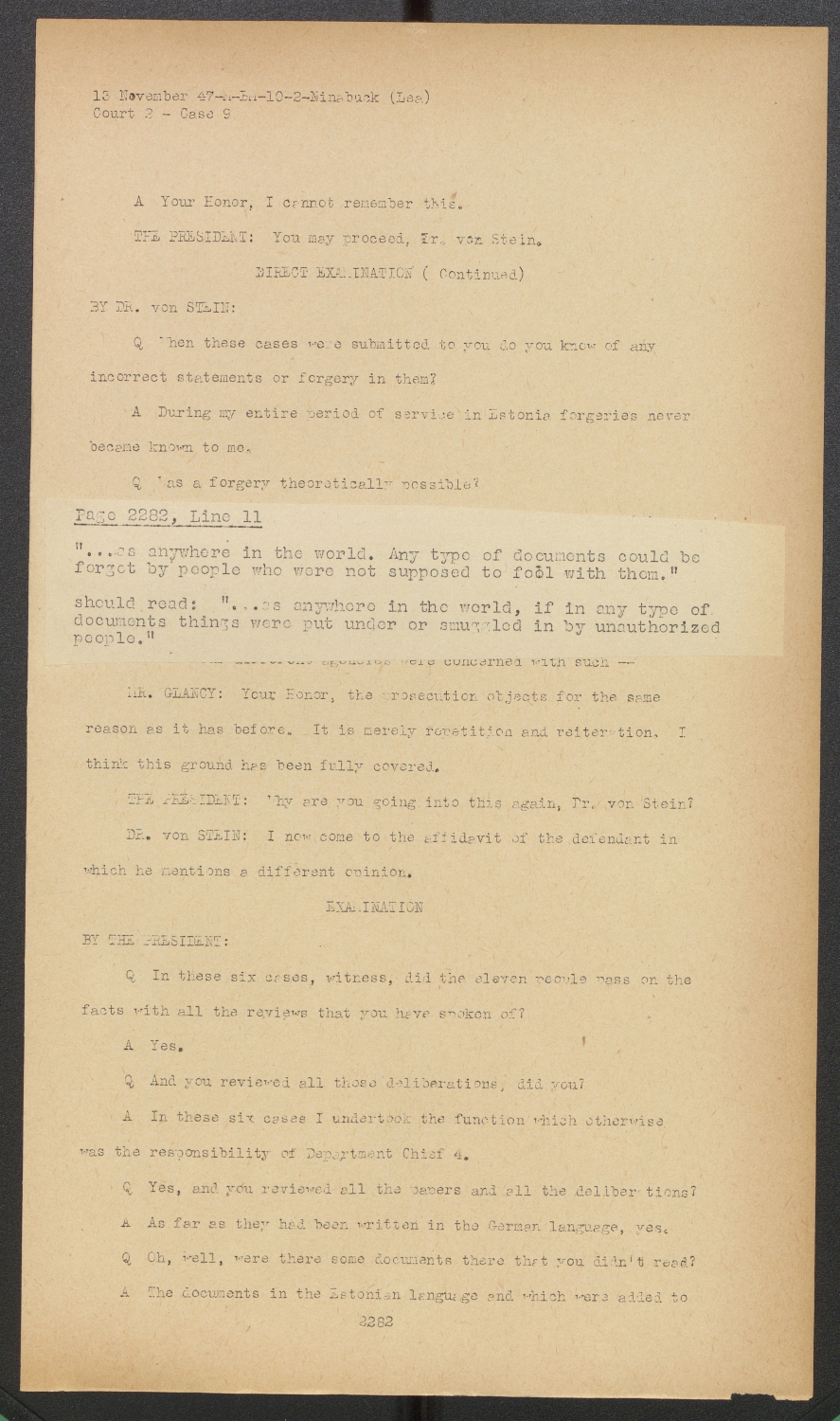
AThey were theoretically possible to the same extent and in the same manner as anywhere in the world. Any type of documents could be forged by people who were not supposed to fool with them. Practically it was the way I have explained it, that ten to eleven Estonian officials in three to four different agencies were concerned with such -
MR. GLANCY:Your Honor, the prosecution objects for the same reason as it has before. It is merely repetition and reiteration. I think this ground has been fully covered.
THE PRESIDENT:Why are you going into this again, Dr. von Stein?
DR. von STEIN: I now come to the affidavit of the defendant in which he mentions a different opinion.
EXAMINATION BY THE PRESIDENT:
QIn these six cases, witness, All the eleven people pass on the facts with all the reviews that you have spoken of?
AYes.
QAnd you reviewed all those deliberations, did you?
AIn these six cases I understood the function which otherwise was the responsibility of Department Chief 4.
QYes, and you reviewed all the papers and all the deliberations?
AAs far as they had been written in the German language, yes.
QOh, well, were there some documents there that you didn't read?
AThe documents in the Estonian language and which were added to this, these documents I did not read because I do not know the Estonian language.